Arabic Example Sentence From Test Set
(ARABIC)
twSy Al- ljnp Al- sAdsp Al- jmEyp Al- EAmp b- AEtmAd m$rwE Al- mqrr Al- tAly :
(PHR.-BRACKETED AR.)
[twSy] [Al- ljnp Al- sAdsp] [Al- jmEyp Al- EAmp] [b- AEtmAd m$rwE Al- mqrr Al- tAly] [:]
(AN ENG. GLOSS)
[recommends] [the committee the sixth] [the assembly the general] [to adoption draft the decision the following] [:]
(ENG. MT OUTPUT)
[the sixth committee] [recommends] [the general assembly] [in the adoption of the following draft resolution] [:]
[image:3.612.68.557.73.148.2]
(REFERENCE TRANS.)
the sixth committee recommends to the general assembly the adoption of the following draft decision :
Table 1: An Arabic translation from the test set. We revisit portions of this example throughout the text. All Arabic
strings in this paper are rendered in the reversible Buckwalter transliteration. In addition, all words or symbols referring
to Arabic and French in this paper are italicized.
figures and tables are from the actual Arabic and French
trained systems.
Arabic Phrase
Aligned English
Prob.
Sequence
Phrase Sequence
VP
1
NP
2
NP
3
NP
2
VP
1
NP
3
0.23
VP
1
NP
2
NP
3
VP
1
NP
2
PP
3
0.10
[image:3.612.73.212.239.284.2]
VP
1
NP
2
NP
3
NP
3
VP
1
,
2
0.06
Table 3: Top learned sentence-level reorderings for
Ara-bic, for canonical Arabic simple sentence structure VP
(verb) NP (subject) NP (object). Subscripts in English
phrase sequence are alignments to positions in the
corre-sponding Arabic phrase sequence.
4.2
Phrase Translation
Given an Arabic test sentence, a distribution of aligned
English phrase sequences is proposed by the
sentence-level model described in the previous section and in
Ta-ble 2. Each proposed English phrase in each of the phrase
sequence possibilities, therefore, comes to the middle
level of the translation model with access to the identity
of the French phrases aligned to it. Phrase translation is
implemented as shown in Table 4. The phrase
transla-tion model is structured with several levels of backoff: if
no observations exist from training data for a particular
level, the model backs off to the next-more-general level.
In all cases, generation of an English phrase is
condi-tioned on the foreign phrase as well as the type
(NP, VP, etc.) of the English phrase.
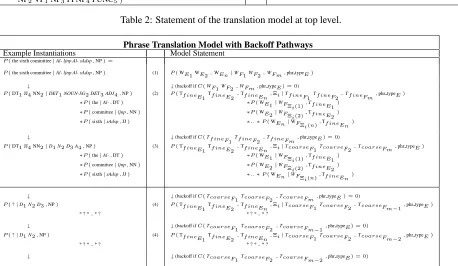
Table 4 (1) describes the initial phrase translation
model. It comes into play if the precise sequence of
foreign words has been observed aligning to an
En-glish phrase of the appropriate type. In the example,
we are trying to generate an NP given the Arabic word
string “Al- ljnp Al- sAdsp” (literally: “the committee the
sixth”). If this has been observed in data, then that
rela-tive frequency distribution serves as the translation
prob-ability distribution. Table 11 contains examples of some
of these literal phrase translations from the French data.
The next stage of backoff from the above, literal level
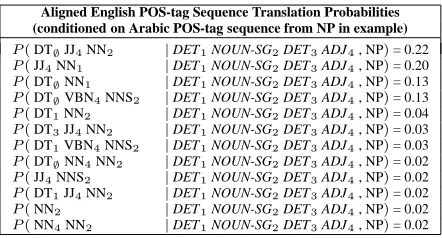
is a model that generates aligned English POS tag
se-quences given foreign POS tag sese-quences: details and
an example can be found in Table 4(2). The sequence
alignments determine the position in English phrase and
the part-of-speech into which we translate the foreign
word. Again, translation is also conditioned on the
En-glish phrase type. Table 5 and Table 6 show the most
probable aligned English sequence generations for two
of the phrases in the example sentence.
If there were no counts for (foreign-POS-sequence,
english-phrase-type) then we back off to counts
collected over (foreign-coarse-POS-sequence,
english-phrase-type), where a coarse POS is, for example, N
in-stead of NOUN-SG. This is shown in Table 4(3).
In case further backoff is needed, as shown in Table
4(4), we begin stripping POS-tags off the “less
signifi-cant” (non-head) end of the foreign POS-sequence until
we are left with a phrase sequence that has been seen in
training, and from this a corresponding English phrase
distribution is observable. We define the “less
signifi-cant” end of a phrase to be the end if it is head-initial,
or the beginning if it is head-final, and at this point
ig-nore issues such as nested structure in French and Arabic
NP’s.
Aligned English POS-tag Sequence Translation Probabilities
(conditioned on Arabic POS-tag sequence from NP in example)
P
(
DT
∅
JJ
4
NN
2
|
DET
1
NOUN-SG
2
DET
3
ADJ
4
, NP
)
= 0.22
P
(
JJ
4
NN
1
|
DET
1
NOUN-SG
2
DET
3
ADJ
4
, NP
)
= 0.20
P
(
DT
∅
NN
1
|
DET
1
NOUN-SG
2
DET
3
ADJ
4
, NP
)
= 0.13
P
(
DT
∅
VBN
4
NNS
2
|
DET
1
NOUN-SG
2
DET
3
ADJ
4
, NP
)
= 0.13
P
(
DT
1
NN
2
|
DET
1
NOUN-SG
2
DET
3
ADJ
4
, NP
)
= 0.04
P
(
DT
3
JJ
4
NN
2
|
DET
1
NOUN-SG
2
DET
3
ADJ
4
, NP
)
= 0.03
P
(
DT
1
VBN
4
NNS
2
|
DET
1
NOUN-SG
2
DET
3
ADJ
4
, NP
)
= 0.03
P
(
DT
∅
NN
4
NN
2
|
DET
1
NOUN-SG
2
DET
3
ADJ
4
, NP
)
= 0.02
P
(
JJ
4
NNS
2
|
DET
1
NOUN-SG
2
DET
3
ADJ
4
, NP
)
= 0.02
P
(
DT
1
JJ
4
NN
2
|
DET
1
NOUN-SG
2
DET
3
ADJ
4
, NP
)
= 0.02
P
(
NN
2
|
DET
1
NOUN-SG
2
DET
3
ADJ
4
, NP
)
= 0.02
P
(
NN
4
NN
2
|
DET
1
NOUN-SG
2
DET
3
ADJ
4
, NP
)
= 0.02
Table 5: From the running Arabic example, top English
NP generations given an Arabic phrase DET NOUN-SG
DET ADJ. Note:
∅
denotes a null alignment (generation
from null). Generation from a null alignment is allowed
for specified parts of speech, such as determiners and
prepositions.
4.3
Lexical Transfer
4.3.1
The Basic Model
[image:3.612.315.536.426.545.2]
Top-level Definition of Translation Model
Example Instantiation of Model Variables
Model Description
P
(
the sixth committee recommends the general assembly ..
|
P
(
english words
|
foreign words
) =
twSy Al- ljnp Al- sAdsp Al- jmEyp Al- EAmp ..
) =
P
(
[twSy]
V P
1
[Al- ljnp Al- sAdsp]
N P
1
[Al- jmEyp Al- EAmp]
N P
2
..
|
(1)
P
(
foreign bracketing , foreign phrase sequence
|
foreign words
)
twSy Al- ljnp Al- sAdsp Al- jmEyp Al- EAmp ..
)
∗
P
(
NP
2
VP
1
NP
3
PPNP
4
PUNC
5
|
(2)
P
(
english phrase sequence , phrase alignment matrix
|
VP
1
NP
2
NP
3
PPNP
4
PUNC
5
)
foreign phrase sequence
)
∗
P
(
[the sixth committee]
N P
2
[recommends]
V P
1
(3)
P
(
english words , english bracketing , english phrase sequence
|
[the general assembly]
N P
3
..
|
foreign words , foreign bracketing , foreign phrase sequence ,
[twSy]
V P
1
[Al- ljnp Al- sAdsp]
N P
1
[Al- jmEyp Al- EAmp]
N P
2
.. ,
english phrase sequence , phrase alignment matrix
)
[image:4.612.88.562.70.199.2]
NP
2
VP
1
NP
3
PPNP
4
PUNC
5
)
Table 2: Statement of the translation model at top level.
.
Phrase Translation Model with Backoff Pathways
Example Instantiations
Model Statement
P
(
the sixth committee
|
Al- ljnp Al- sAdsp , NP
) =
P
(
the sixth committee
|
Al- ljnp Al- sAdsp , NP
)
(1)
P
(
W
E
1
W
E
2
.. W
En
|
W
F
1
W
F
2
.. W
Fm
, phr type
E
)
↓
↓
(backoff if
C
(
W
F
1
W
F
2
.. W
Fm
, phr type
E
) = 0)
P
(
DT
1
JJ
4
NN
2
|
DET
1
NOUN-SG
2
DET
3
ADJ
4
, NP
)
(2)
P
(
T
f ineE
1
T
f ineE
2
.. T
f ineEn
,
Ξ
i
|
T
f ineF
1
T
f ineF
2
.. T
f ineFm
, phr type
E
)
.
∗
P
(
the
|
Al- , DT
)
.
∗
P
(
W
E
1
|
W
F
Ξ
i
(1)
, T
f ineE
1
)
.
∗
P
(
committee
|
ljnp , NN
)
.
∗
P
(
W
E
2
|
W
F
Ξ
i
(2)
, T
f ineE
2
)
.
∗
P
(
sixth
|
sAdsp , JJ
)
.
∗
..
∗
P
(
W
En
|
W
F
Ξ
i
(
n
)
, T
f ineEn
)
↓
↓
(backoff if
C
(
T
f ineF
1
T
f ineF
2
.. T
f ineFm
, phr type
E
) = 0)
P
(
DT
1
JJ
4
NN
2
|
D
1
N
2
D
3
A
4
, NP
)
(3)
P
(
T
f ineE
1
T
f ineE
2
.. T
f ineEn
,
Ξ
i
|
T
coarseF
1
T
coarseF
2
.. T
coarseFm
, phr type
E
)
.
∗
P
(
the
|
Al- , DT
)
.
∗
P
(
W
E
1
|
W
F
Ξ
i
(1)
, T
f ineE
1
)
.
∗
P
(
committee
|
ljnp , NN
)
.
∗
P
(
W
E
2
|
W
F
Ξ
i
(2)
, T
f ineE
2
)
.
∗
P
(
sixth
|
sAdsp , JJ
)
.
∗
..
∗
P
(
W
En
|
W
F
Ξ
i
(
n
)
, T
f ineEn
)
↓
↓
(backoff if
C
(
T
coarseF
1
T
coarseF
2
.. T
coarseFm
, phr type
E
) = 0)
P
(
?
|
D
1
N
2
D
3
, NP
)
(4)
P
(
T
f ineE
1
T
f ineE
2
.. T
f ineEn
,
Ξ
i
|
T
coarseF
1
T
coarseF
2
.. T
coarseF
m
−
1
, phr type
E
)
.
* ? * .. * ?
.
* ? * .. * ?
↓
↓
(backoff if
C
(
T
coarseF
1
T
coarseF
2
.. T
coarseF
m
−
1
, phr type
E
) = 0)
P
(
?
|
D
1
N
2
, NP
)
(4)
P
(
T
f ineE
1
T
f ineE
2
.. T
f ineEn
,
Ξ
i
|
T
coarseF
1
T
coarseF
2
.. T
coarseF
m
−
2
, phr type
E
)
.
* ? * .. * ?
.
* ? * .. * ?
↓
↓
(backoff if
C
(
T
coarseF
1
T
coarseF
2
.. T
coarseF
m
−
2
, phr type
E
) = 0)
[image:4.612.75.533.194.460.2]
....
....
Table 4: The phrase translation model, with backoff. Examples on the left side are from one of the Arabic test
sentences. (1) is the direct, lexical translation level. (2) - (4) constitute the backoff path to handle detailed phenomena
unseen in the training set. (2) is a model of fine POS-tag reordering and lexical generation; (3) is similar, but conditions
generation on coarse tag sequences in the foreign language. (4) is a model for progressively stripping off
POS-tags from the “less significant” end of a foreign sequence. The idea is to do this until we reach a subsequence that has
been seen in training data, and which we therefore have a distribution of valid generatons for. The term
Ξ
i
in (2) - (4)
is a position alignment matrix. At all times, we generate not just an English POS-tag sequence, but rather an aligned
sequence. Similarly, in the lexical transfer probabilities shown in this table, there is a function
Ξ
i
()
which takes an
English sequence position index and returns the (unique) foreign word position to which it is aligned
4
.
Aligned English POS-tag Sequence Translation Probabilities
(conditioned on Arabic POS-tag sequence from VP in example)
P
(
VBZ
1
|
VERB-IMP
1
, VP
)
= .28
P
(
VBP
1
|
VERB-IMP
1
, VP
)
= .17
P
(
VBD
1
|
VERB-IMP
1
, VP
)
= .09
...
P
(
MD
∅
VB
1
|
VERB-IMP
1
, VP
)
= .06
Table 6: From the Arabic example, top English VP
gen-erations given an Arabic phrase VERB-IMP.
is done in the context that the model has already
pro-posed a sequence of POS tags for the phrase. Thus we
know the English POS of the word we are trying to
gen-erate in addition to the foreign word that is generating it.
Consequently, we condition translation on English POS
as well as the foreign word. Table 7 describes the backoff
path for basic lexical transfer and presents a motivating
example in the French word droit. Translation
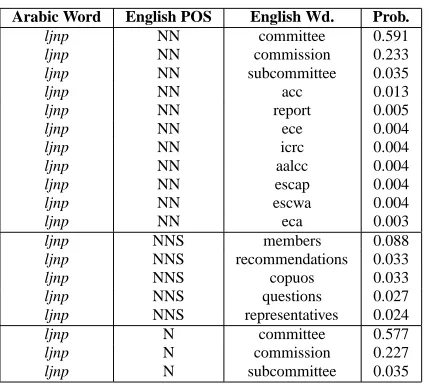
probabili-ties for one of the words in the example Arabic sentence
can be found in Table 8.
4.3.2
Generation via a Lemma Model
[image:4.612.74.277.588.649.2]
lemma-Word Generation
Examples
Model with Backoff Pathways
P
(
W
E
|
droit , NNS
)
P
(
W
E
|
W
F
, T
f ineE
)
rights
0.4389
p
(
rights
|
droit , NNS
)
benefits
0.0690
people
0.0533
laws
0.0188
↓
(backoff if
C
(
W
F
, T
f ineE
) = 0
)
P
(
W
E
|
droit , N
)
P
(
W
E
|
W
F
,
T
coarseE
)
right
0.4970
law
0.1318
rights
0.0424
p
(
rights
|
droit , N
)
property
0.0115
↓
(backoff if
C
(
W
F
,
T
coarseE
) = 0
)
P
(
W
E
|
droit
)
P
(
W
E
|
W
F
)
right
0.2919
entitled
0.0663
law
0.0652
the
0.0249
to
0.0240
rights
0.0210
p
(
rights
|
droit
)
↓
(backoff if
C
(
W
F
) = 0
)
[image:5.612.72.302.70.259.2]
p
(
UNKNOWN WORD
|
W
F
) = 1
Table 7: Description of the conditioning for different
lev-els of backoff in the lexical transfer model. The
exam-ple shows translations for the French word droit (“right”)
conditioned on decreasingly specific values. The
pro-gressively lower ranking of the correct translation as we
move from fine, to coarse, to no POS, illustrates the
ben-efit of conditioning generation on the English part of
speech.
Arabic Word
English POS
English Wd.
Prob.
ljnp
NN
committee
0.591
ljnp
NN
commission
0.233
ljnp
NN
subcommittee
0.035
ljnp
NN
acc
0.013
ljnp
NN
report
0.005
ljnp
NN
ece
0.004
ljnp
NN
icrc
0.004
ljnp
NN
aalcc
0.004
ljnp
NN
escap
0.004
ljnp
NN
escwa
0.004
ljnp
NN
eca
0.003
ljnp
NNS
members
0.088
ljnp
NNS
recommendations
0.033
ljnp
NNS
copuos
0.033
ljnp
NNS
questions
0.027
ljnp
NNS
representatives
0.024
ljnp
N
committee
0.577
ljnp
N
commission
0.227
ljnp
N
subcommittee
0.035
Table 8:
From running example, translation probabilities for Arabic
noun ljnp, “committee”.
based model for word translation. Under this model,
translation distributions are estimated by counting word
alignment links between foreign and English lemmas,
as-suming a lemmatization of both sides of the parallel
cor-pus as input. The form of the model is illustrated below:
P
(
W
E
|
W
F
,T
coarse
F
,T
f ine
E
) =
P
(
W
E
|
lemma
E
, T
coarse
F
, T
f ine
E
)
∗
P
(
lemma
E
|
lemma
F
, T
coarse
F
, T
f ine
E
)
∗
P
(
lemma
F
|
W
F
, T
coarse
F
, T
f ine
E
)
⇓
approximated by
P
(
W
E
|
lemma
E
, T
f ine
E
)
∗
P
(
lemma
E
|
lemma
F
, T
coarse
E
)
∗
P
(
lemma
F
|
W
F
, T
coarse
F
)
First, note that
P
(
lemma
F
|
W
F
, T
coarse
F
)
is very
simply a hard lemma assignment by the foreign
lan-guage lemmatizer.
Second, English word generation
from English lemma and coarse POS (
P
(
W
E
|
lemma
E
, T
f ine
E
)
) is programmatic, and can be handled by
means of rules in conjunction with a lookup table for
irregular forms. The only distribution here that must be
estimated from data is
P
(
lemma
E
|
lemma
F
, T
coarse
E
)
. This is done as described above. Furthermore, given
an electronic translation dictionary, even this distribution
can be pre-loaded: indeed, we expect this to be an
advantage of the lemma model, and an example of
a good opportunity for integrating compiled human
knowledge about language into an SMT system. Some
examples of the lemma model combating sparse data
problems inherent in the basic word-to-word models can
be found in Table 9.
4.3.3
Coercion
Lexical coercion is a phenomenon that sometimes occurs
when we condition translation of a foreign word on the
word and the English part-of-speech. We find that the
system we have described frequently learns this
behav-ior: specifically, the model learns in some cases how
to generate, for instance, a nominal form with similar
meaning from a French adjective, or an adjectival
real-ization of a French verb’s meaning; some examples of
this phenomenon are shown in Table 10. We find this
coercion effect to be of interest because it identifies
in-teresting associations of meaning. For example, in Table
10 “willing” and “ready” are both sensible ways to
re-alize the meaning of the action “to accept” in a passive,
descriptive mode. droit behaves similarly. Though the
English verb “to right’ or “to be righted” does not have
the philosophical/judicial entitlement sense of the noun
“right”, we see that the model has learned to realize the
meaning in an active, verbal form: e.g., VBG ‘receiving”
and VB “qualify”.
5
Decoding
[image:5.612.72.286.397.590.2]