Optimisation of the organisation
of the mass vaccination program
for nine-year-old school
children in Twente.
Anne Morssink (s1600486)
M.Sc. Thesis Health Sciences
13 July 2018
Supervisors:
General information
Author: A.J. Morssink
Student number: 1600486
Date of graduation: 13-07-2018
University of Twente
Faculty: Science and Technology Faculty (TNW)
Study direction: Health Sciences
Master track: Innovation in Public Health
Address: Drienerlolaan 5, 7522 NB Enschede
Supervisors
Supervision University of Twente:
First supervisor: Prof. dr. Ariana Need
List
of content
Acknowledgements ... 2
List of abbreviations ... 3
Dutch Abstract ... 4
English Abstract ... 5
1. Introduction ... 6
1.1. Background ... 6
1.2. Importance of the vaccination program ... 8
1.3. Organisation of the mass vaccination program ... 9
1.4. Research problem ... 9
1.5. Research questions ... 10
2. Theoretical framework ... 13
2.1. Vaccination hesitance ... 13
2.2. Organisation of mass vaccination program ... 13
3. Method ... 18
3.1. Research setting and strategy ... 18
3.2. Data-collection methods ... 19
3.3. Data-analysis methods ... 22
3.4. Ethical Approval ... 23
4. Result analysis ... 24
4.1. Result organisation current vaccination program in the Netherlands ... 24
4.2. Result mini-literature review ... 27
4.3. Result interviews with health care professionals ... 32
5. Discussion and conclusion ... 38
5.1. Conclusion results sub-questions ... 38
5.2. Answering the main research question ... 40
5.3. Explanation results and comparison with literature ... 40
5.4. Recommendations for an optimal organisation ... 43
5.5. Generalizability ... 44
5.6. Strengths and limitations of this research ... 45
5.7. Short conclusion ... 45
References ... 46
Appendix I: Infographic effects of the NIP in the Netherlands ... 55
Appendix II: Overview used literature found in mini-literature review. ... 56
Appendix III: Informed consent ... 62
Appendix IV: Interview protocol GGD employees ... 63
Appendix V: Interview protocol GP... 75
Acknowledgements
In front of you lies a half year of hard work. With this master thesis I end an era of my life as a student.
This research is conducted to complete my master program Health Sciences at the University of Twente
with innovation in public health as focus.
First, I would like to thank my supervisors of the University of Twente, Ariana Need and Pieter-Jan
Klok for their guidance and time throughout this trajectory. I learned a lot from their feedback during
our meetings, to improve the quality of my work. The pleasant cooperation with them resulted in this
thesis.
I also would like to thank the healthcare professionals for their effort, time and participation in my study.
Without them this research could not been executed. Finally, I would like to thank my family and friends
for their needed mental support finishing my master thesis.
Anne Morssink
List of abbreviations
DPT Diphtheria, Pertussis, Tetanus
GGD Public Health services of municipalities
GP General Practitioner
MMR Measles, Mumps and Rubella
NIP National immunisation program
Dutch Abstract
Achtergrond: Vaccineren is een van de meest levensreddende en kosteneffectieve interventies ter bescherming van de gezondheid. Een hoge vaccinatiegraad bij kinderen zorgt ervoor dat complicaties
en mogelijke vroege sterfte zoveel mogelijk worden voorkomen, om de gezondheid van niet alleen de individuele maar ook de ‘herd immunity’ te beschermen. In Nederland wordt op de leeftijd van negen
jaar de tweede dosis van de BMR en de derde dosis van de DTP-vaccins gegeven door middel van
massavaccinatie. Er zijn een aantal onderzoeken uitgevoerd naar de factoren, die verband houden met
de individuele besluitvorming, maar toch is er een verschil in de vaccinatiegraden van de zuigelingen
en peuters en de schoolkinderen. Dezelfde trend is ook zichtbaar in Twente. Het grootste verschil tussen
het vaccinatieprogramma van kinderen, leeftijdscategorie 0-4, en het vaccinatieprogramma van de
9-jarige is het ontwerp van de organisatie.
Doel: Het doel van deze studie is om aanbevelingen te doen aan de GGD om de organisatorische deel van vaccinatieprogramma voor negenjarigen te verbeteren om de vaccinatiegraad voor deze groep te
verhogen.
Methode: Een verkennend onderzoek werd uitgevoerd bestaande uit een documentanalyse, mini-literatuur review en een kwalitatief onderzoek. In de documentanalyse wordt mini-literatuur uit verschillende
bronnen samengevoegd om te onderzoeken hoe de huidige vaccinatieprogramma wordt georganiseerd
in Nederland. De mini-literatuur review is gedaan om de voor- en nadelen van de huidige
vaccinatieprogramma en welke aanbevelingen voor verbetering van de organisatie er zijn. Het
kwalitatieve onderzoek bestond uit interviews met beroepsbeoefenaren in de gezondheidszorg (N=6)
om hun mening te geven over de organisatie van het nationale immunisatieprogramma en aanbevelingen
voor verbetering.
Resultaten: Volgens de literatuur en de zorgprofessionals zijn tegenstrijdige prioriteiten, ervaringen en vergeetachtigheid de belangrijkste obstakels waarom ouders niet komen opdagen tijdens de massa
vaccinatie sessies. Een meer op maat gemaakte aanpak zou moeten helpen om de vaccinatiegraad te
verhogen.
Conclusie: Dit onderzoek biedt aanbevelingen aan de GGD om de massa vaccinatieprogramma te optimaliseren. Drie aanbevelingen op het gebied van implementatie wijzigingen worden aanbevolen.
Ten eerste, bied ouders mogelijkheden aan buiten de traditionele vaccinatie uren. Ten tweede, verander
de massa vaccinatiesessies in kleinere een-op-een vaccinatiesessies of op zijn minst kleinere massa
vaccinatiesessies op de locatie van de GGD. Ten derde, gebruik een goed herinneringssysteem om de
ouders te helpen herinneren aan de massa vaccinatiesessies. De uitkomsten van dit onderzoek vormen
de basis voor toekomstige studies om de vaccinatiegraad van negenjarige schoolkinderen in Nederland
English Abstract
Background: Immunisation is one of the most lifesaving and cost-effective health protection intervention. High immunisation rates among children ensure that complications and possible early
death as much as possible is prevented by reducing the spread of common childhood diseases to protect
the health of not only the individual but also the herd immunity. In the Netherlands, the second dose of
the MMR and third dose of the DTP vaccines are given at the age of nine in mass vaccination. A number
of studies have been carried out to research the factors related to the individual decision making. Still,
there is a difference among the vaccination rates from the infants and toddlers campaign. The same trend
of vaccination rates, lower for school children than for infants and toddlers, is also visible in Twente.
The biggest difference between the vaccination program of children, age category 0-4, and the
vaccination program of the nine-year old, is the design of the organisation.
Objective: The main objective of this study is to give recommendations to the GGD to optimise the organisational part of the vaccination program for nine-year olds with resulting in higher vaccination
rates.
Method: An exploratory study was carried out consisting of a document analysis, mini-literature review and qualitative research. Literature from various sources is combined in the document analysis to
investigate how the current vaccination program is being organised in the Netherlands. The
mini-literature review was done to determine the advantages and disadvantages of the current vaccination
program and which recommendations are given for improvement of the organisation. The qualitative
research consisted of interviews with healthcare professionals (N = 6) to give their opinion on the
organisation of the national immunisation program and recommendations for improvement.
Results: According to the literature and the healthcare professionals conflicting priorities, patient experience and forgetfulness are the most important barriers why parents do not show up at the mass
vaccination sessions. A more tailored approach should help to raise the vaccination rates.
Conclusion: This research provides recommendations for the GGD to optimise the mass vaccination program. Three implementation changes in terms of convenience are recommended. First provide
parents with options outside the traditional vaccination hours. Secondly, change the mass vaccination
sessions into smaller one to one vaccination sessions or at least smaller mass vaccination sessions given
at the location of the GGD. Thirdly, make use of a good recall/remind system to help remember the
parents of the mass vaccination sessions. The outcome of this research is the basis for future studies to
1. Introduction
1.1. Background
The Dutch National Immunisation Program (NIP) is a prevention program which started in 1957 (van
Lier A. , et al., 2012). The main aim of the NIP program is to prevent against infectious diseases,
complications and mortality by vaccination. This is done at two levels: first to provide individual
protection and secondly to provide herd immunity. Therefore, a high overall vaccination rate is required
to prevent epidemics and to protect the non-vaccinated children. The program exists of fourteen vaccines
against twelve deadly infectious diseases to ensure that children are protected against: diphtheria,
Haemophilus influenzae serotype b (Hib) disease, hepatitis B, human papilloma virus (HPV) infection,
measles, meningococcal disease, mumps, pertussis, pneumococcal disease, poliomyelitis, rubella and
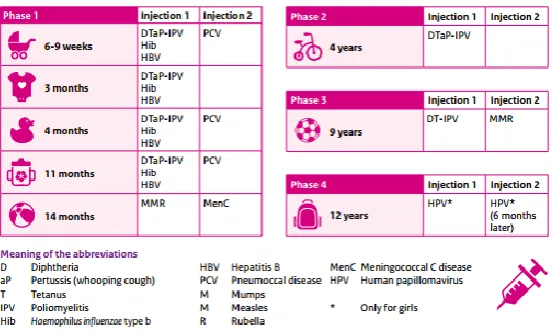
tetanus. The vaccination schedule as it is in 2018 can be seen in Figure 1. The vaccines are available for
[image:8.595.74.352.326.493.2]free and are not compulsory but recommended (RIVM, 2017).
Figure 1: Current vaccination schedule the Netherlands in 2018 (source: RIVM)
In the Netherlands, the ministry of Health, Welfare and Sport determines which vaccinations
are available in the national immunisation program (NIP) on advice of the Health Council. The national
management of the NIP is in the hands of the National Institute of Public Health and Environmental
(RIVM). The RIVM execute the supervision of the NIP on behalf of the Minister of Health, Welfare
and Sport and coordinate the regional implementation. How the NIP should be performed, is the
responsibility of the department Regional coordination of programs, storage and distribution. Five of
their managers organise the implementation of the NIP in their own region. The vaccinations are given
on a local level by Youth health care clinics. The evaluation and surveillance of the NIP is the
responsibility for the Epidemiology and Surveillance through research (van Lier A. , et al., 2012).
From all the infants, 91.2% of the children at the age of two received all NIP vaccinations
according to the schedule. This percentage dropped with a half percent for infants for the third year in a
92% in 2016 to 90.85% in 2017 (RIVM, 2017). The vaccination rates can be seen in Figure 2. In the
Netherlands the vaccination rates are still higher than the aim of 90% of Global Vaccine Action Plan
(GVAP). This action plan implies that nationwide the vaccination rate should reach at least 90% with a
minimum level of 80% coverage for all vaccines in the NIP in every county or municipality. However,
the percentages are lower than the 95% threshold of the World Health Organisation (WHO) (WHO,
2013). This threshold is held because this rate is needed to destroy diseases like measles and diphtheria
to ensure herd immunity (RIVM, 2017).
Only the vaccination rate of HPV is lower compared to the other vaccination rates of the NIP.
In this study the focus is on the vaccination program for infants and school children and not on the HPV
vaccination for 14-year old girls. There are two reasons for this. The first reason is that HPV vaccination
is much more recent, and the long-term effects are not known yet. Parents “want to learn more about this vaccine” (Brown et al., 2017, p.42). The second reason is that parents have other motives not to
vaccinate their child than for the earlier vaccines, for example their child is not sexually active, and
parents are afraid of the unknown side effects (Gilkey, et al., 2017) (Patty, et al., 2017).
[image:9.595.79.342.361.527.2]
Figure 2: Vaccination rates per vaccine per age category in report year 2017 (Source: RIVM)
The national registration system Praeventis
Since 2005 the national registration system Praeventis is connected to the Basic Registration Persons,
this forms the basis for the determination of the vaccination rates of the NIP. Within this system the
validity (correctness and punctuality) of vaccinations is assessed on individual level according to an
algorithm based on the annual report of the Centre of Infectious diseases. The executive youth health
organisations send the personalised cards back to the department Regional Coordination of
Programs/Purchase, Storage and Distribution by post. The managers enter the data in Preaventis.
Therefore, the system can precisely determine the vaccination rates on individual level. Data on the
1.2. Importance of the vaccination program
In the Netherlands the vaccinations are voluntary and that went well for a long time. Due to the fact that
the vaccination coverage is high, infectious diseases do not exist that often anymore in the Netherlands
and less children die because of that the need for vaccination seems to have disappeared (WHO, n.d.).
Recent outbreaks of the measles show otherwise, that vaccination is still needed.
The European Parliament worried about the fact that the vaccination rate is insufficient for
adequate protection in the European Union (EU). In the time period from 2008 till 2015, 215.000 cases
of diseases like measles could have been prevented by vaccination. (Europa Nu, 2018). Two till three
million deaths can be saved by using vaccination every year and another 1.5 million deaths can be
avoided if coverage is increased (Europa nu, 2018).
The number of outbreaks of the measles in the EU has tripled in 2017 compared to the numbers
in 2016. A total of 14.451 cases were reported including 50 death cases. Most patients are reported by
the countries: Romania. Italy, Greece and Germany. The vast majority of patients were not vaccinated.
In many EU countries, however, vaccination coverage is too low for parts of the population to eliminate
measles. In the Netherlands, sixteen cases of measles are reported in 2017. This number has doubled
since 2015 when eight cases were reported (RIVM, 2018).
Measles is one of the most contagious diseases that exist. The virus is transmitted through the
air, through coughing and sneezing. The disease lasts about seven till ten days. Sometimes complications
arise, e.g. ear infection, pneumonia, or brain inflammation, which can cause children to become disabled
or even die. Infection with the measles is only possible if you have not had measles before or you are
not vaccinated against measles (RIVM, 2018). Vaccination against measles has been added to NIP in
the Netherlands in 1976. In Appendix I, an infographic about the effects of the NIP in the Netherlands
is shown.
Outbreaks among unvaccinated individuals occurred every four to seven years from that year
on. A small outbreak of measles among anthroposophist’s occurred in 2008. The most recent large
outbreak occurred in the Bible belt in 1999-2000. During this large outbreak 3292 cases were reported,
150 people were hospitalized, and three people died of the consequences of the measles (Knoll, et al.,
2013). The last measles outbreak in the Netherlands was not that long ago, namely in 2013. This
outbreak occurred among the unvaccinated orthodox protestant population during a period of nine
months. During this epidemic, more than 2600 measles patients were officially reported, 182 children
were hospitalized, and one child died from complications of measles (Knoll, et al., 2013).
The fact that the vaccination rates drops is a reason to worry even at European level. Child
vaccination programmes are still important, because not only in the Netherlands the contagious diseases
1.3. Organisation of the mass vaccination program
Immunisation is one of the most lifesaving and cost-effective health protection intervention. High
immunisation rates among children ensure that complications and possible early deaths is prevented as
much as possible by reducing the spread of common childhood diseases to protect the health of not only
the individual but also the herd immunity (Keegan & Bilous, 2004) (NHS, 2014). In the Netherlands,
the second dose of the MMR and third dose of the DTP vaccines are given at the age of nine in mass
vaccination campaign.
Mass vaccination is being done to vaccinate many individuals in a fast and effective way to
prevent outbreaks. Together with routine immunisation, mass vaccination is necessary to achieve both
national and international targets for the control of the vaccine avoidable diseases (Plotkin, 2006). The
implementation of mass vaccination programs requires complex planning and coordination by
experienced immunisation staff together with locally trained support staff in order to achieve high levels
of vaccine coverage in the shortest length of time (Grabenstein & Nevin, 2006).
Current mass vaccination programs should be often evaluated and monitored to find
opportunities to improve the organisation (Grabenstein & Nevin, 2006). In this time century, quality of
the program becomes more and more important, because parents have more knowledge and are more
inquisitive about the safety of the vaccines than years ago. Healthcare employees must be able to answer
all types of questions about vaccination and offer support services which are crucial for the success of
the vaccination program. It provides information about the effects of traditional mass vaccination
programs to help educate the healthcare professionals and parents nowadays when hesitation about the
vaccines enlarges (Grabenstein & Nevin, 2006).
The organisation of the mass vaccination program must be well-organised, to provide parents
with the best service delivered to ensure that there are no practical barriers for refusing the recommended
vaccines. Despite great accomplishment, there are still many challenges regarding the ultimate efficacy
of vaccination programs. The determinants, who play a role in the organisation of the mass vaccination
program will be explained in chapter 2.
1.4. Research problem
A number of studies have been carried out to find out which barriers, like religion, fear of side effects
and safety of the vaccine, influences the individual decision making (Dubé, et al., 2013) (McKee &
Bohannon, 2016) (Harmsen, et al., 2013). These barriers should not make a difference in the two age
categories, but there is a difference among the vaccination rates from the infants and toddlers (full
immunisation vaccination rate of 91.2%) and the vaccination rates of the school children (average
vaccination of 90.5%). This can be seen in Figure 2. Assumed is that the organisation can be a reason
and the vaccination program of the nine-year old, is the design of the organisation. Children at the age
of nine do not go to the GGD for regular check-ups anymore, but the vaccinations are given in a central
location somewhere in their own city or village (RIVM, 2018). The organisation is not well researched
at the moment, that is why this research is focused on the organisational part of the vaccine program.
The same trend of vaccination rates, lower for school children than for infants and toddlers, is
also visible in Twente. The average vaccination for infant and toddlers in 2017 is 95.3% and the average
vaccination rate for school children in Twente in 2017 is 93.1%. In this study the focus is on Twente,
because the GGD Twente wants to find out which practical reasons cause the difference in vaccination
rate. Twente is a region in the eastern part of the Netherlands and exists of fourteen Overijssel
municipalities with in total 627.200 inhabitants in 2017 (TwenteKennispunt, 2016).
1.5. Research questions
The main objective of this study is to give recommendations to the GGD for optimising the organisation
of the mass vaccination program. These recommendations are made by doing literature research to find
out which organisational factors have influence on the vaccination rates of the mass vaccination program
and by interviewing healthcare professionals to see their point of view. To reach this objective the
following research question is formulated:
Research question
How can the organisation around the child vaccination program for nine-year old be optimised
according to the literature and the healthcare professionals in Twente?
Three sub-questions are formulated to help answering the research question. These questions aim to
highlight all aspects of the research question. The sub-questions that need to be answered are as follow:
Sub-questions
1. How is the vaccination program in the Netherlands currently organised?
2. A: What are the advantages and disadvantages regarding the current vaccination program
in the Netherlands according to the literature?
B: Which recommendations do literature give to improve the organisation of the vaccination
program in the Netherlands?
3. A: What are the advantages and disadvantages regarding the current vaccination program
in the Netherlands according to the healthcare professionals in Twente?
B: Which recommendations do healthcare professionals in Twente give to improve the
Societal relevance
The vaccines against various human infectious diseases reduced the harmful effects with in the end a
lower child mortality globally. Not only by doing research and the development of vaccines, also to
implement these vaccines into the public healthcare system worldwide (Rey-Jurado, et al., 2018). It is
still important to vaccinate, because there are no country boundaries for diseases like the measles and
pertussis. People go on holiday to for example to Italy and take the disease back with them to the
Netherlands. Favourable effects related to vaccination programs are not only related to the indirect
protective effect for the individual, which unvaccinated people could benefit from, but also with larger
social benefits in the form of higher productivity, better education and economic profit (Lopalco &
Santisteve, 2014) .
The proposed research is not only beneficial for the GGD Twente, but also beneficial for all
GGD organisations in the Netherlands, because this research gives them handles to improve the
organisation of the mass vaccination program and to know how healthcare professionals think about the
current situation and can do further research about the vaccination program to make an optimum
organisation in Twente with in the end a higher vaccination rate. A higher herd immunity means less
chance to get sick or spread the diseases. So, vaccinating not only affects the individual but also has an
advantage for society.
Scientific relevance
The vaccination program is accepted as a public health measure globally (Dubé, et al., 2013). Still
outbreaks occur in the developed world and these are assigned to under-vaccinated or non-vaccinated
communities (Falagas & Zarkadoulia, 2008). Besides this, research show that not only unvaccinated
communities refuse to vaccinate, also vaccinated individuals have doubts and concerns about the
vaccination program (Casiday, et al., 2006) (Burton-Jeangros, et al., 2005).
The choice to vaccinate their children depends on the parental view on the severity of the disease
and on the safety and effectiveness of the vaccine. When the vaccination rate is high, and the diseases
do no longer occur the need for vaccination decreases and parents believe that their child is not in danger
(Warrel, et al., 2012). The vaccination rate also declines, due to the fact that parents fear the safety of
the vaccines and their corresponding side effects. These beliefs can be a reflection of the fact that the
preventable diseases almost no longer occur and seem less important than the risk of vaccination
(Harmsen, et al., 2013).
Besides risk perception, religion and anthroposophical worldview are also factors why parents
refuse to vaccinate. In the so-called Bible Belt region in the Netherlands lives the highest concentration
of conservative protestants and the inhabitants are not vaccinated because of religious beliefs. For
orthodox protestant communities the most important reason not to vaccinate is to rely on God (Fournet,
fact that the vaccinations given, are combination vaccines and that these vaccines are in contrast with
their view that health is a balance between body, soul and spirit (Harmsen, et al., 2012).
Factors about the individual decision making whether or not to vaccinate are known, but the
role of the organisation is not. The differences between the vaccination rates of 0 till 4-years and school
children clearly show that organisational factors play a role and that therefore research is needed to
examine the link between the organisation and the vaccination rates of the nine-year old school children.
Literature research and interviewing the healthcare professionals gives a better look inside the
organisation of the vaccination program in Twente and their recommendations to uptake the vaccination
rate among school children in Twente.
Thesis outline
In the next chapter, chapter two, theory about the vaccination hesitancy of parents and how the
organisation is involved in the vaccination rates are described. In chapter three, the method how the
research was carried out, is explained. The results are presented in chapter four. Finally, there is a
discussion and conclusion in chapter five. In this chapter, the research results are explained more in
detail and are compared with the literature, just like the generalizability of the research, also the strengths
and limitations of this research are explained. Finally, some recommendations to improve the
2. Theoretical framework
In the first paragraph, vaccination hesitance is explained. After that, in the second paragraph, the
organisational impact on the vaccination rate is clarified more in depth. This is a general theoretical
framework and does not provide answers to sub-questions 2A and 2B.
2.1. Vaccination hesitance
To understand why parents, refuse or accept the vaccines, vaccination hesitancy is deeper explained.
Refusal against vaccination is not something new. It started in the early 1800s, when many citizens
criticise the use of the vaccine against smallpox, a deadly disease that plagued the human population for
an extended period of time (Dubé, et al., 2015).
Vaccination rate is the primary output indicator of the vaccination program and is measured in
percentages. Vaccination rate is important to the healthcare professionals, because it provides
information about how many persons are vaccinated and it provides information about the herd
immunity. This information is needed for the design and implementation of customised interventions,
i.e. particular age groups (Lopalco & Santisteve, 2014). Achieving and continuing of the high
vaccination rates should become priority for all healthcare systems. To monitor the development towards
this goal, vaccination rates can serve as an indicator of the ability of a health care system to provide
essential services to the most susceptible persons of the society (Bos & Batson, 2000).
A high vaccination rate depends not on one, but on multiple determinants. One determinant
becomes more and more important for the vaccination rate, namely the hesitation of the vaccine that
leads to delay or refusal of vaccinations (Eskola, et al., 2015). The hesitation of the vaccine is the
behaviour that results from the decision-making process and reflects to various factors that influences
the decision to vaccination according to the NIP (WHO, 2014).
Despite the fact that hesitation about vaccination has always existed, it is still important that
organisations of the NIP ensure that the vaccination rates are high among the inhabitants to guarantee
herd immunity.
2.2. Organisation of mass vaccination program
To uptake the vaccination rates among nine-year old school children the organisational factors are
explained. To increase and maintain the vaccination rates, a strong vaccine infrastructure is needed. Just
like transport infrastructure, which requires good road surfaces that are well-connected to each other to
make sure that people and products reach their destination. A well-designed vaccine infrastructure
depends also on vaccine storage and treatment procedures, confidence in the system that delivers
decide on the program and in the media, who write about the good and bad about vaccinations that must
work flawlessly together (Orsolini, 2018) (Larson, et al., 2011).
The organisational factors, that play a role in whether or not to vaccinate their child, are shown in
Figure 3, the context of eight core components of routine vaccination (Shen, et al., 2014). These can be
divided into the following eight organisational areas:
1. Policy, standards and guidelines
2. Governance, organisation and management
3. Human resources
4. Vaccine, cold chain and logistics management
5. Service delivery
6. Communication and community partnerships
7. Data generation and use
[image:16.595.72.307.342.541.2]8. Sustainable financing
Figure 3: The context of eight core components of routine vaccination (source: Shen, et al., 2014).
Policy, Standard, Guidelines
The national vaccination program guideline is mentioned in the Public Health Act. In the Netherlands
the guideline is adjusted where necessary and published every year. The 2018 version was drawn up by
the RIVM, under the direction of medical advisors with specialisation in the NIP. In this guideline the
framework of implementation of the NIP is mentioned even as the medical information. The GGD
Twente must also carry out the vaccination program according to this guideline (RIVM, 2018).
Governance, Organisation and Management
The minister of Health, Welfare and Sports determines the content of the NIP program in the
establishment of the NIP framework, implementation guidelines and standards; coordination of the NIP;
communication and monitoring end evaluation of the vaccination program; securing vaccine supply and
distribution; preparing materials and monitoring tools for training; organising immunisation campaigns;
disease surveillance and budget implementation. The NIP is performed by youth health care services,
that includes GGD Twente (RIVM, 2018) (Shen, et al., 2014).
Human Resource
The growing hesitance against the NIP increases the need for well-trained healthcare professionals.
Their technical skills about injections must be sufficient and their management and supervisory skills
are also becoming more and more important, because responsibilities towards financial and data
management increases (Shen, et al. 2014). Train and inform healthcare professionals how they must
respond to side effects. To improve knowledge about side effects, side effects must be reported to the
RIVM and local coordinator (Grabenstein & Nevin, 2006). Since healthcare professionals are one of the
largest influencing bodies in the decision of vaccinations, good knowledge about the vaccines are needed
to recommend the vaccinations and to handle the difficult conversation with the doubting parents
(Paterson, et al., 2016).
Vaccine, Cold Chain and Logistics Management
To ensure the optimal strength of vaccines, careful attention is required in all levels of cold chain
management. These includes storage and transport of the vaccines from producer to the local operator
(Kartogly & Milstien, 2014). Large amounts of vaccines must be linked to recording thermometers and
alarm systems (Grabenstein & Nevin, 2006). In case of the mass vaccination, barriers affecting the
supply and cold chain management are common. Vaccine shortages because of too small production of
the vaccinations sometimes occur (Esposito, et al. 2014). What also sometimes happened are incorrect
temperatures of the fridge at local storage. Right temperatures are important, because it can decline
vaccines potency and efficacy (Levinson, 2012). In the Netherlands the RIVM is responsible for the
vaccine distribution and cold chain to the local operator. The vaccines may only be used for the NIP and
remains property of the RIVM. The responsibility from delivery to the administration of the vaccines
are for the local operators. Vaccines must be stored and transported under controlled conditions and only
be administered if this is guaranteed (RIVM, 2018).
Quality, Reliable Service Delivery
For the mass vaccination quality, reliable service delivery is the most important factor, because parents
have to do more effort in terms of getting their child vaccinated than when their child was 0 till 4-years
old, because the design of the vaccination program is different. The design of the vaccination program
can influence the vaccination rates, which is the focus in this research. For mass vaccination, this means
2015). Not only must vaccinations be given in a proper and safe way, also access to the location of the
vaccination must be reachable for everybody. Access to the location of vaccination is an important
factor. Distance to the location is found to be one of the reasons for lower vaccination rates (Esposito,
et al, 2014).
Communication and Community Partnerships
Good information about the vaccination program must be available for everybody. Healthcare
professionals are still one of the most important sources of information about the NIP. Just knowing
information about the NIP is not enough for vaccination acceptance. Parents do not let their child
vaccinated if healthcare professionals do not know about the value of the vaccines, when children need
to be vaccinated and where the vaccines be given. Besides that, parents also do not vaccinate their
children if healthcare professionals do not trust the safety of the vaccines (Waisbord & Larson, 2005).
To inform the parents: why, where, when and how many times their children need vaccines, health care
professionals need the right training (Shen, et al., 2014). In the Netherlands information about the NIP
is available at the RIVM website. Negative publicity about the vaccination program and their safety is
written a lot in the media. Although many side effects have been contradicted by science, some parents
still believe that the MMR vaccine causes autism (Offit & Coffin, 2003)
Data Generation & Use
A lack of an information system to collect data about the vaccination status of the individual, who should
receive a vaccination, is a health system barrier and can influence the vaccination rate. The use of an
automated, population-based computer system to collect the data is essential for higher vaccination rates
(Kelly, et al., 2007). These systems not only provide clinical advice and vaccination rates reports, but
also help the inventory management of vaccines and recall messages. Unfortunately, these systems do
not exist yet, because they are not fully developed. (Esposito, et al, 2014).
Sustainable Financing
Vaccination programs can be a victim of its own success. When huge outbreaks of infectious diseases
do not occur anymore, and the vaccination rates are consistently high, the demand for vaccination can
decrease and policy-makers and decision-makers may focus on other interventions. Vaccine preventing
diseases can occur again and outbreaks return, causing a more financial burden to the government (Shen,
et al., 2014).
All elements together, make a good organisation to provide the best vaccination program to the
The three C´s model
Not all elements of the eight core elements of vaccination can declare the difference in design of the
vaccination program between the two age categories, the 0 till 4-years and the nine-year olds. In this
research, the focus will only be on quality of the service and service delivery, because the design of the
vaccination program is different. Therefore, quality of the service and service delivery factors could
potentially explain the difference between the two age categories. Quality of the service and service
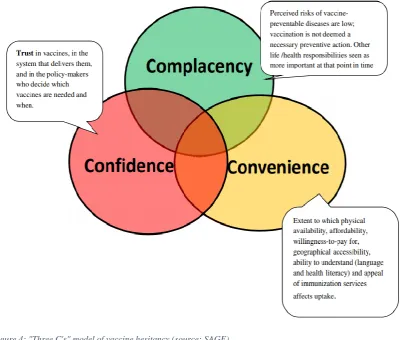
delivery at a time and place fits in the circle convenience in the “three Cs model of the SAGE working
group of the WHO”, see Figure 4. This model consists of three categories: complacency, confidence and
convenience (MacDonald, 2015). For this research only, convenience is taken as a factor, because this
is affected by the design of the vaccination program and the service provided. The decision to vaccinate
depends on the quality of the vaccination service provided at a certain time and place that are suitable
and comfortable for parents and their children and can be the deciding factor in making the choice to
vaccinate (WHO, 2013). To give recommendations in terms of convenience to improve the quality of
the service could result in higher vaccination rates for nine-year old school children. That is why this is
the only factor deeper explained in the analysis of this research.
[image:19.595.79.483.378.718.2]3. Method
To answer the research question and its related sub-questions, data on the organisation of the
child-vaccination program was collected. In this chapter, the research setting and strategy, data collection
methods, data analysis methods and ethical issues will be explained more in depth. This research is
considered to be an explorative research with qualitative data collection method. Research for this
master thesis was conducted during a time period of February 2018 till July 2018.
3.1. Research setting and strategy
Sub-question 1:
The design of sub-question 1: How is the vaccination program in the Netherlands currently organised?
is as follows: the organisation of the vaccination program among 0 till 4-year olds is explained as a
comparison to the organisation of the vaccination program among nine-year olds. This is done to give a
broad view how the vaccination program is currently organised in the Netherlands and to make the
difference in organisation between the two programs clear. It has been decided to perform a document
analysis, because it is an efficient and effective way to collect data, because documents are manageable
and practical tools for reviewing the literature (Bowen, 2009).
Literature study
Since the literature on the direct link between the organisation of the mass vaccination program and the
lower vaccination rates in school children is scarce, exploratory research was required to develop
profound and inductive insights. To identify and analyse these insights, a mini-literature review is done
to answer sub questions 2A: What are the advantages and disadvantages regarding the current
vaccination program in the Netherlands according to the literature? and 2B: Which recommendations
do literature give to improve the organisation of the mass vaccination program in the Netherlands?
Conducting a mini-literature review has the advantages that it is replicable, it minimises bias, draw
consistent conclusions and it improves the generalisability to provide straight forward information to
healthcare providers (Gopalakrishnan & Ganeshkumar, 2013).
The design of sub-question 2A is that first general advantages and disadvantages of the
vaccination program are described, after that advantages and disadvantages of the mass vaccination
program in terms of convenience are mentioned, because convenience was mentioned in chapter 2 as
most important factor for this research. In the last paragraph, recommendations, for improving the
service delivered, according to the literature are shown to answer sub-question 2B.
Interviews with healthcare professionals
In addition to the literature, a qualitative research is consulted to answer sub-question 3A: What are the
to healthcare professionals? and 3B: Which recommendations do healthcare professionals give to
improve the organisation of the mass vaccination program in the Netherlands?
A qualitative research provides in depth information by asking participants the underlying
motivations and their work experience to understand the meaning of the participants attribute to their
experiences (Austin & Sutton, 2014) (Sutton & Austin, 2015). It helps to understand how the
organisation around the vaccination program is set up the way it is and to ask for recommendations
about optimising the organisation for improving the vaccination rates among school children. Interviews
with healthcare professionals from the GGD and General Practitioners (GPs) were conducted to insight
information about the organisation around the child vaccination program in Twente in the months April,
May and June 2018. Employees of the GGD were interviewed, because they execute the NIP program
in Twente. GPs were interviewed, because they are a healthcare professional, mentioned as stakeholder
in the implementation of the vaccination program (RIVM, 2018).
Advantages and disadvantages towards the vaccination program among 0 till 4-year olds are
also explained as a comparison to the advantages and disadvantages towards the vaccination program
among nine-year olds. This is done to see what kind of different aspects healthcare professionals see in
vaccination of the two age categories.
3.2. Data-collection methods
Current organisation of the vaccination program:
Data to answer sub-question 1 is conducted to combine a document analysis with interviews from the
healthcare professionals. Year reports and implementation documents of the NIP from the RIVM and
GGD Twente are read, to see how the organisation of the vaccination program in Twente is currently
organised for both age groups, 0 till 4-year old and nine-year old. The different documents and the
interviews were combined together to summarise to answer the sub-question.
Mini literature review
For answering sub-questions 2A and 2B a mini literature review was conducted. The main aim of this
review was to identify the advantages and disadvantages of the current mass vaccination program and
to find recommendations to improve the mass vaccination program according to the literature. The focus
was as much as possible on the convenience advantages, disadvantages and recommendations. Two
databases were used to conduct the mini literature review which were Science Direct and Pub Med. Only
English or Dutch written articles, published between 01-01-2000 and 31-12-2018, based on convenience
barriers for childhood vaccinations and specified on humans, were included in this review. Full-texts
not written in English or Dutch were excluded as well as articles only written about HPV vaccination or
adult and immigrant vaccination as well as articles written on socio-economic barriers and articles
was chosen to use service delivery as a search term, because convenience did not give any results. Both
immunization and immunisation were used just like organization and organisation, because the notation
with a z is American English and the notation with the s is UK English.
The search terms to find the articles were: (immunisation/immunization OR vaccination), AND (children OR “school children”) AND (“service delivery” or organization/organisation) AND (barriers OR
factors)
Based on search terms from the literature review, also Google was used to find relevant academic
literature available online. Relevant articles found during reference or citation tracking were also
included. One non-academic article found in Google, top strategies for increasing immunisation
coverage rates by the Massachusetts department of public health, is included. The search strategy of the
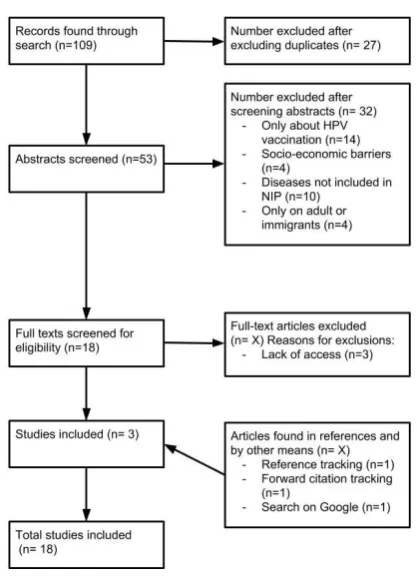
included articles is in Figure 5. An overview of the articles, used in the result analysis, are shown in
[image:22.595.81.290.330.619.2]Appendix II.
Figure 5: Search strategy
Interviews with healthcare professionals
To understand how the organisation currently is organised and to give recommendations to the GGD,
one-to-one interviews with in total six healthcare professionals in Twente were conducted. The research
data were collected by doing semi-structured interviews. In semi- structured interviews, questions are
issues (Barriball & While, 1994). The open questions enable us to formulate appropriate follow-up
questions to our understanding of the opinion of the respondents. This is done to improve the quality of
the interviews. The interviews were conducted according to two different interview protocols, which are
included in Appendix III and IV. One protocol was used for interviewing the healthcare professionals
of the GGD and the other protocol was used for interviewing the GPs. The questions of the interview
were based on literature that lead to answering the research question. The interview protocol for the
GGD employees existed of a total of 24 open questions divided into four parts: 1. General information
about their work 2. General questions about the vaccination program in their municipality 3. Questions
about the vaccination rate in Twente and the Netherlands where numbers of the vaccination rate where
shown to the participants. 4. Questions about the organisation of the vaccination program in their
municipality. The interview protocol for the GPs existed of a total of nineteen open questions also
divided into the same for parts as the interview protocol of the GGD employees only with some different
questions to find out the exact role of the GP in the vaccination program. All interviews ended with
room for additional comments and feedback.
Research population
Interviews with four GGD employees, among them were two youth healthcare nurses, one youth doctor and one youth doctor’s assistant. The GGD employees were recruited by the team leaders of the
municipalities. Therefore, the inclusion criteria of the participants were based on the vaccination grade
of their municipality. Three high graded and three least graded municipalities in Twente were selected
based on the MMR and DPT vaccination rate for children at the age of nine. The three high graded
municipalities are: Hellendoorn, Oldenzaal and Tubbergen. The three low graded municipalities are:
Almelo, Borne, and Twenterand. In addition, Enschede is included, because two healthcare
professionals volunteered in this research and they are working in Enschede. Only four employees of
three municipalities (Hengelo/Borne, Enschede, Oldenzaal and Twenterand) were available for an
interview. After the researcher got the list with names of the employees who wants to participate in this
research, these employees were contacted for permission by the researcher herself. The other two
interviews were conducted with GPs. The GPs were contacted by the researcher herself to ask for
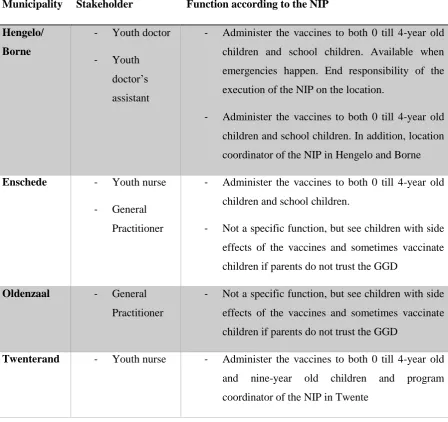
permission in this research. An overview of the stakeholder per municipality is shown in Table 1.
The interviews were held face-to-face at the location the participants preferred. At the start of
the interview the interviewer introduced the research and clarify the aim if necessary. The participants
were asked for permission to record the interview and were asked to sign the consent form included in
Appendix III. The interviews for GGD employees took forty-five minutes to an hour depending on the
Table 1: Overview of the stakeholders and their function according to the NIP per municipality.
Municipality Stakeholder Function according to the NIP Hengelo/
Borne
- Youth doctor
- Youth doctor’s
assistant
- Administer the vaccines to both 0 till 4-year old
children and school children. Available when
emergencies happen. End responsibility of the
execution of the NIP on the location.
- Administer the vaccines to both 0 till 4-year old
children and school children. In addition, location
coordinator of the NIP in Hengelo and Borne
Enschede - Youth nurse - General
Practitioner
- Administer the vaccines to both 0 till 4-year old
children and school children.
- Not a specific function, but see children with side
effects of the vaccines and sometimes vaccinate
children if parents do not trust the GGD
Oldenzaal - General Practitioner
- Not a specific function, but see children with side
effects of the vaccines and sometimes vaccinate
children if parents do not trust the GGD
Twenterand - Youth nurse - Administer the vaccines to both 0 till 4-year old and nine-year old children and program
coordinator of the NIP in Twente
3.3. Data-analysis methods
Mini-literature review
The search terms were used to find academic literature to be included in this research. A total of 18
full-texts were found and reviewed. These articles included systematic reviews, document analysis, surveys,
case control study, SWOT-analysis, focus groups and interviews. The articles were based on
perspectives of parents, the organisation and healthcare professionals. Key findings for advantages,
disadvantages and recommendations were summarised by one researcher.
Interviews with health care professionals
The first interview was performed as a pilot to check whether the questions were clear and if some
changes were necessary. At the beginning of each interview a clear explanation about the aim of the
has been recorded and later be transcribed in Microsoft Word to minimise possible loss of information
and to cite direct quotes. After transcription of the interviews, the transcribed interviews were uploaded
into the software program Atlas.ti 8.0 and coded according to a coding scheme. Atlas.ti is a software
program to help systematically analyse and visualise qualitative data by using a coding frame (Wester,
2004). One researcher coded the interviews. The coding frame existed of codes based on the questions
of the interview and is included in Appendix V. When doubting, the code is not given to the sentence
and when an answer occurs several times, it is included once in the analysis. Finally, the transcripts were
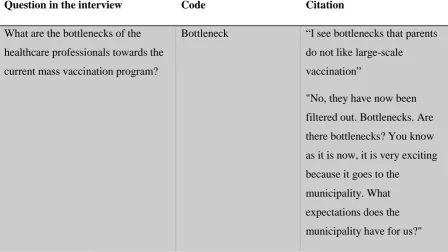
read again to make sure that the codes were correct and that all data was coded. A part of the codebook
[image:25.595.72.521.272.524.2]is given in Table 2.
Table 2: Part of the codebook of the interviews with healthcare professionals
Question in the interview Code Citation
What are the bottlenecks of the
healthcare professionals towards the
current mass vaccination program?
Bottleneck “I see bottlenecks that parents
do not like large-scale
vaccination”
"No, they have now been
filtered out. Bottlenecks. Are
there bottlenecks? You know
as it is now, it is very exciting
because it goes to the
municipality. What
expectations does the
municipality have for us?"
3.4. Ethical Approval
To justify this research ethically, ethical approval is given by the ethical board of the University of
Twente under application number 18373. The interview participants were informed about correct
information about the research during email-contact and further explanations were given verbally. They
were also informed about the fact that the interview is voluntarily, and they could stop the interview at
any time. Permission to the participants was asked before the interview either written or verbally. After
the interview, the data is processed and analysed anonymously and there is no way the data is traced
4.
Result analysis
This chapter describes the results that have emerged from the analysis of the data. First, sub-question 1
is answered after that results of the literature study to answer sub-questions 2A and 3A are shown.
Finally, the results of the interviews with healthcare professionals are shown to answer sub-questions
3A and 3B. The focus will be on the convenience. After every paragraph a short conclusion is given to
summarise the results found.
4.1. Result organisation current vaccination program in the Netherlands
This sub-question: How is the vaccination program currently organised in the Netherlands? goes deeper
into the organisation of the vaccination program in the Netherlands and specific for Twente. The results
are shown in two paragraphs: paragraph one is about how the vaccination program among 0 till 4-year
old children is organised and paragraph two is about how the vaccination program among nine-year old
school children is organised.
Vaccination program among 0 till 4-year old children
Van Lier et al. describes how the current vaccination program among 0 till 4-year old children currently
is organised. When children are four weeks old, parents receive an invitation for their child to participate
in the national vaccination program (NIP) with a brochure with information about for example side
effects, the vaccine certificate and a set vaccination cards for all vaccines till the age of four from the
RIVM office. Infants (from birth to fourteen months) get nine vaccinations against those infectious
diseases mentioned in the introduction. Before the vaccines are given a youth doctor always examine
the child to see if the child is healthy enough to get the vaccines. The doctor will also ask for permission.
This request for permission is only made for the first vaccination and recorded in the digital dossier. In
the first fourteen months the child receives nine vaccines spread over five visits at the consultation
office. The vaccinations take place during the regular check-ups at the consultation bureau of the
municipal health centre (GGD). At phase two of the NIP, when the child is at the age of four, he/she
will get one vaccine at the consultation bureau of the GGD. For each phase in the vaccination scheme
there will be a separate invitation sent to the parents included with a personalised vaccination card that
parents need to bring to each vaccination session. On this vaccination card the vaccine characteristics of
the administered vaccination (dose, date, executive organisation) even the reasons for not vaccination
are mentioned on this card (van Lier A. , et al., 2012). If parents have indicated not to vaccinate their
child, they still receive an invitation letter for the following vaccinations. The reason for this is in case
parents have changed their minds about the vaccination program or medical grounds are no longer apply.
Not only will they be reminded by the RIVM, but also by the consultation office. If parents forget an
appointment they will be called to remind them of their appointment. (Rijksoverheid, sd). In Twente,
Vaccination program among nine-year old children
The vaccination program for the nine-year old children is organised as a mass vaccination. This way of
organising dates from 1953 with only a vaccination against diphtheria. In 1954 this vaccination was
added with pertussis and tetanus. For poliomyelitis, the vaccination started in 1957 and in 1962 it was
added to the DTP vaccine. Vaccination against rubella was started in 1974 and was limited to just
11-year-old girls and extended with the measles and mumps in 1987. The current MMR vaccine is given to
both boys and girls at 14 months of age with a booster vaccination at the age of nine (van Wijhe, et al.,
2018).
The vaccination program of the nine-year old exists of two repeated vaccines at the age of nine
(DTP and MMR). An invitation letter from the RIVM for vaccination against these two diseases is sent
to the home address of the child. On this invitation letter the expected date, time and location is
mentioned. If they really are not able to come at the indicated time and date, parents are free to choose
a different time and location by themselves. Other timeframes and locations are attached to the invitation
letter. The group of nine-year olds are divided into two cohorts: one cohort, existing of the children born
in January till June, is at the beginning of the year and the other cohort, existing of the children born in
July till December, is at the end of the year. In most cases the vaccinations take place at a central location
of the village or city where the child lives. In this central location (e.g. big gym) a lot of children can
visit at the same time. Parents and their children report with their invitation letter and vaccination card
at the front desk, so the two vaccinations can be stamped. After that the children can stand in line where
they wait to get the vaccinations. The vaccinations are given by the GGD or youth healthcare in both
arms at the same time. It could be that children get a fever or get red spots on the arm(s) after the
injection. Most of these complaints disappear by itself in one or two days. Children who did not get
vaccinated, get another, invitation later in the year. (GGDTwente, sd).
One municipality in Twente, namely Borne, organise the mass vaccination in a different way.
All other municipalities organise the mass vaccination program as explained before (Interview P4, line
numbers 50-65). In Borne children at the age of nine do not go to a central location in their municipality
for their vaccination but go to the location at the GGD. They have organised it for the second year now.
That means that school children gather at the location of the GGD were they must wait in line to get the
two vaccines at the same time. An advantage of this way of organising is that the mass vaccination
programme is provided at a smaller scale, because parents do not have to go to Hengelo anymore where
it is much more crowded with longer waiting lines. Parents find this way of organising more pleasant
(Interview P3, line numbers 155-159). way of organising makes no difference in the vaccination rates.
Despite the fact that parents say that they like the mass vaccination better at smaller scale, the
vaccinations rates do not rise, they even drop. In terms of vaccination rates difference should be
started in 2014 (GGD Twente, 2016). This trend is compared to the vaccination rates in Twente for
2015, 2016 and 2017 (van Lier E. , et al., 2015) (van Lier E. , et al., 2016) (RIVM, 2017). In the rest of
Twente, the vaccination rates for DTP and MMR also drops. This van be seen in Figure 7. This way of
vaccination is included in the analysis, because parents find this way of organising at smaller scale
[image:28.595.69.433.173.389.2]pleasant.
Figure 6: Trend in vaccination rates of the mass vaccination program in Borne in 2014, 2015 and 2016
Figure 7: Trend of vaccination rates of the mass vaccination in Twente in 2014, 2015 and 2016
Role of the general practitioner
GPs do not have a function in the vaccination program. Parents only contact the GP when their children
have side effects, or they do not trust the injection method of the GGD and contact the GP to ask if he
can vaccinate (Interview P6, line numbers 16-34)
90,0% 91,0% 92,0% 93,0% 94,0% 95,0% 96,0%
2014 2015 2016
Trend of vaccination rates in Borne
DTP MMR
92,0% 92,5% 93,0% 93,5% 94,0% 94,5%
2014 2015 2016
Trend of vaccination rates in Twente
[image:28.595.72.434.426.644.2]Conclusion
There is a design difference in the vaccination program for 0 till 4-years and for nine-year olds. Parents
of 0 till 4-year olds go to the consultation office for regular check-ups of their young child and there
they also get individually the vaccines. Youth healthcare providers have there a possibility to talk with
them about the vaccines and parents can ask questions. This is different from the design of the nine-year
olds, where children get the vaccines during a mass vaccination session. Parents get an invitation with
a location and timeframe of a central location in their municipality to get the vaccines for their children
at the age of nine. One municipality in Twente organises the mass vaccination is a slightly different way.
In Borne the mass vaccination are not given at a central location in the municipality, but at the
consultation office in the village so parents do not have to travel to Hengelo. There is no role for the
GPs in the NIP.
4.2. Result mini-literature review
This paragraph shows the answers of sub-questions 2A and 2B conducted from the mini literature review
about the advantages, disadvantages and recommendations in terms of convenience about the mass
vaccination program. The results are shown in two paragraphs. In the first part, results of sub-question
2A are shown and in the second part results of sub-question 2B are shown.
Advantages and disadvantages
In this paragraph sub-question 2A: What are the advantages and disadvantages regarding the current
vaccination program in the Netherlands according to the literature? is answered. First general
advantages and disadvantages about the vaccination program are given. After that, advantages and
disadvantages specific for convenience are given, because this is the most important factor that can
declares the difference in vaccination rates between the two age categories.
Advantages
General advantages
Vaccination programs have a lot of advantages that is why all countries in the world have applied the
vaccination program in their public health policy, because it saves many lives. Vaccination is the best
way to prevent infectious diseases especially for infants and children by individual protection and herd
immunity. Attenuated vaccines activate all phases of the immune system and provide quick and more
stable immunity against those diseases. Vulnerable children can profit directly, by being vaccinated or
indirectly by gaining health benefit of the fact that other people are protected against the infectious
diseases. This is an objective of the mass vaccination program, because it stops the transfer of the
infectious diseases from one person to another person. An advantage for the organisation is that the
Advantages in terms of convenience
Two advantages for mass vaccination were mentioned (Grabenstein & Nevin, 2006) (Hanvoravongchai,
et al., 2011). One advantage in perspective of the organisation, is that the range is large. Organising the
vaccination in a mass vaccination way a lot of children can be vaccinated in a short timeframe
(Grabenstein & Nevin, 2006). The other advantage, in perspective of the parents, is that mass
vaccination programs raise community awareness, because parents talk to each other about vaccination
at e.g. schools and with friends and family (Hanvoravongchai, et al., 2011).
Disadvantages
General disadvantages
All vaccines have side effects and are not 100% safe. Some children are more delicate and react strongly
to the vaccination than others, but there are a few side effects caused by vaccines. Most side effects are
relatively innocent. The most common side effects are, muscle pain, headache, red swollen arm at the
side of the injection or fever. Vaccines are in no relation with several conditions like autism, diabetes
and asthma (Hendriksz, et al., 2013) (MacDonald, 2004).
Individual and herd-immunity benefits of vaccination are world-wide, but by providing
large-scale vaccination. It can be a ‘victims of their own success’. A disadvantage can be that the diseases are
less familiar to the parents and they do not see the necessity of the vaccines (Yaqub, et al., 2014).
Disadvantage in terms of convenience
Disadvantages are written in terms of barriers why parent do not come to the mass vaccination. These
barriers can explain the difference in vaccination rates, because the factors have influence on the service
delivery of the mass vaccination program. Overview of the barriers according to the literature are shown
in Table 3.
A major barrier for parents are conflicting priorities. In the current time century were parents
are juggling to prioritise (child) activities after school, because they are too busy for example with
working or have other children to care for at the time of the mass vaccination. This reason is mentioned
in eight articles (Weiss, Winch, & Burnham, 2009) (Favin, et al., 2012) (Letley, et al., 2016) (Hendriksz,
et al., 2013) (Yawn, et al., 2000) (Tarrant & Gregory, 2002) (Mack & Darden, 2008) (Yaqub, et al.,
2014). Five articles give inconvenient hours as a barrier for non-vaccinations (Favin, et al., 2012)
(Hendriksz, et al., 2013) (Yawn, et al., 2000) (Smith, et al. 2017) (Mack & Darden, 2008). For the mass
vaccination program parents receive an invitation with a timeframe of vaccination. Mass vaccinations
are mostly held at a Wednesday afternoon between two and four p.m. This information is given on the
GGD website. On the invitation a list of other data and timeframes in other municipalities in Twente are
mentioned, but if the mass vaccinations are organised late in the year, limited possibilities are left. If