Unbounded Dependency Recovery for Parser Evaluation
Laura Rimell and Stephen Clark
University of Cambridge Computer Laboratory
[email protected] [email protected]
Mark Steedman
University of Edinburgh School of Informatics
Abstract
This paper introduces a new parser eval-uation corpus containing around 700 sen-tences annotated with unbounded depen-dencies, from seven different grammatical constructions. We run a series of off-the-shelf parsers on the corpus to evaluate how well state-of-the-art parsing technology is able to recover such dependencies. The overall results range from 25% accuracy to 59%. These low scores call into ques-tion the validity of using Parseval scores as a general measure of parsing capability. We discuss the importance of parsers be-ing able to recover unbounded dependen-cies, given their relatively low frequency in corpora. We also analyse the various er-rors made on these constructions by one of the more successful parsers.
1 Introduction
Statistical parsers are now obtaining Parseval scores of over 90% on theWSJsection of the Penn Treebank (Bod, 2003; Petrov and Klein, 2007; Huang, 2008; Carreras et al., 2008). McClosky et al. (2006) report an F-score of 92.1% using self-training applied to the reranker of Charniak and Johnson (2005). Such scores, in isolation, may suggest that statistical parsing is close to becom-ing a solved problem, and that further incremental improvements will lead to parsers becoming as ac-curate asPOStaggers.
A single score in isolation can be misleading, however, for a number of reasons. First, the single score is an aggregate over a highly skewed distri-bution of all constituent types; evaluations which look at individual constituent or dependency types show that the accuracies on some, semantically important, constructions, such as coordination and PP-attachment, are much lower (Collins, 1999).
Second, it is well known that the accuracy of parsers trained on the Penn Treebank degrades when they are applied to different genres and do-mains (Gildea, 2001). Finally, some researchers have argued that the Parseval metrics (Black et al., 1991) are too forgiving with respect to certain er-rors and that an evaluation based on syntactic de-pendencies, for which scores are typically lower, is a better test of parser performance (Lin, 1995; Carroll et al., 1998).
In this paper we focus on the first issue, that the performance of parsers on some constructions is much lower than the overall score. The construc-tions that we focus on are various unbounded de-pendency constructions. These are interesting for parser evaluation for the following reasons: one, they provide a strong test of the parser’s knowl-edge of the grammar of the language, since many instances of unbounded dependencies are diffi-cult to recover using shallow techniques in which the grammar is only superficially represented; and two, recovering these dependencies is necessary to completely represent the underlying predicate-argument structure of a sentence, useful for appli-cations such as Question Answering and Informa-tion ExtracInforma-tion.
To give an example of the sorts of constructions we are considering, and the (in)ability of parsers to recover the corresponding unbounded depen-dencies, none of the parsers that we have tested were able to recover the dependencies shown in bold from the following sentences:
We have also developed techniques for recognizing and locating underground nuclear tests through thewavesin the ground which theygenerate.
By Monday , they hope to have a sheaf ofdocumentsboth sides cantrust.
By means of charts showing wave-travel times and depths in the ocean at various locations , it is possible to estimate therateof approach and probabletimeof arrival at Hawaii ofa tsunami getting under way at any spot in the Pacific .
The contributions of this paper are as follows. First, we present the first set of results for the recovery of a variety of unbounded dependen-cies, for a range of existing parsers. Second, we describe the creation of a publicly available un-bounded dependency test suite, and give statistics summarising properties of these dependencies in naturally occurring text. Third, we demonstrate that performing the evaluation is surprisingly dif-ficult, because of different conventions across the parsers as to how the underlying grammar is rep-resented. Fourth, we show that current parsing technology is very poor at representing some im-portant elements of the argument structure of sen-tences, and argue for a more focused construction-based parser evaluation as a complement to exist-ing grammatical relation-based evaluations. We also perform an error-analysis for one of the more successful parsers.
There has been some prior work on evaluating parsers on long-range dependencies, but no work we are aware of that has the scope and focus of this paper. Clark et al. (2004) evaluated a CCG parser on a small corpus of object extraction cases. Johnson (2002) began the body of work on insert-ing traces into the output of Penn Treebank (PTB) parsers, followed by Levy and Manning (2004), among others. This PTB work focused heavily on the representation in the Treebank, evaluat-ing against patterns in the trace annotation. In this paper we have tried to be more “formalism-independent” and construction focused.
2 Unbounded Dependency Corpus
2.1 The constructions
An unbounded dependency construction contains a word or phrase which appears to have been moved, while being interpreted in the position of the resulting “gap”. An unlimited number of clause boundaries may intervene between the moved element and the gap (hence “unbounded”). The seven constructions in our corpus were cho-sen for being relatively frequent in text, compared to other unbounded dependency types, and rela-tively easy to identify. An example of each con-struction, along with its associated dependencies, is shown in Table 1. Here we give a brief descrip-tion of each construcdescrip-tion.
Object extraction from a relative clause is characterised by a relative pronoun (awh-word or that) introducing a clause from which an argument
in object position has apparently been extracted: the paper which I wrote. Our corpus includes cases where the extracted word is (semantically) the object of a preposition in the verb phrase: the agency that I applied to.
Object extraction from a reduced relative clauseis essentially the same, except that there is no overt relative pronoun: the paper I wrote; the agency I applied to. We did not include participial reduced relatives such asthe paper written by the professor.
Subject extraction from a relative clause is characterised by the apparent extraction of an ar-gument from subject position:the instrument that measures depth. A relative pronoun is obligatory in this construction. Our corpus includes passive subjects: the instrument which was used by the professor.
Free relatives contain relative pronouns with-out antecedents: I heard what she said, where whatdoes not refer to any other noun in the sen-tence. Free relatives can usually be paraphrased by noun phrases such asthe thing she said(a standard diagnostic for distinguishing them from embedded interrogatives like I wonder what she said). The majority of sentences in our corpus are object free relatives, but we also included some adverbial free relatives:She told us how to do it.
Objectwh-questionsare questions in which the wh-word is the semantic object of the verb: What did you eat?. Objects of prepositions are included: What city does she live in?. Also included are a few cases where the wh-word is arguably adver-bial, but is selected for by the verb: Where is the park located?.
Right node raising (RNR) is characterised by coordinated phrases from which a shared element apparently moves to the right: Mary saw and Su-san bought the book. This construction is unique within our corpus in that the “raised” element can have a wide variety of grammatical functions. Ex-amples include: noun phrase object of verb, noun phrase object of preposition (material about or messages from the communicator), a combination of the two (applied for and won approval), prepo-sitional phrase modifier (president and chief exec-utive of the company), infinitival modifier (the will and the capacity to prevent the event), and modi-fied noun (a good or a bad decision).
ap-Object extraction from a relative clause
Each must match Wisman’s “pie” with thefragmentthat hecarrieswith him.
dobj(carries, fragment)
Object extraction from a reduced relative clause
Put another way, the decline in the yield suggests stocks have gotten pretty rich in price relative to the dividendstheypay, some market analysts say.
dobj(pay, dividends)
Subject extraction from a relative clause
It consists of aseriesof pipes and a pressure-measuringchamberwhichrecordthe rise and fall of the water surface.
nsubj(record, series) nsubj(record, chamber)
Free relative
He tried to ignorewhathis own common sensetold him, but it wasn’t possible; her motives were too blatant.
dobj(told, what)
Objectwh-question
Whatcitydoes the Tour de France endin?
pobj(in, city)
Right node raising
For the third year in a row, consumers voted Bill Cosbyfirstand James Garnersecond inpersuasiveness as spokesmen in TV commercials, according to Video Storyboard Tests, New York.
prep(first, in) prep(second, in)
Subject extraction from an embedded clause
In assigning to God the responsibility which he learned could notrest with his doctors, Eisenhower gave evidence of that weakening of the moral intuition which was to characterize his administration in the years to follow.
nsubj(rest, responsibility)
Table 1: Examples of the seven constructions in the unbounded dependency corpus.
parently extracted across two clause boundaries, as shown in the following bracketing (where ∗
marks the origin of the extracted element): the responsibility which [the government said [∗ lay with the voters]]. Our corpus includes sentences where the embedded clause is a so-called small clause, i.e. one with a null copula verb: the plan that she considered foolish, where planis the se-mantic subject offoolish.
2.2 The data
The corpus consists of approximately 100 sen-tences for each of the seven constructions; 80 of
these were reserved for each construction for test-ing, giving a test set of 560 sentences in total, and the remainder were used for initial experimenta-tion (for example to ensure that default settings for the various parsers were appropriate for this data). We did not annotate the full sentences, since we are only interested in the unbounded dependencies and full annotation of such a corpus would be ex-tremely time-consuming.
of the parsers in our set) and half from Brown (roughly balanced across the different sections). The questions were taken from the question data in Rimell and Clark (2008), which was obtained from various years of the TREC QA track. We chose to use the PTBas the main source because the use of traces in thePTBannotation provides a starting point for the identification of unbounded dependencies.
Sentences were selected for the corpus by a combination of automatic and manual processes. A regular expression applied toPTBtrees, search-ing for appropriate traces for a particular con-struction, was first used to extract a set of can-didate sentences. All cancan-didates were manually reviewed and, if selected, annotated with one or more grammatical relations representing the rel-evant unbounded dependencies in the sentence. Some of the annotation in the treebank makes identification of some constructions straightfor-ward; for example right node raising is explicitly represented as RNR. Indeed it may have been pos-sible to fully automate this process with use of thetgrepsearch tool. However, in order to ob-tain reliable statistics regarding frequency of oc-currence, and to ensure a high-quality resource, we used fairly broad regular expressions to iden-tify the original set followed by manual review.
We chose to represent the dependencies as grammatical relations (GRs) since this format seemed best suited to represent the kind of seman-tic relationship we are interested in. GRs are head-based dependencies that have been suggested as a more appropriate representation for general parser evaluation than phrase-structure trees (Carroll et al., 1998). Table 1 gives examples of how GRs are used to represent the relevant dependencies. The particular GR scheme we used was based on the Stanford scheme (de Marneffe et al., 2006); however, the specificGRscheme is not too crucial since the whole sentence is not being represented in the corpus, only the unbounded dependencies.
3 Experiments
The five parsers described in Section 3.2 were used to parse the test sentences in the corpus, and the percentage of dependencies in the test set recov-ered by each parser for each construction was cal-culated. The details of how the parsers were run and how the parser output was matched against the gold standard are given in Section 3.3. This
Construction WSJ Brown Overall Obj rel clause 2.3 1.1 1.4 Obj reduced rel 2.7 2.8 2.8 Sbj rel clause 10.1 5.7 7.4
Free rel 2.6 0.9 1.3
RNR 2.2 0.9 1.2
Sbj embedded 2.0 0.3 0.4 Table 2: Frequency of constructions in the PTB (percentage of sentences).
is essentially a recall evaluation, and so is open to abuse; for example, a program which returns all the possible word pairs in a sentence, together with all possible labels, would score 100%. However, this is easily guarded against: we simply assume that each parser is being run in a “standard” mode, and that each parser has already been evaluated on a full corpus ofGRs in order to measure precision and recall across all dependency types. (Calculat-ing precision for the unbounded dependency eval-uation would be difficult since that would require us to know how manyincorrectunbounded depen-dencies were returned by each parser.)
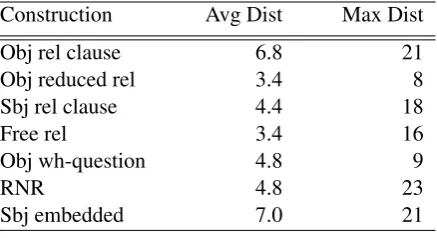
3.1 Statistics relating to the constructions Table 2 shows the percentage of sentences in the PTB, from those sections that were examined, which contain an example of each type of un-bounded dependency. Perhaps not surprisingly, root subject extractions from relative clauses are by far the most common, with the remaining con-structions occurring in roughly between 1 and 2% of sentences. Note that, although examples of each individual construction are relatively rare, the combined total is over 10% (assuming that each construction occurs independently). Section 6 contains a discussion regarding the frequency of occurrence of these events and the consequences of this for parser performance.
Construction Avg Dist Max Dist Obj rel clause 6.8 21 Obj reduced rel 3.4 8 Sbj rel clause 4.4 18
Free rel 3.4 16
Obj wh-question 4.8 9
RNR 4.8 23
[image:5.595.72.291.62.181.2]Sbj embedded 7.0 21
Table 3: Distance between head and dependent. subject embedded construction:
the same stumpwhich had impaled the car of many a guest in the past thirty years and which he refused to haveremoved.
3.2 The parsers
The parsers that we chose to evaluate are theC&C CCG parser (Clark and Curran, 2007), the Enju HPSG parser (Miyao and Tsujii, 2005), the RASP parser (Briscoe et al., 2006), the Stanford parser (Klein and Manning, 2003), and the DCU post-processor of PTB parsers (Cahill et al., 2004), based on LFG and applied to the output of the Charniak and Johnson reranking parser. Of course we were unable to evaluate every publicly avail-able parser, but we believe these are representative of current wide-coverage robust parsing technol-ogy.1
The C&Cparser is based on CCGbank (Hock-enmaier and Steedman, 2007), a CCG version of the Penn Treebank. It is ideally suited for this eval-uation because CCG was designed to capture the unbounded dependencies being considered. The Enju parser was designed with a similar motiva-tion to C&C, and is also based on an automat-ically extracted grammar derived from the PTB, but the grammar formalism is HPSG rather than CCG. Both parsers produce head-word dependen-cies reflecting the underlying predicate-argument structure of a sentence, and so in theory should be straightforward to evaluate.
The RASP parser is based on a manually con-structed POS tag-sequence grammar, with a sta-tistical parse selection component and a robust
1One obvious omission is any form of dependency parser
(McDonald et al., 2005; Nivre and Scholz, 2004). However, the dependencies returned by these parsers are local, and it would be non-trivial to infer from a series of links whether a long-range dependency had been correctly represented. Also, dependency parsers are not significantly better at recovering head-based dependencies than constituent parsers based on thePTB(McDonald et al., 2005).
partial-parsing technique which allows it to re-turn output for sentences which do not obtain a full spanning analysis according to the grammar. RASPhas not been designed to capture many of the dependencies in our corpus; for example, the tag-sequence grammar has no explicit representation of verb subcategorisation, and so may not know that there is a missing object in the case of extrac-tion from a relative clause (though it does recover some of these dependencies). However, RASP is a popular parser used in a number of applications, and it returns dependencies in a suitable format for evaluation, and so we considered it to be an appro-priate and useful member of our parser set.
The Stanford parser is representative of a large number of PTB parsers, exemplified by Collins (1997) and Charniak (2000). The Parseval scores reported for the Stanford parser are not the highest in the literature, but are competitive enough for our purposes. The advantage of the Stanford parser is that it returns dependencies in a suitable format for our evaluation. The dependencies are obtained by a set of manually defined rules operating over the phrase-structure trees returned by the parser (de Marneffe et al., 2006). Like RASP, the Stanford parser has not been designed to capture unbounded dependencies; in particular it does not make use of any of the trace information in thePTB. However, we wanted to include a “standard” PTBparser in our set to see which of the unbounded dependency constructions it is able to deal with.
Finally, there is a body of work on inserting trace information into the output of PTB parsers (Johnson, 2002; Levy and Manning, 2004), which is the annotation used in thePTBfor representing unbounded dependencies. The work which deals with thePTBrepresentation directly, such as John-son (2002), is difficult for us to evaluate because it does not produce explicit dependencies. However, the DCU post-processor is ideal because it does produce dependencies in aGR format. It has also obtained competitive scores on generalGR evalu-ation corpora (Cahill et al., 2004).
3.3 Parser evaluation
Obj RC Obj Red Sbj RC Free Obj Q RNR Sbj Embed Total C&C 59.3 62.6 80.0 72.6 (81.2) 27.5 49.4 22.4 (59.7) 53.6
Enju 47.3 65.9 82.1 76.2 32.5 47.1 32.9 54.4
DCU 23.1 41.8 56.8 46.4 27.5 40.8 5.9 35.7
Rasp 16.5 1.1 53.7 17.9 27.5 34.5 15.3 25.3
Stanford 22.0 1.1 74.7 64.3 41.2 45.4 10.6 38.1 Table 4: Parser accuracy on the unbounded dependency corpus; the highest score for each construction is in bold; the figures in brackets forC&Cderive from the use of a separate question model.
specially designed question model, and so we ap-plied both this and the standard model to the object wh-question cases.
The parser output was evaluated against each dependency in the corpus. Due to the variousGR schemes used by the parsers, an exact match on the dependency label could not always be expected. We considered a correctly recovered dependency to be one where the gold-standard head and depen-dent were correctly idepen-dentified, and the label was an “acceptable match” to the gold-standard label. To be an acceptable match, the label had to indi-cate the grammatical function of the extracted el-ement at least to the level of distinguishing active subjects, passive subjects, objects, and adjuncts. For example, we allowed anobj(object) relation as a close enough match fordobj(direct object) in the corpus, even though obj does not distin-guish different kinds of objects, but we did not al-low generic “relative pronoun” relations that are underspecified for the grammatical role of the ex-tracted element.
The differences in GR schemes were such that we ended up performing a time-consuming largely manual evaluation. We list here some of the key differences that made the evaluation difficult.
In some cases, the parser’s set of labels was less fine-grained than the gold standard. For example, RASP represents the direct objects of both verbs and prepositions asdobj(direct object), whereas the gold-standard uses pobj for the preposition case. We counted the RASP output as correctly matching the gold standard.
In other cases, the label on the dependency containing the gold-standard head and depen-dent was too underspecified to be acceptable by itself. For example, where the gold-standard relation was dobj(placed,buckets), DCU produced relmod(buckets,placed) with a generic “relative modifier” label. However,
the correct label could be recovered from else-where in the parser output, specifically a com-bination of relpro(buckets,which) and
obj(placed,which). In this case we counted the DCU output as correctly matching the gold standard.
In some constructions the Stanford scheme, upon which the gold-standard was based, makes different choices about heads than other schemes. For example, in the the phraseHonolulu, which is the center of the warning system, the corpus con-tains a subject dependency withcenteras the head:
nsubj(center,Honolulu). Other schemes, however, treat the auxiliary verbisas the head of the dependency, rather than the predicate nominal center. As long as the difference in head selec-tion was due solely to the idiosyncracies of theGR schemes involved, we counted the relation as cor-rect.
Finally, the different GR schemes treat coordi-nation differently. In the corpus, coordinated ele-ments are always represented with two dependen-cies. Thus the phrasethey may half seeand half imagine the oldsplendor has two gold-standard dependencies: dobj(see,splendor) and
dobj(imagine,splendor). If a parser pro-duced only the former dependency, but appeared to have the coordination correct, then we awarded two marks, even though the second dependency was not explicitly represented.
4 Results
construction can be successful (Rimell and Clark, 2008).
In order to learn more from these results, in Sec-tion 5 we analyse the various errors made by the C&Cparser on each construction. The conclusions that we arrive at for theC&Cparser we would also expect to apply to Enju, on the whole, since the de-sign of the two parsers is so similar. In fact, some of the recommendations for improvement on this corpus, such as the need for a better parsing model to make better attachment decisions, are parser in-dependent.
The poor performance of RASP on this corpus is clearly related to a lack of subcategorisation in-formation, since this is crucial for recovering ex-tracted arguments. For Stanford, incorporating the trace information from thePTBinto the statistical model in some way is likely to help. TheC&Cand Enju parsers do this through their respective gram-mar formalisms. Our informal impression of the DCU post-processor is that it has much of the ma-chinery available to recover the dependencies that the Enju andC&Cparsers do, but for some reason which is unclear to us it performs much worse.
5 Analysis of theC&C Parser
We categorised the errors made by theC&Cparser on the development data for each construction. We chose the C&C parser for the analysis because it was one of the top performers and we have more knowledge of its workings than those of Enju.
The C&Cparser first uses a supertagger to as-sign a small number ofCCGlexical categories (es-sentially subcategorisation frames) to each word in the sentence. These categories are then combined using a set of combinatory rules to build a CCG derivation. The parser uses a log-linear probabil-ity model to select the highest-scoring derivation (Clark and Curran, 2007). In general, errors in de-pendency recovery may occur if the correct lexical category is not assigned by the supertagger for one or more of the words in a sentence, or if an incor-rect derivation is chosen by the parsing model.
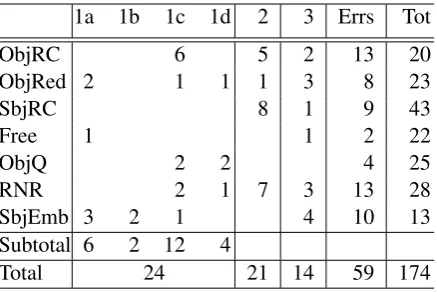
For unbounded dependency recovery, one source of errors (labeledtype 1in Table 5) is the wrong lexical category being assigned to the word (normally a verb or preposition) governing the ex-traction site. Inthese testaments that I would sub-mit here, if submit is assigned a category for an intransitive rather than transitive verb, the verb-object relation will not be recovered.
1a 1b 1c 1d 2 3 Errs Tot
ObjRC 6 5 2 13 20
ObjRed 2 1 1 1 3 8 23
SbjRC 8 1 9 43
Free 1 1 2 22
ObjQ 2 2 4 25
RNR 2 1 7 3 13 28
SbjEmb 3 2 1 4 10 13
Subtotal 6 2 12 4
[image:7.595.308.527.61.207.2]Total 24 21 14 59 174
Table 5: Error analysis for C&C. Errs is the to-tal number of errors for a construction, Totis the number of dependencies of that type in the devel-opment data.
There are a number of reasons why the wrong category may be assigned. First, the lexicon may not contain enough information about possible categories for the word (1a), or the necessary cat-egory may not exist in the parser’s grammar at all (1b). Even if the grammar contains the correct cat-egory and the lexicon makes it available, the pars-ing model may not choose it (1c). Finally, aPOS -tagging error on the word may mislead the parser into assigning the wrong category (1d).2
A second source of errors (type 2) is attach-ment decisions that the parser makes indepen-dently of the unbounded dependency. InMorgan
. . . carried in several buckets of water from the
spring which he poured into the copper boiler, the parser assigns the correct categories for the rela-tive pronoun and verb, but chooses springrather thanbucketsas the head of the relativized NP (i.e. the object of pour). Most attachment errors in-volve prepositional phrases (PPs) and coordina-tion, which have long been known to be areas where parsers need improvement.
Finally, errors in unbounded dependency recov-ery may be due to complex errors in the surround-ing parse context (type 3). We will not comment more on these cases since they do not tell us much about unbounded dependencies in particular.
Table 5 shows the distribution of error types across constructions for the C&Cparser. Subject relative clauses, for example, did not have any er-rors of type 1, because a verb with an extracted
2We considered an error to be type 1 only when the
subject does not require a special lexical category. Most of the errors here are of type 2. For exam-ple, ina series of pipes and a pressure-measuring chamber which record the rise and fall of the wa-ter surface, the parser attaches the relative clause tochamberbut not toseries.
Subject embedded sentences show a different pattern. Many of the errors can be attributed to problems with the lexicon and grammar (1a and 1b). For example, inshadows that they imagined were Apaches, the wordimaginednever appears in the training data with the correct category, and so the required entry is missing from the lexicon.
Object extraction from a relative clause had a higher number of errors involving the parsing model (1c). Inthe first carefree, dreamless sleep that she had known, the transitive category is available forknown, but not selected by the model. The majority of the errors made by the parser are due to insufficient grammar coverage or weak-ness in the parsing model due to sparsity of head dependency data, the same fundamental problems that have dogged automatic parsing since its in-ception. Hence one view of statistical parsing is that it has allowed us to solve the easy problems, but we are still no closer to a general solution for the recovery of the “difficult” dependencies. One possibility is to create more training data target-ing these constructions – effectively “active learn-ing by construction” – in the way that Rimell and Clark (2008) were able to build a question parser. We leave this idea for future work.
6 Discussion
Unbounded dependencies are rare events, out in the Zipfian “long tail”. They will always consti-tute a fraction of a percent of the overall total of head-dependencies in any corpus, a proportion too small to make a significant impact on global mea-sures of parser accuracy, when expressive parsers are compared to those that merely approximate human grammar using finite-state or context-free covers. This will remain the case even when such measures are based on dependencies, rather than on parse trees.
Nevertheless, unbounded dependencies remain highly significant in a much more important sense. They support the constructions that are central to those applications of parsing technology for which precision is as important as recall, such as open-domain question-answering. As low-power
ap-proximate parsing methods improve (as they must if they are ever to be usable at all for such tasks), we predict that the impact of the constructions we examine here will become evident. No matter how infrequent object questions like “What do frogs eat?” are, if they are answered as if they were sub-ject questions (“Herons”), users will rightly resub-ject any excuse in terms of the overall statistical distri-bution of related bags of words.
Whether such improvements in parsers come from the availability of more human-labeled data, or from a breakthrough in unsupervised machine learning, we predict an imminent “Uncanny Val-ley” in parsing applications, due to the inability of parsers to recover certain semantically important dependencies, of the kind familiar from humanoid robotics and photorealistic animation. In such ap-plications, the closer the superficial resemblance to human behavior gets, the more disturbing sub-tle departures become, and the more they induce mistrust and revulsion in the user.
7 Conclusion
In this paper we have demonstrated that current parsing technology is poor at recovering some of the unbounded dependencies which are crucial for fully representing the underlying predicate-argument structure of a sentence. We have also argued that correct recovery of such dependen-cies will become more important as parsing tech-nology improves, despite the relatively low fre-quency of occurrence of the corresponding gram-matical constructions. We also see this more fo-cused parser evaluation methodology — in this case construction-focused — as a way of improv-ing parsimprov-ing technology, as an alternative to the exclusive focus on incremental improvements in overall accuracy measures such as Parseval.
Acknowledgments
References
E. Black, S. Abney, D. Flickenger, C. Gdaniec, R. Gr-ishman, P. Harrison, D. Hindle, R. Ingria, F. Jelinek, J. Klavans, M. Liberman, M. Marcus, S. Roukos, B. Santorini, and T. Strzalkowski. 1991. A proce-dure for quantitatively comparing the syntactic cov-erage of English grammars. InHLT ’91: Proceed-ings of the Workshop on Speech and Natural Lan-guage, pages 306–311.
Rens Bod. 2003. An efficient implementation of a new DOP model. InProceedings of the 10th Meeting of the EACL, pages 19–26, Budapest, Hungary. Ted Briscoe, John Carroll, and Rebecca Watson. 2006.
The second release of the RASP system. In Proceedings of the Interactive Demo Session of COLING/ACL-06, Sydney, Australia.
A. Cahill, M. Burke, R. O’Donovan, J. van Genabith, and A. Way. 2004. Long-distance dependency resolution in automatically acquired wide-coverage PCFG-based LFG approximations. InProceedings of the 42nd Meeting of the ACL, pages 320–327, Barcelona, Spain.
Xavier Carreras, Michael Collins, and Terry Koo. 2008. Dynamic programming and the perceptron for efficient, feature-rich parsing. InProceedings of the Twelfth Conference on Natural Language Learning (CoNLL-08), pages 9–16, Manchester, UK.
John Carroll, Ted Briscoe, and Antonio Sanfilippo. 1998. Parser evaluation: a survey and a new pro-posal. InProceedings of the 1st LREC Conference, pages 447–454, Granada, Spain.
Eugene Charniak and Mark Johnson. 2005. Coarse-to-fine n-best parsing and maxent discriminative reranking. In Proceedings of the 43rd Meeting of the ACL, pages 173–180, Michigan, Ann Arbor.
Eugene Charniak. 2000. A maximum-entropy-inspired parser. In Proceedings of the 1st Meeting of the NAACL, pages 132–139, Seattle, WA. Stephen Clark and James R. Curran. 2007.
Wide-coverage efficient statistical parsing with CCG and log-linear models. Computational Linguistics, 33(4):493–552.
Stephen Clark, Mark Steedman, and James R. Curran. 2004. Object-extraction and question-parsing using CCG. In Proceedings of the EMNLP Conference, pages 111–118, Barcelona, Spain.
Michael Collins. 1997. Three generative, lexicalised models for statistical parsing. In Proceedings of the 35th Meeting of the ACL, pages 16–23, Madrid, Spain.
Michael Collins. 1999. Head-Driven Statistical Mod-els for Natural Language Parsing. Ph.D. thesis, University of Pennsylvania.
Marie-Catherine de Marneffe, Bill MacCartney, and Christopher D. Manning. 2006. Generating typed dependency parses from phrase structure parses. In Proceedings of the 5th LREC Conference, Genoa, Italy.
Daniel Gildea. 2001. Corpus variation and parser per-formance. InProceedings of the 2001 EMNLP Con-ference, Pittsburgh, PA.
Julia Hockenmaier and Mark Steedman. 2007. CCG-bank: a corpus of CCG derivations and dependency structures extracted from the Penn Treebank. Com-putational Linguistics, 33(3):355–396.
Liang Huang. 2008. Forest reranking: Discrimina-tive parsing with non-local features. In Proceed-ings of the 46th Meeting of the ACL, pages 586–594, Columbus, Ohio.
Mark Johnson. 2002. A simple pattern-matching al-gorithm for recovering empty nodes and their an-tecedents. InProceedings of the 40th Meeting of the ACL, pages 136–143, Philadelphia, PA.
Dan Klein and Christopher D. Manning. 2003. Ac-curate unlexicalized parsing. InProceedings of the 41st Annual Meeting of Association for Computa-tional Linguistics, pages 423–430, Sapporo, Japan. Roger Levy and Christopher Manning. 2004. Deep
de-pendencies from context-free statistical parsers: cor-recting the surface dependency approximation. In Proceedings of the 42nd Meeting of the ACL, pages 328–335, Barcelona, Spain.
Dekang Lin. 1995. A dependency-based method for evaluating broad-coverage parsers. InProceedings of IJCAI-95, pages 1420–1425, Montreal, Canada. David McClosky, Eugene Charniak, and Mark
John-son. 2006. Effective self-training for parsing. In Proceedings of the North American Chapter of the Association for Computational Linguistics Confer-ence, pages 152–159, Brooklyn, NY.
Ryan McDonald, Koby Crammer, and Fernando Pereira. 2005. Online large-margin training of de-pendency parsers. InProceedings of the 43rd Meet-ing of the ACL, pages 91–98, Michigan, Ann Arbor. Yusuke Miyao and Jun’ichi Tsujii. 2005. Probabilis-tic disambiguation models for wide-coverage HPSG parsing. InProceedings of the 43rd Meeting of the ACL, pages 83–90, Michigan, Ann Arbor.
J. Nivre and M. Scholz. 2004. Deterministic depen-dency parsing of English text. In Proceedings of COLING-04, pages 64–70, Geneva, Switzerland. Slav Petrov and Dan Klein. 2007. Improved
infer-ence for unlexicalized parsing. In Proceedings of the HLT/NAACL Conference, Rochester, NY. Laura Rimell and Stephen Clark. 2008. Adapting a