Abstract—This study aims to incorporate most recent multiphase models in order to investigate the hydrodynamic behavior of a TBR in terms of pressure drop and liquid holdup. Taking into account transport phenomena such as mass and heat transfer, an Eulerian k-fluid model was developed resulting from the volume averaging of the continuity and momentum equations and solved for a 3D representation of the catalytic bed. Computational fluid dynamics (CFD) model predicts hydrodynamic parameters quite well if good closures for fluid/fluid and fluid/particle interactions are incorporated in the multiphase model. Moreover, catalytic performance is investigated with the catalytic wet oxidation of a phenolic pollutant.
Index Terms—CFD, Euler-Euler model, Hydrodynamics, Multiphase Flow.
I. INTRODUCTION
Multiphase flow systems are described by the cocurrently downward flow of gas and liquid through a packed bed and its commercial applications arises in processing of fuels and chemicals such as desulfurization, hydrotreating, hydrocracking, distillation and filtration. Over the last three decades, the research conducted for the design of such multiphase systems still relies on simplified empirical models rather than on a theoretical basis. The lack of knowledge about the detailed flow picture in packed beds relies in the complex mechanisms governing the fluid flow so that pilot scale experiments is often carried out to perform scale-up studies. Therefore, in reactor design, the coupling between different flow regimes as well as mass and heat transfer rates are directly linked with the hydrodynamics of multiphase reactors such as trickle-bed reactors (TBR). The success of the modeling of multiphase flow processes is virtually related with recent advances achieved in computational fluid dynamics (CFD) given that nowadays computers offer unprecedented numerical power to address
Manuscript received July 22, 2007.
This work was supported by REMOVALS – 6th Framework Program for Research and Technological Development – FP06 Project no. 018525 and Fundação para a Ciência e Tecnologia, Ministério para a Ciência , Tecnologia e Ensino Superior, Portugal under grant SFRH/BD/19933/2004/WM59.
R.J.G. Lopes and R. M. Quinta-Ferreira are with Chemical Engineering Department, Faculty of Sciences and Technology, University of Coimbra, 3030-290 COIMBRA PORTUGAL (e-mail: [email protected];
complex chemical process operational and design issues. Our case study outlines an alternative CFD modeling method to investigate the hydrodynamic behavior of a TBR in terms of pressure drop, liquid holdup and catalyst wetting efficiency. After a brief review of modeling approaches, further details of an Eulerian two-fluid model is provided discussing velocity 3D maps and catalyst surface temperature profiles evaluated in unsteady state after performing the CFD validation.
II. STATE OF THE ART
The large number of studies that have been reported in the literature on various hydrodynamic aspects of trickle-bed reactors rely on several correlations and models of pressure gradient and liquid holdup. The existing hydrodynamic models can be broadly classified into two different categories [1]-[9]. The first category uses an empirical approach based on dimensional analysis to produce explicit correlations for pressure drop and holdup. These correlations have several parameters for fitting the experimental results in which the predicted values of pressure gradient and liquid saturation vary considerably. The second category involves the development of models resulting from equations of motion and considers determination of drag forces of gas and liquid phases at various operating regimes. In this category it has been used three distinct approaches: the relative permeability model, the fundamental force balance model and the slit model [4]. More recently, the effort has been routed for advanced CFD models based on macroscopic mass and momentum conservation laws, in which the drag force has a contribution to both particle-liquid and gas-liquid interactions [5]. The present trend is to develop models based on the fundamental approach to exploit their wider range of applicability unlike the correlative models, which are system specific. Therefore, our model is based on the fundamental physics based approach containing the mechanistic details of the system coupled with reaction kinetics for the catalytic degradation of liquid pollutants performed elsewhere [10] and attempts to model pressure drop and liquid holdup at high-pressure operation for the trickle-bed reactor. The CFD model was then developed focusing a unified approach in modeling of the hydrodynamics with incidence for the downflow mode to present a more realistic picture of the complex hydrodynamics prevailing in the reactor.
Multiphase CFD Modeling of Trickle-Bed
Reactor Hydrodynamics
III. CFDMODEL
In the present work, the flow in the trickle-bed reactor was modeled using a multiphase CFD approach incorporated in the FLUENT 6.1 (FLUENT INC. USA) [11] software that is the Eulerian multiphase model. In the Eulerian two-fluid approach, the different phases are treated mathematically as interpenetrating continua. The derivation of the conservation equations for mass, momentum and energy for each of the individual phases is done by ensemble averaging the local instantaneous balances for each of the phases. The current model formulation specifies that the probability of occurrence of any one phase in multiple realizations of the flow is given by the instantaneous volume fraction of that phase at that point where the total sum of all volume fractions at a point is identically unity. Fluids, gas and liquid, are treated as incompressible, and a single pressure field is shared by all phases. In multiphase flows, the continuity (1), momentum (2) and species continuity equations (3) are solved for each phase and the momentum transfer between the phases is modeled through a drag term [12].
0 = ∂ ∂ + ∂ ∂ + ∂ ∂ z U y U x
Ux y z (1)
ij ji ji n p ij ij ij i i i i i i i i i i i F U m U m R g p U U U t r r & r & r r r r r + − + + + ⋅ ∇ + ∇ − = ⋅ ∇ + ∂ ∂
∑
= ) ( ˆ ) ( ) ( 1 ρ α τ α ρ α ρ α (2) i i i i i i i D j w j U t α ρ ρ ρ ⋅ ∇ − = = − ⋅ ∇ + × ⋅ ∇ + ∂ ∂ r r r0 (3)
ρ is density, U the mass average velocity, h is specific enthalpy and g is gravity; subscripts i and k represents different species. The arrow overbar signifies a vector, and ˆ is a second-order tensor. μ and b are the first and second coefficients of viscosity, respectively. κ is the thermal conductivity, and Di is the multi-component diffusion
coefficient and αi is the mass fraction. In turbulent flows, the
incompressible transport equations are given by (4)-(6).
(
)
∑∑
∑
∑
− ∂ ∂ + ⎥ ⎥ ⎦ ⎤ ⎢ ⎢ ⎣ ⎡ ∂ ∂ + ∂ ∂ = ∂ ∂ + ∂ ∂i j j
i t j j t j i i i x U x k x x k U t k ρε τ μ μ ρ ρ (4)
(
)
k C x U k C x x x U ti j j
i t i j t j i i i 2 2 1 77 . 0 ρε τ ε ε μ μ ε ρ ε ρ ε
ε ∂ −
∂ + + ⎥ ⎥ ⎦ ⎤ ⎢ ⎢ ⎣ ⎡ ∂ ∂ + ∂ ∂ = ∂ ∂ + ∂ ∂
∑∑
∑
∑
(5) ⎟⎟ ⎠ ⎞ ⎜⎜ ⎝ ⎛ ∂ ∂ + − ⎟ ⎟ ⎠ ⎞ ⎜ ⎜ ⎝ ⎛ ∂ ∂ + ∂ ∂ = k k t ij i j j i t t x U k x U xU δ ρ μ
μ τ
3
2 (6)
δij is Kronecker delta and k subscript indicates a summation
over the xk Cartesian coordinates. The thermal energy
balance and the heat flux are expressed in (7) and (8), respectively.
∑∑
∑
∑
∑
∑
∑
⎥ ⎥ ⎦ ⎤ ⎢ ⎢ ⎣ ⎡ ∂ ∂ + ∂ ∂ − ∂ ∂ − ∂ ∂ + ∂ ∂ + ∂ ∂ + ∂ ∂ = ∂ ∂ + ∂ ∂i j j m
i ij j i ij i m i i i i i
i i m
i i i i i i i x U x U i U x x q x P U x P U t P x h U t h '' '' ' '' τ τ ρ ρ ρ (7)
∑
∑
= = ⎟ ⎟ ⎠ ⎞ ⎜ ⎜ ⎝ ⎛ ∂ ∂ − ∂ ∂ − = ⎟ ⎟ ⎠ ⎞ ⎜ ⎜ ⎝ ⎛ ∂ ∂ − ∂ ∂ − = n j j i i j p n j j i i j j x h Sc x T C x h Sc x T q 1 1 Pr α μ μ α μ κ (8)IV. NUMERICAL METHOD
lead to an inefficient distribution of grid points in the final mesh. The momentum equations are solved with the coupling SIMPLE algorithm and the second upwind discretization scheme. The pressure is computed by means of the PRESTO scheme. Model equations were solved in a transient fashion with a time step of 1 s for the Eulerian simulations and a number of sub-iterations were performed within each time step to ensure continuity. The residuals convergence was accelerated by under-relaxation parameters, 0.4 for pressure and 0.8 for velocity vector field. Inlet boundary conditions are assigned at the top distributor and outlet conditions at the free surface.
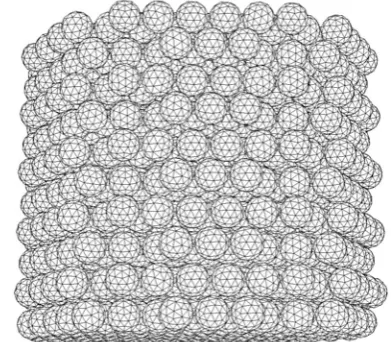
Fig. 1 – Trickle-bed reactor computational mesh
The turbulent flow is modeled through a set of modified k-ε equations with terms that include interphase turbulent momentum derived from the instantaneous equation of the continuous phase and involves the velocity covariance. The equations discussed above are solved using an extension of the SIMPLE algorithm. The momentum equations are decoupled using the full elimination algorithm available in FLUENT in which the variables for each phase are eliminated from the momentum equations for all other phases. The pressure correction equation is obtained by summing the continuity equations for each of the phases. The equations are then solved in a segregated, iterative fashion and are advanced in time. At each time step, with an initial guess for the pressure field, the primary- and secondary-phase velocities are computed. These are used in the pressure correction equation and based on the discrepancy between the guessed pressure field and the computed field, the velocities, L/G holdups and fluxes are suitably modified to obtain convergence in an iterative manner. In the first stage, several runs were computed with sufficiently fine meshes to evaluate this dependency. At this point, it was possible to check the near-wall mesh in the post-processing treatment. The solution independency was then established after several assays with the definition of turbulence boundary conditions available in k-ε model. The boundary conditions at the walls are internally taken care by FLUENT, which obviates the need for boundary condition inputs for k and ε supplied by inlet boundaries, specifically
velocity inlet. Pressure inlet was also tested but the results seem to be well described by the first which specify more realistic boundary conditions at the inlet. It should be pointed that inlet turbulence can significantly affect the downstream flow as observed in high pressure trickle-bed reactor [15]. In the trickle-bed simulations performed, the fidelity of the results for turbulent flows is largely determined by the turbulence model being used and in order to enhance the quality of turbulent flow simulations, the mesh generation accounts for wall-bounded flow, at least on catalyst particle, since the wall is expected to significantly affect the flow.
V. HYDRODYNAMIC VALIDATION
measurements can provide an indirect means of checking on the computations at higher flows, although most comparisons have been made at relatively low flow rates. Therefore, pressure gradient and liquid holdup was the two fundamental hydrodynamic parameters evaluated for the design, scale-up, and performance studies of TBR. Pressure drop is an important parameter in the design of two-phase concurrent reactors because if affects the energy supply and it has been use to correlate the gas-liquid and solid-liquid mass transfer whereas liquid holdup is the liquid volume contained in a unit column volume. It should be pointed that in the model validation it was taken into consideration that almost all the holdup data available in open literature refers to laboratory columns [15].
Several runs simulating operating pressures in the range 10 to 30 bar runs were carried out for the vector field of liquid and gas velocity and for liquid hold up and pressure drop using spherical catalysts with 2 mm diameter. Simulated CFD liquid holdup and pressure drop are represented in Figs. 2 and 3 by lines as a function of liquid mass flux water when the reactor operates with air as the gas phase at different gas flow rates. The experimental data plotted were obtained with one reactor with dimensions described by Nemec and Levec [15]. In the high interaction regime modeled for the gas and liquid phases, the predictions are in good agreement with experimental values which enables the validation of our CFD model. In fact, the computational fluid dynamic model validation was carried out first in single-phase pressure drop simulations with only the gas phase flowing downward the bed; afterwards, two-phase flow is simulated to perform the final comparison between predicted hydrodynamic parameters and experimental data. In the whole range of Re numbers for gas phase, pressure drop predictions are within 10% error when comparing with the literature measurements. The resulting pressure drop is given by the addition of laminar flow local losses with frictional losses. At very low velocities, exclusively laminar or viscous contributions to pressure drop are observed but at higher velocities the laminar term from Blake-Kozeny-Carman equation and the inertial term from Burke-Plummer equation are additive. This mutual contribution that represents the ratio between the static pressure and the hydrostatic pressure is plotted in Fig. 2. The operational region of flow rates (10<ReG<400) is that of
particular interest to TBR and in this ambit Eulerian model fits the pressure drop data as well as liquid holdup quite well within acceptable limits of 10%. Furthermore, taking into account that the detailed knowledge of liquid holdup is essential for safe processing to prevent hot-spot formations and possible runaways that could have significant influence on the liquid residence time distribution, mass- and heat-transfer processes as well as wetting efficiency, our results in terms of liquid holdup were also successfully validated in Fig. 3 avoiding many correlations that have been published in multiphase reactors.
L / (kg/m2s)
0 2 4 6 8 10 12 14 16
1000 10000
G = 0.10 kg/m2s G = 0.30 kg/m2s G = 0.50 kg/m2s G = 0.70 kg/m2s
Δ
P/
L (P
[image:4.595.323.544.85.255.2]a/m)
Fig. 2 – Comparison of simulated pressure drop as a function of liquid mass flux at constant gas flow rates with experimental data [15]
L / (kg/m2s)
0 2 4 6 8 10 12 14 16
0,01 0,1
G = 0.10 kg/m2s G = 0.30 kg/m2s G = 0.50 kg/m2s G = 0.70 kg/m2s
εL
Fig. 3 – Comparison of simulated liquid holdup as a function of liquid mass flux at constant gas flow rates with experimental data [15]
[image:4.595.327.543.300.468.2]exponentially with increasing pressure, the ratio of driving forces and viscous force increases also. This causes a gradual reduction of the liquid saturation in the packed bed. Moreover, the comparison between the hydrodynamic parameters determined at 10 and 40 bar shows that the effect of the reactor pressure has greater influence on the pressure drop than it has on the liquid holdup, as expected. Furthermore, CFD model results state that liquid holdup is slight insensitive to low gas flow rates. This fact could be interpreted by the evolution of liquid holdup as a function of gas density by plotting liquid holdup as a function of superficial mass liquid velocity demonstrating that the theoretical model is able to predict quite well the significant influence of the gas flow rate on the hydrodynamic parameters when comparing the theoretical results with the experimental data sets. It should be also emphasized that the fixed-bed modeled in this work had the tube to particle diameter ratio higher than 10 so the available geometry and data taken from literature should not be affected by the reactor column wall. In accordance to Fig. 3, when the liquid mass flux increases, the liquid holdup also increases for L higher than 8 kg/m2s being the growth rate smaller for the
same total pressure value whereas an increase of the total pressure results in a considerable decrease of liquid holdup. The influence of the gas flow determined by a different operating pressure on the liquid holdup is less pronounced at low values of liquid mass fluxes. For example, in case the reactor operates with a gas flow rate at 0.7 kg/m2s, the liquid
holdup is substantially lower when compared with the case it operates at 0.1 kg/m2s. These higher differences at higher
liquid flow rates result from the fact that a further increase of the reactor pressure at a constant gas velocity corresponds to a higher driving force. The theoretical predictions from the model correctly account for the strong influence of the gas flow on the hydrodynamic behavior of the trickle-bed reactors, as stated by several authors [1]-[4]. The important influence of the gas flow is attributed to the interactions phenomena exerted by the gas phase on the liquid phase. These interactions clearly appear to be significant at high superficial gas mass velocities.
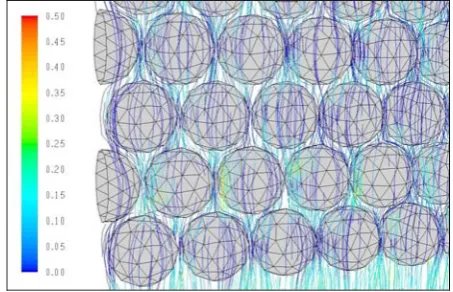
Finally, in order to address CFD flow streamlines, the 3D map taken with a vertical catalyst layer illustrated in Fig. 4 indicate that the velocity is higher at points where the flow is processed downward in axial direction. In accordance to these results, the maximum gas velocity is about 0.5 cm/s (whereas the liquid velocity is about 0.005 cm/s) which is in the range of well accepted trickle flow maps reviewed in the literature [1]. In fact, the TBR hydrodynamics are affected differently in each flow regime and the operating conditions that are of particular interest in the industry is the extensively used trickle flow encountered at low gas and liquid superficial velocities. In the 3D map, it is shown the uniformity in packing structure with spherical particles, but the gas/liquid distribution depends not only on the superficial gas and liquid velocities but also in particle shape and particle equivalent diameters in order to study the effect of particle geometry. Spheres were used by virtue of their unique shape and are incapable of influencing the structure of the bed by their orientation. Some additional differences
[image:5.595.318.545.301.447.2]between the porosities of beds, despite the same packing procedures were due to wall effect, which as mentioned before did not affect the overall pressure drop. With regards to the porosity dependence within the inertial regime, it should be reported in the basis of theoretical simulations of flow through random arrays of spheres that the porosity function is also well taken into account as long as the porosity is around 0.4 as is indeed the case for packed bed reactors when made up of spheres. The values of porosity distribution function for the present CFD Eulerian model were applied in the range from 0.38 to 0.40. It should be also pointed that when the superficial velocity of gas is sufficient to interact comparatively with that of liquid, liquid distribution improves significantly and the pressure drop arises as described elsewhere [13]. In our simulation activities, it was assumed that the trickle-bed reactor has a uniform distributor at the top and we can state that liquid distribution do not depends on the design of the distributor.
Fig. 4 – Gas streamlines colored by axial velocity (cm/s)
VI. REACTION STUDIES
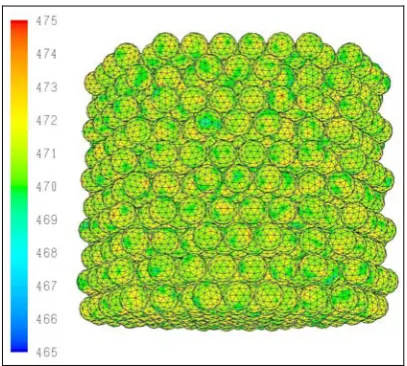
Fig. 5 – Catalyst surface temperature (K)
Furthermore, as the liquid holdup is directly related to the catalyst wetting efficiency that also might affect the reaction yield, in accordance to Fig. 5, the different temperatures ranging from 470 to 474 K attained in different locations of the catalyst particles indicate different reaction rates. These results in terms of catalyst surface temperature for the exothermic oxidation process of the pollutants reflect different wetting levels of the solid by the liquid effluent. Therefore, in the TBR design and scale-up studies external catalyst wetting efficiency is also a hydrodynamic parameter that indicates the utilization degree of catalyst surface area. However, the coupling nature of transport phenomena and kinetics in TBR is far from being completely understood so that general scale-up and scale-down rules for the quantitative description of multiphase flows depends on how phenomenological analysis is correlated with available numerical power to address complex chemical process operational and design issues.
VII. CONCLUSION
A unique physics-based model has been proposed for modeling trickle-bed reactors at elevated pressures aiming to predict the hydrodynamic parameters. The unified approach includes fundamental point force balance and takes into account the influence of gravity in the force balance. The model consists in an Euler-Euler treatment for the fluid phases coupled with the energy equation. The numerical simulations are compared against experimental data to validate the predicted pressure drop and liquid holdup. Operating conditions were simulated with 10-30 bar of reactor pressure while gas and liquid mass flow rate were in the range 0.10 – 0.70 and 0.05 – 15 kg/m2s, respectively. The
novel hydrodynamic model has been found to predict with a reasonable accuracy the experimental data, pointing out that the liquid holdup increases as the liquid mass flux increases and decreases for higher operating pressure values. At low values of pressure drop the liquid holdup is small but with an increasing value of pressure drop due to an increase of the reactor pressure, the liquid holdup growth rate reduces when
the liquid mass flux increases. The influence of operating pressure on liquid holdup is less pronounced than in pressure drop. Finally, CFD runs performed in unsteady state for the catalytic wet air oxidation of one phenolic solution demonstrated the effect of temperature illustrated by catalyst surface temperature 3D map.
ACKNOWLEDGMENT
The authors gratefully acknowledged the financial support of REMOVALS – 6th Framework Program for Research and
Technological Development – FP06 Project no. 018525 and Fundação para a Ciência e Tecnologia, Portugal.
REFERENCES
[1] M. H. Al-Dahhan, F. Larachi, M. P. Dudukovic, and A. Laurent, “High pressure trickle-bed reactors: A Review” Ind. Eng. Chem. Res. 36 (8), 1997, 3292-3314.
[2] R.G. Carbonell, “Multiphase flow models in packed beds” Oil & Gas Science and Technology – Revue de l‘IFP 55, 2000, 417-425. [3] M. P. Dudukovic, F. Larachi, and P. L. Mills, “Multiphase catalytic
reactors: A perspective on current knowledge and future trends” Catal. Rev. 44 (1), 2002, 123.
[4] A. Lakota, J. Levec, R. G. Carbonell, “Hydrodynamics of trickling flow in packed beds: relative permeability concept” A.I.Ch.E. J., 48, 2002, 731.
[5] P. R. Gunjal, M. N. Kashid, V. V. Ranade, and R. V. Chaudhari, “Hydrodynamics of trickle-bed reactors: experiments and CFD modeling” Ind. Eng. Chem. Res. 2005, 44, 6278.
[6] S. T. Sie and R. Krishna, “Process development and scale up: III. Scale-up and scale-down of trickle bed processes” Rev. Chem. Eng. 14, 1998, 203-252
[7] S. Goto and J. M. Smith, “Trickle bed reactors performance: I hold-up and mass transfer effects” A.I.Ch.E. Journal 21, 1975, 706.
[8] R. A Holub, M. P. Dudukovic, and P. A. Ramachandran, “Pressure drop, liquid hold-up and flow regime transition in trickle flow” A.I.Ch.E. Journal 39, 1993, 302.
[9] A. E. Saez and R. G. Carbonell, “Hydrodynamic parameters for gas liquid cocurrent flow in packed beds” A.I.Ch.E. J. 31, 1985, 52. [10] R. J. G. Lopes, A. M. T. Silva, and R. M. Quinta-Ferreira, “Screening
of catalysts and effect of temperature for kinetic degradation studies of aromatic compounds during wet oxidation” Appl. Catal B: Environmental, 73 (1), 2007, 193-202.
[11] FLUENT 6.1., 2005. User’s Manual to FLUENT 6.1. Fluent Inc. Centrera Resource Park, 10 Cavendish Court, Lebanon, USA. [12] A. Attou and G. A. Ferschneider, “Two-fluid model for flow regime
transition in gas–liquid trickle-bed reactors” Chem. Eng. Sci. 54 (21), 1999, 5031-5037.
[13] R. J. G. Lopes, A. M. T. Silva, and R. M. Quinta-Ferreira, “Kinetic Modelling and Trickle-Bed CFD Studies in the Catalytic Wet Oxidation of Vanillic Acid” Ind. Eng. Chem. Res., 2007, in press. [14] GAMBIT 2, 2005. User’s Manual to GAMBIT 2. Fluent Inc. Centrera
Resource Park, 10 Cavendish Court, Lebanon, USA.
![Fig. 2 – Comparison of simulated pressure drop as a function of liquid mass flux at constant gas flow rates with experimental data [15]](https://thumb-us.123doks.com/thumbv2/123dok_us/1330867.664076/4.595.327.543.300.468/comparison-simulated-pressure-function-liquid-constant-rates-experimental.webp)