Classifying Referential and Non-referential
It
Using Gaze
Victoria Yaneva, Le An Ha, Richard Evans, and Ruslan Mitkov
Research Institute in Information and Language Processing, University of Wolverhampton, UK
{v.yaneva, ha.l.a, r.j.evans, r.mitkov}@wlv.ac.uk
Abstract
When processing a text, humans and machines must disambiguate between different uses of the pronounit, including non-referential, nom-inal anaphoric or clause anaphoric ones. In this paper, we use eye-tracking data to learn how humans perform this disambiguation. We use this knowledge to improve the automatic classification of it. We show that by using gaze data and a POS-tagger we are able to sig-nificantly outperform a common baseline and classify between three categories of it with an accuracy comparable to that of linguistic-based approaches. In addition, the discrimi-natory power of specific gaze features informs the way humans process the pronoun, which, to the best of our knowledge, has not been ex-plored using data from a natural reading task.
1 Introduction
Anaphora resolution is both one of the most im-portant and one of the least developed tasks in Nat-ural Language Processing (Lee et al., 2016). A particularly difficult case for anaphora resolution systems is the pronounit, as it may refer to a spe-cific noun phrase or an entire clause, or it may even refer to nothing at all, as in sentences 1 - 3 below1.
1. “I couldnt say exactly, sir, but it wasnt tea-time by a long way.” (Pleonastic it (non-referential)).
2. Now, as to this quarrel. When was the first time you heard of it?(Nominal anaphoric)
3. You have been with your mistress many years, is it not so?(Clause anaphoric2.)
1
Extracted from the GECO corpus (Cop et al.,2016) 2Some authors also distinguish other, less-common types
of the pronoun it such as proaction, cataphoric, discourse topic, and idiomatic, among others (Evans,2001).
This phenomenon is not specific only to En-glish; pronouns that can be used both referentially and non-referentially exist in a variety of language groups such as the pronoun‘het’in Dutch,‘det’in Danish,‘ello’in Spanish,‘il’in French, etc.
In NLP, there has been active research in the area of automatic classification of it during the past four decades but the issue is far from being solved (Section2). According to corpus statistics, the pronoun it is by far the most frequently used pronoun in the English language (Li et al.,2009), and as recently as 2016, incorrect classification of different cases ofit and their antecedents is high-lighted as one of the major reasons for the failure of question-answering systems (Lee et al.,2016). In the state of the art, the best approaches to clas-sifyingitachieve between 2% and 15% improve-ment over a majority baseline when assigning ex-amples of the pronoun to more than two classes.
In contrast with the extensive research in NLP, very little is known about the way humans ap-proach the disambiguation of it. To the best of our knowledge,Foraker and McElree(2007) is the only study on this subject that uses online mea-sures of reading. It proves empirically that the pronounitis resolved more slowly and less accu-rately than gendered pronouns due to its ambigu-ity. So far there have been no studies investigating the subject using natural reading data as opposed to artificially created controlled sentences.
In this paper we approach these two problems as one and hypothesise that obtaining information on the way humans disambiguate the pronoun can improve its automatic classification.
show that by using gaze data and a POS tagger we are able to achieve classification accuracy of three types of it that is comparable to the performance of linguistic-based approaches and that outperforms a common baseline with a statistically significant difference. In addition, ex-amining the discriminatory power of specific gaze features provides valuable information about the human processing of the pronoun. We make our data, code and annotation available at https: //github.com/victoria-ianeva/
It-Classification. The GECO
eye-tracking corpus is available at http:
//expsy.ugent.be/downloads/geco/.
2 Related Work
Gaze data in NLP While eye-movement data has been traditionally used to gain understanding of the cognitive processing of text, it was recently applied to a number of technical tasks such as part-of-speech tagging (Barrett et al., 2016), de-tection of multi-word expressions (Rohanian et al.,
2017;Yaneva et al.,2017), sentence compression (Klerke et al.,2016), complex-word identification (ˇStajner et al.,2017), and sentiment analysis ( Rot-sztejn, 2018). Eye movements were also shown to carry valuable information about the reader and were used to detect specific conditions affecting reading such as autism (Yaneva et al.,2018,2016) and dyslexia (Rello and Ballesteros, 2015). The motivation behind these approaches is two-fold. First, eye tracking is already making its way into everyday use with interfaces and devices that fea-ture eye-tracking navigation (e.g. Windows Eye Control3). Second, linguistic annotation by gaze is faster than traditional annotation techniques, does not require trained annotators, and provides a language-independent approach that can be ap-plied to under-resourced languages (Barrett et al.,
2016). This is particularly interesting for the case of non-referential pronouns, as the phenomenon exists in different languages.
Classification ofit The majority of the machine learning approaches to classifying the pronoun
it in different languages are based on linguistic features capturing token, syntactic and semantic context. Different papers report varying majority baseline metrics (between 50% and 75%) depend-ing on the annotated corpora, and an improvement
3
https://support.microsoft.com/en-gb/help/4043921/windows-10-get-started-eye-control
over the majority baselines of between 2% and 15% for classification of more than two classes of
it(Lo´aiciga et al.,2017;Uryupina et al.,2016;Lee et al.,2016;M¨uller,2006;Boyd et al.,2005;Hoste et al.,2007;Evans,2001). For example,Lo´aiciga et al.(2017) train a bidirectional recurrent neural network (RNN) to classify three classes of it in the ParCor corpus (Guillou et al.,2014) and com-pare its performance to a feature-based maximum entropy classifier. The RNN achieves accuracy of 62% compared to a majority baseline of 54% and is significantly outperformed by the linguistic-feature classifier which obtained 68.7% accuracy.
Lee et al.(2016) compare several statistical mod-els and report 75% accuracy for four-class classi-fication over a majority baseline of around 62% using linguistic features and a stochastic adaptive gradient algorithm. They also report that exper-imenting with word embeddings did not lead to more accurate classification. So far, approaches using linguistic features still represent the state of the art in the classification ofit.
3 Data
Corpus: The eye-tracking data was extracted from the GECO corpus (see Cop et al. (2016) for full corpus specifications) which is the largest and most recent eye-tracking corpus for English at present. The text of the corpus is a novel by Agatha Christie entitled “The Mysterious Affair at Styles”, the English version of which contains 54,364 tokens and 5,012 unique types. The entire novel was read by 14 native English undergradu-ates from the University of Southampton using an eye-tracker with a sampling rate of 1 kHz.
Annotation scheme: A total of 1,052 instances ofit were found in the corpus4. Each of the in-stances ofitwas annotated by two annotators and assigned to one of three categories: Pleonastic, Nominal anaphoric and Clause anaphoric, fol-lowing the scheme used byLee et al.(2016). The annotators were free to view as much of the pre-vious text as necessary to decide on a label. The inter-annotator agreement for the three categories wasκ= 0.636, p<0.0005, indicating substantial agreement between the annotators. This number corresponds to a percentage agreement of 77.47% for the three categories and is comparable to the
4This number does not include the possessive pronoun
Annotat. 1 Annotat. 2 Final Pleonastic 339 (33%) 406 (38%) 272 (33%) Nom. anaph. 492 (46%) 527 (50%) 453 (56%) Clause anaph. 221 (21%) 119 (11%) 89 (11%)
Table 1: Annotation categories
Prev. “It” Next It + Next Early 61.1 60.3 61.7 61 Medium 60.9 60.5 60.6 61.2
Late 58.9 60.2 61 61.4
Table 2: Weighted F1 scores for an ablation study for different gaze feature groups over the Previous and Next word baseline (60.4)
81% agreement reported inLee et al.(2016). We perceived adjudication between cases of disagree-ment (237 instances) to be extremely arbitrary, so those cases were excluded rather than resolved. Examples of such arbitrary cases include:
• ”Sit down here on the grass, do. It’s ever so much nicer.”(nominal vs. clause anaphoric)
• It’s a jolly good life taking it all round...if it weren’t for that fellow Alfred Inglethorp!”
(pleonastic vs. clause anaphoric)
The distribution of each class of the retained data by annotator is presented in Table1. We make the full annotations of both annotators available.
4 Experiments
Overview In order to test the extent to which gaze data can help the classification of different cases ofit, we trained and compared three separate classifiers. The first classifier is based on gaze fea-tures, the second one is based on linguistic features and finally, we trained a combined classifier using both gaze and linguistic features. We compared the performance of these classifiers to a majority baseline of 55.7 and to another baseline obtained by using the tokens surrounding the pronoun (pre-vious and next word) as features (60.4). We also experimented with adding word embeddings6 for the surrounding tokens as features. While the full exploration of word embeddings for the classifica-tion ofitremains outside of the scope of this work, it would be interesting to explore whether the em-beddings add value to the models by encoding in-formation that was not otherwise captured.
5
Except L4 and L3
6300-dimensional vectors from Google
News obtained through word2vec:
https://code.google.com/archive/p/word2vec/
Ling Gaze Comb
EARL
Y First Run Fixation CountFirst Run Fixation % * * First Fixation Duration
First Fixation Visited Count †*
First Fix Progressive †*
MEDIUM
Second Run Fixation Count
Second Run Fixation % *
Second Fixation Duration * †*
Second Fixation Run * *
Gaze Duration †
LA
TE
Third Run Fixation Count
Third Run Fixation % †
Third Fixation Duration †*
Third Fixation Run *
Last Fixation Duration * †*
Last Fixation Run
Go Past Time †
Selective Go Past Time †
Fixation Count †
Fixation % * †
Total Reading Time
Total Reading Time % * *
Trial Fixation Count *
Trial Total Reading Time Spillover
Skip *
LINGUISTIC
Word position + +
# Preceding NPs in sentence # Preceding NPs in paragraph # Following NPs in sentence # NPs in the sentence
# NPs in the paragraph +
# Following adject. in sentence
Previous verb +
Following adjective + +
Following verb + +
POS in posit. L4, L3, L2, L1 + +5 +
POS in posit. R4, R3, R2, R1 + + + # Following complementisers + + An adjective before the next NP + + Words until next complementiser + + Words until next infinitive + + Words until next preposition +
Words until next ing verb + +
A compl. before the next NP Immediately preceding preposit.
B
ASIC
Previous word + + +
Next word + + +
Word length + +
Punctuation +
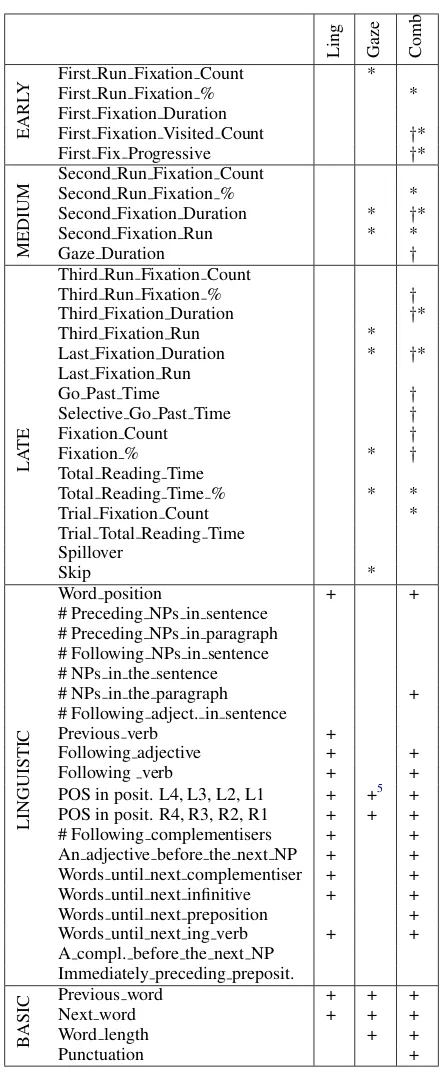
Table 3: List of features and their inclusion in the dif-ferent models. + refers to linguistic data, * to added values for theIt + Nextregion, and†to gaze features for the previous word region. The features that do not have marks in the last three columns were not retained in any of the three best models.
experiments can be seen in Table3.
Different eye-tracking measures (usually di-vided intoearlyandlate) are indicative of different aspects of cognitive processing. Early gaze mea-sures such asFirst Fixation Duration give infor-mation about the early stages of lexical access and syntactic processing, while late measures such as
Total Reading Time orNumber of Fixations give information about processes such as textual in-tegration and disambiguation (see Rayner et al.
(2012) for a review). In Table 3, the distinction betweenEarly, Medium andLategaze features is mainly based on the run during which the fixa-tions were made (i.e. whether the eyes were pass-ing through the text for the first, second or third time). For each run we report count measures, percentage measures (as part of the trial) and du-ration measures (in milliseconds). Additional late features reported include Last Fixation Duration
and Last Fixation Run (the run during which the last fixation in a given region occurred),
Total Reading Time (in msec and %), and
Trial Fixation Count (the overall number of fix-ations within the trial). Go Past Time refers to the summation of all fixation durations on the cur-rent word during the first pass. Spilloverrefers to the duration of the first fixation made on the next word after leaving the current word in the first run. Finally, a word is considered skipped if no fixa-tion occurred during the first run (Skip). A com-plete legend explaining each feature can be found within the corpus metadata.
An ablation study on the contributions of indi-vidual groups of gaze features towards the classi-fication ofitis presented in Table2.
Linguistic features We implemented a set of features originally proposed byEvans(2001) and subsequently used extensively in the studies pre-sented in Section2. In terms of features and cat-egories of it, the study by Evans (2001) is the most fine-grained one we could find, classifying 7 categories ofit with 69% accuracy. The set of features from Evans(2001) is presented in Table
3. These features synthesize information based on corpus studies of the pronounit and thus aim to capture positional, part-of-speech and proximity information, as well as specific patterns of usage. For example, Evans (2001) notes that pleonastic pronouns rarely appear immediately after a prepo-sitional word and that complementisers or adjec-tives often follow pleonastic instances. Another
P R F1
Baselines
Majority baseline 55.7
Previous + Next word 62.1 63.9 60.4
Embeddings
Prev. + Next Embed. 63.1 64.4 62.1
Linguistic models
Full feature set 63.4 66 63.2
Best linguistic 66.7 68.8 66.1*
Best linguistic + Embed. 66.9 68.8 67.2*
Gaze-based models
Basic + POS 63.3 64.5 62.2
Select. Gaze + Basic 65.8 66.8 64.2 Select. Gaze + Basic + POS 66.6 67.9 65.6* S. Gaze + Bas. + POS + Embed. 66.3 68.8 66.7*
Combined model
Best Gaze + Ling 71 71.5 68.8*
[image:4.595.307.524.61.283.2]Best Gaze + Ling. + Embed. 67.5 69.3 671*
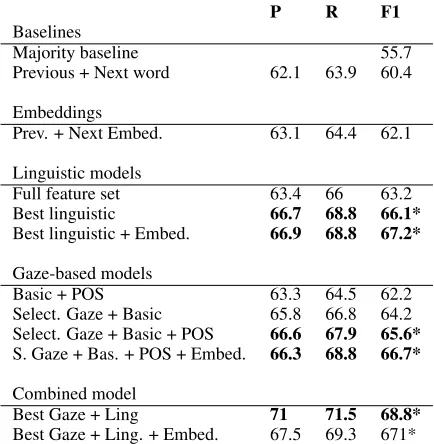
Table 4: Precision, Recall and Weighted F1 for the var-ious classifiers. The * symbol marks statistical signif-icance compared to the baseline model of Previous + Next Word (60.4).
pattern that distinguishes the pleonastic use of it
is associated with certain sequences of elements such as ‘adjective + noun phrase’ and ‘comple-mentiser + noun phrase’ (Evans,2001). Therefore, the linguistic features proposed by Evans (2001) and used in our experiments make possible the uti-lization of corpus-based knowledge for the auto-matic classification ofit.
Classification We use simple logistic regression as implemented in WEKA (Hall et al.,2009) with 10-fold cross validation and a random seed pa-rameter 20. Since logistic regression is an inter-pretable method, we are able to assess the perfor-mance of individual features and gain insight into the psycholinguistic processing of the pronoun.
We experimented with gaze features for the in-dividual words but as gaze data is inherently very noisy, we found that smoothing the features by adding the ones that correspond to the pronoun and the next word stabilized the results. Adding the gaze features for the previous word signifi-cantly reduced the performance but using them separately in a model with the addedIt + Next fea-tures maximised our results. For the role of indi-vidual features in the models see Table3.
multi-plying it by the number of instances in the class. Then the F1 scores for all classes are summed up and divided by the total number of instances. The resulting weighted F1 score is lower than the tradi-tionally reported mean F1 score, but it represents the effects of class imbalance more accurately.
5 Results and Discussion
The results from the classification experiments presented in Table 4 have implications for lan-guage processing by both humans and machines.
From the NLP perspective, the potential of gaze data to not only improve but also, to a certain ex-tent, substitute text processing approaches is an exciting new frontier. Our results show that the gaze-based classifier performs on par with the one using linguistic features and both of them perform significantly better7than the baseline of 60.4. An improvement of 13% over the majority baseline is achieved when combining the two but this differ-ence is not a significant improvement over the in-dividual best classifiers. A possible reason for this is that the gaze data and linguistic features encode similar information about the disambiguation ofit
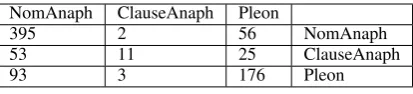
and adding them together leads to overlap instead of complementation. In all three classifiers, the clause-anaphoric class was consistently predicted with lowest accuracy (Table 5), which is not sur-prising given that it only accounts for 11% of the retained data. In line with the observation ofLee et al.(2016) (Section2), the embeddings do not show a stable contribution. In our case, this is likely related to the small amount of data, to which we add 300 dimensions per word.
Overall, the improvement achieved by the clas-sifiers is comparable with the current state-of-the-art (Section2). It is important to note that this is the first study to use text from the domain of liter-ature and that this may have influenced the extrac-tion of the linguistic features. At the same time, literature can be regarded as a more challenging domain than the declarative texts used in previous research, owing to the creative use of language.
From a psycholinguistic perspective, we pro-vide epro-vidence that, indeed, the three classes ofit
are processed differently. We observe that medium and late gaze features related to disambiguation are more discriminative than the early ones. For
7Gaze + Basic + POS:
p= 0.029, 95% CI (0.509; 9.858) ; Best Linguistic:p= 0.0017, 95% CI (1.01; 10.34); Best Gaze + Ling: p= 0.0004, 95% CI (3.75; 12.99). The CI indicate the difference in %
NomAnaph ClauseAnaph Pleon
395 2 56 NomAnaph
53 11 25 ClauseAnaph
[image:5.595.309.516.61.108.2]93 3 176 Pleon
Table 5: Confusion matrix for the best combined model (Weighted F1 = 68.8)
example, measures such as first fixation duration were not included in any of the models, while re-visits as late as the third run (the third time the eyes pass over the region of interest) occurred in these regions and provided a strong signal. Particularly useful features were the durations of the second and last fixations, as well as the information about the run (pass) during which they occur.
The significance of these features in the best classifiers somewhat contradicts the ablation study presented in Table2. According to that table, early processing features for the preceding and next words are expected to outperform the late ones. A possible explanation for this are predictability and spillover effects, as the pronoun it is both highly predictable and easy to skip, because of its high frequency and shortness. Indeed, the gaze features from the it-region itself are not as useful as the ones from the surrounding words.
The results from this study showed that: i) gaze features encode information about the way hu-mans disambiguate the pronounit, ii) that this in-formation partially overlaps with the inin-formation carried by linguistic features, and that iii) gaze can be used for automatic classification of the pronoun with accuracy comparable to that of linguistic-based approaches. In our future work we will at-tempt to identify specific patterns of cognitive pro-cessing for the individual classes, as well as ex-plore factors related to the readers.
6 Conclusion
References
Maria Barrett, Joachim Bingel, Frank Keller, and An-ders Søgaard. 2016. Weakly supervised part-of-speech tagging using eye-tracking data. In Proceed-ings of the 54th Annual Meeting of the Association for Computational Linguistics (Volume 2: Short Pa-pers), volume 2, pages 579–584.
Adriane Boyd, Whitney Gegg-Harrison, and Donna Byron. 2005. Identifying non-referential it: a machine learning approach incorporating linguisti-cally motivated patterns. In Proceedings of the ACL Workshop on Feature Engineering for Machine Learning in Natural Language Processing, pages 40–47. Association for Computational Linguistics.
Uschi Cop, Nicolas Dirix, Denis Drieghe, and Wouter Duyck. 2016. Presenting GECO: An eyetracking corpus of monolingual and bilingual sentence read-ing. Behavior research methods, pages 1–14.
Richard Evans. 2001. Applying machine learning to-ward an automatic classification of it. Literary and linguistic computing, 16(1):45–58.
Stephani Foraker and Brian McElree. 2007. The role of prominence in pronoun resolution: Active ver-sus passive representations. Journal of Memory and Language, 56(3):357–383.
Liane Guillou, Christian Hardmeier, Aaron Smith, J¨org Tiedemann, and Bonnie Webber. 2014. Parcor 1.0: A parallel pronoun-coreference corpus to support statistical mt. In 9th International Conference on Language Resources and Evaluation (LREC), MAY 26-31, 2014, Reykjavik, ICELAND, pages 3191– 3198. European Language Resources Association.
Mark Hall, Eibe Frank, Geoffrey Holmes, Bernhard Pfahringer, Peter Reutemann, and Ian H Witten. 2009. The weka data mining software: an update.
ACM SIGKDD explorations newsletter, 11(1):10– 18.
Veronique Hoste, Iris Hendrickx, and Walter Daele-mans. 2007. Disambiguation of the neuter pronoun and its effect on pronominal coreference resolution. InInternational Conference on Text, Speech and Di-alogue, pages 48–55. Springer.
Sigrid Klerke, Yoav Goldberg, and Anders Søgaard. 2016. Improving sentence compression by learning to predict gaze.arXiv preprint arXiv:1604.03357.
Timothy Lee, Alex Lutz, and Jinho D Choi. 2016. Qa-it: Classifying non-referential it for question answer pairs. InProceedings of the ACL 2016 Student Re-search Workshop, pages 132–137.
Yifan Li, Petr Musilek, Marek Reformat, and Loren Wyard-Scott. 2009. Identification of pleonastic it using the web. Journal of Artificial Intelligence Re-search, 34:339–389.
Sharid Lo´aiciga, Liane Guillou, and Christian Hard-meier. 2017. What is it? disambiguating the differ-ent readings of the pronoun it. InProceedings of the 2017 Conference on Empirical Methods in Natural Language Processing, pages 1325–1331.
Christoph M¨uller. 2006. Automatic detection of non-referential it in spoken multi-party dialog. In 11th Conference of the European Chapter of the Associa-tion for ComputaAssocia-tional Linguistics.
Keith Rayner, Alexander Pollatsek, Jane Ashby, and Charles Clifton Jr. 2012. Psychology of reading. Psychology Press.
Luz Rello and Miguel Ballesteros. 2015. Detecting readers with dyslexia using machine learning with eye tracking measures. InProceedings of the 12th Web for All Conference, page 16. ACM.
Omid Rohanian, Shiva Taslimipoor, Victoria Yaneva, and Le An Ha. 2017. Using gaze data to predict mul-tiword expressions. InProceedings of the Interna-tional Conference Recent Advances in Natural Lan-guage Processing, RANLP 2017, pages 601–609.
Jonathan Rotsztejn. 2018. Learning from cogni-tive features to support natural language processing tasks. Master’s thesis, ETH Zurich.
Sanja ˇStajner, Victoria Yaneva, Ruslan Mitkov, and Si-mone Paolo Ponzetto. 2017. Effects of lexical prop-erties on viewing time per word in autistic and neu-rotypical readers. InProceedings of the 12th Work-shop on Innovative Use of NLP for Building Educa-tional Applications, pages 271–281.
Olga Uryupina, Mijail Kabadjov, and Massimo Poe-sio. 2016. Detecting reference and non-anaphoricity. In Anaphora Resolution, pages 369– 392. Springer.
Victoria Yaneva, Le An Ha, Sukru Eraslan, Yeliz Yesi-lada, and Ruslan Mitkov. 2018. Detecting autism based on eye-tracking data from web searching tasks. In Proceedings of the Internet of Accessible Things. ACM.
Victoria Yaneva, Shiva Taslimipoor, Omid Rohanian, and Le An Ha. 2017. Cognitive processing of mul-tiword expressions in native and non-native speak-ers of english: Evidence from gaze data. In Inter-national Conference on Computational and Corpus-Based Phraseology, pages 363–379. Springer.