Original citation:
Lloyd, Kevin, Sanborn, Adam N., Leslie, David and Lewandowsky, Stephan (2017) Why does
higher working memory capacity help you learn? In: CogSci 2017, London, 26-29 Jul 2017.
Published in: Proceedings of the 39th Annual Conference of the Cognitive Science Society.
(in press).
Permanent WRAP URL:
http://wrap.warwick.ac.uk/90819
Copyright and reuse:
The Warwick Research Archive Portal (WRAP) makes this work by researchers of the
University of Warwick available open access under the following conditions. Copyright ©
and all moral rights to the version of the paper presented here belong to the individual
author(s) and/or other copyright owners. To the extent reasonable and practicable the
material made available in WRAP has been checked for eligibility before being made
available.
Copies of full items can be used for personal research or study, educational, or not-for-profit
purposes without prior permission or charge. Provided that the authors, title and full
bibliographic details are credited, a hyperlink and/or URL is given for the original metadata
page and the content is not changed in any way.
Publisher’s statement:
http://cognitivesciencesociety.org/wp-content/uploads/archival/cognitivesciencesociety.org/conference_archival.html
A note on versions:
The version presented here may differ from the published version or, version of record, if
you wish to cite this item you are advised to consult the publisher’s version. Please see the
‘permanent WRAP URL’ above for details on accessing the published version and note that
access may require a subscription.
Why Does Higher Working Memory Capacity Help You Learn?
Kevin Lloyd ([email protected])
Gatsby Computational Neuroscience Unit 25 Howland Street, London, W1T 4JG, UK
Adam Sanborn ([email protected])
Department of Psychology, University of Warwick University Road, Coventry, CV4 7AL, UK
David Leslie ([email protected])
Department of Mathematics and Statistics, Lancaster University Lancaster, LA1 4YF, UK
Stephan Lewandowsky ([email protected])
School of Experimental Psychology and Cabot Institute, University of Bristol Clifton, BS8 1TU, UK
Abstract
Algorithms for approximate Bayesian inference, such as Monte Carlo methods, provide one source of models of how people may deal with uncertainty in spite of limited cognitive resources. Here, we model learning as a process of sequential sampling, or ‘particle filtering’, and suggest that an individ-ual’s working memory capacity (WMC) may be usefully mod-elled in terms of the number of samples, or ‘particles’, that are available for inference. The model qualitatively captures two distinct effects reported recently, namely that individuals with higher WMC are better able to (i) learn novel categories, and (ii) flexibly switch between different categorization strategies.
Keywords:Bayesian inference; particle filter; working
mem-ory; category learning; knowledge restructuring
Introduction
Humans often behave in a manner consistent with Bayesian principles (Chater & Oaksford, 2008) yet how they achieve this is unclear. Though simple in principle, exact Bayesian calculations are frequently intractable in real-world settings, leading to a need for approximations. In statistics and com-puter science, this challenge has been met through the de-velopment of powerful, general-purpose techniques for ap-proximate Bayesian inference, such as Monte Carlo meth-ods, which allow practical application of Bayesian methods in complex domains. The practical success of these tech-niques has naturally prompted an interest in whether people deal with uncertainty in an analogous manner (Griffiths, Vul, & Sanborn, 2012). Importantly, such algorithms can approx-imate probabilistic inference arbitrarily well when sufficient time and memory are available, thereby providing a bench-mark for ideal performance, but also display systematic de-viations from the normative solution when resources are lim-ited. These latter ‘qualitative fingerprints’ may be particu-larly illuminating when considering human cognition, where constraints on information-processing capacity are typically assumed. A salient example is provided by limits on work-ing memory capacity (WMC; Cowan, 2001). While the exact nature of these limits remain the subject of debate, one promi-nent conception is that they reflect a limited resource which is
shared across representations and processes in working mem-ory (e.g., Just & Carpenter, 1992).
In the current work, we consider WMC limits within the context of Bayesian inference, asking whether WMC may be usefully modelled as a constraint oninferentialresources. In particular, we model the learning process as one ofparticle
filtering, in which a series of probability distributions is
rep-resented by a limited set of samples (‘particles’) which are sequentially updated over time (Griffiths et al., 2012). Higher WMC is then assumed to be implemented as a greater num-ber of particles. This approach is applied to two recent exper-iments which indicate positive effects of higher WMC on two distinct aspects of categorization: (i) the facility with which novel categories are learned (Lewandowsky, 2011); and (ii) the ability to flexibly switch between different category rep-resentations or response strategies, referred to asknowledge
restructuring(Sewell & Lewandowsky, 2012). We show that
both of these effects are qualitatively captured by a single model in which WMC is equated with the number of parti-cles available for inference — i.e., thenumber of hypotheses
about category structure that an individual can concurrently entertain.
WMC and Category Learning
WMC and Knowledge Restructuring
Sewell and Lewandowsky (2012) assessed the relationship between WMC and performance in a knowledge restructur-ing (KR) task. Participants were guided to use one particular categorization strategy in a binary classification task before being instructed to switch to an alternative, equally-effective strategy (Fig 1A). The stimuli, rectangles of varying height with a vertical bar located at different locations along their base, belonged to categoryAorBdepending on their position in category space (Fig 1B). Crucially, training stimuli (filled circles) were clustered into two separate regions of category space (as indicated by different colours), with categories ar-ranged so that partial category boundaries (solid lines) could not be integrated in a coherent manner; neither partial bound-ary could be extended so as to allow accurate classification of all stimuli in the other cluster. A third, binary ‘context’ dimension was systematically mapped onto the two training clusters so that stimuli belonging to distinct clusters appeared in different colours (see example stimuli, lower Fig 1B).
At the task outset, participants were given information de-signed to guide them towards using one of two different strategies for co-ordinating partial categorization rules: (1)
aknowledge partitioning (KP) strategy was encouraged by
imparting that the context variable (colour) could be used to determine which dimension to use (rectangle height or bar po-sition) for categorization; (2) acontext-insensitive(CI) strat-egy was instead encouraged by highlighting that bar position could be used to determine which partial boundary to apply (i.e., regardless of context). Both strategies could support per-fect performance but predicted different patterns of general-ization when applied to new stimuli (open squares, Fig 1B) in a transfer test, thereby revealing which strategy was in use (Fig 1C). A summary ‘context sensitivity’ (CS) measure was applied to participants’ test patterns to quantify the degree to which they generalized in a manner consistent with the KP (high CS) or CI (low CS) strategy (Fig 1D).
Critically, Sewell and Lewandowsky found evidence that individuals with higher WMC were more adept at switch-ing between these different categorization strategies when in-structed to do so, as measured by how much their CS scores changed between tests. This was interpreted in terms of greater ‘knowledge restructuring’, i.e., ability to coordinate different category representations or response requirements.
Modelling Approach
Our model comprises three parts: 1) assumptions about how participantsrepresentcategories, specified in terms of an ex-plicit generative process; 2) a procedure by which participants are assumed toinfercategories in light of prior assumptions and experimental stimuli; and 3) a means for translating par-ticipants’ beliefs intochoice(i.e., a predicted category label). Our description focuses on how the modelling approach is applied to the KR task; the SHJ tasks are simpler and easily modelled with only minor modifications.
Train Strategy
Session 1
Transfer Test 1
Transfer Test 2
“switch”
A B
C D
bar position
rec
tangle heigh
t
context 1 context 2
CI
KP
A B
A B
Train Strategy
Session 2
Transfer Test 3
Transfer Test 4
“switch”
0 0.5 1
CI-first condition KP-first condition
Transfer Test
1 2 3 4
Con
te
xt S
ensitivit
y
1
2
Figure 1: (A) Knowledge restructuring (KR) task design. (B) Experimental stimuli, depicted in category space: position of a vertically-oriented bar (x-axis) vs. height of rectangle (y -axis). Filled circles denote training stimuli; open squares de-note test stimuli; solid lines indicate the partial rule bound-aries. Two example stimuli are shown underneath. (C) ‘Ideal’ predicted response profiles given exclusive use of a context-insensitive (CI; top row) or knowledge-partitioning (KP; bot-tom row) strategy during test. Darker shading indicates a higher probability of classifying as category A. (D) Aver-age context-sensitivity (CS) scores across participants during transfer tests, indicating use of CI (low) or KP (high) strategy. Figures B–D adapted from Sewell and Lewandowsky (2012).
Category Representation
A number of representational formats for categories have been discussed in the literature. Here, we opted to use
classi-fication and regression tree(CART) models (Breiman,
Fried-man, Olshen, & Stone, 1984). Firstly, these are well-suited to cases in which categories are readily described in terms of simple rules, particularly if an ordering on these rules is suggested (as in the KR task). Secondly, the classifica-tion boundaries generated by CART models lead naturally to ‘axis-aligned’ generalization patterns like those observed in the KR task (participants’ response profiles were very similar to those shown in Fig 1C), whereas producing this behaviour is non-trivial for other category models.
Briefly, CART models provide a flexible method for spec-ifying the conditional distribution of a binary category la-bel y given a p-dimensional stimulus feature vector x= (x1,x2, . . . ,xp). In the KR task, for a given stimulus on
trialt, we haveyt∈ {A,B}and a 3-dimensional input xt=
(xt,1=bar positiont∈R,xt,2=heightt∈R, xt,3=contextt∈
[image:3.612.316.557.69.266.2]A). The sequence of partitions can be represented as a binary tree (Fig 2).
Formally, a binary tree structure T consists of a hierar-chy of nodesη∈T. Nodes with children areinternalnodes, while nodes without children areleaf nodes (Fig 2A). Each node is associated with a blockB(η)⊆Rpof the input space
as follows: the root node is associated with the entire input space, while each further internal node splits its block into two halves by selecting a single dimensionκ(η) ={1, . . . ,p}
and locationτ(η)on which to split (Fig 2B). The block of input space associated with a node η is determined by the
ranges on each dimension jwhich it covers, and we denote the corresponding rangeRηj = [Rη,j−,Rη,j+]. We call the tuple
T
= (T,κ,τ)thedecision tree.η
ηL ηR
Internal node
Leaf nodes
Dimension 1 Dimension 2 B(η )L B(η )R
τ(η)
A B Β(η)
Figure 2: (A) Simple binary tree with (internal) root node
η which splits into two ‘leaf’ nodes,ηL andηR. (B)
Cor-responding split of a two-dimensional input space. The root nodeηis associated with the full input space,B(η). Here, nodeηis split on dimension 1,κ(η) =1, at a locationτ(η). This splits the input space into two blocks,B(ηL)andB(ηR),
associated with the leaf nodesηLandηR.
In addition to a decision tree
T
withKleaf nodes, a parameterΘ= (θ1,θ2, . . . ,θK) associates parameter valueθk with the
kth leaf node. If a stimulusxlies in the region of thekth leaf node, theny|x has distribution f(y|θk)for some parametric
familyf. It is typically assumed that, conditional on(Θ,
T
),yvalues within a leaf node are i.i.d. and thatyvalues across leaf nodes are independent. Thus, lettingnk denote the number
of observations assigned to thekth leaf node and lettingyk,i
denote theith observation ofyassigned to leafk,
p(y1:n|x1:n,Θ,
T
) =K
∏
k=1
nk
∏
i=1
f(yk,i|θk), (1)
wheren=∑Kk=1nkis the total number of observations.
Prior beliefs about category structure can be formalized as a prior distribution on decision trees, specified via a stochastic generative process. Following Chipman, George, and McCul-loch (1998), we set the prior probability of a nodeηin tree
structureTbeing split into children nodes to
pSPLIT(η,T) =
α (1+dη)β
, (2)
wheredηdenotes the depth of the node, andα<1 andβ≥
0 are parameters controlling expected tree size. Under this specification, the probability pSPLITis a decreasing function
of node depth, and decreases more steeply for largeβ.
In addition to this prior on tree structureT, we generally
assume that the probability of splitting on each dimension is equal,
p(κ(η) =j) =1/p, j=1, . . . ,p, (3)
and that split location is then drawn uniformly from the node’s range,
τ(η)|κ(η) =j∼
U
(Rη,j−,Rη,j+). (4)However, in the KR task, participants were guided towards a particular strategy by being told in the first instance that stimulus colour (KP-first condition) or bar position (CI-first condition) reliably indicated whether height or bar position was diagnostic of stimulus category. To incorporate this ad-ditional information, we assume a bias termb≤1 which as-signs higher probability to splitting the root node η0on the
dimension j∗highlighted by instruction:
p(κ(η0)) = (
b ifκ(η0) =j∗,
1−b
2 otherwise.
(5)
The generative model is completed by the conditional probabilities of stimulus labels given the tree structure,
p(y1:t|x1:t,
T
). We assume that thekth leaf node has anas-sociated probabilityθkof generating labelA,
p(yt|θk,xt) =θkyt(1−θk)1−yt, (6)
and that this probability is an i.i.d. draw from a Beta
distri-bution,θk iid
∼Beta(a0,b0). Standard analytical simplification
then yields the marginal likelihood
p(y1:t|T,x1:t) =
Γ(a0+b0) Γ(a0)Γ(b0)
K K
∏
k=1Γ(ntkA+a0)Γ(ntk·−ntkA+b0) Γ(ntk·+a0+b0)
,
(7)
wherentkAandntk·are respectively the number of instances of categoryAand the total number of data points in the partition of leafkup to trialt. Note that for a given tree, this likeli-hood is higher for leaves assigned observations with homoge-nous labels, and these are exactly the partitions that constitute ‘good’ solutions to the categorization problem.
Inference
Participants are assumed to approximate the sequence of pos-terior distributions{p(
T
|x1:t,y1:t)}Tt=1over trials. Given theimplausibility of enumerating all possible trees, participants are assumed to represent a relatively small number of sam-ples, i.e. hypotheses, from these posterior distributions which can be updated over time. In other words, we assume partici-pants perform particle filtering.
Two aspects of the inference process which we now de-scribe draw parallels with working memory. Firstly, simi-lar to the idea of a limit on the number of items that can be held in working memory (Cowan, 2001), we assume there is a bounded number of hypotheses about category structure — in this case, the particles which correspond to specific tree structures — that can be entertained at a given time. Sec-ondly, similar to the notion that working memory isactive
[image:4.612.55.301.250.326.2]passive storage of items, we assume that inference involves a continual process whereby local transformations to current hypotheses are proposed, and which may be accepted or re-jected. The latter process promotes diversity in the hypothesis set and continuous exploration of the hypothesis space.
In detail, we assume that on trialt, a participant’s beliefs are represented by a small set ofLpossible trees {
T
(l)}Ll=1
with associated importance weights {w(tl)}L
l=1. This set of
trees constitutes the limited set of hypotheses putatively maintained in a working memory of capacityL. With the ob-servation of the stimulus and category label on the next trial
t+1, a proper reweighting of thelth tree is given by the fol-lowing update (Chopin, 2002):
wt(+l)1∝wt(l)p(yt+1|
T
(l),xt+1,y1:t). (8)As standard within particle filtering methods, this reweight-ing process is alternated with a resampling stage in which very unlikely trees, i.e., those with very low weights, are dis-carded and replaced by replicates of more probable trees. A simple way of doing this is to sampleLtimes with replace-ment from the set {T(l)} with probabilities proportional to the updated weights{wt(+l)1}L
l=1(Gordon, Salmond, & Smith,
1993). Following this resampling step, all particle weights are equalized to 1/L.
Additionally, this resampled particle set can then be
re-juvinated(Chopin, 2002), reintroducing diversity and
allow-ing continuous exploration of alternative solutions. This is the ‘active’ step which, we suggest, recalls conceptions of work-ing memory as involvwork-ing active manipulation of currently-stored items. Specifically, we may, without altering the tar-geted posterior distribution, propose transformations of trees from a Markov chain transition kernelqt+1(·|
T
(l))withap-propriate stationary distribution p(
T
|x1:t+1,y1:t+1). Closelyfollowing the transition kernel suggested by Chipman et al. (1998), we consider the scheme where for each tree{
T
(l)},a new tree
T
(l)∗ is proposed by randomly choosing among 3 possible transformations: (1)grow: randomly select a leaf node, then draw a splitting dimension and location from the prior; (2)prune: randomly select an internal node, then turn it into a leaf node by deleting all nodes below it; or (3)change: randomly select an internal node, then reassign it a splitting dimension and location by a draw from the prior. The pro-posed treeT
(l)∗is then accepted with probabilityα(T(l),T(l)∗) =min
(
p(T(l)∗|x
1:t+1,y1:t+1)/qt+1(T(l)∗|T(l))
p(T(l)|x
1:t+1,y1:t+1)/qt+1(T(l)|T(l)∗)
)
,
as per the standard Metropolis-Hastings algorithm.
We also need to model the effect of an instruction to switch categorization strategy. We assume that the effect is tochange
the prior distributionover trees, which is then combined with
past observations to produce an updated posterior distribu-tion. This update can be implemented via a simple reweight-ingoperation on the set of trees.
To see how this works, consider the specific example where a participant has initially been guided to use the CI strategy
and aftert training sessions has in mind the set of weighted trees{
T
(l),w(l)t }Ll=1approximating the target distribution
un-der the prior appropriate to the CI strategy. We denote this target distribution pCI(
T
|x1:t,y1:t). The experimenter theninstructs the participant to change to using the KP strategy. Assuming that the set of trees remains fixed, the associated tree weights now need to be changed to reflect the new tar-get distribution pKP(
T
|x1:t,y1:t). This can be achieved byanimportance weightingstep, treatingpCI(
T
|x1:t,y1:t)as theimportance distribution. In particular, denoting a particle’s weight before and after the instruction to switch asw(tl)−and
w(tl)+, respectively, the relevant reweighting is
w(tl)+∝w
(l)−
t
pKP(
T
(l)|x1:t,y1:t)pCI(
T
(l)|x1:t,y1:t). (9)
To switch in the reverse direction — from the KP to CI strategy — the appropriate reweighting instead uses the ra-tiopCI(
T
(l)|x1:t,y1:t)/pKP(T
(l)|x1:t,y1:t).Choice
Participants are assumed to predict category labels based on their current hypotheses. Assuming a newly-resampled par-ticle set with equal weights 1/L, a sample-based approxima-tion to the predictive probability that a stimulusxt+1has label
yt+1=Ais given by
p(yt+1=A|x1:t+1,y1:t)≈
1
L
L
∑
l=1
p(yt+1=A|x1:t+1,y1:t,
T
(l))=1
L
L
∑
l=1
Eθk|x1:t+1,y1:t,T(l)[θk]. (10)
Thus, an approximation to the predictive probability is given by an unweighted average of posterior means forθk, wherek
for thelth particle is the index of the leaf node relevant to the inputxt+1in
T
(l). In our case, the posterior mean isEθk|x1:t+1,y1:t,T(l)[θk] =
ntkA+a0
nt
k·+a0+b0
. (11)
Results
Rate of Learning
Lewandowsky (2011) found that WMC was positively corre-lated with category learning performance. We hypothesized that a greater number of particles, i.e. increasingL, would have a similar effect since, on average, one might expect the search for a ‘good’ (i.e., more probable) category structure to progress faster, and with less chance of getting stuck in local maxima, with a higher number of particles.
Block
1 2 3 4 5 6 7 8 9 10 11 12
Proportion Error
0 0.2 0.4 0.6
Block
1 2 3 4 5 6 7 8 9 10 11 12
Proportion Error
0 0.2 0.4 0.6
Type I Type II Type III Type IV Type V Type VI
Number of Particles
0 20 40 60 80 100
Learning Rate
0.34 0.36 0.38 0.4 0.42
A B
C
[image:6.612.315.571.70.260.2]1 particle 100 particles
Figure 3: Increasing the number of particles leads to faster category learning. Simulated learning curves for (A) 1 parti-cle, and (B) 100 particles. Learning curves are averages over 100 simulations with other model parameters fixed (a0=b0=
1;α=0.95,β=1). (C) Learning rate as a function of number of particles. For each setting, the model is run 100 times and exponential curves fit to each individual learning curve. The resulting coefficients are averaged over both simulation runs and problem types to yield an aggregate ‘learning rate’.
larger coefficient indicates a steeper learning curve). Figure 3C shows that the learning rate does increase with more par-ticles, though the effect is small beyond≈20 particles.
Note that even without fitting the model parameters, the basic SHJ pattern of results — Type I easiest, Type VI hard-est, and Types II-V clustered in between — is reproduced. Briefly, this results from the preference for simpler, or more parsimonious, hypotheses that arises naturally within the Bayesian framework. An advantage for the Type II problem relative to types III-V is not produced by the model here, but we note that any such advantage was extremely marginal in Lewandowsky (2011), and that the effect may arise only un-der specific conditions (cf. Kurtz, Levering, Stanton, Romero, & Morris, 2013).
Knowledge Restructuring
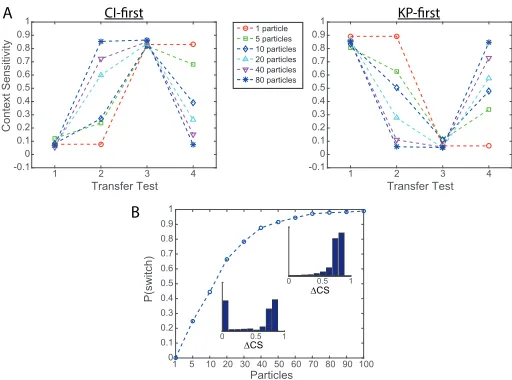
Sewell and Lewandowsky (2012) found a positive association between WMC and knowledge restructuring. In the model, increasing the number of particles also has a beneficial effect on the average degree of knowledge restructuring (Fig 4A), with an increased probability of being able to successfully switch strategy (Fig 4B).
This result arises from an enhanced ability to accurately represent the posterior distribution with a greater number of particles. Recall that strategy-switching was modelled by a change in posterior distribution, driven by the different priors underlying the distinct strategies; a simple way to track this change was by reweighting particles according to the new
dis-Transfer Test
1 2 3 4
Context Sensitivity
-0.10 0.1 0.2 0.3 0.4 0.5 0.6 0.7 0.8
0.91 1 particle5 particles 10 particles 20 particles 40 particles 80 particles
Transfer Test
1 2 3 4
-0.10 0.1 0.2 0.3 0.4 0.5 0.6 0.7 0.8 0.91
CI-first KP-first
Particles
1 5 10 20 30 40 50 60 70 80 90 100
P(switch)
0 0.1 0.2 0.3 0.4 0.5 0.6 0.7 0.8 0.9 1
A
B
0 0.5 1
0 0.5 1
∆CS
∆CS
Figure 4: (A) In both the context-sensitive (CI)-first (left) and knowledge-partitioning (KP)-first (right) conditions, increas-ing the number of particlesL leads to a greater change in context sensitivity (CS) score on average when prompted to change strategy (1500 simulation runs per condition). (B) This is due to an increased probabilityP(switch)of a suc-cessful switch (∆CS>0.5). Lower inset: with fewer particles
(L=20), it will frequently occur that the model completely fails to switch (∆CS=0). Upper inset: with more particles
(L=100), such failures are unlikely (3000 simulation runs;
b=0.9,a0=b0=1,α=0.95,β=1).
tribution (Eq. (9)). However, the success of this will depend on how well the particle set covers the support of the updated distribution. With a sufficiently large number of particles, at least some should be allocated to (previously) lower probabil-ity regions; if the new strategy corresponds to such a region, then appropriate reweighting can be applied. However, with a decreasing number of particles, representation of the pos-terior distribution may be so impoverished that such regions of low probability may not contain any particles at all, and so switching is not immediately possible.
Discussion
[image:6.612.64.290.71.264.2]hy-pothesis: more particles in the model enhanced both category learning performance and the ability to switch between dif-ferent categorization strategies.
These effects respectively arise due to increased search ef-ficiency and what we might call ‘representational adequacy’. Conceptualized in terms of search for more probable cate-gories, the more resources (i.e., particles) available to search this space — i.e., the greater the number of hypotheses that one can entertain and manipulate within working memory — then the more likely it is that one will quickly discover good solutions, a process which draws natural parallels with the broader topic of problem-solving (Hambrick & Engle, 2003; Newell & Simon, 1972). Furthermore, a greater num-ber of particles generally means that the posterior distribution over categories is more accurately represented — including those assigned lower probability — and this pluralism means that the model can more easily express alternative hypothe-ses when instructed to switch strategy, as operationalized by a reweighting of particles. This source of flexibility may also be relevant to so-called ‘insight’ problem-solving (Murray & Byrne, 2005; Ohlsson, 1992).
The current work is preceded by a number of related lines of research. The HyGene model (Dougherty, Thomas, & Lange, 2010; Thomas, Dougherty, Sprenger, & Harbison, 2008), which emphasizes the importance of hypothesis gen-eration and testing, includes the assumption that the number of hypotheses that can be entertained at a given time is lim-ited by working memory constraints. Similarly, in their study of ‘garden path’ effects in sentence processing, Levy, Reali, and Griffiths (2008) suggested that difficulties in parsing such sentences correctly may be explained by constraints on the resources (i.e., number of particles) available for incremental parsing; their demonstration that a decreasing number of par-ticles increases the probability of parse failure is exactly anal-ogous to the mechanism suggested here in relation strategy-switching.
There are a number of avenues for future investigation. We have focused on qualitative effects here, but fitting the model to individual participants will be necessary for a more quantitative assessment; the obvious prediction is that high-WMC individuals should tend to be fit best by a larger num-ber of particles. Decomposing the relative contributions of particular features of the model, such as resampling, should also be explored, and quality of fit directly compared with ‘single-particle’ approaches (e.g., Bramley, Dayan, Griffiths, & Lagnado, 2017). How the approach fares in domains be-yond category learning is also of clear interest. More gener-ally, Monte Carlo methods provide a rich source of ideas for psychological models — exploring how such methods may succeed or fail to illuminate aspects of human cognition is a substantial task for future research.
Acknowledgments
This work was supported by the Gatsby Charitable Founda-tion (KL), and by EPSRC grant EP/I032622/1 (DL).
References
Baddeley, A. (1992). Working memory.Science,255, 556-559.
Bramley, N., Dayan, P., Griffiths, T., & Lagnado, D. (2017). For-malizing Neurath’s ship: Approximate algorithms for online causal learning.Psychological Review,124(3), 301–338. Breiman, L., Friedman, J., Olshen, R., & Stone, C. (1984).
Classi-fication and regression trees. Belmont, CA: Wadsworth. Chater, N., & Oaksford, M. (Eds.). (2008). The probabilistic mind:
Prospects for Bayesian cognitive science. Oxford University Press.
Chipman, H., George, E., & McCulloch, R. (1998). Bayesian CART
model search. Journal of the American Statistical
Associa-tion,93(443), 935-948.
Chopin, N. (2002). A sequential particle filter method for static models.Biometrika,89(3), 539–552.
Cowan, N. (2001). The magical number 4 in short-term memory: A
reconsideration of mental storage capacity. Behavioral and
Brain Sciences,24(1), 87–114.
Dougherty, M., Thomas, R., & Lange, N. (2010). Toward an integra-tive theory of hypothesis generation, probability judgment,
and hypothesis testing. In B. Ross (Ed.),The psychology of
learning and motivation(Vol. 52, pp. 299–342). Burlington: Academic Press.
Gordon, N., Salmond, D., & Smith, A. (1993). Novel approach
to nonlinear/non-Gaussian Bayesian state estimation. Radar
and Signal Processing, IEE Proceedings F,140(2), 107–113. Griffiths, T., Vul, E., & Sanborn, A. (2012). Bridging levels of anal-ysis for probabilistic models of cognition.Current Directions in Psychological Science,21(4), 263-268.
Hambrick, D., & Engle, R. (2003). The role of working memory in problem solving. In J. Davidson & R. Sternberg (Eds.),The psychology of problem solving(pp. 176–206). Cambridge University Press.
Just, M., & Carpenter, P. (1992). A capacity theory of
comprehen-sion: Individual differences in working memory.
Psycholog-ical Review,99, 122–149.
Kurtz, K., Levering, K., Stanton, R., Romero, J., & Morris, S. (2013). Human learning of elemental category structures: revising the classic result of Shepard, Hovland, and
Jenk-ins (1961). Journal of Experimental Psychology: Learning,
Memory, and Cognition,39(2), 552–572.
Levy, R., Reali, F., & Griffiths, T. (2008). Modeling the effects of memory on human online sentence processing with particle filters. In D. Koller, D. Schuurmans, Y. Bengio, & L. Bottou
(Eds.),Advances in Neural Information Processing Systems
21.
Lewandowsky, S. (2011). Working memory capacity and catego-rization: Individual differences and modeling.Journal of Ex-perimental Psychology: Learning, Memory, and Cognition,
37(3), 720-738.
Murray, M. A., & Byrne, R. M. (2005). Attention and working memory in insight problem solving. In B. Bara, L. Barsa-lou, & M. Bucciarelli (Eds.),Proceedings of the xxvii annual conference of the cognitive science society(pp. 1571–1575). Lawrence Erlbaum Associates.
Newell, A., & Simon, H. (1972). Human problem solving.
Engle-wood Cliffs, NJ: Prentice-Hall.
Ohlsson, S. (1992). Information processing explanations of insight and related phenomena. In M. Keane & K. Gilhooly (Eds.),
Advances in the psychology of thinking.London: Harvester-Wheatsheaf.
Sewell, D., & Lewandowsky, S. (2012). Attention and Working Memory Capacity: Insights From Blocking, Highlighting,
and Knowledge Restructuring.Journal of Experimental
Psy-chology: General,141(3), 444-469.
Shepard, R. N., Hovland, C. I., & Jenkins, H. M. (1961). Learning
and memorization of classifications. Psychological
Mono-graphs: General and Applied,75(13), 1–42.
Thomas, R., Dougherty, M., Sprenger, A., & Harbison, J. (2008).
Diagnostic hypothesis generation and human judgment.