A Thesis Submitted for the Degree of PhD at the University of Warwick
Permanent WRAP URL:
http://wrap.warwick.ac.uk/100470/
Copyright and reuse:
This thesis is made available online and is protected by original copyright.
Please scroll down to view the document itself.
Please refer to the repository record for this item for information to help you to cite it.
Our policy information is available from the repository home page.
Dose-response-time data analysis
Karl Robert Andersson
Thesis
Submitted to the University of Warwick
for the degree of
Doctor of Philosophy in Engineering
Biomedical and Biological Systems
School of Engineering
University of Warwick
Table of Contents
List of Figures iv
List of Tables vi
Abbreviations and symbols vii
Acknowledgments xii
Declaration xiv
I
Introduction
1
Introduction 2
1 Background and literature review 6
1.1 PK-PD modelling . . . 6
1.2 Dose-response-time data analysis . . . 8
1.2.1 Instantaneous response models . . . 9
1.2.2 Turnover models . . . 13
1.2.3 Kinetic-Pharmacodynamic models . . . 14
1.3 Summary and perspectives . . . 16
2 Methods and models 21 2.1 Model selection . . . 22
2.1.1 Biophase function . . . 22
2.1.2 Pharmacodynamic model . . . 24
2.1.3 Mixed-effects modelling . . . 29
2.2.1 Identifiability methods . . . 37
2.3 Parameter estimation . . . 41
2.3.1 Linear models . . . 42
2.3.2 Nonlinear models . . . 46
2.3.3 Nonlinear mixed-effects models . . . 56
2.3.4 Profile likelihood . . . 61
2.3.5 Software . . . 62
2.4 Sensitivity analysis . . . 62
2.4.1 Methods . . . 63
2.5 Model evaluation . . . 63
2.5.1 Quantitative analysis . . . 64
2.5.2 Qualitative analysis . . . 68
2.6 Summary . . . 70
II
Analysis and results
72
3 Background 73 3.1 Nicotinic acid-induced antilipolysis . . . 733.2 Pharmacokinetics of NiAc . . . 75
3.3 Data . . . 79
3.3.1 Outline of experimental procedures . . . 79
4 DRT I - Free fatty acid dynamics 84 4.1 Model development . . . 84
4.2 The biophase function . . . 85
4.2.1 Selection process of biophase models . . . 85
4.2.2 The final biophase model . . . 87
4.3 The pharmacodynamic model . . . 88
4.3.1 Structural identifiability . . . 91
4.3.2 Modelling between-subject variability . . . 92
4.4 Parameter estimation . . . 92
4.4.1 Initial parameter estimates . . . 92
4.5 Results and validation . . . 94
4.5.1 Model predictions . . . 100
4.5.2 Shrinkage analysis . . . 101
4.5.3 Sensitivity analysis . . . 101
4.5.4 Goodness-of-fit plots . . . 103
4.6 Discussion . . . 103
4.6.1 DRT modelling . . . 103
4.6.2 Strategy when selecting the biophase model . . . 104
4.6.4 Control theory . . . 106
4.6.5 Inter-individual and intra-individual variability . . . 107
5 DRT II - Free fatty acid and insulin dynamics 108 5.1 Model development . . . 109
5.1.1 Disease modelling and inter-study variability . . . 109
5.1.2 Notation conventions . . . 110
5.2 The biophase function . . . 110
5.3 The pharmacodynamics of insulin . . . 110
5.4 The pharmacodynamics of FFA . . . 115
5.4.1 Structural identifiability . . . 118
5.5 Parameter estimation . . . 119
5.6 Results and validation . . . 122
5.6.1 Biophase dynamics . . . 122
5.6.2 Insulin model . . . 122
5.6.3 FFA model . . . 129
5.6.4 Shrinkage analysis . . . 133
5.6.5 Predicted FFA lowering . . . 134
5.6.6 Comparison to exposure-driven analysis . . . 135
5.6.7 Goodness-of-fit plots . . . 135
5.6.8 Sensitivity analysis . . . 135
5.7 Discussion . . . 139
5.7.1 Model evolution . . . 139
5.7.2 Model characteristics . . . 139
5.7.3 Model evaluation . . . 140
6 Conclusions 143 6.1 Future work . . . 147
Appendices 166
A Mathematica code - Identifiability analysis of DRT I model 167
B Mathematica code - Parameter estimation of DRT I model 169
C Mathematica code - Identifiability analysis of DRT II insulin model 173
List of Figures
1.1 Examples of pharmacokinetic models . . . 8
1.2 Conceptual figure of DRT analysis . . . 10
1.3 Biophase models presented by Smolen . . . 11
1.4 Biophase-driven turnover model . . . 14
2.1 Biophase library . . . 23
2.2 Example—response-time data . . . 27
2.3 Example - response-time data . . . 33
2.4 Example—response-concentration course . . . 45
2.5 Example—Emax model fitted with Newton’s method . . . 55
2.6 Model validation—Visual Predictive Check plots . . . 68
2.7 Model validation—Individual predictions . . . 69
2.8 Model validation—Qualitative evaluations . . . 70
3.1 Mechanisms of NiAc and insulin-induced antilipolysis in adipose tissue . . . . 74
3.2 NiAc pharmacokinetics for lean Sprague-Dawley and obese Zuecker rats . . . 75
4.1 Biophase library . . . 85
4.2 Example of FFA-time course data . . . 89
4.3 Schematic structure of FFA model . . . 90
4.4 Visual predictive check plots for the FFA model and data . . . 97
4.5 Individually fitted FFA response-time courses . . . 98
4.6 Population predicted biophase drug amount . . . 99
4.7 Long-term model predicted effect of NiAc on FFA . . . 100
4.8 Local senitivity analysis—FFA model . . . 102
5.1 NiAc-FFA dependencies in the current and previous studies . . . 109
5.2 The selected biophase functions . . . 111
5.3 Example of insulin-time course data . . . 112
5.4 Mechanisms of insulin dynamics . . . 114
5.5 Example of FFA-time course data . . . 116
5.6 Mechanisms of FFA dynamics . . . 117
5.7 VPC for insulin and FFA model and data—lean Sprague-Dawley rats . . . . 123
5.8 Individual fits for insulin and FFA model—lean Sprague-Dawley rats . . . 124
5.9 Fitted biophase amount for insulin and FFA model—lean Sprague-Dawley rats125 5.10 VPC for insulin and FFA model and data—obese Zucker rats . . . 126
5.11 Individual fits for insulin and FFA model—obese Zucker rats . . . 127
5.12 Fitted biophase amount for insulin and FFA model—obese Zucker rats . . . . 128
5.13 Model simulation of acute and chronic action of NiAc exposure . . . 133
5.14 Model predicted reduction in FFA exposure . . . 134
5.15 Goodness-of-fit plots—insulin and FFA model—lean Sprague-Dawley rats . . 136
5.16 Goodness-of-fit plots—insulin and FFA model—obese Zucker rats . . . 137
5.17 Local senitivity analysis—FFA model . . . 138
D.1 Visual predictive checks for lean Sprague-Dawley rats . . . 178
D.2 Visual predictive checks for obese Zucker rats . . . 179
D.3 Model predicted reduction in FFA exposure . . . 185
List of Tables
I List of published articles . . . 4
1.1 Published DRT studies . . . 20
2.1 Parameter estimate uncertainty—linear model example . . . 46
2.2 Parameter estimate uncertainty—nonlinear model example . . . 56
3.1 Study I data characteristics . . . 79
3.2 Study II data characteristics . . . 80
4.1 Evolution of biophase model structure . . . 86
4.2 DRT I summary of model . . . 93
4.3 Estimated system rate constants with corresponding half-lives . . . 95
4.4 DRT I model parameter estimates and between-subject variability . . . 96
4.5 Comparison between DRT and exposure-driven pharmacodynamics analysis . 100 4.6 Model residual additive errors . . . 101
4.7 η-shrinkage of the EBE’s . . . 101
5.1 DRT II summary of model . . . 121
5.2 Turnover half-lives . . . 129
5.3 DRT II model parameter estimates and between-subject variability . . . 132
5.4 Insulin and FFA model residual additive errors . . . 133
5.5 η-shrinkage of the EBE’s . . . 134
5.6 Comparison between DRT and exposure-driven pharmacodynamic analysis . 135 D.1 Turnover half-lives . . . 180
Abbreviations and symbols
Name Definition or explanation
β model parameters ˆ
β parameter estimates β0 intercept parameter β1 slope parameter γ Hill exponent
δ lumped diffusion parameter
ηi random effects of individuali
λ first-order elimination rate from the biophase compartment
Ω covariance matrix
φi parameters of individuali
σ residual error
θ system parameters θµ fixed effect
ˆ
θML maximum likelihood estimate
Θ feasible parameter space
Aa(t) drug amount in the absorption compartment at timet Ab(t) drug amount in the biophase at timet
Ac(t) drug amount in the systemic fluid compartment at timet Ad(t) drug amount in the tissue depot compartment at timet Ag(t) drug amount in the gut at timet
AC adenylate cyclase
ACTH adrenocorticotropin
AIC Akaike information criterion
ATGL adenosine triglyceride lipase
ATP adenosine triphosphate
Bk approximated Hessian atkth iteration
BFGS Broyden-Fletcher-Goldfarb-Shanno (algorithm)
C(t) drug concentration in the plasma at timet
C50 steady-state concentration that produces 50% of the effect
Ce(t) drug concentration in the effect compartment at timet Cp(t) drug concentration in the plasma compartment at timet Ct(t) drug concentration in the tissue compartment at timet cAMP cyclic adenosine monophosphate
CDF cumulative distribution function
Cl clearance
Clcr clearance of creatine
Cld inter-compartmental distribution Clde clearance of desirudin
CV coefficient of variation
D drug dose
DIV bolus drug dose
DKL(θ) Kullback-Leibler divergence DSC subcutaneous drug dose
DAISY Differential Algebra for Identifiability of SYstems
DFP Davidon-Fletcher-Powell (algorithm)
DRT dose-response-time
e observed residuals
eij residual variability at timetj for individuali
E(t) drug effect at timet E0 baseline effect Emax efficacy
EAR Exact arithmetic rank
EBE Empirical Bayes Estimates
ED50 potency
EDK50 infusion rate that gives half-measured response EM Expectation-Maximisation
EPO erythropoietin
F bioavailability or biophase availability F(t) FFA concentration at timet
FFA free fatty acids
FOCEI first-order conditional estimation with interactions
GN Gauss-Newton
H(Ab) drug-mechanism function Hb haemoglobin
HSL hormone sensitive lipase
I(θ) expected Fisher information I( ˆθML) observed Fisher information I(t) insulin concentration at timet IKL(θ) Kullback-Leibler information Imax efficacy (maximal inhibitory effect)
IC50 potency (plasma concentration were 50% of the effect is attained)
ID50 potency (biophase drug amount were 50% of the effect is attained) Inf(t) function dependent on infusion protocol
IR(t) virtual infusion rate at timet IV intravenous
IPRED individual predictions
IWRES individual weighted residuals
k first-order elimination rate
k10 first-order elimination rate from the plasma compartment
k12 first-order distribution rate from the plasma to the tissue compartment k21 first-order distribution rate from the tissue to the plasma compartment ka first-order absorption rate
kag absorption rate from the gut compartment
kasc absorption rate from the subcutaneous compartment ke first-order elimination rate
keo first-order elimination rate from the plasma to the biophase kin turnover rate
koff rate constant for dissociation kon rate constant for association kout fractional turnover rate
kout,max maximal fractional turnover rate ktol fractional turnover rate of moderator Kd dissociation constant
Ki integral gain parameter
Km1 Michaelis constant, first pathway Km2 Michaelis constant, second pathway Kmg Michaelis constant, gut
KM Michaelis constant Kmax maximal toxic effect K-PD kinetic-pharmacodynamic
KM Levenberg-Marquardt
l(θ;y) log-likelihood function
l(θ,Ω,R;y) population log-likelihood function [L] free ligand concentration
[LR] ligand-receptor complex concentration L(θ;y) likelihood function
L(θ,Ω,R;y) population likelihood function
Lf extendedLie derivative differential operator
L(fk) k:th repeated Lie derivative M0 moderator baseline
Mi(t) moderator response at timet
MCEM Monte Carlo Expectation-Maximisation
ML maximum likelihood
MM Michaelis-Menten
MSE mean squared error
n number of observations
N number of individuals in the population NiAc nicotinic acid
NLME nonlinear mixed-effects models
ODE ordinary differential equation
p amplification factor
pk search direction
pN
k Newton step
pGN
k Gauss-Newton step
pGN
k Levenberg-Marquardt step
P-P probability-probability
PBPK physiologically-based PK
PD pharmacodynamic
PDE3B phosphodiesterase 3B
PDF probability density function
PK pharmacokinetic
PKA protein kinase A
PL Profile Likelihood
PO per os (Latin for by mouth, i.e., oral drug administration). Q-Q quantile-quantile
QRPEM Quasi-Random Parametric Expectation-Maximisation
[R] free receptor concentration
R residual matrix
R(t) pharmacodynamic response R0 baseline response
b
RSD relative standard deviation
RSE relative standard error
Smax efficacy (maximal stimulatory effect) Sn(β sum of squares
SA sensitivity analysis
SAEM Stochastic Approximation Expectation-Maximisation
SC subcutaneous
SD50 potency (biophase drug amount were 50% of the effect is attained) SDE stochastic differential equation
STS standard two-stage (method)
SVD singular value decomposition
SYNT endogenous NiAc synthesis
TT x duration of toxic effect
TG triglyceride
ui(t) input functions
V volume of distribution of the drug Vmax maximal elimination rate
Vmax1 maximal elimination rate, first pathway Vmax2 maximal elimination rate, second pathway Vmaxg maximal absorption rate, from the gut Vp volume of distribution, plasma compartment Vt volume of distribution, tissue compartment VPC visual predictive check
x0 initial conditions ˙
xi(t) state variables for theith individual at timet
X design matrix
y dependent variables
yij observations of the system at timestj for individual i
Acknowledgments
This work would not have been possible without the support and encouragement I have
received during my time as a PhD student. I would first and foremost like to express my
sincerest gratitude to my principal thesis advisors. Thank you, Johan Gabrielsson, for being
an excellent mentor. Besides your experience and vast knowledge in quantitative
pharma-cology, you possess a contagious curiosity of exploring what is unknown to you - a perfect
trait when working in an interdisciplinary field. Thanks to Mats Jirstrand for always being
accessible and sharing your expertise in all aspects of model identification. Your enthusiasm
and compassion contribute to an inspiring and pleasurable working environment. The both
of you have taught me a great deal about how to conduct scientific research. Many thanks to
my advisors at the University of Warwick, Michael Chappell and Neil Evans. Thank you for
providing valuable discussions on model development in general, and identifiability analysis
in particular. Also, big thanks for all of your corrections of my somewhat flawed British
gram-mar. I would like to express my appreciation to Michael for coordinating the IMPACT project.
Many colleagues have aided me in my research. Joachim Almquist at Fraunhofer-Chalmers
Centre is greatly acknowledged for valuable discussions concerning parameter estimation and
parameter uncertainty, and for guidance on the in-house developed Mathematica framework
for nonlinear mixed-effects estimation. Thanks to Christine Ahlstr¨om and Tobias Kroon
at AstraZeneca for generating the data that I have analysed. Thank you, Nick Oakes,
for providing feedback on my pharmacodynamic models and for sharing your insights on
metabolic diseases. I would like to thank my roommates and colleagues David Janz´en and
Linnea Bergenholm who endured spending every waking hour with me in Britain. I would
also like to send my warmest well-wishes to the entire A407 Biomedical Superhero group.
I would not have pursued a research career if it had not been for the support and
believing in me and my capability.
Me and Tony Johansson have studied together since upper secondary school. Besides
being the closest of friends, you have patiently answered my mathematical queries and
laughed inexplicably at my horrible, stupid humour. Thank you, and good luck on your
future academic career. I would like to thank my dearest friends, Filip and Anton, and the
infamous “You was smoochin’ with my brother!” chat. Thanks to Pablo Lerner for sharing;
intellectual conversations, non-intellectual anti-humour, great taste in music, beers on Andra
L˚ang, among many other things. Thanks to my temporary ‘parents’ Filip and Amanda for
letting me stay at your place.
I would finally wish to express my utmost thanks to my family and all of my friends
for your support through the roller-coaster of ups and downs that constitute the life of a
PhD student.
This work was funded through the Marie Curie FP7 People ITN European Industrial
Doctorate (EID) project, IMPACT (Innovative Modelling for Pharmacological Advances
through Collaborative Training) (No. 316736) and by the Swedish Foundation for Strategic
Research.
Robert Andersson
Declaration
This thesis have been submitted to the University of Warwick in support of Robert
Anders-son’s application for the degree of Doctor of Philosophy. Robert is the sole author of this
work and it has not been submitted in any previous applications for any degree.
The data presented in this thesis were collected at AstraZenca, Gothenburg, Sweden. The
experimental parts were conducted by Christine Ahlstr¨om Ahlstr¨om et al. (2011b) under the
supervision of Professor Johan Gabrielsson, and by Tobias Kroon Kroon (2016) under the
supervision of Doctor Nicholas Oakes and Professor Johan Gabrielsson.
Parts of this thesis have been published by the author:
[A]Andersson R., Jirstrand M, Peletier L. A., Chappell M. J., Evans N. D., Gabrielsson
J. 2016. Dose-response-time modelling: Second-generation turnover model with integral
feedback control. Eur. J. Pharm. Sci. 81, 189-200.
[B] Andersson R., Kroon T., Almquist J., Jirstrand M., Oakes N. D., Evans N. D.,
Chappell M. J., Gabrielsson J. 2017. Modeling of free fatty dynamics: Insulin and NiAc
Abstract
The traditional approach to pharmacodynamic modelling relies on knowledge about the
pharmacokinetics. A prerequisite for obtaining kinetic information is reliable exposure data.
However, in several therapeutic areas, exposure data are unavailable—including when the
drug response precedes the systemic exposure (for example pulmonary drug administration)
and when the drug is locally administered (for example ophthalmics).
Dose-response-time (DRT) data analysis provides an alternative to exposure-driven
phar-macodynamic modelling when exposure data are sparse or lacking. In DRT modelling, the
response data are assumed to contain enough information about the drug kinetics, whereby
a biophase model can be developed and act as the driver of the pharmacological response.
The following work presents the fundamental principles of DRT modelling. This include the
entire procedure of identifying a DRT model, encompassing the assessment of the biophase
function and the pharmacodynamic model, extensions to cover population variations,
identi-fiability analysis, parameter estimation, and model validation. To demonstrate the utility of
the technique, two extensive pre-clinical DRT studies of the interaction between nicotinic
acid (NiAc) and free fatty acids (FFA) are presented. The first study covered the response
behaviour following intravenous and oral NiAc dosing in both normal (lean) and diseased
(obese) rats. The second study extended the models of the first study to incorporate insulin
as a driver of the FFA response. Moreover, data from chronic trials were analysed with the
aim to quantitatively understand the adaptive behaviours associated with long-term NiAc
treatments.
The aim of this work is to answer the questions of when and how to use DRT data
The DRT models of the first study were successfully fitted to all response-time courses
in lean rats, with high precision in the parameter estimates (relative standard errors (RSE)
<25%), visual predictive check (VPC) and individual plots that captured the population and subject trends, andε-shrinkages of less than 10%. The model for the obese rats were less precise, with specific parameters being practically non-identifiable (with, for example,
RSE∼250%). The results for both lean and obese rats were generally consistent with those of
an exposure-driven reference model, albeit with less precision and accuracy in the parameter
estimates. Finally, the model was able to describe non-linear biophase kinetics, present at
high oral dosages of NiAc.
The DRT models of the second study were able to capture the response-time courses
for insulin and FFA on a population and individual level, and for both lean and obese rats.
However, many parameters were uncertain (with RSE of, for example, 30-50%) and some
were practically non-identifiable (with RSE of>100%). The estimates were generally less precise and more inaccurate than those obtained in an exposure-driven reference model.
Yet, most parameter estimates of the DRT models were within one standard deviation from
those of the exposure-driven model. The final model was used to predict steady-state FFA
exposures following repeated NiAc dosing for a range of different infusion protocols. The
optimal dosing regimens consisted of infusions and wash-out periods were the wash-outs
were 2h longer than the infusions. These predictions were consistent with those made by the
exposure-driven model. Albeit, the DRT model predicted a slightly lower optimal reduction
of FFA exposure.
It is important to recognise that DRT analyses introduce bias and variability in the parameter
estimates. To obtain reliable results, it is advisable to have rich pharmacodynamic data,
cover-ing drug administration at different routes, rates, and schedules. With these issues taken into
account, the technique still performed well in the two extensive studies presented in this work.
In conclusion, DRT data analysis is a modelling technique used in situations when
ex-posure data are unavailable. The method is versatile and can describe a range of different
pharmacological behaviours. Precision and accuracy is lost when comparing to an
exposure-driven pharmacodynamic modelling approach. Thus, DRT modelling is not to be considered
as a replacement of the gold-standard pharmacokinetic-pharmacodynamic framework, but
rather as a compliment when exposure data are unavailable.
Keywords: Dose-response-time modelling, Biophase functions, Pharmacodynamic
modelling, Nonlinear mixed-effects (NLME), Disease modelling, Tolerance, Adaptation,
Part I
Introduction
This thesis is divided into two parts, each with separate objectives; the first part serves to
describewhat dose-response-time (DRT) data analysis and population modelling are and
how these techniques are applied. The second part focuses onwhy the studies of this PhD
project were conducted, and their respective contribution.
Aims and objectives
The aim of this thesis is primarily to answer the following questions:
• When and how do we use DRT data analysis?
• What are the limitations of DRT data analysis?
In order to achieve the aims, an exhaustive literature review and two major data analyses
were conducted. A key aspect of this project was to demonstrate how simple biophase
structures can be used as the underlying driving mechanism when describing complex
pharmacodynamic systems, where lack of pharmacokinetic data prohibits the standard
pharmacokinetic-pharmacodynamic modelling practice.
Quantitative pharmacology
Modelling and simulation are crucial in modern pharmaceutical research (Allerheiligen, 2014;
Breimer and Danhof, 1997; Burman and Wiklund, 2011; Lalonde et al., 2007; Leil and
Bertz, 2014; Manolis et al., 2013; Marshall et al., 2016; Staab et al., 2013). The methods at
hand provide quantitative ways to perform pharmacology; applicable when evaluating and
comparing drugs, and when designing future experimental protocols (Aarons et al., 2001;
decisions throughout the drug development cycle, from initialin silico analyses to post-marketing predictive studies on new populations (Bonate, 2011). In detail, modelling and
simulation enable a better understanding of the drug properties, or thepharmacokinetics
(PK) andpharmacodynamics (PD), which are the two main areas of pharmacology (Rowland and Tozer, 2011). PK may in layman’s terms be described aswhat the body does to the drug, which encompasses absorption, distribution, metabolism, and elimination of the drug (Benet
and Zia-Amirhosseini, 1995; Gibaldi and Perrier, 1982). The kinetic properties are assessed
by conducting in vivo studies wherein the drug is administered and the corresponding exposure (typically in blood plasma) is measured over time. The experimental data provide
the basis for the PK model. A well-designed model may contribute quantitative knowledge
of the concentration-elimination relationship, the drug bioavailability, the unbound drug
concentration, the volume of distribution of the drug, and so forth.
In contrast to PK, PD represents what the drug does to the body. Generally, drugs are designed to alter normal physiological or biochemical processes, inhibit pathological
pro-cesses, or disrupt parasites or microbes (Lees et al., 2004). Drugs typically function as
agonists, antagonists or inverse agonists on a specific receptor (Gabrielsson and Weiner,
2010). By binding to its receptor, and forming a receptor-ligand complex, the drug provokes
a stimulating, stabilising or inhibiting action. If the expression of the receptor-ligand complex
is measurable, or some downstream biomarker (Aronson, 2005) is measurable, then the PD
may be assessed. Measuring exposure and drug effect are done in parallel, whereby the drug
concentration-effect relation may be assessed. Traditionally, the PK is analysed first and
considered to drive the PD (Holford and Sheiner, 1982). Consequently, the fitted PK model
will act as the driving mechanism of the perturbed pharmacological response, and the final
PK-PD model will encompass both the kinetic and dynamic properties of the drug and how
these are related.
Dose-response-time data analysis
Dose-response-time data analysis is as an alternative to exposure-driven PK-PD modelling
when PK data are sparse or lacking, or when it is difficult to relate measured exposure
(typically in plasma) to exposure at the target (e.g., in the brain (Andersson et al., 2015;
Gabrielsson et al., 2000; Gabrielsson and Peletier, 2014; Jacqmin et al., 2007)). This
involves studies where, for example, it is undesirable to perform exposure sampling (e.g.,
in paediatrics (Tod, 2008)), the drug is locally administered (e.g. in ophthalmics (Audren
et al., 2004; Gabrielsson et al., 2000; Smolen, 1971b)), general clinical trials (Abou Hammoud
et al., 2009; Buil-Bruna et al., 2014; Ramon-Lopez et al., 2009; Wilbaux and He, 2014),
or the pharmacological response precedes the systemic exposure (e.g. pulmonary drug
administration (Musuamba et al., 2015; Nielsen et al., 2012; Wu et al., 2011)). In DRT
modelling, the pharmacological effect is assumed to be driven by the drug amount at the
organ, or combinations of tissues and organs. The choice of structure of the biophase depends
on how the drug was administered, what characteristics are seen in the response-time data,
and the physiological knowledge of the system (Andersson et al., 2015; Gabrielsson and
Peletier, 2014).
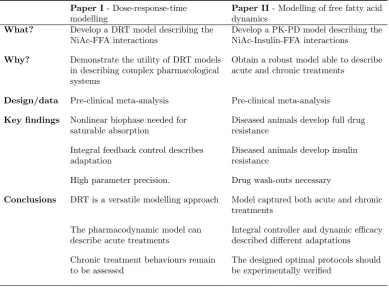
Paper I- Dose-response-time modelling
Paper II- Modelling of free fatty acid dynamics
What? Develop a DRT model describing the
NiAc-FFA interactions
Develop a PK-PD model describing the NiAc-Insulin-FFA interactions
Why? Demonstrate the utility of DRT models in describing complex pharmacological systems
Obtain a robust model able to describe acute and chronic treatments
Design/data Pre-clinical meta-analysis Pre-clinical meta-analysis
Key findings Nonlinear biophase needed for
saturable absorption
Diseased animals develop full drug resistance
Integral feedback control describes adaptation
Diseased animals develop insulin resistance
High parameter precision. Drug wash-outs necessary
Conclusions DRT is a versatile modelling approach Model captured both acute and chronic
treatments The pharmacodynamic model can
describe acute treatments
Integral controller and dynamic efficacy described different adaptations Chronic treatment behaviours remain
to be assessed
[image:22.595.124.514.177.466.2]The designed optimal protocols should be experimentally verified
Table I: Summary of published articles that are presented in this thesis.
This work provides the principles of DRT data analysis in a population context; how
basic biophase and pharmacodynamic models are constructed, structural and practical
identifiability of these models, incorporation of variability, and assessment of the resulting
models. The technique is demonstrated by means of two pre-clinical meta-analyses. The data
sets for these analyses cover a range of routes, rates, and schedules of drug administration.
Both studies were conducted on the complex metabolic system of free fatty acid (FFA)
dynamics, under the provocation of the antilipolytic compound nicotinic acid (NiAc) (Carlson,
2005). In the first study, the drug dose-response relations are analysed in an acute setting,
using a single-biomarker data set of FFA response-time data. In this study, special emphasis
was placed on the selection process of the biophase functions. The modelled biophase amount
functioned as the driving-mechanism for a sigmoidal function that acted as an inhibiting
force on the turnover of FFA. In the second study, the model was extended to capture chronic
dose-response patterns. This was partly done by adding insulin as a second biomarker.
Two different types of adaptive behaviours were included in the model; one to describe
available, which allowed for a comparison between the DRT analysis and an exposure-driven
analysis (Andersson et al., 2017; Tapani et al., 2014). The first chapter of the thesis consists of
a thorough literature review of DRT data analysis. This is followed by a Methods and Models
chapter where it is demonstrated how a DRT model is constructed. Furthermore, population
modelling is introduced and, in particular, the nonlinear mixed-effects framework (Bonate,
2011; Davidian, Marie, 2003). This is followed by a section on parameter estimation and
model validation. The second part of the thesis starts with a chapter on the physiology
of NiAc-induced antilipolysis and a presentation of the analysed data. Chapters four and
five consist of the two major case studies where the potential of DRT data analysis is
demonstrated. The majority of the presented scientific contributions have been published
Chapter 1
Background and literature
review
Pharmacokinetic (PK) and pharmacodynamic (PD) modelling are cornerstones in
model-based drug development. The modelling techniques serve as a means to understanding and
quantifying patterns seen in pharmacological data. This enables the modeller to evaluate
the performance of pharmaceutical substances. Furthermore, suitable models can be applied
to simulate unobserved pharmacological events and thus predict optimal dosage strategies.
In this way, simulations provide valuable input in the design of future experimental trials.
The trials, in turn, contribute new data to be analysed. Hence, mathematical modelling and
simulation and experiments are used symbiotically to enhance the modeller’s knowledge of
the pharmacology and physiology. The iterative strategy of using modelling and simulation
and experiments advances the pharmacological development process until a drug has been
accepted or discontinued.
1.1
PK-PD modelling
The PK-PD modelling procedure is traditionally sequential1 in that the PK are initially
analysed and then considered to be known when assessing the PD. In detail, a PK model
1The sequential approach to PK-PD modelling has traditionally been favoured over the simultaneous one
is developed and fitted to the exposure-time data (typically drug plasma concentrations).
From the generated PK model, a time continuous exposure signal is generated to act as
an input to the PD model. Consequently, when assessing the PD, it is assumed that the
PK are known and that the simulated PK input corresponds to the true exposure. Given
this premise, the PK-PD modelling framework is constrained by the existence of reliable
exposure data. PKs is often modelled using compartmental models (Godfrey, 1983). These
models consist of ordinary differential equations, where the state variables represent drug
concentrations in different physiological compartments. In the simplest possible case, a
single-compartment model is used to represent the drug concentration in the plasma (model
illustrated in Fig. 1.1a). This concentration, denotedC(t), is given by
dC(t)
dt =−k·C(t) =− Cl
V ·C(t) with C(0) = 0, (1.1)
wherekis the elimination rate,Cl the clearance, andV the volume of distribution of the drug (describing the fraction between the drug amount and the drug concentration2). Given
an intravenous bolus doseD, the initial condition in Eq. (1.1) becomesC(0) =D/V. For extravascular drug administration, an intermediate absorption compartment is added to
Eq. (1.1) from where the drug is absorbed into the blood plasma compartment (model
illustrated in Fig. 1.1b). The drug kinetics are given by
dA(t)
dt =−ka·A(t) with A(0) =D, (1.2a) dC(t)
dt =
F·ka·A(t)
V −k·C(t) with C(0) = 0, (1.2b)
whereA is the drug amount in the absorption compartment,ka the absorption rate, and F the bioavailability. The bioavailability ranges from 0 to 1 and represents the fraction of dose that reaches plasma intact. Generally, Eq. (1.2a) is solved forA(t) and the system is reduced to, and considered as, a single-compartment model given by
dC(t) dt =
D·F·ka·e−kat
V −k·C(t) with C(0) = 0. (1.3)
These elementary PK models may be expanded to include additional compartments,
de-scribing the drug kinetics in other tissues and organs. Such extensions may be required for
various reasons; if, for example there are two different phases in the drug plasma kinetics, the
drug distributes into different tissues, whereby a peripheral compartment is needed (model
illustrated in Fig. 1.1c). In this case, the plasmaCp(t) and tissueCt(t) concentrations after
2The volume of distribution is an estimate of how well the drug distributes throughout the body. For
a bolus dose could be given by
dCp(t)
dt =k21·Ct(t)−k12·Cp(t)−k10·Cp(t) with Cp(0) =D/V, (1.4a) dCt(t)
dt =k12·Cp(t)−k21·Ct(t) with Ct(0) = 0, (1.4b)
wherek10 is the elimination rate from the plasma compartment,k12 the distribution rate from the plasma to the tissue compartment, andk21 the distribution rate from the tissue to the plasma compartment.
(a) (b) (c)
Figure 1.1: Examples of typical PK models: (a) represents a one-compartment model with first-order drug elimination;(b) a two-compartment model with an absorption and a central drug compartment. The drug is absorbed into, and eliminated from, the central compartment via first-order processes;(c) a two-compartment model with a plasma and a tissue compartment. The drug is distributed between plasma and tissue via first-order processes and eliminated from the plasma via a first-order elimination.
The compartmental modelling framework can be expanded to include any number of
compartments in order to describe more complex kinetic scenarios. In particular, the
physiologically-based PK (PBPK) models consist of multiple compartments and aim at
explaining as much as possible of the drug disposition (Rowland et al., 2011). These
sophis-ticated multi-compartment models provide a more general picture of the drug kinetics, and
are convenient when, for example, translating results between species. However, the scope of
PBPK models often complicates parameter identification (see Section 2.2), and in order for
these models to be useful the modeller generally needs prior knowledge of the pharmacology
and physiology, and/or exposure assays generated at multiple sites (for a review on PBPK
models, see Rowland et al. 2011). As we will see, kinetic information is not always available,
whereby PBPK, and simpler PK models, fail.
1.2
Dose-response-time data analysis
Dose-response-time (DRT) data analysis is a modelling approach that is used for assessing
the PD response when PK data are lacking or uninformative. PK data may, for example, be
(i) the turnover of the drug is quick (Uehlinger et al., 1992; Port et al., 1998)
(ii) the concentration of the drug is below the limit of quantification (Lalonde and
Gau-dreault, 1999)
(iii) the drug is locally administered (e.g., in ophthalmicss (Audren et al., 2004; Smolen,
1971b; Gabrielsson et al., 2000))
Furthermore, in certain clinical trials, it is undesirable to measure drug exposure due to
the invasiveness of the sampling methods. Invasiveness is generally an issue in paediatric
studies (Tod, 2008) and in situations where the patient is put under considerable
dis-tress (e.g., in oncology (Frances et al., 2011; Paule et al., 2012; Wilbaux and He, 2014)).
Moreover, if the drug effect precedes the systemic exposure (e.g., for pulmonary drug
administration (Musuamba et al., 2015; Nielsen et al., 2012; Wu et al., 2011)), the drug
concentration-time series may be uninformative about the unbound drug at the active site. In
addition, PK data may be uninformative when there are vast differences between the initial
and terminal phase of the drug treatment periods (Lange and Schmidli, 2014, 2015). The
traditional PK-PD modelling approach fails in situations where exposure data are lacking
or uninformative. In cases like these, DRT data analysis acts as a surrogate (a schematic
difference between DRT and PK-PD modelling is illustrated in Fig. 1.2).
DRT modelling is based on the premise that the pharmacological response data contain
information about the drug kinetics. This “hidden” information is assumed to be sufficient
to determine the drug amount in an intermediate biophase compartment. The biophase
represents any organ or tissue where the drug produces its pharmacological effect. From
a modelling perspective, the kinetics of the biophase and the pharmacodynamics need to
be assessed simultaneously, which is not the case in PK-PD modelling. This is achieved by
selecting a possible model that describes the hypothetical drug amount-time course in the
biophase. The biophase amount will subsequently act as the driver of a drug-mechanism
function—which acts on the pharmacological response.
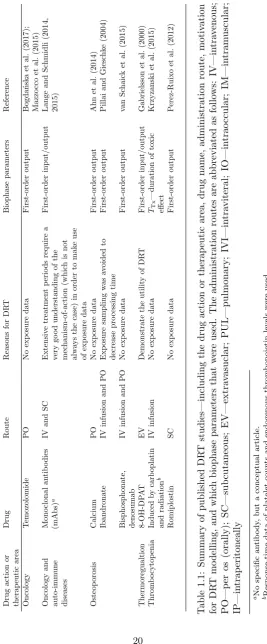
A summary of published DRT data analyses is given in Table 1.1.
1.2.1
Instantaneous response models
Dose-response-time data analysis dates back to the 1960’s and 1970’s when Levy (Levy,
1964a,b, 1966; Gibaldi and Levy, 1972) and Smolen (Smolen, 1971b; Schoenwald and Smolen,
1971; Smolen and Schoenwald, 1971; Smolen, 1971a; Smolen and Weigand, 1973; Smolen
et al., 1975; Smolen, 1976b,a,c, 1978) introduced the concept. Levy described a relationship
between the amount of drug in the body and the corresponding pharmacological effect.
Smolen, on the other hand, analysed the dose-response relationship of a mydriatic3 drug
after oral and ophthalmic administration. In the qmydriatic studies, no exposure data were
available due to difficulties in assaying the drug in body fluids. Consequently, response
PK-PD modelling approach
[image:28.595.152.474.133.390.2]DRT modelling approach
Figure 1.2: Illustration of the conceptual difference between traditional PK-PD modelling and DRT analysis. In traditional pharmacodynamic modelling, the response is assumed to be driven by the pharmacokinetic model. In DRT modelling, the response is driven by the drug amount in the biophase.
data were the sole source of information when quantifying the bioavailability and biokinetic
behaviours. Smolen’s studies were based on two major assumptions (Smolen, 1976c):
• “The dynamics of the drug’s disposition are linear.”
• “The intensity of pharmacological response is a single-valued function of the biophasic drug levels.”
For example, with a biophase amount of Ab(t), and a pharmacological response of I(t) (mydriatic response intensity, in this case), the functional relationship was assumed to be
given by
I(t) =f(Ab(t)), (1.5)
for some appropriate functionf. Now, given the first assumption, a dose vs. effect relationship was used to convert observed intensity-time courses into relative biophase amount-time
courses. Combining this with a compartmental model for the biophase dynamics, and
Smolen analysed a range of two- and three-compartment biophase models to describe the
kinetics of the biophase (the are models illustrated in Fig. 1.3). The corresponding model
fits demonstrated the structural and practical identifiability4issues associated with
multi-compartment biophase models (without making appropriate prior assessments). Nonetheless,
when applying an identifiable biophase function, the method was proven to be successful in
capturing the pharmacodynamic behaviours and the biophase kinetics. However, the second
of Smolen’s assumptions heavily constrains the application of the defined technique since
many pharmacological processes are non-direct (Dayneka et al., 1993).
Figure 1.3: Biophase models presented by Smolen (1971b). Smolen used two-compartment models with a biophaseAb, and systemic fluidAc compartment, and three-compartment models with a biophase Ab, a systemic fluid Ac, and a tissue depot compartment Ad. Moreover, a fourth compartment Aa, corresponding to the site of administration, was included if the drug was not administered systemically.
Since those initial studies, DRT modelling was not applied until the early 1990’s when Verotta
and Sheiner (1991) further developed the existing techniques. In their study, semi-parametric
methods were applied to analyse pharmacodynamic data over a range of different data sets
(e.g., verapamil-induced changes in the PR interval of an electrocardiogram). Verotta and
Sheiner (1991) made the following model assumptions
• “Both the distribution of the drug and its effect vs. concentration relationship are stationary processes.”
• “The distribution of the drug is linear with respect to the input of the drug.”
• “The pharmacodynamic response to the drug depends on the concentration of the drug
at a single site.”
• “The relationship between effect and drug concentration is memoryless.”
4The identifiability issues were discussed by Smolen. However, no formal identifiability analysis was
The semi-parametric model consisted of an unobserved stateX that was proportional to the drug concentration at the active siteCe. The stateX was given by the convolution of the input function and a sum of exponentials. Furthermore, the pharmacological effectE was related to X according to a cubic spline. As Verotta and Sheiner had access to PK data in their study, the estimated exposure could be compared with the observed exposure.
Here, the uncertainty of the non-parametric technique was made clear, as the worst case
estimated exposure profile was far off the observed exposure. Furthermore, the assumption
of having stationary processes and a memoryless relationship between the effect and the
drug concentration limits the method substantially. However, the study by Verotta and
Sheiner inspired subsequent DRT studies. In particular, the response behaviour of the
muscle relaxant drug vecuronium was analysed in a range of studies (Bragg et al., 1994;
Fisher and Wright, 1997; Fisher et al., 1997; Warwick et al., 1998), where twitch depressions
of the muscles were used as the pharmacodynamic biomarker. In these studies, the drug
plasma concentration was measurable, but not the concentration at the neuromuscular
junction, which is the effective site. Regardless, the studies successfully characterised both
the respiratory and adductor pollicis muscle behaviours seen after vecuronium administration.
This was done by modelling the biophase concentration Ce (called effective concentration or
active concentration in the studies) with a first-order elimination model given by
Ce =keo·D·
A·(e−λt−e−keot) keo−λ
, (1.6)
wherekeo is the elimination rate from the plasma compartment to the biophase compart-ment,D is the dose,Athe dose-normalised intercept, andλthe elimination rate from the biophase compartment. This biophase concentration drives the response according to a Hill
equation (Gesztelyi et al., 2012)
Effect = Ce
γ
Ceγ+ Cγ50, (1.7)
where C50 is the steady-state concentration that produces 50% of the effect, andγ is the Hill coefficient. This model was applied to both the respiratory and the adductor pollicis
twitch tension data. The models showed that the peak concentration of vecuronium occurred
earlier in the respiratory muscles than in the adductor pollicis. This implies a higher peak
concentration level and thus explains why the respiratory muscles more frequently experience
paralysis than the adductor pollicis after vecuronium exposure. Furthermore, Warwick et al.
(1998) showed the potential advantages associated with PK-free PD analysis. In particular,
the DRT approach allows for individual predictions of future dosing during anaesthesia. This
is not possible using the conventional PK/PD approach due to the time needed to assay the
drug. Further usage of DRT data analysis was successfully demonstrated in studies where
children were treated with erythropoietin (EPO) for renal anaemia (Uehlinger et al., 1992;
linearly dependent on the EPO dose
R=β·D, (1.8)
whereR is the drug-induced Hb production,Dthe dose, andβ the production rate per dose unit. A DRT approach was suitable in these studies since the EPO turnover is rapid in
comparison to the response turnover. Consequently, it is hard to relate the concentration-time
course of EPO to that of Hb.
1.2.2
Turnover models
Following the DRT studies of the 1990’s, the field saw a breakthrough when Gabrielsson
et al. (2000), introduced biophase-driven turnover models (Dayneka et al., 1993). In the
turnover model framework, the PD responseR(t) is given by
dR(t)
dt =kin−kout·R(t) with R(0) =R0, (1.9)
wherekinandkout are the turnover and fractional turnover rate of the response, respectively, andR0 is the baseline response. For a biophase-driven response, the biophase amountAb will act on the production or elimination of response through a drug-mechanism function
H(Ab) according to
dR(t)
dt =kin·H(Ab)−kout·R(t) (1.10)
or
dR(t)
dt =kin−kout·H(Ab)·R(t). (1.11)
The drug-mechanism functions that were applied in the study by Gabrielsson et al. (2000)
included nonlinear Hill relations (similar to that of Eq. 1.7) that were either stimulatory
H(Ab) = 1 +
Emax·Aγb
ED50γ +Aγb (1.12)
or inhibitory
H(Ab) = 1− Emax·A
γ
b
ED50γ +Aγb. (1.13)
where Emax is the efficacy, ED50 the potency (based on dose), and γ the Hill coefficient. Turnover models allow for a wide range of response-time behaviours, out of the scope of
previous DRT studies (due to their assumptions). The study by Gabrielsson et al. (2000),
contained four different cases of biophase-driven turnover models, describing response-time
is illustrated in Fig. 1.4). These case studies showed that DRT models are applicable when
the kinetics and/or dynamics behave non-linearly, when there are time-delays in the response
data, and when the system contains feedback mechanisms. This heavily expanded the
possible applications of DRT models. Beyond the study of Gabrielsson et al. (2000), the
Figure 1.4: Biohase-driven turnover model presented by Gabrielsson et al. (2000). The input into the biophase is either direct (iv administration) or through absorption (oral administration)F·ka, whereF is the biophase availability andkais the first-order absorption rate from an absorption compartment into the biophase. The parameterk is the first-order (linear) elimination rate from the biophase. The biophase amount Ab was then driving a drug-mechanism function H(Ab), which can, for example, inhibit the turnover kin or fractional turnoverkoutof the response R.
biophase-driven turnover model was applied across a range of DRT studies in the late 1990’s
and early 2000’s (Lalonde and Gaudreault, 1999; Audren et al., 2004; Gruwez et al., 2005; Tod
et al., 2005). In particular, Lalonde and Gaudreault (1999), analysed parathyroid hormone
concentrations under treatment by the calcimimetic agent R-568. Since the concentration
of the specific agent was below the limits of quantification in more than half of the patient
samples, the exposure analysis was excluded and the PD model was assumed to be driven
by the drug amount in the biophase. Further, Gruwez et al. (2005) applied a dose-response
model to analyse categorical data when they explored the effect of paroxetine and pindolol.
Here, the response-time data consisted of total scores on the MADR scale (Montgomery and ˚
Asberg, 1979).
1.2.3
Kinetic-Pharmacodynamic models
In addition to the original DRT-approach by Smolen (1971b), an alternative rate-driven
model (K-PD) was suggested by Jacqmin et al. (Gieschke et al., 2001; Goggin et al., 2001;
Jacqmin et al., 2001; Pillai et al., 2001). The concepts of the K-PD model are similar to
rate) is assumed to be the driver of the pharmacological response, rather than the biophase
amount. This is an unconventional approach in pharmacological modelling, where drug
exposure (or amounts) are generally assumed to drive the pharmacological effect.
To demonstrate the idea of the K-PD model, assume that the biophase amountAb(t) has a first-order elimination ratek given by
dAb(t)
dt =−k·Ab(t), (1.14)
with initial valueAb(0) =D. Furthermore, assume that the drug inhibits the turnover of the pharmacodynamic responseR(t) according to a nonlinear Hill relation. The response behaviour would then, for the traditional DRT and the K-PD approach, be given by
dR(t)
dt =kin· 1−
Emax·A
γ
b(t) ED50γ +Aγb(t)
!
−kout·R(t) DRT, (1.15)
and
dR(t)
dt =kin· 1−
Emax·IRγ(t) EDK50γ +IRγ(t)
!
−kout·R(t) K-PD, (1.16)
with
IR(t) =−dAb(t)
dt =k·Ab(t), (1.17)
whereIR(t) is the virtual infusion rate andEDK50(amount per time unit) the rate that gives half-measured drug-reduced response. As is indicated by Eq. (1.17), the ‘drivers’ of the
DRT and K-PD models are proportional. Thus, the two frameworks only differ by a scaling
factor.
K-PD models have been applied in numerous studies (see for example Abou Hammoud et al.
(2009); Hamberg et al. (2013); Salem et al. (2016); Wu et al. (2011)) following its introduction
by Jacqmin et al. (2001, 2007). However, several studies have misunderstood the original
model definition and used the biophase amount as the driving force of the response (see
for example Gruwez et al. (2007); Jacobs et al. (2010); Mikaelian et al. (2013); Musuamba
et al. (2015); Nielsen et al. (2012)). These studies have in fact applied the traditional DRT
approach (Smolen, 1971b).
In a study of chemoradiotherapy-induced thrombocytopenia by Krzyzanski et al. (2015), no
biophase kinetics were addressed. Rather, the drug (carboplatin) was assumed to have an
on/off effect given by
T x(t) =
Kmax if tj≤t≤tj+TT x,
0 otherwise,
that acted on the elimination of cells. Here,tjrepresents the starting time of the chemora-diotherapy,TT x the duration of the toxic effect andKmaxis the maximal toxic effect. The study by Krzyzanski et al. (2015) demonstrated that DRT modelling does not necessarily
need to include a compartmental biophase.
1.3
Summary and perspectives
DRT data analysis could be an option when the traditional PK-PD approach fails. This
occurs when exposure data are lacking or are uninformative, which may be due to:
• Exposure sampling is difficult—quick drug turnover, drug concentrations below limits of quantification, local administration etc.
• Exposure sampling is undesirable—clinical studies, in particular within paediatrics.
• Exposure data are uninformative about the drug exposure—e.g., pulmonary
adminis-tered drugs or drugs that penetrate the blood-brain barrier.
• Large time differences between the initial and terminal phase—biologics (Morrow and Felcone, 2004).
The technique has been applied for describing drug behaviour in several therapeutic areas
(see Table 1.1). In almost all of these studies, simple biophase models were used with
first-order elimination and first-order absorption (the latter being applied in cases where
drug is not directly administered into the biophase). During recent years, DRT modelling
has frequently been applied in clinical oncology (Buil-Bruna et al., 2014; Frances et al., 2011;
Parra-Guillen et al., 2013; Paule et al., 2012; Ramon-Lopez et al., 2009; Wilbaux and He,
2014)—a therapeutic area where invasiveness is undesirable. As for clinical oncology studies,
invasiveness is an issue in paediatric studies. Thus, DRT modelling is a promising technique
Chapter 2
Methods and models
This chapter serves to illustrate how to perform dose-response-time (DRT) data analysis.
In principle, the study constitutes five fundamental modelling techniques; model selection,
identifiability analysis, parameter fitting, sensitivity analysis, and modelevaluation. These
techniques will be examined in a logical order—albeit remembering that modelling is an
iterative exercise where the modeller goes back and forth until the final model meets some
quantitative or qualitative criteria. Since the methods ultimately are designed to be applied
in pharmacological studies, particular focus will be on the implementation of the ideas in
various examples.
The first section of this chapter covers model selection in a standard DRT data analysis—
wherein mean population behaviours are described. Central to these studies is the choice
of the biophase function. The biophase generally has a basic structure with, for example,
zero- or first-order drug absorption and first-order drug elimination from the biophase. The
modelled drug amount in the biophase is subsequently assumed to act as the driver of
the pharmacological response via a drug-mechanism function. To successfully choose the
PD model with a suitable drug-mechanism function, the response-time data need to be
qualitatively analysed and the characteristic response behaviours recognised. The second
section of the chapter is devoted to population modelling, where it is demonstrated how a
biophase-driven PD model may be extended to incorporaterandom effects. These allow for a quantitative way to assess differences in a population, such as between-subject, inter-study,
and inter-occasional variabilities (Bonate, 2011; Davidian, Marie, 2003). To determine
to vary in populations (Mould and Upton, 2012). The section will mainly focus on the
nonlinear mixed-effects frameworksince this has been the standard population modelling
approach in pharmacology for more than 30 years (Sheiner and Beal, 1980, 1981, 1983). In
the subsequent section, the developed models will be subject to an identifiability analysis
to verify that the parameter estimation problems are well-posed (Raue et al., 2014). The
discussion will encompass both a priori and data-based identifiability techniques. The identifiability analysis is followed by a section on different methods for parameter estimation,
particularly for nonlinear mixed-effects models. The fourth section will cover sensitivity
analysis; a framework that studies how the system output is affected by uncertainties, or
perturbations, of the input. Sensitivity analysis techniques will be proven to be useful in both
model selection and validation. Finally, tools for validation and diagnostics are examined as
ways for quantitative and qualitative evaluation of the analysis.
2.1
Model selection
One of the biggest challenges of developing a DRT model is that the biophase dynamics and
the PD need to be assessed simultaneously. Consequently, it may be difficult to distinguish
the kinetic and dynamic properties of the drug from each other. More specifically, time-delays
in the dose-response data could, for example, be a consequence of rate-limiting absorption or
slow onset of the biomarker. To discriminate between the kinetic and dynamic properties, it
is important to have arich1 data set. The data should preferably include multiple dosages and administration routes, as well as careful selection of the dosages (Gabrielsson et al.,
2000).
2.1.1
Biophase function
The biophase model is generally simple due to the difficulties associated with identifying
a complex kinetic model without exposure data (for identifiability analysis, see Sec. 2.2).
More sophisticated biophase models may be used by making prior assessments and fixing
some parameter values. The simplicity of the single–compartment biophase model makes
it a suitable candidate for describing the biophase dynamics. This model will be slightly
modified depending on the drug administration route. If the drug enters directly into the
biophase, the input function is that of an intravenous (IV) administration. With a first-order
elimination rate from the biophase, denoted byk, the dynamics of the biophase following a direct bolus input or an infusion input are given by
dAb(t)
dt =−k·Ab(t) with Ab(0) =D bolus, (2.1)
1Obtained from experiments where the system has been properly ‘provoked,’ thereby revealing the full
or
dAb(t)
dt = Inf(t)−k·Ab(t) with Ab(0) = 0 infusion, (2.2)
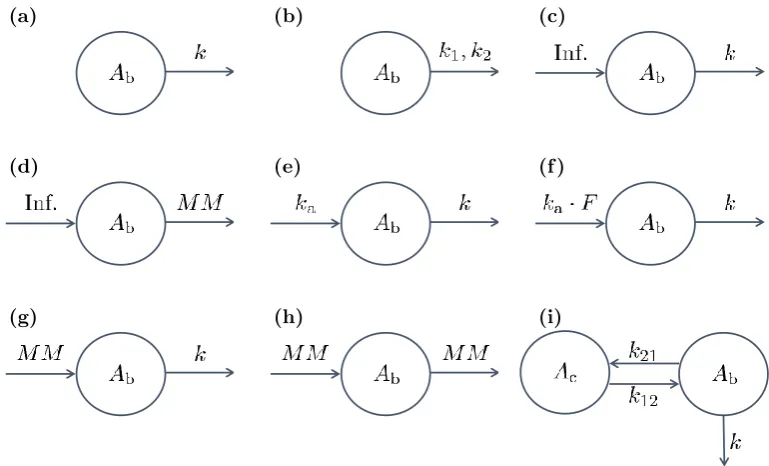
whereAb(t) is the biophase drug amount, Inf(t) a function dependent on the infusion protocol, D the drug dose (the models are illustrated in Fig. 2.1a and Fig. 2.1c, respectively). If
(a) (b) (c)
(d) (e) (f )
[image:41.595.138.523.214.447.2](g) (h) (i)
Figure 2.1: Examples drawn from the biophase model library: (a) represents a bolus input and first-order elimination; (b) a bolus input and biphasic first-order elimination; (c) a zero-order input and first-order elimination; (d) a zero-order input and Michaelis-Menten elimination; (e) a first-order input and elimination; (f) a first-order input, scaled by the biophase availability, and order elimination; (g) Michaelis-Menten input and first-order elimination; (h) Michaelis-Menten input and elimination; (i) two-compartment model with order distribution between the central compartment and the biophase and first-order elimination from the biophase. The parametersAb, Inf,k,ka,F and MM represent, respectively, the biophase amount, the constant rate infusion input, the first-order elimination rate constant, the first-order absorption rate constant, the biophase availability and the Michaelis-Menten absorption/elimination process, respectively. All models presented in the library have been applied in published DRT studies (see Table 1.1)
the drug is administered to a peripheral compartment, and subsequently absorbed into the
biophase via a first-order process, then the biophase dynamics are given by
dAa(t)
dt =−ka·Aa(t) with Aa(0) =D, (2.3a) dAb(t)
whereAa(t) is the drug amount in the absorption compartment,kathe first-order absorption rate into the biophase, andF the availability, or thebiophase availability (Smolen (1971b), model illustrated in Fig. 2.1e). By solving forAa(t) in Eq. (2.3a), the system can be re-written as
dAb(t)
dt =D·F·ka·e
−kat−k·A
b(t) with Ab(0) = 0. (2.4) The aforementioned models are the simplest biophase functions and these have been frequently
applied in DRT studies (see Table 1.1). Apart from these models, Andersson et al. (2015)
introduced nonlinear absorption/elimination models to describe the biophase dynamics.
In their study, an extravascular doseD was absorbed into the biophase via a nonlinear Michaelis-Menten model, which gives the following biophase dynamics
dAa(t) dt =−
Vmax·Aa(t) Km+Aa(t)
with Aa(0) =D, (2.5a)
dAb(t) dt =
Vmax·Aa(t) Km+Aa(t)
−k·Ab(t) with Ab(0) = 0, (2.5b)
where Vmax is the maximal absorption rate from the absorption compartment andKm the drug amount at which 50% absorption is attained. The biophase elimination could, of course,
also be modelled using the nonlinear Michaelis-Menten model. A typical scenario is that the
drug amount (or concentration) is measurable in a central compartment (e.g., plasma) but
not in the biophase. In cases like these, multi-compartmental biophases could be applied.
Such a model could, for example, be characterised in the following way:
dAb(t)
dt =k12·Ac(t)−k21·Ab(t)−k·Ab(t) with Ab(0) =D, (2.6a) dAc(t)
dt =k21·Ab(t)−k12·Ac(t) with Ac(0) = 0, (2.6b)
where Ac(t) is the drug amount in a central compartment,k12 andk21 are the absorption/e-limination rates between the biophase and central compartment,kthe elimination rate from the biophase out of the system, and D the drug amount (model illustrated in Fig. 2.1i). Models like the aforementioned have been used by Fisher et al. (1997) among others (Smolen,
1971b; Warwick et al., 1998).
2.1.2
Pharmacodynamic model
The pharmacology literature encompasses a plethora of PD models—aimed at describing
different pharmacological phenomena. This section will cover the ones most commonly
applied in DRT studies. This includes, for instance, direct and indirect models with linear
and nonlinear dose-response relations. For a more thorough discussion on PD modelling, see
for example Gabrielsson and Weiner (2010).
The PDs in the DRT framework are assumed to be driven by the biophase amountAb(t). If there is a rapid equilibrium between the biophase amount and the pharmacological effect
2010). The simplest possible direct response model assumes a linear effect-amount relation
given by
E(t) =E0±β·Ab(t), (2.7)
whereE(t) is the effect, E0 the baseline, andβ the slope parameter. However, the linear dose-response relationship is unbounded and therefore violates basic physiological principles
(e.g., a limited receptor pool). TheEmax model, on the other hand, has a saturable dose-response relationship as well as physiologically interpretable parameters (Gabrielsson and
Weiner, 2010). The standard (γ= 1) and sigmoidal form of this model are given by
E(t) =E0±
Emax·A
γ
b(t)
EDγ50+Aγb(t), (2.8)
whereEmaxis the maximal drug effect (efficacy),ED50 the biophase drug amount at 50% maximal effect (potency), andγ the Hill exponent. The linear and saturable direct response models in Eqs. (2.7) and (2.8) have been applied in several DRT studies (Uehlinger et al., 1992;
Port et al., 1998; Bragg et al., 1994; Fisher et al., 1997; Fisher and Wright, 1997; Warwick
et al., 1998). To illustrate the connection between the Emax-model and ligand-receptor binding, consider thelaw of mass action, which states
[L] + [R]
kon
koff
[LR], (2.9)
where [L] is the free concentration of a specific ligand, [R] the free concentration of the corresponding receptor, [LR] the free concentration of the receptor-ligand complex, kon the rate constant for association, andkoff the rate constant for the dissociation. For the receptor-ligand binding, assume that
• The interaction is reversible.
• The interaction is rapid.
• The receptor has one binding site for the ligand.
• The receptor, ligand, and receptor-ligand complex are in equilibrium.
Under equilibrium, Eq. (2.9) implies that
kon[R][L] =koff[LR], (2.10)
or
[R][L] [LR] =
koff kon
whereKdis known as the the dissociation constant. Now, assume that a drug-induced effect is proportional to the free concentration of the receptor-ligand complex as
E=α·[LR]. (2.12)
This implies that the maximal drug-induced effect is given by
Emax=α·([LR] + [R]). (2.13)
By taking the fraction of the drug-induced effect and the maximal effect, we get
E Emax
= [LR]
[LR] + [R] (2.14) = 1
1 + [LR[R]]
. (2.15)
Using the identity in Eq. (2.11) gives
E Emax
= [L] [L] +Kd
(2.16)
or
E= Emax·[L] [L] +Kd
, (2.17)
and we are done. To conclude, under some assumptions, theEmax-model may be derived from the law mass action of receptor-ligand binding.
The previous discussion has focused on direct response models. Generally though, the
relationship between the biophase drug amount and the pharmacological effect is indirect,
whereby turnover models are frequently applied (Dayneka et al., 1993). In a turnover model,
the responseR(t) is given by
dR(t)
dt =kin−kout·R(t) with R(0) =R0, (2.18) wherekin andkout are the turnover rate and the fractional turnover rate of the response, respectively, andR0the baseline response. Depending on the nature of the drug, its induced effect is typically given by a drug-mechanism functionH(Ab(t)) that is either stimulatory
H(Ab(t)) =S(Ab(t)) = 1 +
Smax·Aγb(t) SD50γ +Ab(t)γ
, (2.19)
or inhibitory
H(Ab(t)) =I(Ab(t)) = 1−
Imax·Aγb(t)
Here,Smaxand Imax represent the maximum stimulatory and inhibitory effect (efficacies), respectively,SD50andID50are the biophase drug amounts were 50% of the effect is attained (potencies), andγis the Hill exponent. The stimulatory (displayed in Eq. (2.19)) or inhibitory (displayed in Eq. (2.20)) drug effect acts on the production or loss (or both) of response
in Eq. (2.18). For example, a stimulatory effect on the turnover would yield the following
relation:
dR(t)
dt =kin·S(Ab(t))−kout·R(t), (2.21) and an inhibitory effect on the fractional turnover would be given by
dR(t)
dt =kin−kout·I(Ab(t))·R(t). (2.22)
Turnover equations with nonlinear inhibition or stimulation have frequently been applied in
DRT studies (see for example Abou Hammoud et al. (2009); Audren et al. (2004); Lalonde
and Gaudreault (1999); Gabrielsson et al. (2000); Mikaelian et al. (2013); Wilbaux and He
(2014)).
Example 2.1.2.1 Turnover model (Gabrielsson et al., 2000)
In order to illustrate how the characteristic behaviours of a generic response-time
data set are extracted, consider the following example where an antinociceptive drug has been
given both as an IV bolus (in two different doses of 40 and 80µg kg−1) and subcutaneously
(in three different doses of 50, 100, and 200µg kg−1) to Sprague-Dawley rats (the data are
adapted from Gabrielsson et al. (2000)). Post drug administration, radiant heat is focused
on the tail of the rat and the time, in seconds, is measured until the rat removes its tail. The
response-time behaviour was observed during 180 min (the data are illustrated in Fig. 2.2).
Since the drug was administered via two different routes, we need two separate biophase
● ● ●
● ●
●
●
■■ ■
■ ■
■
■
■
◆ ◆
◆ ◆
◆ ◆
◆
◆
▲ ▲
▲ ▲
▲
▲ ▲
▼▼ ▼
▼ ▼
▼
▼
0 50 100 150 200
0 2 4 6 8 10 12 14
●
■
◆
▲
▼