1
Conflict, Risk & Safety Faculty of Behavioural, Management & Social Sciences
Adaptability
–
Positive Outcome Measures in Adverse
Contexts and How a Crime Suspect Utilizes Them
Marius Ostendorf
University of Twente, The Netherlands
2019 @ Faculty of Behavioural, Management & Social Sciences
This study is on how adaptability might be linked to different evidence disclosure techniques and how it affects a suspect’s ability to stick to a pre-planned strategy despite a constantly changing
situation. Two evidence disclosure tactics were used to elicit adaptive responses from the participants. Participants (N=51) had to complete a mock-crime and enter an interrogation
afterwards. The participants were specifically asked to convince the interviewer of their innocence and come up with a strategy on how to achieve that goal. A shift-of-strategy approach
and a late disclosure approach were used in the interview. It was predicted that higher levels of adaptability would lead to better abilities to follow through with a pre-planned strategy and stick
to their goal. No significant link between adaptability and of the outcome measures could be established. Adaptability did not seem to influence the participants ability to stick to their pre-planned strategy. Adaptability also has no influence on the amount of statement-inconsistencies a
participant made during the interrogation. Several factors, including the strength of the evidence disclosure technique and the subjective measure of adaptability seemed to have resulted in the
2 Introduction
Police interrogations have the primary goal of finding the truth about what happened by
gathering accurate information about a crime (Kassin, 2005). Guilty and innocent suspects are
faced with the prospect of being interrogated about their actions in relation to the crime. Both
apply distinctive counter-interrogation strategies within the interrogation context (Hartwig,
Granhag, Giolla & Clemens, 2014). These strategies denote all attempts made by guilty and
innocent suspects to withstand an interrogation and appear as truthful (Clemens, 2013). This has
similarities with the self-regulation theory which proposes that people, who are faced with a
goal-oriented situation, will try to control their behaviours in an attempt to move towards a desired
outcome, while trying to avoid the negative consequences (Carver & Sheier, 2011). Applied to
the interrogation context, both liars and truth-tellers want to be perceived as credible by the
interviewer (Carver & Sheier, 2011). The main goal of being regarded as innocent, is identical for
both guilty and innocent suspects. Therefore, differences can be examined in the strategies both
apply to reach that goal. The main difference relates to the amount and type of information they
hold and what they choose to do with that information (Hartwig, Granhag, Strömwall & Doering,
2010). Lying suspects try to conceal information and develop a pre-planned strategy prior to the
interrogation to make sure their goal can be achieved (Hartwig et al., 2007). Truthful suspects
want to be as open as possible about the crime and their involvement in it. Innocent suspects will
apply these strategies to avoid being perceived as deceptive. They hold the general belief by
being open, the truth of their actions will be understood by the interrogator (Hartwig et al., 2010).
These two fundamentally different approaches to information management tactics create
distinctive counter-interrogation strategies (Hartwig et al., 2015). With regards to lying suspects,
Hartwig argues that they make use of two types of strategies, which they pre-plan before entering
the interrogation. First off, the avoidance strategies. Liars are trying to avoid disclosing any
critical information should the opportunity present itself during the interrogation (Hartwig et al.,
2010). This is most commonly identified as vague statements about one´s whereabouts during the
interrogation (Hartwig et al., 2010). The second strategy is denial. It is typically found when
asked specific questions about the evidence. Liars will switch to denying all critical information
that is presented to them (Hartwig, Granhag, Strömwall & Vrij, 2005). Truth-tellers on the other
hand have the main strategy of forthcomingness, meaning that they volunteer to present all
3
Despite these, both liars and truth-tellers are faced with several risks when applying their
counter-interrogation strategies. The main threat of the truth-teller is the possibility of not being perceived
as truthful, despite their openness about the crime and their personal involvement in it (Hartwig
et al., 2010). The main risks for the lying suspect are different since their main goal-oriented
strategy will be expressed through the suppression of critical information (Granhag et al., 2015).
One critical problem that arises when trying to conceal information, is in the way of how much to
convey and how it is conveyed to the interrogator (Hartwig et al., 2014). By not providing any
information, guilty suspects present themselves as suspicious, leaving them with the other option
to provide false or slightly altered information (Hartwig et al., 2014). Offering false information
runs the risk, that the evidence the interrogator holds against them contradicts their statement.
That impacts their pre-planned strategy forcing them to change their plan, as well as their level of
credibility. Overall, both increase the risk of an undesired outcome (Granhag et al, 2014). Guilty
suspects automatically run the risk of creating statement-evidence inconsistencies through the
very nature of their counter-interrogation strategies. Statement-evidence inconsistencies can be
defined as statements that were not answering the questions of the interrogator truthfully
(Hartwig et al., 2005). Another form of inconsistencies can be termed the within-statement
inconsistencies. These are defined as incoherent statements in the form of different facts related
to the same evidence (Hartwig et al., 2005). These can be used by an interrogator to decrease the
suspects chances of sticking to their initial goal and reaching their desired outcome (Granhag et
al., 2014).
Several different interview techniques have been applied in correlation to the suspect´s
counter-interrogation strategies to determine which is the most effective in eliciting
statement-evidence inconsistencies (Hartwig, Granhag & Luke, 2013). Two main forms of statement-evidence
disclosure tactics have been developed through various research and integrated into the
strategic-use-of-evidence framework (Hartwig, Granhag & Luke, 2013). Generally, timing seems to be the
most influential factor for evidence disclosure. It refers to the most ideal timeframe, in which to
disclose evidence to the suspect and is divided into an early and late disclosure tactics (Hartwig,
Granhag & Luke, 2013)
Early disclosure tactics involve the reveal of every piece of evidence at the very
beginning of the interrogation to immediately break down any pre-planned strategy of the guilty
4
Dawson & Xhihani, 2012). This process seems to be reliant on the strength of the evidence, since
stronger evidence makes denial and avoidance futile (Jordan et al., 2012). Recent research
however discarded the effectiveness of the early disclosure tactic in producing effective
interrogation outcomes, since only minimal inconsistencies are produced after the evidence has
been disclosed (May, Granhag & Tekin, 2017; Jordan et al., 2012) This is due to the reason that
an early disclosure provides the suspect with an opportunity to develop his narrative to fit the
evidence just presented to them in order to come across as innocent (Jordan et al., 2012).
The other tactic is the late disclosure tactic, which confronts the suspect with the evidence
at the end of the interrogation (Hartwig et al., 2005). This aims to produce statement-evidence
inconsistencies which significantly reduces the suspects level of credibility. The suspect is getting
a sense of succeeding in deceiving the interrogator by coming up with a false narrative. Only at
the end, suspects realize that this strategy is not working out and too much incriminating
evidence was gathered to which they cannot adjust to (Jordan et al., 2012). Furthermore, a late
disclosure of evidence would result in only one instance that requires an adjustment to the
pre-planned strategy.
Both the early and the late disclosure approach only focus on disrupting any pre-planned
goal-oriented strategies of the guilty suspect at one specific moment in time. None of them force
the suspect to make any adjustments to their pre-planned strategy throughout the interrogation. In
the early disclosure, the suspect does not have to adjust his narrative as he simply has to come up
with a story that addresses all of the evidence disclosed to them before (Jordan et al., 2012). In
the late disclosure, the suspect also does not have to adjust in the beginning and can simply tell
his account, while only being in a position for potential singular adjustment at the end of the
interrogation (Jordan et al., 2012). A shift-of-strategy (SoS) approach might be a beneficial
evidence disclosure tactic to be used against the suspect to elicit the need for adjustment during
the interrogation (Hartwig, Granhag & Luke, 2013). In this approach, the suspect is confronted
with one piece of evidence at a time throughout the entire interrogation (Hartwig, Granhag &
Luke, 2013). This would force the guilty suspect to adjust his strategy throughout the
interrogation. A suspect would provide a false narrative and be under the belief of convincing the
interrogator and being able to stick to their goal-oriented behaviour, pre-planned before the
5
with evidence against their statement, forcing them to adjust their whole narrative and
pre-planned strategy for each piece of evidence.
If the adjustments of a suspect during the SoS-approach are effective and increase the
chances of a positive outcome, then it is equal to adaptability. Adaptability is defined as the
subjective capacity to make appropriate responses to changing situations, the adjustment and
modification of behaviours when interacting with different people or entering new situations
(VandenBos, 2015). In addition, adaptability also includes efficient regulation of emotional,
behavioural and cognitive responses when responding to change and uncertainty. Martin (2017)
also argues that adaptability does not occur within an adverse context. Adaptability is related to
positive outcomes in situations that create uncertainty, novelty and change. Change in correlation
with adaptability is observed as opportunities for personal growth and new beginnings (Martin,
2017). The interrogation context would be classified as a threatening and adverse situation
resulting in negative outcomes should the individual not be able to adjust to these situations. It
could be possible that adaptability can be examined through the SoS-approach since it forces the
suspect to adjust several times during the interrogation by changing the suspect´s strategy through
its continuing disclosure of evidence. Additionally, for guilty suspects, being perceived as
credible might be equally evaluated as a situation that allows for personal growth or a new
beginning, even though it is adverse (Martin, Nejad, Colmar & Liem, 2013).
Measuring adaptability within the interrogation context could be done by clarifying
effective and ineffective adjustments. Effectiveness can be defined in terms of a subject
pre-planning their behaviours and being able to stick and adjust that plan to follow through with it.
Ineffectiveness can be classified as a subject who planned to behave in a certain way but
ultimately deviated from their initial plan, as well as planning not to do something but doing it in
the end. By examining effective and ineffective adaptability, it becomes viable to think of this
concept as match and mismatch of pre-planned strategies and the actual behaviour during a
situation. Applied to the interrogation context, matches can be exemplified with a suspect
planning to share a piece of information to avoid losing credibility and succeeding in their plan
by actually sharing the information. In contrast, a mismatch would translate into a suspect
wanting to share that information but ultimately did not, resulting in them failing their initial
6
pre-planned, goal-directed behaviour, despite a stepwise evidence disclosure forcing constant
adjustments to that pre-planned strategy
The Present Study
To summarize, guilty and innocent suspects use different counter-interrogation strategies
while being interviewed about their involvement in a criminal activity. These usually focus on
information-management tactics, leading innocent suspects to become forthcoming about their
involvement in a crime, whereas guilty suspects resort to plan beforehand what type of
information they want to reveal and which to hold on to. By doing that, guilty suspects run the
risk of making statements that are inconsistent with the evidence held by the interviewer. This in
turn creates statement-evidence inconsistencies which can be elicited by using different
evidence-disclosure tactics. These being the early and late evidence evidence-disclosure techniques, as well as the
SoS approach. Generally, the late disclosure technique is more effective in eliciting
inconsistencies and break down the pre-planned strategies of the suspect, as compared to the
early disclosure (Jordan et al., 2012). However, the new SoS approach could be used to examine
possible adjustments of the goal-oriented behaviours of suspects, since it uses several stages of
evidence disclosure during the interrogation, forcing the suspect to adapt their strategy on several
occasions. Effective adjustment is expressed as adaptability, the ability to adjust behavioural
responses during changing situations. Within the interrogation context, effective adaptability is
expressed in the total number of matches (goal-oriented pre-interview plan translates into actual
behaviour during interview) and mismatches (discrepancies between goal and actual behaviour).
The more matches a suspect would have, the more effective his adjustments and therefore the
higher his level of adaptability.
The aim of this research is to examine adaptability within the interrogation context since
no recent research examined the concept of suspects adapting to different evidence disclosure
techniques and how effective they are in adjusting their pre-planned goals to a stepwise
disclosure of evidence approach. Two interrogation techniques were used in this study. The SoS
approach as the main condition to test for adaptability, and the late evidence disclosure approach
as the control condition It is expected that higher levels of adaptability would lead to significantly
higher ability to stick to their pre-planned behaviour. As a result, fewer inconsistencies with the
7
predict that the SoS approach is significantly better in breaking down the effectiveness of the
adjustments in comparison to the late disclosure technique.
The main research question of this study is “How do suspects adapt their
counter-interrogation strategies depending on the evidence disclosure technique applied by the
interviewer?”. Five hypotheses have been derived to test the research question. Hypothesis 1
predicts that higher levels of adaptability lead to higher chances of following through with a
goal-oriented plan developed prior to the interview (positive match-mismatch ratio). Hypothesis 2
predicts that higher levels of adaptability lead to fewer statement-evidence inconsistencies.
Hypothesis 3 predicts that higher levels of adaptability would lead to fewer within-statement
inconsistencies. Hypothesis 4 and 5 predicted that a more positive match-mismatch ratio would
result in less statement-evidence and within-statement inconsistencies.
To test the research question of whether varying levels of adaptability lead to different
levels of outcomes in the interview, three mediator analyses have been conducted. The first test
was examining the indirect effect of adaptability with regards to the overall match-mismatch ratio
(effectiveness) scale. In addition, the mediator analysis tested for a main effect of the independent
variable (interview condition) on the match-mismatch scale. The second test included the
statement-evidence inconsistency variable to test for an indirect effect of adaptability to the
inconsistency variable. The third mediation analysis examined the relationship between the
interview condition, adaptability and the within-statement inconsistency scale to test for the same
direct and indirect effects as the second mediator analysis. The fourth and last mediation analyses
tested for an indirect effect of match-mismatch onto the statement-evidence inconsistencies and
the within-statement inconsistencies.
Methods
Participants
51 students (32 females and 23 males) between 19 and 28 years old (M = 22.38, SD = 1.683).
were contacted through various channels, ranging from the universities study sign-up system (i.e.,
Sona System), information flyers or by directly contacting participants. 26 participants were
randomly allocated to the direct interview approach condition, and 25 participants were allocated
to the SoS approach. 4 participants were excluded from the data set, due to confounding factors
8
Though not specifically stated, the study included some exclusion criteria for the participants,
mainly in the form of a proper English language proficiency. Each participant was paid 5 euros as
a reward for their participation. Before the experiment started, each participant signed the
informed consent. After the experiment, all participants were debriefed about the true intentions
behind the study.
Procedure
Phase 1: Background & Planning. In the beginning, all participants received the initial
background information about the role that they had to assume for the experiment. All
participants had to imagine being a student at the University of Twente. They had come across
evidence that one of the professors of the university was doing illegal experiments on dogs. The
directorial level of the university was aware of this but did not seem to intervene (Appendix 2).
Several unsuccessful attempts to stop these activities have been previously made. The participant
decided to contact an investigative reporter through the help of an animal rights activist group.
The participant had to commit a crime to reach their goal. All of the background information was
presented to the participants in one coherent story (Appendix 2).
Before engaging in the mock crime, the participant received a checklist with all the necessary
instructions listed in a step-by-step order. The checklist detailed every step and each action
needed to complete the mock crime. The checklist was included to guide participants through the
process. The participants had to provide the researchers with their phone number to initiate the
experiment. Via a second researcher, a text message was sent out with instructions on how to
initiate the mock-crime. The text message contained several pieces of information, needed to
successfully complete the mock-crime. Included were the number to a locker, which held a
USB-stick needed to store files, as well as passwords to access the two separate computers, one of the
professors who was conducting the illegal research, another one that was used by the participants
to send the stolen data files to the investigator. After that, they started to complete the checklist
9 Table 1.1
Instructions – Mock Crime
Action Location
Receive text message from contact person Entrance area of the Cubicus
Building
Collect envelope at the given location established by the text
message
Study area at the ground floor
of the Cubicus
go into the office where you find information regarding the
animal experiments (room C225)
C-Wing, 2nd Floor of the
Cubicus, Room 225
start the computer and plug in the USB stick to collect the
necessary evidence
Room C225
search the file ‘experiments’ and copy it on the USB stick
(located on Desktop)
Room C225
search the file ‘experiments’ and copy it on the USB stick
(located on Desktop)
Room C225
go to room XXX (there you can find a secure computer) Different locations used
during data collection
Different buildings on
university grounds (Raveljin,
Vrijhof, Carrè)
use the computer to log into your email- account Specified Room in building
used at collection day
send the files of the USB stick to
[email protected] (a journalist who belongs to
Rights for Animals who wants to publish your story)
Specified Room in building
10
next to the computer, search for the folder ‘contracts’ and take
a picture of the Documents
which you find inside. They serve as additional evidence.
Specified Room in building
used at collection day
send it via WhatsApp to this number (Kalle Blom): Specified Room in building
used at collection day
put the USB stick back into the envelope and place it into the
folder ‘private’ (your
accomplice will collect it)
Specified Room in building
used at collection day
return to room XXX Second room in same building
located further away from first
room
Phase 2: The Interview. Each participant entered the last room specified in the instructions
(Table 1.1). Here they received further instructions, explaining that they are guilty of committing
a crime and will be interviewed about their actions. The participants were informed that the
police had significant suspicion against them. The instruction sheet informed them about the
things they had to do during the interview (Appendix 3). They needed to convince the interviewer
of their innocence. Otherwise, the animal testing would continue, and they would be prosecuted.
The main goal for the participant was to be perceived as innocent. Participants learned that they
should not remain silent, as well as not call for a lawyer. After reading the instructions,
participants received a five-minute time frame to come up with a strategy to accomplish the goal
(convince interviewer of innocence). Participants had no knowledge about possible evidence
against them. After the five minutes ended, the interviewer entered the room and the interview
started. All interviews were audio recoded for further analysis. The SoS and late disclosure
technique were applied by the interviewer in altering order. This was done to compare the SoS
approach to the late disclosure approach in eliciting adjustments of goal-oriented strategies
during the interview. Both approaches had identical introductions and endings, despite having
11
The Shift-of-Strategy (SoS) Approach vs Late Disclosure Approach. Both interview approaches
started similar. The interviewer started by providing the participant with the introductory
information. This included the reason for conducting the interview, as well as general information
about the participants rights (Appendix 5; Appendix 6). The participant was already made aware
of this information during the pre-interview preparation phase. After being presented with the
general information, the participant was asked whether he confesses to or denies having
committed the crime. A free recall of the participants actions was initiated by the interviewer.
After the recall phase, the participants were asked a specific set of questions regarding the
evidence that was held against them. The wording and order of the questions were in the exact
same order for both approaches. The first question asked about the participants whereabouts in
one of the buildings at the university campus “Have you been around/You mentioned being at the
study area of the ground floor of the Cubicus building today?”. Two versions of all evidence
themes were created to account for the possibility that the participant mentioned being at the
study area for example. The interviewer also was instructed to prompt for further information,
should the participant remain silent or answer with a simple yes-answer. Each question was
worded like the first question, only referring to different evidence theme, “Have you been/You
mentioned being around the office of one of the professors (C225) after being at the study area”;
“Have you recently entered/You mentioned entering the office of the professor?; “Have you
entered/You mentioned entering another room after you left the office?. In the end, both
interviewers concluded the interview by thanking the participant for their time and by informing
them about possible future interviews.
Several differences between the two conditions existed. The main difference was in the
questioning and evidence disclosure phase. The SoS approach used specific follow-up responses
to the statements of the participants. The interviewer could choose between a discredit, should the
statement not fit with the evidence (statement-evidence inconsistency) or accepting the statement
if the participant gave a fitting response. In the late disclosure approach all questions were asked
in a sequence without the follow-up responses from the interviewer. No evidence was disclosed
until the end in which the interviewer disclosed all pieces of evidence at once “Okay, thank you.
We have collected some evidence that I would like you to address. Our tech team intercepted the
text message you received today, shortly thereafter a witness saw you pick up an envelope from
12
the professor. We have also found your fingerprints inside the office, and a webcam has shown
that you used the computer in room XXX. Before we conclude this interview, would you mind
explaining all these activities.” The participant was able to respond and after that the interview
was finished.
The interviewers. The researchers of this study acted as the interviewers, which negated
the need for training on how to conduct the interview protocol and each interview condition was
applied equally. The interviewers followed scripted protocols and were not allowed to make any
deviations to ensure standardization. The interview protocol contained the standard introduction
with which the interview would be initiated, followed by exactly worded questions to ask over
the course of the interview. All interviews included phases of free recall, specific questions and
disclosure of evidence, as well as a closing phase in which the interviewer asked whether the
participants confirms having committed a crime. The interviews were audio recorded and lasted
between 3 and 15 minutes on average. All five interviewers were aware of the main research
questions of the study.
Phase 3: Post-Interview Questionnaire. After the interview the participants were
provided with a questionnaire. The questionnaire examined psychological concepts in relation to
adaptability and how it was expressed within the interview. General measures of motivation were
gathered to examine how motivated participants were to follow through with the study and
pretend to be an actual suspect in a criminal investigation. The item was coded on a five-point
Likert scale ranging from 1 (not at all) to 5 (extremely). Overall, the participants had high
motivational levels over the whole study procedure (M = 3.96, SD = .744, Min = 2, Max = 5,
Range = 3).
Data Analysis
Dependent Variables. Two dependent variables were used in the data analysis. The first
dependent variable was the effective adjustment variable (effectiveness variable). This variable
examined the amount of information a participant planned or did not planned to share (
Pre-planning scale) and what they shared or did not share of that in the end (Actual Behaviour scale).
The items of both the pre-plan and actual behaviour scale contained seven pieces of information
that were related to the actions of the participant, for example them being at the study area. Both
13
scale, 0 was coded for (did not plan to share) or 1 (did plan to share). The actual behaviour scale
was coded with 0 (did not share) and 1 (did share). To create the match and mismatch
conceptualization, two new variables were coded. The first was labelled match, the second got
labelled mismatch. To quantify the matches and mismatches, the scores for the pre-plan and the
actual-behaviour scale were subtracted from one another to have a single value for both the
matches and mismatches for each individual participant (Pre_planning – Actual_behaviour =
match/mismatch; 0-1, 1-0, 0-0, 1-1). By subtracting the individual scores for the pre-plan and
actual-behaviour scale the participant would either get a 0 score (match) or a -1 and +1 score
(mismatch). Both match and mismatch scores were combined to the total amount of mismatches
and matches. That created the effective adjustment variable, which contained two match options
(wanted to share and did - did not want to share and did not = [0]) and two mismatch options
(wanted to share and did not = [1] ; did not want to share but did = [-1]). Each participant
obtained values in a range from -7 to +7 depending on how many matches and mismatches he
gathered. The range from -7 to 0 would be defined as lower ability to follow the pre-planned
strategy, whereas scores in the range from 0 to +7 would equal a higher ability to follow the
pre-planned strategy.
The second dependent variable was divided into two different subscales and examined
statement inconsistencies occurring during the interview. The first subscale gathered data on the
statement-evidence inconsistencies (SEI ́s). The second subscale measured within-statement
inconsistencies (WSI ́s). The SEI ́s were examined for the five evidence themes and coded when
the suspect did not answer truthfully, for example admitting entering the office of the professor.
Coding only took place once per evidence. A coding scheme was developed and based on the
statements of the participants. A [0] was coded if the participant answered the question of the
interviewer truthfully, and a [1] was coded should the participant answered deceptively. By
combining all inconsistencies per evidence, a total statement-evidence inconsistency scale was
created resulting in an end score of either 0 (no inconsistencies) or 5 (inconsistencies with all 5
pieces of evidence). Regarding the WSI ́s, they were coded when the participants would pose two
different facts regarding the same evidence themes over the duration of the interview. The coded
WSI`s did not have a maximum score like the statement-evidence inconsistencies, since
participants were able to make several inconsistencies when addressing one piece of evidence. In
14
interview, not per piece of evidence like the SEI´s. Both SEI ́s and WSI ́s had inconsistencies at
the beginning of the interview (before the last phase of the interview) and at the end of the
interview (during the last phase of the interview). Beginning and ending inconsistencies for both
types were combined into a total score variable (WSI_beginning + WSI_ending = WSI_total,
SEI_beginning + SEI_ending = SEI_total). The total scores were used to establish how the
independent variable (adaptability) would indirectly affect the amount of inconsistencies a
participant would make.
Independent Variables. Two independent variables were used in order to predict the dependent
variables of admissions and inconsistencies. The first was the adaptability scale derived from the
post-interview questionnaire, consisting of nine items related to cognitive, behavioural and
emotional adjustments during the evidence disclosure procedure. The variable was used as a
mediator variable in the data analysis to examine potential indirect effects of adaptability in
combination with the interview approach. All the items were statements about the participants
cognitive and emotional responses towards the evidence disclosure. Each item measured the
subjective experience of their level of adaptability when incriminating evidence was disclosed to
them. The remaining items further examined themes of adaptability. This includes the
participants perception of their success in adjusting their thinking and behaviour during the
interview. In addition, the scale examined the participants ability to seek out new information or
draw from other sources to adjust to the situation as well as the interview tactics deployed by the
participants and how effective they were able to utilize them to adapt to changing situations.
Then it probed about the verbal responses of the participants during confrontation with the
evidence. Lastly, three items were examining the emotional responses of the participant and the
way they were able to adapt these during evidence disclosure, including the negative emotions, as
well as the positive emotional resources available (see Table 1.2). The scale was coded on a
7-point Likert scale ranging from 1 (strongly agree) to 7 (strongly disagree). The adaptability scale
was run through a Cronbach´s alpha and showed strong reliability coefficients of .87.
Table 1.2
Adaptability-Scale Items
15
1.) “I was able to think through a number of possible options to
assist me in the situation”.
2.) “I was able to revise the way I was thinking about the evidence
to help me through the situation.”
3) “I was able to adjust my thinking or expectations to assist me in
the situation when it was necessary.”
4) “I was able to seek out new information, alternative scenarios, or
useful memories to effectively deal with the situation.”
5) “When I was uncertain of what evidence the interview held, I
was able to develop new ways of going about things (e.g. a
different way of answering questions or new ways to
redirect/interfere the interviewer’s questions) to help me through.”
6) “To assist me when being presented with the evidence, I was able
to change the way I responded when necessary”
7) “I was able to reduce negative emotions (e.g., fear, frustration) to
help me deal with unexpected evidence.”
8) “When uncertainty arose about what evidence was actually
known to the interviewer, I was able to minimize frustration or
irritation so I could deal with it best.”
9) “To help me through when presented with unexpected evidence,
I was able to draw on positive feelings and emotions (e.g.
16
The second independent variable was measured through the interview conditions
applied to the participants. These interview conditions were divided into a late evidence
disclosure approach and the Shift-of-Strategy-Approach. In the first approach, all existing
evidence was used at the end of the interview to confront the participants. Within the second
approach, the interviewer disclosed evidence at several key moments over the course of the
whole interview.
Results
Hypothesis 1 stated that higher levels of adaptability lead to higher success outcomes. The
standardized indirect effect was (-.05)(.43) = -.02. More importantly, no direct effect of interview
condition on the success rate, t(2,48) = 1.00, p = .263 was found, hence the mediation model for
Hypothesis 1 cannot be significant. The regression coefficient between the interview condition
and the perceived level of adaptability showed no effect, t(1,49) = -0.18, p = .859. The regression
coefficient between adaptability and the effectiveness of information management strategies
showed no effect, t(2,48) = -1.13, p = .321. Thus, hypothesis 1 is rejected.
Hypothesis 2 stated that depending on the interview condition, higher levels of
adaptability would lead to fewer statement-evidence inconsistencies. There was a direct effect of
interview condition on statements evidence inconsistencies, t(2,48) = -2.48, p .000. Analyzing
the means and standard deviations, the late disclosure elicited more statement-evidence
inconsistencies (M= 4.35, SD = .745) as compared to the SoS approach (M= 3.72, SD= 1.021).
However, no significant indirect effect of adaptability on the total amount of statement-evidence
inconsistencies has been found t(2,48) = .05, p = .96. The significance values for the indirect
effect of the interview condition on the adaptability variable (path a) was the same as for the first
test. The standardized total effect size of the second analysis displayed a sole direct effect of the
independent measure on the dependent variable (-.63). 5000 bootstrapped samples were
computed for the indirect effects and a 95 % confidence interval was created. The effect was .00
and the confidence interval ranged from -.10 to .09. Thus, the indirect effect is almost
non-existent and only able to explain a small fraction of the total effect size, but nonetheless
significant. Based on the results, Hypothesis 2 is rejected.
Hypothesis 3 stated that, depending on the interview condition, higher levels of
adaptability would lead to fewer within-statement inconsistencies. Firstly, no direct effect was
17
= .37, leaving the mediation model non-significant. Even though the standardized indirect effect
size was able to establish that the effect (-.0049) was within the 95 % confidence interval ranging
from -.1043 to .0593, no significance on path c means no mediating effects can be observed and
Hypothesis 3 is rejected. Secondly, no mediating effect of adaptability on the within-statement
inconsistencies have been established by the analysis t(2,48) = .69, p = .496. Thus, Hypothesis 3
is rejected.
Hypothesis 4 predicts that a more positive match-mismatch ratio (more effective
adjustments) would lead to significantly less statement-evidence inconsistencies. Like with
Hypothesis 2, a direct effect from the interview condition variable was found t(2,48) = -2.20, p =
.032. No indirect effect from the interview condition on the mediating variable (match-mismatch)
was established t(1,49) = -1.157, p = .253. A significant indirect effect did occur from the
match-mismatch ratio variable onto the statement-evidence inconsistency scale t(2,48) = 2.453, p = .017.
The bootstrap analysis confirms the indirect effect size (-.096) was within the boundaries of the
95 % confidence interval ranging from -.302 to .067. Total effect sizes also were able to establish
a negative total effect size (-.626). That implies that the mediation model with both the
independent and mediating variable is able to explain over 60 percent of the effect on the
dependent variable. Therefore, Hypothesis 4 is accepted.
Hypothesis 5 predicted that a more positive match-mismatch ratio would lead to
significantly less within-statement inconsistencies. No significant direct effect was found
between the interview condition variable and the within-statement inconsistency variable t(2,48)
= .612, p = .543. A non-significant direct effect means that the mediation model cannot be
significant. No significant indirect effects could be established from the interview condition to
the match-mismatch ratio variable t(1,49) = - 1.157, p = .252, as well as from the
match-mismatch variable to the within-statement inconsistency variable t(2,48) = -1.713, p = .093.
Hypothesis 5 is rejected based on the results of the analysis.
A correlation analysis for the match-mismatch variable and the two inconsistency scales
was made, to examine whether any type of adjustments that have been made could be objectively
related to the actual interview outcome. Fewer inconsistencies would mean a higher chance of
being perceived as innocent. The match-mismatch ratio variabel showed a positive correlation
with the variable statement-evidence inconsistencies, r(51) = .37, p = .008. The variable success
showed a negative correlation with the variable within-statement inconsistencies, r (51) = -.255, p
18
Hypotheses 1,2,3 and 5 have been rejected based on the outcome measures of the four
independent mediator analyses, only Hypothesis 4 showed significant effect sizes and is
accepted.
To further analyse the data, four mean analyses have been conducted to produce further
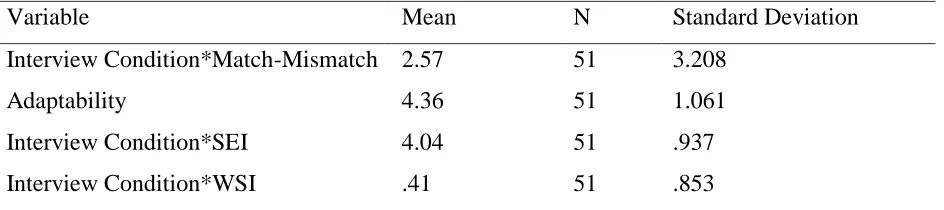
implications for the results of the mediator analyses. All variables were used to compare the
[image:18.612.73.545.236.341.2]means (Table 2)
Table 2
Means Independent & Dependent Variables
Variable Mean N Standard Deviation
Interview Condition*Match-Mismatch 2.57 51 3.208
Adaptability 4.36 51 1.061
Interview Condition*SEI 4.04 51 .937
Interview Condition*WSI .41 51 .853
Discussion
The main focus of this research was to establish whether higher levels of adaptability
would lead to higher chances of following a pre-planned strategy to reach a previously set goal.
Two interrogation techniques were compared to observe which was better at eliciting adaptability
and which made it more difficult to stick to the initial plan of a suspect. Five hypotheses were
created that predicted different outcomes. Hypothesis 1 predicted that higher levels of
adaptability would result in a more positive match-mismatch ratio. Hypotheses 2 and 3 predicted
that higher levels of adaptability would result in fewer statement-evidence and within-statement
inconsistencies. Hypotheses 4 and 5 predicted that a more positive match-mismatch ration would
result in fewer statement-evidence and within-statement inconsistencies. Five independent
mediator analyses were conducted to examine the mediating effect of (1) adaptability and (2)
interview approach on (3) match-mismatch ratio, (4) statement-evidence inconsistencies and (5)
within-statement inconsistencies. Only one mediator analysis produced a significant indirect
effect, the mediator analysis for Hypothesis 4. Hypothesis 1,2,3 and 5 were all rejected based on
19
Regarding the first three hypotheses, the non-significant results seem to suggest that the
disclosure of evidence is the main influencing factor on adaptability. We can assume that
evidence disclosure is overwhelming to such a degree that adaptability simply does not occur.
Both evidence-disclosure techniques appear highly effective. They significantly limit the ability
to behave in a goal-directed way and adjust behaviour to stick to a pre-planned strategy. That
resulted in more inconsistencies in the interview. Hypothesis 4 was found to be significant which
means that a more positive match-mismatch ratio resulted in fewer inconsistencies regarding the
evidence. This makes sense, since evidence disclosure techniques were not directly affecting the
match-mismatch ratio, as established in the first mediation analysis, testing Hypothesis 1. It
seems that the pre-planning and translation into actual behaviour are separated from the
interrogation tactics. The higher the match-mismatch ratio, the more efficient was the suspects
ability to follow through with the pre-planned strategy. This resulted in less inconsistencies, since
suspects planned what to reveal without the need for major adjustments. Further research is
needed to confirm this assumption. Hypothesis 5 might have been non-significant due to several
factors. First of all, the evidence disclosure had no significant indirect effect on the
match-mismatch ratio variable. That suggest that, the late disclosure and SoS have no influence on the
pre-planned strategy and how it is translated into actual behaviour. No direct effect on the
within-statement inconsistencies were found in both H5 and H3. Itseems that despite the evidence
disclosure participants were able to hold on to the strategy without major adjustment necessity.
That led to fewer contradicting statements. This could be explained by the small significant
indirect effect that adaptability had on the within-statement inconsistencies. It could imply that
participants were able to utilize it to some degree to produce less within-statement
inconsistencies. By comparing the means of both statement-evidence and within-statement
inconsistencies, higher means were found in the SEI´s (Table 2). A significant direct effect was
established from the evidence disclosure technique to the SEI´s. This implies that WSI´s might be
more influenced by adaptability than the evidence disclosure technique used, as indicated by the
significantly lower mean scores.
One limitation of this research were the confounding interview variables. All hypotheses
which incorporated adaptability as their mediator variable showed non-significant results. This is
directly related to the interview conditions of the study. The late disclosure approach gave the
20
too effective evidence disclosure techniques which overwrote adaptability. Future research
should aim to develop another evidence-disclosure technique that is better suited to elicit adaptive
responses from the participants. Another explanation could be related to the adaptability variable.
Adaptability showed no significant effects because the variable was based on subjective
measures. A possibility could be related to participants misjudging their own level of adaptability
during the evidence disclosure in hindsight. Mean scores overall indicate high levels of
adaptability, whereas the objective measures indicate the opposite (Table 2). Both
statement-evidence inconsistencies and the match-mismatch ratio variable had mean scores directly
opposing the mean score of the adaptability variable. The statement-evidence inconsistencies had
higher total mean scores and the match-mismatch ratio variable had mean scores in the lower
positive range, indicating only moderate effectiveness rates overall (Table 2). Therefore,
adaptability had no significant indirect effects, as participants overestimated their own level of
adjustments. To negate this problem, future research should develop adaptability variables which
are less reliant on subjective judgements.
Another limitation of the study is related to the match-mismatch ratio variable. It
measured the times a participant planned to share something but did not and did not plan to share
information but did in the end (mismatch) or planned to share something and did or did not plan
to share information and did not in the end (match). If a participant did not want to share a piece
of information but ultimately did during the interview, the participant might have picked that he
wanted to share it to look more efficient and in control of their thought processes and
behaviours. Two biases could influence the participants response in this example. For one the
hindsight bias, arguing that the participant wanted to say that information all along. In addition,
the outcome bias, which resulted from the participants having trouble acknowledging his errors.
One possible solution to this problem would be a pre-interview assessment of the strategies
before the interview starts to properly examine possible adjustments to the pre-planned strategy.
A follow up study might want to include another measure into the study procedure and
data analysis. Further research could incorporate the measure of resilience as a mediator variable.
By conducting a comparison study, researchers could examine if adaptability was exclusively
overwritten by the evidence disclosure techniques or whether resilience was a more dominant
response to the evidence disclosure, as it is closely correlated with adaptability (Martin, 2017).
Instead of using adaptability variables, the comparison study could develop resilience variables
21
study should be a 2x2 design (late disclosure vs SoS approach & adaptability vs resilience) with
the mediator of match-mismatch ratio and the dependent measures of inconsistencies and
admissions as the outcome variables. With this, researchers could examine which of the two
processes would be dominant during an interrogation. Research by Martin (2017) backs this up,
as he claims that individuals who enter a threatening situation will draw more on resources
related to resilience, rather than adaptability.
Conclusion
In the context of police interrogations, next to no research has examined how suspects
might adapt their strategies to successfully reach their goal of being perceived as innocent. Most
research solely focused on evidence disclosure techniques that aim to seek out the truth and
gather new information from the suspect. Much is known on which evidence disclosure tactic
elicits responses from the suspects and wears down their counter-interrogation strategies
(Hartwig et al., 2014). Adaptability also has been the subject of several studies. No research has
been conducted on adaptability within the interrogation context, despite growing interest in the
cognitive elements behind suspects counter-interrogation strategies. No study established a link
between adaptability and the evidence disclosure tactics applied by the interrogator. The present
study was one of the first that aimed to examine how suspects adjust their pre-planned strategies
and how they are able to translate that into actual behaviours during an interrogation. The results
showed that adaptability had no significant effect on the amount of statement-evidence
inconsistencies a suspect would make. Additionally, adaptability also showed no significant
influence on the suspects ability to follow his pre-planned strategy and translate it into actual
behaviours. Several factors might have influenced the effects of adaptability on the dependent
measures. For one, the evidence disclosure techniques might have been too overwhelming for the
participants, which overwrote any adaptive responses. Secondly, adaptability was measured by
using subjective judgements, creating the possibility that participants misjudged their own ability
to adapt to the evidence disclosure techniques. Lastly, the usage of evidence disclosure
techniques might have triggered a resilient response rather than an adaptive response. To
conclude, more research into the phenomenon of adaptability is needed to draw further
22 References
Carver, C. S., & Scheier, M. F. (2011). Self-Regulation of action and affect. Handbook of
Self-Regulation: Research, theory and applications, 2, 3-21. New York, NY: Guilford.
Clemens, F. (2013). Detecting lies about past and future actions: The strategic use of evidence
(SUE) technique and suspects’ strategies (Unpublished doctoral dissertation). University of
Gothenburg, Sweden
Granhag, P. A., Hartwig, M., Giolla, E. M., & Clemens, F. (2015). Suspects' verbal
counter-interrogation strategies: Towards an integrative model. Psychology of crime, policing and law.
Detecting deception: Current challenges and cognitive approaches, 293-313.
Hartwig, M., Granhag, P. A., Strömwall, L. A., & Vrij, A. (2005). Detecting deception via
strategic disclosure of evidence. Law and Human Behavior, 29, 469-484.
Hartwig, M., Granhag, P. A., & Strömwall, L. A. (2007). Guilty and innocent suspects’ strategies
during police interrogations. Psychology, Crime andLaw, 13, 213–227.
Hartwig, M., Granhag, P. A., Strömwall, L. A., & Doering, N. (2010). Impression and
information management: On the strategic self-regulation of innocent and guilty suspects. Open
Criminology Journal, 3, 10–16.
Hartwig, M., Granhag, P. A., & Luke, T. (2013). Strategic Use of Evidence During Investigative
Interviews: The State of the Science. Credibility Assessment, 1, 1-36.
Jordan, S., Hartwig, M., Wallace, B., Dawson, E., & Xhihani, A. (2012). Early vs Late
Disclosure of Evidence: Effects of Verbal Cues to Deception, Confessions and Lie Catcher´s
Accuracy. Journal of Investigative Psychology and Offender Profiling, 9, 1-12.
May, L., Granhag, P. A., & Tekin, S. (2017). Interviewing Suspects in Denial: On How Different
Evidence Disclosure Modes Affect the Elicitation of New Critical Information. Frontiers of
23
Martin, A. J. (2017). Adaptability – What It Is and What It Is Not: Comment on Chandra and
Leong (2016)
VandenBos, G. R. (2015). American Psychological Association (APA) dictionary of psychology,
2. Washington DC: American Psychological Association.
Appendices
Background & Planning (Materials)
Appendix 1
Criminal Decision Making
Informed Consent
Purpose
This study is about criminal behavior. An important feature of a criminal investigation is to
understand the behavior of suspects of crime. The current study will examine your perceptions and
behaviors as a suspect who commits a mock crime.
More detailed information regarding the theoretical background, such as underlying concepts
or frameworks, cannot be disclosed at the present moment to ensure that you behave as normal and
natural as you would in reality. Any detailed information will be provided upon request after the
experiment is done.
24
As a participant in this study, you will be instructed to perform some criminal activities and
afterwards you will be interviewed about it and fill in a questionnaire about your perceptions of
your experiences. The interview will be audio recorded.
Once you have filled in the questionnaire the study is completed. Because it is important to protect
the validity of psychological experiments (i.e., that you behave as normal and natural as possible
during the operation), we cannot tell you everything about the study at this time. After the study is
complete you will be fully debriefed and we will answer any questions that you may have about
the study. If you decide to enroll in this study, your involvement will last for up to 60 minutes and
you will receive 1 SONA credit for your participation. To ensure confidentiality, your responses
will be anonymous (i.e., personal identifying information cannot be matched with your answers)
and we only analyze group averages (i.e., individual performances will not be analyzed). The
recorded data is treated confidentially and only available to the research team. In case of
publication, it is obligatory to store the material for up to 10 years.
Participant Rights
Your participation is voluntary. You may choose not to take part in the study or to stop participating
at any time, for any reason, without consequences. Also, the audio recordings will be destroyed
immediately at your request. You will receive the full compensation also if you stop participating.
For further information about this study, contact the principal investigator Simon Oleszkiewicz,
Ph.D. at [email protected]
25
Your signature indicates that you voluntarily agree to participate in Criminal Decision
Making, that the study has been explained to you, that you have been given the time to
read the document, and that your questions have been satisfactorily answered.
Name
I consent to participate in the study on
criminal behavior
Signature
I consent to be audio recorded during the
interview
26 Appendix 2
Background
Imagine that you are a person who was raised in a house full of love for pets, especially cats and
dogs. Having been around animals all your life you have developed a very special bond to them.
Simply put, you love cats and dogs.
You are currently studying at the UT and from your fellow students, you just heard some
rumors that made your bones chill to the core: There is a professor at the University who does
animal testing on dogs. You found out that this professor is doing his research on animals
illegally, and that he violates the strict ethical procedures for animal handling.
However, it seems as if the university is turning a blind eye. Because of your love for animals,
you decided that this was too much: There is no way such cruel treatment of animals can be
justified, you had to do something to make it stop!
Since your gruesome discovery, you have made several attempts to put an end to this
horror. You have emailed the professor directly, you have arranged demonstrations, talked with
the heads of several faculties, the HR department, study advisors, you name it. However, this has
only resulted in straight out denials – nobody acknowledges any unethical animal treatment. At
this point in time, your hard work and efforts have not paid off at all, and you conclude that only
one option remains: To collect evidence about the unethical behavior and forward it to an
investigative journalist that will publish a story about it in the news.
To collect the evidence you need help, so you contacted the organization Rights for Animals.
However, this organization is currently under investigation for other crimes. Therefore, they
cannot play any major role in gathering evidence, but they are willing to help you work out the
27 What you are going to do
You’re planning to collect evidence that the UT is involved in illegal and cruel treatment of
animals. The organization Rights for Animals supports you. Soon, they will get into contact with
you and help you with your mission. The collected evidence will then be forwarded to an
employee at Rights for Animals.
Briefly put, to complete your mission you have to (specific instructions will follow later):
(1) gain access to the office
(2) collect evidence in the office
(3) provide the evidence to your accomplice
You will next receive detailed instructions for what you have to do to collect and forward the
evidence. Read the instructions carefully so you know it by heart. You will be allowed to take
these instructions with you, so you do not need to memorize every word. Feel free to check this
28 Appendix 3
Instructions
These instructions will be performed in consecutive order. Meaning that once you have ticked of
a box, you move to the next box directly under it. Do not jump between boxes; you have to
follow the order from top to bottom.
⬜ received text message from your contact person from the animal rights organization
(mission starts) → WhatsApp message
⬜ collect envelope at the given location established by the text message
⬜ go into the office where you find information regarding the animal experiments (room XXX)
⬜ start the computer and plug in the USB stick to collect the necessary evidence
⬜ search the file ‘experiments’ and copy it on the USB stick (located on Desktop)
⬜ take the USB stick and the envelope and leave the office
⬜ go to room XXX (there you can find a secure computer)
29
⬜ send the files of the USB stick to [email protected] (a journalist who belongs
to Rights for Animals who wants to publish your story)
⬜ next to the computer, search for the folder ‘contracts’ and take a picture of the Documents
which you find inside. They serve as additional evidence.
⬜ send it via WhatsApp to this number (Kalle Blom): +4915774479784
⬜ put the USB stick back into the envelope and place it into the folder ‘private’ (your
accomplice will collect it)
⬜ return to room XXX
Pre-Interview Instructions
Appendix 4
Instructions for participant (before the police interview starts)
In 5 minutes, you will be interviewed by a police officer. You are instructed to interact with the
police, so please try to imagine how you would answer possible questions in reality. The police
already held several interviews with suspects, collected fingerprints from all involved (including
you) and checked back alibis.
Please imagine that you have already concluded that it is important for you to give an innocent
appearance and that this will best be done by speaking with the police. Hence, you concluded that
30
the interview you will be asked whether you want to have a lawyer present. Please imagine that
you have already considered this option and decided it was best to not invite a lawyer, because in
this way you look more innocent. Hence, you are instructed to answer this question with a ‘No’.
Don’t forget: You are an activist for animal rights. While getting your information about the cruel
researcher, you were, however, committing a crime. In order to complete your mission, you
should try to convince the interviewer of your innocence. Otherwise, Rights for Animals won’t be
able to publish your findings as their work will be linked to your criminal activity; all your work
would be for nothing. Please imagine that this is very important for you: If you don’t come across
as innocent during the interview you will fail to save the animals.
Please note that it is the interviewer who will end the interview. The interviewer will then tell you
what you need to do after the interview is over.
Interview Protocols
Appendix 5
Control Interview
Control Interview- Late disclosure
“Hello, my Name is XXX. I am part of the team investigating a crime that was committed here at the University today. Someone broke into the University’s facilities and stole confidential data.
There is reasonable suspicion that you have committed this crime, and I will therefore ask you
some questions about your behavior and your observations around the University today. Because
of the suspicion against you, you do have the right to have a lawyer present during this interview.
Would you like to consult one?
I also want to mention that you have the right to remain silent and that you do not have to answer
31
#Response of Suspect
Do you confess or deny having engaged in any criminal activities?
#Response of Suspect
You can start by freely telling me how you arrived at the university today and what you did there.
#Response of Suspect
Thank you. I have a few more specific questions.
Have you been around/ You mentioned being at the study area on the ground floor of the
Cubicus builduing today?
#Response of Suspect
***if suspect remains silent or only answers with a ‘yes’ after the first question of each evidence
theme, prompt once by saying: Please tell me about that***
Have you been around/you mentioned you were around the office of one of the professors after
32
#Response of Suspect
Have you recently entered/ you mentioned that you entered the office of a professor?
#Response of Suspect
Have you entered/you mentioned that you entered another room after you left the office?
#Response of Suspect
Is there anything you would like to add at this point?
#Response of Suspect
Okay, thank you. We have collected some evidence that I would like you to address. Our tech
team intercepted the text message you received today, shortly thereafter a witness saw you pick
up an envelope from one of the lockers in the Cubicus building. Later on, another witness saw
you near the office of the professor. We have also found your fingerprints inside the office, and a
webcam has shown that you used the computer in room XXX. Before we conclude this interview,
would you mind explaining all these activities.
#Response of Suspect
Alternative Deceptive: I would like to point out that you’re better off, the more information you
33
#Response of Suspect
***If suspect remains silent***
So, do you have anything to add?
***If suspect objects or complains, simply read out the evidence again***
---
Okay, to conclude this interview I will ask the same question I started with: Do you confess or do
you deny having engaged in any criminal activities?
Okay, thank you for your time. If we find something in need for further clarification, we will ask
you to come back at a later time. Have a good day.
(Investigator opens the door for participant)
SoS-Interview Protocol
Appendix 6
Control Interview- Late disclosure
“Hello, my Name is XXX. I am part of the team investigating a crime that was committed here at the University today. Someone broke into the University’s facilities and stole confidential data.
There is reasonable suspicion that you have committed this crime, and I will therefore ask you
some questions about your behavior and your observations around the University today. Because
of the suspicion against you, you do have the right to have a lawyer present during this interview.
34
I also want to mention that you have the right to remain silent and that you do not have to answer
any of my questions.
#Response of Suspect
Do you confess or deny having engaged in any criminal activities?
#Response of Suspect
You can start by freely telling me how you arrived at the university today and what you did there.
#Response of Suspect
Thank you. I have a few more specific questions.
Have you been around/ You mentioned being at the study area on the ground floor of the
Cubicus builduing today?
#Response of Suspect
***if suspect remains silent or only answers with a ‘yes’ after the first question of each evidence
35
Have you been around/you mentioned you were around the office of one of the professors after
being at the study area?
#Response of Suspect
Have you recently entered/ you mentioned that you entered the office of a professor?
#Response of Suspect
Have you entered/you mentioned that you entered another room after you left the office?
#Response of Suspect
Is there anything you would like to add at this point?
#Response of Suspect
Okay, thank you. We have collected some evidence that I would like you to address. Our tech
team intercepted the text message you received today, shortly thereafter a witness saw you pick
up an envelope from one of the lockers in the Cubicus building. Later on, another witness saw
you near the office of the professor. We have also found your fingerprints inside the office, and a
webcam has shown that you used the computer in room XXX. Before we conclude this interview,
would you mind explaining all these activities.
36
Alternative Deceptive: I would like to point out that you’re better off, the more information you
provide voluntarily. I’ll give you one last chance to cooperate by answering my questions.
#Response of Suspect
***If suspect remains silent***
So, do you have anything to add?
***If suspect objects or complains, simply read out the evidence again***
---
Okay, to conclude this interview I will ask the same question I started with: Do you confess or do
you deny having engaged in any criminal activities?
Okay, thank you for your time. If we find something in need for further clarification, we will ask
you to come back at a later time. Have a good day.