Original citation:
Câmara, Odilon and Bernhardt, Daniel . (2015) Learning about challengers. Games and Economic Behavior, Volume 90 . pp. 181-206
Permanent WRAP url:
http://wrap.warwick.ac.uk/68355
Copyright and reuse:
The Warwick Research Archive Portal (WRAP) makes this work by researchers of the University of Warwick available open access under the following conditions. Copyright © and all moral rights to the version of the paper presented here belong to the individual author(s) and/or other copyright owners. To the extent reasonable and practicable the material made available in WRAP has been checked for eligibility before being made available.
Copies of full items can be used for personal research or study, educational, or not-for-profit purposes without prior permission or charge. Provided that the authors, title and full bibliographic details are credited, a hyperlink and/or URL is given for the original metadata page and the content is not changed in any way.
Publisher’s statement:
© 2015, Elsevier. Licensed under the Creative Commons Attribution-NonCommercial-NoDerivatives 4.0 International http://creativecommons.org/licenses/by-nc-nd/4.0/
A note on versions:
The version presented here may differ from the published version or, version of record, if you wish to cite this item you are advised to consult the publisher’s version. Please see the ‘permanent WRAP url’ above for details on accessing the published version and note that access may require a subscription.
Learning about Challengers
⇤
ODILON C ˆ
AMARA
†University of Southern California
DAN BERNHARDT
University of Illinois at Urbana-Champaign and University of Warwick
January 10, 2015
Abstract
We examine a political agency problem in repeated elections where an incumbent
runs against a challenger from the opposing party, whose policy preferences are
un-known by voters. We first ask: do voters benefit from attracting a pool of challengers
with more moderate ideologies? When voters and politicians are patient, moderating
the ideology distribution of centrist and moderate politicians (those close to the median
voter) reduces voter welfare by reducing an extreme incumbent’s incentives to
com-promise. We then ask: do voters benefit from informative signals about a challenger’s
true ideology? We prove that giving voters informative, but sufficiently noisy, signals
always harm voters, because they make it harder for incumbents to secure re-election.
JEL: C72, C73, D72.
Keywords: Political Agency, Repeated Elections, Interest Groups.
⇤For their helpful comments, we thank Jon Eguia, John Matsusaka, Joseph McMurray, as well as seminar
participants at the Queen’s University Belfast, University of Southern California, and 2012 Midwest Political
Science Association Conference (Chicago). The paper also benefited from the suggestions of the anonymous
referees.
†Corresponding author: USC FBE Dept, 3670 Trousdale Parkway Ste. 308, BRI-308 MC-0804,
1
Introduction
This paper examines how changes in the ideology distribution of individuals running for
office or in the information voters have about candidates a↵ect equilibrium outcomes and
voter welfare. These are important determinants of equilibrium behavior for two reasons.
First, in the predominately two-party system in the United States, an incumbent officeholder
typically runs for re-election against an untried challenger drawn from the opposing party.
Voters know far more about an incumbent because they see her policy choices in office. In
contrast, a challenger is a risky option whose true preferences are unknown. As a result, an
incumbent can implement policies away from the median voter’s preferred policy and still
win re-election. Second, in this two-party system, the likely policy choices that a challenger
might select if elected serve as the chief device with which voters can discipline office-holders
to control this political agency problem. The fear of losing to the opposing party’s candidate
who may implement policies far from an incumbent’s ideal policy provides a key inducement
to incumbents to moderate policy choices when politicians cannot commit to policies.
We begin by addressing a basic question: when do voters benefit from attracting a better
pool of challenging candidates? Concretely, when do voters gain if challengers are more
likely to hold views closer to those of the median voter? We then ask: do voters benefit from
receiving an informative, but noisy, signal about a challenger’s ideology prior to an election?
That is, do voters benefit from learning about a challenger’s views of the world, so that they
can more precisely predict her likely policy choices if elected?
These changes in the ideology distribution of candidates or the information available
to voters may reflect changes in the political environment—e.g., changes in the degree of
ideological polarization between competing interest groups, the behavior of media outlets
covering politics, or the institutions governing primary elections, campaign financing and
spending—studied by the political economy literature. Our analysis complements this
liter-ature and provides insights into the possible equilibrium implications of such changes.
Our core model builds on the infinite horizon, repeated elections models of Duggan (2000)
and Bernhardt et al. (2009). It features a pool of politicians with ideologies symmetrically
distributed around the median voter, divided into a left-wing [ 1,0] and a right-wing [0,1]
deviate from their preferred policies. Equilibrium outcomes are characterized by two
ide-ology cuto↵s, w and c, where 0 < w < c < 1. When in office, “centrist politicians” with
ideologyi2[ w, w] implement their preferred policies and are re-elected. “Moderate
politi-cians” with ideology i 2 (w, c) choose to compromise and adopt policy w in order to win
re-election, while politicians in ( c, w) compromise to w. “Extreme politicians” with
ideology i2[ 1, c][[c,1] implement their preferred policies, but lose re-election.
In an ideal world, with no other agency problems, social welfare would be maximized by a
pool of politicians whose interests wereperfectly aligned with the median voter’s, and hence
would want to adopt the median’s preferred policies. But, in practice, selecting challengers
is a complex, noisy process, resulting in significant variation in the realized preferences of
challengers, and substantial voter uncertainty about a challenger’s preferred policies. In this
context, the welfare e↵ects of attracting more politicians with ideologies close to the median
and fewer politicians with ideologies far from the median are less clear. The direct benefit
from attracting a better population of challengers is obvious—when replacing an incumbent,
most voters want to elect as moderate a challenger as possible. However, improved selection
of challengers also adversely feeds back to a↵ect incentives of office holders to moderate
policy choices to win re-election. In particular, an office holder does not mind losing by as
much if she is likely to be replaced by a moderate rather than an extremist from the
oppos-ing party: better challengers weaken the threat of replacement that voters use to discipline
incumbents. This gives rise to a negative indirect e↵ect of moderating challengers—cuto↵ c
falls, as more incumbents choose to implement extreme policies.
Do voters benefit from attracting a more moderate pool of challengers? We show that
if voters and politicians are sufficiently impatient, then given any two ideology
distribu-tions of challengers, voters always prefer the more moderate distribution.1 Intuitively, when
incumbent politicians do not care much about the future, they do not care much about
compromising to be reelected. The indirect negative welfare e↵ects for voters of changes in
cuto↵ care then small relative to the direct benefits of ideology moderation.
In sharp contrast, if voters and politicians arepatient, moderating the ideology
distribu-tion of centrist and moderate politicians, while keeping constant the ideology distribudistribu-tion
1For politicians with right-wing ideologies i 0, ideology distributionF0
R is more moderate than FR if
of more extreme politicians, hurts voters. To understand why, observe that (i) although
centrist and moderate politicians have ideologiesi2( c, c), they only implement policies in
the smaller set [ w, w]; and (ii) when players are patient, the compromise cuto↵ w is close
to the median voter, but cis far away. As a result, moderation in the ideology distribution
of centrist and moderate politicians only provides a small direct benefit to the median voter,
since these politicians already implement policiesclose to the median. In contrast, ideology
c is far from the median voter and the policy set [ w, w], so moderation of centrist and
moderate politicians has a large direct positive impact on a right-wing incumbent’s expected
payo↵from being replaced by a left-wing challenger. This causes enough extreme incumbents
to cease compromising that the direct benefit is swamped, reducing voter welfare.2
What happens when ideology moderation shifts the distribution of extreme politicians?
A na¨ıve conjecture would be that when the proportion of extreme politicians is reduced,
voter welfare would always rise. This conjecture is false. We consider a class of linear
ide-ology distributions, for which moderation implies a rotation that shifts extreme ideologies
closer to the median. We show that such moderating shifts reduce voter welfare as long as
politicians and voters are sufficiently patient.
Our findings indicate that one must be cautious when evaluating the welfare impacts
of changes to the processes that select challengers. Many institutional or strategic changes
may lead to a pool of more moderate challengers—a shift from a closed to open primary
system that draws more independents; increased party filtering of challengers to improve
electability; or increased concerns of primary voters for more moderate candidates, with
better chances in the general election. Alternatively, reductions in the opportunity cost of
running for office, e.g., increased compensation, may di↵erentially appeal to “good”
(mod-erate) challengers. Our findings highlight that di↵erentially drawing particularly attractive,
moderate challengers robustly and paradoxically reduces voter welfare whenever voters and
officeholders are patient. Indeed, a robust empirical feature of electoral competition is that
“weak” incumbents who adopt extreme policies are more likely to draw “good” challengers.
Paradoxically, this endogenous response raises the incumbent’s incentives to adopt extreme
policies, harming voters.
2When voters are impatient, holding constant any discount factor, we prove that any moderation in the
Having characterized how a more moderate distribution of challenger ideologies a↵ects
outcomes, we next characterize how more information about challengers a↵ects outcomes.
Specifically, we derive the impact of a political campaign process prior to an election that
re-veals information to voters about a challenger’s attributes. We want to understand whether
and when voter learning via the electoral process improves political outcomes. We suppose
that voters receive a binary (good or bad) signal about a challenger’s true preferences, for
example, reflecting an endorsement by an informed interest group. A good signal indicates
that a challenger’s ideology is more likely to be closer to the median, while a bad signal
means that it is more likely to be farther away.
Now, incumbents with sufficiently extreme ideologies must compromise by more to
de-feat a challenger following a good signal about the challenger than following a bad one. We
identify sufficient conditions such that all incumbents who compromise do so by enough to
win re-election against all challengers. In particular, this is so whenever the signal about
the challenger is sufficiently noisy. Intuitively, when signals are noisy, re-election standards
vary little with the signal realization—by compromising a little more, an incumbent gains a
discrete increase in the probability of re-election.
We then derive a very negative result for the impact of learning about challengers: more
accurate signals about challengers always harm voters provided that incumbents who
com-promise do so by enough to defeat all challengers. To understand why, suppose the political
process conveys no information to voters about challengers other than party affiliation. Then
voters would be better o↵if they could commit torelaxingthe policy standard for re-election,
i.e., if they could commit to re-electing incumbents who compromise by slightly less than
what is required for re-election in equilibrium. At the equilibrium standard, the median
voter is just indi↵erent between re-electing the incumbent and trying the risky challenger.
The median voter does not internalize that if he set a slacker standard, then more extreme
incumbents would choose to compromise to win re-election, rather than locate extremely.
The welfare gain from greater compromise is first-order, and the cost from slightly inefficient
replacement is second-order. Now consider slightly informative signals about a challenger.
A good signal about a challenger induces voters to set a stricter re-election standard, and
all incumbents who choose to compromise do so to that stricter standard. Because the
preferred extreme policies and lose, and this hurts voters. Moreover, increasing the signal’s
accuracy and making it harder to secure reelection further decreases voter welfare, as long
as incumbents who compromise do so by enough to defeat all challengers.
Informative signals about the challenger harm voters by more when they are more patient
or when politicians are likely to have extreme ideologies. In both scenarios, more incumbent
types compromise. This means that an incumbent politician who is just indi↵erent between
compromising and not has a more extreme ideology. Hence, changes that make the re-election
cuto↵ stricter reduce an incumbent’s payo↵ from compromising by more, making her more
likely to stop compromising and, instead, to adopt as policy her own extreme ideology.
There are many factors that a↵ect the amount of noise in the information about
challeng-ing candidates that reaches voters: the media’s coverage of campaigns, the laws governchalleng-ing
campaign expenditures (e.g., the Citizen’s United ruling), increased exposure to social
me-dia, and so on. As we show, one must be cautious when evaluating the welfare impacts
of such changes: voters may benefit from very informative signals about challengers, but
sufficiently noisy signals are always worse than no information.
The paper’s outline is as follows. We next review the literature. Section 2 presents
our base model. Section 3 analyzes how the distribution of politician ideologies a↵ects
out-comes and welfare. Section 4 considers campaigns that provide informative signals about a
challenger. Section 5 concludes. All proofs are in the Appendix.
1.1
Related Literature
Our paper relates to a literature on the equilibrium consequences of noisy signals about
candidates. In the single-election models of Carrillo and Castanheira (2008) and Boleslavsky
and Cotton (2014), voters trade o↵valence and policy. Noisy information about candidates’
valence a↵ects their choices of policy platforms and may induce increased polarization. The
authors show how variations in the signal’s informativeness can increase or decrease voter
welfare. Eguia and Nicol`o (2011) explore how voter information about candidate platforms
a↵ects the subsequent provision of inefficient local public goods (pork) by the elected
gov-ernment. They show that if the electorate is well informed about the platforms to which
papers examine signaling games where politicians choose policies and actions that convey
in-formation about their private types—e.g., Kartik and McAfee (2007), Callander and Wilkie
(2007), and Van Weelden and Morelli (2012).
In our dynamic model, noisy signals about future challengers negatively a↵ects the
be-havior of current incumbents. Incumbents anticipate that voters will be more tempted to
elect a future candidate if they observe a “good” signal (i.e., the challenger is more likely
to be moderate), which makes current reelection standards harder. Moreover, losing to a
“good” challenger is less costly for the incumbent, since she is expected to be more moderate.
These two e↵ects combined reduce an incumbent’s incentive to compromise by too much,
reducing voter welfare. Dewan and Hortala-Vallve (2014) also study a dynamic model in
which information about a challenger makes it harder for an incumbent to guarantee
reelec-tion, possibly reducing voter welfare. Interestingly, the mechanism driving their negative
welfare result is the opposite of ours: in their model, voters lose because some incumbents
inefficiently choose a risky policy to increase their reelection chances, while in our model
voters lose because some incumbents give up on reelection and choose an extreme policy.
Our paper also relates to a recent literature on how some degree of ideological extremism
may benefit voters. In Van Weelden (2013, 2014), voters care about one policy dimension
and the expropriation of resources. He assumes that voters canperfectlyselect a challenger’s
ideology. He shows that it is optimal to select slightly-ideologically irresponsible challengers
in order to raise the cost of replacement to an office holder and thereby induce them to
reduce their theft of resources. In Bernhardt et. al (2009), voters want policies to adapt to
a random state of the world. When candidates propose platforms that have a certain degree
of polarization, the possibility of choosing between the candidates allows voters to select the
policy that better adapts to the realized state. In our framework, there is no need to adapt
policies to unknown states, nor do voters trade o↵ di↵erent policy dimensions. However, we
provide broad conditions under which a more extreme distribution of politicians’ ideologies
benefits patient voters. In our model, under these conditions, the threat of being replaced
in the future by a more extreme challenger indirectly benefits voters by increasing an
in-cumbent’s incentives to compromise to such an extent that it dominates the always negative
2
Basic Model
We build on the infinite horizon, repeated elections models of Duggan (2000) and Bernhardt
et al. (2009). When politicians care about policies but cannot commit to future choices, an
incumbent’s agency problem is limited by the threat of voters to elect a challenger from the
opposing party.3
There is a continuum of infinitely-lived voters, each indexed by his private ideology
x 2 [ 1,+1], and distributed according to a probability density function that is
contin-uous and symmetric about the median voter’s ideology, x = 0. There is a continuum of
infinitely-lived politicians, each indexed by her private ideology i2[ 1,+1]. Politicians are
divided into a left-wing party L and a right-wing party R. Party R consists of politicians
with ideologies i2 [0,1], distributed according to the probability density function fR, with
associated cumulative distribution function FR. Party L consists of politicians with
ideolo-gies i 2 [ 1,0], distributed according to the probability density fL, with associated c.d.f.
FL, wherefL(i) =fR( i).
At any date t = 0,1,2, . . ., an office holder with ideology i selects a policy p(i) ⌘ y,
providing voter x a date-t payo↵ of u(x, y) = (x y)2, and delivering a date-t payo↵ of
u(i, y) = (i y)2 to politician i. Period utilities are discounted by factor 2 [0,1). At
date 0, an office holder is randomly drawn from one of the parties. At any subsequent date-t
the incumbent runs for re-election against an untried challenger drawn from the opposing
party, with the incumbent winning if and only if he wins at least half of the votes.4 The
3Duggan (2000) studies a model without parties where the ideology of each challenger is drawn from
“at-large” (i.e., from the same distribution). Bernhardt et al. (2009) introduce parties so that the distribution of a
challenger’ ideology depends on her party affiliation. In this paper we focus on the case where each incumbent
runs for reelection against an untried challenger from the opposing party. Bernhardt et al. (2009) show that
the resulting “party competition e↵ect” strictly benefits all voters. In an on-line Appendix, we study the
at-large case, without parties. While all results regarding the impact of noisy signals about challengers extend to
at-large settings, the result that a more moderate distribution of challenger ideologies can reduce voter welfare
doesnothold with at-large selection of challengers when voters and politicians have quadratic preferences.
4To maintain the “party competition e↵ect”, as in Bernhardt et al. (2009) we assume that either
incumbents always run for re-election, or that the indi↵erent median voter votes for the untried candidate
of the party whose incumbent is not running for re-election if and only if the median voter would vote to
challenger’s ideology is not known by voters, but its distribution is common knowledge.
In order to guarantee the existence of an equilibrium, we assume that
(A.1) Distribution FR has support [0,1] and an absolutely continuous density fR, with
fR(i) f for all i2[0,1], for some f >0.
2.1
Equilibrium and Voter Welfare
Equilibrium Concept: We focus on the class of symmetric, stationary perfect Bayesian
equilibria described by Duggan (2000) for at-large selection, and extended to party selection
by Bernhardt et al. (2009). In this equilibrium class, voters use simple strategies:5 voters act
as though they are “pivotal” in the current election, and voterx votes to re-elect the
incum-bent if and only if her most recent policy choice satisfied a voter-specific utility standard. In
equilibrium, this utility standard corresponds to the expected discounted payo↵ of voterx if
the challenger is elected. Therefore, voters’ equilibrium behavior is consistent with both
ret-rospective and pret-rospective voting. Stationarity implies that this re-election standard is
time-invariant and history independent. Politicians also use simple strategies: along the
equilib-rium path, in each period in office, politicianiimplements the same policyp(i).6 When
choos-ingp(i), an incumbent politician cares about the current and future implications of her policy,
in particular, the re-election consequences of her actions, and the discounted expected payo↵
from being replaced by a challenger. Symmetry impliesp(i) = p( i) for alli2[0,1].
Con-sequently, in equilibrium each voter can correctly predict an incumbent’s future behavior
sim-ply by observing her most recent policy choice, and will vote for the challenger if and only if
the expected payo↵from electing the challenger exceeds that from re-electing the incumbent.
Equilibrium existence and uniqueness follow directly from Bernhardt et al. (2009). Along
the equilibrium path, outcomes are characterized by a re-election standardw2(0,1) and by
a compromise thresholdc2(w,1). The median voter is decisive: an incumbent is re-elected if
and only if she implements a policyy that is sufficiently close to the median voter’s preferred
policy, y 2 [ w, w]. Incumbents with ideology i 2 [ w, w] are called “centrists”. Centrist
5See Banks and Duggan (2008) for a detailed discussion.
6One also needs to specify reasonable beliefs and behavior following out-of-equilibrium-path policy
i implements her preferred policy p(i) = i and is re-elected. Incumbents i 2 [1, c][[c,1]
are called “extremists”. Extremists implement their preferred policies, but are ousted from
office. Incumbents with ideology i2(w, c) are called “moderates.” They do not adopt their
preferred policies, as they would then lose office. Instead, they compromise and adopt the
most extreme policy that still allows them to win re-election,p(i) =w. Similarly, incumbents
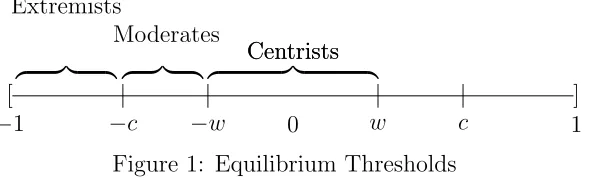
i2( c, w) compromise to p(i) = w. Figure 1 depicts such thresholds.
[ ]
1 1
|
c
|
w 0
|
w c|
Centrists
z }| {
Moderates
z }| {
Extremists
[image:11.612.171.468.225.316.2]z }| { Centrists
Figure 1: Equilibrium Thresholds
Voter Welfare: To measure voter welfare, we use the median voter’s expected discounted
payo↵ from electing an untried challenger. In a symmetric equilibrium with quadratic
pref-erences, the payo↵ derived by a voter from electing an untried challenger from either party
with equal probability equals that of the median voter minus a constant that reflects the
distance of the voter’s ideology to the median. That is, ex ante (at time t = 0), all
vot-ers share the median voter’s preference ordering over di↵erent symmetric equilibria.7 Thus,
focusing on the payo↵ of voters and disregarding the payo↵s of incumbent politicians, our
welfare concept is Pareto efficiency.
3
The Value of Moderation
In this section we address the question: what is the value of selecting challengers from a
pool of politicians with more moderate ideologies? We want to identify the conditions under
which voters benefit from selecting from a pool of politicians whose world views tend to
better reflect those of the median voter. In practice, the distribution of challenger
ideolo-gies depends on the opportunity cost of running for office, which may di↵erentially impact
7Loosely speaking, with quadratic utility and a symmetric equilibrium, all voters would benefit ex ante
from reductions in the variance of the implemented policies. See Banks and Duggan (2006) for a more
potential candidates with more extreme or more moderate ideologies. Similarly, changes in
the institutions governing the process of primary selection of candidates, or changes in the
ideological composition of primary voters may a↵ect the ideological distribution of selected
challengers. Substantial uncertainty remains after the selection of a challenger, reflecting
both the small pool of interested candidates in most primary elections, and the limited
information that primary voters have about these untried politicians.
3.1
Analysis
We refer to politicians with ideologies further from the median voter as “more extreme”, and
those with ideologies closer to the median as “more moderate.” Consistent with this idea,
we use the following definition to compare di↵erent distributions of politicians’ ideologies:
Definition: If ideology distribution FR first order stochastically dominates8 ideology
dis-tribution F0
R, FR F OSD FR0, then we say that distribution FR0 is “more moderate” than
distribution9 F
R. Equivalently, we say that FR is “more extreme” than FR0.
In equilibrium, politicians with ideologies further from the median voter implement more
extreme policies. This raises the basic question: do voters benefit from drawing challenging
candidates from a more moderate distribution of ideologies? If so, when do they benefit?
A more moderate ideology distribution has a positive direct e↵ect and a negative indirect
e↵ect. Holding constant the equilibrium strategy of incumbents,10the direct impact of having
a more moderate distribution of politicians’ ideologies is that the median voter now expects
a higher payo↵ from electing a challenger, who is expected to implement policies closer to
the median. From an incumbent’s perspective, however, more ideologically-moderate
chal-lengers mean that losing re-election is less costly, since a challenger is less likely to implement
an extreme policy if elected. This makes incumbents less willing to compromise (reduces
8Recall thatF
R F OSD FR0 if and only ifFR(i)FR0(i) for alli, and the inequality is strict for somei. 9Throughout this Section we focus our discussion on the comparison between economies featuring
right-wing ideology distributionsFR andFR0. It is implicit that we always consider symmetric parties, that
is, we always consider symmetric left-wing ideology distributionsFL andFL0.
10This amounts to holding fixed the cuto↵sw and c that describe how a politician’s ideology maps into
compromise cuto↵c), and this indirect e↵ect on incumbents’ strategies reduces voter payo↵s.
So the question is: which e↵ect dominates?
Lemma B.1 in the on-line Appendix shows that given any pair of ideology distributions
FR and FR0, withFR F OSD FR0, if voters are sufficiently impatient, then they all prefer the
more moderate distribution of ideologies. When voters are sufficiently impatient, changes in
the ideology distribution have a small indirect impact on equilibrium cuto↵s w and c, since
voters and politicians are not very concerned about the future. Consequently, the direct
pos-itive e↵ect of drawing challengers from a more moderate distribution of ideologies dominates.
But, what if voters and politicians are patient? Our first contribution is to define a
comprehensive sufficient condition for patient voters to prefer a more extreme distribution
of politicians’s ideology.
Definition: Given k 2 (0,1), ideology distribution FR k-dominates FR0, FR k FR0, if
FR F OSD FR0 and fR(i) =fR0(i) for all i2[k,1].
To understand the definition, consider an economy A with ideology distribution FR and
an economy B with distribution FR0, such that FR k FR0. Recall that we symmetrically
define left-wing candidates, and that the overall distribution of politicians’ ideologies has
support [ 1,1]. Cuto↵k divides politicians into two groups: a group with ideologies ( k, k)
in the middle of the distribution, and a group with ideologies [ 1, k][[k,1] that comprises
the tails of the distribution. Both economies feature the same distribution of politicians in
the tails, but economy B has a more moderate ideology distribution (in the FOSD sense)
in the middle of its support. That is, as we move from the “more extreme” economy A to
the “more moderate” economyB, the ideology distribution of politicians ( k, k) around the
median voter moves closer to the median, while the ideology distribution of tail politicians
remains the same.11
Proposition 1 proves that, if FR k-dominates FR0, then sufficiently patient voters prefer
the more extreme ideology distributionFR.
11Thus, k-dominance implies first order stochastic dominance, but not conversely. The only additional
constraint imposed by k-dominance is on the set of tail ideologies [ 1, k][[k,1]. Fork close to one, this
Proposition 1 SupposeFR kFR0 and both distributions satisfy (A.1). If voters and
politi-cians are sufficiently patient, then all voters prefer the more extreme ideology distribution
FR. The preference is strict if the distribution of centrist ideologies is not the same.12
To understand the intuition, first consider the role of patience in the proposition. Fix
any k 2 (0,1) and any pair of ideology distributions such that FR k FR0. Let {w, c} and
{w0, c0}be the respective equilibrium cuto↵s, where it is implicit that cuto↵s depend on the discount factor . Recall that politicians with ideology i2 [0, w] are centrists, i2[w, c] are
moderates, and i 2 [c,1] are extremists. Lemma B.3 in the on-line Appendix shows that,
when voters are patient, min{c, c0} is close to one and max{w, w0} is close to zero. This has
two important consequences. First, if agents are sufficiently patient, then k < min{c, c0}.
Consequently, the ideology distribution of extreme politicians i2[min{c, c0},1] is the same
in both distributions. In other words, as we move fromFR toFR0, we only shift the ideology
distribution of centrist and moderate politicians. Second, if agents are sufficiently patient,
the ideologies of politicians cand c0 are far from the median voter.
The intuition behind the result is then the following. Consider changing the economy
from the more extreme distributionFR to the more moderate distribution FR0. Consider the
median voter’s decision of whether to reelect a right-wing incumbent, or to elect an untried
left-wing challenger. Moderation of centrist and moderate politicians provides a small direct
benefit to the median voter, since these politicians are already implementing policies close
to the median voter. Now consider the decision of a right-wing incumbent with an extreme
ideology aroundc. When politicians are patient, the cuto↵ideologycis far from the median
voter. As a result, the moderation of centrist and moderate politicians has a large direct
pos-itive impact on the expected payo↵ of this extreme right-wing incumbent if she is replaced
by a left-wing challenger. This causes a large decrease in c: enough extreme incumbents
cease compromising that the net result is that voter welfare is harmed. Paradoxically,
im-provements in the distribution of political ideologies reduce welfare by more precisely when
politicians tend to be extreme. This reflects that decreases incare more harmful when more
politicians have extreme ideologies close toc, i.e., when fR(c) is high.
12That is, iff
R(i)6=fR0 (i) for somei < w. This always holds iffR(0)6=fR0(0), since a politician with the
Given k 2 (0,1) and distributions FR k FR0, Proposition 1 requires voters to be suffi
-ciently patient. But what does sufficiently patient mean? Loosely speaking, whenk is closer
to one, agents must be more patient in order to ensure that we only change the ideology
distri-bution of centrist and moderate politicians,k <min{c, c0}. Whenk is closer to zero, the
re-sult in Proposition 1 extends when agents are less patient. We now establish that for any fixed
discount 2(0,1) and F0
R, voters prefer the more extreme ideology distribution wheneverk
is sufficiently small: fixing 2(0,1) andF0
R, there exists a strictly positive cuto↵k⇤ such that
if FR kFR0 and k k⇤, then all voters prefer the more extreme ideology distribution FR.
Proposition 2 Fix any discount 2 (0,1) and any ideology distribution F0
R that satisfies
(A.1). Let {w0, c0} be the equilibrium cuto↵s given { , F0
R}. Define f = mini2[0,1]fR0 (i),
f = maxi2[0,1]fR0 (i), and
k⇤ = min
(
w0, f[c
02 w02]
⇥
4 + 2 f ⇤ ,
q
[c02 w02] [c0 w0]f
)
. (1)
Then, if distributionFR satisfies (A.1) and FR k FR0 for some k2(0, k⇤], all voters strictly
prefer the more extreme ideology distribution FR.
This result has two important implications. First, every moderation of ideologies that only
involves politicians whose ideologies are close enough to the median voter harms all voters.
Second, since given any fixed discount factor we havek⇤ >0,there always existmore extreme
ideology distributions of politicians that benefit all voters.
Propositions 1 and 2 consider ideology shifts that do not change the ideology distribution
of politiciansi2[c0,1]. But, what happens when ideology moderation shifts the distribution
of these extreme politicians? Bernhardt et al. (2009, Proposition 2) present the following
example. They start from uniformly distributed ideologiesFR, and consider a more moderate
distributionFR0 that takes the form of eliminating all probability mass on the most extreme
ideologies and redistributing it uniformly across the remaining more moderate ideologies.
In that case, moderation always benefits voters: such an extreme form of moderation has
such a large direct positive payo↵ impact on the median voter that it always dominates the
negative impact of a lower compromise cuto↵c. That is, eliminating the worst possible office
However, not every ideology moderation involving extreme politicians is beneficial. To
better understand when moderating shifts in the distribution of challengers benefit voters, we
next numerically solve for equilibrium voter welfare when the density of right-wing ideologies
fR is linear. This lets us capture the degree of moderation with a single parameter. Similar
to Proposition 1, we find that moderation hurts voters when agents are sufficiently patient.
3.2
Linear densities
Suppose that party R consists of politicians with ideologies i2[0,1], distributed according
to the probability density function
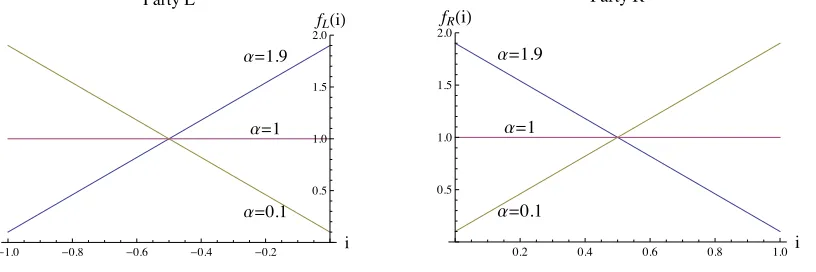
fR(i) = ↵+ 2(1 ↵)i, (2)
where↵ 2(0,2). The associated cumulative distribution function isFR(i) = ↵i+ (1 ↵)i2.
PartyL consists of politicians with ideologies i2[ 1,0], distributed according to
fL(i) = ↵ 2(1 ↵)i. (3)
The associated cumulative distribution function is FL(i) = 1 FR(|i|), for i2[ 1,0].
a=1.9
a=1
a=0.1
-1.0 -0.8 -0.6 -0.4 -0.2 i
0.5 1.0 1.5 2.0
fLHiL
Party L
a=1.9
a=1
a=0.1
0.2 0.4 0.6 0.8 1.0 i
0.5 1.0 1.5 2.0fRHiL
[image:16.612.114.522.448.584.2]Party R
Figure 2: Probability density function of ideologies, for di↵erent values of ↵.
Parameter↵ captures the degree of ideological moderation. A higher↵means that
chal-lengers are more likely to have ideologies closer to the median voter’s. The distributions are
uniform when↵= 1. The expected ideology of a partyRcandidate isR01i[↵+2(1 ↵)i]di=
2 3
↵
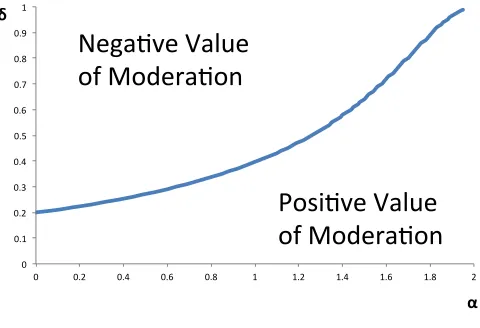
Figure 3 reveals how voter welfare varies with the ideology parameter ↵and the discount
factor . The line in Figure 3 represents parameters such that the marginal value of
increas-ing the moderation parameter ↵ is zero. Above this line, the marginal value of increasing
↵ is negative, and below this line, the value is positive. When voters are sufficiently
impa-tient (low ), a more moderate distribution of ideologies (marginal increase in↵) benefits all
voters, while the opposite is true when voters are sufficiently patient.
0" 0.1" 0.2" 0.3" 0.4" 0.5" 0.6" 0.7" 0.8" 0.9" 1"
0" 0.2" 0.4" 0.6" 0.8" 1" 1.2" 1.4" 1.6" 1.8" 2" δ"
α"
Nega1ve"Value"
of"Modera1on"
[image:17.612.195.435.214.378.2]Posi1ve"Value"
of"Modera1on"
Figure 3: The marginal value of moderation (marginal value of increasing ↵)
When agents are even modestly patient, moderation has a non-monotonic impact on
welfare. For any discount factor > 0.2, voter welfare first falls in ↵, before rising. That
is, when↵ is sufficiently low—so politicians are likely to be extreme—marginal increases in
the moderation parameter ↵ increase the expected extremism of policies implemented by
incumbents, harming voters. Figure 3 shows that for plausible discount factors, >0.5, the
marginal value of a more moderate pool of challengers is negative unlessthe distribution of
political ideologies is already quite moderate (↵much greater than one). This reflects that if
enough politicians have moderate-to-extreme ideologies just belowc, the extremism e↵ect of
the decrease inc dominates. Moreover, when many politicians have extreme ideologies and
agents are patient, the compromising incentives generated by party competition are large—
incumbents are very concerned about losing to a challenger from the opposing party. In this
party competition.13,14
4
The “Value” of Information about Challengers
Bernhardt et al. (2009) introduces political parties to the repeated election framework of
Duggan (2000). Party labels are informative because candidates from di↵erent parties have
ideologies drawn from opposing sides of the ideological spectrum. When ousting an
incum-bent from office, this additional information allows voters to select a challenger from the
opposing party. Incumbents dislike being replaced by someone with a more distant ideology,
so they become more willing to moderate policy choices, raising voter welfare. Thus, in that
model, the value of information (party labels) is always positive.
We next characterize how equilibrium outcomes are a↵ected when, in addition to the
information conveyed by party labels, voters receive a noisy, but informative, signal about a
challenging candidate’s ideology. When voters can partially distinguish between challengers,
they are more willing to replace an incumbent when they receive a signal suggesting that
the challenger is more likely to be a moderate, than when the signal suggests that she is
an extremist. We want to understand whether voters benefit from such additional learning
about challengers.
To do this we extend our basic model by introducing a noisy binary signal about a
chal-lenger’s ideology. This signal’s natural interpretation is as a binary signal “endorsement”
or “no endorsement” by informed interest groups. Although we take this signal’s origin as
exogenous, we describe how one can endogenize the source and information content of the
13We numerically replicated Figure 3 using loss functions that take the form u(x, y) =
|x y|z,
z2{1,2,3}. In all cases, marginal increases in↵reduce the median voter’s payo↵if is large and↵is low.
The region that represents a “negative value of moderation” for the median voter is smallest for Euclidean
preferences, and largest for cubic preferences. This is because the threat provided by the ideology distribution
of challengers has a bigger disciplining e↵ect on incumbents when utility functions are more concave.
14In contrast, with at large selection of challengers, and quadratic utility, moderations in the distribution
of ideologies a↵ect voters in the same way, regardless of their ideologies. As a result, the change in the
median voter’s expected payo↵ from electing a challenger exactly equals the change in an incumbent’s
expected payo↵ from losing re-election to a challenger. Hence, moderation in the distribution of political
signal by studying public endorsements from informed interest groups.
As before, right- and left-wing politicians are drawn from probability distributions FR
and FL. After the incumbent implements her policy but before the election, voters observe
a noisy public signal about the challenger’s ideology.
Consider a left-wing incumbent facing a right-wing challenger. Recall that voters’ prior
belief is that the challenger has an ideology i 2 [0,1] drawn from the probability density
function fR. After a challenger is selected, voters learn about the challenger, observing a
public signal ⇧ about her ideology, where the index 2[0,1] captures the accuracy of
sig-nal⇧ relative to a benchmark likelihood function⇡ in a way that we describe momentarily.
Signal⇧ has two possible realizations,s2{sG, sB}. RealizationsGis a “good” signal about
the challenger’s moderacy, whilesB is a “bad” signal: sG implies that the challenger is more
likely to have an ideology closer to the median voter than doessB. Formally, realizations sG
andsB generate updated posterior beliefsfRG andf B
R , respectively, that both satisfy (A.1)
and the monotone likelihood ratio property.
Our central focus is on how the degree of informativeness of the signal about the challenger
a↵ects equilibrium behavior and welfare. To this end, we want to distinguish the
informative-ness of the signal, from the unconditional probability that the challenger generates good
signalsG. Accordingly, public signal⇧ places weight 2[0,1] on an informative benchmark
likelihood function⇡and remaining weight 1 on the prior probability of a good signal. The
benchmark likelihood function⇡: [0,1]!(0,1) defines the probability⇡(i) that a challenger
with ideology i generates signal realization sG. To capture that signal sG is a good signal
about the challenger’s moderacy and guarantee that posterior beliefs satisfy (A.1) we assume:
(A.2) The benchmark likelihood function ⇡ : [0,1] ! (⇡,⇡) is absolutely continuous and
weakly decreasing, strictly decreasing on some interval [0, h), with 0<⇡<⇡ <1 andh >0.
The likelihood function ⇡ of signal ⇧ is then
⇡ (i) = ⇡(i) + (1 )⇢, (4)
where⇢=R01⇡(i)fR(i)di is the prior probability of a good signal. Thus, a higher indicates
a more informative signal. When = 1, the likelihood function⇡ is as informative ofias is
Further, the unconditional probability of signal realizationsG does not vary with :
P r(s =sG) =
Z 1
0
⇡ (i)fR(i)di =
Z 1
0
⇡(i)fR(i)di+ (1 )⇢= ⇢+ (1 )⇢=⇢.
This structure isolates the e↵ects of a change in signal accuracy from those of the prior
probability ⇢of signal realization sG.15
When signal ⇧ generates realization s 2 {sG, sB}, Bayes’ rule yields the following
up-dated probability density functions,
fRG (i) = ⇡ (i)fR(i)
⇢ =
⇡(i)fR(i)
⇢ + (1 )fR(i) = f
G1
R (i) + (1 )fR(i),
fRB (i) = [1 ⇡ (i)]fR(i)
1 ⇢ =
[1 ⇡(i)]fR(i)
1 ⇢ + (1 )fR(i) = f B1
R (i) + (1 )fR(i),
Thus, posteriors are a weighted average of the maximum feasible information captured by
fG1
R =
⇡(i)fR(i)
⇢ and f
B1
R =
[1 ⇡(i)]fR(i)
1 ⇢ , and the prior belief fR, where the weight on the
in-formation in the signal is . It is straightforward to compute the corresponding cumulative
density functionsFRG andFRB . When the challenger is a left-wing politician, the symmetric
signal is defined analogously.
Remark 1: Suppose FR satisfies (A.1) and ⇡ satisfies (A.2). Then, for any signal ⇧ with
2(0,1],
• Densities fRG and fRB satisfy (A.1) for some lower-bounds fG >0 and fB >0;
• Densities fRG and fRB satisfy the monotone likelihood ratio property (MLRP): fRB (i)
fRG (i)
weakly increases in i2[0,1], and strictly increases in the range [0, h).
Moreover, for any 2 (0,1] we have FRB F OSD FRG : a good signal raises the likelihood
that the challenger has a more moderate ideology. Indeed, the greater is , i.e., the more
accurate is the signal technology, the more the signals reveal about whether the challenger is
a moderate or an extremist: for 1 0 > >0, FRB 0 F OSD FRB F OSD FRG F OSD FG
0
R .
One can also show that the posteriors FRB and FRG inherit the MLRP ordering of fRG and
fRB for each . An analogous formulation describes beliefs about left-wing challengers.
15If we generalize equation (4) to⇡ (i) = ⇡(i) + (1 )˜⇢for some exogenous constant ˜⇢
2(0,1), then
@P r(s=sG)
@ =⇢ ⇢˜. The results that we establish in Proposition 3 extend to any ˜⇢, and ˜⇢ ⇢(so increasing
In summary, the signal structure ⇧ is defined by an accuracy parameter and a
bench-mark likelihood function ⇡. A new challenger is drawn before each election. All voters see
the new signal realizations 2{sG, sB}about the challenger’s ideology. Because the ideology
of a challenger from a given party is an i.i.d. draw each period, and the signal generating
process ⇧ is independent across periods, knowledge of past signal realizations contains no
information about the ideologies of current or future challengers. Therefore, we again focus
on stationary strategies: after a politician takes office, her policy choices depend only on her
ideology—it is independent of past signal realizations. So, too, voter choices in any given
elec-tion are funcelec-tions only of the incumbent’s most recent policy choice, and the signal about the
current challenger’s ideology. The retrospective/prospective voting choices reflect voters’
up-dated beliefs about a challenger after observing the binary signal: each voterxsets two
signal-specific utility (voting) standards. In equilibrium, each voting standard corresponds to the
expected discounted payo↵from electing the challenger after observing that particular signal.
4.1
Analysis
Consider any benchmark likelihood function ⇡ that satisfies (A.2). If the signal ⇧ is
com-pletely uninformative ( = 0), then the unique equilibrium is that established in Sections 2
and 3. When the signal is informative ( >0), voters set two re-election cuto↵s,wGandwB,
where 0 < wG < wB < 1. In equilibrium, the decisive median voter is indi↵erent between
re-electing the incumbent and electing the challenger if the realized signal is sG and the
incumbent implemented policywG. The median voter is similarly indi↵erent if the realized
signal issB and the incumbent implemented the more extreme policywB. Thus, a right-wing
incumbent who implements policy y 2 [0, wG] always wins re-election; an incumbent who
implements policy y 2 (wG, wB] wins if and only if voters receive a bad signal about the
challenger; and an incumbent who implements an extreme policyy > wB always loses.
Consider a right-wing incumbent with ideology i > wB. Her choices reduce to deciding
whether (1) to compromise towG in order to ensure re-election even when the signal about a
challenger is good; (2) to compromise to wB and win re-election only when the signal about
a challenger’s ideology is bad, which happens with probability (1 ⇢); or (3) to implement
decide whether to compromise all the way to wG to ensure victory, or only to compromise
partially to wB and be ousted from office with probability ⇢ each period when she draws a
challenger who generates a good signal realization.16
For politician i wB, the direct period payo↵ cost of implementing policy wG instead
of wB is (i wB)2+ (i wG)2 = 2i(wB wG) +wG2 wB2. Because i 1 and wB > wG,
this cost is strictly less than 2(wB wG). Consequently, when wB wG is close to zero, this
cost is even closer to zero. The direct benefit from choosingwG instead ofwB is the increase
in the probability of re-election from (1 ⇢) to one, that is, a probability increase of⇢ >0.
Hence, if wB is close enough to wG, then any incumbent with ideology i 2 [wB,1] faces a
small marginal cost of changing her policy choice from wB to wG, but a discrete positive
benefit from guaranteeing re-election and avoiding replacement by a challenger. Thus, when
the di↵erence (wB wG) is small, the option to compromise to wG strictly dominates the
option to compromise towB, so that the relevant decision for incumbentsi2[wB,1] becomes
whether to compromise to wG or to choose as policy their own ideology.
We focus on the case where all politicians who choose to compromise do so by
compromis-ing towG. A sufficient condition for no incumbent to compromise towB, i.e., for all
compro-mising incumbents to compromise towG, is that the signal about the challenger be sufficiently
noisy. This reflects the practical observation that when signals are noisy,wGis not that much
smaller thanwBso that an incumbent who finds it optimal to compromise, might as well
com-promise a little more, in order to ensure victory. We later investigate what “sufficiently noisy”
signals mean in a setting where uncertainty over ideologies is described by linear densities.
Lemma 1 SupposeFR satisfies (A.1) and⇡ satisfies (A.2). If the signal⇧ about the
chal-lenger is sufficiently noisy ( is sufficiently small) then no incumbent compromises to wB.
Thus, when the signal about the challenger is informative, but sufficiently noisy,
equilib-rium outcomes are characterized by the two re-election cuto↵s described above, 0 < wG <
wB <1, andonecompromise cuto↵c. Incumbents with ideologiesi2(0, wG] implement their
16Politicians with ideology i 2 (w
G, wB), but close to wG always prefer to compromise to wG. If the
distance between wB and wG is large (because the signal about the challenger is very informative), then
incumbents with ideologyi2(wG, wB) sufficiently close towB may prefer to implement their own preferred
own ideologies as policy, while incumbentsi2(wG, c) compromise towG. Both groups are
re-elected regardless of whether the signal about the challenger is good or bad. Extremist
incum-bentsi2[c,1] implement p(i) = iand are always ousted from office. The indi↵erence
condi-tion is that politiciani=cis indi↵erent between (a) compromising top(i) = wGto guarantee
re-election even when the signal about a challenger is good, and (b) implementing her own
extreme ideologyp(i) =i and losing re-election for sure. Figure 4 depicts these thresholds.
[ ]
1 1
|
c w|B
|
wG 0
|
wG
|
wB
|
[image:23.612.167.465.221.258.2]c
Figure 4: Equilibrium Thresholds
We now ask our second fundamental question: do voters value receiving an informative
but noisy signal about a challenger’s ideology?
To answer this question, we make a technical assumption that voters are sufficiently
pa-tient with discount factors > ⇤⇤(F
R), where given any ideology distribution FR satisfying
(A.1), ⇤⇤(F
R) 0 is the minimum discount factor such that for all 2( ⇤⇤(FR),1),
2 +p (2 )
2(1 ) imax2[0,c]
✓
fR(i)
fR(c)
◆
, for all c2[0,1]. (5)
As goes from zero to one, 2 +
p (2 )
2(1 ) strictly increases from 1 to infinity. Therefore,
⇤⇤(F
R) < 1. Moreover, if fR is weakly increasing (e.g., FR is uniform), then ⇤⇤(FR) = 0,
i.e., our results hold for all 2(0,1).17
Proposition 3 Suppose FR satisfies (A.1), ⇡ satisfies (A.2), and voters are patient, 2
( ⇤⇤(F
R),1). Then voters strictly prefer not to receive signals about the challenger if the
signal ⇧ is sufficiently noisy ( is sufficiently small).
Thus, learning about whether a challenger is more likely to be a moderate or an extremist
reducesvoter welfare. To understand the result, letw⇤ be the equilibrium re-election standard
andc⇤ be the compromising cuto↵when the signal is completely uninformative ( = 0). If
is positive, but small, politicians only compromise to wG. The key is that re-election cuto↵
17More generally, > ⇤⇤(F
R) is sufficient, but not necessary, for Proposition 3; we suspect that regardless
wG is stricter thanw⇤,wG< w⇤, reflecting that voters are more favorably disposed to a
chal-lenger with a good signal. That is, the presence of an informative signal forces incumbents to
compromise by more to ensure re-election. As a result, fewer incumbents compromise, i.e.,
c < c⇤, and more incumbents implement their own extreme ideologies. This hurts all voters.
Moreover, the informative signal about the challenging candidate’s ideological preferences
only a↵ects the winning vote margin and not who wins—it does not improve the selection
of winning challenging candidates. This is because whether a challenging candidate wins or
not does not depend on whether there is a good or bad signal about her ideology, but only
on whether or not she faces an extremist incumbent who chose not to compromise.
To glean a deeper understanding for the result, recall that when signals are completely
uninformative, i.e., when = 0, the median voter is just indi↵erent between re-electing an
incumbent who adopts the equilibrium standardw⇤as policy, and trying the risky challenger.
The median voter does not internalize that if he set a slacker standard, then more extreme
incumbents would choose to compromise to win re-election, rather than locate extremely,
which would raise voter welfare. The key is that the welfare gain from greater compromise is
first-order, while the cost from slightly inefficient replacement is second-order.18 Slightly
in-formative signals induce the median voter to set a more demanding standard for re-election,
i.e., to reduce wG; and because all incumbents who compromise do so to wG, this serves
to set a more demanding standard for re-election, hurting voters. Moreover, voter welfare
continues to decrease following any increase in the signals informativeness that decreaseswG
without leading incumbents to compromise towB.
This powerful negative result regarding the welfare costs of learning about challengers
holds as long as no incumbent type compromises to wB in equilibrium. Proposition 3 only
assumes that the signal about the challenger is sufficiently noisy as a sufficient condition for
18In fact, Lemma A.1 in the Appendix proves the stronger result that were a social planner to imposeany
re-election standard wthat is stricter than the equilibrium standard, w < w⇤, this would strictly decrease
the welfare of all voters. Indeed, voter welfare declines continuously with reductions in w. This result
contrasts sharply with the recent papers by Ashworth et al. (2012) and Caselli et al. (2012), who argue
that in equilibrium voters would benefit from stricter re-election thresholds. A key di↵erence between these
models and ours is that in our model politicians and voters are horizontally di↵erentiated by ideology, while
in these other papers politicians are not policy motivated—they are vertically di↵erentiated by ability and
no incumbent to compromise towB (Lemma 1). But how small does have to be in practice?
The bound on the signal’s informativeness for all compromising incumbents to choosewG
is an intricate function of model parameters. In particular, the signal’s information content
as captured by is a measure of information about a challenger’s fundamental
characteris-tics (her ideology). However, how ideology translates into actual policy choices and hence
the median voter’s expected payo↵ from electing a challenger depends on the equilibrium of
the game. For instance, a signal may be very informative about a challenger’s ideology, but
if most challengers compromise in equilibrium, the payo↵ relevant information content of the
signal may be small. Hence, if the parameters of the model are such that many incumbents
compromise, the result in Lemma 1 may hold even for very informative signals. In particular,
one expects the result to hold for higher when an incumbent’s incentives to compromise
are higher—when agents are very patient or the unconditional distribution of challengers’
ideologies is more extreme. We now show that this intuition holds for our linear density
parameterization.
4.2
Linear Densities with Signals
We focus on signal⇧ when the prior distributionfRand the posterior distributionsfRG and
fRB (updated after observing the signal realization) are linear functions of the challenger’s
ideology. Formally, for alli2[0,1],
fR(i) = ↵+ 2(1 ↵)i,
fRG (i) = ↵G + 2(1 ↵G )i,
fRB (i) = ↵B + 2(1 ↵B )i,
where 0<↵B <↵<↵G <1. Recall that↵ captures the degree of ideological moderation,
where a higher ↵ implies a more moderate ideology distribution. Hence, voters start with
a prior belief ↵ about the degree of the challenger’s ideology moderation, then their beliefs
rise to ↵G after observing a good signal s
G, and fall to ↵B after a bad signal sB.
If the prior probability of a good signal is ⇢2(0,1), then Bayes’ rule yields:
To guarantee that the posteriors↵G and ↵B are always between 0 and 2, we assume that
0 <↵ ⇢ < 1 and define the bounds ↵ =↵+ (1 ⇢) and ↵ = ↵ ⇢. Conditional on the
right-wing challenger’s ideologyi, the benchmark likelihood function⇡ generates realization
sG with probability
⇡(i) = [↵+ 2(1 ↵)i]⇢ fR(i)
=⇢+⇢(1 ⇢)(1 2i) fR(i)
. (6)
Note that⇡ satisfies (A.2),
@⇡(i)
@i = ⇢(1 ⇢)
(
2 fR(i)
2(1 ↵)(1 2i) fR(i)2
)
= 2⇢(1 ⇢) fR(i)2
<0.
Substitute (6) into (4). Signal ⇧ generates realization sG with conditional probability
⇡ (i) = (1 )⇢+ ⇡(i) =⇢+⇢(1 ⇢) (1 2i) fR(i)
.
Integrating over ideologies i 2 [0,1], the overall probability of a good signal is ⇢. After
receiving a signal, voters update their beliefs using Bayes’ rule:
fRG (i) = ⇡ (i)fR(i)
⇢ = fR(i) + (1 ⇢) (1 2i) = ↵
G + 2(1 ↵G )i,
where↵G ⌘↵+ (1 ⇢) captures the expected increased degree of ideological moderation,
and
fRB (i) = [1 ⇡ (i)]fR(i)
(1 ⇢) = fR(i) ⇢ (1 2i) = ↵
B + 2(1 ↵B )i,
where ↵B ⌘↵ ⇢ captures the expected decreased degree of ideological moderation.
Note that ↵G ↵B = . That is, the distance between the posterior beliefs strictly
in-creases with the signal’s informational content , as the signal “rotates” the linear posterior
aroundi= 0.5. Figure 5 illustrates prior and posterior beliefs for di↵erent parameter values.
We numerically solve the model when good and bad signals are equally likely (⇢= 12), for
di↵erent values of and↵. Figure 6 shows that as long as agents are even modestly patient
with a discount factor that exceeds 0.3, noincumbent compromises to wB even when = 1
so the signal is maximally informative.19 More generally, the region where incumbents never
compromise towB is greater when agents value the future more ( is higher) and the overall
19When = 1 and⇢= 0.5, condition 0<↵ ⇢<1 implies ↵
aG=1.5
a=1
aB=0.5
0.0 0.2 0.4 0.6 0.8 1.0i
0.5 1.0 1.5 2.0
fRHiL
Party R
(a) ↵= 1, = 1, ⇢= 0.5
aG=1.75
a=1
aB=0.75
0.0 0.2 0.4 0.6 0.8 1.0i
0.5 1.0 1.5 2.0
fRHiL
Party R
(b) ↵= 1, = 1, ⇢= 0.25
aG=1.75 a=1.5
aB=1.25
0.0 0.2 0.4 0.6 0.8 1.0i
0.5 1.0 1.5 2.0
fRHiL Party R
[image:27.612.85.545.73.210.2](c) ↵= 1.5, = 0.5,⇢= 0.5
Figure 5: Prior ↵ and posterior beliefs↵G and ↵B for di↵erent values of{↵, ,⇢}.
distribution of ideologies is more extreme (↵ is lower). Thus, for this linear density
param-eterization, voters necessarily strictly prefer not to receive information about challengers
whenever 0.3. Moreover, in this parameter region where no incumbent compromise to
wB, every increase in the signal’s informativeness (every increase in 2 [0,1]) decreases
wG, which further decreases voter welfare. Consequently, voter welfare is maximized by an
uninformative signal ( = 0), and is decreasing in , minimized by the most informative
signal ( = 1).
0" 0.1" 0.2" 0.3" 0.4" 0.5" 0.6" 0.7" 0.8" 0.9" 1"
0.5" 0.6" 0.7" 0.8" 0.9" 1" 1.1" 1.2" 1.3" 1.4" 1.5" δ"
α""
No#Incumbent#Compromises#to#wB#
Some#Incumbents#Compromise#to#wB#
Figure 6: Party Selection with Linear Densities and Signal = 1.
It is worthwhile to reflect on our two welfare results. We find that under plausible
scenar-ios, more information about challengers impairs welfare. In contrast, while more moderate
distributions of challenger ideologies impair voter welfare if concentrated sufficiently on
[image:27.612.221.406.417.594.2]To understand what underlies the di↵erence, observe that with a more moderate pool of
challengers, a challenger who replaces an incumbent is likely better—selection improves. In
contrast, whenever compromising incumbents always do so by enough to ensure reelection,
electoral outcomes only hinge on an incumbent’s policy choices—more informative signals
only serve to force incumbents to compromise by more to ensure re-election. Thus, the
first-order e↵ect of improving the distribution of challengers is to raise the value of replacing
an incumbent with a new challenger. In contrast, the first-order e↵ect of improving the
information about challengers is to raise the cost of compromise to incumbents.
4.3
Endogenous Information Transmission
In the on-line Appendix we endogenize the information transmitted to voters about
chal-lengers, by examining cheap-talk messages sent by informed interest groups. Below we
highlight some of these results.
Consider two symmetrically-situated interest groups that have the same utility functions
as voters { ,+ }. Before each election, the IGs costlessly gain access to information
about whether the challenger is more likely to have a moderate or an extreme ideology.
This learning process corresponds to the signal ⇧ with possible realizations s 2 {sG, sB}
described previously. The signal received by IGs is non-verifiable, but each IG can send a
public (cheap-talk) message to voters about a challenger’s ideology. One can interpret the
IGs as newspapers or other political institutions with limited biases in their political
prefer-ences, and better access to political information than voters. The messages have the natural
interpretation as political endorsements for a challenger or incumbent.
We prove that the set of equilibrium cuto↵s wG and wB in the model without IGs, also
characterize the equilibrium in the model where information is endogenously transmitted by
IGs—as long as the political biases of the IGs are not too large ( is small enough). When
the IGs are only slightly politically biased, there exists an informative equilibrium in which
voters rely on IG endorsements to learn about a challenger’s expected ideology. However,
voters must account for incentive misalignments. There is a range of intermediate policies
such that a right-wing incumbent is always supported by the right-wing IG, so that its
by the opposing IG, which turns out to be informative. Conversely, in a more extreme
range of policies implemented by the right-incumbent, the left-wing IG always supports the
left-challenger; now the informative endorsement comes from the right IG.20
An interesting implication is that if interest groups are sufficiently biased ( is large
enough), then the incentive misalignment between the median voter and the IGs is so large
that the median voter ceases to learn in any cheap-talk equilibrium about the signals received
by the IGs. Consequently, in an economy where the results of Proposition 3 hold, having
very extreme IGs is better than having very centrist IGs. Extreme IGs guarantee that voters
will not learn about the challenger, when the value of this information is negative.
5
Conclusion
Our paper focus on two questions. First, how do changes in the ideology distribution of
can-didates a↵ect the equilibrium behavior of incumbent politicians? Voters can only credibly
threaten to replace an incumbent who implements policies that are too extreme if they
ex-pect the challenging candidate to implement better policies. However, improving this outside
option—having challengers with preferences closer to those of most voters—need not benefit
voters. This is because more moderate challengers reduce the incentives generated by party
competition for an incumbent to compromise, since losing to a more moderate challenger is
less costly.
Our second question asks: do voters benefit from learning about challengers during the
general election? Although ideology information conveyed by party labels always benefits
voters, additional information about particular challengers reduces welfare under a robust
set of circumstances. We show that if voters receive sufficiently noisy signals about a
chal-lenger’s ideological preferences, then incumbents who compromise do so to the stricter
re-election standard required to defeat a challenger who receives a good signal. This stricter
re-election standard causes more incumbents to adopt extreme policies. We show that this
20These prediction are consistent with Chiang and Knight (2011). They find that newspaper endorsements
are influential in the sense that voters are more likely to support a recommended candidate after publication
of an endorsement. Moreover, endorsements of Democratic candidates by left-leaning newspapers are less