warwick.ac.uk/lib-publications
Original citation:
Beckingsale, David A., Gaudin, W. P., Herdman, J. A. and Jarvis, Stephen A. (2015) Resident
block-structured adaptive mesh refinement on thousands of graphics processing units. In:
44th International Conference on Parallel Processing, Beijing, China, 1-4 Sep 2015 pp. 61-70.
Permanent WRAP URL:
http://wrap.warwick.ac.uk/90868
Copyright and reuse:
The Warwick Research Archive Portal (WRAP) makes this work by researchers of the
University of Warwick available open access under the following conditions. Copyright ©
and all moral rights to the version of the paper presented here belong to the individual
author(s) and/or other copyright owners. To the extent reasonable and practicable the
material made available in WRAP has been checked for eligibility before being made
available.
Copies of full items can be used for personal research or study, educational, or not-for profit
purposes without prior permission or charge. Provided that the authors, title and full
bibliographic details are credited, a hyperlink and/or URL is given for the original metadata
page and the content is not changed in any way.
Publisher’s statement:
© 201
5
IEEE. Personal use of this material is permitted. Permission from IEEE must be
obtained for all other uses, in any current or future media, including reprinting
/republishing this material for advertising or promotional purposes, creating new collective
works, for resale or redistribution to servers or lists, or reuse of any copyrighted component
of this work in other works.
A note on versions:
The version presented here may differ from the published version or, version of record, if
you wish to cite this item you are advised to consult the publisher’s version. Please see the
‘permanent WRAP url’ above for details on accessing the published version and note that
access may require a subscription.
Resident Block-Structured Adaptive Mesh Refinement on Thousands of Graphics
Processing Units
David Beckingsale∗, Wayne Gaudin†, Andy Herdman†, Stephen Jarvis∗
∗Department of Computer Science, University of Warwick, Coventry, UK
{dab,saj}@dcs.warwick.ac.uk
†High Performance Computing, AWE plc, Aldermaston, UK
{Wayne.Gaudin,Andy.Herdman}@awe.co.uk
Abstract—Block-structured adaptive mesh refinement (AMR) is a technique that can be used when solving partial differential equations to reduce the number of cells necessary to achieve the required accuracy in areas of interest. These areas (shock fronts, material interfaces, etc.) are recursively covered with finer mesh patches that are grouped into a hierarchy of refinement levels. Despite the potential for large savings in computational requirements and memory usage without a corresponding reduction in accuracy, AMR adds overhead in managing the mesh hierarchy, adding complex communication and data movement requirements to a simulation. In this paper, we describe the design and implementation of a resident GPU-based AMR library, including: the classes used to manage data on a mesh patch, the routines used for transferring data between GPUs on different nodes, and the data-parallel operators developed to coarsen and refine mesh data. We validate the performance and accuracy of our implementation using three test problems and two architectures: an 8 node cluster, and 4,196 nodes of Oak Ridge National Laboratory’s Titan supercomputer. Our
GPU-based AMR hydrodynamics code performs up to 4.87×
faster than the CPU-based implementation, and is scalable on 4,196 K20x GPUs using a combination of MPI and CUDA.
Keywords-adaptive mesh refinement; hydrodynamics; CUDA; mini-applications;
I. INTRODUCTION
Block-structured adaptive mesh refinement (AMR) allows fewer resources to be used to achieve the required accuracy in interesting areas of a problem [1, 2]. These areas of interest (shock fronts, material interfaces, etc.) are refined, and recursively covered with rectangular patches of com-putational mesh at a higher resolution. The patches are grouped into a hierarchy of levels of refinement that adapt throughout the computation as the areas of interest move. Despite the potential for large savings in resource usage without loss of accuracy, AMR requires dedicating a portion of application runtime to managing the mesh hierarchy; this requires complex data management and communication.
Massively parallel accelerator architectures like graph-ics processing unit (GPUs) can provide order of magni-tude improvements in application performance [3–5]. With tremendous memory bandwidth and the ability to operate on hundreds of data items in parallel, these architectures
provide the perfect platform for many high-performance computing applications providing they are ported well. These many-core architectures are the natural extension of the architectural trends introduced by multi-core processors, and consist of processors with even more cores, running at even lower frequencies. At the node level, it is now common to see an accelerator attached to at typical multi-core processor.
Most AMR applications run exclusively on the central processing unit (CPU), and those that do use GPUs often copy the necessary data between GPU and CPU memory at the beginning and end of every GPU-based routine [4, 6, 7].
In this paper, we present the first resident implementation
of block-structured AMR on GPUs, where all data is stored exclusively on the GPU. The SAMRAI library is a collection of software components for writing AMR codes [8], and has been to develop scalable CPU-based applications [9]. Building on SAMRAI, we create classes that manage the life cycle of AMR patches. All routines that manage the patch hi-erarchy continue to be handled by SAMRAI on the CPU, but all AMR-specific routines that operate on patch data, such as the coarsening and refining of data between adjacent levels in the hierarchy, execute on the GPU. We use this library to write a GPU-based version of CleverLeaf, a hydrodynamics mini-application with AMR. Mini-applications are small, self-contained programs that embody the key performance characteristics of some key application [10], and provide the perfect vehicle for investigating new programming models, algorithms and architectures. The GPU-based version of
CleverLeaf performs up to 4.87×faster than the CPU-based
implementation on a single node, and has been scaled to over four thousand nodes using a combination of MPI and CUDA. In this paper, we make the following specific contributions:
• We describe the design and implementation of our
GPU-based extensions to the SAMRAI library, includ-ing the classes used to manage patch data, the routines used for transferring data between GPUs on different nodes, and the data parallel operators developed to coarsen and refine mesh data.
develop-ment of the only resident GPU-based shock hydrody-namics application with AMR.
• The application, CleverLeaf, is designed as a proxy
for shock hydrodynamics applications with AMR, and thus can be used to investigate the performance of GPU-based architectures for other large hydrodynamics codes.
• Furthermore, by developing the code as part of the
SAMRAI library, we provide a collection of compo-nents that can be re-used in other block-structured AMR applications.
• Through performance analysis, we show that our
GPU-based application performs up to 4.87× faster than
the CPU-based implementation, and present scalability results using up to 4,096 NVIDIA K20x GPUs.
The remainder of this paper is structured as follows: Section II contains a description of the AMR technique and algorithm; Section III discusses related work; Section IV details the design and development of our GPU-based library and corresponding hydrodynamics code; Section V presents a performance analysis library and hydrodynamics code; and finally, Section VI concludes the paper and offers suggestions for future work.
II. ADAPTIVEMESHREFINEMENT
Solving equations at higher resolution is more expensive both in terms of computational time and memory used. AMR is a computational technique where the resolution of the simulation is only increased in areas where it is necessary. For example, when simulating a tsunami travelling across the ocean the location of the wave is the most important feature in the solution. The rest of the ocean is much less interesting, and the impact of the wave is either negligible or easily approximated. An adaptive simulation would only simulate the area containing the wave at a high-resolution, saving both time and memory.
Developed by Berger et al. [1, 2], block-structured AMR has been successfully applied to many domains that display disparate physical scales, including cosmology, astrophysics, and shock hydrodynamics [11–13]. Other domains in which these disparate scales are observed include various mili-tary applications (small projectiles impacting much larger structures) and laser fusion experiments. Improving the performance of AMR will allow more of these important problems to be solved without increasing resource usage.
Block-structured adaptive mesh refinement uses a hier-archy of nested, logically rectangular grids over which the partial differential equation being solved is discretised. We briefly present a formal notation for the hierarchy in terms of these grids. The coarsest grid is the base grid, specified
at the start of the computation and denoted G0. It may be
composed of several patches, which remain fixed throughout
the simulation. Each component patch is denoted G0,j, and
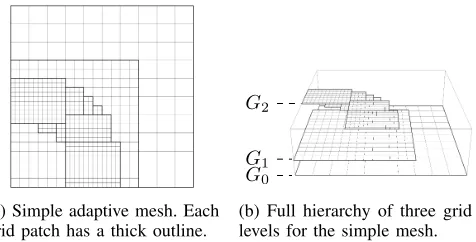
(a) Simple adaptive mesh. Each grid patch has a thick outline.
G0
G1
G2
[image:3.612.322.560.70.191.2](b) Full hierarchy of three grid levels for the simple mesh.
Figure 1: Example adaptive mesh and the corresponding grid hierarchy.
thusG0 is the union of its components G0,j:
G0=∪jG0,j
During the simulation, refined sub-grids of patches will be created in response to features in the solution. Sub-grids are not placed in the coarse grid, but on top of it. Each sub-grid is defined independently and has its own solution, and can be advanced almost independently of all other grids. These independent grids provide a natural method of domain decomposition allowing for easy parallelisation of the algorithm.
Fine sub-grids can contain finer sub-grids within their boundaries. Sub-grids are recursively generated to provide the necessary level of refinement, creating a hierarchy of
grid levels. The coarse gridG0is at level 0 in the hierarchy.
Sub-grids ofG0 are part ofG1 and are described as level 1
refinements. Refined grids withinG1are at level 2. A nested
sequence of sub-grids may be created to cover a portion of the domain. Figure 1 shows an example hierarchy containing three grid levels.
The mesh spacing, or resolution, hl for each grid levell
is normally specified in advance, where eachhlis an integer
multiple ofhl−1. The relationship between the mesh spacing
at each level is typically specified as the refinement ratio:
rl=
hl−1
hl
Grids at different levels of the hierarchy must be properly nested. A fine grid must start and end at the corner of a cell in the next coarser grid, and there must be at least one
levell−1 cell separating a grid cell at levellfrom a cell at
levell−2in any direction unless the cell is at the physical
boundary of the domain.
error estimation and hierarchy generation procedure must be used to generate the hierarchy, since only the coarsest level is specified by the user. Once the hierarchy is created, the main loop of the simulation proceeds as follows: first, the boundary conditions of each patch are filled; second, the simulation is advanced in time using the integration al-gorithm; third, the error estimation and hierarchy generation procedure is used to update the simulation grid.
Each patch will require some data to be placed in ad-ditional cells around the patch edge to provide boundary conditions for the system of partial differential equations. Boundary data for each patch can be filled in one of three ways: (i) with the physical boundary conditions, (ii) with the data from a neighbouring patch on the same level, or (iii) with the data from a neighbouring patch on the next coarsest level. When data is transferred between levels it must be interpolated to correctly fill the increased number of smaller cells on the finer level.
Since each patch is defined as an independent computa-tional entity with its own solution storage, each patch can be integrated in time independently once its boundary values are supplied. This independence means that, using the patch as a basic unit of work in the simulation, work can be easily shared between multiple processes. The solution on a patch is modified in the case when a cell is covered by a fine grid, and the coarse cell value is replaced by a conservative average of the fine cell values that cover the coarse cell.
At the beginning of the simulation, and with a given frequency, an error estimation procedure is invoked to de-termine the structure of the patch hierarchy. When more than one level of patches exists, the procedure is applied recursively from the second finest to the coarsest level of the hierarchy. This regridding procedure has three steps: flagging, where a heuristic is applied to determine which
level lcells ought to be covered by the levell+ 1 patches;
clustering, where the new set of level l patches is created
from a set of flagged cells on levell−1; and solution transfer,
where data is copied from the old to the new hierarchy. Once the regridding procedure is completed, the next time step starts and the main algorithmic steps (boundary value determination, integration, and regridding) are repeated until the end of the simulation.
III. RELATEDWORK
Berger’s adaptive mesh refinement algorithm was pre-sented in 1984, and many computational physics codes have been ported to GPUs since the release of CUDA in 2007 [1, 3, 14–17]. However, there is little work where AMR codes have been ported to GPUs. We suppose that this is due to the large amount of data management required when updating the adaptive hierarchy, and the fact that the nave method for porting codes to GPUs revolves around repeatedly copying simulation data to and from the GPU across the slow PCI bus.
An early paper by Wang et al. describes an implementa-tion of a compressible flow solver with AMR on GPUs [4]. At the beginning and end of the Runge-Kutta kernel used to advance the solution, the required data must be copied from the CPU to the GPU. This basic implementation achieves a 10x speedup over a single CPU core, although with today’s supercomputer nodes typically having at least 16 processor cores, this number is not high enough to make this method useful.
In [18] the authors briefly describe a forest-of-octrees
based AMR algorithm for seismic wave propagation on GPUs. The implementation doesn’t appear to be resident, as although the text lacks sufficient details about the GPU-based implementation, the results presented include timings for transferring the mesh and initial data to the GPU from the CPU memory. Nevertheless, the parallel performance of the code is scalable on up to 256 GPUs.
Schive et al. introduce GAMER, an astrophysical simu-lation code with both AMR and GPU support [19]. Both the Eulerian hydrodynamics and self-gravity phases of the application are solved on the GPU, but the necessary data is stored in the CPU memory, and must be transferred to the GPU memory before a computational kernel is launched. The data transfer is performed concurrently with other computation, so its impact is minimised, and the authors note that data transfer time typically only takes 30% of the application runtime.
The Uintah framework from the University of Utah is an AMR framework that supports GPUs [7, 20]. The focus in Uintah is on heterogeneous platforms, and as with GAMER, solution data must be copied between the CPU and GPU memory as required by the numerical kernels. These data transfers are overlapped with other work, but nevertheless, this is not a fully resident framework.
The CLAMR application developed at Los Alamos Na-tional Laboratory is a cell-based AMR code that solves the shallow-water equations [21]. Implemented in OpenCL, the code is resident; initial conditions are set on the CPU and then copied to the GPU memory at that start of the simulation, but data is not copied back to the CPU during the simulation timestep. The cell-based scheme is different to the block-structured approach described by Berger and used in our work.
The most promising application is presented in [6],
which describes a resident implementation of patch-based AMR application for solving the shallow-water equations. The authors take a similar approach to our library and ensure all computationally expensive parts of the AMR library are handled on the GPU, and they demonstrate
performance improvements of up to 3.4× compared to a
To the best of our knowledge we have developed the only resident GPU-based shock hydrodynamics code with AMR. Furthermore, by developing the code as part of the SAMRAI library, we provide a collection of components that can be re-used in other block-structured AMR applications.
IV. DESIGN ANDDEVELOPMENT
In this section we describe our GPU-based extensions to the SAMRAI library that allow AMR simulations to execute on accelerator-based node architectures. To test the library in the context of a real application, we extend the CleverLeaf mini-application using our newly developed library, and perform a performance analysis on over 4,000 GPUs. The development of library and the extensions to CleverLeaf are made easier by the adherence to the design patterns present in SAMRAI. We highlight the essential object-oriented abstractions that allow our GPU-based library to be fully compatible with existing SAMRAI code.
A. Programming Models
The design of the GPU-based extensions to SAMRAI are constrained by the design of accelerator-based nodes. Accelerators such as GPUs are devices specialised for fast floating point performance, that are attached to a CPU, but have their own memory space. Currently, the CPU and GPU communicate by transferring data across the PCI bus. This link between the two memory spaces is much slower than access to main memory, so a key design point is avoiding unnecessary transfer of data over this interface. Typically, the network interface will also be connected to the CPU, and when data must be transferred from the GPU across the network, it must first be copied to the CPU memory.
Programming for GPUs typically requires the use of a programming model such as CUDA or OpenCL [22, 23]. More recent developments in directive-based approaches like OpenACC and OpenMP 4 provide another way to execute code on an attached accelerator [24, 25]. For this work, we use NVIDIA’s CUDA programming model. GPU functions are written as kernels which are executed simultaneously in a single-instruction-multiple-data (SIMD) fashion on the device.
A CUDA-capable GPU is a collection of stream multipro-cessors (SMs), consisting of a number of stream promultipro-cessors (SPs) that share an instruction cache. The CUDA program-ming model revolves around the concept of threads, blocks, and grids that execute on these hardware units. A thread executes on a single SP, and blocks are groups of threads that are mapped to SMs and will execute concurrently. A grid is a collection of thread blocks, typically dependent on the size of the data being manipulated. The grid can be either one- or two-dimensional, and defines the total index space for the threads. These grids are used to map threads onto portions of the application domain. When a device kernel is launched, each thread runs one instance of the kernel. The
co-ordinates of a thread can be accessed inside the kernel, allowing each thread to determine which elements of global data to process.
OpenCL uses a similar programming model to CUDA, with GPU functions being written as kernels that will be executed in parallel on a given device. The use of CUDA in our work is an implementation detail, and the techniques we apply would map equally well to OpenCL. The OpenACC and OpenMP programming models rely on source code annotation to mark regions of code for execution on the GPU. These annotations are flexible and portable between different architectures, and hence tend to discourage explicit control of important parameters such as the number of threads launched. They also hide the low level control required to explicitly manage memory, a feature of CUDA (and OpenCL) that is essential in our library.
B. CudaPatchData
The SAMRAI library uses object-oriented design patterns to allow for easy interaction with user-supplied code [26]. Each of the basic structural units of the AMR hierarchy: patches, patch levels, and the patch hierarchy itself; are pro-vided as fundamental software constructs by SAMRAI. The
Patchclass is a container for all the data living in a partic-ular mesh region, and provides a way to access this data. All
the data on a patch are handled usingPatchDataobjects,
each of which represents some simulation quantity on the
mesh. The PatchDatainterface uses the Strategy design
pattern [27], and defines a set of operations that an object must provide in order to be interoperable with SAMRAI’s data management and communication routines. We use this interface to develop a library capable of storing patch-based data in GPU memory whilst still using SAMRAI for mesh management, communication, and visualisation.
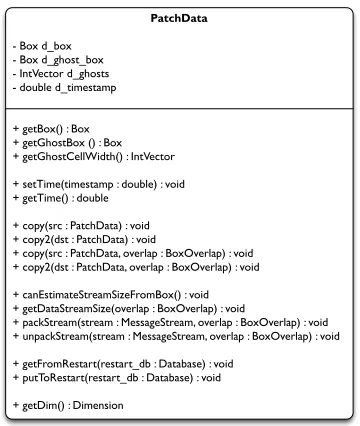
1) PatchData Interface: The PatchData interface de-fines the operations a class must provide to allow SAM-RAI to gather data from the patch in order to transfer it to other patches in the hierarchy. The functions that the
PatchData routines must perform include copying data
from one PatchDataobject to another, packing the data
corresponding to a given region of the patch into a buffer, and unpacking data from a buffer into a given patch region.
These methods are the key points of the PatchData
interface that we implement. By allowing an application to fully control data management, SAMRAI is easy to use in an existing application. In the case of our GPU-based
extensions, the abstraction provided by the PatchData
interface is at the perfect level to let us store simulation data in the GPU memory at all times and only copy data across the PCI bus when necessary. Figure 2 documents the fullPatchDatainterface.
2) CudaPatchData Libray: The CudaPatchData library
we have developed contains two packages: pdat, which
PatchData
- Box d_box - Box d_ghost_box - IntVector d_ghosts - double d_timestamp
+ getBox() : Box + getGhostBox () : Box + getGhostCellWidth() : IntVector
+ setTime(timestamp : double) : void + getTime() : double
+ copy(src : PatchData) : void + copy2(dst : PatchData) : void
+ copy(src : PatchData, overlap : BoxOverlap) : void + copy2(dst : PatchData, overlap : BoxOverlap) : void
+ canEstimateStreamSizeFromBox() : void + getDataStreamSize(overlap : BoxOverlap) : void
+ packStream(stream : MessageStream, overlap : BoxOverlap) : void + unpackStream(stream : MessageStream, overlap : BoxOverlap) : void
+ getFromRestart(restart_db : Database) : void + putToRestart(restart_db : Database) : void
[image:6.612.319.556.70.235.2]+ getDim() : Dimension
Figure 2: The SAMRAI PatchData inteface.
CudaArrayData
double* d_cuda_buffer;
CudaCellData
CudaArrayData* d_array_data;
CudaNodeData
CudaArrayData* d_array_data;
CudaSideData
CudaArrayData* d_array_data;
[image:6.612.86.266.71.284.2]PatchData
Figure 3: The SAMRAI CudaPatchData data-types.
managing data in GPU memory; andgeom, which provides
a collection of coarsen and refine routines that are essential when copying data between patches at different levels of the hierarchy.
The three different PatchData implementations are
specialised for the three data-centrings required for the hydrodynamics scheme implemented in CleverLeaf. The
common data store for each class is theCudaArrayData
object. This class is responsible for allocating a contiguous array of data in GPU memory, corresponding to a given box size. This class also contains data-parallel routines to copy data, pack a region of the array into a buffer, and unpack a buffer into a region of the array. Each data-centring passes
a slightly different Box to the CudaArrayData object
it owns, ensuring the necessary data is stored. The three centrings required for CleverLeaf are: cell-centred, node-centred, and side-centred. Figure 3 shows the design of each class, as well as the data that each stores.
double* cuda_stream;
packStream()
(3,3) (4,4)
CudaArrayData
double* d_cuda_buffer;
CudaCellData
CudaArrayData* d_array_data;
T2
[image:6.612.57.296.337.457.2]T0 T1 T3
Figure 4: Data-parallel buffer packing for MPI operations.
During an AMR simulation, boundary conditions can be filled using the physical boundary conditions, with data from a neighbouring patch on the same level, or with data from a patch on the next coarser level. Filling the boundary cells with the physical boundary conditions is handled by the application, and requires no additional features to be added to our library. When data must be transferred between two patches at the same level of refinement, a copy routine is used. If the two patches involved in the copy operation are located on different nodes the required data must be packed and transferred using MPI. Supporting large parallel architectures is essential for any modern scientific code, and by including the necessary routines in our library we can use MPI to run on multiple GPUs.
The data-parallel copy and packing operators use the same
general design. Each operation will receive aBoxas one of
its parameters. This box describes the region of the patch that needs to be operated on. In all cases, the size of this box controls the number of CUDA threads that will be launched. Each thread will then be responsible for copying, packing, or unpacking one array element.
In the case of the pack and unpack methods, we provide CUDA kernels to pack data from the required region into a contiguous buffer in GPU memory. This buffer is then copied to the host memory and passed to SAMRAI, which handles the MPI communications. To unpack received data, the buffer is copied into the GPU memory and then unpacked in parallel using another CUDA kernel. Once the data has been
transferred, a newPatchDataobject is created locally and
the copy operators described previously can be used to fill the boundary cells on the receiving processor. We launch one CUDA thread per element to be packed into the buffer, ensuring the maximum amount of parallelism is exposed. As an example, Figure 4 shows how the overlapping region is copied into the contiguous buffer in parallel.
The routines described by thePatchDatainterface are
level of refinement. However, to transfer data between ob-jects at different refinement levels, we must use a refinement operator or a coarsen operator. These operators interpolate the data to fill the differing number of cells on the receiving level. In SAMRAI, these operations are handled by two
interfaces: CoarsenOperator andRefineOperator;
that provide the necessary methods for coarsening or refining
data. To allow theCudaPatchDataclasses to be used in
an AMR simulation, we must provide operators to coarsen and refine data resident in GPU memory between different levels of the hierarchy.
The four operators we provide for coarsening and refining are fully data-parallel. As with the copy, pack, and un-pack routines, each method executes using multiple CUDA threads. These are, to the best of our knowledge, the first data-parallel implementations for each of these operators. As an illustrative example, we consider linear interpolation for node-centred data. The code listing for our data-parallel algorithm is shown in Figure 5. In a typical implementation, data dependencies exist between temporary variables in different loop iterations and the algorithm is not immediately amenable to the data-parallel programming model of a GPU. Through substitutions and some operation re-ordering, we remove these dependencies and develop an algorithm that is fully data-parallel. When this kernel is launched to refine some region of data, one CUDA thread can be used per fine node, offering massive parallelism. We also provide conservative linear refine operators for the cell- and side-centred data, as well as a node-side-centred injection operator.
Together, the pdat and geom packages provide all the
necessary components for a block-structured AMR sim-ulation to be solved on a GPU, all that the user code must provide is a black-box integrator that can advance the simulation on a single patch.
C. Adding GPU Support to CleverLeaf
We have used the GPU-based SAMRAI extensions de-scribed so far port the CleverLeaf mini-app to GPUs. The original version of CleverLeaf is a CPU-based code, which extends the CloverLeaf mini-app by adding AMR. CloverLeaf is a 2D explicit hydrodynamics mini-app that solves Euler’s equations on a structured grid [28–30]. Both CloverLeaf and CleverLeaf are available for download as part of the award-winning Mantevo suite [31].
CleverLeaf uses a single class to control the integration of the numerical solution on a patch. This class functions as a black box, and the remaining routines written to advance the simulation on the mesh hierarchy can remain unchanged even when a new programming model is used.
To develop the GPU-based version of CleverLeaf, we created a new patch integrator class that contains the code specific to advancing the solution on a single patch on a
GPU. All references to the CPU-basedPatchDataobjects
provided by SAMRAI were replaced with references to the
const intnblocks = (fine_box_size + BLOCK_SIZE - 1)/BLOCK_SIZE;
constint2 ratio = make_int2(ratio_vector[0], ratio_vector[1]);
cudaEvent_t fine_kernel;
cudaStreamSynchronize(coarse_stream);
cartcudanodelinrefine2d_kernel
<<<nblocks, BLOCK_SIZE, 0, fine_stream>>>( coarse_data,
coarse_data_offset, coarse_data_width, fine_data, fine_data_offset, fine_data_width, fine_box_width, fine_box_height, ratio);
cudaEventCreate(&fine_kernel);
cudaEventRecord(fine_kernel, fine_stream); cudaStreamWaitEvent(coarse_stream, fine_kernel, 0);
(a) Host C++ code for launching the data-parallel linear refine kernel.
if(column < fine_box_width && row < fine_box_height) {
const doublerealrat0 = 1.0/static_cast<double>(ratio.x);
const doublerealrat1 = 1.0/static_cast<double>(ratio.y);
const intic0 = floor(column/static_cast<double>(ratio.x));
const intic1 = floor(row/static_cast<double>(ratio.y));
const intir0 = column - (ic0*ratio.x);
const intir1 = row - (ic1*ratio.y);
const doublex = ir0*realrat0;
const doubley = ir1*realrat1;
const intcoarse_index = (coarse_data_offset+ic0) + (ic1*coarse_data_width);
arrayf[fine_index] = (arrayc[coarse_index]*(1.0-x) + arrayc[coarse_index+1]*x)
*(1.0-y) + (arrayc[coarse_index+coarse_data_width]*(1.0-x) + arrayc[coarse_index+1+coarse_data_width]*x)*y; }
[image:7.612.322.549.455.582.2](b) Data-parallel CUDA linear refine kernel for node-centred data.
Figure 5: Host and device code for data-parallel node-centred linear refine.
CleverLeaf
LagrangianEulerianIntegrator
LagrangianEulerianLevel Integrator
Cleverleaf
main Create and compose simulation objects
Manage adaptive hierarchy and advance simulation
Advance simulation on a single level
Advance simulation on a single patch using appropriate physics kernels
Cudaleaf
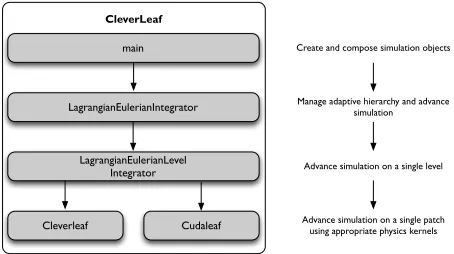
Figure 6: Flexible CPU and GPU implementation in Clev-erLeaf.
GPU-basedCudaPatchDataobjects we have developed.
We advance the simulation by passing a pointer to the data from these objects to CUDA kernels functions. Figure Figure 6 shows how the two patch integrator classes are driven by the top level algorithm.
management continues to be provided by the
LagrangianEulerianIntegrator and
LagrangianEulerianLevelIntegrator classes using SAMRAI’s various packages. This code is identical to the CPU-based version of the mini-app, and observing
and implementing thePatchDatainterface meant that no
additional changes were needed to allow CleverLeaf to run on GPUs.
To support adaptive simulation of Euler’s equations on NVIDIA GPUs, we require three additional routines to allow data-parallel execution on GPU hardware. These routines are used to flag cells for refinement, and coarsen data between two levels in two specific ways: mass-weighted and volume-weighted.
Evaluating the tagging heuristic at each mesh cell is triv-ially parallel. Since the heuristic does not update any mesh data, and since each point can be calculated independent of any other, the routine can evaluate each point in the patch using a separate CUDA thread. However, once cells have been flagged for refinement, they must be transferred to the host memory to allow SAMRAI to construct the updated mesh hierarchy.
To transfer the data, we compress the array of tags (stored
as ints) to an array of bits, where a 1 represents a flag,
and 0 represents no flag. This compression minimises the amount of data that must be transferred, and is particularly important when a patch is large. Additionally, we store a
taggedflag for each patch. If no cells in a patch are flagged for refinement then we don’t copy data, since re-creating the appropriate data in the host memory is trivial.
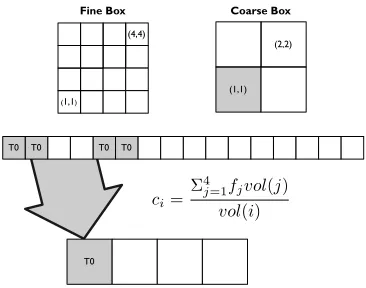
Volume- and mass-weighted coarsen operations are essen-tial in hydrodynamics simulations using AMR because they ensure that the quantities being simulated are conserved. To the best of our knowledge, we present the first implementa-tion of these data-parallel operators. Each coarsen operator follows the same general pattern, with one CUDA thread being launched for every coarse value that needs to be filled. This thread then reads the relevant fine values and performs the necessary mathematical operations to calculate the coarse value. Figure 7 shows this operation for the volume-weighted coarsen schematically, and the algorithm we use is presented in Figure 8.
Combining the CudaPatchData classes and the
rou-tines described in this section allows CleverLeaf to simulate Euler’s equations natively in GPU memory. Simulation data is stored in global memory at all times, and the relevant regions of data are copied to the host memory in three sit-uations: regridding, boundary updates, and synchronisation.
V. PERFORMANCEANALYSIS
To asses the performance and scalability of our imple-mentation we performed a series of experiments using two different architectures: the IPA testbed machine at Lawrence Livermore National Laboratory and the Titan supercomputer
Fine Box
(1,1)
(4,4)
Coarse Box
(1,1) (2,2)
T0
T0 T0 T0
T0
ci=
⌃4
j=1fjvol(j)
[image:8.612.345.528.72.216.2]vol(i)
Figure 7: Data-parallel volume-weighted coarsen operator.
const intglobal_index = blockDim.x * blockIdx.x + threadIdx.x;
const intcoarse_row = global_index / box_width;
const intcoarse_column = global_index % box_width;
const intfine_row = coarse_row*row_ratio;
const intfine_column = coarse_column*column_ratio;
const intcoarse_index = (coarse_data_offset + coarse_column) + (coarse_row * coarse_data_width);
const intfine_index = (fine_data_offset + fine_column) + (fine_row * fine_data_width);
if(coarse_row < box_height && coarse_column < box_width) {
doublespv = 0.0;
for(intj = 0; j < row_ratio; j++) {
for(inti = 0; i < column_ratio; i++) {
const intcurrent_fine_index = fine_index + i + (j * fine_data_width);
spv += fine_data[current_fine_index]*Vf; }
}
coarse_data[coarse_index] = spv/Vc; }
Figure 8: Code listing for the data-parallel volume-weighted coarsen kernel.
at Oak Ridge National Laboratory. The hardware and soft-ware configuration of each platform is detailed in Table I. The experiments use a range of problem sizes and node counts, and are designed to test both serial performance and parallel scalability.
IPA Titan
Processor Intel Xeon E5-2670 AMD Opteron 6274
Clock 2.6 GHz 2.2 GHz
Accelerator NVIDIA Tesla K20x NVIDIA Tesla K20x
PCI gen
Nodes 8 18,688
CPUs/node 2×8cores 1×16cores
GPUs/node 2 1
CPU RAM/node 128 Gb 32 Gb
GPU RAM/node 6 Gb 6 Gb
Interconnect Mellanox FDR Infiniband Cray Gemini
Compiler Intel 13.1.163 Intel 13.1.3.192
MPI MVAPICH 1.9 Cray MPT
[image:8.612.328.543.564.686.2]CUDA Version 5.5 5.5
3125 200000 6400000
10.62 200 400 600 800 940.47
Resolution (coarse zones)
Runtime
(s) NVIDIA K20x
[image:9.612.58.292.74.167.2]Intel E5-2670
Figure 9: Serial performance.
A. Serial
[image:9.612.333.538.74.172.2]Our first study compares a single NVIDIA Kepler K20x to one node (16 cores) of dual-socket Intel Xeon E5–2670 “Sandy Bridge” running at 2.6GHz. We use the Sod problem described previously and run 1000 timesteps at a range of coarse resolutions from 3 thousand to over 6 million zones, using 3 levels of refinement and a refinement ratio of 2. Figure 9 contains the results of this experiment. At small problem sizes the GPU and CPU performance are similar, and in all cases less than 200,000 cells the performance
of the GPU is an average of 1.6× slower than the CPU.
However, at large problem sizes, we see a performance
improvement of up to 2.67×. The average speedup of the
GPU on problem sizes 200,000 cells and over is1.99×This
performance improvement at larger problem sizes is typical of the throughput-oriented GPU architecture.
B. Parallel
The second performance experiment investigates the scal-ability of our code as the number of GPUs is increased from 2 to 16 (1 to 8 nodes), we also include equivalent results for the CPU-based code. The experiment is a strong-scaling study, where the problem size remains constant as the number of GPUs (or nodes) is increased. We use the 6.4 million zone problem and run for 1000 timesteps. The results of this experiment are detailed in Figure 10, and for all node counts, the performance of the GPU-based code is better than the GPU-based code. For a single node, with two GPUs
compared against two CPUs (16 cores), the GPUs are4.87×
faster. At eight nodes (16 GPUs vs. 128 cores) the
GPU-based code is still1.92×faster. We attribute this reduction
in performance to the data transfer required during the boundary exchanges and the regridding phase beginning to dominate the simulation runtime; a consequence of running our experiment as a strong-scaling study and the effects of Amdahl’s law. Since the parallel region of the code is so small, runtime is dominated by the serial fraction and as additional GPUs are added, the parallel region represents only a small portion of overall runtime compared to the serial regions of the code [32].
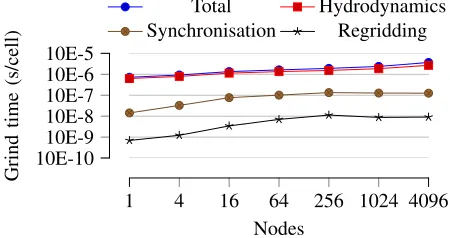
Our third experiment investigates the performance of our code at large scale, running on over 4 thousand GPUs on
1 2 4 8
67.2 150 400 938
Nodes
Runtime
(s)
NVIDIA K20x Intel E5-2670
Figure 10: Strong-scaling parallel performance.
1 4 16 64 256 1024 4096
10E-10 10E-9 10E-8 10E-7 10E-6 10E-5
Nodes
Grind
time
(s/cell)
Total Hydrodynamics
Synchronisation Regridding
Figure 11: Weak-scaling performance analysis on Titan.
the Titan system at Oak Ridge National Laboratory. This experiment is a weak-scaling study, where the problem size is increased as the number of GPUs is increased. In theory, this means that each GPU will have a constant amount of work, and any costs associated with using an increasing number of nodes will be highlighted. We use a modified version of the triple point shock interaction problem presented in [33]. A rectangular domain is split into three regions, and as the simulation progresses from its initial state a strong shock travels from left to right. This shock generates a large amount of vorticity and creates a complex area of interest, with a large number of patches moving throughout the simulation domain.
[image:9.612.323.548.211.330.2]com-prise only a fraction of the overall runtime.
Specifically, at 4,096 nodes 44% of the runtime is spent advancing the simulation; this includes the hydrodynamics kernels and boundary exchanges. Calculating the timestep, which contains the only global reduction operation consumes 6% of the runtime. Synchronising fine data to the coarser levels takes an average of 3% of the runtime. In contrast, on a single node 59% of the runtime is spent advancing the simulation, with only 1% of time spent synchronising levels, and less than 1% calculating the global timestep. In both cases the time taken to fill boundaries remains roughly the same.
VI. CONCLUSIONS ANDFUTUREWORK
In this paper we have described our GPU-based AMR package, and shown how it can be used in a shock hydrody-namics mini-application. Using the object-oriented design of the SAMRAI library we developed a set of classes that allocate and manipulate patch-based data on the GPU.
Our implementation is resident, with data located in GPU
memory at all times, and we provide the routines necessary for transferring data between GPUs on different nodes, and coarsening and refining data in parallel on the GPU. The novelty of this work lies in the fact that our implementation is resident, and that we have developed the first fully data-parallel versions of a range of coarsen and refine operators. We have compared the performance and scalability of our based code to the existing CPU-based code. The
GPU-based code is up to4.87×faster than the CPU-based code.
Finally, we have demonstrated scalability on up to 4096 GPUs on the Titan system at Oak Ridge National Laboratory. In future work, we plan to investigate ways to mitigate the performance impact of copying data between the GPU and host memory by overlapping data transfer and computation. We also plan to investigate mechanisms to allow efficient use of the CPU and GPU memory simultaneously, such as allowing patches to be “spilled” into CPU memory and then be transferred back to the device when necessary. Using both CPU and GPU resources will allow larger problems to be solved and increase the relevance of our implementation to production codes.
ACKNOWLEDGMENT
This work is supported in part by The Royal Society through their Industry Fellowship Scheme (IF090020/AM) and by the UK Atomic Weapons Establishment under grants CDK0660 (The Production of Predictive Models for Future Computing Requirements) and CDK0724 (AWE Technical Outreach Programme).
The research presented in this work has made use of the resources at Lawrence Livermore National Laboratory, which is supported by the U.S. Department of Energy under Contract No. DE-AC52-07NA27344, and the resources of the Oak Ridge Leadership Facility at the Oak Ridge National
Laboratory, which is supported by the Office of Science of the U.S.B Department of Energy under Contract No. DE-AC05-00OR22725.
REFERENCES
[1] M. J. Berger and J. Oliger, “Adaptive Mesh Refinement
for Hyperbolic Partial Differential Equations,”Journal
of Computational Physics, vol. 53, no. 3, pp. 484–512, Mar. 1984.
[2] M. J. Berger and P. Colella, “Local Adaptive Mesh
Refinement for Shock Hydrodynamics,” Journal of
Computational Physics, vol. 82, no. 1, pp. 64–84, May 1989.
[3] J. A. Anderson, E. Jankowski, T. L. Grubb, M. Engel, and S. C. Glotzer, “Journal of Computational Physics,”
Journal of Computational Physics, vol. 254, no. C, pp. 27–38, Dec. 2013.
[4] P. Wang, T. Abel, and R. Kaehler, “Adaptive mesh fluid
simulations on GPU,”New Astronomy, vol. 15, no. 7,
pp. 581–589, Oct. 2010.
[5] J. D. Owens, M. Houston, D. Luebke, S. Green, J. E.
Stone, and J. C. Phillips, “GPU Computing,”
Proceed-ings of the IEEE, vol. 96, no. 5, pp. 879–899, May 2008.
[6] M. L. Sætra, A. R. Bordtkorb, and K.-A. Lie, “Efficient GPU-Implementation of Adaptive Mesh Refinement
for the Shallow-Water Equations,”Journal of Scientific
Computing, Jul. 2014.
[7] Q. Meng, A. Humphrey, J. Schmidt, and M. Berzins, “Investigating Applications Portability with the Uintah DAG-based Runtime System on PetaScale
Supercom-puters,” in Proceedings of the 24th ACM/IEEE
Inter-national Conference on Supercomputing, Nov. 2013. [8] Lawrence Livermore National Laboratory. (2014,
May) SAMRAI Overview. [Online]. Available: http: //computation.llnl.gov/casc/SAMRAI/
[9] R. W. Anderson, N. S. Elliott, and R. B. Pember, “An arbitrary Lagrangian–Eulerian method with adaptive mesh refinement for the solution of the Euler
equa-tions,” Journal of Computational Physics, vol. 199,
no. 2, pp. 598–617, Sep. 2004.
[10] M. A. Heroux, D. W. Doerfler, P. S. Crozier, J. M. Willenbring, H. C. Edwards, A. Williams, M. Rajan, E. R. Keiter, H. K. Thornquist, and R. W. Num-rich, “Improving Performance via Mini-applications,” Sandia National Laboratories, Tech. Rep. SAND2009-5574, Sep. 2009.
[11] B. Fryxell, K. Olson, P. Ricker, F. Timmes, M. Zingale, D. Lamb, P. MacNeice, R. Rosner, J. Truran, and H. Tufo, “FLASH: An Adaptive Mesh Hydrodynam-ics Code for Modeling Astrophysical Thermonuclear
Flashes,”The Astrophysical Journal Supplement Series,
[12] J. Quirk, “A parallel adaptive grid algorithm for
com-putational shock hydrodynamics,” Applied Numerical
Mathematics, vol. 20, no. 4, pp. 427–453, Apr. 1996. [13] G. Bryan, “Fluids in the Universe: Adaptive Mesh
Refinement in Cosmology,” Computing in Science &
Engineering, vol. 1, no. 2, pp. 46–53, Apr. 1999. [14] C. Gheller, P. Wang, F. Vazza, and R. Teyssier,
“Numer-ical cosmology on the GPU with Enzo and Ramses,”
arXiv.org, Dec. 2014.
[15] J. K. Holmen and D. L. Foster, “Accelerating Sin-gle Iteration Performance of CUDA-Based 3D
Reac-tion–Diffusion Simulations,” International Journal of
Parallel Programming, May 2013.
[16] Z. H. Ma, H. Wang, and S. H. Pu, “GPU computing of compressible flow problems by a meshless method
with space-filling curves,” Journal of Computational
Physics, vol. 263, no. C, pp. 113–135, Apr. 2014. [17] B. P. Rybakin, L. I. Stamov, and E. V. Egorova,
“Accelerated Solution of Problems of Combustion Gas
Dynamics on GPUs,” Computers & Fluids, pp. 1–18,
Nov. 2013.
[18] C. Burstedde, O. Ghattas, M. Gurnis, T. Isaac, G. Stadler, T. Warburton, and L. C. Wilcox,
“Extreme-Scale AMR,” in Proceedings of the 22nd IEEE/ACM
International Conference on Supercomputing, Nov. 2010.
[19] H.-Y. Schive, Y.-C. Tsai, and T. Chiueh, “GAMER: A graphic processing unit accelerated
adaptive-mesh-refinement code for astrophysics,” The Astrophysical
Journal Supplement Series, vol. 186, no. 2, pp. 457– 484, Feb. 2010.
[20] A. Humphrey, Q. Meng, M. Berzins, and T. Harman, “Radiation modeling using the Uintah heterogeneous
CPU/GPU runtime system,” in Proceedings of the 1st
Conference of the Extreme Science and Engineering Discovery Environment, Jul. 2012.
[21] D. Nicholaeff, N. Davis, D. Trujillo, and R. W. Robey, “Cell-Based Adaptive Mesh Refinement Implemented with General Purpose Graphics Processing Units,” Los Alamos National Laboratory, Tech. Rep. LA-UR-11-07127, Mar. 2012.
[22] NVIDIA Corporation. Parallel Programming and
Computing Platform — CUDA — NVIDIA. [Online]. Available: http://www.nvidia.com/object/cuda home new.html
[23] The Khronos Group Inc. OpenCL - The open standard for parallel programming of heterogeneous systems. [Online]. Available: http://www.khronos.org/opencl/ [24] OpenACC.org. OpenACC Home — openacc.org.
[Online]. Available: http://www.openacc.org
[25] OpenMP Architecture Review Board, “OpenMP Ap-plication Program Interface,” Tech. Rep., Jul. 2013. [26] R. D. Hornung and S. R. Kohn, “Managing application
complexity in the SAMRAI object-oriented
frame-work,” Concurrency and Computation: Practice &
Experience, vol. 14, no. 5, pp. 347–368, Apr. 2002.
[27] J. Vlissides, R. Helm, R. Johnson, and E. Gamma,
De-sign Patterns: Elements of Reusable Object-Oriented Software. Addison-Wesley, 1995.
[28] J. A. Herdman, W. P. Gaudin, S. McIntosh-Smith, M. Boulton, D. A. Beckingsale, A. C. Mallinson, and S. A. Jarvis, “Accelerating Hydrocodes with
Ope-nACC, OpeCL and CUDA,” inProceedings of the 24th
IEEE/ACM International Conference on
Supercomput-ing, Nov. 2012, pp. 465–471.
[29] A. C. Mallinson, D. A. Beckingsale, W. P. Gaudin, J. A. Herdman, and S. A. Jarvis, “Towards Portable Performance for Explicit Hydrodynamics Codes,” in
Proceedings of the 1st International Workshop on OpenCL, May 2013.
[30] A. C. Mallinson, D. A. Beckingsale, W. P. Gaudin, J. A. Herdman, J. M. Levesque, and S. A. Jarvis, “Clover-Leaf: Preparing Hydrodynamics Codes for Exascale,” inProceedings of the Cray User Group, May 2013. [31] Mantevo.org. Mantevo - Home. [Online]. Available:
http://mantevo.org
[32] G. M. Amdahl, “Validity of the single processor ap-proach to achieving large scale computing capabilities,” in Proceedings of the AFIPS Spring Joint Computer Conference, Apr. 1967, pp. 483–485.
[33] S. Galera, P.-H. Maire, and J. Breil, “A two-dimensional unstructured cell-centered multi-material ALE scheme using VOF interface reconstruction,”