Original citation:
Chaplin, Adrian B. (2014) Rhodium(I) complexes of the conformationally rigid IBioxMe4Ligand: preparation of mono-, bis-, and tris-ligated NHC complexes. Organometallics, 33 (12). pp. 3069-3077.
Permanent WRAP URL:
http://wrap.warwick.ac.uk/65623
Copyright and reuse:
The Warwick Research Archive Portal (WRAP) makes this work by researchers of the University of Warwick available open access under the following conditions. Copyright © and all moral rights to the version of the paper presented here belong to the individual author(s) and/or other copyright owners. To the extent reasonable and practicable the material made available in WRAP has been checked for eligibility before being made available.
Copies of full items can be used for personal research or study, educational, or not-for profit purposes without prior permission or charge. Provided that the authors, title and full bibliographic details are credited, a hyperlink and/or URL is given for the original metadata page and the content is not changed in any way.
Publisher’s statement:
This document is the Accepted Manuscript version of a Published Work that appeared in final form in Organometallics, copyright © American Chemical Society after peer review and technical editing by the publisher.
To access the final edited and published work see:
http://dx.doi.org/10.1021/om500332n
A note on versions:
The version presented here may differ from the published version or, version of record, if you wish to cite this item you are advised to consult the publisher’s version. Please see the ‘permanent WRAP URL’ above for details on accessing the published version and note that access may require a subscription.
Revised manuscript om-2014-00332n
Rhodium(I) Complexes of the Conformationally Rigid IBioxMe4 Ligand: Preparation
of Mono-, Bis- and Tris-Ligated NHC Complexes
Adrian B. Chaplin
Department of Chemistry, University of Warwick, Gibbet Hill Road, Coventry CV4 7AL, UK.
Email: [email protected]
Abstract
The preparation and characterisation of a series of mono-, bis- and tris-ligated rhodium(I) complexes of Glorius’ conformationally rigid bioxazoline derived N-heterocyclic carbene ligand IBioxMe4 are described.
Through reaction of [Rh(COE)2Cl]2 (COE = cis-cyclooctene) with isolated IBioxMe4, [Rh(IBioxMe4)(COE)Cl]2
(1), trans-[Rh(IBioxMe4)2(COE)Cl] (2) and [Rh(IBioxMe4)3Cl] (3) were each isolated by careful choice of the
reaction conditions. Further substitution and salt metathesis reactions of 1 – 3 were investigated and derivatives containing CO, norbornadiene and cyclopentadienyl ancillary ligands were readily isolated. Notably, halide abstraction from 2 and 3 using Na[BArF
4] (ArF = 3,5-C6H3(CF3)2) resulted in the formation of
low coordinate T-shaped cis-[Rh(IBioxMe4)2(COE)][BArF4] (9) and [Rh(IBioxMe4)3][BArF4] (11). The solid-state
structures of 2, 9 and 11 each feature IBioxMe4 ligands that bind unusually with tilted coordination
Introduction
With generally stronger σ-donating characteristics and orthogonal steric profiles to phosphine ligands, N -heterocyclic carbenes (NHCs) have quickly emerged as a powerful class of carbon-based ligand in organometallic chemistry and catalysis.1 While in the majority of applications spectator roles are intended,
intramolecular C(sp3)–H bond activation reactions of coordinated NHC ligands are increasingly being
observed when partnered with reactive late transition metal fragments.2 Examples include activation of the N-aryl and alkyl substituents of common NHC ligands: 1,3-diisopropyl-4,5-dimethylimidazol-2-ylidene (IiPr
2Me2), 1,3-bis-tert-butylimidazol-2-ylidene (ItBu), bis-mesitylimidazol-2-ylidene (IMes), and
1,3-bis(2,6-diisopropylphenyl)-imidazol-2-ylidene (IPr), amongst others (Chart 1). 3,4,5,6,7 The IMes ligand has
even been shown to support double cyclometalation8 and subsequent reactivity of NHC-based
metallocycles can lead to alkyl dehydrogenation.6a,7,9 However, although cyclometalation reactions are of
interest in their own right,10 they can represent unwanted and potentially detrimental reactivity
characteristics of NHC based metal complexes.
Chart 1: Cyclometalated NHC topologies.
Scheme 1: Hypothesised reactivity modulation.
Recognising that substituent flexibility, particularly rotation about N-aryl/alkyl bonds, is a key prerequisite for cyclometalation reactions of NHC ligands, conformationally rigid analogues were targeted as a means to attenuate such reactivity, whilst retaining the desirable electronic and steric properties of the ligand class. With such features in mind, bioxazoline-derived NHC ligands (IBiox) developed by Glorius and co-workers were identified from the literature.11, 12 IBiox ligands are particularly notable for their application in
palladium catalysed cross coupling reactions, although their coordination chemistry has not been widely explored. Given the structural similarity with IiPr
2Me2 and ItBu, the tetramethyl-substituted IBiox ligand,
IBioxMe4, was chosen for investigation (Scheme 1). With a view of contrasting the cyclometalation N
N
[M]
N N
[M] M = Ni, Rh, Ir, Pt
M = Fe, Ru, Co, Rh, Ir, Pt
N N
[M] M = Ir, Pt N
N
[M] M = Fe, Ru, Ir
N N
[M]
N N
[M] H
Rotation (ItBu)
N N
O O
[M]
Conformationally rigid IBioxMe4 ligand
Attenuated intramolecular C–H
processes observed by Nolan and others in rhodium complexes of ItBu,3,4 the coordination chemistry of
IBioxMe4 with rhodium was targeted and a range of mono-, bis- and tris-ligated derivatives are reported
herein. Some aspects of this chemistry were published as a communication (i.e. tris-NHC complexes 11 and
12).13
Results and discussion Synthesis of free carbene
The target imidazolium pro-ligand IBioxMe4.HOTf was synthesised in four steps, from commercially
available 2-amino-2-methyl-propanol and diethyloxalate, as previously described by Glorius and co-workers.11 The corresponding free carbene ligand was readily formed by reaction of the pro-ligand with the
strong hindered base K[N(SiMe3)2] in THF (Scheme 2).13 In this manner IBioxMe4 was isolated in 80% yield,
following removal of volatiles in vacuo and extraction with pentane, and stored under argon in a glove box. Satisfactory microanalyses were obtained and the free carbene was fully characterised in C6D6 solution by
NMR spectroscopy. C2v symmetry is observed in solution with the carbene resonance at 190.1 ppm, significantly downfield from the pro-ligand (112.4 ppm) and consistent with other systems.12b,14
Scheme 2: Preparation of IBioxMe4.
Reaction of IBioxMe4 with [Rh(COE)2Cl]2
Following the procedure of Nolan and co-workers,3 reaction of IBioxMe
4 with the rhodium(I) precursor
[Rh(COE)2Cl]2 (COE = cis-cyclooctene) in pentane resulted in the formation of dimeric chloro-bridged
rhodium(I) complex [Rh(IBioxMe4)(COE)Cl]2 1, which was isolated in good yield following recrystallisation
from benzene–heptane (66%, Scheme 3). Coordination of the COE and carbene ligands is confirmed by the observation of 13C doublet resonances at δ 60.4 (1JRhC = 17 Hz) and
δ 158.3 (1JRhC = 59 Hz), respectively, by
NMR spectroscopy. Likewise, coordinated alkene protons are observed at 2.97 ppm as an integral 2H multiplet in the 1H NMR spectrum. These data are in good agreement with those of the ItBu analogue (A)3
and related dimeric complexes [Rh(NHC)(H2C=CH2)Cl]2 (NHC = IMes, SIMes, IPr, SIPr, ItBu (B))15 previously
prepared by Crudden and co-workers.4
Scheme 3: Preparation of dimeric 1.
Isolated 1 is stable in solution, showing no apparent reaction after 7 days in C6D6 solution (293 K) by 1H
NMR spectroscopy. While A has also been reported to be stable in benzene solution,3 in the presence of N N
O O
N N
O O
H
K[N(SiMe3)2]
THF
IBioxMe4 OTf
[Rh(COE)2Cl]2 Rh
Cl Cl
Rh COE
NHC NHC
COE
NHC = ItBu (A), IBioxMe 4 (1)
excess ItBu sequential formation of monomeric cyclometalated derivatives C and D occurs; where these
complexes contain one and two cyclometalated ItBu ligands (ItBu’), respectively (Chart 2). Addition of
excess IBioxMe4 to isolated 1 in C6D6 similarly resulted in fragmentation of the chloride bridge. However,
instead of intramolecular activation of the NHC ligand, mixtures of the bis- and tris-NHC complexes trans -[Rh(IBioxMe4)2(COE)Cl] (2) and [Rh(IBioxMe4)3Cl] (3) were obtained; the later almost completely insoluble in
benzene (Scheme 4). Following this reaction in situ by NMR spectroscopy (C6D6, 293 K) revealed a
significant rate dependence on the concentration of the NHC ligand. With 4 equivalents IBioxMe4 the initial
rate for the disappearance of 1 was ca 3.7 × 10⁻⁶ mol·L-1s-1, which increased to ca 8.2 × 10⁻⁶ mol·L-1s-1 when
using 8 equivalents of the ligand. After 90% consumption of 1, the resulting ratios of 2:3 were 5.8 and 4.5, respectively. These data indicate approximate first order dependence on [IBioxMe4] and a faster rate of
formation for 2 relative to 3. Given that reaction between 2 and IBioxMe4 to give 3 is two orders of
magnitude slower than the reaction of 1 with IBioxMe4 (vide infra), the most plausible mechanism for this
reaction involves bifurcated (associative) ligand substitution chemistry of 1 (Scheme 4); a suggestion that invokes the presence of transient (unobserved) bis-NHC complex, cis-[Rh(IBioxMe4)2(COE)Cl] or
[Rh(IBioxMe4)2Cl]2, in the formation of 3. Throughout these in situ reactions no evidence for ligand
cyclometalation was observed supporting the hypothesised reactivity attenuation of the conformationally rigid ligand in comparison to ItBu. A feature of the IBioxMe
4 complexes further contrasted by the reported
reactivity of isolated B, which undergoes spontaneous intramolecular activation of the NHC ligand, resulting in formation of the rhodium(III) dimer [Rh(ItBu’)(CH
2CH3)Cl]2, C and metallic rhodium.4
Chart 2: Cyclometalated rhodium complexes of ItBu.
Scheme 4: Reaction of 1 with IBioxMe4.
Complexes 2 and 3 are most conveniently prepared by direct reaction between [Rh(COE)2Cl]2 and excess
IBioxMe4 (4.6 eqv.) in benzene and were obtained in this way with isolated yields of 47% and 24%
respectively; the insolubility of 3 enabled easy separation of the two complexes. The structures of 2 and 3 Rh
N N tBu tBu
N N
tBu
Cl H Rh
N N tBu N N tBu Cl D C 1 IBioxMe4 Slow Fast C6D6
IBioxMe4 IBioxMe4
N N O O Rh Cl 2 N N O O 3 N N O O Rh Cl N N O O N N O O
2 step reaction. Intermediate not
observed – COE
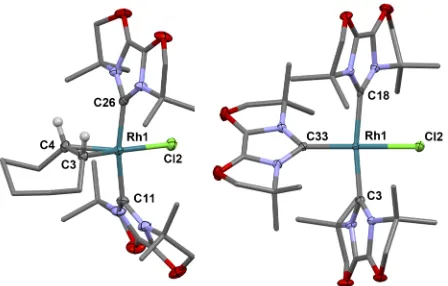
were determined by X-ray crystallography (Figure 1) and corroborated in solution by NMR spectroscopy. Both complexes adopt the expected square planar geometries, although for 2 (with two crystallographically independent, but structurally similar complexes) there is a significant degree of distortion: the C11-Rh1-C26 angle deviating from linearity (167.49(7)º; 167.47(7)º for Rh1A equivalent). Interestingly, one of the IBioxMe4 ligands binds unusually, pitching significantly out of plane as quantified by a non-linear NHC
centroid−CNCN−Rh angle (ΘNHC)16 of 156.50(14)º (164.72(13)º for Rh1A equivalent). Such large deviations
from planar coordination are rare in transition metal complexes,17,18 and notably more pronounced in 2 in
comparison to related [Rh(SIMes)(PPh3)(H2C=CH2)Cl] (ΘNHC = 170.5º)4, trans-[Rh(SIMes)2LCl] (L = N2, O2, CO
(E); ΘNHC = 177.4 – 178.5º)19 and trans-[Ir(NHC)
2(COE)Cl] (ΘNHC = 169.6 – 178.4º).20 This tilting is attributed to
steric interactions between the NHC and the coordinated COE ligands and born out through the presence of close {COE}CH2···H3C{IBioxMe4} contacts of ca 3.6 Å (sum of Van der Waal radii = 3.4 Å). Moreover in line
with this reasoning, essentially planar IBioxMe4 coordination is observed when COE is replaced with a less
bulky ancillary ligand (i.e. 7, vide infra). Complex 3 is an NHC analogue of Wilkinson’s catalyst, examples of which have been previously reported by Lappert et al.21 The IBioxMe
4 ligands twist in a helical fashion and
[image:6.595.187.411.372.515.2]all ΘNHC are greater than 175º in the solid-state structure of 3.
Figure 1: Solid-state structures of 2 (left) and 3 (right).Thermal ellipsoids for selected atoms are drawn at the 50% probability level; most hydrogen atoms are omitted for clarity; only one of the two independent molecules shown for each complex (Z’ = 2 for both 2 and 3). Selected bond lengths (Å) and angles(º): 2 – Rh1-Cl2, 2.4231(5); Rh1-C3, 2.125(2); Rh1-C4, 2.117(2); Rh1-C11, 2.100(2); Rh1-C26, 2.026(2); C3-C4, 1.411(3); Cl2-Rh1-Cnt(C3,C4), 175.10(2); C11-Rh1-C26, 167.49(7); ΘNHC(@C11), 156.50(14); ΘNHC(@C26), 172.98(13); ΘNHC(@C11A), 164.72(13); ΘNHC(@C26A), 170.1(2); 3 – Rh1-Cl2, 2.4224(14); Rh1-C3, 2.046(5); Rh1-C18, 2.060(5); Rh1-C33, 2.016(5); Cl2-Rh1-C33, 177.3(2); C3-Rh1-C18, 169.2(2); all ΘNHC > 175.
To establish if 2 is a kinetically relevant intermediate in the formation of 3 from 1, in situ NMR experiments were carried out involving reaction of 2 with excess IBioxMe4 (2 and 4 eqv.) in C6D6 (293 K). A slow reaction
was observed, involving substitution of the COE ligand independent of [IBioxMe4], with an initial rate for
the disappearance of 2 of ca 7.0 × 10⁻⁸ mol·L-1s-1 and approximate half-life of 82 h. These data suggest a
dissociative mechanism for the substitution of the COE ligand and clearly show the formation of 3 via 2 is not a kinetically relevant pathway in the reaction of dimeric 1 with IBioxMe4. Consistent with this
suggestion, isolated 2 slowly lost COE in solution (ca 15% decomposition after 24 h in C6D6 at 293 K).
identification so far.
Coordination chemistry of 1 – 3
Seeking to further explore the coordination chemistry of these rhodium(I) IBioxMe4 complexes,
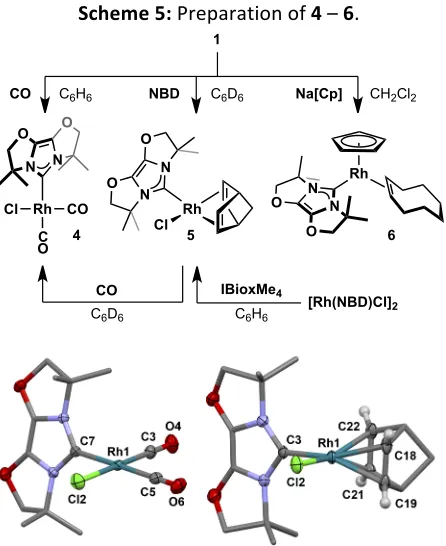
incorporation of other carbon based ancillary ligands was targeted. To this end, reactions of 1 with CO, norbornadiene (NBD) and Na[Cp] were investigated (Scheme 5). Under an atmosphere of CO, 1 was rapidly (< 10 min) and quantitatively (by NMR spectroscopy) converted to the bis-carbonyl complex cis -[Rh(IBioxMe4)(CO)2Cl] 4 (solid-state structure in Figure 2). Complexes of the formulation cis
-[M(NHC)(CO)2Cl] (M = Rh, Ir) have been widely used to probe the electronic and steric characteristics of
NHC ligands (Table 1).22 In particular, these complexes allow the determination of the Tolman electronic
parameter (TEP)23 for the NHC ligand from the carbonyl stretching frequencies of cis-[M(NHC)(CO) 2Cl],
avoiding the need to prepare toxic nickel adducts.24,25 Using this approach the calculated TEP for IBioxMe 4
using 4 (2053 cm-1) is in good agreement with that determined using the previously reported iridium
analogue cis-[Ir(IBioxMe4)(CO)2Cl] (2052 cm-1)11 and both are marginally larger in magnitude than those of
IiPr
2Me2 (2051 cm-1) and ItBu (2050 cm-1), inline with the presence of the electronegative oxygen
substituents. The steric characteristics of IBioxMe4 have also been quantified through measurement of it’s
percentage buried volume (%Vbur) using the solid-state structure of 4 for the relevant calculation.26,27 Steric
bulk increases in the order IiPr
2Me2 < IBioxMe4 < ItBu, with the %Vbur of IBioxMe4 (32.0) notably similar to
that of aryl substituted IMes (33.8)
[image:7.595.188.411.433.706.2]Scheme 5: Preparation of 4 – 6.
Figure 2: Solid-state structures of 4 (left) and 5 (right).Thermal ellipsoids for selected atoms are drawn at the 50% probability level; most hydrogen atoms are omitted for clarity. Selected bond lengths (Å) and angles(º): 4 – Rh1-Cl2, 2.3519(5); Rh1-C3, 1.830(2); Rh1-C5, 1.897(2); Rh1-C7, 2.069(2); ΘNHC(@C7), 178.97(13); 5 – Rh1-Cl2, 2.3642(15); Rh1-C3, 2.048(6); Rh1- C18, 2.197(6); Rh1-C19, 2.182(6); Rh1-C21, 2.098(6); Rh1-C22, 2.105(6); ΘNHC(@C3), 177.2(4).
N N
O O
Rh N N
O O
C Rh
Cl CO
O
Cl Rh N
N O
O
1
CO NBD Na[Cp]
4 5 6
C6H6 C6D6 CH2Cl2
CO
C6D6
IBioxMe4 C6H6
Table 1: Steric and electronic properties of NHC ligands derived from cis-[M(NHC)(CO)2Cl] M NHC ν(CO) [CH2Cl2] /cm-1 TEP [calc.]a (expt.) /cm-1 %Vbur b Ref. Rh IBioxMe4 2081 2000 2053 32.0 This work
Ir IBioxMe4 2066 1982 2052 - 11
Rh IiPr
2Me2 2076 1996 2051 28.0c 28
Ir ICyd 2065 1981
2051 (2050)29 28.1 25
Ir ItBu 2065 1980 2050 37.6 25
Ir IMes 2066 1980 2051 (2051)29 33.8 25
a Tolman electronic parameter calculated from regression using the average ν(CO) value.22bCalculated
using SambVca (sphere radius = 3.5, distance from centre of sphere = 2.0, mesh spacing = 0.5, hydrogens omitted, bondi radii scaled by 1.17).27cEstimated from X-ray structure of [Rh(IiPr
2Me2)(COD)(OH)].30 d ICy =
= 1,3-bis-cyclohexylimidazol-2-ylidene.
In comparison to the reaction with CO, the reaction between 1 and NBD to afford [Rh(IBioxMe4)(NBD)Cl] 5
occurred significantly slower, with an approximate half-life of 3.6 h. Indeed, 5 was more readily prepared by reaction of IBioxMe4 with the dimeric rhodium(I) precursor [Rh(NBD)Cl]2 (88% isolated yield). The
solid-state structure of 5 (Figure 2) resembles that of 4 and is otherwise unremarkable, as are NMR data. Placing
5 under an atmosphere of CO quantitatively afforded 4 (by NMR spectroscopy) alongside free NBD – therefore offering an alternative synthetic route to the bis-carbonyl compound (Scheme 5).
Cyclopentadienyl complex [Rh(IBioxMe4)(Cp)(COE)] (6) resulted from salt metathesis of 1 in CH2Cl2 using
Na[Cp] and was isolated in good yield (72%). Coordination of the hydrocarbon ligands are apparent by the presence of a 5H and 2H signals at δ 5.11 and 2.11 together with characteristic doublets in the 13C{1H} NMR
spectrum at δ 86.2 (1JRhC = 3 Hz) and 53.1 (1JRhC = 17 Hz) for the [Cp]– and COE ligands, respectively; the
carbene signal was observed at δ 159.7 (d, 1JRhC = 66 Hz). Surprisingly, few examples of non-chelating NHC rhodium(I) cyclopentadienyl complexes are known; [Rh(IMes)(C5R5)(H2C=CH2)] (R = H (F), Me) and
[Rh(SIMe)(Cp)(CO)] (SIMe = 1,3-bis-methylimidazolin-2-ylidene) being the only precedents.31 The NMR
characteristics of 6 are in agreement with those reported for F; δC5H5 84.7 (d, 1JRhC = 4 Hz), δC2H4 24.3 (d, 1JRhC
= 16 Hz) and δNCN 185.0 (1JRhC = 70 Hz).
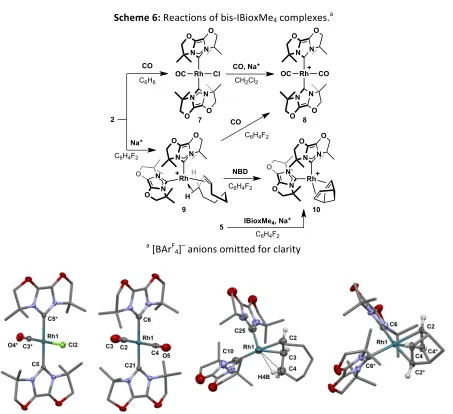
Reaction of bis-NHC 2 with carbon monoxide readily affords trans-[Rh(IBioxMe4)2(CO)Cl] 7, which can be
substituted further with carbon monoxide in the presence of Na[BArF
4] (ArF = 3,5-C6H3(CF3)2), as a halide
abstracting agent, to give the bis-carbonyl complex trans-[Rh(IBioxMe4)2(CO)2][BArF4] 8 (Scheme 6). The
structures of both carbonyl complexes were established through a combination of NMR and IR spectroscopy (C2v, 7; D2h, 8), alongside crystallographic characterisation (Figure 3). A more upfield 13C
resonance for the NHC (141.0 vs. 160.5 ppm), reduced carbonyl 1JRhC coupling constant (64 vs. 82 Hz) and
higher carbonyl stretching frequency (2024 vs. 1942 cm-1) are observed for 8 in comparison to 7, fully
consistent with the more electron deficient nature of the metal centre. While there are a number of examples of complexes of the formulation [Rh(NHC)2(CO)Cl] (e.g. E),5x,19, 28,32 there is only one non-chelating
Scheme 6: Reactions of bis-IBioxMe4 complexes.a
a [BArF
[image:9.595.74.527.46.460.2]4]– anions omitted for clarity
Figure 3: Solid-state structures of 7 – 10 (left to right).Thermal ellipsoids for selected atoms are drawn at the 50% probability level; most hydrogen atoms, minor disordered components, anions and solvent molecules are omitted for clarity; only one of the two independent molecules shown for 9 (Z’ = 2); symmetry operations -x,-y,-z (7) and 2-x,+y,3/2-z (10) were used to generate the started atoms. Selected bond lengths (Å) and angles(º): 7 – Rh1-Cl2, 2.386(2); Rh1-C3*, 1.807(6); Rh1-C5, 2.050(2); C5-Rh1-C5* 180.00; ΘNHC(@C5), 176.8(2); 8 – Rh1-C2, 1.910(3); Rh1-C4, 1.917(3); Rh1-C6, 2.063(2); Rh1-C21, 2.061(2); C6-Rh1-C21, 177.53(9); all ΘNHC(NHC) > 175; 9 – C2, 2.196(14); C3, 2.123(14); C4, 2.56(2); Rh1-C10, 2.099(14); Rh1-C25, 1.971(15); all other Rh1-C > 3.0; C10-Rh1-C25, 100.5(6); ΘNHC(@C10), 168(1);
ΘNHC(@C25), 178.5(12); Rh1A-C4A, 2.94(2); all other non-coordinated Rh1A-C > 3.0; ΘNHC(@C10A), 168.4(11); ΘNHC(@C25A), 177.8(13); 10 – Rh1-C2, 2.163(2); Rh1-C4, 2.159(2); Rh1-C6, 2.121(2); C6-Rh1-C6*, 101.51(9); ΘNHC(@C6), 173.05(12).
Targeting the preparation of a low-coordinate bis-NHC complex derivative, 2 was reacted with the halide abstracting agent Na[BArF
4] in difluorobenzene at reduced temperature (253 K). From this reaction, cationic
cis-[Rh(IBioxMe4)2(COE)][BArF4] 9 was isolated in good yield (71%). Formally a 14 valence electron complex,
formation of 9 was readily apparent by 1H NMR spectroscopy (250 K) by a 2H coordinated alkene resonance
centred at δ 3.97, which gave a strong HMQC cross-peak with a 13C signal at δ 76.3, 12H resonances for the
[BArF
4]– anion and two singlet signals (8H, 24H) for the IBioxMe4 ligands. The complex is thus highly
fluxional in solution (500 MHz). On the basis of the low stability of 9 (vide infra) and to reconcile the high time-averaged symmetry implicated from the IBioxMe4 proton resonances (D2h), a mechanism involving
N N O O Rh Cl OC N N O O N N O O Rh CO OC N N O O N N O O Rh N N O O N N O O Rh N N O O H H 2 + + + CO Na+
C6H6 CH2Cl2
C6H4F2 CO, Na+
C6H4F2
C6H4F2
NBD CO
7 8
9 10
IBioxMe4, Na+ 5
COE ligand dissociation is suggested. Cooling further to 200 K did not halt this process, although the onset of decoalescence was noted – particularly through resolution of inequivalent methylene signals for the NHC backbone (see ESI).
Subsequent to the NMR characterisation, a relatively low quality solid-state structure of 9 was determined, containing two crystallographically independent, but structurally similar molecules (Z’ = 2); one of which is shown in Figure 3. The refined structure unambiguously confirms coordination of the COE and IBioxMe4
ligands, with 9 adopting an overall T-shaped coordination geometry. The complex is stabilised by an agostic interaction with the COE ligand; a feature that is much more pronounced in one of the independent molecules (Rh1···C4 = 2.56(2) Å) than the other (Rh1A···C4A = 2.94(2) Å). Notably, the methyl substituents of the IBioxMe4 ligand remain distant from the metal centre, with the closest approaches having Rh···C
distances of 3.67(4) and 3.18(3) Å in the independent molecules (containing Rh1 and Rh1A, respectively). [Rh(PiBu
3)(PtBu2CH2CH2CH=CH2)]+ (G) 34 and [Rh{((2,6-Me2C6H3)NMeC)2CH}(L)] (L = norbornene (H), COE (I))35
are closely related rhodium(I) alkene complexes; G and H are stabilised by strong agostic interactions (Rh···C = 2.41 and 2.53 Å, respectively), while I is considered a genuinely low coordinate T-shaped complex with Rh···C distances of 2.89 and 2.97 Å. Consistent with the T-shaped formulation of 9, the NHC binding trans to the open coordination site does so with a significantly shorter Rh-CNCN bond distance (Rh1,
1.971(15) vs 2.099(14) Å; Rh1A, 1.921(17) vs 2.070(15) Å).
In both CD2Cl2 and difluorobenzene solution at 298 K, 9 undergoes decomposition via loss of COE although
this process is much faster in the former (t1/2 = 0.54 hrs vs. 6.6 hrs) presumably reflecting the differing coordinating ability of the two solvents; the resulting mixtures have so far proven intractable to further characterisation in either solvent. Complex 9 does, however, act as a source of the reactive {Rh(IBioxMe4)2}+
fragment in solution affording 8 and the diene complex [Rh(IBioxMe4)2(NBD)][BArF4] 10 quantitatively by
NMR spectroscopy on addition of carbon monoxide and NBD, respectively (Scheme 6). The formation of 10
was further verified by independent synthesis from 5, IBioxMe4 and Na[BArF4] and the solid-state structure
is shown in Figure 3.
Scheme 7: Reactions of tris-IBioxMe4 complexes.a
a [BArF
4]– anions omitted for clarity
+ + 11 N N O O Rh N N O O N N O O 12 N N O O Rh CO N N O O N N O O 3 Na +
CH2Cl2
CO
C6H4F2
IBioxMe4
9
C6H4F2
No reaction NBD
C6H4F2
[Rh(COE)2Cl]2
IBioxMe4, Na+
Encouraged by the formation of 9 from 2, reaction of tris-NHC complex 3 with Na[BArF
4] in CH2Cl2 at room
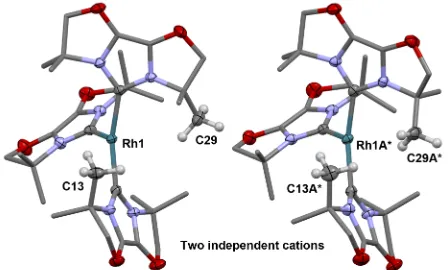
temperature led to the isolation of cationic formally 14 valence electron Rh(I) complex [Rh(IBioxMe4)3][BArF4] 11 in 65% yield (Scheme 7, Figure 4). Complex 11 can also be prepared as previously
described using a high yielding one-pot procedure involving reaction between [Rh(COE)2Cl]2 and IBioxMe4
in difluorobenzene, using Na[BArF
4] as a halide abstractor (83% isolated yield).13 In contrast to 9, the
tris-NHC complex was found to be completely stable in CD2Cl2 and difluorobenzene solution at room
temperature (over 48 hours under argon). This increased stability is readily accounted for by the stronger donor characteristics of IBioxMe4 in comparison to COE and confirmed by rapid COE substitution by
[image:11.595.186.410.260.395.2]IBioxMe4 on addition of the NHC to 9, forming 11 quantitatively by 1H NMR spectroscopy (Scheme 7).
Figure 4: Solid-state structures of 11 (Z’ = 2). Thermal ellipsoids for selected atoms are drawn at the 50% probability level; most hydrogen atoms, minor disordered components, anions and solvent molecule are omitted for clarity. Selected distances: Rh1-C13, 3.273(3); Rh1-C29, 3.574(3); C13A, 3.421(3); Rh1A-C29A, 3.191(3).13
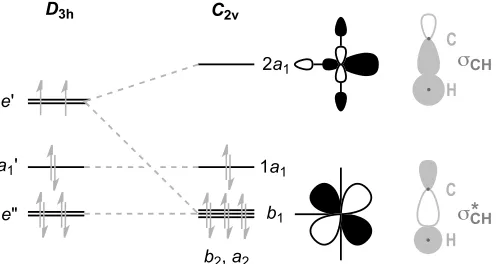
As noted by Reed reporting on the solid-state structure of [Rh(PPh3)3]+ (J), the adoption of a T-shaped
geometry is electronically favoured over trigonal planar for three coordinate d8 metal centres to allow for
diamagnetism (Figure 5).36 Moreover, T-shaped low-coordinate d8 metal fragments can be stabilised
through formation of agostic interactions with alkyl ligand appendages, due to the presence of accessible frontier orbitals of suitable symmetry and energy (i.e. b1 and 2a1). This facet is borne in the solid-state for rhodium(I) phosphine complexes G, H, J (Rh···C = 2.62 Å), [Rh(PiPr
3)3]+ (Rh···C = 2.49 Å), 37
[Rh(tBu
2PCH2PtBu2)(CH2tBu)] (Rh···C = 2.49 Å)38, as well as platinum(II) NHC and phosphine complexes
[Pt(IPr)(IPr’)]+ (Pt···C = 2.89 Å)6b and [Pt(PiPr
3)2(Me)]+ (Pt···C = 2.86 Å).39 As an additional interesting
example, phosphine-boryl-pincer complex [Rh{(PtBu
2CH2)2(BN2C6H4)}] adopts intermolecular σ-C–H bond
interactions between individual complexes in the absence of accessible alkyl groups.40 In the case of 11,
however, there is no evidence for any significant agostic interactions between the NHC ligands and the metal centre in both solution (highly fluxional at 298 K) and the solid-state (Rh···C distances for the methyl substituents > 3.1 Å).13 Thus, the rigid geometry of the IBioxMe
4 ligand appears to prohibit any significant
Figure 5: Frontier molecular orbitals for d8 metal centres in idealised trigonal planar and T-shaped
coordination geometries.41
Inspection of the IBioxMe4 coordination geometries in 9 and 11 reveals tilted binding for those cis to open
coordination sites: ΘNHC = 168(1) / 168.4(11)º for 9 and 160.0(2) − 173.1(2)º for 11.13 Given that related distortions observed in coordinatively saturated 2 can be confidently ascribed to steric effects, and taking into account the bulky nature of IBioxMe4 and the absence any significant Rh···H3C interactions (Rh···C ≥
3.18 Å and Rh···H ≥ 2.44 Å),42 it seems reasonable to similarly attribute the unusual NHC geometries in 9
and 11 to steric effects. Related phenomena in main group bis-NHC complexes of gallium and indium have been reported, with ΘNHCvalues ranging from 144.8 – 154.6º, and attributed to π-bonding interactions [s(M) to p(CNCN)].18a Contrasting with 11, all IBioxMe4 ligands in coordinatively saturated tris-NHC complexes 3 and 12 (vide infra) bind with and ΘNHC angles > 175º; steric interactions between the ancillary chloride/carbonyl ligand and the cis IBioxMe4 ligands counteracting NHC tilting (CH3···Cl = 3.38 – 3.72 Å cf.
sum of Van der Waal radii = 3.45 Å; CH3···OC = 3.35 – 3.76 Å cf. sum of Van der Waal radii = 3.40 Å).13
Likewise in the context of 9, only slight tilting is observed in 10, containing cis IBioxMe4 ligands (ΘNHC =
173.05(12)º).
As reported earlier, complex 11 shows no reaction with excess IBioxMe4, PCy3, or NBD, but reacts rapidly
with carbon monoxide to generate [Rh(IBioxMe4)3(CO)][BArF4], 12 (Scheme 7).13 Notably, the static C2v
structure observed for 12 in solution at room temperature (400 MHz) contrasts to previously reported tris-NHC complexes [Rh(tris-NHC)3(CO)]+ [NHC = IiPr2Me2, ICy], which undergo restricted rotation of the NHC
ligands (about Rh-CNCN) at room temperature (500 MHz).43 This difference in behaviour is presumably
attributed to the more imposing steric profile of IBioxMe4 compared to IiPr2Me2 and ICy; a feature
quantified by %Vbur values listed in Table 1 (ca 32 vs 28). Summary and Outlook
A series of new rhodium(I) complexes of Glorius’ conformationally rigid bioxazoline derived N-heterocyclic carbene ligand IBioxMe4 have been prepared. In contrast to non-rigid ItBu, complexes of IBioxMe4 appear
to be more resistant to cyclometalation reactions allowing the coordination of up to three NHC ligands to rhodium via the common (isolated) dimeric intermediate [Rh(IBioxMe4)(COE)Cl]2 (1); i.e. isolation of trans
-[Rh(IBioxMe4)2(COE)Cl] (2) and [Rh(IBioxMe4)3Cl] (3). Substitution and salt metathesis reactions of 1 – 3
were investigated and derivatives containing CO, norbornadiene and cyclopentadienyl ancillary ligands
e" a1' e'
1a1
b2, a2
2a1
C2v D3h
b1
C
H
C
H σCH
were readily isolated. In search of low-coordinate complexes of IBioxMe4, 2 and 3 were reacted with
Na[BArF
4] and led to the isolation of T-shaped cis-[Rh(IBioxMe4)2(COE)][BArF4] (9) and [Rh(IBioxMe4)3][BArF4]
(11). Although 9 exhibits low solution stability, readily losing COE at room temperature, 11 shows excellent stability. Using these complexes as pertinent examples, the rigid geometry of the IBioxMe4 ligand appears
to preclude interaction of the metal centre with the ligand’s alkyl appendages as hypothesised. The large steric profile of IBioxMe4 (%Vbur = 32.0) also leads to interesting tilted NHC coordination geometries (2, 9
and 11). The electronic structure and additional reactivity of these complexes is currently being investigated together with that of iridium analogues. These results will be reported in due course.
Experimental
General experimental methods
All manipulations were performed under an atmosphere of argon, using Schlenk and glove box techniques. Glassware was oven dried at 130ºC overnight and flamed under vacuum prior to use. Anhydrous C6H6,
CH2Cl2, heptane and pentane (<0.005 % H2O) were purchased from ACROS or Aldrich and
freeze-pump-thaw degassed three times before being placed under argon. C6D6, CD2Cl2 and 1,2-difluorobenzene (C6H4F2)
were dried over CaH2,vacuum distilled and the latter stored over thoroughly vacuum dried 3 Å molecular
sieves. Norbornadiene (NBD) was dried over Na, vacuum distilled and stored over thoroughly vacuum dried 3 Å molecular sieves. IBioxMe4.HOTf,11 [Rh(COE)2Cl]2,44 [Rh(NBD)Cl]245 Na[Cp]46and Na[BArF4]47 were
synthesised using literature procedures. All other solvents and reagents are commercial products and were used as received. NMR spectra were recorded on Bruker DPX-400, AV-400 and DRX-500 spectrometers at 298 K unless otherwise stated. Chemical shirts are quoted in ppm and coupling constants in Hz. IR spectra were recorded on a Perkin-Elmer Spectrum One FT-IR spectrometer. Microanalyses were performed by Stephan Boyer at London Metropolitan University.
Synthesis of new compounds
1.1 IBioxMe4
Prepared from IBioxMe4.HOTf as described in an earlier communication.13
1.2 [Rh(IBioxMe4)(COE)Cl]2 (1)
To a suspension of [Rh(COE)2Cl]2 (0.100 g, 0.14 mmol) in pentane (30 mL) was added a solution of IBioxMe4
(0.058 g, 0.28 mmol) in pentane (30 mL) drop-wise over 5 minutes. The resulting suspension was stirred at room temperature for 1 hour and then filtered. The filtrate was washed with pentane (2 × 10 mL) and the residue recrystallised from benzene – heptane. Yield = 0.085 g (66%, microcrystalline cream solid).
1H NMR (C
6D6, 400 MHz): δ 3.76 (d, 2JHH = 8.1, 2H, OCH2), 3.71 (d, 2JHH = 8.1, 2H, OCH2), 2.89 – 3.05 (m, 2H,
CH), 2.41 – 2.65 (m, 4H, CHCH2), 2.02 (s, 6H, CH3), 1.80 (s, 6H, CH3), 1.68 – 1.88 (m, 4H, CH2{COE}), 1.44 –
OCH2), 62.2 (s, C(CH3)2), 60.4 (d, 1JRhC = 17, CH), 31.2 (s, CH2{COE}), 30.4 (s, CHCH2), 27.5 (s, CH3), 27.2 (s,
CH2{COE}), 24.9 (s, CH3). Anal. Calcd for C38H60N4O4Rh2.0.66(C6H6) ([913.62] 965.18 gmol-1): C, 52.22; H,
6.68; N, 5.80. Found: C, 52.21; H, 6.91; N, 5.95. Reproducible microanalyical data were unable to be obtained between different batches of this product due the presence of variable benzene solvate (confirmed by dissolving in CD2Cl2). 1H and 13C{1H} NMR spectra are provided in the ESI.
1.3 [Rh(IBioxMe4)2(COE)Cl] (2) and [Rh(IBioxMe4)3Cl] (3)
To a solution of [Rh(COE)2Cl]2 (0.150 g, 0.21 mmol) in benzene (10 mL) was added a solution of IBioxMe4
(0.200 g, 0.960 mmol) in benzene (10 mL) drop-wise (over ca 1 min). The resulting solution was stirred at room temperature for 24 hours, during which time 3 crystallised. Complex 3 wasisolated by filtration and washed with benzene (2 x 2 mL) – the washings being discarded. Yield = 0.080 g (24% / Rh, deep yellow crystalline solid). Addition of excess heptane to the reaction filtrate afforded 2. Yield = 0.140 g (47% / Rh, yellow microcrystalline solid). Higher yields of 3 can be achieved using a larger excess of IBioxMe4, e.g.
repeating using 8 equivalents of ligand gave a 55% yield of 3 after 24 hours.
Data for 2: 1H NMR (C
6D6, 400 MHz): δ 3.93 (d, 2JHH = 7.9, 4H, OCH2), 3.80 (d, 2JHH = 7.9, 4H, OCH2), 3.19 – 3.28 (m, 2H,
CH), 2.50 – 2.61 (m, 2H, CHCH2), 2.13 (s, 12H, CH3), 1.77 (s, 12H, CH3), 1.71 – 1.85 (obscured m, 4H,
CH2{COE}), 1.52 – 1.62 (m, 4H, CHCH2 + CH2{COE}), 1.39 – 1.52 (m, 2H, CH2{COE}). 13C{1H} NMR (C6D6, 101
MHz): δ 169.6 (d, 1JRhC = 42, NCN), 126.5 (s, COCH2), 87.8 (s, OCH2), 62.5 (s, C(CH3)2), 57.7 (d, 1JRhC = 16, CH),
34.4 (s, CHCH2), 31.7 (s, CH2{COE}), 27.2 (s, CH2{COE}), 26.7 (s, CH3), 24.4 (s, CH3). Anal. Calcd for
C30H46ClN4O4Rh.0.5(C6H6) ([665.07] 704.13 gmol-1): C, 56.29; H, 7.01; N, 7.96. Found: C, 56.18; H, 7.07; N,
8.17. Benzene solvate is readily apparent from the crystal structure and on dissolving in CD2Cl2 (not
stable).48
Data for 3: 1H NMR (C
6D6, 400 MHz): δ 4.00 (d, 2JHH = 7.4, 4H, OCH2), 3.97 (d, 2JHH = 7.4, 4H, OCH2), 3.89 (d, 2JHH = 7.7,
4H, OCH2), 3.82 (d, 2JHH = 7.7, 4H, OCH2), 3.74 (s, 4H, OCH2), 2.34 (s, 6H, CH3), 2.33 (s, 6H, CH3), 2.27 (s, 6H,
CH3), 2.18 (s, 6H, CH3), 0.76 (s, 6H, CH3), 0.55 (s, 6H, CH3). 13C NMR (C6D6, 101 MHz): concentration was too
low to measure. Anal. Calcd for C33H48ClN6O6Rh.0.25(C6H6) ([763.13] 782.66 gmol-1): C, 52.94; H, 6.37; N,
10.75. Found: C, 52.72; H, 6.38; N, 10.68. Benzene solvate was confirmed by dissolving in CD2Cl2 (not
stable).
1.4 cis-[Rh(IBioxMe4)(CO)2Cl] (4)
1H NMR (C
6D6, 400 MHz): δ 3.66 (d, 2JHH = 8.3, 2H, CH2), 3.61 (d, 2JHH = 8.3, 2H, CH2), 1.51 (s, 12H, CH3), 1.25
(s, 12H, CH3). 13C{1H} NMR (C6D6, 101 MHz): δ 186.7 (d, 1JRhC = 55, CO), 183.9 (d, 1JRhC = 73, CO), 149.4 (d, 1JRhC = 42, NCN), 126.2 (s, COCH
2), 87.3 (s, CH2), 61.3 (s, C(CH3)2), 26.7 (s, CH3), 25.2 (s, CH3). IR (CH2Cl2, cm-1):
ν(CO) 2081 (s), 2000 (s). Anal. Calcd for C13H16ClN2O4Rh (402.64 gmol-1): C, 38.78; H, 4.01; N, 6.96. Found: C,
38.83; H, 4.04; N, 6.88.
1.5 [Rh(IBioxMe4)(NBD)Cl] (5)
To a mixture of [Rh(NBD)Cl]2 (0.100 g, 0.22 mmol) and IBioxMe4 (0.100 g, 0.48 mmol) was added benzene.
The resulting suspension was stirred at room temperature for 2 hours before the volatiles were removed in vacuo. The residue was chromatographed on silica using 1:3 THF – CH2Cl2 (in air) and then recrystallised
from CH2Cl2 – hexane. Yield = 0.168 g (88%, yellow microcrystalline solid).
1H NMR (CD
2Cl2, 400 MHz): δ 4.69 (app q, J = 2, 2H, CH=CH), 4.47 (d, 2JHH = 8.2, 2H, OCH2), 4.42 (d, 2JHH = 8.2,
2H, OCH2), 3.78 (br, 2H, CH2CH), 3.56 (app q, J = 2, 2H, CH=CH), 1.98 (s, 6H, CH3), 1.89 (s, 6H, CH3), 1.37 (td, 2JHH = 8.2, 3JHH = 1, 1H, CH
2{NBD}), 1.30 (dt, 2JHH = 8.2, 3JHH = 1, 1H, CH2{NBD}). 13C{1H} NMR (CD2Cl2, 101
MHz): δ 162.3 (d, 1JRhC = 56.5, NCN), 126.1 (s, COCH2), 88.0 (OCH2), 76.9 (d, 1JRhC = 6, CH=CH), 63.9 (d, 3JRhC =
5, CH2{NBD}), 61.9 (s, C(CH3)2), 51.3 (s, CH2CH), 49.2 (d, 1JRhH = 12, CH=CH), 27.1 (s, CH3), 26.0 (s, CH3). Anal.
Calcd for C18H24ClN2O2Rh (438.75 gmol-1): C, 49.27; H, 5.51; N, 6.38. Found: C, 49.29; H, 5.81; N, 6.22.
1.6 [Rh(IBioxMe4)(Cp)(COE)] (6)
A suspension of 1 (0.060 g, 0.066 mmol) and Na[Cp] (0.012 g, 0.140 mmol) in CH2Cl2 (2 mL) was stirred at
room temperature for 3 hours. The volatiles were removed in vacuo and the product obtained by extraction of the residue with heptane (2 × 5 mL). Yield = 0.052 g (72%, yellow powder).
1H NMR (C
6D6, 400 MHz): δ 5.11 (s, 5H, Cp), 3.70 (d, 2JHH = 8.1, 2H, OCH2), 3.67 (d, 2JHH = 8.1, 2H, OCH2), 2.48
– 2.58 (m, 2H, CHCH2), 2.06 – 2.15 (m, 2H, CH), 1.70 – 1.95 (m, 6H, CH2{COE}), 1.75 (s, 6H, CH3), 1.48 – 1.62
(m, 4H, CH2{COE}), 1.32 (s, 6H, CH3). 13C{1H} NMR (C6D6, 101 MHz): δ 159.7 (d, 1JRhC = 66, NCN), 125.6 (s,
COCH2), 87.2 (s, OCH2), 86.2 (d, 1JRhC = 3, Cp), 62.4 (s, C(CH3)2), 53.1 (d, 1JRhC = 17, CH), 34.7 (s, CH2{COE}),
33.9 (s, CH2{COE}), 27.3 (s, CH2{COE}), 27.3 (s, CH3), 23.2 (s, CH3). Anal. Calcd for C24H35N2O2Rh (486.45 gmol -1): C, 59.26; H, 7.25; N, 5.76. Found: C, 59.40; H, 7.35; N, 5.83.
1.7 trans-[Rh(IBioxMe4)2(CO)Cl] (7)
A solution of 2 (0.050 g, 0.071 mmol) in benzene (2 mL) was placed under CO (1 atm) and stirred at room temperature for 24 hours. The volatiles were removed in vacuo and the crude product recrystallised from CH2Cl2 – heptane at room temperature. Yield = 0. 035 g (85%, pale yellow microcrystalline solid).
1H NMR (CD
1.91 (s, 12H, CH3). 13C{1H} NMR (CD2Cl2, 101 MHz): δ 188.0 (d, 1JRhC = 82, CO), 160.5 (d, 1JRhC = 39, NCN),
125.5 (s, COCH2), 88.6 (s, CH2), 61.3 (s, C(CH3)2), 27.3 (s, CH3), 26.3 (s, CH3). IR (CH2Cl2, cm-1): ν(CO) 1942 (s). Anal. Calcd for C23H32ClN4O5Rh (582.88 gmol-1): C, 47.39; H, 5.53; N, 9.61. Found: C, 47.41; H, 6.04; N, 9.69.
1.8 trans-[Rh(IBioxMe4)2(CO)2][BArF4] (8)
A suspension of 7 (0.020 g, 0.034 mmol) and Na[BArF
4] (0.034 g, 0.038 mmol) in CH2Cl2 was placed under CO
(1 atm) and stirred at room temperature for 30 minutes. The reaction was placed under an argon atmosphere, the solution filtered and the filtrate layered with heptane to afford a crystalline product upon diffusion. Yield = 0.034 g (70%, yellow crystals).
1H NMR (CD
2Cl2, 400 MHz): δ 7.69 – 7.73 (m, 8H, ArF), 7.56 (br, 4H, ArF), 4.63 (s, 8H, OCH2), 1.80 (s, 24H,
CH3). 1H NMR (C6H4F2, 500 MHz): δ 8.34 (br, 8H, ArF), 7.70 (br, 4H, ArF), 4.58 (s, 8H, OCH2), 1.91 (s, 24H, CH3).
13C{1H} NMR (CD
2Cl2, 101 MHz): δ 185.4 (d, 1JRhC = 64, CO), 162.3 (q, 1JBC = 50, ArF), 141.0 (d, 1JRhC = 37, NCN),
135.4 (s, ArF), 129.4 (qq, 2JFC = 32, 3JBC = 3, ArF), 128.4 (s, COCH
2), 125.2 (q, 1JFC = 272, ArF), 118.0 (sept, 3JFC =
4, ArF), 88.1 (OCH
2), 61.9 (s, C(CH3)2), 26.8 (s, CH3). IR (CH2Cl2, cm-1): ν(CO) 2024 (s). Anal. Calcd for
C56H44BF24N4O6Rh (1438.65 gmol-1): C, 46.75; H, 3.08; N, 3.89. Found: C, 46.91; H, 2.96; N, 4.08.
1.9 cis-[Rh(IBioxMe4)2(COE)][BArF4] (9)
In an inert atmosphere glove box, cold C6H4F2 (1.5 mL, -20ºC) was added to a mixture of 2 (0.060 g, 0.090
mmol) and Na[BArF
4] (0.088 g, 0.099 mmol). The resulting suspension was held at -20ºC for 10 minutes with
periodic shaking. The mixture was diluted with cold heptane (-20ºC) and rapidly filtered through celite. Addition of excess cold heptane resulted in the precipitation of the product, which was subsequently washed with cold heptane (2 x 2 mL) and dried in vacuo. Yield = 0.095 g (71%, light red-brown solid). The sample for NMR analysis was prepared by vacuum transfer of CD2Cl2 into a J Young’s NMR tube containing
the solid product cooled to -196ºC. The complex dissolved on warming the tube to -78ºC; the sample was then transferred directly into a NMR spectrometer pre-cooled to -23ºC (250 K).
1H NMR (CD
2Cl2, 500 MHz, 250 K): δ 7.68 – 7.72 (m, 8H, ArF), 7.54 (br, 4H, ArF), 4.44 (s, 8H, CH2), 3.93 – 4.01
(m, 2H, CH), 2.46 – 2.56 (m, 2H, CHCH2), 1.66 (s, 24H, CH3), 1.17 – 1.75 (m, 10H, CH2{COE}; δ 1.29, 2H,
CHCH2’). 1H NMR (C6H4F2, 500 MHz, 298 K): δ 8.34 (br, 8H, ArF), 7.70 (br, 4H, ArF), 4.45 (s, 8H, CH2), 4.24 –
4.31 (m, 2H, CH), 2.29 – 2.38 (m, 2H, CHCH2), 1.62 (s, 24H, CH3), 1.26 – 1.85 (m, 10H, CH2{COE}). 13C{1H} NMR (CD2Cl2, 126 MHz, 250 K): δ 161.9 (q, 1JBC = 50, ArF), 134.9 (s, ArF), 128.9 (qq, 2JFC = 32, 3JBC = 3, ArF),
126.8 (br, COCH2), 124.7 (q, 1JFC = 272, ArF), 117.7 (sept, 3JFC = 4, ArF), 87.6 (s, CH2), 76.3 (very br – from
HMQC, CH), 62.7 (s, C(CH3)2), 30.2 (br, CHCH2) 30.0 (s, CH2{COE}), 26.0 (s, CH2{COE}), 25.6 (br, CH3). The NCN
1.10 [Rh(IBioxMe4)2(NBD)][BArF4] (10)
To a mixture of 5 (0.056 g, 0.13 mmol), IBioxMe4 (0.030 g, 0.14 mmol) and Na[BArF4] (0.124 g, 0.14 mmol)
was added C6H4F2 (2 mL) and the resulting suspension stirred at room temperature for 90 minutes. The
solution was filtered and the product crystallised by addition of excess heptane. Yield = 0.150 g (78%, yellow – orange microcrystalline solid).
1H NMR (CD
2Cl2, 400 MHz): δ 7.70 – 7.74 (m, 8H, ArF), 7.57 (br, 4H, ArF), 4.60 (app q, J = 2, 4H, CH=CH), 4.44
(d, 2JHH = 8.3, 4H, OCH
2), 4.40 (d, 2JHH = 8.3, 4H, OCH2), 3.92 (br, 2H, CH2CH), 1.87 (s, 12H, CH3), 1.60 (s, 12H,
CH3), 1.49 (t, 3JHH = 1, 2H, CH2{NBD}).1H NMR (C6H4F2, 500 MHz): δ 8.34 (br, 8H, ArF), 7.70 (br, 4H, ArF), 4.73
(app q, J = 2, 4H, CH=CH), 4.43 (d, 2JHH = 8.4, 4H, OCH
2), 4.39 (d, 2JHH = 8.4, 4H, OCH2), 3.95 (br, 2H, CH2CH),
1.94 (s, 12H, CH3), 1.70 (s, 12H, CH3), 1.53 (t, 3JHH = 1, 2H, CH2{NBD}). 13C{1H} NMR (CD2Cl2, 101 MHz): δ
162.3 (q, 1JBC = 50, ArF), 157.0 (d, 1JRhC = 57, NCN), 135.4 (s, ArF), 129.4 (qq, 2JFC = 32, 3JBC = 3, ArF), 127.4 (s,
COCH2), 125.2 (q, 1JFC = 272, ArF), 118.0 (sept, 3JFC = 4, ArF), 88.7 (OCH2), 67.9 (d, 1JRhC = 8, CH=CH), 66.9 (d, 3JRhC = 4, CH
2{NBD}), 63.8 (s, C(CH3)2), 52.6 (s, CH2CH), 27.6 (s, CH3), 24.4 (s, CH3). Anal. Calcd for
C61H52BF24N4O4Rh (1474.77 gmol-1): C, 49.68; H, 3.55; N, 3.80. Found: C, 49.87; H, 3.46; N, 3.90.
1.11 [Rh(IBioxMe4)3][BArF4] (11)
To a mixture of 3 (0.100 g, 0.131 mmol) and Na[BArF
4] (0.128 g, 0.144 mmol) was added CH2Cl2 (4 mL). The
resulting dark purple solution was filtered and the filtrate layered with heptane to afford a crystalline product upon diffusion. Yield = 0.140 g (65%, purple crystals). Complex 11 can also be made from [Rh(COE)2Cl]2 and IBioxMe4 in difluorobenzene, using Na[BArF4] as a halide abstractor (83% isolated yield).
Details of this alternative procedure and NMR data were reported earlier.13
1.12 [Rh(IBioxMe4)3(CO)][BArF4] (12)
Prepared from 11 as described in an earlier communication.13 IR (CH
2Cl2, cm-1): ν(CO) 1968 (s).
Supporting information
Experimental details for NMR scale reactions, selected NMR spectra of 1 – 10, crystallographic data and the structure of [Rh(IBioxMe4)2Cl2]. This material is available free of charge via the Internet at
http://pubs.acs.org. Full crystallographic details are document in CIF format and have been deposited with the Cambridge Crystallographic Data Centre under CCDC 972199 – 972208 and 994089 ([Rh(IBioxMe4)2Cl2]
see ESI).
Acknowledgements
References
1 (a) Díez-González, S.; Marion, N.; Nolan, S. P. Chem. Rev.2009, 109, 3612–3676; (b) Samojłowicz, C.;
Bieniek, M.; Grela, K. Chem. Rev.2009, 109, 3708–3742; (c) Hahn, F. E.; Jahnke, M. C. Angew. Chem. Int. Ed.2008, 47, 3122–3172.
2 Crudden, C. M.; Allen, D. P. Coordin. Chem. Rev.2004, 248, 2247–2273.
3 (a) Scott, N. M.; Dorta, R.; Stevens, E. D.; Correa, A.; Cavallo, L.; Nolan, S. P. J. Am. Chem. Soc.2005, 127, 3516–3526; (b) Dorta, R.; Stevens, E. D.; Nolan, S. P. J. Am. Chem. Soc.2004, 126, 5054–5055.
4 Zenkina, O. V.; Keske, E. C.; Wang, R.; Crudden, C. M. Organometallics2011, 30, 6423–6432.
5 (a) Wheatley, J. E.; Ohlin, C. A.; Chaplin, A. B. Chem. Commun.2014, 50, 685–687; (b) Ouyang, Z.; Deng,
L. Organometallics2013, 32, 7268–7271; (c) Day, B. M.; Pugh, T.; Hendriks, D.; Guerra, C. F.; Evans, D. J.; Bickelhaupt, F. M.; Layfield, R. A. J. Am. Chem. Soc.2013, 135, 13338–13341. (d) Phillips, N.; Rowles, J.; Kelly, M. J.; Riddlestone, I.; Rees, N. H.; Dervisi, A.; Fallis, I. A.; Aldridge, S. Organometallics2012, 31, 8075–8078; (e) Mo, Z.; Chen, D.; Leng, X.; Deng, L. Organometallics2012, 31, 7040–7043; (f) Tang, C. Y.; Smith, W.; Thompson, A. L.; Vidovic, D.; Aldridge, S. Angew. Chem. Int. Ed.2010, 50, 1359–1362; (g) Burling, S.; Mas-Marzá, E.; Valpuesta, J. E. V.; Mahon, M. F.; Whittlesey, M. K. Organometallics2009,
28, 6676–6686; (h) Häller, L. J. L.; Page, M. J.; Macgregor, S. A.; Mahon, M. F.; Whittlesey, M. K. J. Am. Chem. Soc.2009, 131, 4604–4605; (i) Torres, O.; Martín, M.; Sola, E. Organometallics2009, 28, 863– 870; (j) Ledger, A. E. W.; Mahon, M. F.; Whittlesey, M. K.; Williams, J. M. J. Dalton Trans.2009, 6941; (k) Ohki, Y.; Hatanaka, T.; Tatsumi, K. J. Am. Chem. Soc. 2008, 130, 17174–17186; (l) Tanabe, Y.; Hanasaka, F.; Fujita, K.-I.; Yamaguchi, R. Organometallics2007, 26, 4618–4626; (m) Burling, S.; Paine, B. M.; Nama, D.; Brown, V. S.; Mahon, M. F.; Prior, T. J.; Pregosin, P. S.; Whittlesey, M. K.; Williams, J. M. J.
J. Am. Chem. Soc.2007, 129, 1987–1995; (n) Corberán, R.; Sanau, M.; Peris, E. Organometallics2006,
25, 4002–4008; (o) Hanasaka, F.; Tanabe, Y.; Fujita, K.-I.; Yamaguchi, R. Organometallics2006, 25, 826– 831; (p) Scott, N. M.; Pons, V.; Stevens, E. D.; Heinekey, D. M.; Nolan, S. P. Angew. Chem. Int. Ed.2005,
44, 2512–2515; (q) Cabeza, J. A.; del Río, I.; Miguel, D.; Sánchez-Vega, M. G. Chem. Comm.2005, 3956; (r) Burling, S.; Mahon, M. F.; Paine, B. M.; Whittlesey, M. K.; Williams, J. M. J. Organometallics2004, 23, 4537–4539; (s) Abdur-Rashid, K.; Fedorkiw, T.; Lough, A. J.; Morris, R. H. Organometallics2004, 23, 86– 94; (t) Chilvers, M. J.; Jazzar, R. F. R.; Mahon, M. F.; Whittlesey, M. K. Adv. Synth. Catal. 2003, 345, 1111–1114; (u) Caddick, S.; Cloke, F. G. N.; Hitchcock, P. B.; de K Lewis, A. K. Angew. Chem. Int. Ed. 2004, 43, 5824–5827; (v) Trnka, T. M.; Morgan, J. P.; Sanford, M. S.; Wilhelm, T. E.; Scholl, M.; Choi, T.-L.; Ding, S.; Day, M. W.; Grubbs, R. H. J. Am. Chem. Soc. 2003, 125, 2546–2558; (w) Jazzar, R. F. R.; Macgregor, S. A.; Mahon, M. F.; Richards, S. P.; Whittlesey, M. K. J. Am. Chem. Soc.2002, 124, 4944– 4945; (x) Huang, J.; Stevens, E. D.; Nolan, S. P. Organometallics2000, 19, 1194–1197.
6 (a) Rivada-Wheelaghan, O.; Ortuño, M. A.; Díez, J.; Lledós, A.; Conejero, S. Angew. Chem. Int. Ed.2012, 51, 3936–3939; (b) Rivada-Wheelaghan, O.; Donnadieu, B.; Maya, C.; Conejero, S. Chem. Eur. J.2010,
16, 10323–10326;
7 (a) Tang, C. Y.; Lednik, J.; Vidovic, D.; Thompson, A. L.; Aldridge, S. Chem. Comm.2011, 47, 2523–2525;
(b) Tang, C. Y.; Thompson, A. L.; Aldridge, S. J. Am. Chem. Soc.2010, 132, 10578–10591; (c) Tang, C. Y.; Smith, W.; Vidovic, D.; Thompson, A. L.; Chaplin, A. B.; Aldridge, S. Organometallics 2009, 28, 3059– 3066;
8 (a) Tang, C. Y.; Phillips, N.; Kelly, M. J.; Aldridge, S. Chem. Comm.2012, 48, 11999–12001; (b) Navarro,
J.; Torres, O.; Martín, M.; Sola, E. J. Am. Chem. Soc.2011, 133, 9738–9740.
9 (a) Dible, B. R.; Sigman, M. S.; Arif, A. M. Inorg. Chem.2005, 44, 3774–3776; (b) Prinz, M.; Grosche, M.;
10 (a) Grellier, M.; Sabo-Etienne, S. Chem. Comm. 2011, 48, 34; (b) Albrecht, M. Chem. Rev.2010, 110,
576–623.
11 Altenhoff, G.; Goddard, R.; Lehmann, C. W.; Glorius, F. J. Am. Chem. Soc.2004, 126, 15195–15201. 12 (a) Lohre, C.; Nimphius, C.; Steinmetz, M.; Würtz, S.; Fröhlich, R.; Daniliuc, C. G.; Grimme, S.; Glorius, F.
Tetrahedron2012, 68, 7636–7644. (b) Würtz, S.; Lohre, C.; Fröhlich, R.; Bergander, K.; Glorius, F. J. Am. Chem. Soc.2009, 131, 8344–8345; (c) Würtz, S.; Glorius, F. Acc. Chem. Res.2008, 41, 1523–1533. (d) Altenhoff, G.; Goddard, R.; Lehmann, C. W.; Glorius, F. Angew. Chem. Int. Ed.2003, 42, 3690–3693; (e) Glorius, F.; Altenhoff, G.; Goddard, R.; Lehmann, C. Chem. Comm.2002, 2704–2705.
13 Chaplin, A. B. Organometallics2014, 33, 624–626.
14 Tapu, D.; Dixon, D. A.; Roe, C. Chem. Rev.2009, 109, 3385–3407.
15 SIMes = 1,3-bis-mesitylimidazolin-2-ylidene, SIPr = 1,3-bis(2,6-diisopropylphenyl)-imidazolin-2-ylidene
16 NHC centroids are calculated from the central five-membered IBioxMe
4 ring containing the
coordinated carbon and nitrogen atoms; when necessary the coordinated carbon of the NHC associated with ΘNHC is given in parentheses.
17 Kühl, O. Coordin. Chem. Rev.2009, 253, 2481–2492.
18 For examples of tilted NHC geometries in non-transition-metal systems see: (a) Higelin, A.; Keller, S.;
Göhringer, C.; Jones, C.; Krossing, I. Angew. Chem. Int. Ed.2013, 52, 4941–4944l; (b) Arnold, P. L.; Rodden, M.; Wilson, C. Chem. Commun.2005, 1743−1745. (c) Mungur, S. A.; Liddle, S. T.; Wilson, C.; Sarsfield, M. J.; Arnold, P. L. Chem. Commun.2004, 2738−2739.
19 (a) Zenkina, O. V.; Keske, E. C.; Wang, R.; Crudden, C. M. Angew. Chem. Int. Ed.2011, 50, 8100–8104;
(b) Praetorius, J. M.; Wang, R.; Crudden, C. M. Eur. J. Inorg. Chem.2009, 2009, 1746–1751.
20 Nelson, D. J.; Truscott, B. J.; Slawin, A. M. Z.; Nolan, S. P. Inorg Chem2013, 52, 12674–12681.
21 (a) Çetinkaya, E.; Hitchcock, P. B.; Küçükbay, H.; Lappert, M. F.; Al-Juaid, S. J. Organomet. Chem.1994, 481, 89–95; (b) Çetinkaya, B.; Hitchcock, P. B.; Lappert, M. F.; Shaw, D. B.; Spyropoulos, K.; Warhurst, N. J. J. Organomet. Chem.1993, 459, 311–317.
22 Dröge, T.; Glorius, F. Angew. Chem. Int. Ed.2010, 49, 6940–6952. 23 Tolman, C. A. Chem. Rev.1977, 77, 313–348.
24 Chianese, A. R.; Li, X.; Janzen, M. C.; Faller, J. W.; Crabtree, R. H. Organometallics2003, 22, 1663–1667. 25 Kelly, R. A., III; Clavier, H.; Giudice, S.; Scott, N. M.; Stevens, E. D.; Bordner, J.; Samardjiev, I.; Hoff, C. D.;
Cavallo, L.; Nolan, S. P. Organometallics2008, 27, 202–210.
26 Clavier, H.; Nolan, S. P. Chem. Commun.2010, 46, 841–861.
27 Poater, A.; Cosenza, B.; Correa, A.; Giudice, S.; Ragone, F.; Scarano, V.; Cavallo, L. Eur. J. Inorg. Chem. 2009, 2009, 1759–1766.
28 Neveling, A.; Julius, G. R.; Cronje, S.; Esterhuysen, C.; Raubenheimer, H. G. Dalton Trans. 2005, 181–
192.
29 Dorta, R.; Stevens, E. D.; Scott, N. M.; Costabile, C.; Cavallo, L.; Hoff, C. D.; Nolan, S. P. J. Am. Chem. Soc.2005, 127, 2485–2495.
30 Truscott, B. J.; Slawin, A. M. Z.; Nolan, S. P. Dalton Trans.2013, 42, 270–276.
31 (a) Fooladi, E.; Dalhus, B.; Tilset, M. Dalton Trans.2004, 3909–3917; (b) Macomber, D. W.; Rogers, R. D. J. Organomet. Chem.1986, 308, 353–360.
32 (a) Bittermann, A.; Herdtweck, E.; Härter, P.; Herrmann, W. A. Organometallics2009, 28, 6963–6968;
33 Schütz, J.; Herrmann, W. A. J. Organomet. Chem. 2004, 689, 2995–2999. The authors assign a
cis-geometry for a purine based NHC complex [Rh(NHC)2(CO)2]+, however, by inspection of the IR data
(one CO stretch), the complex is most likely trans-[Rh(NHC)2(CO)2]+. 34 Chaplin, A. B.; Weller, A. S. Organometallics2010, 29, 2332–2342.
35 (a) Budzelaar, P. H. M.; de Gelder, R.; Gal, A. W. Organometallics1998, 17, 4121–4123. (b) Budzelaar, P.
H. M.; Moonen, N. P. N.; Gelder, R. de; Smits, J. M. M.; Gal, A. W. Eur. J. Inorg. Chem.2000, 753–769.
36 Yared, Y. W.; Miles, S. L.; Bau, R.; Reed, C. A. J. Am. Chem. Soc.1977, 99, 7076–7078.
37 Chaplin, A. B.; Poblador-Bahamonde, A. I.; Sparkes, H. A.; Howard, J. A. K.; Macgregor, S. A.; Weller, A.
S. Chem. Comm.2009, 244–246.
38 Urtel, H.; Meier, C.; Eisenträger, F.; Rominger, F.; Joschek, J. P.; Hofmann, P. Angew. Chem. Int. Ed. 2001, 40, 781–784.
39 Ingleson, M. J.; Mahon, M. F.; Weller, A. S. Chem. Commun.2004, 2398–2399.
40 Hasegawa, M.; Segawa, Y.; Yamashita, M.; Nozaki, K. Angew. Chem. Int. Ed.2012, 51, 6956–6960. 41 Albright, T. A. Electronic Structure of Organometallic Compounds; Encyclopedia of Inorganic and
Bioinorganic Chemistry, John Wiley & Sons, Ltd, Chichester, UK, 2011.
42 Brookhart, M.; Green, M. L. H.; Parkin, G. Proc Natl Acad Sci USA2007, 104, 6908–6914.
43 Burling, S.; Douglas, S.; Mahon, M. F.; Nama, D.; Pregosin, P. S.; Whittlesey, M. K. Organometallics 2006, 25, 2642–2648.
44 van der Ent, A.; Onderdelinden, A. L.; Schunn, R. A. Inorg. Synth.1990, 28, 90–92.
45 Chaplin, A. B.; Hooper, J. F.; Weller, A. S.; Willis, M. C. J. Am. Chem. Soc.2012, 134, 4885–4897. 46 Panda, T. K.; Gamer, M. T.; Roesky, P. W. Organometallics2003, 22, 877–878.
47 Buschmann, W. E.; Miller, J. S.; Bowman-James, K.; Miller, C. N. Inorg. Synth.2002, 33, 83–91. 48 On one occasion single crystals of paramagnetic [Rh(IBioxMe
4)2Cl2] were obtained by dissolving 2 in
CD2Cl2. The formation of this species was accompanied by the presence of very broad signals in the
NMR spectrum. The structure derived by X-ray diffraction is given in the ESI.
![Table 1: Steric and electronic properties of NHC ligands derived from cis-[M(NHC)(CO)2Cl]](https://thumb-us.123doks.com/thumbv2/123dok_us/9536486.458577/8.595.104.493.90.211/table-steric-electronic-properties-nhc-ligands-derived-nhc.webp)