http://go.warwick.ac.uk/lib-publications
Original citation:
Hill, Steven M., Neve, Richard M., Bayani, Nora, Kuo, Wen-Lin, Ziyad, Safiyyah,
Spellman, Paul T., Gray, Joe W. and Mukherjee, Sach. (2012) Integrating biological
knowledge into variable selection : an empirical Bayes approach with an application in
cancer biology. BMC Bioinformatics, Vol.13 (No.1). Article no. 94. ISSN 1471-2105
Permanent WRAP url:
http://wrap.warwick.ac.uk/54280
Copyright and reuse:
The Warwick Research Archive Portal (WRAP) makes the work of researchers of the
University of Warwick available open access under the following conditions.
This article is made available under the Creative Commons
Attribution-NonCommercial-NoDerivs 3.0 Unported (CC BY-NC-ND 3.0) license and may be reused according to the
conditions of the license. For more details see:
http://creativecommons.org/licenses/by-nc-nd/3.0/
A note on versions:
The version presented in WRAP is the published version, or, version of record, and may
be cited as it appears here.
M E T H O D O L O G Y A R T I C L E
Open Access
Integrating biological knowledge into variable
selection: an empirical Bayes approach with an
application in cancer biology
Steven M Hill
1,2,3*, Richard M Neve
4, Nora Bayani
5, Wen-Lin Kuo
5, Safiyyah Ziyad
5, Paul T Spellman
6,
Joe W Gray
6and Sach Mukherjee
1,2,3*Abstract
Background: An important question in the analysis of biochemical data is that of identifying subsets of molecular variables that may jointly influence a biological response. Statistical variable selection methods have been widely used for this purpose. In many settings, it may be important to incorporate ancillary biological information concerning the variables of interest. Pathway and network maps are one example of a source of such information. However, although ancillary information is increasingly available, it is not always clear how it should be used nor how it should be weighted in relation to primary data.
Results: We put forward an approach in which biological knowledge is incorporated using informative prior distributions over variable subsets, with prior information selected and weighted in an automated, objective manner using an empirical Bayes formulation. We employ continuous, linear models with interaction terms and exploit biochemically-motivated sparsity constraints to permit exact inference. We show an example of priors for pathway-and network-based information pathway-and illustrate our proposed method on both synthetic response data pathway-and by an application to cancer drug response data. Comparisons are also made to alternative Bayesian and frequentist penalised-likelihood methods for incorporating network-based information.
Conclusions: The empirical Bayes method proposed here can aid prior elicitation for Bayesian variable selection studies and help to guard against mis-specification of priors. Empirical Bayes, together with the proposed pathway-based priors, results in an approach with a competitive variable selection performance. In addition, the overall procedure is fast, deterministic, and has very few user-set parameters, yet is capable of capturing interplay between molecular players. The approach presented is general and readily applicable in any setting with multiple sources of biological prior knowledge.
Background
Ongoing advancements and cost reductions in biochem-ical technology are enabling acquisition of ever richer datasets. In many settings, in both basic biology and med-ical studies, it may be important to model the relationship between assayed molecular entities, such as genes, pro-teins or metabolites, and a biological response of interest. Molecular players may act in concert to influence biological response: this has motivated a need for
multi-*Correspondence: [email protected]; [email protected] 1The Netherlands Cancer Institute, 1066 CX Amsterdam, The Netherlands 2Centre for Complexity Science, University of Warwick, Coventry CV4 7AL, UK Full list of author information is available at the end of the article
variate methods capable of modelling such joint activity. When sample sizes are small-to-moderate, as is often the case in molecular studies, robust modelling of joint influ-ences becomes especially challenging. However, often it is likely that only a small number of players are critical in influencing the response of interest. Then, the challenge is to identify appropriate variable subsets.
Statistical variable selection methods have been widely used in the bioinformatics domain to discover subsets of influential molecular predictors. Both penalised likeli-hood and Bayesian approaches have been used in a diverse range of applications [1-6].
Bayesian approaches can facilitate the integration of ancillary information regarding variables under study through prior probability distributions. Ongoing devel-opment of online tools and databases have meant that such information is widely available, and depending on context, may include networks and pathway maps, public gene expression datasets, molecular interaction databases, ontologies and so on. However, while the idea of incor-porating such information into variable selection has a clear appeal, it is not always obvious what information should be included nor how it should be weighted. Indeed, many existing Bayesian variable selection approaches do not attempt integrative analyses exploiting such infor-mation and instead employ standard priors that do not specify preferences for particular variables, but may, for example, encode a preference for sparse models [4,7]. Sev-eral Bayesian variable selection studies have put forward simple approaches for incorporating prior knowledge by independently assigning each variable a prior probability of being included in the model [1,6,8,9]. However, sub-jectively setting such hyperparameters for each variable may be difficult. Furthermore, prior independence may be a questionable assumption, since molecular variables are unlikely to influence a response independently of one another.
We develop a variable selection procedure in which an empirical Bayes approach is used to objectively select between a choice of informative priors incorporating ancillary information (‘biologically informative priors’) and also to objectively weight the contribution of the prior to the overall analysis. The work presented here is moti-vated by questions concerning the relationship between signalling proteins and drug response in human cancers. In the protein signalling setting (as also in gene regula-tion) there is now much information available, both in the literature and in diverse online resources, concern-ing relevant pathways and networks. We therefore develop pathway- and network-based informative priors for this setting, applying the methods proposed to automatically select and weight the prior and thence carry out variable selection.
The relationship between response and predictors is modelled using a continuous, linear model with interac-tion terms. In this way we avoid data discretizainterac-tion (which can lose information) yet retain the ability to capture com-binatorial interplay. We take advantage of biochemically-motivated sparsity constraints to permit exact inference, thereby avoiding the need for approximate approaches such as Markov chain Monte Carlo (MCMC). This enables the calculation of exact probability scores over which vari-ables are likely to be influential. The overall procedure is computationally fast: empirical Bayes analysis and subse-quent calculation of posterior (inclusion) probabilities for 52 predictors via full model averaging required only 10
minutes (in MATLAB R2010a on a standard single-core personal computer; code freely available, together with simulation scripts, at http://go.warwick.ac.uk/stevenhill/ IBKVS). Moreover, the overall procedure we put forward is simple from the user perspective, requiring very few user-set parameters or MCMC convergence diagnostics.
The remainder of the paper is organised as follows. We begin below by defining notation and reviewing Bayesian variable selection. We then describe methods, including empirical Bayes analysis to objectively select and weight biologically informative prior information, pathway-based informative priors and exact inference. We illustrate our method on published single cell proteomic data [10] and on proteomic data and drug response from ongoing work in breast cancer. We also compare the proposed approach to alternative methods. We conclude with a discussion of our results, the merits and shortcomings of our work, and highlight directions for further work.
Notation
LetY= (Y1,. . .,Yn)T ∈ Rnbe a vector of response
val-ues and Xi ∈ Rp for i ∈ {1,. . .,n} be corresponding
p-dimensional candidate predictors.Xiforms rowiof the
n×ppredictor matrixX. Let γ = γ1,. . .,γp
T
∈ {0, 1}p be a binary vector and|γ| = jγjbe the number of non-zeros inγ. Then
Xγ is then× |γ| matrix obtained by removing fromX those columns jfor which γj = 0. Similarly, for a
vec-tora = a1,. . .,ap
,aγ is obtained fromaby removing componentsajfor whichγj=0.
Bayesian variable selection Bayesian linear model.
Consider the classical linear modelY = Xβ +, where
β = β1,. . .,βp
T
are regression coefficients and ∼
N0,σ2I, where N denotes a Normal distrbution. In some settings it makes sense to assume that some of the regression coefficients can be set to zero, thereby remov-ing the correspondremov-ing predictors from the model. Variable selection addresses the question of which subset of pre-dictors best models the response. An inclusion indicator vectorγ ∈ {0, 1}pspecifies which regression coefficients vanish. That is, predictorjis included in the model if and only ifγj=1. We useγ to denote both the inclusion
indi-cator vector and the model it specifies. Given modelγ we have the reduced linear model
Y=Xγβγ+. (1)
We are interested in the posterior distribution over modelsP(γ |Y,X). From Bayes’ rule we have
P(γ |Y,X)∝p(Y|γ,Xγ)P(γ ) (2)
focus of the present paper. The marginal likelihood is obtained by integrating out the regression parameters
βγ and variance parameterσ2and thereby automatically penalises complex models with many parameters. This penalisation occurs because a more complex model has a larger parameter space. This means that for more complex models, the integral that defines the marginal likelihood is over a greater number of dimensions, with prior mass spread over a larger space. This in turn results in a lower marginal likelihood score.
Model selection and model averaging.
The posterior distribution over modelsP(γ|Y,X)can be used to find a single,maximum a posteriori(MAP) model,
ˆ
γ = argmaxγP(γ|Y,X). However, considering a single ‘best’ model may be misleading, especially in the small-sample setting where the posterior distribution is likely to be diffuse with several similarly high-scoring models. Model averaging [11,12] can ameliorate such effects by averaging over the entire space of models to calculate pos-terior inclusion probabilities for each individual predictor,
P(γj=1|Y,X)=
γ:γj=1
P(γ|Y,X). (3)
These inclusion probabilities are a measure of the impor-tance of each individual predictor in determining the response.
Evaluating the summation in Equation 3 requires enu-merating the entire posterior over modelsP(γ|Y,X). The model space can be vast (|| = 2p) even for
moder-ate values of p. Thus, Markov chain Monte Carlo [13]
is often used to sample from the posterior over mod-els thereby providing asymptotically valid estimates of the inclusion probabilities [4]. As outlined in Methods below, we instead calculate exact inclusion probabilities; an approach rendered computationally viable through restricting the size of model space . Justifications for such a restriction and advantages and disadvantages of an exact approach are provided in the Discussion below.
Model prior.
Calculating the posterior distribution over models (2) requires specifying a prior over,P(γ ). A common choice of prior assumes that thea prioriinclusion probabilities are independent and have Bernoulli distributed marginal distributionsP(γj)with success parameterπ. This
hyper-parameter may be a user-defined constant or may itself have a Beta prior [9,14]. In the former case, small values are often chosen to promote parsimonious models [1].
These priors provide no information regarding specific predictors and do not utilise domain knowledge.
Employ-ing predictor dependent hyperparameters πj enables
incorporation of prior knowledge that some predictors are more important than others. However, utilising such a prior may be difficult in practice due to the many hyper-parameters that must be subjectively specified. We note also in this formulation, prior inclusion probabilities are still independent.
Methods
We now describe the Bayesian variable selection method used in the present work. We describe in turn, an extended linear model including interactions between predictors, exact computation of posterior inclusion prob-abilities, biologically informative model priors and empir-ical Bayes learning of associated hyperparameters.
Bayesian linear model with interaction terms
We extend the classical linear model in Equation 1 above to enable combinatorial relationships between predictors
and response to be captured. Given modelγ, response
Yi depends in a non-linear fashion on the included
pre-dictors Xiγ whilst remaining linear in the regression parameters. In particular, the mean forYiis a linear
com-bination of included predictors and all possible products of included predictors. For example, if|γ| =2 withγ3=
γ5 = 1, we haveYi = Xiγβγ +αXi3Xi5+i. We extend
then× |γ|predictor matrixXγand regression coefficient vectorβγto include the interaction terms and coefficients respectively, and we denote the extended versions byX¯γ andβ¯γ. All columns inX¯γ are standardised to have zero mean and unit variance.
The likelihood now takes the form
p(Y|γ,X¯γ,β¯γ,σ2)∼NX¯γβ¯γ,σ2I. (4)
We choose hierarchical parameter priors following Smith and Kohn [15] and Nott and Green [14], taking the prior forβ¯γ givenγ andσ2to be Normal
p(β¯γ|γ,X¯γ,σ2)∼N
0,nσ2X¯TγX¯γ −1
(5)
and the prior forσ2to bep(σ2)∝σ−2. Integrating out the parameters results in the following closed form marginal likelihood,
p(Y|γ,Xγ)∝(1+n)−2|γ2|−1
×
YTY− n
n+1Y
TX¯
γ
¯
XT
γX¯γ
−1
¯
XT
γY
−n
2 .
We note that, in contrast to the widely-used normal inverse-gamma prior [8,16], this formulation has no free hyperparameters and enjoys attractive invariance proper-ties under rescaling [17].
Exact posterior inclusion probabilities
We enforce a restriction on the number of predictors that are allowed to be included in the model. That is,
we only allow γ with |γ| ≤ dmax for some dmax ∈
N. Thus, instead of being exponential in p, the model spacehas polynomial size of orderpdmax, thereby
allow-ing explicit calculation of posterior inclusion
probabili-ties via Equation 3. We take dmax = 4, giving || =
294, 204 for the p = 52 predictors in the cancer drug
response application below; the original size ofwas of order 1015.
Biologically informative model priors
We now turn our attention to the model prior P(γ ). In many molecular biology settings, there is much valuable information available which may be used to construct biologically informative model priors. This could be net-work and pathway structures, providing information on relationships between predictors, or information from publicly available datasets. However, it may not be obvi-ous preciselyhowsuch information should be used and it is usually possible to encode several different, apparently plausible priors. We are therefore interested in inves-tigating the question of how to choose between such priors.
Suppose we have Mpriors to choose from, with each
prior, indexed by m ∈ {1,. . .,M}, encoded by a func-tionfm: {0, 1}p → Rwhich scores a proposed modelγ
according to the prior information. Following Mukherjee
et al.[4], we take the overall prior to be of the following
form,
P(γ |m,λ)∝expλfm(γ )
(7)
where m is a hyperparameter (the ‘source parameter’)
that selects amongst priors and λ is a hyperparameter
controlling the overall strength of the prior.
We consider two simple pathway-based priors, captur-ing information regardcaptur-ing number of pathways and intra-pathway distances via functions f1 and f2 respectively.
Below we proceed to give details for each, making use of the following notation. We letEk ⊆ {1,. . .,p}denote the
set of proteins contained in pathwayk,k∈ {1,. . .,K}, and we letEkγ = γ ∩Ekbe the set of proteins that are both in
modelγ and in pathwayk. We note that a protein is both allowed to be a member of more than one pathway or to not be a member of any pathways. If there is no prior infor-mation available, the pathway-based priors reduce to a flat
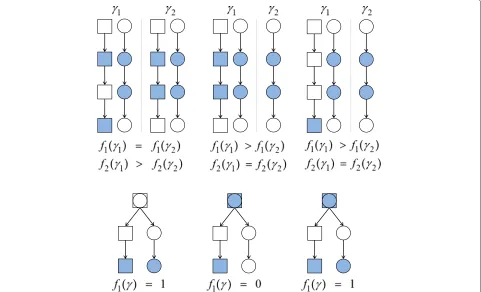
prior over model space. Figure 1 illustrates properties of the two prior components.
Number of pathways(f1)
The first pathway-based feature encodes the notion that predictors that are influential in determining response may belong to a small number of pathways or, in con-trast, may be spread across many pathways. We encode such beliefs by a function f1(γ )which counts the num-ber of pathways represented in a model γ. Specifically,
f1(γ ) = max(0,Kγ −1) whereKγ is the pathway count given by minS|S|forS⊆ {1,. . .,K}satisfying
K
k=1
Ekγ =
k∈S
Ekγ. (8)
This definition prevents the empty model being a priori
most probable and avoids double counting (proteins that are members of multiple pathways are considered to be a member of only one pathway for the purpose of calculat-ingf1(γ ), and this single pathway is selected to minimise the pathway count; see Figure 1). If the strength parame-terλis negative, the prior increasingly penalises models as number of pathways increases, whereas a positive value results in a prior that prefers models representing many pathways.
Intra-pathway distance(f2)
The second feature we consider is that variables which jointly influence the response may either be close to each other in a network sense, or may in fact be far apart in the network. This is done by a functionf2(γ )which gives the average distance between pairs of proteins that are both inγ and in the same pathway. Specifically, the dis-tance between two proteins j1 and j2, denoted d(j1,j2),
is the number of edges in the shortest (undirected) path between them. Then, we definef2(γ ) = max(0,Dγ −1) whereDγ is the average of alld(j1,j2)withj1,j2 ∈Ekγ for
somek. In order for the distance to be defined for any two proteins in a pathway, we assume that the network topol-ogy for a pathway consists of a single connected compo-nent (in the undirected sense). We term a protein included
inγ as asingletonif there are no other included proteins
in the same pathway (i.e. proteinjis a singleton ifEkγ = {j}
Figure 1Properties of pathway-based priors.Priors are encoded by functionsf1(γ )(number of pathways) andf2(γ )(intra-pathway distance).
Shaded components are contained in modelγand shapes represent different pathways. Top row: Comparisons of the scoring functions. Top left -γ1has larger intra-pathway distance thanγ2; Top middle - distance is agnostic to number of pathways; Top right - addition of a singleton has no
effect on distance. Bottom row: The root component in each network is in both pathways. However,f1(γ )is defined so as to avoid double counting.
Empirical Bayes
We set the prior source parametermand strength param-eterλin an objective manner using empirical Bayes [18]. Specifically, we maximise the following marginal likeli-hood,
p(Y|X,m,λ)=Ep(Y|γ,Xγ)P(γ|m,λ)
=
γ
p(Y|γ,Xγ)P(γ|m,λ). (9)
For a given choice of hyperparameters, the marginal likelihood can be calculated exactly by exploiting the model space restriction described above. The score is cal-culated for varying hyperparameters and those resulting in the largest score are used for variable selection.
Prediction
Given already observed data X,Y, we can predict the
expected value of new responseY from new predictor
dataX by model averaging:
EY |X,X,Y= γ
EY |X,X,Y,γP(γ|Y,X)
(10) with
EY |X,X,Y,γ= n
n+1X¯γ
¯
XT
γX¯γ
−1
¯
XT
γY (11)
and the model posterior P(γ | Y,X) calculated via
Equations 2, 6 and 7.
Results
We first show an application of our proposed approach to synthetic response data generated from a published study of cell signalling, and then further illustrate the approach with an analysis of proteomic data and drug response from breast cancers.
Synthetic response data
assessed the methods proposed using published single-cell, phospho-proteomic data [10] with responses gen-erated from that data. This preserved pathway-related correlation structure between predictors but permitted objective assessment. The dataset consists of 11 proteins andntot= 853 samples. (The complete dataset from [10]
contains data obtained under nine different conditions, corresponding to different interventions. Here, we use the baseline dataset which contains 853 samples).
Figure 2 shows a network and pathway structure for the 11 proteins for use with the biologically informative priors of the type described above. The network structure was taken from Sachset al. [10] and reflects current knowl-edge of signalling interactions. The proteins were assigned into four pathways.
We first considered two simulation models,γ1∗andγ2∗, each of which is a predictor subset consisting of three proteins; PIP3, ERK1/2, p38 for Simulation 1, and RAF, MEK1/2, PKA for Simulation 2. In each case, the three proteins were chosen to be favoured by a particular prior.
γ∗
[image:7.595.57.290.356.633.2]1 is favoured by the intra-pathway distance prior (f2)
Figure 2Protein network and pathway structure for biologically informative priors in the synthetic response data study.
Responses were generated from published phospho-proteomic data [10] consisting of 11 proteins and 853 samples (baseline data only). Network structure shown here is based on that given in Sachset al. [10] and reflects current knowledge of signalling interactions. Proteins were divided into four pathways, denoted by node colours red, blue, green and yellow. The grey nodes are each members of all four pathways.
with positiveλ; the proteins included inγ1∗ had a large average intra-pathway distance(f2(γ1∗) = 2.5)and incor-porated a medium number of pathways(f1(γ1∗) = 1).γ2∗ is favoured by either the number of pathways prior (f1)
with negative λ or the intra-pathway distance prior(f2)
with negative λ; the proteins included inγ2∗ had both a small intra-pathway distance (f2(γ2∗) = 0)and incorpo-rated a small number of pathways(f1(γ2∗) =0). Since, by construction, each model is favoured by a particular prior, we can test the ability of the empirical Bayes approach to select appropriate hyperparameter values. Response data
Y were generated using a linear model with interaction
terms (4);Y = A+BC+, whereA,B,C are the three
influential variables.
We are especially interested in the small-sample regime that is often of interest in molecular studies. We
there-fore subsampled (without replacement) n = 35 training
data from the complete dataset (this matched the sam-ple size of the drug response study reported below), and assessed predictive ability on the remaining, held-out data (n˜=ntot−n=818).
Subsampling was repeated to give 5,000 training/test pairs, over which results are reported below. At each iter-ation, only small-sample training data was used for infer-ence. The empirical Bayes method was employed to set prior source and strength parameters (using training data only), withλ ∈ [−5, 5] (this specification permits a flat prior if empirical Bayes analysis supports neither prior). Posterior inclusion probabilities were then calculated as described above.
We assessed performance by comparing the true under-lying modelγ∗to the modelγτobtained by thresholding posterior inclusion probabilities at levelτ. For results from each small-sample dataset, a receiver operating character-istic (ROC) curve was constructed by plotting number of true positives(|γ∗∩γτ|)against number of false positives
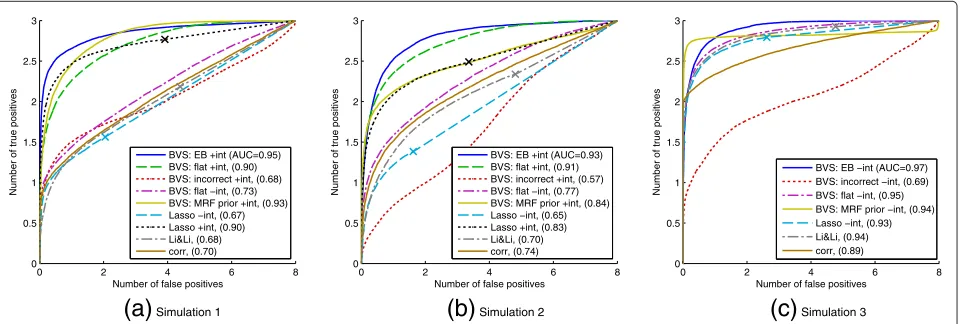
(|γτ\γ∗|)for varying thresholdsτ. Figure 3a,b shows aver-age ROC curves over the 5,000 iterations for Simulation 1 and Simulation 2, together with the area under the ROC curve (AUC). AUC is a summary of the curve and pro-vides a measure of variable selection accuracy, with higher scores indicating better performance. The score is nor-malised to take a value between 0 and 1. Our Bayesian variable selection (BVS) method with empirical Bayes and linear model with interaction terms (‘BVS: EB +int’) is compared with eight other approaches:
(i) BVS with flat prior and linear model with interaction terms (‘BVS: flat +int’);
(ii) BVS with a prior that is incorrect with respect to the true, underlying model: intra-pathway distance prior
0 2 4 6 8 0
0.5 1 1.5 2 2.5 3
Number of false positives
Number of true positives
BVS: EB +int (AUC=0.95) BVS: flat +int, (0.90) BVS: incorrect +int, (0.68) BVS: flat −int, (0.73) BVS: MRF prior +int, (0.93) Lasso −int, (0.67) Lasso +int, (0.90) Li&Li, (0.68) corr, (0.70)
0 2 4 6 8
0 0.5 1 1.5 2 2.5 3
Number of false positives
Number of true positives
BVS: EB +int (AUC=0.93) BVS: flat +int, (0.91) BVS: incorrect +int, (0.57) BVS: flat −int, (0.77) BVS: MRF prior +int, (0.84) Lasso −int, (0.65) Lasso +int, (0.83) Li&Li, (0.70) corr, (0.74)
0 2 4 6 8
0 0.5 1 1.5 2 2.5 3
Number of false positives
Number of true positives
BVS: EB −int (AUC=0.97) BVS: incorrect −int, (0.69) BVS: flat −int, (0.95) BVS: MRF prior −int, (0.94) Lasso −int, (0.93) Li&Li, (0.94) corr, (0.89)
[image:8.595.61.541.87.249.2](a)
Simulation 1(b)
Simulation 2(c)
Simulation 3Figure 3Synthetic response data, average ROC curves.Number of true positives plotted against number of false positives for Simulations 1, 2 and 3. Proteomic data from Sachset al.[10] were used to create response data with true underlying model known to favour a particular prior: Simulaton 1 - distance prior with positiveλ; Simulations 2 and 3 - either distance prior or number of pathways prior with negativeλ. Legend - ‘BVS’: Bayesian variable selection; ‘+int’: linear model with interaction terms; ‘-int’: linear model without interaction terms; ‘EB’: empirical Bayes used to select and weight pathway-based priors automatically; ‘flat’: flat prior; ‘incorrect’: wrong prior with respect to true, underlying protein set (see main text for details); ‘MRF prior’: Markov random field prior [19]; ‘Lasso’: Lasso linear regression (curve produced by thresholding absolute regression coefficients, whilst marker ‘X’ is single model obtained by taking only predictors with non-zero coefficients); ‘Li&Li’: penalised-likelihood approach proposed by Li and Li [21] that also incorporates network information (see main text for details); ‘corr’: absolute Pearson correlations between each protein and response. Area under the (average) ROC curve (“AUC”) appears in parentheses.
(iii) BVS with flat prior and linear model with no interaction terms (‘BVS: flat -int’);
(iv) BVS with a Markov random field prior [19] and linear model with interaction terms (see below for further details; ‘BVS: MRF prior +int’);
(v) penalised-likelihood Lasso regression [20] using a linear model with no interaction terms (see below for further details; ‘Lasso -int’);
(vi) penalised-likelihood Lasso regression [20] using a linear model with pair-wise interaction terms (‘Lasso +int’);
(vii) a penalised-likelihood approach, proposed by Li and Li [21], based on the Lasso and also incorporates network structure information (‘Li&Li’); and (viii) absolute correlation coefficients between each
predictor and response (‘corr’).
Markov random field priors have previously been used in Bayesian variable selection to take network structure of predictors into account [19,22]. A Markov random field is an undirected graphical modelG= (V,E)in which ver-ticesVrepresent variables (here, the predictors) and edges
Erepresent probabilistic relationships between them. Let
A = (ai,j)be a binary symmetric matrix withai,j = 1 if
and only if edge(i,j)∈E. Then, the Markov random field prior is given by
P(γ|λ)∝exp
λγT
Aγ
. (12)
The strength parameterλis usually constrained to be non-negative, resulting in a prior that encourages selection of
predictors whose neighbours inGare also included in the model. Here, we do not enforce this constraint and also allow negative values for λ. Negative values result in a prior that penalises models containing predictors that are neighbours inG. As with the proposed Bayesian variable selection method, we use a linear model with interaction
terms and setλ with empirical Bayes. The graph
struc-tureGis obtained from the structure shown in Figure 2 by converting all directed edges to undirected edges.
Lasso regression performs variable selection by placing an1penalty on the regression coefficients. This has the effect of shrinking a subset of regression coefficients to exactly zero; the predictors with non-zero coefficients are taken as the inferred model. Sparsity of the inferred model is controlled by a tuning parameter, which we set by 5-fold cross-validation. This method results in a single inferred model (i.e. point estimate). However, a full ROC curve can still be obtained by thresholding absolute regression coefficients.
respectively; we set these parameters by 5-fold cross-validation. (This approach, and the standard Lasso regres-sion approach, were implemented using Matlab package glmnet[23].)
We observe that, in both simulations, the automated empirical Bayes analysis, with pathway-based priors, improves performance over the flat prior and provides substantial gains over an incorrect prior. The empirical Bayes approach selected the correct prior in 85% of itera-tions for Simulation 1 and 96% of iteraitera-tions for Simulation 2 (for Simulation 1 correct prior parameters werem = 2 withλ > 0, median value of λselected was λ = 3.5; for Simulation 2 correct prior parameters werem =1 or
m=2 withλ <0, median value ofλselected wasλ= −5
for both m = 1 and m = 2). Since the Lasso
regres-sion method (with interaction terms) does not incorporate prior information, it is unsurprising that it is also out-performed by the empirical Bayes approach. Hence, it is fairer to compare it to Bayesian variable selection with a flat prior (and interaction terms). In Simulation 1 these regimes both show a similar performance with the Lasso approach displaying some gains at small numbers of false positives. However, in Simulation 2 the Bayesian approach offers a clear improvement in performance over Lasso regression (AUC scores of 0.91 and 0.83 respectively). Due to its inability to model combinatorial interplay, the linear model without interaction terms is outperformed by the linear model with interaction terms for both Bayesian and Lasso approaches.
In Simulation 1, the strength parameter for the Markov random field prior was set toλ = −5 by empirical Bayes in 86% of iterations, thereby correctly promoting mod-els that do not contain predictors that are neighbours in the network. However, although the Markov random field prior offers improvements over a flat prior, it is outper-formed by the proposed pathway-based priors at small numbers of false negatives. This is due to the fact that our intra-pathway distance prior is able to promote mod-els with large distances between predictors, whilst the Markov random field prior can only penalise models that contain neighbours. The Markov random field prior is in general less flexible because it considers neighbours rather than distances. Intriguingly, in Simulation 2,λ >0 (which correctly promotes models containing neighbours in the network) was only selected by empirical Bayes in 41% of iterations. As a result, performance of the Markov random field prior is inferior to a flat prior. We discuss this further in Discussion below.
The penalised-likelihood approach proposed in [21], incorporating network information, performs poorly in both simulations, with similar performance compared to simply looking at correlations between predictors. Whilst in Simulation 2, a clear improvement is observed over standard Lasso regression (without interaction terms),
this is not the case in Simulation 1. This is because the approach promotes models containing predictors that are neighbours in the network, which reflects the true underlying model for Simulation 2 only. The general poor performance of this approach is likely due to its inabil-ity to capture combinatorial interplay since it necessarily employs a linear model without interaction terms.
Since the network-based penalised-likelihood approach [21] does not incorporate interaction terms we performed a third simulation to investigate its performance under a data-generating model without interaction terms. In particular, we used the same true underlying predictor subset as in Simulation 2 (i.e. γ3∗ = γ2∗), which con-tains predictors that are neighbours in the network, but generated data using a linear model without interaction terms;Y =A+2B+3C+, whereA,B,Care the three influential variables. We note that each predictor in the data-generating model has a different magnitude of influ-ence on the response (i.e. different regression coefficients). Average ROC curves are shown in Figure 3c. Compar-isons are made to other approaches as described above, but all methods now use linear models without interac-tion terms. As in Simulainterac-tions 1 and 2 the Bayesian variable selection approach with empirical Bayes and pathway-based priors outperforms a flat prior and an incorrect prior, with empirical Bayes selecting the correct prior in 99% of iterations (correct and incorrect priors are the same as for Simulation 2). The Bayesian approach with Markov random field prior showed a similar performance to the proposed pathway-based priors (a correct value of
λ > 0 was selected in 90% of iterations). However, the approach of Li and Li [21], whilst now more competi-tive compared with Simulation 2, is still outperformed by the empirical Bayes approach with pathway-based priors. Moreover, it does not display a clear improvement over Lasso regression.
The failure of the incorrect prior illustrates the impor-tance of prior elicitation. Moreover, our results demon-strate that the proposed empirical Bayes approach can select a suitable prior automatically, even under very small
sample conditions (here n = 35). If the data is not in
agreement with a proposed prior, then it is desirable that
λ = 0 is selected by empirical Bayes, resulting in a flat prior. To test this, we used the model in Simulation 2 with a prior that favoured models with predictors from many pathways (i.e. number of pathways prior withλrestricted to be non-negative). This prior does not reflect the true, underlying model, which contains a small number of path-ways. Empirical Bayes analysis successfully selectedλ=0 in 95% of iterations.
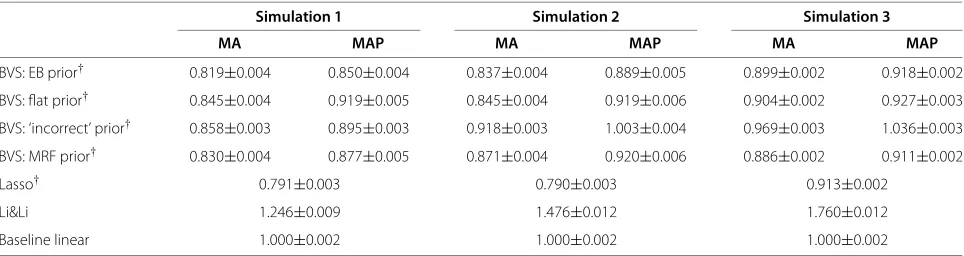
over all 5,000 train/test iterations, are shown in Table 1 (‘MA’). The empirical Bayes approach with pathway-based priors shows improvements in predictive accuracy over a flat prior, and substantial improvements over both the ‘incorrect’ prior and a baseline linear model without interaction terms including all 11 predictors (i.e. no vari-able selection). It also outperforms the Markov random field prior in Simulations 1 and 2, and outperforms Lasso regression in Simulation 3. In Simulations 1 and 2, Lasso regression offers the best predictive performance (we note that prediction used regression coefficients obtained by maximum penalised likelihood estimation; the alternative of using Equation 11 with the single model corresponding to non-zero coefficients gave very poor predictive accu-racy, inferior to the baseline linear approach; data not shown). In Simulation 3, the best predictive accuracy is provided by the Markov random field prior. The penalised regression approach proposed in [21] has very poor pre-dictive performance across all simulations, inferior to the baseline linear model. We also found that model averag-ing provided gains relative to prediction usaverag-ing the MAP model (Equation 11), with a 5%, 7% and 3% decrease in error on average for Simulations 1-3 respectively (see Table 1, ‘MAP’).
The only user-set parameters in the proposed method
are dmax (the maximum number of predictors allowed
in a model), and the range of values for the prior
strength parameter λ to optimise over in empirical
Bayes. We sought to check the sensitivity of our results to these parameters. As described in ‘Methods’ above,
we set dmax = 4 and considered λ ∈ [−5, 5]. We
compared the posterior inclusion probabilities inferred from 50 iterations of Simulation 1 to those obtained using (i) an increased maximum number of included predictors ofdmax = 5; (ii) Markov chain Monte
Carlo-based (MCMC) inference with no restriction on number
of included predictors, and (iii) an increased range for the prior strength λ ∈ [−10, 10] (see Figure 4). We found very close agreement in all cases, indicating that results reported do not depend on the sparsity restriction or the chosen range forλ.
In Simulation 2 and Simulation 3, the smallest value of
λ = −5 was selected by empirical Bayes in a majority of iterations. The true, underlying model has the minimum possible number of pathways and intra-pathway distance. Hence, the strong (negative) prior strength is appropriate because it causes the prior to heavily penalise any model not satisfying these minima. Under the increased range forλ, the smallest value (λ = −10) was still selected in these iterations, but results were almost identical (as seen for Simulation 1 in Figure 4). This indicates that the prior was already having close to maximal influence at the lower value ofλ= −5.
Cancer drug response data
Aberrant signalling is heavily implicated in almost every aspect of cancer biology [24,25] and, as a result, signalling proteins are targets for many emerging cancer thera-pies. Here, we apply the methods proposed to probing phospho-proteomic influences on response to an anti-cancer agent Triciribine.
Phospho-protein abundance was assayed in a
high-throughput manner using the KinetWorksTM system
(Kinexus Inc, Vancouver, Canada), for p = 52 proteins
[image:10.595.58.540.552.680.2]related to epidermal growth factor receptor (EGFR) sig-nalling, in each ofn = 35 breast cancer cell lines (see Additional File 1:Sections 1.1-1.2 for details). The EGFR signalling network plays a central role in breast cancer biology [26] and the cell lines used have previously been shown to retain much of the biological heterogeneity of primary tumours [27]. GI50 (log transformed) was used to quantify response to Triciribine for each of the 35 cell lines
Table 1 Synthetic response data, predictive errors from held-out test data
Simulation 1 Simulation 2 Simulation 3
MA MAP MA MAP MA MAP
BVS: EB prior† 0.819±0.004 0.850±0.004 0.837±0.004 0.889±0.005 0.899±0.002 0.918±0.002
BVS: flat prior† 0.845±0.004 0.919±0.005 0.845±0.004 0.919±0.006 0.904±0.002 0.927±0.003 BVS: ‘incorrect’ prior† 0.858±0.003 0.895±0.003 0.918±0.003 1.003±0.004 0.969±0.003 1.036±0.003
BVS: MRF prior† 0.830±0.004 0.877±0.005 0.871±0.004 0.920±0.006 0.886±0.002 0.911±0.002
Lasso† 0.791±0.003 0.790±0.003 0.913±0.002
Li&Li 1.246±0.009 1.476±0.012 1.760±0.012
Baseline linear 1.000±0.002 1.000±0.002 1.000±0.002
0 0.2 0.4 0.6 0.8 1 0
0.2 0.4 0.6 0.8 1
exact, d max=4
exact, d
max
=5
0 0.2 0.4 0.6 0.8 1 0
0.2 0.4 0.6 0.8 1
exact, d max=4
MCMC
0 0.2 0.4 0.6 0.8 1 0
0.2 0.4 0.6 0.8 1
λ∈[−5,5]
λ∈
[image:11.595.59.539.86.239.2][−10,10]
Figure 4Synthetic response data; effect of sparsity restriction and range of prior strength parameter.Results reported in Figure 3, for the empirical Bayes approach, were obtained by exact model averaging with the number of predictors included in a model restricted to not exceed dmax=4. Posterior inclusion probabilities for 50 simulated datasets from Simulation 1 were compared with results obtained by exact model averaging with an increased maximum number of included predictors ofdmax=5 (left) and using Markov chain Monte Carlo-based model averaging with no sparsity restriction (centre). Sensitivity to the range of prior strength parameter values considered by empirical Bayes was also assessed by comparing the posterior inclusion probabilities obtained withλ∈[−5, 5] to those obtained with an increased range ofλ∈[−10, 10].
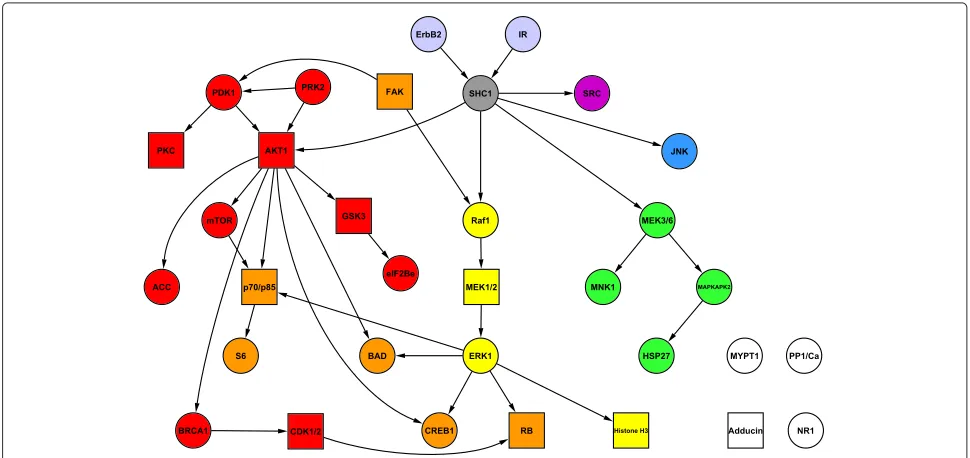
[28]. GI50 is the concentration that causes 50% growth inhibition compared to a baseline. A network (with a total of five pathways) was constructed using cellsignal.com (see Figure 5).
Figure 6 shows marginal likelihood scores arising from empirical Bayes. This selects the intra-pathway distance
prior (m = 2) with hyperparameter λ = 5 (i.e. a prior
promoting larger distances). Due to the small sample size,
we tested robustness of this choice by running empirical Bayes with each data sample removed. The same prior was selected in 86% of the iterations.
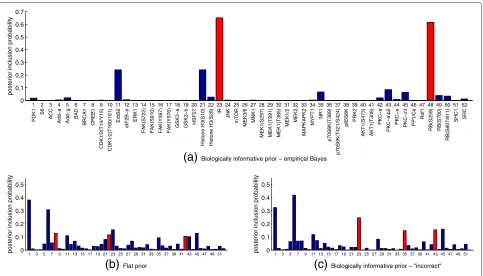
[image:11.595.55.540.446.675.2]Figure 7 shows posterior inclusion probabilities obtained under three prior regimes: empirical Bayes (intra-pathway distance prior withλ = 5), flat prior and an “incorrect” prior that is not optimal according to the empirical Bayes analysis (number of pathways prior with
−50 −4 −3 −2 −1 0 1 2 3 4 5 1
2 3 4 5
prior strength, λ log marginal likelihood (up to proportionality)
[image:12.595.61.541.86.265.2]m=1 m=2
Figure 6Drug response data, empirical Bayes analysis.Parameters controlling source of prior information and prior strength (mandλ respectively) were set objectively using the data. Log marginal likelihood (calculated exactly up to a constant) is plotted againstλform=1 (number of pathways prior) andm=2 (intra-pathway distance prior). Parameters were set to the values with maximal marginal likelihood:m=2 andλ=5.
λ = −5). Phospho-IR and phospho-RB(S259) stand out
in the empirical Bayes analysis. Triciribine targets AKT, which inhibits apoptotic processes and is heavily impli-cated in cancer signalling [29]. IR (insulin receptor) is a tyrosine kinase receptor, known to stimulate the AKT
pathway [30], and it has been suggested that the RB/E2F pathway, which is also known to play a role in cancer [31], has an effect on AKT activity via transcriptional regula-tion [32]. Hence, the salience of IR and RB accords with known biology and drug mechanism. The MAP model
0 0.1 0.2 0.3 0.4 0.5 0.6 0.7
posterior inclusion probability
PDK1
S6
ACC
Add−a Add−g BAD BRCA1 CREB1
CDK1/2(T14/Y15) CDK1/2(T160/161)
ErbB2
eIF2B−e
ERK1
FAK(S722) FAK(S910) FAK(Y397) FAK(Y576) GSK3−a GSK3−b HSP27
Histone H3(S10) Histone H3(S28)
IR
JNK
mTOR
MEK3/6 MNK1
MEK1(S297) MEK1(T291) MEK1(T385) MEK1/2 MEK2
MAPKAPK2
MYPT1
NR1
p70S6K(T389)
p70S6K(T421/S424)
p85S6K PRK2
AKT1(S473) AKT1(T308)
PKC−a
PKC−a\b2
PKC−e PKC−z\I PP1/Ca
Raf1
RB(S259) RB(S780)
RB(S807/811)
SHC1 SRC 1 2 3 4 5 6 7 8 9 10 11 12 13 14 15 16 17 18 19 20 21 22 23 24 25 26 27 28 29 30 31 32 33 34 35 36 37 38 39 40 41 42 43 44 45 46 47 48 49 50 51 52
0 0.1 0.2 0.3 0.4 0.5
posterior inclusion probability 1 3 5 7 9 11 13 15 17 19 21 23 25 27 29 31 33 35 37 39 41 43 45 47 49 51 0 0.1 0.2 0.3 0.4 0.5
posterior inclusion probability 1 3 5 7 9 11 13 15 17 19 21 23 25 27 29 31 33 35 37 39 41 43 45 47 49 51
(a)
Biologically informative prior − empirical Bayes(b)
Flat prior(c)
Biologically informative prior − "incorrect" [image:12.595.58.541.403.679.2]for each prior regime is highlighted in red in Figure 7. We note that these models do not always contain the proteins with highest inclusion probabilities.
We performed Leave-One-Out-Cross-Validation (LOO CV), making predictions for the held-out test sample using both posterior model averaging (Equation 10) and the MAP model (Equation 11). The full variable selection approach, including selection of hyperparameters with empirical Bayes, was carried out at each cross-validation iteration. Table 2 shows mean absolute predictive errors, with comparisons made as in the synthetic response data study above. For the ‘incorrect’ prior, the prior source parameter not selected by empirical Bayes was used, along with the optimal strength parameterλfor that prior. Mir-roring the synthetic data results (Simulations 1 and 2), we observe that prior elicitation with empirical Bayes pro-vides an increase in mean predictive accuracy over a flat prior, an ‘incorrect’ prior, the Markov random field prior and the approach proposed by Li and Li [21], whilst Lasso regression has lowest mean predictive error. We note, however, that due to the very small sample size, differ-ences in mean predictive error between these regimes are not conclusive. Yet, they all show an improvement over the baseline linear approach, and model averaging results in an average 26% decrease in predictive error over using MAP models. The prior strength parameter for the Markov random field prior was set toλ= −5 by empirical Bayes in every cross-validation iteration (this agrees with the selection of a pathway-based prior promoting large distances).
[image:13.595.306.540.86.450.2]We again checked sensitivity of results to the restric-tion on the number of predictors included in a model,
Table 2 Drug response data, predictive errors from cross-validation
MA MAP
BVS: EB prior +int 0.84±0.12 1.00±0.16
BVS: flat prior +int 0.86±0.11 1.26±0.17
BVS: ‘incorrect’ prior +int 0.93±0.15 1.22±0.17
BVS: MRF prior +int 0.86±0.11 1.24±0.17
Lasso +int 0.73±0.10
Li&Li 0.96±0.21
Baseline linear 1.00±0.14
Predictions using leave-one-out-cross-validation (see text for details). Results shown are mean absolute predictive errors±SEM for the following methods: Bayesian variable selection (BVS) with biologically informative pathway-based prior with source and strength parameters set by empirical Bayes, BVS with flat prior, BVS with ‘incorrect’ prior (contradicting empirical Bayes; see text for details), BVS with a Markov random field (MRF) prior, Lasso regression, penalised-likelihood approach proposed by Li and Li [21], and a baseline linear regression without interaction terms including all 11 predictors. ‘+int’ denotes linear model with interaction terms. For BVS, predictions made using the posterior predictive distribution with exact model averaging (‘MA’) and using themaximum a posteriorimodel (‘MAP’).
0 0.2 0.4 0.6
0 0.2 0.4 0.6
exact, d max=4
exact, d
max
=5
0 0.2 0.4 0.6 0.8 0
0.2 0.4 0.6 0.8
exact, d max=4
MCMC
0 0.2 0.4 0.6
0 0.2 0.4 0.6
exact, d max=4
exact, d
max
=5
0 0.2 0.4 0.6
0 0.2 0.4 0.6
exact, d max=4
MCMC
0 0.2 0.4 0.6
0 0.2 0.4 0.6
exact, d max=4
exact, d
max
=5
0 0.2 0.4 0.6
0 0.2 0.4 0.6
exact, d max=4
MCMC
(a)
Biologically informative prior − empirical Bayes(b)
Flat prior [image:13.595.57.291.525.638.2](c)
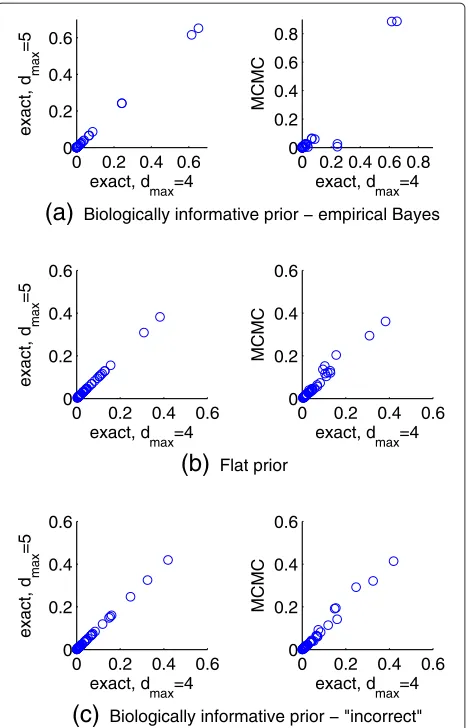
Biologically informative prior − "incorrect"Figure 8Drug response data; effect of sparsity restriction.
Posterior inclusion probabilities in Figure 7 were obtained by exact model averaging with the number of predictors included in a model restricted to not exceeddmax=4. These results were compared with results obtained by exact model averaging with an increased maximum number of included predictors ofdmax=5 (left column) and using Markov chain Monte Carlo-based model averaging with no sparsity restriction (right column).
dmax = 4. The results in Figure 7 were compared with
those obtained using an increased maximum number of
included predictors of dmax = 5 and using
MCMC-based inference with no such restriction (see Figure 8).
The strong agreement between dmax = 4 and dmax =
5 suggests that the minor differences observed between
dmax = 4 and MCMC are a result of inherent Monte
Carlo error. We also see a close agreement between results in Figure 7a (using λ ∈ [−5, 5]) and those obtained by
optimising over the increased range of λ ∈ [−10, 10]
Discussion
Model priors incorporating biological information can play an important role in variable selection, especially at the small sample sizes characteristic of molecular studies. In applications where there are multiple sources of prior information, or multiple possible prior specifications, the empirical Bayes approach we put forward permits objec-tive selection and weighting. This aids prior elicitation and guards against the use of mis-specified priors. We demonstrated that a biologically informative prior, with hyperparameters set by empirical Bayes, can have ben-efits over both a flat prior and a subjectively formed prior which is incorrect with respect to the underlying system. We also observed that, whilst Lasso regression can offer some improvement in predictive performance over the Bayesian approaches, its accuracy in selecting the correct underlying model (i.e. variable selection) can be inferior to the proposed empirical Bayes approach, thereby affecting interpretability of results. Empirical Bayes approaches have previously been used in vari-able selection, but with standard Bernoulli-distributed priors [33,34].
We developed informative priors in the context of pro-tein signalling based on two high-level features derived from network information: the number of pathways a subset of predictors incorporates and the intra-pathway distance between proteins in a proposed model. This for-mulation used the entire network structure in an intuitive way, removing the the need to specify individual prior probabilities for each variable and avoiding assumptions of prior independence between variables.
Our pathway-based priors form part of a growing lit-erature on exploiting existing domain knowledge to aid inference, especially in the small sample setting. For exam-ple, recent variable selection studies also make use of graph structure within a Bayesian Markov random field prior [19,35,36] and within a non-Bayesian framework [21,37,38], essentially preferring models containing pre-dictors that are neighbours in the graph. This is similar in spirit to the special case of our prior where the network
consists of a single pathway and short intra-pathway dis-tances are strongly preferred.
We compared our pathway-based priors to the Markov random field prior, but found in Simulation 2 that empir-ical Bayes frequently set the prior strength parameter to an incorrect value, resulting in a prior that penalises models containing predictors that are neighbours in the network, instead of promoting them. This is likely due to the parameterisation of the Markov random field prior, which is not agnostic to the number of included predic-tors in the model|γ|; addition of a predictor to a model could lead to a substantial increase in the prior score. Indeed, it has previously been noted that Markov random field priors can be unstable with the occurance of phase transitions in|γ|[19]. Hence, the prior prefers less sparse models, but these models do not agree well with the data, as more complex models are penalised by the marginal likelihood. In contrast, our distance prior is based on an average distance measure and so is somewhat indifferent to|γ|. In Simulation 3, we do not observe this behaviour of the Markov random field prior; since the linear model does not include interaction terms, the model complexity does not increase as sharply with|γ|and so there is less disagreement between the prior and the marginal likeli-hood. We note that biologically informative priors have also been used for classification [22,39,40] and network inference [41-43].
[image:14.595.58.541.603.689.2]We also compared our approach to the network-based penalised-likelihood method proposed by Li and Li [21]. It performed poorly in Simulations 1 and 2, primarily due to its inability to capture nonlinear interplay. How-ever, even in Simulation 3, with no interaction terms in the data-generating model, it failed to match the perfor-mance of our proposed empirical Bayes approach with pathway-based priors. This could be due to lack of sim-ilarity between the regression coefficients in the data-generating model, which goes against an assumption of the penalised-likelihood approach; that coefficients are similar for predictors that are neighbours in the network. This could also explain its poor predictive performance.
Table 3 Illustrative computation times
Linear model without interaction terms Linear model with interaction terms
dmax=2 dmax=3 dmax=4 dmax=5 dmax=2 dmax=3 dmax=4 dmax=5
p=30 0.1 1.1 8.7 9.5 0.4 4.7 38.6 374.6
p=60 0.5 10.5 114.3 − 1.8 39.4 661.6 −
p=120 2.8 116.3 − − 8.2 350.1 − −
p=500 150.3 − − − 238.7 − − −
We used a continuous regression framework with inter-action terms. Whilst discrete models are naturally capable of capturing non-linear interplay between components, the discretisation process results in a loss of information. Continuous models avoid this loss, but the response is usually assumed to depend linearly on predictors. The product terms in our model provide the possibility of cap-turing influences on the response of interest by interplay between predictors, including higher-order interactions.
Chipman [44] and Jensen et al. [3] have employed a
related approach allowing pairwise interactions only. We note that, under our formulation, model complex-ity grows rapidly with number of included predictors. However, complex models are naturally penalised by the marginal likelihood formulation giving overall sparse, parsimonious models, yet allowing for complex interplay via product terms.
We carried out variable selection using exact model averaging. This was made possible by means of a spar-sity restriction. Sparspar-sity constraints have been employed in previous work in Bayesian variable selection [4,45] and also in the related setting of inference of gene regula-tory networks [42,46]. The sparsity-constrained approach proposed is attractive as it yields exact posterior probabil-ities and facilitates exact empirical Bayes analysis. Sparsity is a reasonable assumption in settings where it is likely that only a few predictors play a key role in influencing a response. In such settings, and where data is of small-to-moderate dimensionality, our exact approach is fast and deterministic with no requirement of MCMC con-vergence diagnostics. This, together with empirical Bayes and the choice of parameter priors, results in the overall approach having very few user-set parameters.
In applications of higher dimensionality, where the exact calculation is no longer feasible, empirical Bayes can still be performed using an approximate conditional marginal ‘likelihood’ approach as seen in George and Foster [33] and Yuan and Lin [34]. This involves optimi-sation over the model space instead of averaging. MCMC, with the selected hyperparameter values, can then be used to estimate inclusion probabilities. Alternatively, a fully Bayes MCMC approach could be taken, which places a prior on the hyperparameters and integrates them out (see e.g. [14]).
Illustrative computational times for our approach are
shown in Table 3, for four values of p (number of
pre-dictors) and four values of dmax (maximum number of
predictors allowed in a model). We also considered lin-ear models with and without interaction terms. Empirical
Bayes was used to select between two priors (M = 2)
and to set the prior strength parameter (optimisation per-formed over ten values ofλ). The computation time scales asdmaxpdmaxfor the model without interaction terms and
(2dmax −1)pdmax for the model with interaction terms.
We see that the approach is fast on datasets of mod-erate dimensionality (∼100 variables) with dmax = 3.
We note that shortage of memory was the limiting fac-tor on our machine. Computational time could also be improved by using multiple cores to calculate empirical Bayes marginal likelihood scores for multiple values ofλ simultaneously.
We showed examples of automated selection between multiple sources of ancillary information, but, rather than selecting a single source, the methods proposed could be generalised to allow combinations of complementary information sources as seen in Jensen et al. [3]. Whilst our priors were based on pathway and network structure, the methods can also permit integration and weighting of publicly available data, which while plentiful, can be of uncertain relevance to a given study.
Conclusions
In this paper we have proposed an empirical Bayes method for objective selection and weighting of biologi-cally informative prior information for integration within Bayesian variable selection. The method is computation-ally efficient, exact and has very few user-set parameters. We developed informative pathway-based priors in the context of protein signalling and illustrated our method on synthetic repsonse data. We demonstrated that in sit-uations where there are several plausible formulations for the prior, it is capable of selecting the most appropriate. In particular, the approach has potential to significantly improve results by guarding against mis-specification of priors. Comparisons were made to alternative methods, demonstrating that the proposed approach offers a com-petitive variable selection performance. We have also shown an application on cancer drug response data and obtained biologically plausible results. Our method is general and can be applied in any setting with multiple sources of prior knowledge.
Additional file
Additional file 1:Cancer drug response application.Tables of proteins and cell lines included in the analysis, further details of the experimental procedure and Figure S1.
Competing interests
The authors declare that they have no competing interests.
Acknowledgements
Author details
1The Netherlands Cancer Institute, 1066 CX Amsterdam, The Netherlands. 2Centre for Complexity Science, University of Warwick, Coventry CV4 7AL, UK. 3Department of Statistics, University of Warwick, Coventry CV4 7AL, UK. 4Genentech Inc., San Francisco, CA 94080.5Life Sciences Division, Lawrence
Berkeley National Laboratory, Berkeley, CA 94720.6Center for Spatial Systems
Biomedicine, Oregon Health & Science University, Portland, OR 97239.
Authors contributions
SMH designed the priors, carried out all computational analyses and wrote the paper. SM conceived the study, provided feedback on all aspects and revised the manuscript. RMN and NB carried out the cell line assays. WLK and SZ carried out the drug response assays. PTS and JWG led the biological aspects of the work and provided feedback. All authors read and approved the final manuscript.
Received: 13 June 2011 Accepted: 19 April 2012 Published: 11 May 2012
References
1. Lee KE, Sha N, Dougherty ER, Vannucci M, Mallick BK:Gene selection: a Bayesian variable selection approach.Bioinformatics2003,19:90–97. 2. Rogers S, Girolami M:A Bayesian regression approach to the
inference of regulatory networks from gene expression data.
Bioinformatics2005,21(14):3131–3137.
3. Jensen ST, Chen G, Stoeckert CJ:Bayesian variable selection and data integration for biological regulatory networks.Ann Appl Stat2007, 1:612–633.
4. Mukherjee S, et al.:Sparse combinatorial inference with an application in cancer biology.Bioinformatics2009,25:265–271. 5. Wu TT, Chen YF, Hastie T, Sobel E, Lange K:Genome-wide association
analysis by lasso penalized logistic regression.Bioinformatics2009, 25:714–721.
6. Ai-Jun Y, Xin-Yuan S:Bayesian variable selection for disease classification using gene expression data.Bioinformatics2010, 26:215–222.
7. Brown PJ, Vannucci M, Fearn T:Bayes model averaging with selection of regressors.J R Stat Soc B2002,64:519–536.
8. George EI, McCulloch RE:Approaches for Bayesian variable selection.
Stat Sin1997,7:339–373.
9. Chipman H, et al.:The practical implementation of Bayesian model selection.IMS Lecture Notes-Monograph Ser2001,38:65–134. 10. Sachs K, Perez O, Pe’er D, Lauffenburger DA, Nolan GP:Causal
protein-signaling networks derived from multiparameter single-cell data.Science2005,308:523–529.
11. Madigan D, York J, Allard D:Bayesian graphical models for discrete data.Int Stat Rev1995,63:215–232.
12. Raftery AE, Madigan D, Hoeting JA:Bayesian model averaging for linear regression models.J Am Stat Assoc1997,92:179–191. 13. Robert CP, Casella G:Monte Carlo Statistical Methods. 2nd edition. New
York: Springer; 2004.
14. Nott DJ, Green PJ:Bayesian variable selection and the
Swendsen-Wang algorithm.J Comput Graph Stat2004,13:141–157. 15. Smith M, Kohn R:Nonparametric regression using Bayesian variable
selection.J Econometrics1996,75:317–343.
16. Denison DGT, Holmes CC, Mallick BK, Smith AFM:Bayesian Methods for Nonlinear Classification and Regression. London: Wiley; 2002. 17. Kohn R, Smith M, Chan D:Nonparametric regression using linear
combinations of basis functions.Stat Comput2001,11:313–322. 18. Carlin BP, Louis TA:Bayesian Methods for Data Analysis. 3rd edition:
Chapman & Hall; 2008.
19. Li F, Zhang NR:Bayesian variable selection in structured
high-dimensional covariate spaces with applications in genomics.
J Am Stat Assoc2010,105:1202–1214.
20. Tibshirani R:Regression shrinkage and selection via the lasso.J R Stat Soc B1996,58:267–288.
21. Li C, Li H:Network-constrained regularization and variable selection for analysis of genomic data.Bioinformatics2008,24:1175–1182. 22. Stingo FC, Vannucci M:Variable selection for discriminant analysis
with Markov random field priors for the analysis of microarray data.
Bioinformatics2011,27:495–501.
23. Friedman J, Hastie T, Tibshirani R:Regularization paths for generalized linear models via coordinate descent.J Stat Soft2010,33:1–22. 24. Weinberg RA:The Biology of Cancer. New York: Garland Science; 2006. 25. Hanahan D, Weinberg RA:The hallmarks of cancer.Cell2000,100:57–70. 26. Yarden Y, Sliwkowski MX:Untangling the ErbB signalling network.Nat
Rev Mol Cell Biol2001,2:127–137.
27. Neve RM, et al.:A collection of breast cancer cell lines for the study of functionally distinct cancer subtypes.Cancer Cell2006,10:515–527. 28. Heiser LM, et al.:Subtype and pathway specific responses to
anticancer compounds in breast cancer.Proceedings of the National Academy of Sciences2011, in press.
29. Yang L, et al.:Akt/protein kinase B signaling inhibitor-2, a selective small molecule inhibitor of Akt signaling with antitumor activity in cancer cells overexpressing Akt.Cancer Res2004,64:4394–4399. 30. Burgering BMT, Coffer PJ:Protein kinase B (c-Akt) in
phosphatidylinositol-3-OH kinase signal transduction.Nature2002, 376:599–602.
31. Nevins JR:The Rb/E2F pathway and cancer.Hum Mol Genet2001, 10:699–703.
32. Chaussepied M, Ginsberg D:Transcriptional Regulation of AKT Activation by E2F.Mol Cell2004,16:831–837.
33. George EI, Foster DP:Calibration and empirical Bayes variable selection.Biometrika2000,87:731–747.
34. Yuan M, Lin Y:Efficient empirical Bayes variable selection and estimation in linear models.J Am Stat Assoc2005,100:1215–1225. 35. Wei Z, Li H:A hidden spatial-temporal Markov random field model
for network-based analysis of time course gene expression data.
Ann Appl Stat2008,2:408–429.
36. Monni S, Li H:Bayesian methods for network-structured genomics data.InFrontiers of Statistical Decision Making and Bayesian Analysis. Edited by Chen MH, M ¨uller P, Sun D, Ye K, Dey DK. New, York: Springer; 2010:303–315.
37. Binder H, Schumacher M:Incorporating pathway information into boosting estimation of high-dimensional risk prediction models.
BMC Bioinf2009,10:18.
38. Slawski M, zu Castell W, Tutz G:Feature selection guided by structural information.Ann Appl Stat2010,4:1056–1080.
39. Zhu Y, Shen X, Pan W:Network-based support vector machine for classification of microarray samples.BMC Bioinf2009,10:S21. 40. Guillemot V, Tenenhaus A, Le Brusquet L, Frouin V:Graph constrained
discriminant analysis: A new method for the integration of a graph into a classification process.PLoS ONE2011,6:e26146.
41. Bernard A, Hartemink AJ:Informative structure priors: Joint learning of dynamic regulatory networks from multiple types of data.InPac Symp Biocomput 2005. Singapore: World Scientific; 2005:459–470. 42. Werhli AV, Husmeier D:Reconstructing gene regulatory networks with
Bayesian networks by combining expression data with multiple sources of prior knowledge.Stat Appl Genet Mol Biol2007,6:15. 43. Mukherjee S, Speed TP:Network inference using informative priors.
Proc Natl Acad Sci USA2008,105:14313–14318.
44. Chipman H:Bayesian variable selection with related predictors.Can J Stat1996,24:17–36.
45. Jiang W:Bayesian variable selection for high dimensional
generalized linear models: convergence rates of the fitted densities.
Ann Stat2007,35:1487–1511.
46. Husmeier D:Sensitivity and specificity of inferring genetic regulatory interactions from microarray experiments with dynamic Bayesian networks.Bioinformatics2003,19:2271–2282.
doi:10.1186/1471-2105-13-94
Cite this article as:Hillet al.:Integrating biological knowledge into
![Figure 2 Protein network and pathway structure for biologicallyinformative priors in the synthetic response data study.Responses were generated from published phospho-proteomic data[10] consisting of 11 proteins and 853 samples (baseline data only).Network](https://thumb-us.123doks.com/thumbv2/123dok_us/9627187.465247/7.595.57.290.356.633/structure-biologicallyinformative-synthetic-responses-generated-published-proteomic-consisting.webp)