Original citation:
Quach, H. N. B., Tao, S., Vrljicak, P, Joshi, A., Ruan, H., Sukumaran, R., Varshney, G.
K., LaFave, M. C., Burgess, S. M., Winkler, C., Emelyanov, A., Parinov, S. and
Sampath, Karuna. (2015) A multifunctional mutagenesis system for analysis of gene
function in zebrafish. G3 Genes|Genomes|Genetics, Volume 5 (Number 6).
Permanent WRAP url:
http://wrap.warwick.ac.uk/69560
Copyright and reuse:
The Warwick Research Archive Portal (WRAP) makes this work of researchers of the
University of Warwick available open access under the following conditions.
This article is made available under the Creative Commons Attribution 3.0 Unported
(CC BY 3.0) license and may be reused according to the conditions of the license. For
more details see:
http://creativecommons.org/licenses/by/3.0/
A note on versions:
The version presented in WRAP is the published version, or, version of record, and may
be cited as it appears here.
MUTANT SCREEN REPORT
A Multifunctional Mutagenesis System for
Analysis of Gene Function in Zebra
fi
sh
Helen Ngoc Bao Quach,*,2Shijie Tao,*,†,2Pavle Vrljicak,*,‡,2Adita Joshi,* Hua Ruan,* Rashmi Sukumaran,* Gaurav K. Varshney,§Matthew C. LaFave,§ The Ds Screen Team1 Shawn M. Burgess,§Christoph Winkler,†,** Alexander Emelyanov,* Sergey Parinov,* and Karuna Sampath†,‡,3
*Temasek Life Sciences Laboratory and†Department of Biological Sciences, National University of Singapore, Singapore 117604,‡Division of Biomedical Cell Biology, Warwick Medical School, Coventry, United Kingdom CV4 7AJ,§National Human Genome Research Institute, National Institutes of Health, Bethesda, MD 20892-8004, and **Centre for Bioimaging Sciences, National University of Singapore, Singapore 117543
ABSTRACT Since the sequencing of the human reference genome, many human disease-related genes have been discovered. However, understanding the functions of all the genes in the genome remains a challenge. The biological activities of these genes are usually investigated in model organisms such as mice and zebrafish. Large-scale mutagenesis screens to generate disruptive mutations are useful for identifying and understanding the activities of genes. Here, we report a multifunctional mutagenesis system in zebrafish using the maizeDs
transposon. Integration of theDstransposable element containing an mCherry reporter for protein trap events and an EGFP reporter for enhancer trap events produced a collection of transgenic lines marking distinct cell and tissue types, and mutagenized genes in the zebrafish genome by trapping and prematurely terminating endog-enous protein coding sequences. We obtained 642 zebrafish lines with dynamic reporter gene expression. The characterizedfish lines with specific expression patterns will be made available through the European Zebrafish Resource Center (EZRC), and a database of reporter expression is available online (http://fishtrap.warwick.ac.uk/). Our approach complements other efforts using zebrafish to facilitate functional genomic studies in this model of human development and disease.
KEYWORDS
functional genomics insertional
mutagenesis
Ac/Dstransposon gene expression
Although at least 20,000 protein-coding genes have been identified in the human genome, only a small number of genes have been
well-studied, and the normal function or disease significance of many genes remains obscure (Edwardset al.2011). Due to low spontaneous mu-tation frequency and other ethical considerations pertaining to re-search in humans, large-scale mutagenesis in model organisms is the most efficient way to discover novel genes and generate tools to dissect genetic pathways in human diseases and development. It is important to assemble genetic resources from multiple organisms to facilitate comprehensive understanding of biological activities of genes, and the well-annotated genome sequences of many organisms have provided a strong foundation for genome-wide genetic screens (White et al.2013). Recently, the zebrafish genome was completely sequenced and its relationship to the human genome has been re-vealed, indicating the value of this model organism for functional analysis of vertebrate genes and, in particular, human disease genes. Several recent efforts have aimed to systematically mutate all protein-coding genes in zebrafish (Howeet al.2013; Kettleboroughet al.2013; Varshney et al.2013; Milleret al.2013). In large-scale mutagenesis screens using the chemical mutagen, N-ethyl-N-nitrosourea (ENU), a number of mutants were identified for many known zebrafish
Copyright © 2015 Quachet al. doi: 10.1534/g3.114.015842
Manuscript received November 20, 2014; accepted for publication March 28, 2015; published Early Online April 2, 2015.
This is an open-access article distributed under the terms of the Creative Commons Attribution Unported License (http://creativecommons.org/licenses/ by/3.0/), which permits unrestricted use, distribution, and reproduction in any medium, provided the original work is properly cited.
Supporting information is available online atwww.g3journal.org/lookup/suppl/ doi:10.1534/g3.114.015842/-/DC1
1The Ds screen team includes the following: DBS, NUS: Joerg Renn, Yin Jun, Jan Brocher, Bernd Willems, Yao Sheng, Flora Rajaei, and Ram Vinod Roy; NUS: Robyn Sumay Lim, Nur Adilah Bte Mahbob, Krishna Balasubramaniam, Choi Kwun, and Ng Xiu Li; NTU: Engel Teo, Kau Jie Hung, Eirene Koh, Sim Zhi Wei, Nur Zatul Ezza Bte Zainal, Rong Li (Ngee Ann Polytechnic), Kim Wei Liang (Republic Polytechnic), and Melvin Teo (Singapore Polytechnic); NUS High School of Mathematics and Science: Kiang Teng and Phan Nop. 2These authors contributed equally to this work.
protein-coding genes, aided by high-throughput sequencing methods and a well-annotated zebrafish reference genome (Kettleboroughet al. 2013; Miller et al.2013; Drieveret al.1996; Haffteret al.1996). A Moloney murine leukemia virus (MMLV)-based insertion mutagene-sis strategy has also isolated thousands of zebrafish mutations (Var-shneyet al.2013). These mutants are valuable tools for the study of their human orthologs.
Protein trapping offers an alternative, powerful approach to abolish gene function by random insertion of DNA. A protein trap construct typically contains a splice acceptor site immediately upstream of a promoter-less reporter gene to create reporter-tagged fusion proteins. This approach simultaneously mutates the trapped gene and provides information about itsin vivoexpression (Gossler et al.1989; Kawakamiet al.2004b; Skarneset al.1992; Skarneset al. 2004; Trinh le et al.2011). However, enhancer trap (ET) vectors contain a weak basal promoter that requires the cassette to insert in the vicinity ofcis-acting enhancer elements to express the reporter gene under the control of endogenous sequences. The ET reporter is expressed in a spatio-temporal fashion under the control of endog-enous enhancers, providing dynamic gene expression information. However, this reporter system does not efficiently create mutants (Allen et al.1988; Kothary et al.1988; O’Kane and Gehring 1987; Weberet al.1984).
Various gene trap and enhancer trap vectors have been applied in animal model organisms, such as Drosophila, mice, zebrafish, and the Japanese ricefish medaka, successfully capturing the func-tional proteome and enabling visualization offluorescent reporter expression regulated by endogenous elements (Hummel and Klambt 2008; Lukacsovich and Yamamoto 2001; Morin 2003; Gossleret al.1989; Stanfordet al.2001; Wurstet al.1995; Asakawa and Kawakami 2009; Froschauer et al. 2012; Kawakami et al. 2004b; Trinh le et al. 2011; Clark et al. 2011; Grabher et al. 2003). Trapping vectors can be efficiently introduced into genomes by electroporation, microinjection, or retroviral infection, depend-ing on the vector design and model system. Electroporation can lead to tandem insertions into the same locus, and vector DNA is often digested by exonucleases, making the cloning of insertion sites problematic (Stanford et al. 2001). Retroviral vectors have a tendency to insert into the 59region of genes, and their packaging size is limited (Stanford et al. 2001). DNA transposon-based protein trap and enhancer trap systems overcome some of these disadvantages and provide additional tools for efficient genome engineering. The first widely used DNA transposon was the P element in Drosophila(Rubin and Spradling 1982; Spradling and Rubin 1982). Then, an active hAT family DNA transposon Tol2 was identified and cloned from medaka (Kogaet al.1996; Parinov et al.2004) and subsequently used for gene transfer in many ver-tebrate genomes, including zebrafish, frog, chicken, mouse embry-onic stem cells, and human cells (Kawakami 2005, 2007; Kawakami et al.2004a,b; Parinovet al.2004; Hamletet al.2006; Kawakami and Noda 2004; Sato et al. 2007; Tanabe et al. 2006; Wu et al. 2006). TheTc1/mariner family transposon,Sleeping Beauty (SB), which was reconstructed from fish, and the piggyBac (PB) transposon, reconstructed from moths, are also commonly used transposons that have been used for insertional mutagenesis and genetic manipulation infish, frogs, and mammalian cells (Grabher et al.2003; Ivicset al.1997; Kitadaet al.2007; Mateset al.2009; Munoz-Lopez and Garcia-Perez 2010; Sinzelleet al.2006; Wilson et al.2007; Yusaet al.2009). Recently, thefirst transposon to be discovered, the Activator (Ac)/Dissociation (Ds) system from maize, has also been successfully adopted for germ-line
transgen-esis in vertebrates and has been demonstrated to be an effective gene transfer vehicle (Boon Ng and Gong 2011; Emelyanov et al. 2006; Froschauer et al. 2012; Trinh le et al. 2011; McClintock 1948). To utilize the strengths of gene and enhancer trapping, we developed a multifunctional DsDELGT4 system to simultaneously introduce both protein trap and enhancer trap cassettes into the zebrafish genome using the maizeAc/Dstransposon system. Com-pared with single protein trap or enhancer trap systems, our dual trap system not only provides expression information but also creates protein-disrupting mutants in the same screen.
Ac/Dsbelongs to the large hAT family and acts by the" cut-and-paste"mechanism (McClintock 1948, 1951). TheAcor Activator is an autonomous element carrying a transposase gene encoded between the cis-required terminal sequences. TheDsor Dissociation element does not harbor sequences encoding the transposase, but contains the cis-required terminal sequences, which can betrans-activated only in the presence of theAcelement or Ac transposase (McClintock 1951). The Ac/Ds system has been used for mutagenesis in many plant species and has also been demonstrated to function in vertebrate species and cultured human cells (Boon Ng and Gong 2011; Chin et al.1999; Emelyanovet al.2006; Froschaueret al.2012; Kuromori et al.2004). Several studies have reported that theAc/Dssystem can achieve high germ-line transmission rates in both medaka and
zebra-fish embryos by microinjection at the one-cell stage (Boon Ng and Gong 2011; Emelyanovet al.2006).
We screened 2790 F0 founders and successfully obtained 642 zebrafish lines with fluorescent reporter expression. Each line contains, on average, 4–6 Ds transposon insertions. We used the thermal asymmetric interlaced polymerase chain reaction (TAIL-PCR) method to identify genomic sequences flanking theDs inser-tions. Here, we report the identification of 277 integration sites that can be unambiguously mapped to the zebrafish genome (Zv9). In addition, we provide reporter expression information for the trans-poson lines and some representative mutant phenotypes. These lines will be made available to the research community via the EZRC. Our multifunctionalDstransposon collection can be a useful resource for analyzing gene expression and function in this vertebrate model of development and disease.
MATERIALS AND METHODS
Transposon vectors
The pDsDELGT4 donor construct was derived from the pDs vector containing the 59Dsand 39Dsends (Emelyanovet al.2006). Down-stream of the 59Dselement, zebrafish B-cell CLL/lymphoma 2 (bcl2) splice acceptor site sequence (663 bp) was cloned by PCR, based on the zebrafish bcl2 gene intron 1/exon 2 boundary (ENS-DARG00000089109), and inserted beforemCherry(lacking thefirst methionine) sequence, which was followed by bovine growth hor-mone polyadenylation (BGH-PolyA) signal sequence. In the opposite orientation, downstream of the 39Dsrepeat sequences, a shortglial
fibrillary acidic protein (GFAP) promoter (consisting of 360 bp of upstream sequence and the entire 16 bp 59UTR) was sub-cloned into the pDs vector, preceding a lox2272 site and EGFP sequences, and followed by an SV40 polyA signal. The vector design excluded the GFAP enhancer driving glial expression, and no specific CNS activity was observed in transient assays. A mini-tol2 cassette was placed between the BGH polyA and SV40 polyA signal. Ac transposase mRNA was synthesizedin vitrousing the mMESSAGE mMACHINE SP6 Kit (Ambion, AM1340M) from the NLSK5E-TPase construct
Microinjection
Aliquots of donor pDsDELGT4 plasmid DNA (100 pg) were co-injected with 100 pg of transposase mRNA into one-cell stage AB zebrafish embryos. Injected embryos showing reporter expression at 24 hr after fertilization were raised to adulthood as the F0 generation. For remobilization of Ds insertions, 100 pg of transposase mRNA was injected into embryos from intercrosses of homozygous Tg(DsDELGT4)ws0310 orTg(DsDELGT4)ws01961parent pairs. For Tg (DsDELGT4)ws0310, to detect excision events at the integration locus on chromosome 21, primers 59-TCCAAGTGATCAACTAG AAGTC-39 and 59-GAGACTTGCACTGATATACTGACTG-39 were used to amplify sequences surrounding the original integration site. PCR products were cloned into the pGEM-T easy vector (Promega, A1360) for sequencing.
Screening of transgenicfish
F0 founders were raised to adulthood and crossed with wild-type zebrafish for testing the germ-line transmission rates by observing EGFP and mCherry expression in F1 embryos from 0–7 d after fer-tilization. Reporter negative embryos were collected for Ds-specific PCR (59-TCAAGCGGCCGCCTGTGTTTCAGACA-39 and 59 -ACCGTTTCACCGGGATCCCGTTTTTAA-39) to test for the pres-ence of Ds integrations without fluorescent reporter expression. Reporter expression-positive embryos were raised to adulthood and named according to ZFIN nomenclature guidelines (Mullins 1995) after the founder number, such that the laboratory allele designation, ws, is followed by a four-digit unique founder number, for example, Tg(DsDELGT4)ws1234. Founders were numbered sequentially in the order that they were identified. For lines with multiple insertions, each insertion was given another identifier digit after the four-digit founder number, for example, Tg(DsDELGT4)ws12341 or Tg(DsDELGT4) ws12342, such that each integration has a unique identity. New lines derived from a particular line by remobilization or by excision were given an additional letter suffix. For example, lines derived from Tg(DsDELGT4)wsXXXXorTg(DsDELGT4)wsXXXX1were named Tg(DsDELGT4)wsXXXXaorTg(DsDELGT4)wsXXXX1a.
Microscopy
Embryos were anesthetized in 0.168 mg/ml Tricaine methanesulfonate (Sigma, A-5040) and mounted in 0.8–1% low-melting agarose gel (Bio-Rad, 161-3111) in egg water before observation. GFP and mCherry reporter expression was observed and the various patterns were recorded under either a Nikon Eclipse 80i upright microscope or a Zeiss Axiovert invertedfluorescence imaging system, equipped with a Coolsnap monochrome camera (Photometrics, EZ). Higher
magni-fication images were documented using a Leica SP5 TCF inverted confocal microscope.
Genomic DNA preparation
DNA from caudalfins excised from adultfish or from whole single embryos was isolated in 400ml or 30ml of DNA lysis buffer (0.1 M Tris, pH 8, 0.1 M NaCl, 0.05 M EDTA, 0.5% SDS) containing 100mg/ ml proteinase K (Promega, V3021) for 10 hr at 55°and then incu-bated for 10 min at 65°to heat-inactivate the proteinase K. DNA was purified using phenol-chloroform and precipitated using isopropanol. DNA pellets were washed with 70% ethanol and resuspended in water.
Southern blot analysis
Caudal fins were lysed as described above and genomic DNA was extracted using phenol-chloroform, precipitated with isopropanol, and
re-suspended in 30ml of Tris-EDTA (TE) buffer. Ten mg of genomic DNA was digested overnight with Sac II andNde I, separated on a 0.8% agarose gel (Bio-Rad, 161-3102), followed by transfer onto a Amersham Hybond N+ nylon membrane (GE Healthcare) and UV cross-linking (Stratagene, UV Stratalinker 1800). Antisense mCherry DNA probe was labeled with digoxigenin (DIG) by using the PCR DIG probe synthesis kit (Roche, 11636090910). The EasyHyb DIG wash and block buffer set was used for hybridization (Roche, 11585762001), and anti-DIG-AP Fab fragments (Roche, 1093274) and CDP-Star chemiluminescent substrate (Roche, 11685627001) were used to detect the hybridized probes.
Cryopreservation andin vitrofertilization
Sperm from individual killed males was released in 100ml of FBS (Sigma, F0926), containing 15% N, N-dimethylacetamide (Sigma, D5511), and was mixed briefly by pipetting. Four aliquots of 25ml each were pipetted directly into 2-ml cryovials (Simport, T311-2) and transferred immediately into a pre-chilled 50-ml Falcon tube on dry ice. After 20 min, the samples were moved into liquid nitrogen for at least 1 hr and stored long-term in liquid nitrogen. Forin vitrofertilization, sperm samples were thawed by adding 500
ml FBS at 37°into the frozen cryovials. The sperm suspension was mixed immediately with freshly squeezed eggs in a Petri dish and activated by addition of 0.1 ml of I-buffer (116 mM NaCl, 23 mM KCl, 6 mM CaCl2, 2 mM MgSO4, 29 mM NaHCO3, and 0.5%
fructose). After 30 sec, another 0.25 ml of 0.5% fructose egg water was added into the dish. Fertilization rates were checked at 3 hr after fertilization at 28.5°.
Mapping ofDsintegration sites
TAIL-PCR and analysis of flanking sequence: TAIL-PCR was performed as previously described (Liu and Whittier 1995; Parinov et al.2004; Emelyanovet al.2006) using the following set of primers:
Ds59-1, 59-TAGAAAATACGGTAACGAACGGGATCATCC-39; Ds59-2, 59-CCGTTTACCGTTTTGTATATCCCG-39;
Ds59-3, 59-TCGTTTTTTACCTCGGGTTCGAAATCG-39; Ds39-1, 59-ATGTTAGCCAAGAGCCCAAGACTTATCAC-39; Ds39-2, 59-CAAAAATACCGGTTCCCGTCCGATTT-39; Ds39-3, 59-CGATTACCGTATTTATCCCGTTCG-39; AD5, 59-WCAGNTGWTNGTNCTG-39;
AD11, 59-NCASGAWAGNCSWCAA-39;
AD6, 59-STTGNTASTNCTNTGC-39 and AD3-2, 59-NGTA SASWGTNAWCAA-39.
Products of secondary and tertiary PCRs were separated on 1.8% agarose gels. Individual fragments from“band shift”pairs were sliced from the gel, purified using the QIAquick gel extraction kit (QIAGEN), and sequenced withDs59-3 andDs39-3 primers. Flanking sequences obtained from TAIL-PCR were analyzed against the
zebra-fish reference genome (Zv9) and Ensembl gene databases. BLAT was used to map the sequences to the reference genome. Flanking sequen-ces were considered unambiguously mapped if the sequence obtained by TAIL-PCR matched a given location of the genome assembly with 85% identity or more.
using a 39 Ds ITR primer and a linker primer (59-TATGAAAAT GAAAACGGTAGAGGTATTTTACCGACCG-39and 59-GTAATAC GACTCACTATAGGGCACGCGTG-39, respectively) and the second round of PCR was performed using nested 39 Ds ITR and linker primers (59-TTTACCGACCGTTACCGACCGTTTTCATC-39and 59-GCGTGGTCGACTGCGCAT-39, respectively). Insertion sites were identified using a version of the GeIST program that had been modified to detect Ds integrations (Lafaveet al.2014). Sequence logos were generated using weblogo v3 (Crookset al.2004
Rapid amplification of cDNA ends (RACE)
For 59 RACE to identify trapped genes upstream of the mCherry reporter, we used the First Choice RLM Race kit from Ambion (Ambion, AM1700). Typically, 10 mg of total RNA was extracted using Trizol (Invitrogen) and dephosphorylated with calf intestine alkaline phosphatase (CIP). The cap structure of full-length mRNA is not affected by CIP, but it is removed with tobacco acid pyrophos-phatase (TAP) before ligation to a 45-base RNA Adapter using T4 RNA ligase. During the ligation reaction, the majority of full-length de-capped mRNA acquires the adapter sequence as its 59end. First-strand cDNA was synthesized in a random decamer primed reverse-transcription reaction, and nested PCR with primers tomCherryand the 59 RACE adapter were used to amplify the 59 end of trapped genes. For the first round of amplification, we used the mCherry external primer (59-CTTGTAGATGAACTCGCCGTCCTG-39) and 59 RACE outer primer (59 -GCTGATGGCGATGAATGAACACTG-39). For the second round of amplification, we used themCherryinner primer (59-AGCTTCAAGTAGTCGGGGATGTCG-39) and 59RACE inner primer (59-CGCGGATCCGAACACTGCGTTTGCTGGCTTT GATG-39). PCR was performed as instructed by the manufacturer, and PCR products were gel-purified and cloned into the pGEM-T easy vector for sequencing.
Validation of integration sites
Once an integration site was identified, forward and reverse genomic primers were designed to sequences either upstream or downstream of the integration locus. The 59Dsor 39Dsprimers were used in com-bination with genomic primers according to the orientation of theDs inserts. For verifyingDsinsertions in the sense orientation, we used 59 Dsreverse primer (59-ACCTTGTATGGCTCGAGGGATC-39) and 39 Ds forward primer (59-AGTTACTCCGGAGTTGCTCTGC-39); for verifyingDsinsertions in antisense direction, we used 59Dsforward primer (59-AGTAGCGTGTACTGGCATTAGATTG-39) and 39 Ds reverse primer (59-AGCTTGATATCGAATTCCTGCAGC-39).
Morpholino and RNA injections
All morpholinos were obtained from GeneTools. To reduce side effects and lethality, dhx37ATG morpholinos and dhx37intron 4/ exon 5 splice morpholinos were co-injected withp53morpholino at a concentration of 1+1.5 ng per embryo. The morpholino sequences are:
dhx37 ATG morpholino: 59-TGTGTTTCTTTCTCAATCTGCC CAT-39
dhx37 intron4/exon5 morpholino: 59-TCTGCAAGAACACAG CAAAAAACAC-39.
The cDNA encoding full-lengthdhx37gene was amplified by PCR and cloned into the pCS2+ vector. For injection, constructs were digested with Not I and the capped mRNA was synthesized with
the mMessage mMachine SP6 kit (Ambion, AM1340) according to the manufacturer’s instructions. For rescue experiments, 200 pg of dhx37mRNA was injected intodhx37ws0977Tg/+intercross embryos.
Detection of cell death, lipids, and RNA expression
Acridine Orange was used to detect cell death. Live embryos were incubated for 30 min at 28°in egg water containing 5mg/ml Acridine Orange (Sigma). After extensive washes in egg water, embryos were anesthetized in tricaine (Sigma) and imaged using a fluorescence microscope.
Oil red O was used to visualize lipids. Embryos werefixed in 4% paraformaldehyde/PBS. Oil Red O was applied overnight in 100% propylene glycol. After staining, embryos were washed in 85% propylene glycol and PBS before imaging.
Whole-mount in situ hybridization was performed as described (Tianet al.2003) with aflk1probe (Stainieret al.1995) on embryos
fixed in 4% paraformaldehyde/PBS.
RESULTS
Visualization and identification of enhancer trap and protein trapfluorescent reporters
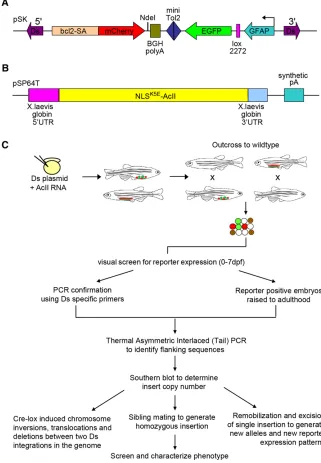
In this multi-functional screen, we developed a protein trap and enhancer trap mutagenesis cassetteflanked by 59and 39terminal sequences of theDselement, allowing integration in the presence of theActransposase. The pDsDELGT4 vector has several features that allow it to efficiently report gene expression and/or disrupt gene func-tion. The vector contains two key domains that are used to capture genomic sequences that encode enhancers and protein coding genes. The enhancer and protein trap cassettes are in opposite orientation, with an intervening miniTol2element, which can act as a launching pad for Tol2 transposase-mediated remobilizations in the vicinity of the targetedDsDELGT4insertion sites, for further insertional muta-genesis (Figure 1A).
In the protein trap cassette, a zebrafish B-cell CLL/lymphoma 2 (bcl2) splice acceptor sequence (at the intron 1/exon 2 junction of transcript ENSDART00000128843) was placed immediately upstream of themCherryreporter gene, which lacks a translation start site but maintains the stop codon sequence, followed by the bovine growth hormone (BGH) poly-adenylation signal. WhenDsDELGT4integrates into an intron in the same orientation as the protein coding sequence [open reading frame (ORF)], thebcl2splice acceptor sequence creates a fusion transcript between endogenous upstream exons andmCherry sequences, either by competing with normal splicing or by, perhaps, preventing it. Protein translation terminates aftermCherrysequences and expression of the truncated mCherry fusion protein is only detected whenmCherryis spliced in-frame with endogenous coding sequences. In the enhancer trap cassette, the GFP reporter is con-trolled by a shortglialfibrillary acidic protein(GFAP) promoter that is expressed when theDsDELGT4insertion is near enhancer sequen-ces. In addition, there is a lox2272 site between the GFAP and GFP sequences. When there are two insertions in the genome, injection of RNA encoding Cre recombinase can induce defined and precise chro-mosomal deletions, inversions, or translocations, depending on the location and orientation of the lox2272 sites (Figure 1A).
in various cell types, whereas transient mCherry expression was rarely observed. Embryos that exhibited transient reporter expression were raised to adulthood as F0 founders.
Each F0 founderfish was mated with wild-typefish to produce F1 embryos. We performed a visual screen on F1 embryos at various early developmental stages starting from fertilization until 7 d after fertilization. Reporter-positive progeny from each founder were raised as a separate line named after the founder number (Figure 1C). In total, we screened 2790 F0 individuals and identified 26 lines express-ing only mCherry, 278 lines expressexpress-ing only GFP, and 338 lines expressing both mCherry and GFP. The germ-line transmission rate based on reporter expression is 23% (Table 1). However, not everyDs insertion will cause trap events or show reporter expression within the
first 7 d after fertilization, and many protein traps are also likely to be out of the reading frame and may not produce mCherry fusion pro-teins. Therefore, the actual germ-line transmission rate for our DsDELGT4 transposon is likely to be higher than 23%. In fact, we
collected genomic DNA from F1 embryos lacking reporter expression and examined the presence ofDsinsertions by PCR (Figure 1C). An additional 176 lines were found to be PCR-positive forDsinsertions, even though they did not express either of the reporter genes at the stages examined. Therefore, the actual germ-line transmission fre-quency forDsDELGT4is30%.
[image:6.603.48.369.50.513.2]We often observed different reporter expression patterns in embryos derived from the same F0 founder, suggesting the Ac transposase introduces multiple Ds insertions in the germ cells of founders. Southern analysis performed using a mCherry probe on genomic DNA from 42 representative F1fish or their progeny showed that the founders harbor multipleDsinsertions, ranging from one to eight copies (Supporting Information,Figure S1). We used TAIL-PCR to identify the sequencesflanking the integration sites and mapped 277 sequences to the zebrafish reference genome (Zv9 assembly). In cases where we failed to identify any insertions or where the insert numbers from TAIL-PCR did not tally with estimates from Southern
Figure 1 Schematic representation of the multi-functional Ac/Ds transposon system and inser-tion screen. (A) The pDsDELGT4 vector consists of a protein trap unit and an enhancer trap unit. The protein trap unit is close to theDs59 termi-nal repeat sequences. ThemCherrycoding se-quence without the first methionine (red) is
flanked by the zebrafish B-cell
leukemia/lym-phoma 2 (bcl2)splice acceptor sequence and
the bovine growth hormone (BGH) polyadenyla-tion signal. In the reverse orientapolyadenyla-tion, close to the Ds 39 terminal repeat sequences, the en-hancer trap reporter GFP (green) is downstream of a short glial fibrillary acidic protein (GFAP) promoter and a lox2272 site. A mini Tol2 se-quence is present between the two trap units (blue). (B) Schematic representation of the con-struct for synthesizing Ac transposase mRNA, with 59UTR and 39UTR sequences from the
Xenopus globin gene. (C) Overview of the
DsDELGT4 mutagenesis screen. pDsDELGT4
hybridization, we used a high-throughput sequencing approach to complement TAIL-PCR. Although most of our lines harbor multiple Dsintegrations, theflanking sequence information can be found else-where (http://fishtrap.warwick.ac.uk/) and can be used to easily breed the line to single insert.
Reporter expression profiling of DsDELGT4integrations
The 642 lines that were positive for reporter expression exhibited a dynamic and wide range of expression patterns. For thefirst 24 hr
after fertilization, we observed different intensities of GFP expression, typically in the central nervous system (CNS) or ubiquitous distribution throughout the embryo (Figure S2 andFigure S3). Ex-pression of mCherry was usually weak and ubiquitous, and we rarely observed strong or restricted Cherry expression at early stages, unless there was maternal expression (Figure S4 and Figure S5). From 2 d after fertilization onwards, we observed more lines with both reporters expressed in the CNS, especially strong in the eyes and specific sub-domains in the developing brain, as well as in other cell type-specific patterns, such as expression in the branchial arches,fins,
[image:7.603.51.422.317.711.2]n Table 1 Screen summary
otoliths, heart tube, notochord, hatching gland, and various muscle cell types (Figure S3 and Figure S5). From 3 d after fertilization onwards, reporter expression was observed in more organs and tis-sues, such as the liver, pancreas, pronephric ducts, intestine, olfactory placodes, cranial cartilages, and blood vessels.
We observed mCherry expression in more than 70 lines at 24 hr after fertilization (Figure S4), and we even observed maternal mCherry expression in one-cell stage embryos from 59 lines. How-ever, the level of mCherry expression in some lines is low and some-times difficult to observe by eye alone. This might be due to a combination of three factors. First, mCherry expression levels are controlled by endogenous target gene promoters that might be expressed at low levels during the early stages when we assessed the reporters. Second, successful protein trapping results in a range of different fusion proteins, some of which might interfere withfl uores-cent activity of mCherry or may be out of frame. Finally, replacement of the 39end of the endogenous mRNA by mCherry might result in the absence of RNA stabilizing sequences.
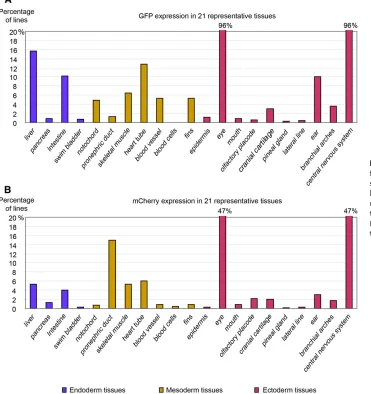
Many lines exhibited strong expression of both reporters in the CNS, but we also identified brighter expression in more specific regions, such as the mid-hindbrain boundary (MHB), forebrain-midbrain boundary (FMB), and rhombomeres of the hindbrain ( Fig-ure S2andFigure S4). In fact, 304 protein trap lines and 616 enhancer trap lines showed expression in the CNS and eyes, although we rarely see eye expression alone, but we do observe it in combination with CNS expression (Figure 2, A and B). For enhancer traps, we used a short promoter from thegfapgene, which encodes an intermediate
filament protein expressed by numerous cell types of the CNS (Eng et al.2000; Kuzmanovicet al.2003). This may partially explain the high proportion of lines with GFP expression in the CNS. After 24 hr after fertilization, and similar to previous reports in which 30–75% of
lines exhibit neuronal expression (Clark et al.2011; Stoykovaet al. 1998; Wurst et al. 1995), we also identified a large proportion of protein trapped lines with mCherry expression in the head and neural tube. Transgenic lines and mutants isolated from our screens can provide helpful information to further unravel the molecular hierar-chies involved in the development of the CNS.
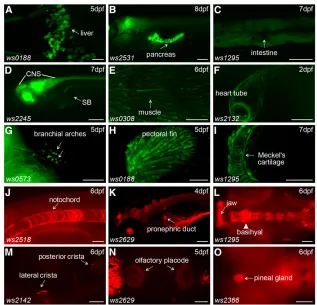
Besides the CNS, we also found reporter expression in various tissues/organs derived from all three germ layers of zebrafish embryos (Figure 2, A and B andTable S1,Table S2,Table S3,Table S4,Table S5,Table S6,Table S7,Table S8,Table S9,Table S10,Table S11,Table S12,Table S13,Table S14,Table S15,Table S16,Table S17,Table S18,
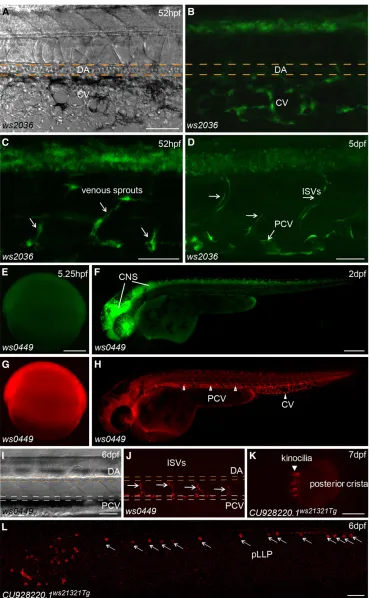
[image:8.603.46.363.407.712.2]Table S19), including expression in the liver (Figure 3A), pancreas (Figure 3B), intestine (Figure 3C), swim bladder (Figure 3D), noto-chord (Figure 3J), pronephric ducts (Figure 3K), various muscles (Figure 3E), the heart tube (Figure 3F), branchial arches (Figure 3G), fins (Figure 3H), jaw (Figure 3L), olfactory placodes (Figure 3N), cranial cartilages (Figure 3I), otoliths (Figure 3M) and the pineal gland (Figure 3O). Many lines show diverse expression patterns at different developmental stages, indicating dynamic expression of the tagged genes and/or multiple insertions in the founders. Tissue-specific expression patterns are usually a direct readout of protein activity, indicating where the protein product functions. For example, the Tg(DsDELGT4)ws2036line contains an insertion 333.13 kb up-stream of the translation start site of the zebrafishnr2f2(Coup-TFII) gene. The transcription factor COUP-TFII functions as a determinant for venous cell fate specification and promotes venous identity by inhibiting expression of arterial-specific genes (Youet al.2005). In-terestingly, the enhancer trap reporter GFP inTg(DsDELGT4)ws2036 embryos is expressed strongly in the vein and venous sprouts at 52 hr after fertilization (Figure 4, A–C). Later, at 5 d after fertilization, GFP expression is restricted to the posterior cardinal vein (PCV) and
intersegmental veins, but not in the dorsal aorta and intersegmental arteries (Figure 4D).
We found that 338 lines showed both GFP and mCherry expression during the first 7 d of development. For example, the Tg(DsDELGT4)ws0449 line shows ubiquitous GFP and mCherry
[image:9.603.50.420.44.642.2]expression during gastrulation (Figure 4, E and G); however, GFP expression is gradually restricted to the CNS (Figure 4F), whereas mCherry expression becomes stronger in the vasculature and is later detected exclusively in venous cells (Figure 4, H–J). The spatio-temporal distribution of GFP does not necessarily overlap
Figure 4 Tissue-specific expression patterns may reveal activities of trapped loci. (A–D) Brightfield (A) and
fluorescent images ofTg(DsDELGT4)
ws2036embryos at 52 hr after
fertiliza-tion (A–C), and 5 d after fertilization (D). Arrows show GFP expression in venous sprouts from posterior cardinal vein (C) and inter-segmental veins (ISVs) (D). (E– J) Brightfield (I) andfluorescent images
of Tg(DsDELGT4)ws0449 embryos at
5.25 hr after fertilization (E, G), 2 d after fertilization (F, H), and 6 d after fertiliza-tion (I, J). GFP expresses in CNS and mCherry expresses in posterior cardinal vein (PCV), caudal vein (CV) (arrow-heads in H), and intersegmental veins (arrows in J), but not in dorsal aorta (DA in J). (K, L) Fluorescent images of
a CU928220.1ws21321Tg embryo with
with dynamic mCherry expression in the same embryo, suggesting the presence of multiple trapping insertions. Moreover, the same protein trap insertion that causes mCherry expression does not always show GFP expression in the same cells. In certain cell types, the short GFAP promoter sequences may not capture the enhancer of the gene where it resides, perhaps due to the distance or genomic architecture, such that the transcription initiation complex does not form. We also identified 59 lines with maternal GFP and/or mCherry expression in one-cell stage embryos (data not shown), indicating possible maternal functions for the tagged genes.
Many lines in the collection likely contain multiple integrations. In the case of single insert lines, wefind that insertions falling within an intron or exon in the same direction of the gene can give rise to mCherry expression [e.g.,Tg(DsDELGT4)ws1894andTg(DsDELGT4) ws0310]. In contrast, GFP expression can result from insertions in intergenic regions [e.g., Tg(DsDELGT4)ws2027] and introns in sense [e.g.,Tg(DsDELGT4)ws1309] or antisense directions [e.g., Tg(DsDELGT4)ws1782].
[image:10.603.92.518.181.664.2]Reporter expression can provide useful information to predict the role of tagged novel genes. The Tg(DsDELGT4)ws21321line has an
insertion in intron 1 of a novel geneCU928220.1(full cDNA sequence predicted from EST sequences EE203339, EE302153, and Ensembl predicted transcript ENSDART00000112096), which shows sequence similarity to neuron-derived neurotrophic factor (NDNF). The ws21321 protein trap reporter is expressed exclusively in neuromasts of the lateral line system, which is important for schooling behavior, predation, and orientation offish, and it is regarded as a model to study the mechanisms of hearing (Chitniset al.2012; Froehlicheret al. 2009). We found mCherry-expressing cells were deposited along the length of the embryo, from the otic vesicle to the tip of the tail, consistent with migration of the posterior lateral line primordia (pLLP) (Figure 4L). When we looked carefully into the posterior crista of the inner ear, enhanced mCherry expression was observed in ciliary bundles (Figure 4K). The expression pattern of mCherry fusion pro-tein indicates a possible role for theCU928220.1gene in the develop-ment and maintenance of neuromasts, similar to some brain-derived neurotrophic factors (Germanaet al. 2010). This demonstrates that our Ds integrations show the potential for novel gene and novel transcript discovery. Thus, the collection of tissue-specific reporter lines from our DsDELGT4 screen provides an opportunity to identify novel signaling pathways and factors involved in differentiation of various tissues (e.g., veinvs.artery development) and constitutes a use-ful tool for studying organogenesis.
Annotation of insertions
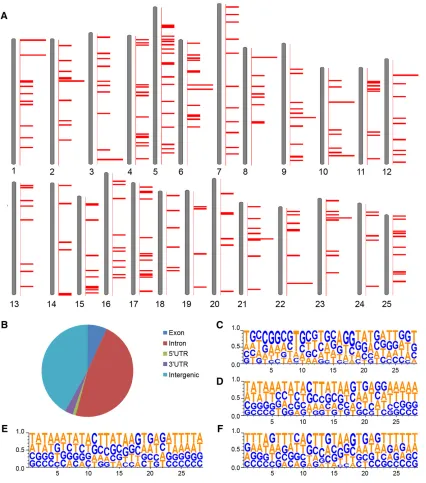
Dynamic reporter expression is usually associated with protein functions of tagged genes, so it is important to identify the corresponding insertions. However, most of the reporter lines have complex protein trap and/or enhancer trap expression patterns due to the tagging of many genes by multipleDsinsertions, making it diffi -cult to assign each specific expression pattern to a particular insertion by a single method. We used TAIL-PCR to recover the flanking sequences of theDsinsertions, performed 59 rapid amplification of cDNA ends (59 RACE) to identify the trapped genes, and we also utilized a high-throughput sequencing method in cases where both TAIL-PCR and RACE failed. We mapped 467 sequences from 310 reporter-positive lines by TAIL-PCR and RACE and found them to be distributed across all 25 chromosomes with no obvious bias or recog-nizable hotspots (based on Zv9; Figure 5A). We identified 277 unique Ds insertion sites. Fish with 212 of the insertions were successfully propagated and sperm has been cryopreserved. Approximately 42% of the 277 insertions map to intergenic regions, but the majority were found in introns (47%), exons (7%), or UTRs of known genes (4%), some of which potentially lead to protein trap events (Figure 5B).
Ds integrations occurred in a wide range of gene types (Table 2), including translational regulators [e.g., msi2 in Tg(DsDELGT4) ws1208], signaling receptors [e.g., ptprub inTg(DsDELGT4)ws0148], helicases [e.g., dhx37 in Tg(DsDELGT4)ws0977], and microtubule motors [e.g., dnah7l inTg(DsDELGT4)ws2293]. Although we observed enrichment of some gene ontology terms (e.g., WD40 repeat), these were not statistically significant on correction for multiple testing (Benjamini p-value 0.17; Table S20). Alignment of a 28-nucleotide sequence around the 277 mapped integration sites did not show any obvious consensus sequence or preferential site for the DsDELGT4integrations (Figure 5, C–F). We found an additional 54
flanking sequences that could not be mapped unambiguously to chro-mosomes. These insertions possibly fall in repetitive regions of the zebrafish genome. As the molecular characterization of the integra-tions progresses, and as the annotation of the zebrafish genome
improves further, we expect that more insertion sites will be resolved n
and new genes and transcripts may be discovered (
http://fishtrap.war-wick.ac.uk/).
Functions of tagged genes
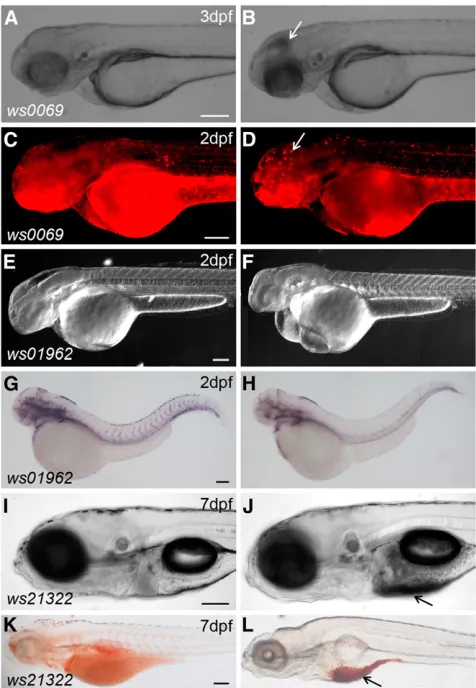
By phenotypic analysis of 283 lines, we identified 21 phenotypes (7.5%) from sibling matings of heterozygous carriers. For instance, lineTg(DsDELGT4)ws0069shows cell death in the brain (Figure 6, A– D),Tg(DsDELGT4)ws01962shows defects in vasculature development (Figure 6, E–H), andTg(DsDELGT4)ws21322shows aberrant yolk fat metabolism (Figure 6, I–L). However, the overall percentage of phe-notypic mutations is likely much larger, because we only concentrated on obvious or lethal phenotypes up to 7 d after fertilization and did not score subtle phenotypes, those requiring comparisons of marker gene expression, or other specific phenotypes (such as behavior or
physiology). Based on the number of integrations occurring within thefirst exon or intron, we estimate that 12% of insertions are likely mutagenic. It is expected that further exploration of this collection should yield higher numbers of affected loci. Further characterization is required to determine the precise molecular mechanisms by which these integrations disrupt gene function.
We have also identified potential protein trap events in many lines based onDsintegration locations identified from TAIL-PCR or RACE results. These include integrations in novel genes as well as known genes whose functions have not been described previously (Table 2). Although not every protein trap event gives rise to mCherry expres-sion, depending on the strength of expression and whethermCherryis fused in frame with upstream endogenous exons, these protein trap lines allow us to generate mutants and assess the functions of the trapped loci. We describe the characterization of the dhx37ws0977Tg
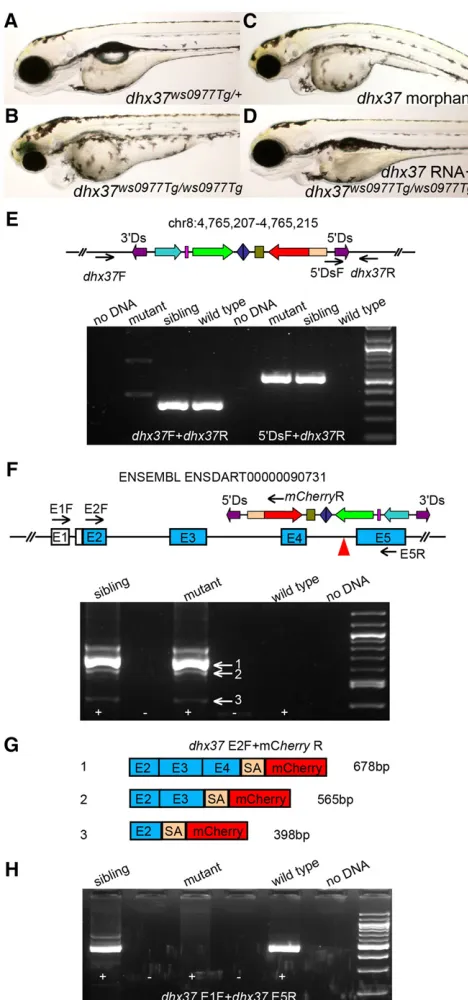
insertion as a representative example. TheTg(DsDELGT4)ws0977line harbors an insertion in intron 4 of the DEAH (Asp-Glu-Ala-His) box polypeptide 37 (dhx37) gene. Thedhx37gene encodes a putative RNA helicase. RNA helicases are usually involved in various aspects of RNA metabolism and play roles in differentiation and carcinogenesis (Abdelhaleemet al.2003; Alliet al.2006). F2 adult carriers with the dhx37ws0977Tg insertion were inter-crossed to generatedhx37ws0977Tg
homozygotes. Mutant embryos exhibited edema and overall reduction in the anterior brain, as well as a shortened body axis (Figure 7, A and B). These developmental defects can be phenocopied by injecting dhx37ATG morpholinos (35%, n = 62; Figure 7C) and splice mor-pholinos toward the intron 4/exon 5 acceptor site ofdhx37(28%, n = 60) into one-cell stage wild-type embryos. By co-injecting wild-type dhx37 RNA, mutant phenotypes can be rescued to wild-type mor-phology (Figure 7D). The flanking genomic sequence of theDs in-sertion was mapped to chromosome 8, and the orientation ofmCherry was found to be the same as that of the dhx37gene. Single PCR products containing the 59 endDssequence and adjacent flanking genomic sequence were amplified in mutants and siblings, but not in wild-type embryos. By contrast, a pair of primers spanning the integration site can amplify robustly in sibling and wild-type embryos, but not in mutants. Taken together, these results show that theDs transposon integration within thedhx37gene is responsible for the mutant phenotype observed in dhx37ws0977Tg homozygotes (Figure
7E).
To determine whether thebcl2splice acceptor in theDsinsertion trapped the dhx37transcripts, we prepared total RNA from dhx37 mutant, sibling, and wild-type embryos at 3 d after fertilization and performed reverse-transcription PCR (RT-PCR) using a primer in the
[image:12.603.53.291.223.567.2]first coding exon (exon 2) of the dhx37 gene and a primer in the mCherrycoding sequence. Multiple fusion products were detected in mutants and siblings, indicating that thebcl2splice acceptor trapped the dhx37 transcript (Figure 7F). Sequencing the fusion products showed that the bcl2 splice acceptor from this insertion not only trapped the most adjacent donor site but also trapped all the upstream splice donor sites of the same gene (Figure 7G). The distance between the splice donor and acceptor sites may influence trapping efficiency (Figure 7, F and G). The major fusion products are out-of-frame for mCherry coding sequence (Figure 7G), which may explain why mCherry reporter expression is barely detected in dhx37 mutants and siblings. In addition, when we used a primer targeting the 59 noncoding exon (exon 1) of thedhx37gene and another primer to-ward sequences in exon 5 (the exon immediately downstream of the Dsinsertion) by standard RT-PCR, we could not amplify any PCR products from mutants embryos and only mutant fusion transcripts
Figure 6 Representative mutant phenotypes inDsDELGT4insertion lines. TheTg(DsDELGT4)ws0069mutant shows cell death in the brain (B) compared to siblings (A) (brightfield images). (C, D) Acridine Or-ange labeling to show cell death in the brain of mutant embryos (D) compared to siblings (C). White arrows in (B) and (D) show cell death in
mutants. DIC images of Tg(DsDELGT4)ws01962 mutants showing
were detected. This suggests that the protein trap insertion in Tg(DsDELGT4)ws0977 disrupted normal splicing.
Database ofDstransposon integrations
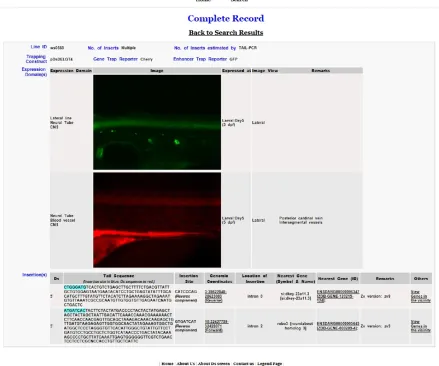
OurDsintegrations disrupt gene functions in the manner in which a fusion protein may be expected. It provides a rich resource of mutants and tissue-specific transgenic reporter lines, complementing other large-scale screens to facilitate the identification and functional study of known as well as novel genes and transcripts. We developed a web-based interface to store and report the expression and molec-ular analysis ofDsDELGT4lines (http://fishtrap.warwick.ac.uk/). The website provides information that includes reporter expression pat-terns, integration sites, andflanking sequence data. As more integra-tion sites and trapped genes are identified, more data will be made available. For data inquiry, the interface can be simply searched by four parameters: line number, expression domains, developmental stage, and gene name. In the advanced search function, the chromo-some, scaffold, and integration site are additional fields for inquiry. The system can also show records that match multiple or any of the parameters. Figure 8 shows an example of the record for line Tg(DsDELGT4)ws0585. Cryopreserved sperm from the Ds integra-tion lines are being deposited with the European Zebrafish Resource Centre (http://www.ezrc.kit.edu/) to be made available to the broader research community.
Applications of theDsDELGT4insertion collection
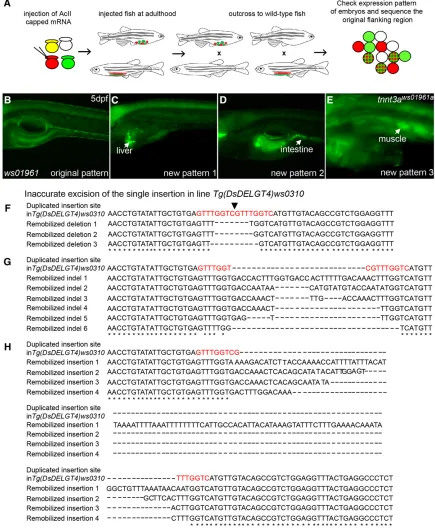
TheDsDELGT4transposon system provides opportunities to modify the integrations for various purposes. Re-introducing the Ac trans-posase will lead to excision of existingDsDELGT4insertions. A precise Dsexcision leaves an 8-bp duplication footprint (Saedler and Nevers 1985). However, we observed that in 43% of re-mobilizations, inac-curate excisions occurred and led to various mutations in the original locus, including local deletions, insertions, and indels (Figure 9, A, F– H). This feature can therefore enable targeted genetic manipulation at each integration locus. With aberrant excision, it should be possible to easily generate multiple alleles for the transposon-tagged loci. Simi-larly, on excision of mutant-phenotype-causing protein trap integra-tions, we can expect rescue of the mutant phenotypes in subsequent generations. At the same time, re-integration ofDsDELGT4into new loci of the genome can produce new expression patterns that are distinct from the original Ds line, indicating novel protein trap or enhancer trap events (Figure 9, B–E). By using such a strategy, we acquired a protein trap linetnnt3aws01961aTgwith theDsinsertion in
exon 6 of thetroponin T3agene (chr25:32,256,224-32,256,231, sense strand) derived from remobilization of the single insertion (chr1:20205236-20205244, antisense strand) in the Tg(DsDELGT4) ws01961 line (Figure 9, B and E). It was reported thattnnt3agene is expressed in fast-twitch muscles, head muscles, pectoralfin muscles, and hypaxial muscles from 18 hr after fertilization in zebrafish (Ferranteet al.2011). Ourtnnt3aws01961aTgembryos also show GFP
and mCherry expression in these cells, consistent with the published reports. Dominant mutations in TNNT3cause distal arthrogryposis (DA) disorders in humans (Sunget al.2003), and depletion oftnnt3a in zebrafish via morpholinos blocks normal myofibrillogenesis (Ferrante et al.2011). Thetnnt3aws01961aTgline generated by
[image:13.603.53.287.45.545.2]re-in-tegration ofDsDELGT4insertion may provide a useful model to study
Figure 7 Protein trap-induced mutant phenotype affecting thedhx37 gene. (A–D) Brightfield images ofdhx37ws0977Tg/+sibling (A), homo-zygous dhx37ws0977Tg/ws0977Tg mutant (B), dhx37 ATG morpholino-injected (C), or full-lengthdhx37RNA-injected homozygous mutant embryo (D). (E) TheDsinsertion in chr8:4765207-4765215 is linked to the mutant phenotype. Black arrows indicate the position of primers used for genotyping PCRs. (F–H) RT-PCR results from homozygous
dhx37ws0977Tg/ws0977Tg embryos show that the bcl2 splice acceptor
sequence trapped endogenous upstream splice donor sites in the
dhx37gene, producing multiple fusion transcripts (F, G), leading to
the disruption of wild-type transcripts (H). (G) The main fusion prod-ucts, 1 and 2, are out of frame with respect to the reading sequence. Black arrows in the schematic in (F) indicate the positions of primers used for RT-PCR. No evidence of wild-type transcripts was found, and only mutant fusion transcripts were detected. The fusion transcripts always have a 71-bp linker sequence (SA) originated frombcl2splice
acceptor site left between upstream exons and themCherryreporter sequence. The major fusion transcripts 1 and 2 are out of frame for
the function oftnnt3aand to understand the basis of DA syndromes in humans. Thus, iterative remobilizations of theDsDELGT4 integra-tions can offer near-infinite possibilities to visualize the expressed genome, to provide information regarding the functions of trapped genes, and to specifically modify the genome in a directed manner.
DISCUSSION
Our pDsDELGT4 is a multifunctional vector whose integration simultaneously enables visualization of the expressed genome and its mutagenesis. The Ds insertions trap enhancers of endogenous genes and reveal their expression with GFP tagging. When protein traps happen with reporter fusions in frame, mCherry expression exhibits endogenous protein expression information to some extent. In cases where mCherry fusion occurs out of frame, the expression of fusion products can be unmasked byin situhybridization with anti-sensemCherryprobes. Depending on the insert location, mCherry-tagged fusion proteins may terminate at different positions along the peptide. If fusion happens at the N-terminus, then it is more likely to
produce functional protein-null alleles, providing useful tools to analyze the function of the gene product. If fusion happens at the C-terminus, then it is more likely to produce proteins with partial functions. Although the expression of the protein trap reporter may not faithfully reflect the wild-type protein expression of trapped genes, the truncated fusion proteins may retain at least some information, such as protein localization, facilitating prediction of protein func-tions. Because our lines show reporter expression in various cell types, they may reveal multiple novel signaling pathways and factors in the development of labeled organs.
[image:14.603.87.526.74.440.2]The percentage of phenotypic mutations observed was low, similar to previously reported screens (Kettleboroughet al.2013). There are several reasons for this. First, we only monitored morphological changes in embryos during thefirst week of development. The assay used was not efficient for discovering subtle phenotypes that may require in-depth investigation or defects that may arise at later stages. Second, paralog redundancy is common in the zebrafish genome (Postlethwaitet al.2000). Third, based on the location of the protein
Figure 8 The FISHTRAP database ofDsDELGT4line expression and molecular data. This web-based interface stores reporter expression and
trap, a mutation may or may not disrupt gene function and manifest an obvious phenotype. Fourth, in some homozygous mutants, mater-nal contribution of the gene products may compensate for their
[image:15.603.84.519.50.579.2]zygotic functions; therefore, embryos from homozygous mutant females will need to be examined to assess the function of these genes. Nonetheless, we recovered some obvious mutant phenotypes by
visually screening embryos from random intercrosses of F2 or F3 generation siblings (Figure 6). We have also identified many potential protein trap insertions based on the integration locations (Table 2). Therefore, it may be possible to identify more phenotypic mutations in the future.
We showed that theDscollection can be used to create additional enhancer and protein trap events by remobilization of the existingDs insertions. This strategy can be useful for achieving saturation muta-genesis and for obtaining more comprehensive gene and enhancer trap expression patterns. With our Dscassette design, the presence of two or moreDsDELGT4insertions in the same genome can also allow Cre-lox–mediated recombination, which can lead to defined chromosome segment inversions, translocations, or deletions, depend-ing on the orientation and location of the lox2272 sites inDsDELGT4 integrations. For instance, by injecting Cre recombinase RNA into embryos with twoDsDELGT4insertions oriented in the same direc-tion on a segment of chromosome 21, we were able to generate a 25-Mb deletion (with a deletion frequency of 7%; Figure S6), encompassing the nodal-related gene,squint. Cre-mediated recombi-nation can potentially also be deployed to generate precise segmental inversions betweenDsinsertion sites, which, together with reporter expression as markers, could facilitate the generation of balancer chro-mosomes (Muller 1918).
In recent years, a number of transposon-based protein trap and enhancer trap systems have been developed and successfully used in many cells and vertebrate organisms (Boon Ng and Gong 2011; Emelyanovet al.2006; Froschaueret al.2012; Huanget al.2010; Song et al.2011). Compared to other mutagenesis strategies, transposon-based protein trap systems produce higher mutagenesis frequencies, easier identification of mutated genes, and also report endogenous gene expression patterns (Stanfordet al.2001). However, the number of genes studied is much less than the protein coding genes in most target genomes, partly due to the limitations of transposons currently used. PiggyBac targets the tetra-nucleotide sequence TTAA and all knownTc1/marinertransposons, includingSleeping Beauty(SB), pref-erentially insert at TA dinucleotides (Ivics and Izsvak 2010). TheTol2 element does not seem to have a consensus sequence for insertion at the primary DNA sequence level, but some studies show a pronounced preference for Tol2 to integrate close to transcriptional start sites (Grabundzijaet al.2010), CpG islands, and DNase I hypersensitive sites (Huanget al.2010). The presence of such preferences and biases is a limitation for any large-scale mutagenesis screen. In contrast, the DsDELGT4insertions we mapped were found distributed across all 25 zebrafish chromosomes and we did not observe any obvious sequence or genomic region preferences for Ds in the 277 integration sites reported here. However, a larger dataset needs to be analyzed to
de-finitively determine ifDsshows integration site preferences similar to those observed with other insertional mutagenesis tools.
TheAc/Dssystem belongs to the samehATfamily asTol2, and it has many advantageous features: high integration rates (30% in
zebra-fish and medaka); no obvious consensus DNA sequence for insertion targets; and no sensitivity to overproduction inhibition, unlike theSB transposon for which elevated concentrations of the transposase in-hibit transposition (Geurts et al.2003). In contrast, Ac/Ds-injected embryos can tolerate up to 100 pg of Ac transposase RNA without affecting the insertion rate. TheAc/Dssystem has a large cargo ca-pacity (A. Emelyanov and S. Parinov, unpublished observation) and functions in a wide spectrum of hosts. Most importantly,Dscan in-tegrate throughout the genome and does not cause gross rearrange-ments around the integration sites (Boon Ng and Gong 2011; Froschaueret al.2012; Emelyanovet al.2006; Trinh leet al.2011).
TheAc/Ds system has been extensively used for mutagenesis in plants such asArabidopsis, rice, and barley (Chinet al.1999; Kuromori et al.2004; Lazarow and Lutticke 2009; Sundaresanet al.1995.), but has only been applied in a few small-scale screens in human cells, zebrafish, and medaka (Boon Ng and Gong 2011; Emelyanovet al. 2006; Froschauer et al. 2012; Trinh le et al. 2011). So far, our DsDELGT4screen in zebrafish is thefirst large-scale attempt to use the maizeAc/Dsfor protein traps and enhancer traps in a vertebrate model organism. To fully understand the expression and function of a protein-coding gene, usually multiple mutant alleles will be needed, so comprehensive study of all the protein-coding genes in a vertebrate genome (for example, more than 26,000 protein-coding genes in zebrafish) requires millions of mutational events, which cannot be achieved by using a single mutagen. Therefore, the different mutagens, trapping strategies, vectors and transposon systems, and genome edit-ing can be used to complement each other to minimize biases and achieve maximal genome coverage.
In summary, with theDsDELGT4system, we have successfully obtained numerous tissue-specific transgenic lines and created mutants affecting both known and novel genes. Our results in zebrafish suggest that Dscould be a useful tool to systematically modify the genomes of other vertebrates as well. This may be especially useful for medaka becauseTol2is not suitable for trans-genesis in this animal due to its natural inhibition in the host. Our collection ofDsDELGT4transposon insertion lines has the poten-tial to advance our knowledge of the biological basis for vertebrate development and human diseases.
ACKNOWLEDGMENTS
We thank the Sampath laboratory and our colleagues in Singapore and Warwick for discussions and suggestions; Hugh Woodland, Lavanya Sivashanmugam, and Jennifer Holden for suggestions to improve the manuscript; Chin Heng Goh and the Temasek Life Sciences Laboratoryfish, imaging, and sequencing facilities; and Ian Bagley and the Warwick fish facility for technical support. C.W. is supported by Department of Biological Sciences, National University of Singapore. G.K.V., M.C.L., and S.M.B. were supported by the Intramural Research Program of the National Human Genome Research Institute, National Institutes of Health. K.S. and P.V. are supported by Warwick Medical School. The authors declare no conflict of interest.
LITERATURE CITED
Abdelhaleem, M., L. Maltais, and H. Wain, 2003 The human DDX and DHX gene families of putative RNA helicases. Genomics 81: 618–622. Allen, N. D., D. G. Cran, S. C. Barton, S. Hettle, W. Reiket al.,
1988 Transgenes as probes for active chromosomal domains in mouse development. Nature 333: 852–855.
Alli, Z., C. Ackerley, Y. Chen, B. Al-Saud, and M. Abdelhaleem, 2006 Nuclear and mitochondrial localization of the putative RNA helicase DHX32. Exp. Mol. Pathol. 81: 245–248.
Asakawa, K., and K. Kawakami, 2009 The Tol2-mediated Gal4-UAS method for gene and enhancer trapping in zebrafish. Methods 49: 275– 281.
Boon Ng, G. H., and Z. Gong, 2011 Maize Ac/Ds transposon system leads to highly efficient germline transmission of transgenes in medaka (Or-yzias latipes). Biochimie 93: 1858–1864.
Chin, H. G., M. S. Choe, S. H. Lee, S. H. Park, J. C. Kooet al.,
1999 Molecular analysis of rice plants harboring an Ac/Ds transposable element-mediated gene trapping system. Plant J. 19: 615–623. Chitnis, A. B., D. D. Nogare, and M. Matsuda, 2012 Building the posterior
Clark, K. J., D. Balciunas, H. M. Pogoda, Y. Ding, S. E. Westcotet al., 2011 In vivo protein trapping produces a functional expression codex of the vertebrate proteome. Nat. Methods 8: 506–515.
Crooks, G. E., G. Hon, J. M. Chandonia, and S. E. Brenner, 2004 WebLogo: a sequence logo generator. Genome Res. 14: 1188–1190.
Driever, W., L. Solnica-Krezel, A. F. Schier, S. C. Neuhauss, J. Malickiet al., 1996 A genetic screen for mutations affecting embryogenesis in zebra-fish. Development 123: 37–46.
Edwards, A. M., R. Isserlin, G. D. Bader, S. V. Frye, T. M. Willsonet al., 2011 Too many roads not taken. Nature 470: 163–165.
Emelyanov, A., Y. Gao, N. I. Naqvi, and S. Parinov, 2006 Trans-kingdom transposition of the maize dissociation element. Genetics 174: 1095– 1104.
Eng, L. F., R. S. Ghirnikar, and Y. L. Lee, 2000 Glialfibrillary acidic protein: GFAP-thirty-one years (1969–2000). Neurochem. Res. 25: 1439–1451.
Ferrante, M. I., R. M. Kiff, D. A. Goulding, and D. L. Stemple, 2011 Troponin T is essential for sarcomere assembly in zebrafish skeletal muscle. J. Cell Sci. 124(Pt 4): 565–577.
Froehlicher, M., A. Liedtke, K. J. Groh, S. C. Neuhauss, H. Segneret al., 2009 Zebrafish (Danio rerio) neuromast: promising biological endpoint linking developmental and toxicological studies. Aquat. Toxicol. 95: 307– 319.
Froschauer, A., D. Sprott, F. Gerwien, Y. Henker, F. Rudolphet al., 2012 Effective generation of transgenic reporter and gene trap lines of the medaka (Oryzias latipes) using the Ac/Ds transposon system. Transgenic Res. 21: 149–162.
Germana, A., R. Laura, G. Montalbano, M. C. Guerrera, V. Amatoet al., 2010 Expression of brain-derived neurotrophic factor and TrkB in the lateral line system of zebrafish during development. Cell. Mol. Neurobiol. 30: 787–793.
Geurts, A. M., Y. Yang, K. J. Clark, G. Liu, Z. Cuiet al., 2003 Gene transfer into genomes of human cells by the sleeping beauty transposon system. Mol. Ther. 8: 108–117.
Gossler, A., A. L. Joyner, J. Rossant, and W. C. Skarnes, 1989 Mouse em-bryonic stem cells and reporter constructs to detect developmentally regulated genes. Science 244: 463–465.
Grabher, C., T. Henrich, T. Sasado, A. Arenz, J. Wittbrodtet al., 2003 Transposon-mediated enhancer trapping in medaka. Gene 322: 57–66.
Grabundzija, I., M. Irgang, L. Mates, E. Belay, J. Matraiet al.,
2010 Comparative analysis of transposable element vector systems in human cells. Mol. Ther. 18: 1200–1209.
Haffter, P., M. Granato, M. Brand, M. C. Mullins, M. Hammerschmidtet al., 1996 The identification of genes with unique and essential functions in the development of the zebrafish, Danio rerio. Development 123: 1–36. Hamlet, M. R., D. A. Yergeau, E. Kuliyev, M. Takeda, M. Tairaet al.,
2006 Tol2 transposon-mediated transgenesis in Xenopus tropicalis. Genesis 44: 438–445.
Howe, K., M. D. Clark, C. F. Torroja, J. Torrance, C. Berthelotet al., 2013 The zebrafish reference genome sequence and its relationship to the human genome. Nature 496: 498–503.
Huang, X., H. Guo, S. Tammana, Y. C. Jung, E. Mellgrenet al., 2010 Gene transfer efficiency and genome-wide integration profiling of Sleeping Beauty, Tol2, and piggyBac transposons in human primary T cells. Mol. Ther. 18: 1803–1813.
Hummel, T., and C. Klambt, 2008 P-element mutagenesis. Methods Mol. Biol. 420: 97–117.
Ivics, Z., P. B. Hackett, R. H. Plasterk, and Z. Izsvak, 1997 Molecular re-construction of Sleeping Beauty, a Tc1-like transposon fromfish, and its transposition in human cells. Cell 91: 501–510.
Ivics, Z., and Z. Izsvak, 2010 The expanding universe of transposon tech-nologies for gene and cell engineering. Mob. DNA 1: 25.
Kawakami, K., 2005 Transposon tools and methods in zebrafish. Dev. Dyn. 234: 244–254.
Kawakami, K., 2007 Tol2: a versatile gene transfer vector in vertebrates. Genome Biol. 8(Suppl 1): S7.
Kawakami, K., and T. Noda, 2004 Transposition of the Tol2 element, an Ac-like element from the Japanese medakafish Oryzias latipes, in mouse embryonic stem cells. Genetics 166: 895–899.
Kawakami, K., K. Imanaka, M. Itoh, and M. Taira, 2004a Excision of the Tol2 transposable element of the medakafish Oryzias latipes in Xenopus laevis and Xenopus tropicalis. Gene 338: 93–98.
Kawakami, K., H. Takeda, N. Kawakami, M. Kobayashi, N. Matsudaet al., 2004b A transposon-mediated gene trap approach identifies develop-mentally regulated genes in zebrafish. Dev. Cell 7: 133–144.
Kettleborough, R. N., E. M. Busch-Nentwich, S. A. Harvey, C. M. Dooley, E. de Bruijnet al., 2013 A systematic genome-wide analysis of zebrafish protein-coding gene function. Nature 496: 494–497.
Kitada, K., S. Ishishita, K. Tosaka, R. Takahashi, M. Uedaet al.,
2007 Transposon-tagged mutagenesis in the rat. Nat. Methods 4: 131– 133.
Koga, A., M. Suzuki, H. Inagaki, Y. Bessho, and H. Hori, 1996 Transposable element infish. Nature 383: 30.
Kothary, R., S. Clapoff, A. Brown, R. Campbell, A. Petersonet al., 1988 A transgene containing lacZ inserted into the dystonia locus is expressed in neural tube. Nature 335: 435–437.
Kuromori, T., T. Hirayama, Y. Kiyosue, H. Takabe, S. Mizukadoet al., 2004 A collection of 11 800 single-copy Ds transposon insertion lines in Arabidopsis. Plant J. 37: 897–905.
Kuzmanovic, M., V. J. Dudley, and V. P. Sarthy, 2003 GFAP promoter drives Muller cell-specific expression in transgenic mice. Invest. Oph-thalmol. Vis. Sci. 44: 3606–3613.
LaFave, M. C., G. K. Varshney, D. E. Gildea, T. G. Wolfsberg, A. D. Baxevanis
et al., 2014 MLV integration site selection is driven by strong enhancers and active promoters. Nucleic Acids Res. 42: 4257–4269.
Lazarow, K., and S. Lutticke, 2009 An Ac/Ds-mediated gene trap system for functional genomics in barley. BMC Genomics 10: 55.
Liu, Y. G., and R. F. Whittier, 1995 Thermal asymmetric interlaced PCR: automatable amplification and sequencing of insert end fragments from P1 and YAC clones for chromosome walking. Genomics 25: 674–681. Lukacsovich, T., and D. Yamamoto, 2001 Trap a gene andfind out its
function: toward functional genomics in Drosophila. J. Neurogenet. 15: 147–168.
Mates, L., M. K. Chuah, E. Belay, B. Jerchow, N. Manojet al., 2009 Molecular evolution of a novel hyperactive Sleeping Beauty transposase enables robust stable gene transfer in vertebrates. Nat. Genet. 41: 753–761.
McClintock, B., 1948 Mutable loci in maize. Carnegie Institute of Wash-ington Year Book 47: 155–169.
McClintock, B., 1951 Chromosome organization and genic expression. Cold Spring Harb. Symp. Quant. Biol. 16: 13–47.
Miller, A. C., N. D. Obholzer, A. N. Shah, S. G. Megason, and C. B. Moens, 2013 RNA-seq-based mapping and candidate identification of muta-tions from forward genetic screens. Genome Res. 23: 679–686. Morin, X., 2003 In vivo protein trapping in Drosophila. Brief. Funct.
Ge-nomics Proteomics 2: 137–141.
Muller, H. J., 1918 Genetic variability, twin hybrids and constant hybrids, in a case of balanced lethal factors. Genetics 3: 422–499.
Mullins, M., 1995 Genetic nomenclature guide. Zebrafish. Trends Genet. Mar: 31–32.
Munoz-Lopez, M., and J. L. Garcia-Perez, 2010 DNA transposons: nature and applications in genomics. Curr. Genomics 11: 115–128.
O’Kane, C. J., and W. J. Gehring, 1987 Detection in situ of genomic reg-ulatory elements in Drosophila. Proc. Natl. Acad. Sci. USA 84: 9123– 9127.
Parinov, S., I. Kondrichin, V. Korzh, and A. Emelyanov, 2004 Tol2 trans-poson-mediated enhancer trap to identify developmentally regulated ze-brafish genes in vivo. Dev. Dyn. 231: 449–459.
Postlethwait, J. H., I. G. Woods, P. Ngo-Hazelett, Y. L. Yan, P. D. Kellyet al., 2000 Zebrafish comparative genomics and the origins of vertebrate chromosomes. Genome Res. 10: 1890–1902.
Saedler, H., and P. Nevers, 1985 Transposition in plants: a molecular model. EMBO J. 4: 585–590.
Sato, Y., T. Kasai, S. Nakagawa, K. Tanabe, T. Watanabeet al., 2007 Stable integration and conditional expression of electroporated transgenes in chicken embryos. Dev. Biol. 305: 616–624.
Sinzelle, L., J. Vallin, L. Coen, A. Chesneau, D. Du Pasquieret al., 2006 Generation of trangenic Xenopus laevis using the Sleeping Beauty transposon system. Transgenic Res. 15: 751–760.
Skarnes, W. C., B. A. Auerbach, and A. L. Joyner, 1992 A gene trap ap-proach in mouse embryonic stem cells: the lacZ reported is activated by splicing, reflects endogenous gene expression, and is mutagenic in mice. Genes Dev. 6: 903–918.
Skarnes, W. C., H. von Melchner, W. Wurst, G. Hicks, A. S. Nordet al., 2004 A public gene trap resource for mouse functional genomics. Nat. Genet. 36: 543–544.
Song, J. S., H. P. Kim, and E. Rubin, 2011 Development of a Sleeping Beauty-based telomerase gene delivery system for hepatocytes. Biosci. Biotechnol. Biochem. 75: 227–231.
Spradling, A. C., and G. M. Rubin, 1982 Transposition of cloned P elements into Drosophila germ line chromosomes. Science 218: 341–347. Stainier, D. Y., B. M. Weinstein, H. W. Detrich, 3rd, L. I. Zon, and M. C.
Fishman, 1995 Cloche, an early acting zebrafish gene, is required by both the endothelial and hematopoietic lineages. Development 121: 3141–3150.
Stanford, W. L., J. B. Cohn, and S. P. Cordes, 2001 Gene-trap mutagenesis: past, present and beyond. Nat. Rev. Genet. 2: 756–768.
Stoykova, A., K. Chowdhury, P. Bonaldo, M. Torres, and P. Gruss, 1998 Gene trap expression and mutational analysis for genes involved in the development of the mammalian nervous system. Dev. Dyn. 212: 198–213.
Sundaresan, V., P. Springer, T. Volpe, S. Haward, J. D. Joneset al., 1995 Patterns of gene action in plant development revealed by en-hancer trap and gene trap transposable elements. Genes Dev 9: 1797– 1810.
Sung, S. S., A. M. Brassington, K. Grannatt, A. Rutherford, F. G. Whitbyet al., 2003 Mutations in genes encoding fast-twitch contractile proteins cause distal arthrogryposis syndromes. Am. J. Hum. Genet. 72: 681–690.
Tanabe, K., Y. Takahashi, Y. Sato, K. Kawakami, M. Takeichiet al., 2006 Cadherin is required for dendritic morphogenesis and synaptic terminal organization of retinal horizontal cells. Development 133: 4085– 4096.
Tian, J., C. Yam, G. Balasundaram, H. Wang, A. Goreet al., 2003 A temperature-sensitive mutation in the nodal-related gene cyclops reveals that thefloor plate is induced during gastrulation in zebrafish. Development 130: 3331–3342.
Trinh le, A., T. Hochgreb, M. Graham, D. Wu, F. Ruf-Zamojskiet al., 2011 A versatile gene trap to visualize and interrogate the function of the vertebrate proteome. Genes Dev. 25: 2306–2320.
Varshney, G. K., J. Lu, D. E. Gildea, H. Huang, W. Peiet al., 2013 A large-scale zebrafish gene knockout resource for the genome-wide study of gene function. Genome Res. 23: 727–735.
Weber, F., J. de Villiers, and W. Schaffner, 1984 An SV40“enhancer trap” incorporates exogenous enhancers or generates enhancers from its own sequences. Cell 36: 983–992.
White, J. K., A. K. Gerdin, N. A. Karp, E. Ryder, M. Buljanet al., 2013 Genome-wide generation and systematic phenotyping of knock-out mice reveals new roles for many genes. Cell 154: 452–464. Wilson, M. H., C. J. Coates, and A. L. George, Jr., 2007 PiggyBac
transposon-mediated gene transfer in human cells. Mol. Ther. 15: 139–145. Wu, S. C., Y. J. Meir, C. J. Coates, A. M. Handler, P. Pelczaret al.,
2006 piggyBac is aflexible and highly active transposon as compared to sleeping beauty, Tol2, and Mos1 in mammalian cells. Proc. Natl. Acad. Sci. USA 103: 15008–15013.
Wurst, W., J. Rossant, V. Prideaux, M. Kownacka, A. Joyneret al., 1995 A large-scale gene-trap screen for insertional mutations in developmentally regulated genes in mice. Genetics 139: 889–899.
You, L. R., F. J. Lin, C. T. Lee, F. J. DeMayo, M. J. Tsaiet al.,
2005 Suppression of Notch signalling by the COUP-TFII transcription factor regulates vein identity. Nature 435: 98–104.
Yusa, K., R. Rad, J. Takeda, and A. Bradley, 2009 Generation of transgene-free induced pluripotent mouse stem cells by the piggyBac transposon. Nat. Methods 6: 363–369.