warwick.ac.uk/lib-publications
Original citation:
Stuart, Andrew M. and Dunlop, Matthew M.. (2016) The Bayesian formulation of EIT :
analysis and algorithms. Inverse Problems and Imaging, 10 (4). pp. 1007-1036.
Permanent WRAP URL:
http://wrap.warwick.ac.uk/86371
Copyright and reuse:
The Warwick Research Archive Portal (WRAP) makes this work by researchers of the
University of Warwick available open access under the following conditions. Copyright ©
and all moral rights to the version of the paper presented here belong to the individual
author(s) and/or other copyright owners. To the extent reasonable and practicable the
material made available in WRAP has been checked for eligibility before being made
available.
Copies of full items can be used for personal research or study, educational, or not-for-profit
purposes without prior permission or charge. Provided that the authors, title and full
bibliographic details are credited, a hyperlink and/or URL is given for the original metadata
page and the content is not changed in any way.
Publisher’s statement:
This is a pre-copy-editing, author-produced PDF of an article accepted for publication in
Inverse Problems and Imaging following peer review. The definitive publisher-authenticated
version Stuart, Andrew M. and Dunlop, Matthew M. (2016) The Bayesian formulation of EIT :
analysis and algorithms. Inverse Problems and Imaging, 10 (4). pp. 1007-1036. is available
online at:
http://dx.doi.org/10.3934/ipi.2016030
A note on versions:
The version presented here may differ from the published version or, version of record, if
you wish to cite this item you are advised to consult the publisher’s version. Please see the
‘permanent WRAP URL’ above for details on accessing the published version and note that
access may require a subscription.
ANALYSIS AND ALGORITHMS
Matthew M. Dunlop
Computing & Mathematical Sciences, California Institute of Technology,
Pasadena, CA 91125, USA
Andrew M. Stuart
Computing & Mathematical Sciences, California Institute of Technology,
Pasadena, CA 91125, USA
Abstract. We provide a rigorous Bayesian formulation of the EIT problem
in an infinite dimensional setting, leading to well-posedness in the Hellinger metric with respect to the data. We focus particularly on the reconstruction of binary fields where the interface between different media is the primary unknown. We consider three different prior models – log-Gaussian, star-shaped and level set. Numerical simulations based on the implementation of MCMC are performed, illustrating the advantages and disadvantages of each type of prior in the reconstruction, in the case where the true conductivity is a binary field, and exhibiting the properties of the resulting posterior distribution.
1. Introduction
1.1. Background. Electrical Impedance Tomography (EIT) is an imaging
tech-nique in which the conductivity of a body is inferred from electrode measurements on its surface. Examples include medical imaging, where the methodology is used to non-invasively detect abnormal tissue within a patient, and subsurface imaging where material properties of the subsurface are determined from surface (or occa-sional interior) measurements of the electrical response; the methodology is often referred to as electrical resistance tomography – ERT – in this context and discussed in more detail below. The concept of EIT appears as early as the late 1970’s [15] and ERT the 1930’s [28].
A very influential mathematical formulation of the inverse problem associated with EIT dates back to 1980, due to Calder´on. He formulated an abstract version of the problem, in which the objective is recovery of the coefficient of a diver-gence form elliptic PDE from knowledge of its Neumann-to-Dirichlet or Dirichlet-to-Neumann operator. Specifically, in the Dirichlet-Dirichlet-to-Neumann case, if D ⊆Rd andg∈H1/2(∂D) is given, letu
∈H1(D) solve (
−∇ ·(σ∇u) = 0 inD u=g on∂D.
1991Mathematics Subject Classification. Primary: 62G05, 65N21; Secondary: 92C55. Key words and phrases. inverse problems, ill-posed problems, electrical impedance tomography, Bayesian regularisation, geometric priors, level set methodology.
1
The problem of interest is then to ask does the mapping Λσ : H1/2(∂D) → H−1/2(∂D) given by
g7→σ∂u ∂ν
determine the coefficient σ in D? Physically, g corresponds to boundary volt-age measurements, and Λσ(g) corresponds to the current density on the boundary.
Much study has been carried out on this problem – some significant results, in the case where all conductivities are in C2(D) and d
≥ 3, concern uniqueness [42], reconstruction [35], stability [2] and partial data [22]. Details of these results are summarised in [38].
In 1996, Nachman proved global uniqueness and provided a reconstruction pro-cedure for the cased= 2, involving the use of a scattering transform and solving a D-bar problem [36]. The D-bar equation involved is a differential equation of the form ∂q =f, where ∂ denotes the conjugate of the complex derivative andf depends on the scattering transform. A regularised D-bar approach, involving the truncation of the scattering transform, was provided in [23,24], enabling the recov-ery of features of discontinuous permeabilities. The regularised D-bar approach is also used in [25], for the case when the data is not of infinite precision. Other work in the area includes joint inference of the shape of the domain and conductivity [26]. For applications, a more physically appropriate model for EIT was provided in 1992 in [40]. This model, referred to as the complete electrode model (CEM), re-places complete boundary potential measurements with measurements of constant potential along electrodes on the boundary, subject to contact impedances. The au-thors show that predictions from this model agree with experimental measurements up to the measurement precision of 0.1%. For this model they also prove existence and uniqueness of the associated electric potential. It is this model that we shall consider in this paper, and it is outlined in section2.
When using the CEM, there is a limitation on the number of measurements that can be taken to provide additional information. This is due to the fact that there are only a finite number of electrodes through which current can be injected and voltages read, combined with the linear relationship between current and voltage. The data is therefore finite dimensional in the inverse problem, as distinct from the Calder´on problem where knowledge of an infinite dimensional operator is assumed. As a consequence, reconstruction using the CEM often makes use of Tikhonov regularisation; such a regularisation can also be used to account for noise on the data. The paper [13] analyses numerical convergence when an H1 or TV penalty term is used, with a finite element discretisation of the problem. We will adopt a Bayesian approach to regularisation, and this is discussed below.
MCMC methodology introduced here will be useful for the ERT problem as well as the EIT problem.
Statistical, in particular Bayesian, approaches to EIT inversion have previously been studied, for example in [18, 19, 31]. In [18], the authors prove certain regu-larity of the forward map associated with the CEM, formulate the Bayesian inverse problem in terms of the discretised model, and investigate the effect of different priors on reconstruction and behaviour of the posterior. The paper [31] focuses on Whittle-Mat`ern priors, using EIT and ERT as examples for numerical simulation. The paper [19] presents a regularised version of the inverse problem, which admits a Bayesian interpretation.
The Bayesian approach to inverse problems, especially in infinite dimensions, is a relatively new technique. Two approaches are typically taken: discretise first and use finite dimensional Bayesian techniques, or apply the Bayesian methodology directly on function space before discretising. The former approach is outlined in [20]. The latter approach for linear problems has been studied in [12,32, 33, 34]. More recently, this approach has been applied to nonlinear problems [10,29,30,41]. It is this approach that we will be taking in this paper.
1.2. Our Contribution. The main contributions in our paper are as follows:
(i) This is the first paper to give a rigorous Bayesian formulation of EIT in infinite dimensions.
(ii) This setting leads to proof that the posterior measure is Lipschitz in the data, with respect to the Hellinger metric, for all three priors studied; further stabil-ity properties of the posterior with respect to perturbations, such as numerical approximation of the forward model, may be proved similarly.
(iii) We employ a variety of prior models, based on the assumption that the underlying conductivity we wish to recover is binary. We initially look at log-Gaussian priors, before focusing on priors which enforce the binary field property. These binary field priors include both single star-shaped inclusions parametrised by their centre and by a radial function [8], and arbitrary geo-metric interfaces between the two conductivity values defined via level set functions [17].
(iv) Numerical results using state of the art MCMC demonstrate the importance of the prior choice for accurate reconstruction in the severely underdetermined inverse problems arising in EIT.
1.3. Organisation of the Paper. In section2we describe the forward map asso-ciated with the EIT problem, and prove relevant regularity properties. In section 3we formulate the inverse problem rigorously and describe our three prior models. We then prove existence and well-posedness of the posterior distribution for each of these choices of prior. In section4 we present results of numerical MCMC simula-tions to investigate the effect of the choice of prior on the recovery of certain binary conductivity fields. We conclude in section5.
2. The Forward Model
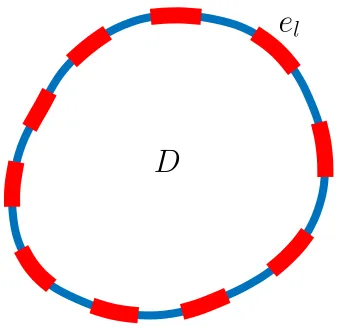
2.1. Problem Statement. Let D ⊆ Rd, d ≤ 3, be a bounded open set with smooth boundary representing a body, with conductivityσ:D→R. A numberLof electrodes are attached to the surface of the body. We treat these as subsets (el)Ll=1 of the boundary∂D, and assume that they have contact impedances (zl)Ll=1∈R
L.
A current stimulation pattern (Il)Ll=1∈R
L is applied to the electrodes. Then the
electric potentialv within the body and boundary voltages (Vl)Ll=1∈RL on (el)Ll=1 are modelled by the following partial differential equation.
−∇ ·(σ(x)∇v(x)) = 0 x∈D
Z
el σ∂v
∂ndS=Il l= 1, . . . , L
σ(x)∂v
∂n(x) = 0 x∈∂D\
SL l=1el
v(x) +zlσ(x) ∂v
∂n(x) =Vl x∈el, l= 1, . . . , L (1)
This model was first proposed in [40]; a derivation can be found therein. Note that the inputs to this forward model are the conductivityσ, input current (Il)Ll=1 and contact impedances (zl)Ll=1. The solution comprises the functionv : D → R
and the vector V ∈RL of voltages. Also note that solutions to this equation are only defined up to addition of a constant: if (v, V) solves the equation, then so does (v+c, V +c) for any c ∈R. This is because it is necessary to choose a reference ground voltage.
D
[image:5.612.222.392.458.626.2]e
l
2.2. Weak Formulation. We first define the space in which the solution to equa-tion (1) will live. Using the notation of [40] we set
H=H1(D)⊕RL,
k(v, V)k2 H=kvk
2
H1(D)+kVk2`2
=kvk2
L2(D)+k∇vk2L2(D)+kVk2`2.
Since solutions are only defined up to addition of a constant, we define the quotient space ( ˙H,k · kH˙) by
˙
H=H/R,
k(v, V)kH˙ = inf
c∈Rk(v−c, V −c)kH.
We will often use the notationv0 = (v, V) for brevity. It is more convenient to equip
˙
Hwith an equivalent norm, as stated in the following lemma from [40]:
Lemma 2.1. Definekv0
k∗ by
kv0k2
∗=k∇vk2L2(D)+
L X
l=1 Z
el
|v(x)−Vl|2dS.
Thenk · k∗ andk · kH˙ are equivalent.
We can now state the weak formulation of the problem as derived in [40]. For this letw0= (w, W).
Proposition 2.2. Let B: ˙H×H˙ →Randr: ˙H→Rbe defined by
B(v0, w0;σ) =Z
D
σ∇v· ∇wdx+
L X
l=1 1 zl
Z
el
(v−Vl)(w−Wl) dS,
r(w0) =
L X
l=1 IlWl.
Then ifv0
∈H˙ is a strong solution to the problem (1), it satisfies
B(v0, w0;σ) =r(w0) for allw0∈H.˙
(2)
We will use the weak formulation (2) to define our forward map for the complete electrode model (1). In order to guarantee a solution to this problem, we make the following assumptions.
Assumptions 2.3. The conductivityσ:D→R, the contact impedances (zl)Ll=1∈ RL and the current stimulation pattern (Il)Ll=1∈R
L satisfy
(i) σ∈L∞(D;
R), essinf
x∈D σ(x) =σ−>0;
(ii) 0< z−≤zl≤z+<∞, l= 1, . . . , L;
(iii)
L X
l=1 Il= 0.
Proposition 2.4. Let Assumptions 2.3 hold, then there is a unique [(v, V)] ∈H˙
solving (2). We may, without loss of generality, choose the element(v, V)∈[(v, V)]
of the equivalence class of solutions to be that which satisfies
L X
l=1 Vl= 0.
(3)
Remark 2.5. Assumptions2.3(i) and (ii) are to ensure coercivity and boundedness ofB(·,·;σ). Assumption 2.3(iii) is necessary for continuity of r(·), and physically may be thought of as a conservation of charge condition. Choosing a solution from the equivalence class corresponds to choosing a reference ground voltage.
2.3. Continuity of the Forward Map. In what follows we will restrict to the set of admissible conductivities, which is defined as follows.
Definition 2.6. A conductivity fieldσ:D→Ris said to be admissible if
(i) there exists N ∈ N, {Dn}Nn=1 open disjoint subsets of D for which D = SN
n=1Dj;
(ii) σ D
j ∈C(Dj); and (iii) there existσ−, σ+
∈(0,∞) such thatσ−
≤σ(x)≤σ+ for allx
∈D. The set of all such conductivities will be denotedA(D).
Note that anyσ∈ A(D) will satisfy Assumptions2.3(i). Assume that the current stimulation pattern (Il)Ll=1 ∈R
L and contact impedances (z
l)Ll=1 ∈R
L are known
and satisfy Assumptions 2.3(ii)-(iii). Then we may define the solution map M :
A(D)→Hto be the unique solution to (2) satisfying (3). The above existence and uniqueness result tells us that this map is well-defined.
In [18] it is shown that M:A(D)→His Fr´echet differentiable when we equip
A(D) with the supremum norm. Though this is a strong result, this choice of norm is not appropriate for all of the conductivities that we will be considering. We hence establish the following continuity result.
Proposition 2.7. Fix a current stimulation pattern (Il)Ll=1 ∈ R
L and contact
impedances (zl)Ll=1 ∈ R
L satisfying Assumptions 2.3. Define the solution map
M : A(D) → H as above. Let σ ∈ A(D) and let (σε)ε>0 ⊆ A(D) be such that
either
(i) σε converges to σuniformly; or
(ii) σεconverges toσin (Lebesgue) measure, and there existσ−, σ+∈(0,∞)such
that for all ε >0 andx∈D,σ−≤σ
ε(x)≤σ+.
ThenkM(σε)− M(σ)k∗→0.
Proof. Define the mapsB :H×H× A(D)→Rand r:H→Ras in Lemma 2.2,
but onHrather than ˙H. Then denotingu0ε= (vε, Vε) =M(σε) and v0 = (v, V) =
M(σ), we have for allw0
∈H,
B(vε0, w
0;σ
It follows that
0 =B(v0ε, w0;σε)−B(v0, w0;σε) +B(v0, w0;σε)−B(v0, w0;σ)
=
Z
D
σε∇(vε−v)· ∇wdx+ L X l=1 1 zl Z el
((vε−v)−(Vlε−Vl))(w−Wl) dS
+
Z
D
(σε−σ)∇v· ∇wdx.
Lettingw0= (v
ε−v, Vε−V), we see that
Z
D
σε|∇(vε−v)|2dx+ L X l=1 1 zl Z el
((vε−v)−(Vlε−Vl))2dS
≤
Z
D|
σε−σ||∇v· ∇(vε−v)|dx.
In both cases (i) and (ii), we have that (σε)ε>0 is bounded uniformly below by a positive constant. Hence for small enough ε, the left hand side above may be bounded below byCkv0
ε−v0k2∗. We then have by Cauchy-Schwarz
kv0ε−v0k 2
∗≤C
Z
D|
σε−σ||∇v· ∇(vε−v)|dx
≤C Z
D|
σε−σ|2|∇v|2dx 1/2
· k∇(vε−v)kL2
≤C Z
D|
σε−σ|2|∇v|2dx 1/2
· kvε0 −v
0
k∗
(4)
≤Ckσε−σk∞k∇vkL2kv0ε−v0k∗.
(5)
Ifσε→σuniformly, we deduce from (5) thatkv0ε−v0k∗→0 and the result follows.
If|σε−σ| →0 in measure, then since|D|<∞, it follows that the integrand in (4)
tends to zero in measure, see for example Corollary 2.2.6 in [6]. Sinceσεis assumed
to be uniformly bounded, the integrand is dominated by a scalar multiple of the integrable function|∇v|2. We claim that this implies that the integrand tends to zero in L1. Suppose not, and denote the integrand f
ε. Then there exists δ > 0
and a subsequence (fεi)i≥1 such thatkfεikL1 ≥δ for alli. This subsequence still converges to zero in measure, and so admits a further subsequence that converges to zero almost surely. An application of the dominated convergence theorem leads to a contradiction, hence we deduce that fε tends to zero in L1 and the result
follows.
Denote the projection Π : H→ RL, (v, V) 7→ V. The following lemma shows that the above result still holds if we replaceMby Π◦ M.
Corollary 2.8. Let the assumptions of Proposition2.7 hold. Then
|Π◦ M(σε)−Π◦ M(σ)|`2 →0.
Proof. We show that there existsC >0 such that for all (v, V)∈HwithPLl=1Vl=
0,k(v, V)k∗≥C|V|`2. By the equivalence ofk · k∗ andk · kH˙, Lemma 2.1, we have
k(v, V)k∗≥Cinf
c∈R
(kv−ckH1+|V −c|`2)≥Cinf
c∈R|
The infimum on the right-hand side is attained at
c= 1 L
L X
l=1 Vl= 0.
Then by Proposition2.7, we have
0≤ |Π◦ M(σε)−Π◦ M(σ)|`2 ≤ kM(σε)− M(σ)k∗→0
3. The Inverse Problem
We are interested in the inverse problem of determining the conductivity field from measurements of the voltages (Vl)Ll=1 on the boundary, for a variety of input currents (Il)Ll=1 on the boundary. To this end we introduce the following version of Ohm’s law. Observe that the mapping I 7→v0, taking the current stimulation
pattern to the solution of (2), is linear. Then given a conductivity fieldσ∈ A(D), there exists a resistivity matrix R(σ) ∈ RL×L such that the boundary voltage measurementsV(σ) arising from the solution of the forward model are related toI via
V(σ) =R(σ)I
By applying several different current stimulation patterns we should be able to infer more about the conductivityσ. Note however that since the mappingI7→V is lin-ear, only linearly independent stimulation patterns will provide more information1. Since we have the conservation of charge condition onI, there are at most L−1 linearly independent patterns we can use.
Assume that J linearly independent current patterns I(j)
∈ RL, j = 1, . . . , J, J ≤L−1 are applied, and noisy measurements ofV(j)=R(σ)I(j) are made:
yj=V(j)+ηj, ηj ∼N(0,Γ0) iid. We have
yj=Gj(σ) +ηj
whereGj(σ) =R(σ)I(j). Concatenating these observations, we write y=G(σ) +η, η∼N(0,Γ)
where Γ = diag(Γ0, . . . ,Γ0). The inverse problem is then to recover the conduc-tivity field σ from the datay. This problem is highly ill-posed: the data is finite dimensional, yet we wish to recover a function which, typically, lies in an infinite dimensional space. We take a Bayesian approach by placing a prior distribution on σ. The choice of prior may have significant effect on the resulting posterior distri-bution, and different choices of prior may be more appropriate depending upon the prior knowledge of the particular experimental set-up under consideration.
In subsection 3.1 we outline three different families of prior models, and show the appropriate regularity of the forward maps arising from them. In subsection 3.2we describe the likelihood and posterior distribution formally, before rigorously proving that the posterior distribution exists and is Lipschitz with respect to the data in the Hellinger metric.
1If there is noise on the measurements, additional linearly dependent observations can be made
3.1. Choices of Prior. In this section we consider three priors, labelled by i = 1,2,3, defined by functionsFi:Xi→ A(D) which map draws from prior measures
on the Banach spacesXito the space of conductivitiesA(D). Our prior
conductiv-ity distributions will then be the pushfoward of the prior measures by these maps Fi. We describe these maps, and establish continuity properties of them needed
for the study of the posterior later. In what follows, the space C0(D) of contin-uous functions on D will be equipped with the supremum norm k · k∞ and the
corresponding Borelσ-algebra.
3.1.1. Log-Gaussian prior. We first consider the simple case that the coefficient is given by the exponential of a continuous function. Let F1 : C0(D)
→ A(D) be defined by F1(u) = exp(u). Then it is easily seen that F1 does indeed map into
A(D). Furthermore, since D is bounded, if u∈C0(D) and (u
ε)ε>0 ⊆C0(D) is a sequence such thatkuε−uk∞→0, thenkF1(uε)−F1(u)k∞→0.
In this case, we will take our prior measure µ0 on u to be a non-degenerate Gaussian measureN(m0,C0) onC0(D). Note that the push forward of a Gaussian measure byF1is a log-Gaussian measure.
Example 3.1. Consider the case D = B(0,1) ⊆ R2. Suppose that u is drawn
from a Gaussian measure µ0 =N(0,C). Typical samples from F1#(µ0) are shown below2. The covariance
C is chosen such that the samples u almost surely have regularity u∈Cbsc,s−bsc(D) for alls < t, where from left to rightt= 2,1.5,1,0.5
respectively. Here the samples are generated on [−1,1]2
⊇D and then restricted to D, for computational simplicity.
3.1.2. Star-shaped prior. We now consider star-shaped inclusions, that is, inclusions parametrised by their centre and a radial function. These were studied in two-dimensions in the paper [8] to parametrise domains for a Bayesian inverse shape scattering problem. In [8] the authors prove well-posedness of the inverse problem in an infinite dimensional setting through the use of shape derivatives and Riesz-Fredholm theory.
Let D ⊆Rd, andRd−1 = (−π, π]×[0, π]d−2 ⊆ Rd−1. Let h: Rd → Rd−1 be the continuous function representing the mapping from Cartesian to angular polar coordinates. Define the mappingA:C0
P(Rd−1)×D→ B(D) by A(r, x0) =
x∈D
|x−x0| ≤r(h(x−x0))
where C0
P(Rd−1) is the space of continuous periodic functions on Rd−1. Then A(r, x0) describes the set of points in D which lie within the closed surface parametrised in polar coordinates centred atx0 by
Γ(Θ) = (Θ, r(Θ)), Θ∈Rd−1.
2Given a measureµon (X,X) and a measurable mapF: (X,X)→(Y,Y) between measurable
spaces,F#(µ) denotes the pushforward ofµbyF, i.e. the measure on (Y,Y) given byF#(µ)(A) =
In two dimensions, we haveR1= (−π, π] and the mappingh:R2→R1is given by
h(x, y) = atan2(y, x)≡2 arctan p y x2+y2+x
!
where atan2 is the two-parameter inverse tangent function.
In three dimensions, we haveR2= (−π, π]×[0, π] and the mappingh:R3→R2 is given by
h(x, y, z) = atan2(y, x),arccot p z x2+y2
!! .
Similar expressions forhexist in higher dimensions, though for applications we are only interested in the cased= 2,3.
Define now the mapF2:C0
P(Rd−1)×D→ A(D) by F2(r, x0) =u+1A(r,x0)+u−1D\A(r,x0)
= (u+−u−)1A(r,x0)+u−,
where u+, u− >0 are the scalar conductivity values. Again it can easily be seen
that F2 does indeed map intoA(D). We claim that this map is continuous in the following sense:
Proposition 3.2. Define the map F2 : C0
P(Rd−1)×D → A(D) as above. Let
x0∈D and letr∈C0
P(Rd−1)be Lipschitz continuous.
(i) Suppose that (rε)ε>0 ⊆ CP0(Rd−1) is a sequence of functions such that
krε−rk∞→0. ThenF2(rε, x0)→F2(r, x0)in measure3.
(ii) Suppose that (xε
0)ε>0 ⊆ D is a sequence of points such that |xε0−x0| → 0.
ThenF2(r, xε
0)→F2(r, x0) in measure.
(iii) Let (rε)ε>0,(xε0)ε>0 be as above. ThenF2(rε, xε0)→F2(r, x0)in measure.
Proof. In order to show that a sequence of functions fε : D → R converges to
f : D → R in measure, it suffices to show that there exists a sequence of sets Zε⊆Dwith|Zε| →0 such that|fε−f| ≤C1Zε. Then for eachδ >0 we have
|{x∈D| |fε(x)−f(x)|> δ}| ≤ |{x∈D| |fε(x)−f(x)| 6= 0}| ≤ |Zε| →0.
(i) Fix the centre x0 ∈ D. DenoteA(r) = A(r, x0). Let r∈ C0
P(Rd−1) and let (rε)ε>0 ⊆ CP0(Rd−1) be a sequence of functions such that krε−rk∞ → 0.
Then there existsγ(ε)→0 such thatkrε−rk∞< γ(ε). By definition we then
have
r(x)−γ(ε)≤rε(x)≤r(x) +γ(ε) for allx∈D andε >0.
It follows that we have the inclusions
A(r−γ(ε))⊆A(rε)⊆A(r+γ(ε)), A(r−γ(ε))⊆A(r)⊆A(r+γ(ε)).
Let ∆ denote the symmetric difference. We deduce that
A(rε)∆A(r)⊆A(r+γ(ε))\A(r−γ(ε)).
3A sequence of functions (f
ε)ε>0,fε :D→R, is said to converge in measure to a function
f :D →Rif for allδ >0,|{x∈D | |fε(x)−f(x)|> δ}| →0. Here|B|denotes the Lebesgue
Now the right-hand side is given by
A(r+γ(ε))\A(r−γ(ε))
=
x∈Dr(h(x−x0))−γ(ε)<|x−x0| ≤r(h(x−x0)) +γ(ε) .
Asε→0, this set decreases to the boundary set
∂A(r) = x∈D
|x−x0|=r(h(x−x0)) .
Since the graph of a continuous function has Lebesgue measure zero, we deduce that |∂A(r)|= 0. It follows that
lim
ε→0|A(rε)∆A(r)|= 0. To conclude, note that
|F2(rε, x0)−F2(r, x0)| ≤ |u+−u−||1A(rε)−1A(rε)|=C1A(rε)∆A(r). (ii) Let r ∈ C0
P(Rd−1) be Lipschitz continuous. Denote A(x0) = A(r, x0). Let (xε
0)⊆D be a sequence of points such that|xε0−x0| →0. Note that we may write
A(xε0) ={x∈D| |x−x ε
0| ≤r(h(x−x ε 0))} ={x∈Rd| |x−xε0| ≤r(h(x−x
ε 0))} ∩D = ((xε0−x0) +{x∈R
d
| |x−x0| ≤r(h(x−x0))})∩D =: ((xε
0−x0) +A(x0)
∗)
∩D.
By the distributivity of intersection over symmetric difference, we then have that
A(xε0)∆A(x0) = [((x ε
0−x0) +A(x0)∗)∩D]∆[A(x0)∗∩D] = [((xε
0−x0) +A(x0)
∗)∆A(x0)∗]
∩D
⊆((xε
0−x0) +A(x0)
∗)∆A(x0)∗.
Therefore, using Theorem 1 from [39], we see that
|A(xε0)∆A(x0)| ≤ |((x ε
0−x0) +A(x0)∗)∆A(x0)∗|
≤ |xε
0−x0|H
d−1(∂A(x0)∗)
where Hd−1 is the (d
−1)-dimensional Hausdorff measure. Since we assume thatris Lipschitz, the surface areaHd−1(∂A(x0)∗) of the boundary ofA(x0)∗
is finite, and so it follows that
lim
ε→0|A(x ε
0)∆A(x0)|= 0. As before, we conclude by noting that
|F2(r, xε
0)−F2(r, x0)| ≤ |u+−u−||1A(xε
0)−1A(x0)|=C1A(xε0)∆A(x0).
(iii) We have that
|F2(rε, xε0)−F2(r, x0)| ≤ |F2(rε, xε0)−F2(r, x ε
0)|+|F2(r, x ε
0)−F2(r, x0)|
≤C(1A(rε,xε0)∆A(r,x0ε)+1A(r,xε0)∆A(r,x0))
≤C1[A(rε,xε0)∆A(r,xε0)]∪[A(r,xε0)∆A(r,x0)].
Now note that
The right hand-side is independent of y0 by translation invariance of the Lebesgue measure. By the same argument as part (i) we conclude that it tends to zero. We then have that
|[A(rε, xε0)∆A(r, x ε
0)]∪[A(r, x ε
0)∆A(r, x0)]|
≤ |A(rε, xε0)∆A(r, x ε
0)|+|A(r, x ε
0)∆A(r, x0)|
≤ sup
y0∈D
|A(rε, y0)∆A(r, y0)|+|A(r, xε0)∆A(r, x0)|
which tends to zero by the discussion above and part (ii).
Remark 3.3. Above we assumed that r : Rd−1 → R was Lipschitz continuous.
This assumption is only used in the proof of part (ii) of the proposition. If the centre of the star-shaped region is known, this assumption may then be dropped to allow for rougher boundaries.
We need to choose a prior measureµ0on (r, x0). We equipC0
P(Rd−1)×Dwith the normk(r, x0)k= max{krk∞,|x0|}and corresponding Borel σ-algebra. We assume
thatr andx0 are independent under the prior so that we may factorµ0=σ0⊗τ0 whereσ0is a measure onC0
P(Rd−1) andτ0is a measure onD. We will assume that σ0is such thatσ0(B)>0 for all ballsB⊆C0
P(Rd−1).
Example 3.4. Consider the caseD=B(0,1)⊆R2. Suppose thatris drawn from a log-Gaussian measureσ0onC0
P((−π, π]), andx0is drawn fromτ0=U([−0.5,0.5]2).
Note that [−0.5,0.5]2
⊆ B(0,1). Typical samples fromF2#(µ0) are shown below. The covariance ofσ0is chosen such that the samplesralmost surely have regularity r ∈ Cbsc,s−bsc((
−π, π]) for all s < t, where from left to right t = 2.5,2,1.5,1 respectively.
3.1.3. Level set prior. We finally consider the case where the inclusions can be described by a single level set function, as in [17]. Let n ∈ N and fix constants
−∞=c0< c1< . . . < cn=∞. Givenu:D→R, define Di⊆D by Di={x∈D|ci−1≤u(x)< ci}, i= 1, . . . , n
so thatD=Sni=1Di andDi∩Dj =∅fori6=j,i, j≥1. Define also the level sets
Di0=Di∩Di+1={x∈D|u(x) =ci}, i= 1, . . . , n−1.
Now given strictly positive functions f1, . . . , fn ∈ C0(D), we define the map F3 : C0(D)
→ A(D) by
F3(u) =
n X
Since eachf is continuous and strictly positive on a compact setD, they are uni-formly bounded above and below by positive constants, and soF3does indeed map intoA(D).
In this paper we are primarily concerned with the case of binary fields, n = 2 andfi constant above, however the theory in proved in the general case. We have
the following result regarding continuity of this map, by the same arguments as in [17].
Proposition 3.5. Define the map F3 :C0(D)
→ A(D) as above. Let u∈C0(D)
be such that |D0
i| = 0 for i = 1, . . . , n−1. Suppose that (uε)ε>0 ⊆ C0(D) is an
approximating sequence of functions so thatkuε−uk∞→0. ThenF3(uε)→F3(u)
in measure.
Proof. Denote byDi,ε and D0i,ε the sets as defined above associated with the
ap-proximating functionsuε. We can write
F3(uε)−F3(u) = n X
i=1 n X
j=1
(fi−fj)1Di,ε∩Dj = n X
i,j=1 i6=j
(fi−fj)1Di,ε∩Dj.
Sincekuε−uk∞→0, there existsγ(ε)→0 withkuε−uk∞< γ(ε). Then we have
for allx∈D andε >0
u(x)−γ(ε)< uε(x)< u(x) +γ(ε).
Hence for|j−i|>1 andεsufficiently small,Di,ε∩Dj=∅. If|j−i|= 1, then
Di,ε∩Di+1⊆Dei,ε :={x∈D|ci ≤u(x)< ci+γ(ε)} →D0i, Di,ε∩Di−1⊆Dˆi−1,ε:={x∈D|ci−γ(ε)≤u(x)< ci} →∅.
By the uniform boundedness of the (fi), for sufficiently smallεwe can then write
|F3(uε)−F3(u)| ≤ n−1 X
i=1
|fi−fi+1|1De i,ε+
n X
i=2
|fi−fi−1|1Dˆi−1,ε
≤C1Zε (6)
whereZε⊆D is given by
Zε= n−1
[
i=1 e Di,ε
!
∪
n [
i=2 ˆ Di−1,ε
!
→
n−1 [
i=1 D0
i.
By the assumption that|D0
i|= 0 for alli, it follows that|Zε| →0, and so the result
follows from the comment at the start of the proof of Proposition3.2.
Note that bound (6) actually above implies the slightly stronger result that, when the ci-level sets of u∈ X have zero measure, F3 is continuous into Lp(D),
1 ≤ p < ∞, at u. The assumption that the level sets have zero measure is an important one, as illustrated by Figure 2: an arbitrarily small perturbation of u can lead to an order 1 change inF3(u).
F3(·) is continuous atu F3(·) is discontinuous at u
Figure 2. The discontinuity ofF3 intoLp(D).
.
As in the log-Gaussian case, we take our prior measureµ0onuto be a Gaussian measureN(m0,C0) onC0(D).
Example 3.6. Consider the case D = B(0,1) ⊆ R2, n = 2, c1 = 0, f1 ≡ 1
and f2 ≡ 2. Suppose that u is drawn from a centred Gaussian measure µ0 = N(0,C) on C0(D). The covariance
C is chosen such that the samples u almost surely have regularityu∈Cbsc,s−bsc(D) for all s < t, where from left to rightt=
4,3,2,1 respectively. As in the log-Gaussian case, here the samples are generated on [−1,1]2
⊇D and then restricted toD, for computational simplicity.
Remark 3.7. In the cases of the star-shaped and level set priors, we have assumed the values that the conductivity takes are known a priori. This may be appropri-ate in certain situations, for example in medical contexts where conductivities of different types of tissue are known [7]. However it may be preferable to have the flexibility of treating the conductivity values as part of the inference. The theory does not become significantly more involved, as it can be shown that the conclu-sions of propositions 3.2 and 3.5 still hold when we allow for perturbation of the conductivity values as well. We work with the case of fixed conductivity values for clarity of presentation, but we note that it is possible to place a prior upon these.
3.2. The Likelihood and Posterior Distribution. The inverse problem was
introduced at the beginning of the section. Now that we have introduced prior distributions, we may provide the Bayesian formulation of the problem.
LetX be a separable Banach space and F :X → A(D) a map from the space X where the unknown parameters live to the conductivity space. Choose a set of current stimulation patternsI(j)
The datayj from thejth stimulation pattern is assumed to arise from the map
Gj:X→RL,Gj = Π◦ Mj◦F, via
yj=Gj(u) +ηj, ηj∼N(0,Γ0) iid. We concatenate these observations to get datay∈RJ Lgiven by
y=G(u) +η, η∼Q0:=N(0,Γ)
where Γ = diag(Γ0, . . . ,Γ0) andG:X →RJ L. This coincides with the setup at the start of the section, withσ=F(u).
Assume that u∼µ0, where µ0 is independent of Q0. From the above, we see thaty|u∼Qu:=N(G(u),Γ). We use this to find the distribution ofu|y. First note
that
dQu
dQ0(y) = exp
−Φ(u;y) +1 2|y|
2 Γ
where the potential (or negative log-likelihood) Φ :X×Y →Ris given by
Φ(u;y) = 1
2|G(u)−y| 2 Γ :=
1 2|Γ
−1
2(G(u)−y)|2.
(7)
Then under suitable regularity conditions, Bayes’ theorem tells us that the distri-butionµy ofu
|y is as given below:
Theorem 3.8 (Existence and Well-Posedness). Let (X,F, µ0) denote any of the probability spaces associated with any of the three priors introduced in the previous
subsection, and let Φ : X×Y →R be the potential (7) associated with the
corre-sponding forward map. Then the posterior distribution µy of the stateugiven data
y is well-defined. Furthermore,µy
µ0 with Radon-Nikodym derivative
dµy
dµ0(u) = 1 Zµ
exp(−Φ(u;y)) (8)
where fory Q0-a.s.,
Zµ:= Z
X
exp(−Φ(u;y))µ0(du)>0.
Additionally, the posterior measure µy is locally Lipschitz with respect to y, in the
Hellinger distance: for all y, y0
∈ Y with max{|y|Γ,|y0
|Γ} < ρ, there exists C =
C(ρ)>0 such that
dHell(µy, µy0)
≤C|y−y0
|Γ.
In the proof of the above theorem we will make use of the following version of Bayes’ theorem from [10].
Proposition 3.9(Bayes’ theorem).Define the measureν0(du,dy) =µ0(du)Q0(dy)
onX×Y. Assume that Φ :X×Y →Risν0-measurable and that, fory Q-a.s.
Zµ= Z
X
exp(−Φ(u;y))µ0(du)>0.
Then the conditional distribution of u|y exists and is denoted by µy. Furthermore
µy
µ0 and, for y Q0-a.s.,
dµy
dµ0 = 1 Zµ
exp (−Φ(u;y)).
Proposition 3.10. Let (X,F, µ0) denote any of the probability spaces associated
with the priors introduced in the previous subsection. Then the potentialΦ :X×Y →
Rassociated with the corresponding forward map, given by (7), admits the following
properties.
(i) There is a continuous K :R+×R+ →R+ such that for everyρ >0,u∈X
andy∈Y with |y|Γ< ρ,
0≤Φ(u;y)≤K(ρ,kukX).
In the casesF =F2 andF=F3,K has no dependence onkukX.
(ii) For any fixed y ∈ Y,Φ(·;y) :X → R is continuousµ0-almost surely on the
probability space(X,F, µ0).
(iii) There exists C : R+ ×R+ → R+ such that for every y1, y2 ∈ Y with
max{|y1|Γ,|y2|Γ}< ρ, and everyu∈X,
|Φ(u;y1)−Φ(u;y2)| ≤C(ρ,kukX)|y1−y2|Γ.
Moreover,C(ρ,k · kX)∈L2µ0(X)for allρ >0.
Proof. (i) From equation (5) in the proof of Proposition 2.7, we see that there
exists C >0 such that eachMj :A(D)→Hsatisfies
kMj(σ1)− Mj(σ2)k∗≤CkMj(σ2)k∗kσ1−σ2k∞
for allσ1, σ2∈ A(D). Takingσ2≡1, say, we deduce that
kMj(σ1)k∗≤CkMj(1)k∗kσ1−1k∞+kMj(1)k∗≤C(1 +kσ1k∞).
Hence kσk∞ < ρ implies that kMj(σ)k∗ < C(1 +ρ). By Corollary 2.8, it
follows that Π◦ Mj : A(D)→RL is bounded on bounded sets with respect to k · k∞ for allj.
In the case F = F1, if u ∈ X then kF(u)k∞ ≤ ekukX. It follows that
|G(u)|Γ≤maxj|Gj(u)|Γ≤C(1 +ekukX). Now note that
Φ(u;y)≤ |G(u)|2 Γ+|y|
2 Γ. Then for anyy∈Y with|y|< ρ, we may bound
Φ(u;y)≤C(1 +e2kukX+ρ2) =:K(ρ,
kukX).
In the casesF =F2andF=F3, we have thatkF(u)k∞is bounded uniformly
overu∈X and so|G(u)|Γ ≤maxj|Gj(u)|Γ≤C. Hence we obtain the bound
Φ(u;y)≤C(1 +ρ2) =:K(ρ).
(ii) Let u∼µ0 and supposeF :X → A(D) is such that kuε−ukX →0 implies
that F(uε) → F(u) either uniformly or in measure. Then Proposition 2.7
tells us that Mj◦F :X →His continuous at ufor each j. The projection Π : H→ RL is continuous, and so Gj = Π◦ Mj ◦F is continuous at u for
(iii) Letu∈X andy1, y2∈Y with max{|y1|Γ,|y2|Γ}< ρ. Then we have
|Φ(u;y1)−Φ(u;y2)|=1
2|hy1+y2−2G(u), y1−y2iΓ|
≤12(|y1|Γ+|y2|Γ+ 2|G(u)|Γ)|y1−y2|Γ
≤(ρ+|G(u)|Γ)|y1−y2|Γ =: ˜C(ρ, u)|y1−y2|Γ
We now consider cases separately based on the prior. In the log-Gaussian case, we may bound
˜
C(ρ, u)≤C(1 +ρ+ekukX) =:C(ρ,kuk X)
using the bound from the proof of part (i). Square-integrability ofC(ρ,k · kX)
follows since Gaussians have exponential moments.
In the star-shaped and level set prior cases, we have that|G(u)|is bounded uniformly by a constant. We may hence bound ˜C(ρ, u) above by some C(ρ,kukX) := C(1 +ρ) that is independent of u, and so again the
square-integrability follows.
Proof of Theorem 3.8. Define the product measure ν0(du,dy) =µ0(du)Q0(dy) on
X ×Y. We showed in Proposition 3.10 that Φ(·;y) : X → R is almost-surely continuous under the prior for ally ∈ Y, and Φ(u;·) : Y →R is locally Lipschitz for all u∈X. Together these imply that Φ :X ×Y →R is almost-surely jointly continuous underν0. To see this, let (u, y)∈X×Y and let (un, yn)n≥1⊆X×Y be an approximating sequence so thatkun−ukX→0 and |yn−y|Γ→0. Then we have
|Φ(un, yn)−Φ(u, y)| ≤ |Φ(un, yn)−Φ(un, y)|+|Φ(un, y)−Φ(u, y)|.
The second term tends to zero µ0-almost surely by continuity. For the first term, note that the sequences (kunkX)n≥1 and (|yn|Γ)n≥1 are bounded, by K and R respectively, say. Then we can use the local Lipschitz property to deduce that
|Φ(un, yn)−Φ(un, y)| ≤C(R, K)|yn−y|Γ
sinceC(·,·) :R×R→R, as defined in the proof of Proposition3.10, is monotonically increasing in both components. Therefore this term tends to zero, and we obtain the desired continuity. It follows, see for example Lemma 6.1 in [17], that Φ is ν0-measurable.
For the lower bound onZµ, we consider cases separately based on the prior. First
we consider the log-Gaussian and level set prior cases so thatµ0 is Gaussian. Let B⊆X be any ball. Fix anyρ >|y|Γ and define
R= sup
u∈B
whereK is the upper bound from Proposition3.10(i). This supremum is finite by the continuity ofK. Then we have
Z
X
exp(−Φ(u;y))µ0(du)≥
Z
B
exp(−Φ(u;y))µ0(du)
≥
Z
B
exp(−K(ρ,kuk))µ0(du)
≥exp(−R)µ0(B). Sinceµ0 is Gaussian,µ0(B)>0 and soZµ >0.
In the star-shaped prior case, proceed as above but take B = B1×D where B1⊆C0
P(Rd−1) is any ball. Then we have
µ0(B) = (σ0×τ0)(B1×D) =σ0(B1)τ0(D)>0
by the assumption thatσ0assigns positive mass to balls, and so againZµ>0. The
above hold for ally∈Y, and so in particular fory Q0-almost-surely. We may now apply Bayes’ Theorem3.9to obtain the existence ofµy.
The proof of well-posedness is almost identical to that of the analogous result
Theorem 2.2 in [17] and is hence omitted.
4. Numerical Experiments
We investigate the effect of the choice of prior on the recovery of certain binary conductivity fields. The specific fields we consider are shown in Figure 3, where blue represents a conductivity of 1 and yellow a conductivity of 2. Simulations are performed using the EIDORS software [1] to solve the forward model using a first order finite element method; a mesh of 43264 elements is used to create the data and a mesh of 10816 elements is used for simulations in order to avoid an inverse crime [20].
In subsection4.1 we describe the MCMC sampling algorithm that we will use. In subsection4.2 we define the parameters we will use for the forward model and the MCMC simulations. We also describe how the data is created, and define our choices of prior distributions. Finally in subsection4.3we present the results of the simulation, looking at quality of reconstruction, convergence of the algorithm and some properties of the posterior distribution.
4.1. Sampling Algorithm. We aim to produce a sequence of samples fromµyon
X, where µy is given by (8). We make use of the preconditioned Crank-Nicolson
Markov Chain Monte Carlo (pCN-MCMC) method. The pCN-MCMC method is a modification of the standard Random Walk Metropolis (RWM) MCMC method which is well-adapted to Gaussian priors in high dimensions. It was introduced in [5], and its dimension independent properties are analysed and illustrated numerically in [14] and [9] respectively; the pCN nomenclature was introduced in [9]. In the case of the star-shaped prior, we use a Metropolis-within-Gibbs algorithm [43], alternately updating the field with the pCN method above and updating the centre with the standard RWM method.
(a)Conductivity A (b)Conductivity B
Figure 3. The two binary fields we attempt to recover.
Con-ductivity A is drawn from the star-shaped prior, with σ0 = h#
N(0.5,109
·(302
− AD)−3)
, h(z) = (1 + tanhz)/2, and τ0 = U([−0.5,0.5]2). Conductivity B is constructed explicitly, rather than being drawn from a prior.
size from the integrated autocorrelation (neglecting a burn-in period) of a quantity of interest, as in [21].
4.2. Data and Parameters. We work on a circular domain of radius 1, with 16
equally spaced electrodes on its boundary providing 50% coverage. We take all contact impedances zl= 0.01. We stimulate adjacent electrodes with a current of
0.1, so that the matrix of stimulation patternsI= (I(j))15
j=1∈R16×15 is given by
I= 0.1×
+1 0 · · · 0
−1 +1 · · · 0 0 −1 . .. 0
..
. ... . .. +1
0 0 0 −1
The conductivity is chosen such that it takes values 1 and 2. We perturb the measurements with white noiseη∼N(0, γ2I),γ= 0.0002, so that the mean relative error on both sets of data is approximately 10%. The true conductivity fields used to generate the data, henceforth referred to as Conductivity A and Conductivity B, are shown in Figure3. In all cases we generate N = 2.5×10⁶ samples with a burn-in ofk0= 5×10⁵ samples.
Our priors on fields will make use of Gaussians with covariances of the form
C=q(τ2−∆)−α. (9)
These are essentially rescaled Whittle-Matern covariances [31], withτ representing the inverse length scale of the samples, α proportional to their regularity, and q proportional to their amplitude.
In what follows, denote byAN the Laplacian with Neumann boundary conditions
on [−1,1]2, restricted toD, so that its domain is given by
D(AN) =
u|D
u∈H2([
−1,1]2),∂u ∂n= 0
Defining the Laplacian first on a square and then restricting to D will allow for efficient generation of Gaussian samples via the fast Fourier transform. Note that if we were to consider priors of the form (9) withτ= 0, we should restrictD(AN)
further to ensure the invertibility ofAN.
Additionally, denote byADthe Laplacian with Dirichlet boundary conditions on R1= (−π, π], so that its domain is given by
D(AD) =
u∈H2 (
−π, π] u(−π) =u(π) = 0 .
4.2.1. Gaussian prior. States are defined on a grid of 27
×27 points. For both simulations the pCN jump parameterβ is taken to be 0.01, with choice of prior
µ0= exp#
N(0.5 log 2,1016
·(402
− AN)−6)
.
4.2.2. Star-shaped prior. Radial states are defined on a grid of 28points. For Con-ductivity A, we choose the pCN jump parameter β = 0.03 and the RWM jump parameterδ = 0.01. For Conductivity B we chooseβ = 0.01 andδ = 0.005. For both simulations we use the choice of priorµ0=σ0×τ0, with
σ0=h#
N(0.5,109
·(302
− AD)−3)
, τ0=U([−0.5,0.5]2), whereh(z) = (1 + tanhz)/2.
4.2.3. Level set prior. States are defined on a grid of 27
×27 points. For both simulations the pCN jump parameterβ is taken to be 0.005, with choice of prior
µ0=N(0,(352
− AN)−5).
4.3. Results.
4.3.1. Recovery. Figures4and5show conductivities arising from the MCMC chains, and Figure 6 shows the values of the misfit Φ at the different sample means. We consider two different types of mean conductivities. First the sample means are calculated in the sample spaces Xi and then pushed forward to the conductivity
space by the maps Fi, so that we produce estimates of Fi(E(u)). This preserves the binary nature of the fields in the cases of the star-shaped and level set priors. We also consider the sample means of the pushforwards of the posteriors by Fi, E(Fi(u)), which do not preserve the binary property but provide some visualisation
of the interface uncertainty in the posterior.
For Conductivity A, the sample mean F2(E(u)) arising from the star-shaped prior provides a better reconstruction than the other two prior choices. This is expected, since the true conductivity was drawn from this prior. Whilst the sample means arising from the level set prior are fairly close to the true conductivity (both visually and in terms of Φ), the boundary of the interface appears to have too large a length-scale. Appropriate choice of prior length-scale is a key issue the with the level set method; treating the length-scale hierarchically as another unknown in the problem may be beneficial. On the other hand
The sample means arising from the Gaussian prior fail to recover both the sharp interface and the values of the conductivity, which is reflected in the large values Φ takes. Nonetheless, general qualitative properties of the true conductivity can be seen in the sample means. As with the level set prior, reconstruction could be improved by treating hierarchically the parameters in the prior such as length-scale, marginal variance and mean.
prior. Again the Gaussian prior fails to recover both the sharp interface and the values of the conductivity, however it appears to do a better job than the star-shaped prior at identifying the location and shape of the two inclusions.
In both of the above cases, even though the individual samples coming from using the level set prior contain many small inclusions, these do not show up in the sample meansF3(E(u)), though they are visible in the meansE(F3(u)).
In terms of the values of the misfit as shown in Figure 6, in all but one of the above cases the meanE(Fi(u)) provides a better fit than Fi(E(u)) despite the lack of the binary property. The quality of the recovery cannot be assessed solely on the misfit however; an advantage of the Bayesian approach is that both means are available (along with the full posterior), and whichever is more appropriate could depend on the context.
4.3.2. Convergence. In Figure 7, we show the approximate effective sample size (ESS) associated with different quantities of interest. For all choices of prior, these are significantly smaller than the total 2.5×10⁶ samples generated. Many more samples may hence be required to produce accurate approximations of the posterior mean.
The chain associated with the star-shaped prior results in the largest ESS, likely because we are only attempting to infer 28+2 parameters rather than 214parameters as in the log-Gaussian and level set cases.
In order to accelerate the convergence of the MCMC we can adjust the jump parametersβ andδ. Larger choices of these parameters mean that accepted states will be less correlated with the current state, however the proposed states are less likely to be accepted. The choiceβ = 1 in pCN produces proposed states that are independent of the current state, but dependent upon how far the prior is from the posterior, very few or no states may be accepted so that the chain never moves. Similarly, smaller choices of these jump parameters mean that more proposals will be accepted, but the states will be more correlated. A balance hence must be achieved – in our simulations we choose the parameters such that approximately 20-30% of proposals are accepted, though in general the optimal acceptance rate is not known [3].
Alternatively, reconstruction may be accelerated by looking at an approximation of the posterior instead of the exact posterior, for example using the ensemble Kalman filter [16] or a sequential Monte Carlo method [4]. We could also initialise the MCMC chains from EnKF estimates to significantly reduce the burn-in period and hence computational cost. If the derivative of the forward map is available, Hybrid Monte Carlo (HMC) methods could be used to accelerate the convergence [11]. Emulators could also be used to reduce the computational burden of derivative calculation, allowing the use of geometric MCMC methods such as Riemannian Manifold Hamiltonian Monte Carlo (RHMC) and Lagrangian Monte Carlo (LMC) [27].
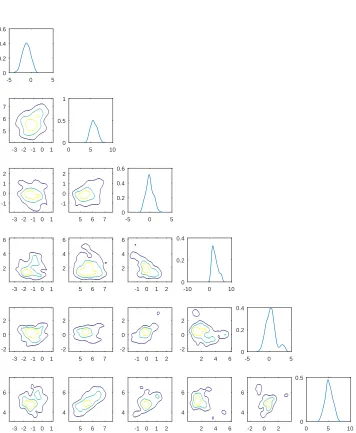
log-Gaussian case, especially in the joint distributions, but they are still very close to uni-modal.
The least regular, more multi-modal densities come from the level set prior. One reason for this is likely the lack of identifiability of the level set function: the forward model only ‘sees’ the zero level set of the state, and hence cannot distinguish between infinitely many different states. The prior can however distinguish between these states, and will weight them appropriately, which can help explain the shape of the posterior densities.
5. Conclusions
The primary contributions of this paper are:
• We have formulated the EIT problem rigorously in the infinite dimensional Bayesian framework.
• We have studied three different prior models, each with their own advan-tages and disadvanadvan-tages based on prior knowledge and the nature of the field we are trying to recover.
• With each of these choices of prior we obtain well-posedness of the problem. We can obtain well-posedness using additional prior models, as long as the mapping from the state space to the conductivity space has appropriate regularity.
• The infinite dimensional formulation of the problem leads to the use of state of the art function space MCMC methods for sampling the posterior distribution.
• Simulations performed using these methods illustrate that the conditional mean provides a reasonable reconstruction of the conductivity, even with fairly significant noise on the measurements. They also illustrate the fact that the choice of prior has a significant impact on reconstruction and, in particular, that the geometric priors (star-shaped and level set) can be particularly effective for the (approximately) piecewise constant fields that arise in many applications.
Future research directions could include the following:
• Sampling the exact posterior distribution using MCMC can be computa-tionally expensive. Methods that approximate the posterior may be as effective for calculating quantities such as the conditional mean, with much lower computational load. The relative effectiveness versus cost of different methods could be studied. This could be especially important for simula-tions in three dimensions, where forward model evaluasimula-tions are even more expensive.
• When using the level set prior, the length scale of samples could be treated hierarchically as an additional unknown in the problem.
• The star-shaped prior could be extended to describe multiple inclusions, either with the number of inclusions fixed or as an additional unknown.
(a)(Top) Estimates ofFi(E(u)). (Bottom) Estimates ofE(Fi(u)).
[image:24.612.162.453.324.657.2](b)Posterior samples.
Figure 4. Recovery of Conductivity A. From left to right, the
(a)(Top) Estimates ofFi(E(u)). (Bottom) Estimates ofE(Fi(u)).
[image:25.612.163.454.323.656.2](b)Posterior samples.
Figure 5. Recovery of Conductivity B. From left to right, the
Conductivity A Conductivity B
Log-Gaussian prior 115960 122180
Star-shaped prior 228.84 45013
Level set prior 284.28 193.03
(a)The values of Φ atFi(E(u)).
Conductivity A Conductivity B
Log-Gaussian prior 111960 117950
Star-shaped prior 284.44 41408
Level set prior 137.93 124.42
[image:26.612.183.435.123.293.2](b)The values of Φ atE(Fi(u))).
Figure 6. The values of the misfit Φ at the different mean
con-ductivities, for the different conductivities and prior distributions.
Quantity Estimated ESS ˆ
u(0,1) 40.0 ˆ
u(0,2) 90.7 ˆ
u(1,1) 35.4 ˆ
u(1,2) 44.5 ˆ
u(1,3) 36.0 ˆ
u(2,1) 101.9 ˆ
u(2,2) 37.9 ˆ
u(2,3) 89.7
(a)Log-Gaussian prior
Quantity Estimated ESS x(1)0 241.7 x(2)0 89.6 ˆ
r(1) 101.1
ˆ
r(2) 179.4
ˆ
r(3) 277.8
ˆ
r(4) 214.8
ˆ
r(5) 146.7
ˆ
r(6) 146.7
(b)Star-shaped prior
Quantity Estimated ESS ˆ
u(0,1) 26.4 ˆ
u(0,2) 28.9 ˆ
u(1,1) 27.2 ˆ
u(1,2) 23.5 ˆ
u(1,3) 23.5 ˆ
u(2,1) 26.0 ˆ
u(2,2) 26.6 ˆ
u(2,3) 24.1
(c)Level set prior
Figure 7. (Conductivity B) The estimated effective sample size
[image:26.612.162.450.331.646.2]-10 0 10 0
0.1 0.2 0.3
-30 -25 -20 0
0.5 1
-5 0 5 0
0.1 0.2 0.3
-20 0 20 0
0.2 0.4
-10 0 10 0
0.2 0.4
-30 -25 -20 0
0.5 1 -2 0 2 4
-28 -26
-2 0 2 4 -2 0 2 -28 -26 -2 0 2
-2 0 2 4 -10
-5
-28 -26 -10
-5
-2 0 2 -10
-5
-2 0 2 4 -4 -2 0 2 4 -28 -26 -4 -2 0 2 4
-2 0 2 -4 -2 0 2 4 -10 -5 -4 -2 0 2 4
-2 0 2 4 -26
-24
-28 -26 -26 -24
-2 0 2 -26
-24
-10 -5 -26 -24
-4 -2 0 2 4 -26
[image:27.612.134.490.141.572.2]-24
Figure 8. (Conductivity B, log-Gaussian prior) Kernel density
0.2 0.25 0.3 0
50
-0.3 -0.2 -0.1 0
20 40
0 50 100 0
0.05
-100 -50 0 0
0.05 0.1
100 150 200 0
0.05 0.1
-50 0 50 0
0.05 0.1 0.23 0.25 0.27
-0.26 -0.24 -0.22
0.23 0.25 0.27 40
60
-0.26 -0.22 40
60
0.23 0.25 0.27 -50 -40 -30 -0.26 -0.22 -50 -40 -30 40 60 -50 -40 -30
0.23 0.25 0.27 130 140 150 -0.26 -0.22 130 140 150 40 60 130 140 150
-50 -40 -30 130
140 150
0.23 0.25 0.27 -20 -10 0 10 -0.26 -0.22 -20 -10 0 10 40 60 -20 -10 0 10
-50 -40 -30 -20
-10 0 10
130 140 150 -20
[image:28.612.134.489.147.574.2]-10 0 10
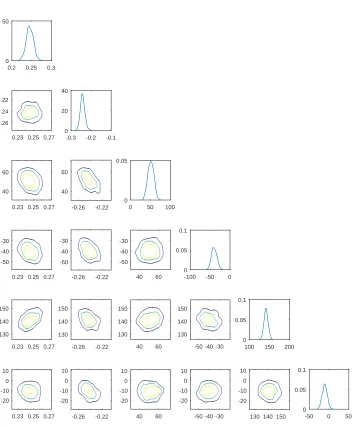
Figure 9. (Conductivity B, star-shaped prior) Kernel density
es-timates associated with the centre (x(1)0 , x (2)
-5 0 5 0
0.2 0.4 0.6
0 5 10 0
0.5 1
-5 0 5 0
0.2 0.4 0.6
-10 0 10 0
0.2 0.4
-5 0 5 0
0.2 0.4
0 5 10 0
0.5 -3 -2 -1 0 1
5 6 7
-3 -2 -1 0 1 -1
0 1 2
5 6 7 -1
0 1 2
-3 -2 -1 0 1 2
4 6
5 6 7 2
4 6
-1 0 1 2 2
4 6
-3 -2 -1 0 1 -2
0 2
5 6 7 -2
0 2
-1 0 1 2 -2
0 2
2 4 6 -2
0 2
-3 -2 -1 0 1 4
6
5 6 7 4
6
-1 0 1 2 4
6
2 4 6 4
6
-2 0 2 4
[image:29.612.134.490.137.570.2]6
Figure 10. (Conductivity B, level set prior) Kernel density
Acknowledgments
MMD is supported by EPSRC grant EP/HO23364/1 as part of the MASDOC DTC at the University of Warwick. AMS is supported by EPSRC and ONR. This re-search utilised Queen Mary’s MidPlus computational facilities, supported by QMUL Research-IT and funded by EPSRC grant EP/K000128/1.
References
[1] A. Adler and W. R. B. Lionheart, Uses and abuses of EIDORS: an extensible software base for EIT.,Physiological measurement,27(2006), S25–S42.
[2] G. Alessandrini, Stable determination of an inclusion by boundary measurements,Applicable Analysis: An International Journal,27(1988), 153–172, URLhttp://arxiv.org/abs/math/ 0403175.
[3] M. B´edard, Optimal acceptance rates for Metropolis algorithms: Moving beyond 0.234, Sto-chastic Processes and their Applications,118(2008), 2198–2222.
[4] A. Beskos, A. Jasra, E. A. Muzaffer and A. M. Stuart, Sequential Monte Carlo methods for Bayesian elliptic inverse problems, Statistics and Computing,25(2015), 727–737, URL
http://link.springer.com/10.1007/s11222-015-9556-7.
[5] A. Beskos, G. O. Roberts, A. M. Stuart and J. Voss, MCMC methods for diffusion bridges, Stochastics and Dynamics,8 (2008), 319–350, URLhttp://dx.doi.org/10.1142/ S0219493708002378.
[6] V. I. Bogachev,Measure Theory Volume I, Springer, 2007.
[7] L. Borcea, Electrical impedance tomography,Inverse problems,18(2002), R99.
[8] T. Bui-Thanh and O. Ghattas, An Analysis of Infinite Dimensional Bayesian Inverse Shape Acoustic Scattering and Its Numerical Approximation, SIAM/ASA Journal on Uncer-tainty Quantification, 2 (2014), 203–222, URL http://epubs.siam.org/doi/abs/10.1137/ 120894877.
[9] S. L. Cotter, G. O. Roberts, A. M. Stuart and D. White, MCMC methods for functions modifying old algorithms to make them faster,Statistical Science,28(2013), 424–446, URL
http://eprints.maths.ox.ac.uk/1492/.
[10] M. Dashti and A. M. Stuart, The Bayesian Approach to Inverse Problems, InHandbook of Uncertainty Quantification, Springer, 2016.
[11] S. Duane, A. D. Kennedy, B. J. Pendleton and D. Roweth, Hybrid Monte Carlo, Physics Letters B,195(1987), 216–222.
[12] J. N. Franklin, Well posed stochastic extensions of ill posed linear problems, Journal of Mathematical Analysis and Applications,31(1970), 682–716, URLhttp://adsabs.harvard. edu/abs/1970JIMIA..31..682F.
[13] M. Gehre, B. Jin and X. Lu, An analysis of finite element approximation in electrical impedance tomography,Inverse Problems,30(2014), 045013, URLhttp://stacks.iop.org/ 0266-5611/30/i=4/a=045013?key=crossref.284cda5f9645598cb83fccc9d226940a.
[14] M. Hairer, A. M. Stuart and S. J. Vollmer, Spectral gaps for a Metropolis-Hastings algorithm in infinite dimensions,The Annals of Applied Probability,24(2014), 2455-2490.
[15] R. P. Henderson and J. G. Webster, An impedance camera for spatially specific measurements of the thorax,IEEE transactions on bio-medical engineering,25(1978), 250–254.
[16] M. A. Iglesias, K. J. H. Law and A. M. Stuart, Ensemble Kalman methods for inverse prob-lems,Inverse Problems,29(2013), 045001, URLhttp://stacks.iop.org/0266-5611/29/i= 4/a=045001?key=crossref.a70b58896eed5588086da7ad3d04954b.
[17] M. A. Iglesias, Y. Lu and A. M. Stuart, A Bayesian Level Set Method for Geometric Inverse Problems, URLhttp://arxiv.org/abs/1504.00313.
[18] J. P. Kaipio, V. Kolehmainen, E. Somersalo and M. Vauhkonen, Statistical inversion and Monte Carlo sampling methods in electrical impedance tomography,Inverse Problems,16 (2000), 1487–1522.
[19] J. P. Kaipio, V. Kolehmainen, M. Vauhkonen and E. Somersalo, Inverse problems with struc-tural prior information,Inverse Problems,15(1999), 713–729.
[20] J. P. Kaipio and E. Somersalo, Statistical and Computational Inverse Problems, Springer, 2005.
[22] C. E. Kenig, J. Sj¨ostrand and G. Uhlmann, The Calder´on problem with partial data on manifolds and applications,Analysis and PDE,6(2013), 2003–2048.
[23] K. Knudsen, M. Lassas, J. L. Mueller and S. Siltanen, D-Bar Method for Electrical Impedance Tomography with Discontinuous Conductivities,SIAM Journal on Applied Mathematics,67 (2007), 893–913.
[24] K. Knudsen, M. Lassas, J. L. Mueller and S. Siltanen, Reconstructions of piecewise constant conductivities by the D-bar method for electrical impedance tomography,Journal of Physics: Conference Series,124(2008), 012029.
[25] K. Knudsen, M. Lassas, J. L. Mueller and S. Siltanen, Regularized D-bar method for the inverse conductivity problem,Inverse Problems and Imaging,3(2009), 599–624.
[26] V. Kolehmainen, M. Lassas, P. Ola and S. Siltanen, Recovering boundary shape and conduc-tivity in electrical impedance tomography,Inverse Problems and Imaging,7(2013), 217–242. [27] S. Lan, T. Bui-Thanh, M. Christie and M. Girolami, Emulation of Higher-Order Tensors in Manifold Monte Carlo Methods for Bayesian Inverse Problems, Journal of Computational Physics,308(2016), 81-101.
[28] R. E. Langer, An inverse problem in differential equations,Bulletin of the American Mathe-matical Society,39(1933), 814–821.
[29] S. Lasanen, Non-Gaussian Statistical Inverse Problems. Part I: Posterior Distributions, In-verse Problems & Imaging,6.
[30] S. Lasanen, Non-Gaussian Statistical Inverse Problems. Part II: Posterior Convergence for Approximated Unknowns,Inverse Problems & Imaging,6.
[31] S. Lasanen, J. M. J. Huttunen and L. Roininen, Whittle-Mat´ern priors for Bayesian statistical inversion with applications in electrical impedance tomography,Inverse Problems and Imag-ing,8(2014), 561–586, URLhttp://www.aimsciences.org/journals/displayArticlesnew. jsp?paperID=9912.
[32] M. Lassas, E. Saksman and S. Siltanen, Discretization-invariant Bayesian inversion and Besov space priors,Inverse Problems and Imaging,3(2009), 87–122.
[33] M. S. Lehtinen, L. Paivarinta and E. Somersalo, Linear inverse problems for generalised random variables,Inverse Problems,5(1989), 599–612.
[34] A. Mandelbaum, Linear estimators and measurable linear transformations on a Hilbert space, Zeitschrift f¨ur Wahrscheinlichkeitstheorie und Verwandte Gebiete,65(1984), 385–397. [35] A. I. Nachman, Reconstructions from boundary measurements,Annals of Mathematics,128
(1988), 531–576, URLhttp://cat.inist.fr/?aModele=afficheN&cpsidt=7131706.
[36] A. I. Nachman, Global uniqueness for a two-dimensional inverse boundary value problem, Annals of Mathematics,143(1996), 71–96.
[37] G. C. Papanicolaou and L. Borcea, Network Approximation for Transport Properties of High Contrast Materials,SIAM Journal on Applied Mathematics,58(1998), 501–539.
[38] M. Salo, Calder´on problem,Lecture Notes.
[39] D. Schymura, An upper bound on the volume of the symmetric difference of a body and a congruent copy,Advances in Geometry,4(2014), 12.
[40] E. Somersalo, M. Cheney and D. Isaacson, Existence and Uniqueness for Electrode Models for Electric Current Computed Tomography,SIAM Journal on Applied Mathematics,52(1992), 1023–1040.
[41] A. M. Stuart, Inverse problems : a Bayesian perspective,Acta Numerica,19(2010), 451–559, URLhttp://webcat.warwick.ac.uk:80/record=b2341209.
[42] J. Sylvester and G. Uhlmann, A Global Uniqueness Theorem for an Inverse Boundary Value, Annals of Mathematics,125(1987), 153–169.
[43] L. Tierney, Markov Chains for Exploring Posterior Distributions, Annals of Statistics,22 (1994), 1701–1728.
E-mail address:[email protected]

![Figure 3.�−0.5, 0.5]2).Conductivity B is constructed explicitly, rather =U([0h� The two binary fields we attempt to recover.Con-ductivity A is drawn from the star-shaped prior, with σ#N(0.5, 109 · (302 − AD)−3), h(z) = (1 + tanh z)/2, and τ0 =than being drawn from a prior.](https://thumb-us.123doks.com/thumbv2/123dok_us/9481930.454398/20.612.233.382.449.519/figure-conductivity-constructed-explicitly-elds-attempt-recover-ductivity.webp)