Original citation:
Martinez Dy, Angela, Martin, Lee and Marlow, Susan. (2014) Developing a critical realist positional approach to intersectionality. Journal of Critical Realism, 13 (5). pp. 447-466.
Permanent WRAP URL:
http://wrap.warwick.ac.uk/80624
Copyright and reuse:
The Warwick Research Archive Portal (WRAP) makes this work by researchers of the University of Warwick available open access under the following conditions. Copyright © and all moral rights to the version of the paper presented here belong to the individual author(s) and/or other copyright owners. To the extent reasonable and practicable the material made available in WRAP has been checked for eligibility before being made available.
Copies of full items can be used for personal research or study, educational, or not-for profit purposes without prior permission or charge. Provided that the authors, title and full
bibliographic details are credited, a hyperlink and/or URL is given for the original metadata page and the content is not changed in any way.
Publisher’s statement:
“This is an Accepted Manuscript of an article published by Taylor & Francis Journal of Critical Realism on 21/04/2014 available online:
http://www.tandfonline.com/10.1179/1476743014Z.00000000043
A note on versions:
The version presented here may differ from the published version or, version of record, if you wish to cite this item you are advised to consult the publisher’s version. Please see the ‘permanent WRAP URL’ above for details on accessing the published version and note that access may require a subscription.
Developing a Critical Realist Positional Account of Intersectionality Theory
KEYWORDS: CRITICAL REALISM; INTERSECTIONALITY; FEMINISM; CRITIQUE; POSITIONALITY.
Abstract
This article introduces an imminent critique of existing intersectional theory, suggesting that current limitations of this theory can be mapped to origins within positivist and hermeneutic schools of thought. Having identified the limitations and their causes, we offer an augmented account of intersectionality theory that reconciles and overcomes extant theoretical tensions and limitations by drawing upon critical realist principles and conceptual tools, enabling us to propose a novel methodological approach to intersectional research.
Introduction
Intersectionality theory has emerged over the past thirty years as an interdisciplinary approach to analysing the concurrent impacts of social structures, with a focus on theorising how belonging to
multiple exclusionary social categories can influence political access and equality. It conceptualises 1
the interaction of categories of difference such as gender, race and class at many levels, including individual experience, social practices, institutions and ideologies, and frames the outcomes of these
interactions in terms of the distribution and allocation of power. Originally a product of black 2
feminism, Jennifer Nash describes intersectionality as ‘outsider knowledge’ that has ‘transversed 3
disciplinary borders and gained institutional legitimacy’. Eventually adopted into mainstream 4
feminist discourse, intersectionality is now acknowledged as a highly significant contribution to feminist scholarship.
However, despite its promise to deepen understanding of how positioning within multiple disadvantaged groups can amplify social inequalities (e.g. woman, ethnic minority, economically impoverished) it has been beset with philosophical, methodological and practical critique concerning precisely how to analyse the varying impacts of one’s position within categories. It is generally accepted that intersectionality helps make visible the influences of multiple categories of oppression, yet when researchers have attempted to tease out the related forces involved, their methods have been subject to pernicious critique. In addition, due to its roots in focusing on the intersecting structural forces of oppression, research has tended to ignore, or pay less attention to questions of
agency and privilege. 5
Hancock 2007. 1
Davis 2008, 67-68; Hurtado 1989. 2
e.g. Combahee River Collective 1977; Crenshaw 1991; Davis 1981; Hill Collins 1990; hooks 1981. 3
Nash 2011, 446-447. 4
Together these critiques have resulted in a move towards understanding social positionality more generally as a contemporary intersectional frame that builds on, but moves away from, the idea of
discrete groups or categories of gender, ethnicity, and class which then intersect. Instead, it is 6
focused on broader social locations and processes, which are explicitly located within social hierarchies and tied to both material and cultural resource distribution. This move is clearly articulated by Floya Anthias, who holds that intersectionality is a social process of practices and arrangements that gives rise to particular forms of positionality. She suggests that from a temporal view, positionality encompasses both the present outcome of intersectionality – i.e., the being – as well as the process of development that is continually occurring, or the becoming. Positionality, then, like its precursor intersectionality, is a dynamic concept with real effects that impact the present, but are subject to change due to changing circumstances of structure and agency.
There is now a rich history to intersectional and positionality research, and whilst there have been
previous attempts to categorise these theories according to how they treat social categories, the 7
philosophical underpinnings of the various approaches have neither been clearly elucidated nor subject to critique. Drawing upon the philosophy of critical realism, this article will explore the philosophical roots of intersectional theory and argue that the issues within intersectionality theory can be resolved if the philosophy of critical realism is used to inform theory development. To do so, contemporary critiques and reviews of intersectionality theory will be examined and the argument presented that ontological and epistemological assumptions based upon the prevailing and ‘taken for granted’ positivist and hermeneutic perspectives have led intersectionality theory into a crisis of method. It will articulate the methodological problems engendered by such assumptions, and present an outline of a critical realist approach to intersectionality which will make suggestions for how these problems may be usefully reconciled.
Intersectional Complexity and the Limitations of Current Approaches
Because of ambiguity in its basic definitions and the complexity of the subjectivities with which it grapples, there is notable lack of consensus about some key elements of intersectionality. Amongst these is a lack of consistency in conceptualisation: that depending on the author or context, intersectionality has been considered a theory, a paradigm, a framework, a method, a perspective, or
a lens. This vagueness and ambiguity has been both heralded for its flexibility and usefulness as 8 9
well as identified as a key tension within the literature. These issues have led Leslie McCall to 10
conclude that the methodology for intersectionality is under-theorised, calling attention to the limited range of methodological tools with which to research intersectionality. Defining methodology as encompassing the philosophy and methods that underpin the research process and production of
Anthias 2001 a&b, 2002, 2006, 2008. 6
McCall 2005; Mehrotra 2010. 7
Mehrotra 2010. 8
Davis 2008, 76. 9
knowledge, she identified three distinct methodological strands within intersectional research:
anti-categorical complexity, intra-anti-categorical complexity, and inter-anti-categorical complexity. 11
Anti-categorical complexity deconstructs and rejects analytical categories, starting from the assumption that categories, including race and gender, are too simplistic to capture the complexity of
lived experience . Intra-categorical complexity, the original approach of intersectionality theory, 12
attempts to focus on social groups at neglected points of intersection. Inter-categorical complexity, described as the ‘strategic use’ of categories, ‘begins with the observation that there are relationships of inequality among already constituted social groups, as imperfect and ever changing as they are,
and takes those relationships as the center of the analysis’. However, McCall notes that not all 13
research on intersectionality can be categorised into one of the three approaches, that some will cross categorical boundaries, that there may not be homogeneity within the categories, and that she may
have misunderstood or misclassified some pieces of research. While this work has made a 14
significant contribution to theoretical understanding, this continuum comprised of anti-, intra- and inter-categorical complexity does not take into account the methodological issues that arise from being uncritically rooted in positivist or hermeneutic traditions. Indeed, it will be argued that the limitations identified by intersectional scholars correspond to problems stemming from the implicit ontological and epistemological assumptions underpinning the various approaches.
Residual positivism in intersectionality theory
The philosophical underpinnings of intersectionality theory have not been at the foreground of intersectional discourse, although McCall notes that those in anticategorical and intracategorical camps tend to negatively associate advanced quantitative techniques, large data sets, and surveys
with the legacies of positivism. However, the positivist tradition has implicitly informed the 15
epistemology of intersectional theorists who do not tend to acknowledge its presence in their thinking. Based on the premise of the existence of causal laws, inter and intra-categorical intersectional approaches attempt to theorise the nature and kind of laws at work in structures of domination, as well as to articulate the historically specific conditions under which they exist. Yet the positivist concern with causal laws and quantifying their effects has arguably led theorists to treat the categorisations as discrete and separable, such that race, class and gender are often portrayed and
analysed as fixed categories with discrete, consistent and measurable effects when they are in fact 16
‘shifting, slippery, [and] highly contextual’. This is an issue within identity-centred intersectionality 17
scholarship in general, as identity and by extension, difference and inequality, are often treated as
McCall 2005. 11
Nash 2008; c.f. McCall 2005. 12
McCall 2005, 1784–1785. 13
McCall 2005, 1774. 14
McCall 2005, 1791. 15
Mehrotra 2010; Nash 2011. 16
static and possessive attributes of individuals or groups. Mehrotra points to the predominance of 18 mathematical and geometric metaphors invoked to structurally describe intersectionality, including
vectors of difference, matrices of oppression, and axes of power, along with the problematic 19
additive model, and its cousin, the multiplicative model. These metaphors suggest that gender, race, 20
and class can be considered separately and so, understood and analysed through, for example,
additive calculation. The extensive use of mathematical tropes to portray structural conditions is 21
reflective of a positivist legacy, and has created a conceptual cul-de-sac from inside of which it is difficult to imagine other ways these structures may interact.
Additionally, positivist predispositions towards prediction are arguably at the root of why simplistic quasi-predictive conceptualisations like the additive approach (i.e. race + class + gender + any additional categories = experience of oppression) became popular in the literature, although they
have since been critiqued as both unlikely and essentialising. Ironically, intersectionality theory 22
was in fact developed to complicate essentialist notions of womanhood espoused by second wave feminism, challenging the assumption that categories such as ‘woman’ or ‘black’ affect everyone within their bounds in the same way, and taking the assumed stability of those boundaries to task. But Nash notes that early theorists’ work on the intersections of race and gender in particular pushed these constructs to the fore, and thus, the theory as a whole away from grappling with other issues of multiple marginality. As a result, ‘intersectional projects often replicate precisely the approaches that
they critique’ by reifying categories or overlooking heterogeneity due to bracketing or ignoring 23
categories with which they are not explicitly concerned.
Despite strong critiques of conventional notions of theory as elitist, exclusionary, and subjective rather than objective as claimed, intersectional scholars have not addressed the positivist denial of
ontology within their epistemologies. Black feminist critiques of theory were concordant with other 24
feminist critiques of the androcentric construction of ‘knowledge’ in the natural sciences. In order 25
to contest the idea of theory as neutral, the black feminist scholarship in which intersectionality is
grounded intentionally ‘collaps[ed] the distinction between theory and experience’. However, in 26
Anthias 2006; 2008. 18
Mehrotra 2010, 420-421. 19
Nash 2008, 7. 20
Mehrotra 2010, 421. 21
e.g. Bowleg 2008; Hancock 2007; Yuval-Davis 2006. 22
Nash 2011; 2008, 6. 23
e.g. Hill Collins 1990. 24
e.g. Harding 1986; Haraway 1988. 25
spite of this move’s admirable aims, it results in the problem of the epistemic fallacy, because of 27 which problems of being are conflated with problems of knowing. The positivist conflation of experience, theory, and knowledge that feminism critiqued in the scientific tradition was replicated in intersectionality, albeit with important differences: the vantage point was now articulated and embodied; it was no longer elite, but instead occupied a subjugated position in the social hierarchy. As such, it had the potential to precipitate an acute awareness of relationships of power, described by
Haraway as ‘vision…from below’. So while the lived experiences of marginalised people are no 28
doubt valuable sources of insight for capturing actualised, observed causal mechanisms in the social world, intersectionality theory is generally consistent with a post-positivist perspective that does not effectively separate ontology from epistemology, and thus fails to theorise that which may not be actualised, observed, or exist outside the realm of experience
The hermeneutic tradition and intersectional identity
Contemporary intersectionality theorists are predominantly associated with the anticategorical approach. Within this approach, taking a broadly defined post-structural position, anti-categorical
approaches view categories as ‘simplifying social fictions’ that are in fact fluid and co-constitutive, 29
and so cannot be depicted in discrete ways. Although this approached has helped reveal the social 30
origins and discursive functions of categories, these perspectives risk becoming ‘drained of causal
import’ as they turn their attention away from structures and towards individual interpretations of 31
reality.
For Bhaskar, the hermeneutic tradition is mistaken in regarding the key problems of philosophy
arising from the ‘conditions, limits and forms’ of language. As in the positivist tradition, 32
transfactuality, the argument that something can exist and have causal mechanisms independent of any given observer, or discourse, is thus denied. Yet Bhaskar stresses that the denial of such an ontology merely results in the tacit adoption of an implicit one. And in general, the implicit ontological assumption made by scholars within the hermeneutic tradition is that society is entirely
conceptual in character, its central category being that of meaning. The risk here is that it is inferred 33
that ‘the natural world becomes a conception of the human mind’ and reality nothing more than a 34
Bhaskar 1998, 133; 2008, 13, 36. 27
Haraway 1988, 583. 28
McCall 2005, 1773. 29
Mehrotra 2010, 421. 30
Bhaskar 1998, 12. 31
Bhaskar 1998, 133. 32
Bhaskar 1998, 133-5. 33
discursive construction. Hence, structural issues are analysed only in terms of individuals’
experiences and understanding of them, to the detriment of analysis of both structure and agency. 35 36
The tendency of intersectionality theorists to focus ever more closely on the meaning-making processes of the individual reflects this implicit belief. Within intersectionality discourse, notions of positionality or structural discrimination are often collapsed into ‘identity’. Yuval-Davis defines
identities as individual and collective narratives that answer questions of who we are. She notes, 37
however, that in contemporary literature, concepts of identity are often required to perform analytical tasks beyond their abilities. For example, the study of identity seems ill-suited to provide wider contextual analysis for a given social condition. Although exploring identity can provide insight into individual perceptions of particular circumstances and how they make sense of and cope with them, it cannot speak decisively about how structural components of those circumstances may be determined by the wider social field. The predominance of inquiries into intersectional identity is herein argued to be a continuation of the hermeneutic focus on the discursive construction of reality as it manifests at the micro level. Concurrently, there is a conspicuous lack of theory on the
intersecting structural conditions that engender these realities , in which resource inequalities of 38
various kinds produce complex experiences of discrimination and privilege, posing significant 39
challenges for intersectional scholars seeking to explain macro-level conditions. What is required is an ontological position that accepts the transfactual existence of structural categories that have causal power and can explain how agency can interact with, reproduce and change these structures.
Table 1 shows the three existing approaches to intersectional methodological complexity. Drawing 40
upon critical realist perspectives, it illustrates how these approaches are implicitly informed by the 41
positivist and/or hermeneutic traditions, and highlights some of the common problematic outcomes that occur as a result.
Table 1: Extant Intersectional Approaches to Methodological Complexity
Approach to Complexity
Intercategorical
(Categorical) Intracategorical Anticategorical
Approach to
Categories Provisionally adopt
Categories inadequate,
but identify complexity Deconstruct and reject
Yuval-Davis 2006. 35
Clegg 2006. 36
Yuval-Davis 2006. 37
Acker 2000, 2006; Yuval-Davis 2006. 38
Anthias 2001; Nash 2011. 39
McCall 2005; Mehrotra 2011; Nash 2008. 40
Towards a Critical Realist Intersectionality
Critical realism can help address the limitations of existing intersectionality theory through providing an alternative ontology to current assumptions. Critical realism contains a conception of causality that enables an understanding of how the social world can exist independently from our knowledge of it. Bhaskar’s philosophy of science arose from asking the question: What must the world be like in order for science, as we understand it, to be possible? He argued that because it is possible to identify correlations and causation through experimental activity, there must be underlying causal mechanisms enabling such events to be measured. As these correlations may not endure outside of this experimental activity (they require scientific work in order to be identified) the causal mechanisms that lead to them must be considered separate from the events they generate. In other words, causes have essential properties that operate continuously, regardless of any immediate
effect. This insight enabled Bhaskar to propose these causal mechanisms underpin events and these 42
mechanisms are considered real if they ‘have an effect or make a difference’. This logic enabled the 43
conclusion that the social world must be stratified into at least three domains: the empirical, in which events are observed and measured; the actual, in which events occur irrespective of our knowledge
of them; and the real or the deep, where forces can exist as tendencies or possibilities. It is 44
maintained that aspects of this reality can be known through the development and improvement of fallible theories. 45
While acknowledging important contributions from both positivist and hermeneutic traditions in developing his philosophy of science, Bhaskar points out two fundamental oversights contained within them. First, that both strands of thought predicate a flat, positive ontology, which he terms
‘ontological monovalence’. Here both philosophies make implicit assumptions that there can be no 46
absence or potential in the world. Positivism assumes only that which can be measured exists hence, the unobserved cannot be considered part of reality and the hermeneutic traditions contain the
Predominant Philosophical Influence
Post-positivist Positivist-Hermeneutic Hermeneutic
(Discursive approach)
Problematic Assumptions
Categories fixed, can be analysed discretely
Intersections fixed, experience = theory.
Categories are fictional and thus irrelevant
Problematic Outcomes Additive approach,
mathematical tropes Epistemic fallacy
Focus limited to ‘identity’ or ‘discourse’
Bhaskar 2008a. 42
Fleetwood 2004, 29. 43
Mole 2012; c.f. Bhaskar, 2008. 44
Bhaskar 2008. 45
implicit assumption that if something is not within the subjective perception or sense making of an individual, it is also not part of the social world. Second, he identified that neither philosophical approach allows for the possibility of transfactuality: the idea that causal powers can exist without
being actualised in events or recognised by observers. Instead, only forces or mechanisms that are 47
observed, experienced and measured are acknowledged, with no means of accounting for that which may not be actualised or recognised. Thus, according to both traditions, any social force or mechanism that is either unactualised or unrecognised by actors cannot be assumed to exist. Bhaskar proposes transfactuality as a path through this divide, in which a depth ontology exists, and causal mechanisms are considered real and external to individuals, but transcendentally so. Accordingly, they may exist actualised or unactualised, perceived or unperceived. The possibility of knowing their existence is pursued through the development of fallible theories, including that of their potential transfactuality. This serves to reconcile these crucial oversights of both of the dominant philosophies of science.
The application of these concepts holds potential for the development of intersectionality theory. For example, because of a tendency within intersectionality literature to avoid conceptualising
privilege, the theory has not clearly articulated ways in which individuals may be subject to 48
oppression by certain mechanisms while benefiting from privilege because of others. Nash articulates the need for this theorising in her comment that ‘progressive scholarship requires a nuanced conception of identity that recognises the ways in which positions of dominance and subordination work in complex and intersecting ways to constitute subjects’ experiences of
personhood’. This could be addressed by incorporating a notion of transfactuality into 49
intersectionality’s conceptualisation of complexity. Intersecting mechanisms of domination such as racism, sexism and classism could be theorised to be actualised and recognised in some cases and contexts, but not in others. The same would be held for mechanisms of privilege. So, for example, it is entirely possible that someone could believe they are not subject to sexist or racist behaviour within an organisation and for this to be incorrect. An institution can contain an implicit culture of sexism and racism in relation to the allocation of financial rewards and it is perfectly plausible that this may not be perceived by any of its members. Such a move can help advance intersectional theory at both the micro- and macro-levels, in order to more accurately theorise the nature of systems of oppression and privilege. At the level of the individual, it would ‘broaden its reach to theorise an
array of subject experience(s)’, while at the structural level, it could help to contextualise and 50
explain complicated findings like McCall’s, wherein changes in a particular economic environment created advantage for some groups of women and disadvantage for other groups of women, relative
to similarly situated men. 51
Bhaskar 1998; 2008a. 47
Nash 2008. 48
Nash 2008, 10. 49
Nash 2008, 10. 50
Critical realist feminism in an intersectional framework
Although critical realism has not yet been fully applied to intersectional theory or fully deployed within feminist theory, critical realist feminists have responded to the poststructuralist and anticategorical approaches that feature prominently in intersectional literature. Anticategorical approaches, implicitly built on hermeneutic or discursive traditions, problematically assume that society is primarily conceptual in character, and that reality is constructed through discourse. Gunnarsson notes that as a result of these approaches, the category ‘woman’ is now assumed to have
little positive theoretical validity in feminist literature, corroborated by McCall who notes that 52
anticategorialism has led to ‘great scepticism about the possibility of using categories in anything but
a simplistic way’. This rejection of the category ‘woman’ stems from ‘deny[ing] categories any 53
analytical validity by virtue of their empirical inseparability’. However, she argues that it is not 54 impossible to distinguish gender analytically from other categories and indeed, that an intersectional standpoint is premised upon a category called ‘gender’ being analysed in conjunction with other
categories. For anticategoricalists, ‘the notion that gender is constructed entails that it is a fiction’. 55
In contrast, critical realist feminists maintain that women are a real group, joined by the abstract
social category of ‘woman’, who may have some universal interests despite the reality of 56
heterogeneity. So, although categories like race, ethnicity and gender are understood as 57
constructions, and as such are not necessarily based on embodied reality or any ‘essential truth’ about a group, this does not negate the fact that they have social meaning.
Gunnarsson details a realist understanding of categories such as race/ethnicity, class and gender as neither essential nor analytically inseparable, but instead as abstractions with real social, political, cultural and economic implications within their respective contexts. Categories are seen to have real material and social effects, particularly on the ‘set of outcomes relating to life conditions, life
chances and solidarity processes’. They serve to enable or constrain opportunities, resources, 58
perception by self and others, and treatment in social settings. With this in mind, a critical realist
understanding of categories as abstractions ‘implies neither essentialism nor homogenisation’ of 59
the people to whom the categories refer. Instead, it is the social meanings that categories convey, and the structural positions to which they correspond, that leads to such essentialising perceptions, resulting in treatment that reproduces or exacerbates inequalities in social conditions.
Gunnarsson 2011. 52
McCall 2005, 1773. 53
Gunnarsson 2011, 26. 54
Gunnarsson 2011, 29, original emphasis. 55
Gunnarsson 2011. 56
New, 2003. 57
Anthias 2001, 367. 58
Finally, Bhaskar’s notion of concrete universality provides the necessary theoretical links between 60 the category-as-abstraction and heterogeneous individual experiences. He describes abstract universal categories (e.g. woman) as being mediated by intersecting factors (including race, class, age, ability, etc.) and framed in a particular geopolitical and historical context. This, combined with the irreducible uniqueness of individuals, defines the concept of a concrete universal, in which abstract categorical belonging is held to be located in a particular spatial/temporal context, mediated by social positioning, and concretised in the life experiences of individuals. It elaborates upon
critical realist feminist perspectives on the validity of the category ‘woman’ while at the same time 61
preserving important intersectional critiques of categorical essentialism by articulating the key factors that produce heterogeneity of experience, therefore broadening the understanding of what a ‘universal’ category is able to encompass.
Structure and agency in intersectional theory
The lack of a well-defined relationship between structure and agency, as well as between structures themselves, are further hurdles within intersectional theorising that a critical realist approach could
help to clarify. Archer’s model of structure and agency is useful here. In this model, termed the 62
morphogenetic approach, structures are regarded as existing prior to the development of agency and influencing actors in the present, who can then contribute to either the reproduction or transformation of these pre-existing structures. The influence of structure upon actors is two-pronged. First, structure is held to affect life-chances, endowing them with initial interests and providing the leverage upon which reasons for different courses of action operate. Thus, while life chances are not deterministic, they ‘strongly condition what type of Social Actor the vast majority can and do
become’. Second, structure is argued to be mediated by social actors primarily through affecting 63
their ‘constellation of concerns’ in relation to the natural, practical, and social orders of reality. This mediation manifests and takes shape through a process of reflexive internal conversation, which then results in chosen courses of action.
Archer challenges the conflations within contemporary social theory that attribute social phenomena either entirely to the influence of structure (e.g. structuralism) or agency (e.g. rational agent models), or, as in the case of Giddens’ structuration theory, collapses the two. In response to these deterministic and individualistic approaches, the morphogenetic approach: ‘shows (a): how human agency is socially mediated but is irreducible to social norms, and (b) how any account of human
agency must include emotional and normative factors as well as any reference to rationality’. It 64
acknowledges the historicity and objectivity of the circumstances of social structure, its consequent impacts on life-chances, and the potential for agential reflexivity and choice within the options available to them. It addresses subjectivity by acknowledging an agent’s personal powers, and
Bhaskar 2008b. 60
Gunnarsson 2011; New 2003. 61
Archer 1995; 2000; 2007. 62
Archer 2000, 285. 63
considers reflexivity, or the internal conversation, to be the primary medium by which the social
world is mediated in action. Although it recognises social positioning, or the ‘differential placement 65
of agents in relation to the distribution of resources,’ it highlights ‘the impossibility of deducing
determinate courses of action from such positionings alone’. It thus rejects both determinism and 66
voluntarism, and instead offers a dialectical, interactionist and mutually constitutive approach to the explanation of social phenomena. It also interrogates contemporary feminist scholarship in which
discussions of agency are limited to the discursive construction of power. Instead, it centres on and 67
upholds the primacy of practice, or, in intersectional feminist terms, ‘lived experience’, which Archer holds ‘yields reasoned knowledge nondiscursively’ and which also ‘underlies practical proficiency in
the linguistic domain’. 68
It may be the case that implicit influences from the hermeneutic tradition have contributed to the avoidance of theorising structure within intersectional theory. Instead, social categories are targeted for deconstruction or dismissed as irrelevant, and concurrent focus placed on individual interpretations of social reality. The relationship between structure and agency has, therefore, been arguably under-theorised here, as has the interaction between agency and the replication of the
structures of domination, gaps which are highlighted in contemporary critiques of the literature. 69
Thus, introducing a realist depth ontology and drawing upon Archer’s conceptions of structure and agency can significantly propel intersectional theory forward. Nash observes that due to its lack of a theory of agency, intersectionality theory has thus far been unable to ‘answer…questions about the
fit between intersectionality and lived experience of identity’. Neither positivist nor hermeneutic 70
approaches have been sufficient to conceptualise this relationship. Although the lack of a theory of agency has not prevented researchers from exploring how individuals negotiate intersecting
oppressions within their experiences, critical realist notions of the structure-agency relationship, 71
such as Archer’s three-stage model or morphogenetic approach can undoubtedly be used to 72 73
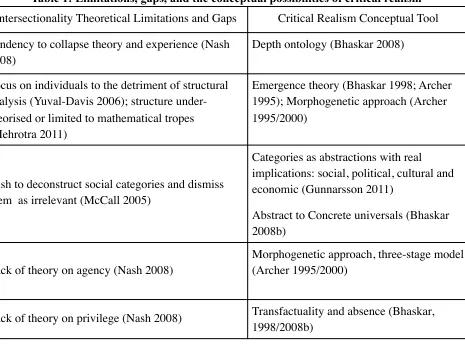
theorise how individuals and groups can be constrained or enabled by structures, and how agency can affect structures in turn. The table below is not meant to be exhaustive but is intended as a starting point for identifying some of the many valuable ways in which critical realist philosophy could potentially advance the intersectional project.
Archer 2007. 65
Archer 2007, 13. 66
New 2003. 67
Archer 2000, 151. 68
McCall 2005; Nash 2008, Yuval-Davis 2006. 69
Nash 2008, 11. 70
e.g. Essers et al., 2010. 71
Archer 2000. 72
Table 1: Limitations, gaps, and the conceptual possibilities of critical realism
Critical Realism and a Positional Approach to Methodological Complexity
This article aims to introduce a novel methodological approach to intersectionality theory. It attempts
to rectify the problematic assumptions and outcomes of the three approaches outlined by McCall 74
by drawing upon critical realist philosophy with the intention of developing a new intersectional social ontology. The treatment of social categories within existing approaches has been taken as their most prominent feature and lent itself to their names. However, the approach introduced here prioritises not its treatment of categories, but its understanding of social positioning. It will therefore be referred to as the ‘positional’ approach, and is presented as an augmented conceptual framework to existing intersectionality theory. Its key characteristics are outlined in Table 3 below.
Table 3: Positional Approach to Methodological Complexity in Intersectionality
Intersectionality Theoretical Limitations and Gaps Critical Realism Conceptual Tool
Tendency to collapse theory and experience (Nash 2008)
Depth ontology (Bhaskar 2008)
Focus on individuals to the detriment of structural analysis (Yuval-Davis 2006); structure under-theorised or limited to mathematical tropes (Mehrotra 2011)
Emergence theory (Bhaskar 1998; Archer 1995); Morphogenetic approach (Archer 1995/2000)
Push to deconstruct social categories and dismiss them as irrelevant (McCall 2005)
Categories as abstractions with real implications: social, political, cultural and economic (Gunnarsson 2011)
Abstract to Concrete universals (Bhaskar 2008b)
Lack of theory on agency (Nash 2008)
Morphogenetic approach, three-stage model (Archer 1995/2000)
Lack of theory on privilege (Nash 2008) Transfactuality and absence (Bhaskar,
1998/2008b)
Approach to Complexity
Positional
Approach to Categories Use as starting point to analyse broader social locations and processes.
From a critical realist positional approach, abstract concepts such as ‘women’ would be acknowledged to be ‘qualitatively different from lived reality’, and so could be used as categories of
analysis ‘without any expectation that they will correspond to…lived reality in any clear-cut sense’. 75
Instead, they will correspond to structural positions. Into each of these positions will be built ‘certain structured interests, resources, powers, constraints and predicaments’ instituted by the web of
relationships that make up a social structure. The notion of structural positions within critical 76
realism echoes the intersectional notion of positionality. Aligning the two concepts means that the positional approach enables the claim that generative structural mechanisms emerge from the various intersections of social categories. These mechanisms position agents in social locations in which they are constrained or enabled, and which they then negotiate via agency. Archer’s well-articulated and
elaborated notions of agency can draw feminist theorising away from poststructuralist conceptions 77
of a fragmented, disempowered subject and towards a unified, embodied subject capable of agency 78
and engaged in processes of social positioning. Positionality would be understood to influence
life-chances, concrete access to material, economic, political, symbolic and cultural resources, and 79 80
condition the cognitive resources available for conducting the internal conversations, both conscious
and unconscious, that influence agent action. 81
Predominant
Philosophical Influence Critical Realist
Key Assumptions
Depth ontology, transfactuality, and morphogenetic approach to structure, culture, and agency. Concrete universals.
Key Outcomes
Structure = durable relationships that position, constrain and/or enable. Social positioning as a continuous process, negotiated by agency. Marginality not a monolith. Nuanced experiences of privilege and oppression.
Gunnarsson, 2011, 32. 75
Porpora, 1998, 344. 76
Archer 1995; 2000; 2007. 77
Clegg 2006. 78
Archer 2000; Anthias 2001b. 79
Anthias 2001a, 635. 80
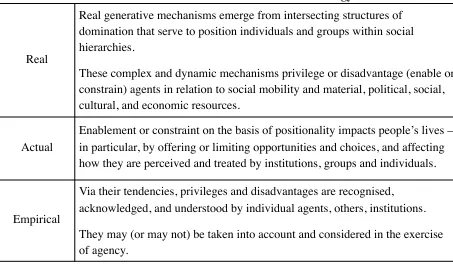
To overcome existing limitations, a novel methodological approach is necessary and can be achieved through drawing upon the ontological assumptions within critical realism. The development of this approach reinvigorates intersectionality theory with the ability to assess just how a particular individual’s social position is being enabled and constrained by structural mechanisms and how these generative structural mechanisms operate within the particular intersection of wider structural categories, such as race, class, and gender. A critical realist intersectional ontology, as shown in Table 4, accounts not only for the presence and recognition of various structural forces that privilege or disadvantage individuals, but also for their existence even if such events did not occur or were not recognised (transfactuality) by any one actor. These forces would be emergent from the interactions of the abstract categories that structure social reality, including race/ethnicity, gender, class, sexuality, age, dis/ability, and others. The ontology should illuminate how, although they may be abstract social constructions, these social categories serve to define real relationships of power that can in some cases exist unactualised, or be actualised but unrecognised by actors, groups and institutions. Subsequently, research can identify how intersectional forces are perceived by individual agents and be safe to assume that if it is not perceived it is not real. This opens up research to explore
[image:15.595.68.521.346.610.2]intersectional forces on the three levels of reality Bhaskar identified. 82
Table 4: Critical Realist Intersectional Ontology
This ontology advances intersectional theory and enables it to more effectively account for the nature of structures of domination, as well as how they are connected and replicate themselves. It rejects the
additive approach common to positivism in favour of an emergent, constitutive approach. From a 83
positivist perspective, prediction is desired, categories are treated as fixed and their intersections
Real
Real generative mechanisms emerge from intersecting structures of domination that serve to position individuals and groups within social hierarchies.
These complex and dynamic mechanisms privilege or disadvantage (enable or constrain) agents in relation to social mobility and material, political, social, cultural, and economic resources.
Actual
Enablement or constraint on the basis of positionality impacts people’s lives – in particular, by offering or limiting opportunities and choices, and affecting how they are perceived and treated by institutions, groups and individuals.
Empirical
Via their tendencies, privileges and disadvantages are recognised, acknowledged, and understood by individual agents, others, institutions.
They may (or may not) be taken into account and considered in the exercise of agency.
Bhaskar 1998. 82
conceptualised as separable and calculable. In contrast, a critical realist intersectional approach 84 would be aimed primarily towards causal explanation, not prediction. From a poststructuralist perspective, social categories are to be deconstructed and rejected, assuming instead ‘the constitution
of subjectivity within discourse’ and favouring a focus on identity as a lens for how this 85
subjectivity is constructed. In contrast, a critical realist positional approach would distinguish between theory and experience and analytically separate categories from the lived experiences of the people to whom they refer. Categories would be seen as abstractions and actors as their referents, occupying dynamic, non-deterministic structural positions that constrain or enable them, in concert
or in conflict, in intersecting ways. Seeking links between the macro and the micro, it would accept 86
the fluid nature of intersections and categories as they impact identities, but recognise that the social meanings attached to categories are structurally emergent, and therefore more durable over time. By conceptualising categories as abstractions related to social hierarchies rather than prescriptive, embodied realities, critical realism can assist intersectionality in tackling and theorising the nature of social structures.
Conclusion
Critical realism offers intersectional theory an alternative ontological framework that has the potential to remove it from the quagmire of a growing body of critique. It helps illustrate the manner in which the scope and explanatory power of intersectionality theory is limited by implicit philosophical assumptions stemming from roots in positivist and hermeneutic traditions. It contains the conceptual tools necessary to augment intersectionality theory and rectify some of its problematic limitations. By building on existing feminist critiques of intersectionality theory, the foundations for a novel approach to methodological complexity within intersectionality, one that takes critical realism as its predominant philosophical influence and contributes a working realist intersectional ontology to the development of this approach, has been proposed. This critical realist positional approach moves away from, on the one hand, inter- and intra-categorical conceptions of discrete and intersecting social categories, and on the other, the popular anticategorical approaches that reject categories altogether. Instead, categories can be taken as abstract starting points with durable social meaning from which to explore broader structural inequalities as well as dynamic processes of positionality and agency. Using critical realist tools to develop intersectionality theory in this way would enable its advancement beyond mere discussions of identity and towards the aims of the original intersectional and realist authors of dismantling negative structures of domination, and promoting emancipation and human flourishing.
Bibliography
Acker, J. 2000. Revisiting Class: Thinking from Gender, Race and Organizations. Social Politics
Summer 2000. Oxford University Press.
Acker, J. 2006. Inequality Regimes : Gender, Class, and Race in Organizations Gender & Society 20:
441.
Nash 2011, 461; Mehrotra, 2010. 84
New 2003, 65 c.f. Weedon, 1997, 163. 85
Anthias, F. 2001a. New hybridities, old concepts: the limits of 'culture'. Ethnic and Racial Studies, 24(4): 619-641.
Anthias, F. 2001b. The material and the symbolic in theorizing social stratification: issues of gender,
ethnicity and class. British Journal of Sociology, 52(3): 367–390.
Anthias, F. 2002. Beyond Feminism and Multiculturalism: Locating Difference and the Politics of
Location. Women’s Studies International Forum, 25(3): 275–286.
Anthias, F. 2006. Belongings in a Globalising and Unequal World: Rethinking Translocations. The
Situated Politics of Belonging. Ed. Nira Yuval-Davis, Kalpana Kannabiran, Ulrike Vieten. London: Sage.
Anthias, F. 2008. Thinking through the lens of translocational positionality: an intersectionality
frame for understanding identity and belonging. Translocations: Migration and Social Change 4(1):
5-20. [online] Available at: http://www.dcu.ie/imrstr/volume_4_issue_1/ Vol_4_Issue_1_Floya_Anthias.pdf. Accessed 19 Jan 2013.
Archer, M. 1995. Realist Social Theory: The Morphogenetic Approach. Cambridge: Cambridge
University Press.
Archer, M. 2000. Being Human: The Problem of Agency. Cambridge: Cambridge University Press.
Bhaskar, R. [1978] 2008a. A Realist Theory of Science. 2nd Edition. London: Verso.
Bhaskar, R. [1979] [1989] 1998. The Possibility of Naturalism. 3rd Edition. London: Routledge.
Bhaskar, R. [1993] 2008b. Dialectic: The Pulse of Freedom. 2nd Edition. London: Routledge.
Bowleg, L. 2008. When Black + Lesbian + Woman ≠ Black Lesbian Woman: The Methodological
Challenges of Qualitative and Quantitative Intersectionality Research. Sex Roles 59: 312–325.
Clegg, S. 2006. The problem of agency in feminism: a critical realist approach. Gender and
Education, 18(3): 309–324.
Combahee River Collective. 1977. A Black Feminist Statement From The Combahee River Collective. [online] Available at: http://www.feministezine.com/feminist/modern/Black-Feminist-Statement.html. [Accessed 22 Jan 2013].
Cooper, F. R. 2005. Against Bipolar Black Masculinity: Intersectionality, Assimilation, Identity
Performance, and Hierarchy. U.C. Davis L. Rev., 39:853.
Crenshaw, K. 1991. Mapping the margins: intersectionality, identity politics, and violence against
women of color. Stanford Law Review, 43(6): 1241-1299.
Davis, A. 1981. Women, Race and Class. New York: Random House.
Davis, K. 2008. Intersectionality as Buzzword. Feminist Theory, 9: 67.
Gunnarson, L. 2011. In defence of the category ‘woman’. Feminist Theory, 12 (1)-23-37.
Hancock, A. 2007. When Multiplication Doesn’t Equal Quick Addition: Examining Intersectionality
as a Research Paradigm. Perspectives on Politics, 5(1): 63-79.
Hill Collins, P. [1990] 2000. Black Feminist Thought. 2nd Edition. New York, NY: Routledge.
Hurtado, A. 1989. Relating to Privilege: Seduction and Rejection in the Subordination of White
Women and Women of Color. Signs, Vol. 14(4): 833-855.
McCall, L. 2005. The Complexity of Intersectionality. Signs, 30(3): 1771-1800.
Mole, K. 2012. Critical Realism and Entrepreneurship. Perspectives in Entrepreneurship: A Critical
Approach. Ed. Kevin Mole with Monder Ram. Houndmills: Palgrave MacMillan.
Mutch, A. 2004. Constraints on the Internal Conversation: Margaret Archer and the Structural
Shaping of Thought. Journal for the Theory of Social Behaviour, 34(4): 429–445.
Porpora, D. 1998. Four Concepts of Social Structure. Critical Realism: Essential Readings. Ed.
Margaret Archer, Roy Bhaskar, Andrew Collier, Tony Lawson and Alan Norrie. New York, NY: Routledge.
Prins, B. 2006. Narrative Accounts of Origins. A Blind Spot in the Intersectional Approach? European Journal of Women's Studies, 13(3): 277-290.
Nash, J. 2008. Re-Thinking Intersectionality. Feminist Review, 89: 1-15.
Nash, J. 2011. ‘Home Truths’ on Intersectionality. Yale Journal of Law and Feminism, 23(1):
445-470.
New, C. 2003. Feminism, Critical Realism and the Linguistic Turn. Critical Realism: The Difference
it Makes. London: Routledge.
Roquemore, K. Negotiating the Color Line: The Gendered Process of Racial Identity Construction
among Black/White Biracial Women. Gender & Society 16(4): 485-503.
Yuval-Davis, N. 2006. Intersectionality and Feminist Politics. European Journal of Women's Studies,