http://wrap.warwick.ac.uk
Original citation:
Kalashnyk, Nataliya, Ganesh Nagaswaran, Praveen, Kervyn, Simon, Riello, Massimo,
Moreton, Ben, Jones, T. S. (Tim S.), De Vita, Alessandro, Bonifazi, Davide and
Costantini, Giovanni. (2014) Self-assembly of decoupled borazines on metal surfaces :
the role of the peripheral groups. Chemistry - A European Journal, Volume 20 (Number
37). pp. 11856-11862.
Permanent WRAP url:
http://wrap.warwick.ac.uk/63770
Copyright and reuse:
The Warwick Research Archive Portal (WRAP) makes this work of researchers of the
University of Warwick available open access under the following conditions.
This article is made available under the Creative Commons Attribution 4.0 International
license (CC BY 4.0) and may be reused according to the conditions of the license. For
more details see:
http://creativecommons.org/licenses/by/4.0/
A note on versions:
The version presented in WRAP is the published version, or, version of record, and may
be cited as it appears here.
&
Self-Assembly
Self-Assembly of Decoupled Borazines on Metal Surfaces:
The Role of the Peripheral Groups
Nataliya Kalashnyk,
[a]Praveen Ganesh Nagaswaran,
[c]Simon Kervyn,
[c]Massimo Riello,
[b]Ben Moreton,
[a]Tim S. Jones,
[a]Alessandro De Vita,*
[b]Davide Bonifazi,*
[c, d]and
Giovanni Costantini*
[a]Abstract: Two borazine derivatives have been synthesised to investigate their self-assembly behaviour on Au(111) and Cu(111) surfaces by scanning tunnelling microscopy (STM) and theoretical simulations. Both borazines form extended 2D networks upon adsorption on both substrates at room temperature. Whereas the more compact triphenyl borazine 1arranges into close-packed ordered molecular islands with an extremely low density of defects on both substrates, the tris(phenyl-4-phenylethynyl) derivative 2 assembles into porous molecular networks due to its longer lateral
substitu-ents. For both species, the steric hindrance between the phenyl and mesityl substituents results in an effective de-coupling of the central borazine core from the surface. For borazine1, this is enough to weaken the molecule–substrate interaction, so that the assemblies are only driven by attrac-tive van der Waals intermolecular forces. For the longer and more flexible borazine 2, a stronger molecule–substrate in-teraction becomes possible through its peripheral substitu-ents on the more reactive copper surface.
Introduction
The rapid development of molecule-based technologies that has started to permeate our everyday life has created a new impetus for studying the interaction and supramolecular as-semblies of functional molecular units on surfaces as these lie at the heart of several device architectures.[1–3] Deposition of
molecules on conducting electrodes may significantly affect their intrinsic chemical, optic and magnetic properties that can result in a correspondently significant modification of the structural and electronic characteristics of the molecule.[4]
Such strong coupling is not always desirable. Indeed, it is often necessary to pursue an electronic decoupling of the mol-ecules from the conductive substrate as, for example, is fre-quently done for organic adsorbates used in molecular elec-tronics.[5] Among the different approaches, the most widely
used method consists of sandwiching ultrathin insulating films, for example, organic layers,[6] inorganic salts[4,7] or oxides,[8,9]
between the metallic substrate and the molecular layer. An al-ternative approach is to exploit molecular systems bearing pe-ripheral bulky alkyl groups that preserve their electronic prop-erties by lifting their functional cores from the substrate.[10–12]
Recent examples include derivatives of azobenzene,[13,14]
oligo-phenylene-ethynylene,[15] porphyrin,[16–18] corannulene[19] and
antracene,[20,21]all adsorbed on metallic surfaces.
Functional polycyclic aromatic hydrocarbons (PAHs) are among the most promising active molecular materials for op-toelectronics.[22–25] Among the different functionalisation
ap-proaches, the replacement of carbon atoms by isostructural el-ements has emerged as a versatile strategy to tune their opto-electronic and mechanical characteristics.[26] In particular, the
replacement of C=C bonds by covalent B¢N couples leads to molecular isosteres displaying a strong local dipole moment[27–31]responsible for their peculiar electronic and
self-assembly properties.[32–35] Specifically, borazine derivatives[36–42]
have been used to fabricate materials for a large variety of op-toelectronic devices.[43–55]
In this respect, we have recently showed that B-trimesityl-N -triphenylborazine (molecule1, Scheme 1) can be processed as an active layer for engineering light-emitting electrochemical cell (LEC) devices operating in the UV region.[56]In another
en-deavour, we also reported the first self-assembly behaviour of
[a]Dr. N. Kalashnyk, B. Moreton, Prof. Dr. T. S. Jones, Prof. Dr. G. Costantini Department of Chemistry, University of Warwick
Gibbet Hill Road, Coventry, CV4 7AL (UK) E-mail: [email protected]
[b]M. Riello, Prof. Dr. A. De Vita
Physics Department, King’s College London, London, WC2R 2LS (UK) E-mail: [email protected]
[c] Dr. P. Ganesh Nagaswaran, Dr. S. Kervyn, Prof. Dr. D. Bonifazi Namur Research College (NARC) and Department of Chemistry
University of Namur (UNamur), Rue de Bruxelles 61, 5000 Namur (Belgium) E-mail: [email protected]
[d]Prof. Dr. D. Bonifazi
Department of Pharmaceutical and Chemical Sciences and INSTM UdR Trieste, University of Trieste
Piazzale Europa 1, 34127 Trieste (Italy)
Supporting information for this article is available on the WWW under http://dx.doi.org/10.1002/chem.201402839.
borazines adsorbed on Cu(111) surfaces. Ruled by a delicate in-terplay of short-range van der Waals (vdW) attractions and long-range Coulomb repulsions between molecules, we have shown that a hydroxyl-pentaaryl borazine assembles in small clusters, which is in striking contrast with the large-island as-sembly obtained for molecule1(Scheme 1).[57]
In the present work we turn to investigating how the self-as-sembly of two borazine derivatives (molecules 1 and 2, Scheme 1) is affected by the presence of lateral groups which, while driving the assembly, can at the same time interact with the metal substrate.
Specifically, we carried out a ultra-high vacuum scanning tunnelling microscopy (UHV-STM) study of the self-assembly of molecules 1 and2 on Au(111) and Cu(111). For the reference borazine 1, carrying only short lateral groups, this produced the same close-packed supramolecular architectures on both substrates. Borazine2was instead found to yield different net-works on the two surfaces. We rationalised this behaviour with the help of molecular dynamics (MD) simulations suggesting that a very effective decoupling of the central borazine core from the substrate occurs for both molecules, whereas a pro-nounced molecule–substrate interaction through its longer pe-ripheral substituents is predicted for borazine 2 only on the more reactive Cu(111) surface.
Results and Discussion
Synthesis of the borazine molecular modules
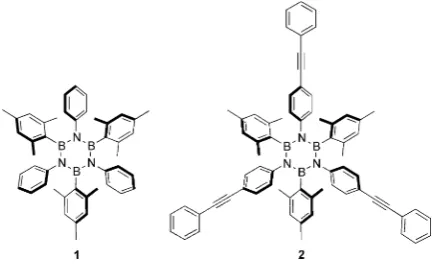
The molecular structures of N-triphenyl-B-trimesityl (1) andN -tri(phenyl-4-phenylethynyl)-B-trimesityl (2) borazine molecules are shown in Scheme 1. Whereas compound 1 features three phenyl (Ph) and three mesityl (Mes) groups bonded to the ni-trogen and boron atoms, respectively, molecule2replaces the phenyl groups with peripherally protruding phenyl-4-ethynyl-phenyl moieties. Following the experimental protocols devel-oped by us for borazine1,[56,57]molecule2was obtained after
reaction of 4-ethynylphenylaniline with BCl3 upon subsequent
addition of three equivalents of MesLi following the route dis-played in the Supporting Information.
Self-assembly of molecule 1 on Cu(111) and Au(111) surfa-ces
At a submonolayer coverage, extended highly-ordered molecu-lar islands of borazine 1 were observed on the terraces of Au(111) and Cu(111) surfaces (Figure 1a and b). A close-up view of these islands shows that molecule 1 self-assembles into the very same close-packed network on both substrates, as it clearly appears from a comparison between Figure 1c and d. This tiling pattern consists of rows formed by triangular fea-tures comprising three bright lobes. The distance of about 6 æ between the lobe centres within the triangles corresponds to that between the aromatic Ph or Mes rings in the molecular structure. Since the Mes substituents are bulkier than the Ph rings, one can assign a triangular set of lobes to the three Mes groups of a single molecule of1. The triangles alternate point-ing upwards and downwards (green and purple outlines in Fig-ure 1c and d) within each row, and neighbouring rows are re-lated by a C2 rotation (rows aandbhighlighted in Figure 1c and d).Two types of inter-row boundaries can be identified, in which pairs of molecules oriented in opposite directions (high-lighted by either purple or green triangles) are arranged side-by-side (linkage is highlighted by red or blue ovals) across row borders. Due to this intermolecular arrangement, the mole-cules form a structure with a quasi-square unit cell defined by the following parameters a=(22.90.6) æ, b=(24.60.8) æ, and q=(901.9)8 on both Au(111) and Cu(111) surfaces. A similar close-packed arrangement has been reported for six-fold hexaphenylbenzene hydrocarbons on these three-six-fold symmetry surfaces.[58, 59]
A modulation of the large and ordered molecular islands is visible on the Au(111) but not on Cu(111) surfaces (Figure 1a and b). This corresponds to the characteristic herringbone re-construction of Au(111) substrates, which influences the appar-ent STM height of the individual molecules (Figure 1c and d). The fact that the reconstruction appears to be completely un-affected by the molecular adsorbates suggests the presence of feeble molecule–substrate interactions, most likely as a conse-quence of the surface-decoupling enforced by the bulky Mes substituents. This in turn suggests that short-range vdW attrac-tive forces alone must govern the observed molecular packing arrangement.
[image:3.595.60.282.156.288.2]We next performed MD calculations to rationalise the forces governing the distinctive organisation observed on the two substrates. The calculated equilibrium structures are in excel-lent agreement with the experimental images. A closer look at Figure 1e and f reveals that both Mes and Ph groups of neigh-bouring molecules are deeply interdigitated, ensuing from vdW attractive forces. Specifically, a first type of vdW interac-tion occurs through offset parallel displacements of the Mes groups (red or blue ovals in Figure 1e and f) belonging to those neighbouring molecules that are arranged side-by-side across the row borders (purple or green triangles in Figure 1c and d). Another type of vdW interaction takes place between four adjacent molecules through perpendicular arrangement of their Mes groups, which can be described by clockwise or anticlockwise windmill motifs (see circular red or blue arrows
Scheme 1.Chemical structures of borazines1and2.[56, 57]
Chem. Eur. J.2014,20, 11856 – 11862 www.chemeurj.org 11857 Ó 2014The Authors. Published by Wiley-VCH Verlag GmbH & Co. KGaA, Weinheim
in Figures 1e and f). Notably, the supramolecular organisation observed in the STM images and re-obtained by MD simulation is the exact same on both Au(111) and Cu(111) surfaces, once more suggesting that the assembly behaviour of borazine1is not affected by the substrate chemical nature.
Self-assembly of molecule 2 on Au(111) and Cu(111) sur-faces
Molecule2was deposited under similar conditions on Au(111) and Cu(111) surfaces held at room temperature (RT) at submo-nolayer coverage. Large scale STM images recorded at 77 K (Figure 2a and b) show that, although the molecule assembles on both metals into porous networks forming large and well-ordered islands, the structure of the network differs between the two substrates (compare Figure 2c and d).
In particular, the deposition of molecule2on Au(111) results in a molecular honeycomb pattern built of triangular features comprising three bright lobes (Figure 2c), very similar to those
observed for molecule 1 (Figure 1e and f). As for borazine 1, a detailed analysis of the distance between adjacent lobes clearly shows that each can be assigned to the B-linked bulky Mes groups. Notably, the ethynyl-phenyl moieties are not visi-ble in the STM images. This is essentially only due to a topo-graphical effect since, as supported by MD simulations, the ter-minal Ph rings are likely to lie flat on the metal surface, about 5 æ below the Mes groups.
In this honeycomb structure, single molecules are in contact with three neighbours in a “propeller-like” arrangement with either clockwise or anticlockwise orientations (Figure 2c and the Supporting Information, SI6a and b). As a result, each mol-ecule is surrounded by three large openings, each of which has hexagonal symmetry and is delimited by six molecules. The entire monolayer could be described as a hierarchical mul-tilevel structure in which chiral clusters are wedged into each other yielding an overall chiral porous network with a rhombic unit cell with parameters a=b=(26.31.2) æ and q=(60
[image:4.595.53.284.65.415.2]4.5)8(Figure 2c).
[image:4.595.312.543.66.417.2]Figure 1.STM images of borazine1deposited on Au(111) (left panels) and Cu(111) (right panels) surfaces held at 300 K. The images were acquired at 77 K. Large views (a and b) of extended 2D supramolecular islands. Higher-resolution images (c and d) of parallel supramolecular stripes constituting the general assembly. The pink-shaded areas indicate the quasi-square unit cell. MD models (e and f) of the 2D molecular structure superimposed on the STM images.
The corresponding lowest energy configuration obtained from the MD simulations confirms the chiral ratchet-like ar-rangement of the phenyl-4-phenylethynyl groups within the pores conveying chirality to the entire network (Figure 2e and the Supporting Information, SI7 a). Also in this case, the assem-bly is stabilised by short-range vdW interactions between offset parallel Mes groups of interdigitated neighbouring mole-cules (highlighted by the red contours in Figure 2e).
A porous structure is also formed when molecule2is depos-ited on Cu(111) surfaces. The network assembly is built from what appear to be single, large, bright protrusions (pink filled ovals in Figure 2d) with a size corresponding to an individual molecule. All molecules are linked with four neighbours in an X-shaped assembly geometry and separate two adjacent pores (red empty circles in Figure 2d), each pore being surrounded by six molecules. Every molecule shares two further smaller pores of different size (blue and green empty circles in Fig-ure 2d), each surrounded by three molecules. The resulting hexagonal porous network has a rhombic unit cell with param-eters a=b=(35.41.7) æ and q=(604.8)8, which is signifi-cantly larger than that observed on Au(111).
MD simulations of this second type of porous network reveal that all the molecules adopt the same orientation with respect to the substrate and interact with their neighbours through different substituents. Consistent with the observa-tions, three main types of voids characterise our calculated stable network structure: 1) The smallest pores (green circles in Figure 2 f), stemming from the interaction of strongly inter-digitated (phenyl-4-phenylethynyl) groups of three neighbour-ing molecules; 2) The intermediate size pores (blue circles in Figure 2 f), also originating from the interaction of three mole-cules, this time through their (phenyl-4-phenylethynyl) and Mes groups; 3) The largest pores (red circles in Figure 2 f), de-riving from alternating (phenyl-4-phenylethynyl) and Mes groups of six contiguous molecules.
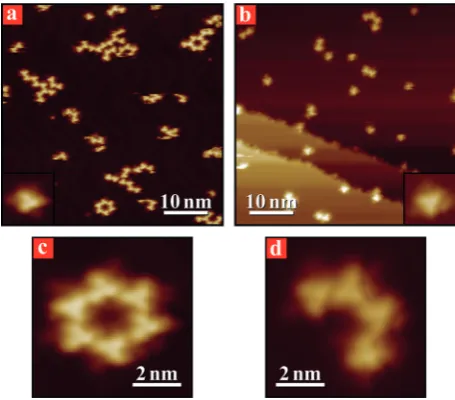
Low coverage deposition experiments of molecule 2 were also performed at 140 K on both substrates. These resulted in the formation of small clusters, composed from two to a few tens of molecules (Figure 3a and b). All clusters are relatively stable over time and diffusing molecules were observed only occasionally. This stability is more pronounced on Cu(111) than on Au(111), suggesting stronger interactions for borazine 2 with the former substrate. On both surfaces, the isolated mole-cules are visualised as three bright lobes alternated by three dim spikes (insets of Figure 3a and b). Whereas the former fea-tures clearly correspond to the Mes moieties, the latter can be assigned to the ethynyl-phenyl peripheries, proving that the molecules do not fragment during thermal sublimation. Larger clusters are organised into ring-like architectures, similar in size and structure to the ratchet motifs formed at RT on Au(111) surfaces. This observation is particularly interesting for Cu(111) surfaces (Figure 3b and d), as these low-temperature clusters are denser and significantly different from those formed at RT on the same substrate (compare with Figure 2 f). However, the assemblies formed at 140 K appear to be metastable, as they irreversibly transform into the RT porous honeycomb in Fig-ure 2d and b when the sample is annealed atT300 K.
Rationale
On both substrates, molecule 1 self-assembles in large and highly ordered molecular islands with an extremely low density of defects. The 2D suprastructure is characterised by an interdi-gitated packing of Ph substituents that, independent of the metal surface, is driven by intermolecular short-range vdW forces. All observations suggest extremely weak molecule–sub-strate interactions caused by an effective separation of the central molecular borazine core from the underlying metallic surface. The mutual steric hindrance between alternating Ph and Mes substituents in molecule 1, force the substituents to adopt an almost perpendicular orientation with respect to the borazine core. As a consequence, molecule 1 physisorbs on both substrates, essentially not experiencing any in-plane modulation of the adsorption potential.
Coming now to molecule2, the interaction with the Au(111) surface is also relatively weak and the supramolecular assem-bly is again largely governed by intermolecular forces, with the molecular packing being driven by the vdW interdigitation of the aromatic rings. The resulting organisation can thus be seen as a natural extension of the molecular assembly of borazine1, in which the longer substituents space apart neighbouring molecules, yielding a porous molecular network.[60,61]
[image:5.595.312.540.65.265.2]A porous network is also formed by borazine2 on Cu(111), but with a significantly different structure associated with a much lower degree of interdigitation. The relation between these two supramolecular arrangements can be visualised by considering the honeycomb assembly on Au(111) as being formed by molecules oriented in an alternating anti-parallel fashion (red and green triangles in Figure 4a), which allows them to closely pack in a chiral hexagonal organisation. If every second molecule in this structure was rotated by 608 Figure 3.STM images of the assemblies formed by molecule2deposited on Au(111) (left panels) and Cu(111) (right panels) surfaces held at 140 K. Large-scale images (a and b) displaying molecular clusters of different sizes. Insets in (a and b) show individual molecules. High-resolution images of c) ring-and d) arc-like supramolecular architectures composed of six ring-and four mo-lecular units, respectively.
Chem. Eur. J.2014,20, 11856 – 11862 www.chemeurj.org 11859 Ó 2014The Authors. Published by Wiley-VCH Verlag GmbH & Co. KGaA, Weinheim
and the neighbouring molecules were allowed to rearrange to maximise vdW interactions (left-handed side in Figure 4b), a new type of trimer would be formed that would constitute the basic unit of the porous hexagonal lattice observed on Cu(111) (right-handed side in Figure 4b).
It should be noticed that structure and size of the large pores in this lattice (red circles in Figure 2d and f) are such that they could exactly accommodate one further borazine 2. The molecular density in this theoretical assembly would then be 0.50 nm¢2, that is, the same as the one associated with the
honeycomb structure observed on Au(111). However, such a network of closed-packed interleaved trimeric units was never observed and all the STM measurements showed the porous networks in Figure 4b, with a molecular density of 0.33 nm¢2.
Evidently, the less dense arrangement of borazine 2 on Cu(111) implies an energy loss from vdW intermolecular inter-actions, which must be counterbalanced by a prevailing ener-getic gain. A possible explanation is provided by the attraction between the substrate and the terminal Ph rings in the phenyl-4-phenylethynyl moieties, which is expected to be stronger on the more reactive Cu(111) surface. When compared with the deposition of 2on Au(111), the increased molecule– substrate interaction will enhance the relevance of the in-plane modulation of the adsorption potential, making some adsorption positions more favourable than others. We note that this is supported by the observation of two different mo-lecular adsorption configurations for borazine 2 on Cu(111), which cause two different orientations for the porous network (the Supporting Information, Figure SI6c and d).
As a consequence, the structure of the observed porous net-works on Cu(111) can be seen as the result of a better epitaxial positioning of the Ph rings on the underlying substrate atomic lattice. This is different from the case of Au(111), in which the honeycomb network only derives from the vdW intermolecular forces because of the feebler interaction of2with this surface.
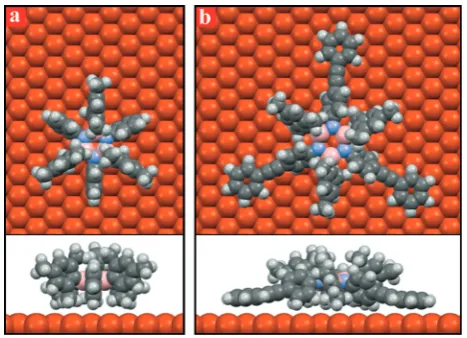
At the same time, the stronger molecule–metal interaction on Cu(111) is also likely to induce a more pronounced deforma-tion of molecule 2(Figure 5). We speculate that a less closely packed assembly may also help moderate the molecular strain energy cost, therefore effectively increasing the relative stabili-ty of the observed porous structure. We notice that for both molecules 1 and 2, the strong steric hindrance between the phenyl and mesityl substituents moieties imposes a lower limit on the adsorption height of the borazine ring, which our MD calculations evaluate as 5.4 æ for both molecules. This effective substrate decoupling of the molecular functional core is the result of the precisely targeted synthetic strategy we adopted. Finally, we note that the low coverage and temperature (140 K) development of small structures with a honeycomb symmetry on Cu(111) is only apparently in contradiction with the RT data. Indeed, low molecular density and high mobility should be expected to promote the formation of sparse dimers, trimers and tetramers to which the postulated cumula-tive surface-induced strain discussed above would not apply.
Conclusion
We have studied for the first time the influence of lateral groups on the self-assembly of two borazine derivatives on metal substrates. By means of UHV-STM, various supramolec-ular structures have been observed for molecules2 and1, all resulting from the interplay between intermolecular and mole-cule-substrate interactions. Molecule 1, bearing Mes and Ph groups, forms identical close-packed networks on both Au(111) and Cu(111) surfaces, with a structure that is only governed by short-range attractive vdW interactions. In contrast, borazine derivative2arranges into porous motifs. Notably, the porosity of the networks was revealed to strongly depend on the nature of the metal substrate. Whereas more densely packed assemblies have been observed on Au(111), less compact
[image:6.595.54.286.65.238.2]net-Figure 4.a) Schematic honeycomb structure of borazine2adsorbed on Au(111). The “anti-parallel” self-assembly mechanism ruling the formation of a single supramolecular hexagon is shown on the left. b) Schematic repre-sentation of the porous network on Cu(111) surfaces built upon the trimeric supramolecular cluster shown on the left.
Figure 5.Calculated minimum energy adsorption configuration of borazines
[image:6.595.310.544.512.681.2]works of molecule2 were imaged on Cu(111), in which stron-ger molecule–substrate interactions are most likely to be pres-ent.
Molecular dynamics simulations showed that this behaviour can be explained in terms of structural differences between the two borazines. In particular, the protruding phenyl-4-phe-nylethynyl substituents of molecule 2 act as intermolecular spacers, thus driving the formation of a porous network. More-over, their flexibility allows a stronger interaction with the sub-strate which, in the case of the more reactive Cu(111) surface, causes a higher porosity.
It can be reasonably concluded that the central boron-ni-tride core does not exert any influence on the molecular ability to adsorb, self-assemble, or interact on different surfaces, thus proving the effectiveness of the synthetic strategy adopted to achieve molecule–substrate decoupling. As a consequence, it could be expected that combining similar types of all-carbon and BN-doped molecular isosteres in self-assembled architec-tures will contribute to the design of advanced molecular nanostructures for applications in electronic devices, in which an electrical decoupling from the metal substrates is required.
Acknowledgements
This work was supported by EPSRC (EP/D000165/1). G.C. ac-knowledges financial support from the EU through the ERC Starting Grant “VISUAL-MS”, from the Royal Society through Grant No. RG100917 and from the Warwick-Santander Fund. D.B. acknowledges the EU through the ERC Starting Grant “COLORLANDS” project, the FRS-FNRS (FRFC contracts No. 2.4.550.09), the Science Policy Office of the Belgian Federal Government (BELSPO-IAP 7/05 project), the “TINTIN” ARC proj-ect (09/14-023), the “Service Public de Wallonie” through the 2013 program of excellence (FLYCOAT project), the MIUR through the FIRB “Futuro in Ricerca” (“SUPRACARBON”, con-tract n8 RBFR10DAK6). Part of the equipment used in this re-search was obtained through Birmingham Science City: “Inno-vative Uses for Advanced Materials in the Modern World” with support from Advantage West Midlands and part funded by the European Regional Development Fund. G.C. and T.S.J. gratefully acknowledge the open access funding for this article, awarded from the 2014-15 University of Warwick RCUK block grant.
Keywords: borazines · molecular dynamics · scanning tunnelling microscopy·self-assembly·surface chemistry
[1] S. R. Forrest,Nature2004,428, 911– 918.
[2] A. R. Murphy, J. M. J. Fr¦chet,Chem. Rev.2007,107, 1066– 1096. [3] A. Facchetti,Chem. Mater.2011,23, 733– 758.
[4] J. Repp, G. Meyer, S. M. Stojkovic´, A. Gourdon, C. Joachim,Phys. Rev. Lett.2005,94, 026803.
[5] R. Bennewitz,J. Phys. Condens. Matter2006,18, R417– R435.
[6] R. Forker, D. Kasemann, T. Dienel, C. Wagner, R. Franke, K. Mìllen, T. Fritz,Adv. Mater.2008,20, 4450 –4454.
[7] E. C´avar, M.-C. Blìm, M. Pivetta, F. Patthey, M. Chergui, W.-D. Schneider,
Phys. Rev. Lett.2005,95, 196102.
[8] S. W. Wu, G. V. Nazin, X. Chen, X. H. Qiu, W. Ho,Phys. Rev. Lett.2004,93, 236802.
[9] X. H. Qiu, G. V. Nazin, W. Ho,Science2003,299, 542– 546.
[10] W. D. Xiao, X. L. Feng, P. Ruffieux, O. Grçning, K. Mìllen, R. Fasel,J. Am. Chem. Soc.2008,130, 8910– 8912.
[11] M. Yu, N. Kalashnyk, R. Barattin, Y. Benjalal, M. Hliwa, X. Bouju, A. Gour-don, C. Joachim, E. Lægsgaard, F. Besenbacher, T. R. Linderoth,Chem. Commun.2010,46, 5545 –5547.
[12] M. Yu, N. Kalashnyk, W. Xu, R. Barattin, Y. Benjalal, E. Lægsgaard, I. Sten-sgaard, M. Hliwa, X. Bouju, A. Gourdon, C. Joachim, F. Besenbacher, T. R. Linderoth,ACS Nano2010,4, 4097 –4109.
[13] M. Alemani, M. V. Peters, S. Hecht, K.-H. Rieder, F. Moresco, L. Grill,J. Am. Chem. Soc.2006,128, 14446–14447.
[14] M. J. Comstock, N. Levy, A. Kirakosian, J. Cho, F. Lauterwasser, J. H. Harvey, D. A. Strubbe, J. M. J. Fr¦chet, D. Trauner, S. G. Louie, M. F. Crom-mie,Phys. Rev. Lett.2007,99, 038301.
[15] S. Weigelt, C. Busse, L. Petersen, E. Rauls, B. Hammer, K. V. Gothelf, F. Be-senbacher, T. R. Linderoth,Nat. Mater.2006,5, 112– 117.
[16] T. A. Jung, R. R. Schlittler, J. K. Gimzewski,Nature1997,386, 696 –698. [17] T. Yokoyama, S. Yokoyama, T. Kamikado, Y. Okuno, S. Mashiko,Nature
2001,413, 619 –621.
[18] D. Bonifazi, H. Spillmann, A. Kiebele, M. de Wild, P. Seiler, F. Cheng, H.-J. Gìntherodt, T. Jung, F. Diederich,Angew. Chem.2004,116, 4863 –4867;
Angew. Chem. Int. Ed.2004,43, 4759 –4763.
[19] O. Guillermet, E. Niemi, S. Nagarajan, X. Bouju, D. Martrou, A. Gourdon, S. Gauthier,Angew. Chem.2009,121, 2004 –2007;Angew. Chem. Int. Ed.
2009,48, 1970 –1973.
[20] F. Moresco, A. Gourdon,Proc. Natl. Acad. Sci. USA 2005, 102, 8809 – 8814.
[21] F. Rosei, M. Schunack, P. Jiang, A. Gourdon, E. Laegsgaard, I. Stensgaard, C. Joachim, F. Besenbacher,Science2002,296, 328 –331.
[22] L. Chen, Y. Hernandez, X. Feng, K. Mìllen, Angew. Chem. 2012, 124, 7758 –7773;Angew. Chem. Int. Ed.2012,51, 7640– 7654.
[23] L. Dçssel, L. Gherghel, X. Feng, K. Mìllen, Angew. Chem. 2011, 123, 2588 –2591;Angew. Chem. Int. Ed.2011,50, 2540– 2543.
[24] F. Chen, N. J. Tao,Acc. Chem. Res.2009,42, 429–438.
[25] T. N. Hoheisel, S. Schrettl, R. Szilluweit, H. Frauenrath, Angew. Chem.
2010,122, 6644 – 6664;Angew. Chem. Int. Ed.2010,49, 6496 –6515. [26] S. Kervyn, C. Aurisicchio, D. Bonifazi, inFunctional Supramolecular
Archi-tectures for Organic Electronics and Nanotechnology (Eds.: P. Samori, F. Cacialli), Wiley-VCH, Weinheim,2010, pp. 233– 280.
[27] M. Cút¦, P. D. Haynes, C. Molteni,Phys. Rev. B2001,63, 125207. [28] Z. Liu, T. B. Marder,Angew. Chem.2008, 120, 248– 250;Angew. Chem.
Int. Ed.2008,47, 242– 244.
[29] D. Golberg, Y. Bando, Y. Huang, T. Terao, M. Mitome, C. Tang, C. Zhi,ACS Nano2010,4, 2979 –2993.
[30] K. Watanabe, T. Taniguchi, T. Niiyama, K. Miya, M. Taniguchi,Nat. Photon-ics2009,3, 591– 594.
[31] K. Watanabe, T. Taniguchi, H. Kanda,Nat. Mater.2004,3, 404–409. [32] A. J. V. Marwitz, A. N. Lamm, L. N. Zakharov, M. Vasiliu, D. A. Dixon, S.-Y.
Liu,Chem. Sci.2012,3, 825– 829.
[33] A. J. V. Marwitz, M. H. Matus, L. N. Zakharov, D. A. Dixon, S. Y. Liu,Angew. Chem.2009,121, 991 –995;Angew. Chem. Int. Ed.2009, 48, 973–977. [34] C. Zhi, Y. Bando, T. Terao, C. Tang, H. Kuwahara, D. Golberg,Adv. Funct.
Mater.2009,19, 1857 – 1862.
[35] M. J. D. Bosdet, C. A. Jaska, W. E. Piers, T. S. Sorensen, M. Parvez,Org. Lett.2007,9, 1395– 1398.
[36] A. Stock, E. Pohland,Ber. Dtsch. Chem. Ges.1926,59, 2215 –2223. [37] A. Wakamiya, T. Ide, S. Yamaguchi,J. Am. Chem. Soc.2005,127, 14859 –
14866.
[38] S. Biswas, M. Mìller, C. Tçnshoff, K. Eichele, C. Maichle-Mçssmer, A. Ruff, B. Speiser, H. F. Bettinger,Eur. J. Org. Chem.2012, 4634 –4639. [39] S. J. Groszos, S. F. Stafiej,J. Am. Chem. Soc.1958,80, 1357 –1360. [40] J. Haberecht, R. Nesper, H. Grìtzmacher,Chem. Mater.2005,17, 2340 –
2347.
[41] B. Anand, H. Nçth, H. Schwenk-Kircher, A. Troll, Eur. J. Inorg. Chem.
2008, 3186– 3199.
[42] H. Nçth, S. Rojas-Lima, A. Troll,Eur. J. Inorg. Chem.2005, 1895 –1906. [43] Y. Park, J.-H. Lee, D. H. Jung, S.-H. Liu, Y.-H. Lin, L.-Y. Chen, C.-C. Wu, J.
Park,J. Mater. Chem.2010,20, 5930 – 5936.
[44] C. Gao, M. S. Pei, Q. W. Pan,Asian J. Chem.2012,24, 2899– 2902.
Chem. Eur. J.2014,20, 11856 – 11862 www.chemeurj.org 11861 Ó 2014The Authors. Published by Wiley-VCH Verlag GmbH & Co. KGaA, Weinheim
[45] X. Fang, L. Hu, K. Huo, B. Gao, L. Zhao, M. Liao, P. K. Chu, Y. Bando, D. Golberg,Adv. Funct. Mater.2011,21, 3907 – 3915.
[46] S. Xu, C. Xu, Y. Liu, Y. Hu, R. Yang, Q. Yang, J.-H. Ryou, H. J. Kim, Z. Loch-ner, S. Choi, R. Dupuis, Z. L. Wang,Adv. Mater.2010,22, 4749 –4753. [47] S. Park, T. Vogt,J. Am. Chem. Soc.2010,132, 4516 –4517.
[48] K. Geramita, J. McBee, Y. Shen, N. Radu, T. D. Tilley,Chem. Mater.2006,
18, 3261 –3269.
[49] T. C. Chao, Y. T. Lin, C. Y. Yang, T. S. Hung, H. C. Chou, C. C. Wu, K. T. Wong,Adv. Mater.2005,17, 992 –996.
[50] I. H. T. Sham, C.-C. Kwok, C.-M. Che, N. Zhu, Chem. Commun. 2005, 3547 –3549.
[51] S. Kervyn, T. Nakanishi, J. Aimi, A. Saeki, S. Seki, B. Champagne, D. Boni-fazi,Chem. Lett.2012,41, 1210– 1212.
[52] K. T. Jackson, T. E. Reich, H. M. El-Kaderi, Chem. Commun. 2012, 48, 8823 –8825.
[53] C. Tçnshoff, M. Mìller, T. Kar, F. Latteyer, T. Chass¦, K. Eichele, H. F. Bet-tinger,ChemPhysChem2012,13, 1173– 1181.
[54] X. Xie, M. F. Haddow, S. M. Mansell, N. C. Norman, C. A. Russell,Chem. Commun.2011,47, 3748– 3750.
[55] M. K. Kesharwani, M. Suresh, A. Das, B. Ganguly,Tetrahedron Lett.2011,
52, 3636 –3639.
[56] S. Kervyn, O. Fenwick, F. Di Stasio, Y. S. Shin, J. Wouters, G. Accorsi, S. Osella, D. Beljonne, F. Cacialli, D. Bonifazi,Chem. Eur. J.2013,19, 7771 – 7779.
[57] S. Kervyn, N. Kalashnyk, M. Riello, B. Moreton, J. Tasseroul, J. Wouters, T. S. Jones, A. De Vita, G. Costantini, D. Bonifazi, Angew. Chem.2013,
125, 7558– 7562;Angew. Chem. Int. Ed.2013,52, 7410 – 7414.
[58] L. Gross, F. Moresco, P. Ruffieux, A. Gourdon, C. Joachim, K.-H. Rieder,
Phys. Rev. B2005,71, 165428.
[59] R. Coratger, B. Calmettes, Y. Benjalal, X. Bouju, C. Coudret, Surf. Sci.
2012,606, 444 –449.
[60] U. Schlickum, R. Decker, F. Klappenberger, G. Zoppellaro, S. Klyatskaya, M. Ruben, I. Silanes, A. Arnau, K. Kern, H. Brune, J. V. Barth,Nano Lett.
2007,7, 3813 –3817.
[61] S. Lei, K. Tahara, F. C. De Schryver, M. Van der Auweraer, Y. Tobe, S. De Feyter, Angew. Chem. 2008, 120, 3006 –3010; Angew. Chem. Int. Ed.
2008,47, 2964 –2968.