Proceedings of the 56th Annual Meeting of the Association for Computational Linguistics (Long Papers), pages 2609–2619 2609
Interactive Language Acquisition with One-shot Visual Concept Learning
through a Conversational Game
Haichao Zhang†, Haonan Yu†, and Wei Xu†§ †Baidu Research - Institue of Deep Learning, Sunnyvale USA
§National Engineering Laboratory for Deep Learning Technology and Applications, Beijing China
{zhanghaichao,haonanyu,wei.xu}@baidu.com
Abstract
Building intelligent agents that can com-municate with and learn from humans in natural language is of great value. Su-pervised language learning is limited by the ability of capturing mainly the statis-tics of training data, and is hardly adaptive to new scenarios or flexible for acquiring new knowledge without inefficient retrain-ing or catastrophic forgettretrain-ing. We high-light the perspective that conversational interaction serves as a natural interface both for language learning and for novel knowledge acquisition and propose a joint imitation and reinforcement approach for grounded language learning through an in-teractive conversational game. The agent trained with this approach is able to ac-tively acquire information by asking ques-tions about novel objects and use the just-learned knowledge in subsequent conver-sations in a one-shot fashion. Results com-pared with other methods verified the ef-fectiveness of the proposed approach.
1 Introduction
Language is one of the most natural forms of com-munication for human and is typically viewed as fundamental to human intelligence; therefore it is crucial for an intelligent agent to be able to use lan-guage to communicate with human as well. While supervised training with deep neural networks has led to encouraging progress in language learning, it suffers from the problem of capturing mainly the statistics of training data, and from a lack of adaptiveness to new scenarios and being flexible for acquiring new knowledge without inefficient retraining or catastrophic forgetting. Moreover, supervised training of deep neural network
mod-els needs a large number of training samples while many interesting applications require rapid learn-ing from a small amount of data, which poses an even greater challenge to the supervised setting.
In contrast, humans learn in a way very different from the supervised setting (Skinner, 1957; Kuhl, 2004). First, humans act upon the world and learn from the consequences of their actions (Skinner, 1957; Kuhl, 2004; Petursdottir and Mellor, 2016). While for mechanical actions such as movement, the consequences mainly follow geometrical and mechanical principles, for language, humans act by speaking, and the consequence is typically a response in the form of verbal and other behav-ioral feedback (e.g., nodding) from the conversa-tion partner (i.e., teacher). These types of feed-back typically contain informative signals on how to improve language skills in subsequent conver-sations and play an important role in humans’ language acquisition process (Kuhl, 2004; Peturs-dottir and Mellor, 2016). Second, humans have shown a celebrated ability to learn new concepts from small amount of data (Borovsky et al., 2003). From even just one example, children seem to be able to make inferences and draw plausible bound-aries between concepts, demonstrating the ability of one-shot learning (Lake et al., 2011).
trans-ferable skill of actively seeking and memorizing information about novel objects, and develop the one-shot learning ability, purely through conver-sational interaction with a teacher.
2 Related Work
Supervised Language Learning. Deep neural network-based language learning has seen great success on many applications, including machine translation (Cho et al., 2014b), dialogue genera-tion (Wen et al., 2015; Serban et al., 2016), image captioning and visual question answering (?Antol et al., 2015). For training, a large amount of la-beled data is needed, requiring significant efforts to collect. Moreover, this setting essentially cap-tures the statistics of training data and does not re-spect the interactive nature of language learning, rendering it less flexible for acquiring new knowl-edge without retraining or forgetting (Stent and Bangalore, 2014).
Reinforcement Learning for Sequences. Some recent studies used reinforcement learning (RL) to tune the performance of a pre-trained language model according to certain metrics (Ranzato et al., 2016; Bahdanau et al., 2017; Li et al., 2016; Yu et al., 2017). Our work is also related to RL in natural language action space (He et al., 2016) and shares a similar motivation with Weston (2016) and Li et al. (2017), which explored language learning through pure textual dialogues. However, in these works (He et al., 2016; Weston, 2016; Li et al., 2017), a set of candidate sequences is provided and the action is to select one from the set. Our main focus is rather on learning language from scratch: the agent has to learn togeneratea sequence action rather than to simply select one from a provided candidate set.
Communication and Emergence of Language. Recent studies have examined learning to com-municate (Foerster et al., 2016; Sukhbaatar et al., 2016) and invent language (Lazaridou et al., 2017; Mordatch and Abbeel, 2018). The emerged lan-guage needs to be interpreted by humans via post-processing (Mordatch and Abbeel, 2018). We, however, aim to achieve language learning from the dual perspectives of understanding and gener-ation, and the speaking action of the agent is read-ily understandable without any post-processing. Some studies on language learning have used a guesser-responder setting in which the guesser tries to achieve the final goal (e.g., classification)
by collecting additional information through ask-ing the responder questions (Strub et al., 2017; Das et al., 2017). These works try to optimize the question being asked to help the guesser achieve the final goal, while we focus on transferable speaking and one-shot ability.
One-shot Learning and Active Learning. One-shot learning has been investigated in some re-cent works (Lake et al., 2011; Santoro et al., 2016; Woodward and Finn, 2016). The memory-augmented network (Santoro et al., 2016) stores visual representations mixed with ground truth class labels in an external memory for one-shot learning. A class label is always provided follow-ing the presentation of an image; thus the agent receives information from the teacher in a passive way. Woodward and Finn (2016) present efforts toward active learning, using a vanilla recurrent neural network (RNN) without an external mem-ory. Both lines of study focus on image classi-fication only, meaning the class label is directly provided for memorization. In contrast, we tar-get language and one-shot learning via conversa-tional interaction, and the learner has to learn to extract important information from the teacher’s sentences for memorization.
3 The Conversational Game
We construct a conversational game inspired by experiments on language development in infants from cognitive science (Waxman, 2004). The game is implemented with the XWORLD simula-tor (Yu et al., 2018; Zhang et al., 2017) and is pub-licly available online.1 It provides an environment for the agent2 to learn language and develop the one-shot learning ability. One-shot learning here means that during test sessions, no further training happens to the agent and it has to answer teacher’s questions correctly about novel images of never-before-seen classes after being taught only once by the teacher, as illustrated in Figure 1. To suc-ceed in this game, the agent has to learn to 1) speak by generating sentences, 2) extract and memo-rize useful information with only one exposure and use it in subsequent conversations, and 3) be-have adaptively according to context and its own knowledge (e.g., asking questions about unknown objects and answering questions about something known), all achieved through interacting with the
1
https://github.com/PaddlePaddle/XWorld
S1
Train
T
eacher
Lear
ner
8 8 8
Sl
4 4
4 Test(novel data) 4
-Figure 1: Interactive language and one-shot concept learning. Within a sessionSl, the teacher may ask questions, answer learner’s questions, make statements, or say nothing. The teacher also provides reward feedback based on learner’s responses as (dis-)encouragement. The learner alternates between in-terpreting teacher’s sentences and generating a response throughinterpreterandspeaker.Left:Initially, the learner can barely say anything meaningful. Middle:Later it can produce meaningful responses for interaction. Right:After training, when confronted with an image ofcherry, which is a novel class that the learner never saw before during training, the learner can ask a question about it (“what is it”) and generate a correct statement (“this is cherry”) for another instance of cherry after only being taught once.
teacher. This makes our game distinct from other seemingly relevant games, in which the agent can-not speak (Wang et al., 2016) or “speaks” by se-lectinga candidate from a provided set (He et al., 2016; Weston, 2016; Li et al., 2017) rather than
generating sentences by itself, or games mainly focus on slow learning (Das et al., 2017; Strub et al., 2017) and falls short on one-shot learning.
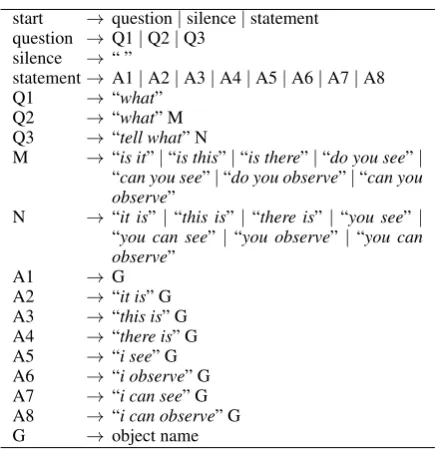
In this game, sessions (Sl) are randomly in-stantiated during interaction. Testing sessions are constructed with a separate dataset with concepts that never appear before during training to eval-uate the language and one-shot learning ability. Within a session, the teacher randomly selects an object and interacts with the learner about the ob-ject by randomly 1) posing a question (e.g., “what is this”), 2) saying nothing (i.e., “”) or 3) mak-ing a statement (e.g., “this is monkey”). When the teacher asks a question or says nothing, i) if the learner raises a question, the teacher will pro-vide a statement about the object asked (e.g., “it is frog”) with aquestion-asking reward(+0.1); ii) if the learner says nothing, the teacher will still pro-vide an answer (e.g., “this is elephant”) but with an incorrect-reply reward (−1) to discourage the learner from remaining silent; iii) for all other in-correct responses from the learner, the teacher will provide anincorrect-reply rewardand move on to the next random object for interaction. When the teacher generates a statement, the learner will re-ceive no reward if a correct statement is gener-ated otherwise an incorrect-reply reward will be given. The session ends if the learner answers the teacher’s question correctly, generates a cor-rect statement when the teacher says nothing (re-ceiving acorrect-answer reward+1), or when the
maximum number of steps is reached. The sen-tence from teacher at each time step is generated using a context-free grammar as shown in Table 1. A success is reached if the learner behaves cor-rectly during the whole session: asking questions about novel objects, generating answers when asked, and making statements when the teacher says nothing about objects that have been taught within the session. Otherwise it is a failure.
Table 1: Grammar for the teacher’s sentences.
start → question|silence|statement
question → Q1|Q2|Q3
silence → “ ”
statement→ A1|A2|A3|A4|A5|A6|A7|A8
Q1 → “what”
Q2 → “what” M
Q3 → “tell what” N
M → “is it”|“is this”|“is there”|“do you see”|
“can you see”|“do you observe”|“can you observe”
N → “it is”|“this is”|“there is”|“you see”|
“you can see”|“you observe”|“you can observe”
A1 → G
A2 → “it is” G A3 → “this is” G A4 → “there is” G A5 → “i see” G A6 → “i observe” G A7 → “i can see” G A8 → “i can observe” G
G → object name
4 Interactive Language Acquisition via Joint Imitation and Reinforcement
[image:3.595.307.526.409.634.2]helps the agent to develop the basic ability to generate sensible sentences. As learning is done by observing the teacher’s behaviors during con-version, the agent essentially imitates the teacher from a third-person perspective (Stadie et al., 2017) rather than imitating an expert agent who is conversing with the teacher (Das et al., 2017; Strub et al., 2017). During conversations, the agent perceives sentences and images without any explicit labeling of ground truth answers, and it has to learn to make sense of raw perceptions, extract useful information, and save it for later use when generating an answer to teacher’s ques-tion. While it is tempting to purely imitate the teacher, the agent trained this way only devel-opsechoic behavior(Skinner, 1957),i.e., mimicry.
Reinforce leverages confirmative feedback from the teacher for learning to converse adaptively be-yond mimicry by adjusting the action policy. It enables the learner to use the acquired speaking ability and adapt it according to reward feedback. This is analogous to some views on the babies’ language-learning process that babies use the ac-quired speaking skills by trial and error with par-ents and improve according to the consequences of speaking actions (Skinner, 1957; Petursdottir and Mellor, 2016). The fact that babies don’t fully de-velop the speaking capabilities without the ability to hear (Houston and Miyamoto, 2011), and that it is hard to make a meaningful conversation with a trained parrot signifies the importance of both im-itation and reinforcement in language learning.
Formulation. The agent’s response can be mod-eled as a sample from a probability distribu-tion over the possible sequences. Specifically, for one session, given the visual input vt and conversation history Ht={w1,a1,· · ·,wt}, the
agent’s responseatcan be generated by sampling from a distribution of the speaking action at∼
pSθ(a|Ht,vt). The agent interacts with the teacher
by outputting the utterance at and receives feed-back from the teacher in the next step, withwt+1a sentence as verbal feedback andrt+1reward feed-back (with positive values as encouragement while negative values as discouragement, according to
at, as described in Section 3). Central to the goal is learningpSθ(·). We formulate the problem as the minimization of a cost function as:
Lθ=EW
−P
tlogpIθ(wt|·)
| {z }
ImitationLI θ
+EpS θ
−P
t[γ]
t−1·rt
| {z }
ReinforceLR θ
where EW(·) is the expectation over all the
sen-tences W from teacher, γ is a reward discount factor, and[γ]tdenotes the exponentiation overγ. While the imitation term learns directly the predic-tive distributionpIθ(wt|Ht−1,at), it contributes to
pSθ(·)throughparameter sharingbetween them.
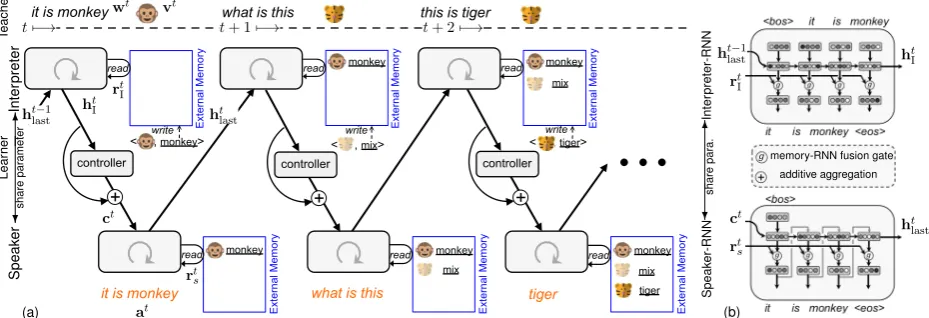
Architecture. The learner comprises four ma-jor components: external memory, interpreter,
speaker, andcontroller, as shown in Figure 2. Ex-ternal memoryis flexible for storing and retriev-ing information (Graves et al., 2014; Santoro et al., 2016), making it a natural component of our net-work for one-shot learning. Theinterpreteris re-sponsible for interpreting the teacher’s sentences, extracting information from the perceived signals, and saving it to the external memory. Thespeaker
is in charge of generating sentence responses with reading access to the external memory. The re-sponse could be a question asking for informa-tion or a statement answering a teacher’s quesinforma-tion, leveraging the information stored in the external memory. The controller modulates the behavior of the speaker to generate responses according to context (e.g., the learner’s knowledge status).
At time step t, the interpreter uses an interpreter-RNN to encode the input sentencewt
from the teacher as well as historical conversa-tional information into a state vector htI. htI is then passed through a residue-structured network, which is an identity mapping augmented with a learnable controller f(·) implemented with fully connected layers for producing ct. Finally, ct is used as the initial state of the speaker-RNN for generating the responseat. The final statehtlastof the speaker-RNN will be used as the initial state of the interpreter-RNN at the next time step.
4.1 Imitation with Memory Augmented Neural Network for Echoic Behavior
it is monkey
it is monkey
monkey
write
what is this what is this
< , mix>
mix
read
read monkey
write
read read monkey
tiger this is tiger
monkey
write
read read monkey
< , tiger>
tiger controller + controller + controller + < , monkey>
Ext ern al Me mo ry Ext ern al Me mo ry Ext ern al Me mo ry Ext ern al Me mo ry Ext ern al Me mo ry Ext ern al Me mo ry mix mix
t7−→ t+ 17−→ t+ 27−→
wt vt
ht−1
last h t last ht I rt I ct rt s at Inter preter Speak er 6 ? share par ameter T eacher Lear ner (a) Inter preter-RNN Speak er-RNN 6 ? share par a.
memory-RNN fusion gate
additive aggregation
[image:5.595.67.532.62.221.2]ht−1 last rt I ht I ct rt s ht last (b)
Figure 2: Network structure. (a) Illustration of the overall architecture. At each time step, the learner uses the interpreter module to encode the teacher’s sentence. The visual perception is also encoded and used as a key to retrieve information from the external memory. The last state of the interpreter-RNN will be passed through a controller. The controller’s output will be added to the input and used as the initial state of the speaker-RNN. The interpreter-RNN will update the external memory with an importance (illustrated with transparency) weighted information extracted from the perception input. ‘Mix’ denotes a mixture of word embedding vectors. (b) The structures of the interpreter-RNN (top) and the speaker-RNN (bottom). The interpreter-speaker-RNN and speaker-speaker-RNN share parameters.
learner{w1,a1,· · · ,wt−1,at−1}as
pIθ(wt|Ht−1,at−1,vt) =Q
i p
I
θ(wit|w1:ti−1,ht −1 last,v
t), (1)
wherehtlast−1is the last state of the RNN at time step
t−1 as the summarization of {Ht−1,at−1} (c.f.,
Figure 2), andiindexes words within a sentence. It is natural to model the probability of thei-th word in thet-th sentence with an RNN, where the sentences up totand words up toiwithin thet-th sentence are captured by a fixed-length state vec-tor hti= RNN(hti−1, wit). To incorporate knowl-edge learned and stored in the external memory, the generation of the next word isadaptivelybased on i) the predictive distribution of the next word from the state of the RNN to capture the syntac-tic structure of sentences, and ii) the information from the external memory to represent the previ-ously learned knowledge, via a fusion gateg:
pIθ(wti|hti,vt) = (1−g)·ph+g·pr, (2)
where ph = softmax ETfMLP(hti)
and pr =
softmax ETr
. E∈Rd×kis the word embedding
table, withdthe embedding dimension andkthe vocabulary size. r is a vector read out from the external memory using a visual key as detailed in the next section. fMLP(·) is a multi-layer
Multi-Layer Perceptron (MLP) for bridging the seman-tic gap between the RNN state space and the word
embedding space. The fusion gategis computed as g=f(hti, c), where c is the confidence score
c=max(ETr), and a well-learned concept should have a large score by design (Appendix A.2).
Multimodal Associative Memory. We use a mul-timodal memory for storing visual (v) and sen-tence (s) features with each modality while pre-serving the correspondence between them (Badde-ley, 1992). Information organization is more struc-tured than the single modality memory as used in Santoro et al. (2016) and cross modality re-trieval is straightforward under this design. A vi-sual encoder implemented as a convolutional neu-ral network followed by fully connected layers is used to encode the visual image v into a visual keykv, and then the corresponding sentence
fea-ture can be retrieved from the memory as:
r←READ(kv,Mv,Ms). (3)
Mv and Ms are memories for visual and
sen-tence modalities with the same number of slots (columns). Memory read is implemented asr=
Msα with α a soft reading weight obtained
through the visual modality by calculating the co-sine similarities betweenkvand slots ofMv.
Memory write is similar to Neural Turing Ma-chine (Graves et al., 2014), but with a content im-portance gategmemto adaptively control whether
the contentcshould be written into memory:
For the visual modalitycv,kv. For the sentence
modality, cs has to be selectively extracted from
the sentence generated by the teacher. We use an attention mechanism to achieve this bycs=Wη,
where W denotes the matrix with columns be-ing the embeddbe-ing vectors of all the words in the sentence. η is a normalized attention vector representing the relative importance of each word in the sentence as measured by the cosine sim-ilarity between the sentence representation vec-tor and each word’s context vecvec-tor, computed us-ing a bidirectional-RNN. The scalar-valued con-tent importance gategmemis computed as a
func-tion of the sentence from the teacher, meaning that the importance of the content to be written into memory depends on the content itself (c.f., Ap-pendix A.3 for more details). The memory write is achieved with an erase and an add operation:
˜
Mm=Mm−Mm(gmem·1·βT),
Mm= ˜Mm+gmem·cm·βT, m∈{v, s}.
denotes Hadamard product and the write loca-tion βis determined with a Least Recently Used Access mechanism (Santoro et al., 2016).
4.2 Context-adaptive Behavior Shaping through Reinforcement Learning
Imitation fosters the basic language ability for generating echoic behavior (Skinner, 1957), but it is not enough for conversing adaptively with the teacher according to context and the knowl-edge state of the learner. Thus we leverage re-ward feedback to shape the behavior of the agent by optimizing the policy using RL. The agent’s re-sponseatis generated by thespeaker, which can be modeled as a sample from a distribution over all possible sequences, given the conversation history Ht={w1,a1,· · · ,wt}and visual inputvt:
at∼pSθ(a|Ht,vt). (4)
As Ht can be encoded by the interpreter-RNN
as htI, the action policy can be represented as
pSθ(a|htI,vt). To leverage the language skill that is learned via imitation through the interpreter, we can generate the sentence by implementing the
speaker with an RNN, sharing parameters with the interpreter-RNN, but with a conditional signal modulated by a controller network (Figure 2):
pSθ(at|hIt,vt) =pIθ(at|htI+f(hIt, c),vt). (5)
The reason for using a controllerf(·)for modula-tion is that the basic language model only offers the learner the echoic ability to generate a sen-tence, but not necessarily the adaptive behavior according to context (e.g. asking questions when facing novel objects and providing an answer for a previously learned object according to its own knowledge state). Without any additional module or learning signals, the agent’s behaviors would be the same as those of the teacher because of param-eter sharing; thus, it is difficult for the agent to learn to speak in an adaptive manner.
To learn from consequences of speaking ac-tions, the policypSθ(·)is adjusted by maximizing expected future reward as represented byLR
θ. As a
non-differentiable sampling operation is involved in Eqn.(4), policy gradient theorem (Sutton and Barto, 1998) is used to derive the gradient for up-datingpS
θ(·)in the reinforce module:
∇θLRθ =EpS θ
P
tAt· ∇θlogpSθ(at|ct)
, (6)
where At=V(htI, ct)−rt+1−γV(htI+1, ct+1) is the advantage (Sutton and Barto, 1998) estimated using a value networkV(·). The imitation mod-ule contributes by implementingLI
θ with a
cross-entropy loss (Ranzato et al., 2016) and minimizing it with respect to the parameters inpIθ(·), which are shared withpSθ(·). The training signal from imita-tion takes the shortcut connecimita-tion without going through the controller. More details onf(·),V(·) are provided in Appendix A.2.
5 Experiments
We conduct experiments with comparison to base-line approaches. We first experiment with a word-level task in which the teacher and the learner communicate a single word each time. We then investigate the impact of image variations on con-cept learning. We further perform evaluation on the more challenging sentence-level task in which the teacher and the agent communicate in the form of sentences with varying lengths.
Setup. To evaluate the performance in learning a transferable ability, rather than the ability of fit-ting a particular dataset, we use anAnimaldataset for training and test the trained models on aFruit
0 1 2 3 4 5 6 7 8 9 -6
-5 -4 -3 -2 -1 0
Number of Games
Reward
Reinforce Imitation
Imitation+Gaussian-RL Proposed
[image:7.595.80.286.58.223.2]×103
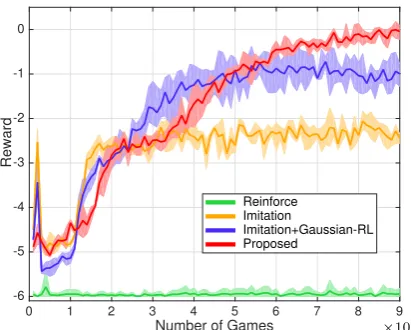
Figure 3:Evolution of rewardduring training for the word-level task without image variations.
Baselines. The following methods are compared:
• Reinforce: a baseline model with the same network structure as the proposed model and trained using RL only,i.e.minimizingLR
θ;
• Imitation: a recurrent encoder decoder (Serban et al., 2016) model with the same structure as ours and trained via imitation (minimizingLI
θ);
• Imitation+Gaussian-RL: a joint imitation and reinforcement method using a Gaussian pol-icy (Duan et al., 2016) in the latent space of the control vectorct(Zhang et al., 2017). The pol-icy is changed by modifying the control vector
ctthe action policy depends upon.
Training Details. The training algorithm is imple-mented with the deep learning platform PaddlePad-dle.3 The whole network is trained from scratch in
an end-to-end fashion. The network is randomly initialized without any pre-training and is trained with decayed Adagrad (Duchi et al., 2011). We use a batch size of16, a learning rate of1×10−5
and a weight decay rate of 1.6×10⁻³. We also exploit experience replay (Wang et al., 2017; Yu et al., 2018). The reward discount factor γ is 0.99, the word embedding dimension d is 1024 and the dictionary size k is 80. The visual im-age size is 32×32, the maximum length of gen-erated sentence is 6 and the memory size is 10. Word embedding vectors are initialized as random vectors and remain fixed during training. A sam-pling operation is used for sentence generation during training for exploration while a max op-eration is used during testing both for Proposed
and forReinforcebaseline. Themaxoperation is
3https://github.com/PaddlePaddle/Paddle
0 20 40 60 80 100
Success Rate (%)
Reinforce Imitation Imitation+Gaussian-RL Proposed
-6 -5 -4 -3 -2 -1 0 1
Reward
[image:7.595.308.526.61.137.2]Reinforce Imitation Imitation+Gaussian-RL Proposed
Figure 4: Test performance for the word-level task without image variations. Models are trained on theAnimaldataset and tested on theFruitdataset.
Image Variation Ratio
0 0.2 0.4 0.6 0.8 1
0 20 40 60 80 100
Success Rate (%)
Image Variation Ratio
0 0.2 0.4 0.6 0.8 1 -6
-4 -2 0
Reward Reinforce Imitation
[image:7.595.306.524.196.280.2]Imitation+Gaussian-RL Proposed
Figure 5: Test success rate and rewardfor the word-level task on the Fruit dataset under differ-ent test image variation ratios for models trained on the Animaldataset with a variation ratio of 0.5 (solid lines) and without variation (dashed lines).
used in both training and testing forImitationand
Imitation+Gaussian-RLbaselines.
5.1 Word-Level Task
In this experiment, we focus on a word-level task, which offers an opportunity to analyze and under-stand the underlying behavior of different algo-rithms while being free from distracting factors. Note that although the teacher speaks a word each time, the learner still has to learn to generate a full-sentence ended with an end-of-full-sentence symbol.
Figure 3 shows the evolution curves of the re-wards during training for different approaches. It is observed that Reinforce makes very little progress, mainly due to the difficulty of explo-ration in the large space of sequence actions.
Imitation obtains higher rewards thanReinforce
during training, as it can avoid some penalty by generating sensible sentences such as ques-tions. Imitation+Gaussian-RL gets higher re-wards than both Imitation and Reinforce, indi-cating that the RL component reshapes the action policy toward higher rewards. However, as the Gaussian policy optimizes the action policy indi-rectly in a latent feature space, it is less efficient for exploration and learning. Proposed achieves the highest final reward during training.
sum-(a) (b) (c) (d)
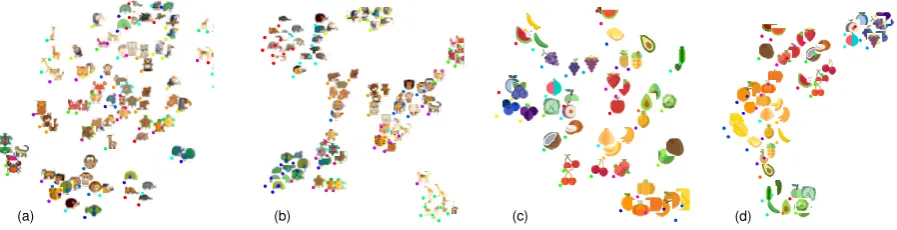
Figure 6:Visualization of the CNN featureswith t-SNE. Ten classes randomly sampled from(a-b)the
Animaldataset and(c-d)theFruitdataset, with features extracted using the visual encoder trained without (a, c) and with (b, d) image variations on the theAnimaldataset.
T
eacher
Lear
ner Interpreter
Speaker
η η η η
g g g g
gmem gmem gmem gmem
[image:8.595.76.515.238.295.2]large
Figure 7: Example results of the proposed approach on novel classes. The learner can ask about the new class and use the interpreter to extract useful information from the teacher’s sentence via word-level attentionηand content importancegmemjointly. The speaker uses the fusion gategto adaptively switch
between signals from RNN (smallg) and external memory (largeg) to generate sentence responses.
marizes the success rate and average reward over 1K testing sessions. As can be observed, Rein-forceachieves the lowest success rate (0.0%) and reward (−6.0) due to its inherent inefficiency in learning. Imitation performs better than Rein-force in terms of both its success rate (28.6%) and reward value (−2.7). Imitation+Gaussian-RLachieves a higher reward (−1.2) during test-ing, but its success rate (32.1%) is similar to that of Imitation, mainly due to the rigorous criteria for success.Proposedreaches the highest success rate (97.4%) and average reward (+1.1)4, outper-forming all baseline methods by a large margin. From this experiment, it is clear that imitation with a proper usage of reinforcement is crucial for achieving adaptive behaviors (e.g., asking ques-tions about novel objects and generating answers or statements about learned objects proactively).
5.2 Learning with Image Variations
To evaluate the impact of within-class image vari-ations on one-shot concept learning, we train mod-els with and without image variations, and during testing compare their performance under different image variation ratios (the chance of a novel image instance being present within a session) as shown in Figure 5. It is observed that the performance of
4The testing reward is higher than the training reward
mainly due to the action sampling in training for exploration.
the model trained without image variations drops significantly as the variation ratio increases. We also evaluate the performance of models trained under a variation ratio of 0.5. Figure 5 clearly shows that although there is also a performance drop, which is expected, the performance degrades more gradually, indicating the importance of im-age variation for learning one-shot concepts. Fig-ure 6 visualizes sampled training and testing im-ages represented by their corresponding features extracted using the visual encoder trained with-out and with image variations. Clusters of visu-ally similar concepts emerge in the feature space when trained with image variations, indicating that a more discriminative visual encoder was obtained for learning generalizable concepts.
5.3 Sentence-Level Task
difficult than the word-level task and the learner has to adaptively fuse information from RNN and external memory to generate a complete sentence. Comparison of different approaches in terms of their success rates and average rewards on the novel test set are shown in Figure 8. As can be observed from the figure,Proposedagain outper-forms all other compared methods in terms of both success rate (82.8%) and average reward (+0.8), demonstrating its effectiveness even for the more complex sentence-level task.
We also visualize the information extraction and the adaptive sentence composing process of the proposed approach when applied to a test set. As shown in Figure 7, the agent learns to extract use-ful information from the teacher’s sentence and use the content importance gate to control what content is written into the external memory. Con-cretely, sentences containing object names have a largergmemvalue, and the word corresponding to
object name has a larger value in the attention vec-tor η compared to other words in the sentence. The combined effect ofηandgmem suggests that
words corresponding to object names have higher likelihoods of being written into the external mem-ory. The agent also successfully learns to use the external memory for storing the information extracted from the teacher’s sentence, to fuse it adaptively with the signal from the RNN (captur-ing the syntactic structure) and to generate a com-plete sentence with the new concept included. The value of the fusion gate g is small when gener-ating words like “what,”, “i,” “can,” and “see,” meaning it mainly relies on the signal from the RNN for generation (c.f., Eqn.(2) and Figure 7). In contrast, when generating object names (e.g., “banana,” and “cucumber”), the fusion gateghas a large value, meaning that there is more emphasis on the signal from the external memory. This ex-periment showed that the proposed approach is ap-plicable to the more complex sentence-level task for language learning and one-shot learning. More interestingly, it learns an interpretable operational process, which can be easily understood. More re-sults including example dialogues from different approaches are presented in Appendix A.4.
6 Discussion
We have presented an approach for grounded lan-guage acquisition with one-shot visual concept learning in this work. This is achieved by purely
0 20 40 60 80 100
Success Rate (%)
Reinforce Imitation Imitation+Gaussian-RL Proposed
-6 -5 -4 -3 -2 -1 0 1
Reward
[image:9.595.308.525.62.137.2]Reinforce Imitation Imitation+Gaussian-RL Proposed
Figure 8: Test performance for sentence-level task with image variations (variation ratio=0.5).
interacting with a teacher and learning from feed-back arising naturally during interaction through joint imitation and reinforcement learning, with a memory augmented neural network. Experimental results show that the proposed approach is effec-tive for language acquisition with one-shot visual concept learning across several different settings compared with several baseline approaches.
In the current work, we have designed and used a computer game (synthetic task with synthetic language) for training the agent. This is mainly due to the fact that there is no existing dataset to the best of our knowledge that is adequate for de-veloping our addressed interactive language learn-ing and one-shot learnlearn-ing problem. For our cur-rent design, although it is an artificial game, there is a reasonable amount of variations both within and across sessions, e.g., the object classes to be learned within a session, the presentation order of the selected classes, the sentence patterns and im-age instances to be used etc. All these factors con-tribute to the increased complexity of the learning task, making it non-trivial and already very chal-lenging to existing approaches as shown by the experimental results. While offering flexibility in training, one downside of using a synthetic task is its limited amount of variation compared with real-world scenarios with natural languages. Al-though it might be non-trivial to extend the pro-posed approach to real natural language directly, we regard this work as an initial step towards this ultimate ambitious goal and our game might shed some light on designing more advanced games or performing real-world data collection. We plan to investigate the generalization and application of the proposed approach to more realistic environ-ments with more diverse tasks in future work.
Acknowledgments
References
Stanislaw Antol, Aishwarya Agrawal, Jiasen Lu, Mar-garet Mitchell, Dhruv Batra, C. Lawrence Zitnick, and Devi Parikh. 2015. VQA: Visual Question An-swering. InInternational Conference on Computer Vision (ICCV).
Alan Baddeley. 1992. Working memory. Science, 255(5044):556–559.
Dzmitry Bahdanau, Philemon Brakel, Kelvin Xu, Anirudh Goyal, Ryan Lowe, Joelle Pineau, Aaron C. Courville, and Yoshua Bengio. 2017. An actor-critic algorithm for sequence prediction. InInternational Conference on Learning Representations (ICLR).
Ann C. Baker, Patricia J. Jensen, and David A. Kolb. 2002. Conversational Learning: An Experiential Approach to Knowledge Creation. Copley Publish-ing Group.
Arielle Borovsky, Marta Kutas, and Jeff Elman. 2003. Learning to use words: Event related potentials in-dex single-shot contextual word learning. Cognzi-tion, 116(2):289–296.
K. Cho, B. Merrienboer, C. Glehre, D. Bahdanau, F. Bougares, H. Schwenk, and Y. Bengio. 2014a. Learning phrase representations using rnn encoder-decoder for statistical machine translation. In Em-pirical Methods in Natural Language Processing (EMNLP).
Kyunghyun Cho, Bart van Merri¨enboer, C¸ alar G¨ulc¸ehre, Dzmitry Bahdanau, Fethi Bougares, Hol-ger Schwenk, and Yoshua Bengio. 2014b. Learn-ing phrase representations usLearn-ing RNN encoder– decoder for statistical machine translation. In Em-pirical Methods in Natural Language Processing (EMNLP).
Abhishek Das, Satwik Kottur, , Jos´e M.F. Moura, Ste-fan Lee, and Dhruv Batra. 2017. Learning cooper-ative visual dialog agents with deep reinforcement learning. InInternational Conference on Computer Vision (ICCV).
Yan Duan, Xi Chen, Rein Houthooft, John Schulman, and Pieter Abbeel. 2016. Benchmarking deep rein-forcement learning for continuous control. In Inter-national Conference on InterInter-national Conference on Machine Learning (ICML).
J. Duchi, E. Hazan, and Y. Singer. 2011. Adaptive sub-gradient methods for online learning and stochas-tic optimization. Journal of Machine Learning Re-search, 12:2121–2159.
Jakob N. Foerster, Yannis M. Assael, Nando de Freitas, and Shimon Whiteson. 2016. Learning to commu-nicate with deep multi-agent reinforcement learning. InAdvances in Neural Information Processing Sys-tems (NIPS).
Alex Graves, Greg Wayne, and Ivo Danihelka. 2014. Neural turing machines. CoRR, abs/1410.5401.
Ji He, Jianshu Chen, Xiaodong He, Jianfeng Gao, Li-hong Li, Li Deng, and Mari Ostendorf. 2016. Deep reinforcement learning with a natural language ac-tion space. In Association for Computational Lin-guistics (ACL).
Derek M. Houston and Richard T. Miyamoto. 2011. Effects of early auditory experience on word learn-ing and speech perception in deaf children with cochlear implants: Implications for sensitive pe-riods of language development. Otol Neurotol, 31(8):1248–1253.
Patricia K. Kuhl. 2004. Early language acquisi-tion: cracking the speech code. Nat Rev Neurosci, 5(2):831–843.
Brenden M. Lake, Ruslan Salakhutdinov, Jason Gross, and Joshua B. Tenenbaum. 2011. One shot learn-ing of simple visual concepts. InProceedings of the 33th Annual Meeting of the Cognitive Science Soci-ety.
Angeliki Lazaridou, Alexander Peysakhovich, and Marco Baroni. 2017. Multi-agent cooperation and the emergence of (natural) language. In Inter-national Conference on Learning Representations (ICLR).
Jiwei Li, Alexander H. Miller, Sumit Chopra, MarcAu-relio Ranzato, and Jason Weston. 2017. Learning through dialogue interactions by asking questions. InInternational Conference on Learning Represen-tations (ICLR).
Jiwei Li, Will Monroe, Alan Ritter, Dan Jurafsky, Michel Galley, and Jianfeng Gao. 2016. Deep re-inforcement learning for dialogue generation. In
Empirical Methods in Natural Language Processing (EMNLP).
V. Mnih, K. Kavukcuoglu, D. Silver, A. Graves, I. Antonoglou, D. Wierstra, and M. Riedmiller. 2013. Playing Atari with deep reinforcement learn-ing. InNIPS Deep Learning Workshop.
Igor Mordatch and Pieter Abbeel. 2018. Emergence of grounded compositional language in multi-agent populations. InAssociation for the Advancement of Artificial Intelligence (AAAI).
Anna Ingeborg Petursdottir and James R. Mellor. 2016. Reinforcement contingencies in language acquisi-tion. Policy Insights from the Behavioral and Brain Sciences, 4(1):25–32.
Marc’Aurelio Ranzato, Sumit Chopra, Michael Auli, and Wojciech Zaremba. 2016. Sequence level train-ing with recurrent neural networks. InInternational Conference on Learning Representations (ICLR).
Iulian Vlad Serban, Alessandro Sordoni, Yoshua Ben-gio, Aaron C. Courville, and Joelle Pineau. 2016. Building end-to-end dialogue systems using genera-tive hierarchical neural network models. In Associ-ation for the Advancement of Artificial Intelligence (AAAI).
B. F. Skinner. 1957.Verbal Behavior. Copley Publish-ing Group.
Bradly C. Stadie, Pieter Abbeel, and Ilya Sutskever. 2017. Third-person imitation learning. In Inter-national Conference on Learning Representations (ICLR).
Amanda Stent and Srinivas Bangalore. 2014. Natural Language Generation in Interactive Systems. Cam-bridge University Press.
Florian Strub, Harm de Vries, J´er´emie Mary, Bilal Piot, Aaron C. Courville, and Olivier Pietquin. 2017. End-to-end optimization of goal-driven and visually grounded dialogue systems. In International Joint Conference on Artificial Intelligence (IJCAI).
Sainbayar Sukhbaatar, Arthur Szlam, and Rob Fergus. 2016. Learning multiagent communication with backpropagation. In Advances in Neural Informa-tion Processing Systems (NIPS).
Richard S. Sutton and Andrew G. Barto. 1998. Rein-forcement Learning: An Introduction. MIT Press.
S. I. Wang, P. Liang, and C. Manning. 2016. Learning language games through interaction. InAssociation for Computational Linguistics (ACL).
Z. Wang, V. Bapst, N. Heess, V. Mnih, R. Munos, K. Kavukcuoglu, and N. Freitas. 2017. Sample effi-cient actor-critic with experience replay. In Inter-national Conference on Learning Representations (ICLR).
Sandra R. Waxman. 2004. Everything had a name, and each name gave birth to a new thought: links be-tween early word learning and conceptual organi-zation. Cambridge, MA: The MIT Press.
Tsung-Hsien Wen, Milica Gasic, Nikola Mrksic, Pei-hao Su, David Vandyke, and Steve J. Young. 2015. Semantically conditioned LSTM-based natural lan-guage generation for spoken dialogue systems. In
Empirical Methods in Natural Language Processing (EMNLP).
Jason Weston. 2016. Dialog-based language learning. InAdvances in Neural Information Processing Sys-tems (NIPS).
Mark Woodward and Chelsea Finn. 2016. Active one-shot learning. InNIPS Deep Reinforcement Learn-ing Workshop.
Haonan Yu, Haichao Zhang, and Wei Xu. 2018. Inter-active grounded language acquisition and general-ization in a 2D world. InInternational Conference on Learning Representations (ICLR).
Lantao Yu, Weinan Zhang, Jun Wang, and Yong Yu. 2017. SeqGAN: Sequence generative adversarial nets with policy gradient. InAssociation for the Ad-vancement of Artificial Intelligence (AAAI).