Oviedo University Press 98 Economics and Business Letters
7(3), 98-107, 2018
Evaluating the liberalization process on
Telecommunications services for EU countries
Christos Agiakloglou1 • Michael Polemis1,2*
1University of Piraeus, Department of Economics, Piraeus, Greece 2Hellenic Competition Commission, Athens, Greece
Received: 20 April 2018 Revised: 03 September 2018 Accepted: 03 September 2018
Abstract
This paper investigates the main determinants of Telecommunications demand for European Union (EU) countries using a panel data set for 19 EU countries over the period 1991-2010, capturing the years before and after the liberalization process. The goal is to clarify whether any changes in the demand of Telecommunications, as expressed by volume of traffic in local, mobile and international market segments, are attributed to regulatory process or to some other major drivers, taking also into account the relevant price elasticities. It turns out that the regulatory process does not seem to have significant impact on demand for Telecommunications services for the first period of liberalization.
Keywords: Telecommunications demand; price elasticities; regulation; competition; panel data JEL Classification Codes: L51, L1, L94, C2
1. Introduction
The Telecommunications sector in Europe has undergone substantial regulatory and institu-tional reorganizations over the last two decades. Specifically, the European Union (EU) has issued several directives (1998/84/EC, 2002/21/EC and 2009/140/EC) in order to promote ef-fective competition in each market segment of the sector. The primary goal of these Directives was to establish a common regulatory framework in Telecommunications within the EU coun-tries, although, in practice, the implementation process varied considerably across member states.
As a result, the Telecommunications industry in the EU has changed drastically, in terms of the intensity of competition, moving from a pure monopolistic environment to a regulated re-gime, where this regulatory process was controlled by National Regulatory Authorities, known as NRAs (Beesley and Littlechild, 1989). Indeed, up to the early ‘90s the Telecommunications
* Corresponding author. E-mail: [email protected].
sector in Europe was governed by vertically integrated state-owned companies, whereas after
this period several policy actions have been taken to facilitate regulation in terms of formulating prices and revenues to meet social and macroeconomic goals (Boylaud and Nicoletti, 2001). The liberalization of the industry was a necessary tool to eliminate distortions, generated by the Public Telecommunications Operators (PTOs) that failed to meet social goals, and to enhance competition in order to provide better quality of services at lower prices (Newbery, 2002). Meanwhile, the demand for Telecommunications services has overall increased over the last few years, without being able though to determine whether this increase is due to market open-ing or to other macroeconomic and demographic factors, such as economic activity, population density, technology and human needs.
These two fundamental characteristics of the Telecommunications sector, i.e., the regulatory process and all determinants of demand, gave researchers the incentive to analyze and investi-gate the behavior of the industry. For example, Laffont and Tirole (2000) focused their research on regulation and they concluded that a good regulatory framework requires cost and demand information. Other studies examined the impact of structural reforms, such as regulation, com-petition and privatization, on telecommunications performance1. Clearly, determining demand conditions for Telecommunications is not only important for the operating companies but it is also essential for the NRAs. Existing companies need to know how their demand is formulated to design their strategies for their short run and long run internal and market goals, whereas NRAs need to know market conditions to pursue policies and set rules regarding the structure, the conduct and the performance of the industry.
In this study, we extent the on-going empirical literature on telecommunications demand by capturing regulatory strategy and competition policy elements. For this reason, we formulate a number of research hypotheses including the following: How does regulatory policies affect the level of market demand in the telecommunications sector? How does the downstream firms’ mode of competition (quantities vs prices) affect the corresponding market and societal out-comes? Does privatization increase the level of telecommunications demand in each of the three sub-segments? How do macroeconomic and demographic factors affect the level of telecom-munications demand? Lastly, what policy implications could be drawn in order to improve mar-ket and societal outcomes in this industry?
As it is known, demand conditions for Telecommunications services are determined by vol-ume of traffic of calls in each market segment and prices (see for example Squire, 1973 and Rohlfs, 1974) as well as by several other macro and micro economic factors, discussed in detail by Taylor (1994). Hence, it is very interesting to assess the impact of regulation, competition and privatization on Telecommunications demand for EU countries before and after the liber-alization period. The aim of this study is to clarify whether the deregulation process has affected volume of calls in three market segments, such as local, mobile and international calls.
The paper is organized as follows. Section 2 states the research hypotheses. Section 3 presents the data and the variables used in the relevant econometric methodology. Section 4 reports and analyzes the empirical results, whereas the concluding remarks as well as some policy implica-tions are portrayed in Section 5.
2. Formulation of research hypotheses
Regulation of telecommunications sector plays a crucial role in the political and economic agenda for both industrial and developing countries. The regulatory efforts of more developing
1 See for example Agiakloglou and Polemis (2017) and Wallsten (2001b), whereas several other studies attempted
countries in order to attract investments and enhance the level of effective competition in the
industry are hindered by the absence of a sound legal framework, the weak level of regulation, and the extended state interventionism (see Polemis and Stengos, 2017). A carefully designed regulatory scheme can be expected, therefore, to be a key component of a successful process of telecommunications privatization. This can be explained by two reasons. On the one hand, in-dependent telecommunications providers will be unwilling to invest and will produce less under risky regulatory conditions, while at the same time, a well-established regulatory regime can be expected to reduce ‘regulatory risk’ and provide the marketers with the right signals and incen-tives (Polemis and Stengos, 2017).
As suggested by many researchers (Zhang et al, 2005, 2008, Akkemik and Oguz, 2011), in a competitive market, prices and profits provide the firm with incentives to improve efficiency minimising costs. This will lead to increased technical efficiency that may be passed through in lower prices, thus increasing the quantity demanded (Polemis and Stengos, 2017).
Lastly, the impact of privitization is a rather controversial issue. This is because there may be arguments suggesting changes of performance in different directions, particularly about invest-ment, following some aspects of reform. Similarly to the electricity sector, the driving force for privatization of telecommunications sector is that public ownership is less efficient than private ownership. Privatization reforms may induce the incumbent either to eliminate excess staff or to increase employment as it improves its network (Li and Xu, 2004; Wallsten, 2001a). Specif-ically, Wallsten, (2001a), argues that privatization in fixed lines expanded fixed line penetration, but was offset by a negative effect associated with independent regulation. Privatization also expanded mobile penetration. However, Wallsten, (2001a) claims that when privatization and competition were both present, mobile penetration was reduced. We must mention though that competition and privitization had a strong impact on demand, with competition in the mobile market dominating all others—reducing fixed line and augmenting mobile penetration.
Based on the above, we can summarise the above considerations in the following research hypotheses:
Hypothesis 1.
The existence of a regulatory regime will affect market prices and hence telecommunications demand.
Hypothesis 2.
Effective competition will lead to a larger capacity and an increased output reflecting increased demand for telecommunications services.
Hypothesis 3.
Privatization has a strong and positive impact on telecommunications demand especially in the mobile segment.
3. Data and methodology
We consider volume of calls as the main response variable to study demand for Telecommuni-cations for three market segments such as: (a) local, measured by fixed to fixed telephone traffic in minutes (LOCAL), (b) mobile, measured by domestic mobile telephone traffic in minutes (MOB), and (c) international, measured by total international outgoing fixed telephone traffic in minutes (INTER). These variables are obtained from the World Telecommunications / ICT Indicators database (June 2014) published by the International Telecommunications Union (ITU) for 19 EU countries over the period 1991 – 20102.
2 The E.U. countries are the following: Austria, Belgium, Czech Republic, Denmark, Finland, France, Germany,
The explanatory variables used to identify the behavior of these response variables are
cate-gorized in two sets: (a) structural reform variables, and (b) macroeconomic and demographic variables. The first set of explanatory variables tries to capture the impact of structural reforms, such as regulation, competition and privatization, on the volume of Telecommunications ser-vices. For this reason we use: (a) for regulation the Regulatory Reform Index (RRI), an index that measures the level of regulation in Telecommunications for each country, taking values from 0 to 6, meaning perfectly deregulated market to totally regulated market respectively, (b) for privatization a dummy variable (PRIV) taking the value of one when the percentage of shares in the PTO owned by the government is less than 50% and zero otherwise, and (c) for competition three dummy variables (COMP_LOCAL, COMP_MOB and COMP_INTER) ac-counting for the competitive conditions prevailing in local-trunk, mobile and international mar-ket segments, respectively, taking the value of one if competition exists in each of the three market segments and zero otherwise. The data for all of the above variables is obtained directly from the OECD regulation database. It is interesting to point out that the RRI index is formed according to the methodology of Conway and Nicoletti (2006) capturing several elements of market structure and it has been used in several other empirical studies (see, for example, Li and Lyons, 2012, Pompei, 2013, Nesta et al, 2014).
The second set of variables includes some macroeconomic and demographic variables such as: (a) the FRASER index, (b) the number of active subscribers per 100 inhabitants for local-fixed and mobile market segments, i.e., F_SUBS and M_SUBS respectively, and (c) population density (POP). Specifically, the FRASER index is a very important measure that declares the prevailing degree of economic risk in each country. This index takes values from 0 to 10, with the highest value indicating less economic risk, and it is generated as a weighted average of five main macroeconomic factors such as: (i) the size of government, (ii) the legal system and prop-erty rights, (iii) the access to sound money, (iv) the freedom to trade internationally, and (v) the regulation of credit, labor and business (see Gwartney et al., 2012). Data for the FRASER index and for the aforementioned demographic variables is drawn from the FRASER Institute and from the World Development Indicators Database available from the World Bank respectively.
The model adopted for this study is given by the following equation:
Yjit = +a0 a RRI1 it+a COMP2 it+a PRIV3 it+a X4 it+ + +t ui it (1)
where all non-index variables are in natural logarithms, j = 1, 2, 3 denotes the three dependent variables, i.e., LOCAL, MOB and INTER, for all countries (i) at time t and the errors (εit) are uncorrelated to each other. Xit is a vector of control variables described above3. The γt stands for the time fixed effects and ui are the country fixed effects that control for differences across countries (see Agiakloglou and Polemis, 2017).
4. Results and discussion
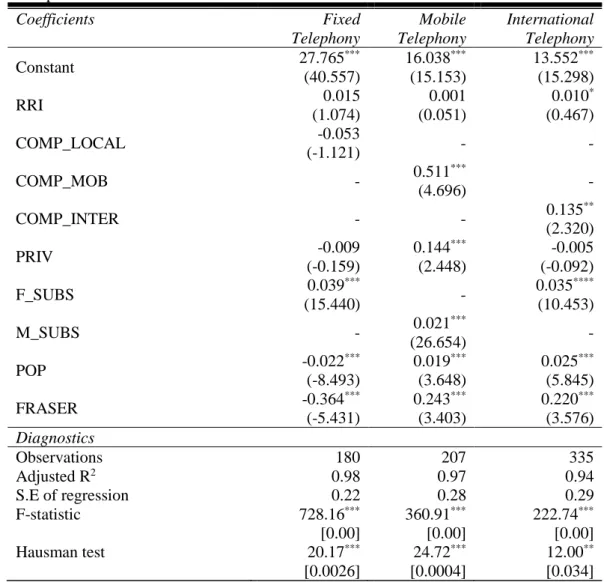
Model (1) is estimated using OLS with fixed effects for each of the three market segments and the results are reported on Table 1. The use of fixed effects is justified by the Hausman test (1978) since the null hypothesis is strongly rejected in all of the three specifications. As can be seen from column one of this table none of the three structural reform variables affects the volume of fixed telephone traffic in the local market segment, since their coefficients are not statistically significant. This result denotes that the deregulation process does not affect the
3 It is interesting to indicate that several other macroeconomic variables are included to model (1), such as Gross
volume of calls for this specific market segment4. One possible explanation for this finding can
be attributed to the fact that the demand for this particular segment of the Telecommunications market has not been increased, since other modes of Telecommunications have been risen ab-sorbing part of this volume of traffic. Hence, the volume of fixed telephone traffic is affected by the other variables included in model (1).
Specifically, the number of active subscribers per 100 inhabitants for fixed telephone lines has a positive and statistically significant impact on the level of traffic volume for the local market segment. However, its magnitude is rather small, i.e., equal to 3.9%, meaning that a 100% increase (decrease) of the number of subscribers will lead to a roughly 4% increase (de-crease) of the traffic volume, ceteris paribus. This small magnitude is probably attributed to the fact that subscribers tend to apply for fixed line connections not basically to make telephone calls, but to obtain other high value added complementary services bundled to a fixed line. Therefore, it is more important for firms, in terms of pricing, to charge low prices for fixed telephony and high prices for all other complementary services, such as internet and broadband connections, as well as cable TV.
Table 1. Empirical results.
Coefficients Fixed
Telephony
Mobile Telephony
International Telephony
Constant 27.765
*** (40.557) 16.038*** (15.153) 13.552*** (15.298)
RRI 0.015
(1.074)
0.001 (0.051)
0.010*
(0.467)
COMP_LOCAL -0.053
(-1.121) - -
COMP_MOB - 0.511
***
(4.696) -
COMP_INTER - - 0.135
**
(2.320)
PRIV -0.009
(-0.159)
0.144***
(2.448)
-0.005 (-0.092)
F_SUBS 0.039
***
(15.440) -
0.035****
(10.453)
M_SUBS - 0.021
***
(26.654) -
POP -0.022
*** (-8.493) 0.019*** (3.648) 0.025*** (5.845)
FRASER -0.364
*** (-5.431) 0.243*** (3.403) 0.220*** (3.576) Diagnostics
Observations 180 207 335
Adjusted R2 0.98 0.97 0.94
S.E of regression 0.22 0.28 0.29
F-statistic 728.16***
[0.00]
360.91***
[0.00]
222.74***
[0.00]
Hausman test 20.17***
[0.0026]
24.72***
[0.0004]
12.00**
[0.034]
Note: Robust standard errors are in parentheses. The numbers in square brackets are the p-values. Significant at
***1%, **5% and *10% respectively. The Hausman test is used to differentiate between fixed (FE) and random (RE)
effects. Rejection of the null hypothesis declares that FE is at least as consistent and thus preferred.
4 Indeed, from the analysis of raw data it is evident that the mean volume traffic for all EU countries before the
On the other hand, the other two variables, population density and FRASER index, have a
negative and statistically significant impact on the level of traffic volume for fixed telephony. Clearly, as population density increases, the volume of fixed telephone traffic decreases, indi-cating the existence of a substitution effect, i.e., people tend to substitute fixed telephony with other more advanced ways of communications, such as mobile telephony. Similarly, as the economic risk of a country decreases, meaning that the FRASER index increases, people tend to use more often other means of communications rather than fixed telephony, such as broad-band services.
Column two of Table 1 reports the results obtained from the estimation of model (1) for the mobile market segment. As can be seen from this column the structural reform variables provide mixed results. Contrary to Garbacz and Thompson (2007), the level of competition has positive and statistically significant effect on volume, although, its magnitude is small, relative to the constant term, since it is a dummy variable, indicating that competition has minor impact on the volume of mobile telephony. Similarly, privatization has positive and statistically significant effect on volume with an estimate of 0.14, lower than the 0.51 estimate of competition, indicat-ing that more privatization does not necessarily lead to a large increase in volume. On the con-trary, the volume of mobile telephony is not affected by the level of regulation, since its coeffi-cient is not statistically significant. Perhaps, one possible explanation for this finding is at-tributed to the fact that the market for mobile telephony has opened instantly without the nec-essary regulatory enforcement period. However, other explanations for this finding are related to the huge increase in demand for communication on the move as well as cultural and social factors that are likely to make people less sensitive to the vagaries of competition and regulation.
The other three variables, such as the number of mobile subscribers, the population density and the FRASER index, do statistically significant affect the behavior of the dependent variable. For example, the volume of mobile telephony is positively related to the number of mobile subscribers, as expected and similarly found in the case of local telephony. Likewise, population density and FRASER index have positive impact on the volume of mobile telephony, a result though that it is in alignment with the one obtained for fixed telephony. This finding supports the argument that people tend to use more mobile telephony, instead of conventional means of communication, such as fixed telephony, as economic activity grows along with the population density. It is also interesting to point out that the magnitude of the coefficient of FRASER index is significantly larger than the estimates of the coefficients of the other two variables, such as M_SUB and POP, a finding that highlights the importance of a stable economic environment, mostly evident in EU.
Finally, column three of Table 1 depicts the estimated results by using the international vol-ume traffic as the dependent variable. The effect of structural reform variables on international calls is different than the one obtained from the other two market segments. In this case, only the level of competition has statistically significant effect on volume of international calls, while the other two structural reform variables, such as privatization and regulation, do not play any role in determining the volume of this market segment. This finding can be justified by the fact that it is relatively easy for potential firms to enter the market and provide international calls at competitive prices. However, the magnitude of the estimated coefficient of competition is rela-tively small, as indicated in the other two market segments, revealing that competition has lim-ited impact on international volume traffic.
attributed to the fact that people prefer to make their international calls through fixed line
con-nections since calls are typically less expensive than calls made through mobile telephony. Sim-ilarly to the mobile market the magnitude of the coefficient of the FRASER index is substan-tially larger than the other two control variables, meaning that the level of the economic activity of a country is more is more important than the number of subscribers and population density.
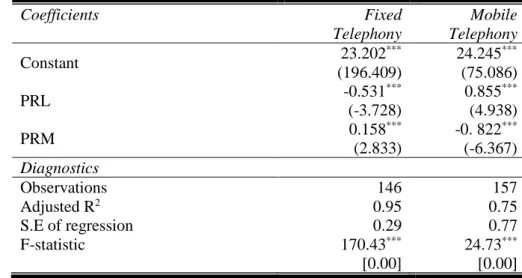
Clearly, to support further the findings of this study a complimentary analysis is implemented in terms of estimating own and cross price elasticities for Local and Mobile market segments in order to obtain robust and meaningful results using only prices for Fixed and Mobile calls as regressors in model (1). For this reason we use the price of a three minute local call to a fixed telephone line at pick rate, named as PRL, and the mobile cellular prepaid price of a three minute local call, at pick on net rate, named as PRM, as a proxy variable of a regular price of three minutes mobile call. The values of these prices are obtained from the World Telecommu-nications / ICT Indicators database (June 2014) published by the ITU and the estimated own and cross price elasticities for fixed and mobile telephony are reported on Table 25.
In particular, column one of Table 2 reports the estimated results of regressing volume of fixed telephony on its own price and on the price of mobile telephony. The own price elasticity of fixed telephony is equal to -0.53, whereas the cross price elasticity of fixed telephony using prices of mobile telephony is equal to 0.15. All estimates are statistically significant and have the anticipated signs. More specifically, the absolute value of the own price elasticity of fixed telephony is less than one, indicating inelastic demand, whereas the positive cross price elas-ticity suggests the existence of a substitution effect. However, the magnitude of the cross price elasticity is small, close to zero, revealing that a price increase of the mobile telephony has a minor and negligible effect on the demand for fixed telephony.
In contrast, the own price elasticity of mobile telephony is equal to -0.82, whereas the cross price elasticity of mobile to fixed telephony equals to 0.85, as can been seen from column two of Table 2. These results are obtained by regressing volume of mobile telephony on its own price and on the price of fixed telephony and all estimates are statistically significant and have the proper signs. The own price elasticity of mobile telephony is in absolute terms less than one, indicating also an inelastic demand for this market, whereas the cross price elasticity is positive, declaring the existence of a substitution effect.
Table 2. Estimated Elasticities in Fixed and Mobile Telephony.
Coefficients Fixed
Telephony
Mobile Telephony
Constant 23.202
***
(196.409)
24.245***
(75.086)
PRL -0.531
***
(-3.728)
0.855***
(4.938)
PRM 0.158
***
(2.833)
-0. 822***
(-6.367)
Diagnostics
Observations 146 157
Adjusted R2 0.95 0.75
S.E of regression 0.29 0.77
F-statistic 170.43***
[0.00]
24.73***
[0.00]
Note: Robust standard errors are in parentheses. The numbers in square brackets are the p-values. Significant at
***1%, **5% and *10% respectively.
Nevertheless, important results emerge by comparing the estimates of own and cross price
elasticities obtained by the two market segments. First, the magnitude of the own price elastic-ity of mobile telephony is larger in absolute terms than the one obtained in fixed telephony. This finding can be explained by the fact that fixed subscribers are less active to change provider than mobile subscribers. On the other hand, the magnitude of the cross price elasticity of mobile telephony is almost six times larger than its counterpart cross price elasticity for fixed teleph-ony, indicating that the substitution effect is more sensitive towards the mobile rather than the fixed telephony market to price changes.
5. Concluding remarks and policy implications
This paper studied the main determinants of Telecommunications demand for three market segments (local, mobile and international) before and after the the liberalization process of the industry across 19 EU countries. The aim of this research was to explore the impact of structural reform variables, such as, regulation, competition and privatization, on traffic volume of calls in each of the three market segments taking also into account some other demographic and macroeconomic factors.
The empirical findings based on a panel fixed effects static model suggest that structural re-form variables do not have unire-form impact on volume of calls in all of the three examined market segments. In particular, for the local market none of the three structural reform variables play significant role in determining the volume of calls. On the contrary, competition and pri-vatization do affect positively and statistically significant the volume of mobile calls, whereas the level of regulation does not influence at all the volume of this market. Finally, for the international market only the level of competition has positive and statistically significant effect on volume of calls compared to the other two structural reform variables.
Moreover, the aforementioned findings are in alignment with the existing economic condi-tions. The local market seems to remain unaltered by the liberalization process, simply because the tendency was to move away from this market to some other niche markets, such as mobile. On the other hand, the mobile and the international markets have been affected mainly by com-petition due to gradually decreases in prices. The switching of the demand from fixed to mobile telephony can also be supported by the positive sign of the cross price elasticity. This result strongly suggests the existence of a substitution effect between fixed and mobile demand, fa-vorable towards mobile telephony, revealing the robustness of the empirical findings.
Finally, all other macroeconomic and demographic variables do statistically significant affect the volume of calls in all three market segments, but, to some extent, at a different impact. As it is showed, the number of subscribers affects positively the volume of calls in all markets. However, the population density and the level of economic risk, have a negative impact on the level of traffic volume only for fixed telephony at the local market segment, a result that can be attributed to the fact that as economy and technology grow the relative importance of fixed telephony to the overall Telecommunications sector decreases.
more advanced ways of communications, such as mobile telephony or internet (Skype) calls.
This raises important policy implications for regulators and government officials toward the further opening of the mobile and internet segments (e.g termination rates, roaming fees, etc).
Acknowledgements
We would like to thank the Editor-in-Chief Francisco J. Delgado for giving us the opportunity to revise and thus to improve our paper and the two anonymous reviewers for their useful and constructive comments. Special thanks also go to Teodosio Pérez Amaral for his fruitful com-ments and suggestions on an earlier version of the paper. Lastly, we would like to thank the Organizing Committee and the seminar participants of the 26th European Regional Conference ITS which was held in Madrid, 24-27 June 2015. Any errors belong to the authors. Usual dis-claimer applies.
References
Agiakloglou, C., and Karkalakos S. (2009) A Spatial and Economic Analysis for Telecommu-nications: Evidence from the European Union, Journal of Applied Economics, XII, 11-32. Agiakloglou, C., and Polemis M. (2017) The Impact of Structural Reforms on
Telecommuni-cations Performance, Journal of Industry Competition and Trade, 18(2), 209-222.
Agiakloglou, C., and Yiannelis D. (2005) Estimation of Price Elasticities for International Tel-ecommunications Demand, International Advances in Economic Research, 12, 131-137. Akkemik, K.A, and Oğuz F. (2011) Regulation, Efficiency and Equilibrium: A General
Equi-librium Analysis of Liberalization in the Turkish Electricity Market, Energy 36(5), 3282-3292.
Beesley, M. E., and Littlechild, S. C. (1989) The Regulation of Privatized Monopolies in the United Kingdom, Rand Journal of Economics, 20(3), 454-472.
Boylaud, O., and Nikoletti G. (2001) Regulation, Market Structure and Performance in Tele-communications, OECD Economic studies No 32.
Conway P., and Nicoletti, G. (2006) Product Market Regulation in the Non-Manufacturing Sec-tors of OECD Countries: Measurement and Highlights, OECD Economics Department Working Papers 530.
Garbacz, C., and Thompson, H. G. (2007) Demand for telecommunication services in develop-ing countries, Telecommunications Policy, 31(5), 276-289,
Gwartney, J. D., Hall, J., and Lawson, R. (2012) Economic Freedom of the World: 2012 Annual Report, Vancouver, BC: The Fraser Institute.
Hausman, J. (1978) Specification Tests in Econometrics, Econometrica, 46, 1251- 1262. Laffont, J., and Tirole, J. (2000) Competition in Telecommunications, MIT Press, London Li, Y., and Lyons, B., (2012) Market Structure, Regulation and the Speed of Mobile Network
Penetration, International Journal of Industrial Organization, 30, 697–707
Li, W., and Xu, L. C. (2004) The impact of privatization and competition in the telecommuni-cations sector around the world, Journal of Law and Economics, 47, 395–430.
Madden, G., and Savage, S.J., (2000) Market Structure, Competition, and Pricing in United States International Telephone, The Review of Economics and Statistics, 82, 291-296. Munoz, T. G., and Amaral, T. P. (1998) Econometric modeling of Spanish very long distance
international calling, Information Economics and Policy, 10, 237-252.
Nesta, L., Vona, F., and Nicolli, F. (2014) Environmental Policies, Competition and Innovation in Renewable Energy, Journal of Environmental Economics and Management, 67, 396–411. Paleologos, J., and Polemis, M. (2013) What Drives Investment in the Telecommunications
Polemis M., and Stengos, T. (2017) Electricity Sector Performance: A Panel Threshold
Analy-sis, The Energy Journal, vol. 0 (Number 3).
Pompei, F. (2013) Heterogeneous Effects of Regulation on the Efficiency of the Electricity Industry Across European Union Countries, Energy Economics 40, 569–585.
Rohlfs, J. (1974) A Theory of Interdependent Demand for a Communications Service, Bell Journal of Economics, 5(1), 16-37.
Squire, L. (1973) Some Aspects of Optimal Pricing for Telecommunications, The Bell Journal of Economics, 4(2), 515-525.
Taylor, L. D. (1994) Telecommunications Demand: A Survey and Critique, London, Kluwer Academic.
Wallsten, S. J. (2001a) An Econometric Analysis of Telecom Competition, Privatization and Regulation in Africa and Latin America, The Journal of Industrial Economics, 49, 1-19. Wallsten, S. J. (2001b) Telecommunications investment and traffic in developing countries:
The effects of international settlement rate reforms, Journal of Regulatory Economics, 20, 307–323.
Wright, J. (1999) International Telecommunications, Settlement Rates and the FCC, Journal of Regulatory Economics, 15, 267-291.
Zhang, Y. F., Parker, D., and Kirkpatrick. C. (2005) Competition, Regulation and Privatization of Electricity Generation in Developing Countries: Does the Sequencing of the Reforms Mat-ter?, Quarterly Review of Economics and Finance 54(2–3), 358–379.