142
Constructing large scale biomedical knowledge bases from scratch with
rapid annotation of interpretable patterns
Julien Fauqueur∗
BenevolentAI 4-8 Maple St, London
W1T 5HD
Ashok Thillaisundaram∗
BenevolentAI 4-8 Maple St, London
W1T 5HD
Theodosia Togia∗
BenevolentAI 4-8 Maple St, London
W1T 5HD
Abstract
Knowledge base construction is crucial for summarising, understanding and inferring re-lationships between biomedical entities. How-ever, for many practical applications such as drug discovery, the scarcity of relevant facts (e.g. gene X is therapeutic target for dis-ease Y) severely limits a domain expert’s abil-ity to create a usable knowledge base, either directly or by training a relation extraction model. In this paper, we present a simple and effective method of extracting new facts with a pre-specified binary relationship type from the biomedical literature, without requiring any training data or hand-crafted rules. Our sys-tem discovers, ranks and presents the most salient patterns to domain experts in an inter-pretable form. By marking patterns as com-patible with the desired relationship type, ex-perts indirectly batch-annotate candidate pairs whose relationship is expressed with such pat-terns in the literature. Even with a complete absence of seed data, experts are able to dis-cover thousands of high-quality pairs with the desired relationship within minutes. When a small number of relevant pairs do exist - even when their relationship is more general (e.g.
gene X is biologically associated with disease Y) than the relationship of interest - our sys-tem leverages them in order to i) learn a better ranking of the patterns to be annotated or ii) generate weakly labelled pairs in a fully auto-mated manner. We evaluate our method both intrinsically and via a downstream knowledge
∗
Equal contribution. Listing order is alphabetical. Theo-dosia proposed and co-ordinated the research project, built the early prototypes and contributed the different methods for extracting and lexicalising patterns. Ashok provided concep-tual work on the metrics for ranking simplifications and for the intrinsic evaluation, developed the simplification extrac-tion module, ran the experiments for the automated workflow (with all the parameter variations) and performed all the ex-trinsic evaluations. Julien was mainly responsible for the sys-tem architecture and workflow, the intrinsic evaluation (in-cluding interacting with the experts), handling negation and speculation and the clustering algorithm.
base completion task, and show that it is an ef-fective way of constructing knowledge bases when few or no relevant facts are already avail-able.
1 Introduction
In many important biomedical applications, ex-perts seek to extract facts that are often complex and tied to particular tasks, hence data that are truly fit for purpose are scarce or simply non-existent. Even when only binary relations are sought, useful facts tend to be more specific (e.g.
mutation of gene X has a causal effect on disease Y in an animal model) than associations typically found in widely available knowledge bases. Ex-tracting facts with a pre-specified relationship type from the literature in the absence of training data often relies on handcrafted rules, which are labo-rious, ad-hoc and hardly reusable for other types of relations. Recent attempts to create relational data from scratch by denoising the output of mul-tiple hand-written rules (Ratner et al.,2016) or by augmenting existing data through the induction of new black-box heuristics (Varma and R´e, 2018) are still dependent on ad-hoc human effort or pre-existing data. Our approach involves discovering and recommending, rather than prescribing, rules. Importantly, our rules are presented as text-like patterns whose meaning is transparent to human annotators, enabling integration of an automatic data generation (or augmentation) system with a domain expert feedback loop.
In this work, we make the following contribu-tions:
• We propose a simple method for presenting patterns in a readable way, enabling faster, more reliable human annotation
• For cases where a small number of seed pairs are already available, we propose a method which utilises these seed pairs to rank newly discovered patterns in terms of their compat-ibility with the existing data. The resulting patterns can be used with or without a human in the loop.
The rest of the paper is organised as follows. Section2describes some related work. Section3
explains the relationship between patterns and la-belling rules and presents some pattern types along with techniques for rendering them interpretable. Section 4 provides a high-level overview of the system and covers details of our different work-flows (with and without seed data; with and with-out human feedback). Section5explains how we measure the system’s performance both intrinsi-cally and via a downstream knowledge base com-pletion task. In section 6, we report the details of our main experiments while in sections 7 and
8we present some analysis along with further ex-periments. The paper ends with conclusions and proposals for further work in section9.
2 Related work
The idea of extracting entity pairs by discovering textual patterns dates back to early work on boot-strapping for relation extraction with the DIPRE system (Brin,1999). This system was designed to find co-occurrences of seed entity pairs of a known relationship type inside unlabelled text, then ex-tract simple patterns (exact string matches) from these occurrences and use them to discover new entity pairs. Agichtein et al. (2000) introduced a pattern evaluation methodology based on the pre-cision of a pattern on the set of entity pairs which had already been discovered; they also used the dot product between word vectors instead of an exact string match to allow for slight variations in text. Later work (Greenwood and Stevenson,
2006; Xu et al., 2007; Alfonseca et al., 2012) has proposed more sophisticated pattern extrac-tion methods (based on dependency graphs or ker-nel methods on word vectors) and different pat-tern evaluation frameworks (document relevance scores).
Two recent weak supervision techniques, Data Programming (Ratner et al.,2016) and the method
underlying the Snuba system (Varma and R´e,
2018) have attempted to combine the results of handcrafted rules and weak base classifiers respec-tively. Data Programming involves modelling the accuracy of ideally uncorrelated rules devised by domain experts, then combining their output into weak labels. Although this approach does not re-quire any seed data, it does rely on handwritten rules, which are both time consuming and ad-hoc due to the lack of a data-driven mechanism for ex-ploring the space of possible rules. Snuba learns black-box heuristics (parameters for different clas-sifiers) given seed pairs of the desired relationship. This method avoids the need for manually com-posing rules, however, the rules it learns are not interpretable, which makes the pipeline harder to combine with an active learning step. Second, the system requires gold standard pairs. In contrast, while our system can leverage gold standard an-notations, if available, in order to reduce the space of discovered rules, as well as tune the ranking of newly discovered patterns, it is entirely capa-ble of starting without any gold data if ranking is heuristics-based (e.g. prioritisation by frequency) and a human assesses the quality of the highest coverage rules suggested. Our method does not preclude use within a data programming setup as a way of discovering labelling functions or within a system like Snuba, as a way of generating seed pairs. Another body of work, distant supervision (Verga et al., 2018; Lin et al., 2016) has been a recent popular way to extract relationships from weak labels, but does not give the user any control on the model performance.
A well known body of work, OpenIE (Banko et al., 2007; Fader et al., 2011; Mausam et al.,
2012;Angeli et al.,2015) aims to extract patterns between entity mentions in sentences, thereby dis-covering new surface forms which can be clus-tered (Mohamed et al., 2011; Nakashole et al.,
sur-face forms.
3 Extracting interpretable patterns
In a rule-based system, a rule, whether handwrit-ten or discovered, can be described as a hypothet-ical proposition “if P then Q”, whereP (the an-tecedent) is a set of conditions that may be true or false of the system’s input andQ(the consequent) is the system’s output. For instance, a standard rule-based relation extraction system can i) take as input a pair of entities (e.g. TNF-GeneID:7124
andMelanoma-MESH:D008545) that are mentioned
in the same piece of text, ii) test whether cer-tain conditions are met (e.g. presence of lex-ical or syntactic features) and iii) output a la-bel (e.g. 1: Therapeutic target, 0: Not therapeutic target.)
In this work, patterns are seen as the antecedents of rules that determine which label (consequent) should be assigned to some input (e.g. candidate pair + text that mentions it.) We aim to extract patterns that are expressive enough to allow a sys-tem or a domain expert to discriminate between the different labels available for an input but also generic enough to apply to a wide range of inputs. In this work, we have made the following simpli-fying assumptions:
1. Relationships are binary (i.e. hold between exactly two entities).
2. A pair of entities are candidates for relation extraction if they are mentioned simultane-ously in the same sentence.
3. There is a one-to-many relationship between patterns and inputs. An input (i.e. sentence + entity pair) is described by a single pattern (although this pattern can be a boolean com-bination of other patterns) but one pattern can correspond to multiple inputs.
4. We can select patterns which are expressive enough to represent the relationship, so it is possible to classify the input from which a given pattern has been extracted by exam-ining the pattern alone. However, the omit-ted part of the sentence may contain contex-tual information which specifies the condi-tion when or where the relacondi-tionship holds. Modeling such contextual information would be useful but is beyond the scope of this work. A consequence of this assumption is that it is possible to batch-annotate a group
of inputs that correspond to the same pattern by annotating the pattern itself.
Pattern interpretability An important consid-eration in this research is pattern interpretability, which could assist domain experts (who are not NLP experts) in exploring the space of labelling rule antecedents for a given relationship type in a given corpus. Hence, for each pattern, we con-struct what we call a pattern lexicalisation, that is converting a pattern to a readable text-like se-quence.
Pattern types Simple patterns, which can po-tentially be combined with boolean operators, can be of different types. We illustrate some types of patterns used in our experiments through the fol-lowing example sentences that include mentions of a gene-disease pair:
(1) “We investigate the hypothesis that the knockdown of BRAF may affect melanoma
progression.”
(2) “The study did not record higher NF-kb ac-tivity incancerpatients.”
Below are some types of patterns, as well as their lexicalisations:
• KEYWORDS: words (e.g. ‘inhibiting’) or lemmas (e.g. ‘inhibit’) in the entire sentence or in the text between the entities. This pat-tern’s lexicalisation is, trivially, the word it-self.
• PATH: shortest path between the two entity mentions in the dependency graph of the sentence. For instance, in example (1), the path could be BRAF <-pobj- of <-prep-knockdown <-nsubj- affect -dobj->
progression -compound-> melanoma;
in example (2), the path could be NF-kb
<-compound- activity -prep-> in
-pobj-> patients -compound-> cancer).
To lexicalise patterns of this type, we extract the nodes (i.e. words) from the path, arrange them as per their order in the sentence and replace the entity mentions by a symbol denoting simply their entity types. For in-stance, the first pattern becomes"knockdown of GENE affect DISEASE progression".
We call its lexicalisation a simplification
because it is a text-like piece that simplifies a sentence by discarding all but the most essential information.
• PATH ROOT: the root (word with no in-coming edges) of the shortest path between the two entities (e.g. ‘affect’ and ‘activ-ity’ in examples (1) and (2) respectively). The lexicalisation could be trivial (i.e. the root itself) or, alternatively, if this pattern is used in anANDboolean combination with the
PATH pattern, the root can simply be high-lighted (e.g. "knockdown of GENE affect
DISEASE progression")
• SENTENCE ROOT: the root of the depen-dency graph of the entire sentence (e.g. ‘investigate’ and ‘record’ in the examples above), which is often not the same as root of the path connecting the two entities. It can be lexicalised similarly to the pattern above.
• PATH BETWEEN ROOTS: the path between
the root of the entire sentence and the root of the path between the two entities (e.g. investigate -dobj-> hypothesis -acl-> affect and record -dobj-> activity for examples (1) and (2)
re-spectively). The pattern can be lexicalised as what we have called “simplification” (e.g. investigate hypothesis affect,
or, if AND-ed with the PATH pattern, all the
words from both patterns can be merged and arranged as per their original order in the sentence, potentially with some highlighting to differentiate the two simpler patterns (e.g.
"investigate hypothesis knockdown of
GENE affect DISEASE progression")
• SENTENCE ROOT DESCENDANTS: the direct descendants of the SENTENCE ROOT,
for instance, ‘did’, ‘not’ and ‘activity’ in the example (1), because of the edges did <-aux- record, not <-neg- record and record -dobj-> activity. To lexicalise
this pattern, we can extract the words and merge them with words of other patterns. Alternatively, we can devise some simpler sub-patterns, for instance, descendants with
aux, that is auxiliary, edges, such as ‘may’,
or descendants withnegedges such as ‘not’
and place them outside any simplification:
"investigate hypothesis knockdown
of GENE affect DISEASE progression +
hedging:[may]"
• PATH ROOT DESCENDANTS: the direct de-scendants of the root of the path between the entities (e.g. ‘may’ and ‘progres-sion’ in example (1) because may <-aux-affectandaffect -dobj-> progression;
‘higher’ and ‘in’ in the example (2) because
higher <-amod- activity and activity -prep-> in). Its lexicalisation can be the
same as that of the previous pattern type.
Other examples of patterns could be regu-lar expressions or rules informed by an ex-ternal biomedical ontology (e.g. GENE is a Rhodopsin-like receptor) or with lexical
in-formation from databases like WordNet (Miller,
1995) (e.g. for increasing pattern coverage lever-aging synonyms or hypernyms of words in a pat-tern.)
It should be obvious that the more expressive a pattern becomes (for instance byAND-ing multiple
other patterns), the less capable it is of subsuming many sentences. It is important to discover pat-terns with this trade-off in mind.
4 System overview
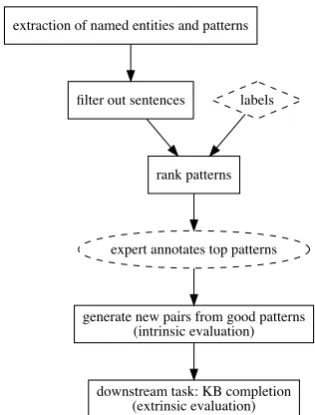
In this section, we will describe each step of our system, outlined in Figure1.
4.1 Data preparation
Extracting named entities and patterns The first step is performing named entity recognition (NER) on the sentences in the corpus to enable us to identify all the sentences which contain en-tity pairs of interest. Our experiments are focused on gene-therapeutic target pairs, however, the sys-tem is designed to be agnostic to different types of entities and relationships between them. We then extract the desired patterns from each of these sentences, as described in section3. For simplic-ity, we limited our experiments to sentences that contain exactly one gene-disease pair, however, extending the system to handle multiple pairs is straightforward.
We index each sentence in a database along with the lexicalisation for its pattern (e.g. the ‘simpli-fication’ forPATHorPATH BETWEEN ROOTS
extraction of named entities and patterns
filter out sentences
rank patterns labels
expert annotates top patterns
generate new pairs from good patterns (intrinsic evaluation)
[image:5.595.100.258.66.274.2]downstream task: KB completion (extrinsic evaluation)
Figure 1: System overview. Diamond box is present only in workflows with seed labels available (i.e. “no expert but labels” and “expert with labels”), elliptical box is only present in workflows involving an expert (i.e. “expert - no labels” and “expert with labels”) and rectangular boxes are always present.
and stored as a string) or ii) for all patterns that correspond to an entity pair.
Filtering out sentences with negation and hedg-ing. Since we are interested in inputs which un-ambiguously encode affirmations of facts about entities, we filter out any sentences which con-tain negation, speculation, or other forms of hedging. We adopt a conservative approach by excluding sentences which match specific instantiations of these pattern types: i) KEY
-WORDS (e.g. presence of terms such as “no”, “didn’t”, “doubt”, “speculate” etc. in the sen-tence); our list is modified from NegEx ( Chap-man et al.,2013),ii)SENTENCE ROOT ANDSEN
-TENCE ROOT DESCENDANTS(e.g. “study we
in-vestigated”, which makes no statement of results),
iii) PATH ROOT AND PATH ROOT DESCENDANTS
(e.g. “was used”, “was performed”), iv)
path between roots (e.g. “found associated”) This filtering is applied at all stages in our system where sentences are used.
4.2 Ranking patterns
Below we describe methods for ranking and se-lecting top patterns in the presence or absence of domain expertise or labelled training data.
Baseline workflow: “no expert - no labels” In this workflow, we simply extract new pairs using
simplifications (from the PATH pattern type, but other types are also described in our experiments) that have a high enough (>= 5) count of entity pairs.
Manual curation in the absence of any labelled training data: “expert - no labels” In this workflow, we have a domain expert (a biologist) available for manual curation but there is no la-belled training data. It is not possible for a domain expert to annotate all simplifications; this would be too time-consuming. In such cases, active learning can be helpful in deciding which simplifi-cations should be shown to the domain experts for manual curation to best improve the output of our system. The approach that we adopt here is sim-ple but the system could be extended with more sophisticated active learning strategies. We rank the simplifications by their count of entity pairs; by this we mean the number of unique pairs con-tained in the sentences in our corpus which corre-spond to a given simplification (similar to section
4.2). We then show the top ranked simplifications (i.e. those with the greatest pair count) to our do-main expert with a fixed number of random exam-ple sentences who then decides if a given simpli-fication is an appropriate heuristic to extract new entity pairs from the corpus, by selecting one of three options “Yes”, “No”, “Maybe”.
Automated workflow: “no expert but labels”
by the total number of positive and negative pairs respectively in our training data. For each simpli-ficationSwe define true positives (T PS) and false
positives (F PS) as the sets of correctly and
incor-rectly positive-labelled entity pairs respectively. Our variant of precision for a simplification S is then, precisionS = |T PS|/NP
|T PS|/NP+|F PS|/NN where NP andNN are the number of positive and
neg-ative pairs respectively in the training data. With this metric, if a simplification classifies 10% of the positive pairs as true positives and 10% of the neg-ative pairs as false positives then precisionS =
0.1
0.1+0.1 = 0.5. The metric utilises the
percent-age of each class instead of the absolute number of pairs, as would be the case for the standard pre-cision metric. The definition of recall for a given simplificationSis with respect to just the positive training data and is thus unaffected by an imbal-ance in the sizes.
Manual curation with labelled data: “expert with labels” For this workflow, both domain ex-perts and labelled training data are available to us. We improve on our methodology in the “expert -no labels” workflow by making use of the metrics discussed in the “no expert but labels” workflow which are calculated using the labelled training data. As we want to maximise the number and pre-cision of new pairs extracted, we keep only sim-plifications with recall and precision above certain respective thresholds and present them to domain experts ranked by pair count to ensure they see the most impactful simplifications first.
4.3 Generating new pairs
All previous stages aim at generating a list of good simplifications. We now have a collection of rules which can be used to extract new entity pairs from the corpus. Any simplification selected as useful implies that all entity pairs recovered from the cor-pus using this rule can be added as positive ex-amples to the dataset. With the selected simplifi-cations, we can batch-annotate thousands of sen-tences, and hence pairs, with minimal effort. We simply query our database for all new pairs which are found in a sentence expressing any of our se-lected simplifications.
Clustering simplifications We found that many simplifications can be very similar up to a few characters. We create clusters of quasi-identical simplifications, and use them i) to enforce
diver-sity in the selection of simplifications for the user to annotate, by picking only one simplification per cluster and, ii) to safely extend the selection of positive simplification to other simplification in the cluster. We create clusters of simplifications by detecting connected components in a graph where the nodes are the simplifications and the edges are between simplifications which are at a maximum Levenshtein distance of 2. This allows us to be in-variant to plural forms, upper/lower case, to short words like in/of etc. Note that some (not all) of these variations could be captured with a lemma-tiser. Example of a distance 2 cluster:
{GENE effects on DISEASE, GENE effect on DISEASE, GENE effects in DISEASE}
With a distance of 2, we typically increase the number of positive simplifications by 50%, which significantly increases the recall on new pairs.
5 Evaluation
We implement two evaluation frameworks. The first is an intrinsic evaluation of the quality of the new extracted pairs. The second is extrinsic; we consider how the inclusion of the new pairs dis-covered by our system affects the performance of a downstream knowledge base completion task.∗
5.1 Intrinsic evaluation
Pair-level Our aim in this subsection is to con-struct an intrinsic evaluation framework which can directly measure the quality of the discovered pairs. We do this by holding out a fraction of the gold standard positive pairs and the negative pairs (under the closed world assumption) to be used as a test set. The remaining fraction is used as train-ing data. We evaluate our system by measurtrain-ing its recall, specificity (true negative rate), precision, and F-score against this test set. In more detail, the new pairs discovered by our selected simplifi-cations are taken to be the positive pairs predicted by our system. The overlap between these new pairs and the positive test set are the true positives (T P) while the overlap with the negative test set are the false positives (F P). Recall and specificity take their standard definitions. Again, we consider a precision score which is normalised to correct
∗
for the imbalance in numbers between positive and negative pairs, precision = |T P|/NP
|T P|/NP+|F P|/NN,
whereNP andNN are the numbers of positive and negative pairs respectively present in the test set (as described in section4.2). We take the F-score to be the harmonic mean of this precision variant and recall.
Simplification-level For the manual workflows, we also consider the expert annotations while as-sessing the quality of the simplifications. We report M SP, the manual simplification preci-sion, based onNY es,NN o andNM aybe, the num-ber of simplifications that the expert has anno-tated as “Yes”, “No” and “Maybe”. M SP =
NY es
NY es+NN o+NM aybe. We expect MSP to be as high
as possible.
Extrinsic evaluation via knowledge base com-pletion The setup for our extrinsic evaluation framework is straightforward and intuitive. The initial gold standard set of positive pairs is split into training and test data. A graph completion model is then trained using the training data and evaluated to determine whether it can predict the existence of the pairs in the test data. To de-termine whether our knowledge base construction system can add value, we use the new pairs found from our system to augment the training data for the graph completion model, and observe whether this improves its performance against the test set. We use ComplEx (Trouillon et al., 2017), a well-established tensor factorisation model, as our knowledge base completion model. We provide standard information retrieval metrics to quantify the performance of the graph completion model. These are the precision, P(k), and recall, R(k), calculated for the topkpredictions along with the mean average precision (mAP). For gene-disease entity pairs, for example, mAP = N1
d
P
d
AveP,
where the sum is over the diseasesdwithNd
be-ing the total number of diseases, and AveP =
P
k
P(k) (R(k)−R(k−1))with P(k)andR(k)
as defined above.
6 Main experiments and results
6.1 Datasets
For all the following experiments, our data was drawn from the following datasets: DisGeNET (Pinero et al., 2016) and Comparative Toxicoge-nomics Database (CTD) (Davis et al.,2018). CTD
contains two relation types: ‘marker/mechanism’ and ‘therapeutic’. We use both the entire CTD dataset and the subset of therapeutic gene-disease pairs which we refer to as CTD therapeutic.
The datasets above are first restricted to human genes and then to the gene-disease pairs which ap-pear in our corpus of sentences; this corpus con-sists of sentences from PubMed articles which have been restricted, for simplicity, to sentences which contain just one gene-disease pair each. With these restrictions in effect, the CTD dataset has 8828 gene-disease pairs, CTD therapeutic has 169 pairs, and Disgenet has 33844 pairs.
6.2 Intrinsic evaluation results
In table1, we report the pair-level metrics (see sec-tion 5.1) for our three proposed workflows and a baseline (see section4). We also report the expert-based metricM SP (see section 5.1) for the two manual workflows. The CTD therapeutic dataset was the most suitable dataset for this evaluation becausei)it is very relevant to crucial domains of application such as drug discovery, andii)its small size makes it a good candidate for expansion. In each session, the expert annotated 200 simplifica-tions accompanied by 20 sentences. It took the expert about 3 hours to annotate the first session, which is a rapid way to generate thousands of new pairs from scratch.
We find that our three main proposed workflows (‘expert - with labels’, ‘expert - no labels’, and the fully automated ‘no expert but labels’) all discover a significant number of new gene-disease thera-peutic pairs. As confirmed by both pair-level and user-based metrics, incorporating the use of do-main expert’s time and the use of labelled data re-sults in higher precision at the expense of recall.
6.3 Extrinsic evaluation results
In table 2, we list the results of the downstream knowledge base completion task for the fully auto-mated workflow and the baseline. We compare the performance of our knowledge base completion model when trained with just the initial seed train-ing data versus the seed traintrain-ing data augmented with the new pairs discovered by our fully auto-mated workflow (and baseline workflow).
Selection method MSP New pairs Recall Specificity Precision F-score expert with labels 0.315 8875 0.286 0.976 0.923 0.436
[image:8.595.115.488.62.114.2]expert - no labels 0.265 9560 0.250 0.975 0.908 0.392 no expert but labels - 30006 0.679 0.920 0.894 0.772 no expert - no label (baseline) - 59913 0.774 0.842 0.830 0.801
Table 1: Intrinsic evaluation results for the main experiments on the CTD therapeutic dataset. This was carried out with a train/valid/test split of 0.4/0.1/0.5, and precision threshold of 0.6 for the ‘expert with labels’ and ‘no expert but labels’ workflows. MSP is our “manual simplification precision” metric. The precision and F-scores reported here are normalised as described in the section4.2.
level of recall. For the baseline workflow, mAP
is higher but with lower precision (for the top 100 and 1000 predictions respectively).
7 Top simplifications
In table 3, we show the simplifications with the highest count of Disease-Gene pairs in our whole corpus (after the sentence filtering), which have been annotated by the expert as “Yes” or “No”, for the CTD therapeutic dataset. While “Yes” and “No” patterns look similar, we can clearly see dif-ferences in language. The “No” annotations look unspecific while the “Yes” ones express the target has a therapeutic effect on the disease.
8 Further experiments
We performed several other experiments using our fully automated workflow to evaluate the quality of the new pairs discovered as we varied our ex-periment parameters.
We consider three dimensions of variation: varying the precision threshold for selecting sim-plifications, varying the size of the seed training set, and varying the expressiveness of the sim-plification (for example, by including the SEN
-TENCE ROOTor restricting to simplifications with at least a specified number of words).
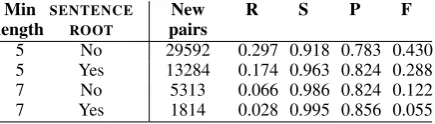
The intrinsic evaluation results for these exper-iments are listed in tables4,5, and6. In all cases, as we make our system more selective either by raising the precision threshold, by starting with fewer seeds pairs, or by restricting to more infor-mative simplifications, we unsurprisingly obtain higher precision at the expense of lower recall.
The extrinsic evaluation framework is less sen-sitive to these changes but improvements were ob-served (without any noticeable trend) for all these parameter changes.
9 Conclusions and further work
We have presented a simple and effective method for knowledge base construction when the desired relational data are scarce or absent. We have demonstrated its effectiveness viai)classification metrics on a held-out test set, ii)human evalua-tion andiii)performance on a downstream knowl-edge base completion task. We further show that in the presence of a small set of data, it is possi-ble to control the quality of the pairs discovered, by introducing stricter precision thresholds when ranking patterns. Our method could in principle be extended in order to: 1) handle higher-order (e.g. ternary) relations between tuples, as opposed to pairs (for instance using dependency subgraphs that connect more than two entities cooccurring in a sentence),2)discover explicit negative examples of a binary relation instead of simply positive ex-amples, 3)train sentence-level relation extraction systems, 4) collect and utilise continuous, rather than discrete annotations for each pattern (e.g. an-notators could indicate the percentage of correct example sentences that correspond to a pattern displayed) as part of a more sophisticated active learning strategy,5)extract patterns from a seman-tic representation (Banarescu et al.,2013) and, fi-nally, 6) map patterns to a vector space using a distributional representation (e.g. defined by their neighbouring words in sentences) and cluster them for an optimal balance between expressive power and coverage.
Acknowledgments
Selection method New pairs MAP Precision Recall seed dataset only - 0.0414 0.0179 / 0.0179 1.0 / 1.0 no expert but labels 30006 0.0545 0.0192 / 0.0192 1.0 / 1.0 no expert - no label (baseline) 59913 0.1885 0.01 / 0.0015 0.6019 / 0.9208
Table 2: Extrinsic evaluation results for the CTD therapeutic dataset. The experiment parameters are the same as those given in table1. Precision figures are given as ‘top 100 / top 1000’ and similarly for recall.
Pairs “Yes” simplif.
3345 role of GENE in DISEASE 839 GENE plays in DISEASE 648 GENE involved in DISEASE 321 GENE target in DISEASE 318 GENE target for DISEASE 289 GENE mice develop DISEASE 279 DISEASE caused by mutations in GENE 276 GENE gene for DISEASE 273 role of GENE in development of DISEASE 237 GENE promotes DISEASE
Pairs “No” simplif.
6629 GENE DISEASE 4110 DISEASE GENE 3350 GENE and DISEASE 2370 GENE in DISEASE 2333 DISEASE and GENE 1228 GENE DISEASE cells 904 DISEASE of GENE 879 DISEASE in GENE 638 DISEASE in GENE mice 572 role for GENE in DISEASE 528 GENE in DISEASE patients
Table 3: Top 10 simplifications for CTD Therapeutic annotated “Yes” (left) and “No” (right) by the expert.
[image:9.595.72.290.163.271.2]Dataset Thres. New pairs R S P F CTD 0.8 29592 0.297 0.918 0.783 0.430 CTD 0.4 50329 0.379 0.863 0.735 0.500 DG 0.8 17441 0.180 0.947 0.773 0.292 DG 0.4 45446 0.314 0.867 0.703 0.434
Table 4: Intrinsic evaluation results (Recall, Specificity, Precision and F-score) on CTD and DisGeNET (DG) as we vary the precision threshold for the ‘no expert but labels’ workflow. Experiments are done with a train/valid/test split of 0.8/0.1/0.1 and we restrict to simplifications with at least 5 words to ensure that they are reasonably expressive.
References
Eugene Agichtein and Luis Gravano. 2000. Snow-ball: Extracting relations from large plain-text col-lections. In Proceedings of the Fifth ACM Con-ference on Digital Libraries, DL ’00, pages 85–94, New York, NY, USA. ACM.
Enrique Alfonseca, Katja Filippova, Jean-Yves Delort, and Guillermo Garrido. 2012. Pattern learning for relation extraction with a hierarchical topic model. InProceedings of the 50th Annual Meeting of the As-sociation for Computational Linguistics: Short Pa-pers - Volume 2, ACL ’12, pages 54–59, Strouds-burg, PA, USA. Association for Computational Lin-guistics.
Gabor Angeli, Melvin Jose Johnson Premkumar, and Christopher D. Manning. 2015. Leveraging linguis-tic structure for open domain information extrac-tion. InACL (1), pages 344–354. The Association for Computer Linguistics.
Laura Banarescu, Claire Bonial, Shu Cai, Madalina Georgescu, Kira Griffitt, Ulf Hermjakob, Kevin Knight, Philipp Koehn, Martha Palmer, and Nathan Schneider. 2013. Abstract meaning representation
Train/val/test New pairs R S P F 0.8/0.1/0.1 29592 0.297 0.918 0.783 0.430 0.5/0.1/0.4 25539 0.274 0.930 0.798 0.408 0.2/0.1/0.7 18268 0.225 0.950 0.818 0.352
Table 5: Intrinsic evaluation results (Recall, Specificity, Precision and F-score) for CTD as we vary size of the seed training data for the ‘no expert but labels’ work-flow. Experiments are done with a precision threshold of 0.8 and we restrict to simplifications with at least 5 words to ensure that they are reasonably specific.
Min length
SENTENCE ROOT
New pairs
R S P F
5 No 29592 0.297 0.918 0.783 0.430 5 Yes 13284 0.174 0.963 0.824 0.288 7 No 5313 0.066 0.986 0.824 0.122 7 Yes 1814 0.028 0.995 0.856 0.055
Table 6: Intrinsic evaluation results (Recall, Specificity, Precision and F-score) for CTD as we vary simplifi-cation expressive power (minimum length) for the ‘no expert but labels’ workflow. Experiments are done with a train/valid/test split of 0.8/0.1/0.1 and a preci-sion threshold of 0.8.
for sembanking. InProceedings of the 7th Linguis-tic Annotation Workshop and Interoperability with Discourse, pages 178–186, Sofia, Bulgaria. Associ-ation for ComputAssoci-ational Linguistics.
Michele Banko, Michael J. Cafarella, Stephen Soder-land, Matt Broadhead, and Oren Etzioni. 2007.
Open information extraction from the web. In Pro-ceedings of the 20th International Joint Conference on Artifical Intelligence, IJCAI’07, pages 2670– 2676, San Francisco, CA, USA. Morgan Kaufmann Publishers Inc.
Sergey Brin. 1999. Extracting patterns and relations from the world wide web. InSelected Papers from the International Workshop on The World Wide Web
and Databases, WebDB ’98, pages 172–183,
Lon-don, UK, UK. Springer-Verlag.
WW Chapman, D Hillert, S Velupillai, M Kvist, M Skeppstedt, BE Chapman, M Conway, M Tharp, DL Mowery, and L. Deleger. 2013. Extending the negex lexicon for multiple languages. In Proceed-ings of the 14th World Congress on Medical & Health Informatics (MEDINFO).
[image:9.595.309.527.292.354.2]2018. The comparative toxicogenomics database: update 2019. Nucleic Acids Res.
Anthony Fader, Stephen Soderland, and Oren Etzioni. 2011.Identifying relations for open information ex-traction. InProceedings of the Conference on Em-pirical Methods in Natural Language Processing, EMNLP ’11, pages 1535–1545, Stroudsburg, PA, USA. Association for Computational Linguistics.
MA Greenwood and Mark Stevenson. 2006. Improv-ing semi-supervised acquisition of relation extrac-tion patterns. InProceedings of the Workshop on In-formation Extraction Beyond The Document, IEBe-yondDoc ’06, pages 29–35, Stroudsburg, PA, USA. Association for Computational Linguistics.
Yankai Lin, Zhiyuan Liu, Shiqi Shen, Huanbo Luan, and Maosong Sun. 2016. Neural relation extraction with selective attention over instances. In Proceed-ings of the 54th Annual Meeting of the Association for Computational Linguistics (Volume 1: Long Pa-pers), pages 2124–2133. Association for Computa-tional Linguistics.
Mausam, Michael Schmitz, Robert Bart, Stephen Soderland, and Oren Etzioni. 2012. Open language learning for information extraction. InProceedings of the 2012 Joint Conference on Empirical Methods in Natural Language Processing and Computational
Natural Language Learning, EMNLP-CoNLL ’12,
pages 523–534, Stroudsburg, PA, USA. Association for Computational Linguistics.
George Miller. 1995. Wordnet A lexical database for English. Communications of ACM, 38(11):39–41.
Thahir P Mohamed, Estevam R Hruschka Jr, and Tom M Mitchell. 2011. Discovering relations be-tween noun categories. InProceedings of the Con-ference on Empirical Methods in Natural Language Processing, pages 1447–1455. Association for Com-putational Linguistics.
Ndapandula Nakashole, Gerhard Weikum, and Fabian M. Suchanek. 2012. Discovering and explor-ing relations on the web.PVLDB, 5(12):1982–1985.
Bethany Percha and Russ B. Altman. 2018. A global network of biomedical relationships derived from text. Bioinformatics, 34(15):2614–2624.
Janet Pinero, Alex Bravo, Nuria Queralt-Rosinach, Alba Gutierrez-Sacristan, Jordi Deu-Pons, Emilio Centeno, Javier Garcia-Garcia, Ferran Sanz, and Laura I. Furlong. 2016. Disgenet: a comprehensive platform integrating information on human disease-associated genes and variants. Nucl. Acids Res.
Alexander Ratner, Christopher De Sa, Sen Wu, Daniel Selsam, and Christopher R´e. 2016. Data Program-ming: Creating Large Training Sets, Quickly.arXiv e-prints, page arXiv:1605.07723.
Theo Trouillon, Christopher R Dance, Johannes Welbl, Sebastian Riedel, Eric Gaussier, and Guillaume Bouchard. 2017. Knowledge graph completion via complex tensor factorization.JMLR.
Paroma Varma and Christopher R´e. 2018. Snuba: Au-tomating weak supervision to label training data.
Proc. VLDB Endow., 12(3):223–236.
P Verga, E Strubell, and A McCallum. 2018. Si-multaneously self-attending to all mentions for full-abstract biological relation extraction. In North American Chapter of the Association for Computa-tional Linguistics (NAACL).