4780
Detecting Subevents using Discourse and Narrative Features
Mohammed Aldawsari & Mark A. Finlayson School of Computing and Information Sciences
Florida International University Miami FL, 33199
{malda021,markaf}@fiu.edu
Abstract
Recognizing the internal structure of events is a challenging language processing task of great importance for text understanding. We present a supervised model for automatically identifying when one event is a subevent of an-other. Building on prior work, we introduce several novel features, in particular discourse and narrative features, that significantly im-prove upon prior state-of-the-art performance. Error analysis further demonstrates the utility of these features. We evaluate our model on the only two annotated corpora with event hi-erarchies: HiEve and the Intelligence Commu-nity corpus. No prior system has been evalu-ated on both corpora. Our model outperforms previous systems on both corpora, achieving 0.74 BLANCF1on the Intelligence Commu-nity corpus and 0.70F1on the HiEve corpus, respectively a 15 and 5 percentage point im-provement over previous models.
1 Introduction
An event is something that occurs in a certain place at a certain time (Pustejovsky et al.,2003). Understanding events plays a major role in various natural language processing tasks such as infor-mation extraction (Humphreys et al.,1997), ques-tion answering (Narayanan and Harabagiu,2004), textual entailment (Haghighi et al., 2005), event coreference (Choubey and Huang,2018) and con-tradiction detection (De Marneffe et al., 2008). There has been a significant amount of work on automatic processing of events in text including systems for events extraction, event coreference resolution, and temporal relation detection (Araki,
2018;Ning et al.,2017). However, events are not atomic entities: they often have complex inter-nal structure that can be expressed in a variety of ways (Huttunen et al.,2002;Bejan and Harabagiu,
2008;Hovy et al.,2013).
One of the unsolved problems related to event understanding is the detection of subevents, also referred to asevent hierarchy construction. As de-scribed by Glavaˇs and ˇSnajder (2014a), there have been efforts that have focused on detecting tem-poral and spatial subevent containment individu-ally. However, it is clear that subevent detection requires both simultaneously. The subevent rela-tionship is defined in terms of (e1,e2), where e1 ande2 are events: evente2 is a subevent of event
e1ife2is spatiotemporally contained bye1. More precisely, we say that an evente1is a parent event of event e2, and e2 is a child event of e1 if (1)
e1 is collector event that contains a complex se-quence of activities; (2) e2 is one of these activ-ities; and (3) e2 is spatially and temporally con-tained within e1 (i.e., e2 occur at the same time and same place ase1) (Hovy et al.,2013;Glavaˇs and ˇSnajder,2014b). This subevent relationship is independent of other types of relationships, e.g., causal relationship between the events. Example1
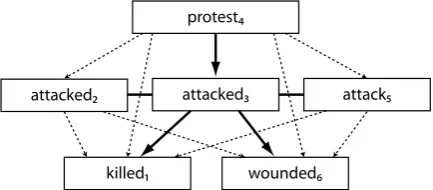
illustrates a text expression of a complex event hi-erarchy. Figure1shows a corresponding graphical representation of the hierarchy.
Egyptian police have said that five protesters werekilled1 when they were attacked2 by an armed group near the Defense Ministry building in Cairo. The statement said that early this morning, the armed group attacked3 the demon-strators who have for days been staging their protest4 against the military gov-ernment. . . . Police said that theattack5 on Wednesday wounded6 at least 50 protesters.
protest
attacked attacked attack
[image:2.595.73.290.64.159.2]killed wounded
Figure 1: The corresponding event hierarchy of exam-ple 1. Bolded arrows indicate subevent relationships and bolded lines indicate event coreference relation-ships, when they are explicitly indicated in the HiEve annotations. Dashed lines indicate implicit subevent re-lationship.
In Figure1, we see thatkilled1 andwounded6 are explicitly annotated as subevents ofattacked3, while that event in turn is a subevent ofprotest4. Events attacked2 and attack5 are explicitly in-dicated as coreferent with attacked3. These re-lationships induce the implicit subevent relations shown by dashed lines.
In this work we propose a pairwise model that leverages new discourse and narrative features to significantly improve subevent relation detection. evaluate our model on two corpora, namely, the HiEve corpus (Glavaˇs et al., 2014a) and the In-telligence Community (IC) corpus1 (Hovy et al.,
2013). We build on feature sets proposed in pre-vious work, but propose several important dis-course and narrative level features. We show that our model outperforms current systems on the subevent detection task by a significant margin. An error analysis reveals why these features are important and further details on why the subevent detection task is difficult.
We begin the paper by discussing prior work on subevent detection task (§2). Then we introduce our model and the feature set (§3). Following that, we describe the corpora (§4.1) we used and the ex-perimental setup (§4.2). We then present the eval-uation metrics and the performance of our model (§4.3) as well as compare our model performance to previous works (§5). To the end, we show an extensive error analysis (§6) and conclude with a list of contributions (§7).
2 Related Work
There are two pieces of prior work that are most related to our work. Araki et al. (2014)
pro-1The IC corpus is unfortunately not publically available;
we obtained a copy fromHovy et al.(2013).
posed a logistic regression model to classify pairs of events into four classes:coreference,subevent, sister, andno relation. They then used sister re-lations and their parents to improve the system performance. Their model was trained and tested on 65 articles from the IC corpus developed by (Hovy et al.,2013). Similarly,Glavaˇs and ˇSnajder
(2014b) used a logistic regression model to clas-sify pairs of event into three classes: subevent relations (SuperSub and SubSuper) and no rela-tion. They enforced structural coherence which improved the quality of the extracted event hier-archies by 7.6% F1score. They trained and tested their approach on the HiEve corpus developed by (Glavaˇs et al.,2014a). Both approaches were eval-uated using different evaluations metrics. Araki et al.evaluated their model using BLANC evalua-tion metric (Recasens and Hovy, 2011) whereas
Glavaˇs and ˇSnajder evaluated their model using the standardF1 evaluation metric. Both works in-troduced a variety of features. The main contribu-tion of our work is to note that the subevent detec-tion task requires a better understanding of the dis-course. Thus here we introduce several new fea-tures, including discourse structure and narrative structure. The error analysis (§6) demonstrates why these features are effective and also reveals more details on why subevent detection is difficult.
3 Features
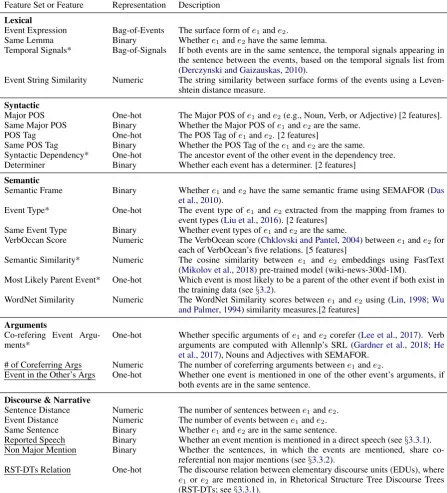
In this section, we explain the features used in our model. As discussed, both the HiEve and IC cor-pus (Hovy et al., 2013;Glavaˇs et al., 2014a) are annotated with both subevent and event corefer-ence relationships. We compute features over all pairs of events (e1, e2) where e1 precedes e2 in the text. Each pair of events is either related by a forward pointing parent-child relationship (PC), a backward pointing parent-child relationship (CP), or no relation (NoRel). Our features can be di-vided into five sets as shown in Table 1. In the following sections we first illustrate the features we directly obtained from prior work (§3.1); next we explain the features that were inspired by prior work but that we modified significantly (§3.2); and finally we introduce our new discourse and narra-tive features (§3.3).
3.1 Prior Features
Feature Set or Feature Representation Description
Lexical
Event Expression Bag-of-Events The surface form ofe1ande2.
Same Lemma Binary Whethere1ande2have the same lemma.
Temporal Signals* Bag-of-Signals If both events are in the same sentence, the temporal signals appearing in the sentence between the events, based on the temporal signals list from (Derczynski and Gaizauskas,2010).
Event String Similarity Numeric The string similarity between surface forms of the events using a Leven-shtein distance measure.
Syntactic
Major POS One-hot The Major POS ofe1ande2(e.g., Noun, Verb, or Adjective) [2 features]. Same Major POS Binary Whether the Major POS ofe1ande2are the same.
POS Tag One-hot The POS Tag ofe1ande2. [2 features]
Same POS Tag Binary Whether the POS Tag of thee1ande2are the same. Syntactic Dependency* One-hot The ancestor event of the other event in the dependency tree. Determiner Binary Whether each event has a determiner. [2 features]
Semantic
Semantic Frame Binary Whethere1ande2have the same semantic frame using SEMAFOR (Das et al.,2010).
Event Type* One-hot The event type ofe1 ande2 extracted from the mapping from frames to event types (Liu et al.,2016). [2 features]
Same Event Type Binary Whether event types ofe1ande2are the same.
VerbOccan Score Numeric The VerbOcean score (Chklovski and Pantel,2004) betweene1ande2for each of VerbOcean’s five relations. [5 features]
Semantic Similarity* Numeric The cosine similarity between e1 and e2 embeddings using FastText (Mikolov et al.,2018) pre-trained model (wiki-news-300d-1M).
Most Likely Parent Event* One-hot Which event is most likely to be a parent of the other event if both exist in the training data (see§3.2).
WordNet Similarity Numeric The WordNet Similarity scores betweene1ande2 using (Lin,1998;Wu and Palmer,1994) similarity measures.[2 features]
Arguments
Co-refering Event Argu-ments*
One-hot Whether specific arguments ofe1 ande2corefer (Lee et al.,2017). Verb arguments are computed with Allennlp’s SRL (Gardner et al., 2018;He et al.,2017), Nouns and Adjectives with SEMAFOR.
# of Coreferring Args Numeric The number of coreferring arguments betweene1ande2.
Event in the Other’s Args One-hot Whether one event is mentioned in one of the other event’s arguments, if both events are in the same sentence.
Discourse & Narrative
Sentence Distance Numeric The number of sentences betweene1ande2. Event Distance Numeric The number of events betweene1ande2. Same Sentence Binary Whethere1ande2are in the same sentence.
Reported Speech Binary Whether an event mention is mentioned in a direct speech (see§3.3.1). Non Major Mention Binary Whether the sentences, in which the events are mentioned, share
co-referential non major mentions (see§3.3.2).
RST-DTs Relation One-hot The discourse relation between elementary discourse units (EDUs), where
[image:3.595.74.522.66.560.2]e1 ore2 are mentioned in, in Rhetorical Structure Tree Discourse Trees (RST-DTs; see§3.3.1).
Table 1: Features used in the model. Novel features are underlined. Features modified from prior work are marked with an asterisk.
from prior work on subevent detection (Araki et al.,2014;Glavaˇs and ˇSnajder,2014b). We used spaCy (Honnibal and Montani) to compute lexical and syntactic features.
3.2 Modified Features
Five of our features were inspired by those in prior work, but we modified them for our system.
Temporal Signals We observed that if a sen-tence mentions two events from different event
hi-erarchies, then a temporal signal often exists be-tween them (e.g., after and since). This is il-lustrated by the first sentence in Example 6. To capture this we used a temporal signals list ( Der-czynski and Gaizauskas,2010) to find intervening temporal signal words between the events, and en-coded this as a bag of temporal signals.
the other. We expand that to checking for ancestry more generally. This is encoded as one-hot vector.
Event Type We use the mapping from frames to 33 ACE 2005 event types introduced in (Liu et al., 2016) to determine the event type of each event. Prior work relied on the IBM SIRE system to compute event types (Florian et al.,2010). This is encode as a one-hot vector.
Semantic Similarity We used the Fast-Text (Mikolov et al., 2018) pre-trained model (wiki-news-300d-1M) to measure the seman-tic similarity between pairs of events. Prior work used the SENNA system for this feature (Collobert et al.,2011). This is encoded as a numeric feature.
Most Likely Parent Event Similar to (Araki et al., 2014), we count the number of times in the training data that a particular event lemma and POS pair is observed as a parent of another event lemma/POS pair. For a pair(e1, e2), if the lemma and POS ofe1is more often found as a parent of
e2, this is encoded as the vector (1,0,0); if the op-posite is true, this is encoded as (0,1,0). If there were no observations, this is encoded as (0,0,1). Prior work did not take into account the part of speech, or the direction of the subevent relation-ship.
Co-referring Event ArgumentsWhen match-ing arguments, we allowed ARG0 to match ARG0 or ARG1 and vice versa, and we also examined LOC and TMP modifying arguments. This is en-coded as six-place binary vector for ARG0/ARG1, LOC, and TMP.
3.3 New Features
The new features are divided into three types: two discourse features (§3.3.1), one narrative feature (§3.3.2) and two semantic features (§3.3.3).
3.3.1 Discourse Features
We for the first time investigate the importance of discourse features for detecting subevents. We introduced two new features: rhetorical structure and reported speech.
Rhetorical Structure Rhetorical Structure Theory (RST) (Mann and Thompson, 1988) is a hierarchical model aims to identify the discourse structure of a text. The text is first segmented into Elementary Discourse Units (EDUs) which in turn are linked in binary or multi-way discourse relations (seeCarlson and Marcu,2001). Rhetor-ical analysis has been shown to be beneficial in many NLP tasks including sentiment analysis (
So-masundaran, 2010; Lazaridou et al., 2013; Bha-tia et al., 2015), text generation (Prasad et al.,
2005), information extraction (Maslennikov and Chua,2007), question answering (Verberne et al.,
2007) and coreference resolution (Cristea et al.,
1998; Joty et al., 2015). Therefore we hypoth-esized that discourse structure could be useful to the subevent detection task. We employ the CODRA discourse parser (COmplete probabilistic Discriminative framework for performing Rhetor-ical Analysis; Joty et al., 2015) to build a dis-course tree of each text. We use (Neumann,2015) for post-processing the CODRA output to build a graph representing the result. We then extract the rhetorical relation between event mentions us-ing the rhetorical relation between the EDUs in which the event are found. The feature is encoded as a one-hot vector covering all 16 main relation classes.
Consider Example2. When applied to this text, the discourse parser identifies the relation between raid3 andkilled4as anElaborationrelation. Fur-thermore, the parser also captures aTopic-Change relation between offensive6 and each of killed1,
wounded2,raid3,killed4, andinjured5.
Although the discourse parser is useful primar-ily for providing information about inter-sentential relationships between events, it can also give useful information about intra-sentential relation-ships. Consider Example3. For this text the dis-course parser finds the Background relation be-tween abduction1 and each of killed2 and
res-cued3.
Reported Speech We also observed that
One Palestinian waskilled1and at least four others were wounded2 in an Is-raeli airraid3 near the southern Gaza town of Rafah on Sunday, Palestinian security sources said. . . . Palestinian security sources said that one Pales-tinian bystander waskilled4and at least four others wereinjured5. . . . Israeli troops continued a massive ground and airoffensive6 in the Gaza Strip on Sun-day.
Example 2: Excerpt from IC corpus (Hovy et al.,
Mahsud, a former prisoner at Guan-tanamo Bay, is being hunted for the abduction1 of two Chinese engineers, which ended last Thursday when com-mandos killed2 five kidnappers and rescued3one Chinese.
Example 3: A sentence where intra-sentential dis-course relations are useful for discovering subevent re-lations.
subevents are often reported in direct and indi-rect speech. Diindi-rect speech is speech set off with quotes, while indirect speech is speech reported without quotes. We only considered direct speech in this work, primarily because it is easy to detect; however, subevents are also likely to be reported in indirect speech as can be seen in example 2
wherekilled4 andinjured5 (which are subevents ofraid3) are mentioned in indirect speech.
3.3.2 Narrative Feature: Non-Major Mentions
We also introduced what we are calling a narra-tive feature that we found informative in detect-ing subevent relations. This feature recognizes that other entities mentioned in a sentence be-sides those in the event arguments can be useful in subevent detection. This feature is narrative in the sense that it takes into account whether an en-tity is central to the story in the text.
In particular, we observed that many sentences which shared an event hierarchy also share some coreferring mentions beside events argument. De-spite this, certain entities are so central to the text that they are mentioned nearly everywhere and are thus no especially informative. Therefore we filter out thesemajor mentions and encode as a binary feature whether or not the sentences contain the events share a non-major mention.
The trick, of course, is defining what is a ma-jor mention. A simple and effective way of filter-ing out major mentions is to measure the distribu-tion of coreference chain lengths (normalized to the number of the corresponding article’s chains), and discard all chains with a length above a cer-tain threshold. This threshold can be tuned to the data. In our experiment we estimated the mean and standard deviation of the distribution of coref-erence chains in each text and filtered out chains that were longer than a single standard deviation above the mean. In Example 2, the threshold of the corresponding article is 2, thusPalestinian se-curity sources, which is mentioned only twice, is
The Al-Qaeda linked Army of Ansar al-Sunna claimed responsibility Tuesday for a car bomb attack1 which killed2 four Iraqi guardsmen . . .
Example 4: A sentence where one event appears in-side the argument for another event. Eventkilled2is a
subevent ofattack1.
not considered a major mention.
3.3.3 Semantic Features
Event in the Other’s Arguments We observed that if an event hierarchy is expressed within a sentence, one of the events is often mentioned as part of the other event’s arguments as can be seen in Example4, where theattack1event appears as ARG0 ofkilled2. Although this feature is related to theSyntactic Dependencyfeature, an event’s ar-guments are not always syntactically dependent on the event head, so it adds useful information.
Number of Coreferring Arguments We also include the number of coreferring event arguments as numeric feature.
4 Experiment
Here we describe the corpora on which the experi-ment were performed and the evaluation metrics used to measure the performance of our model. Then we compare the performance of our model with previous models, specifically those ofAraki et al.(2014) andGlavaˇs and ˇSnajder(2014b).
4.1 Corpora
iden-tity: fully identical, quasi-identical (a.k.a., par-tial co-reference) andfully independent(not iden-tical). Quasi-identity in turn appears in two ways: membershiporsubevent. Membership is defined as when an event is a set of multiple instances of the same type of event and the other event is one of the instances. In Example 5, attack1 and
operation2are members ofblows3, not subevents. In contrast, the HiEve corpus considers the mem-bership relation as a subevent relation. When training on the IC corpus we considered only the subevent relations, and ignore the membership re-lations.
The Al-Qaeda linked group which said it carried out the deadlyattack1 against US soldiers in the Iraqi city of Mo-sul accused the United States . . . The operation2is one of the heaviestblows3 in the city of Mosul . . .
Example 5: Illustration of the membership quasi-identity relationship ofHovy et al.(2013)
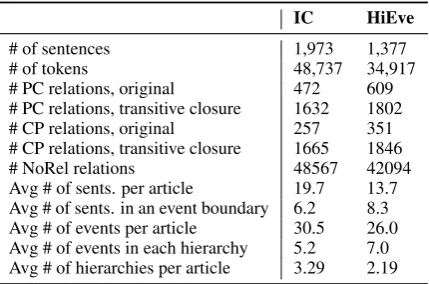
For both corpora we extend the annotations by computing the transitive closure of both co-reference and subevent relations according to the following rules, where e1, e2 and e3 are event mentions,≡indicates event coreference,e1 > e2 indicates e1 is a parent of e2 , and e1 < e2 in-dicates e1 is a child of e2. All of these rules are taken from the work byGlavaˇs et al.(2014a). We confirmed that this closure produces a consistent graph, and thus is insensitive to the order of com-putation of the closure. Table2shows the statistics of both corpora.
1. (e1≡e2)&(e2 ≡e3)⇒(e1 ≡e3) 2. (e1> e2)&(e2 > e3)⇒(e1 > e3) 3. (e1< e2)&(e2 < e3)⇒(e1 < e3) 4. (e1> e2)&(e2 ≡e3)⇒(e1 > e3) 5. (e1> e2)&(e1 ≡e3)⇒(e3 > e2) 6. (e1< e2)&(e2 ≡e3)⇒(e1 < e3) 7. (e1< e2)&(e1 ≡e3)⇒(e3 < e2)
4.2 Experimental Setup
We use Linear SVM classifier from scikit-learn package for classification over the gold annotated event mentions. Linear SVM can handle multi-class multi-classification using a one-vs-rest scheme (Pedregosa et al., 2011). Most of the parameters are default parameters 2, but to address the issue
2penalty=l2,C=0.01, random state=0,
max iter=1000, class weight=balanced, multi class=ovr.
IC HiEve
[image:6.595.310.525.62.204.2]# of sentences 1,973 1,377 # of tokens 48,737 34,917 # PC relations, original 472 609 # PC relations, transitive closure 1632 1802 # CP relations, original 257 351 # CP relations, transitive closure 1665 1846 # NoRel relations 48567 42094 Avg # of sents. per article 19.7 13.7 Avg # of sents. in an event boundary 6.2 8.3 Avg # of events per article 30.5 26.0 Avg # of events in each hierarchy 5.2 7.0 Avg # of hierarchies per article 3.29 2.19
Table 2: Statistics of IC and HiEve corpora.
of the data imbalance as shown in Table 3, we use the parameter class weight=balanced to assign a higher misclassification penalty on the minority class (PC and CP). We conducted 5-fold cross-validation for the experiment. Average fold statistics are shown in Table3.
4.3 Evaluation and Result
We use the same evaluation metrics used in pre-vious models. (Araki et al.,2014) evaluated their model using BLANC evaluation metric (Recasens and Hovy, 2011) whereas (Glavaˇs and ˇSnajder,
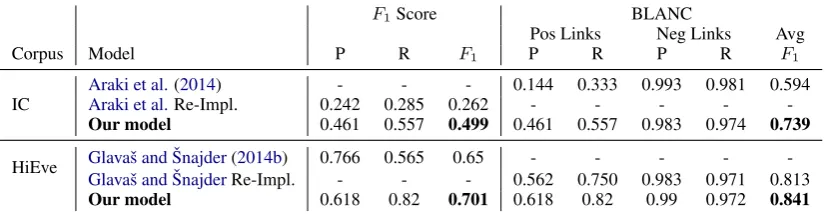
2014b) evaluated their model using the standard F1 evaluation metric. The results of the perfor-mance averaged across all five folds on the three classes (PC, CP and NoRel) are shown in Ta-ble 4 using both evaluation metrics on both cor-pora. Table5 shows the comparison between our model and previous models. Although it is not clear to us how Araki et al. handled the direc-tion of the subevent reladirec-tion, we take the average of our model classes (PC and CP) and compare it with the subevent class inAraki et al.’s work. For
IC corpus HiEve corpus Training Test Total Training Test Total
# articles 80 20 100 80 20 100 # PC (avg.) 1299.2 332.8 1632 1484 318 1802 # CP (avg.) 1317.8 347.2 1665 1456.4 389.6 1846 # NoRel (avg.) 39469 9098 48567 35621.2 6472.8 42094
Table 3: Average statistics of the folds. PC stands for parent-child relation. CP stands for child-parent relation. NoRel stands for no relation.
Evaluation Metrics
F1Score BLANC
Pos Links Neg Links Avg Corpus Relation P R F1 P R P R F1
HiEve
PC 0.576 0.807 0.67 0.661 0.832 0.989 0.973 0.857 CP 0.661 0.832 0.733 0.576 0.807 0.990 0.971 0.825 NoRel 0.98 0.945 0.962 0.980 0.945 0.625 0.830 0.836
IC
[image:7.595.152.446.63.134.2]PC 0.469 0.564 0.506 0.455 0.549 0.982 0.973 0.735 CP 0.454 0.550 0.492 0.468 0.564 0.983 0.975 0.743 NoRel 0.966 0.905 0.958 0.966 0.949 0.461 0.557 0.729
Table 4: Our model result on IC corpus (Hovy et al.,2013) and HiEve corpus (Glavaˇs et al.,2014a) using BLANC andF1standard evaluation metrics. PC stands for parent-child relation. CP stands for child-parent relation.
5 Discussion
As shown in Table 4, our model performs worse on the IC corpus than on HiEve. This is not sur-prising given the large difference in annotation agreement between IC and HiEve as well as the the removal of membership relations on IC cor-pus (see§4.1). Beside its lower annotation agree-ment, the IC corpus is also domain specific, with events only related to the intelligence community. This make general resources and tools (e.g., Ver-bOcean, WordNet) less effective.
We investigated the importance of each of the five feature sets (Table1) to our model by retrain-ing it while leavretrain-ing out one set at time. In order of importance they are (1) Syntactic, (2) Seman-tic, (3) Discourse & Narrative, (4) Lexical, and (5) Arguments. The importance of the syntactic fea-tures derived from the fact that children events are most often mentioned in the same sentence as their parent events. The three most important features among the Semantic features areMost Likely Par-ent EvPar-ent,Event Type, andSemantic Frame. For the Lexical feature set, theEvent Featureand Tem-poral Signalsare the most important.
6 Error Analysis
Inspection of the results revealed several types of errors, aside from the usual noise introduced by the various sub-components, such as the
dis-course parser or co-reference systems. We clus-ter the errors into three types: (1) an event pair that should be classified as PC but classified as CPand vice versa (about 28%); (2) an event pair is wrongly classified as NoRel (missed subevent relation; about 12%); (3) an event pair that is actu-ally NoRel is wrongly classified as subevent (PC or CP; about 60% of the errors).
Type 1: PC as CP or vice versaAbout a third of the model errors were this type. Most of the errors are a result of an incorrectEvent Type fea-ture. This feature plays a major role in capturing the direction of the subevent relation. For exam-ple, if an evente1 with event type Dieoccurs in the text before an evente2 with event typeAttack, then the direction of the relation is mostly child-parent relation. But if e2 occurs before e1, then the direction of the relation is mostlyparent-child. If the event type is unknown for one of the event mentions, then our model commonly usually fails to capture the direction.
F1Score BLANC
Pos Links Neg Links Avg
Corpus Model P R F1 P R P R F1
IC
Araki et al.(2014) - - - 0.144 0.333 0.993 0.981 0.594 Araki et al.Re-Impl. 0.242 0.285 0.262 - - - - -Our model 0.461 0.557 0.499 0.461 0.557 0.983 0.974 0.739
[image:8.595.93.506.64.171.2]HiEve Glavaˇs and ˇSnajder(2014b) 0.766 0.565 0.65 - - - - -Glavaˇs and ˇSnajderRe-Impl. - - - 0.562 0.750 0.983 0.971 0.813 Our model 0.618 0.82 0.701 0.618 0.82 0.99 0.972 0.841
Table 5: Our model performance compared to previous models (Araki et al.,2014;Glavaˇs and ˇSnajder,2014b). Each row represent the average of both classes parent-child (PC) and child-parent (CP). Because the prior systems both did not report both metrics, we approximated the metrics for those systems by reimplementing them.
found that when the distance is greater than 9 sen-tences and the number of events is greater than 14 events, the more likely the model would conduct this error. Subevents tend to be close to their par-ents in the text as shown in Table 2. Moreover, we observed that theNon-Major Mention(§3.3.2) andDiscourse Relationfeatures (§3.3.1), were less useful the larger the distance between the events.
Type 3: False Positive PC or CP Most of the errors were of this type. There were a vari-ety of causes, but the most common was when a sentence contained multiple event hierarchies. Consider Example 6where the sentence contains two different event hierarchies, namely, one hier-archy containingoffensive3 and another contain-ingabduction4.
Over 90 Palestinians and one Israeli soldier have been killed1 since Israel launched2 a massive air and ground offensive3 into the Gaza Strip on June 28, three days after the abduction4 of one Israeli soldier by Palestinian mili-tants in a cross-borderraid5.
Example 6: Excerpt from IC corpus (Hovy et al.,2013) showing a passage that results in an error of Type 3.
In this example, killed1 and launched2 are subevents ofoffensive3, whereasabduction4 is a subevent ofraid5. When processing this example the discourse parser failed to capture the discourse relation between offensive3 and abduction4 be-cause both events are in the same EDU. More-over, even though we introduced features such as temporal signals (after, since, etc.) to capture subevent relation between intra-sentential events, this error can still occur if the intra-sentential events are syntactically related (i.e., killed1 syn-tactically dominates abduction4, or there is a causal relation between events).
Based on this observation, we ran an experi-ment on the IC corpus to examine the impact on subevent detection of having two different events in the same sentence. We construct a subset of the IC corpus (58 articles) which excluded all articles that contain at least one sentence with two differ-ent evdiffer-ent hierarchy, and re-ran our main experi-ment. Under these conditions, the model perfor-mance increased by 6 and 4.6 pointsF1onPCand CP classes, respectively (because of the smaller set, we used 3 folds instead of 5). Returning to the original corpus, we observed that two different event hierarchies are mostly found in compound and complex sentences, and one of the them is usually background event. This observation in-dicates that splitting compound or complex sen-tences into two simple sensen-tences in advance might be useful in detecting subevents. Even though the discourse parser does this splitting automatically, this split is not currently propagated to the other features.
7 Contributions
We present a model to detect subevent relation in news articles which outperforms the two prior ap-proaches by 15 and 5 percentage points, respec-tively. Our model involves several novel discourse and narrative features, as well as a small number of feature modifications. Our error analysis indicates that having two event hierarchies in the same sen-tence is a major problem, as well as having signif-icant separation between a parent and child event.
Acknowledgments
by US National Science Foundation grant number IIS-1749917 to Dr. Finlayson. Both authors would like to thank Ed Hovy for providing the IC Corpus for our use.
References
Jun Araki. 2018. Extraction of Event Structures from Text. Ph.D. thesis, Carnegie Mellon University.
Jun Araki, Zhengzhong Liu, Eduard H Hovy, and Teruko Mitamura. 2014. Detecting subevent struc-ture for event coreference resolution. In Proceed-ings of the 9th International Conference on Lan-guage Resources and Evaluation (LREC), pages 4553–4558, Lisbon, Portugal.
Cosmin Adrian Bejan and Sanda M Harabagiu. 2008. A linguistic resource for discovering event structures and resolving event coreference. InProceedings of the 6th Language Resources and Evaluation Con-ference (LREC), pages 2881–2887, Marrakech, Mo-rocco.
Parminder Bhatia, Yangfeng Ji, and Jacob Eisenstein. 2015. Better document-level sentiment analysis from RST discourse parsing. InProceedings of the 2015 Conference on Empirical Methods in Natural Language Processing (EMNLP), pages 2212–2218, Lisbon, Portugal.
Lynn Carlson and Daniel Marcu. 2001. Discourse tag-ging reference manual. ISI Technical Report ISI-TR-545.
Timothy Chklovski and Patrick Pantel. 2004. VerbO-cean: Mining the web for fine-grained semantic verb relations. InProceedings of the 2004 Conference on Empirical Methods in Natural Language Processing (EMNLP), pages 33–40, Barcelona, Spain.
Prafulla Kumar Choubey and Ruihong Huang. 2018. Improving event coreference resolution by modeling correlations between event coreference chains and document topic structures. In Proceedings of the 56th Annual Meeting of the Association for Compu-tational Linguistics, Volume I, pages 485–495, Mel-bourne, Australia.
Ronan Collobert, Jason Weston, L´eon Bottou, Michael Karlen, Koray Kavukcuoglu, and Pavel Kuksa. 2011. Natural language processing (almost) from scratch. Journal of Machine Learning Research, 12:2493–2537.
Dan Cristea, Nancy Ide, and Laurent Romary. 1998. Veins theory: A model of global discourse cohesion and coherence. InProceedings of the 36th Annual Meeting of the Association for Computational Lin-guistics and 17th International Conference on Com-putational Linguistics (ACL-ICCL), pages 281–285, Montreal, Canada.
Dipanjan Das, Nathan Schneider, Desai Chen, and Noah A Smith. 2010. Probabilistic frame-semantic parsing. InProceedings of Human Language Tech-nologies: The 2010 Annual Conference of the North American Chapter of the Association for Compu-tational Linguistics (NAACL-HLT), pages 948–956, Los Angeles, CA.
Marie-Catherine De Marneffe, Anna N Rafferty, and Christopher D Manning. 2008. Finding contradic-tions in text. In Proceedings of the 46th Annual Meeting of the Association for Computational Lin-guistics: Human Language Technologies (ACL-08 HLT), pages 1039–1047, Columbus, OH.
Leon Derczynski and Robert Gaizauskas. 2010. USFD2: Annotating temporal expresions and tlinks for tempeval-2. In Proceedings of the 5th In-ternational Workshop on Semantic Evaluation (Se-mEval’10), pages 337–340, Los Angeles, CA.
Radu Florian, John F Pitrelli, Salim Roukos, and Imed Zitouni. 2010. Improving mention detection robust-ness to noisy input. InProceedings of the 2010 Con-ference on Empirical Methods in Natural Language Processing (EMNLP), pages 335–345, Cambridge, MA.
Matt Gardner, Joel Grus, Mark Neumann, Oyvind Tafjord, Pradeep Dasigi, Nelson Liu, Matthew Pe-ters, Michael Schmitz, and Luke Zettlemoyer. 2018. Allennlp: A deep semantic natural language pro-cessing platform. arXiv preprint arXiv:1803.07640.
Goran Glavaˇs and Jan ˇSnajder. 2014b. Constructing coherent event hierarchies from news stories. In
Proceedings of the Workshop on Graph-based Meth-ods for Natural Language Processing (TextGraphs-9), pages 34–38, Doha, Qatar.
Goran Glavaˇs, Jan ˇSnajder, Parisa Kordjamshidi, and Marie-Francine Moens. 2014a. Hieve: A corpus for extracting event hierarchies from news stories. In
Proceedings of 9th Language Resources and Evalu-ation Conference (LREC), pages 3678–3683.
Aria D Haghighi, Andrew Y Ng, and Christopher D Manning. 2005. Robust textual inference via graph matching. InProceedings of the Conference on Hu-man Language Technology and Empirical Methods in Natural Language Processing (HLT/EMNLP), pages 387–394, Vancouver, Canada.
Luheng He, Kenton Lee, Mike Lewis, and Luke Zettle-moyer. 2017. Deep semantic role labeling: What works and what’s next. InProceedings of the 55th Annual Meeting of the Association for Computa-tional Linguistics (ACL), Volume I, pages 473–483, Vancouver, Canada.
Eduard Hovy, Teruko Mitamura, Felisa Verdejo, Jun Araki, and Andrew Philpot. 2013. Events are not simple: Identity, non-identity, and quasi-identity. In
Proceedings of the Workshop on Events: Definition, Detection, Coreference, and Representation, pages 21–28, Atlanta, Georgia.
Kevin Humphreys, Robert Gaizauskas, and Saliha Az-zam. 1997. Event coreference for information ex-traction. InProceedings of a Workshop on Opera-tional Factors in Practical, Robust Anaphora Reso-lution for Unrestricted Texts, pages 75–81, Madrid, Spain.
Silja Huttunen, Roman Yangarber, and Ralph Grish-man. 2002. Complexity of event structure in ie sce-narios. In Proceedings of the 19th International Conference on Computational Linguistics (COL-ING), pages 1–7, Taipei, Taiwan.
Shafiq Joty, Giuseppe Carenini, and Raymond T Ng. 2015. Codra: A novel discriminative framework for rhetorical analysis. Computational Linguistics, 41(3):385–435.
Angeliki Lazaridou, Ivan Titov, and Caroline Sporleder. 2013. A Bayesian model for joint unsupervised induction of sentiment, aspect and discourse representations. In Proceedings of the 51st Annual Meeting of the Association for Computational Linguistics (ACL), Volume I, pages 1630–1639, Sofia, Bulgaria.
Kenton Lee, Luheng He, Mike Lewis, and Luke Zettle-moyer. 2017. End-to-end neural coreference reso-lution. InProceedings of the 2017 Conference on Empirical Methods in Natural Language Processing (EMNLP), pages 188–197, Copenhagen, Denmark.
Dekang Lin. 1998. An information-theoretic defini-tion of similarity. InProceedings of the 15th Inter-national Conference on Machine Learning (ICML), pages 296–304, San Francisco, CA.
Shulin Liu, Yubo Chen, Shizhu He, Kang Liu, and Jun Zhao. 2016. Leveraging framenet to improve automatic event detection. In Proceedings of the 54th Annual Meeting of the Association for Compu-tational Linguistics (ACL), Volume I, pages 2134– 2143, Berlin, Germany.
William C Mann and Sandra A Thompson. 1988. Rhetorical structure theory: Toward a functional the-ory of text organization. Text, 8(3):243–281.
Mstislav Maslennikov and Tat-Seng Chua. 2007. A multi-resolution framework for information extrac-tion from free text. InProceedings of the 45th An-nual Meeting of the Association of Computational Linguistics (ACL), pages 592–599, Prague, Czech Republic.
Tomas Mikolov, Edouard Grave, Piotr Bojanowski, and Armand Puhrsch, Christian andJoulin. 2018. Advances in pre-training distributed word repre-sentations. In Proceedings of the 11th Language
Resources and Evaluation Conference (LREC), Miyazaki, Japan.
Srini Narayanan and Sanda Harabagiu. 2004. Ques-tion answering based on semantic structures. In Pro-ceedings of the 20th International Conference on Computational Linguistics (COLING), pages 693– 701, Geneva, Switzerland.
Arne Neumann. 2015. discoursegraphs: A graph-based merging tool and converter for multilayer an-notated corpora. InProceedings of the 20th Nordic Conference of Computational Linguistics (NODAL-IDA 2015), pages 309–312, Vilnius, Lithuania.
Qiang Ning, Zhili Feng, and Dan Roth. 2017. A struc-tured learning approach to temporal relation extrac-tion. In Proceedings of the 2017 Conference on Empirical Methods in Natural Language Process-ing (EMNLP), pages 1027–1037, Copenhagen, Den-mark.
Fabian Pedregosa, Gael Varoquaux, Alexandre Gram-fort, Vincent Michel, Bertrand Thirion, Olivier Grisel, Mathieu Blondel, Peter Prettenhofer, Ron Weiss, Vincent Dubourg, Jake Vanderplas, Alexan-dre Passos, David Cournapeau, Matthieu Brucher, Matthieu Perrot, and Edouard Duchesnay. 2011. Scikit-learn: Machine learning in Python. Journal of Machine Learning Research, 12:2825–2830.
Rashmi Prasad, Aravind Joshi, Nikhil Dinesh, Alan Lee, Eleni Miltsakaki, and Bonnie Webber. 2005. The Penn Discourse TreeBank as a resource for nat-ural language generation. In Proceedings of the Corpus Linguistics Workshop on Using Corpora for Natural Language Generation, pages 25–32, Birm-ingham, UK.
James Pustejovsky, Jos´e M Castano, Robert Ingria, Roser Sauri, Robert J Gaizauskas, Andrea Set-zer, Graham Katz, and Dragomir R Radev. 2003. TimeML: Robust specification of event and tem-poral expressions in text. In Proceedings of the 2003 AAAI Spring Symposium on New Directions in Question Answering, pages 28–34. Stanford, CA.
Marta Recasens and Eduard Hovy. 2011. Blanc: Im-plementing the rand index for coreference evalua-tion. Natural Language Engineering, 17(4):485– 510.
Swapna Somasundaran. 2010. Discourse-level rela-tions for Opinion Analysis. Ph.D. thesis, University of Pittsburgh.
Naushad UzZaman and James Allen. 2011. Temporal evaluation. InProceedings of the 49th Annual Meet-ing of the Association for Computational LMeet-inguis- Linguis-tics: Human Language Technologies (ACL-HLT), pages 351–356, Portland, OR.
Conference on Research and Development in Infor-mation Retrieval (SIGIR), pages 735–736, Amster-dam, The Netherlands.