Proceedings of the 57th Annual Meeting of the Association for Computational Linguistics, pages 4124–4134
4124
Learning Transferable Feature Representations Using Neural Networks
Himanshu S. Bhatt∗
AI Labs, American Express Bengaluru, India
[email protected] Arun Rajkumar
IIT Madras Chennai, India
Shourya Roy∗
AI Labs, American Express Bengaluru, India
[email protected] Sriranjani Ramakrishnan
Conduent Labs Bengaluru, India
[email protected] Abstract
Learning representations such that the source and target distributions appear as similar as possible has benefited transfer learning tasks across several applications. Generally it re-quires labeled data from the source and only unlabeled data from the target to learn such representations. While these representations act like a bridge to transfer knowledge learned in the source to the target; they may lead to negative transfer when the source specific characteristics detract their ability to represent the target data. We present a novel neural network architecture to simultaneously learn atwo-part representation which is based on the principle of segregating source specific representation from the common representa-tion. The first part captures the source specific characteristics while the second part captures the truly common representation. Our archi-tecture optimizes an objective function which acts adversarial for the source specific part if it contributes towards the cross-domain learn-ing. We empirically show that two parts of the representation, in different arrangements, out-performs existing learning algorithms on the source learning as well as cross-domain tasks on multiple datasets.
1 Introduction
Unsupervised domain adaptation is a sub field of machine learning where one learns from annotated data in a source domain with the aim of perform-ing well on non-annotated data in a target domain. This attractive feature wherein the data, distribu-tions and tasks may vary across domains has led to the widespread use of domain adaptation algo-rithms in several real world applications. A typical domain adaptation algorithm is provided with an-notated source data and non-anan-notated target data
∗
[image:1.595.346.487.225.373.2]Research done while working for Xerox Research Cen-tre India.
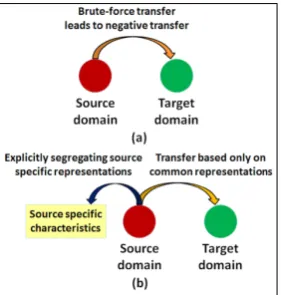
Figure 1: Illustrates the fundamental idea of learn-ing transferable feature representations behind the pro-posed technique.
and it learns a ‘common representation’ where the source and target data distributions look similar. In this common representation, a model trained on the source data is expected to perform well on the target data as well.
the primary objective is maximizing the target per-formance, a technique that simultaneously sus-tains the source performance will always be pre-ferred.
Our primary contribution is a novel neural net-work learning algorithm based on the principle of two-part hidden representation where individual parts can be disentangled or combined for learn-ing tasks in different domains. We highlight some of the salient features of our algorithm:
• A novel technique for learning a two-part rep-resentation between domains. One compris-ing source specific and the other compriscompris-ing common characteristics.
• The two-part representation behaves differ-ently for different learning objectives:
1. For the cross-domain task, explicitly learning the source specific representa-tion and keeping them separate from common representation enhances the performance in the target domain. 2. For the source learning task, the source
specific and common units come to-gether to sustain the source performance where the performance of most domain adaptation algorithms is compromised.
The proposed neural network architecture achieves this through an objective function which acts adversarial for a part of representation (source specific part) if it contributes to the cross-domain learning. Moreover, the proposed two-part repre-sentation learning approach also mitigates the pos-sible effects of “negative transfer”, as learning sep-arate source specific and common representations evades the influence of source specific character-istics on the common representation.
2 Related Work
The problem of domain adaptation has gained a lot of attention due to its huge practical implica-tions. Pan et al. (2010) focuses on learning a com-mon representation minimizing the divergence be-tween the source and target domains. Many body of work exists in literature including learning non-linear mappings (Daum´e III, 2009; Pan et al., 2011;Blitzer et al.,2007;Pan et al.,2010;Barnes et al.,2018), mappings to mitigate domain diver-gence (Pan et al., 2010), common features (Dai et al.,2007;Dhillon et al.,2003), ensemble based
approaches (Bhatt et al., 2015), subspace based methods (Gopalan et al.,2011;Gong et al.,2012; Harel and Mannor, 2010;Fernando et al., 2013) and neural networks based methods (Glorot et al., 2011;Chopra et al.,2013;Long and Wang,2015; Tzeng et al.,2014).
A variant of unsupervised models namely marginalized stacked denoising autoencoders (mSDA) (Chen et al., 2012a) learn robust repre-sentation to input corruption noise, which is stable across changes in domains, allowing cross-domain transfer. Existing literature exploits the princi-ple of representations generalizing across domains for classification, without labelled data from tar-get ((Sarma et al., 2018), (Bhatt et al., 2016)) and with labelled data from target ((Zhang et al., 2018)). Our work emphasizes on domain dis-crimination by incorporating domain divergence and source risk minimization into the objective for learning better transferable representation without any labelled data from target domain. Another line of work aims to achieve distribution consistency between the source and target domains with lin-ear data reconstruction such as co-regularization based augmented space (Kumar et al.,2010), cou-pled learning to link target-specific features to source features (Blitzer et al.,2011) and transfer of the source examples to the target and vice-versa (Zhou et al.,2016).
Domain adversarial neural networks (DANN) (Ajakan et al.,2014;Ganin et al., 2016), closely similar in philosophy to our work, learns a single representation by using an adversarial (Liu et al., 2017) gradient reversal component for domain di-vergence. In DANN, the entire hidden layer con-tributes unanimously towards the source classifi-cation and domain divergence objective. Unlike DANN, our approach segregates the hidden layer where the two components of hidden layer are treated differently for different objectives. Both the source specific and common parts contribute positively to the source classification objective. However, for the domain divergence objective, the common part contributes positively (i.e., tries to minimize divergence by maximizing the domain regressor’s loss); whereas, the source specific part contributes negatively (i.e., tries to maximize di-vergence by minimizing domain regressor’s loss)
cat-egory due to the similar method of measuring and minimizing the discrepancy between the feature distributions. The GAN model learns the repre-sentation in generative mode while our work is based on discriminative learning.
Domain separation networks (DSN) (Bousmalis et al., 2016) inspired from shared-space compo-nent analysis, explicitly and jointly models the domain-specific (private) and shared component domain representation. DSN is based on CNN and ours is a feed-forward network based on dis-criminating adversarial framework. The objective function of DSN has separate losses for difference, similarity, reconstruction and task-specific, while our approach follows min-max optimization crite-rion minimizing domain specific component loss and maximizing shared component loss.
Jiang & Zhai (2007) also proposed a two-stage approach for domain generalization and adapta-tion where first stage finds the generalizable fea-ture representation across domains and its appro-priate weights. The second stage picks up features useful for the target domain using semi-supervised learning. Their approach is a semi-supervised ap-proach which uses labelled data from source and target domains along with linear classifiers. How-ever, our framework is unsupervised (no labeled data from target) and leverages non-linear neural network classifier.
3 Problem Formulation
Let us consider a binary classification task where
X ⊆Rnis the input space andY ={0,1}is the label space. We have two different distributions overX × Y, called the source domainDsand the
target domainDt. We have labeled samples from
sourceS drawn i.i.d fromDsand unlabeled sam-ples from the targetT drawn i.i.d. fromDt.
S={(xsi, ysi)}m
i=1∼(Ds)m; T ={xti}mi=10 ∼(Dt)m 0
wheremandm0are the number of labeled source and unlabeled target samples. Let h(·) be the
D-dimensional hidden representation of the net-work which is further represented as h(·) =
hss(·)Lhc(·), wherehss(·), hc(·), Lrepresent
source specific, common representations and con-catenation respectively. The neural network is parametrized by{W,V, b.c}. Our objective is to learn two parts of the hidden layer such that the
source specific characteristicshss(·)do not detract
the ability of common representationhc(·)to
gen-eralize to the target task. Let W be the weight matrix between input and hidden units. W0 &
W00be the weight matrix between the input units to the common and source specific units respec-tively. Leto(·)&o0(·)be the domain regressor for the common and source specific representations parametrized by{u, d}&{u0, d0}respectively.
4 Proposed Neural Network Architecture
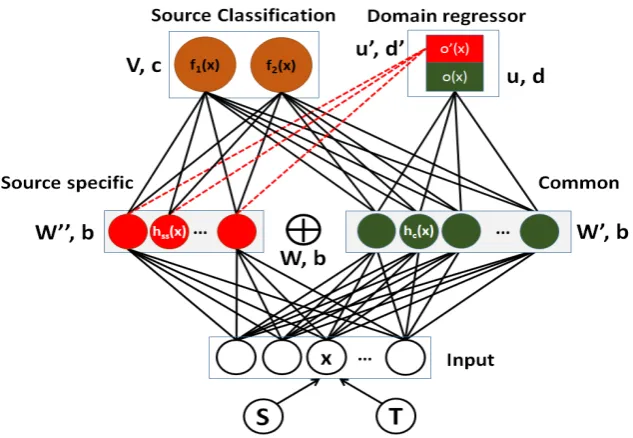
The proposed neural network is a fully connected architecture, as shown in Figure 2. The empha-sis of our work, in contrast to most of the pre-vious work, is not only on modeling the similar-ity between the domains but also on modeling the differences i.e., the domain specific information. We propose to achieve this by learning a two part hidden layer comprising the source specific part and the common part. The network tries to opti-mize two objectives - a classification objective and a domain divergence objective. The classification objective tries to minimize the mis-classifications in the labeled source data while the domain diver-gence objective attempts to learn a representation where both the source and target domain data ap-pears close to each other. In our network, both the source specific part and the common part con-tribute positively to the source classification ob-jective (i.e., minimize the mis-classification loss). However, for the domain divergence objective, the common part contributes positively (i.e., tries to minimize divergence) whereas the source spe-cific part contributes negatively (i.e., tries to max-imize divergence). Thus, the common representa-tion acquires domain independence and generaliz-able classification abilities while the source spe-cific representation remains domain-spespe-cific and highly discriminating for the in-domain classifica-tion task.
4.1 Learning in Source Domain
A neural network architecture with one hidden layer learns the function, h : X → RD, to map
the input to aD-dimensional representation:
h(x) =sigm(Wx+b),
where h(x) = hss(x)Lhc(x) and
sigm(a)h1+exp(1−a
i) i|a|
i=1 is parametrized by a matrix-vector pair (W, b) ∈ RD×n ×
Figure 2: Illustrates the architecture to simultaneously learn the common and source specific representations.
For source classification, our network follows a standard neural network architecture where the output functionf :RD →[0,1]Lis given as:
f(x) =sof tmax(Vh(x) +c)
Given source examplesS={(xsi, yis)}m
i=1and the classification loss as the negative log-probability of the correct label:
`(f(x), y) =log 1 fy(x)
Objective function for the source classification task becomes:
min
W,V,b,c
1
m m
X
i=1
`(f(xsi), ysi)
(1)
4.2 Domain Divergence
Theoretical results in transfer learning literature (Ben-David et al., 2010) show that adapting to a target domain from a source domain depends on a measure of similarity between the two. A for-mal measure used in this context is known asH -divergence. Intuitively, it is based on the capacity of a hypothesis classHto distinguish between ex-amples generated by a pair of source-target tasks.
Definition 1 Given feature distributions of two domains,Ds &Dt and a hypothesis classH, the
H-divergence betweenDsandDtis defined as:
dH(Ds,Dt) = 2 sup
η∈H
Pr
xs∼D s
[η(xs) = 1]
− Pr
xt∼D t
η(xt) = 1
We employ a result due to Ben-David et al. (2010) where they proved that for a symmetric hypothesis classH, one can compute an approximate empiri-calH-divergenceby running a learning algorithm on the problem of discriminating between source and target examples. For this, we construct a new dataset as:
{(xsi,1)}mi=1∪ {(xtj,0)}mj=10 .
where the target and source samples are labeled as0 and1respectively. Then, the error () of the classifier trained on the above dataset can be used as an approximation of H-divergence termed as
proxy− Adistance (PAD) and is given as:
ˆ
dA= 2(1−2)
Let the common representation for the source and target samples be hc(S){hc(xsi)}mi=1
and hc(T){hc(xti)}m 0
i=1 respectively. Let ˆ
dcH(hc(S), hc(T))be the empiricalH-divergence
on the common representation, given as:
ˆ
dcH(hc(S), hc(T)) =
2 1−min
η∈H
"
1
m m
X
i=1
I[η(hc(xsi)) = 1]
1
m0 m0
X
i=1
I[η(hc(xti)) = 0]
Algorithm 1 Learning Two-Part Hidden Representation for Neural Network
Input: SamplesS = {(xsi, yis)}mi=1andT = {xti}m
0
i=1,
hidden layer sizelwithnssource specific andnccommon
nodes, adaptation parameterλ, learning rateα. Output:neural network{W,V,b,c}.
Initialization:W, V←random init(l)
b, c, u, d, u0, d0←0
whilestopping criteria is not metdo forifrom1tom do
#Forward Propagation
h(xs
i)←σ(b+W xsi)
f(xsi)←sof tmax(c+V h(x
s i))
# whereh(xsi) =hc(xsi) +hss(xsi)
#Backpropagation
4c← −(e(yis)−f(x s i))
4V ← 4ch(xsi) >
4b←(V>4c)h(xsi)(1−h(xsi))
4w ← 4b·(xsi) >
# whereh(xs
i) =hc(xsi) +hss(xsi)
#Domain adaptation regularizer...
#...from current domain - common representation
o(xsi)←σ(d+u >
hc(xsi))
4d ← λ(1 − o(xsi)); 4u ← λ(1 −
o(xsi))hc(xsi)
tmp ← λ(1 −o(xsi))u hc(xsi) (1−
hc(xsi))
4b← 4b+tmp;4w0← 4w0+tmp·(xsi)> #...from current domain - source specific repre-sentation
o0(xs
i)←σ(d 0
+u0>hss(xsi))
4d0 ←λ(1−o0(xsi))
4u0 ←λ(1−o0(xsi))hss(xsi)
tmp ← λ(1−o0(xs
i))uhss(xsi)(1−
hss(xsi))
4b ← 4b+tmp;4w00 ← 4w00 +tmp· (xsi)
>
#...from other domain - common representation
j ⇐unif orm integer(1, ..., m0)
hc(xtj)⇐σ(b+W xtj)
o(xt
j)←σ(d+u >
hc(xtj))
4d ← 4d − λo(xtj);4u ← 4u −
λo(xt
j)hc(xtj)
tmp← −λo(xtj)uhc(xtj)(1−hc(xtj))
4b← 4b+tmp;4w0← 4w0+tmp·(xtj)> #...from other domain - source specific represen-tation
j ⇐unif orm integer(1, ..., m0)
hss(xtj)⇐σ(b+W xtj)
o0(xt
j)←σ(d 0
+u0>hss(xtj))
4d0← 4d0+λo0(xtj)
4u0← 4u0+λo0(xtj)hss(xtj)
tmp←λo0(xtj)u
0
hss(xtj)(1−hss(xtj))
4b ← 4b+tmp;4w00 ← 4w00 +tmp· (xt
j) >
#Update neural network parameters
W ←W −α4w;V ←V −α4v
W0←W0−α4w0;W00←W00−α4w00
b⇐b−α4b;c⇐c−α4c
#Update domain classifier parameters
u←u+α4u;d←d+α4d
u0←u0+α4u0;d0←d0+α4d0
end for end while
whereI[·]is the indicator function andη(·)is a hy-pothesis function fromH. To estimate the “min” part of the above equation, we use a logistic re-gression model that predicts the probability that a given input (using the common representation) is from the source domainDSx(denoted byz= 1) or the target domainDxT (denoted byz= 0):
p(z= 1|φ) =o(φ)sigm(d+uTφ)
whereφis eitherhc(xs) orhc(xt)ando(·) is the
domain (logistic) regressor on the common repre-sentation with loss function`d(·,·)defined as:
`d(o(·), z) =−zlog(o(·))−
(1−z) log(1−o(·)) (2)
Similarly, the divergence on the source specific representationdˆssH(hss(S), hss(T))is given as:
ˆ
dssH(hss(S), hss(T)) =
2 1−min
η∈H
"
1
m m
X
i=1
I[η(hss(xsi)) = 1]
1
m0 m0
X
i=1
I[η(hss(xti)) = 0]
#!
The “min” part of above equation is estimated us-ing the domain regressor for the source specific representation,o0(φ0)sigm(d0 +u0Tφ0), whereφ0
is eitherhss(xs)orhss(xt)and`d 0
(·,·)is its loss, defined similar to Eq.2.
4.3 The Learning Algorithm
min
W,V,b,c
1
m m
X
i=1
`(f(xsi), yis)+
λ max
W0,u,b,d
− 1
m m
X
i=1
`d(o(xsi),1)
− 1
m0 m0
X
i=1
`d(o(xti),0)
+
λ min
W00,u0,b,d0
− 1
m m
X
i=1
`d0(o0(xsi),1)
− 1
m0 m0
X
i=1
`d0(o0(xti),0)
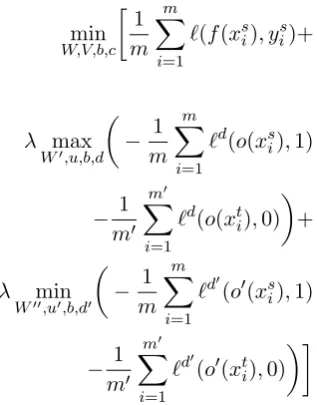
where the hyper-parameter λ > 0 is the domain adaptation regularization term that controls the trade-off between the source risk and the domain divergence terms. In other words, it controls how much weight mass is put on generalizable com-mon representation v/s the source specific repre-sentation.
The optimization problem involves minimiza-tion with respect to some parameters and max-imization with respect to the others. We use a stochastic gradient descent (SGD) approach which samples a pair of source and target examplexsi ,xti
and updates all the parameters of the neural net-work. The first term in the objective represents the source classification loss and updates for its asso-ciated parameters, i.e. {W,V,b,c}, follow the negative of the gradient to minimize this loss. The second term in the objective represents the loss of
[image:6.595.103.262.82.285.2]o(·)which is the domain regressor on the common representation. This term is maximized so as to diminish the ability of domain regressor to detect whether the sample belongs to the source or the target domain using the common representation. This makes both the domains look similar by min-imizing the divergence. Note, minmin-imizing the do-main divergence is equivalent to maximizing the loss of the domain regressor. Therefore, the asso-ciated parameters,{W0,u,d}, are updated in the direction of the gradient (since we maximize with respect to them, instead of minimizing). The last term in the objective represents the loss of o0(·) which is the domain regressor on the source spe-cific representation. We want the source spespe-cific representation to make the two domains appear largely distinct and hence, minimize the loss of
Table 1: Collections from the OSM dataset.
Target Description # Unlabelled # Labelled Col1 Mobile support 22645 5650
Col2 Obama Healthcare 36902 11050
Col3 Microsoft kinnect 20907 3258
Col4 X-box 36000 4580
its domain regressor. The updates for its associ-ated parameters,{W00,u0,d0}, follows the nega-tive of the gradient. The algorithm is detailed in Algorithm1wheree(y)represents a one-hot vec-tor, consisting of all0s except for a1at positiony
andrepresents the element-wise product.
5 Experimental Evaluation
The effectiveness of the proposed technique which learns source specific and common shared rep-resentations between domains is evaluated for a cross-domain sentiment classification task.
5.1 Datasets
The first dataset used in this research is the Ama-zon review dataset (Blitzer et al., 2007) which has four domains each comprising user reviews about Books (B), DVDs (D), Kitchen appliances (K) and Electronics (E) respectively. Each do-main has 2000 reviews in-total with equal num-ber of positive and negative reviews. Each review is encoded in 5000 dimensional feature vectors of unigrams/bigrams pre-processed to tf-idf vec-tors. The performance is compared on12different cross-domain classification tasks on the Amazon review dataset and is reported as the classification accuracy for binary classification. For each task, 1400labeled reviews from one domain constitute the source and1400unlabeled reviews from a dif-ferent domain constitute the target. Unseen non-overlapping200and400reviews from the target domain are used as the validation and test set.
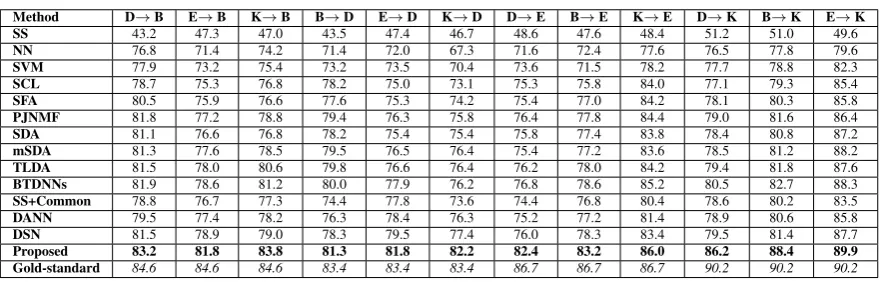
Table 2: Comparing the cross-domain performance of different approaches on the Amazon Review dataset. D→B represents the performance of an algorithm on unlabeled target domainBwithDas labeled source domain.
Method D→B E→B K→B B→D E→D K→D D→E B→E K→E D→K B→K E→K SS 43.2 47.3 47.0 43.5 47.4 46.7 48.6 47.6 48.4 51.2 51.0 49.6
NN 76.8 71.4 74.2 71.4 72.0 67.3 71.6 72.4 77.6 76.5 77.8 79.6
SVM 77.9 73.2 75.4 73.2 73.5 70.4 73.6 71.5 78.2 77.7 78.8 82.3
SCL 78.7 75.3 76.8 78.2 75.0 73.1 75.3 75.8 84.0 77.1 79.3 85.4
SFA 80.5 75.9 76.6 77.6 75.3 74.2 75.4 77.0 84.2 78.1 80.3 85.8
PJNMF 81.8 77.2 78.8 79.4 76.3 75.8 76.4 77.8 84.4 79.0 81.6 86.4
SDA 81.1 76.6 76.8 78.2 75.4 75.4 75.8 77.4 83.8 78.4 80.8 87.2
mSDA 81.3 77.6 78.5 79.5 76.5 76.4 75.4 77.2 83.6 78.5 81.2 88.2
TLDA 81.5 78.0 80.6 79.8 76.6 76.4 76.2 78.0 84.2 79.4 81.8 87.6
BTDNNs 81.9 78.6 81.2 80.0 77.9 76.2 76.8 78.6 85.2 80.5 82.7 88.3
SS+Common 78.8 76.7 77.3 74.4 77.8 73.6 74.4 76.8 80.4 78.6 80.2 83.5
DANN 79.5 77.4 78.2 76.3 78.4 76.3 75.2 77.2 81.4 78.9 80.6 85.8
DSN 81.5 78.9 79.0 78.3 79.5 77.4 76.0 78.3 83.4 79.5 81.4 87.7
[image:7.595.76.526.268.409.2]Proposed 83.2 81.8 83.8 81.3 81.8 82.2 82.4 83.2 86.0 86.2 88.4 89.9 Gold-standard 84.6 84.6 84.6 83.4 83.4 83.4 86.7 86.7 86.7 90.2 90.2 90.2
Table 3: Comparing the cross-domain performance of different approaches on the OSM dataset.
Method Col2→1 Col3→1 Col4→1 Col1→2 Col3→2 Col4→2 Col1→3 Col2→3 Col4→3 Col1→4 Col2→4 Col3→4 SS 35.0 39.4 35.6 32.8 40.2 38.6 40.7 41.9 42.5 45.0 44.9 42.4
NN 66.4 65.2 68.3 65.8 66.8 63.8 65.2 67.2 68.2 67.3 67.2 68.1
SVM 67.1 63.2 64.3 62.6 64.3 60.4 62.8 63.2 65.8 68.2 69.3 72.4
SCL 68.2 67.5 67.2 67.1 67.3 64.1 64.5 65.3 72.1 68.8 70.1 73.6
SFA 71.3 67.6 67.8 69.1 70.2 67.8 68.2 68.4 74.2 69.5 72.3 76.3
PJNMF 72.0 67.2 68.3 70.4 70.5 68.4 69.3 69.1 74.8 70.0 72.5 74.8
SDA 71.5 66.3 67.6 68.2 69.3 70.2 67.6 68.3 68.7 72.4 69.3 72.6
mSDA 72.1 67.5 68.2 69.0 70.4 70.8 68.3 69.1 69.2 73.0 70.2 73.1
TLDA 72.4 67.8 68.6 69.7 71.1 71.5 68.8 69.8 70.0 73.8 70.7 73.8
BTDNNs 73.1 68.3 69.0 70.2 71.6 72.1 69.4 70.2 70.6 74.2 71.3 74.2
SS+Common 68.7 67.9 67.7 67.5 67.8 64.9 65.0 65.7 72.6 69.4 70.7 74.2
DANN 69.6 69.5 69.8 70.0 68.7 66.2 66.3 66.6 73.4 70.6 71.4 75.7
DSN 72.9 68.6 69.4 70.5 72.0 72.2 69.5 70.3 70.8 74.3 71.5 74.6
Proposed 77.6 74.5 75.5 76.2 77.8 78.2 75.2 75.7 76.1 80.1 77.9 80.9 Gold-standard 78.2 78.2 78.2 79.1 79.1 79.1 81.0 81.0 81.0 81.4 81.4 81.4
comments for which the actual labels are avail-able; however, label information is used only as ground truth to report the performance. The com-ments were pre-processed by converting it to low-ercase followed by stemming. Further, feature se-lection was based on document frequency (DF = 5) which reduces the number of features as well as speed up the learning task.
5.2 Experimental Protocol
Performance of proposed architecture is compared with standard neural network architecture with one hidden layer (“NN”) (as described in Eq. 1) and a support vector machine (“SVM”) ( Chih-Wei Hsu and Lin,2003) with linear kernel where the training is performed on labelled source do-main and performance is reported on the target domain. “Gold-standard” refers to target domain supervised performance of the SVM. The perfor-mance is further compared with popular shared representation learning approaches for domain adaptation including Structural Correspondance Learning (“SCL”) (Blitzer et al., 2006),(Blitzer et al.,2007), Spectral Feature Alignment (“SFA”) (Pan et al., 2010) and “PJNMF” (Zhou et al.,
2015).
We also compared the performance with “DANN” (Ajakan et al., 2014), stacked De-noising Auto-encoders (“SDA”) (Glorot et al., 2011), and marginalized SDA (“mSDA”) (Chen et al., 2012b) and transfer learning with deep auto-encoders (“TLDA”) (Pan et al., 2008) , “BTDNNs” (Zhou et al.,2016) and “DSN” ( Bous-malis et al., 2016) which are some of the popu-lar approaches in cross-domain sentiment analy-sis. The performance is also compared with dif-ferent components of the learned representations i.e. source specific (“SS”), common (“Proposed”), and “SS+common” representations. For SDA, mSDA, TLDA, BTDNNs, SS, SS+common and the proposed, a standard SVM is trained on the learned representation and is applied to predict the sentiment labels for target data.
5.3 Results and Analysis
Results in Table 2 show the efficacy of the pro-posed neural network architecture for learning common shared representation while limiting the source specific representation from negatively ef-fecting their generalizable capabilities in the target domain. Results suggest that the learned common representation, referred to as “Proposed”, consis-tently outperforms other existing algorithms for all cross-domain sentiment analysis task on the Amazon review dataset (Blitzer et al.,2007). The source specific (SS) representation performs con-sistently poor at the all target tasks as they are trained to emphasize only on the source task. Re-sults also suggest that combining source specific representation with the common representation, referred to as “SS+Common” leads to a lower per-formance than the common representation alone. This validates our assertion that combining source specific characteristics with common representa-tion negatively effects the generalizarepresenta-tion capabil-ities of the common representation in the target domain. The proposed method also surpasses BTDNNs (state-of-the-art) which focuses on the feasibility of transfer between domains with a linear data reconstruction for distribution consis-tency. Contrary to the proposed two-part repre-sentations, it suggests that enforcing distribution consistency across all hidden units suppresses the discriminating information which results in lower classification performance for BTDNNs. The pro-posed approach even outperforms deep learning based methods (SDA, mSDA and TLDA) as these approaches learn the unified domain-invariable feature representation by combining the source domain and target domain data which may not separate out the domain-specific features from the commonality of domains. On the contrary, the ob-jective used in the paper is based on the min-max optimization criterion that minimizes the domain specific component loss as well as maximizes the shared component loss. In other words, the pro-posed approach not only models the similarity be-tween domains but also models and mitigates the source domain specific information, thus leading to better cross-domain performance.
[image:8.595.329.500.61.368.2]Results in Table 3compare the performance of all algorithms on the OSM dataset. We observe that the overall performance of all the algorithms is lower on the OSM dataset, as compared to the first dataset, as it is more challenging due to short
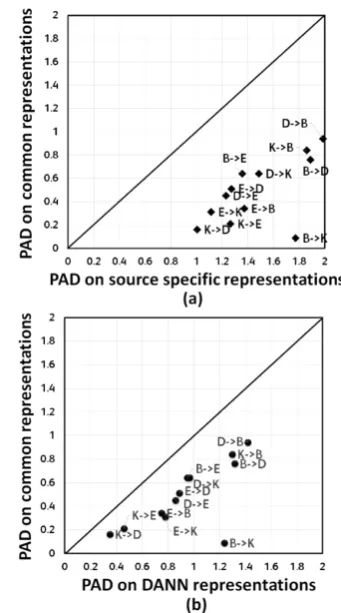
Figure 3: Compares theproxy− Adistances (PAD) computed on the common representations learned us-ing the proposed technique v/s the (a) source specific and (b) representations learned using DANN.
and noisy text. Both Tables 2 & 3 demonstrate that the domain adaptation methods perform better than the baselines and “SS” representation which suggests that transferring knowledge across do-mains benefits the cross-domain sentiment clas-sification task. The improvements achieved by the proposed technique, which reaches closest to the target domain supervised performance “Gold-standard”, is consistently better than the existing algorithms as it explicitly keeps away any source specific components from the learned common representation so as to yield the best generaliza-tion on the target domain.
5.3.1 The Common Representation:
il-Figure 4: Compares the performance on the source classification task. For example, B→D here represent the performance of an algorithm on the source domain B when the representations are learned with B as labeled source andDas unlabeled target domain.
lustrates that the learned common representation leads to a lower PAD when compared with either the source specific representation or the represen-tation learned using DANN. A low PAD between domains for a given representation signifies that the divergence between the domains is reduced.
5.3.2 The Source Specific Representation:
We evaluate the performance of different parts of the learned representation on the source domain. Optimizing the target domain performance is in-deed the primary objective for domain adapta-tion; however, existing domain adaptation algo-rithms generally exhibit a lower performance on the source. We empirically demonstrate that the proposed method for learning source specific and common parts of the hidden layer sustains a higher level of performance in the source as well.
Results in Figure 4 compares the performance of the different representations on the source do-main. We compare the performance of the source specific representation and the common represen-tation learned using the proposed approach with the representation learned using DANN (Ajakan et al.,2014) and the skyline source domain perfor-mance. Results suggest that while the two individ-ual parts of the learned representation yield lower source domain performance, the combined source specific and common representation (“combined”) outperforms the source domain performance of the representation learned using DANN. This signi-fies that the two parts of the learned representation learn complementary characteristics i.e. source specific and general.
5.3.3 Source Specific & Common Units:
While learning the two part representation with our neural network architecture, the number of source specific and common units in the hidden layer is an important factor to influence the
cross-domain performance. In our experiments, we ob-served that when the source and target domains were similar (as measured by the PAD), hidden layer with a higher portion of common v/s source specific units resulted in better cross-domain per-formance as compared to when the source and target domains were dissimilar. This intuitively suggests that for similar domains there are more commonalities than domain specific characteris-tics and hence, a higher number of common units is required to capture this commonality. Similarly, we observed that for not so similar domains, the source specific units dominate the number of com-mon units.
6 Conclusion & Future Work
[image:9.595.85.515.63.160.2]References
Hana Ajakan, Pascal Germain, Hugo Larochelle, Franc¸ois Laviolette, and Mario Marchand. 2014. Domain-adversarial neural networks. arXiv preprint arXiv:1412.4446.
Jeremy Barnes, Roman Klinger, and Sabine Schulte im Walde. 2018. Projecting embeddings for domain adaption: Joint modeling of sentiment analysis in diverse domains. InProceedings of the 27th Inter-national Conference on Computational Linguistics, pages 818–830. Association for Computational Lin-guistics.
Shai Ben-David, John Blitzer, Koby Crammer, Alex Kulesza, Fernando Pereira, and Jennifer Wortman Vaughan. 2010. A theory of learning from different domains. Machine learning, 79(1-2):151–175.
Himanshu Sharad Bhatt, Arun Rajkumar, and Shourya Roy. 2016. Multi-source iterative adaptation for cross-domain classification. In In Proceedings of International Joint Conference on Artificial Intelli-gence.
Himanshu Sharad Bhatt, Deepali Semwal, and Shourya Roy. 2015. An iterative similarity based adapta-tion technique for cross-domain text classificaadapta-tion. InProceedings of Conference on Natural Language Learning, pages 52–61.
J. Blitzer, R. McDonald, and F. Pereira. 2006. Domain adaptation with structural correspondence learning. InProceedings of Conference on Empirical Methods in Natural Language Processing, pages 120–128.
John Blitzer, Mark Dredze, and Fernando Pereira. 2007. Biographies, bollywood, boom-boxes and blenders: Domain adaptation for sentiment classi-fication. InProceedings of Association for Compu-tational Linguistics, pages 440–447.
John Blitzer, Sham Kakade, and Dean Foster. 2011. Domain adaptation with coupled subspaces. In Pro-ceedings of the Fourteenth International Conference on Artificial Intelligence and Statistics, volume 15 of
Proceedings of Machine Learning Research, pages 173–181, Fort Lauderdale, FL, USA. PMLR.
Konstantinos Bousmalis, George Trigeorgis, Nathan Silberman, Dilip Krishnan, and Dumitru Erhan. 2016. Domain separation networks. arXiv preprint arXiv:1608.06019.
Minmin Chen, Zhixiang Xu, Kilian Weinberger, and Fei Sha. 2012a. Marginalized denoising autoen-coders for domain adaptation.
Minmin Chen, Zhixiang Xu, Kilian Q. Weinberger, and Fei Sha. 2012b. Marginalized denoising au-toencoders for domain adaptation. InProceedings of the 29th International Coference on International Conference on Machine Learning, ICML’12, pages 1627–1634, USA. Omnipress.
Chih-Chung Chang Chih-Wei Hsu and Chih-Jen Lin. 2003. A practical guide to support vector classifi-cation. Technical report, Department of Computer Science, National Taiwan University.
S Chopra, S Balakrishnan, and R Gopalan. 2013. Dlid: Deep learning for domain adaptation by interpolat-ing between domains. ICML Workshop on Chal-lenges in Representation Learning.
Wenyuan Dai, Gui-Rong Xue, Qiang Yang, and Yong Yu. 2007. Co-clustering based classification for out-of-domain documents. InProceedings of Inter-national Conference on Knowledge Discovery and Data Mining, pages 210–219.
Hal Daum´e III. 2009. Frustratingly easy domain adap-tation.arXiv preprint arXiv:0907.1815.
I. S. Dhillon, S. Mallela, and D. S Modha. 2003. Information-theoretic co-clustering. InProceedings of International Conference on Knowledge Discov-ery and Data Mining, pages 89–98.
Basura Fernando, Amaury Habrard, Marc Sebban, and Tinne Tuytelaars. 2013. Unsupervised visual do-main adaptation using subspace alignment. In Pro-ceedings of the IEEE International Conference on Computer Vision, pages 2960–2967.
Yaroslav Ganin, Evgeniya Ustinova, Hana Ajakan, Pascal Germain, Hugo Larochelle, Franc¸ois Lavi-olette, Mario Marchand, and Victor Lempitsky. 2016. Domain-adversarial training of neural net-works. Journal of Machine Learning Research, 17(59):1–35.
Xavier Glorot, Antoine Bordes, and Yoshua Bengio. 2011. Domain adaptation for large-scale sentiment classification: A deep learning approach. InIn Pro-ceedings of the International Conference on Ma-chine Learning.
Boqing Gong, Yuan Shi, Fei Sha, and Kristen Grau-man. 2012. Geodesic flow kernel for unsupervised domain adaptation. In Computer Vision and Pat-tern Recognition (CVPR), 2012 IEEE Conference on, pages 2066–2073. IEEE.
Ian Goodfellow, Jean Pouget-Abadie, Mehdi Mirza, Bing Xu, David Warde-Farley, Sherjil Ozair, Aaron Courville, and Yoshua Bengio. 2014. Generative ad-versarial nets. In Advances in neural information processing systems, pages 2672–2680.
Raghuraman Gopalan, Ruonan Li, and Rama Chel-lappa. 2011. Domain adaptation for object recog-nition: An unsupervised approach. In 2011 inter-national conference on computer vision, pages 999– 1006. IEEE.
Jing Jiang and ChengXiang Zhai. 2007. A two-stage approach to domain adaptation for statistical classi-fiers. InProceedings of the sixteenth ACM confer-ence on Conferconfer-ence on information and knowledge management, pages 401–410. ACM.
Abhishek Kumar, Avishek Saha, and Hal Daume. 2010. Co-regularization based semi-supervised do-main adaptation. In J. D. Lafferty, C. K. I. Williams, J. Shawe-Taylor, R. S. Zemel, and A. Culotta, ed-itors, Advances in Neural Information Processing Systems 23, pages 478–486. Curran Associates, Inc.
Pengfei Liu, Xipeng Qiu, and Xuanjing Huang. 2017. Adversarial multi-task learning for text classifica-tion. InProceedings of the 55th Annual Meeting of the Association for Computational Linguistics, ACL 2017, Vancouver, Canada, July 30 - August 4, Vol-ume 1: Long Papers, pages 1–10.
Mingsheng Long and Jianmin Wang. 2015. Learning transferable features with deep adaptation networks.
arXiv preprint arXiv:1502.02791.
S. J. Pan and Q. Yang. 2010. A survey on trans-fer learning. IEEE Transactions on Knowledge and Data Engineering, 22(10):1345–1359.
Sinno Jialin Pan, , Ivor W. Tsang, James T. Kwok, and Qiang Yang. 2011. Domain adaptation via transfer component analysis. IEEE Transactions on Neural Networks, 22(2):199–210.
Sinno Jialin Pan, James T Kwok, and Qiang Yang. 2008. Transfer learning via dimensionality reduc-tion. InAAAI, volume 8, pages 677–682.
Sinno Jialin Pan, Xiaochuan Ni, Jian-Tao Sun, Qiang Yang, and Zheng Chen. 2010. Cross-domain senti-ment classification via spectral feature alignsenti-ment. In
Proceedings of International Conference on World Wide Web, pages 751–760.
Prathusha K. Sarma, Yingyu Liang, and William A. Sethares. 2018. Domain adapted word embed-dings for improved sentiment classification. CoRR, abs/1805.04576.
Eric Tzeng, Judy Hoffman, Ning Zhang, Kate Saenko, and Trevor Darrell. 2014. Deep domain confusion: Maximizing for domain invariance. arXiv preprint arXiv:1412.3474.
Qi Zhang, Xuanjing Huang, Minlong Peng, and Yu-Gang Jiang. 2018. Cross-domain sentiment classi-fication with target domain specific information. In
Proceedings of the 56th Annual Meeting of the As-sociation for Computational Linguistics, ACL 2018, Melbourne, Australia, July 15-20, 2018, Volume 1: Long Papers, pages 2505–2513.
Guangyou Zhou, Tingting He, Wensheng Wu, and Xi-aohua Tony Hu. 2015. Linking heterogeneous input features with pivots for domain adaptation. In Pro-ceedings of the Twenty-Fourth International Joint Conference on Artificial Intelligence, IJCAI 2015,
Buenos Aires, Argentina, July 25-31, 2015, pages 1419–1425.