Proceedings of the 55th Annual Meeting of the Association for Computational Linguistics (Short Papers), pages 72–78 Vancouver, Canada, July 30 - August 4, 2017. c2017 Association for Computational Linguistics
Proceedings of the 55th Annual Meeting of the Association for Computational Linguistics (Short Papers), pages 72–78 Vancouver, Canada, July 30 - August 4, 2017. c2017 Association for Computational Linguistics
Learning to Parse and Translate Improves Neural Machine Translation
Akiko Eriguchi†,Yoshimasa Tsuruoka†, and Kyunghyun Cho‡ †The University of Tokyo, 7-3-1 Hongo, Bunkyo-ku, Tokyo, Japan
{eriguchi, tsuruoka}@logos.t.u-tokyo.ac.jp
‡New York University, New York, NY 10012, USA
Abstract
There has been relatively little attention to incorporating linguistic prior to neu-ral machine translation. Much of the previous work was further constrained to considering linguistic prior on the source side. In this paper, we propose a hybrid model, called NMT+RNNG, that learns to parse and translate by combining the recurrent neural network grammar into the attention-based neural machine trans-lation. Our approach encourages the neu-ral machine translation model to incorpo-rate linguistic prior during training, and lets it translate on its own afterward. Ex-tensive experiments with four language pairs show the effectiveness of the pro-posed NMT+RNNG.
1 Introduction
Neural Machine Translation (NMT) has enjoyed impressive success without relying on much, if any, prior linguistic knowledge. Some of the most recent studies have for instance demonstrated that NMT systems work comparably to other systems even when the source and target sentences are given simply as flat sequences of characters (Lee et al.,2016;Chung et al.,2016) or statistically, not linguistically, motivated subword units (Sennrich et al., 2016; Wu et al., 2016). Shi et al. (2016) recently made an observation that the encoder of NMT captures syntactic properties of a source sen-tence automatically, indirectly suggesting that ex-plicit linguistic prior may not be necessary.
On the other hand, there have only been a couple of recent studies showing the potential benefit of explicitly encoding the linguistic prior into NMT. Sennrich and Haddow (2016) for in-stance proposed to augment each source word with its corresponding part-of-speech tag, lemmatized
form and dependency label.Eriguchi et al.(2016) instead replaced the sequential encoder with a tree-based encoder which computes the represen-tation of the source sentence following its parse tree. Stahlberg et al.(2016) let the lattice from a hierarchical phrase-based system guide the decod-ing process of neural machine translation, which results in two separate models rather than a single end-to-end one. Despite the promising improve-ments, these explicit approaches are limited in that the trained translation model strictly requires the availability of external tools during inference time. More recently, researchers have proposed meth-ods to incorporate target-side syntax into NMT models. Alvarez-Melis and Jaakkola(2017) have proposed a doubly-recurrent neural network that can generate a tree-structured sentence, but its ef-fectiveness in a full scale NMT task is yet to be shown. Aharoni and Goldberg (2017) introduced a method to serialize a parsed tree and to train the serialized parsed sentences.
We propose to implicitly incorporate linguis-tic prior based on the idea of multi-task learn-ing (Caruana,1998;Collobert et al.,2011). More specifically, we design a hybrid decoder for NMT, called NMT+RNNG1, that combines a usual
con-ditional language model and a recently pro-posed recurrent neural network grammars (RN-NGs,Dyer et al.,2016). This is done by plugging in the conventional language model decoder in the place of the buffer in RNNG, while sharing a sub-set of parameters, such as word vectors, between the language model and RNNG. We train this hy-brid model to maximize both the log-probability of a target sentence and the log-probability of a parse action sequence. We use an external parser ( An-dor et al., 2016) to generate target parse actions, but unlike the previous explicit approaches, we do not need it during test time.
1Our code is available at https://github.com/
tempra28/nmtrnng.
We evaluate the proposed NMT+RNNG on four language pairs ({JP, Cs, De, Ru}-En). We observe significant improvements in terms of BLEU scores on three out of four language pairs and RIBES scores on all the language pairs.
2 Neural Machine Translation
Neural machine translation is a recently proposed framework for building a machine translation sys-tem based purely on neural networks. It is of-ten built as an atof-tention-based encoder-decoder network (Cho et al., 2015) with two recurrent networks—encoder and decoder—and an atten-tion model. The encoder, which is often imple-mented as a bidirectional recurrent network with long short-term memory units (LSTM, Hochre-iter and Schmidhuber, 1997) or gated recurrent units (GRU,Cho et al.,2014), first reads a source sentence represented as a sequence of wordsx = (x1, x2, . . . , xN). The encoder returns a sequence
of hidden statesh= (h1, h2, . . . , hN). Each
hid-den state hi is a concatenation of those from the
forward and backward recurrent network: hi =
h−→ hi;←−hi
i , where
− →
hi =−→fenc(−→hi−1, Vx(xi)),
←−
hi =←−fenc(←h−i+1, Vx(xi)).
Vx(xi)refers to the word vector of thei-th source
word.
The decoder is implemented as a conditional re-current language model which models the target sentence, or translation, as
logp(y|x) =X
j
logp(yj|y<j,x),
wherey = (y1, . . . , yM). Each of the conditional
probabilities in the r.h.s is computed by
p(yj =y|y<j,x) =sof tmax(Wy>s˜j), (1)
˜
sj = tanh(Wc[sj;cj]), (2)
sj =fdec(sj−1,[Vy(yj−1); ˜sj−1]), (3)
wherefdecis a recurrent activation function, such
as LSTM or GRU, andWyis the output word
vec-tor of the wordy.
cj is a time-dependent context vector that is
computed by the attention model using the se-quencehof hidden states from the encoder. The attention model first compares the current hidden
statesj against each of the hidden states and
as-signs a scalar score: βi,j = exp(h>i Wdsj) (
Lu-ong et al., 2015). These scores are then normal-ized across the hidden states to sum to 1, that is αi,j = Pβi,j
iβi,j. The time-dependent context vector
is then a weighted-sum of the hidden states with these attention weights:cj =Piαi,jhi.
3 Recurrent Neural Network Grammars A recurrent neural network grammar (RNNG,
Dyer et al.,2016) is a probabilistic syntax-based language model. Unlike a usual recurrent lan-guage model (see, e.g.,Mikolov et al., 2010), an RNNG simultaneously models both tokens and their tree-based composition. This is done by having a (output) buffer, stack and action his-tory, each of which is implemented as a stack LSTM (sLSTM,Dyer et al.,2015). At each time step, the action sLSTM predicts the next action based on the (current) hidden states of the buffer, stack and action sLSTM. That is,
p(at=a|a<t)∝eW
>
a faction(hbuffert ,hstackt ,hactiont ), (4)
whereWa is the vector of the actiona. If the
se-lected action isshift, the word at the beginning of the buffer is moved to the stack. When the re-duceaction is selected, the top-two words in the stack are reduced to build a partial tree. Addi-tionally, the action may be one of many possible non-terminal symbols, in which case the predicted non-terminal symbol is pushed to the stack.
The hidden states of the buffer, stack and action sLSTM are correspondingly updated by
hbuffert =StackLSTM(hbuffertop , Vy(yt−1)), (5)
hstackt =StackLSTM(hstacktop , rt),
hactiont =StackLSTM(hactiontop , Va(at−1)),
whereVy andVaare functions returning the target
word and action vectors. The input vectorrtof the
stack sLSTM is computed recursively by
rt= tanh(Wr[rd;rp;Va(at)]),
where rd and rp are the corresponding vectors
represented as a sequence of the three types of ac-tions in a transition-based parsing model.
When the complete sentence is provided, the buffer simply summarizes the shifted words. When the RNNG is used as a generator, the buffer further generates the next word when the selected action is shift. The latter can be done by replacing the buffer with a recurrent language model, which is the idea on which our proposal is based.
4 Learning to Parse and Translate
4.1 NMT+RNNG
Our main proposal in this paper is to hybridize the decoder of the neural machine translation and the RNNG. We continue from the earlier observation that we can replace the buffer of RNNG to a recur-rent language model that simultaneously summa-rizes the shifted words as well as generates future words. We replace the RNNG’s buffer with the neural translation model’s decoder in two steps.
Construction First, we replace the hidden state
of the buffer hbuffer (in Eq. (5)) with the hidden state of the decoder of the attention-based neural machine translation from Eq. (3). As is clear from those two equations, both the buffer sLSTM and the translation decoder take as input the previous hidden state (hbuffertop and sj−1, respectively) and
the previously decoded word (or the previously shifted word in the case of the RNNG’s buffer), and returns its summary state. The only difference is that the translation decoder additionally consid-ers the state ˜sj−1. Once the buffer of the RNNG
is replaced with the NMT decoder in our proposed model, the NMT decoder is also under control of the actions provided by the RNNG.2 Second, we
let the next word prediction of the translation de-coder as a generator of RNNG. In other words, the generator of RNNG will output a word, when asked by the shift action, according to the condi-tional distribution defined by the translation de-coder in Eq. (1). Once the buffer sLSTM is re-placed with the neural translation decoder, the ac-tion sLSTM naturally takes as input the translaac-tion decoder’s hidden state when computing the action conditional distribution in Eq. (4). We call this hy-brid modelNMT+RNNG.
2Thej-th hidden state in Eq. (3) is calculated only when the action (shift) is predicted by the RNNG. This is why our proposed model can handle the sequences of words and ac-tions which have different lengths.
Learning and Inference After this integration,
our hybrid NMT+RNNG models the conditional distribution over all possible pairs of transla-tion and its parse given a source sentence, i.e., p(y,a|x). Assuming the availability of parse
annotation in the target-side of a parallel cor-pus, we train the whole model jointly to maxi-mizeE(x,y,a)∼data[logp(y,a|x)]. In doing so, we
notice that there are two separate paths through which the neural translation decoder receives er-ror signal. First, the decoder is updated in or-der to maximize the conditional probability of the correct next word, which has already existed in the original neural machine translation. Second, the decoder is updated also to maximize the con-ditional probability of the correct parsing action, which is a novel learning signal introduced by the proposed hybridization. Furthermore, the second learning signal affects the encoder as well, encour-aging the whole neural translation model to be aware of the syntactic structure of the target lan-guage. Later in the experiments, we show that this additional learning signal is useful for translation, even though we discard the RNNG (the stack and action sLSTMs) in the inference time.
4.2 Knowledge Distillation for Parsing
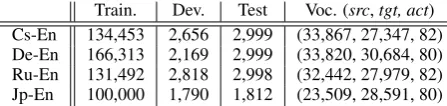
Train. Dev. Test Voc. (src,tgt, act) Cs-En 134,453 2,656 2,999 (33,867, 27,347, 82) De-En 166,313 2,169 2,999 (33,820, 30,684, 80) Ru-En 131,492 2,818 2,998 (32,442, 27,979, 82) Jp-En 100,000 1,790 1,812 (23,509, 28,591, 80)
Table 1: Statistics of parallel corpora.
propose here is a special case of distant supervi-sion in that the external parser provides noisy an-notations to otherwise an unlabeled training set.
Specifically, we use SyntaxNet, released by An-dor et al.(2016), on a target sentence.3We convert
a parse tree into a sequence of one of three tran-sition actions (SHIFT, REDUCE-L, REDUCE-R). We label each REDUCE action with a correspond-ing dependency label and treat it as a more fine-grained action.
5 Experiments
5.1 Language Pairs and Corpora
We compare the proposed NMT+RNNG against the baseline model on four different language pairs–Jp-En, Cs-En, De-En and Ru-En. The ba-sic statistics of the training data are presented in Table1. We mapped all the low-frequency words to the unique symbol “UNK” and inserted a spe-cial symbol “EOS” at the end of both source and target sentences.
Ja We use the ASPEC corpus (“train1.txt”) from the WAT’16 Jp-En translation task. We tokenize each Japanese sentence withKyTea(Neubig et al.,
2011) and preprocess according to the recommen-dations from WAT’16 (WAT,2016). We use the first 100K sentence pairs of length shorter than 50 for training. The vocabulary is constructed with all the unique tokens that appear at least twice in the training corpus. We use “dev.txt” and “test.txt” provided by WAT’16 respectively as development and test sets.
Cs, De and Ru We use News Commentary v8.
We removed noisy metacharacters and used the to-kenizer from Moses (Koehn et al.,2007) to build a vocabulary of each language using unique tokens that appear at least 6, 6 and 5 times respectively for Cs, Ru and De. The target-side (English) vocab-ulary was constructed with all the unique tokens
3When the target sentence is parsed as data preprocessing, we use all the vocabularies in a corpus and do not cut off any words. We use the plain SyntaxNet and do not train it furthermore.
appearing more than three times in each corpus. We also excluded the sentence pairs which include empty lines in either a source sentence or a target sentence. We only use sentence pairs of length 50 or less for training. We use “newstest2015” and “newstest2016” as development and test sets re-spectively.
5.2 Models, Learning and Inference
In all our experiments, each recurrent network has a single layer of LSTM units of 256 dimensions, and the word vectors and the action vectors are of 256 and 128 dimensions, respectively. To re-duce computational overhead, we use BlackOut (Ji et al.,2015) with 2000 negative samples andα = 0.4. When employing BlackOut, we shared the
negative samples of each target word in a sen-tence in training time (Hashimoto and Tsuruoka,
2017), which is similar to the previous work (Zoph et al.,2016). For the proposed NMT+RNNG, we share the target word vectors between the decoder (buffer) and the stack sLSTM.
Each weight is initialized from the uniform dis-tribution [−0.1,0.1]. The bias vectors and the weights of the softmax and BlackOut are initial-ized to be zero. The forget gate biases of LSTMs and Stack-LSTMs are initialized to 1 as recom-mended in J´ozefowicz et al. (2015). We use stochastic gradient descent with minibatches of 128 examples. The learning rate starts from1.0, and is halved each time the perplexity on the de-velopment set increases. We clip the norm of the gradient (Pascanu et al., 2012) with the thresh-old set to 3.0 (2.0 for the baseline models on Ru-En and Cs-Ru-En to avoid NaN and Inf). When the perplexity of development data increased in train-ing time, we halved the learntrain-ing rate of stochastic gradient descent and reloaded the previous model. The RNNG’s stack computes the vector of a de-pendency parse tree which consists of the gener-ated target words by the buffer. Since the complete parse tree has a “ROOT” node, the special token of the end of a sentence (“EOS”) is considered as the ROOT. We use beam search in the inference time, with the beam width selected based on the devel-opment set performance.
It took about 15 minutes per epoch and about 20 minutes respectively for the baseline and the pro-posed model to train a full JP-EN parallel corpus in our implementation.4
De-En Ru-En Cs-En Jp-En BLEU
NMT 16.61 12.03 11.22 17.88
NMT+RNNG 16.41 12.46† 12.06† 18.84†
RIBES
NMT 73.75 69.56 69.59 71.27 NMT+RNNG 75.03† 71.04† 70.39† 72.25†
Table 2: BLEU and RIBES scores by the baseline and proposed models on the test set. We use the bootstrap resampling method fromKoehn (2004) to compute the statistical significance. We use†to mark those significant cases withp <0.005.
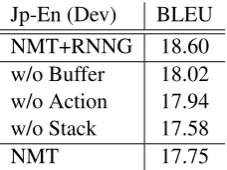
Jp-En (Dev) BLEU NMT+RNNG 18.60 w/o Buffer 18.02 w/o Action 17.94 w/o Stack 17.58
[image:5.595.72.299.62.164.2]NMT 17.75
Table 3: Effect of each component in RNNG.
5.3 Results and Analysis
In Table 2, we report the translation qualities of the tested models on all the four language pairs. We report both BLEU (Papineni et al.,2002) and RIBES (Isozaki et al., 2010). Except for De-En, measured in BLEU, we observe the statis-tically significant improvement by the proposed NMT+RNNG over the baseline model. It is worth-while to note that these significant improvements have been achievedwithoutany additional param-eters nor computational overhead in the inference time.
Ablation Since each component in RNNG may
be omitted, we ablate each component in the pro-posed NMT+RNNG to verify their necessity.5 As
shown in Table3, we see that the best performance could only be achieved when all the three compo-nents were present. Removing the stack had the most adverse effect, which was found to be the case for parsing as well byKuncoro et al.(2017).
Generated Sentences with Parsed Actions
The decoder part of our proposed model consists of two components: the NMT decoder to
gener-threads on Intel(R) Xeon(R) CPU E5-2680 v2 @2.80GHz) 5Since the buffer is the decoder, it is not possible to com-pletely remove it. Instead we simply remove the dependency of the action distribution on it.
Figure 1: An example of translation and its depen-dency relations obtained by our proposed model.
ate a translated sentence and the RNNG decoder to predict its parsing actions. The proposed model can therefore output a dependency structure along with a translated sentence. Figure 1 shows an example of JP-EN translation in the development dataset and its dependency parse tree obtained by the proposed model. The special symbol (“EOS”) is treated as the root node (“ROOT”) of the parsed tree. The translated sentence was generated by using beam search, which is the same setting of NMT+RNNG shown in Table3. The parsing ac-tions were obtained by greedy search. The re-sulting dependency structure is mostly correct but contains a few errors; for example, dependency re-lation between “The” and “ transition” should not be “pobj”.
6 Conclusion
We propose a hybrid model, to which we refer as NMT+RNNG, that combines the decoder of an attention-based neural translation model with the RNNG. This model learns to parse and translate si-multaneously, and training it encourages both the encoder and decoder to better incorporate linguis-tic priors. Our experiments confirmed its effec-tiveness on four language pairs ({JP, Cs, De, Ru} -En). The RNNG can in principle be trained with-out ground-truth parses, and this would eliminate the need of external parsers completely. We leave the investigation into this possibility for future re-search.
Acknowledgments
[image:5.595.307.525.75.155.2] [image:5.595.125.239.255.340.2]16H01715. KC thanks support by eBay, Face-book, Google and NVIDIA.
References
Roee Aharoni and Yoav Goldberg. 2017. Towards string-to-tree neural machine translation. In Pro-ceedings of the 55th Annual Meeting of the Asso-ciation for Computational Linguistics. to appear.
H´ector Mart´ınez Alonso, Djam´e Seddah, and Benoˆıt Sagot. 2016. From noisy questions to minecraft texts: Annotation challenges in extreme syntax sce-nario. InProceedings of the 2nd Workshop on Noisy User-generated Text (WNUT). pages 13–23.
David Alvarez-Melis and Tommi S. Jaakkola. 2017. Tree-structured decoding with doubly-recurrent neural networks. In Proceedings of International Conference on Learning Representations 2017.
Daniel Andor, Chris Alberti, David Weiss, Aliaksei Severyn, Alessandro Presta, Kuzman Ganchev, Slav Petrov, and Michael Collins. 2016. Globally nor-malized transition-based neural networks. In Pro-ceedings of the 54th Annual Meeting of the Asso-ciation for Computational Linguistics. pages 2442– 2452.
Rich Caruana. 1998. Multitask learning. InLearning to learn, Springer, pages 95–133.
Kyunghyun Cho, Aaron Courville, and Yoshua Ben-gio. 2015. Describing multimedia content using attention-based encoder-decoder networks. IEEE Transactions on Multimedia17(11):1875–1886.
Kyunghyun Cho, Bart van Merrienboer, Caglar Gul-cehre, Dzmitry Bahdanau, Fethi Bougares, Holger Schwenk, and Yoshua Bengio. 2014. Learning phrase representations using rnn encoder–decoder for statistical machine translation. InProceedings of the 2014 Conference on Empirical Methods in Nat-ural Language Processing. pages 1724–1734.
Junyoung Chung, Kyunghyun Cho, and Yoshua Ben-gio. 2016. A character-level decoder without ex-plicit segmentation for neural machine translation. In Proceedings of the 54th Annual Meeting of the Association for Computational Linguistics. Associ-ation for ComputAssoci-ational Linguistics, pages 1693– 1703.
Ronan Collobert, Jason Weston, L´eon Bottou, Michael Karlen, Koray Kavukcuoglu, and Pavel Kuksa. 2011. Natural language processing (almost) from scratch. Journal of Machine Learning Research
12:2493–2537.
Chris Dyer, Miguel Ballesteros, Wang Ling, Austin Matthews, and A. Noah Smith. 2015. Transition-based dependency parsing with stack long short-term memory. In Proceedings of the 53rd Annual
Meeting of the Association for Computational Lin-guistics and the 7th International Joint Conference on Natural Language Processing. pages 334–343.
Chris Dyer, Adhiguna Kuncoro, Miguel Ballesteros, and A. Noah Smith. 2016. Recurrent neural net-work grammars. InProceedings of the 2016 Con-ference of the North American Chapter of the Asso-ciation for Computational Linguistics: Human Lan-guage Technologies. pages 199–209.
Akiko Eriguchi, Kazuma Hashimoto, and Yoshimasa Tsuruoka. 2016. Tree-to-sequence attentional neu-ral machine translation. InProceedings of the 54th Annual Meeting of the Association for Computa-tional Linguistics. pages 823–833.
Kazuma Hashimoto and Yoshimasa Tsuruoka. 2017. Neural Machine Translation with Source-Side Latent Graph Parsing. arXiv preprint arXiv:1702.02265.
Geoffrey Hinton, Oriol Vinyals, and Jeff Dean. 2015. Distilling the knowledge in a neural network. arXiv preprint arXiv:1503.02531.
Sepp Hochreiter and J¨urgen Schmidhuber. 1997. Long short-term memory. Neural Comput. 9(8):1735– 1780.
Hideki Isozaki, Tsutomu Hirao, Kevin Duh, Katsuhito Sudoh, and Hajime Tsukada. 2010. Automatic eval-uation of translation quality for distant language pairs. In Proceedings of the 2010 Conference on Empirical Methods in Natural Language Process-ing. pages 944–952.
Shihao Ji, S. V. N. Vishwanathan, Nadathur Satish, Michael J. Anderson, and Pradeep Dubey. 2015. Blackout: Speeding up recurrent neural network lan-guage models with very large vocabularies. Pro-ceedings of International Conference on Learning Representations 2015.
Rafal J´ozefowicz, Wojciech Zaremba, and Ilya Sutskever. 2015. An empirical exploration of recur-rent network architectures. In Proceedings of the 32nd International Conference on Machine Learn-ing. pages 2342–2350.
Philipp Koehn. 2004. Statistical significance tests for machine translation evaluation. In Proceedings of the 2004 Conference on Empirical Methods in Nat-ural Language Processing. pages 388–395.
Philipp Koehn, Hieu Hoang, Alexandra Birch, Chris Callison-Burch, Marcello Federico, Nicola Bertoldi, Brooke Cowan, Wade Shen, Christine Moran, Richard Zens, Chris Dyer, Ondrej Bojar, Alexandra Constantin, and Evan Herbst. 2007. Moses: Open source toolkit for statistical machine translation. In
Adhiguna Kuncoro, Miguel Ballesteros, Lingpeng Kong, Chris Dyer, Graham Neubig, and Noah A. Smith. 2017. What do recurrent neural network grammars learn about syntax? In Proceedings of the 15th Conference of the European Chapter of the Association for Computational Linguistics: Volume 1, Long Papers. pages 1249–1258.
Jason Lee, Kyunghyun Cho, and Thomas Hofmann. 2016. Fully character-level neural machine trans-lation without explicit segmentation. arXiv preprint arXiv:1610.03017.
Thang Luong, Hieu Pham, and Christopher D. Man-ning. 2015. Effective approaches to attention-based neural machine translation. In Proceedings of the 2015 Conference on Empirical Methods in Natural Language Processing. pages 1412–1421.
Tom´aˇs Mikolov, Martin Karafi´at, Luk´aˇs Burget, Jan ˇCernock´y, and Sanjeev Khudanpur. 2010. Recurrent neural network based language model. In Proceed-ings of the 11th Annual Conference of the Interna-tional Speech Communication Association (INTER-SPEECH 2010). International Speech Communica-tion AssociaCommunica-tion, pages 1045–1048.
Mike Mintz, Steven Bills, Rion Snow, and Dan Juraf-sky. 2009. Distant supervision for relation extrac-tion without labeled data. In Proceedings of the Joint Conference of the 47th Annual Meeting of the ACL and the 4th International Joint Conference on Natural Language Processing of the AFNLP. pages 1003–1011.
Graham Neubig, Yosuke Nakata, and Shinsuke Mori. 2011. Pointwise prediction for robust, adaptable japanese morphological analysis. InProceedings of the 49th Annual Meeting of the Association for Com-putational Linguistics: Human Language Technolo-gies. pages 529–533.
Kishore Papineni, Salim Roukos, Todd Ward, and Wei-Jing Zhu. 2002. Bleu: A method for automatic eval-uation of machine translation. InProceedings of the 40th Annual Meeting on Association for Computa-tional Linguistics. pages 311–318.
Razvan Pascanu, Tomas Mikolov, and Yoshua Ben-gio. 2012. Understanding the exploding gra-dient problem. arXiv preprint arXiv:1211.5063
abs/1211.5063.
Rico Sennrich and Barry Haddow. 2016. Linguistic input features improve neural machine translation. InProceedings of the First Conference on Machine Translation. pages 83–91.
Rico Sennrich, Barry Haddow, and Alexandra Birch. 2016. Neural machine translation of rare words with subword units. InProceedings of the 54th Annual Meeting of the Association for Computational Lin-guistics. pages 1715–1725.
Xing Shi, Inkit Padhi, and Kevin Knight. 2016. Does string-based neural mt learn source syntax? In Pro-ceedings of the 2016 Conference on Empirical Meth-ods in Natural Language Processing. pages 1526– 1534.
Felix Stahlberg, Eva Hasler, Aurelien Waite, and Bill Byrne. 2016. Syntactically guided neural machine translation. InProceedings of the 54th Annual Meet-ing of the Association for Computational LMeet-inguis- Linguis-tics. pages 299–305.
WAT. 2016. http://lotus.kuee. kyoto-u.ac.jp/WAT/baseline/
dataPreparationJE.html.
Yonghui Wu, Mike Schuster, Zhifeng Chen, Quoc V. Le, Mohammad Norouzi, Wolfgang Macherey, Maxim Krikun, Yuan Cao, Qin Gao, Klaus Macherey, Jeff Klingner, Apurva Shah, Melvin Johnson, Xiaobing Liu, Lukasz Kaiser, Stephan Gouws, Yoshikiyo Kato, Taku Kudo, Hideto Kazawa, Keith Stevens, George Kurian, Nishant Patil, Wei Wang, Cliff Young, Jason Smith, Jason Riesa, Alex Rudnick, Oriol Vinyals, Greg Corrado, Macduff Hughes, and Jeffrey Dean. 2016. Google’s neural machine translation system: Bridging the gap between human and machine translation. arXiv preprint arXiv:1609.08144.