Munich Personal RePEc Archive
Measuring the External Stability of the
One-to-One Matching Generated by the
Deferred Acceptance Algorithm
Saglam, Ismail
TOBB ETU
15 January 2019
Online at
https://mpra.ub.uni-muenchen.de/91472/
Measuring the External Stability of the One-to-One Matching
Generated by the Deferred Acceptance Algorithm
Ismail Saglam
TOBB University of Economics and Technology, Department of Economics, Sogutozu Cad. No.43, Sogutozu 06560, Ankara, Turkey
Abstract. In this paper, we consider a one-to-one matching model where the popu-lation expands with the arrival of a man and a woman. Individuals in this popupopu-lation are matched, before and after the expansion, according to a version of the deferred acceptance algorithm (Gale and Shapley, 1962) where men propose and women reject or (tentatively or permanently) accept. Using computer simulations of this model, we study how the percentage of matches disrupted (undisrupted) with the expansion of the population is affected when the initial size of the population and the size of correlation in the preferences of individuals change.
Key words: One-to-one matching; deferred acceptance; stability; external stability.
1
Introduction
who provide the proof by showing that a dynamic procedure —called the deferred acceptance (DA) algorithm— always produces, after some finite iterations, a sta-ble matching. According to this algorithm, individuals in one side of the population propose for matching and individuals in the other side reject or (tentatively or perma-nently) accept these proposals. Because of its simplicity and computational power, this algorithm has been very popular and useful —since it was proposed (and in some markets even before that)— to solve many theoretical and practical matching problems (e.g. Roth, 1984, 2002, 2008; Balinski and S¨onmez, 1999; Abdulkadiro˜glu, Pathak, and Roth, 2005; and Pathak and S¨onmez, 2008).
In this paper, we aim to investigate —with the help of computer simulations— how the stable matching generated by the DA algorithm is affected when the popu-lation expands with the arrival of a man and a woman. To measure the investigated effect, we count the number of matches disrupted (undisrupted) after the expansion of the population, and in more detail, the number of individuals who change/retain their marital status and the number of individuals who change/retain their partners. Then, we explore how all these numbers change with the size of population and the size of correlation in the preferences of individuals over potential partners.
While our research question and our findings are novel to the best of our knowl-edge, the destabilizing effects caused by a change in the matching population are already known in the matching literature since the works of Blum et al. (1997) and Cantala (2004), dealing with one-to-one markets and many-to-one markets respec-tively. In this literature, the closest work to ours is due Gabszewicz et al (2008), who show by example that entry to the matching population can heavily destabilize
one-to-one marriages and suggest a new stability concept, calledk-external stability,
to account for the disruptive effects of a change in the matching population. In more detail, Gabszewicz et al (2008) say that the matching population (the marriage
mar-ket) is k-externally stable if at any stable matching at least k of the matches are not
disrupted whenever the matching population expands with the entry of a man and a
woman. Using this definition, they show that a matching population withnmen and
nwomen would become 0-externally stable (the worst possible case) if all individuals
external stability would be n−2 (the best possible case) if all individuals had peak load preferences, i.e., a structure of preferences requiring that on a common ranking of individuals the further distant a potential mate is from the rank of an individual, the least preferred it is. We should note that in our study we do not consider all possible stable matchings associated with the matching population; we focus on the stable matching generated by the DA algorithm, only. Hence, when we expand the matching population, we measure the extent of the survival of the matches under this particular matching only, instead of calculating the degree of external stability of the whole matching population. In addition, unlike in Gabszewicz et al (2008), we consider heterogenous preferences, using a setup we borrow from Saglam (2019a, 2019b). This setup allows us to vary, in our simulations, the degree of correlation in the preferences from zero to one and to measure the possible effects of this variation
on the percentage of disrupted/undisrupted matches.1
Moreover, we measure these effects by varying the initial size of the matching population, as well.
The rest of our paper is organized as follows. Section 2 introduces our model and Section 3 presents our results. Finally, Section 4 concludes.
2
Model
Consider a population involving a finite set of men M and a finite set of women W,
where each individual can be matched to another individual only if they are from
opposite sexes. Let N =M ∪W denote this population. Individual i ∈ N derives
the utility Ui(j) when he/she is matched with individual j, and derives the utility
Ui(i) when he/she is unmatched to any individual (and remains single). Given any
X, Y ∈ {M, W}withX 6=Y, anyi∈X, and anyj, k ∈Y ∪{i}, we say thatiprefers
j tok if Ui(j)> Ui(k). We assume that each individual in the population knows all
1Using this setup, Saglam (2019b) extends the Todd and Miller’s (1999) results in mutual
relevant utilities for himself/herself before a matching takes place, and these utilities do not change during the matching process.
A matching is a one-to-one function µ:N → N such that for each m ∈M and
w ∈ W, µ(w) = m if and only if µ(w) = m. In addition, µ(m) ∈/ W if and only
if µ(m) = m, and µ(w) ∈/ M if and only if µ(w) = w. Individuals m and w are
matched to each other ifµ(m) = w, and individual i is single ifµ(i) =i.
A matching µis said to be acceptablefor individual iif Ui(µ(i))≥Ui(i); i.e., the
utility of individuali from the matchµ(i) is not below the utility from being single.
Also, given any matching µ, a man m and a woman w are together called ablocking
pair for µ if µ(m) 6= w and Ui(j) > Ui(µ(i)) for i, j ∈ {m, w} with i 6= j; i.e., m
and w are not matched under µ and they prefer each other to their matches at µ.
Given these definitions, a matching µ is said to be stableif µ is acceptable for each
individual and there exists no blocking pair for µ.
A celebrated result in matching theory, due to Gale and Shapley (1962), shows that there exists a stable matching for every matching population provided that
in-dividuals’ preferences satisfy completeness and transitivity.2
Moreover, under these assumptions, a stable matching can always be obtained as the outcome of a pro-cedure, called the deferred acceptance (DA) algorithm, which has two versions de-pending upon the roles of men and women. In one of these algorithms, men propose to women and women give rejections or (tentative or permanent) acceptances, while in the other algorithm proposals are given by women and rejections/acceptances by men. The matching outcomes of these two algorithms, even though they are both stable, have different welfare implications. Gale and Shapley (1962) shows that if all individuals have strict preferences, the DA algorithm, when men (women) propose, always produces the men-optimal (women-optimal) stable matching; i.e. a stable matching which is preferred by all men (women) to any other stable matching.
2Given two alternativesxand y, an individual is said to weakly prefer xto y if he/she strictly
prefersx to y or is indifferent between them. The preference ordering of this individual over the
set of possible alternatives satisfies completeness if for any two alternatives in this set it is true that he/she weakly prefers one of them to the other. Also, his/her preference ordering satisfies
transitivityif for any three alternativesx,y,zit is true that he/she weakly prefersxtozwhenever
We will denote by DA-MP (DA-WP) the deferred acceptance with men proposing
(women proposing). Below, we describe the DA-MP algorithm with k ≥ 1 steps.
Initially, all individuals are single in this algorithm. (Interchanging the roles of men and women, one can simply obtain the DA-WP algorithm from below.)
Stepk ≥1: Every man who is in step 1, or who was rejected in stepk−1 whenk
is at least 2, proposes to his most preferred woman in his updated list of acceptable women (if any). A man makes no proposal if his list is empty. Each woman holds the most preferred acceptable proposal she has received until now and rejects all other proposals. Then, each man rejected in this step deletes the woman who rejected him from his list of acceptable women. (Above, if any individual is indifferent between any two potential mates, he/she is allowed to break the tie arbitrarily.) The algorithm terminates when no further proposal is made by any man, and at this step each woman is matched to the man (if any) whose proposal she is holding.
Gale and Shapley (1962) proved that the above algorithm must always yield, after finite steps, a stable matching.
3
Results
Below, we study through computer simulations how the external stability of the matching outcome of the DA-MP algorithm is affected by a change in the size of heterogeneity in the preferences of individuals when the initial size of the matching population is also varied. We conduct all simulations using GAUSS Software Ver-sion 3.2.34 (Aptech Systems, 1998). (The program code of the simulations and the resulting data are available upon request.)
We assume that the number of men and the number of women in the initial
population are the same and denoted byn; and we vary in our simulations the number
nbetween the integers 2 and 100. For eachn, we denote the corresponding population
byNn. We consider the addition of a man and a women to this population, and call
the expanded population by Ne
n+1. We denote the set of men and women in the
initial and extended populations by Mn, Wn and Me
n+1, W
We model the preferences of individuals in the population Ne
n+1 (which contains
Nnby construction) using the preference structure in Saglam (2018, 2019). Formally,
we assume that for any n, any X, Y ∈ {Me
n+1, W
e
n+1} with X 6= Y, any i∈ X, and
any j ∈Y, the match utility Ui(j) of individual i derived from individual j satisfies
Ui(j) =ω Uc
(j) + (1−ω)Uip(j),
where Uc(j) denotes the common part of the utility any individual in X can derive
from individualj,Uip(j) denotes the private part of the utility only individual i can
derive from individual j, and ω denotes a weight parameter that is, for simplicity,
assumed to be common for all individuals inX∪Y. In our simulations, the utilities
Uc(j) and Up
i(j) in the above expression are always randomly drawn from a uniform
distribution of values in [0,100]. On the other hand, the weight parameter ω is
varied inside the set of values {0, 1/3, 2/3,1}. It is clear that the higher the value
of ω, the less heterogenous the preferences of individuals. In particular, ω = 0
and ω = 1 induce completely heterogenous (perfectly uncorrelated) and completely
homogenous (perfectly correlated) preferences, while ω = 1/3 and ω = 2/3 induce
partially heterogenous (imperfectly correlated) preferences.
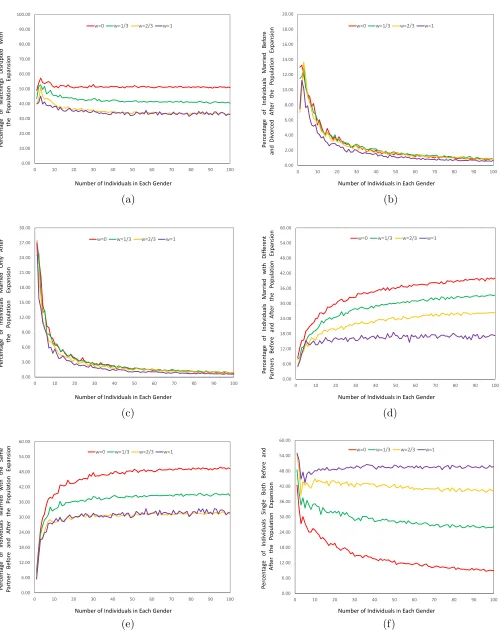
Our simulation results are reported in the six panels of Figure 1. Panel (a) illus-trates the percentage of matches disrupted with the expansion of the population by the arrival of a man and a woman. Our results show that the higher the correlation (the lower the heterogeneity) in the preferences of individuals, the lower the percent-age of disrupted matches. Moreover, the size of the population, unless it is extremely small, has no remarkable effect on the percentage of disrupted matches, irrespective of the size of heterogeneity in the preferences. Here, the calculation of disrupted matches include an individual if the marital status of this individual changes (from single to married or from married to single) or if this individual is married with a different partner before and after the expansion of the population. We report these three types of disruptions separately in panels (b)-(d).
The size of heterogeneity in the preferences has negligible effects on our results. Nevertheless, we always obtain the lowest percentage values when the preferences are homogenous. All these observations are also valid for panel (c), where we report the percentage of individuals who change —after the expansion of the population— their marital status from married to single. The only remarkable difference between panels (b) and (c) is about the levels. We observe that when the population expands, there are more individuals who change their marital status from single to married (panel c) than from married to single (panel b), especially when the initial size of the population is sufficiently small. In panel (d), we report the percentage of indi-viduals who are married with different partners before and after the expansion of the population. We should immediately see that this percentage is monotonically
decreasing in the size of correlation (ω), irrespective of the initial size of the
pop-ulation. However, the population size can have significantly large effects when it is extremely small. In that case, we observe that the higher the size of the population, the higher the percentage of married individuals who become divorced and marry with another partner after the expansion of the population.
Number of Individuals in Each Gender 0.00 10.00 20.00 30.00 40.00 50.00 60.00 70.00 80.00 90.00 100.00
0 10 20 30 40 50 60 70 80 90 100
w=0 w=1/3 w=2/3 w=1
Pe rc en ta ge of M at ch in gs Di sr up te d W ith th e P op ul at io n E xp an sio n
Number of Individuals in Each Gender
0.00 2.00 4.00 6.00 8.00 10.00 12.00 14.00 16.00 18.00 20.00
0 10 20 30 40 50 60 70 80 90 100
w=0 w=1/3 w=2/3 w=1
Pe rc en ta ge of In di vi du al s M ar rie d B ef or e an d D iv or ce d A fte r th e P op ul at io n E xp an sio n (a) (b) Pe rc en ta ge of In di vi du al s M ar rie d O nl y A fte r th e Po pu la tio n E xp an sio n
Number of Individuals in Each Gender
0.00 3.00 6.00 9.00 12.00 15.00 18.00 21.00 24.00 27.00 30.00
0 10 20 30 40 50 60 70 80 90 100
w=0 w=1/3 w=2/3 w=1
Number of Individuals in Each Gender
0.00 6.00 12.00 18.00 24.00 30.00 36.00 42.00 48.00 54.00 60.00
0 10 20 30 40 50 60 70 80 90 100
w=0 w=1/3 w=2/3 w=1
Pe rc en ta ge of In di vi du al s M ar rie d w ith Di ffe re nt Pa rt ne rs Be fo re an d A fte r th e P op ul at io n E xp an sio n (c) (d) Pe rc en ta ge of In di vi du al s M ar rie d w ith th e S am e Pa rt ne r B ef or e a nd Af te r th e P op ul at io n E xp an sio n
Number of Individuals in Each Gender
0.00 6.00 12.00 18.00 24.00 30.00 36.00 42.00 48.00 54.00 60.00
0 10 20 30 40 50 60 70 80 90 100
w=0 w=1/3 w=2/3 w=1
Pe rc en ta ge of In di vi du al s Si ng le Bo th Be fo re an d Af te r th e P op ul at io n E xp an sio n
Number of Individuals in Each Gender
0.00 6.00 12.00 18.00 24.00 30.00 36.00 42.00 48.00 54.00 60.00
0 10 20 30 40 50 60 70 80 90 100
w=0 w=1/3 w=2/3 w=1
[image:9.612.54.554.20.660.2](e) (f)
Figure 1. Various Effects of the Population Expansion on the Outcome of the DA
4
Conclusion
In this paper, we have studied how the stable matching outcome generated by the DA algorithm is affected when the matching population expands with the arrival of a man and a woman. Using Monte Carlo simulations, we have showed that the size of correlation in the preferences of individuals has, in general, a negative effect on the overall percentage of disrupted matches, irrespective of the initial size of the population. While this negative effect is observed for both the set of individuals who change their marital status (from married to single or from single to married) and the set of married individuals who change their partners after the expansion of the population, the magnitude of the effect is incomparably larger in the latter case. On the other hand, the initial size of the population is found to have no remarkable effects on the overall percentage of disrupted matches, unless it is extremely small. However, this last result becomes no longer valid when we identify the type of disruption in our simulations. We find that the percentage of individuals who change —after the expansion of the population— their marital status is hyperbolically decreasing with the population size, whereas the percentage of individuals who are married to a different partner before and after the expansion of the population is mildly increasing unless the size of correlation in the preferences is extremely high.
population has a negative effect (only) if the size of correlation is sufficiently small.
References
Abdulkadiro˜glu, A., Pathak, P. A. & Roth, A. E. (2005) The New York City high
school match. American Economic Review, Papers and Proceedings, 95(2), 364–367.
Aptech Systems. (1998) GAUSS version 3.2.34. Maple Valley, WA: Aptech Systems, Inc.
Balinski, M. & S¨onmez, T. (1999) A tale of two mechanisms: Student Placement.
Journal of Economic Theory, 84, 73-94.
Blum, Y., Roth A. E. & Rothblum, U. G. (1997) Vacancy chains and equilibration
in senior-level labor markets. Journal of Economic Theory, 76, 362–411.
Cantala, D. (2004) Restabilizing matching markets at senior level. Games and
Eco-nomic Behavior, 48(1), 1–17.
Gabszewicz, J. J., Garcia, F., Pais, J. & Resende, J. (2012) On Gale and Shapley
“College admissions and the stability of marriage”. Theoretical Economics Letters,
2, 291–293.
Gale, D. & Shapley, L. S. (1962) College admissions and the stability of marriage.
American Mathematical Monthly, 69, 9–15.
Pathak, P. A. & S¨onmez, T. (2008) Leveling the playing field: Sincere and
sophisti-cated players in the Boston mechanism. American Economic Review, 98(4), 1636–
1652.
Roth, A. E. (2008) Deferred acceptance algorithms: History, theory, practice, and open questions. A collection of papers dedicated to David Gale on the occasion
of his 85th birthday, special issue. International Journal of Game Theory, 36(3-4),
Roth, A. E. (2002) The economist as engineer: Game theory, experimental economics
and computation as tools of design economics. Econometrica, 70(4), 1341–1378.
Roth, A. E. (1984) The evolution of the labor market for medical interns and
resi-dents: A case study in game theory. Journal of Political Economy, 92, 991–1016.
Saglam, I. (2019a) The success of the deferred acceptance algorithm under heteroge-nous preferences with endogeheteroge-nous aspirations, manuscript.
Saglam, I. (2019b) The mutual sequential mate search model under non-homogenous
preferences. Marriage & Family Review, forthcoming.
Todd, P. M. & Miller, G. F. (1999) From pride and prejudice to persuasion: Satis-ficing in mate search. In G. Gigerenzer, P. M. Todd & the ABC Research Group
(Eds.), Simple Heuristics That Make Us Smart(pp. 287–308). New York: Oxford