Bilingual Segmented Topic Model
Akihiro Tamura and Eiichiro Sumita
National Institute of Information and Communications Technology 3-5 Hikaridai, Seika-cho, Soraku-gun, Kyoto, JAPAN {akihiro.tamura, eiichiro.sumita}@nict.go.jp
Abstract
This study proposes the bilingual seg-mented topic model (BiSTM), which hi-erarchically models documents by treat-ing each document as a set of segments, e.g., sections. While previous bilingual topic models, such as bilingual latent Dirichlet allocation (BiLDA) (Mimno et al., 2009; Ni et al., 2009), consider only cross-lingual alignments between entire documents, the proposed model consid-ers cross-lingual alignments between seg-ments in addition to document-level align-ments and assigns the same topic distri-bution to aligned segments. This study also presents a method for simultane-ously inferring latent topics and segmen-tation boundaries, incorporating unsuper-vised topic segmentation (Du et al., 2013) into BiSTM. Experimental results show that the proposed model significantly out-performs BiLDA in terms of perplexity and demonstrates improved performance in translation pair extraction (up to +0.083 extraction accuracy).
1 Introduction
Probabilistic topic models, such as probabilis-tic latent semanprobabilis-tic analysis (PLSA) (Hofmann, 1999) and latent Dirichlet allocation (LDA) (Blei et al., 2003), are generative models for documents that have been used as unsupervised frameworks to discover latent topics in document collections without prior knowledge. These topic models were originally applied to monolingual data; how-ever, various recent studies have proposed the use of probabilistic topic models in multilingual
set-ĚŽĐƵŵĞŶƚͲ ůĞǀĞů ĂůŝŐŶŵĞŶƚ
ƚŽƉŝĐĂůůLJ ĐŽƌƌĞƐƉŽŶĚĞŶĐĞ
㻭㼟㼟㼛㼏㼕㼍㼠㼕㼛㼚㻌㼒㼛㼛㼠㼎㼍㼘㼘 ƐƐŽĐŝĂƚŝŽŶĨŽŽƚďĂůů͕ŵŽƌĞ ĐŽŵŵŽŶůLJŬŶŽǁŶĂƐĨŽŽƚďĂůů ŽƌƐŽĐĐ Ğƌ͕ ŝƐĂƐƉŽƌƚƉůĂLJĞĚ ďĞƚǁǁŽ ŵƐ ŽĨĞůĞǀĞŶƉůĂLJĞƌƐ ǁŝƚŚƐƉ ŚĞƌŝĐĂů ďĂůů͘ƚ ƉůĂLJĞĚďLJϮŶƉůĂLJĞƌƐŝŶ ŽǀĞƌϭϱϬĐŽƵŶƚƌŝĞƐ͕ ŵĂŬŝ ŶŐŝƚƚŚĞǁŽƌůĚ͚Ɛ
ϭ,ŝƐƚŽƌLJ
ϮƚLJŵŽůŽŐLJĂŶĚŶĂŵĞƐ ϯ'ĂŵĞƉůĂLJ
ϰ>ĂǁƐ
ϱ'ŽǀĞƌŶŝŶŐďŽĚŝĞƐ
䝃䝑䜹䞊 (football)
䝃䝑䜹䞊䠄ⱥ: soccer䠅䛿䚸⌫ ᙧ䛾䝪䞊 䝹䜢⏝䛔䛶1䝏䞊 䝮11ே䛾2 䝏䞊䝮㛫䛷⾜ 䜟䜜䜛䝇䝫䞊 䝒➇ᢏ䛾 䛸䛴䛷䛒 䜛䚹䜰䝋䝅䜶䞊 䝅 䞉䝑䝖䠄ciatiall ; ༠ ᘧ䝣䝑䝖䝪䞊䝹 䛾ព䠅䛺䛔䛧 䛿䜰䝋䝅䜶䞊䝅 䝵䞁ᘧ䝣䝑䝖
1 ᴫせ
2 ྡ⛠ (name)
3 ヨྜ (game)
4 Ṕྐ (history)
5 ⌧ᅾ䛾䝃䝑䜹䞊
[image:1.595.308.525.221.316.2]͙ ͙
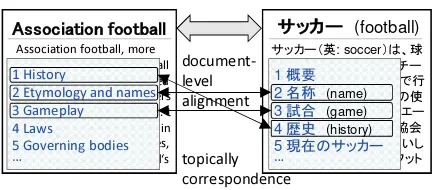
Figure 1: Wikipedia Article Example
tings1, where latent topics are shared across multi-ple languages. These models have improved sev-eral multilingual tasks, such as translation pair ex-traction and cross-lingual text classification (see the survey paper by Vuli´c et al. (2015) for details). Most multilingual topic models, including bilin-gual LDA (BiLDA) (Mimno et al., 2009; Ni et al., 2009), model a document-aligned comparable corpus, such as a collection of Wikipedia articles, where aligned documents are topically similar but are not direct translations2. In particular, these models assume that the documents in each tuple share the same topic distribution and that each cross-lingual topic has a language-specific word distribution.
Existing multilingual topic models consider only document-level alignments. However, most documents are hierarchically structured, i.e., a document comprises segments (e.g., sections and paragraphs) that can be aligned across languages. Figure 1 shows a Wikipedia article example, which contains a set of sections. Sections 1, 2, and 3 in the English article correspond topically to sections 4, 2, and 3 in the Japanese counterpart, re-1In this work, we deal with a bilingual setting, but our approach can be extended straightforwardly to apply to more than two languages.
2In this study, we focus on models for a document-aligned comparable corpus. We describe other types of multilingual topic models and their limitations in Section 7.
spectively. To date, such segment-level alignments have been ignored; however, we consider that such corresponding segments must share the same topic distribution.
Du et al. (2010) have shown that segment-level topics and their dependencies can improve model-ing accuracy in a monolmodel-ingual settmodel-ing. Based on that research, we expect that segment-level topics can also be useful for modeling multilingual data. This study proposes a bilingual segmented topic model (BiSTM) that extends BiLDA to capture segment-level alignments through a hierarchical structure. In particular, BiSTM considers each document as a set of segments and models a docu-ment as a docudocu-ment-segdocu-ment-word structure. The topic distribution of each segment (per-segment topic distribution) is generated using a Pitman– Yor process (PYP) (Pitman and Yor, 1997), in which the base measure is the topic distribution of the related document (per-document topic distri-bution). In addition, BiSTM introduces a binary variable that indicates whether two segments in different languages are aligned. If two segments are aligned, their per-segment topic distributions are shared; if they are not aligned, they are inde-pendently generated.
BiSTM leverages existing segments from a given segmentation. However, a segmentation is not always given, and a given segmentation might not be optimal for statistical modeling. Therefore, this study also presents a model, BiSTM+TS, that incorporates unsupervised topic segmentation into BiSTM. BiSTM+TS integrates point-wise bound-ary sampling into BiSTM in a manner similar to that proposed by Du et al. (2013) and infers seg-mentation boundaries and latent topics jointly.
Experiments using an English–Japanese and English–French Wikipedia corpus show that the proposed models (BiSTM and BiSTM+TS) sig-nificantly outperform the standard bilingual topic model (BiLDA) in terms of perplexity, and that they improve performance in translation extrac-tion (up to +0.083 top 1 accuracy). The exper-iments also reveal that BiSTM+TS is comparable to BiSTM, which uses manually provided segmen-tation, i.e., section boundaries in Wikipedia arti-cles.
2 Bilingual LDA
This section describes the BiLDA model (Mimno et al., 2009; Ni et al., 2009), which we take as
ɲ ɽ
nj ǁ ʔĞ ɴĞ
nj ǁ ʔĨ ɴĨ
EĞ
EĨ
<
Ğ
Ĩ
Ğ
Ĩ >ĂŶŐƵĂŐĞĞ
[image:2.595.311.527.116.381.2]>ĂŶŐƵĂŐĞĨ
Figure 2: Graphical Model of BiLDA
Algorithm 1 Generative Process of BiLDA 1:foreach topick∈ {1, ..., K}do
2: foreach languagel∈ {e, f}do
3: chooseϕl
k∼Dirichlet(βl)
4: end for
5:end for
6:foreach document pairdi(i∈ {1, ..., D})do
7: chooseθi∼Dirichlet(α)
8: foreach languagel∈ {e, f}do
9: foreach wordwl
im(m∈ {1, ..., Nil})do
10: choosezl
im∼Multinomial(θi)
11: choosewl
im∼p(wlim|ziml ,ϕl)
12: end for
13: end for
14:end for
our baseline. BiLDA is a bilingual extension of basic monolingual LDA (Blei et al., 2003) for a document-aligned comparable corpus. While monolingual LDA assumes that each document has its own topic distribution, BiLDA assumes that aligned documents share the same topic distribu-tion and discovers latent cross-lingual topics.
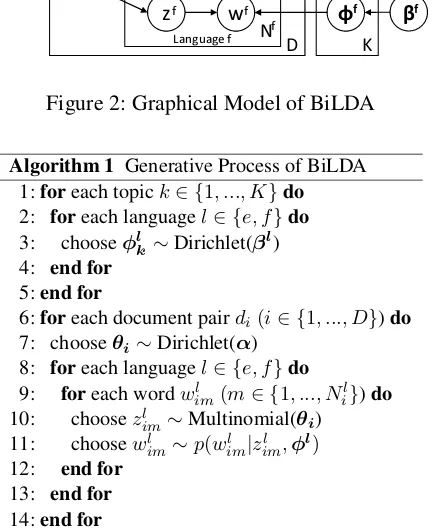
Algorithm 1 and Figure 2 show the genera-tive process and graphical model, respecgenera-tively, of BiLDA. BiLDA models a document-aligned com-parable corpus, i.e., a set of D document pairs in two languages, e andf. Each document pair di (i ∈ {1, ..., D})comprises aligned documents in the languageeandf: di=(dei,dfi). BiLDA as-sumes that each topic k ∈ {1, ..., K} comprises the set of a discrete distribution over words for each language. Each language-specific per-topic word distributionϕl
k (l ∈ {e, f}) is drawn from a Dirichlet distribution with the prior βl (Steps 1-5). To generate a document pair di, the per-document topic distributionθiis first drawn from a Dirichlet distribution with the priorα (Step 7). Thus, aligned documentsde
i anddfi share the same topic distribution. Then, for each word at m ∈ {1, ..., Nl
i}in documentdli in languagel, a latent topic assignmentzl
ɲ ɽ
nj ǁ ʔĞ ɴĞ
nj ǁ ʔĨ ɴĨ
EĞ
EĨ
<
Ğ
Ĩ Ğ
Ĩ >ĂŶŐƵĂŐĞĞ
>ĂŶŐƵĂŐĞĨ
ʆ
ʆ
^Ĩ
^Ğ
LJ
Ğ
[image:3.595.74.295.63.164.2]Ĩ
Figure 3: Graphical Model of BiSTM
Algorithm 2 Generative Process of BiSTM 1:foreach topick∈ {1, ..., K}do 2: foreach languagel∈ {e, f}do 3: chooseϕl
k∼Dirichlet(βl)
4: end for 5:end for
6:foreach document pairdi(i∈ {1, ..., D})do
7: chooseθi∼Dirichlet(α) 8: ifyiare not giventhen 9: chooseγi∼Beta(η0, η1)
10: chooseyi∼Bernoulli(γi)
11: end if
12: generate aligned segment setsASi= genAS(yi) 13: foreach setASig(g∈ {1, ...,|ASi|})do 14: chooseνig∼PYP(a, b,θi)
15: end for
16: foreach languagel∈ {e, f}do 17: foreach segmentsl
ij(j∈ {1, ..., Sil})do
18: get index ofsl
ijinASi:g=get idx(ASi,slij)
19: foreach wordwl
ijm(m∈ {1, ..., Nijl})do
20: choosezl
ijm∼Multinomial(νig)
21: choosewl
ijm∼p(wlijm|zijml ,ϕl)
22: end for 23: end for 24: end for 25:end for
distribution with the prior θi (Step 10). Later, a wordwl
imis drawn from a probability distribution p(wl
im|zlim,ϕl)given the topicziml (Step 11).
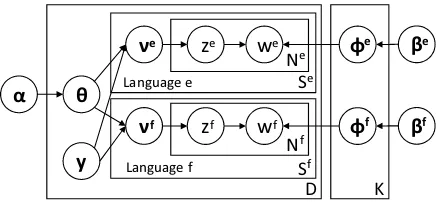
3 Bilingual Segmented Topic Model Here, we describe BiSTM, which extends BiLDA to capture segment-level alignments. Algorithm 2 and Figure 3 show the generative process and graphical model, respectively, of BiSTM. As can be seen in Figure 3, BiSTM introduces a segment-level layer between the document- and word-segment-level layers in both languages. In other words, per-segment topic distributions for each language,νe and νf, are introduced between per-document topic distributions θ and topic assignments for
words, ze andzf. In addition, BiSTM incorpo-rates binary variablesyto represent segment-level alignments.
Each document dl
i in a pair of aligned doc-uments di is divided into Sl
i segments: dli =
∪Sl i
j=1slij. BiSTM makes the same assumption for per-topic word distributions as BiLDA, i.e.,ϕl
kare language-specific and drawn from Dirichlet distri-butions (Steps 1-5).
In the generative process for a document pair di, the per-document topic distribution θi is first drawn in the same way as in BiLDA (Step 7). Thus, in BiSTM, each document pair shares the same topic distribution.
Then, if segment-level alignments are not given, yi are generated (Steps 8-11). We assume that each document pair di has a probability γi that indicates comparability between segments across languages. γi is drawn from a Beta distribution with the priorsη0 andη1 (Step 9). Then, each of yiis drawn from a Bernoulli distribution with the priorγi (Step 10). Here,yijj′ = 1 if and only if se
ij andsfij′ are aligned; otherwise,yijj′ = 0. Note
that if segment-level alignments are observed, then Steps 8-11 are skipped. Later, a set of aligned segment setsASi is generated based onyi (Step 12). For example, given de
i = {sei1, sei2}, dfi =
{sfi1, sfi2, sfi3},yi11andyi12are 1, and the othery’s are 0, ASi = {ASi1 = {sei1, sfi1, sfi2},ASi2 =
{se
i2},ASi3 = {sfi3}} is generated in Step 12. Then, for each aligned segment set ASig (g ∈
{1, ...,|ASi|}), the per-segment topic distribution νig is obtained from a Pitman–Yor process with the base measure θi, the concentration parame-ter a, and the discount parameter b (Step 14). Through Steps 12-15, aligned segments indicated by y share the same per-segment topic distribu-tion. For instance,se
i1,sfi1, andsfi2 have the same topic distributionνi1 ∼PYP(a,b,θi) in the above example.
Then, for each word at m ∈ {1, ..., Nl ij} in segment sl
ij in document dli in language l, a la-tent topic assignmentzl
ijm is drawn from a multi-nomial distribution with the prior νig (Step 20), where g denotes the index of the element set of ASi that includes the segment slij, e.g., gforsfi2 is 1. Subsequently, a wordwl
ijmis drawn based on the assigned topiczl
tigk Table count of topickin the CRP for
ali-gned segment setgin document pairi.
tig K-dimensional vector, wherek-th value
istigk.
tig· Total table count in aligned segment set gin document pairi, i.e.,∑ktigk.
nigk Total number of words with topickin
al-igned segment setgin document pairi.
nig· Total number of words in aligned segme-nt setgin document pairi, i.e.,∑knigk.
Ml
kw Total number of wordwwith topickin
languagel.
Ml k |W
l|-dimensional vector, wherew-th
[image:4.595.73.289.61.251.2]value isMl kw.
Table 1: Statistics used in our Inference
3.1 Inference for BiSTM
In inference, we find the set of latent variables θ, ν, z, and ϕ that maximizes their posterior probability given the model parameters α,β and observations w, y, i.e., p(θ,ν,z,ϕ|α,β,w,y). Here, a language-dependent variable without a su-perscript denotes both of the variable in language e and that in f, e.g., z = {ze,zf}. Unfortu-nately, as in other probabilistic topic models, such as LDA and BiLDA, we cannot compute this pos-terior using an exact inference method. This sec-tion presents an approximasec-tion method for BiSTM based on blocked Gibbs sampling, inspired by Du et al. (2013).
In our inference, the hierarchy in BiSTM, i.e., the generation of ν and z, is explained by the Chinese restaurant process (CRP), through which the parameters θ, ν, and ϕ are integrated out, and the statistics on table counts in the CRP, t, are introduced. Table 1 lists all statistics used in our inference, where Wl denotes a vocabulary set in language l. Moreover, to accelerate con-vergence, we introduce an auxiliary binary vari-able δl
ijm for wlijm, indicating whether wijml is the first customer on a table (δl
ijm = 1) or not (δl
ijm = 0), and tigk is computed based on δ in the same manner as in Chen et al. (2011):
tigk =
∑
sl ij∈ASig
Nl ij ∑
m=1 δl
ijmI(zlijm=k), whereI(x)
is a function that returns 1 if the conditionxis true and 0 otherwise.
Our inference groupszl
ijmandδlijm(each group is called a “block”) and jointly samples them.
Moreover, if y is not observed, our inference al-ternates two different kinds of blocks, (zl
ijm, δlijm) andyijj′. In each sampling, individual variables
are resampled, conditioned on all other variables. In the following, we describe each sampling stage. Sampling (z,δ):
The joint posterior distribution ofz, w, and δis induced in a manner similar to that in Du et al. (2010; 2013):p(z,w,δ|α,β, a, b,y)
=∏D
i=1
(
BetaK(α+∑ASitig)
BetaK(α)
∏
ASi ((b|a)
tig·
(b)nig· K
∏
k=1
S(nigk, tigk, a
)(n
igk tigk
)−1))
K
∏
k=1
(Beta
We(βe+Mke)
BetaWe(βe)
BetaWf(βf+Mkf)
BetaWf(βf) )
,
where BetaK(·)and BetaWl(·)areK- and|Wl|
-dimensional beta functions, respectively,(b|a)nis the Pochhammer symbol3, and (b)n is given by
(b|1)n. S(n, m, a)is a generalized Stirling num-ber of the second kind (Hsu and Shiue, 1998), which is given by the linear recursion S(n + 1, m, a) =S(n, m−1, a) + (n−ma)S(n, m, a). To reduce computational cost, the Stirling num-bers are preliminarily calculated in a logarithm format (Buntine and Hutter, 2012). Then, the cached values are used in our sampling.
The joint conditional distributions of zl
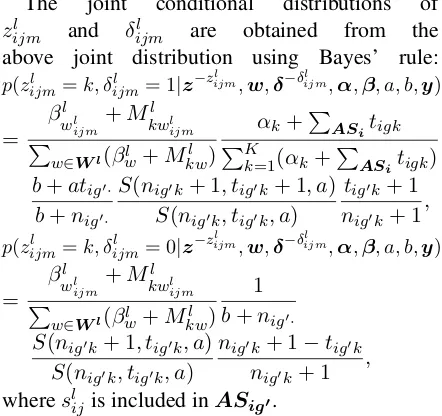
ijm and δijml are obtained from the above joint distribution using Bayes’ rule:
p(zijml =k, δijml = 1|z−z
l
ijm,w,δ−δlijm,α,β, a, b,y)
= β
l wl
ijm+M
l kwl
ijm ∑
w∈Wl(βwl +Mkwl )
αk+∑ASitigk
∑K
k=1(αk+∑ASitigk)
b+atig′· b+nig′·
S(nig′k+ 1, tig′k+ 1, a) S(nig′k, tig′k, a)
tig′k+ 1 nig′k+ 1,
p(zijml =k, δijml = 0|z−z
l
ijm,w,δ−δlijm,α,β, a, b,y)
= β
l wl
ijm+M
l kwl
ijm ∑
w∈Wl(βwl +Mkwl )
1
b+nig′· S(nig′k+ 1, tig′k, a)
S(nig′k, tig′k, a)
nig′k+ 1−tig′k nig′k+ 1 ,
wheresl
ij is included inASig′. Samplingy:
In our inference, each aligned segment set cor-responds to a restaurant in the CRP. We regard the sampling ofyijj′ as the choice of splitting or
merging restaurant(s) in a manner similar to that 3(b|a)
[image:4.595.306.527.460.668.2]in the sampling of segmentation boundaries in Du et al. (2013). In particular, if yijj′ = 0, then
one aligned segment set ASm is split into two aligned segment setsASl andASr, whereASl, ASr, and ASm include seij, sfij′, and both,
re-spectively. If yijj′ = 1, then ASl andASr are merged to ASm. For simplicity, our inference specifiesASl andASr based on the currentyas follows: if ASi(se
ij) = ASi(sfij′), then ASl =
{se
ij} ∪ASif(seij)\ {sijf′} and ASr = {sfij′} ∪ ASe
i(sfij′)\{seij}; otherwise,ASl =ASi(seij)and ASr=ASi(sfij′). Here,ASi(j)is the element set ofASi that includes the segment j, andASil(j) is the set of segments in language l included in ASi(j). For example, in the example in Section 3, ASi(sfi1) = ASi1 = {sei1, sfi1, sfi2}, ASie(sfi1) =
{se
i1}, andASif(sfi1) = {sfi1, sfi2}. In addition, if yi11 = 0, thenASm ={sie1, sfi1, sfi2}is split into ASl = {sei1} ∪ ASif(sei1)\ {sfi1} = {sei1, sfi2} andASr = {sfi1} ∪ASie(sif1)\ {sei1} = {sfi1}. If yi23 = 1, then ASl = ASi(sei2) = {sei2} and ASr = ASi(sif3) = {sfi3} are merged to ASm={sei2, sfi3}.
The conditional distributions of yijj′ are as
follows:
p(yijj′ = 0|y−yijj′,z,w,δ,α, a, b, η0, η1)
∝ η0+ci0
η0+η1+ci0+ci1BetaK
(
α+∑
ASi
tig
)
∏
g∈{ASl,ASr}
(b|a)tig·
(b)nig· K
∏
k=1
S(nigk, tigk, a),
p(yijj′ = 1|y−yijj′,z,w,t\T,α, a, b, η0, η1)
∝∑
T
(
η1+ci1
η0+η1+ci0+ci1BetaK
(
α+∑
ASi
tig
)
(b|a)ti,ASm,·
(b)ni,ASm,· K
∏
k=1
S(ni,ASm,k, ti,ASm,k, a) )
,
where T is the set of tigk such that for either or both ofASl andASr, tigk = 1. ci0 andci1 are the total number of yi’s whose values are 0 and that ofyi’s whose values are 1, respectively. Note that we change yi’s that relate to the selected action (merging or splitting), in addition toyijj′ to
maintain consistency between y and the aligned segment sets.
Inference ofθ,ν,ϕ:
Although our inference does not directly estimate θ, ν, and ϕ, these variables can be inferred from the following posterior expected values via
Algorithm 3 Generative Process for Segments 1:foreach documentdl
i(i∈ {1, ..., D})do 2: chooseπl
i ∼Beta(λ0,λ1) 3: foreach passageul
ih(h∈ {1, ..., Uil})do 4: chooseρl
ih∼Bernoulli(πil) 5: end for
6: sl
i= concatenate(uli,ρli) 7:end for
sampling:
ˆ
θik =Ezi,ti|wi,α,β,a,b,y
[
αk+∑ASitigk
∑K
k=1(αk+∑ASitigk)
]
,
ˆ
νigk =Ezi,ti|wi,α,β,a,b,y
[
nigk−atigk
b+nig· +θik
atig·+b
b+nig· ]
,
ˆ
ϕl
kw=Ez,t|w,α,β,a,b,y
[
βl
w+Mkwl
∑
w′∈Wl(βwl′ +Mkwl ′) ]
.
4 Integration of Topic Segmentation into BiSTM (BiSTM+TS)
To infer segmentation boundaries simultaneously with cross-lingual topics, we integrate the unsu-pervised Bayesian topic segmentation method pro-posed by Du et al. (2013) into the propro-posed BiSTM (BiSTM+TS).
We assume that each segment is a sequence of topically-related passages. In particular, we con-sider a sentence as a passage. Our segmenta-tion model defines a segment in document dl
i by a boundary indicator variable ρl
ih for each pas-sage ul
ih (h ∈ {1, ..., Uil}); ρlih is 1 if there is a boundary after passageul
ih(otherwise 0). For ex-ample, ρl
i = (0,1,0,0,1)indicates that the doc-ument dl
i comprises the two segments{uli1, uli2} and{ul
i3, uli4, uli5}.
Algorithm 3 shows the generative process for segments. The generative process of BiSTM+TS inserts Algorithm 3 between Steps 7 and 8 of Al-gorithm 2. Note that two documents(de
i, dfi) ∈ di are segmented independently. BiSTM+TS as-sumes that each document dl
i has its own topic shift probability πl
i. For each document dli, πil is first drawn from a Beta distribution with the priors λ0 and λ1 (Step 2). Then, for each pas-sage ul
ih (h ∈ {1, ..., Uil}), ρlih is drawn from a Bernoulli distribution with the prior πl
i (Step 4). Finally, segmentssl
iare generated by concatenat-ing passages based onρl
4.1 Inference for BiSTM+TS
Our inference for BiSTM+TS alternates three dif-ferent kinds of blocks, sampling of ρ and sam-plings for BiSTM ((z,δ) andy). The conditional distribution ofρcomprises the Gibbs probability for splitting one segmentsminto two segmentssr andslby placing the boundary afterul
ih(ρlih= 1) and that for mergingsrandsltosmby removing the boundary afterul
ih(ρlih= 0).
These probabilities are estimated in the same manner as the conditional probabilities of yijj′,
wherey(yijj′ = 0,1),ASl,ASr,ASm,η0, and η1are replaced withρ(ρlih= 1,0),sl,sr,sm,λ1, andλ0, respectively, and the statisticstandnare summed for every segment rather than for every aligned segment set (see Equation (6) and (9) in Du et al. (2013)).
Our inference assumes that sampling ρ does not depend on aligned segments in the other lan-guage, i.e., y4. After splitting or merging, we set they’s of sm, sl, andsr as follows: ifsm is split intosl andsr, thenAS(sl) = AS(sm) and AS(sr) =AS(sm); ifslandsrare merged tosm, thenAS(sm) =AS(sl)∪AS(sr).
5 Experiment
We evaluated the proposed models in terms of perplexity and performance in translation pair extraction, which is a well-known application that uses a bilingual topic model. We used a document-aligned comparable corpus comprising 3,995 document pairs, each of which is a Japanese Wikipedia article in the Kyoto Wiki Corpus5 and its corresponding English Wikipedia article6. Note that the English articles were collected from the English Wikipedia database dump (2 June 2015)7 based on inter-language links, even though the original Kyoto Wiki corpus is a parallel corpus, in which each sentence in the Japanese articles is manually translated into English. Thus, our perimental data is not a parallel corpus. We ex-tracted texts from the collected English articles using an open-source script8. All Japanese and 4We leave a bilingual extension of the topic segmentation, i.e., incorporation ofy, for future work.
5http://alaginrc.nict.go.jp/
WikiCorpus/index_E.html
6We filtered out the Japanese articles that do not have cor-responding English articles.
7http://dumps.wikimedia.org/enwiki/ 8https://github.com/attardi/
wikiextractor/
English texts were segmented using MeCab9 and TreeTagger10(Schmid, 1994), respectively. Then, function words were removed, and the remaining words were lemmatized to reduce data sparsity.
For translation extraction experiments, we au-tomatically created a gold-standard translation set according to Liu et al. (2013). We first com-puted p(we|wf) and p(wf|we) by running IBM Model 4 on the original Kyoto Wiki corpus, which is a parallel corpus, using GIZA++ (Och and Ney, 2003), and then extracted word pairs
( ˆwe,wˆf) that satisfy both of the following con-ditions: wˆe = argmax
wep(we|wf = ˆwf) and
ˆ
wf = argmax
wfp(wf|we = ˆwe). Finally, we
eliminated word pairs that do not appear in the document pairs in the document-aligned compa-rable corpus. We used all 7,930 Japanese words in the resulting gold-standard set as the evaluation input.
5.1 Competing Methods
We compared the proposed models (BiSTM and BiSTM+TS) with a standard bilingual topic model (BiLDA). BiSTM considers each section in Wikipedia articles as a segment. Note that align-ments between sections are not given in our exper-imental data. Thus, yis inferred in both BiSTM and BiSTM+TS.
As in the proposed models, BiLDA was trained using Gibbs sampling (Mimno et al., 2009; Ni et al., 2009; Vuli´c et al., 2015). In the training of each model, each variable was first initialized. Here,zl
ijmis randomly initialized to an integer be-tween 1 andK, and each ofδl
ijm,yijj′, andρlihis
randomly initialized to 0 or 1. We then performed 10,000 Gibbs iterations. We used the symmetric prior αk = 50/K and βwl = 0.01 over θ and ϕl, respectively, in accordance with Vuli´c et al. (2011). The hyperparametersa,b,λ0, andλ1were set to 0.2, 10, 0.1, and 0.1, respectively, in accor-dance with Du et al. (2010; 2013). Bothη0 and η1were set to 0.2 as a result of preliminary exper-iments. We used several values of K to measure the impact of topic size: we usedK = 100and K = 400 in accordance with Liu et al. (2013) in addition to the suggested valueK = 2,000in Vuli´c et al. (2011).
In the translation extraction experiments, 9http://taku910.github.io/mecab/
10http://www.cis.uni-muenchen.de/
Model K=100 K=400 K=2,000 BiLDA 693.6 530.7 479.9 BiSTM 520.1 429.3 394.6 BiSTM+TS 537.5 445.3 411.8
Table 2: Test Set Perplexity
we used two translation extraction methods, i.e., Cue (Vuli´c et al., 2011) and Liu (Liu et al., 2013). Both methods first infer cross-lingual topics for words using a bicross-lingual topic model (BiLDA/BiSTM/BiSTM+TS) and then extract word pairs (we, wf) with a high value of the probability p(we|wf) de-fined by the inferred topics. Cue calculates p(we|wf) = ∑K
k=1p(we|k)p(k|wf), where p(k|w) ∝ ∑Kp(w|k)
k=1p(w|k) and p(w|k) = ϕkw. Liu first converts a document-aligned com-parable corpus into a topic-aligned parallel corpus according to the topics of words and computes p(we|wf, k) by running IBM Model 1 on the parallel corpus. Liu then calcu-lates p(we|wf) = ∑K
k=1p(we|wf, k)p(k|wf). Hereafter, a bilingual topic model used in an extraction method is shown in parentheses, e.g.,
Cue(BiLDA) denotesCuewith BiLDA. 5.2 Experimental Results
We evaluated the predictive performance of each model by computing the test set perplexity based on 5-fold cross validation. A lower perplexity in-dicates better generalization performance. Table 2 shows the perplexity of each model. As can be seen, BiSTM and BiSTM+TS are better than BiLDA in terms of perplexity.
We measured the performance of translation ex-traction with top N accuracy (ACCN), the number
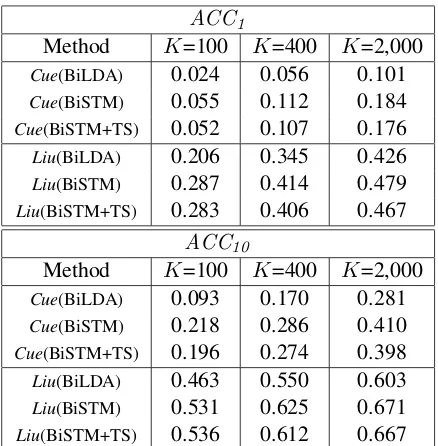
of test words whose top N translation candidates contain a correct translation over the total num-ber of test words (7,930). Table 3 summarizes ACC1 and ACC10 for each model. As can be
seen, Cue/Liu(BiSTM) andCue/Liu(BiSTM+TS) significantly outperform Cue/Liu(BiLDA) (p <
0.01in the sign test). This indicates that BiSTM and BiSTM+TS improve the performance of trans-lation extraction for both theCueandLiumethods by assigning more suitable topics.
Both experiments prove that capturing segment-level alignments is effective for modeling bilin-gual data. In addition, these experiments show that BiSTM+TS is comparable with BiSTM,
indicat-ACC1
Method K=100 K=400 K=2,000 Cue(BiLDA) 0.024 0.056 0.101 Cue(BiSTM) 0.055 0.112 0.184 Cue(BiSTM+TS) 0.052 0.107 0.176 Liu(BiLDA) 0.206 0.345 0.426 Liu(BiSTM) 0.287 0.414 0.479 Liu(BiSTM+TS) 0.283 0.406 0.467
ACC10
Method K=100 K=400 K=2,000 Cue(BiLDA) 0.093 0.170 0.281 Cue(BiSTM) 0.218 0.286 0.410 Cue(BiSTM+TS) 0.196 0.274 0.398 Liu(BiLDA) 0.463 0.550 0.603 Liu(BiSTM) 0.531 0.625 0.671 Liu(BiSTM+TS) 0.536 0.612 0.667 Table 3: Performance of Translation Extraction
Referencey= 1 Referencey= 0
Inferencey= 1 195 174
Inferencey= 0 43 1132
Table 4: Distribution of Segment-level Align-ments
ing that the proposed model could yield a signifi-cant benefit even if the boundaries of segments are unknown.
Tables 2 and 3 show that a larger topic size yields better performance for each model. Fur-thermore, Liuoutperforms Cue regardless of the choice of bilingual topic models, which is con-sistent with previously reported results (Liu et al., 2013). The results of our experiments demonstrate that the proposed models have the same tendencies as BiLDA.
6 Discussion
6.1 Inferred Segment-level Alignments We created a reference set to evaluate segment-level alignmentsyinferred by BiSTM (K=2,000). We randomly selected 100 document pairs from the comparable corpus and then manually iden-tified cross-lingual alignments between sections. Table 4 shows the distribution of inferredyvalues and that ofyvalues in the reference set. As can be seen, the accuracy ofyis 0.859 (1,327/1,544).
[image:7.595.77.283.62.120.2]Model Japanese article English article
BiSTM 4.8 2.9
[image:8.595.324.509.61.217.2]BiSTM+TS 10.6 4.1
Table 5: Average Number of Segments
Japanese section “history” and the English sec-tion “Bujutsu (old type of Budo)” in the “Budo (a Japanese martial art)” article pair, where a part of the English section “Bujutsu” is described in the Japanese section “history.” Such errors might not necessarily have a negative effect, because partial alignments can be useful.
6.2 Inferred Segmentation Boundaries This section compares segment boundaries in-ferred by BiSTM+TS (K=2,000) with section boundaries in the original articles, which have been referred to by BiSTM. The recall of BiSTM+TS for the original section boundaries is 0.727. This indicates that the unsupervised segmentation in BiSTM+TS finds drastic topical changes, i.e., section boundaries, with high recall. Table 5 shows the average number of seg-ments per article for each model. As can be seen, BiSTM+TS divides an article into segments smaller than the original sections. This seems to be reasonable, because some original sections in-clude multiple topics. However, Tables 2 and 3 show that inferred boundaries do not work better than section boundaries. One reason for that is that some errors are caused by a sparseness prob-lem, when BiSTM+TS separates an article into ex-tremely fine-grained segments. In addition, Table 5 reveals that BiSTM+TS increases the gap be-tween languages. Thus, segmentation with a com-parable granularity between languages might be favorable for the proposed models.
6.3 Effectiveness for an English–French Wikipedia Corpus
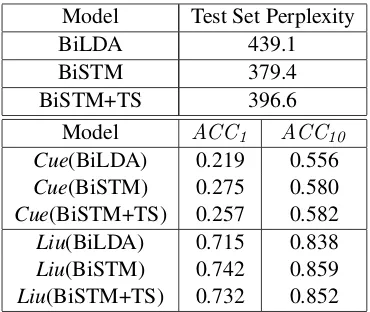
We evaluated BiLDA, BiSTM, and BiSTM+TS in terms of perplexity and performance in translation extraction on an English–French Wikipedia corpus to verify the effectiveness of the proposed models for language pairs other than English–Japanese. The settings, e.g., parameters, for each model are the same as in Section 5. Note that we report only the performances of each model withK = 2,000, because all models achieved the best performances whenK= 2,000.
Model Test Set Perplexity
BiLDA 439.1
BiSTM 379.4
BiSTM+TS 396.6
Model ACC1 ACC10
Cue(BiLDA) 0.219 0.556
Cue(BiSTM) 0.275 0.580
Cue(BiSTM+TS) 0.257 0.582
Liu(BiLDA) 0.715 0.838
Liu(BiSTM) 0.742 0.859
Liu(BiSTM+TS) 0.732 0.852
Table 6: Performance on an English–French Wikipedia Corpus (K = 2,000)
We collected French articles that correspond to the English articles used in the experiments in Section 5, from the French Wikipedia database dump (2 June 2015) based on inter-language links. As a result, our English–French corpus comprises 3,159 document pairs. The French articles were preprocessed in the same manner as the English ar-ticles: text extraction using the open-source script, segmentation using TreeTagger, removal of func-tion words, and lemmatizafunc-tion.
We created a gold-standard translation set for translation extraction experiments using Google Translate service11 in a manner similar to that in Gouws et al. (2015) and Coulmance et al. (2015), translating the French words in our corpus us-ing Google Translate, and then eliminatus-ing word pairs that do not appear in the document pairs in our corpus. We used the top 1,000 most frequent French words in the resulting gold-standard set as the evaluation input.
Table 6 summarizes ACC1, ACC10, and
per-plexity. It shows that the proposed models are ef-fective also for the English–French Wikipedia cor-pus. BiSTM and BiSTM+TS outperform BiLDA in terms of perplexity and performance of transla-tion extractransla-tion, and BiSTM+TS works well even if the boundaries of segments are unknown.
7 Related Work
Multilingual topic models other than BiLDA (Sec-tion 2) have been proposed for document-aligned comparable corpora. Fukumasu et al. (2012) ap-plied SwitchLDA (Newman et al., 2006) and Cor-respondence LDA (Blei and Jordan, 2003), which
[image:8.595.78.294.64.107.2]were originally intended to work with multimodal data, such as annotated image data, to modeling multilingual text data. They also proposed a sym-metric version of Correspondence LDA. Platt et al. (2010) projected monolingual models based on PLSA or Principal Component Analysis into a shared multilingual space with the constraint that document pairs must map to similar locations. Hu et al. (2014) proposed a multilingual tree-based topic model that uses a hierarchical bilingual dic-tionary in addition to document alignments. Note that these models do not consider segment-level alignments.
There are several multilingual topic models tai-lored for data other than a document-aligned com-parable corpus, including bilingual topic mod-els for word alignment and machine translation on parallel sentence pairs (Zhao and Xing, 2006; Zhao and Xing, 2008). Some models have mined multilingual topics from unaligned text data by bridging the gap between different lan-guages using a bilingual dictionary (Jagarlamudi and Daum´e III, 2010; Zhang et al., 2010; Negi, 2011). Boyd-Graber and Blei (2009) used parallel sentences in combination with a bilingual dictio-nary. However, these models have the drawback that they require a parallel corpus or a bilingual dictionary in advance, which cannot be obtained for some language pairs or domains.
In a monolingual setting, some topic models that consider segment-level topics have been pro-posed. Du et al. (2010) considered a document as a set of segments and generated each per-segment topic distribution from the topic distribution of the related document through a Pitman–Yor process. Others have considered a document as a sequence of segments. Cheng et al. (2009) reflected the un-derlying sequences of segments’ topics by posit-ing a permutation distribution over a document. Wang et al. (2011) modeled topical sequences in documents with a latent first-order Markov chain, and Du et al. (2012) generated each per-segment topic distribution from the topic distribution of its document and that of its previous segment. Note that none of these models have been extended to a multilingual setting.
8 Conclusions
In this paper, we proposed BiSTM, which models a document hierarchically and deals with segment-level alignments. BiSTM assigns the same topic
distribution to both aligned documents and aligned segments. We also presented an extended model, BiSTM+TS, that infers segmentation boundaries in addition to latent topics by incorporating unsu-pervised topic segmentation (Du et al., 2013). Our experimental results show that capturing segment-level alignments improves perplexity and transla-tion extractransla-tion performance, and that BiSTM+TS yields a significant benefit even if the boundaries of segments are not given.
This paper presented an extension to BiLDA, but hierarchical structures can also be incorporated into other bilingual topic models (Section 7). As future work, we would like to verify the effec-tiveness of the proposed models for other datasets or other cross-lingual tasks, such as cross-lingual document classification (Ni et al., 2009; Platt et al., 2010; Ni et al., 2011; Smet et al., 2011) and cross-lingual information retrieval (Vuli´c et al., 2013).
Acknowledgments
We thank Atsushi Fujita for valuable comments on earlier versions of this manuscript.
References
David M. Blei and Michael I. Jordan. 2003. Model-ing Annotated Data. InProceedings of the 26th An-nual International ACM SIGIR Conference on Re-search and Development in Informaion Retrieval, pages 127–134.
David M. Blei, Andrew Y. Ng, and Michael I. Jordan. 2003. Latent Dirichlet Allocation. Journal of Ma-chine Learning Research, 3:993–1022.
Jordan Boyd-Graber and David M. Blei. 2009. Mul-tilingual Topic Models for Unaligned Text. In Pro-ceedings of the Twenty-Fifth Conference on Uncer-tainty in Artificial Intelligence, pages 75–82. Wray Buntine and Marcus Hutter. 2012. A Bayesian
View of the Poisson-Dirichlet Process. http:// arxiv.org/pdf/1007.0296.pdf.
Harr Chen, S.R.K. Branavan, Regina Barzilay, and David R. Karger. 2009. Global Models of Docu-ment Structure using Latent Permutations. In Pro-ceedings of Human Language Technologies: The 2009 Annual Conference of the North American Chapter of the Association for Computational Lin-guistics, pages 371–379.
Principles and Practice of Knowledge Discovery in Databases 2011, pages 296–311.
Jocelyn Coulmance, Jean-Marc Marty, Guillaume Wenzek, and Amine Benhalloum. 2015. Trans-gram, Fast Cross-lingual Word-embeddings. In Pro-ceedings of the 2015 Conference on Empirical Meth-ods in Natural Language Processing, pages 1109– 1113.
Lan Du, Wray Buntine, and Huidong Jin. 2010. A Segmented Topic Model Based on the Two-parameter Poisson-Dirichlet Process. Machine Learning, 81(1):5–19.
Lan Du, Wray Buntine, and Huidong Jin. 2012. Modelling Sequential Text with an Adaptive Topic Model. In Proceedings of the 2012 Joint Confer-ence on Empirical Methods in Natural Language Processing and Computational Natural Language Learning, pages 535–545.
Lan Du, Wray Buntine, and Mark Johnson. 2013. Topic Segmentation with a Structured Topic Model. InProceedings of the 2013 Conference of the North American Chapter of the Association for Computa-tional Linguistics: Human Language Technologies, pages 190–200.
Kosuke Fukumasu, Koji Eguchi, and Eric P. Xing. 2012. Symmetric Correspondence Topic Models for Multilingual Text Analysis. In Advances in Neu-ral Information Processing Systems 25, pages 1286– 1294.
Stephan Gouws, Yoshua Bengio, and Greg Corrado. 2015. BilBOWA: Fast Bilingual Distributed Rep-resentations without Word Alignments. In Proceed-ings of the 32nd International Conference on Ma-chine Learning, pages 748–756.
Thomas Hofmann. 1999. Probabilistic Latent Seman-tic Indexing. In Proceedings of the 22nd Annual International ACM SIGIR Conference on Research and Development in Information Retrieval, pages 50–57.
Leetsch C. Hsu and Peter Jau-Shyong Shiue. 1998. A Unified Approach to Generalized Stirling Numbers. Advances in Applied Mathematics, 20(3):366–384.
Yuening Hu, Ke Zhai, Vladimir Eidelman, and Jordan Boyd-Graber. 2014. Polylingual Tree-Based Topic Models for Translation Domain Adaptation. In Pro-ceedings of the 52nd Annual Meeting of the Asso-ciation for Computational Linguistics, pages 1166– 1176.
Jagadeesh Jagarlamudi and Hal Daum´e III. 2010. Ex-tracting Multilingual Topics from Unaligned Com-parable Corpora. In Proceedings of the 32nd Eu-ropean Conference on Advances in Information Re-trieval, pages 444–456.
Xiaodong Liu, Kevin Duh, and Yuji Matsumoto. 2013. Topic Models + Word Alignment = A Flexible Framework for Extracting Bilingual Dictionary from Comparable Corpus. In Proceedings of the Seven-teenth Conference on Computational Natural Lan-guage Learning, pages 212–221.
David Mimno, Hanna M. Wallach, Jason Naradowsky, David A. Smith, and Andrew McCallum. 2009. Polylingual Topic Models. In Proceedings of the 2009 Conference on Empirical Methods in Natural Language Processing, pages 880–889.
Sumit Negi. 2011. Mining Bilingual Topic Hierarchies from Unaligned Text. InProceedings of 5th Interna-tional Joint Conference on Natural Language Pro-cessing, pages 992–1000.
David Newman, Chaitanya Chemudugunta, Padhraic Smyth, and Mark Steyvers. 2006. Statistical Entity-topic Models. In Proceedings of the 12th ACM SIGKDD International Conference on Knowledge Discovery and Data Mining, pages 680–686. Xiaochuan Ni, Jian-Tao Sun, Jian Hu, and Zheng Chen.
2009. Mining Multilingual Topics from Wikipedia. InProceedings of the 18th International World Wide Web Conference, pages 1155–1156.
Xiaochuan Ni, Jian-Tao Sun, Jian Hu, and Zheng Chen. 2011. Cross Lingual Text Classification by Mining Multilingual Topics from Wikipedia. In Proceed-ings of the Fourth ACM International Conference on Web Search and Data Mining, pages 375–384. Franz Josef Och and Hermann Ney. 2003. A
System-atic Comparison of Various Statistical Alignment Models.Computational Linguistics, 29:19–51. Jim Pitman and Marc Yor. 1997. The Two-Parameter
Poisson-Dirichlet Distribution Derived from a Sta-ble Subordinator. The Annals of Probability, 25(2):855–900.
John Platt, Kristina Toutanova, and Wen tau Yih. 2010. Translingual Document Representations from Dis-criminative Projections. InProceedings of the 2010 Conference on Empirical Methods in Natural Lan-guage Processing, pages 251–261.
Helmut Schmid. 1994. Probabilistic Part-of-Speech Tagging Using Decision Trees. In Proceedings of the International Conference on New Methods in Language Processing, pages 44–49.
Wim De Smet, Jie Tang, and Marie-Francine Moens. 2011. Knowledge Transfer Across Multilingual Corpora via Latent Topics. In Proceedings of the 15th Pacific-Asia Conference on Advances in Knowledge Discovery and Data Mining, pages 549– 560.
Associ-ation for ComputAssoci-ational Linguistics: Human Lan-guage Technologies, pages 479–484.
Ivan Vuli´c, Wim De Smet, and Marie-Francine Moens. 2013. Cross-Language Information Retrieval Mod-els Based on Latent Topic ModMod-els Trained with Document-Aligned Comparable Corpora. Informa-tion Retrieval, 16(3):331–368.
Ivan Vuli´c, Wim De Smet, Jie Tang, and Marie-Francine Moens. 2015. Probabilistic Topic Mod-eling in Multilingual Settings: An Overview of Its Methodology and Applications. Information Pro-cessing & Management, 51(1):111–147.
Hongning Wang, Duo Zhang, and ChengXiang Zhai. 2011. Structural Topic Model for Latent Topical Structure Analysis. InProceedings of the 49th An-nual Meeting of the Association for Computational Linguistics: Human Language Technologies, pages 1526–1535.
Duo Zhang, Qiaozhu Mei, and ChengXiang Zhai. 2010. Cross-Lingual Latent Topic Extraction. In Proceedings of the 48th Annual Meeting of the Asso-ciation for Computational Linguistics, pages 1128– 1137.
Bing Zhao and Eric P. Xing. 2006. BiTAM: Bilingual Topic AdMixture Models for Word Alignment. In Proceedings of the 21st International Conference on Computational Linguistics and 44th Annual Meet-ing of the Association for Computational LMeet-inguis- Linguis-tics, pages 969–976.