122
WordNet Embeddings
Chakaveh Saedi, António Branco, João António Rodrigues, João Ricardo Silva University of Lisbon
NLX-Natural Language and Speech Group, Department of Informatics Faculdade de Ciências
Campo Grande, 1749-016 Lisboa, Portugal
{chakaveh.saedi, antonio.branco, joao.rodrigues, jsilva}@di.fc.ul.pt
Abstract
Semantic networks and semantic spaces have been two prominent approaches to represent lexical semantics. While a uni-fied account of the lexical meaning re-lies on one being able to convert between these representations, in both directions, the conversion direction from semantic networks into semantic spaces started to attract more attention recently. In this pa-per we present a methodology for this con-version and assess it with a case study. When it is applied over WordNet, the per-formance of the resulting embeddings in a mainstream semantic similarity task is very good, substantially superior to the performance of word embeddings based on very large collections of texts like word2vec.
1 Introduction
The study of lexical semantics has been at the core of the research on language science and technol-ogy as the meaning of linguistic forms results from the meaning of their lexical units and from the way these are combined (Pelletier, 2016). How to represent lexical semantics has thus been a cen-tral topic of inquiry. Three broad families of ap-proaches have emerged in this respect, namely those advocating that lexical semantics is repre-sented as a semantic network (Quillan, 1966), a feature-based model (Minsky,1975;Bobrow and Norman,1975), or a semantic space (Harris,1954;
Osgood et al.,1957).
In terms of data structures, under a semantic network approach, the meaning of a lexical unit is represented as a node in a graph whose edges between nodes encode different types of seman-tic relations holding among the units (e.g.
hyper-nymy, merohyper-nymy, etc.). In a feature-based model, the semantics of a lexicon is represented by a hash table where a key is the lexical unit of interest and the respective value is a set of other units denoting typical characteristics of the denotation of the unit in the key (e.g. role, usage or shape, etc.). Under a semantic space perspective, in turn, the mean-ing of a lexical unit is represented by a vector in a high-dimensional space, where each component is based on some frequency level of co-occurrence with the other units in contexts of language usage. The motivation for these three families of lexi-cal representation is to be found in their different suitability and success in explaining a wide range of empirical phenomena, in terms of how these are manifest in ordinary language usage and how they are elicited in laboratory experimentation. These phenomena are related to the acquisition, storage and retrieval of lexical knowledge (e.g. the spread activation effect (Meyer and Schvaneveldt,1971), the fan effect (Anderson,1974), among many oth-ers) and to how this knowledge interacts with other cognitive faculties or tasks, including categoriza-tion (Estes, 1994), reasoning (Rips, 1975), prob-lem solving (Holyoak and Koh, 1987), learning (Ross,1984), etc.
informa-tion encoded in Small World of Words is evoked from laypersons; and word2vec is built on the ba-sis of the co-occurrence frequency of lexical units in a collection of documents.
Even when motivated in the first place by psy-cholinguistic research goals, these repositories of lexical knowledge have been extraordinarily im-portant for language technology. They have been instrumental for major advances in language pro-cessing tasks and applications such as word sense disambiguation, part-of-speech tagging, named entity recognition, sentiment analysis (e.g. (Li and Jurafsky,2015)), parsing (e.g. (Socher et al.,
2013)), textual entailment (e.g. (Baroni et al.,
2012)), discourse analysis (e.g. (Ji and Eisenstein,
2014)), among many others.1
The proliferation of different types of represen-tation for the same object of research is common in science, and searching for a unified rendering of a given research domain has been a major goal in many disciplines. To a large extent, such search focuses on finding ways of converting from one type of representation into another. Once this is made possible, it brings not only the theoretical satisfaction of getting a better unified insight into the research object, but also important instrumen-tal rewards of reapplying results, resources and tools that had been obtained under one representa-tion to the other representarepresenta-tions, thus opening the potential for further research advances.
This is the case also in what concerns the re-search on lexical semantics. Establishing whether and how any given lexical representation can be converted into another representation is important for a more unified account of it. On the language science side, this will likely enhance the plausibil-ity of our empirical modeling about how the mind-brain handles lexical meaning. On the language technology side, in turn, this will permit to reuse resources and find new ways to combine different sources of lexical information for better applica-tion results.
In the present paper, we seek to contribute to-wards a unified account of lexical semantics. We report on the methodology we used to convert from a semantic network based representation of lexical meaning into a semantic space based one, and on the successful evaluation results obtained when applying that methodology. We resorted to
1For the vast number of applications of WordNet, see http://lit.csci.unt.edu/∼wordnet
Princeton WordNet version 3 as a repository of the lexical semantics of the English language, repre-sented as a semantic graph, and converted a sub-graph of it with half of its concepts into wnet2vec, a collection of vectors in a high-dimension space. These WordNet embeddings were evaluated un-der the same conditions that semantic space based repositories like word2vec are, namely under the processing task of determining the semantic sim-ilarity between pairs of lexical units. The evalua-tion results obtained for wnet2vec are around 15% superior to the results obtained for word2vec with the same mainstream evaluation data set SimLex-999 (Hill et al.,2016).
2 Distributional vectors from ontological graphs
For a given word w, its distributional represen-tation w~ (aka word embedding) is a high dimen-sion vector whose elements w~i record real val-ued scores expressing the strength of the seman-tic affinity of w with other words in the vocab-ulary. The usual source of these scores, and ul-timately the empirical base of word embeddings, has been the frequency of co-occurrence between words taken from large collections of text.
The goal here instead is to use semantic net-works as the empirical source of word embed-dings. This will permit that the lexical knowledge that is encoded in a semantic graph be re-encoded as an embeddings matrix compiling the distribu-tional vectors of the words in the vocabulary.
To determine the strength of semantic affinity of two words from their representation in a semantic graph, we follow this intuition: the larger the num-ber of paths and the shorter the paths connecting any two nodes the stronger is their affinity.
To make this intuition operative we resort to the following procedure, to be refined later on. First, the semantic graph G is represented as an adja-cency matrixM such that iff two nodes ofGwith wordswi andwj are related by an edge represent-ing a direct semantic relation between them, the elementMij is set to 1 (to 0 otherwise).
Second, to enrichM with scores that represent the strength of semantic affinity of nodes not di-rectly connected with each other by an edge, the following cumulative iteration is resorted to
MG(n)=I+αM +α2M2+. . .+αnMn (1)
the transition matrix, Mn, is the matrix where eachMij counts the number of paths of lenghtn between nodesiandj; andα <1is a decay fac-tor determining how longer paths are dominated by shorter ones.
Third, this iterative procedure is pursued until it converges into matrixMG, which is analytically obtained by an inverse matrix operation given by2
MG = ∞ X
e=0
(αM)e= (I−αM)−1 (2)
3 WordNet embeddings
In order to assess this procedure, we use it to convert a mainstream ontological graph into an embeddings matrix. We use Princeton WordNet (Fellbaum, 1998) as our working semantic net-work. This is a lexical ontology for English with over 120k concepts that are related by over 25 types of semantic relations and comprise over 155k words (lemmas), from the categories Noun (with 117k words), Verb, Adjective and Adverb.
The quality of the resulting semantic space (based on a semantic network) is assessed by re-sorting to the mainstream procedure to evaluate se-mantic spaces: (i) it is used to solve the task of de-termining the semantic similarity between words in a mainstream test data set used in the litera-ture; (ii) its performance is compared to the per-formance of a mainstream semantic space (based on a text collection), namely word2vec (Mikolov et al.,2013b), which serves as our baseline.
The base data set was obtained by extracting a sub-graph from WordNet that supports a 60k word distributional matrix. All parts of speech in Word-Net were considered.
The nodes in WordNet are related by differ-ent types of semantic relations (e.g. hypernymy, meronymy, etc.). Relations of different types were taken into account with identical weight for the sake of the conversion of the graph into a matrix.
Upon applying the conversion procedure by re-solving equation (2),3 its outcome MG was sub-ject to the Positive Point-wise Mutual Information transformation (PMI+) seeking to reduce the even-tual bias introduced by the conversion towards words with more senses.
2This is equation (7.63) in (Newman,2010) where it is presented as a regular equivalence measure termed Katz sim-ilarity.
3We usedlinalg.invfrom thenumpypackage for the inverse matrix calculation.
Model Similarity
wnet2vec 0.50
[image:3.595.359.474.64.121.2]word2vec 0.44
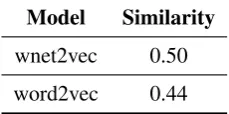
Table 1: Performance in semantic similarity task over SimLex-999 given by Spearman’s coefficient (higher score is better).
For the sound application of the conversion, each line inMGwas normalized, using L2-norm, so that it corresponds to a vector whose scores sum to 1, corresponding to a transition matrix.
Finally, we used Principal Component Analysis (PCA) (Wold et al.,1987) to transform the matrix, reducing the size of the vectors and setting to 850 the dimension of the encoded semantic space.
To assess the quality of the resulting semantic space, we resorted to the test data set SimLex-999 (Hill et al., 2016), containing a list of 999 pairs of words. Each pair is associated with a score, on a 0-10 scale, that indicates the strength of the se-mantic similarity between the words in that pair. For each pair, with the resulting embedding ma-trix, the cosine between the vectors of the words in that pair is calculated and mapped into the 0-10 scale. The outcome is compared to the gold standard scores in SimLex-999 resorting to Spear-man’s rank correlation coefficient.4 The respective scores are displayed in Table1.
4 Discussion
These results indicate a clear advantage of around 15% of the WordNet embeddings, scoring 0.50, over the word2vec embeddings, scoring 0.44. This indicates that the proposed conversion procedure is very effective.
WordNet embeddings is a semantic space em-pirically based on an internal language resource: on a systematic elicitation and recording of the semantic relations between words, thus being closely aligned with the lexical knowledge in the minds of speakers. Word2vec, in turn, is a se-mantic space empirically based on an external lan-guage resource: on records of contingent lanlan-guage usage, namely some texts that were produced by a population of language users and happened to be
4We used theevaluate_word_pairsfunction from
collected together. Hence, while words related by some semantic relation are likely to be linked in WordNet, they may happen to rarely or never oc-cur in relevant context windows, as practical con-straints on the production and usage of language may not favor that. This may help to explain the advantage of wnet2vec over word2vec.5
The conversion procedure is composed by a number of steps where each may receive a range of configurations. This opens a large experimental space of which the experiment in Section3 instan-tiates one set of coordinates. In the remainder of the present section we justify the eventual empir-ical settings used and discuss the lessons learned by exploring this experimental space. The con-version procedure will be revisited in a backwards fashion, from its final to its initial steps, with the experiments being performed over the 60k subset identified in Subsection4.3.
4.1 Matrix manipulation
Vector dimension: There have been studies indi-cating the positive effect of the reduction of the dimensionality of the semantic space (e.g. ( Un-derhill et al.,2007;Grünauer and Vincze,2015)). We experimented with a range of final vector di-mensions, namely sizes 100, 300, 850, 1000 and 3000, also over evaluation data sets other than just SimLex-999.6 Results obtained consistently indi-cated that size 850 leads to better performance.7
Dimensionality reduction: We compared two different techniques for dimensionality reduction, PCA (Wold et al., 1987) and a neural network approach. For the neural solution, the encoder-decoder architecture with a Sigmoid activation function was employed. The model was trained using a Nadam optimizer with binary cross en-tropy as loss metric. Experimentation consistently indicated that PCA is substantially more success-ful.
Normalization and bias: We contrasted the performance of the WordNet embeddings obtained with and without normalization of the
distribu-5Naturally, the comparative advantage between a seman-tic space based on a semanseman-tic network and another based on a collection of texts depends also on the sizes of the net-work and of the collection. The training corpus of word2vec-GoogleNews-vectors we used is one of the largest, with an impressive amount of 100 billion tokens, and a vocabulary of 3 million types, which differently from the vocabulary units in WordNet, are wordforms, not lemmas (Mikolov et al., 2013a).
6More on evaluation data sets in Section4.4 7The vector size in word2vec embeddings is 300.
tional vectors. Results consistently indicated the advantage of doing normalization, even if for a small margin, with a delta of around0.08.
Ablation tests were done also with respect to PMI+, which indicated a clear advantage of ap-plying it.
4.2 Graph manipulation
Decay factor:The best results were achieved with
α = 0.75, after experimenting with values in the range0.65to0.85.
Picking semantic relations: Concepts in WordNet are connected via semantic relations of different types. The relations of Hyper-nymy/Hyponymy, Synonymy and Antonymy play an essential role in structuring a semantic network, as without them the network could not exist. We undertook experiments where all semantic rela-tions or only these kernel relarela-tions were taken into account for the conversion procedure, with results indicating a clear advantage for using all relations.
Weighting semantic relations: In the defini-tion of a semantic network, some types of re-lations appear as necessary (e.g. Hypernymy), while other appears as more secondary (e.g. Meronymy). It might thus happen that the con-version of a semantic network into a semantic space might be optimized if different weights were assigned to different relations accordingly. We ran an experiment where different weights were assigned to different relations, namely hyper-nymy, hypohyper-nymy, antonymy and synonymy got 1, meronymy and holonymy 0.8 and other relations 0.5; and another experiment where all types of semantic relation were assigned the same weight. Better results were obtained with the latter.
4.3 Base data sets
Subgraphs: The conversion procedure relies on equation (2), whose complexity is dominated by the calculation of the inverse matrix, which is of exponential order. For the Princeton WordNet graph, with over 120k concepts, given the size of the adjacency matrixM1is over120k×120k, its calculation and the overall conversion of the on-tological graph into the final embeddings matrix faces substantial challenges in terms of the mem-ory footprint. To cope with this issue, we resorted to initial subgraphs of manageable size.8
We reduced the size of M1 by eliminating more sparse rows (rows with more zero elements), corresponding to eliminating words in concepts with lower number of outgoing edges in Word-Net. Rows were ordered by decreasing sparsity, with rows with identical level of sparsity (identi-cal number of zero elements) randomly ordered among themselves. The first 25k, 30k, 45k and 60k rows were extracted and used in the conver-sion process. To maximize overlap wth test set SimLex-999, its words in WordNet were retained. The performance scores of the resulting models are displayed in Table2.
Random subgraphs 25k 30k 45k 60k
Semantic similarity 0.45 0.47 0.49 0.50
Table 2: Performance of wnet2vec in similarity task over SimLex-999 (Spearman’s coefficient).
The larger the size of the WordNet subgraph the better is the performance of the resulting embed-dings. As they contain more concepts, which on average are closer to each other, larger subgraphs tend to be denser and generate less sparse adja-cency matrices. This supports semantic spaces with distributional vectors with more discrimina-tive information on the semantic affinity of a word with respect to others.
The progression of scores in Table 2, for sub-graphs with matrices in the range 25k-60k, sup-ports the conjecture that when enough computa-tional means are available and the full 155k word WordNet be used, the performance of the result-ing embeddresult-ings may still improve by a substantial margin over the result now observed for the 60k matrix, with less than half of the words.
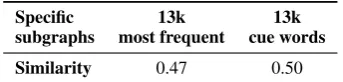
Additionally, we experimented with two spe-cific subgraphs that werenotrandomly extracted from WordNet, namely: the subgraph supporting the matrix with the 13k most frequent words of English;9 and the subgraph supporting the ma-trix with the 13k words used in (De Deyne et al.,
2016),10 which have been selected to act as cue words in psycholinguistic experiments for elic-iting associated words from subjects. The per-formance results of the resulting models are
dis-9To reach 13k, we used the 10k most common English words, as determined by n-gram frequency analysis of the Google’s Trillion Word Corpus, from (Kaufman,2017), sup-plemented with non repeating words from Wiktionary fre-quency lists (Wiktionary,2017).
10Available from https://smallworldofwords.org/en
played in Table3.
Specific 13k 13k
subgraphs most frequent cue words
[image:5.595.331.503.89.130.2]Similarity 0.47 0.50
Table 3: Performance of wnet2vec in similarity task over SimLex-999 given by Spearman’s coeffi-cient. First row indicates the sizes of the matrices supported by specific subgraphs.
These matrices have less than 1/4 of the size of the 60k matrix, and yet they show a better than expected approximation to its performance, taking into account the progression registered in Table2. These results indicate that larger size is not the only factor improving the performance of Word-Net embeddings. Very interestingly, they seem to indicate that words more commonly used may support semantic spaces that are more accurate to discriminate semantic similarity.
Frequency of occurence in texts plays no direct role in the conversion of semantic networks into semantic spaces by equation (2). Hence this ef-fect likely results from the fact captured by one of the Zipf word distributions, that on average more frequent words are more ambiguous than less fre-quent ones: On average more frefre-quent words ex-press more concepts — that is, they occur in more WordNet synsets — and thus enter in more outgo-ing edges in the semantic network, and this should support less sparse vectors in the semantic space.
This explanation is empirically supported by the fact that the word ambiguity rates are 2.7 and 2.8, in the sugraphs with 13k cue words and with 13k most frequent words, respectively, while there is a lower word ambiguity rate of around 1.5 for the random graph with 60k words.11
Parts of Speech: Princeton WordNet covers nouns, adjectives, verbs and adverbs. Nouns (117k) are the largest portion of all words (155k) in the graph and, among the different POS, they support the most dense subgraph of semantic re-lations. We run experiments with words from all POS categories, and where only Nouns where con-sidered. While results obtained with Nouns only (0.44) are not that distant from the results obtained with all POS (0.50), the latter setting consistently showed better performance.
4.4 Testing data and metrics
To assess the robustness of the results obtained, experiments were undertaken with: (i) yet an-other evaluation metric, namely Pearson’s corre-lation coefficient; (ii) further evaluation data sets for semantic similarity, namely RG1965 ( Ruben-stein and Goodenough, 1965) and Wordsim-353-Similarity (Agirre et al., 2009); (iii) and test-ing over another task, namely semantic related-ness, with the evaluation data sets Wordsim-353-Relatedness (Agirre et al., 2009), MEN (Bruni et al.,2012) and MTurk-771 (Halawi et al.,2012). In these experiments we used our best settings, with a random 60k subgraph, and our second best settings, with the best model with a specific 13k subgraph, cf. Subsection4.3.
Additional metric: The evaluation scores ob-tained over SimLex-999 with the Pearson’s coeffi-cient are basically aligned with the scores already obtained with Spearman’s coefficient, confirming the superiority of the WordNet embeddings.
Additional data sets: Even with a number of test pairs much lower than the pairs in SimLex-999 and built under less standard procedure, and thus supporting less reliable results, we evaluated our models over the Wordsmith353-S and RG1965 data sets. Wnet2vec showed competitive perfor-mance when put side by side with word2vec even though their scores were not superior. With these smaller alternative data sets, the results for the spe-cific 13k model were slightly superior to the re-sults for the random 60k model.
Additional task: The relation “semantic relat-edness” is broader and less well defined than the relation “semantic similarity”. Experiments with a second task of determining semantic related-ness showed that word2vec performs clearly bet-ter on this task than on the task of semantic sim-ilarity, while wnet2vec in general performs worst on it. Wnet2vec is thus less prone than word2vec to get fooled by words that are just semantically related by not necessarily similar. This indicates that the superiority of wnet2vec in the similarity task results from an enhanced discriminative ca-pacity, with it being better both at judging as sim-ilar, words that are actually simsim-ilar, and at judging as non similar, not only words that may be clearly non similar but also words that are semantically related, and thus may be close to be similar.
The results obtained with these experiments are
displayed in Table4.12
5 Related work
From semantic spaces to semantic networks:
There has been a long research tradition on se-mantic networks enhanced with information ex-tracted from text, including distributional vectors, which in the limit may encompass semantic net-works obtained from semantic spaces. As a way of illustration, among many others, this includes the work on semantic relations determined from patterns based on regular expressions, either hand crafted (Hearst, 1992), or learned from corpora (Snow et al., 2005); work on semantic relations predicted by classifiers running over distributional vectors (Baroni et al., 2012; Roller et al., 2014;
Weeds et al., 2014); work on semantic relations obtained with deep learning that integrates distri-butional information and patterns of grammatical dependency relations (Shwartz et al., 2016), in-cluding the hard task of distinguishing synonymy from antonymy (Nguyen et al.,2017); etc. While being highly relevant for a unified account of lex-ical semantics, this line of research addresses the conversion direction, from semantic spaces to se-mantic networks, that is not the major focus of this paper.
From semantic networks to semantic spaces:
Work towards the conversion direction that is of interest here is more recent. As a way of illus-tration, among others, one can mention (Faruqui et al.,2015), which explored retrofitting to refine distributional representations using relational in-formation, and (Yu and Dredze,2014), which fo-cused also on refining word embeddings with lex-ical knowledge, but which are not addressing the goal of obtaining semantic spaces solely on the ba-sis of semantic networks as we do here.
That is the aim also of recent work like (Camacho-Collados et al.,2015) who improve the embeddings built from data sets made of selected Wikipedia pages by resorting to the local, one-edge relations of each relevant word in the Word-Net graph.
Further recent works worth mentioning include (Vendrov et al., 2015) that resorted to order em-beddings, which however do not preserve dis-tance and/or do not preserve directionality under
data set task size over- w2vec n2vec n2vec w2vec n2vec n2vec
lap % 13k s 60k r 13k s 60k r
Spearman coef Pearson coef
SimLex-999 simil 999 99.8 0.44 0.50 0.50 0.45 0.52 0.51
RG1965 simil 65 100.0 0.75 0.65 0.56 0.75 0.75 0.72 Wordsim353-S simil 203 98.0 0.74 0.65 0.51 0.73 0.67 0.58
Wordsim353-R relat 252 97.6 0.61 0.32 0.31 0.58 0.33 0.30
MEN relat 3000 44.9 0.70 0.46 0.45 0.68 0.48 0.45
MTURK-771 relat 771 99.7 0.66 0.54 0.53 0.63 0.54 0.52
Table 4: Performance of different models in the semantic similarity (simil) and relatedness (relat) tasks over different data sets measured by Spearman’s and Pearson’s coefficients. Models used: word2vec (w2vec); wnet2vec with the random 60k subgraph (n2vec 60k r); and wnet2vec with the best specific 13k subgraph (n2vec 13k s), cf. Subsection4.3. Overlap with the vocabulary of wnet2vec 60k random appears in the fourth column.
the relevant semantic relations; (Nickel and Kiela,
2017) that experimented with computing embed-dings not in Euclidean but in hyperbolic space, namely the Poincaré ball model. A shortcoming with these proposals is that their outcome is not easily plugged into neural models. Also they are not fit to evaluation on external tasks, like the se-mantic similarity task, with their evaluation be-ing rather based on their ability to complete miss-ing edges from ontological graphs. In contrats, an example of the sutability of wnet2vec to be plugged into neural models and of its application in a downstream task is reported in (Rodrigues et al.,2018), where these embeddings support the predicition of brain activation based on neural net-works.
There has been also a long tradition of re-search on learning vector embeddings from multi-relational data of which, among many others, one can refer (Bordes et al.,2013), (Lin et al.,2015), and (Nickel et al.,2016). Though to a large extent these are generic approaches for graph to vectors conversion, also here the major focus has been on exploring these models on their ability to complete missing relations in knowledge bases rather than to experiment them on natural language process-ing and lexical semantics.
Other related approaches worth of note are (De Deyne et al., 2016) and (Goikoetxea et al.,
2015). While being based also on the iterative con-version procedure used here, the first concentrates however on converting, not a semantic network, but a fragment of the lexicon represented under a feature-based approach into a semantic space.
While seeking to obtain WordNet embeddings, the second resorts, however, not to a genuine conversion procedure, but to a lossy intermediate “textual” representation: it generates sequences of words by concatenating words visited by random walks over the WordNet; this “artificial text” is a partial and contingent reflection of the semantic network and is used to obtain distributional vec-tors by resorting to typical word embeddings tech-niques based on text.
Distances in a semantic graph:
The task of determining the semantic similar-ity between two words can be performed not only on the basis of the distance of their respective vectors in a semantic space, but also on the ba-sis of the distance of the respective concepts in a lexical semantic network, like WordNet. There has been a long research tradition on this issue whose major proposals include (Jiang and Con-rath,1997), (Lin,1998), (Leacock and Chodorow,
1998), (Hirst and St-Onge,1998),(Resnik,1999), among others, which received nice comparative assessments in (Ferlez and Gams,2004) and ( Bu-danitsky and Hirst,2006), including their correla-tion with human judgments.
se-mantic space.
The focus of the present paper is on an effec-tive method to convert a semantic network into a semantic space, with the graph-based affinity ob-tained by the chaining of "local" one-edge dis-tances ensured by the iteration in (1)-(2) being central for that goal.
It will be interesting to understand whether it will be possible to consider, as an alternative, those graph-based metrics of semantic similarity for any two nodes anywhere in the graph — re-sorting to the "non-local" multi-edge distance be-tween the two input words. It remains to be under-stood whether they can be resorted to as the ba-sis of an "all vs. all" type of procedures for an exhaustive screening of the graph that are compu-tationally tractable — thus aiming at keeping up with an effective method for graph to matrix con-version of an entire lexical semantic network that resists the eventual exponential explosion.
6 Conclusions
In this paper, we offer a contribution towards a unified account of lexical semantics. We propose a methodology to convert from semantic networks, that are encoded in ontological graphs and em-pirically based on systematic linguistic intuitions (in their higher quality incarnations), to semantic spaces, that are encoded in distributional vectors and empirically based on very large collections of texts (in their higher quality implementations). This conversion methodology relies on a straight-forward yet powerful intuition — the larger the number of paths and the shorter the paths connect-ing two nodes in an ontological graph the stronger is their semantic affinity —, with iteration (1) making it operative in order to generate a distri-butional matrix from an ontological graph.
We report also on the results of assessing this conversion methodology with a case study, namely by applying it to a subgraph of WordNet with less than half of its words (60k), randomly selected from the ones whose senses have a larger num-ber of outgoing edges. The resulting distributional vectors wnet2vec were evaluated under the main-stream task of determining the semantic similarity of words arranged in pairs, against the mainstream gold standard SimLex-999, with very good results. The performance of wnet2vec was around 15% su-perior to the performance of word2vec, trained on a 100 billion token collection of texts. This
in-dicates that the proposed conversion procedure is very effective and that the WordNet embeddings are competitive when compared to text based em-beddings.
It is nevertheless worth underlying that the re-search goal of this paper was not to re-search for word embeddings that outperform all previous proposals known in the literature in terms of in-trinsic evaluation tasks, like semantic similarity, etc., or when they are embedded in larger systems. Its research goal was rather to demonstrate that it is feasible to create very effective word embed-dings from semantic networks with a straightfor-ward and yet powerful method of conversion from semantic networks to semantic spaces that, given its simplicity, offer the promise to generalize very well for more types of lexical networks and on-tologies other than just WordNet, which was the case study used here.
The fact that less than half of the words in WordNet were used in the reported experiment re-inforces this positive expectation with respect to the strength of the proposed approach, and point towards future work that will seek to use larger portions of WordNet, as computational limitation can be overcome.
The results reported in this paper thus hint at very promising research avenues, including, among others, experiments with further ontologies of different domains, empirical origins, etc.; with cross-lingual triangulation with aligned WordNets and aligned embeddings; with reciprocal rein-forcement of ontological graphs and distributional vectors; with other metrics of semantic affinity in a graph, etc.
The wnet2vec data and software and their future updates are distributed at https://github. com/nlx-group/WordNetEmbeddings
Acknowledgments
The research results presented here were partly supported by PORTULAN/CLARIN Infrastruc-ture for the Science and Technology of Lan-guage, by the National Infrastructure for Dis-tributed Computing (INCD) of Portugal, and by the ANI/3279/2016 grant.
References
study on similarity and relatedness using distribu-tional and wordnet-based approaches. In NAACL-HLT2009, pages 19–27.
John Robert Anderson. 1974. Retrieval of proposi-tional information from long-term memory. Cogni-tive Psychology, 6(4):451–474.
Marco Baroni, Raffaella Bernardi, Ngoc-Quynh Do, and Chung-chieh Shan. 2012. Entailment above the word level in distributional semantics. In EACL2012, pages 23–32.
Daniel G. Bobrow and Donald Arthur Norman. 1975. Some principles of memory schemata. In Represen-tation and Understanding: Studies in Cognitive Sci-ence, page 131–149. Elsevier.
Antoine Bordes, Nicolas Usunier, Alberto Garcia-Duran, Jason Weston, and Oksana Yakhnenko. 2013. Translating embeddings for modeling multi-relational data. InAdvances in Neural Information Processing Systems 26, pages 2787–2795.
Elia Bruni, Gemma Boleda, Marco Baroni, and Nam-Khanh Tran. 2012. Distributional semantics in tech-nicolor. InACL2012, pages 136–145.
Alexander Budanitsky and Graeme Hirst. 2006. Eval-uating wordnet-based measures of lexical semantic relatedness. Computational Linguistics, 32(1):13– 47.
José Camacho-Collados, Mohammad Taher Pilehvar, and Roberto Navigli. 2015. Nasari: a novel ap-proach to a semantically-aware representation of items. InNAACL-HLT2015, pages 567–577.
Simon De Deyne, Daniel J Navarro, and Gert Storms. 2013. Better explanations of lexical and seman-tic cognition using networks derived from continued rather than single-word associations. Behavior Re-search Methods, 45(2):480–498.
Simon De Deyne, Amy Perfors, and Daniel J Navarro. 2016. Predicting human similarity judgments with distributional models: The value of word associa-tions. InCOLING2016, pages 1861–1870.
William K Estes. 1994. Classification and Cognition. Oxford University Press.
Manaal Faruqui, Jesse Dodge, Sujay Kumar Jauhar, Chris Dyer, Eduard Hovy, and Noah A. Smith. 2015. Retrofitting word vectors to semantic lexicons. In AACL-HLT 2015, pages 1606–1615.
Christiane Fellbaum, editor. 1998. WordNet: An Elec-tronic Lexical Database. MIT Press.
Jure Ferlez and Matjaz Gams. 2004. Shortest-path se-mantic distance measure in wordnet v2.0. Informat-ica, 28:381–386.
Josu Goikoetxea, Aitor Soroa, and Eneko Agirre. 2015. Random walks and neural network language mod-els on knowledge bases. In NAACL-HLT25, pages 1434–1439.
Andreas Grünauer and Markus Vincze. 2015. Us-ing dimension reduction to improve the classifi-cation of high-dimensional data. arXiv preprint arXiv:1505.06907.
Guy Halawi, Gideon Dror, Evgeniy Gabrilovich, and Yehuda Koren. 2012. Large-scale learning of word relatedness with constraints. In Proceedings of the 18th ACM SIGKDD International Conference on Knowledge Discovery and Data Mining, pages 1406–1414. ACM.
Zellig S Harris. 1954. Distributional structure. Word, 10(2-3):146–162.
Marti A Hearst. 1992. Automatic acquisition of hy-ponyms from large text corpora. InCOLING1992, pages 539–545.
Felix Hill, Roi Reichart, and Anna Korhonen. 2016. Simlex-999: Evaluating semantic models with (gen-uine) similarity estimation. Computational Linguis-tics, 41:665–695.
G. Hirst and D. St-Onge. 1998. Lexical chains as rep-resentations of context for the detection and correc-tion of malapropisms. In C. Fellbaum, editor, Word-Net: An Electronic Lexical Database, pages 305– 332. MIT Press.
Keith J Holyoak and Kyunghee Koh. 1987. Sur-face and structural similarity in analogical transfer. Memory & Cognition, 15(4):332–340.
Thad Hughes and Daniel Ramage. 2007. Lexical se-mantic relatedness with random graph walks. In EMNLP-CONLL2007, Prague, Czech Republic.
Yangfeng Ji and Jacob Eisenstein. 2014. Represen-tation learning for text-level discourse parsing. In ACL2014, pages 13–24.
J. Jiang and D. Conrath. 1997. Semantic similar-ity based on corpus statistics and lexical taxonomy. InProceedings on International Conference on Re-search in Computational Linguistics.
Josh Kaufman. 2017. 10,000 most common en-glish words in google’s trillion word corpus. https://github.com/first20hours/ google-10000-english.
C. Leacock and M. Chodorow. 1998. Combining lo-cal context and wordnet similarity for word sense identification. In C. Fellbaum, editor,WordNet: An Electronic Lexical Database, pages 265–285. MIT Press.
Jiwei Li and Dan Jurafsky. 2015. Do multi-sense em-beddings improve natural language understanding? arXiv preprint arXiv:1506.01070.
Yankai Lin, Zhiyuan Liu, Maosong Sun, Yang Liu, and Xuan Zhu. 2015. Learning entity and relation embeddings for knowledge graph completion. In AAAI’15, pages 2181–2187.
David E Meyer and Roger W Schvaneveldt. 1971. Fa-cilitation in recognizing pairs of words: Evidence of a dependence between retrieval operations. Journal of Experimental Psychology, 90(2):227.
Tomas Mikolov, Kai Chen, Greg Corrado, and Jeffrey Dean. 2013a. Googlenews-vectors-negative300.bin.gz - efficient estimation of word representations in vector space. arXiv preprint arXiv:1301.3781. https://code.google. com/archive/p/word2vec/.
Tomas Mikolov, Ilya Sutskever, Kai Chen, Greg S Cor-rado, and Jeff Dean. 2013b. Distributed representa-tions of words and phrases and their compositional-ity. InAdvances in Neural Information Processing Systems 26, pages 3111–3119.
Marvin Minsky. 1975. A framework for represent-ing knowledge. InPsychology of Computer Vision. McGraw-Hill.
Mark Newman. 2010.Networks: An Introduction. Ox-ford University Press.
Kim Anh Nguyen, Sabine Schulte im Walde, and Ngoc Thang Vu. 2017. Distinguishing antonyms and synonyms in a pattern-based neural network. arXiv preprint arXiv:1701.02962.
Maximilian Nickel, Lorenzo Rosasco, and Tomaso Poggio. 2016. Holographic embeddings of knowl-edge graphs. InAAAI’16, pages 1955–1961.
Maximillian Nickel and Douwe Kiela. 2017. Poincaré embeddings for learning hierarchical representa-tions. InAdvances in Neural Information Process-ing Systems 30, pages 6341–6350.
Charles E Osgood, George J Suci, and Percy H Tan-nenbaum. 1957. The measurement of meaning. Ur-bana: University of Illinois Press.
Francis Jeffrey Pelletier. 2016. Semantic composition-ality. InThe Oxford Research Encyclopedia of Lin-guistics. Oxford University Press.
M Ross Quillan. 1966. Semantic memory. Technical report, Bolt Beranek and Newman Inc., Cambridge MA.
Radim ˇReh˚uˇrek and Petr Sojka. 2010. Software frame-work for topic modelling with large corpora. In Pro-ceedings of the LREC 2010 Workshop on New Chal-lenges for NLP Frameworks, pages 45–50. European Language Resources Association.
P. Resnik. 1999. Semantic similarity in a taxonomy: An information-based measure and its application to problems of ambiguity in natural language. Journal of Artificial Intelligence Research, 11.
Lance J Rips. 1975. Inductive judgments about natural categories. Journal of Verbal Learning and Verbal Behavior, 14(6):665–681.
João António Rodrigues, Ruben Branco, João Ricardo Silva, Chakaveh Saedi, and António Branco. 2018. Predicting brain activation with wordnet embed-dings. InProceedings of the 8th Workshop on Cog-nitive Aspects of Computational Language Learning and Processing (CogACLL2018), the 56th Annual Meeting of the Association for Computational Lin-guistics (ACL2018), Melbourne, Australia. Associa-tion for ComputaAssocia-tional Linguistics.
Stephen Roller, Katrin Erk, and Gemma Boleda. 2014. Inclusive yet selective: Supervised distributional hy-pernymy detection. InCOLING 2014, pages 1025– 1036.
Brian H Ross. 1984. Remindings and their effects in learning a cognitive skill. Cognitive Psychology, 16(3):371–416.
Herbert Rubenstein and John B Goodenough. 1965. Contextual correlates of synonymy. Communica-tions of the ACM, 8(10):627–633.
Vered Shwartz, Yoav Goldberg, and Ido Dagan. 2016. Improving hypernymy detection with an integrated path-based and distributional method. InACL2016, pages 2389–2398.
Rion Snow, Daniel Jurafsky, and Andrew Y Ng. 2005. Learning syntactic patterns for automatic hypernym discovery. InAdvances in Neural Information Pro-cessing systems 17, pages 1297–1304.
Richard Socher, John Bauer, Christopher D Manning, and Andrew Y. Ng. 2013. Parsing with composi-tional vector grammars. In ACL2013, pages 455– 465.
David G Underhill, Luke K McDowell, David J Marchette, and Jeffrey L Solka. 2007. Enhancing text analysis via dimensionality reduction. In IEEE-IRI2007, pages 348–353.
Ivan Vendrov, Ryan Kiros, Sanja Fidler, and Raquel Urtasun. 2015. Order-embeddings of images and language.arXiv preprint arXiv:1511.06361.
Julie Weeds, Daoud Clarke, Jeremy Reffin, David Weir, and Bill Keller. 2014. Learning to distinguish hyper-nyms and co-hypohyper-nyms. In COLING 2014, pages 2249–2259.
Wiktionary. 2017. Wiktionary: Frequency lists. https://en.wiktionary.org/wiki/ Wiktionary:Frequency_lists.
Svante Wold, Kim Esbensen, and Paul Geladi. 1987. Principal component analysis. Chemometrics and Intelligent Laboratory Systems, 2(1-3):37–52.