Proceedings of the 56th Annual Meeting of the Association for Computational Linguistics (Short Papers), pages 540–545 540
End-Task Oriented Textual Entailment
via Deep Explorations of Inter-Sentence Interactions
Wenpeng Yin,1Hinrich Sch ¨utze,2Dan Roth1
1Dept. of Computer Science, University of Pennsylvania, USA
2CIS, LMU Munich, Germany
{wenpeng,danroth}@seas.upenn.edu
Abstract
This work deals with SCITAIL, a nat-ural entailment challenge derived from a multi-choice question answering prob-lem. The premises and hypotheses in SCITAIL were generated with no aware-ness of each other, and did not specif-ically aim at the entailment task. This makes it more challenging than other entailment data sets and more directly useful to the end-task – question an-swering. We propose DEISTE (deep explorations ofinter-sentence interactions for textual entailment) for this entail-ment task. Given word-to-word inter-actions between the premise-hypothesis pair (P, H), DEISTE consists of: (i) a
parameter-dynamic convolution to make important words inP andHplay a domi-nant role in learnt representations; and (ii) a position-aware attentive convolution to encode the representation and position in-formation of the aligned word pairs. Ex-periments show that DEISTE gets ≈5% improvement over prior state of the art and that the pretrained DEISTE on SCI-TAIL generalizes well on RTE-5.1
1 Introduction
Textual entailment (TE) is a fundamental prob-lem in natural language understanding and has been studied intensively recently using multiple benchmarks – PASCAL RTE challenges (Dagan et al., 2006, 2013), Paragraph-Headline (Burger and Ferro, 2005), SICK (Marelli et al., 2014) and SNLI (Bowman et al., 2015). In particular, SNLI – while much easier than earlier datasets
1https://github.com/yinwenpeng/SciTail
PremiseP
Pluto rotates once on its axis every 6.39 Earth days. 0 Once per day, the earth rotates about its axis. 1 It rotates on its axis once every 60 Earth days. 0 Earth orbits Sun, and rotates once per day about axis. 1 Table 1: Examples of four premises for the hy-pothesis “Earth rotates on its axis once times in one day” in SCITAIL dataset. Right column (la-bel): “1” meansentail, “0” otherwise.
– has generated much work based on deep neu-ral networks due to its large size. However, these benchmarks were mostly derived independently of any NLP problems.2 Therefore, the premise-hypothesis pairs were composed under the con-straint of predefined rules and the language skills of humans. As a result, while top-performing sys-tems push forward the state-of-the-art, they do not necessarily learn to support language inferences that emerge commonly and naturally in real NLP problems.
In this work, we study SCITAIL (Khot et al.,
2018), an end-task oriented challenging entail-ment benchmark. SCITAIL is reformatted from a multi-choice question answering problem. All hypothesesH were obtained by rewriting (ques-tion, correct answer) pairs; all premisesP are rel-evant web sentences collected by an Information retrieval (IR) method; then (P, H) pairs are an-notated via crowdsourcing. Table1shows exam-ples. By this construction, a substantial perfor-mance gain on SCITAIL can be turned into bet-ter QA performance (Khot et al., 2018). Khot et al.(2018) report that SCITAIL challenges neu-ral entailment models that show outstanding per-formance on SNLI, e.g., Decomposable Attention Model (Parikh et al.,2016) and Enhanced LSTM (Chen et al.,2017).
We propose DEISTE for SCITAIL. Given word-to-word inter-sentence interactions between
more likely less likely
premise
hypothesis 1 hypothesis 2
[image:2.595.89.275.66.141.2]entail
Figure 1: The motivation of considering alignment positions in TE. The same color in (premise, hy-pothesis) means the two words are best aligned.
pi hj
i
j Given : I = interactions(P, H)
(1) 1.0 + max(I[i, :])1.0 : importance of pi
(2) H ⋅ softmax(I[i, :]) : soft best match of pi
(3) argmax(I[i, :]) : hard location of best match of pi
Learn :
P H
[image:2.595.328.501.70.296.2]I
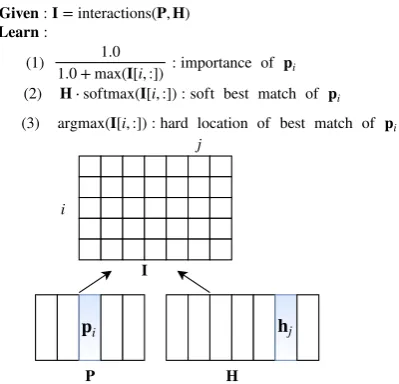
Figure 2: The basic principles of DEISTE in mod-eling the pair (P,H)
the pair (P, H), DEISTE pursues three deep ex-ploration strategies of these interactions. (a) How to express the importance of a word, and let it play a dominant role in learnt representations. (b) For any word in one of (P, H), how to find the best aligned word in the other sentence, so that we know their connection is indicative of the final decision. (c) For a window of words inP orH, whether the locations of their best aligned words in the other sentence provides clues. As Figure1 il-lustrates, the premise “in this incident, the cop (C) shot (S) the thief (T)” is more likely to entail the hypothesis “C . . .ˆ S . . .ˆ Tˆ” than “T . . .ˆ S . . .ˆ Cˆ” whereXˆ is the word that best matchesX.
Our model DEISTE is implemented in convo-lutional neural architecture (LeCun et al., 1998). Specifically, DEISTE consists of (i) a parameter-dynamic convolution for exploration strategy (a) given above; and (ii) a position-aware atten-tive convolution for exploration strategies (b) and (c). In experiments, DEISTE outperforms prior top systems by ≈5%. Perhaps even more interestingly, the pretrained model over SCI-TAIL generalizes well on RTE-5.
pi
mi
P H
aligned hidden state attentive
convolution
rpos
row-wise max-pooling
Representation for pair (P, H)
p˜i
pi
zi
position embedding
Figure 3: Position-aware attentive convolution in modeling the pair (P,H)
2 Method
To start, a sentenceS(S∈ {P, H}) is represented as a sequence ofns hidden states, e.g., pi,hi ∈
Rd(i = 1,2, . . . ,|np/h|), forming a feature map S∈Rd×|ns|, wheredis the dimensionality of hid-den states. Figure2depicts the basic principle of DEISTE in modeling premise-hypothesis pair (P,
H) with feature mapsPandH, respectively. First, P and H have fine-grained interactions
I∈Rnp×nhby comparing any pair of (pi,hj):
I[i, j] = cosine(pi,hj) (1)
We now elaborate DEISTE’s exploration strategies (a), (b) and (c) of the interaction resultsI.
2.1 Parameter-dynamic convolution
Intuitively, important words should be expressed more intensively than other words in the learnt representation of a sentence. However, the impor-tance of words within a specific sentence might not depend on the sentence itself. E.g., Yin and Sch¨utze(2017b) found that in question-aware an-swer sentence selection, words well matched are more important; while in textual entailment, words hardly matched are more important.
In this work, we try to make the semantics of those important words dominate in the output rep-resentations of a convolution encoder.
[image:2.595.87.287.201.393.2]higher-level representationrfor this trigram:
r= tanh(W·[pi−1,pi,pi+1] +b) (2)
whereW∈Rd×3dandb∈
Rd.
For simplicity, we neglect the bias term b and split the multiplication of big matrices – W ·
[pi−1,pi,pi+1] – into three parts, then rcan be formulated as:
r= tanh(W−1·pi−1⊕W0·pi⊕W+1·pi+1)
= tanh(ˆpi−1⊕piˆ ⊕ˆpi+1)
where ⊕ means element-wise addition; W−1,
W0, W+1 ∈ Rd×d, and their concatenation equals to the W in Equation 2; ˆpi is set to be W0 ·p
i, so pˆi can be seen as the projection of pi in a new space by parametersW0; finally the three projected outputs contribute equally in the addition:pˆi−1⊕pˆi⊕ˆpi+1.
The convolution encoder shares parameters [W−1, W0,W+1] in all trigrams, so we cannot expect those parameters to express the importance ofˆpi−1,ˆpi orˆpi+1in the output representationr. Instead, we formulate the idea as follows:
mi = tanh(αi−1ˆpi−1⊕αipiˆ ⊕αi+1piˆ+1) in which the three scalarsαi−1,αiandαi+1 indi-cate the importance scores of piˆ−1, piˆ and ˆpi+1 respectively. In our work, we adopt:
αi=
1.0
1.0 + max(I[i,:]) (3)
Sinceαiˆpi =αiW0·pi =W0,i·pi, we notice
that the original shared parameterW0 is mapped to a dynamic parameter W0,i, which is specific to the input pi. We refer to this as parameter-dynamic convolution, which enables our system DEISTE to highlight important words in higher-level representations.
Finally, a max-pooling layer is stacked over
{mi}to get the representation for the pair (P,H), denoted asrdyn.
2.2 Position-aware attentive convolution
Our position-aware attentive convolution, shown in Figure3, aims to encode the representations as well as the positions of the best word alignments.
Representation. Given the interaction scores inI, the representationpi˜ of all soft matches for hidden statepiinP is the weighted average of all
hidden states inH:
˜
pi =X j
softmax(I[i,:])j·hj (4)
methods dev test
Majority Class 50.4 60.4 Hypothesis only 66.9 65.1 Premise only 72.6 73.4 NGram model 65.0 70.6 ESIM-600D 70.5 70.6 Decomp-Att 75.4 72.3
DGEM 79.6 77.3
AttentiveConvNet 79.3 78.1
DEISTE 82.4 82.1
[image:3.595.330.501.60.238.2]w/o dyn-conv 80.2 79.1 w/o representation 76.3 74.9 w/o position 82.1 81.3
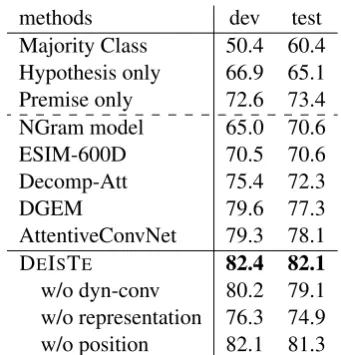
Table 2: DEISTE vs. baselines on SCITAIL
Position. For a trigram [pi−1, pi,pi+1] inP,
knowing where its best-matched words are located inHis helpful in TE, as discussed in Section1.
Forpi, we first retrieve the indexxiof the
best-matched word inHby:
xi = argmax(I[i,:]) (5)
then embed the concrete {xi} into
randomly-initialized continuous space:
zi=M[xi] (6)
whereM∈Rnh×dm;n
his the length ofH;dmis
the dimensionality of position embeddings. Now, the three positions [i− 1, i, i+ 1] in
Pconcatenate vector-wisely original hidden states [pi−1,pi,pi+1] with position embeddings [zi−1, zi,zi+1], getting a new sequence of hidden states: [ci−1, ci, ci+1]. As a result, a position i in P
has hidden stateci, left contextci−1, right context
ci+1 and the representation of soft-aligned words inH, i.e.,p˜i. Then a convolution works at
posi-tioniinP as:
ni= tanh(W·[ci−1,ci,ci+1,p˜i] +b) (7)
As Figure3shows, the position-aware attentive convolution finally stacks a standard max-pooling layer over {ni} to get the representation for the pair (P,H), denoted asrpos.
Overall, our DEISTE will generate a represen-tationrdynthrough the parameter-dynamic
convo-lution, and generate a representationrposthrough
methods acc. Majority Class 34.3 Premise only 33.5 Hypothesis only 68.7
ESIM 86.7
Decomp-Att 86.8 AttentiveConvNet 86.3 DEISTESCITAIL 84.7 DEISTEtune 87.1
State-of-the-art 88.7
Table 3: DEISTE vs. baselines on SNLI. DEISTESCITAILhas exactly the same system layout and hyperparameters as the one reported on SCI-TAIL in Table2; DEISTEtune: tune
hyperparame-ters on SNLI dev. State-of-the-art refers to (Peters et al.,2018). Ensemble results are not considered.
3 Experiments
Dataset. SCITAIL3(Khot et al.,2018) is for tex-tual entailment in binary classification: entailment or neutral. Accuracy is reported.
Training setup. All words are initialized by 300D Word2Vec (Mikolov et al., 2013) embed-dings, and are fine-tuned during training. The whole system is trained by AdaGrad (Duchi et al.,
2011). Other hyperparameter values include: learning rate 0.01,dm=50 for position embeddings M, hidden size 300, batch size 50, filter width 3.
Baselines. (i) Decomposable Attention Model (Decomp-Att) (Parikh et al., 2016): Develop at-tention mechanisms to decompose the problem into subproblems to solve in parallel. (ii) En-hanced LSTM (ESIM) (Chen et al., 2017): En-hance LSTM by encoding syntax and semantics from parsing information. (iii) Ngram Overlap: An overlap baseline, considering unigrams, one-skip bigrams and one-one-skip trigrams. (iv) DGEM (Khot et al., 2018): A decomposed graph entail-ment model, the current state-of-the-art. (v) At-tentiveConvNet (Yin and Sch¨utze, 2017a): Our top-performing textual entailment system on SNLI dataset, equipped with RNN-style attention mech-anism in convolution.4
In addition, to check if SCITAIL can be eas-ily resolved by features from only premises or hypotheses (like the problem of SNLI shown by
Gururangan et al. (2018)), we put a vanilla CNN (convolution&max-pooling) over merely hypothe-sis or premise to derive the pair label.
3
Please refer to (Khot et al.,2018) for more details.
4https://github.com/yinwenpeng/Attentive Convolution
Table 2 presentsresults on SCITAIL. (i) Our model DEISTE has a big improvement (∼ 5%) over DGEM, the best baseline. Interestingly, At-tentiveConvNet performs very competitively, sur-passing DGEM by 0.8% on test. These two results show the effectiveness of attentive convolution. DEISTE, equipped with a parameter-dynamic convolution and a more advanced position-aware attentive convolution, clearly gets a big plus. (ii) The ablation shows that all three aspects we ex-plore from the inter-sentence interactions con-tribute; “position” encoding is less important than “dyn-conv” and “representation”. Without “repre-sentation”, the system performs much worse. This is in line with the result of AttentiveConvNet base-line.
To further study the systems and datasets, Table
3gives performance of DEISTE and baselines on SNLI. We see that DEISTE gets competitive per-formance on SNLI.
Comparing Tables 2 and 3, the baselines “hy-pothesis only” and “premise only” show anal-ogous while different phenomena between SCI-TAIL and SNLI. On one hand, both SNLI and SCITAIL can get a relatively high number by looking at only one of {premise, hypothesis} – “premise only” gets 73.4% accuracy on SCITAIL, even higher than two more complicated baselines (ESIM-600D and Decomp-Att), and “hypothesis only” gets 68.7% accuracy on SNLI which is more than 30% higher than the “majority” and “premise only” baselines. Notice the contrast: SNLI “prefers” hypothesis, SCITAIL “prefers” premise. For SNLI, this is not surprising as the crowd-workers tend to construct the hypotheses in SNLI by some regular rules (Gururangan et al.,
2018). The phenomenon in SCITAIL is left to ex-plore in future work.
Error Analysis. Table4gives examples of er-rors. We explain them as follows.
Language conventions: The pair #1 uses dash “–” to indicate a definition sentence for “Front”; The pair #2 has “A (or B)” to denote the equiva-lence between A and B. This challenge is expected to be handled by rules.
Ambiguity: The pair #3 looks like having a sim-ilar challenge with the pair #2. We guess the anno-tators treat “· · · a vertebral column or backbone” and “· · · the backbone (or vertebral column)” as the same convention, which may be debatable.
# (PremiseP, HypothesisH) Pair G/P Challenge 1 (P) Front – The boundary between two different air masses. 1/0 language
conventions (H) In weather terms, the boundary between two air masses is called front.
2 (P) . . . the notochord forms the backbone (or vertebral column). 1/0 language conventions (H) Backbone is another name for the vertebral column.
3 (P)· · ·animals with a vertebral column or backbone and animals without one. 1/0 ambiguity (H) Backbone is another name for the vertebral column.
4
(P) Heterotrophs get energy and carbon from living plants or animals ( consumers
) or from dead organic matter ( decomposers ). 0/1 discourse relation (H) Mushrooms get their energy from decomposing dead organisms.
5
(P) Ethane is a simple hydrocarbon, a molecule made of two carbon and six
hydrogen atoms. 0/1 discourse
relation (H) Hydrocarbons are made of one carbon and four hydrogen atoms.
6 (P) . . . the SI unit. . . for force is the Newton (N) and is defined as (kg·m/s
−2
).
[image:5.595.108.492.60.218.2]0/1 beyond text (H) Newton (N) is the SI unit for weight.
Table 4: Error cases of DEISTE in SCITAIL. “· · ·”: truncated text. “G/P”: gold/predicted label.
dev test Majority baseline 50.0 50.0 State-of-the-art – 73.5 training data
SNLI 47.1 46.0
[image:5.595.105.257.243.324.2]SCITAIL 60.5 60.2
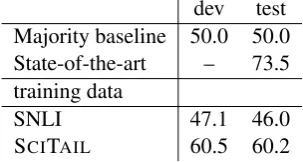
Table 5: Train on different TE datasets, test accu-racy on two-way RTE-5. State-of-the-art refers to (Iftene and Moruz,2009)
the pair #4 has an “or” structure. In the pair #5, “a molecule made of · · ·” defines the con-cept “Ethane” instead of the “hydrocarbon”. Both cases require the model to be able to comprehend the discourse relation.
Knowledge beyond text: The main challenge in the pair #6 is to distinguish between “weight” and “force”, which requires more physical knowledge that is beyond the text described here and beyond the expressivity of word embeddings.
Transfer to RTE-5. One main motivation of exploring this SCITAIL problem is that this is an end-task oriented TE task. A natural question thus is how well the trained model can be trans-ferred to other end-task oriented TE tasks. In Table 5, we take the models pretrained on SCI-TAIL and SNLI and test them on RTE-5. Clearly, the model pretrained on SNLI has not learned any-thing useful for RTE-5 – its performance of 46.0% is even worse than the majority baseline. The model pretrained on SCITAIL, in contrast, demon-strates much more promising generalization per-formance: 60.2% vs. 46.0%.
4 Related Work
Learning automatically inter-sentence word-to-word interactions or alignments was first stud-ied in recurrent neural networks (Elman, 1990).
Rockt¨aschel et al.(2016) employ neural word-to-word attention for SNLI task. Wang and Jiang
(2016) propose match-LSTM, an extension of the attention mechanism in (Rockt¨aschel et al.,2016), by more fine-grained matching and accumulation.
Cheng et al.(2016) present a new LSTM equipped with a memory tape. Other work following this attentive matching idea includes Bilateral Multi-Perspective Matching model (Wang et al.,2017), Enhanced LSTM (Chen et al.,2016) etc.
In addition, convolutional neural networks ( Le-Cun et al.,1998), equipped with attention mecha-nisms, also perform competitively in TE.Yin et al.
(2016) implement the attention in pooling phase
so that important hidden states will be pooled with higher probabilities.Yin and Sch¨utze(2017a) fur-ther develop the attention idea in CNNs, so that a RNN-style attention mechanism is integrated into the convolution filters. This is similar with our position-aware attentive convolution. We instead explored a way to make use of position informa-tion of alignments to do reasoning.
Attention mechanisms in both RNNs and CNNs make use of sentence interactions. Our work achieves a deep exploration of those interactions, in order to guide representation learning in TE.
5 Summary
This work proposed DEISTE to deal with an end-task oriented textual entailment end-task – SCITAIL. Our model enables a comprehensive utilization of inter-sentence interactions. DEISTE outperforms competitive systems by big margins.
References
Samuel R. Bowman, Gabor Angeli, Christopher Potts, and Christopher D. Manning. 2015. A large anno-tated corpus for learning natural language inference. InProceedings of EMNLP. pages 632–642.
John Burger and Lisa Ferro. 2005. Generating an
en-tailment corpus from news headlines. In
Proceed-ings of the ACL Workshop on Empirical Modeling of Semantic Equivalence and Entailment. pages 49–54.
Qian Chen, Xiaodan Zhu, Zhen-Hua Ling, Si Wei, and Hui Jiang. 2016. Enhancing and combining sequen-tial and tree LSTM for natural language inference.
CoRRabs/1609.06038.
Qian Chen, Xiaodan Zhu, Zhen-Hua Ling, Si Wei, Hui Jiang, and Diana Inkpen. 2017. Enhanced LSTM for
natural language inference. InProceedings of ACL.
pages 1657–1668.
Jianpeng Cheng, Li Dong, and Mirella Lapata. 2016. Long short-term memory-networks for machine
reading. InProceedings of EMNLP. pages 551–561.
Ido Dagan, Oren Glickman, and Bernardo Magnini. 2006. The PASCAL recognising textual entailment
challenge. InMachine Learning Challenges,
Eval-uating Predictive Uncertainty, Visual Object Clas-sification and Recognizing Textual Entailment, First PASCAL Machine Learning Challenges Workshop. pages 177–190.
Ido Dagan, Dan Roth, Mark Sammons, and Fabio
Mas-simo Zanzoto. 2013. Recognizing Textual
Entail-ment: Models and Applications. Morgan and Clay-pool.
John Duchi, Elad Hazan, and Yoram Singer. 2011. Adaptive subgradient methods for online learning
and stochastic optimization. JMLR12:2121–2159.
Jeffrey L. Elman. 1990. Finding structure in time.
Cognitive Science14(2):179–211.
Suchin Gururangan, Swabha Swayamdipta, Omer Levy, Roy Schwartz, Samuel R. Bowman, and Noah A. Smith. 2018. Annotation artifacts in natural
language inference data. InProceedings of NAACL.
Adrian Iftene and Mihai Alex Moruz. 2009. UAIC
par-ticipation at RTE5. InProceedings of TAC.
Tushar Khot, Ashish Sabharwal, and Peter Clark. 2018. SciTail: A textual entailment dataset from science
question answering. InProceedings of AAAI.
Yann LeCun, L´eon Bottou, Yoshua Bengio, and Patrick Haffner. 1998. Gradient-based learning applied to
document recognition. InProceedings of the IEEE.
pages 2278–2324.
Marco Marelli, Stefano Menini, Marco Baroni, Luisa Bentivogli, Raffaella Bernardi, and Roberto Zam-parelli. 2014. A SICK cure for the evaluation of
compositional distributional semantic models. In
Proceedings of LREC. pages 216–223.
Tomas Mikolov, Ilya Sutskever, Kai Chen, Greg S Cor-rado, and Jeff Dean. 2013. Distributed representa-tions of words and phrases and their
compositional-ity. InProceedings of NIPS. pages 3111–3119.
Ankur P. Parikh, Oscar T¨ackstr¨om, Dipanjan Das, and Jakob Uszkoreit. 2016. A decomposable attention
model for natural language inference. In
Proceed-ings of EMNLP. pages 2249–2255.
Matthew E. Peters, Mark Neumann, Mohit Iyyer, Matt Gardner, Christopher Clark, Kenton Lee, and Luke Zettlemoyer. 2018. Deep contextualized word
rep-resentations. CoRRabs/1802.05365.
Tim Rockt¨aschel, Edward Grefenstette, Karl Moritz Hermann, Tom´aˇs Koˇcisk`y, and Phil Blunsom. 2016. Reasoning about entailment with neural attention. InProceedings of ICLR.
Shuohang Wang and Jing Jiang. 2016. Learning
natu-ral language inference with LSTM. InProceedings
of NAACL. pages 1442–1451.
Zhiguo Wang, Wael Hamza, and Radu Florian. 2017. Bilateral multi-perspective matching for natural
lan-guage sentences. In Proceedings of IJCAI. pages
4144–4150.
Wenpeng Yin and Hinrich Sch¨utze. 2017a. Attentive
convolution. CoRRabs/1710.00519.
Wenpeng Yin and Hinrich Sch¨utze. 2017b.
Task-specific attentive pooling of phrase alignments
con-tributes to sentence matching. In Proceedings of
EACL. pages 699–709.
Wenpeng Yin, Hinrich Sch¨utze, Bing Xiang, and Bowen Zhou. 2016. ABCNN: attention-based con-volutional neural network for modeling sentence