Vol. 4 No.3
MARCH 1955
Question
· .. Isaac Asimov
Computers and Weather Prediction
· .. Bruce Gilchrist
Random Numbers and Their Generation
· .. Gordon Spenser
Problems Involved in, the Application of Electronic Digital
-' Computers to Business Operations
· .. John M. Breen
Computers to Make Administrative Decisions?
~
... Hans SchroederComponents of Automatic Computing Machinery - list of Types (cumulative)
.ANNOUNCING TIlE SMALLEST ALMOST-AUTOMATIC COMPUTER:
Electric Brain ·Con'struction Kit No.'
I
SCiENTIFIC -- ENTERTAINING -- INSTRUCTIVE -- SAFE -- INEXPENSIVE
This kit is an introduction to the design of arithmetical, logical, reasoning, computing, puzzle-solving, and game-playing circuits for:
BOYS· --STUDENTS -- SCHOOLS -- COLLEGES -- DESIGNERS
The kit is simple enough for intelligent boys to assemble, and yet is instructive to compute r .men because it shows how many kinds of computing and reasoning circuits can be made from simple
components.
The kit is the outcome of four years of design and development work with small robots by Berkeley Enterprises, Inc., publisher of "Computers and Automation", with the assistance of Toy D evelop-ment Co.
With this kit ahd manual, you can easily make dozens of small electric brain machines that ex-hibit intelligent behavior. Each runs on one flashlight battery. All connections with nuts and boltsi no soldering required. Ready about the middle of March. Price, $15.95 -- returnable for full refund if not satisfactory.
SOME OF THE SIMPLE ELECTRIC BRAIN MACHINES THAT YOU CAN MAKE WITH THE GENIAC KIT AND TIIAT ARE DESCRIBED
IN THE MANUAL
Logic Machines Comparing Reasoning
Syllogism Machine Intelligence Testing
Cryptographic Machines Secret Coder
Secret Decoder Combination Locks
Game Playing Machines Tic Tac Toe
Nim
Ari thmetic Machines (Decimal and Binary) Adding Machine
Subtracting Machine Multiplying Machine Dividing Machine Arithmetical Car~ing
Simple Circui ts Burglar Alarm
Automatic Oil Furnace Circuit, etc.
Puzzle Machines
The Space Ship Airlock
The Fox, Hen, Corn, and Hired Man Douglas Macdonald's Will
The Uranium Shipment and the Spa c e Pirates
2
-MANUAL
"Simple Electric Brain Machines and How to Make Them" by Edmund C. Berkeley, to be pub-lished by Berkeley Enterprises, Inc. in March, 1955, 64 pp. -- Describes over 25 small elec-tric brain machines that reason arithmetically or logically, solve puzzles, play games, etc. Each machine operates on one flashlight battery. Gives sufficient details so that each machine can be constructed with the materials in Geniac Kit No.1 or with other materials.
PARTS LIST
1 Manual
6 Multiple Switches, of a new design 1 Mounting Panel
1 Flashlight Battery, size D 1 Battery Clamp
10 Flashlight Bulbs 10 Bulb Sockets
50 Feet of Insulated Wire
Nuts, Bolts, Jumpers, and other necess-ary hardware
(NO SOLDERING REQUIRED -- COMPLETELY SAFE)
---Mail this Request or a Copy of It---Berkeley Enterprises, Inc.
815 Washington St., Sl03, N6Vtonville 60, Mass.
COMPUTERS AND AUTOMATION
CYBERNETICS
•
ROBOTS
•
AUTOMATIC CONTROL
Vol. 4, No. 3
March, 1955
- ESTABLISH.ED SEPTEMBER, 1951
-ARTICLES
Computers and Weather Prediction
Computers to Make Administrative Decisions?
FICTION
Bruce Gilchrist
Hans Schroeder
Question
••• Isaac Asimov
PAPERS
Random Numbers and Thei'r Generation
A Mechanized Analog Computer for Solving Linear
Algebraic Simultaneous Equations
Problems Involved in the Application of Electronic
Digital Computers to Business Operations
REFERENCE INFORMATION
Gordon Spenser
Cyril P. Atkinson
John M. Breen
8
28
6
10
12
16
Components of Automatic Computing Machinery -- List of Types {cumulative} 22
Roster of Organizations in the Field of Computers and Automation
{supplement}
-
24
Books and Other Publications
••• Gordon Spenser
25
Patents
••• Hans Schroeder
29
Automatic Computers -- Estimated Commercial Population {cumulative}
30
FORUM
Computer "Think,ing"
Association for Computing Machinery
Cooperative Graduate Summer Session
••• Francis T. Chambers
Meeting
Sidney Kaplan
in Statistics ••• Herbert A. Meyer
••• Vergil N. Slee
Binary Addition Table -- Correction
Electronic Scanning and Detection of Possible
Cancer Cells
He Made His Mark
The Editor's Notes
Notices: Index
Advertising Index
...
Neil Macdonald
Bill Danch
9
30
,32 3234
36
4 32
42
Editor: Edmund C. Berkeley Advisory Committee: Samuel R. Williams, Assistant Editors: Eva Di Stefano, Neil Macdonald, Jack Herbert F. Mitchell, Jr., Justin
Moshman, Gordon Spenser, F. L. Walker Oppenheim
Contributing Editors: Andrew D. Booth, John W. Carr, III, Alston S. Householder, Fletcher Pratt Publisher: Berkeley EnterQrises, Inc.
36 West 11 St., New York 11, N. Y. -Algonquin 4 7675
815 Wa shington St., Newton vill e 60, Mass. - Decatu; 2 5453 or 2 392A
Effective September ~, 1954, COMPUTERS AND AUTOMATION is published monthly, twelve times a year. Copyright,
1955, by Edmund Call~s Berkeley. Subscription rates: $4.50 for one year, S8.50 for two years, in the United States: S5.?0 ~or one year, $9.50 for two years, in Canada; $5.50 for one year, $10.50 for two years else-Bulk subscr~pt~on rates: see page 22. Advertising rates: see page 40.
Entered as second class matter at the Post Office, New York, N. Y.
-THE EDITOR'S NOTES
REFERENCE INFORMATION
Two more kinds of reference information appear for the first time in this issue of COMPUTffiS AND AUTOMATION: "Components of Auto-matic Computing Machinery -- List of Types" and "Automatic Computers -- Estimated Commer-cial Population". We hope these pieces of re-ference information will be useful to our readers. As always, we shall much appreciate comments, additions, and corrections; in any compilation there is no way of being complete-ly right the first time, and every comp~lation requires negative feedback, adjustment to er-ror.
WHO'S WHO IN THE COMPUTER FlEW
Considerable progress is being made in the organization of the "Who's Who in the Com-puter Field" scheduled to be published in "The Computer Directory, 1955", which is the June issue of COMPUTffiS AND AUTOMATION. We have had punch cards made showing the name, compa-ny, street address, city, and state for some
6000 names on various lists of computer ~le. There are duplicates between these lists; the proportion of duplicates seems to be about one quarter. About March 1 we shall send out a mailing with reply cards to all these names in order to obtain Who's Who information for the directory.
Another use for this punch card file will be that it will be possible for us to furnish the Joint Computer Conference Commi ttee of the Association for Computing Machinery, the In--stitute of Radio Engineers, and the American Institute of Electrical Engineers, with mail-ing labels produced by punch card machines for mailing meeting announcements to every person who has attended a recent computer meeting or who has otherwise demonstrated his real interest in automatic computers.
There will be other ways besides where-by this punch card file of computer people's names and addresses can be made available on a proper basis to the general advantage of computer people.
COMPUTffi DIRECTORY -- SECOND NOTICE
The June, 1955, issue of "Computers and Automation" will be a "Computer Di r e c tory'. The present plans in regard to this directory issue are as follows.
Part 1 of the directory will be the sec-ond edition of "Who's Who in the Computi n g Machinery Field" which we published in 1953-54. It will contain names and some information a-bout all persons whom we know of or can fin d who are really interested in computers. E n-tries will be free. If there are 4000 s u c h persons and 80 entries to a page, this par t of the directory will be 50 pages long.
If you are "really interested in comput-ers" and desire to have an up-to-date en try for you in this directory, please send us your name and address and ask for a who's whoentry form, or else complete the "Identificat ion" and "Who's Who Entry Form" in the style th a t is published in the magazine (see page 42, and send the entry form to us.
Part 2 of the directory will be a c u mu-lative ''Roster of Organizations in the Com-puting Machinery Field" based on the r 0 s t e r
regularly published in "Computers and Automa-tion", with entries expanded to some exte n t. Entries in this roster will also be free, i n order that it may be as complete as possible. This part of the direc tory may be 20 p age s long. If you know of any changes, additions, or correc tions, which should appear i n t h e Roster of Organizations which we publish, we would be grateful to you for sending the m to us.
Part 3 of the directory will be the first edi tion of "The Computing Machinery Fie 1 d : Products and Services For Sale". It will be a compendium of descriptions, pictures, etc., of machinery, systems, components, services, etc., for computing and data-handling. Organ-izations are invited to submit descripti 0 n s
of their products and services for inclusion in this part, at an advertising cost substan-tially less than our regular advertising rates; if the description fits exactly with editorial requirements, and can be photo-offset as i t stands, the cost is still less. Details are available on request. It is anticipated that
50 to 150 pages of information, descriptions, and advertising may make up this part.
If you are the sa les direc tor or a d v er-tising director of an organization having any such products, please send us (1) your name, title, organization, and address, (2) tot a 1 number of different products and services that you would like to have mentioned or described in this compendium, and (3) a list of the names or identification of such products and services. We will then send you entry forms for
report-ing their particulars. At least some of the
(con t inued on page '(0) _
-Not on the Drawing Board, -Not "On Order",
IN ACTUAL BUSINESS USE!
The Remington Rand Univac is the onlycompletely self-checked electronic data-processing system now being delivered ... the only one actually proven in busi-ness use. No comparable system handles alphabetic and numeric data to turn out payrolls, control inventories, and perform the other down-to-earth routine tasks vital to American industry.
In today's competitive market, the company which cuts its overhead first
comes out on top. Univac is already at work in many organizations, so don't wait until 1956 ... 1957 ... or 1958 to
cash in on the tremendous savings a~ai1-able with this large-scale electronic busi-ness system. The time to act is now, to prevent your lagging perilously behind competition in the years to come.
QUESTION
Isaac Asimov
Wal tham, Mass.
The corridors within Mul tivac were co m-modious and well-ventilated. There were even nooks where a technician could pause t o e a t his sandwich and pour a hot cup of coffee for himself out of his thermos bottle.
But Ben LeLancey was always a bit uneasy when he interrupted a hard day inthat manner.
"It doesn't seem right," he mutter e d.
'iI get the feeling Mul tivac is staring dow n
at me and doesn't like it."
Joe Cialli, who was an old hand as co m::-puter technician and who could actuall y r e-member the days before Mul ti vac could t a l k, found statements like that revolting.
He said, "The trouble wi th you, Ben, i s that you let size impress you." He moved his hand in an upward, crossward arc. "Noth i ng. Just size. Just a billion tubes, two billion relays, four billion circuit-complexes, and--nothing. In here," and he tapped his forehe ad gently, "everything."
"I know that," said Ben, troubled'. H e looked about him. He didn't see th e end of -Mul tivac in either direction. It was hal f a . mile long, a quarter of a mile thick, f i v e stories high. It was the world repository of all knowledge. The Library of Congress was all but obsolete. The smallest junior college, any village factory for buttonhooks, c 0 u 1 d
pI ug into it and learn whatever could be learnoo. Problems in economics and sociology that were too complicated for a generation of scientists even to approximate were solved by Multi v a c in a matter of minutes.
Joe watched Ben's eyes and seemed to read his mind without trouble. "Sure," he sa i d , "it sol ves problems. But only when we set u p the proper relationships, feed in the per t i-nent. data, adj ust the circui ts for neces sa r y correlations. After that, it's just electrons following lines of least resistance."
"What more is the human brain?" demanded Ben, challengingly.
"Ah, but the brain isn't half a mile long. It fi ts in one skull. And the human brain can create. A human brain wrote "Hamlet" and hunan brains built Multivac. There's no comparison. A machine is no more than a machine, whe the r it's a lever or Multivac."
6
-They sat. on little stools; their backs against the smooth wall of the resting recess. All about them were the glowing indic at ors, whose ever-changing pattern of light acted as guide-spots to the immensely complex electron-flow that twisted and wri thed within Mul tivac 's vast interior.
Mul tivac was "on its own" now; that is, no question was being put to it, or would be put to it for some time. It was making cor r ela-tions at random.
Ben stared at the steam curling up lightly from his coffee and thought of that. He said, "It's awfully quiet, today."
"No correlations, I suppose," said Joe, indifferently.
"I don't like it when it's on its 0 w n.
I keep wondering: What's it doing? What's it thinking abou.!-?"
"This is your problem, not Mul ti v a c 's. Random correlations. What's mysterious about it? It's like giving a person so many hours a day off his job in order that he might spend his time thinking quietly."
"All right. You admit Mul tivac can think."
Joe Cialli snorted. "Just a met a ph 0 r,
Ben. It happens not to be thought i n a n y 1 i teral sense. When you throw in the ra ndo_m correlation circuit, all you're doing is let-ting the electron flow be determined by the chance effects of thermal noise. T hr 0 w the
dice and see what turns up; turn the kaleido-scope and watch the design; set twenty mill ion billion monkeys to work on twenty million bil-lion typewriters---"
And as though on cue, Mul ti vac 's qui e t, resonant voice filled the corridor. It said: "GEORGE ... WASHINGTON ... WAS • •• FATHER ... OF. • • HIS ... COUN1RY ... BUT ... HAD ... NO ... CHILDREN. "
Joe laughed and the echoes of his mirt h rasped sacrilegiously against Ben's ear.
Ben said, "Stop that, Joe."
QUESTION
'Father of his Country'. He also had the da- He shook himself to break the mood. tum that Father George had no children. H e
put the two together."
"And sounded surprised," said Ben. " I t seemed an incongrui ty to him. He's been think-ing about it."
''You're hopeless," said Joe. ''Mul t i v a c can't sound surprised. His voice isn't fitted for inflection. And he can't think. He just correlated two statements containing an e I e-ment of contradiction and therefore connected them with the conjunction 'but.' He just made a special case of the statement: "a but not a." He looked at his watch. "Well, fifteen m i n-utes more and he's off his own. Back 0 n
in-formational util i ty and then you can stop wor-rying." He yawned.
But Ben put his elbows on his knees and buried his chin in the palm of one hand. ''He's too quiet. That's the only thing he's s aid. Mter all, he's getting bigger all the tim e. More circuits. More data. More refinements. When he started ,. he could accept data 0 n I y
when it was reduced to a binary puncture pat-tern. He could only give out answers in the same way. Then it could print words instead of having to make pat terns. Then i t co u I d throw words on a screen. Now it can s pe a k words in any of ten languages, and it can ac-cept spoken data."
"What of it?"
"How much bigger, how much more complex, before it becomes alive. At what moment will it stop being a machine and become a person? There must be some boundary line."
''You're being metaphysical. You mig h t as well ask when can a piano compose its ow n symphony, just because it is being tune d t 0
greater and greater perfection."
Ben stared again at all that magnificance of complexity about him, of which he could see only an inner skin. All those millions of tons of matter, so carefully designed--- Surely, there could come a point when machine was to 0
feeble a word.
Multivac remained quiet. Usually, i t s time "on its own" was a medley of odd s cr a p s of information, off-hand correlations, occ a-sionally a startling conj oining of is 0 la ted
facts that set human scientists bus i 1 y and excitedly to work.
But now, only that casual remark abo u t George Washington. Nothing more.
Ben thought uneasily: It's meditating. It's deep in thought about something.
7
-Joe Cialli got heavily to his feet. He said, "How could you ever tell it was al i ve, anyway? What would be the magic giveaway?"
Ben said, "Well, let's throw Mul tivac off its own and into informational." (He would be reI ieved to do this, and even more re lie ve d when his week's session of interior duty would come to an end and he could take his p I ace outside the mach---the thing, whatever it was.)
They wal ked to one of the main sec t ion levers and made certain it was in series-lock so that its shift from one main circui t t 0
another would simultaneously shift circuits in everyone of the hundred other main sections.
Ben lifted his hand, and midway i n th e gesture, froze.
Multivac spoke again!
The words tumbled grandly down the c or-ridor, echoed back, and ~ounded again, while Ben and Joe stared wh i te-raced at one another. And then Joe reached for the lever, managed to hook his fingers about it and ram it home.
The voice of Multivac cut off.
But Ben could still hear it.
He could hear Mul ti vac saying, over and over, till cut off:
WHO ••• .Mi ••• I ••••••••• WHO ••• .Mi ••• I ••••••• WHO. • ..Mi. . . I ••••••••• WHO • • ..Mi. • . I • • • • • • • •• WHO
-Computers and Weather Prediction
nruce Gilchrist
Institute for Advanced Study Princeton, N.
J.
During the past few years there has been
con~iderable and growing interest in the ap-plication of high speed computing machines to the problem of weather prediction. Numerical weather prediction has in fact become now an important part of meteorology besides providing an important group of users of electronic com-puting machines.
The pioneer in numerical- weather predic-tion was a British phys icis t, Lewis Richardson, who, around 1920, suggested a comprehensi v e method of preparing weather forecasts by n u-merical means. Despite the failure .of the ex-amples given, his book describing the sys t e m went a long way toward laying the foundations of modern numerical forecasting. Richardson's failure was probably due to his being too am-bi tious and being too far ahead of other branch-es of meteorology. Having no conception ofan electronic computing mac'hine Richardson en-visaged a myriad of hand computers in order to man his, dream of a numerical forecasting cen-ter. A quarter of a century had to pas s be-fore a serious attempt was made to conve r t this dream into reality.
This second birth of numerical we at her prediction owes much to John von Neumann,whose interest in computing machines as well as nu-meric-al weather prediction led to the form a-tion of a meteorology group as part of the E-lectronic Computer Proj ect at' the Ins t i t ute for Advanced Study (lAS). This group, led by Jule Charney, produced in 1950 the first reason-ably successful numerical forecasts. The s e forecasts were made using the ENIAC. It was not until the spring of 1952 that the lAS ma-chine was first used. Since then,however, the meteorology group has been a 'maj or us e r of the lAS machine and has played a maj or r <> I e
in developing new and improved for e cas tin g methods. In addition to using its own machine the lAS has also made some forecasts using an International Business Machines Type 701
com-pu~er.
Following the success of the early Prince-ton forecasts several other groups of research-ers became interested in the problem. W hi I e up to the present none of these groups has had such easy access to a computing machine as the lAS group has had, several have been able to use electronic computers. In this country a group at the Air Force-, Geophysics Resea r c h Directorate's Cambridge Research Center has made a fairly long series of forecasts usi n g an IBM 701 computer. The U. S. Weather Bureau has also made some experimental forecasts
us-ing a Remus-ington Rand 1103 (Univac Scientific) c0mputer. In Europe a group at the Univers i ty of Stockholm has made forecasts using the BESK, and in England the Meterologicaf Office has made forecasts using LEO.
These experimental forecasts made during the past four years have so encouraged the U. S. Government that a joint Air Force and Navy, Weather Bureau unit has been set up in Wa s h-ington to test numerical weather prediction on a routine basis. This unit is expe c te d t 0
start producing daily predictions in the spring of 1955 using an IBM 701 computer. This will be the first computer devoted full-time tome-teorological problems. The establishmen~ 0 f
this unit should not be regarded as indicating that all or indeed most of the problems of nu-merical forecasting have been solved. Rather it marks the acceptance of the numerical meth-od as a valid forecasting tool and a decision to judge its worth by extens i ve use, in the course of which many refinements and, we hope, major improvements will be made.
While it is a comparatively easy task to wri te down in general terms the mathem a tical equations governing the motions of the earth~ atmosphere, it is an entirely different prob-lem to solve them. Not only are the diffe r-ential equations highly non-linear,the bound-aries of the atmosphere highly irregular and the relative importance of many atmospher i c processes not known, but there is also the dif-ficul ty that we can never observe exactly what the atmosphere is doing at a particular moment in time. It is furthermore sometimes suggest-ed that since the motion of the atmosphere is generally in an unstable state, it is fund a-mentally impostible -to predict its m oti 0 n s • While this may be true in. particular cas e s , the results to date would seem to disprove the generality of this suggestion.
The first task of the numerical forecaster is therefore to reduce the problem itself t 0
a more tractable form. This involves mak in g many simplifying assumptions which in
compar-ison with some other phys ical sciences may ap-pear very great and perhaps even arb i t r a r y • For instance, the earth is assumed to be flat, though still rotating, all motions are assumed adiabatic, and small scale phenomena such as wind gustiness are neglected. It almost goes without saying that the differential equations are linearized. These assumptions can only be / justified by the resul ts which to date h a ve fortunately been most encouraging for forecast periods up to t~~nty-four hours.
-COMPUTERS AND WEATHER PREDICTION
All numerical forecasts made up t o t h 'e the initial data, which comes from a wi del y present time have been for comparatively small distributed set of observing stations, in order areas of the earth's surface and wi th Ol:lly very to -produce data sui table for the forecast i n g limited definition in the vertical. Using the system. The estimates may, however, indicate resul ts of these experiments it is of interest that the computing problem met with i n t h e to estimate the characteristics of a computing forecasting problem is a great one, and we have machine of sufficient size to produce routine not, as yet, computers available to tackle it weather predictions over the whole Norther n in its entirety. This is not to say,ofcourse, Hemisphere. Let us assume that we requ ire a that our present computers cannot be of ver y definition of approximately 200 kilometers in great use. "They are, in fact, probably still the horizontal and 200 millibars in the vert- ahead of our meteorological knowledge.
ical. To cover the whole Northern Hemisphere with such a grid would require approximately 28,000 grid points. We further assume that the method to be used will be sufficiently similar to the present ones to allow certain time corn-parisons to be made and that a period of 1/2 hour will be allowed for the preparation of a 24-hour forecast.
On the basis of experience we must allow for the storage of at least four qua n tit ie s per grid point, each quantity to a significance of at least 12 binary digits. Our machine will thus require a storage medium for approximately 112,000 words of at least 12 binary digits each. If suitably arranged, this storage c oul d be made partly of high speed storage as provided by an electro-static or magnetic core memory, and partly of auxiliary storage such as magnetic drums and tapes. Al though some present machines ,have this capacity, their rates of access to this .data are not fast enough. The s torag e problem is then not one of capacity, but rather one of finding a storage medium with a suffic-iently fast access time.
Again relying on our past experience we must allow the time equivalent of at least 50 multiplications per grid point per time step. This time covers the logical operations, addi-tions, and such like as well as the act u a 1 multiplications involved in the computations. Thus if we require 48 half-hour time steps for a 24-hour forecast, we will have to t a k e the time equivalent of 67 x 106 multiplications. Thus if the total time allowed is a half hour, the machine must have a multiplication time of approximately 30 microseconds. This is approx-imately ten times faster than that obtainable wi th nearly all present machines. This a 1 s 0
implies a corresponding improvement in all other operations of the machine including the access time to the memory. Such an increase of speed will require considerable further research and development before it is widely attainable.
These rough calculations do not take into account any meteorological refinements wh i c h we will undoubtedly want to add to the present forecasting models in order to increase their accuracy. They also do not take into account the time which may be required to process the input data, that is, the time requi red for applying some objective method of analyz ing
Note: After the foregoing was written,annouree-ment of the Naval Ordnance Research Compu te r
(NORC) shows that it has characteristics which approach the requirements of meteorological forecasting. While its arithmetical spe e d s are very good, actual coding experience w i l l determine whether or not the limited e lectro-static storage plus the high speed tapes can supply sufficient rapid access memory.
• END •
*--- *---*
Forum
COMPUTER "THINKING"
Francis T. Chambers,
9
-Applied Science Corporation of Princeton, Princeton, N. J.
A charter but non-voca 1 subs c r i be r t 0
"Computers and Automation", . I am finally com-pelled to express myself, first in relief 0 n
reading Mr. Chauvenet's rebuttal to Mr. Rosen-thaI's "The Capaci ty of Computers Not to Think" which, withi" a priori definition of thinking as a human process, its anthropomorphically weighted vocabulary ("flash of int u i t ion" ,
"passion", " ••• heart desires", etc:) and its illogical arguments, was the worst example of its kind that I have come across in printin a long time. I was surprised that he omitted to state that if the creator had wanted us to have thinking machines} they would have been mentioned in the Bible.
I would suggest, though, that a k ern e 1 of thought exists in Rosenthal's article,which is that an "uncomfortable" or unbalanced sit-uation, combined with a bui 1 t-in urge towa r d balance is the gestalt required as a basis for thinking as he would like to have it defined: viz, servomechanisms, the homeostat, etc.
Random Numbers and Their Generation
f.ordon Spenser Whippany, New Jersey
Many people have an intuitive concept of a set of random digits, a random selection of the digits 0,1,2,3, up to 9, repetitions allowed. The term "random" implies that, i f one has a sequence of digits which are alleg-edly random, the next digit cannot be predict-ed. Some further reflection would indicate the additional requirement that, in fac t, any one of the.ten possible digits should have an equal chance of occurring. Granting this, it follows that all numbers, 00, 01, ••• , 98,99, are equally likely when a sequence of rando m digits are considered pairwise. If someon e, whom we might call John Jones, were as ked t
0-write down 200 random digits, he would probably try to make the ordering of the individualdi-gits "random" to the point of excluding s u c-cessive repetitions like 00, 11, 22, ••• , 99. But even if Jones did not do this, itis likely that the sequence he wrote down would b e un-satisfactory because it would be "too random".
What can be too random in a sequenc e 0 f
random numbers? It is not unreasonable to as-sume that Jones would pay careful attent ion to the fact that one would expect and desire approximately equal frequencies of each digit. In fact, he would likely write down 200 digits, examine them, and then change some digits i n order to achieve 10 per cent O's, 10 per cent l's, etc. Now it may be shown mathematically that the chance that 200 digits, selected at random, should result in precisely 10 per cent of each of the ten pqssible values is about 1 in 1,000,000,000. Approximately equal frequen-cy is expected; but absolutely equal frequenfrequen-cy is a very rare event, and would be "too random".
Tests of Randomness
Various tests have been proposed for test-ing. the randomness of a sequence of dig its. The five most common types of tests are th e frequency, serial, run, gap, and poker tests.
The frequency test is the simplest; itis almost self-explanatory. It consists simply of examining the discrepancy between the ob-served frequency of each of the ten digits and the theoretical frequency equal to 10 percent of the total number of digits. The frequency test, as well as the other tests described be-low, is failed if the discrepancies are too large, or too small.
Serial tests examine the digits for any selective tendency for one digit to follow an-other.
The run test looks for signif ican t d e-partures from the theoretical in the frequency with which one digit is repeated 1, 2, 3, ••• times in succession.
In the gap test the digits are scrut i n-ized for the agreement of the length 0 f the
gaps between repetitions of the same dig i t . Thus the sequence 5 2 8 3 5 5 6 2 has a gap of three between the first and sec 0 n d 5's, a gap of six between the 2's and a gap of zero between the second and third 5's.
Finally, the poker test groups the digits into subsets of five and then compares the re-sulting distribution of poker hands with the theoretical. Possible poker hands, with illus-trative sets of digits, are:
1. All different -89251
2. One pair - 3 6 3 1 2
3. Two pairs 7 793 9
4. Three of a kind -04900
5. Straight -64758
6. Full house - 131 1 3
7. Four of a kind - 5 2 5 5 5
8. Five of a kind -66666
A flush is not possible.
Exactly how these tests decide whether a sequence of digits is random or not random is technical and outside of the scope of this dis-cussion.
The Need for Random Digits
An example of the use of random dig its appears in recent work to create a mathematic-al theory which would describe the spread and propagation of rumors within a closed, isolated . community. One of the assumptions made is that each individual to whom the rumor has been im-parted has a circle of acquaintances to some of whom he will, in turn, repeat the r u mo r. If one of these acquaintances hears a ru m 0 r
for the second time, according to the theory he spreads it no further (a 1 though, in fa c t, he may consider this independent verification and spread the rumor wi th added vigor) ; but if the acquaintance hears the rumor for the first time, he now becomes the center of an 0 the r
group to which he may transmit the rumor. In this elementary framework, the number 0 f a
c-quaintances to whom the rumor is repeated, as well as the specific individuals involved, are random quantities.
-RANTXW NU~:BERS
One way of testing the mathematical theo-ry in the laboratotheo-ry is to simulate the total population of the community by using the mem-ory cells of a computer, al1d to program the computer to transmit the information from one simulated individual to another. Specifically, several adjacent cells in the storage may re-fer to a given individual. Contained in the cells are the cell numbers of acquaintance s and a "yes" or "no" indication as to whethe r or not the rumor has reached this point. For simplicity, we will assume each individual to have nine acquaintances.
At some intermediate stage in the program the rumor reaches individual X, say. The in-dicator is examined firs t. If it is at the "yes" version, nothing further is done with X. If not, it is changed to "yes" and a random dig i t is called for. Th is wi 11 indicate the number of acquaintances to whom the rumor is passed. If this digit is p, then p additional digi ts are obtained to indicate the spec if i c individuals involved, say R, S, U and V.
The program would then store the address-es of R, S, U and V and proceed on to R,where the pattern is repeated. If now Y and Z are produced in this manner at R, they are add e d to the list behind R, S, G and V) an d R i s dropped, each other address moving u p 0 n e
place. S is next investigated, and the pro-cedure repeated.
Wi th a finite population, the rat e 0 f
propagation of the rumor will eventually d e-crease and die out as more and more people are already cognizant of the information. Upo n completion of the simulated problem, one can see how many persons did, or did not, receive the rumor and how long, in some sui table units, it took to spread.
This is b.ut one example of the use 0 f
random digits in computation. One may easily conceive of the spread of a neutron chain re-action in an essentially similar manner.
An-other example may deal with circui t s i n a transcontinental telephone swi telling s y s tern.
~Iany other poss ibi Ii ties present themselves.
Some problems require relatively few ran-dom digits, but others demand many millions. flow can they be obtained?
Existing Tables
The first attempts to obtain random d i-gits resulted in producing tables 0 f s u c h
digits. The first table of random digits was that published in 1927 by Tippett; it contained 41,600 digits derived from census reports. In 1938, M. V. Kendall and Babington Smith brought forth a table of 100, 000 ra!1dom digits obtained
by observing numbers on a spun disk. at her collections followed, the largest bein g the table produced by the Rand Corp., publis he d last year, having 1,000,000 digits. The Rand table, generated by a phys ical device, is avail-able on punched cards.
Other sources of random digits have been tried; some have been notably inadequate.Num-bers drawn from the London telephone directory showed a deficiency in 5 's and 9 's. Number s culled from the latitude and longitude ofgeo-graphical locations in an atlas were also bad; the distribution of listed locations is not uniform over the globe, but is affected, 0 f course, by oceans, deserts, polar regrons,etc.
For modern high-speed computing, w her e many random digits are needed, it is often un-economical to reproduce an existing table onto the machine's external, or slow, storage to be used as necessary. The fast, internal storage will rarely be sufficiently large to store all the digits required, along with s to r in g the program and other problem parameters. If,then, needed random digits are not to be quantities generated outside the machine, they must some-how be ge·nerated wi thin, and by, the computer.
High-Speed Generation
Random digits may be generated at hi g h speed in a computer in two ways, physic a 11 y or arithmetically. A physical procedure util-izes some physical device which is rna d e an integral part of the computer. Its 0 u t p u t
may, for example, be related to the number of cosmic rays detected by a scintillation counter. Practical difficulties are threefold:
1. If the computation is to be checke d by repetition, it is necessary to sto r e all the random digits used. No t o n 1 y would a possibly prohibitivel y 1 a r g e storage therefore be required, but the original program must then be altered to obtain the random digi ts from the storage unit instead of from the physical gener-ating device.
2. Even if only a few random digi t s are required, more would have tobe checked in order to insure randomness.
3. The added piece of physical equip-ment represents additional cost.
Ari thmetical generation of .random digits, being deterministic, is not in the true sense random. Numbers so generated are usually term-ed "pseudo-random". It is required that such numbers satisfy certain prescribed tests for randomness, even though one could, given the computing algorithm and the original conditions,
(continued on page 23)
-A Mechanical -Analog Computer for Solving Linear Simultaneous
Algehraic Equations
Cyril P. Atkinson
Assistant Professor of Engineering Design University of California, Berkeley, Calif.
The importance of a machine for solving quickly linear simultaneous algebraic equtions in engineering practice may be indic a-ted by ,pointing out the extent of the prohillms in which such equations occur. Problems in free vibration, steady forced vibration, and impact may be set up for the cnmplex linear systems as sets of simultaneous linear alge -braic equations. Problems in elastic stabil-ity may be similarly treated. Statistically indeterminate structures are analyzed intenns of simultaneous algebraic equations. Addition-al appl ications in the fields of aircraft wing load distribution, control surface effective-ness, divergence, flutter, and static and dy-namic airplane stability have been discussed
0). An ele~tri-cal machine for sol ving the simultaneous equations resulting from spectro-graphic analysis of hydrocarbons has also been discussed (2). Thus, it can be seen that the field of application of linear simul taneo us algebraic equations is broad indeed, andknow~ ledge of various rapid methods of solution of such probl ems may we 11 be of cons i d er able value to a practicing engineer.
This paper describes a mechanical analog computer capable of solving a set of simulta~
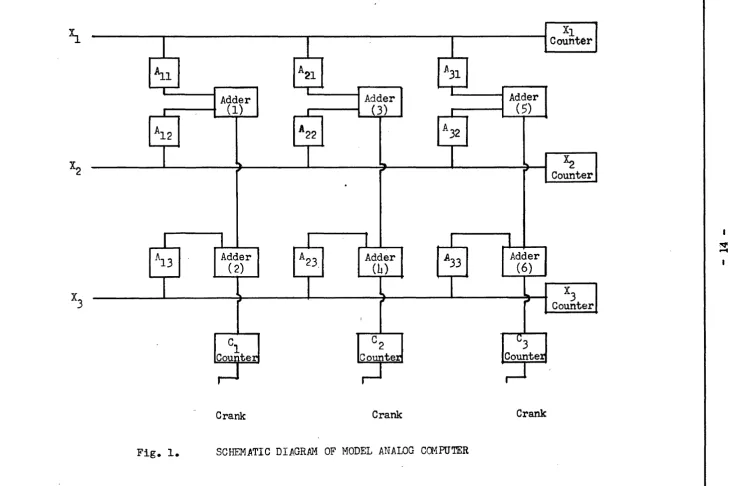
neous 1 inear algebraic equations. A model has been actually constructed; its schematic dia-gram is shown in Fig. 1, and its picture in Fig. 2.
Consider the set of three simul tane 0 u s
linear algebraic equations
0)
A3lXI + A.32X2 + A:33X3 C3
Although the discussion will be limited to this set of three equations for demonstration purposes, it is equally applicable to systems involving,many more equations. It,is for sys-tems of ten, twenty,or more equations in fact that computing machines are actually desirable or necessary.
To solve these equations, the compu ter must perform the following operations: (a) the multiplication of a constant into a variable for each term on the left hand side of Eqs •
0); (b) summing the sets of products for each of Eqs. (1); and (c) equating the sum to the cQnstant terms CI, C2, C3. These arithmetical procedures may be done by mechanical, electra-mechanical or, electronic methods. In the
pre-sent model, only mechanical equipment is used.
All variable quantities are represented by shaft rotations. Mpltiplication of a var~ able by a constant is accomplished by the in-sertion of an appropriately ratioed gear b e-tween the shaft whose turns represent the val ue of the variable and the shaft whose turns re-present the value of the product. The addi-tion of two variable quantities is accomplish-ed by means of a differential gear assembl y • In such a unit, the 'number of turns of the out-put shaft is the average of the number of turn s of the two input shafts. In other words, the , number of output turns is one-half the sum of the input turns. This produces in addition a scale change which must be compensated by set-ting up necessary gear ratios or ,by interpre-ting the results obtained from the machine.
The shafts, gears and differentials thus constitute the main elements of the machine. Revol ution counters are used on the shaf t s representing the unknowns and also on the constant term shafts (CI , C2, C3) in order to provide numerical answers and to indi cat e when the solution has been accomplished.
The schematic diagram of the apparatus necessary for solving Eqs. (1) is shown in Fig. 1. Shafts are indicated by lines; gear ratios, adders and counters are indicated by rectangular blocks. Handcranks for operating the machine are shown with the three constant term counters. In this diagram it will be no-ted that the Xlshaft is geared up by means of the ratios All, A21 and A31 to provide the three equations of Eqs. (1). The X2 shaft is similarly geared up to provide the second term products and the X3 shaft to provide the third term products., In adder (1) one-half the sum of AIIX2 and AI
ZX
2 occurs. This is converted to the true sum by means of a geared step-up of 2. In adder (2) one half of the sum All Xl of Al2X2 T Al3X3 occurs. This is also con-verted to the true sum by a geared step-up of 2. (Actually, the insertion of the geare d step-ups at these points is unnecessary and would not ordinarily be done. Instead, an equi· valent procedure would be to use 4AII as the gear ratio in the Xl multiplier, 4Al2 in the X2 mul tipl ier and 2Al3 in the X3 mul tipl i e r. Then, the sum appearIng on the summation side of adder (2) will be exactly AIIX I + Al2X2
+
A13X3.) This sum must equal C1 in accordance wi th Eqs. (1). Mders (3) and (4) prod u ce A21 Xl 1" ~2X2 -r A32X2 and equate the sum of C2.
Adders (5) and (D) perform a similar operati 011.
for the third of Eqs. (1). '
-A MEdi-AN! C-AL -AN-ALOG COMPUTER
In the operating procedure adopted fo r the model, the machine was driven by cranks on the constant term shafts. The crank on Cl was operated until its counter registered the vruue of Cl. The shaft was then locked against turn-ing and the crank on C2 operated until the val ue of C2 appeared in its counter. T his shaft was also locked against turning at this time, and the crank on C3 operated to obta i n the value of C3 in the final counter. The c~
rect val ues of the unknowns were then read fran the X-counters.
The demonstration model is shown in Fig. 2. It is constructed of gears and differen -tials obtained from war surplus outlets at a small fraction of original cost. Most of the coefficients are built into the unit so that they are not subject to variation. However, two of the coefficients (All and A12) may be set in gear boxes (shown in back left corn e r of unit) having four different settings, so that some variation is permitted in the equa-tions, other than that obtained by the unlimi-ted variation possible in the constant term values. Spur-type differentials are used for adding. Hand cranks are shown next to the c ons-tant term counters at the front of the unit • The unknowns are registered in the counters 0 n
the right.
The values of the coefficients are:
All -= K, 31(, 41(, 6K (adj ustable)
A12
=
K, 3K, 4K, 6K (adj ustable)A13
=
-A23=
lA33 -1/ (8K)-A21
=
A22 := A31=
A32 =- K\'lhere K - 54/110 (due to odd gear ratios avail-able in surplus property apparatus.)
For purposes of comparing analytical so-lutions with analog machine soso-lutions, the following set of equations has been solved by both methods:
1
KXl
+
6KX2 -rrK
X3 == 12 KXl+
KX2- 1 X3 -: -243K
-KXl
+-
KX2 - 1 X3= -4.JOK
After setting all counters to zero, the constant term cranks were operated in turn to attain in their respective counters the values of 12, -24 and -43. The readings of. the X-counters were then Xl = -24.44, X2
=
-3.49 , X3=
134.65. The analytical solution gave the values Xl=
-24.444, X2 = 134.649, indica t-ing an accuracy of 2 parts in 3500 for the worst root.To determine how well zero roots rnre shown by the machine, the constant terms on the right of Eqs. (2) were changed, respectively, to 100, -100, -100, and solutions obtained both analy-tically and by means of the analog computer. After turning the input cranks to the abo ve settings, -tne X-counters were found to read Xl
=
00000, Xz
=
00000, X3 ~392.6. The analy-tical solutIon gives the resul ts Xl=- 0, X2=
0, X3 = 392.7. The accuracy of the machine in this case is 1 part in 4000.When an attempt is made to solve an in -compatible set of equations, the machine locks up and cannot be operated. A simple example ill
a two-equatJon system which binds the machine is
Xl
+
X2 ,... 1Xl
+
X2 ~ 2Obviously, these two equations are not compa-table.
Comparisons may be made between this ma-chine and some of the other linear algebraic equation sol vers. Potentiometric equation sol-vers are widely used for solving linear alge-braic equations because of their simplici ty and the low cost of their component parts (2). The iterative method used for solving the equa-tions in this type of computer is a mechanical equivalent of the Gauss-Seidel numerical pro-cess. The method requires that the equations be "well-conditioned" to insure the convergence towards a solution.
Electronic simultaneous equation solvers (4) avoid iterative methods but introduce the all too frequent possibility of positive feed-back which often limits their usefulness. A digital computer has been designed for the spe-cial purpose of solving linear algebraic equa-tions (5). This high-speed machine can handle 300 variables (emphasizing the fact that any good digital computer is better than the best of the analog computers,) and solve proble m s involving matrix products, Fourier analysis,e~.
For the analog computer discussed in this paper, it can be said that the machine has an advantage over potentiometric types in avoiding the iterative process by solving the algebraic equations directly, simply by turning the con-stant term cranks to the required values. Posi-tive feedback, the drawback of the electron ic simultaneous equation solver, is also avoided, as is the need that the diagonal of the deter-minant of coefficients must contain the largest coefficients of the rows. The cost of a mechanical computer of the type outlined in this pa -per, but designed for 10 to 12 variables, would run considerably higher ~han the potentiometric equation solvers. Nith n decimal gear boxes (at
(continued on page ~O)
-Xl
I
l
I
Counter
All
A21
A31
I T I
Adder
Adder
Adder
I
(1)
I(3)
I (5)A12
122
A32
I
~I
....
I
...~
Counter
I
I
I
r
I
I
A13
Adder
A23
Adder
A33
Adder
( 2)
(4)
(6)
I
,
I
I
X3
~
"
"
Counter
J
C
1
C2 C3
Counter
Counter
Countex
,J
.-I
~
Crank
Crank
Crank
[image:14.794.45.774.64.550.2]\ ';£l
Problems Involved in the Application of Electronic Digital
Computers to Business Operations
John M. Breen
New York
(Note: The following consists of thr~e excerpts from an unpublished thesis completed June, 1954 for the degree of master of b~siness,administration at the American University, Washington, D. C.)
THE NEED FOR A NEW APPROACH
The possible applications of computers to business can be found to range across a wide spectrum of sui tabili ty for computer pro-cessing. Because of this, the tasks handled within a firm may involve several levels of difficulty. The applications must be studied individually and in combination to evaluate their suitability for computer processing.
Be-cause investment in a computer is large, its efficient use is of prime importance when ,a choice may be made among several applications.
Such revelations often come as a s ho c k to the businessman who has been led to expect a change in the office through electronics without effort on his part. The severity, du-ration and effect of the shock will depend on the individual and the thoroughness with which he has investigated the use of computers in business applications. For his own protecthn he must realize that the computer, as it ~ID
day, appears to be the product of the last phase in the development of a "great idea." It seems probable that future developments will tend to be improvements on what is known rather than radical basic discoveries. It has been suggested that the next "great idea" to be explored will be the use of computers i nlO either automation or business data processing. If this is so~ the businessman must be ready to play his part by familiarizing himself with computers and reviewing the way data is pro-cessed in his office to prepare the way for
electronic equipment.
-The systematic analysis of business data processing has received the attention of se-veral professional groups and large companies, who have suggested -proce~~res suitable fer ron-ducting such an inquiry. Insurance compa-nies have been particularly active in mvesti-gating and experimenting with computers, and' have published comprehensive reports of their findings. The consensus of their reports is uniformly emphatic in calling for individual re-thinking of applications and careful eva-luation of computers before investment. 12 Se-veral approach'es to the problem are open to both businessmen and manufacturers interested in business data processing.
Functional analysis of applications. The first and most obvious of these is the review of present business procedures ,to assure that they perform an efficient function. Many of
the apparent difficulties in the applications of computers may well be due to inefficient methods. The mere transfer of present manual or machine procedures to computer process in g ,without change may not be the best means 0 f
accomplishing the desired result. The need for review of procedures is constantly stress-ed in publications dealing wi th busin~s's appli-cations. 13 In particular, the need for func-tional thinking in terms of an entire process seems overdue,. The businessman has become accustomed to equating long, detailed reports with efficient control. Too often, procedur~
are superimposed and reports pyramided in the hope that quantity will accomplish what might have been brought about wi th less waste b y functional thinking. This concept has recent-ly been challenged by an article suggesting the benefits to business of familiarity with communication or information-theory. In this theory, information is equated with news, and efficiency becomes a function of news trans-mitted ~nd no-news suppressed. 11 Its practi-cal application in business would be one way to reduce or eliminate the overload on compu-ter output devices.
Operations research. The recently deve-loped techniques of operations research may also aid business in adapting its procedures to computer processing. Applied to military situations during the war, operations resanxh provided the solution to many complex problems by developing ~thematical models of logistic and tactical operations. In recent years in-dustrial problems have been receiving the at-tention of experts in this field. 15 Sin ce their solution will result from the develop-ment of mathematical models, these problems will become more amenable to processing b y computers. 16
Improved communication. Still another possible approach is open to both manufactu-rers and potential users. Research and
deve-lopment intended to close the gap between pre-sent computers and future machines more suit-able to business has already been undertaken by manufacturers. They have des igned and built special purpose machines to perform specific operations in business. They are developing input, output and memory devices specifically
f~r business data processing. Too frequently, howeve-.:, the manufacturer works without an
adequ~te idea of his customer's desires and expectations because the d~signer
and-busi-n~ssman lack a common bond of understanding.
-APPLICATION OF COMPUTERS 10 BUSINESS OPERATIONS
In this area it has become clear that busin~s
men and des igners mus t communicate wi th e ac h other. Such interchange of information will serve to clarify what is expected by the one, and what existing techniques enable the other to provide.
The opportunity which this last approach offers is coupled with the responsibility w~h
the businessman will have of extending his knowledge. This is not to say that he must become an electronic engineer or applied ma~
matician, but he must have a clear concept of how computers operate, what computer equipment is available, and how the equipment can be ap-plied to the various phases of business data processing.
COSTS OF COMPUTER OWNERSHIP
Businessmen have been made painfully a-ware in recent years that business data pro-cessing can become a costly necessity to a firm. The rise in clerical salaries and the growth in volume of paperwork have caused over-head expenses to rise spectacularly. It is hardly surprising, therefore, that businessmen reacted quickly to any suggestion of a practi-cal method to reduce costs. Many such sugges-tions were made concerning computers, but few of them were specific in saying how these sav-ings would be achieved. A greater service to businessmen and computer manufacturers would have been done by reducing generalities to de-finite statements about the costs of equipment, installation and operation for complete da t a processing systems.
Equipment costs. In many published arti-cles dealing with computers, the authors hav~
mentioned equipment costs which are often mis-leading. This may be attributed to lack of ex-perience in the field or to too ready accept-ance of manufacturer's claims. While it is true that many small computers are priced by their manufacturers in the range of from $50,000 to $100,000, it is found that they are usually scientific machines. That is to say, they are stripped-down computers with minimum input and output equipment, limited external memory facilities, and technical characteris-tics which in some cases reduce their utility in business applications. The businessman who investigates these small computers finds i n most cases that they will be useless to him unless he adds magnetic tape drive units, punched card input-output facilities, printer units or other equipment to the basic unit. If this is done the price rises rapidly and, i n most cases, approaches $200,000 for the combi-nation of units of equipment needed for an in-tegrated system.
This situation does not seem to prevail
in the case of the large computers. This may be due in part to the need to sell them byem-phasizing savings rather than price, and in part to the fact that a number of the la rg e machines- have been in use for a number of years and their prices have become relatively well known.
The firm which considers the use of com-puters must deal with specifics. It must de-termine whether the computer being investiga-ted can be used as-is or, if it cannot, how much the extrF equipment needed will cost.
Costs of Installation. In addition to the cost of equipment, the initial expense of acquiring a computer will be increased by freight and insurance charges incurred in mo-ving the machine and the costs of preparing the site for its installation.
It is not unusual for prices of compu-ters to be quoted f.o.b. at the manufacturer~ plant. The buyer may have to pay freight and insurance charges. Since computers are deli-cate machines, the costs of transcontinental haul may in some cases be a deciding factor in choosing between two machines of approxi-mately the same price.
The site at which the computer is to be installed must also be selected and prepared by the buyer. If a site above ground level is to be used, means must be providedm raise the computer as well as to move it horizontal-ly to its final location. Obvioushorizontal-ly, suffi-cient space must be provided for its instal-lation. Attention must be given not only to square-footage, but to the third dimension as well if false flooring or special interconnec'-ting ducts are needeo. Electrical wiring of adequate capacity must be provided, and shoWd be terminated in the type of electrical fit-tings required by the computer's power cable& Temperature and humidity control may also be necessary to assure that proper operating con-ditions are maintained.
Costs of operation. The operating costs of computers are similar to those of other da-ta processing insda-tallations. They include -operators' salaries, cost of supplies ofpu~
ed cards, magnetic tape, paper tape, continu-out forms, etc., and the cost of maintenance parts. Since the cost of all but the last will depend on the application, their
magni-tude will vary and can be determined wit h reasonable accuracy when the factors of each case are known. The cost of maintenance parts is discussed separately in a following parag-raph.
Personnel requirements and training prob-lems. Operating personnel for an electronic data processing system fall into several
ca 17 ca
-/
APPLICATION OF COMPUTERS TO BUSINESS OPERATIONS I
tegories, the number in ea§~ depending on the nature of the application. The largest group of these is made up of the operators of input and output devices. One operator per machine is normal for input equipment, while one ope-rator may be able to handle several output de-vices. The level of skill and type of train-ing needed to prepare these operators is simi-lar to that necessary for comparable punched cara equipment,. Arrangements can usually be made with the manufacturer for any special training needed to operate input and output devices.
The operation of arithmetic-logic and ~ trol units is a specialized task and should be the responsibility of a train~d person on each operating shift worked. The qualifications of the computer operator are still a matter of de-bate, but a common area of agreement exists as to the need for a person possessing a high-de-gree of native intelligence. The experience of a governmen~ agency operating a large com-puter installation shows that over a period of months, an intelligent clerk can become as skilled in handling controls as a much more highly trained programmer. 32 Several of the smaller computers on the- market are advertised as requiring only the services of an intelli-gent clerk for satisfactory operation.
Training programs for computer operators are usually conducted by manufacturers prior to the installation of equipment. This train-ing is usually included in the cost of the com-puter for a designated number of persons. Ad-ditional trainees are accepted on a contract basis at extra cost. The housing and subsis-tence of trainees during the training period are the responsibility of the buyer. A typi-cal training course for computer operators of-fered
§3
a leading manufacturer lasts for ten weeks.The need for a trained programmer will de-pend on the expected amount of change in ope-rating procedures of the business which will affect prepared programs. In some cases when assistance can be obtained from service burerus on a contract basis, it may prove advantageous to use these facilities. When changes may be frequent and cause constant re-programming the company will undoubtedly benefit from the per-manent services of a programmer.
The programmer should ordinarily possess sufficient mathematical training to enable him to prepare programs for statistical and other mathematical problems which may arise in pro-cess ing the firm's data. Training of a program-mer is usually included in the cost of the rom-puter, with additional trainees accepted a t extra cost. For most firms, the logical choke for such training is a member of the management I
engineering or office procedures staff who
pos-sesses the requisite mathematical background. A training course for programmers offered by a leading manufacturer requires 14 weeks to complete. 34
The outright purchase of a computer pla-ces the problem of maintenance at the door of the buyer. The high reliability in operation required of computers in business applications makes this function extremely important. One or more mainte~ance men will be required t 0
make operational checks, carry out pre-ventive routines and repair the.equipment when it fails. The minimum training to qualify a man for this work on a small computer should include the theoretical and practical aspects of television or radar maintenance supplemen-ted by training in computers themselves. On larger computers, one or more engineers and several technicians may be required. In l~ tions remote from manufacturer's service bu-reaus, a full time maintenance staff will un-doubtedly be required for a computer instal-lation. Training courses for maintenance men, available under the same conditions as those
35 for operators and programmers, last 26 weeks.
, Potential users of computers should be aware that the supply of personnel skilled in the operation, maintenance and programming of computers is short. Until this situation changes, trained personnel will be in demand and vulnerability to labor piracy will fre-quently be the lot of the user who has inves-ted in their training.
Cost of maintenance parts. The cost of spare parts for maintenance falls into two classes. The relatively predictable or cons-tant costs will usually be confined to there-placement of parts such as vacuum tubes and crystal diodes. Complete data on replacement costs of these parts are not available, but engineering estimates of a replacement rate of 25% annually for vacuum tubes and 10% for crystal diodes are considered reasonably accu-rate. 36 Sinc~ only a few different types of vacuum tubes and crystal diodes are used in most computers, a small inventory of these parts will provide for all but the most unusu-al emergencies.
Less predictable parts failures present a different problem. Although these are in-frequent, the possibility of failure and its consequences makes the ready availability of an adequate inventory of parts essential. The user who is near enough to the factory or to a service bureau may only require a small in-ventory of parts. The remote user, however, must prepare for all eventualities by main-taining a large inventory. The preparation of a recommended list of spares by the manu-facturer can aid the user substantially t 0
protect himself at minimum cost. The need to