Microblog Analysis as a Programme of Work
1PETER TOLMIE, Universität Siegen ROB PROCTER, University of Warwick MARK ROUNCEFIELD, Lancaster University MARIA LIAKATA, University of Warwick ARKAITZ ZUBIAGA, University of Warwick
Inspired by a European project, PHEME, that requires the close analysis of Twitter-based conversations in order to look at the spread of rumors via social media, this paper has two objectives. The first of these is to take the analysis of microblogs back to first principles and lay out what microblog analysis should look like as a foundational programme of work. The other is to describe how this is of fundamental relevance to Human-Computer Interaction’s interest in grasping the constitution of people’s interactions with technology within the social order. Our critical finding is that, despite some surface similarities, Twitter-based conversations are a wholly distinct social phenomenon requiring an independent analysis that treats them as unique phenomena in their own right, rather than as another species of conversation that can be handled within the framework of existing Conversation Analysis. This motivates the argument that Microblog Analysis be established as a foundationally independent programme, examining the organizational characteristics of microblogging from the ground up. We articulate how aspects of this approach have already begun to shape our design activities within the PHEME project.
• Human-centred computing➝Human computer interaction (HCI) • Collaborative and social computing➝Social media.
Additional Key Words and Phrases: Conversation analysis, ethnomethodology, turn-taking systems, microblogs, Twitter, rumor, annotation.
1.
INTRODUCTIONThis paper has two primary objectives: 1) to constitute Microblog Analysis as a foundational programme of work; 2) to further articulate how this is of foundational relevance to Human-Computer Interaction and related matters of understanding how people use social media; in particular, how people are seen to attend to the challenges of making the use of social media orderly.
This work has been motivated by the PHEME2 project and its central interest in
the detection of rumors in social media and their subsequent assessment and handling according to the veracity or otherwise of the information they are disseminating [Bontcheva et al., 2015; Zubiaga et al., 2015a; Zubiaga et al., 2016a]. A core part of this endeavor has been the identification of rumorous tweets on Twitter and the annotation of those tweets in terms of features that might ultimately lend themselves to system recognition and machine learning. It seemed reasonable to us
1 The research reported in this paper is supported by EC FP7-ICT Collaborative Project PHEME (No. 611233). www.pheme.eu
Authors’ addresses: P. Tolmie, Universität Siegen, Wirtschaftsinformatik und Neue Medien, Kohlbettstr. 15, 57068, Siegen, Germany. R. Procter, M. Liakata, A. Zubiaga, Department of Computer Science, University of Warwick, Coventry, CV4 7AL, United Kingdom. M. Rouncefield, School of Computing and Communications, Lancaster University, Lancaster.
that, if you are going to try and handle tweets in this way, you had better first of all understand what kinds of things you are dealing with as human socially-constituted phenomena. To do this, we initially brought to bear the analytic apparatus of Conversation Analysis as first laid out by Harvey Sacks and his colleagues in the 1960s and 70s. We did this because it eschews pre-theoretical judgments regarding what kinds of phenomena one might be looking at and instead seeks to uncover empirically how talk-based phenomena are the methodical production of the parties to that production. In this way, we figured we might be able to bring out the methodical features of tweets that provide for their character as rumors (or anything else) in social interaction and that these methodical features would give a handle on what one might want to label when engaged in annotation [Zubiaga et al., 2015a]. However, it quickly became apparent to us that to just apply the apparatus of conversation analysis and seek to identify phenomena already identified within its canon was not wholly satisfactory. Tweeting, for all of its conversational characteristics that people are happy to point to [Honeycutt & Herring, 2009], is not
conversation.3 So, this paper unpacks some of the important distinctions between
conversation and ‘microblogging’ (to take the term that has been applied to a variety of very similar forms of interaction using social media), in order to outline what a suitable approach to analysing microblogging might look like. Building on this, we propose a programme of analysis that is better suited to microblogging. To conclude we demonstrate some of the ways it might then be used by looking at how we ourselves have begun to use it to handle Twitter threads that potentially incorporate rumors. The importance of this particular application we briefly outline below.
2.
RUMORS IN SOCIAL MEDIASocial media such as Twitter provide a constant flow of information that is used by many as a news source, especially in cases of emergency situations or at the start of an event, when traditional media have not yet been able to deploy reporters on the ground. The value of social media in coping with the aftermath of natural disasters is well documented [Bruns et al., 2013; Tonkin et al., 2012]. Equally, events such as the 2011 Arab Spring have been heralded as evidence of how social media can strengthen the capacity of citizens to challenge and overcome social and political repression [e.g., Khondker, 2011], though even materials published prior to those events would suggest we treat such claims with caution [e.g. Weaver, 2010]. Journalists and analysts of various backgrounds now monitor social media to identify new stories or gain insights on events unraveling or other areas of interest. Moreover, social media provide a mechanism for people to broadcast their own viewpoint and thoughts, constituting a powerful means for individuals to exercise influence and even mobilize crowds [Procter et al., 2013a; Khondker, 2011].
However, the advent of streaming information broadcast by a multitude of sources comes with one large caveat, that of being able to establish the veracity of a statement, distinguishing between a corroborated fact and a piece of unverifiable information. Indeed, research suggests that social media provides an extremely fertile ground for rumors and misinformation [Mendoza et al., 2010], especially during crises, when unverified statements may sometimes be picked up and given credibility by mainstream media reporting or government agencies such as the emergency services [Procter et al., 2013b]. During an earthquake in Chile, for
3 We note that Twitter’s user interface and tweet metadata have evolved in such a way to suggest
example, rumors spread through Twitter that a volcano had become active and there was a tsunami warning in Valparaiso [Mendoza et al., 2010]. Twitter has also been used to spread false rumors during election campaigns [Ratkiewicz et al., 2011]. The challenges communities face from rumors in social media is well-illustrated by the 2011 riots in England, which began as an isolated incident in Tottenham, London, on
the 6th of August but subsequently quickly spread across London and to other cities
in England [Lewis et al., 2011; Procter et al., 2013a].
It is this problem of verifying information posted in social media that has motivated the PHEME project [Derczynski et al., 2015]. In this paper we focus on closely examining Twitter as a socially constituted phenomenon. This has been a necessary step towards developing an annotation scheme [Zubiaga et al., 2015a; 2015b] for tweets that the project will be using to train natural language processing and machine learning techniques that will assist in the rumor verification process. Whilst it may be tempting to think that one can simply find a way of looking at isolated tweets and see within them already the necessary constituents that might
make them a rumor, individual tweets are made into rumors by people and the ways
in which they are responded to, articulated and spread. These are social processes through and through and can only be understood by understanding the social order that underpins them. To unravel the social order in play one needs the right kinds of tools. Our starting point was Conversation Analysis because it sets aside any theoretical preconceptions regarding the phenomena in play and examines the ways in which social phenomena are constituted in situ through the sequential production of inter-related utterances, which would seem to capture what Twitter-based
conversations, rumorous or otherwise, look like4 . However, there is a risk involved in
taking Conversation Analysis as a frame. Doing so rests upon an assumption that tweeting works the same way as conversation. This was not an assumption we could comfortably make. Rather, it seemed important to understand tweeting on its own terms. We therefore looked instead to the foundational insights that first inspired Conversation Analysis as an enterprise to see if this could provide us with insights as to how to proceed when handling how people use Twitter. It is the outcome of that exploration that we present in this paper.
3.
TWITTER, SOCIAL COMPUTING AND THE CONVERSATION ANALYTIC FRAMETwitter is a microblogging site that was set up in 2006, which allows users to post messages (‘tweets’) of up to 140 characters in length. Unlike social media platforms such as Facebook, Twitter’s friendship model is directed and non-reciprocal. Users can follow whomever they like, but those they follow do not have to follow them back. When one user follows another, the latter’s tweets will be visible in the former’s ‘timeline’. It is not necessary, however, to follow another user to access tweets: Twitter is an open platform, so by default tweets are public and can be discovered
through Twitter search tools. The one exception to this is the direct message (DM),
which is private, and can be seen only by the follower to whom it is sent. Users can
also reference another user through the mention convention, where a user name,
prefixed with ‘@’, is included anywhere in a tweet. A user, thus referenced, will see the tweet in their timeline. A user can also opt to make their account private, in which case the user can approve who would be able to read their tweets.
4 Paulus et al (2016) systematically review 89 other CA-based papers that rest upon the same
A number of other important conventions have emerged as Twitter use has
evolved. One is the retweet option, usually referred to as RT, whereby users can
forward tweets from other users to their own followers. This works by either clicking on the retweet button available on the standard Twitter user client, or by copying the original tweet and putting ‘RT @username’ in front of it, the latter giving the option to accompany the original tweet with their own comment. In this way, tweets can
propagate through users’ follower networks. Another convention is the hashtag,
which is distinguished by prefixing a string of text with the hash sign, ‘#’. Hashtags provide a way for users to assign a label to a tweet, thereby enabling the co-creation of a fluid and dynamic thread within the timeline that facilitates information discovery: anyone searching for or using the same hashtag can see what everyone
else is saying about this topic. Yet another convention is the reply option, which, as
the name suggests is a mechanism for responding to a specific tweet. As such, it is a specialisation of the mention convention in that the username of the poster of the tweet being replied to is prepended to the new tweet. Unlike a mention, however, only users (other than the sender and the recipient) who follow both the sender and
the recipient will see it in their timeline. Finally, favoriting a tweet is a way of letting
the tweet’s poster know that you liked the tweet. The usage patterns of each of these conventions differ and in the case of hashtags there is recent evidence that their
appeal is diminishing [Rahimi, 2015].5
If one looks at studies of Twitter both within and beyond social computing what
one finds in abundance are studies that look in one way or another at the content of
tweets and how that content might be seen to relate to a variety of other matters. Thus, and for instance, we find treatments of the content of Twitter-based conversations in the course of political campaigns, or in other political contexts. As an example, Burgess & Bruns [2012] looked at the content of tweets associated with the #ausvotes hashtag during the Australian elections in 2010 to examine the character of political discussion on Twitter. In particular, they provide examples of tweets to demonstrate that the most popular tweets were not engaging at all with any of the mainstream political reporting (see Stieglitz & Dang-Xuan [2012] and Jungherr & Jurgens [2014] for other examples of this kind of tweet-based analysis). Equally common are examinations of Twitter posts in the aftermath of natural disasters, or as a feature of other kinds of emergencies or security scares. Chatfield et al. [2014], for example, examine the way in which government bodies made use of Twitter in the aftermath of Hurricane Sandy. Additionally, they provide examples of tweets to evidence how citizens were using Twitter to circulate specific points of advice. This is built into an argument that citizens have a critical role to play in supporting the public services under such circumstances. (See also Mandel et al., [2012] and Purohit et al. [2013] for other treatments of the same kind of material). Also popular are examinations of the use of Twitter during major news events. For instance, Hu et al. [2012] examine large number of tweets before, immediately after
5 It should be noted that the original version of this paper was written in early 2015 and that a number of
and some time after the news of Osama Bin Laden’s death to try and pull out markers of ‘certainty’ from the content. They note, in particular, the impact politicians and journalists tweeting in their own right were able to have on this score and this is then used to argue for the important role Twitter may play in disseminating breaking news more in relation to more traditional mass media channels. (Other content-based treatments of the handling of news events can be found in: Bruns & Burgess [2012]; Gupta & Kumaraguru [2012]; Procter et al., [2013b]; and Zubiaga et al., [2016a]).
Other bodies of tweet content examined include those used in specific settings such as conferences, learning environments, or the workplace. Gonzales [2014], for instance, looked at when and what tweeters typically tweet about whilst attending conferences, using content from a range of tweets to make the case that Twitter plays an important role in supporting discussion at conferences. The presentation of tweet content to make a case for how Twitter may support specific kinds of interactions amongst certain communities can also be found in Borau et al. [2009], and Bougie et al. [2011], Hambrick et al. [2010], and Morris [2014].
Yet another sort of content analysis has been devoted to the use of Twitter in different kinds of interpersonal communications and relationships. McPherson et al. [2012] looked at how people were tweeting one another whilst they were actually
engaged in watching the television show Glee to see what part this might be playing
in the shaping of their viewing as a social experience. Specific tweets were gathered and categorized according to whether they were comments about characters, general comments about the show, comments about the episode they were currently watching, and so on. Associated interviews and analysis were then used to bring into question whether these kinds of interchanges amount to actual conversations. Examples of this kind of focus on Twitter abound. Bak et al. [2012] looked at how certain kinds of content in Twitter conversations might be indicative of self-disclosure and the strength of relationship between the participants; Murnane & Counts [2014] examine the Twitter posts from smokers and the part they play in them giving up smoking; Kendall et al. [2011] examine how people use Twitter to share information with one another about their health and fitness activities; Magee et al. [2013] use tweets amongst players of a role-playing game to explore the part played by these in enhancing their gaming experience; Zhang et al. [2011] look at how consumers use ‘word-of-mouth’ on Twitter to share information about businesses and their products and services; and Sleeper et al. [2013] examine a range of tweets that tweeters have subsequently regretted posting and the actions they have then taken to engage in some kind of repair.
Another body of work can be seen to be stepping beyond the cherry-picking of ‘interesting’ content in order to take the actual constitution of tweeting as
conversation as its topic of interest. Cogan et al. [2012] use a graphing approach to try and extract whole Twitter conversations given a conversational root. Larodec et al [2014], by contrast, use content analysis to try and identify user interactions on Twitter as a way of getting at conversations. On a different tack, Schantl et al. [2013] attempt to develop a model that can be used to predict who the repliers might be in Twitter-based conversations. A particularly significant trend is the quest to identify
trending or persistent topics.This may involve: looking at a large number of trending
Conversation focused work also includes examination of how to identify and model specific kinds of conversational acts. In this vein, Huang et al. [2010] look at the specific practice of adding hashtags to tweets and the kinds of things it is designed to accomplish; whilst Naaman et al. [2010] consider how to use the content of tweets to identify different kinds of user behaviour; and Ritter et al. [2010] look at how interactions between users on Twitter might be modeled as ‘dialogue acts’. Research
has also been devoted tomatters of conversational address and coherence, and how
Twitter conversations are topically organized. Honeycutt & Herring [2009], for instance, have looked at the use of the @ sign as a marker of address; Lai & Rand [2013] have examined how topics of conversation unfold dynamically; and Sommer et al. [2012] have focused upon both topic relations and sentiment in Twitter conversations. Broader approaches have also included reflection upon how to analyse
the structure of tweets in terms of conversational frameworks. de Moor [2010], for
instance, developed a socio-technical context framework to examine how the technical
aspects of Twitter were related to the production of conversations. At the same time
Kumar et al. [2010] were exploring the structure of Twitter conversations to establish whether there was scope for developing a mathematical model of how they were organized. Relatedly, Zappavigna [2012] examined how Twitter interactions might be formulated as specific forms of electronic discourse.
Other authors concern themselves more with how to analyse Twitter- and microblog-based phenomena in their own right, for instance, by looking at the use of specific features such as hashtags (Laniado & Mika [2010]), or retweets (Boyd et al
[2010]). Other considerations look at Twitter’s linguistic character such as the use of
curses (Wang et al. [2014]), or its multilingual character and how it might itself constitute a language ecology (Eleta [2012]).
Quite a different set of analyses have looked at the social character of Twitter. Rossi & Magnani [2012] look at how the public nature of Twitter has an impact upon the ways in which people use it. Schoenebeck, [2014], on the other hand, has looked at how people take breaks from using Twitter and their reasons for doing so, and Stibe et al. [2011] have examined how Twitter can be used as a tool for persuasion and the influence some users may have upon the attitudes of others. Yet another set of studies focus upon Twitter as a vehicle for information-exchange and matters such as the identification of people’s information requirements by examining how they use Twitter (Zhao & Mei [2013]) and the extent to which information needs may not currently be well-supported (Ramage et al. [2010]). This, of course, also relates to our own interest in rumor, with Qazvinian et al. [2011], Starbird et al. [2014], Maddock et al [2015], and Zhao et al. [2015] all using a range of techniques to try and detect the presence of rumors in tweets and to then relate this to rumor diffusion.
Other studies again have looked at Twitter use in terms of motivation or interest.
By way of example, Alonso et al. [2013] used crowdsourcing techniques to try and
identify what kinds of content people find interesting on Twitter; and both Naveed et al. [2011] and Azman et al. [2012] looked at what kinds of motivation people might have for retweeting.
piqued your interest; and so on. This is not intended to set aside in any way the significant academic endeavour and intellectual rigor involved in many of the studies we have cited. It is also important to acknowledge the extent to which Twitter has changed in both format and use over the 10 years since its inception, which has itself had an impact upon the kinds of studies and publications addressed to that use. However, we feel that it is a matter of foundational research concern that we should not a priori assume that we all just know how to handle Twitter use as a phenomenon. All too often the understanding evinced in current studies is indexed upon a commonsense understanding of what Twitter is about, and what kind of a thing we might want to describe it as, without ever digging into the grounds of that commonsense understanding itself. Thus, just as with the problem Garfinkel [1967] was seeking to address in his early work regarding an overwhelming propensity in social sciences to speak of society but to leave the actual accomplishment of society untouched, we are confronted here with a similar tendency to set the actual accomplishment of tweeting as a social phenomenon aside and to instead simply work with its products, i.e. how the content is used. That is, as Garfinkel might have suggested, actual Twitter use is not investigated or researched as a ‘topic’ but is instead treated as if we already understand the phenomenon and is used as a mere ‘resource’ in the investigation of other matters (see Garfinkel & Wieder [1992]). Thus
there is an ongoing absence in the literature regarding the nature of the technology6
that is being brought to bear and its impact on social interaction and what that interaction therefore looks like.
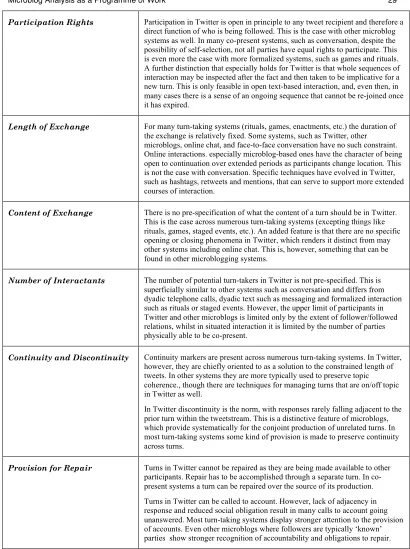
Taking seriously the early work of Sacks, Schegloff and Jefferson [1974] regarding just what the organizational properties of conversation might look like as an effective system for getting the job of co-situated talk done, we argue here that there is a similar need with Twitter and other like phenomena (characterized here as microblogging) to go back to basics and look at their organizational characteristics and that this is the only effective way of being able to handle them as social phenomena.
It’s some time now since ICT systems design first took its ‘turn to the social’ (see Crabtree et al. [2012] and Button et al. [2015]), famously instantiated in the works of Suchman [1987] and Grudin [1990]. As pointed out in Button et al. [2015] a part of this turn was what might be seen as a rather problematic flirtation with social
science theory – postmodernism, post-feminism, queer theory as well as the cultural,
linguistic and textual ‘turns’ [Bardzell & Bardzell, 2011; Light, 2011; Rode, 2011] and so on – where it was assumed that this could simply be imported wholesale from social science into systems design. It is not our position here to critique the progress or results of this frequently less than happy, or productive, interdisciplinary
endeavour, other than to point to Anderson and Sharrock’s comment that: ”the
alignment of sociological theory and design specification remains intractable … designers and especially members of the HCI research community have continued to advocate incorporation of forms of social and sociological theory into design but with very little substantive success” [Anderson & Sharrock, 2013]. However, another and perhaps rather more fruitful part of ‘the turn to the social’ was an equally willing
embrace of social science methods to reveal, document and evaluate aspects of user
6 We use technology here in its grandest sense, incorporating not just the computing technology
experience etc. Conversation Analysis was, of course, one of these methods and its use has, in fact, played a quite significant role in social computing over the years (see, for instance, Heath & Luff’s [1991] analysis of interaction in control rooms for the London Underground and Ruhleder’s [1999] analysis of communication breakdowns in video-mediated communication across remote sites). We would also point out that another strand of ‘social’ research in HCI that has been of some moment is an attention to the use of technology for the production of text in interaction, such as Grintner and Eldridge’s work on the use of SMS by teenagers [2001] and Curtis’s work on social interaction in MUDs [1992]. This paper can therefore also been seen as a continuation and development of these kinds of lines of enquiry, considering the intimate connections between the technology and talk or text in social interaction, but with a more specific and detailed emphasis upon a proper consideration of exactly what an appropriate methodology for such undertakings might need to look like.
This being the case, we set aside here the assumption that we know already how to analyze Twitter feeds, even if we regularly process such content both as users and researchers. We similarly set aside the assumption that tweeting is just conversation, even if conversation is a label that is often apparently convenient to use. Instead we set about here trying to establish from the ground up what an appropriate framework for analyzing Twitter feeds might look like, and how that is in fact quite distinct from the conversation analytic enterprise that we first thought we might use. To this end, from this point onwards instead of using the term ‘Twitter-based ‘conversations’’ we shall use the more general term Twitter-based ‘interactions’, holding in abeyance at this stage any assumption that we know what these interactions amount to.
4.
METHODICAL PRACTICES AS SOLUTIONS TO ORGANISATIONAL PROBLEMSHarvey Sacks, in some profoundly significant remarks regarding the way in which any orderly organizational apparatus geared towards the accomplishment of a coherent social order would have to operate, noted that such an apparatus needs to be available to just any member of society such that they could make use of it without much fuss or bother or the need to engage in extensive formal training or the accumulation of multiple examples of its use. It is the spirit of these remarks that can be seen to inhabit the seminal work he undertook along with Emmanuel Schegloff and Gail Jefferson in specifying some of the fundamental organizational characteristics of the turn-taking system in conversation [Sacks et al., 1974].
demonstration of a programmatic approach to the description of a social order that is, even up until now, largely undescribed.
In that our current work seeks to establish microblog analysis as a programme of work, it seeks to proceed along the same lines as the simplest systematics by taking, in the first instance, the phenomena associated with microblogging to be methodically constituted solutions to arising organizational problems in the work of communicating in that way. In that case it will be seeking a) to uncover just what those organizational problems might be and b) to describe in methodological terms how microblogging phenomena represent ways in which those problems are being recurrently addressed.
As a note of clarification, the term microblogging has been adopted here in order to capture a set of rather similar communicational phenomena to be found across a range of social networking sites and in certain kinds of forums. The original term used to cover these kinds of short text-based phenomena was ‘tumblelogs’ [Kottke, 2005], but by 2006 ‘microblog’ had become the preferred term. It was used to cover a variety of services such as Twitter, Tumblr, FriendFeed, Cif2.net, Plurk, Jaiku, identi.ca, PingGadget and Pownce [Barnes & Bohringer, 2011; Honeycutt & Herring, 2009; Huang et al., 2010; Java et al., 2007; Kaplan & Haenlein, 2011; Lai & Rand, 2013; Naaman et al., 2010; Oulasvirta et al., 2010; Zappavigna, 2011; 2012]. More recently the term has come to also cover the status update features of social networking sites such as Facebook, MySpace, LinkedIn, Diaspora*, JudgIt, Yahoo Pulse, Google Buzz, Google+ and XING [Archambault & Grudin, 2012; Chen & She, 2012; Gilbert et al., 2013; Larodec et al., 2014]. The specific worked through case here is that of Twitter.
More than this, our focus here is upon interactions using Twitter that are now recurrently grouped by Twitter itself into ‘conversations’. It is, of course, the case that Twitter feeds, can take many forms, and many postings to Twitter stand as isolated fragments of text or images, that are not produced as a direct response to other postings, and that are not productive of other responses in their own right. This alone puts much of the content of Twitter outside of anything Conversation Analysis might seek to tackle. Our interest in examining the production of Twitter interactions, where there is an interlinking of related texts, derives from our interest in the propagation of rumors on Twitter. The spreading of rumors on Twitter necessarily entails posts being productive of further postings, otherwise the phenomena would not be describable as rumors in the first place. Thus it is the case that in this paper we are only addressing part of a much larger enterprise that would seek to understand what tweets and tweeting might amount to as organized social phenomena across the board rather than just in the context of Twitter interactions. Nor is there any assumption here that what can be said for Twitter can be said for all in all regards and significant further work would need to be undertaken in each separate microblogging domain to fully capture their organizational characteristics. By focusing on Twitter-based interactions, however, we found that, just as is the case with the materials first gathered for exploring the organizational character of conversation (see Sacks [1984]) we were confronted with a turn-taking system and proceeded to examine it accordingly.
produced asynchronously. They are also produced, at least in the first instance, in a single largely undifferentiated stream that is temporally organized with the latest contribution being placed at the top of the list. This description provides for the possibility of a variety of social networking sites being analyzed in a similar fashion.
5.
MICROBLOG INTERACTIONS AS A FORM OF TURN-TAKINGAs articulated above our prime interest here is in understanding how microblog exchanges on Twitter work as human organizational phenomena. As we also point out above, the exchange format of Twitter interactions makes them, operationally at least, a species of turn-taking. What we mean by this is that the exchanges in question are made up of a series of inter-related parts, where one part is implicative of another, and where the different parts are produced by at least two different parties. Thus the job of understanding how these exchanges work entails, amongst
other things7 , looking at how the parts are organized in relation to one another as a
series of turns. Now, fortunately for us, we are not the first to examine how identifiably distinct utterances might be organized as a system of turn-taking. A
central work in the conversation analysis canon, A Simplest Systematics for the
Organization of Turn-Taking for Conversation, by Harvey Sacks, Emmanuel
Schegloff and Gail Jefferson [1974], undertook exactly this job of work when examining the organizational properties of face-to-face conversation. We will therefore be making use of a number of their key insights here in order to articulate
precisely the ways in which Twitter-based exchanges are phenomenologically distinct
from ordinary face-to-face conversation.
At the very heart of Sacks et al.’s Simplest Systematics is the observation that
talk is organised such that only one speaker speaks at once. This is seen as a fundamental premise of social order because any other system would frequently render talk completely ineffectual. On the basis of this, and probing just how it could be that this is systematically provided for in interaction, Sacks et al. elaborated what they called the ‘turn-taking mechanism’. They saw this system as containing some primary features that together serve to underpin most other kinds of conversational phenomena. Thus, and for instance, there are: speakers (recognizable individuals who produce utterances); speakers who talk first, and other speakers who may also talk as a conversation unfolds; mechanisms whereby a current speaker may select who talks next; and mechanisms whereby speakers may select themselves to be the next person to produce an utterance.
They also made a point of noting that human action and interaction is replete with examples of turn-taking, so:
“Turn-taking is used for the ordering of moves in games, for allocating political office, for regulating traffic at intersections, for serving customers at business establishments, and for talking in interviews, meetings, debates, ceremonies, conversations etc.” [Sacks et al., 1974: 696].
A number of online activities that were not a feature of human interaction at the time may be seen as further candidate members of this list, including microblogging.
7 We make no claim to comprehensiveness in our analysis here. This is merely a first foray and
A key justification of their work that is of equal moment here was the following: “it is of particular interest to see how operating turn-taking systems are characterizable as adapting to properties of the sorts of activities in which they operate” [ibid]. Thus “an investigator interested in some sort of activity that is organized by a turn-taking system will want to determine how the sort of activity investigated is adapted to, or constrained by, the particular form of turn-taking system which operates on it.” [ibid]. It is this spirit of trying to understand the organizing properties of tweet exchange in Twitter as a system in its own right that motivates this current body of work.
Whilst we will be using the Simplest Systematics to compare certain aspects of
turn-taking in Twitter to turn-taking in conversation it is important to note here that
our aim is not simply to apply the Simplest Systematics to microblogging in Twitter.
Instead our interest is based upon how the Simplest Systematics may provide a
model for how one might proceed to examine turn-taking systems and uncover their
organizational features8 . As a model the Simplest Systematics can be seen to have a
number of key strengths. One of the most important aspects of all is that the proposed model is able to be simultaneously ‘context-free’ but also exceptionally ‘context-sensitive’. So you can dip into whomsoever, wheresoever and find the same system in play, with the same key operational characteristics. At the same time, the system can be endlessly adapted to meet the particularities of local need without having to step outside of the system itself [Sacks et al., 1974: 700].
5.1 Turn-taking in Twitter-based interactions
In order to map out some of the key organizational features of turn-taking in Twitter- based interactions we are going to set out here a range of foundational observations about Twitter that can together be seen to form the building blocks of a thoroughgoing analysis of microblogs that can be expanded upon, developed and refined over time. Where relevant we shall indicate how these observations relate to the observations Sacks et al [1974] made about the organization of turn-taking in
conversation in the Simplest Systematics.
5.1.1. Tweeter Change. One of the core observations that Sacks et al. make [1974:
700] is that the participating parties within the system change over time: it is not just one party doing all the work. In Twitter this is a direct function of who is being followed, the frequency with which they tweet, and the presence of other factors such as promoted tweets. It is conceivable that someone might follow just one other party in which case tweeter change would be rare. However, promoted tweets usually result in some extraneous tweets appearing on anyone’s timeline throughout the day. More importantly, in view of the fact that even in 2012 the average number of people being followed for Twitter users was 102 [beevolve.com, 2012] and Twitter has expanded since then, tweeter change is a characteristic of most people’s timelines and, for the larger part, two or more tweets concurrently by the same person is infrequent though it certainly occurs.
5.1.2. Timeline Organization. As Sacks et al. observe [1974: 700] it is ‘overwhelmingly’
the case in face-to-face conversation that only ‘one party talks at a time’. Now it is the case that in Twitter some of its characteristics are managed as much as anything by its technical configuration and this is one such case. Now, of course, it is in the nature of Twitter that people can be composing tweets at the same time as one
8 Ivarsson & Greiffenhagen [2015] have recently used the Simplest Systematics as a similar
another or at widely spaced intervals. However, the actual appearance of a tweet on people’s timelines is a function of the time it is registered by the system. Thus, a) whilst it is entirely possible for two parties to be composing tweets in overlap, even in
Twitter interactions; b) it is also a feature of Twitter that the timeline is organized in
independent tweets that do not appear in a simultaneous and overlaid fashion and that do not overlap. Thus the individual actions and their representation are potentially disjoint but this disjuncture is never made visible to recipients.
5.1.3. Tweet Separation. Something made much of in the original Simplest
Systematics is the fact that, whilst turns between contributors in the system are independent, overlaps in turns do, in fact, often occur, though they are typically very brief [Sacks et al., 1974: 701]. However, in the case of tweet exchange, Twitter does
not represent overlaps of articulation, even if such overlaps are occurring at an
individual level. The consequence of this is that within the timeline each turn appears to be tightly independent and consecutive. This has some important implications that we shall be returning to in due course.
5.1.4. Temporal Disjuncture. Having pointed out that small overlaps in turns do occur
in the case of the conversational system they were examining, Sacks et al. [1974:701] also emphasise that ‘transitions (from one turn to a next) with no gap and no overlap are [also] common’, and that, together, these three possibilities ‘make up the vast majority of transitions’. In the case of Twitter temporal gaps between the appearance
of one tweet and another do routinely occur. This is often emphatically the case in
Twitter interactions where people have to take time to read another tweet, with tweets coming ‘all at once’, so to speak, because recipients are not able to witness the ongoing composition of the tweet’ (something that some messaging services do
provide for by the way, e.g. the Beam Messenger for Android phones9 ). Contributors
to a Twitter interaction may also come to it some time later: this is another point to which we shall later return. However, all of these temporal disjuntures do not manifest themselves as ‘gaps’ in the timeline but rather as delays in updates. Once again the extent to which delays in updates occur is tightly bound up with the number of people being followed and the frequency with which they tweet. Broadly speaking, though, temporal disjuncture between tweets can be considered to be a routine feature in Twitter, making gaps in interaction an unremarkable feature of use that is not oriented to by users as problematic or subjected to efforts to repair. This goes hand-in-hand with describing exchange systems like Twitter as being both
‘synchronous’ and ‘asynchronous’, but it does also immediately render it as
something quite distinct from face-to-face conversation10 .
5.1.5. Turn Order. A feature of tweet exchange organization that it shares with a
number of other turn-taking systems including conversation, is that the actual order of turns ‘is not fixed, but varies’ [Sacks et al, 1974: 701-702]. In Twitter just where a tweet will fall next in the timeline is not predictable in advance. A notable
9 www.beammessenger.com
10 Of course, as it does not involve co-presence or spoken language, microblogging differs from
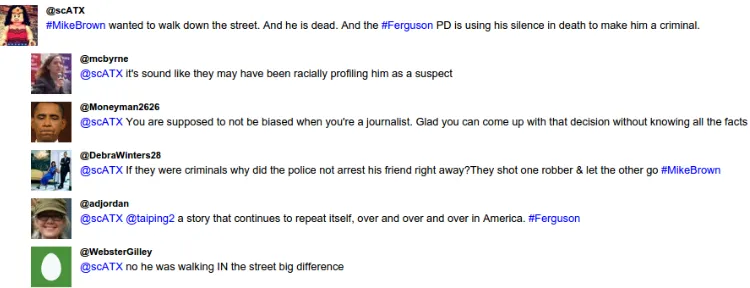
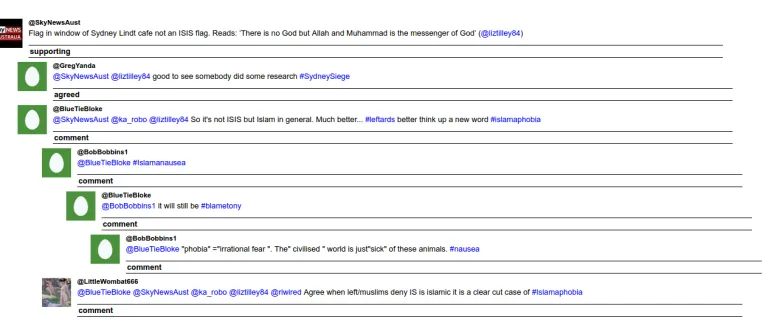
consequence of this is that one can get the following kind of pattern where a whole set of distinct tweeters all respond individually to an initial opening gambit without any predictable relationship between them (Fig. 1).
Fig. 1. A typical timeline.
Another important point we return to later is that this business of turn order not being fixed can result in a potentially indefinite number of people self-selecting to tweet in response to a prior tweet. It would appear that the only systematic constraint in operation here is the size of the cohort of people who follow the person who tweeted initially (with retweeting creating scope for endless extension of this
cohort to other users’ followers). Looking for a moment outside of Twitter interactions,
self-selection is clearly entirely routine, and is often occasioned by matters wholly
outside of Twitter11 . This means that it is frequently not clear that parties producing
originating tweets are oriented to implicating any overt responses from their
followers12 at all. In the case of the turn-taking system that Sacks et al. [op cit] were
looking at, face-to-face conversation, the number of potential self-selecting next speakers is tightly controlled both by the limits that exist on the number of people who can be co-present and in range to hear, and by a range of incumbent rights and obligations that exist as a feature of the relationships that hold between those people who are co-present.
5.1.6. Implicated Turns and Tweeter Selection (i). A fundamental observation to be made
here is that, whilst turn order in Twitter is not fixed, there are ways in which next
turns can be implicated, a feature Twitter interactions do share with other kinds of turn-taking phenomena, and people may be held accountable for the production of turns implicated in these ways. It is therefore the case that there are both self-selection and next tweeter self-selection techniques in Twitter. Some important
11 Indeed, the occasioning of first tweets is potentially a whole further job of research that has yet
to be undertaken in any thoroughgoing or empirical way. It presents unique research challenges in that it requires situated observation of tweeters in whatever environments they may be happening to tweet from. In this regard, a recent paper by Reeves & Brown [2016] makes a strong case for examining how the production of social media texts and interaction with them needs to be studied as those activities occur, in situ, in the ordinary flow of everyday life.
12 This is not to say, however, that tweets are not ‘recipient-designed’ [Sacks, 1992]. On the
[image:13.612.115.490.132.276.2]differences between this and the system Sacks et al. [1974] were examining, however, are that a) next tweeter selection does not necessarily provide for that next tweeter responding as the next tweeter in the interaction’s timeline. Responses can happen after a number of other people have chipped in. Furthermore, b) many self-selected tweets do not implicate continuing interaction anyway. In this case interaction evolves by respondents finding within the tweets the grounds for their own self-selection. So, whilst Twitter may be asynchronous and public facing it is unlike online fora and question answering websites because the goal of a post is not necessarily to start an interaction.
5.1.7. Tweet Length. An important aspect of Twitter is that, whilst the exact length
of a turn may not be pre-specified, its maximum length is very tightly constrained at
140 characters13 . This puts it in direct contradistinction with the Simplest
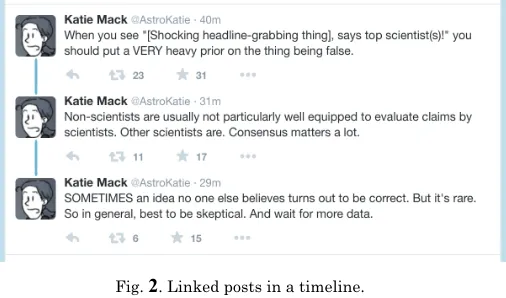
Systematics, where it is observed that turn lengths are not fixed and can vary significantly. Having said this, strategies can be adopted in Twitter that result in something akin to an extension of a turn. One such strategy is the linking of posts (see Fig. 2).
Fig. 2. Linked posts in a timeline.
Another is the completion of the turn over multiple posts, using the convention of three dots at the end of each post to indicate that there is more to come (see Fig. 3).
Fig. 3. Linking with dots.
And yet another way of linking posts is by numbering them, so that it is previously announced how many more posts are coming (Fig. 4).
13 It should be noted here that, at the time of writing this article, discussions were afoot in Twitter
[image:14.612.186.439.298.447.2]Fig. 4. Numbering posts to link them.
However, it should be noted that in the context of the timeline, as it is encountered by recipients (or, to be more accurate, ‘followers’), these strategies still result in separate posts that look to all intents and purposes like separate turns. This needs especially to be borne in mind in view of how tweets like this may appear on a follower’s timeline separated out by other posts, even if they are produced consecutively by the tweeter and appear adjacent in the capture of the interaction alone. Fig. 5 shows a way in which the connection can be further emphasized in some cases by including additional elements such ‘Cont’ before the dots and a reiteration of the last part of the previous post in the subsequent one.
Fig. 5. Additional linking strategies.
It is clear that these strategies are oriented to a fundamental difficulty present in Twitter: maintaining cross-post coherence. In traditional conversation analysis, these strategies would be typically labeled as ‘topic reference markers’ (Sacks [1992]) (e.g. like ‘but as I was saying before’, ‘with regard to…’, ‘coming back to…’, etc.) in that there is a marker external to the actual content to be provided that makes evident to recipients the presence of a connection. However, in face-to-face conversation these are primarily solutions to problems of temporal disjuncture and topic change. In Twitter they are primarily solutions to the fact that turn-size is pre-specified, or at least absolutely constrained. Thus they are used to extend a turn, not to return to
some topic previously mentioned. Having said this, they may, of course, also operate
as techniques for re-establishing topics which might otherwise have been set aside, even if this is not their most frequent function.
5.1.8. Duration of Linked Exchange. An important distinction Sacks et al. [1974: 702]
make between naturally-occurring conversation and other kinds of turn-taking
talk-based phenomena14 is that the unfolding talk is not, in principle, constrained to some
specific duration. This is not to say that the conversation has no projectible conclusion, no controls over length of turns, no control exercised upon the choice of topic, no constrained rights to speak, etc., but rather to acknowledge that this is something that is locally managed within the course of the talk itself, rather than something that is imposed upon the talk by other external considerations. We can observe here that linked exchanges on Twitter apparently share this characteristic with naturally-occurring conversation, though not with quite the same organizational outcomes in all regards. Thus we have already seen that, in Twitter-based exchanges, the length of a turn and the management of the topic it relates to have some quite distinct organizational characteristics imposed upon them by the nature of the
technology and the rigid limit placed upon the number of characters available for use in any one turn.
We shall also see below that the routinely asynchronous character of Twitter has distinct consequences for how such exchanges may unfold. Nonetheless, it remains the case that Twitter-based interactions are not subject to any particular kinds of external constraint upon the amount of time within which they may unfold. More than this, Twitter-based interactions, because of the scope for participants to join and leave the thread over extended periods of time, without any pre-defined preference for temporal contiguity, can unfold over the course of a day or even days as people encounter relevant tweets within their timeline at convenient moments within their own external routine.
Against this, there has to be set another standard technological and organizational feature of Twitter. On its mobile phone-based application Twitter routinely excises tweets from the stream going back more than a couple of hours previously and just glosses their presence with the words ‘load more tweets’. Users can click on this and display the missing tweets from the stream, but the fact that they are not displayed as a matter of course has clear implications for what people may most readily engage with. Additionally, because the timeline is relentlessly chronological in its display, at least upon first encounter, going back through the
stream to older tweets you may have missed on any interface is physically laborious
and may involve significant amounts of scrolling down the page to get at them, depending on the number of people being followed, and this too has implications for what may more readily be encountered and acted upon as a turn. The upshot of all this is that people are less likely to engage with tweets over a certain age so the scope for the interaction to be sustained across a group of interested parties is limited by the scope that exists for related tweets to be encountered.
Certain mechanisms such as mentioning and favoriting provide a way for contributions by others to be highlighted within a user’s own interface, and the use of hashtags provides a way in which users may at least return to a specific topic and explore what has lately been said. Furthermore, topic reference markers, as well as other strategies such as retweeting, can all be seen as ways in which people may attempt to enter or even reanimate the interaction at a later stage. Nonetheless, the fact remains that the structure of Twitter promotes engagement with tweets that are more recent within the overall stream and works against engagement with an unfolding interaction that has lapsed such that no contributions are visible from anyone you follow within the past few hours.
The core points to take note of here are that: i) the length of Twitter interactions is not pre-specified; ii) a range of techniques exists whereby Twitter interactions can be engaged in asynchronously and extended (potentially indefinitely) over time.
5.1.9. The Content of Exchange. A fundamental observation present in the Simplest
Additionally, because Twitter has an in principle right for self-selection when producing turns there is little work for greetings and partings to do, unless direct address to a specific follower or groups of followers is undertaken (as in Figs. 6a & b).
…
Figs. 6a & b. Openings and closing directed to specific recipients.
Furthermore, as we noted above many tweets are not produced with a built-in assumption that they will be productive of interaction anyway.
The key organizational feature to be noted here is that, along with many non-scripted turn-taking systems, Twitter exchange has the characteristic that the
content of tweets is not specified in advance, even if certain elements (such as retweets and mentions) may be governed by certain conventions when they arise as
part of the content.
5.1.10. Distribution of Turns. Aninteresting thing with Twitter is that one can inspect
Twitter interactions and see systematically that the number of turns different contributors make can vary but without there being any evident externally imposed pattern. Instead you get people all jumping in separately to respond on occasion and just one or two on other occasions, even across the same groups of followers. Sometimes direct mentions and topical coherence will shape an interaction in such a way that it is, to all intents and purposes, purely dyadic. A critical thing to note here is that, even though there is a sense in which systematic features that have arisen in conversation to handle the problem of gaps and overlaps and ensure that there is only one speaker speaking at a time, are drawn upon as a matter of course in Twitter
as well, the fact remains that the technology itself overrides any possibility of overlap
and continually imposes gaps. Thus there is an orientation to managing an unfolding
series of turns in microblogging that works as much as anything because of its to-hand nature (in that everyone already knew how to do conversation before any microblogging came on the scene) and its ready intelligibility to just anyone else. However, just because there are superficial similarities in the adoption of techniques, it should not be assumed that this therefore gives licence to treat Twitter-based exchanges as just another species of conversation and to therefore subject it to the conventions of traditional conversation analysis. Indeed, we have already seen that apparently similar techniques may be used in Twitter to achieve quite distinct ends.
The core observation to be made here is that there is no pre-defined distribution of
tweets and turns at tweeting on Twitter. However, an important outcome of this
5.1.11. The Number of Potential Turn-Takers and Tweeter Selection (ii). Something that
Sacks et al. point to as systematically significant in the Simplest Systematics is the
way in which the number of people involved in naturally-occurring face-to-face conversation is not pre-specified and can vary across the duration of a single conversation. This can be set against certain other kinds of spoken turn-taking systems where the number of parties who may participate can be very tightly specified, for instance during legal proceedings, during scripted activities such as rituals or theatre pieces, even during traditional telephone conversations where interactions are strictly dyadic, and similar kinds of two-way radio-based interactions.
It is equally the case in Twitter-based exchanges that the number of parties can vary systematically and without pre-specification. The only potential exception here is direct messaging where the interaction is dyadic in much the same way as it is for telephone calls etc. Indeed, just as telephone-based interaction can be observed to have some specific organizational features that set it apart from face-to-face conversational turn-taking, so one might say that direct messaging in Twitter (or in other microblogging domains) is a specialization of more general microblogging systems. Thus one can see in Twitter exchanges that remain more or less dyadic even though they are putatively public (an example of a dyadic Twitter interaction can be seen below in Figure 8), and on other occasions, exchanges that have exceptionally large numbers of contributors. A single recent interaction about the color of a dress on Twitter, for instance, attracted more than 650,000 responses. In fact, whilst the operating constraints of audibility and witnessable speaker selection serve to place a definite upper limit on the number of participants in ordinary face-to-face conversation, in the case of public microblogging domains the potential number of participants is constrained only by the extent of the follower network of the contributors to the interaction, making the possible upper limit potentially millions if the interaction involves a number of people with very large numbers of followers. Furthermore, it is clearly the case that on Twitter you can catch up on an exchange at any point (the tweets are there and you can read them at any point after the interaction has started). In spoken conversation, if you miss the beginning the scope to participate is extremely limited. The extent of visibility of Twitter interactions and the scope to contribute obviously also has implications for the possible transmission of rumors in public microblogging domains in that it can be systematically appropriate for large numbers of people to take a turn.
The critical point to be made here is that the number of potential parties involved in Twitter interactions is both varied and constrained only by the network of
followers who might encounter a tweet (either in its original form or as a retweet)15.
Thus there is an implicit understanding when one tweets that all followers may potentially respond. So, unless you are direct messaging, you cannot initiate a Twitter interaction with any assumption of it being dyadic. As we point out
elsewhere in this paper, there are participant selection techniques available such as
replying and mentioning but these do not close down the scope for other contributions
15 It is, of course, the case that Twitter also incorporates a search mechanism. For this reason, and in view
in at all the same way as they would in face-to-face conversation. Instead the
dominant mechanism for participant selection in Twitter is self-selection.
Furthermore, it should be stressed here that the strong counterpart to the right to
self-select in Twitter interactions is that one may also choose not to self-select. That
is, one may encounter tweets and interactions yet not produce any kind of response. People do, of course, ‘sit in’ on face-to-face conversations in which they have no interest and may, for the larger part, ‘zone out’ of those conversations and play no part in them. However, in that they are present and can be understood to have heard what was said, they may nonetheless be accountably called upon to contribute, something most people have experienced from time to time with much accompanying embarrassment. No such accountable presumption is in play on Twitter and, across
most microblogging sites, non-selection is by far the most common phenomenon.
5.1.12. Continuity and Discontinuity. Twitter is, by nature, synchronous or
asynchronous in terms of response, with it usually being the case that a large number of unrelated tweets appear moment by moment within the stream, whilst tweets addressed to the same topic may potentially be widely spaced apart. A temporal consequence of this characteristic of Twitter is that the time spans over which respondents may address themselves to a topic without loss of coherence are much greater than they would be in face-to-face conversation.
The temporal organisation of Twitter means that there are certain distinct but equally systematic ways of marking out topic relationships that people will use in various sophisticated ways in order to manage coherence across more extended interactional threads. Re-tweeting is one obvious way in which this is accomplished.
Another more specific technique can be the use of the mention convention, which has the dual effect of both indicating the presence of a topic relation to all witnessing parties and of ensuring that the person specifically addressed sees one’s tweet (Fig. 7).
Fig. 7. Use of the mention convention in Twitter.
Fig. 8. Managing change of topic in Twitter.
Principal matters to be attended to here are that tweets can be simultaneous, synchronous or asynchronous in terms of their composition, but are always either synchronous or asynchronous in their presentation on the timeline, with asychronicity being the norm. Key outcomes of this are that topical coherence in Twitter has less dependency upon adjacency than it does in many speech-based turn-taking systems such as face-to-face conversation. Nonetheless, Twitter also retains
topic reference markers one can find in co-present interaction (e.g. ‘as I was saying’,
‘btw’), as well as a number of more specialised techniques (e.g. the use of mentioning and hashtags).
5.1.13. The Allocation of Turns and Tweeter Selection (iii). Despite its largely
respondents within the original tweet, and there are parties who select themselves as respondents to a tweet in some way. As indicated above, an important difference from face-to-face conversation here is the matter of ‘co-placement’, where responses to a specific tweet may not be sequentially directly adjacent to that tweet within a feed (because, in principal, all comers may respond to all tweets, so next up in a feed may be an entirely unrelated response to a different topic). For the allocation of turns it is also important to note that ‘rights of response’ in Twitter-based exchanges work in quite a distinct way. In principal any recipient of a tweet may respond to it or retweet it. This is not at all the case in face-to-face conversation, where just who gets to speak is a very tightly managed affair.
5.1.14. Turn Constructional Units. Something Sacks et al. make much of in the
Simplest Systematics is the projectable character of just where a turn in talk might end. Twitter is evidently distinct here in a number of regards. First of all, because turns are usually already asynchronous, there is no need to provide for minimizing the gap between turns. At the same time. as we have already observed, there is an absolute length of 140 characters that constrains how long any ‘constructional unit’ might be. Nonetheless, if you can fit more than one sentence in your 140 characters that’s absolutely fine and not a matter that is called to account by others. The example in Fig. 9 is just the originating tweet we saw in Fig. 1. Reference to Fig. 1 will show a number of other multi-sentence turns in that particular thread.
Fig. 9. A multi-sentence turn.
This scope for multi-sentence turns has structural consequences. For a start there is no need to project the ending. Recipients can see the whole turn as it has been crafted over any possible amount of time between previous postings. Additionally, recipients also understand that, without other indicators (such as we saw above regarding connected tweet markers), a tweet counts as the whole turn at talk and can be treated accordingly. Originators are thus accountable for its production and it is accountably appropriate to treat it as a complete turn even if it was posted prematurely by mistake. The fundamental point here is that turn-constructional units in Twitter are individual tweets, even if linking strategies are adopted. Furthermore, there is no scope for retrenchment, modification and repair within the tweet itself, something that happens routinely in face-to-face conversation as potential responses are foreseen and headed off before they become manifest. This matter of repair is an important aspect of any effective system for the organization of interaction.
5.1.15. Provision for Repair
.
In view of its importance, the organizationalFig. 10. Apologising for errors beyond one’s control.
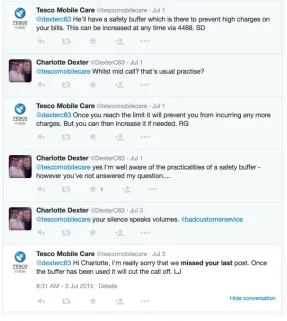
Other accounts, however, are framed in terms of user errors of one kind or another. Many accounts here can be found to relate to simple absence, as in the following. Note here how this provokes a further suggestion from the user that the absence of response is deliberate (Fig. 11):
Fig. 11: Missing a post and being understood to be ignoring a complaint.
[image:22.612.170.457.227.548.2]Fig. 12. Being pulled up on keying errors.
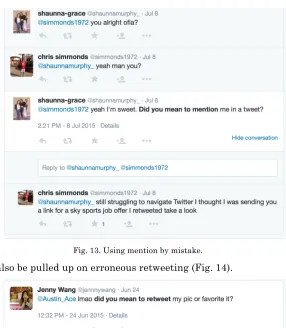
[image:23.612.168.454.261.589.2]Yet another is lack of competence, such as the misuse of the mention facility (Fig. 13):
Fig. 13. Using mention by mistake.
People may also be pulled up on erroneous retweeting (Fig. 14).
Fig. 14. Retweeting by mistake.
An important part of how tweeters are held accountable and their actions subject to
repair relates to the moral probity of their actions. In this case Twitter is quite clear
delete Tweets that you have made, you cannot delete other users' Tweets from your timeline.” [Twitter Help Center: ‘Deleting a Tweet’] However, Twitter also makes the following observation:
“Note: Deleted Tweets sometimes hang out in Twitter search, they
will clear with time.” [ibid.]
[image:24.612.171.458.211.319.2]Additionally, there is nothing to stop users saving and then re-posting your deleted tweet (although, on occasion, Twitter may treat the re-posting as a violation). This can result in attempts at repair being unsuccessful (Fig. 15).
Fig. 15. Broadcasting a deleted tweet.
It should also be noted that Twitter does operate mechanisms for flagging offensive tweets which may then be removed by Twitter itself [see Twitter Help Centre, The
Twitter Rules16 ]. Of course, there are occasions when users attempt to repair directly
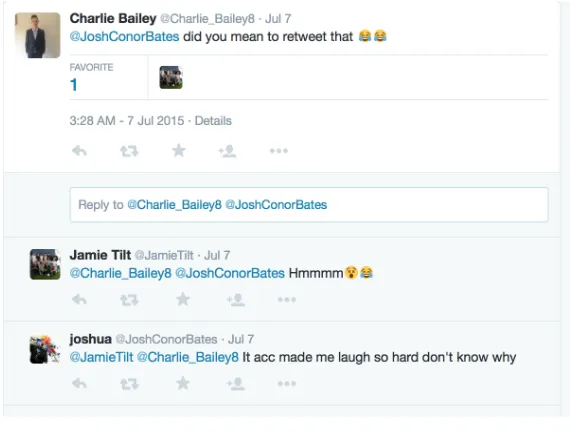
misunderstandings that may have arisen regarding their posts (Fig. 16).
Fig. 16. Trying to account for an ‘inappropriate’ retweet.
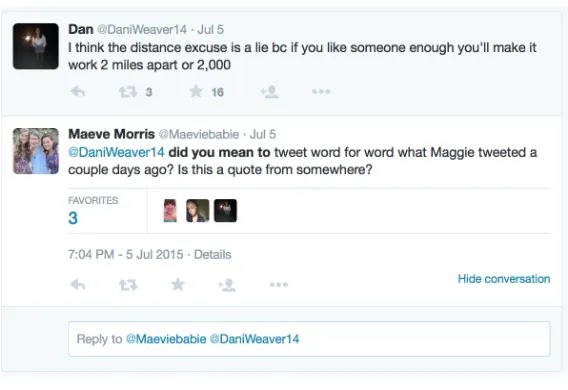
And on some occasions tweets are called to account by others but nonetheless left to stand. In the following an accusation of plagiarism provokes no response (Fig. 17):
[image:24.612.170.455.381.597.2]