Getting Ahead: Resilience and digital
practices
Development of a research and practice toolkit:
Report from the pilot group
Don Passey
Department of Educational Research, Lancaster University
i
AcknowledgementsDepartment of Educational Research, Lancaster University
iii
Contents
1. Executive summary 1
2. Background: Key points from the initial pilot 2
3. Factors affecting resilience 4
4. The activity programme for 2017-18 11
5. A profiling tool
5.1 Presenting the outcomes
5.2 Results from the May 2017 trial group
12 14 19
6. A developmental tool 26
Department of Educational Research, Lancaster University
1
1.
Executive summary
Getting Ahead offers ‘a series of interventions taking place outside of the school environment’1. Getting Ahead is one of the delivery elements of HeadStart Wolverhampton2, which has developed and provided programmes to develop stronger resilience in young people. An initial pilot programme was run in 2016. Evidence provided by the Learning Technologies Services, from project personnel, teachers and pupils involved in the programme, highlighted a number of key points about their experiences. Overall, the outcomes reported in this evidence were strongly positive; both pupils and teachers recognised ways in which the programme had developed their resilience, and this evidence was strongly aligned by reports from both pupils and teachers.
Findings from the pilot programme enabled an identification of 21 attributes that were crucial elements of resilience. It was felt that to explore the development of resilience more carefully, these could be measured at specific times, as they were developed over the period of the programme. To enable project personnel, teachers and pupils to report on these attributes at specific times during a programme, to measure the changes occurring, and to provide means to support the development of resilience, it was proposed that four tools could be developed. This report defines these tools, but more specifically shows how the first two of those four tools were developed, indicates how they might be used by tutors, teachers and pupils, illustrates how results might be presented and analysed, and details how the profiling tool was tested by the Learning Technologies Service with a trial group and how analyses of data provided allowed findings to be identified.
A research background is provided, and presents some details about each of the 21 attributes
identified. This review of the research literature indicates clearly that there is an existing awareness of the importance, contribution and influence of these attributes. From this review, recommendations are drawn out about elements or features of practice that tutors or counsellors should consider when programmes of this nature are developed and provided.
Getting Ahead ran a trial programme group in 2017, and the profiling tool was used prior to and after activities that were run at an outdoor pursuits centre. The results from the pupils completing the profiling tool before and after these activities showed changes in attitudes, communication, behaviours and emotions (in some cases substantial). When analysed statistically, some of these changes were at significant levels. However, it was found that the statistically significant changes for all pupils were not the same in all instances as those for pupils from each of the two individual schools. Statistical tests showed that the influence of changes from one school could have a strong effect on the overall pupil reported changes.
Results were not gathered from teachers, but it was clear from project personnel involved and from the pupil responses that changes did occur as a result of the programme and its activities. Further research to substantiate these findings by gathering and analysing evidence from other groups and from a wider range of personnel (teachers and tutors) would clearly be of value. From the evidence to date, the programme in place appears to adhere to the recommendations of how to effectively support young people in building resilience, and this has been demonstrated by teacher (in the trial group) and pupil (in the trial and pilot group) responses.
Department of Educational Research, Lancaster University
2
2.
Background: Key points from the initial pilot
This report documents developments undertaken during the trial stage of the Getting Ahead Programme in 2017. This trial stage followed a pilot that was run in 2016. From that pilot, pupil and teacher responses were gathered, and these suggested that four tools could be produced as a toolkit to support the Getting Ahead Programme and similar programmes. The four tools proposed are:
• A profiling tool • A developmental tool • A diagnostic tool • An evaluation tool
The initial design and development of these tools and this toolkit were generated from key outcomes that arose from the previous pilot programme in 2016. Discussions and meetings with project personnel in August and September 2016, with pupils and teachers in four pilot schools in November 2016, raised a number of key points, from their experiences of the initial pilot programme.
Points raised indicated that:
• The programme had clearly been successful.
• Pupils and teachers were very happy with the pilot programme of activities that was run in 2016.
• Even after several months, pupils remembered specific activities, such as the T-shirt activity, the positive mottos they created, and they still recalled these when they were faced with challenges.
• They remembered personalities they met, the difficulties they faced, and how those personalities moved beyond the difficulties they faced.
• The day at the Woodlands Centre presented them with real challenges; a number of these were described as perceptual obstacles that they faced, but they moved through them in many cases. • On the day they spent at the Civic Centre, many pupils were surprised that they were allowed
to talk to ‘strangers’; some found the questioning task difficult, but would then do it again. • Many pupils gained in confidence on that day, and felt they were being listened to by
‘important people’.
• On the ‘Safe Side day’, pupils enjoyed using the technologies.
• The ‘Kingswood day’ offered challenges that pupils needed to overcome; some described how they needed to overcome challenges that they felt were put in place by the actions of other pupils.
• Some pupils referred to the programme experiences as being life changing. Many referred to their self-confidence being enhanced, as were their abilities to work in teams. Many pupils stated that they were then doing what they had not done before, whether undertaking challenging physical activities, giving presentations, talking to others, communicating with others in the school and at home, having greater emotional stability, trusting peers, understanding strengths and weaknesses of self and others more, or holding greater mutual respect.
• Pupils seemed to come to a ‘switch point’ when they felt different about themselves and their relationships to others; indeed, some pupils were able to pinpoint these ‘switch points’.
• Many pupils who were involved afterwards supported and worked with other pupils in their schools.
• Teachers appreciated the opportunities for well-being that were provided, as these were much harder for them to access in schools than had been the case previously.
Department of Educational Research, Lancaster University
3
• In terms of making any changes to the programme, the use of the Yammer facility was not regarded as being useful. Some pupils were concerned about privacy when using it, because of possible teacher monitoring.• Some pupils felt that team building should come earlier in the programme.
In terms of measuring outcomes arising:
• Given the findings from the pilot stage, it is recommended that as a part of direct observation of activities by tutors or counsellors, evaluation of social and emotional attributes should be considered.
• In this respect, there are 21 attributes to identify, aligned with features reported by teachers and pupils. Means to identify uses, presence and levels of the following should be put in place: positive and negative attitude; personal mottos; role models; concern with fears, challenges, obstacles or unease; confidence with strangers; confidence in speaking publicly; handling anger; problem-solving ability; acts of withdrawal; taking a pragmatic approach; communicating with teachers, parents or guardians; assertiveness; emotional stability; perseverance; understanding each other’s strengths and weaknesses; trust of others; communicating with strangers; team working; understanding one-self; having shared experiences; discussing and accommodating the ideas of others; and having respect.
• Other outcome measures to record are: gaining roles and positions in school that support others; and identification of ‘switch points’.
Taking these findings forward:
• It is clear from responses from teachers and young people involved in the pilot programme of activities, that the young people gained in particular ways.
• When considering young people who might be involved in future programmes, the sorts of characteristics that have been identified by young people and teachers as positive outcomes can be used to both profile young people initially, and monitor their development throughout the trials being set up in 2017.
Department of Educational Research, Lancaster University
4
3.
Factors affecting resilience
Schools and teachers have increasingly, over the past 20 years, been expected to become more conversant with social, emotional and psychological needs of their pupils. The relationship of these needs to learning has been highlighted through a range of studies and initiatives. Whilst there have been school-based, government-supported programmes and initiatives in the past to support these needs (such as the Social and Emotional Aspects of Learning (SEAL) initiative3), the current curriculum4 focuses heavily on cognitive (subject) needs of pupils. Teachers are reporting that they are finding it increasingly difficult to find the time and the funds to support social, emotional and psychological needs. At the same time, the focus of lessons on cognitive (subject) needs means that focusing on social, emotional and psychological needs in lessons or in formal education (in-school lesson or class time) is increasingly challenging. In this context, a focus on social, emotional and psychological needs is worthy of consideration within additional elements of education - the informal (out-of-school groups) and non-formal (out-of-school clubs or organised activities). Having run a successful pilot in 2016, Getting Ahead has clearly placed these needs, and looks to supports appropriate practices to do this, within the informal and non-formal domains.
From the key points made by teachers and young people who experienced the pilot programme of activities (see Section 2), twenty-one factors affecting resilience were identified. A background discussion of these factors, and how they relate to learning, linked to key research in the field, is provided in Table 1.
Factor Brief discussion of the research
Positive attitude It has been shown that positive attitude can be built through a supportive environment. The authors of this research showed that a regular practice of loving-kindness meditation ‘produced increases over time in daily experiences of positive emotions, which, in turn, produced increases in a wide range of personal resources (e.g., increased mindfulness, purpose in life, social support, decreased illness symptoms). In turn, these increments in personal resources predicted increased life satisfaction and reduced depressive symptoms’ (p. 1045)5.
Having role models
Role models are important to young people, but research has shown that a positive attitude to achieving goals is related to how young people take positive role models on board. This researcher summarises it as follows: ‘young people are more likely to be inspired by positive role models when they have growth mindsets – when they see themselves as active learners and achievers who accomplish goals through hard work and perseverance. With this type of mindset, youth strive to achieve their best selves. And they look toward role models to show them the way. A growth mindset can be contrasted to a prevention mindset. When youth approach life with a desire to prevent or avoid disasters and negative outcomes, they are more likely to gravitate toward role models who will help them learn avoidance strategies’ (p. n.p.)6.
3https://www.gov.uk/government/uploads/system/uploads/attachment_data/file/181718/DFE-RR049.pdf 4https://www.gov.uk/government/collections/national-curriculum
5 Fredrickson, B. L., Cohn, M. A., Coffey, K. A., Pek, J., & Finkel, S. M. (2008). Open hearts build lives:
Positive emotions, induced through loving-kindness meditation, build consequential personal resources. Journal of Personality and Social Psychology, 95(5), 1045-1062. https://dx.doi.org/10.1037%2Fa0013262
6 Price-Mitchell, M. (2014). How Role Models Influence Youth Strategies for Success. Accessed on 10
Department of Educational Research, Lancaster University
5
Factor Brief discussion of the researchFacing fears, challenges, obstacles or concerns
Research offers suggestions for how to support children in overcoming fears, challenges, obstacles or concerns. As this author says: ‘Emphasize effort over ability. …One way to encourage effort is to provide specific feedback to students that recognizes and praises effort. Studies have shown that students who receive this kind of feedback are not only more motivated to succeed, but also believe that they can succeed. …Encourage students to practice self-compassion when they fail. …When we do that, it is easier for us to extend compassion to ourselves when we fail. …Build positive relationships with students. …talk with students about how the fear of failure might be impacting their lives’ (p. n.p.)7.
Confidence with strangers
Starting a conversation with a stranger can be daunting prospect. However, as these authors conclude: ‘As we go about our daily lives, we are surrounded by opportunities to talk to strangers. Although these interactions may be enjoyable, the prospect of initiating a conversation with a stranger is often daunting. The current results highlight the benefits of transforming instrumental conversations that we are already having—such as placing a coffee order—into more sociable encounters’ (p. 440)8.
Confidence in speaking publicly
Confidence in speaking publicly can be developed. This author provides material to develop confidence in a range of different public speaking situations. He suggests as a key point: ‘Remember, nervousness is normal and can enhance a speaker’s ability. The key is not to eliminate the butterflies, but get them to fly in formation’ (p. 11)9.
Handling anger There are three strategies that are suggested for handling anger. These are summarised by this author as: ‘progressive relaxation …[to] quickly use personal cues, such as words, phrases or images, …Cognitive therapy [to] see alternative ways of thinking and reacting to anger’, and developing skills, so as an angry learner, you need safe learning skills, which need to be practiced (p. 54)10.
Problem-solving ability
Problem-solving can be developed, but researchers tend to agree that this development needs to be phased over time. As this author concludes, ‘To improve the problem solving skills of students, instructors must first focus on developing students’ knowledge base and skills base. Without these tools, students will never succeed in true problem solving. Heavy emphasis should be placed on conceptual understanding of topics; secondary emphasis should be placed on carrying out and completing drills and exercises’ (p. 15)11.
7 Zakrzewski, V. (2013). How to Help Kids Overcome Fear of Failure. The Greater Good Science Center at the
University of California, Berkeley. Accessed on 10 December 2017 at: https://greatergood.berkeley.edu/article/item/how_to_help_kids_overcome_fear_of_failure
8 Sandstrom, G.M. and Dunn, E.W. (2014). Is Efficiency Overrated?: Minimal Social Interactions Lead to
Belonging and Positive Affect. Social Psychological and Personality Science, 5(4), 437-442
9 Lewis, S.R. (n.d.). Speaking with Confidence: A teaching guide to improve public speaking in youth.
University of Nevada, Reno. Accessed 10 December 2017 at: https://www.unce.unr.edu/publications/files/cd/2000/cm0008.pdf
10 Holloway, J.D. (2003). Advances in anger management: Researchers and practitioners are examining what
works best for managing problem anger. Monitor on Psychology, 34 (3), 54
11 Finney, R. (n.d.). Research in Problem-Solving: Improving the Progression from Novice to Expert. Accessed
Department of Educational Research, Lancaster University
6
Factor Brief discussion of the researchEngaging rather than
withdrawing
Engaging rather than withdrawing is an issue that has been explored in the field of sports and outdoor activities. In that respect, these authors highlight, ‘the critical influence of significant others during the adolescent years, and the fragility of athletes’ relationships with these individuals. In particular, the findings of this study underline the importance of parents, coaches, and peers’ changing roles during adolescence. While dropout and engaged athletes recounted similar significant other influences during childhood, differences began to emerge during adolescence as athletes faced new challenges and obstacles. This study highlighted the importance of open communication with parents and coaches, leading to healthy reciprocal relationships. As Horn et al. (2001) suggest, coaches must make an effort to interact frequently with all their athletes and to solicit information concerning their athletes’ perceptions, opinions, and attitudes regarding their sport involvement. Further, findings emphasize the importance of parents “backing-off” in their practice and performance involvement as their child moves into adolescence’ (p. 660)12.
Taking a pragmatic approach
Taking a pragmatic approach requires an understanding of facts that relate to the specific context and situation in which an individual finds themselves. As a classic text on this field states, ‘When a person thinks about uncertainty, the first notion that usually comes to mind is that it destabilizes things. Any decision made under uncertainty, which effects future events, has some to it, and people are typically averse to risk. Since practically all aspects of human behaviour involve explicit decisions, it is easy to imagine how even the smallest amount of uncertainty can have a significant effect on the total of social, business, organizational, and personal activity’ (p. 3). The author goes on to say that, ‘There are two necessary but not sufficient items of information that are needed to handle uncertainty. The first item is the collection of indicators in the real world. …The second item is the belief in what the indicators mean’ (p. 7)13.
Communicating with teachers and parents or guardians
Pupils vary enormously in terms of their ways and willingness to communicate with teachers, parents and guardians. These ways and willingness can be greatly influenced by the approaches and demeanour of the adults themselves. As one author stated with regard to pupil and teacher communication: ‘Teachers working with quiet pupils are faced with a dilemma. Allowing pupils to be passive observers deprives them of important learning experiences, but these pupils may appear to be so nervous that even the gentlest persuasion seems like a violation. As has already been recognised, it can be difficult for teachers to know how to handle extremely quiet pupils even in a one-to-one situation. As one nursery nurse has found, earning the trust of quiet pupils can be a painfully slow process’ (p. n.p.)14.
12 Fraser-Thomas, J., Côté, J. and Deakin, J. (2008). Understanding dropout and prolonged engagement in
adolescent competitive sport. Psychology of Sport and Exercise, 9, 645–662
13 Katzan, H., Jr. (1992). Managing uncertainty: a pragmatic approach. Chapman and Hall/CRC: Boca Raton,
FL.
14 Collins, J. (1997). Barriers to Communication in Schools. Paper presented at the British Educational Research
Department of Educational Research, Lancaster University
7
Factor Brief discussion of the researchAssertiveness Developing assertiveness has not always been felt to necessarily lead to positive outcomes. However, as these authors conclude from a recent study in the context of a student population: ‘The results showed that with increasing assertiveness and self-efficacy, aggression would be reduced. Researchers believe that certain people act fair and in a reasoning manner and are committed to mutual respect in social communication, also having appropriate skills in resolving the conflict. Thus, outcomes in aggressive behavior are seen less’ (p. 228)15.
Emotional stability
The importance of emotional stability has been highlighted, but few studies have explored this from an adolescent perspective. These authors, conducting a study with adolescents, concluded that: ‘Emotionally stable adolescents have better emotional regulation skills, enabling them to modulate and cope with powerful affective states. More importantly, we found that emotional stability moderated the association between witnessing violence and symptoms of anxiety and depression. Emotional stability is protective for adolescents’ emotional health – perhaps through coping or regulating their emotions in spite of stressful situations (i.e., witnessing violence). Although psychological symptoms were linked to experiences of witnessing violence, emotionally stable adolescents may have the capacity to adjust their emotional responses in spite of stressful situations; therefore, they showed better emotional functioning (fewer symptoms of anxiety and depression)’ (p. 637)16.
Perseverance In terms of perseverance, as these authors conclude: ‘these findings provide a source of optimism that grit, tenacity, and perseverance can be teachable or transferable’ (p. xi). Their report stated that, ‘Learning environments can be designed to promote grit, tenacity, and perseverance. …First, students need opportunities to take on “optimally challenging” goals that, to the student, are worthy of pursuit. …Second, students need a rigorous and supportive environment to accomplish these goals and/or develop critical psychological resources’ (p. vii). One of the approaches they suggest is, ‘Interventions that address mindsets, learning strategies, and resilience. There is growing research demonstrating that brief interventions (e.g., 2 to 10 hours) can significantly impact students’ mindsets and learning strategies, and, in turn, academic performance’ (p. x)17.
Understanding the strengths and weaknesses of others
Understanding the strengths and weaknesses of others requires an understanding of the strengths of oneself. As HandsOnScotland state, ‘Focus on character strengths instead of achievement. This will have a more positive effect on a child’s confidence. …every child has the potential to develop their character strengths, for example, to use their sense of humour, to be braver, to be kinder or to be more grateful’ (p. n.p.)18.
15 Khademi Mofrad, S.H. and Mehrabi, T. (2015). The role of self-efficacy and assertiveness in aggression
among high-school students in Isfahan. Journal of Medicine and Life, 8(4), 225-231.
16 Ho, M.Y., Cheung, F.M., You, J., Kam, C., Zhang, X. and Kliewer, W. (2013). The moderating role of
emotional stability in the relationship between exposure to violence and anxiety and depression. Personality and Individual Differences, 55, 634–639.
17 Shechtman, N., DeBarger, A.H., Dornsife, C., Rosier, S. and Yarnall, L. (2013). Promoting Grit, Tenacity, and
Perseverance: Critical Factors for Success in the 21st Century. U.S. Department of Education - Office of Educational Technology: Washington, DC.
18 HandsOnScotland (n.d.). Character Strengths. Accessed on 11 December 2017 at:
Department of Educational Research, Lancaster University
8
Factor Brief discussion of the researchTrust of others The ways that trust in others is developed in adolescents can depend upon a range of factors. These authors have recently found that there are, ‘paths between children’s reliability trust beliefs in parents and behavior-dependent reliability trust on peers. …that children’s reliability trust beliefs in parents served as a mediator between those two variables. …children’s trust beliefs in parents, as part of their IWM, provide the cognitive structure for their trust beliefs in peers and thus affect their trusting behavior with peers as a form of peer competence. The current findings confirmed the expectation that girls demonstrate greater reliability trustworthiness towards peers than do boys’ (p. 7)19.
Communicating with strangers
Factors that lead to avoidance of communicating with strangers have been researched fairly broadly. This author has brought out the important influence of social acceptance, concluding that, ‘The current research proposes that one way to understand WOM [word of mouth] behavior among strangers and friends is through social acceptance. Social acceptance rests upon initiating and maintaining existing social relationships. Accordingly, when communicating with strangers, people self-enhance in order to attract others; when communicating with friends, people attempt to emotionally connect to maintain existing ties. …WOM [word of mouth] may be used strategically to achieve social acceptance: when people are at the initiation stages of a relationship (strangers), they attempt to self-enhance by sharing positive WOM. However, as the relationship progresses (friends), they seek to emotionally connect by sharing negative WOM’ (p. 628)20.
Team working Team working is known to be an important practice that can support resilience, through sharing and trust. These authors state, however, that, “Unfortunately, youth sport participation begins to decline after the age of 12. This finding is especially worrisome because that age is also a crucial time for the development of children’s social skills and self-esteem. …One way that coaches can improve the sporting environment is through group activities that promote team building’ (p. 44)21.
Understanding one-self
The difficulties of understanding one-self at an adolescent age are well framed by these authors, who say, ‘The early adolescent is subjected to multiple changes and developments, which do not necessarily occur at the same time or complete their trajectories at the same rate. While he or she is equipped with an increasingly complex sense of self or identity, the early adolescent has yet to fully live in these “new clothes”. As our brief review shows, this period is characterized by increased self-consciousness, introspection, inner conflict, stress, uncertainty, and disorientation. Taken together, the combination of cognitive, social, and physical changes makes early adolescence a critical time for the consideration of self- and identity-related applications and interventions’ (p. 7)22.
19 Rotenberg, K.J., Petrocchi, S., Lecciso, F. and Marchetti, A. (2013). Children’s Trust Beliefs in Others and
Trusting Behavior in Peer Interaction. Child Development Research, Article ID 806597, 8 pages. http://dx.doi.org/10.1155/2013/806597
20 Chen, Z. (2017). Social Acceptance and Word of Mouth: How the Motive to Belong Leads to Divergent
WOM with Strangers and Friends. Journal of Consumer Research, 44(3), 613–632.
21 Bloom, G.A., Loughead, T.M. and Newin, J. (2008). Team Building for Youth Sport. JOPERD, 79(9), 44-47. 22 Brinthaupt, T.M. and Lipka, R.P. (2002). Understanding Early Adolescent Self and Identity: Applications and
Department of Educational Research, Lancaster University
9
Factor Brief discussion of the researchHaving shared experiences
The importance of shared experiences in developing resilience is becoming highlighted in the literature. As these authors state, ‘Every person perceives the world in his or her own way and describes the past through the lens of individual history, selecting different details or themes as most important. However, memories do not seem to be entirely idiosyncratic; for example, after seeing the same list of pictures, there is considerable inter-subject similarity in which items are remembered. The capacity to share memories is essential for our ability to interact with others and form social groups’ (p. 115)23.
Discussing and accommodating the ideas of others
Tolerance is a key factor in discussing and accommodating the ideas of others. The contrary feature, intolerance, has been examined in some depth. This author summarises reasons for intolerance as, ‘The first root cause is ignorance – a lack of knowledge, of understanding, or a tendency to see the world in black and white with no grey zones. With this attitude, you are convinced that what you know is the truth and that everyone else is wrong. …Another cause is bias and prejudice and, if we are really honest with ourselves, we are all biased, because we receive this bias as we are growing up. …Fortunately today, the youth are in a somewhat more favourable situation with internet and modern communication technology as other sources of information to draw on, in addition to what a teacher or their local environment tells them. Bias has to be broken by questioning attitudes - but at the same time we have to recognise that the tools of questioning, like the internet, themselves provide a huge amount of misinformation and bias as well. Another cause of intolerance is fear of things we are not familiar with. …We are fearful of “otherness”, but by breaking that cycle – by knowing about other cultures and religions and being exposed to new ideas – you break that fear. Another cause is a threat to the status quo – a threat to stability. …And of course we want to place responsibility for this on someone, and that is where the intolerant attitude will come from. …Stress is another factor. We are more likely to be intolerant when we are stressed, so we should learn to manage this’ (p. n.p.)24.
Having respect Respect and use of language are critically intertwined. As this author states, ‘language simultaneously performs ideational functions (communicating information, ideas, thoughts and opinions) and interpersonal functions (expressing and sustaining relations between or among individuals and groups). [A third, ‘textual’ function, need not concern us here.] For example, a bullying adult manager hurling verbal abuse at a younger employee is both expressing ideas or opinions and enacting a particular kind of unequal relationship’ (p. 14)25.
Table 1: A brief research discussion of the factors that affect resilience in young people
These research findings highlight features that young people identified as being critical to their positive development of resilience. For tutors and counsellors, these findings indicate that any programme should:
• Foster positive attitudes through a positive supportive environment. • Provide role models when young people are actively striving to achieve.
23 Chen, J., Leong, Y.C., Honey, C.J., Yong, C.H., Norman, K.A. and Hasson, U. (2017). Shared memories
reveal shared structure in neural activity across individuals. Nature Neuroscience, 20(1), 115-125.
24 Beekman, K. (2008). Promoting a culture of tolerance. International Federation of Red Cross and Red
Crescent Societies. Accessed on 19 December 2017 at: http://www.ifrc.org/en/news-and-media/opinions-and-positions/speeches/2008/promoting-a-culture-of-tolerance/
Department of Educational Research, Lancaster University
10
• Help overcome fear through positive feedback, self-compassion, and relationships with others. • Enable confidence in speaking to others by using everyday interactions as a means of initiatingconversation.
• Enable confidence in speaking publicly by using nervousness as a feature offering positive potential.
• Offer ways to handle anger through a variety of strategies. • Seek to develop problem-solving in a phased way over time. • Build engagement through open communication.
• Develop a pragmatic approach through greater understanding of and belief in indicators. • Support and develop communication over a period of time, especially with quiet individuals. • Build assertiveness alongside the development of self-efficacy.
• Support the development of emotional regulation skills.
• Provide short-term opportunities to develop perseverance, which young people feel are worthy of undertaking.
• Allow an understanding of strengths more than weaknesses of others to be recognised.
• Develop trust between young people and parents/guardians, as well as between young people themselves.
• Support communication with others by focusing on concepts of social acceptance. • Provide opportunities for team building and team working.
• Provide opportunities for young people to understand their ongoing developments of self and identity.
• Support ways to enable shared experiences.
• Develop tolerance, accommodated by an understanding of how to address features of intolerance.
Department of Educational Research, Lancaster University
11
4.
The activity programme for 2017-18
Following the successful pilot programme that was run in 2016, an initial trial was undertaken in January 2017, with 2 cohorts of young people, at the Towers Centre, Snowdonia, involving a primary school class during the first half of the week, and a secondary school class during the second half of the week.
From reflections on this initial trial, a further trial was run from 3rd-5th May 2017, with 12 young people in year 7 (11 to 12 years of age), from two secondary schools. The trial involved school staff, Learning Technologies staff, Getting Ahead and Towers Centre staff. The timetable was, in outline:
• From lunch on Day 1, the programme started with Towers Centre activities, involving outside wires, ropes, etc., orienteering in the evening, a night walk and the T-shirt activity (the latter taking about 1 hour, being a condensed form of the day activity from the pilot programme). • Day 2 started with an expedition, using Ordnance Survey (OS) maps on iPads, so that the
young people could navigate for themselves, as the system told them if they were off-route, meaning they needed minimal supervision. This system allowed them to navigate to points to undertake a mental/physical activity/challenge (manned by Towers Centre staff), with instructions coming via the Global Positioning System (GPS) signal. There were 5/6 challenges on the expedition, which in total was about 7 miles in length, with the final activity requiring the young people to abseil to the minibuses. The evening provided opportunity for reflection, using a blog, with photographs gathered from across the day, supplemented with some video.
• Day 3 involved activities during the morning only.
Following this full trial:
• In September 2017, there will be a programme run for 2 cohorts of primary school pupils (year 6), spending half a week in the Towers Centre each, followed by 5 day-long activities, one per month, finishing in February 2018. Online activities will be run between the monthly activity days.
• In January 2018, there will be a programme for 2 cohorts of secondary school pupils (year 7), following the same pattern as above, and finishing in July 2018.
Department of Educational Research, Lancaster University
12
5.
A profiling tool
Taking the key factors affecting resilience of young people that were highlighted from the pilot programme, the profiling tool below is designed for teachers to record a starting profile and end profile of young people selected to take part in the Getting Ahead programme of activities starting in May 2017. The features that teachers assess are based on those factors where there was recognised change in the young people after their participation in the initial pilot programme. In the matrix (Figure 1), teachers can tick what they feel is a starting position for each young person.
School:
Reference code for the young person: Initial/final:
Very weak
Weak So, so - neither weak nor
strong
Strong Very strong
Positive attitude Having role models Facing fears, challenges, obstacles or concerns Confidence with strangers Confidence in speaking publicly
Handling anger
Problem-solving ability Engaging rather than withdrawing
Taking a pragmatic approach Communicating with teachers and parents or guardians Assertiveness
Emotional stability Perseverance
Understanding the strengths and weaknesses of others Trust of others
Communicating with strangers
Team working
Understanding one-self Having shared experiences Discussing and
accommodating the ideas of others
[image:18.595.69.530.190.673.2]Having respect
Figure 1: Matrix for a teacher to record an individual pupil’s starting and finishing positions
Department of Educational Research, Lancaster University
13
Towers Centre activities; 1C – after the first additional day; 2C – after the second additional day; 3C – after the third additional day; 4C – after the fourth additional day; F – after the fifth and final additional day).School:
Reference code for the young person: Initial/interim/final: I/TC/1C/2C/3C/4C/F
Very weak
Weak So, so - neither weak nor
strong
Strong Very strong
Being positive
Having an idol I admire Facing fears, or concerns Confident with people I don’t know
Confident in speaking in assembly
Handling my anger Problem-solving
Keeping working with others Being practical
Talking to teachers and parents or guardians Saying what I mean Keeping calm Keeping on trying
Understanding strengths and weaknesses of others
Trusting others
Talking with strangers Working in a team Understanding myself Remembering things I did with others
Taking other people’s ideas on board
Respecting others
Department of Educational Research, Lancaster University
14
5.1 Presenting the outcomes
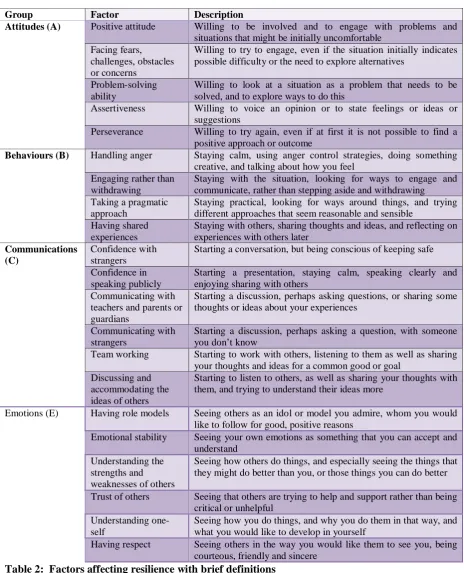
In the teacher and young person profiling tools above, the factors that affect resilience are ordered randomly. However, these factors can be grouped into four main categories: Attitudes (A); Behaviours (B); Communications (C); and Emotions (E). The factors grouped in this way, with each factor described in outline, are shown in Table 2.
Group Factor Description
Attitudes (A) Positive attitude Willing to be involved and to engage with problems and situations that might be initially uncomfortable
Facing fears, challenges, obstacles or concerns
Willing to try to engage, even if the situation initially indicates possible difficulty or the need to explore alternatives
Problem-solving ability
Willing to look at a situation as a problem that needs to be solved, and to explore ways to do this
Assertiveness Willing to voice an opinion or to state feelings or ideas or suggestions
Perseverance Willing to try again, even if at first it is not possible to find a positive approach or outcome
Behaviours (B) Handling anger Staying calm, using anger control strategies, doing something creative, and talking about how you feel
Engaging rather than withdrawing
Staying with the situation, looking for ways to engage and communicate, rather than stepping aside and withdrawing
Taking a pragmatic approach
Staying practical, looking for ways around things, and trying different approaches that seem reasonable and sensible
Having shared experiences
Staying with others, sharing thoughts and ideas, and reflecting on experiences with others later
Communications (C)
Confidence with strangers
Starting a conversation, but being conscious of keeping safe
Confidence in speaking publicly
Starting a presentation, staying calm, speaking clearly and enjoying sharing with others
Communicating with teachers and parents or guardians
Starting a discussion, perhaps asking questions, or sharing some thoughts or ideas about your experiences
Communicating with strangers
Starting a discussion, perhaps asking a question, with someone you don’t know
Team working Starting to work with others, listening to them as well as sharing your thoughts and ideas for a common good or goal
Discussing and accommodating the ideas of others
Starting to listen to others, as well as sharing your thoughts with them, and trying to understand their ideas more
Emotions (E) Having role models Seeing others as an idol or model you admire, whom you would like to follow for good, positive reasons
Emotional stability Seeing your own emotions as something that you can accept and understand
Understanding the strengths and weaknesses of others
Seeing how others do things, and especially seeing the things that they might do better than you, or those things you can do better
Trust of others Seeing that others are trying to help and support rather than being critical or unhelpful
Understanding one-self
Seeing how you do things, and why you do them in that way, and what you would like to develop in yourself
[image:20.595.66.531.179.753.2]Having respect Seeing others in the way you would like them to see you, being courteous, friendly and sincere
Department of Educational Research, Lancaster University
15
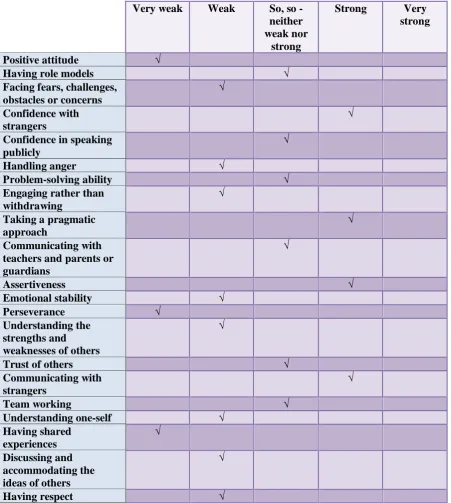
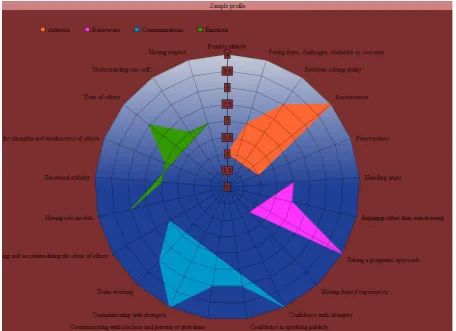
The level that a teacher or young person places in the profile matrix can be used to create different profiles, a profile of the single factors, and a profile of grouped factors. The latter can then generate quantitative levels of attitudes, behaviours, communications and emotions. These can be presented in output tables and on a radar chart. For example, if a teacher marked a sheet as shown in Figure 3, then individual levels, grouped levels, and a radar chart can be generated (shown in Figures 4 to 6).Very weak Weak So, so - neither weak nor
strong
Strong Very
strong
Positive attitude √
Having role models √
Facing fears, challenges, obstacles or concerns
√
Confidence with strangers
√
Confidence in speaking publicly
√
Handling anger √
Problem-solving ability √
Engaging rather than withdrawing
√
Taking a pragmatic approach
√
Communicating with teachers and parents or guardians
√
Assertiveness √
Emotional stability √
Perseverance √
Understanding the strengths and weaknesses of others
√
Trust of others √
Communicating with strangers
√
Team working √
Understanding one-self √
Having shared experiences
√
Discussing and accommodating the ideas of others
√
[image:21.595.68.520.146.650.2]Having respect √
Department of Educational Research, Lancaster University
16
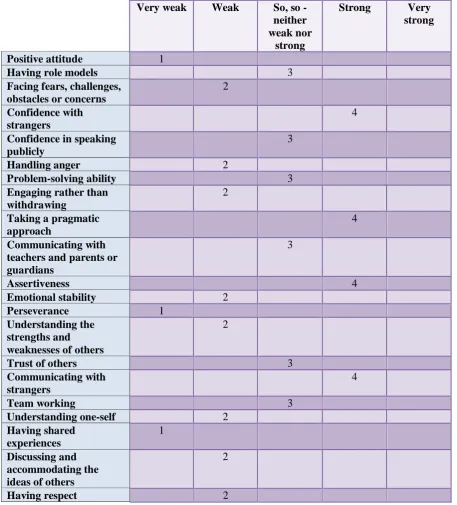
Individual levels can be shown as follows (Figure 4), where factors are scored (1=very weak; 2=weak; 3=so, so – neither weak nor strong; 4=strong; 5=very strong).Very weak Weak So, so - neither weak nor
strong
Strong Very
strong
Positive attitude 1
Having role models 3
Facing fears, challenges, obstacles or concerns
2
Confidence with strangers
4
Confidence in speaking publicly
3
Handling anger 2
Problem-solving ability 3
Engaging rather than withdrawing
2
Taking a pragmatic approach
4
Communicating with teachers and parents or guardians
3
Assertiveness 4
Emotional stability 2
Perseverance 1
Understanding the strengths and weaknesses of others
2
Trust of others 3
Communicating with strangers
4
Team working 3
Understanding one-self 2
Having shared experiences
1
Discussing and accommodating the ideas of others
2
[image:22.595.64.522.109.615.2]Having respect 2
Department of Educational Research, Lancaster University
17
Grouped levels can be shown as follows (Figure 5).Very weak
Weak So, so - neither weak nor
strong
Strong Very strong
Group average
Positive attitude 1 2
Facing fears, challenges, obstacles or concerns
2
Problem-solving ability 3
Assertiveness 4
Perseverance 1
Handling anger 2 2.25
Engaging rather than withdrawing
2
Taking a pragmatic approach 4
Having shared experiences 1
Confidence with strangers 4 3.2
Confidence in speaking publicly
3
Communicating with teachers and parents or guardians
3
Communicating with strangers 4
Team working 3
Discussing and accommodating the ideas of others
2
Having role models 3 2.3
Emotional stability 2
Understanding the strengths and weaknesses of others
2
Trust of others 3
Understanding one-self 2
[image:23.595.69.520.108.528.2]Having respect 2
Department of Educational Research, Lancaster University
18
A form of radar plot can be created based on Figure 5 (Figure 6).Figure 6: Example radar plot of a teacher’s record of an individual pupil’s position, quantified and grouped (Source: http://www.onlinecharttool.com/graph?selected_graph=radar)
Similar presentations can be produced for each young person, and the full range of matrix profiles completed by teachers (two from across the period of the programme) and young people (seven from across the period of the programme) can show:
• Difference between the start and finish from the teacher’s perspective.
• Difference between the start, end of each activity and the finish from the young person’s perspective.
• Difference between the teacher’s and young person’s perspectives.
Department of Educational Research, Lancaster University
19
5.2 Results from the May 2017 trial group
Background
From the pupil self-reporting questionnaires, completed by the trial group of 12 pupils in May 2017 prior to the Towers Centre activities (I) and after these activities (TC), responses were collated together:
• For all pupils; and
• By individual school group.
Overall findings of change at a statistically significant level
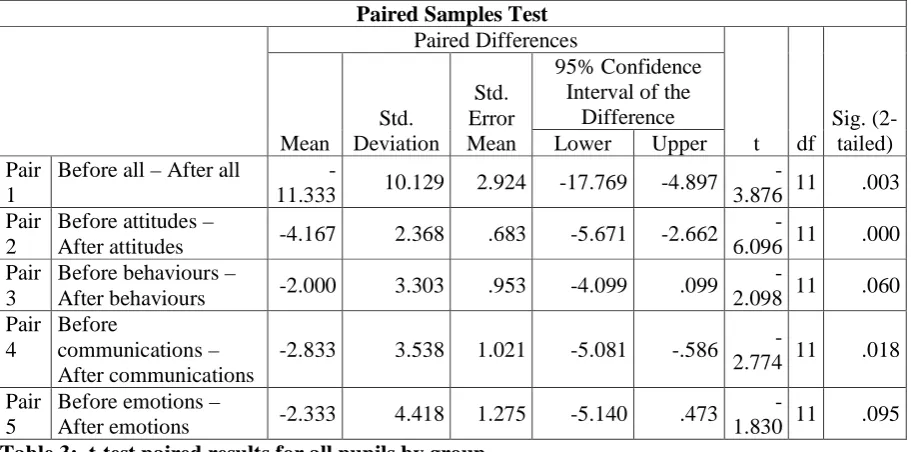
Overall findings of change from self-reports by pupils were explored through paired t-tests. To create the scores for the analysis, pupil reports for each of the features concerned with resilience were scored from 5 as ‘very strong’ to 1 as ‘very weak’. For each pupil a ‘before’ and ‘after’ score was created for all features, and for features within each of the four categories comprising the full range of characteristics – attitudes; behaviours; communication; and emotions. The analysis was undertaken using SPSS version 23. The results of the paired sample t-tests are shown in Table 3.
Paired Samples Test Paired Differences
t df
Sig. (2-tailed) Mean
Std. Deviation
Std. Error Mean
95% Confidence Interval of the
Difference Lower Upper Pair
1
Before all – After all
-11.333 10.129 2.924 -17.769 -4.897
-3.876 11 .003 Pair
2
Before attitudes –
After attitudes -4.167 2.368 .683 -5.671 -2.662
-6.096 11 .000 Pair
3
Before behaviours –
After behaviours -2.000 3.303 .953 -4.099 .099
-2.098 11 .060 Pair
4
Before
communications – After communications
-2.833 3.538 1.021 -5.081 -.586
-2.774 11 .018
Pair 5
Before emotions –
After emotions -2.333 4.418 1.275 -5.140 .473
[image:25.595.71.527.329.555.2]
-1.830 11 .095 Table 3: t-test paired results for all pupils by group
For all pupils, these results show that there was a statistically significant difference (at a level of p<0.05) in their reports before and after the Towers Centre experiences:
• Across all features. • For attitudinal features. • For communication features.
There was no statistically significant difference at the same level:
Department of Educational Research, Lancaster University
20
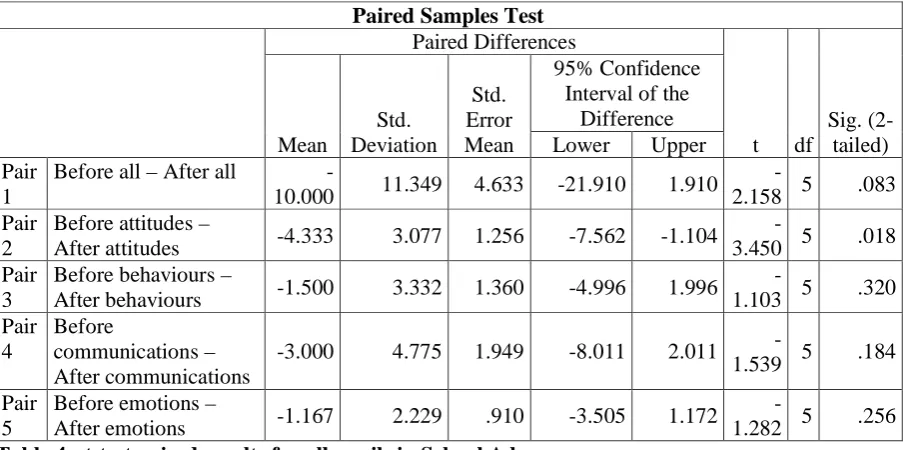
For School A, similar t-tests were conducted. The results of the paired sample t-tests are shown Table 4.Paired Samples Test Paired Differences
t df
Sig. (2-tailed) Mean
Std. Deviation
Std. Error Mean
95% Confidence Interval of the
Difference
Lower Upper
Pair 1
Before all – After all
-10.000 11.349 4.633 -21.910 1.910
-2.158 5 .083 Pair
2
Before attitudes –
After attitudes -4.333 3.077 1.256 -7.562 -1.104
-3.450 5 .018 Pair
3
Before behaviours –
After behaviours -1.500 3.332 1.360 -4.996 1.996
-1.103 5 .320 Pair
4
Before
communications – After communications
-3.000 4.775 1.949 -8.011 2.011
-1.539 5 .184
Pair 5
Before emotions –
After emotions -1.167 2.229 .910 -3.505 1.172
[image:26.595.73.525.123.348.2]
-1.282 5 .256 Table 4: t-test paired results for all pupils in School A by group
For this group of pupils, these results show that there was a statistically significant difference (at a level of p<0.05) in their reports before and after the Towers Centre experiences only:
• For attitudinal features.
There was no statistically significant difference at the same level:
• Across all features. • For behavioural features. • For communication features. • For emotional features.
Department of Educational Research, Lancaster University
21
For School B, similar t-tests were conducted. The results of the paired sample t-tests are shown in Table 5.Paired Samples Test Paired Differences
t df
Sig. (2-tailed) Mean
Std. Deviation
Std. Error Mean
95% Confidence Interval of the
Difference
Lower Upper
Pair 1
Before all – After all
-12.667 9.626 3.930 -22.769 -2.564
-3.223 5 .023 Pair
2
Before attitudes –
After attitudes -4.000 1.673 .683 -5.756 -2.244
-5.855 5 .002 Pair
3
Before behaviours –
After behaviours -2.500 3.507 1.432 -6.181 1.181
-1.746 5 .141 Pair
4
Before
communications – After communications
-2.667 2.160 .882 -4.934 -.400
-3.024 5 .029
Pair 5
Before emotions –
After emotions -3.500 5.891 2.405 -9.682 2.682
-1.455 5 .205 Table 5: t-test paired results for all pupils in School B by group
For this group of pupils, these results show that there was a statistically significant difference (at a level of p<0.05) in their reports before and after the Towers Centre experiences:
• Across all features. • For attitudinal features. • For communication features.
There was no statistically significant difference at the same level:
• For behavioural features. • For emotional features.
These results are the same as those for all pupils in both school groups. This suggests that the reported changes by this school group are indeed stronger than those of the other school group.
Department of Educational Research, Lancaster University
22
Findings for School AThe collation of results for School A is presented in Table 6, which shows the number of pupil responses in each category.
I TC
Feature Very
weak
Weak So, so - neither weak
nor strong
Strong Very strong
Very weak
Weak So, so - neither weak
nor strong
Strong Very strong
Being positive 0 2 2 2 0 0 0 0 3 3
Having an idol I admire
1 0 0 4 1 0 0 1 2 3
Facing fears, or concerns
1 0 2 0 3 0 0 1 0 5
Confident with people I don’t know
0 0 3 2 1 0 0 1 1 4
Confident in speaking in assembly
1 2 1 1 1 0 0 2 3 1
Handling my anger
0 0 3 1 2 0 0 1 2 3
Problem-solving 0 1 1 3 1 0 0 2 2 2
Keeping working with others
0 0 1 2 3 0 0 2 1 3
Being practical 0 1 3 2 0 0 0 1 3 2
Talking to teachers and parents or guardians
0 0 1 3 2 0 0 2 0 4
Saying what I mean
0 0 3 3 0 0 0 2 2 2
Keeping calm 0 1 0 3 2 0 0 0 3 3
Keeping on trying
0 0 3 2 1 0 0 0 2 4
Understanding strengths and weaknesses of others
1 0 2 1 2 0 2 1 1 2
Trusting others 0 0 1 3 2 0 1 2 2 1
Talking with strangers
0 0 3 2 1 0 0 1 3 2
Working in a team
0 0 1 2 3 0 0 0 2 4
Understanding myself
0 0 2 1 3 0 0 2 1 3
Remembering things I did with others
0 0 0 3 3 0 0 1 2 3
Taking other people’s ideas on board
0 0 3 1 2 0 0 2 2 2
Respecting others
0 0 1 2 3 0 0 0 1 5
Department of Educational Research, Lancaster University
23
From these data, totals, differences and extents of self-reported change were identified for School A. In Table 7, totals refer to the added frequencies times score (5 ‘very strong’ to 1 ‘very weak’).I TC
Very
weak
Weak So, so - neither weak nor
strong
Strong Very strong
Total Very weak
Weak So, so - neither weak nor
strong
Strong Very strong
Total Difference Comment
Trusting others 0 0 1 3 2 25 0 1 2 2 1 21 -4 Strong decrease
Keeping working with others
0 0 1 2 3 26 0 0 2 1 3 25 -1 No real difference
Remembering things I did with others
0 0 0 3 3 27 0 0 1 2 3 26 -1 No real difference
Understanding myself
0 0 2 1 3 25 0 0 2 1 3 25 0 No real difference
Understanding strengths and weaknesses of others
1 0 2 1 2 21 0 2 1 1 2 21 0 No real difference
Taking other people’s ideas on board
0 0 3 1 2 23 0 0 2 2 2 24 1 No real difference
Talking to teachers and parents or guardians
0 0 1 3 2 25 0 0 2 0 4 26 1 No real difference
Problem-solving 0 1 1 3 1 22 0 0 2 2 2 24 2 Small increase
Working in a team
0 0 1 2 3 26 0 0 0 2 4 28 2 Small increase
Handling my anger
0 0 3 1 2 23 0 0 1 2 3 26 3 Small increase
Keeping calm 0 1 0 3 2 24 0 0 0 3 3 27 3 Small increase
Respecting others 0 0 1 2 3 26 0 0 0 1 5 29 3 Small increase
Saying what I mean
0 0 3 3 0 21 0 0 2 2 2 24 3 Small increase
Talking with strangers
0 0 3 2 1 22 0 0 1 3 2 25 3 Small increase
Having an idol I admire
1 0 0 4 1 22 0 0 1 2 3 26 4 Strong increase
Confident with people I don’t know
0 0 3 2 1 22 0 0 1 1 4 27 5 Strong increase
Being practical 0 1 3 2 0 19 0 0 1 3 2 25 6 Strong increase
Confident in speaking in assembly
1 2 1 1 1 17 0 0 2 3 1 23 6 Strong increase
Facing fears, or concerns
1 0 2 0 3 22 0 0 1 0 5 28 6 Strong increase
Keeping on trying 0 0 3 2 1 22 0 0 0 2 4 28 6 Strong increase
Being positive 0 2 2 2 0 18 0 0 0 3 3 27 9 Dramatic increase
Table 7: Differences of before and after results for all pupils in School A by feature
For these pupils, there was:
• A strong decrease in trusting others.
• A strong increase in having an idol they admire, being confident with people they don’t know, being practical, being confident in speaking in assembly, facing fears or concerns, and keeping on trying.
• A dramatic increase in being positive.
Department of Educational Research, Lancaster University
24
Findings for School BSimilarly, totals, differences and extents of self-reported change were identified for School B. Again, in this table, totals refer to the added frequencies times score (5 ‘very strong’ to 1 ‘very weak’).
Total I Total C Difference Comment
Respecting others 24 20 -4 Strong decrease
Facing fears, or concerns 25 24 -1 No real difference
Problem-solving 27 26 -1 No real difference
Keeping on trying 24 24 0 No real difference
Saying what I mean 18 18 0 No real difference
Talking with strangers 26 26 0 No real difference
Working in a team 22 22 0 No real difference
Having an idol I admire 24 25 1 No real difference
Understanding strengths and weaknesses of others 21 22 1 No real difference
Handling my anger 26 29 3 Small increase
Trusting others 22 25 3 Small increase
Keeping working with others 19 23 4 Strong increase
Talking to teachers and parents or guardians 18 22 4 Strong increase
Being positive 24 29 5 Strong increase
Taking other people’s ideas on board 20 25 5 Strong increase
Understanding myself 12 17 5 Strong increase
Confident in speaking in assembly 18 25 7 Strong increase
Keeping calm 18 25 7 Strong increase
Confident with people I don’t know 13 21 8 Strong increase Remembering things I did with others 17 28 11 Dramatic increase
Being practical 18 30 12 Dramatic increase
Table 8: Differences of before and after results for all pupils in School B by feature
For these pupils, there was a different pattern:
• A strong decrease in respecting others.
• A strong increase in keeping working with others, talking to teachers and parents or guardians, being positive, taking other people’s ideas on board, understanding themselves, being confident in speaking in assembly, keeping calm and being confident with people they do not know.
• A dramatic increase in remembering things they did with others, and being practical.
Department of Educational Research, Lancaster University
25
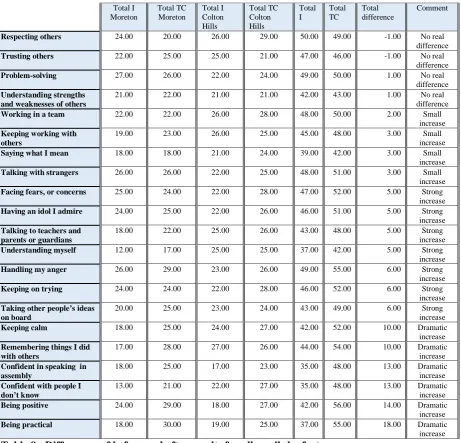
Totals, differences and extents of self-reported change were identified for all pupils (shown in Table 9). Total I Moreton Total TC Moreton Total I Colton Hills Total TC Colton Hills Total I Total TC Total difference CommentRespecting others 24.00 20.00 26.00 29.00 50.00 49.00 -1.00 No real difference
Trusting others 22.00 25.00 25.00 21.00 47.00 46.00 -1.00 No real difference
Problem-solving 27.00 26.00 22.00 24.00 49.00 50.00 1.00 No real difference
Understanding strengths and weaknesses of others
21.00 22.00 21.00 21.00 42.00 43.00 1.00 No real
difference
Working in a team 22.00 22.00 26.00 28.00 48.00 50.00 2.00 Small increase
Keeping working with others
19.00 23.00 26.00 25.00 45.00 48.00 3.00 Small
increase
Saying what I mean 18.00 18.00 21.00 24.00 39.00 42.00 3.00 Small increase
Talking with strangers 26.00 26.00 22.00 25.00 48.00 51.00 3.00 Small increase
Facing fears, or concerns 25.00 24.00 22.00 28.00 47.00 52.00 5.00 Strong increase
Having an idol I admire 24.00 25.00 22.00 26.00 46.00 51.00 5.00 Strong increase
Talking to teachers and parents or guardians
18.00 22.00 25.00 26.00 43.00 48.00 5.00 Strong
increase
Understanding myself 12.00 17.00 25.00 25.00 37.00 42.00 5.00 Strong increase
Handling my anger 26.00 29.00 23.00 26.00 49.00 55.00 6.00 Strong increase
Keeping on trying 24.00 24.00 22.00 28.00 46.00 52.00 6.00 Strong increase
Taking other people’s ideas on board
20.00 25.00 23.00 24.00 43.00 49.00 6.00 Strong
increase
Keeping calm 18.00 25.00 24.00 27.00 42.00 52.00 10.00 Dramatic increase
Remembering things I did with others
17.00 28.00 27.00 26.00 44.00 54.00 10.00 Dramatic
increase
Confident in speaking in assembly
18.00 25.00 17.00 23.00 35.00 48.00 13.00 Dramatic
increase
Confident with people I don’t know
13.00 21.00 22.00 27.00 35.00 48.00 13.00 Dramatic
increase
Being positive 24.00 29.00 18.00 27.00 42.00 56.00 14.00 Dramatic increase
[image:31.595.70.532.121.564.2]Being practical 18.00 30.00 19.00 25.00 37.00 55.00 18.00 Dramatic increase
Table 9: Differences of before and after results for all pupils by feature
Overall, there was yet a different pattern:
• No strong decrease in any feature.
• A strong increase in understanding themselves, handling their anger, keeping on trying, and taking other people’s ideas on board.
• A dramatic increase in keeping calm, remembering things they did with others, being confident in speaking in assembly, being confident with people they didn’t know, being positive and being practical.
Department of Educational Research, Lancaster University
26
6.
A developmental tool
The same background factors and grouped factors can be used to create a developmental tool, where observers can identify specific outcomes that young people achieve at different points in times while young people are undertaking programme activities. Staff involved in the programme can record the presence of these outcomes for each individual young person at various points. An example is shown in Figure 7. However, it should be noted that details within this matrix need to reviewed and appropriately revised when details of any programme are finalised.
School:
Reference code for the young person: Initial/interim/final: I/TC/1C/2C/3C/4C/F
Physical Mental Virtual
ATTITUDES
Positive attitude Going forward to try a physical challenge, even though this generates fear or concern
Putting forward ideas and responses during reflections or mental activities
Unrequested creation of a text, blog entry, image library, video, etc.
Facing fears, challenges, obstacles or concerns
For a difficult physical challenge, recognising the fear or concern that one has, and how this might be overcome
During reflection or discussion sessions, putting forward ideas and thoughts even though this is a challenge
Coming to a problem, and seeking help and support, rather than leaving it for someone else to solve
Problem-solving ability
For a difficult physical challenge, finding a way to solve a
particular problem that is beneficial to others and oneself
For a difficult mental challenge, finding a way to solve a
particular problem that is beneficial to others and oneself
Seeing someone else with a problem, and being willing to look at the problem and to solve it in a positive way
Assertiveness For a physical team activity, offering your own view and giving reasons for it
For a reflective or mental team activity, offering your own view and giving reasons for it
Working with other young people in developing a digital outcome and being able to express individual ideas positively
Perseverance In a physical activity, trying again even though success was not achieved initially or others were well in front
In a reflection or mental activity, trying again even though success was not achieved initially or others were well in front
Department of Educational Research, Lancaster University
27
BEHAVIOURSHandling anger During a physical activity, recognising when anger rises, and talking about the ways that that anger has been handled
In reflection sessions, recognising when anger rises, and talking about the ways that that anger has been handled
Being frustrated when unable to use the digital technologies in some way, but being able to handle this situation positively
Engaging rather than
withdrawing
In a stressful physical situation, continuing to engage rather than stepping away
In a stressful reflection situation, continuing to engage rather than stepping away
Being willing to join one or more other young people in developing a blog, image library or video that is shared online
Taking a pragmatic approach
When confronted with a physical challenge, using a pragmatic approach to take things forward
When confronted with a mental challenge, using a pragmatic approach to take things forward
Finding a technical problem and working out a practical or pragmatic way to solve it
Having shared experiences
Reflecting on physical activities, and
recognising how one’s own involvement was related to the
involvement of others, and what emotions arose from those activities
Reflecting on mental activities, and
recognising how one’s own involvement was related to the
involvement of others, and what emotions arose from those activities
Reflecting on
technological activities, and recognising how one’s own involvement was related to the involvement of others, and what emotions arose from those activities COMMUNICATIONS
Confidence with strangers
Meeting with young people and tutors who are unknown during physical activities, and being willing to talk to them about a range of issues
Meeting with young people and tutors who are unknown during reflection times, and being willing to talk to them about a range of issues
Handling online responses confidently, but considering safety and how to handle any such issues
Confidence in speaking publicly
As part of a physical activity, presenting verbally about a key issue
Standing up in front of a group, and presenting verbally about a key issue
Making a text, image or video accessible for others to see it so that they can view and respond to it Communicating
with teachers and parents or
guardians
Discussing outcomes and concerns about physical challenges with teacher, parents or guardians
Discussing outcomes and concerns about mental challenges with teacher, parents or guardians
Creating a text, image or video that is shared with a teacher, parent or guardian, that leads to an online discussion in an appropriate medium Communicating
with strangers
In physical activities, communicating with other young people and tutors who are not known to you
In reflection or mental activities,
communicating with other young people and tutors who are not known to you
Communicating with a stranger online, maintaining