
Business Process Models at Run-time
David Redlich, B.Sc., M.Sc.(Hons)
School of Computing and Communications
Lancaster University
This dissertation is submitted for the degree of
Doctor of Philosophy
I hereby declare that except where specific reference is made to the work of others, the contents of this dissertation are original and have not been submitted in whole or in part for consideration for any other degree or qualification in this, or any other university. This dissertation is my own work and contains nothing which is the outcome of work done in collaboration with others, except as specified in the text and Acknowledgements. This dissertation contains fewer than 100,000 words including footnotes and appendices but excluding the bibliography.
First and foremost, I would like to thank my academic and industrial supervisors, Gordon Blair, Awais Rashid, and Wasif Gilani, for their guidance and feedback as well as their con-tinuous motivation and support throughout the course of my PhD studies. I would have never seen the end of it without your help.
I would also like to extend my gratitude towards SAP in general and my managers in particular: Phil Taylor and Wasif Gilani (yes, you are mentioned twice), who have always supported me on my way towards thesis submission and provided helpful guidance about how to survive in the industrial as well as the academic world.
My colleagues, Thomas Molka, Marc Drobek, Mykola Galushka, Ulrich Winkler, and Mathias Fritzsche, deserve also a very big thanks. They made work a fun and enjoyable place to be, but more importantly were always there to bounce ideas back and forth. This helped my research progress enormously.
Today’s competitive markets require organisations to react proactively to changes in their environment if financial and legal consequences are to be avoided. Since business pro-cesses are elementary parts of modern organisations they are also required to efficiently adapt to these changes in quick and flexible ways. This requirement demands a more dy-namic handling of business processes, i.e. treating business processes as run-time arte-facts rather than design-time artearte-facts. One general approach to address this problem is provided by the community of[email protected], which promotes methodologies con-cerned with self-adaptive systems where models reflect the system’s current state at any point in time and allow immediate reasoning and adaptation mechanisms. However, in contrast to common self-adaptive systems the domain of business processes features two additional challenges: (i) a bigger than usual abstraction gap between the business pro-cess models and the actual run-time information of the enterprise system and (ii) the possibility of run-time deviations from the planned models. Developing an understand-ing of such processes is a crucial necessity in order to optimise business processes and dynamically adapt to changing demands.
Table of contents iv
List of figures viii
List of tables xiii
1 Introduction 1
1.1 Problem Domain . . . 1
1.2 Problem Statement . . . 2
1.3 Overall Goal and Objectives . . . 3
1.4 Research Questions . . . 5
1.5 Research Strategy . . . 5
1.6 Research Philosophy & Research Method . . . 6
1.7 Main Contributions . . . 8
1.8 Thesis Roadmap . . . 10
2 State of the Art: Business Processes and Model-Driven Engineering 12 2.1 Business Processes . . . 12
2.2 Business Process Management . . . 17
2.2.1 Business Process Languages and Modelling Standards . . . 18
2.2.2 Process Execution Event Logs . . . 21
2.2.3 Overview of Business Process Analyses . . . 23
2.3 Flexibility in Business Processes . . . 28
2.3.1 Taxonomy of Business Process Flexibility . . . 28
2.3.2 Build-time vs. Run-time Business Process Flexibility . . . 30
2.4 Process Discovery . . . 33
2.4.1 The Process Discovery Problem . . . 34
2.4.2 Process Discovery Algorithms . . . 38
2.4.3 Concept Drift in Process Mining . . . 44
2.4.4 Online Process Discovery . . . 48
2.5 Performance Decision Support for Business Processes . . . 53
2.5.1 Process Performance Indicators . . . 53
2.5.3 Performance Prediction from Event Logs . . . 61
2.6 Model-Driven Engineering . . . 63
2.6.1 Models . . . 63
2.6.2 Domain-specific Modelling . . . 65
2.6.3 Methods and Techniques in Model-Driven Engineering . . . 67
2.7 Models at Run-time . . . 69
2.7.1 Objectives . . . 70
2.7.2 Techniques . . . 72
2.7.3 Architectures and Megamodels . . . 75
2.7.4 Generalising Models at Run-time . . . 77
2.7.5 Descriptive Models at Run-time . . . 79
2.8 Summary . . . 83
3 Gap Analysis: Descriptive Models at Run-time in Business Process Management 85 3.1 Models at Run-time meets Business Process Management . . . 85
3.1.1 Special Characteristics in Business Process Management . . . 87
3.1.2 Business Process Models at Run-time . . . 89
3.2 Descriptive Business Process Models at Run-time . . . 91
3.3 Process Discovery at Run-time . . . 96
3.3.1 Gap Analysis: Process Discovery Algorithms . . . 96
3.3.2 Gap Analysis: Online Process Discovery . . . 98
3.4 Process Performance Prediction at Run-time . . . 101
3.5 Summary . . . 104
4 Descriptive Business Process Models at Run-time 106 4.1 Identification of Characteristics for DBPMRTs . . . 106
4.1.1 Characteristics for Run-time BP Models . . . 107
4.1.2 Concrete Requirements for DBPMRTs . . . 110
4.2 Descriptive Business Process State Model at Run-time . . . 114
4.2.1 Control-Flow Perspective . . . 115
4.2.2 Resource Perspective . . . 116
4.2.3 Performance Perspective . . . 117
4.2.4 Process Instance Perspective . . . 119
4.2.5 Holistic DBPMRT . . . 121
4.3 Descriptive Business Business Process Evolution Model . . . 122
4.3.1 Structure of Evolution DBPMRT . . . 122
4.3.2 Temporal Relations for Evolution DBPMRT . . . 125
4.4 Qualitative Evaluation . . . 128
5 Establishment of Causal Connection 132
5.1 Detailed Problem Definition . . . 134
5.2 Static Construct Competition Miner . . . 137
5.2.1 Preliminaries . . . 137
5.2.2 Divide and Conquer . . . 138
5.2.3 Footprint . . . 140
5.2.4 Suitability of BP-Constructs . . . 144
5.2.5 Competition Algorithm . . . 149
5.3 Dynamic Process Discovery Framework . . . 151
5.3.1 Concept . . . 152
5.3.2 Event Hub and Global, Standardised Events . . . 153
5.3.3 Dynamic Footprints . . . 155
5.3.4 Modified Methodology for the Control-flow Perspective: The Dynamic Construct Competition Miner . . . 157
5.3.5 Description of other Framework Artefacts . . . 159
5.3.6 Computer- vs. Human-oriented Run-time Models . . . 161
5.4 Dynamic Footprint Update . . . 162
5.4.1 Control-Flow Footprint . . . 163
5.4.2 Resources Footprint . . . 167
5.4.3 Performance Footprint . . . 168
5.5 Dynamic Footprint Interpretation . . . 169
5.5.1 Control-Flow . . . 169
5.5.2 Roles and Resources . . . 170
5.5.3 Performance . . . 172
5.6 Process Instance State Tracking . . . 173
5.6.1 Additional Preliminaries . . . 173
5.6.2 Method Specification . . . 174
5.7 Overview of Mapping from Event Lifecycle Type to BP Perspective . . . 177
5.8 Evaluation . . . 179
5.8.1 Evaluation of Constructs Competition Miner . . . 179
5.8.2 Evaluation of Dynamic Constructs Competition Miner . . . 184
5.8.3 Qualitative Evaluation . . . 193
5.9 Summary . . . 195
6 Reasoning on Descriptive Business Process Models at Run-time 197 6.1 DBPMRT Reasoning Framework . . . 197
6.1.1 Concept of DBPMRT Reasoning Framework . . . 198
6.1.2 Event to Performance Processing (External Component) . . . 199
6.1.3 Performance Prediction via Simulation . . . 201
6.2 Case Study Scenario: Akron Heating Retailer . . . 203
6.2.2 IT-supported Business Processes . . . 204
6.3 Analysis Results . . . 206
6.3.1 Roles and Resources . . . 206
6.3.2 Business Processes . . . 207
6.3.3 Performance Predictions . . . 209
6.4 Summary . . . 217
7 Conclusion and Future Research 218 7.1 Results of the Thesis . . . 218
7.1.1 Research Questions Revisited . . . 218
7.1.2 Main Contributions . . . 220
7.2 Future Research Agenda . . . 222
7.3 Final Remarks . . . 225
Appendix A Publications 226 Appendix B Example Footprint Update with Ageing 230 Appendix C Visualisation Tools 232 C.1 DBPMRT Visualisation . . . 232
C.2 KPI/PPI Visualisations . . . 233
Appendix D Additional Processes in Case Study 235 D.1 Expense Payment . . . 235
D.2 Refill Stock . . . 236
D.3 Return Item . . . 237
Appendix E Additional Evaluation Results for Case Study 238 E.1 Business Processes . . . 238
E.1.1 Expense Payment . . . 238
E.1.2 Refill Stock . . . 239
E.1.3 Return Item . . . 239
E.2 Performance . . . 240
1.1 The Two Common Types of Business Process Models . . . 2
1.2 Scope and Objectives of Thesis . . . 4
1.3 Schematic View of Research Strategy . . . 6
1.4 Structure and Chapters of the Thesis . . . 11
2.1 Outline of Chapter2 . . . 13
2.2 Online-Order-Processing Business Process . . . 14
2.3 BPM life-cycle: Difference between Workflow Management and Business Process Management [246] . . . 18
2.4 Nested Relationship between BPM Theory, Standards, and Systems [123] . . 19
2.5 Common Kinds of Business Process Model Standards . . . 20
2.6 Lifecycle transitions in MXML and XES [90,256] . . . 23
2.7 Extended BPM Lifecycle [251] and different types of BPA in relation . . . 24
2.8 The three main types of Process Mining (in red) [251] . . . 25
2.9 Input and Output of (a)Process Discovery, (b)Conformance Checking, and (c)Model Enhancement[251] . . . 26
2.10 Taxonomy of Business Process Flexibility by Regev [190] . . . 29
2.11 Types of BP Flexibility defined by Sadiq et al. [202] (light grey rectangles) and by Schonenberg et al. [211] (dark grey ovals) in relation to level of abstraction (type vs. instance) and anticipation (build-time vs. run-time) . . . 31
2.12 Example Business Process . . . 34
2.13 MinedTrace Model(left) andFlower Model(right) for LogL1 . . . 36
2.14 Excerpt of a large "Spaghetti" Process Model [89] . . . 37
2.15 Concept of theα-algorithm: Intermediate and End Results for LogL1 . . . . 39
2.16 Result Petri Net of the Inductive Miner Plugin in ProM for LogL1 . . . 41
2.17 Concept of the HeuristicsMiner: Intermediate and End Results for LogL1 . 42 2.18 Example Concept Drift in the Original LogL1 . . . 45
2.19 Different Types of Event Queues [27] . . . 51
2.20 The Relation between PPIs, KPIs and the System . . . 54
2.21 Algorithm of the three-phase discrete-event simulation approach [193] . . . 57
2.24 Mining Simulation Model for Steady-State Prediction [198] . . . 62
2.25 Experts involved in Model-Driven Engineering [69] . . . 65
2.26 MOF layers - Meta-data Architecture proposed by OMG [162] . . . 67
2.27 Design Models vs. Run-time Models [9] . . . 70
2.28 Autonomic Control Loop: Monitor-Analyse-Decide-Execute (MAPE) Mech-anism [116] . . . 74
2.29 Megamodel Example for Self-adaptive Software [267] . . . 76
2.30 Simplified MRT Megamodel Example for IT Service Management [267] . . . 77
2.31 Descriptive vs. Prescriptive Parts . . . 79
2.32 Run-time Models for Monitoring in Maintenance [264] . . . 80
2.33 Schematic View on Relations between Descriptive Run-time Models, other Model Types, and the System . . . 82
3.1 Outline of Chapter3 . . . 86
3.2 BPM Lifecycle and Information Artefacts Exchanged Between Phases . . . . 87
3.3 Conceptual Differences of the Approaches . . . 91
4.1 Outline of Chapter4 . . . 107
4.2 Abstraction Levels of BP Changes . . . 108
4.3 Reflective Business Process Model as Process Instance Model at Run-time . 109 4.4 Business Process Abstraction Levels and the Conceptual Location of the Four Required Characteristics for Run-time BP Models: Dynamism, Variability, Reflectivity, and Expressibility . . . 110
4.5 BP-domain Artefacts Ordered by Abstraction Levels . . . 111
4.6 Selected Element Types of a Business Process and Associations between them (Stroked Lines) . . . 113
4.7 Model Layers of the DBPMRT in comparison to the MOF Layers [162] . . . . 114
4.8 Meta-Model for Single Control-Flow Models in State DBPMRT . . . 115
4.9 Meta-Model for Resource Perspective in State DBPMRT . . . 117
4.10 Meta-Model for Performance Perspective in State DBPMRT . . . 118
4.11 Meta-Model for Process Instance Perspective in State DBPMRT . . . 119
4.12 The Development of the Instance State (Model) for an Example Stream of Events . . . 120
4.13 Meta-Model for the Holistic State DBPMRT . . . 121
4.14 Hierarchy (via Containment Relation) of a DBPMRT and important Associ-ations between Elements . . . 123
4.15 Influence Spheres of Certain Changes and the Situation of Temporal Rela-tions in the Evolution DBPMRT . . . 124
4.16 Model Schema for Temporal 1:1-Containment forProcessInstantiation- Dou-bleValueRelation . . . 125
4.18 Model Schema for TemporalRole-ActivityRelation . . . 127 4.19 Model Schema for TemporalBPScenarioModel-BPCtrlFlowModelRelation . 128
5.1 Outline of Chapter5 . . . 133 5.2 First Steps of the Divide and Conquer Concept for the Example Process . . . 140 5.3 Example business process with two nested parallel constructs . . . 141 5.4 Penalty development of (v ∼=t) (equal) and (v t) (unequal) for givenpu
andtt . . . 145
5.5 Supported Business Process Constructs . . . 147 5.6 Competition Algorithm: Traversing to the best split up . . . 150 5.7 Information Flow: Agents and Model Artefacts involved in the DPDF
Frame-work . . . 153 5.8 Meta-Model for a BP Event Log (relevant elements are highlighted) . . . 154 5.9 Conceptual Methodology of the Dynamic CCM . . . 158 5.10 Result of theFootprint Interpretationon an event stream produced by the
example from Figure5.3if no sub-footprint for {b,c,d} is available yet - only the top-level split has been discovered and due to the missing sub-footprint one activity [b,c,d] is created . . . 159 5.11 Development of the influence of a trace for different trace influence factors
(tif) . . . 165
5.12 Concept of the Role Discovery Shown on an Example . . . 171 5.13 Example Business Process with many Parallel Paths . . . 174 5.14 Mappings from Event Lifecycles to Relation Types to DBPMRT Perspectives 178 5.15 Randomly Created Original BP (Top) and the (Re-)Discovered BP (Bottom)
by analysing the simulated log of the original BP with the CCM Algorithm . 180 5.16 Experimental Workflow . . . 181 5.17 Quality Criteria Net of HeuristicsMiner (HM), Inductive Miner (IM), and
Con-structs Competition Miner (CCM); Simplicity values normalised with|fs| =100fs 184
5.18 Measures for Detection of BP Change in System . . . 185 5.19 The Evolution of the Discovered BP Model During the Warm-up Phase . . . 186 5.20 Warm-up Time with the Discrete Ageing in Relation to the Trace Influence
Factor . . . 187 5.21 Warm-up Time with Time-dependent Ageing in Relation to the Trace
Influ-ence Factor . . . 187 5.22 Warm-up Time without Optimisation in Relation to the Trace Influence
Fac-tor withm=1 . . . 188 5.23 The Evolution of the Discovered BP Model During a Change (Move of
Activ-ity "A") . . . 189 5.24 The Change Transition Period in Relation to the Trace Influence Factor (for
5.25 The Evolution of the Discovered BP Model During a Change (Addition of Activity "I") . . . 190 5.26 The Change Transition Period in Relation to the Trace Influence Factor for
all three Changes (m=1) . . . 191 5.27 The Evolution of the Discovered BP Model During a Change (Complex Change)192
6.1 Outline of Chapter6 . . . 198 6.2 Repository Architecture for the General Reasoning Framework . . . 199 6.3 Exemplary Calculation of PPIs Throughput, Processing Time, and Queue
Length . . . 200 6.4 Concept of Using Simulation for Performance Prediction . . . 201 6.5 Complete Information Flow for the PPI Prediction using BP Simulation . . . 202 6.6 Actively Participating Roles in the Akron Heating Company . . . 204 6.7 IT-supported BPs in the Akron Heating Company . . . 204 6.8 The Planned "Create Telephone Order" BP in the Akron Heating Company . 205 6.9 The Planned "Process Order" BP in the Akron Heating Company . . . 205 6.10 Discovered Resource Perspective . . . 207 6.11 Discovered Control-flows of Create Telephone Order, Create Online Order,
andProcess OrderBPs . . . 208 6.12 Example Extrapolation on Regressed Functions:TrendandPeriodic Trend . 210 6.13 Six Episodes of Prediction Results vs. Real Development forQueue Lengthof
"Telephone Operator" Role . . . 210 6.14 Prediction Results vs. Real Development forQueue Length of "Telephone
Operator" Role . . . 211 6.15 MSE of the Prediction Methods forQueue Lengthof "Telephone Operator"
Role . . . 212 6.16 Prediction Results vs. Real Development forQueue Lengthof "Accounting"
Role . . . 212 6.17 MSE of the Prediction Methods forQueue Lengthof "Accounting" Role . . . 213 6.18 Prediction Results vs. Real Development forEnd-to-End Processing Timeof
"Create Online Order" BP . . . 213 6.19 MSE of the Prediction Methods forEnd-to-End Processing Time of "Create
Online Order" BP . . . 214 6.20 Normalised Mean Square Errors of the Prediction Methods for the individual
PPIs . . . 216 6.21 Average Normalised Mean Square Error for the three different Prediction
Methods: (1) Simulation, (2) Trend Analysis, and (3) Periodic Trend Analysis 216
C.1 DBPMRT Evolution Visualisation (Element Descriptions annotated in red) . 232 C.2 PPI Dashboard (Element Descriptions annotated in red) . . . 233 C.3 PPI Popup - when clicked on PPI in Dashboard (Descriptions annotated in
C.4 Tablet App for PPI Visualisation . . . 234
D.1 The Planned "Expense Payment" Business Process in the Akron Heating Com-pany . . . 235 D.2 The Planned "Refill Stock" Business Process in the Akron Heating Company 236 D.3 The Planned "Return Item" Business Process in the Akron Heating Company 237
E.1 Discovered Control-flow of theExpense PaymentBP . . . 238 E.2 Discovered Control-flow of theRefill StockBP . . . 239 E.3 Discovered Control-flow of theReturn ItemBP . . . 239 E.4 Prediction Results vs. Real Development forEnd-to-End Processing Timeof
"Return Items" BP . . . 240 E.5 MSE of the Prediction Methods forEnd-to-End Processing Timeof "Return
Items" BP . . . 240 E.6 Prediction Results vs. Real Development forUtilisationof "Packer" Role . . 241 E.7 MSE of the Prediction Methods forUtilisationof "Packer" Role . . . 241 E.8 Prediction Results vs. Real Development forThroughputof "Initiate Express
Shipping" Activity . . . 242 E.9 MSE of the Prediction Methods for Throughput of "Initiate Express
2.1 Excerpt of Execution Event Log resulting from Process in Figure2.2 . . . 21
3.1 Overview Gap Analysis Descriptive Business Process Models at Run-time; Legend: (-) not supported, (◦) somewhat supported, (+) mainly supported . 95 3.2 Overview Gap Analysis Process Discovery at Run-time . . . 101 3.3 Overview Gap Analysis Process Performance Prediction at Run-time . . . 104
4.1 Degree of Requirement Fulfilment . . . 130 4.2 Gap Analysis Descriptive Business Process Models at Run-time for DBPMRT;
Legend: (-) not supported, (◦) somewhat supported, (+) mainly supported . 130
Introduction
1.1 Problem Domain
The success of modern organisations depends on the efficiency and performance of their employedBusiness Processes(BPs). These processes dictate the flow of work for high-level business functions to achieve business goals. Prominent examples of business processes areOrder-to-Cash,Accounts-Receivable, orProcure-to-Pay. They represent fundamental parts of many organisations and are considered to be”...the most valuable corporate as-set”[270]. Business processes can reside on different levels of an organisation, e.g. oper-ational vs. strategic [122], and can have different degrees of automation, e.g. fully auto-mated vs. manual execution.
In order to deal with increasing complexity and to efficiently manage business pro-cesses, IT-based solutions have been harnessed. This development led to the rise of Busi-ness Process Management(BPM), as an IT-related discipline. In fact, BPM is an interdisci-plinary subject of ”theory in practice” adopting a variety of paradigms and methodologies from computer science, management theory, philosophy, mathematics, and linguistic, just to name a few [95, 122, 194]. Business processes and their management are sup-ported by (Enterprise)Business Process Management Systems(BPMS’s). They are imple-mentations of so called "application and integration middleware", e.g. SAP Netweaver BPM[287],IBM WebSphere[102],Intalio BPMS Designer[103].
A-posteriori Business Process Model A-priori
Business Process Model
System in Use Deployment/
Implementation
Model Extraction
Timeline
Fig. 1.1 The Two Common Types of Business Process Models
A-priori business process models are design-time models, i.e. business processes are designed or documentedbeforeexecution to specify or pre-analyse the processes in an or-ganisation. This is either done informally via a document listing and describing the steps and their execution sequence or they are modelled via design-time languages. The most prominent business process model languages were developed to build human-readable design-time models with the focus on aspects like interoperability, or being a basis for reliable communication between different stakeholders [47].
In contrast, a-posteriori business process models are extractedafterexecution for di-agnosis purposes to reflect thereal behaviour of the observed system. This kind of ret-rospective analysis of business processes based on execution logs is calledProcess Min-ing(PM) [231]. PM becomes necessary if no design-time model is available or the actual business process execution deviates from the designed model. Such a deviation is com-mon for all non-fully automated business processes and can be caused by, for instance, an under-specification of the designed model, a reaction to exceptional circumstances, or an evolution of the process during run-time [251].
1.2 Problem Statement
Today’s businesses need to survive in a highly competitive environment which comes with strong requirements with regards to fast adaptation and optimisation. Because late, inadequate, or incorrect actions can lead to Service Level Agreement (SLA) violations, causing financial and legal consequences, the ability to react proactively to changes is a crucial feature for successful organisations. Since business processes are driving today’s modern organisations they are ultimately required to adapt and evolve continuously in order to meet demands and constraints inflicted by internal or external sources [203], e.g. changing market contexts, customer requirements, or business imperatives. One exam-ple of such a dynamic organisation is a hospital, in which the treatment processes have to be flexible and quickly modifiable, based on the qualifications of the current staff and patients’ demands, e.g. emergencies, epidemics. Another example is a retail company which is exposed to a lot of market pressure and has to quickly adapt to changing cus-tomer demands and shortages of resources and/or goods.
develop-ing an understanddevelop-ing of the deployed processes is the first immediate and crucial neces-sity. This information enables a business analyst to make insightful decisions and answer questions related tocompliance,performance, orsustainability, e.g.: How are my business functions executed in reality? How do my business processes generally perform? How will this performance change in the future? What are current and expected bottlenecks of the deployed business processes?
However, discovering and understanding the current condition of deployed processes is a difficult task: Firstly, business processes are often either not documented or poorly documented.Secondly, modern organisations and their deployed processes are of an in-creasingly dynamic nature. As a result, even if documented, the actual execution of busi-ness processes usually deviates from the modelled design-time busibusi-ness processes due to changes occurring during run-time. A-priori business process models are, therefore, not accurate enough to be used as information sources for decision making. Process mining algorithms, on the other hand, extract a-posteriori models from historic execution logs and are, therefore, too static to respond to the dynamic nature of flexible business pro-cesses, i.e. these models can already be outdated at the time of extraction.
In conclusion, both types of business process models, a-priori and a-posteriori mod-els, exhibit a chronological distance to the running system. Furthermore, due to process evolution and exceptional circumstances during run-time a factual difference between a design-time model and the business process in the running system is often observable. Both the identified chronological distances and factual differences imply a lack of causal-ity between business process models and the system executing the business processes. This makes reasoning on this information difficult and susceptible to errors.
1.3 Overall Goal and Objectives
The overall goal of this thesis is to mitigate the lack of causality between system and business process model in real-time environments in order to promote a more dynamic
handling of business processes and enable higher-level reasoning on run-time data.
Thesis Scope
Enterprise System
System 1
System 2
System 3
Descriptive
Business
Process Models
@ Run-time
Reasoning
on
Run-time
Model
Update
of
Run-time
Model
System
Modification
Business Analyst
Fig. 1.2 Scope and Objectives of Thesis
Specification of Descriptive Business Process Model at Run-time (DBPMRT):
DBPMRT has to deal with additional concerns as opposed to common business process models, such as capturing status information of the enterprise system’s processes. One of the main objectives is to identify these run-time characteristics and elaborate a DBPMRT specification that allows for expressing these run-time characteristics.
Establishing the Link from Business Process Management System to DBPMRT:
Enterprise systems like BPMSs produce execution events indicating a change of the sys-tem’s internal state. Since they represent fine-granule state transitions, they are on a dif-ferent abstraction level than business processes. One objective is to infer from this low level event data higher level BP information in a real-time environment, i.e. every change in the system should becausallyandtimelyreflected in the associated run-time represen-tation (i.e. DPBPMRT). Due to run-time constraints and the abstract nature of business process models this objective is particularly challenging as the connection from system to DPBPMRT is difficult to maintain.
Reasoning on DBPMRT:
1.4 Research Questions
These objectives raise a number of research questions that are addressed by this thesis: 1. How can the target system (BPMS) be effectively represented at run-time?
2. To what extent can a causal link from BPMS to BP model be established given that event data and BP model conform to different levels of abstraction?
3. To what degree can a causal link from BPMS to BP model be maintained in a dynamic run-time environment?
4. Can the quality of run-time reasoning be improved by utilising DBPMRTs?
In a broader sense this thesis also provides a partial answer, i.e. in the form of a use case, to the question:
5. How and to what extent can a target system emitting low-level events be causally and timely reflected by a run-time model of a higher abstraction level?
1.5 Research Strategy
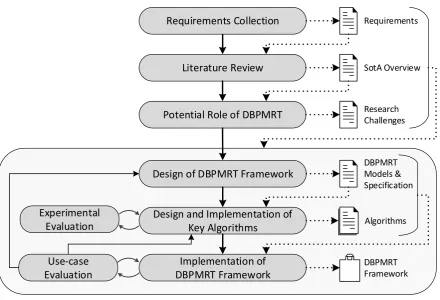
In order to achieve the main goal and objectives the following research strategy has been adopted (see Figure1.3):
1. Requirement Collection: The research carried out in the context of this thesis is driven by the requirements of real-life use cases provided by SAP, a large business software vendor, and TIMBUS, an EU funded research project concerned with the preservation of business processes [84]. These use cases drove the need for DBPMRT and continued to shape the agenda for each of the involved objectives throughout the research process, e.g. run-time constraints of algorithms, what information and what types of reasoning are relevant for business analysts in order to proactively initiate business process modifications and/or preservation.
2. State of the Art Review: In this phase, a state of the art and industry survey in the domains of business process management and run-time models as well as related disciplines has been carried out.
3. Determining the potential role of DBPMRT: By evaluating the state of the art and reflecting on the nature of descriptive business process run-time models, the ob-jectives and the respective individual challenges that need addressing have been determined.
Requirements Collection Literature Review Potential Role of DBPMRT
Design of DBPMRT Framework
Requirements
SotA Overview
DBPMRT Models & Specification
Design and Implementation of Key Algorithms
Research Challenges
Algorithms
Experimental Evaluation
Implementation of DBPMRT Framework
DBPMRT Framework
[image:20.595.98.539.78.378.2]Use-case Evaluation
Fig. 1.3 Schematic View of Research Strategy
5. Addressing of the individual challenges: Key algorithms have been implemented in order to address individual challenges of each of the different objectives. The qual-ity of the key algorithms have been quantitatively evaluated against other relevant state-of-the-art algorithms in experiments based on artificial and real-life data.
6. Prototypical implementation of the DBPMRT framework: In this final phase, a proof of concept for DBPMRT framework has been carried out. This was achieved by im-plementing a DBPMRT solution compliant with the framework specifications which was then utilised and evaluated in the context of industrial use cases provided by SAP and the TIMBUS project.
1.6 Research Philosophy & Research Method
The two fundamental paradigms also apply to research in the specific field of Software Engineering. For instance, when performance is of relevance for the research topic the more traditional paradigm of positivism is the obvious choice [1]. In contrast, when such an empirical measure is not clearly evident - as is often the case in Software Engineering - the research follows the interpretive paradigm. In the latter case the nature of scientific questions asked is more important than the empirical method [87,177], i.e. research must ask questions that can be falsified by observations [108]. The implication is that the scien-tific quality of research in Software Engineering improves if it"...is successfully developed into practical applications (i.e. as a methodology, technique or tool)."[8] For this purpose
Case Studiesare often employed - they are suitable to describe, understand, and explain the research subject as well as validating the results [8,59].
Concretely, this thesis is concerned with Software Engineeringfor BPM, i.e. the result-ing artefacts areInformation Systems. According to Hevner et al. in [97], the traditional research paradigm debates (positivism vs. interpretivism) stem from natural sciences and are based on the assumption that"... somewhere some truth exists and somehow that truth can be extracted, explicated, and codified". They argue that most of the research in Infor-mation Science can be characterised by two other paradigms: behavioural science and design science [97]: (1)"the behavioural-science paradigm seeks to develop and verify the-ories that describe or predict human or organizational behavior", while (2) the "design-science paradigm seeks to extend the boundaries of human and organizational capabilities by creating new and innovative artifacts". The design science paradigm is closely related with the process of engineering and the sciences of the artificial [216], i.e. it does not seek to find the one truth but rather what is effective. Hence, research in design science should be aligned with real world production experience, i.e. case studies [97,143].
1.7 Main Contributions
The foremost and most important contribution of this thesis is the adoption of princi-ples and theories of the [email protected] community to the abstraction level of business processes. By taking this step the thesis addresses general challenges of business process management [122,123,214], i.e. dealing with frequently changing processes and short-ening the business process life cycle, and contributes to research in [email protected] by providing a valid use case as well as further requirements for [email protected] of a higher abstraction level. In particular, this thesis yields the following contributions (including relevant paper publications as lead author):
1. Identification of run-time characteristics of BPs and composition of a DBPMRT ref-erence specification:
The first contribution of this thesis is the identification of run-time characteristics of BPs and the design of a set of DBPMRT meta-models capturing a descriptive reflection of the BP system. The DBPMRTs comprise information of important perspectives of a business process, i.e. control-flow, resources, performance, instance states, and are able to rep-resent different levels of change, i.e. a step of the process was executed vs. the entire process has changed. Part of the findings (with regards to need for representing the dif-ferent levels of change) have been published in [181]. Additionally, in order to deal with the challenge of differing abstraction levels (low level event data vs. high level BP model) an approach for distinguishing between two different types of run-time models has been proposed in [184]:computer-orientedfootprint models vs.human-orientedBP models.
2. Key algorithms to establish a causal link from BPMS to BP model at run-time:
• A novel algorithm to establish a causal link between event data and a descriptive BP control-flow model: The Constructs Competition Miner(CCM) published in [185] follows a top-down approach to discover block-structured process models from event logs possibly containing exceptional and contradictory behaviour.
• Modification of the statically operating CCM algorithm in order to work in a real-time setting to detect changes in the BP control-flow while processing a stream of BP execution events: TheDynamic Constructs Competition Miner(DCCM) is pub-lished in [186]. A second evaluation of the DCCM on the eHealth use case "DrugFu-sion" (provided by the TIMBUS project) is published in [182].
• A smart and time-efficient algorithm to capture the fine-grained instance state of an enterprise system. As of the time of writing this algorithm has not yet been indi-vidually published.
3. DBPMRT Framework:
The third contribution is the design and proof of concept implementation for a generic framework for Descriptive Business Process Models at Run-time, enabling (1) automated monitoring of an enterprise system by capturing the state of the system in a descriptive run-time model and (2) real-time reasoning based on the descriptive run-time model. The concepts and component specifications of the framework have been published in [184].
4. Real-time Reasoning Approach based on DBPMRT and Simulation:
This thesis’ contribution includes a generic conceptual approach for predictive reasoning on DBPMRTs. Since a DBPMRT comprises current and historical data about all impor-tant perspectives and all levels of change it can be utilised by a BP simulation to predict future behaviour. Consequently, already existing reasoning algorithms, e.g. performance prediction, detection of future bottlenecks, what-if analysis, can be (re-)used to enable
proactivedecision support on future states of the system. Parts of the concept have been published in [183] and [188]. In the context of this thesis the predictive reasoning concept is introduced and evaluated for the use case of performance prediction.
1.8 Thesis Roadmap
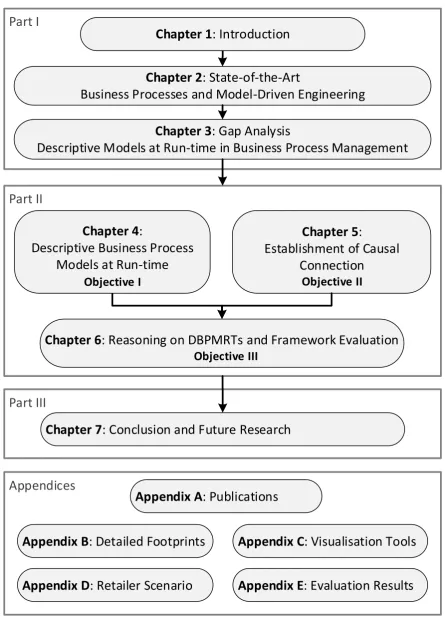
Figure1.4gives an overview and a proposed reading flow of the chapters. The thesis con-sists of three general parts: InPart I introduction, background, and current state of the art for the related research disciplines is presented.Part IIindividually addresses the ob-jectives of this thesis as well as describes and evaluates the main contributions. InPart III
these contributions are qualitatively assessed and future work is presented. The remain-der of the thesis is structured as follows:
Chapter 2: State-of-the-Art Business Processes and Model-driven Engineering, com-prises a discussion of state of the industry and state of the art for relevant disciplines in the business process and model-driven engineering domain. This includes fundamental information about business processes and business process management as well as mod-els and model-driven engineering. Furthermore, the current state-of-the-art in the topics of process discovery, business process analysis, business process flexibility, and models at run-time are discussed and reviewed.
Chapter 3: Gap Analysis of Descriptive Models at Run-time in Business Process Man-agement, discusses the consolidation of the previously introduced research disciplines and the resulting challenges. In this context gaps in the current state-of-the-art work is identified for the three individual challenges of this thesis.
Chapter 4: Descriptive Business Process Models at Run-time, addresses the first objec-tive of this thesis by specifying a reference language for DBPMRTs. The specification is qualitatively evaluated against pre-specified requirements inferred from the challenges.
Chapter 5: Establishment of Casual Connection, describes how the objective of moni-toring a system under study whilst maintaining an accurate run-time model is addressed, i.e. how a causal link from system to DBPMRT can be established and maintained in a dy-namic run-time environment. It furthermore presents the algorithms and components that are involved in the proposed concept. The concept and algorithms are quantitatively and qualitatively evaluated.
Chapter 6: Reasoning on DBPMRTs, presents a concept to harness the run-time infor-mation in a DBPMRT for high-level reasoning, i.e. in particular, short-term performance prediction via simulation. Furthermore, a case scenario is introduced which is the basis of the evaluation of the reasoning concept along with the overall DBPMRT concept in the context of short-term performance prediction.
Part I
Part II
Part III
Appendices
Chapter 1
: Introduction
Chapter 2
: State-of-the-Art
Business Processes and Model-Driven Engineering
Chapter 3
: Gap Analysis
Descriptive Models at Run-time in Business Process Management
Chapter 4
:
Descriptive Business Process
Models at Run-time
Objective I
Chapter 5
:
Establishment of Causal
Connection
Objective II
Chapter 6
: Reasoning on DBPMRTs and Framework Evaluation
Objective III
Appendix C
: Visualisation Tools
Appendix B
: Detailed Footprints
Chapter 7
: Conclusion and Future Research
Appendix E
: Evaluation Results
Appendix D
: Retailer Scenario
[image:25.595.93.539.115.736.2]Appendix A
: Publications
State of the Art: Business Processes and
Model-Driven Engineering
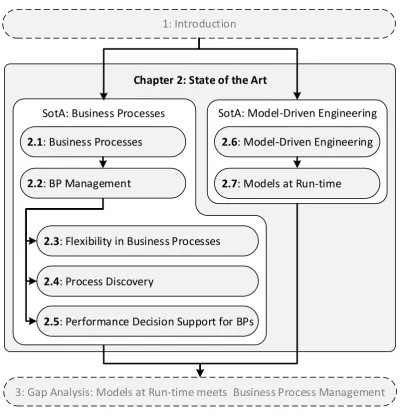
In this chapter state of the art in research and industry for different topics of the busi-ness process domain and Model-Driven Engineering (MDE) domain are discussed. In the beginning a basic introduction to business processes is provided (Section2.1), which is followed by a discussion about themanagement, lifecycle, standards, andanalysisof business processes (Section 2.2). This is followed by Section 2.3in which recent work in the field of process flexibility, i.e. changes applied during enactment of a process, is presented. Furthermore, two relevant topics with regards to descriptive and predictive analysis of business processes are discussed, namelyProcess Discovery(Section2.4) and
Performance Decision Support for Business Processes(Section2.5). Then relevant funda-mentals as well as state of the art work is discussed for the MDE domain in general and Models at Run-time (MRT) domain in particular. First in Section2.6, an introduction to the goals, principles, and definitions of MDE is provided. This is followed by a state of the art analysis of current advances in the domain of models at run-time in Section2.7, no-tably, with regards to objectives, architecture, model composition, techniques, and other characteristics of MRT in current literature. A particular focus throughout this analysis will be on aspects of descriptive models at run-time. Figure2.1shows the overview and the individual dependencies between the described sections.
2.1 Business Processes
Chapter 2: State of the Art
SotA:mModel-DrivenmEngineering
1:mIntroduction
2.1
:mBusinessmProcesses
3:mGapmAnalysis:mModelsmatmRun-timemmeetsm BusinessmProcessmManagement
2.6
:mModel-DrivenmEngineering
2.3
:mFlexibilityminmBusinessmProcesses
2.4
:mProcessmDiscovery
2.5
:mPerformancemDecisionmSupportmformBPs
2.7
:mModelsmatmRun-time
SotA:mBusinessmProcesses
[image:27.595.116.518.76.494.2]2.2
:mBPmManagement
Fig. 2.1 Outline of Chapter2
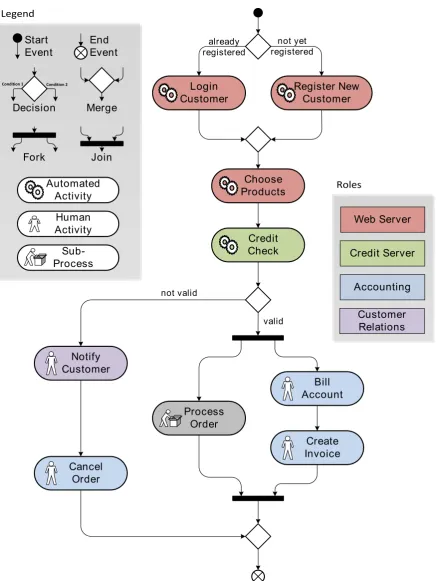
business goal.”Figure2.2depicts an example business process: Online-Order-Processing. It is specified by a set of essential elements, further described in the following:
Start and End Event are required parts of every business process, respectively indicating its entry (start event) and exit points (end event), i.e. they represent instantiation and termination of a process.
Activities are process steps which abstract the execution of actual work. Three different types of activities exist:
Legend
Roles
Chooseb Products
Credit Check
Process Order
Create Invoice
Bill Account valid
Notifyb Customer
Cancel Order
Login Customer
RegisterbNewb Customer notbyet
registered already
registered
WebbServer
CreditbServer
Accounting notbvalid
Condition 2 Condition 1
Automated Activity
Human Activity
Sub-Process Start
Event
End Event
Decision Merge
Fork Join
[image:28.595.100.538.131.713.2]Customerb Relations
2. Human Activities, in contrast, do require a resource to actively perform the work task. These "active" resources can only execute one activity at the time and are as-sociated with one or moreRoleswhich specify their areas of responsibility. An activ-ity has to be executed by a resource that is qualified to perform the associated task, i.e. only resources of a specific role are possible. If currently no resource is available the task cannot be executed and the process execution cannot continue until the required resource becomes available. "Jane Doe", for instance, is a resource that has the roles "Accounting" and "Human Resources": If he is currently not occupied she can perform all tasks that require these roles, e.g. "Bill Account" and "Create Invoice" but cannot perform "Notify Customer".
3. Sub-Process is a non-atomic activity1that abstracts a processes of a lower hierar-chical level, e.g. the "Process Order" step from the Online-Order-Processing ex-ample represents such a sub-process and has its own specification. The usage of sub-processes makes it possible to abstract and modularise business processes.
Fork and Join elements are used to direct the workflow of the process. A fork represents a splitting of the current process execution into two or more parallel paths, i.e. each of the paths can be performed in parallel without dictating the order of execution. Its counter-part, the Join represents a synchronisation point for the process, i.e. the execution only proceeds once all of the incoming parallel paths are completed. This means for the exam-ple that the process can only continue if activities "Create Invoice" and "Process Order" were completed.
Decision and Merge elements are used to direct conditional flows in a process. A Deci-sion is semantically equal to an exclusive choice between two or more target paths, a cer-tain path will be followed if a corresponding condition is true. For instance, the decision in the example process after "Credit Check" represents a choice between either continu-ing or cancellcontinu-ing the order dependcontinu-ing on whether or not the credit check was successful, i.e. valid or not valid. Its counterpart, a Merge, is the join element which is enabled once one of the exclusive source paths is completed. The merge element does not synchronise. Note, that also loop behaviour can be constructed with the help of these two elements.
This list only contains common elements that are shared by all relevant business pro-cess specifications, i.e. a propro-cess can also consists of elements which are not listed above. However, these elements are usually language-specific and/or of a different abstraction level.
In the business process domain a process typeis a particular type of process with a defined business goal, e.g. Online-Order-Processing has the goal of high customer sat-isfaction which translates to reducing the end-to-end processing time. A process type is
represented by a particularprocess schemawhich is captured in abusiness process model
specifying the behavioural information of a business process like activities, ordering, re-sources [168]. Figure2.2shows a particular process schema of Online-Order-Processing. A process type may be represented by more than one process schema expressing different versions or evolution steps of this type. Furthermore, aprocess instanceis a single execu-tion/occurrence of the business process, i.e. a particular sequence of executed activities in order to process awork item.
Furthermore, it is common to distinguish between different perspectives of a business process. For the scope of this thesis the following three perspectives are of importance:
• Control-flow Perspective: describes the execution order of process activities with the help of control elements [233], e.g. start events, forks, and decisions (see Fig-ure2.2). Since it captures the behavioural information of a process it is sometimes also referred to asbehavioural perspective, e.g. [190].
• Resource Perspective: describes the classification of resources (e.g. people, systems) into roles [233] and which of these entities are in charge of executing the activi-ties of the process. In Figure 2.2, only the roles (on the right) and their respective associations to the process activities are shown (via different colours). Since this perspective captures the organisational structure of the process it is also referred to asorganisational perspective, e.g. [190,233].
• Performance Perspective: describes the performance of a business process, which includes for instance information about the execution time of an activity, or how of-ten the process has been initiated, or with which probability certain paths are cho-sen. This perspective is of a retrospective nature and not modelled at design-time but rather extracted after or while execution. Since the majority of performance in-formation is related to timing and frequencies, it is sometimes also referred to as
time perspective, e.g. [233].
2.2 Business Process Management
The increasing complexity and importance of business processes initiated the develop-ment of Business Process Managedevelop-ment (BPM) as an IT-related research area. BPM is a cross-discipline subject of ”theory in practice” adopting a number of different concepts and methodologies from various domains such as computer science, management the-ory, philosophy, linguistics, and mathematics [122]. Perhaps because of its cross-disci-plinary nature, even after three decades, there are many duplicate and contradictory pub-lications trying to clarify definition and scope of basic BPM terminology [122], e.g. busi-ness process vs. workflow, BPM vs. Workflow Management (WfM) vs. Busibusi-ness Process Reengineering (BPR).
Business Process Management (BPM) is, however, considered to be the next step af-ter the workflow wave of the nineties [246]. Originating from the domain of workflow management, many definitions of BPM are based on workflow terminology. AWorkflow Management System(WfMS) is defined as:”A system that defines, creates and manages the execution of workflows through the use of software, running on one or more workflow en-gines, which is able to interpret the process definition, interact with workflow participants and, where required, invoke the use of IT tools and applications.”[125]. In a similar fashion BPM is defined as:”Supporting business processes using methods, techniques, and software to design, enact, control, and analyze operational processes involving humans, organiza-tions, applicaorganiza-tions, documents, and other sources of information.”[246]. Software systems that support the execution and general management of operational business processes are referred to as Business Process Management Systems or Business Process Manage-ment Suites (BPMS’s) [123]. Popular examples of BPMS are SAP Netweaver BPM [287],
IBM WebSphere[102],Intalio BPMS Designer[103].
Part of the complete BPM definition is the BPM life-cycle. It originates from the stan-dard development life cycle and consists of 4 stages (see Figure2.3) [246]:
1. Process Design- In this stage, business processes are modelled for the BPMS.
2. System Configuration- This stage configures the BPMS and the underlying system infrastructure (e.g., synchronisation of roles).
3. Process Enactment- The modelled business processes are deployed and executed in a BPMS.
4. Diagnosis- With analysis and monitoring tools, the BPM analyst can identify bot-tlenecks and improve the business processes.
Fig. 2.3 BPM life-cycle: Difference between Workflow Management and Business Process Management [246]
diagnosis phase started to gain more attention which is reflected in the high number of publications in the fields ofBusiness Process Analysis(BPA) (see Section2.2.3) in general and the sub-topics ofProcess Discovery(see Section2.4) andProcess Intelligence(PI) (see Section2.2.3and Section2.5) in particular. Other definitions of the BPM lifecycle exist but basically centre around the same or similar four lifecycle steps, e.g. Configure, Execute, Analyse, and Decide in [70].
A more industrial viewpoint on BPM and WfM is provided by Gartner [98]: ”Business process management (BPM) is a process-oriented management discipline. It is not a tech-nology. Workflow is a flow management technology found in business process manage-ment suites (BPMS’s) and other product categories.”Here BPM is a management discipline which is supported by WfM as a technology.
To put BPM terminology into one coherent picture, understanding the nested rela-tionship of BPM theory (e.g., Pi Calculus [145] and Petri Nets [172]), BPM standards (e.g., Business Process Model and Notation (BPMN) [168] or Business Process Execution Lan-guage (BPEL) [161]), and BPM systems (e.g. SAP Netweaver BPM [287] or Intalio BPMS Designer [103]) is important: BPM standards are based on established BPM theory and eventually adopted into software, i.e. BPMSs [123]. This nested relationship is depicted in Figure2.4.
2.2.1 Business Process Languages and Modelling Standards
cat-Fig. 2.4 Nested Relationship between BPM Theory, Standards, and Systems [123]
egorise them into groups with similar functions and characteristics [123]. Many of the standards address at least one of the phases of the BPM life cycle. For this reason Ko et al. suggest a separation of features found in existing standards into four different types of standards [123]:
1. Graphical Standardsallow users to express information flow, decision points, and roles for business processes in a diagrammatic way. Standards of this type corre-spond to the design phase of the BPM life cycle and are usually the easiest to un-derstand, i.e. human-readable. Prominent examples of graphical standards are Business Process Model and Notation (BPMN) [168], Event-driven Process Chains (EPC) [207], and activity diagrams of Unified Modelling Language (UML) [165].
2. Execution Standardsare code-like and enable business processes to be deployed in a BPMS. Standards of this type correspond to the enactment phase of the BPM life-cycle. The most prominent example is Business Process Execution Language (BPEL) (sometimes also called Web Service Business Execution Language (WS-BPEL)) [161].
3. Interchange Standardsare used to translate graphical standards to execution stan-dards and exchange business process models between BPMS’s [144]. One of the rea-sons these standards became necessary was the fragmented BPM landscape. Two prominent examples of interchange standards exist: Business Process Definition Metamodel (BPDM) [167] and XML Process Definition Language (XPDL) [289].
[image:33.595.227.407.93.271.2]A-priori
Process)Design)and)Process)Enactment)Stage
BP at Run-time)
A-posteriori
Diagnosis)Stage
Timeline
Graphical) Standards (BPMN,)EPC)
Execution) Standards
(BPEL) Interchange)
Standards) (BPDM,)XPDL)
Diagnosis) Standards (BPRI,)BPQL)
Fig. 2.5 Common Kinds of Business Process Model Standards
Most of the existing standards dealing with modelling languages can be assigned to one of these types. Of course, this a simplified view and standards exist which can be mapped to more than just one type, e.g. Yet Another Workflow Language (YAWL) [245] can be regarded as graphical and execution standard, or BPEL which can have a graphical repre-sentation, too.
The previous classification can be further generalised: Considering only the relation of each of the standards to the system with regards to their time of validity, practically only two different types remain (see Figure2.5):
• A-priori model- Business process models at design-time: In this case business pro-cesses are documentedbeforeexecution. This documentation can range from for-mal, i.e. using a language defined by one of the BP Modelling Standards (e.g. BPEL), to very informal, i.e. defining different design-aspects of the process in a concept-like manner (e.g. word document). Basically, every prominent language that ad-dresses the enactment phase or one of the preceding is considered a-priori model, e.g. BPMN or BPEL, and focuses on design-time aspects like communication and interoperability [47].
2.2.2 Process Execution Event Logs
A computer-aided execution of a business processes via BPMS’s producesprocess execu-tion event logs(or shortevent logs) containing transactional details for each event occur-ring duoccur-ring the execution. These events are usually of a simple nature and often only comprise raw and direct information describing the state transition, but not the state of the whole system [233]. However, since the execution can span over multiple BPMS’s each individual event log can look very different. Differences can occur on many dimensions, e.g. event granularity (activity level events vs. instance level events), perspective support (whether resource, instance or other information is provided or not). Due to the differ-ences in the various log formats, efforts have been made to provide an extensible and general log format, e.g.Mining XML(MXML) [256], its successoreXtensible Event Stream
(XES) [90,258], orBusiness Process Analytics Format (BPAF) [288,293]. In the case of an execution of collaborative BPs spanning multiple different BPMS, events have to be cap-tured, filtered, and merged to one seamless log conforming to such a generic log format before further analysis (discussed in Section2.2.3) is carried out.
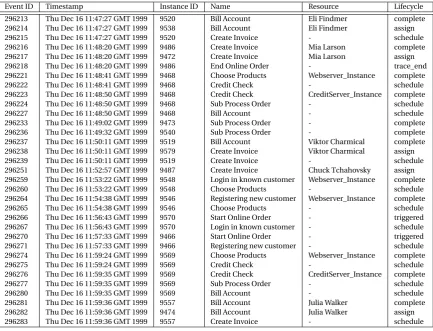
[image:35.595.99.533.436.767.2]Events captured in a process execution log which conforms to a general log format like XES or BPAF have the following characteristics [90,293] (Table2.1contains an excerpt of an execution event log resulting from Process in Figure2.2):
Table 2.1 Excerpt of Execution Event Log resulting from Process in Figure2.2
Event ID Timestamp Instance ID Name Resource Lifecycle
296213 Thu Dec 16 11:47:27 GMT 1999 9520 Bill Account Eli Findmer complete
296214 Thu Dec 16 11:47:27 GMT 1999 9538 Bill Account Eli Findmer assign
296215 Thu Dec 16 11:47:27 GMT 1999 9520 Create Invoice - schedule
296216 Thu Dec 16 11:48:20 GMT 1999 9486 Create Invoice Mia Larson complete
296217 Thu Dec 16 11:48:20 GMT 1999 9472 Create Invoice Mia Larson assign
296218 Thu Dec 16 11:48:20 GMT 1999 9486 End Online Order - trace_end
296221 Thu Dec 16 11:48:41 GMT 1999 9468 Choose Products Webserver_Instance complete
296222 Thu Dec 16 11:48:41 GMT 1999 9468 Credit Check - schedule
296223 Thu Dec 16 11:48:50 GMT 1999 9468 Credit Check CreditServer_Instance complete
296224 Thu Dec 16 11:48:50 GMT 1999 9468 Sub Process Order - schedule
296227 Thu Dec 16 11:48:50 GMT 1999 9468 Bill Account - schedule
296233 Thu Dec 16 11:49:02 GMT 1999 9473 Sub Process Order - complete
296236 Thu Dec 16 11:49:32 GMT 1999 9540 Sub Process Order - complete
296237 Thu Dec 16 11:50:11 GMT 1999 9519 Bill Account Viktor Charmical complete
296238 Thu Dec 16 11:50:11 GMT 1999 9579 Create Invoice Viktor Charmical assign
296239 Thu Dec 16 11:50:11 GMT 1999 9519 Create Invoice - schedule
296251 Thu Dec 16 11:52:57 GMT 1999 9487 Create Invoice Chuck Tchahovsky assign
296259 Thu Dec 16 11:53:22 GMT 1999 9548 Login in known customer Webserver_Instance complete
296260 Thu Dec 16 11:53:22 GMT 1999 9548 Choose Products - schedule
296264 Thu Dec 16 11:54:38 GMT 1999 9546 Registering new customer Webserver_Instance complete
296265 Thu Dec 16 11:54:38 GMT 1999 9546 Choose Products - schedule
296266 Thu Dec 16 11:56:43 GMT 1999 9570 Start Online Order - triggered
296267 Thu Dec 16 11:56:43 GMT 1999 9570 Login in known customer - schedule
296270 Thu Dec 16 11:57:33 GMT 1999 9466 Start Online Order - triggered
296271 Thu Dec 16 11:57:33 GMT 1999 9466 Registering new customer - schedule
296274 Thu Dec 16 11:59:24 GMT 1999 9569 Choose Products Webserver_Instance complete
296275 Thu Dec 16 11:59:24 GMT 1999 9569 Credit Check - schedule
296276 Thu Dec 16 11:59:35 GMT 1999 9569 Credit Check CreditServer_Instance complete
296277 Thu Dec 16 11:59:35 GMT 1999 9569 Sub Process Order - schedule
296280 Thu Dec 16 11:59:35 GMT 1999 9569 Bill Account - schedule
296281 Thu Dec 16 11:59:36 GMT 1999 9557 Bill Account Julia Walker complete
296282 Thu Dec 16 11:59:36 GMT 1999 9474 Bill Account Julia Walker assign
• Event ID: The event’s unique identifier.
• Timestamp: The date and time, at which the event has occurred.
• Process Definition ID: If events of different processes are captured in a log, each event requires a unique identifier to the corresponding process definition the event belongs to. In Table2.1no Process Definition ID is displayed since the example log only contains events from one process definition.
• Instance ID: A Log is a record of the execution details of the instances of one or more business processes. Each event in the log represents a state transition that occurred during the execution of a process instance, i.e. all events in a log corresponding to the same instance make up atrace, which is also sometimes calledcasein literature (e.g. in [233]). TheInstance ID(orTrace ID, orCase ID) is the unique identifier that specifies to which process instance this event belongs to. Note, that an Instance ID only has to be unique in the universe of one process definition, i.e. traces of different business processes may have the same Instance ID. In fact, it can occur that traces span multiple business processes for which a shared identifier is required to analyse inter-process dependencies.
• Name: Represents the generally understood name of the event, e.g. the name of the executed activity represented by the event [90]. This event name is assumed to be a unique identifier of the BP element in the process definition this event is associated with and should not allow for duplicates. Events indicating the start and end of a process may be part of the log but may have a customised "name" entry that is not a direct reference to a BP element in the process definition (see Table2.1Event IDs 296218, 296266, and 296270).
• Resource: The name of the resource that triggered the event [90]. Similar to the name attribute it is assumed to be a unique identifier to the resource associated with the event, e.g. a unique employee id as opposed to the employee’s name. If no resource is associated with this event, this value is empty.
Fig. 2.6 Lifecycle transitions in MXML and XES [90,256]
by the activity lifecycle of MXML/XES. For instance, a successful completion of an activity execution in the MXML/XES format requires a minimum of four events:
sched ul e →assi g n →st ar t →compl et e whereas the successful completion of the automated activity "Credit Check" is expressed by only two events in Table2.1 (Event IDs 296222 and 296223): sched ul e→compl et e. Some logs may even only contain one single event per processed activity, e.g. when the task has been com-pleted.
Since general standards like XES and BPAF are extensible, more information can be contained in the events. For instance, additional organisational data (e.g. the role the resource is associated with), additional cost data (e.g. cost and currency of the activity execution), or additional transactional data (e.g. items of an order) [90].
2.2.3 Overview of Business Process Analyses
Business Process Analysis
Real-time BPA, e.g. BAM, EDBPM
Descriptive Analysis, e.g. Process Mining
Process Intelligence,
Decision Support Design-time Analysis,
e.g. What-if, Optimisation diagnosis
(re)design
analysis
implementation (re)configuration
execution [monitoring &]
[image:38.595.98.537.82.299.2]adjustment
Fig. 2.7 Extended BPM Lifecycle [251] and different types of BPA in relation
dominant and only slightly changed2(Figure2.7- centre cycle). Additionally, two more cycles have been introduced: One which allows for monitoring3and adjustments of the process during run-time (left cycle) and one that describes the iterative procedure em-ploying predictive methods while designing the process (right cycle). The following two types of Business Process Analyses can be distinguished:
Process Intelligence / Decision Support
Decision Support and Process Intelligence are two terms that basically describe the same type of business process analyses: These are analyses supporting stakeholders and busi-ness analyst in making decisions about the busibusi-ness process through providing them with additional computed information of diverse nature, e.g. performance of the business pro-cess or the predicted behaviour of a planned control-flow. This information enables the stakeholders and analysts to obtain more insight into the behaviour of the actual or fu-ture process execution and allows for insightful decision making when designing a new iteration of the process. Note, that a human entity is explicitly involved in the diagno-sis and analydiagno-sis phases of the lifecycle, i.e. the configuration, execution, and evalua-tion of the process intelligence analyses, as well as the eventual decision making are all human-guided. Whereas the definition of Process Intelligence by Muehlen et al. mostly focusses on forecasting future behaviour [292], the definition by Aalst et al. includes de-scriptive techniques and even automated run-time monitoring4 [251]. Here, the term Process Intelligence is defined as an umbrella term for all business process related
high-2now an optional implementation step is included acknowledging differentiation between
de-sign/graphical and execution standards for BPs (see Section2.2.1)
3the term "monitoring" was added to the "adjustment" step of the original extended lifecycle from [251] 4This is mostly due to the fact that Aalst et al. do not distinguish between an ex-post analysis of an event
Fig. 2.8 The three main types of Process Mining (in red) [251]
level analyses (with human interaction) to support the diagnosis and design phase of the traditional BPM lifecycle, e.g. process discovery, what-if analyses, optimisation, etc. In a broader context Process Intelligence is regarded as a specialisation ofBusiness Intelli-gence[44,251].
In Process Intelligence two different types of analyses can be distinguished: Descrip-tive and Design-time Analyses. The former type encompasses all Process Mining (PM) techniques. The goal of Process Mining is to discover, monitor, or improve processes by harnessing information from an event log resulting from an actual BP execution, i.e. PM techniques essentially represent the link between event logs and business process mod-els and enable an log-to-model analysis of the as-is state. As such, process mining is a research discipline located at the intersections between machine learning and data min-ing and between process modellmin-ing and process analysis [233]. Three main disciplines of process mining exist (see Figure2.8) [251]:
1. Conformance Checking,
i.e. determining to what extent the behaviour recorded in the log conforms to the behaviour of a given BP model and vice-versa
2. Model Enhancement,
i.e. extending/annotating an existing model with additional information, e.g. per-formance data, obtained from the event log of this process, and
3. Process Discovery,
Fig. 2.9 Input and Output of (a) Process Discovery, (b) Conformance Checking, and (c)Model Enhancement[251]
only referring to the discovery of the control-flow perspective, e.g. [126,249, 278]. Since most BPMS support the recording of an event log, this information can be readily accessed for analysis. However, the information in an event log is on a differ-ent abstraction level than a BP model. For this reason the extraction of BP-domain information from logs is a non-trivial task and has lead to extensive research in this area. The advances and state-of-the-art in process discovery will be discussed in detail in Section2.4.
Figure 2.9shows the different inputs and outputs of these three Process Mining disci-plines, emphasising they essentially represent the link between execution event log and business process model.
The second type of analyses in Process Intelligence can be summarised as higher-level analyses that support the (re-)design stage. Those are mostly of a predictive or evalua-tive nature on either log-extracted or modelled BP data, or a combination of both. Ex-amples areverification[259],bottleneck detection[195],validation/what-if analysis[73],
sensitivity analysis[69],optimisations[221], orbusiness impact analysis[189]. Methods like optimisation, sensitivity or what-if analyses are based on performance evaluations that employ methodologies for predicting future behaviour. This type of performance-related decision support is of high importance for reasoning and decision making and is discussed in further detail in Section2.5.
![Fig. 2.4 Nested Relationship between BPM Theory, Standards, and Systems [123]](https://thumb-us.123doks.com/thumbv2/123dok_us/9346492.436682/33.595.227.407.93.271/fig-nested-relationship-bpm-theory-standards-systems.webp)
![Fig. 2.6 Lifecycle transitions in MXML and XES [90, 256]](https://thumb-us.123doks.com/thumbv2/123dok_us/9346492.436682/37.595.186.444.87.315/fig-lifecycle-transitions-mxml-xes.webp)
![Fig. 2.7 Extended BPM Lifecycle [251] and different types of BPA in relation](https://thumb-us.123doks.com/thumbv2/123dok_us/9346492.436682/38.595.98.537.82.299/fig-extended-bpm-lifecycle-different-types-bpa-relation.webp)
![Fig. 2.8 The three main types of Process Mining (in red) [251]](https://thumb-us.123doks.com/thumbv2/123dok_us/9346492.436682/39.595.147.486.90.333/fig-main-types-process-mining-red.webp)
![Fig. 2.11 Types of BP Flexibility defined by Sadiq et al. [202] (light grey rectangles) andby Schonenberg et al](https://thumb-us.123doks.com/thumbv2/123dok_us/9346492.436682/45.595.139.492.210.384/types-flexibility-defined-sadiq-light-rectangles-andby-schonenberg.webp)
