Economics Working Paper Series
2017/027
Machine learning for dynamic incentive problems
Philipp Renner and Simon Scheidegger
The Department of Economics
Lancaster University Management School
Lancaster LA1 4YX
UK
© Authors
All rights reserved. Short sections of text, not to exceed two paragraphs, may be quoted without explicit permission,
provided that full acknowledgement is given.
Machine learning for dynamic incentive problems
∗
Philipp Renner
Department of Economics
University of Lancaster
[email protected]
Simon Scheidegger
Department of Banking and Finance
University of Zurich
[email protected]
This version: November 7, 2017
Current version: this link
Abstract
We propose a generic method for solving infinite-horizon, discrete-time dynamic incen-tive problems with hidden states. We first combine set-valued dynamic programming tech-niques with Bayesian Gaussian mixture models to determine irregularly shaped equilib-rium value correspondences. Second, we generate training data from those pre-computed feasible sets to recursively solve the dynamic incentive problem by a massively parallelized Gaussian process machine learning algorithm. This combination enables us to analyze models of a complexity that was previously considered to be intractable. To demonstrate the broad applicability of our framework, we compute solutions for models of repeated agency with history dependence, many types, and varying preferences.
Keywords: Dynamic Contracts, Principal-Agent Model, Dynamic Programming,
Ma-chine Learning, Gaussian Processes, High-Performance Computing.
JEL Classification: C61, C73, D82, D86, E61
∗We thank Johannes Brumm, Ken Judd, Felix Kubler, Luca Mazzone, John Rust, Karl Schmedders, Sevin
1
Introduction
Dynamic incentive (DI) problems are of key importance in model-based economics. They occur whenever two parties form a contract with asymmetric information, and encompass questions such as manager remuneration, insurance contracts, and optimal taxation (see, e.g., Golosov et al., (2016a) and references therein for a thorough review). Solving these models is a formidable task, as standard recursive techniques (see, e.g., Stokey et al., (1989)) are often not directly applicable. To this end, previous research both into discrete-time1 and into continuous-time
settings2extensively studied methods, in various contexts, of recursively representing incentive-compatible contracts in order to make them formally tractable. There are two types of obstacle that arise in these models in general. First, unobservable continuous actions lead to incentive constraints that are are themselves optimization problems. In the literature, they are com-monly referred to asmoral hazard problems. Second, in so-calledadverse selection problems, unobserved discrete states make it necessary to look at a high-dimensional dynamic program with an unknown domain.
In this paper, we present a novel, generic method for dealing with DI problems. In partic-ular, we focus on solving infinite-horizon, discrete-time DI models with hidden states and with shocks that follow a Markov chain. Two major bottlenecks create substantial difficulties in solv-ing such dynamic adverse selection problems3 numerically, namely, (i) the determination and
approximation of (possibly) high-dimensional and non-convex equilibrium correspondences— that is, feasible sets of a dynamic program, and (ii) performing dynamic programming on them. Thus, we also have to repeatedly and efficiently approximate functions on irregularly shaped domains. To the best of our knowledge, there exists at present no solution framework in the DI context that can cope with all these issues at once.
Complication (i) is a standard issue in models with repeated agency, since they require full history dependence (see Lambert, (1983) and Rogerson, (1985)). This, in turn, leads to time-inconsistent dynamic programs. A way of dealing with this issue is to introduce
promised utilities as a bookkeeping mechanism, which has led to several recursive formulations
for various types of hidden information (see, e.g., Spear and Srivastava, (1987), Fernandes and Phelan, (2000), and Doepke and Townsend, (2006)). Once models with history dependence are written in a recursive form, the set of feasible utility vectors is not known in advance and can be of irregular—that is, non-hypercubic geometry. As complication (ii), a curse of
dimensionality (Bellman, 1961) arises in dynamic adverse selection problems, since for every
individual type of agent, the dimensionality of the state space increases. Hence, if standard, Cartesian grid-based algorithms are applied in the solution process, the computational effort as well as the storage requirements grow exponentially and render even models of only moderate complexity computationally infeasible. The existing literature, therefore, is limited to at most two-dimensional models (see, e.g., Broer et al., (2017), Doepke and Townsend, (2006), and Abraham and Pavoni, (2008)), as in them the curse of dimensionality is avoided from the outset, which can be suboptimal with regard to the ideal choice of model.
We propose to tackle (i) by pre-computing the time-invariant feasible set for the
continu-1For an incomplete list of references, see, e.g., Spear and Srivastava, (1987), Fernandes and Phelan, (2000),
Cole and Kocherlakota, (2001), Werning, (2002), Doepke and Townsend, (2006), Abraham and Pavoni, (2008), and Pavoni et al., (2017).
2See, e.g., DeMarzo and Sannikov, (2006), Sannikov, (2008), Williams, (2009, 2011), and He et al., (2017),
among others.
3Note that while the focus of the work presented lies on solving dynamic adverse selection problems, the
ous state variables by combining ideas from Abreu et al., (1986, 1990) (henceforth APS4) with
Bayesian Gaussian mixture models (BGMMs) (see, e.g., Rasmussen, (2000)). Next, we deal with (ii) by solving the recursively formulated DI problem on an irregularly shaped domain by applying a massively parallelized dynamic programming (DP) algorithm that uses Gaus-sian process regression (GPR) to approximate high-dimensional value and policy functions (see Scheidegger and Bilionis, (2017), and references therein) on the entire feasible set. This combination enables us to analyze DI models that were previously considered to be intractable. The seminal work by APS introduced a constructive procedure for computing feasible sets. In particular, the authors showed that there exists a set-valued contraction mapping whose fixed point is the feasible set. In practical applications we therefore have to repeatedly approximate potentially non-convex equilibrium correspondences. To do so, we apply BGMMs to construct a classifier5 (see, e.g., Murphy, (2012)) to divide the computational domain into a feasible and
an infeasible region. This classification then leads to an outer approximation that iteratively shrinks toward the feasible set. We terminate the iteration once two successive classifiers become sufficiently close. Our approach has several desirable features. First, since sampling achieves the approximation of feasible sets through BGMMs, it does not directly suffer from the curse of dimensionality and thus can deal with problems involving many types. Second, the numerical approximation of the feasible set is independent of solving the DI problem and thus does not directly add to the computational complexity. Third, it can approximate both convex and non-convex sets. Thus, the work presented here is a substantial improvement on the previous literature. Judd et al., (2003) and Yeltekin et al., (2017), for example, provide a numerical scheme for determining the feasible sets of discrete state supergames by using polygons. Their approach however relies on the convexification of the payoff set and suffers from the curse of dimensionality. Similarly, Sleet and Yeltekin, (2016) provide an extension to this method for the case of continuous state variables, but their extension suffers from the same issues.
After pre-computing the feasible sets, we have to solve the recursively formulated dynamic adverse selection model on the irregularly shaped domains. For this purpose, we apply a massively parallelized discrete-time DP algorithm that uses GPR in order to approximate the value and policy functions. GPR is a form of supervised machine learning (see, e.g., Rasmussen and Williams, (2005) and Murphy, (2012), and references therein) and has successfully been applied to a variety of applications in data science, engineering, and other fields to perform approximation and classification tasks. In economics, Scheidegger and Bilionis, (2017) recently applied Gaussian processes (GPs) to solve very-high-dimensional dynamic stochastic models as well as to perform uncertainty quantification. A defining feature of GPs is that they combine the best of two worlds—namely, those of grid-free methods such as Monte Carlo (MC) (see, e.g., Press et al., (2007), and references therein) and of smooth function approximation theory. GPs learn a function based on the observations available at so-called design points, and do so without any geometric restriction. Moreover, since the construction of GP surrogates6 is
achieved by sampling from a domain of interest such as a feasible set, they do not directly suffer from the curse of dimensionality as do Cartesian grid-based algorithms. GPs, therefore, stand in stark contrast to ordinary, grid-based approximation schemes for continuous, high-dimensional state spaces such as Smolyak’s method (see, e.g., Malin et al., (2010) and Judd et al., (2014)), adaptive sparse grids (see, e.g., Brumm and Scheidegger, (2017)), high-dimensional model reduction (see Eftekhari et al., (2017)), or projection methods (see, e.g., Judd, (1992)).
4For the remainder of this paper, APS is used to refer both to Abreu et al., (1986, 1990) and to the method
introduced by these authors.
5Note that in the machine learning literature, classification can—loosely speaking—be considered to be the
problem of identifying to which of a set of categories a new data observation belongs.
Those grid-based approximators are restricted to hyper-rectangular state spaces and thus are not a natural modeling choice in the context of solving dynamic adverse selection models.
To demonstrate the capabilities of the framework proposed in this paper, we solve a dynamic adverse selection model similar to those discussed, for example, in Fernandes and Phelan, (2000) and Broer et al., (2017). It consists of a risk-averse agent who has unobserved income shocks, and a risk-neutral planner who wants to provide optimal incentive-compatible insurance against income shocks. The agent reports his income shock to the principal, who then transfers consumption or charges a fee to the agent dependent on the reported shock. Since the principal can only see the reports, the observed shock process is fully history dependent.7 The reason for this history dependence is that the principal has to condition his actions with respect to the agent’s reports and not with respect to the actual shocks. While this model is relatively easy to explain, its dimensionality and complexity can be scaled up in a straightforward and meaningful way, as they just depend linearly on the number of types considered. This feature of the model allows us to focus on the problem of handling irregularly shaped, high-dimensional state spaces in the DI context. Note that much of the existing literature has focused on the stylized analysis of such contracts rather than on their numerical implementation.
The remainder of this paper is organized as follows: In Section 2, we specify the baseline DI environment we are targeting with our framework. In Section 3, we outline the solution method. We first discuss how we construct an APS-style algorithm by using BGMMs; then, we provide a short review of DP and summarize the workings of GP machine learning. Finally, we show how to embed APS and BGMMs into a massively parallel DP algorithm that is based on GPR. In Section 4, we discuss the performance of our method via a variety of illustrative test cases. Section 5 concludes.
2
A baseline dynamic incentive model
To demonstrate the scalability and flexibility of the method we introduce in this paper, we consider an infinitely repeated, dynamic adverse selection problem in discrete time as described in Fernandes and Phelan, (2000).8
Time is indexed byt= 1,2, . . .∈N. In every periodt, an agent observes his9taste shock
θt ∈Θ, where Θ is a finite set of cardinality N. He then reports his shock to the principal.
Subsequently, the principal offers a contractct, which depends on the entire history of reports,
to the agent. Since we need to keep track of the history of types (see Fernandes and Phelan, (2000)), we define the type history at time t to be the (t)-tuple—that is, an ordered list
ht = (θ
0, θ1, . . . , θt−1) for t ≥ 1. Next, we define the set of possible histories at time t by
Ht = Θt = Θ×Θ×. . .×Θ and set h1 ∈Θ to be the initial history at time 1. We assume
without loss of generality that the initial history is public knowledge. An optimal solution to the problem is a transfer scheme that maximizes the principal’s utility while delivering a predetermined lifetime utility to the agent. This scheme will be a sequence of conditional transfers that depend on all past realizations of types. Furthermore, we impose the following assumptions on the primitives of the model:
Assumption 1.
1. The set of types Θ ={1, . . . , N} is of cardinalityN ∈N.
2. The set C⊂Rof compensations is a non-empty and compact interval.
7Previous research suggests that private information in the economic environments we are interested in is
highly persistent (see, e.g., Meghir and Pistaferri, (2004)).
8We follow the formalism of Golosov et al., (2016a) to describe the model.
3. The transition probabilities π(θt|θt−1)are defined by a probability matrixΠ∈RN×N.
4. The principal’s utility function is given byv:C×Θ→Rand the agent’s utility function
byu:C×Θ→R. They are both twice continuously differentiable inC.
5. The principal and the agent have a common discount factorβ ∈(0,1).10
For each periodtand historyht∈Htthe probability distribution on the setHtof histories is given by
π (ht, i)|ht
= Πθt−1,i, ∀i∈ {1, . . . , N} (1)
and by recursion forτ≥1,
π ht+τ, i
|ht
= Πθt−1,i·µ h
t+τ−1|ht
. (2)
The principal’s compensation strategy is a function of the history of reports up to period t. His strategy, therefore, is a function ct:Ht→C. We denote the principal’s infinite horizon
strategies by the sequences of strategy functions c= (c1, c2, . . .).
At time t, the agent has to decide what to report to the principal; his strategy is, thus a function on the domain Ht—that is,at:Ht→Θ. A strategyais called incentive compatible
iff
E
"∞
X
t=1
βt−1u ct(ht, at(ht, Xt)), Xt
h1 # ≥E "∞ X t=1
βt−1u ct(ht,˜at(ht, Xt)), Xt
h1 #
, ∀˜a, (3)
where Xt is a random variable with values in Θ and distribution π. We can get rid of the
reporting strategy of the agent by applying the following theorem:
Theorem 1 (Revelation principle). (Golosov et al., 2016a, Th. 1) For every contract c and
incentive compatible strategy ˆa, there is aˆc with the same payoff to the principal such that
truth-telling is incentive compatible.
The revelation principle allows us to only look at compensation schemes that induce truth-telling and thus to define the dynamic adverse selection problem. Given an initial history
h1={θ
0}, the principal faces the following infinite horizon utility maximization problem:
max
c E
"∞ X
t=1
βt−1v ct(ht, Xt), Xt
h1 # (4)
subject to the truth-telling constraint
E
"∞
X
t=1
βt−1u ct(ht, Xt), Xt
h1 # ≥E "∞ X t=1
βt−1u ct(ht, at(Xt, ht)), Xt
h1 #
, ∀a (5)
and the reservation utility
˜
wθ≤E
"∞ X
t=1
βt−1u ct(ht, Xt), Xt
h1 #
, ∀θ∈Θ. (6)
As a next step, we simplify the incentive constraints by applying a classic theorem.
Theorem 2 (One-shot deviation principle). (Golosov et al., 2016a, Lem. 3) The incentive
constraint (5) holds iff
E
"∞ X
t=1
βt−1u ct(ht, Xt), Xt
h1 # ≥ E
u(cs(hs, a(Xs)), Xs) + ∞
X
t=1,t6=s
βt−1u ct(ht, Xt), Xt
h1
, ∀s∈N,∀a: Θ→Θ.
(7)
Figure 1: The sequence of events in period t.
Note that in the one-shot deviation constraint (see Eq. (7)) we do not allow for all reporting strategies. Instead, only strategies that remain feasible for the agent are admissible. As a concrete example, assume that an agent over-reports his income when filling out his tax declaration. In such a case, he would be charged income tax that he might be unable to pay. All such reports are excluded from Eq. (7).
However, even after all these simplifications the dynamic adverse selection problem is still unsolvable in its present form. To address this, we follow Fernandes and Phelan, (2000) and introduce the utility promisewθ as a continuous state variable.
Theorem 3. (Golosov et al., 2016a, Eqs. (44–47)) There existsW(θ)⊂RN, the feasible sets
of utility promises for type θ, such that the problem defined by Eqs. 4,6, and 7 can be written
recursively as
V(w, θ) = max
c,w+
X
˜
θ∈Θ
Πθ,θ˜(v(cθ˜,θ˜) +βV+(w+θ˜,θ˜)) (8)
s.t. wν =
X
˜
θ∈Θ
Πν,θ˜(u(cθ˜,θ˜) +βw + ˜
θ,θ˜)∀ν∈Θ,
u(cθ˜,θ˜) +βw+˜
θ,θ˜≥u(cν,
˜
θ) +βw+
ν,θ˜∀
˜
θ∈Θ, ∀ν ∈Θ\ {θ˜},
c∈[0, c]N,
w+˜
θ ∈W(˜θ)with w
+ ˜
θ,ν = (w
+ ˜
θ)ν ∀
˜
θ∈Θ, ∀ν∈Θ.
Note that we arranged w+ as an N ×N matrix where the θ-th row of the matrix represents
next period’s utility promise conditional thatθ happens. The first constraint is called promise
keeping constraint. It ensures that the principal follows up on his utility promisesw+θ. The
second constraint is the truth telling constraint.
This measure allows us at the same time to keep track of the full history and to obtain a recursive formulation. The latter point is critical in making the model tractable for the computational method we propose in Sec. 3. Fig. 1 depicts the timeline for the recursively formulated problem. At periodt, the principal “learns” last period’s reportθ and the utility promises w. He then offers the agent a consumption menu c for each possible report, which satisfy the telling and promise-keeping constraints. Next, the agent chooses the truth-telling reporting strategy. Finally, the shock θtrueis realized, the agent reports ˜θaccording to
his strategy, and both the principal and the agent receive their respective utilities,v(cθ˜,θ˜) and
u(cθ˜, θtrue).
3
Dynamic programming on irregularly shaped domains
Solving dynamic adverse selection models as described in Sec. 2 numerically is a formidable task, since we have to deal with a variety of complex issues at the same time: i) The feasible sets
numerically (see Theorem 3). In most of the interesting cases, such sets have a non-trivial—that is, a non–hypercubic geometry (see, e.g., Fernandes and Phelan, (2000), Broer et al., (2017)). ii) For solving a DI problem recursively, for example with value function iteration (VFI; see, e.g., Judd, (1998) and Ljungqvist and Sargent, (2000)), we need to repeatedly approximate and evaluate high-dimensional functions at arbitrary coordinates within domains of interest—that is to say, the irregularly shaped feasible sets. To meet all these challenging modeling demands we therefore apply set-valued dynamic programming techniques in combination with BGMMs to determine irregularly shaped equilibrium value correspondences. Subsequently, we use a massively parallel VFI algorithm that applies GPR in each iteration step to learn the value function and, if needed, the policy functions on the pre-computed, time-invariant feasible sets globally.11
In this section we therefore proceed in four steps. In Sec. 3.1, we characterize the general structure of the models we aim to solve by DP. In Sec. 3.2, we present a novel way of efficiently computing equilibrium correspondences by combining ideas from Abreu et al., (1986, 1990) with BGMMs (see Rasmussen, (2000)). Subsequently, we summarize–in Sec. 3.3–how value and policy functions can be approximated by GP machine learning. Sec. 3.4 finally combines all these components into a generic VFI framework for DI problems.
3.1
Background on dynamic programming
Throughout this paper, the abstract class of models we consider are discrete-time, infinite-horizon stochastic optimal decision-making problems. Following Scheidegger and Bilionis, (2017), we briefly characterize them here by the following general description: letxt∈W ⊂Rdx
denote the state of the economy at time t∈N+ of dimensionality dx ∈N. Controls (actions)
are represented by apolicy function c:W →ζ, whereζ is the space of possible controls. The discrete-time transition function of the economy from one period to the next is given by the distribution ofxt+1, which depends on the current state and policies
xt+1∼f(·|xt, c(xt)). (9)
The transition function f that stochastically maps a state-action pair to a successor state is assumed to be given, whereas the policy function c needs to be determined from equilib-rium or optimality conditions. The standard way to do so is to use DP (see, e.g., Bellman, (1961), Stokey et al., (1989), Judd, (1998), Ljungqvist and Sargent, (2000)), where the task is to find an infinite sequence ofcontrols {χt}∞t=0 to maximize thevalue function
V(x0) :=E
"∞ X
t=0
βtr(xt, χt)
#
(10)
for an initial state x0 ∈W, r(·,·) is the so-calledreturn function, andχt∈Γ(xt) with Γ(xt)
being the set of feasible choices givenxt. The discount factorβ ∈(0,1) weights future returns.
DP seeks a time-invariant policy functioncmapping the statextinto the actionχt, such that
for allt∈N
χt = c(xt)∈Γ(xt), (11)
11Below, we follow Brumm and Scheidegger, (2017) and use the term “global solution” for a solution that
and {χt}∞t=0 solves the original problem. Theprinciple of optimality states that we can find
such a solution by solving theBellman equation
V(x) = max
χ {r(x, χ) +βE[V(˜x)]}, (12)
where the successor state is distributed as ˜x∼f(·|x, χ). The solution is a fixed point of the Bellman operatorT, defined by
(T V)(x) = max
χ {r(x, χ) +βE[V(˜x)]}. (13)
Under appropriate conditions (see, e.g., Stokey et al., (1989)) the Bellman operator is a con-traction mapping. In this case, iteratively applying T provides a sequence of value functions that converges to a unique fixed point. This procedure is called value function iteration (see, e.g. Bertsekas, (2000), Judd, (1998), or Ljungqvist and Sargent, (2000)) and is motivated by this theoretical justification and numerically implements the iterative application of the Bellman operator to successive approximations of the value function. The corresponding DP recursion thus starts from any bounded and continuous guess for the value function, and the solution is approached in the limit asj → ∞by iterations on
Vj+1(x) =T(Vj)(x) := max χj+1
{r(x, c) +βE[Vj(˜x)]}. (14)
In practice, we say that VFI has converged if numerical convergence in some norm, for example
kVτ−Vτ−1k2≤, ∈R+, (15)
and some at some iteration step τ, is reached. The (approximate) equilibrium value function shall be denoted asV∗=Vτand the corresponding policy functions asχ∗=χτ. From Eq. (14),
it becomes apparent that we need to repeatedly approximate and evaluate (potentially multi-dimensional) value functions. An additional complication stems from the fact that domainW
for the models we are targeting (cf. Sec. 2) is often highly complex—that is, irregularly shaped and not known a priori (see, e.g., Fernandes and Phelan, (2000) and Broer et al., (2017)). We therefore describe in Sec. 3.2 how we determine W numerically, whereas in Sec. 3.3 we show how we approximate value and policy functions on irregularly shaped feasible sets.
3.2
On the iterative approximation of irregularly shaped feasible sets
One major complication we are facing is the fact that the feasible set—that is, the state space for dynamic adverse selection problems is unknown and potentially of irregular geometry. If the problem is simple enough, then it can be possible to find an analytical solution. However, we are usually at most able to give an estimate of the hypercubic domain that contains it, namely–
wθ= min
c∈C
u(c, θ)
1−β , wθ= maxc∈C
u(c, θ)
1−β , (16)
where wθ and wθ are the lower and upper bounds on promised utilities, respectively. Hence,
in most of the interesting settings, a numerical procedure for approximating the equilibrium correspondences is required.
One possible way of getting around this issue is to relax the recursive model formulation (see Eq. (8)) by introducing slack variables on the constraints. Whenever they are nonzero, one adds a penalty term to the objective function.12 Since the penalty quickly becomes large
12Note that in Appendix A, we will apply this procedure in combination with a highly-tuned adaptive sparse
outside the original feasible region, the actual solution can be found by restricting the relaxed problem to the feasible set (see, e.g., Judd et al., (2016), and references therein). The advantage of this procedure is that one can apply highly tuned DP algorithms for hypercubic domains (see, e.g., Brumm and Scheidegger, (2017)) to solve DI models. The major disadvantage of this brute-force approach, however, lies in the fact that we need to approximate a computational domain of which large parts might be infeasible, which in turn can result in a massive waste of resources (see, e.g., Scheidegger and Bilionis, (2017) for a detailed discussion).
We therefore propose a novel, simulation-based method for determining irregularly shaped feasible sets. This approach will enable us to concentrate the computational resources where they are needed and thus be highly efficient (cf., Secs. 3.4 and 4). To this end, we follow the classical work by APS, who provide set-valued DP techniques for determining feasible sets. In particular, they show that the feasible sets W(θ) can found by repeatedly applying a set operator Bto an initial “candidate” set until the resulting sequence of sets converges in some metric. In our case (see Sec. 2), this means that we can define the set-valued operator as
B(X) =
w|wν =
X
˜
θ∈Θ
Πν,θ˜(u(cθ˜,θ˜) +βwθ,+˜θ˜)∀ν∈Θ,
u(cθ˜,θ˜) +βwθ,+˜θ˜≥u(cν,θ˜) +βw+ν,θ˜∀θ˜∈Θ, ∀ν∈Θ\ {θ˜},
c∈[0, c]N,
w+˜
θ ∈X withw
+ ˜
θ,ν= (w
+ ˜
θ)ν ∀
˜
θ∈Θ, ∀ν∈Θ
, (17)
whereX ⊂RN, and where the operatorB(X) contains the constraints of the original problem
stated in Eq. (8). This is a monotone operator—that is to say, B(X)⊂X, and its fixed point will be the feasible set for typeθ—namelyB(W(θ)) =W(θ).
A numerical implementation of the APS method requires the repeated approximation of candidate equilibrium value correspondences—that is, a finite collection of sets. To do so, we propose applying BGMMs13 to construct a classifier to divide the computational domain into
a feasible and an infeasible region. This classification then leads to an outer approximation that iteratively shrinks toward the feasible set. We terminate the iteration once two successive classifiers become sufficiently close.
In practice, we start off the APS iteration by uniformly drawing, for every type,msample points
Xtest=
n
w(1), . . . , w(m)o (19)
from a hypercube that contains the feasible set (see Eq. (16)) and fit a BGMM to the points
Xfeas⊂Xtest that were deemed to be feasible. We denote the log-likelihood that corresponds
to the BGMM as fθ. Then, we start with the set-valued DP procedure. To do so, we define
fθ+as the log-likelihood from the BGMM in iterationi−1, and denote`+θ to be the smallest log-likelihood that corresponded to a feasible point—that is,`+θ = minfθ+(w(j))|w(j)∈(Xfeas)θ ,
and generate anothermsample points ˜Xfrom inside the updated feasible set via the respective BGMMs. At a sample point w(k)∈X˜ that satisfiesf+
θ(w
(k))≥`+
θ within an iteration stepi,
13Mixture of Gaussians are usually used to approximate probability distributions from observed data.
Sup-pose that we havendata samplesX={x+i : 1≤i≤n}. We then can approximateρestimatedas a mixture of
Gaussians:
ρestimated(x) = M X
m=1
πmN(x|µm,Σm), (18)
where the mean vectorsµm∈RD, the covariance matricesΣm∈RD×D, the weightsπmwithPMm=1πm= 1,
we solve a slight modification of Eq. (17)14, namely—
ϕ= max
c,w+
X
θ∈Θ
−log(exp(−α(fθ+(w+θ)−`+θ)) + 1)/α,
s.t. wν=
X
˜
θ∈Θ
Πν,θ˜(u(cθ˜,θ˜) +βw+θ,˜θ˜)∀ν ∈Θ,
u(cθ˜,θ˜) +βwθ,+˜θ˜≥u(cν,θ˜) +βwν,+θ˜∀θ˜∈Θ, ∀ν ∈Θ\ {θ˜},
c∈[0, c]N,
w+˜
θ,ν= (w
+ ˜
θ)ν ∀
˜
θ∈Θ, ∀ν ∈Θ.
(20)
The objective functionF(w+θ, θ, fθ+, `+θ) of the constrained optimization problem stated above in Eq. (20) is a smooth relaxation of a classifier that returns 0 for feasible points and a large negative number for infeasible ones. Furthermore, the constraints are the same ones as those in the description of the operator B in Eq. (17). The parameter α controls how strict the relaxation is: the smaller α is, the quicker the objective in Eq. (20) will go to −∞ when leaving the feasible set.15 If ϕis above`+
θ, we label the point w
(j)as feasible and add it to a
set of feasible pointsXfeas. We repeat this until the setXfeashas sufficiently large cardinality.16
Subsequently, we fit another BGMM to Xfeas to obtain updated values for fθ and `θ. This
procedure is repeated until convergence. Alg. 1 summarizes the detailed steps of the set-valued DP for determining the feasible sets W(θ) in a more formal way.
Note that it is non-trivial to measure whether the set-valued DP procedure has converged. To this end, we propose the following procedure: In every iteration stepiand every stateθ, we construct a binary classifierCi,θ(see, e.g., Murphy, (2012)) by labelling infeasible sample points
as 0, and feasible ones by 1, and compute the average L1-error across subsequent candidate
equilibrium correspondences. In practice, this amounts to drawing a uniform sample of points from a hypercube that contains the feasible set. Subsequently, we use the classifiers from steps
i−1 andito find the label of each sample point. We then determine the percentage of points that get different labels from the classifiers ati−1 andi, resulting in an approximation of the error.
The approach presented here has three highly desirable features that yield a substantial improvement over the previous literature. First, since sampling achieves the approximation of feasible sets through BGMMs, it does not directly suffer from the curse of dimensionality and thus can deal with problems involving many types of agents. Second, our scheme of approximating equilibrium correspondences is independent of solving the DI problem and thus does not directly add to the computational complexity of solving the actual model. Finally, it can approximate both convex and non-convex sets.
In contrast, Judd et al., (2003) and Yeltekin et al., (2017), for example, approximate feasible sets by linear hyperplanes. Their approach is limited to models with discrete states and convex sets. Moreover, it suffers from the curse of dimensionality. Thus, it is not useful for models with many types and potentially non-convex, state spaces. Similarly, Abreu and Sannikov, (2014) provide a method for computing feasible sets in discrete state, two-player games that is restricted to convex sets and also suffers from the curse of dimensionality. Sleet and Yeltekin, (2016) provide an extension to Judd et al., (2003) for the case of continuous state variables, but their method is also restricted to convex sets in low-dimensional spaces.
14In the present form, Eq. (17) is numerically un-tractable due to the constraintw+
˜
θ ∈ W(˜θ)—there is no
explicit description of the setW(θ) that is given by inequalities. To circumvent this issue, we get rid of this
constraint by introducing a penalty functionp. For any point in the feasible set, this functionpwill be 0 and
will tend to minus infinity when we leave the boundary of the set (see Eq. (20)).
15In practical applications (see, e.g., Sec. 4.1), we setα= 0.1.
16Note that in our computations (see Sec. 4),|(X
Data: For allθ: initial set of points{w(1), . . . , w(m)}, uniformly drawn from a domain that contains the feasible set (see Eq. (16)). Approximation accuracy ¯.
Result: The approximate feasible setsW(θ), determined by the log-likelihoodfθ and
cut-off`θ that define the classifierCθ, where Cθ(w(j)) = 1 ifffθ(w(j))≥`θ.
Fit BGMM toXfeasfor allθto getfθand `θ= minfθ(w(j))|w(j)∈(Xfeas)θ .
fθ+=fθ.
`+θ =`θ.
while >¯do forθ∈Θdo
Generatemsample points ˜X from the most recent “candidate” feasible set via last iteration’s BGMM and setX ={w(k)∈X˜ :f+
θ(x)≥`
+
θ}.
Setn=|X|. Set (Xfeas)θ=∅.
while|(Xfeas)θ|< ndo
Solve optimization problem given by Eq. (20) at pointw(k)∈X and get
objectiveϕ.
if ϕ≥`+θ then
(Xfeas)θ= (Xfeas)θ∪ {w(j)}.
end end
Fit a BGMM to (Xfeas)θ to obtainfθ andlθ= min
fθ(w)|w(j)∈(Xf eas)θ .
end
fθ+=fθ.
`+θ =`θ.
Compute the averageL1-error.
end
Algorithm 1:Overview of the critical steps for computing the equilibrium correspondences.
Once the set-valued DP procedure for finding the equilibrium correspondences has con-verged, we can use the equilibrium BGMMs to generate training data from within these feasible sets W(θ) to train the GPs (see Secs. 3.3 and 3.4). This focuses the computational resources where needed. Note that for the same reasons as in Eq. (20), we have to restate the original recursive problem (see Eq. (8)) and replace the constraints on the future utility promises with a penaltyF, resulting in
V(w, θ) = max
c,w+
X
˜
θ∈Θ
Πθ,θ˜(v(cθ˜,θ˜) +βV+(w+θ˜,θ˜)) +F(w + ˜
θ,
˜
θ, fθ˜, `θ˜)) (21)
s.t. wν =
X
˜
θ∈Θ
Πν,θ˜(u(cθ˜,θ˜) +βw+˜
θ,θ˜)∀ν∈Θ,
u(cθ˜,θ˜) +βwθ,+˜θ˜≥u(cν,θ˜) +βw+ν,θ˜∀θ˜∈Θ, ∀ν∈Θ\ {θ˜},
c∈[0, c]N,
w+˜
θ,ν = (w
+ ˜
θ)ν ∀
˜
θ∈Θ, ∀ν∈Θ,
whereF is the objective function from the constrained optimization problem stated in Eq. (20). It is easy to see that this penalty will be close to zero for fθ≥`θ, but will diverge to−∞for
3.3
Gaussian process regression
In the following, we provide a very brief introduction to GPR based on Rasmussen and Williams, (2005) and Scheidegger and Bilionis, (2017), with references therein. GPR is a nonparametric regression method from supervised machine learning, and addresses the prob-lem of learning input–output mappings from observed data—the so-called training set. Ob-servations can for example stem from a computer code (as in our case) or from empiri-cal experiments. More abstractly, given a data set D = { x(i), t(i)
|i = 1, ..., N} consist-ing of N input vectors x(i) ∈ W ⊂ Rdx and corresponding, potentially noisy, observations
t(i)=V(x(i)) +, ∼ N 0, σ2
, we want to deduce a model of the unknown functionV that generated the data such that we then can make predictions for new inputsx∗that we have not seen in the training set. In the literature, the matrix
X=nx(1), . . . ,x(N)o (22)
is commonly referred to astraining inputs, whereas
t=nt(1), . . . , t(N)o (23)
is the vector of the correspondingtraining targets (observations). To enable predictions based on information contained in D, we must make assumptions about the characteristics of the underlying functions, as GPR is a Bayesian regression method. We start by defining a prob-ability measure on the function space, where V(·) lives corresponding to our beliefs. Before seeing any data, we model our state of knowledge about V(·) by assigning a GP prior to it. We say that V(·) is a GP withmean function m(·;φ) and covariance function k(·,·;φ), and write
V(·)|φ∼GP(V(·)|m(·;φ), k(·,·;φ)), (24)
where φ∈Θ ⊂Rdθ and d
θ ∈N are the so-calledhyper-parameters of the model. The prior
beliefs about the response are reflected in our choice of the mean and covariance functions. The prior mean function is required to model any general trends of the response surface and can have any functional form.17 The covariance function, also known as thecovariance kernel, is the most important part of GPR: it defines a measure of similarity on the input space. That is to say, given two input points, their covariance models how close we expect the corresponding outputs to be. A valid choice for a covariance function must be positive semi-definite and symmetric. A very popular covariance function is the square exponential (SE)
kSE(x,x0;φ) =s2exp
(
−1
2
D
X
i=1
(xi−x0i)
2
`2
i
)
, (25)
whereφ={s, `1, . . . , `D}, withs >0 being the variability of the latent functionV, and`i>0
the characteristic lengthscale of thei-th input.18 We will use the SE kernel in all our numerical experiments below (see Sec. 4).
Given an arbitrary set of training inputs X, Eq. (24) induces a Gaussian prior on the corresponding response outputs:
V=nV x(1), . . . , V x(N)o. (26)
17We set the prior mean to 0 throughout this paper.
18Note that the hyper-parameters of the covariance function are typically estimated by maximizing the
In particular,Vis distributed as
V|X,φ∼ N(V|m,K), (27) whereN(·|m,K) is the PDF of a multivariate Gaussian random variable withm:=m(X;φ)∈ RN being the mean function evaluated at all points in X, and K ∈RN×N is the covariance
matrix withKij=k(x(i),x(j);φ) (see, e.g., Eq. (25)).
In the Bayesian framework we are operating in, we have to model explicitly the measurement process that gives rise to the observations t. We do so by assuming that measurements are independent of one another, and that they are normally distributed about V(·) with variance
s2n:
t(i)|V x(i), sn ∼ N
t(i) V
x(i), s2n, (28) where sn > 0 is an additional hyper-parameter that must be determined from the training
targets. Using the independence of the observations, we get
t|V, sn ∼ N t
V, s2nIN. (29)
In direct consequence, the likelihood of the observations is, given the inputs,
t|X,φ, sn ∼ N t
m,K+s2nIN
. (30)
Bayes’s rule combines the prior GP (see Eq. (24)) with the likelihood (see Eq. (30)) and yields
theposterior GP
V(·)|X,t,φ, sn∼GP
V(·) m˜(·),
˜
k(·,·), (31)
where theposterior mean and covariance functions are given by
˜
m(x) := ˜m(x;φ) =m(x;φ) +K(x,X;φ) K+s2nIN
−1
(t−m) (32)
and
˜
k(x,x0) := ˜k(x,x0;φ, sn)
= k(x,x0;φ)−K(x,X;φ) K+s2
nIN
−1
K(X,x;φ), (33)
respectively. In order to carry out interpolation tasks when performing VFI (see Secs. 3.4 and 4), one has to operate with the predictive (marginal) distribution of the function value
V(x∗) for a single test inputx∗ conditional on the hyper-parametersφandsn—namely,
V(x∗)|X,t,φ, sn ∼ N(V(x∗)|m˜(x∗),σ˜(x∗)), (34)
where ˜m(x∗) = ˜m(x∗;φ) is thepredictive meangiven by Eq. (32), and ˜σ2(x∗) := ˜k(x∗,x∗;φ, sn)
is the predictive variance. The predictive mean can be used as a point-wise surrogate of the response surface—that is, the interpolation value.
3.4
A solution algorithm for dynamic incentive problems
Given the DP procedure described in Sec. 3.1 (see Eqs. (13) and (14)), we now outline how to solve a dynamic adverse selection model (cf. Sec. 2) recursively by combining the pre-computation of feasible sets with VFI and GPR.
Data: Initial guessV0(·,·) for the value function of every typeθ. Approximation
accuracy ¯.
Result: TheM (approximate) equilibrium policy functionsπ∗(·,·) and the
corresponding value functionsV∗(·,·) for every typeθ∈Θ, where |Θ|=D. Determine for every typeθthe respective feasible setW(θ) by iterating on Eq. (20). Set iteration stepj= 0.
while >¯do forθj+1∈Θ do
Generatentraining inputsX={xji+1: 1≤i≤nj+1} ∈W(θ).
for xji+1∈X do
Evaluate the Bellman operatorT(Vj)(x j+1
i ) (see. Eq. (21)).
Set the training targets for the value function: ti=T(Vj)(x j+1
i ).
end
Sett={ti: 1≤i≤n}.
Given{X,t}, learn the surrogateVj+1.
Calculate (an approximation for) the error, e.g.: θ=kVj+1−Vjk2.
end
Setj =j+ 1. = max(θ1, ..., θD)
end
τ=j−1
V∗(·,·) =Vτ(·,·).
π∗(·,·) ={π1(·,·),· · ·, πM(·,·)}.
Algorithm 2:Overview of the critical steps of the VFI algorithm that operates on equilib-rium correspondencesW(·).
we generate at every iteration step j+ 1 of the VFI and for every discrete state θ a set of
nj+1 training inputs from within the feasible setW(θ)–namely, xj+1
1:n, on which we evaluate
the Bellman operator (see Eqs. 13 and 21)19
tj1:+1nj+1={t j+1 1 , . . . ,t
j+1
nj+1}, (35)
where
tji+1=T(Vj)(xj+1, θj+1). (36)
We use this training data to learn the surrogate of the updated value function for type θ. Note that every individual evaluation of the Bellman operator is carried out by using the predictive mean ofVj(·,·) as the interpolator. The VFI procedure is continued until numerical
convergence is reached (cf. Eq. (15)). Alg. 2 summarizes the detailed steps of the GP VFI on multidimensional, irregularly shaped feasible sets W(θ) in a more formal way. Note that at convergence, one can not only learn the approximate value functions V∗(·,·) =Vτ(·,·) but
also, if desired, the equilibrium policy functions π∗(·,·), using an individual GP per policy. Note that one of the defining features of GPR is that it is a grid-free method of constructing a surrogate—that is, it allows the modeler to closely steer the content of the training set{X,t}
(see Sec. 3.3) and thus to construct surrogates on irregularly shaped geometries. This has two significant practical advantages when addressing DI models numerically. First, if an individual
19At every single training point, the individual optimization problems—given by Eq. (21) in our application—
are solved withIpopt(see Waechter and Biegler, (2006)), which is a high-quality open-source software for solving
optimization problem at some particular pointxidoes not converge, one does not need to deal
with tuning the optimizer until it converges at this location of the state space. Instead, this training input (and the corresponding, nonsensical training target) can be discarded—that is to say, it is not added to the training set. This is in stark contrast to grid-based methods such as “Smolyak” (see, e.g., Krueger and Kubler, (2004) and Judd et al., (2014)) or “adaptive sparse grids” (see, e.g., Brumm and Scheidegger, (2017) and Brumm et al., (2015)), where the construction of the surrogate breaks down if not every optimization problem required by the algorithm can be solved. Second, computing solutions solely on a domain of relevance— that is, W(θ), allows one to carry out VFI on complex, high-dimensional geometries without suffering from massive inefficiencies, as the computational resources are concentrated where needed. Particularly in high-dimensional settings, this can potentially speed up the time-to-solution process by orders of magnitude, as the feasible set might have a negligibly small volume compared to the computational domain that standard approximation methods require (see Scheidegger and Bilionis, (2017) for more details). Finally, note that to solve “large” problems in a reasonably short time, we make use of parallel computation. For the details of the parallelization, see Scheidegger and Bilionis, (2017).
4
Numerical experiments
To demonstrate the broad applicability and versatility of the framework introduced in this paper, we solve three distinct versions of the dynamic adverse selection environment outlined in Sec. 2. In Sec. 4.1, we solve the example by Fernandes and Phelan, (2000) as a basic verification test for our method. In Sec. 4.2, we extend this model to alternative preferences. Third, we solve in Sec. 4.3 the baseline model by Fernandes and Phelan, (2000) for increasingly many typesθ to show that we can handle dynamic adverse selection problems with state spaces of irregular geometry and a dimensionality larger than two, which is the standard in the previous literature.
4.1
Baseline model
To gain a systematic understanding of how our framework behaves in real applications, we apply it to a privately observed endowment model by Fernandes and Phelan, (2000), for which numerical solutions are known. First, we briefly summarize the model and its parameterization. Second, we report on the performance of our proposed set-valued DP method. Finally, we discuss the solution to the DI problem that was obtained by performing VFI on the pre-computed, irregularly shaped state spaces.
We consider an environment that consists of a risk-neutral principal and a risk-averse agent. We choose the agent’s utility over consumption to be
u(c) =√c, (37)
where c is restricted to the finite range [c, c]. There are two types in the model—namely a “low” (state 1) and “high” (state 2) one. The respective endowments are given by hlow and
hhigh. The agent receives a shock in each period and then reports it to the principal. The
Parameter Value
β 0.9
hhigh 0.35
hlow 0.1
[image:17.595.250.342.92.167.2][c, c] [0,1]
Table 1: Parameterization of the privately observed endowment model by Fernandes and Phe-lan, (2000).
than the lower type can afford, then we have to prevent the agent from over-reporting his type (see Sec. 2). The Markov process governing the endowments in the model specification here is such that the agent has a 90 percent chance of receiving the endowment he received in the previous period. The remaining parametrization is reported in Tab. 1.
In Fig. 2, we display approximations of the equilibrium value correspondences for the low state at various iteration steps when performing set-valued DP with BGMMs (see Alg. 1). In particular, we show the candidate points that were generated from within the current ap-proximation of the feasible set as well as the sample points that are deemed feasible in the respective APS iteration step. This sequence of figures indicates that our proposed method— that is, to merge the set-valued DP methods with BGMMs, leads to converging results. In
w1
0 2 4 6 8 10
w
2
0 2 4 6 8 10
Candidate points - state 1 Feasible points - state 1
w1
0 2 4 6 8 10
w
2
0 2 4 6 8 10
Candidate points - state 1 Feasible points - state 1
w1
0 2 4 6 8 10
w2
0 2 4 6 8 10
Candidate points - state 1 Feasible points - state 1
w1
0 2 4 6 8 10
w2
0 2 4 6 8 10
Candidate points - state 1 Feasible points - state 1
Figure 2: The above four panels display the convergence of the (candidate) feasible set for state 1 as a function of w1 andw2 (see Alg. 1). The top-left panel shows the first step in the
[image:17.595.99.501.359.677.2]Fig. 3, we show the feasible sets for both the low and the high state once the set-valued DP iteration has converged—that is, after about 50 iteration steps, where the approximation error for the sets reaches O(10−3) percent.20 Having (approximately) determined the equilibrium
w 1
0 2 4 6 8 10
w
2
2 4 6 8 10
w 1
0 2 4 6 8 10
w
2
2 4 6 8 10
Figure 3: The left panel shows the approximate feasible set for the low state at convergence as a function ofw1 andw2. The right panel shows the respective set for the high state.
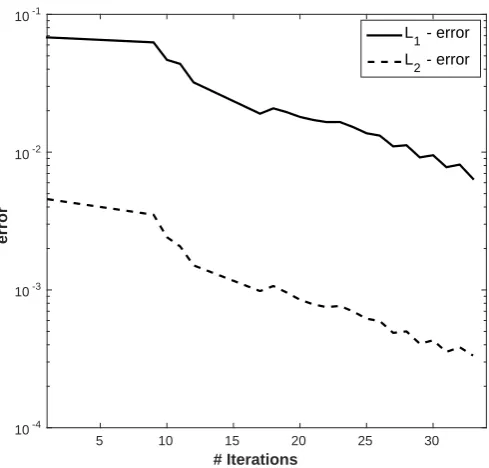
value correspondences for the two states, we turn our attention now to the recursive solution of the model. Fig. 4 depicts the decreasing, aggregatedL1- andL2-errors (see Eq. (15)) for the
value functions when performing VFI with GPs on the feasible sets (see Alg. 2). The graph indicates that our proposed solution framework—that is, the combination of APS, BGMMs, and GPR—can successfully and efficiently solve DI problems.21 In Fig. 5, we show the value
functions for the low and high states at convergence.
To gain some economic insights into the optimal contracts computed, we now carry out a collection of simulations and impulse–response experiments. In the left panel of Fig. 6, we show simulation patterns for the principal’s optimal value in the low (V1) and high (V2) states. The
simulation was launched from the optimal value in the promised utility space. Furthermore, we kept the shocks constant in the respective state. We find that in the low state, the optimal value is increasing, whereas in the high state, the value remains constant. Analogously, the right panel of Fig. 6 displays the utility promise in state i to type i. Fig. 7 displays the corresponding utility transferuin stateito typei. The left and right panels of Fig. 8 depict the simulation paths within the respective feasible sets. In the low state, we almost start at the steady state, whereas in the high state, we traverse almost the entire set. The reason for this is that there is no incentive constraint for the low type (cf. footnote 3 in Fernandes and Phelan, (2000)).
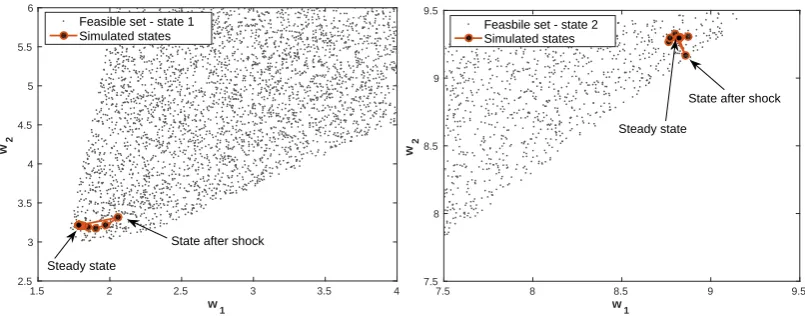
Next, we show several impulse–response experiments on the equilibrium policies. Starting from the steady state, we induce the complementary state, and then return to the original one. The left panel of Fig. 9 displays how the promised utility in the low state reacts to this shock, whereas the right panel shows the same for the utility transfer. We can see that the perturbed quantities quickly return to the steady state, since the discount factor β = 0.9 is relatively small (see Tab. 1). Fig. 10 shows what happens if we change the type for one period, while being in the steady state. As shown in this figure, the utility promises return after a few steps back to the steady state for both the low and high types.
Summarizing, we note that the results shown in this section replicate those reported in
Fer-20We cross-validate the findings here by an alternative method that is based on adaptive sparse grids. The
affirmative results are summarized in Appendix A.
21In this application, generating 100 observations per state and iteration step from the approximate
# Iterations
5 10 15 20 25 30
error
10-4 10-3 10-2 10-1
[image:19.595.176.421.90.324.2]L1 - error L2 - error
Figure 4: Aggregated, decreasingL1- and L2-errors for the 2-dimensional DI model that was
solved by training GP surrogates with 100 observations that were generated from within the feasible sets. The errors were computed by randomly drawing 1,000 points from the feasible sets.
10 8 6
w1
4 2 2 4
w2
6 8 6
-2 0 2 4
10
V1
10 8 6
w1
4 2 2 4
w
2 6 8 4
-2 0 2 8
6
10
V2
Figure 5: Left panel—value function of the low state (V1) as a function ofw1 and w2. Right
panel—value function of the high state (V2) as a function of w1 and w2. In both panels, we
evaluated the respective value functions at 180 equally spaced points for illustrative purposes.
nandes and Phelan, (2000).
4.2
Alternative preferences
To show that our framework is capable of operating on a broad variety of preferences, we turn our attention now to a model specification that is slightly different to the one considered in Sec. 4.1. In particular, the risk-averse agent’s utility over consumption is now given by
u(c) = (c+c)
1−γ
[image:19.595.98.501.398.546.2]t
0 20 40 60 80 100
V
-2 -1 0 1 2 3 4 5 6
V1 V2
t
0 20 40 60 80 100
w
1 2 3 4 5 6 7 8 9 10
[image:20.595.99.499.91.248.2]w1 w2
Figure 6: Left panel—optimal value at simulation step t in states 1 (V1) and 2 (V2). Right
panel—promised utility in the low (w1) and high states (w2) as a function of the simulation
stept.
t
0 20 40 60 80 100
u
-0.2 0 0.2 0.4 0.6 0.8 1 1.2
u
1
u
[image:20.595.198.397.308.457.2]2
Figure 7: Utility transferuin states 1 (u1) and 2 (u2) to type 1 and 2 at simulation stept.
w1
1.5 2 2.5 3 3.5 4
w
2
2.5 3 3.5 4 4.5 5 5.5 6
Feasible set - state 1 Simulated states
Steady state
w1
1 2 3 4 5 6 7 8 9 10
w
2
3 4 5 6 7 8 9
10 Feasible set - state 2 Simulated states
Steady state
Figure 8: Left panel—simulation path in the feasible set for the low state, state 1. Right panel—the same, for the high state, state 2.
As a concrete example, we chooseγ= 2. Moreover, to ensure that the lower bound on utility at c= 0 is 0, we set
u(c) =− 1
c+c +
1
[image:20.595.96.500.493.656.2]t
0 10 20 30 40 50
w1
1.75 1.8 1.85 1.9 1.95 2 2.05 2.1
t
0 10 20 30 40 50
u1
[image:21.595.97.501.92.243.2]-0.02 0 0.02 0.04 0.06 0.08 0.1 0.12 0.14
Figure 9: Left panel—behavior of promised utilityw1if we change the state from 1 to 2 for one
period while being in the steady state. Right panel—similar to the left panel but for utility transfer u1. Note that we induce state 2 att=−1.
w1
1.5 2 2.5 3 3.5 4
w2
2.5 3 3.5 4 4.5 5 5.5 6
Feasible set - state 1 Simulated states
Steady state
State after shock
w1
7.5 8 8.5 9 9.5
w2
7.5 8 8.5 9 9.5
Feasbile set - state 2 Simulated states
Steady state
State after shock
Figure 10: Path of the utility promises after a shock to the steady state has occurred, depicted in the left panel for state 1 and in the right panel for state 2. In both panels, the steady state as well as the utility promises right after the shock are labeled by arrows.
with c = 1. We keep all other parameters as listed in Tab. 1. Since the upper bound on consumption in this example is 1, the upper bound on utility in turn is given by
u(1)/(1−β) = 0.5/0.1 = 5. (40)
In Fig. 11, we show approximations for the feasible sets for both the low and the high state once the set-valued DP iteration with BGMMs has converged (see Alg. 1). Comparing Fig. 11 with Fig. 3—that is, the feasible sets for the two respective utility functions, we can see that the sets for both the low and high types are of similar shape, whereas the ranges are substantially different: the preferences in this example yield substantially smaller equilibrium value correspondences.
As in Sec. 4.1, we now carry out simulations and impulse–response experiments to gain insights into the optimal contracts we compute in this section. The simulations were again launched from the optimal value in the promised utility space. Furthermore, we kept the shocks constant in the respective state.
[image:21.595.96.499.306.464.2]w1
0 1 2 3 4 5
w
2
0 1 2 3 4 5 6
w1
0 1 2 3 4 5
w
2
[image:22.595.100.500.89.248.2]0 1 2 3 4 5 6
Figure 11: The left panel shows the approximate feasible set for the low state at convergence as a function of w1 andw2. The right panel shows the respective set for the high state.
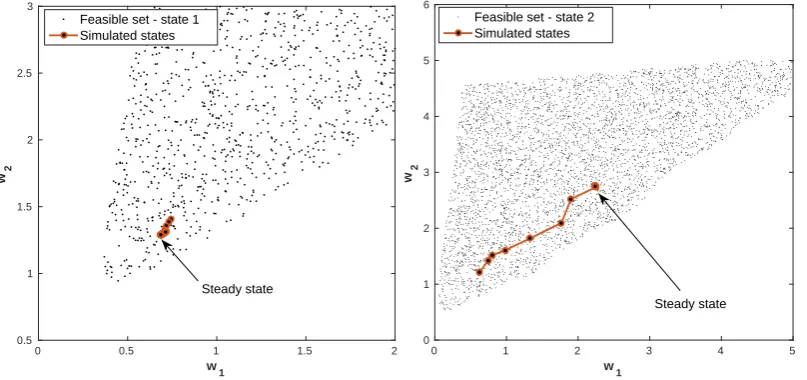
almost start at the steady state, whereas in the high state we traverse a large fraction of the feasible set. The reason for this is again that in the present model setting, there is no incentive constraint for the low type (cf. footnote 3 in Fernandes and Phelan, 2000). Next, we show
w1
0 0.5 1 1.5 2
w
2
0.5 1 1.5 2 2.5 3
Feasible set - state 1 Simulated states
Steady state
w1
0 1 2 3 4 5
w
2
0 1 2 3 4 5 6
Feasible set - state 2 Simulated states
Steady state
Figure 12: Left panel—simulation path in the feasible set for the low state, state 1. Right panel—the same, for the high state, state 2.
impulse–response experiments on the equilibrium policies. Starting from the steady state, we induce the complementary state, and then return to the original one. In Fig. 13, we can see that the perturbed quantities quickly return to the steady state both for the low and the high types. The reason for this is that the discount factorβ = 0.9 is relatively small (see Tab. 1).
4.3
Many types
In this section, we demonstrate the (dimensional) scalability of our method. To do so, we exapand the baseline model (see Sec. 4) to three types, a “low” (state 1), a “middle” (state 2) and a “high” (state 3) one. An agent’s endowment is either hlow = 0.3, hmiddle = 0.6 or
[image:22.595.99.503.356.546.2]w1
0 0.5 1 1.5 2
w2 0.5 1 1.5 2 2.5 3
Feasible set - state 1 Simulated states
State after shock
Steady state
w1
0 1 2 3 4 5
w 2 0 1 2 3 4 5 6
Feasible set - state 2 Simulated states
Steady state
[image:23.595.98.504.93.287.2]State after shock
Figure 13: Path of the utility promises after a shock to the steady state has occurred, depicted in the left panel for state 1 and in the right panel for state 2. In both panels, the steady state as well as the utility promises right after the shock are labeled by arrows.
50 45 w2 40 35 50 45 w 1 40 35 48 46 44 42 40 38 w3 50 45 w2 40 35 50 45 w1 40 35 38 40 48 46 44 42 w3 50 45 w2 40 35 50 45 w 1 40 35 44 38 40 42 48 46 w 3
Figure 14: The left panel shows the approximate feasible set W(θ1) as a function ofw1, w2,
and w3. The central panel displaysW(θ2) as a function of the promised utilities. The right
panel finally depicts the approximate equilibrium correspondenceW(θ3).
Theorem 3) to be
Πθ,θ˜=
0.7 0.3 0.0 0.2 0.5 0.3 0.0 0.4 0.6
. (41)
The choice of the Markov chain given by Eq. (41) is based on the following reasoning: Let us assume that an agent works in a firm with a rigid hierarchy. He can be promoted, demoted, or stay in his rank. If the agent moves inside the company’s hierarchy, it can only happen one level at a time. Moreover, it is also more likely that the agent is on a lower rung than it is for him to be of a hight type. The set discount factor to β= 0.96. All other settings are kept as stated in Sec. 4.
The pre-computed equilibrium value correspondences for the three typesθ1, θ2 and θ3 are
depicted in Fig. 14. Their three-dimensional geometry strongly resembles the one of a airplane wing.
[image:23.595.96.500.350.446.2]5
Conclusion
In this paper, we introduce a scalable and flexible framework for solving infinite-horizon, dis-crete time DI problems with hidden states and of unprecedented complexity. Addressing such dynamic adverse selection models is a formidable task, since two major computational bottle-necks create difficulties in the solution process. Issue one is related to the fact that the feasible sets of utility promises are not known in advance and have to be determined numerically. In most of the interesting economic applications, such sets have a non-hypercubic geometry and might even be non-convex. Issue two results from solving the dynamic adverse selection prob-lem with VFI. To do so, we need to repeatedly approximate and evaluate high-dimensional functions at arbitrary coordinates within the domain of interest—that is, the feasible sets.
We address the computation of the equilibrium value correspondences, combining the set-valued dynamic programming techniques by APS with BGMMs. For the VFI, we use a mas-sively parallel algorithm that applies GP machine learning in every iteration step to approxi-mate the value functions on the pre-computed, time-invariant feasible sets.
Our approach provides several desirable features that yield a substantial improvement over the previous literature. First, since sampling achieves the approximation of feasible sets through BGMMs, it does not directly suffer from the curse of dimensionality and thus can deal with problems involving many types of agents. Second, our scheme of approximating equilibrium value correspondences is independent of solving the DI problem, and thus does not directly add to the computational complexity of solving the actual model. Third, it can approximate both convex and non-convex sets. Moreover, the equilibrium BGMMs can be used to generate sample data from within the approximate equilibrium value correspondences. This directly plays to the strength of GPR: a form of supervised machine learning that can—given a training set that is generated from within the feasible region—be used to approximate and interpolate functions on irregularly shaped state spaces. Furthermore, since the construction of GP surrogates is achieved by sampling from a domain of interest such as a feasible set, they can handle the curse of dimensionality to some extent. Thus, our proposed method—that is, using APS and BGMMs in conjunction with GPs—has the potential of handling highly complex DI models at a relatively low computational cost, as it focuses the resources where needed.
To demonstrate the capabilities of our framework, we compute solutions for models of repeated agency with history dependence, varying preferences, and increasingly many types. It is clear that while the focus of the work presented lies in solving dynamic adverse selection problems, the method proposed here has a far broader scope: it can also be applied, for example, to moral hazard problems, mechanism design, or to dynamic games, where one of the significant difficulties also lies in finding the equilibrium sets.
A
Approximating feasible sets with adaptive sparse grids
To verify the functionality of the framework proposed in this paper for determining the equilibrium correspondences (see Sec. 3.2), we cross-validate it by applying adaptive sparse grids (see, e.g., Brumm and Scheidegger, (2017)). In particular, we solve—as briefly men-tioned in Sec. 3.2—an auxiliary problem of Eq. (17) for which we know the true solution on the feasible set. More precisely, we relax the feasibility via a penalty function such that the resulting value function will be zero on the feasible set and less otherwise. Strictly speaking, we are looking for the fixed point of the following dynamic program:
F(w, θ) = max
c,w+,ξ √
ε−
s
ε+X
˜
θ
ξ2 ˜
θ+β
X
˜
θ∈Θ
Πθ,θ˜F+(w+˜
θ,
˜
θ) (42)
s.t. wν =ξν+
X
˜
θ∈Θ
Πν,θ˜(u(cθ˜,θ˜) +βw+θ,˜θ˜)∀ν∈Θ,
u(cθ˜,θ˜) +βwθ,+˜θ˜≥u(cν,θ˜) +βw+ν,θ˜∀θ˜∈Θ, ∀ν∈Θ\ {θ˜},
c∈[0, c]N,
w+˜
θ ∈R
N withw+
˜
θ,ν= (w
+ ˜
θ)ν ∀
˜
θ∈Θ, ∀ν ∈Θ,
where ε >0 is a relaxation parameter in
√
ε−
s
ε+X
˜
θ
ξ2 ˜
θ, (43)
and where Eq. (43) is a smooth approximation of the norm k · k1. F(·,·) is approximated by
piecewise linear basis functions on an adaptive sparse grid. Eq. (42) is an ordinary DP problem with a fixed point and therefore can be solved by VFI. We know that for all feasible w, the value function will be 0. To see this, note that the payoff of Eq. (42) in some iteration t is
√
ε−qε+P
˜
θξ
2 ˜
θ—that is to say, less than or equal to zero. Moreover, any feasible point
will have an optimal value of zero, since there we will not need to relax the bounds on the equality constraints. Thus, the resulting value function has to be zero for feasible values and less than zero otherwise (for more details, see Judd et al., (2016)). Once the VFI for Eq. (42) has converged, we can go on and use a scaled version ofF(·,·) as a penalty for the dynamic incentive problem.
w 1
0 2 4 6 8 10
w
2
2 4 6 8 10
w 1
0 2 4 6 8 10
w
2
[image:26.595.97.501.90.240.2]2 4 6 8 10
Figure 15: The left panel shows the approximate equilibrium correspondences for the low state as a function of w1 and w2, whereas the right panel shows the respective set for the high
state. Both feasible sets were computed by applying adaptive sparse grids and set-valued DP (see Eq. (42)).
References
Abraham, Arpad and Nicola Pavoni. “Efficient allocations with moral hazard and hidden bor-rowing and lending: a recursive formulation”.Review of Economic Dynamics 11.4 (2008), pp. 781–803.
Abreu, Dilip, David Pearce, and Ennio Stacchetti. “Optimal cartel equilibria with imperfect monitoring”.Journal of Economic Theory 39.1 (1986), pp. 251–269.
Abreu, Dilip, David Pearce, and Ennio Stacchetti. “Toward a Theory of Discounted Repeated Games with Imperfect Monitoring”.Econometrica 58.5 (1990), pp. 1041–1063.
Abreu, Dilip and Yuliy Sannikov. “An algorithm for two-player repeated games with perfect monitoring”.Theoretical Economics 9.2 (2014), pp. 313–338.
Bellman, R.Adaptive Control Processes: A Guided Tour. ’Rand Corporation. Research studies. Princeton University Press, 1961.
Bertsekas, Dimitri P. Dynamic Programming and Optimal Control. 2nd. Athena Scientific, 2000.
Blei, David M. and Michael I. Jordan. “Variational inference for dirichlet process mixtures”.
Bayesian Analysis 1 (2005), pp. 121–144.
Broer, Tobias, Marek Kapicka, and Paul Klein. “Consumption risk sharing with private in-formation and limited enforcement”. Review of Economic Dynamics 23 (2017), pp. 170– 190.
Brumm, Johannes, Felix Kubler, and Simon Scheidegger. “Computing equilibria in dynamic stochastic macro-models with heterogeneous agents”.Advances in Economics and
Econo-metrics, Eleventh World Congress, Forthcoming (2016).
Brumm, Johannes, Dmitry Mikushin, Simon Scheidegger, and Olaf Schenk. “Scalable high-dimensional dynamic stochastic economic modeling”.Journal of Computational Science 11 (2015), pp. 12–25.
Brumm, Johannes and Simon Scheidegger. “Using adaptive sparse grids to solve high-dimensional dynamic models”.Econometrica 85.5 (2017), pp. 1575–1612.
Cole, Harold L. and Narayana R. Kocherlakota. “Efficient allocations with hidden income and hidden storage”. The Review of Economic Studies 68.3 (2001), pp. 523–542. eprint: