Manuscript version: Author’s Accepted Manuscript
The version presented in WRAP is the author’s accepted manuscript and may differ from the published version or Version of Record.
Persistent WRAP URL:
http://wrap.warwick.ac.uk/131165
How to cite:
Please refer to published version for the most recent bibliographic citation information. If a published version is known of, the repository item page linked to above, will contain details on accessing it.
Copyright and reuse:
The Warwick Research Archive Portal (WRAP) makes this work by researchers of the University of Warwick available open access under the following conditions.
Copyright © and all moral rights to the version of the paper presented here belong to the individual author(s) and/or other copyright owners. To the extent reasonable and
practicable the material made available in WRAP has been checked for eligibility before being made available.
Copies of full items can be used for personal research or study, educational, or not-for-profit purposes without prior permission or charge. Provided that the authors, title and full
bibliographic details are credited, a hyperlink and/or URL is given for the original metadata page and the content is not changed in any way.
Publisher’s statement:
Please refer to the repository item page, publisher’s statement section, for further information.
Title Page
Effectiveness and cost-effectiveness of a self-guided internet
intervention for social anxiety symptoms in a general population
sample: randomized controlled trial.
John Powell, PhD1 Veronika Williams, PhD1 Helen Atherton, PhD2 Kylie Bennett, PhD3 Yaling Yang, PhD1 Mina Davoudianfar, BA1 Annika Hellsing, BPsyc4 Angela Martin, PhD1 Jill Mollison, PhD1 Milensu Shanyinde, MSc1 Ly-Mee Yu, DPhil1
Kathleen M Griffiths, PhD4
Corresponding author: Professor John Powell, Nuffield Department of Primary Care Health Sciences, University of Oxford, Oxford, UK Email: [email protected] Tel: 01865 617768.
1 Nuffield Department of Primary Care Health Sciences, University of Oxford, Oxford, UK. 2 Unit of Academic Primary Care, Warwick Medical School, Coventry, UK.
3 eHub Health Pty Ltd, PO Box 331, Goulburn NSW 2580 Australia.
4 Research School of Psychology, Australian National University, Canberra, Australian
Abstract
Background: Many people are accessing digital self-help for mental health problems, often with little evidence of effectiveness. Social anxiety is one of the most common sources of mental distress in the population and many people with symptoms do not seek help for what represents a significant public health problem.
Methods: Two group randomized controlled trial conducted in England between 11th May 2016 and 27th June 2018. Adults with social anxiety symptoms who were not receiving treatment for social anxiety were recruited using online advertisements. All participants had unrestricted access to usual care and were randomized in a 1:1 ratio to either a web-based unguided self-help intervention based on cognitive-behavioural principles, or to a waiting list control group. All outcomes were collected through self-report online questionnaires. The primary outcome was the change in 17-item self-report Social Phobia Inventory (SPIN-17)
score from baseline to 6 weeks using a linear mixed-effect model that used data from all timepoints (6 weeks, 3, 6, 12 months).
Results: 2212 participants were randomized. Six were excluded from analyses as ineligible. Of the 2116 eligible randomized participants (mean age 37 years, 80% women), 70.1% (1484/2116) had follow-up data available for analysis, and 56.9% (1205/2116) had data on the primary outcome, although attrition was higher in the intervention arm. At 6 weeks the mean (95% CI, P value) adjusted difference in change in SPIN-17 score in the intervention group compared to control, was -1.94 (-3.13 to -0.75, P=0.0014), a standardised mean difference effect size of 0.2. The improvement was maintained at 12 months. Given the high drop-out, sensitivity analyses explored missing data assumptions and were consistent with the primary analysis finding. The economic evaluation demonstrated cost-effectiveness with a small health status benefit and a reduction in health service utilisation.
Funding: This work was funded by the MQ: Transforming Mental Health charity under its PsyIMPACT funding call (MQ14PE_25). JP is also funded by the National Institute for Health Research (NIHR) Collaboration for Leadership in Applied Health Research and Care Oxford at Oxford Health NHS Foundation Trust. KG was supported by a National Health & Medical Research Council Senior Research Fellowship.
Trial Registration: ClinicalTrials.gov NCT02451878. https://clinicaltrials.gov/ct2/show/NCT02451878
Main text
Effectiveness of a self-guided internet intervention for social
anxiety symptoms in the general population: a randomized
controlled trial.
Introduction
Many people are accessing digital tools for self-help for a range of mental health problems.[1] Social anxiety is one of the most common sources of mental distress in the population and represents a significant public health problem.[2] Social anxiety is characterised by a cluster of cognitive, behavioural and physiological symptoms including an intense and persistent fear of being negatively evaluated in social or performance situations, along with avoidance of such situations. The individual fears that they may act in such a way, or show anxiety symptoms, as to cause embarrassment or humiliation. A diagnosis of social anxiety disorder may be made when symptoms are persistent and lead to disruption of daily routine, and work or social life, or if the symptoms themselves cause marked distress. There is a spectrum of symptomatology in the general population and even subclinical symptoms which do not reach a clinical diagnostic threshold can cause substantial impairment.[3,4]
largest number of participants in the intervention group in any previous individual study was 100[14]) and has generally been confined to cases of social anxiety of clinical severity, usually based on a structured interview assessment. Very little work has attempted to examine the value of unguided self-help in a real world context, where individuals self-select as requiring help with symptoms which may not reach a clinical threshold, but which may be causing them some level of distress, and who choose to access digital tools themselves, with no clinician contact at all. In this study we examine the effectiveness and cost-effectiveness of the self-help E-couch social anxiety tool (described in detail below). This was chosen as it is a self-directed
online intervention based on cognitive behavioural therapy principles including components of known effectiveness in face-to-face therapy. A previous laboratory-based comparative study of the couch social anxiety tool with 21 participants (mainly university students) in the E-couch arm showed pre-test/post-test improvement in social anxiety measures.[15]
We therefore undertook the first large-scale pragmatic randomized trial of an online self-guided cognitive-behavioural intervention for people with self-reported social anxiety symptoms in the general population. Our experimental hypothesis was that participants who received the intervention would have a greater improvement in symptoms of social anxiety, compared with participants who did not.
Methods
Trial design and participants
to strengthen our repeated measures analysis and to support participant engagement. All study administration was conducted using automated online systems. The trial protocol is in Supplement 1.
Recruitment was primarily through an online advertisement placed on the UK National Health Service (NHS) website. In addition, study advertisements seeking individuals with social anxiety symptoms were placed on University and charity websites and disseminated via email and social media. We aimed to capture people with a broad range of social anxiety symptoms
in the general population, who were likely to be typical of those seeking help from self-directed digital tools. Interested potential participants completed an online screening questionnaire to assess eligibility. We excluded anyone currently receiving therapist-guided treatment for social anxiety disorder or who self-reported a diagnosis of schizophrenia or bipolar affective disorder. Initial inclusion criteria were: having access to the internet-based intervention; aged 18 or over; resident in England; having an email address and mobile telephone number (to receive study emails and text alerts) and an initial criterion of scoring in a ‘subclinical’ range of 13-19 on the Social Phobia Inventory (SPIN-17). We had initially chosen the 13-19 range with expert advice as this would in theory capture those scoring above the population mean score (11-12) while excluding those scoring above the commonly used threshold of 19 which indicates further assessment may be warranted (although this threshold does not represent a diagnosis). However early in recruitment it became apparent that the majority of people in the general population volunteering for this study scored much higher than this and the distribution of SPIN-17 scores meant that very few scored in the low range. There was clear evidence of a high level of unmet need among individuals living with social anxiety symptoms in the community and not seeking help elsewhere. With advice from our independent Trial Steering Committee we therefore revised and re-registered the protocol (in line with good practice in clinical trials) to modify the inclusion criteria to include all individuals scoring 13 or more on SPIN-17, therefore capturing those in our hypothesised ‘subclinical range’ of 13-19, as well as those scoring more highly. We continued to exclude anyone receiving professional help and
therefore the final sample represented adults in the general population who self-reported some level of social anxiety symptoms but who were not receiving treatment for social anxiety. Potentially eligible participants completed consent and 24 hours later they were sent an email link to self-complete their baseline measures using online questionnaires.
Once baseline measures had been completed, participants were randomized (1:1 ratio) to either the intervention group (E-couch) or the waiting list control group using a computer generated random number sequence run through an automatic online programme, using a block size of 2 without stratification. Due to the nature of the intervention, participants were not blind to allocation.
Interventions
Given that this was a general population sample, all participants continued to receive usual
care. Participants in the intervention arm were given access to a password-protected website which contained the E-couch Social Anxiety Module. The website was mobile optimised and could therefore be used on a smartphone with the look and feel of a dedicated app, or on a computer browser.
Self-guided intervention
The E-couch Social Anxiety Module is a self-directed interactive program based on cognitive behavioural therapy principles. The program is divided into six modules: a literacy section which provides information about the symptoms of social anxiety, types of available help, and effective treatments; and five toolkits comprising exposure practice, cognitive restructuring (modifying your thinking), attention practice, social skills training and relaxation. The content of the toolkits consists of evidence-based information, interactive exercises and workbooks, based on cognitive behavioural principles, and participants could complete the modules in any order. Participants were advised to access and use the intervention over the initial period of 6 weeks (although they could work through the intervention at their own pace and were able to access it for the full 12-month duration of the study). ‘Ideal’ usage of the intervention would entail engagement with one new module each week and ongoing updates to diaries and workbooks based on the user’s real-life experiences. E-couch was developed by the e-hub team
at the Australian National University National Institute for Mental Health Research. The intervention was adapted for this study to create a ‘stand-alone’ social anxiety intervention that
was accessed via a password protected portal and with the usual E-couch branding removed. The program was adapted for a UK audience by removing Australian-specific terminology and undertaking user testing on the new version. No changes were made to the intervention during the study period.
Participants in the Control group were informed they had been put on a waiting list to receive access to the intervention in 12 months. They were asked to complete baseline and follow-up measures at the same times as participants in the intervention group. They received no other intervention.
Automated text (SMS) message and email reminders were sent to participants in both groups to reduce attrition. Participants in the intervention condition received one text message within 24 hours of randomization to remind them to access the intervention, and three email reminders
during the 6-week intervention period, reminding them to log in to access the program. All participants also received email invitations to complete follow-up surveys at each outcome measure timepoint, with those who failed to complete receiving a reminder email followed by a reminder text message.
Outcomes
The primary outcome was the change in Social Phobia Inventory (SPIN-17) score from baseline to 6 weeks. The SPIN-17 is a 17-item self-rated scale covering the main social anxiety symptoms of fear, avoidance and physiological disturbance. The responses to 17 statements (such as ‘I avoid talking to people I don’t know’) are rated on a 5-point scale from ‘not at all’ (score=0) to ‘extremely’ (score=4) to indicate the extent to which each statement reflects how
the respondent was feeling in the past week, with higher scores reflecting greater social anxiety symptoms. The SPIN-17 has good test-retest reliability, internal consistency, convergent and divergent validity.[16] Secondary outcomes were all also self-report measures with good reliability and validity: the 8-item Brief Fear of Negative Evaluation (BFNE-S scale) which is very commonly used in studies of social anxiety and measures one of the key psychological constructs of social anxiety (example item: ‘I am frequently afraid of other people noticing my shortcomings’);[17] the 20-item Centre for Epidemiologic Studies Depression scale (CES-D)
which has been widely used in online studies of anxiety and depression interventions to measure depressive symptoms;[18] the 7-item Short Warwick-Edinburgh Mental Well-Being
Scale (SWEMWBS) which is a measure of mental wellbeing requiring participants to provide the extent of their agreement with statements about thoughts and feelings over the previous 2 weeks, which has been shown to be responsive to change (example item: ‘I’ve been feeling useful’);[19,20] and the widely used and validated 36-item Short Form Health Survey (SF36
E-couch modules completed, total time in minutes spent on modules and total page views. Adverse events were not anticipated but participants were asked to self-report any ill-effects thought to be related to the intervention.
Sample size
We aimed to recruit 2104 participants (i.e. 1052 per group) to this trial, to detect a small between group standardised mean difference of 0.2 at 5% two-sided significance level and 90% power, assuming a high level of potential attrition of up to 50% given the fully self-guided
nature of the intervention and automated nature of the trial (all trial procedures were conducted online). Although, previous studies have suggested a larger treatment effect for internet-delivered interventions, we believed this treatment effect is too optimistic for a pragmatic trial of a self-guided treatment in a general population sample. The target effect size, although small at an individual level, can potentially translate into important population-level change.[22]
Statistical analyses
The statistical analysis was finalised prior to unblinding of the data. Primary analysis was modified intention to treat according to allocated group irrespective of adherence and with at least one outcome questionnaire completed post randomization. . A linear mixed-effect model was fitted to the primary outcome data, utilising data collected at 6 weeks, 3, 6, and 12 months. Participant was included as a random intercept. Randomized group, baseline SPIN-17 score, time, and time by randomized group interaction term were fitted as fixed effects. An unstructured variance covariance matrix was specified between repeated measures on the same individual. Assumptions of normality and constant variance for linear mixed effects models were assessed by residual plots and other diagnostics plots.
Given the high level of attrition expected in online trials of self-guided digital interventions, we also prespecified a Complier Average Causal Effect (CACE) analysis for the primary outcome and two other main outcomes, to include only participants who completed at least one module of the intervention and at least one outcome assessment to investigate the effect of the
intervention in participants who adhered to the intervention. An instrumental variable approach was adopted to provide the CACE estimate at 6 weeks. This method involved a two least squares (using the ‘ivregress 2sls’ command in STATA) estimation from fitting a linear
Similar approaches were undertaken for other outcomes. A CACE analysis at 6 weeks was conducted on fear of negative evaluation (BFNE-S) and mental wellbeing (SWEMWBS) measures. Similarly adjusting for baseline BFNE-S and SWEMWBS in the linear regression models. Safety analyses were not conducted as there were no adverse events reported during the study period.
In anticipation of high levels of dropout we prespecified various sensitivity analyses to explore the impact of assumptions regarding missing data in the primary outcome analysis. These
included analyses of: (1) participants with complete data at all time periods; (2) adjusting for factors found to be predictive of missingness; (3) fitting a pattern mixture model to assess different degrees of missing not at random; and (4) an assessment of missing not at random assumption for the primary outcome by assuming plausible arm specific differences of missing SPIN-17 score between responders (with SPIN-17 score at 6 weeks) and non-responders (missing SPIN-17 score at 6 weeks). [24,25]
Predefined subgroup analyses were conducted on change at 6 weeks for SPIN-17, BFNE-S, CES-D and SWEMWBS for baseline SPIN-17 (<19, ≥19) to see if the benefit differed between groups scoring above or below the screening threshold; and for certain demographic characteristics to see if the effectiveness of the intervention differed by the individual characteristics we had measured of age (≤35, >35), gender (male, female), educational level (degree, no degree) and ethnicity (any white, non-white). Subgroup analyses were conducted by inclusion of an interaction term of baseline subgroup by randomized group by time in the linear mixed model. Descriptive statistics were used to describe usage data, adherence and self-reports of other help received during the study period. The statistical analysis plan is in Supplement 2. All statistical analyses were performed using STATA SE version 15.1.[26]
Economic Evaluation
A cost utility analysis from an NHS and social care perspective was conducted within this trial
national average costs.[27] Maximum follow up was one year and therefore no discounting was applied. The total and mean costs for the intervention and the waiting list control group were calculated. Effectiveness was measured in Quality-adjusted life years (QALYs) using the under the curve approach by combining the duration of follow-up with the health status utilities at the start and end points. Health status was measured using the self-reported SF-36 measure at baseline, 6 weeks, 3, 6 and 12 months. The analysis examined short term (6 weeks) and long term (12 months) impact. Health status utilities were converted from SF-36 to SF-6D indices using the established UK-based utility algorithm obtained through University of Sheffield
Licensing.[28] The primary outcome was the incremental cost per QALY gained between the intervention group at 6 weeks and 12 months.
Results
Participant characteristics and trial flow
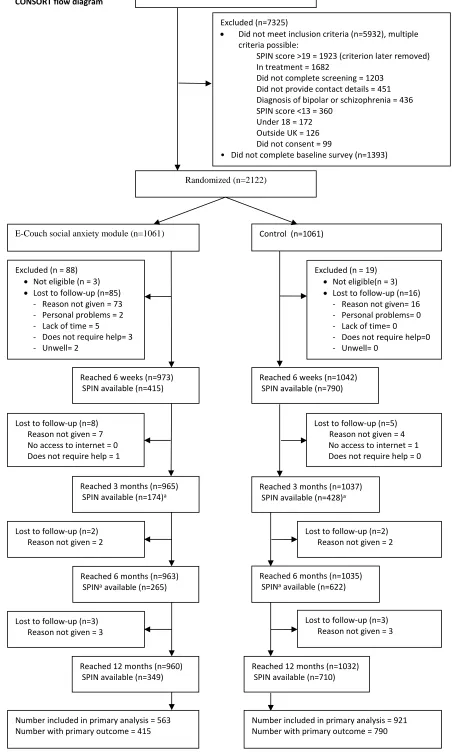
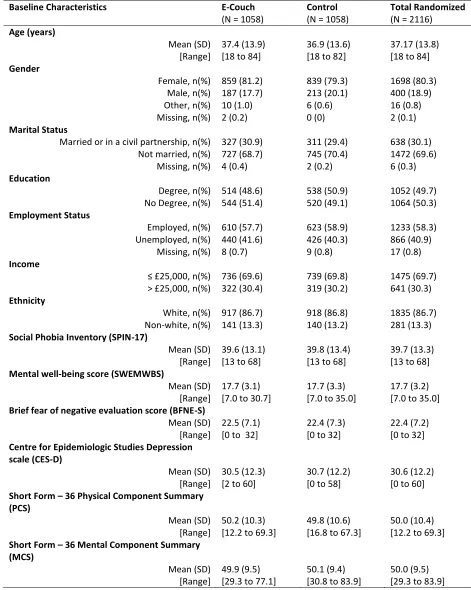
Recruitment took place between 11th May 2016 and 9th May 2017 when the target sample size was reached. Participants were followed-up for one year. Final data were locked on 27th June 2018 (allowing time for delayed 12 month follow-up responses). Figure 1 shows the flow diagram of the participants throughout the study period. We screened 9447 participants of whom 5932 (62.8%) were ineligible and a further 1393 (14.7%) did not complete the baseline measures. We randomized 1061 (50.0%) participants to E-couch and 1061 (50.0%) to the Control. Six participants who were randomized into the study were excluded from all analyses
Primary outcome
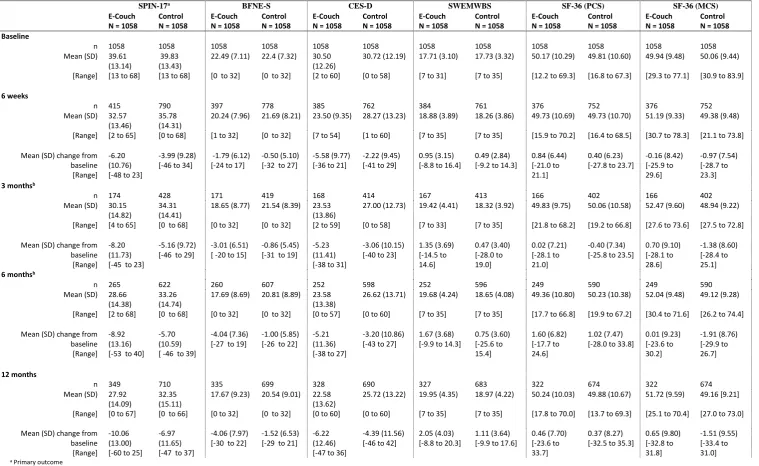
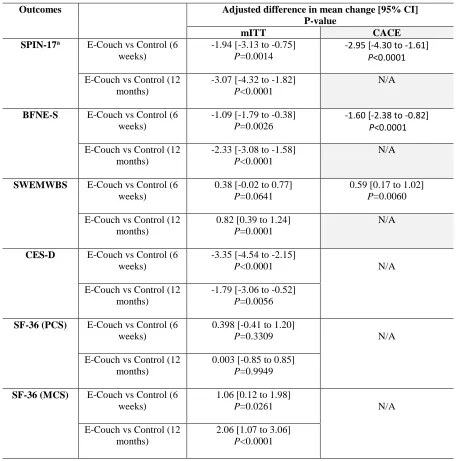
Over the study period, there was a reduction of social anxiety symptoms in the E-couch group compared with the Control group (Table 2). At 6 weeks the E-couch group had a mean (SD) reduction of SPIN-17 score of -6.2 (10.8) and the control group of -3.99 (9.3). The adjusted difference mean (95% CI, P value) in change in SPIN-17 score in E-couch compared to control was -1.94 (-3.13 to -0.75, P=0.0014) (Table 3). This equates to a standardised mean difference effect size (between groups) of 0.2 (the pooled standard deviation for SPIN-17 change was 9.81). At 6 weeks follow-up SPIN-17 outcome measures were available for 415 (39%) and 790
participants (75%) in E-couch and Control group respectively. In the CACE analysis, adjusted mean difference (95% CI, P value) in change in SPIN-17 score for intervention compared to control was -2.95 (-4.30 to -1.61, P<0.0.001) (Table 3). The results from the sensitivity analyses undertaken to explore missing data assumptions were also consistent with the primary outcome 6 week findings. These included analyses which only considered data from completers (defined as participants who returned all their outcome measures at the main timepoints of baseline, 6 weeks and 12 months) (see Supplement 2, eTables 5, 7, 8), and the findings of the pattern mixture model even when assuming different missing data patterns in the intervention or control group (see Supplement 2, eFigure 1). Finally, findings were also similar to the primary outcome analysis even under the assumption of missing not at random (Supplement 2, eTable 10).
Secondary outcomes
Table 3 shows the results for the secondary outcomes. At 12 months follow-up participants randomized to the E-couch group continued to show a greater reduction in severity of social anxiety symptoms than the control participants, with a mean (95% CI, P value) adjusted difference in change in SPIN-17 score of -3.07 (-4.32 to -1.82); P<0.0001) (Table 3). As with the primary outcome, the results of the sensitivity analyses exploring missing data assumptions were consistent with the main analysis SPIN-17 findings at 12 months (Supplement 3, eTables 5, 7, 8). The findings for the other outcome measures of fear of negative evaluation (BFNE-S),
Usage data and subgroup analyses
At 6 weeks the mean (SD) number of E-couch modules fully completed (out of six) was 2 (1.43), total mean (SD) time in minutes spent on modules was 35 (48) and total mean (SD) page views was 38 (41). Greater adherence to the intervention was not associated with baseline SPIN-17 score, age, gender or ethnicity (Supplement 3, eTable 14). At 6 weeks, higher total page views or longer duration spent on modules was associated with larger improvement in social anxiety symptoms (Supplement 3, eTable 15). At 6 weeks, E-couch had a significantly
greater impact in improving social anxiety symptoms for participants with baseline SPIN-17 score greater than 19 (usually taken as cut-off to indicate clinical assessment warranted) compared with the few participants scoring in the lower range (SPIN-17 score 13-19) (P=0.0135) (Supplement 3, eFigure 2). In this subgroup analysis the lower SPIN-17 scorers (the ones we had originally defined as a subclinical population) had no benefit from the intervention compared with the control group. The E-couch intervention also had a significantly greater beneficial impact on depressive symptoms at 6 weeks in participants with higher baseline SPIN-17 scores (P=0.0070) and again in this subgroup analysis the few participants scoring in the lower SPIN-17 range had no benefit on depressive symptoms compared with the control group. There was no evidence of heterogeneity in the effects of intervention for the subgroups analyses involving BFNE-S and SWEMWBS.
Economic evaluation
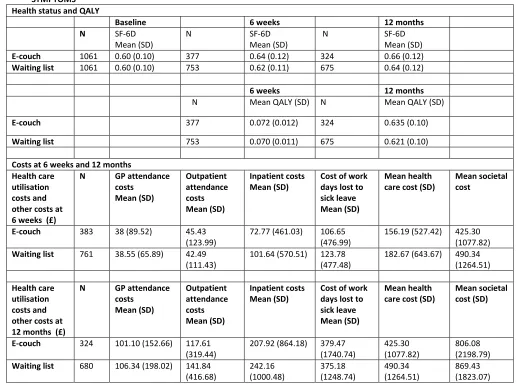
At both 6 weeks and 12 months follow up, the waiting list control group in general used more health care services than the E-couch group (Table 4). This resulted in a mean health care cost saving of £26.48 at 6 weeks follow up and £65.04 at 12 months follow up. Adding the mean intervention cost of £48.40 to the intervention group, the E-couch group cost more than the control group at 6 weeks but is cost saving at 12 months. In the cost utility analysis, at both 6 weeks and 12 months follow up, there were very small improvements of general health status in both the E-couch group and the waiting list control group, with the E-couch group
group, with QALYs gain of 0.024 for the intervention over the control group. The incremental cost per QALY gained at 6 weeks was £10,960 which is highly likely to be cost effective using accepted thresholds. At 12 months follow-up, the E-couch dominated the waiting list control with more QALYs gained and less costs. Taking into consideration societal costs due to sick leave from work, the E-couch intervention was cost saving at both 6 weeks and 12 months follow up, and therefore dominated the waiting list control.
Discussion
Principal results
Our findings showed that this fully self-guided internet intervention gave a small reduction in social anxiety symptoms in participants recruited online from the general population, compared with a usual care waiting list control group, and this small but positive finding was robust to the sensitivity analyses which explored our missing data assumptions. There was a similarly small but significant improvement in fear of negative evaluation. These improvements were also found in the CACE analyses and maintained at 12 months follow-up. In the context of a very common mental health problem, this finding suggests that automated self-help delivered via the internet could reduce the overall level of social anxiety symptoms in the population, although at an individual level the mean symptomatic benefit is small (d=0.2). The study findings provide no evidence as to whether this fully self-guided approach has a role in a clinical setting, where, to date, the evidence base suggests that while unguided self-help has
maintain engagement, although these suggestions need to be empirically tested in future effectiveness and cost-effectiveness work.
Comparison with prior work
This study adds to the body of work showing small positive effects for unguided digital self-help for social anxiety,[5,9–14] and a range of other mental health problems.[29] Our effect size is smaller than others have reported. Previous studies have had far fewer participants and usually required them to meet diagnostic criteria for social anxiety disorder. Our aim was to
undertake a pragmatic trial addressing social anxiety symptoms (rather than disorder) among individuals in the general population. Our broad inclusion criteria, recruiting volunteers from the general population through internet adverts, including those with symptoms not reaching a diagnostic threshold, are likely to have contributed to the more modest benefit compared with previous work. We made the additional decision to conduct the trial in a fully automated and naturalistic way with no researcher contact to encourage intervention use. Our approach was intended to reflect the real world situation of members of the public self-selecting digital tools and using them with no contact with health services.
Strengths and limitations
This study exemplifies both the strengths and weaknesses of undertaking online trials for digital interventions. We were able to recruit large numbers of participants from the general population using digital advertising and we were able to deliver all measures and the intervention remotely using little resource and with no requirement for any ‘real world’ contact
between participants and researchers. The flipside of this was that, in common with other fully automated trials of unguided online interventions, there were high levels of drop-out from the intervention and attrition from the trial.[30] This is commonly seen in internet research,[31] including the higher level of retention in the control arm,[32] which may be partly explained by these participants being on a waiting list and therefore having an incentive to keep returning to complete measures, and partly by participants in the intervention arm being required to ‘take action’ (work through the intervention) whereas the control group could be more passive. Other
overall mixed linear model. We undertook sensitivity analyses and explored various approaches to adjusting for the missing data. All outcome measures were self-report with no observer-rated objective assessment. This was in line with our desire to deliver a fully automated trial, and the scales are well validated but the subjective nature of these measures is a potential source of response bias. We did not employ a placebo but instead used a waiting list comparator whereby people received ‘usual care’. In other work, educational website
placebos have often demonstrated an active effect.[33] Our pragmatic choice of control group, given that participants were not blind to allocation, may have introduced bias and increased the
likelihood of a beneficial effect. Finally, the majority of the participants in the current study (80%) were women. Social anxiety symptoms are twice as common in women than men,[4] and women are more likely to seek healthcare generally.[34] Further work on the predictors and mediators of both adherence and response would be valuable.[35,36]
Conclusions
References
1. Peiris D, Jaime Miranda J, Mohr DC. Going beyond killer apps: Building a better mHealth evidence base. BMJ Glob Heal. 2018. [doi: 10.1136/bmjgh-2017-000676] 2. Bandelow B, Michaelis S. Epidemiology of anxiety disorders in the 21st century.
Dialogues Clin Neurosci 2015; PMID:26487813
3. Crisan LG, Vulturar R, Miclea M, Miu AC. Reactivity to social stress in subclinical social anxiety: Emotional experience, cognitive appraisals, behavior, and physiology. Front Psychiatry 2016; [doi: 10.3389/fpsyt.2016.00005]
4. Fehm L, Beesdo K, Jacobi F, Fiedler A. Social anxiety disorder above and below the diagnostic threshold: Prevalence, comorbidity and impairment in the general
population. Soc Psychiatry Psychiatr Epidemiol 2008; [doi: 10.1007/s00127-007-0299-4]
5. Mayo-Wilson E, Dias S, Mavranezouli I, Kew K, Clark DM, Ades AE, Pilling S. Psychological and pharmacological interventions for social anxiety disorder in adults: A systematic review and network meta-analysis. The Lancet Psychiatry 2014; [doi: 10.1016/S2215-0366(14)70329-3]
6. Cuijpers P, van Straten A. Improving outcomes in social anxiety disorder. The Lancet Psychiatry 2014; [doi: 10.1016/s2215-0366(14)70351-7]
7. Wang PS, Berglund P, Olfson M, Pincus HA, Wells KB, Kessler RC. Failure and delay in initial treatment contact after first onset of mental disorders in the National Comorbidity Survey Replication. Arch Gen Psychiatry. 2005. [doi:
10.1001/archpsyc.62.6.603]
8. Boettcher J, Carlbring P, Renneberg B, Berger T. Internet-based interventions for social anxiety disorder - An overview. Verhaltenstherapie. 2013. [doi:
10.1159/000354747]
9. Ivanova E, Lindner P, Ly KH, Dahlin M, Vernmark K, Andersson G, Carlbring P. Guided and unguided Acceptance and Commitment Therapy for social anxiety
disorder and/or panic disorder provided via the Internet and a smartphone application: A randomized controlled trial. J Anxiety Disord Netherlands; 2016 Dec;44:27–35. PMID:27721123
10. Dear BF, Staples LG, Terides MD, Fogliati VJ, Sheehan J, Johnston L, Kayrouz R, Dear R, McEvoy PM, Titov N. Transdiagnostic versus disorder-specific and clinician-guided versus self-clinician-guided internet-delivered treatment for Social Anxiety Disorder and comorbid disorders: A randomized controlled trial. J Anxiety Disord Netherlands; 2016 Aug;42:30–44. PMID:27261562
11. Gershkovich M, Herbert JD, Forman EM, Schumacher LM, Fischer LE. Internet-Delivered Acceptance-Based Cognitive-Behavioral Intervention for Social Anxiety Disorder With and Without Therapist Support: A Randomized Trial. Behav Modif United States; 2017 Sep;41(5):583–608. PMID:28776431
12. Berger T, Urech A, Krieger T, Stolz T, Schulz A, Vincent A, Moser CT, Moritz S, Meyer B. Effects of a transdiagnostic unguided Internet intervention ('velibra’) for anxiety disorders in primary care: results of a randomized controlled trial. Psychol Med England; 2017 Jan;47(1):67–80. PMID:27655039
13. McCall HC, Richardson CG, Helgadottir FD, Chen FS. Evaluating a Web-Based Social Anxiety Intervention Among University Students: Randomized Controlled Trial. J Med Internet Res Canada; 2018 Mar;20(3):e91. PMID:29563078
intervention for social anxiety disorder in university students: A randomized controlled trial. Int J Methods Psychiatr Res United States; 2019 Jun;28(2):e1766. PMID:30687986
15. Bowler JO, MacKintosh B, Dunn BD, Mathews A, Dalgleish T, Hoppitt L. A comparison of cognitive bias modification for interpretation and computerized cognitive behavior therapy: Effects on anxiety, depression, attentional control, and interpretive bias. J Consult Clin Psychol 2012; [doi: 10.1037/a0029932]
16. Connor KM, Davidson JRT, Erik Churchill L, Sherwood A, Foa E, Weisler RH. Psychometric properties of the social phobia inventory (SPIN). New self- rating scale. Br J Psychiatry 2000; [doi: 10.1192/bjp.176.4.379]
17. Carleton RN, Collimore KC, McCabe RE, Antony MM. Addressing revisions to the Brief Fear of Negative Evaluation scale: Measuring fear of negative evaluation across anxiety and mood disorders. J Anxiety Disord 2011; [doi:
10.1016/j.janxdis.2011.04.002]
18. Radloff LS. The CES-D Scale: A Self-Report Depression Scale for Research in the General Population. Appl Psychol Meas 1977; [doi: 10.1177/014662167700100306] 19. Ng Fat L, Scholes S, Boniface S, Mindell J, Stewart-Brown S. Evaluating and
establishing national norms for mental wellbeing using the short Warwick–Edinburgh Mental Well-being Scale (SWEMWBS): findings from the Health Survey for England. Qual Life Res 2017; [doi: 10.1007/s11136-016-1454-8]
20. Maheswaran H, Weich S, Powell J, Stewart-Brown S. Evaluating the responsiveness of the Warwick Edinburgh Mental Well-Being Scale (WEMWBS): Group and individual level analysis. Health Qual Life Outcomes 2012; [doi: 10.1186/1477-7525-10-156]
21. Ware, J. E. J. SF-36 Health Survey. The use of psychological testing for treatment planning and outcomes assessment. M E Maruish 1999;
22. Glasgow RE, Vogt TM, Boles SM. Evaluating the public health impact of health promotion interventions: The RE-AIM framework. Am J Public Health. 1999. [doi: 10.2105/AJPH.89.9.1322]
23. Angrist JD, Imbens GW, Rubin DB. Identification of Causal Effects Using Instrumental Variables. J Am Stat Assoc 1996; [doi:
10.1080/01621459.1996.10476902]
24. White IR, Carpenter J, Evans S, Schroter S. Eliciting and using expert opinions about dropout bias in randomized controlled trials. Clin Trials 2007; [doi:
10.1177/1740774507077849]
25. Wallace P, Murray E, McCambridge J, Khadjesari Z, White IR, Thompson SG, Kalaitzaki E, Godfrey C, Linke S. On-line randomized controlled trial of an internet based psychologically enhanced intervention for people with hazardous alcohol consumption. PLoS One 2011; [doi: 10.1371/journal.pone.0014740]
26. College Station TSL. StataCorp. 2017. Stata Stat Softw Release 15. 2017.
27. Curtis L, Burns A. Unit Costs of Health & Social Care 2017. PSSRU: Personal Social Services Research Unit. PSSRU Pers Soc Serv Res Unit. 2017.
28. SF-6D: Calculating QALYs from the SF-36 and SF-12 [Internet]. [cited 2019 Oct 1]. Available from: https://licensing.sheffield.ac.uk/i/health-outcomes/SF-6D.html 29. Karyotaki E, Riper H, Twisk J, Hoogendoorn A, Kleiboer A, Mira A, MacKinnon A,
10.1001/jamapsychiatry.2017.0044]
30. Baumeister H, Reichler L, Munzinger M, Lin J. The impact of guidance on Internet-based mental health interventions - A systematic review. Internet Interv. 2014. [doi: 10.1016/j.invent.2014.08.003]
31. Mathieu E, McGeechan K, Barratt A, Herbert R. Internet-based randomized controlled trials: A systematic review. J Am Med Informatics Assoc. 2013. [doi:
10.1136/amiajnl-2012-001175]
32. Murray E, White IR, Varagunam M, Godfrey C, Khadjesari Z, McCambridge J. Attrition revisited: Adherence and retention in a web-based alcohol trial. J Med Internet Res 2013; [doi: 10.2196/jmir.2336]
33. Donker T, Griffiths KM, Cuijpers P, Christensen H. Psychoeducation for depression, anxiety and psychological distress: A meta-analysis. BMC Med 2009; [doi:
10.1186/1741-7015-7-79]
34. Thompson AE, Anisimowicz Y, Miedema B, Hogg W, Wodchis WP, Aubrey-Bassler K. The influence of gender and other patient characteristics on health care-seeking behaviour: A QUALICOPC study. BMC Fam Pract 2016; [doi: 10.1186/s12875-016-0440-0]
35. Boettcher J, Renneberg B, Berger T. Patient expectations in internet-based self-help for social anxiety. Cogn Behav Ther England; 2013;42(3):203–214. PMID:23697570 36. Nordgreen T, Havik OE, Ost LG, Furmark T, Carlbring P, Andersson G. Outcome
Author affiliations:
Nuffield Department of Primary Care Health Sciences, University of Oxford, Oxford, UK (Powell, Williams, Davoudianfar, Martin, Mollison, Shanyinde, Yang, Yu); Unit of Academic Primary Care, Warwick Medical School, Coventry, UK (Atherton); eHub Health Pty Ltd, PO Box 331, Goulburn NSW 2580 Australia (Bennett); Research School of Psychology, Australian National University, Canberra, Australian Capital Territory, Australia (Hellsing, Griffiths).
Author Contributions:
Powell had full access to all study data and takes responsibility for the integrity of the data and the accuracy of the data analysis.
Study concept and design: All authors.
Acquisition, analysis, or interpretation of data: All authors. Drafting of the manuscript: Powell.
Critical revision of the manuscript for important intellectual content: All authors. Statistical analysis: Mollison, Shanyinde, Yu.
Economic evaluation: Yang.
Obtained funding: Powell, Griffiths.
Administrative, technical, or material support: All authors. Study supervision: Powell, Griffiths.
Conflicts of Interest:
All authors have completed and submitted the ICMJE Form for Disclosure of Potential Conflicts of Interest. ehub Health Pty Ltd, a spinout from the Australian National University (ANU) has been granted the license to the E-couch intervention with royalties returning to the ANU. Bennett is an owner and employee of ehub Health Pty Ltd. As a co-creator of E-couch, Griffiths is entitled to a percentage of any royalties received by the ANU from eHub Health Pty Ltd. She has no other financial interest in eHub Health Pty Ltd but is an honorary scientific
advisor to the company. Powell has no interests to declare in the E-couch intervention and Bennett and Griffiths were not involved in the statistical analysis. No other disclosures were reported.
This work was funded by the MQ: Transforming Mental Health charity under its PsyIMPACT funding call (MQ14PE_25). JP is also funded by the National Institute for Health Research (NIHR) Collaboration for Leadership in Applied Health Research and Care Oxford at Oxford Health NHS Foundation Trust. KG was supported by a National Health & Medical Research Council Senior Research Fellowship.
Role of Funders/Sponsors:
The funding bodies had no role in the design and conduct of the study; collection, management,
analysis, and interpretation of the data; preparation, review, and approval of the manuscript; and decision to submit the manuscript for publication. The corresponding author had full access to all the data in the study and had final responsibility for the decision to submit for publication.
Acknowledgements:
22
Screened for eligibility (n=9447)
Randomized (n=2122)
E-Couch social anxiety module (n=1061)
Excluded (n=7325)
Did not meet inclusion criteria (n=5932), multiple criteria possible:
SPIN score >19 = 1923 (criterion later removed) In treatment = 1682
Did not complete screening = 1203 Did not provide contact details = 451 Diagnosis of bipolar or schizophrenia = 436 SPIN score <13 = 360
Under 18 = 172 Outside UK = 126 Did not consent = 99
• Did not complete baseline survey (n=1393)
Excluded (n = 88)
Not eligible (n = 3)
Lost to follow-up (n=85) - Reason not given = 73 - Personal problems = 2 - Lack of time = 5 - Does not require help= 3 - Unwell= 2
Reached 6 weeks (n=973) SPIN available (n=415)
Reached 6 weeks (n=1042) SPIN available (n=790)
Lost to follow-up (n=5)
Reason not given = 4 No access to internet = 1 Does not require help = 0 Lost to follow-up (n=8)
Reason not given = 7 No access to internet = 0 Does not require help = 1
Reached 3 months (n=965) SPIN available (n=174)a
Reached 3 months (n=1037) SPIN available (n=428)a
Reached 6 months (n=963) SPINa available (n=265)
Reached 6 months (n=1035) SPINa available (n=622)
Reached 12 months (n=960) SPIN available (n=349)
Reached 12 months (n=1032) SPIN available (n=710)
Number included in primary analysis = 563 Number with primary outcome = 415
Number included in primary analysis = 921 Number with primary outcome = 790 Lost to follow-up (n=2)
Reason not given = 2
Lost to follow-up (n=2) Reason not given = 2
Lost to follow-up (n=3) Reason not given = 3
Lost to follow-up (n=3) Reason not given = 3
Control (n=1061)
Excluded (n = 19)
Not eligible(n = 3)
[image:23.595.69.521.40.794.2] Lost to follow-up (n=16) - Reason not given= 16 - Personal problems= 0 - Lack of time= 0 - Does not require help=0 - Unwell= 0
FIGURE 1
TABLE 1 BASELINE CHARACTERISTICS OF ALL PARTICIPANTS RANDOMIZED
Baseline Characteristics E-Couch
(N = 1058)
Control (N = 1058)
Total Randomized (N = 2116) Age (years)
Mean (SD) 37.4 (13.9) 36.9 (13.6) 37.17 (13.8) [Range] [18 to 84] [18 to 82] [18 to 84] Gender
Female, n(%) 859 (81.2) 839 (79.3) 1698 (80.3) Male, n(%) 187 (17.7) 213 (20.1) 400 (18.9) Other, n(%) 10 (1.0) 6 (0.6) 16 (0.8) Missing, n(%) 2 (0.2) 0 (0) 2 (0.1) Marital Status
Married or in a civil partnership, n(%) 327 (30.9) 311 (29.4) 638 (30.1) Not married, n(%) 727 (68.7) 745 (70.4) 1472 (69.6)
Missing, n(%) 4 (0.4) 2 (0.2) 6 (0.3) Education
Degree, n(%) 514 (48.6) 538 (50.9) 1052 (49.7) No Degree, n(%) 544 (51.4) 520 (49.1) 1064 (50.3) Employment Status
Employed, n(%) 610 (57.7) 623 (58.9) 1233 (58.3) Unemployed, n(%) 440 (41.6) 426 (40.3) 866 (40.9)
Missing, n(%) 8 (0.7) 9 (0.8) 17 (0.8) Income
≤ £25,000, n(%) 736 (69.6) 739 (69.8) 1475 (69.7) > £25,000, n(%) 322 (30.4) 319 (30.2) 641 (30.3) Ethnicity
White, n(%) 917 (86.7) 918 (86.8) 1835 (86.7) Non-white, n(%) 141 (13.3) 140 (13.2) 281 (13.3) Social Phobia Inventory (SPIN-17)
Mean (SD) 39.6 (13.1) 39.8 (13.4) 39.7 (13.3) [Range] [13 to 68] [13 to 68] [13 to 68] Mental well-being score (SWEMWBS)
Mean (SD) 17.7 (3.1) 17.7 (3.3) 17.7 (3.2) [Range] [7.0 to 30.7] [7.0 to 35.0] [7.0 to 35.0] Brief fear of negative evaluation score (BFNE-S)
Mean (SD) 22.5 (7.1) 22.4 (7.3) 22.4 (7.2) [Range] [0 to 32] [0 to 32] [0 to 32] Centre for Epidemiologic Studies Depression
scale (CES-D)
Mean (SD) 30.5 (12.3) 30.7 (12.2) 30.6 (12.2) [Range] [2 to 60] [0 to 58] [0 to 60] Short Form – 36 Physical Component Summary
(PCS)
Mean (SD) 50.2 (10.3) 49.8 (10.6) 50.0 (10.4) [Range] [12.2 to 69.3] [16.8 to 67.3] [12.2 to 69.3] Short Form – 36 Mental Component Summary
(MCS)
TABLE 2 DESCRIPTIVE STATISTICS OF SPIN-17 SCORE AT ALL TIME POINTS BY RANDOMIZED GROUP
SPIN-17a BFNE-S CES-D SWEMWBS SF-36 (PCS) SF-36 (MCS)
E-Couch N = 1058
Control N = 1058
E-Couch N = 1058
Control N = 1058
E-Couch N = 1058
Control N = 1058
E-Couch N = 1058
Control N = 1058
E-Couch N = 1058
Control N = 1058
E-Couch N = 1058
Control N = 1058 Baseline
n 1058 1058 1058 1058 1058 1058 1058 1058 1058 1058 1058 1058
Mean (SD) 39.61 (13.14)
39.83 (13.43)
22.49 (7.11) 22.4 (7.32) 30.50 (12.26)
30.72 (12.19) 17.71 (3.10) 17.73 (3.32) 50.17 (10.29) 49.81 (10.60) 49.94 (9.48) 50.06 (9.44)
[Range] [13 to 68] [13 to 68] [0 to 32] [0 to 32] [2 to 60] [0 to 58] [7 to 31] [7 to 35] [12.2 to 69.3] [16.8 to 67.3] [29.3 to 77.1] [30.9 to 83.9]
6 weeks
n 415 790 397 778 385 762 384 761 376 752 376 752
Mean (SD) 32.57 (13.46)
35.78 (14.31)
20.24 (7.96) 21.69 (8.21) 23.50 (9.35) 28.27 (13.23) 18.88 (3.89) 18.26 (3.86) 49.73 (10.69) 49.73 (10.70) 51.19 (9.33) 49.38 (9.48)
[Range] [2 to 65] [0 to 68] [1 to 32] [0 to 32] [7 to 54] [1 to 60] [7 to 35] [7 to 35] [15.9 to 70.2] [16.4 to 68.5] [30.7 to 78.3] [21.1 to 73.8]
Mean (SD) change from baseline [Range]
-6.20 (10.76) [-48 to 23]
-3.99 (9.28) [-46 to 34]
-1.79 (6.12) [-24 to 17]
-0.50 (5.10) [-32 to 27]
-5.58 (9.77) [-36 to 21]
-2.22 (9.45) [-41 to 29]
0.95 (3.15) [-8.8 to 16.4]
0.49 (2.84) [-9.2 to 14.3]
0.84 (6.44) [-21.0 to 21.1]
0.40 (6.23) [-27.8 to 23.7]
-0.16 (8.42) [-25.9 to 29.6] -0.97 (7.54) [-28.7 to 23.3]
3 monthsb
n 174 428 171 419 168 414 167 413 166 402 166 402
Mean (SD) 30.15 (14.82)
34.31 (14.41)
18.65 (8.77) 21.54 (8.39) 23.53 (13.86)
27.00 (12.73) 19.42 (4.41) 18.32 (3.92) 49.83 (9.75) 50.06 (10.58) 52.47 (9.60) 48.94 (9.22)
[Range] [4 to 65] [0 to 68] [0 to 32] [0 to 32] [2 to 59] [0 to 58] [7 to 33] [7 to 35] [21.8 to 68.2] [19.2 to 66.8] [27.6 to 73.6] [27.5 to 72.8]
Mean (SD) change from baseline [Range]
-8.20 (11.73) [-45 to 23]
-5.16 (9.72) [-46 to 29]
-3.01 (6.51) [ -20 to 15]
-0.86 (5.45) [-31 to 19]
-5.23 (11.41) [-38 to 31]
-3.06 (10.15) [-40 to 23]
1.35 (3.69) [-14.5 to 14.6] 0.47 (3.40) [-28.0 to 19.0] 0.02 (7.21) [-28.1 to 21.0] -0.40 (7.34) [-25.8 to 23.5]
0.70 (9.10) [-28.1 to 28.6] -1.38 (8.60) [-28.4 to 25.1]
6 monthsb
n 265 622 260 607 252 598 252 596 249 590 249 590
Mean (SD) 28.66 (14.38)
33.26 (14.74)
17.69 (8.69) 20.81 (8.89) 23.58 (13.38)
26.62 (13.71) 19.68 (4.24) 18.65 (4.08) 49.36 (10.80) 50.23 (10.38) 52.04 (9.48) 49.12 (9.28)
[Range] [2 to 68] [0 to 68] [0 to 32] [0 to 32] [0 to 57] [0 to 60] [7 to 35] [7 to 35] [17.7 to 66.8] [19.9 to 67.2] [30.4 to 71.6] [26.2 to 74.4]
Mean (SD) change from baseline [Range]
-8.92 (13.16) [-53 to 40]
-5.70 (10.59) [ -46 to 39]
-4.04 (7.36) [-27 to 19]
-1.00 (5.85) [-26 to 22]
-5.21 (11.36) [-38 to 27]
-3.20 (10.86) [-43 to 27]
1.67 (3.68) [-9.9 to 14.3]
0.75 (3.60) [-25.6 to 15.4] 1.60 (6.82) [-17.7 to 24.6] 1.02 (7.47) [-28.0 to 33.8]
0.01 (9.23) [-23.6 to 30.2] -1.91 (8.76) [-29.9 to 26.7] 12 months
n 349 710 335 699 328 690 327 683 322 674 322 674
Mean (SD) 27.92 (14.09)
32.35 (15.11)
17.67 (9.23) 20.54 (9.01) 22.58 (13.62)
25.72 (13.22) 19.95 (4.35) 18.97 (4.22) 50.24 (10.03) 49.88 (10.67) 51.72 (9.59) 49.16 [9.21]
[Range] [0 to 67] [0 to 66] [0 to 32] [0 to 32] [0 to 60] [0 to 60] [7 to 35] [7 to 35] [17.8 to 70.0] [13.7 to 69.3] [25.1 to 70.4] [27.0 to 73.0]
Mean (SD) change from baseline [Range]
-10.06 (13.00) [-60 to 25]
-6.97 (11.65) [-47 to 37]
-4.06 (7.97) [-30 to 22]
-1.52 (6.53) [-29 to 21]
-6.22 (12.46) [-47 to 36]
-4.39 (11.56) [-46 to 42]
2.05 (4.03) [-8.8 to 20.3]
1.11 (3.64) [-9.9 to 17.6]
0.46 (7.70) [-23.6 to 33.7]
0.37 (8.27) [-32.5 to 35.3]
0.65 (9.80) [-32.8 to 31.8] -1.51 (9.55) [-33.4 to 31.0]
a Primary outcome
bThere was an administrative error with the software sending automatic emails regarding questionnaire surveys which stopped working for about a month before it was spotted. Once this glitch was fixed the response period to have a ‘catch-up’ was extended from 4
TABLE 3: ADJUSTED ESTIMATES FROM MIXED EFFECT MODEL FOR EACH OUTCOME AT 6 WEEKS AND 12 MONTHS AND ESTIMATES FROM THE CACE ANALYSIS AT 6 WEEKS
Outcomes Adjusted difference in mean change [95% CI] P-value
mITT CACE
SPIN-17a E-Couch vs Control (6 weeks)
-1.94 [-3.13 to -0.75]
P=0.0014
-2.95 [-4.30 to -1.61] P<0.0001
E-Couch vs Control (12 months)
-3.07 [-4.32 to -1.82]
P<0.0001
N/A
BFNE-S E-Couch vs Control (6 weeks)
-1.09 [-1.79 to -0.38]
P=0.0026
-1.60 [-2.38 to -0.82] P<0.0001
E-Couch vs Control (12 months)
-2.33 [-3.08 to -1.58]
P<0.0001
N/A
SWEMWBS E-Couch vs Control (6 weeks)
0.38 [-0.02 to 0.77]
P=0.0641
0.59 [0.17 to 1.02]
P=0.0060
E-Couch vs Control (12 months)
0.82 [0.39 to 1.24]
P=0.0001
N/A
CES-D E-Couch vs Control (6 weeks)
-3.35 [-4.54 to -2.15]
P<0.0001 N/A
E-Couch vs Control (12 months)
-1.79 [-3.06 to -0.52]
P=0.0056
SF-36 (PCS) E-Couch vs Control (6 weeks)
0.398 [-0.41 to 1.20]
P=0.3309 N/A
E-Couch vs Control (12 months)
0.003 [-0.85 to 0.85]
P=0.9949
SF-36 (MCS) E-Couch vs Control (6 weeks)
1.06 [0.12 to 1.98]
P=0.0261 N/A
E-Couch vs Control (12 months)
2.06 [1.07 to 3.06]
P<0.0001
TABLE 4 COST UTILITY ANALYSIS OF SELF-GUIDED INTERNET-BASED E-COUCH INTERVENTION FOR SOCIAL ANXIETY SYMPTOMS
Health status and QALY
Baseline 6 weeks 12 months
N SF-6D
Mean (SD)
N SF-6D
Mean (SD)
N SF-6D
Mean (SD)
E-couch 1061 0.60 (0.10) 377 0.64 (0.12) 324 0.66 (0.12)
Waiting list 1061 0.60 (0.10) 753 0.62 (0.11) 675 0.64 (0.12)
6 weeks 12 months
N Mean QALY (SD) N Mean QALY (SD)
E-couch 377 0.072 (0.012) 324 0.635 (0.10)
Waiting list 753 0.070 (0.011) 675 0.621 (0.10)
Costs at 6 weeks and 12 months Health care
utilisation costs and other costs at 6 weeks (£)
N GP attendance
costs Mean (SD) Outpatient attendance costs Mean (SD) Inpatient costs Mean (SD)
Cost of work days lost to sick leave Mean (SD)
Mean health care cost (SD)
Mean societal cost
E-couch 383 38 (89.52) 45.43
(123.99)
72.77 (461.03) 106.65 (476.99)
156.19 (527.42) 425.30 (1077.82) Waiting list 761 38.55 (65.89) 42.49
(111.43)
101.64 (570.51) 123.78 (477.48)
182.67 (643.67) 490.34 (1264.51)
Health care utilisation costs and other costs at 12 months (£)
N GP attendance
costs Mean (SD) Outpatient attendance costs Mean (SD) Inpatient costs Mean (SD)
Cost of work days lost to sick leave Mean (SD)
Mean health care cost (SD)
Mean societal cost (SD)
E-couch 324 101.10 (152.66) 117.61
(319.44)
207.92 (864.18) 379.47 (1740.74)
425.30 (1077.82)
806.08 (2198.79) Waiting list 680 106.34 (198.02) 141.84