© 2019, IRJET | Impact Factor value: 7.211 | ISO 9001:2008 Certified Journal | Page 4625
DESIGN OF BOX CULVERT USING VISUAL BASIC
Ms Vani D
1, Mr Ankith S Kottary
2, Mr Vishwas GK
2, Mr Davison Greson Dsilva
2, Mr Aadith
Charan
21
Assistant Professor, Department of Civil Engineering, St Joseph Engineering College, Mangaluru
2UG Students, Department of Civil Engineering, St Joseph Engineering College, Mangaluru
---***---Abstract - Culverts are defined as structures which provide
a passage over a gap without closing the way beneath which maybe needed for the passage of railways, roadways, footpath and even for the carriage of fluids. The purpose of this project is to introduce to the users the systematic methodology for problem solving of designing of box culvert for any vent using programming language Visual Basic 6.0, one of the most popular and widely used computer language. The onus of working out the algorithm for solving any problem in computer is still on us. This very project provides development of designing box culvert by allowing easy access to what was once a daunting task. Before developing the program the box culvert of one vent is designed manually. The main parameter in this program are concrete and steel property, number of vents, dimension of the box and height of the earth fills.
Key Words: Staad.Pro1, Visual Basic2, Analysis3, Loads4, Culvert5
1.INTRODUCTION
The term "culvert" encompasses particularly all closed
conducts employed for high way drainage with the exception of storm drains. Culverts might be classed as stock products, in that standard designs are used repeatedly. This is in direct contrast to the situation for bridges that span larger streams, for which special designs are made in almost every case. Culverts are far more numerous than bridges, and more money is spent on them. In fact, about 15% of the highway construction, money goes for these smaller drainage structures. Clearly, culvert design warrants the serious attention of highway engineers.For opening of moderate size, box culvert completes for favour. For large openings, single or multiple-span box culverts are generally use. For installing culverts, particular attention is devoted to bedding and to back-fill in order to protect the culvert and to prevent subsequent settlement in the road way surface. Many agencies specify that back-fill materials be brought to the proper moisture content, placed in small lifts, and compacted with power-driven tampers. Some permit the substitution of clean sand or gravel for the regular back-fill material, in which case careful jetting or pudding produces satisfactory compaction. Culverts through embankments demand particular attention to protect them from damage by construction equipment and to secure proper soil compaction around them. Some agencies require
that the embankment first be constructed above the level of the culvert crown, after which a trench is dug for the culvert.
Culverts on steep slope always discharge at supercritical velocities and create serious erosion problems in unprotected channels. One method of dissipating the excess energy is to place a sill across the end of the culvert apron to produce a hydraulic jump. Drops in the upstream channel or drop inlets to the culvert proper, if designed to produce free fall in the stream, sometimes an economical means for velocity control.
To get the best advantage of the capacity of a culvert the shape of the entrance should be such as to cause the least amount of restriction to the flow of the water. This can be achieved in the case of plane face walled culverts by means of pitched aprons at both ends and pitched trained banks with outward cords which makes an angle of 70 with the face wall.
The aim of the present study is to develop a computer program or software on box culvert. Development of such a program succeeds only when it meets the needs of the people who use it, when it performs flawlessly over a long period of time, when it is easy to modify and even easier to use- it can and does change things for the better. To build computer software like box culvert like build any successful product, by applying a process that leads to a high quality result that meets the needs of the people who will use the product.
2. LITERATURE REVIEW
Neha Kolate, Molly Mathew, Snehal Mali (2014), deals with study of some of the design parameters of box culverts like angle of dispersion or effective width of live load, effect of earth pressure and depth of cushion provided on top slab of box culverts. There is no influence on design of box without cushion due to the variation of coefficient of earth pressure. The amount of steel required is less in the box with no cushion as compared to box culvert with cushion because the moment and shear stress is less in box without cushion compared to box culvert with the cushion.
© 2019, IRJET | Impact Factor value: 7.211 | ISO 9001:2008 Certified Journal | Page 4626
cells, for IRC class AA tracked load. They observed thatmoment at the centre of top and bottom slab reduce tremendously in a double cell box culvert as compared to that in a single cell culvert.
Ahmed M et al (1993) have studied the behavior of a double cell box culvert. The main parameters taken are the soil pressure, moment and deflection. The main objective of this paper was to provide some information regarding the structural response of full skill functional culvert.
P. Leela Krishna, Dr. K. Rajashekar (2018), came to conclusion that the maximum positive moment develops at the centre of top and bottom slab for the condition that the sides of the culvert not carrying the live load and the culvert is running full of water that is case 1 condition.
3. METHODOLOGY
The main objective of this project is to redesign and analyze a box culvert, as the box culvert at the current site had been washed out. Hence, our project works on redesigning the culvert at the same site. In order to do so, we had to conduct a survey of the entire site and prepare an existing plan along with the proposed plan. In the later stages, we had to select the dimensions of the culvert based on the site conditions and analyze the so designed culvert using the Staad. Pro software.
3.1
SURVEY OF THE SITE
A survey was conducted at the site where the culvert has to be redesigned. The survey was done using theodolites.
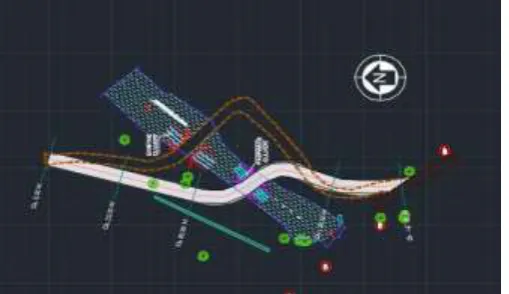
[image:2.595.36.291.600.747.2]After all the necessary points were obtained from the survey, the existing plan of the culvert was drawn using AutoCAD software. Similarly, the proposed culvert was drawn in the AutoCAD software after getting all the necessary points.
Fig 1. Proposed plan of the site
3.2 TYPES OF SOFTWARES USED
a) AutoCAD
AutoCAD is a computer-aided design (CAD) program used for 2-D and 3-D design and drafting. AutoCAD is developed and marketed by Autodesk Inc. and was one of the first CAD programs that could be executed on personal computers.
b) Staad.Pro
Staad Pro stands for Structural Analysis and Designing Program. This Software is most used Software for civil Engineering designing. It is not like Auto CAD. We work in only 2 dimensions in AutoCAD and that is not detailed. In this Software you work 3 dimensionally. Mainly the Software reduces your manual calculation and time.
3.3 DESIGN LOADS
1. Concentrated Loads
In case where the top slab forms the deck of the culvert, concentrated loads due to the wheel loads of the I.R.C. class AA or A type loading have to be considered.
If W= concentrated load on the slab
P= Wheel Load
I= Impact Factor
e= Effective width of dispersion
Then W=(P.I/e)
2. Uniform Distributed Load
The weight of embankment, wearing coat, and, deck slab and the track load are considered to be uniformly distributed loads on the top slab with the uniform soil reaction on the bottom slab.
3. Weight of Side Walls
The self weight of two side walls acting as concentrated loads are assumed to produce uniform soil reaction on bottom slab.
4. Water Pressure inside culvert
When the culvert is full with water, the pressure distribution on side walls is assumed to be triangular with a maximum pressure intensity of p= wh at the base, where
© 2019, IRJET | Impact Factor value: 7.211 | ISO 9001:2008 Certified Journal | Page 4627
5. Earth Pressure on vertical side wallsThe earth pressure on the vertical side walls of the box culvert is computed according to the Coloumb’s theory. The distribution of earth pressure on the side walls.
6. Uniform Lateral Load on side walls
Uniform lateral pressure on vertical side walls has to be considered due to the effect of live load surcharge. Also trapezoidal pressure distribution on side walls due to embankment loading can be obtained by combining the cases (5) and (6).
3.4 DESIGN MOMENTS, SHEAR AND THRUSTS
The box culvert is analysed for moments, shear forces and axial thrusts developed due to the various loading conditions by any of the classical methods such as moment distribution, slope deflection or Column analogy procedures.
3.5 DESIGN OF CRICTICAL SECTIONS
The maximum design moments resulting from the combination of the various loading cases are determined. The moments at the centre of span of top and bottom slabs and the support sections and at the centre of the vertical side walls are determined by suitably combining the different loading patterns. The maximum moments generally develop for the following loading conditions.
1. When the top slab supports the dead and live loads and the culvert is empty.
Fig 2. Design Case 1
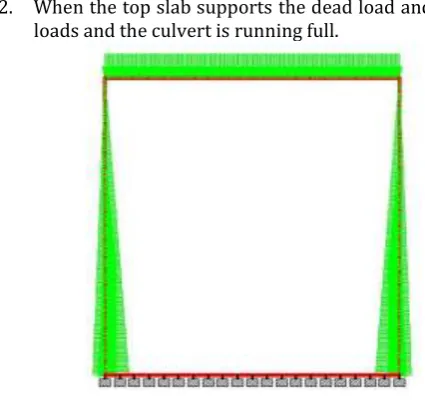
[image:3.595.324.537.102.306.2]2. When the top slab supports the dead load and live loads and the culvert is running full.
Fig 3. Design Case 2
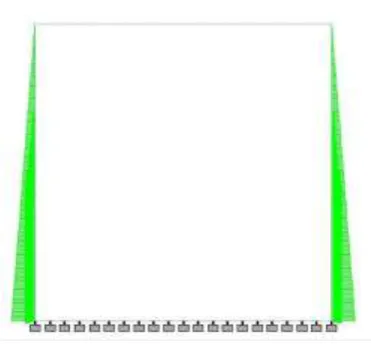
[image:3.595.358.534.375.562.2]3. When the sides of the culvert do not carry the live load and the culvert is running full.
Fig 4. Design Case 3
3.6
CALCULATION
1. Data
We have considered the following dimensions for the Box culvert based on the site conditions-
Clear span, L= 3m
Height of Vent, h=3m
Dead load= 12.8 kN/m2
© 2019, IRJET | Impact Factor value: 7.211 | ISO 9001:2008 Certified Journal | Page 4628
Density of Soil= 18 kN/m3Angle of Repose= 30o
Thickness of slab= 100mm/ meter span=300mm
2. Loads
Self weight of top slab= (0.3 X 24) =7.2 8 kN/m2
[image:4.595.350.521.141.323.2]Total Load, w= 12.8+50+7.2= 70 8 kN/m2
Fig 5. Total Load as shown in Staad. Pro
Weight of vertical side walls=(0.3X3.3X24)=W=24 kN
Soil Pressure, p= wh [(1-sin ϕ)/(1+sin ϕ)]
= (18X3.3X1/3)= 20.8 kN/m2
Fig 6. Soil Pressure as shown in Staad. Pro
Uniform Lateral Pressure due to effect of superimposed dead load and live load surcharge is calculated as
p= ((50+12.8)X1/3)= 21 kN/m2
Uniform Lateral Pressure due to effect of superimposed dead load is calculated as
p= (12.8X1/3)= 21 kN/m2
Intensity of water pressure is obtained as
[image:4.595.84.258.228.360.2]P= wh = (10X3.3) = 33 kN/m2
Fig 7. Water Pressure as shown in Staad. Pro
3.7
VISUAL BASIC
The main objective of this project along with the analysis of box culvert using Staad. Pro is to develop a program which can give necessary outputs while inputs such as length, height of culvert are provided using Visual Basic Software.
i. Declaration of Variables
The first step for developing a program using visual basic is to declare all the necessary variables. If the length of the culvert is to be used in the code, it has to be declared as single (data type).
Fig 8. Declaration of variables in visual basic
ii. Calculation
[image:4.595.66.252.458.630.2] [image:4.595.333.533.534.663.2]© 2019, IRJET | Impact Factor value: 7.211 | ISO 9001:2008 Certified Journal | Page 4629
variable is not declared it cannot be used for calculation. Thecalculation is done using the respective formulae. For example, to calculate the effective span, the formula is
Effective Span= length of span + thickness of slab
[image:5.595.313.556.63.249.2]In the code it is written as, ef= L+ t.
Fig 9. Coding of calculation in visual basic
iii. Declaration of variables in string
[image:5.595.56.267.194.335.2]To get the output and display the output, it is necessary to declare the output variables in terms of string data type.
Fig 10. Declaration of variables in the form of string
4.
RESULTS
1 Staad. Pro
1. BM at centres and Ends of Side Walls and Top Slab
Case 1: When the top slab supports the dead and live loads and the culvert is empty.
TABLE I. BM AT CENTRES AND ENDS CASE 1
Case 1 Design BM at center BM at ends Top slab 31.464 kNm 21.571 kNm Side walls 2.198 kNm 3.583 kNm
Fig 11. Graph Showing BM at centres and ends of top slabs and side walls for case 1
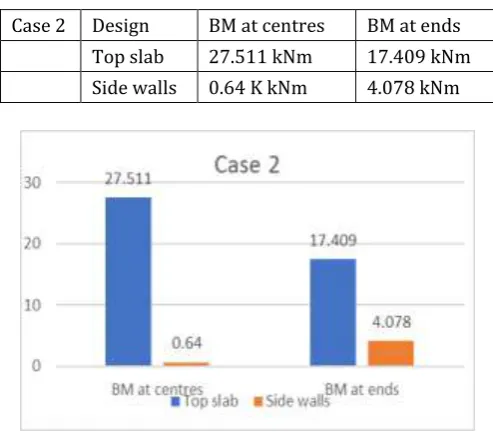
Case 2: When the top slab supports the dead load and live loads and the culvert is running full.
TABLE II. BM AT CENTRES AND ENDS CASE 2
Case 2 Design BM at centres BM at ends Top slab 27.511 kNm 17.409 kNm Side walls 0.64 K kNm 4.078 kNm
Fig 12. Graph Showing BM at centres and ends of top slabs and side walls for case 2
Case 3: When the sides of the culvert do not carry the live load and the culvert is running full.
TABLE III. BM AT CENTRES AND ENDS CASE 3
Case 3 Design BM at center BM at ends
Top slab 33.44 kNm 23.652 kNm
[image:5.595.310.557.349.566.2] [image:5.595.49.275.427.564.2]© 2019, IRJET | Impact Factor value: 7.211 | ISO 9001:2008 Certified Journal | Page 4630
Fig 13. Graph Showing BM at centres and ends of top slabsand side walls for case 3
2. Moments on the culvert in X-direction
[image:6.595.67.263.358.507.2]Case 1: When the top slab supports the dead and live loads and the culvert is empty.
Fig 14. Isometric View of moments on box culvert for case 1
Case 2: When the top slab supports the dead load and live loads and the culvert is running full.
Fig 15. Isometric View of moments on box culvert for case 2
[image:6.595.319.550.438.662.2]Case 3: When the sides of the culvert do not carry the live load and the culvert is running full.
Fig 16. Isometric View of moments on box culvert for case 3
2 Visual Basic
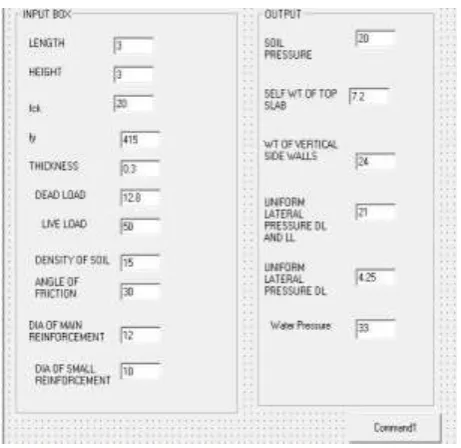
The output is displayed in the form of following:
Fig 17. Input and Output of Visual Basic
[image:6.595.52.254.602.729.2]© 2019, IRJET | Impact Factor value: 7.211 | ISO 9001:2008 Certified Journal | Page 4631
Live load etc. If we input the values for the above, we get thevalues for Soil Pressure, Self weight of top slab, weight of vertical side walls, Uniform lateral pressure, water pressure, etc. without calculating them, as the coding is done for calculation. Hence if we give the inputs in visual basic, we get all the necessary outputs which are used for the design of box culvert.
5. CONCLUSIONS
Staad. Pro is a user friendly and one of the efficient software for the analysis and design of box culvert.
From the analysis of culvert using Staad.Pro, it can be found out that the bending moment at centre is more for the top slab compare to that of side walls. Similarly there is a considerable difference in bending moment at the ends of top slab to that of side walls.
Also the bending moment at centre of top slab is more than the bending moment at ends of top slab, while the bending moment at the ends of side walls is more than that of bending moment at the centres of side walls.
The user affordability of the graphic environment, object-oriented development and possibilities of graphics makes visual basic a platform in the hands of structural engineer.
The calculation and design of box culvert using visual basic is more convenient to use and is less prone to errors.
REFERENCES
[1] Neha Kolate, Molly Mathew, Snehal Mali, “Analysis and
Desigh of RCC Box Culvert” Volume- 05, ISSN 2229-5518, pp. 36-41, December 2014
[2] Kritee Chhetri, Rajendra S, Kavitha N, “Study on a
Multicell Box Culvert Taking Span to Height Ratio and Vehicular Load” vulme-05, eISSN: 2319-1163, pISSN: 2321-7308, pp 368-373, Jun 2016
[3] P Leela Krishna, Dr K Rajaskhar, “Analysis and Design of
Box Culvert” volume-4, ISSN: 2349-784X, pp 114-156, April 2018
[4] Abdulkadir Baba Hassan, Matthew Sunday Abolarin,