UAV Swarm-Enabled Aerial CoMP: A Physical
Layer Security Perspective
XUANXUAN WANG 1,2, WEI FENG 1,2,3, (Senior Member, IEEE),
YUNFEI CHEN 4, (Senior Member, IEEE), AND NING GE 1,2, (Member, IEEE) 1Beijing National Research Center for Information Science and Technology, Tsinghua University, Beijing 100084, China 2Department of Electronic Engineering, Tsinghua University, Beijing 100084, China
3Peng Cheng Laboratory, Shenzhen 518055, China
4School of Engineering, University of Warwick, Coventry CV4 7AL, U.K.
Corresponding author: Wei Feng ([email protected])
This work was supported in part by the Beijing Natural Science Foundation under Grant L172041, in part by the National Natural Science Foundation of China under Grant 61771286, Grant 61701457, and Grant 91638205, and in part by the Beijing Innovation Center for Future Chip.
ABSTRACT Unlike aerial base station enabled by a single unmanned aerial vehicle (UAV), aerial coordi-nated multiple points (CoMP) can be enabled by a UAV swarm. In this case, the management of multiple UAVs is important. This paper considers the power allocation strategy for a UAV swarm-enabled aerial network to enhance the physical layer security of the downlink transmission, where an eavesdropper moves following the trajectory of the swarm for better eavesdropping. Unlike existing works, we use only the large-scale channel state information (CSI) and maximize the secrecy throughput in a whole-trajectory-oriented manner. The overall transmission energy constraint on each UAV and the total transmission duration for all the legitimate users are considered. The non-convexity of the formulated problem is solved by using max-min optimization with iteration. Both the transmission power of desired signals and artificial noise (AN) are derived iteratively. Simulation results are presented to validate the effectiveness of our proposed power allocation algorithm and to show the advantage of aerial CoMP by using only the large-scale CSI.
INDEX TERMSArtificial noise, large-scale fading, physical layer security, secrecy throughput, UAV swarm.
I. INTRODUCTION
In recent years, unmanned aerial vehicles (UAVs) have attracted great interest in wireless communications [1]–[4]. Due to their mobility and elevated position, they can provide agile communications [5]. With their high maneuverability, UAV can augment the network capacity and coverage, espe-cially in the extreme environments without infrastructure, such as disaster rescue, traffic monitoring and so on [1], [6]. More specifically, UAVs are usually cost-effective [7]–[10]. They can be exploited to assist on-demand missions, such as high-speed data transmission in the fifth generation (5G) wireless networks. In addition, with the huge demand in emergency applications, i.e., public safety, delivery and surveillance, deploying a flock of UAVs, or swarm, is becom-ing more attractive, which plays a vital role in meetbecom-ing perfor-mance requirements for communications between multiple UAVs and 5G [11]–[15].
The associate editor coordinating the review of this article and approving it for publication was Zhen Li.
One of the serious concerns in UAV swarm-enabled aerial networks is how to guarantee the privacy and secrecy of the system. Due to the broadcast nature and inherent randomness of wireless channels, UAV swarm-enabled communication networks are particularly vulnerable to various security threats, such as information eavesdropping, information leak-age, data modification and so on. In addition, to facilitate the secure transmission, the UAV swarm often places itself near the legitimate users, which is beneficial to eavesdrop-ping, especially when the eavesdropper moves close to the legitimate users.
A. RELATED WORK
To achieve perfect security, the conventional encryption schemes are typically implemented at the upper layer using cryptographic methods. However, this is often achieved at the cost of high computational complexity [16].
signal processing approaches, has been widely investigated in the UAV-enabled wireless networks [17]–[20]. They enhance the coverage and security of the wireless systems by exploit-ing physical characteristics of the wireless channel. Specifi-cally, by adaptively adjusting the UAVs’ location, they could overcome the propagation constraints in the cellular systems, and provide new possibilities or opportunities for security enhancement. The authors in [17] utilized UAV as a mobile relay, and maximized the secrecy rate of the system with transmit optimization in a four-node. In [18], the authors investigated UAV-enabled secure communication systems where a mobile UAV sent confidential messages to multiple ground users. By considering the imperfect information on the locations of the eavesdroppers, the authors in [19] inves-tigated a UAV-ground communication system with multiple potential eavesdroppers on the ground. The authors in [20] considered UAV-assisted secure communications between a legitimate transmitter-receiver pair for unknown eavesdrop-per location by taking UAV as an air-to-ground friendly jammer.
These studies [17]–[20] have provided insightful results for improving the secrecy performance of the UAV-aided wireless communications. However, they assume an ideal free-space path-loss model [17]–[19] between the UAV and the legitimate receivers/eavesdroppers or the instantaneous channel state information (CSI) [20] of the eavesdroppers at the transmitter, which may not be practical.
In practice, it is generally difficult to acquire the instan-taneous CSI of the eavesdroppers, especially when they are passive. To deal with that, an effective approach, named as artificial noise(AN), has been proposed to mask the desired signals for enhancing the secrecy performance [21]–[25], where AN is designed based on the instantaneous CSI of the legitimate receiver and transmitted in the null-space of the legitimate channel. Although this scheme is help-ful for the security, it requires perfect instantaneous CSI between the source and the legitimate receiver at the trans-mitter, which is nearly unworkable. The idea is then gener-alized to the UAV-enabled wireless systems, where a UAV is applied as a mobile jammer to transmit AN [26] or a legitimate receiver [27]. However, these works haven’t shown useful guidelines to improve physical layer security of UAV swarm-enabled aerial networks.
B. MAIN CONTRIBUTIONS
Despite of the above fruitful results, some challenges still remain in the UAV swarm-enabled aerial networks.
For the UAV swarm-enabled aerial networks, an open challenge is how to acquire CSI. To practically depict the typical propagation environments, the composite channel model, consisting of both small-scale and large-scale fad-ing, needs to be used, which is in stark contrast to the existing literatures [17]–[19]. Under the composite channel, one key role for the power allocation strategy is the prior knowledge. Since it is impossible to perfectly acquire the random small-scale fading prior to the whole trajectory of
the UAV swarm, it is almost infeasible to assume perfect CSI. In this paper, we devote to guarantee the secrecy per-formance of the system in a whole-trajectory-oriented man-ner by utilizing only the large-scale CSI of the legitimate receivers/eavesdroppers, which can be achieved at much lower cost.
In wireless communication systems, path loss could sig-nificantly reduce the signal reception quality at the legit-imate users, especially in the UAV swarm-enabled aerial networks. In the existing literatures, one effective scheme to overcome the limitation is by means of multiple antenna systems, i.e., multiple-input single-output (MISO) [28], [29], multiple-input multiple-output (MIMO) [30], [31], or single-input multiple-output (SIMO) [32]. However, due to the lim-ited size, it is hard for UAVs to be equipped with multiple antennas. To handle that, we consider an effective coordi-nated multiple points (CoMP) between UAVs in this paper, where multiple single-antenna UAVs are combined to form the UAV swarm and then act as a virtual multiple-antenna node. Unlike the conventional CoMP with fixed base sta-tions (BSs), the UAV swarm is able to cooperatively operate as an aerial CoMP by utilizing the mobility of the UAVs. Note that, in contrast to the existing works achieving CoMP based on perfect CSI [33], [34], our scheme uses only the predictable large-scale CSI between UAVs and the legitimate receivers/eavesdroppers.
The transmission energy constraint at each UAV is another challenge for the secrecy performance of UAV swarm-enabled aerial networks. Since it’s generally difficult to recharge the battery of the UAV during its flight, not only the transmission power budget but also the total transmis-sion energy constraint should be taken into account for each UAV. Note that the total energy consumption of the UAV consists of two components: the UAV’s transmission energy consumption, which is due to the radiation, signal processing as well as other circuitry, and the UAV’s propulsion energy consumption, which is determined by the UAV’s flying status including the velocity and acceleration [7]. Due to the signal processing of the confidential messages and the circuitry, this work mainly focuses on the transmission energy constraint per UAV.
In addition, the transmission duration used to serve the legitimate users also plays a vital role to improve the secrecy performance of the system. Due to the limited total transmis-sion energy at each UAV, the transmistransmis-sion duration may be restricted, which should be well designed for each legitimate user.
CSI of the legitimate users, AN in our proposed scheme is designed by using only the large-scale CSI. To the best of our knowledge, this is the first time that studies AN-assisted secure transmission in the UAV swarm-enabled aerial CoMP by exploiting only the large-scale CSI of the legitimate receivers/eavesdroppers.
Our main contributions of the paper are summarized as follows:
• We consider physical layer security in the UAV
swarm-enabled aerial networks. Specifically, multiple single-antenna rotary-wing UAVs perform an aerial CoMP, and enable a virtual MIMO transmission link with the multiple-antenna legitimate receivers or the eavesdropper, in which the swarm transmits the confi-dential messages in conjunction with AN and sequen-tially hovers to serve the scheduled legitimate users. Unlike the existing wiretap mode where the eaves-dropper keeps static at a fixed location, we con-sider the eavesdropper moves following the trajectory of the swarm for better eavesdropping in a passive manner.
• To characterize the typical propagation environments, we consider a practical composite channel model con-sisting of both small-scale and large-scale fading. How-ever, it is infeasible to achieve perfect CSI since the small-scale channel fading is time-varying and hard to be acquired. In this work, we use only the large-scale channel fading, which is more reasonable because the large-scale channel fading mainly depends on the position information of both the UAV and the legitimate receivers/eavesdroppers. We can obtain such information based on the historical data and the related distance between the UAV and the legitimate receivers/eavesdroppers.
• Based on the large-scale CSI, an optimization frame-work in a whole-trajectory-oriented manner is proposed to maximize the secrecy throughput by jointly opti-mizing the power allocation between the confidential messages and AN as well as the transmission durations of all the legitimate receivers subject to the overall trans-mission energy constraint at each rotary-wing UAV. The formulated problem is not convex and hard to be solved directly. To deal with that, an equivalent max-min prob-lem is reformulated by adopting the random matrix the-ory, and then an efficient iterative algorithm is proposed. Specifically, the problem is split into four subproblems. For the first two and the fourth subproblems, they are convex and can be solved using the general optimization toolbox. For the third subproblem, we first transform its non-convex behavior into the convex one by adopting a successive convex approximation technique. Then, these four subproblems are alternately updated in each itera-tion. Furthermore, we show that the proposed algorithm guarantees the convergence. Finally, simulation results validate that our proposed scheme could achieve a good secrecy performance.
C. ORGANIZATION AND NOTATIONS
The rest of the paper is organized as follows. Section II presents the system model and problem formulation. Section III proposes power allocation for secure aerial CoMP. In Section IV, simulation results and discussions are pre-sented. Finally, conclusions are made in Section VI.
Throughout this paper, upper case and lower case boldface letters represent the matrices and the vectors, respectively. IL is an L×L identity matrix, and0 is a zero vector.E(·)
denotes the expectation operation. (·)Hand Tr(·) represent the conjugate transpose and the trace of a matrix, respectively. A 0denotes thatAis a positive semidefinite matrix.y∼ N(0,a) denotes the Gaussian random variable with mean 0 and variancea.x ∼ CN(s, 6) is the complex circularly symmetric Gaussian distribution with the mean vectorsand the covariance matrix6.
II. SYSTEM MODEL AND PROBLEM FORMULATION A. SYSTEM MODEL
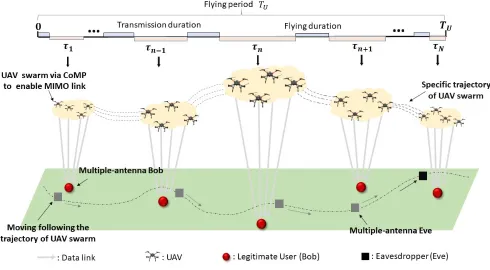
We consider the downlink transmission in the UAV swarm-enabled aerial networks. As illustrated in Fig. 1,
the system consists ofL rotary-wing UAVs (indexed with
1, . . . ,L),Nlegitimate users (indexed with 1, . . . ,N) as Bob,
and one eavesdropper as Eve. All the legitimate users and the eavesdropper are equipped with NB andNE antennas,
respectively. For the rotary-wing UAVs, they form a UAV swarm via CoMP, and act as an aerial base station to assist the wireless networks. When the UAVs serve the legitimate users, they are randomly dispatched in a circle centering at the legitimate users with an altitude.
Due to the limited weight and size, only one single antenna is equipped at each UAV. Over the flight of the UAV swarm, the legitimate users could be provided with the confidential
messages when being scheduled.1 Due to the openness of
the wireless link, there exists a leakage of the confidential messages. In this system, we assume the eavesdropper is pas-sive and only intends for the confidential messages which are transmitted to the scheduled legitimate users. Furthermore, the eavesdropper randomly moves following the specific tra-jectory of the swarm to improve eavesdropping. Meanwhile, the eavesdropper also tries to keep a safety distancereaway
from the scheduled legitimate users so that it could not be spotted.
In this work, we assume the same consecutive period,
denoting as TU, for each rotary-wing UAV in the swarm,
which mainly consists of two parts: the total flying duration
Tf and the total transmission durationTt.Tf is highly depen-dent on the velocity of the UAVs, andTt is determined by the transmission energy consumption of the UAVs. In this work, the UAVs are assumed to serve the scheduled legitimate receivers in a sequential manner. Specifically, they hover above a scheduled legitimate receiver to send the confidential messages during a transmission duration, and then fly to
1In fact, the user scheduling issue is important for the system. However,
FIGURE 1. Illustration of a UAV swarm-enabled aerial network, where a UAV swarm, acting as an aerial CoMP, enables MIMO secure communications with the multiple-antenna legitimate users and the eavesdropper in a whole-trajectory-oriented manner. Specifically, the swarm hovers to serve the scheduled legitimate user in the transmission duration, and then it flies to the next scheduled one within a flying duration. For the eavesdropper, it wiretaps the confidential messages by moving following the trajectory of the UAV swarm.
the next scheduled one within a flying duration. In addition, each legitimate receiver is assumed to be scheduled at most once during the total transmission duration. Denote the trans-mission durations for the scheduled legitimate users asτ1,
τ2, . . . , τN, respectively, which change in practice and need
to satisfy
N
X
n=1
τn≤Tt, (1)
0≤τn≤τmax, ∀n, (2)
whereτmaxdenotes the transmission duration budget. Note that the transmission duration for each scheduled legitimate user is normally short due to the limited transmission energy of the rotary-wing UAV [35].
Suppose that the coordinate of thelth UAV in thenth trans-mission duration is (wl[n],sl[n],hl[n]),2where (wl[n],sl[n])
and hl[n] denote the horizontal coordinate and the
alti-tude of thelth UAV, respectively. Denote the coordinate of the scheduled legitimate user/eavesdropper in thenth trans-mission duration as (rq[n],tq[n],0), where q ∈ {B,E}.
2The UAVs fly following a specific trajectory, whose locations can be
achieved by using the existing positioning technology, i.e., the technology of Global Positioning System (GPS) and BeiDou Navigation Satellite Sys-tem (BDS) combined positioning [36]. Based on the open channel link, the UAVs can broadcast their locations to legitimate receivers for them to follow.
Thus, the distance between the lth UAV and q at the nth transmission duration is
dq,l[n]
= q
(hl[n])2+ wl[n]−rq[n] 2
+ sl[n]−tq[n] 2
,q∈ {B,E}. (3)
To be practical, we consider both line-of-sight (LoS) and non-line-of-sight (NLoS) connections between the UAVs and the legitimate users. Therefore, the large-scale path loss between thelth UAV andqat thenth transmission duration can be modeled as [37]
PLdBq,l[n]= A 1+ae−b(ρq,l[n]−a)
+Bq,l[n], (4)
where
A=ηLoS−ηNLoS,
Bq,l[n]=20lg(dq,l[n])+20lg(
4πf
c )+ηNLoS,
ρq,l[n]= 180
π arcsin
hl[n]
dq,l[n]
,
ηLoS,ηNLoS,aandbare constants related to the propagation
environment,f is the carrier frequency, andcis the speed of light [37].
as:
Qq,l[n]=10
PLdBq,l[n]
10 . (5)
The channel from thelth UAV toqat thenth transmission duration can be rewritten as
hq,l[n]=Q−
1 2
q,l[n]sq,l[n], (6)
where sq,l[n] ∈ CNq×1 represents the small-scale
fad-ing between the lth UAV and q, of which the entries are independently and identically distributed (i.i.d) according to CN(0,1).
In order to degrade the eavesdropper’s channel, each UAV transmits the confidential message in conjunction with AN. Denotingxl[n] as the transmission signal from thelth UAV to
the scheduled legitimate user at thenth transmission duration, we have
xl[n]=xls[n]+xla[n], (7)
wherexls[n] andxla[n] represent the confidential message and AN from thelth UAV, respectively.
Furthermore, we express the transmission power from the
lth UAV to the scheduled legitimate user at thenth transmis-sion duration as
E{|xl[n]|2} =psl[n]+p a
l[n], (8)
whereE{|xls[n]|2} = psl[n],E{|xla[n]|2} = pla[n],psl[n] and
pal[n] denote the power of the confidential message and that of the artificial noise transmitted by the lth UAV for the scheduled legitimate user at the nth transmission duration, respectively.
Since each UAV has the limited transmission power, we have
0≤psl[n]+pal[n]≤Pmax, ∀l,n (9)
where (9) represents the transmission power constraint and
Pmaxis the transmission power budget of each UAV. Consid-ering the short transmission duration, the transmission power is assumed to keep constant at thenth transmission duration. Considering the transmission energy limitation of the UAVs within the flying period, the following constraint is achieved
N
X
n=1
(psl[n]+pa
l[n])τn≤Emax, ∀l (10)
where (10) denotes the total transmission energy constraint at each UAV over the whole flight, andEmaxis the transmission energy budget per UAV.
Based on the aforementioned analysis, all the UAVs work together to transmit the confidential messages for the legiti-mate users, which could form a virtualNq×LMIMO
commu-nication link. Note that to avoid the collision, we assume the UAVs are restricted to fly following their specific trajectory with a minimum safety distance between them. In this case, the composite channel matrixHq[n] ∈ CNq×L between the
swarm andqat thenth transmission duration can be expressed as
Hq[n]=Sq[n]Qq[n],q∈ {B,E} (11)
where
Hq[n]=
hq,1[n],hq,2[n], . . . ,hq,L[n]
,
Sq[n]=sq,1[n],sq,2[n], . . . ,sq,L[n],
Qq[n]=
Q−
1 2
q,1[n]
...
Q−
1 2
q,L[n]
.
The received signal at the scheduled legitimate user, denot-ingyB[n], in thenth transmission duration, and that at the
corresponding eavesdropper, denotingyE[n], in thenth trans-mission duration are given by
yB[n]=HB[n] xs[n]+xa[n]+nB[n], (12)
yE[n]=HE[n] xs[n]+xa[n]
+nE[n], (13)
respectively, where xs[n] ∼ CN(0,Ps[n]) and xa[n] ∼
CN(0,Pa[n]) denote the confidential messages and AN
trans-mitted by the UAV swarm at the nth transmission
dura-tion,3respectively, andPs[n] andPa[n] are their covariance
matrices, respectively.nB[n] ∼ CN(0, δ2INB) andnE[n] ∼
CN(0, δ2INE) denote the noise vectors at the scheduled
legit-imate user and the eavesdropper at thenth transmission dura-tion, respectively, andδ2represents the noise variance.4
Remark 1: Note that the locations of the legitimate users/eavesdropper are prior known by the UAV swarm for transmission resource allocation. Specifically, the positions of the legitimate receivers in different transmission durations could be detected by using GPS or Light Detection and Ranging (LiDAR) at the UAVs [40].
Considering the eavesdropper’s passive behavior when it randomly follows the specific trajectory of the UAV swarm, it may be difficult to achieve the accurate positions of the eavesdropper at the UAVs. In this work, we consider a worst case scenario, where the power allocation strat-egy is performed on the assumption that the eavesdropper locates at the optimal position with the strongest receiving power in a circle of radius re. Fig. 2 illustrates the optimal location of the eavesdropper during the nth transmission duration. Specifically, for the point in the located circle of the eavesdropper with the central angle θ[n], the receiv-ing power from the lth UAV is p
s l[n]+p
a l[n] ¯ QE,l[n]
ksE,l[n]k2, where
3Different from the existing literatures [38], [39], AN in this work is
designed by using only the large-scale CSI instead of the instantaneous legitimate CSI. Owing to the broadcast nature of the wireless channel, AN unavoidably has a leakage and harms the legitimate receivers. Thus, it’s important to carefully design the power allocation between the confidential messages and AN so as to minimize the harmful effect on the legitimate users while jamming the eavesdropper, which would be presented in details in the following.
4Here, we assume the noise variance is the same, i.e., equal toδ2, over the
FIGURE 2. Illustration of the eavesdropper’s optimal location in the located circle of the eavesdropper with the safety distance during thenth transmission duration (top view of Fig. 1).
¯
QE,l[n] = QE,l[n]
rE[n]=rB[n]+recos(θ[n]),tE[n]=tB[n]+resin(θ[n]) based on(5). Considering the constant transmission power in the nth transmission duration, the optimal central angle can be expressed asθ˜[n]= arg min
θ[n]∈[0,2π] ¯
QE,1[n]+...+ ¯QE,L[n] L . Then, the eavesdropper’s optimal location is obtained as (rE[n],tE[n],0) = (rB[n] + recos(θ˜[n]),tB[n] + resin(θ˜[n]),0).
B. PROBLEM FORMULATION
In this subsection, we focus on the problem formulation for this system. Based on (12), the achievable ergodic rate for the scheduled legitimate user at thenth transmission duration is given by
RB[n]=ESB[n]
log2det
INB+HB[n]Ps[n](HB[n])H
×HB[n]Pa[n](HB[n])H +δ2INB
−1
, (14)
whereESB[n](·) is taken over the random small-scale fading
realization ofSB[n],
Ps[n]=
ps1[n]
...
psL[n]
, (15)
and
Pa[n]=
pa1[n]
...
paL[n]
. (16)
Based on (13), the achievable ergodic rate for the eaves-dropper who is intended for the confidential message of the scheduled legitimate user at thenth transmission duration is
RE[n]=ES
E[n]
log2det
INE +HE[n]Ps[n](HE[n]) H
×HE[n]Pa[n](HE[n])H+δ2INE
−1
, (17)
whereESE[n](·) is taken over the random small-scale fading
realization ofSE[n].
Denote 4 = {τn,∀n}, 8s = {Ps[n],∀n} and 8a =
{Pa[n],∀n}. Then, the secrecy throughput for the UAV
swarm-enabled aerial networks is defined as [41]
R 4, 8s, 8a=
1
TU N
X
n=1
τn
h
RB[n]−RE[n]i +
, (18)
where [x]+=max(0,x).
In this work, our goal is to maximize the secrecy through-put over the flying period of the UAV swarm by jointly optimizing the power of the confidential messages (i.e.,8s)
and AN power (i.e.,8a) as well as the transmission durations
of the legitimate users (i.e.,4) under the constraint of the total transmission energy for each UAV. The optimization problem can be formulated as
max
4,8s,8a
1
TU N
X
n=1
τn
h
RB[n]−RE[n]i +
(19a)
s.t. 0≤psl[n]+pal[n]≤Pmax, ∀l,n (19b)
N
X
n=1
(psl[n]+pal[n])τn≤Emax, ∀l (19c)
N
X
n=1
τn≤Tt, (19d)
0≤τn≤τmax, ∀n (19e)
Ps[n]0, ∀n, (19f)
Pa[n]0, ∀n. (19g)
It can be observed that problem (19) is challenging to be solved for two reasons. First, the operator [·]+ results in a nonsmooth manner. Second, even without [·]+, the objective function (19a) has integrals with the expectation operator
E(·), which is intractable and difficult to achieve an explicit
expression in terms of8s,8aand4.
Remark 2: It is worth mentioning that even though the UAV’s propulsion energy is much higher than the UAV’s transmission energy [7], we mainly consider the total trans-mission energy constraint at each UAV in this work. The reasons are as follows:
(1) Based on (12) - (18), secrecy throughput is highly related to the UAV transmission power consumption. Thus, to maximize the secrecy throughput, the UAV trans-mission energy consumption is more important than the UAV’s propulsion energy consumption.
(3) We perform the power allocation by considering an optimization framework in a whole-trajectory-oriented manner, where the UAVs follow a specific trajectory. In this case, the UAV’s flying status, i.e., the flying period, velocity, propulsion energy consumption and so on, can be controlled with commands from the ground station when they serve the legitimate users/eavesdropper, which leads to the limited consideration of propulsion energy.
III. POWER ALLOCATION FOR SECURE AERIAL COMP
In this section, we devote our effort to achieve the optimal solutions of problem (19). Before the further analysis, we first handle the nonsmooth of the objective function in problem (19) by adopting the similar analysis in [19]. Then, (19) can be reformulated into
max
4,8s,8a
1
TU N
X
n=1
τn
h
RB[n]−RE[n]
i
(20a)
s.t. 0≤psl[n]+pal[n]≤Pmax, ∀l,n (20b)
N
X
n=1
(psl[n]+pal[n])τn≤Emax, ∀l (20c)
N
X
n=1
τn≤Tt, (20d)
0≤τn≤τmax, ∀n (20e)
Ps[n]0, ∀n, (20f)
Pa[n]0, ∀n, (20g)
where problem (20) and problem (19) share the same optimal solution, andR 4, 8s, 8a=PNn=1TUτn
h
RB[n]−RE[n]i. To achieve the efficient power allocation, an explicit expression of the objective function in (20) is necessary. Although some works have provided an insightful result to obtain the analytical expression for the objective function, it is generally too cumbersome to do the further power allo-cation design since the analytical result involves a series of integrals [42].
In the following, we first achieve the closed form of the secrecy throughput in terms of8s,8aand4by removing
the expectation operatorE(·) based on [43]. Then, we
refor-mulate the optimization problem. Finally, a computationally efficient iterative algorithm is proposed for the problem and its convergence is presented.
A. PROBLEM TRANSFORMATION
Let Pu[n] = Ps[n] + Pa[n],∀n, where Pu[n] =
diagpu1[1], . . . ,puL[N], and 8u = {Pu[n],∀n}. Then,
the secrecy throughput R 4, 8s, 8a
can be equivalently rewritten as
R 4, 8u, 8a
= 1
TU N
X
n=1
τn
ESB[n]
h
log2detINB+
HB[n]Pu[n](HB[n])H
δ2
i
−ESB[n]hlog2detINB+
HB[n]Pa[n](HB[n])H
δ2
i
−ES
E[n]
h log2det
INE +
HE[n]Pu[n](HE[n])H
δ2
i
+ES
E[n]
h
log2detINE +
HE[n]Pa[n](HE[n])H
δ2
i
.
(21)
It can be observed that (21) is still intractable due to the expec-tation operatorE(·). To cope with that, we try to approximate (21) by introducing the following theorem.
Theorem 1: By introducing auxiliary variables tB,u =
{tB,u[n],∀n}, tE,a = {tE,a[n],∀n}, tB,a = {tB,a[n],∀n},
tE,u = {tE,u[n],∀n}, R 4, 8u, 8a in(21)can be equiva-lently expressed as
Ras 4, 8u, 8a= tB,a≥max0,tE,u≥0,
min tB,u≥0,tE,a≥0,
G(4, 8u, 8a,tB,u,tB,a,tE,u,tE,a), (22)
whereG(4, 8u, 8a,tB,u,tB,a,tE,u,tE,a)is defined in(23)on the top of the next page. Furthermore,G(4, 8u, 8a,tB,u,tB,a,
tE,u,tE,a)is convex in terms of (tB,u,tE,a), and concave with respect to (tB,a,tE,u).
Proof: Please refer to Appendix.
Note that the performance gap between R 4, 8u, 8a
in (21) and Ras 4, 8u, 8a in (22) is negligible, which
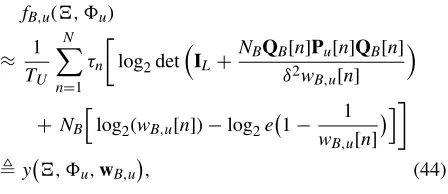
has been demonstrated in Fig. 3. Without loss of general-ity, we randomly select a system topology, and adopt the values of simulation settings in Section IV with different transmission powers based on urban scenario. Specifically, we first verify thatK(4, 8u, 8a,wB,u,wB,a,wE,u,wE,a) = y(4, 8u,wB,u) − y(4, 8a,wB,a) − y(4, 8u,wE,u) + y(4, 8a,wE,a), which is based on the definition (44) in
Appendix, is the closed form ofR 4, 8u, 8a by
[image:7.576.305.521.506.667.2]simula-tion in Fig. 3. Then, considering the relasimula-tionship between
G(4, 8u, 8a,tB,u,tB,a,tE,u,tE,a)
= 1
TU N
X
n=1
τn
gPu[n],NB,QB[n],tB,u[n]
−gPa[n],NB,QB[n],tB,a[n]
−gPu[n],NE,QE[n],tE,u[n]
+gPa[n],NE,QE[n],tE,a[n]
= 1
TU N
X
n=1
τn
h
log2detIL+
NBQB[n]Pu[n]QB[n]
δ2etB,u[n]
+NBlog2etB,u[n]−1+e−tB,u[n]
i
−hlog2detIL+
NBQB[n]Pa[n]QB[n]
δ2etB,a[n]
+NBlog2e
tB,a[n]−1+e−tB,a[n]
i
−hlog2detIL+
NEQE[n]Pu[n]QE[n]
δ2etE,u[n]
+NElog2e
tE,u[n]−1+e−tE,u[n]i
+hlog2detIL+
NEQE[n]Pa[n]QE[n]
δ2etE,a[n]
+NElog2etE,a[n]−1+e−tE,a[n]
i
. (23)
K(4, 8u, 8a,wB,u,wB,a,wE,u, wE,a) and G(4, 8u, 8a,
tB,u,tB,a,tE,u,tE,a) according to the derivation (52) in
Appendix, it is obvious to see that Ras 4, 8u, 8a
is a very accurate approximation forR 4, 8u, 8a
. In this case, the optimization problem (20) can be reformulated as
max
4, 8u, 8a, tB,a,tE,u
min tB,u,tE,a
G(4, 8u, 8a,tB,u,tB,a,tE,u,tE,a) (24a)
s.t. 0≤pul[n]≤Pmax, ∀l,n (24b)
N
X
n=1
pul[n]τn≤Emax, ∀l (24c)
N
X
n=1
τn≤Tt, (24d)
0≤τn≤τmax, ∀n (24e)
Pu[n]−Pa[n]0, ∀n, (24f)
Pa[n]0, ∀n, (24g)
tB,a≥0, tE,u≥0, (24h)
tB,u≥0, tE,a≥0. (24i)
It’s worth mentioning that by performing a serial of reformulations, problem (24) is equivalent to the original problem (19). In the following, we devote to an efficient optimization algorithm for the equivalent problem (24).
B. AN ITERATIVE ALGORITHM TO SOLVE THE PROBLEM Note that since (24) is not convex, it’s generally difficult to achieve the global optimal solutions. In this subsection, we propose an efficient iterative algorithm by adopting the block coordinate descent method to find the stationary solu-tions of (24). We first decouple the optimization variables into the following four blocks (tB,u,tE,a), (tB,a,tE,u), (8u, 8a),
4 and then alternately optimize these four blocks one by one by taking the other variables as the constants obtained in the last iteration. Specifically, for any given transmission power indicators (8u, 8a) and the transmission duration
4, the auxiliary variables (tB,u, tE,a) (or (tB,a, tE,u)) can
be efficiently solved through standard algorithm [44]. For any obtained auxiliary variables (tB,a,tE,u) and (tB,u,tE,a)
as well as the transmission duration 4, the transmission power indicators (8u,8a) can be optimized by the successive
convex approximation technique. Finally, the transmission duration4can be achieved based on the obtained (tB,u,tE,a),
(tB,a,tE,u) and (8u, 8a).
Denote m ≥ 1 as the number of the iteration step.
Problem (24) can be separated into the following four subproblems.
(1) The auxiliary variables (tB,u,tE,a)
In the mth iteration, we first optimize (tB,u,tE,a) with
(8mu−1, 8am−1) and4m−1obtained in them−1th iteration. In this case, problem (24) can be reformulated into
min tB,u,tE,a
1
TU N
X
n=1
τm−1 n
h
g
Pmu−1[n],NB,QB[n],tB,u[n]
+g
Pma−1[n],NE,QE[n],tE,a[n]
i
(25a)
s.t. tB,u≥0, tE,a≥0. (25b)
Based on Theorem 1, we know that problem (25) is convex, which can be efficiently solved by means of the standard optimization toolbox, i.e., CVX.
(2) The auxiliary variables (tB,a,tE,u)
Based on the obtained (8mu−1, 8am−1) and4m−1in them− 1th iteration, the variables (tB,a,tE,u) can be achieved by
min tB,a,tE,u
1
TU N
X
n=1
τm−1 n
h
gPma−1[n],NB,QB[n],tB,a[n]
+gPmu−1[n],NE,QE[n],tE,u[n]
i
(26a)
s.t. tB,a≥0, tE,u≥0. (26b)
(3) The transmission power indicators (8u, 8a)
The variables (8u, 8a) with the obtained (tmB,u,tmE,a),
(tmB,a,tmE,u) and4m−1in themth iteration can be achieved by solving the following problem
max
8u,8a
1
TU N
X
n=1
τm−1 n
h
gPu[n],NB,QB[n],tBm,u[n]
−gPa[n],NB,QB[n],tBm,a[n]
−gPu[n],NE,QE[n],tEm,u[n]
+g
Pa[n],NE,QE[n],tEm,a[n]
i (27a)
s.t.
N
X
n=1
plu[n]τnm−1≤Emax, ∀l (27b)
(24b), (24f), (24g). (27c)
Note that both g Pu[n],NB,QB[n],tBm,u[n]
and g Pu[n], NE,QE[n],tEm,u[n]
are concave with respect toPu[n], and
both g Pa[n],NB,QB[n],tB,am [n] and g Pa[n],NE,QE[n], tE,am [n]
are concave with respect to Pa[n] [43]. Thus,
the objective function in (27) actually mixes the addition and subtraction of these four concave terms, which is neither concave with respect to8unor concave with respect to8a.
That is, problem (27) is not convex in terms of8uand8a.
To overcome the convexity issue, we approximate the sec-ond and the third terms of the objective function in (27) to an affine function based on the first-order Taylor expansion.
The gradient of g Pa[n],NB,QB[n],tB,a[n]
5
can be rewritten as
∇Pa[n]g Pa[n],NB,QB[n],tB,a[n]
=ϕB,a[n]QB[n] IL+ϕB,a[n]QB[n]Pa[n]QB[n]
−1 QB[n]
,F(Pa[n],NB,QB[n],tB,a[n]), (28)
whereϕB,a[n]= δlog2etB2eNB,a[n]. Thus, the first-order Taylor
expan-sion of g Pa[n],NB,QB[n],tB,a[n]
at a certain pointP˜a[n]
can be expressed as
g Pa[n],NB,QB[n],tB,a[n]
P˜a[n]
=g P˜a[n],NB,QB[n],tB,a[n]
+tr F P˜
a[n],NB,QB[n],tB,a[n] Pa[n]− ˜Pa[n],
(29)
where g P˜a[n],NB,QB[n],tB,a[n] = g Pa[n],NB,
QB[n],tB,a[n]|Pa[n]= ˜Pa[n]. Clearly, g Pa[n],NB,QB[n], tB,a[n]| ˜Pa[n]is a linear function with respect toPa[n].
Similarly, the gradient ofg Pu[n],NE,QE[n],tE,u[n]can
be rewritten as
∇Pu[n]g Pu[n],NE,QE[n],tE,u[n]
=ϕE,u[n]QE[n] IL+ϕE,u[n]QE[n]Pu[n]QE[n] −1
QE[n]
,F(Pu[n],NE,QE[n],tE,u[n]), (30)
5For convenience, we dropm.
whereϕE,u[n]= δlog2 2eNE
etE,u[n]. Thus, the first-order Taylor
expan-sion ofg Pu[n],NE,QE[n],tE,u[n]at a certain pointP˜u[n]
can be expressed as
g Pu[n],NE,QE[n],tE,u[n]
P˜u[n]
=g P˜u[n],NE,QE[n],tE,u[n]
+tr F P˜
u[n],NE,QE[n],tE,u[n] Pu[n]− ˜Pu[n],
(31)
where g P˜u[n],NE,QE[n],tE,u[n] = g Pu[n],NE,
QE[n],tE,u[n]|Pu[n]= ˜Pu[n]. Clearly, g Pu[n],NE,QE[n], tE,u[n]| ˜Pu[n]is a linear function in terms ofPu[n].
In this case, problem (27) in themth iteration can be recast into
max
8u,8a
1
TU N
X
n=1
τm−1 n
h
gPu[n],NB,QB[n],tBm,u[n]
− gPa[n],NB,QB[n],tBm,a[n]
Pma−1[n]
− gPu[n],NE,QE[n],tEm,u[n]
Pmu−1[n]
+ g
Pa[n],NE,QE[n],tEm,a[n]
i
(32a)
s.t.
N
X
n=1
plu[n]τnm−1≤Emax, ∀l (32b)
(24b), (24f), (24g). (32c)
Problem (32) is convex in terms of8uand8a. Therefore,
the optimal variables (8u, 8a) can be solved by utilizing the
standard optimization toolbox CVX. (4) The transmission duration4
In the last step of themth iteration, we focus on the trans-mission duration4with the obtained (tmB,u,tmE,a), (tmB,a,tmE,u) and (8mu, 8ma), which can be achieved by the following opti-mization problem
max
4
1
TU N
X
n=1
τn
h
gPmu[n],NB,QB[n],tBm,u[n]
−gPma[n],NB,QB[n],tBm,a[n]
−g
Pmu[n],NE,QE[n],tEm,u[n]
+gPma[n],NE,QE[n],tE,am [n]
i
(33a)
s.t.
N
X
n=1
pu,ml [n]τn≤Emax, ∀l (33b)
N
X
n=1
τn≤Tt, (33c)
0≤τn≤τmax, ∀n (33d)
which is a convex optimization, and can be solved by adopt-ing the general toolbox.
Algorithm 1The Proposed Iterative Algorithm for Solving Problem (19)
1: Initialize: the transmisson power 80u =
P0u[1], . . . ,P0u[N]
, the AN power 80a =
P0
a[1], . . . ,P0a[N]
, the transmission duration
40 = [τ0
1, τ20, . . . , τN0] and the accuracy > 0.
Setm=0.
2: repeat
3: Obtain the optimal set (tB,u,tE,a) by solving problem (25) with the obtained sets (8mu−1,8am−1) and4m−1,
4: Obtain the optimal set (tB,a,tE,u) by solving problem (26) with the obtained sets (8mu−1,8am−1) and4m−1,
5: Obtain the optimal set (8u,8a) by solving problem
(27) with the obtained sets (tm
B,u,tmE,a), (tmB,a,tmE,u) and
4m−1,
6: Obtain the optimal set4by solving problem (33) with the obtained sets (tmB,u,tmE,a), (tmB,a,tmE,u) and (8mu,8ma),
7: m−1←m.
8: untilThe fractional increase of the objective function is below the threshold >0.
solving problem (25), problem (26), problem (27) and prob-lem (33) in an iterative manner. The details of the proposed algorithm can be summarized in Algorithm 1.
C. CONVERGENCE PERFORMANCE ANALYSIS
To analyze the convergence of the proposed algorithm, we present the following Proposition 1.
Proposition 1: The approximation of the secrecy through-put is monotonically increasing in each iteration, i.e.,
Ras 4m, 8mu, 8ma≥Ras 4m−1, 8mu−1, 8ma−1, (35)
which demonstrates the convergence of the proposed algorithm.
Proof: Based on the analysis in Section III-B, we could achieve an approximation of G(4, 8u, 8a,tB,u,tB,a,tE,u,
tE,a) as shown in (34), as shown at the bottom of this page.
Recall that any concave function is upper bounded by its first-order Taylor expansion at a given local point [45]. The following upper-bounded expressions hold
g Pa[n],NB,QB[n],tB,a[n]
≤ g Pa[n],NB,QB[n],tB,a[n]
P˜a[n], (36)
and
g Pu[n],NE,QE[n],tE,u[n]
≤ g Pu[n],NE,QE[n],tE,u[n]
P˜u[n]
, (37)
where the equalities in (36) and (37) are met whenPa[n] =
˜
Pa[n] andPu[n]= ˜Pu[n], respectively.
Thus, we could achieve
G(4, 8u, 8a,tB,u,tB,a,tE,u,tE,a)
≥ ¯G4, 8
u, 8a,tB,u,tB,a,tE,u,tE,a
8˜u,8˜a, (38)
where the equality holds when8u= ˜8uand8a= ˜8a.
Based on the fact (38), we present the convergence of Algorithm 1, as shown next. In themth iteration, the optimal solutions (8mu,8ma), (tm
B,u,tmE,a), (tmB,a,tmE,u) and4m can be
obtained by Algorithm 1. Based on the properties of the sad-dle point [44], the following relationship in themth iteration holds
¯ G
4m, 8m
u, 8ma,tmB,u,tmB,a,tmE,u,tmE,a
8˜mu−1,8˜ma−1
≥ ¯G
4, 8u, 8a,tmB,u,t m B,a,t
m E,u,t
m E,a
8˜m
−1 u ,8˜
m−1 a
. (39)
Let8u = 8mu−1,8a = 8ma−1 and4 = 4m
−1. Then,
it follows from (39) that
¯
G4m, 8m
u, 8ma,tmB,u,tmB,a,tmE,u,tmE,a
8˜mu−1,8˜ma−1
¯ G4, 8
u, 8a,tB,u,tB,a,tE,u,tE,a
8˜u,8˜a
= 1
TU N
X
n=1
τn
h
g Pu[n],NB,QB[n],tB,u[n]−g Pa[n],NB,QB[n],tB,a[n]| ˜Pa[n]
− g Pu[n],NE,QE[n],tE,u[n]| ˜Pu[n]+g Pa[n],NE,QE[n],tE,a[n]
i
= 1
TU N
X
n=1
τn
h
log2detIL+
NBQB[n]Pu[n]QB[n]
δ2etB,u[n]
+NBlog2etB,u[n]−1+e−tB,u[n]
i
− hlog2detIL+
NBQB[n]P˜a[n]QB[n]
δ2etB,a[n]
+NBlog2e
tB,a[n]−1+e−tB,a[n]
+log2eNB δ2etB,a[n]tr
QB[n] IL+ NB
δ2etB,a[n]QB[n]
˜
Pa[n]QB[n] −1
QB[n] Pa[n]− ˜Pa[n]
i
− hlog2detIL+
NEQE[n]P˜u[n]QE[n]
δ2etE,u[n]
+NElog2e
tE,u[n]−1+e−tE,u[n]
+log2eNE δ2etE,u[n]tr
QE[n] IL+ NE
δ2etE,u[n]QE[n]
˜
Pu[n]QE[n] −1
QE[n] Pu[n]− ˜Pu[n]
i
+ hlog2detIL+
NEQE[n]Pa[n]QE[n]
δ2etE,a[n]
+NElog2e
tE,a[n]−1+e−tE,a[n]
i
≥ ¯G4m−1, 8m−1 u , 8m
−1
a ,tmB,u,tmB,a,tmE,u,tmE,a
8˜mu−1,8˜ma−1
(a)
=G(4m−1, 8um−1, 8ma−1,tmB,u,tmB,a,tmE,u,tmE,a), (40)
where (a) holds according to the analysis in (38). According to (22), we know that6
Ras 4m, 8mu, 8ma
= max
tB,a,tE,u tB,umin,tE,aG(4
m, 8m
u, 8ma,tB,u,tB,a,tE,u,tE,a) (b)
= min
tB,u,tE,aG(4 m, 8m
u, 8ma,tB,u,tmB,a,tmE,u,tE,a) (c)
≥ min
tB,u,tE,a
¯ Gh4m, 8m
u, 8ma,tB,u,tmB,a,tmE,u,tE,a
8˜mu−1,8˜ma−1 i,
(41)
where step (b) holds since (tmB,a,tmE,u) are the optimal solutions by using Algorithm 1, and step (c) holds due to the first-order Taylor expansion as shown in (38).
Furthermore, we have
¯ G
4m, 8m
u, 8 m a,t
m B,u,t
m B,a,t
m E,u,t
m E,a
8˜m
−1 u ,8˜
m−1 a
= min
tB,u,tE,aG¯
4m, 8m
u, 8ma,tB,u,tmB,a,tmE,u,tE,a
8˜mu−1,8˜ma−1
.
(42)
Thus, according to (22), (40), (41) and (42), it follows that
Ras 4m, 8mu, 8ma
≥ ¯G
4m, 8m
u, 8 m a,t
m B,u,t
m B,a,t
m E,u,t
m E,a
8˜m
−1 u ,8˜
m−1 a
≥ G(4m−1, 8um−1, 8ma−1,tmB,u,tmB,a,tmE,u,tmE,a)
(d)
= max
tB,a,tE,u tB,u,mintE,aG(4
m−1, 8m−1 u , 8m
−1
a ,tB,u,tB,a,tE,u,tE,a) (e)
= Ras 4m−1, 8um−1, 8ma−1, (43)
where step (d) holds since (tB,u,tE,a) and (tB,a,tE,u) are the optimal solutions in Algorithm 1, and step (e) holds according to the closed form of the secrecy throughput in (22).
(43) indicates that Ras 4, 8u, 8a is nondecreasing
in each iteration, which can assure the convergence of
Algorithm 1. This completes the proof.
IV. NUMERICAL RESULTS AND DISCUSSIONS
In this section, the performance of our proposed scheme is verified by simulation. We consider a 1000m×1000m square
cell, and suppose there are N = 10 legitimate receivers
which are randomly distributed in the cell. The multiple single-antenna rotary-wing UAVs, forming a UAV swarm, hover above the scheduled legitimate receiver to provide the confidential messages during a transmission duration. When the UAVs hover to serve the scheduled one, they are ran-domly dispatched in the circle of radius 50m with altitude
100m ∼ 200m, which is modeled as a cylinder in Fig. 4.
Then, the UAVs fly to the next scheduled one within a flying duration. The eavesdropper randomly locates with a safety
distance re = 100m away from the scheduled legitimate
6Due to the limited space, we simplify the constrainttq
,x ≥ 0astq,x,
[image:11.576.305.535.61.220.2]whereq∈ {B,E}andx∈ {u,a}.
FIGURE 4.Illustration of positions of UAVs and the eavesdropper during a transmission duration. The UAVs hover at arbitrary positions in the cylinder above the scheduled legitimate user to serve it. The eavesdropper locates in a circle with a safety distance 100m away from the legitimate user.
FIGURE 5. Secrecy throughput based on different transmission strategies.
user, which is modeled as a circle in Fig. 4, to hide himself, and moves following the trajectory of the UAV swarm for better eavesdropping. Unless otherwise specified, the system parameters are set as follows: the number of antennas for the legitimate usersNB = 5, the number of antennas for
the eavesdropperNE =3, the transmission duration budget
τmax = 8s, the total transmission duration T
t = 100s,
the consecutive periodTU = 210s[46],f = 2.4GHz [4],
c = 3 × 10⁸m/s, a = 5.0188, b = 0.3511 [37] and
the noise covariance δ2 = −107dBm [43]. The threshold
presented in Algorithm 1 is fixed as=10−3. We consider
the typical propagation environments using the following (ηLoS, ηNLoS) pairs (0.1,21), (1.0,20), (1.6,23), (2.3,34)
corresponding to suburban, urban, dense urban, and highrise urban, respectively [37].
To depict the performance of the proposed scheme, we compare it with the existing scheme in Fig. 5 by con-sidering the suburban environment. We assume P0u[n] = ¯
puIL,∀n, where p¯u = 20dBm, P0a[n] = ¯paIL,∀n, where
¯
pa = 10dBm,40 = [1,1, . . . ,1], Emax = 150J. In the
[image:11.576.308.526.269.438.2]FIGURE 6. Convergence of the proposed algorithm.
null space of the legitimate channel according to the instan-taneous CSI HB via precoding. Similar to [39], the power
allocation between the desired signals and AN is considered,
where the ratioφ= NB
NE+NB of the transmission power budget
is allocated to the desired signals, and the ratio 1 −φ is allocated to AN. Note that, this scheme has been widely investigated in the existing literatures but the large-scale CSI has not been taken into account. From the simulation results, we can observe that the proposed scheme presents a significant performance gain over the existing scheme in the case L = 7 and 9, which can be explained as follows. In our proposed scheme, the UAV swarm could adaptively transmit the confidential messages in a higher power when it is close to the legitimate users based on the large-scale CSI, and allocate the higher power for AN when the swarm is close to the eavesdropper, which promotes the secrecy performance improvement. However, due to the inflexible signal transmission mode in the existing scheme, the confi-dential messages and AN are transmitted in orthogonal chan-nel spaces. Although the eavesdropper can be well suppressed by exploiting AN, it is not able to improve receiving quality of the legitimate receivers with the fixed power of the desired signals. Therefore, a poor secrecy performance is achieved.
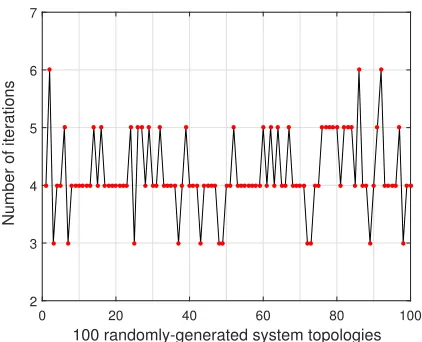
To further illustrate the convergence of Algorithm 1, we present the convergence process for 100 randomly-generated system topologies by the proposed Algorithm 1 in the suburban environment in Fig. 6. We initialize P0
u[n] =
¯
puIL,∀n, wherepu¯ =30dBm,P0a[n]= ¯paIL,∀n, wherepa¯ =
0dBm, 40 = [1,1, . . . ,1], and set the transmission power
budget Pmax = 30dBm, the transmission energy budget
Emax = 300J, the number of the UAVs L = 7. It can be
observed that for the most cases, Algorithm 1 can converge within 6 iterations and the ratio of iterations between 4 ∼5 could achieve 86%, which demonstrates the validity of the proposed scheme.
Fig. 7 illustrates secrecy throughput by Algorithm 1 versus the transmission power budget for each UAV in the suburban scenario. We assumeP0u[n]= ¯puIL,∀n, wherep¯u=20dBm,
[image:12.576.310.523.63.235.2]P0a[n] = ¯paIL,∀n, wherep¯a = 5dBm,40 = [1,1, . . . ,1],
[image:12.576.307.527.270.442.2]FIGURE 7. Secrecy throughput versus transmission power budget for each UAV.
FIGURE 8. Secrecy throughput versus total transmission energy budget for each UAV.
Emax=150J. From Fig. 7, we can see that secrecy through-put increases when the transmission power budget for each UAV becomes large. That is due to the fact that the increas-ing transmission power can enhance the achievable ergodic rate at the legitimate user or the eavesdropper. Furthermore, in our proposed scheme, the confidential message and AN are transmitted independently without cooperation at each UAV. Based on the large-scale CSI, each UAV could allocate more power to the confidential message to improve the achievable rate of Bob when the UAV swarm is close to the legitimate users. When the swarm is close to Eve, more power would be allocated to AN for decreasing the signal receiving quality of Eve. Also, for the same transmission power budget of each UAV, secrecy throughput increases as the number of UAVs in the swarm. Obviously, the larger the number of UAVs is, the higher the power of the confidential messages is, which significantly enhances the secrecy performance of the system. Fig. 8 depicts secrecy throughput achieved by Algo-rithm 1 versus the total transmission energy budget for each UAV in the suburban scenario. It is assumed thatP0u[n] = ¯