warwick.ac.uk/lib-publications Manuscript version: Author’s Accepted Manuscript
The version presented in WRAP is the author’s accepted manuscript and may differ from the published version or Version of Record.
Persistent WRAP URL:
http://wrap.warwick.ac.uk/128408
How to cite:
Please refer to published version for the most recent bibliographic citation information. If a published version is known of, the repository item page linked to above, will contain details on accessing it.
Copyright and reuse:
The Warwick Research Archive Portal (WRAP) makes this work by researchers of the University of Warwick available open access under the following conditions.
Copyright © and all moral rights to the version of the paper presented here belong to the individual author(s) and/or other copyright owners. To the extent reasonable and
practicable the material made available in WRAP has been checked for eligibility before being made available.
Copies of full items can be used for personal research or study, educational, or not-for-profit purposes without prior permission or charge. Provided that the authors, title and full
bibliographic details are credited, a hyperlink and/or URL is given for the original metadata page and the content is not changed in any way.
Publisher’s statement:
Please refer to the repository item page, publisher’s statement section, for further information.
Linear-Size Constant-Query IOPs for Delegating Computation
Eli Ben-Sasson [email protected]
StarkWare
Alessandro Chiesa [email protected]
UC Berkeley
Lior Goldberg [email protected]
StarkWare
Tom Gur
[email protected] University of Warwick
Michael Riabzev [email protected]
StarkWare
Nicholas Spooner [email protected]
UC Berkeley
Abstract
We study the problem of delegating computations via interactive proofs that can be probabilistically checked. Known asinteractive oracle proofs(IOPs), these proofs extend probabilistically checkable proofs (PCPs) to multi-round protocols, and have received much attention due to their application to constructing cryptographic proofs (such as succinct non-interactive arguments).
We prove that a rich class of NEXP-complete problems, which includes machine computations over large fields and succinctly-described arithmetic circuits, has constant-query IOPs withO(T)-size proofs andpolylog(T)-time verification forT-size computations. This is the first construction that simultaneously achieves linear-size proofs and fast verification, regardless of query complexity.
An important metric when using IOPs to delegate computations is the cost of producing the proof. The highly-optimized proof length in our construction enables a very efficient prover, with arithmetic complexity O(TlogT). Hence this construction is also the first to simultaneously achieve prover complexityO(TlogT)and verifier complexitypolylog(T).
Contents
1 Introduction 1
1.1 Our results . . . 2
1.2 Limitations of prior work . . . 5
1.3 Open questions . . . 6
2 Technical overview 8 2.1 Our starting point . . . 8
2.2 Checking succinctly-represented linear relations . . . 9
2.3 Checking bounded-space computations in polylogarithmic time . . . 11
2.4 Checking succinct satisfiability in polylogarithmic time . . . 12
2.5 Oracle reductions . . . 13
3 Roadmap 15 4 Preliminaries 16 4.1 Codes and polynomials . . . 16
4.2 Interactive oracle proofs . . . 17
5 Oracle reductions 18 5.1 Definitions . . . 18
5.2 Reed–Solomon oracle reductions . . . 20
6 Trace embeddings 22 6.1 Bivariate embeddings . . . 23
6.2 Successor orderings . . . 24
7 A succinct lincheck protocol 27 7.1 Properties of the Lagrange basis . . . 28
7.2 Efficient linear independence via the tensor product . . . 29
7.3 Proof of Lemma 7.4 . . . 31
7.4 Extension to block-matrix lincheck . . . 33
8 Probabilistic checking of interactive automata 34 8.1 Staircase matrices . . . 35
8.2 Proof of Lemma 8.2 . . . 37
9 Reducing machines to interactive automata 41 9.1 Matrix permutation check protocol . . . 42
9.2 Proof of Lemma 9.2 . . . 44
10 Proofs of main results 47 10.1 Checking satisfiability of algebraic machines . . . 47
10.2 Checking satisfiability of succinct arithmetic circuits . . . 48
Acknowledgments 50
1
Introduction
Checking computations faster than they can be run is a central goal in the theory of computation. The study of proof protocols that enable fast verification has produced powerful tools for complexity theory and cryptography, and has even led to applications to real-world problems such as delegation of computation. For applications, it is crucial that the underlying complexity-theoretic objects are efficient.
An influential line of work began withprobabilistically checkable proofs(PCPs) [BFLS91]. These are non-interactive proofs for membership in a language, which admit fast probabilistic verification based on local queries to the proof. While the most prominent application of PCPs is to hardness of approximation [FGLSS96], seminal works of Kilian [Kil92] and Micali [Mic00] showed that PCPs can also be used to obtain computationally-sound schemes for delegation of computation that are asymptotically efficient.
The application of PCPs to delegation of computation singles out particular design objectives, distinct from those that arise from hardness of approximation. The relevant complexity measures for PCPs in the context of delegation are:query complexity,verifier time, andprover time. The latter two are self-explanatory, since the proof must be produced and validated; the former arises because, in existing delegation schemes based on PCPs, communication complexity depends linearly on the query complexity of the underlying PCP. Note that the running time of the prover is not typically considered in the context of PCPs, because one considers only the existence of a valid PCP string and not how it is constructed. For delegation schemes, on the other hand, the time required to generate the proof is often a barrier to practical use.
An ideal PCP for delegation would haveconstantquery complexity,(poly)logarithmicverifier time, and
linearprover time. This naturally implies that theproof lengthmust also be linear, since it is a lower bound on the prover’s running time in most applications. State-of-the-art PCPs achieve constant query complexity and polylogarithmic verifier time, but onlyquasilinear(O(NlogcN)) proof length [Mie09]. While the proof length is asymptotically close to optimal,cis a fairly large constant, and moreover the construction uses gap amplification techniques that are not believed to be concretely efficient. Theonlyconstruction of PCPs with linear proof length has query complexityO(N)and a verifier that runs in non-uniform polynomial time [BKKMS13]; the running time of the prover is not specified. Clearly, these parameters are a long way from those desired of PCPs for fast verification of computation.
In light of these apparent barriers, Ben-Sasson et al. [BCS16] have demonstrated how to obtain computationally-sound delegation schemes frominteractive oracle proofs(IOPs). This is a natural gener-alization of PCPs independently introduced by [BCS16; RRR16] (also generalizing the “interactive PCP” model studied in [KR08]). An IOP is an interactive protocol consisting of multiple rounds, where in each round the verifier sends a challenge and the prover responds with a PCP oracle to which the verifier can make a small number of queries. The proof length of an IOP is the total length of all oracles sent by the prover, and the query complexity is the total number of queries made to these oracles. The study of IOPs explores the tradeoff between a new efficiency measure, round complexity, and other efficiency measures. Viewed in this way, a PCP is an IOP with optimal round complexity.
The work of [BCS16] justifies why exploiting the tradeoff between round complexity and other efficiency measures is potentially advantageous for constructing computationally-sound delegation schemes. In particu-lar, if we could obtain IOPs with constant round complexity that otherwise match the parameters of an ideal PCP (constant query complexity, polylogarithmic verifier time, linear prover time), then we would obtain delegation schemes that have the same asymptotic efficiency as those derived from an ideal PCP. Thus, for the purposes of verifiable delegation schemes, it suffices to construct such “ideal” IOPs.
Two of these constructions are particularly relevant for us: [BCGRS17] achieves IOPs for Boolean circuit satisfiability (CSAT) with linear proof length, unspecified polynomial prover time, and constant query and round complexity,1and [BCRSVW19] achieves logarithmic-round IOPs for arithmetic circuit satisfiability withO(N˜ logN)prover time,2linear proof length, and logarithmic query complexity.
However, these IOPs donothave sublinear verifier time (see Section 1.2). The state-of-the-art for IOPs with polylogarithmic verifier time is [BBHR18a], which achievesO(NlogN)proof length,O(N˜ log2N)
prover time, and logarithmic query and round complexity. Our goal in this paper is to make progress towards constructing ideal IOPs by giving a construction that simultaneously achieves the state of the art in all of these metrics: linear proof length,O(N˜ logN)prover time, constant query and round complexity, and polylogarithmic verifier time.
1.1 Our results
In this work we construct IOPs for algebraic computations over large fields that are “almost” ideal; namely, we achieve linear proof length,O(NlogN)(strictly quasilinear) prover arithmetic complexity, constant query and round complexity, andpolylogarithmicverifier time. Our new IOP protocols match the state-of-the-art proof length and prover complexity of [BCRSVW19], while at the same time achieving anexponential improvementin verifier time for a rich class of computations. We focus on arithmetic complexity as the natural notion of efficiency for IOPs for algebraic problems.3
The arithmetic complexity of our prover is tightly connected to the proof length. That is, the proof consists of a constant number of Reed–Solomon codewords of sizeO(N), and the running time of the prover is dominated by the time required to produce these encodings. In particular, if there were a linear-time encoding procedure for the Reed–Solomon code, our prover would run in linear time, and thereby achieve optimal prover efficiency without any other changes to the scheme itself.
Small fields. All of our results are stated over large fields. Computations over small fields (e.g. F2) can
be handled by moving to an extension field, which introduces an additional logarithmic factor in the proof length and prover time (the same is true of [BBHR18a; BCRSVW19]). Even with this additional logarithmic factor, our construction matches the state of the art for prover complexity (but not proof length) for succinct
booleancircuit satisfiability, while improving verifier time to polylogarithmic.
1.1.1 Delegating bounded-space algebraic computation
Rank-one constraint satisfiability (R1CS) is a natural generalization of arithmetic circuits that is widely used across theoretical and applied constructions of proof systems (see [Bow+18]). An R1CS instance is specified by matricesA, B, Cover a finite fieldF, and is satisfied by a vectorwifAw◦Bw =Cw, where◦is the
element-wise (Hadamard) product. Arithmetic circuits reduce in linear time to R1CS instances.
Many problems of interest, however, involve R1CS instances where the matricesA, B, C have some structure. For example, many applications consider computations that involve checking many Merkle authentication paths — in this case a hash function is invoked many times, within the same path and across different paths. It would be valuable for the verifier to run in time that is related to asuccinct representation
of such instances, rather than to the (much larger) explicit representation that “ignores” the structure. In light
1Subsequent to this work, [RR19] showed how to achieve such IOPs forCSATwhere the proof length is(1 +)Nfor any >0.
Their verifier runs in timeO˜(N).
2
Here theO˜notation hidespoly(log logN)factors.
3In terms of bit operations, the prover runs in timeO(N0 log2N0
poly(log logN0)) = ˜O(NlogN), whereN0=N/log|F|=
of this motivation, we introduce a notion ofsuccinctly-represented R1CS instancesthat capture a rich class of bounded-space algebraic computations. (Later in the paper we refer to these asalgebraic automata.)
Definition 1.1(informal). Asuccinct R1CSinstance is specified by matricesA= [A0|A1], B= [B0|B1], C= [C0|C1]∈Fk×2koverF, and a time boundT, and is satisfied by a vectorz∈FkT if
A0 A1 A0 A1
. .. ... A0 A1
w ◦
B0 B1 B0 B1
. .. ... B0 B1
w =
C0 C1 C0 C1
. .. ... C0 C1
w
The relationSuccinct-R1CSconsists of pairs(x, w)s.t.xis an instance of succinct R1CS satisfied byw.
The size of aninstanceisO(k2 + logT), but the size of the described computation iskT. Note that
Succinct-R1CSis aPSPACE-complete relation, while the (regular) R1CS relation is merelyNP-complete. To obtain some intuition about the definition, consider the problem of repeated application of an arithmetic circuitC:Fn → Fn. Suppose that we want to check that there existsz such that CT(z) = 0n, where CT = C(C(· · · C(·)))is the circuit that appliesC iterativelyT times. The circuitCT has sizeΩ(|C| ·T),
and if the verifier were to “unroll” the circuit then it would pay this cost in time. However, the R1CS instance corresponding toCT is of the above form, withk=O(|C|), where (roughly) the matricesA
0, B0, C0
represent the gates ofCandA1, B1, C1represent the wires between adjacent copies ofC. (The condition that
the output ofCT is zero is encoded separately as a “boundary constraint”; see Definition 8.1 for details.)
Our first result gives a constant-round IOP for satisfiability of succinct R1CS where the verifier runs in time
poly(k,logT), the prover has arithmetic complexityO(kTlogkT), and the proof length isO(kTlog|F|)
(linear in the computation transcript). In the theorem statement below we takek=O(1)for simplicity.
Theorem 1(informal). There is a universal constant0 ∈(0,1)such that, for any computation time bound T(n)and large smooth field familyF(n), there is a4-round IOP for succinct R1CS overF(n), with proof
lengthO(T(n) log|F(n)|), 4 queries, and soundness error0. The prover uses O(T(n) logT(n))field operations and the verifier usespoly(n,logT(n))field operations.
As in prior work (e.g., [BS08]), “large smooth field” refers to a field of sizeΩ(N), whose additive or multiplicative group has a nice decomposition (see Definitions 10.2 and 10.3). For example, ensembles of large enough binary fields have this property, as well as prime fields with smooth multiplicative groups.
1.1.2 Delegating unbounded-space algebraic computation
While algebraic automata capture a useful class of computations, they are restricted to space-bounded compu-tation (recallSuccinct-R1CS∈PSPACE). In particular, they do not capture generalNEXPcomputations unlessPSPACE =NEXP. Our second result shows that aNEXP-complete algebraic problem, namely a succinct version of thearithmetic circuit satisfiabilityproblem over large fields, has efficient IOPs.
Succinct SAT. In more detail, first recall the NP-complete problem of arithmeticcircuit satisfiability, denotedASAT, in which the goal is to decide whether an arithmetic circuitC:Fk →Fover a finite fieldF
has a satisfying assignment or not. Then, to captureNEXP, we follow Papadimitriou and Yannakakis [PY86] and consider asuccinctversion of the arithmetic circuit satisfiability problem, denotedSuccinct-ASAT.4In
4
this variant of the problem, we consider the satisfiability of circuits of sizeN that are represented by circuit descriptors of sizeO(logN). These descriptors are themselves circuits that, given a gate indexg, return the type of gateg(addition or multiplication), its left input gate, and its right input gate.
Definition 1.2(informal). The relationSuccinct-ASATconsists of pairs (F, m, H, I, o, D), w, whereFis
a finite field,m∈N,His a succinctly-represented subset ofFmrepresenting the gates of the circuit,I is a subset ofHrepresenting the input gates,o∈His the output gate,D:H→({+,"} ×H×H)∪ {F}is a circuit descriptor of an arithmetic circuitC, and the witnessw:I →Fis such thatC(w) = 0.
Our second result is an IOP forSuccinct-ASATthat has linear proof length and constant query complexity. We stress that the verifier in this IOP runs in(poly)logarithmictime in the sizeN of the circuit.5
Theorem 2 (informal). There is a universal constant0 ∈ (0,1) such that there is a5-round IOP for
Succinct-ASATover large smooth fields with proof lengthO(N),5queries, and soundness error0. The prover usesO(NlogN)field operations and the verifier usespoly(|D|,logN)field operations.
As in prior work (e.g., [BS08]), “large smooth field” refers to a field of sizeΩ(N), whose additive or multiplicative group has a nice decomposition (see Definition 10.2). For example, ensembles of large enough binary fields have this property. Aroundconsists of a verifier message followed by a prover (oracle) message.
The single logarithmic factor in the prover’s arithmetic complexity solely comes from the use of a constant number of Fast Fourier transforms over domains of sizeΘ(N). This prover time matches the best prover times of protocols fornon-succinctarithmetic circuit satisfiability (which is merelyNP-complete).
We remark that standard query reduction techniques donotpreserve linear proof length here. Nevertheless, they can be modified in a straightforward way to preserve it, at the cost of an additional round of interaction. In particular, the number of queries in Theorem 2 can be reduced to2at the cost of an additional round.
Algebraic machines. We prove Theorem 2 by designing an IOP for thealgebraic machinerelation. This is a natural algebraic analogue of the bounded accepting problem for nondeterminstic random-access machines, where the transition function is an arithmetic (rather than Boolean) circuit. There is a simple linear-size reduction fromSuccinct-ASATto the satisfiability problem for algebraic machines: the machine holds the values of the wires in its memory, and checks that each gate is correctly evaluated.
Theorem 3(informal). There is a universal constant0 ∈(0,1)such that, for any computation time bound T(n)and large smooth fieldF(n), there is a5-round IOP for the satisfiability problem ofT(n)-time algebraic
machines overF(n), with proof lengthO(T(n) log|F(n)|),5queries, and soundness error0. The prover usesO(T(n) logT(n))field operations and the verifier usespoly(n,logT(n))field operations.
For simplicity, we have stated Theorem 3 for machines whose description is a constant number of field elements, orΘ(log|F|)bits. The proof length islinearin the size of the computation trace, which is
N := Θ(Tlog|F|)bits. We stress that the number of queries is5,regardlessof the machine.
On the power of machines. In the linear-length regime, the choice of computational model supported by a proof protocol is important, because reductions between problems typically introduce logarithmic factors. For example, it is not known how to reduce a random-access machine, or even a Turing machine, to a circuit of linear size. Indeed, the linear-size sublinear-query PCP of [BKKMS13] only works for circuit but not machine computations. We thus view Theorem 3 as particularly appealing, because it achieves linear length for a powerful model of computation, algebraic machines, which facilitates linear-size reductions from many
5
other problems. Notably, while Theorem 3 implies Theorem 2,we do not know whether the converse holds. We view the identification of a model which is both highly expressive and amenable to efficient probabilistic checking using IOPs as a contribution of this work.
rounds circuit type prover time verifier time proof length queries
[Mie09] 1 succinct boolean Npolylog(N)∗ polylog(N) Npolylog(N) O(1)
[BKKMS13] 1 boolean poly(N)† poly(N)† O(N) N
[BCGRS17] 3 boolean poly(N) poly(N) O(N) O(1)
[BBHR18a] O(logN) succinct arithmetic♦ O(Ne log2N)‡ polylog(N) O(NlogN) O(logN)
[BCRSVW19] O(logN) arithmetic♦ O(Ne logN)‡ poly(N) O(N) O(logN)
this work 5 succinct arithmetic♦ O(Ne logN)‡ polylog(N) O(N) 5
Table 1: Comparison of PCP/IOP constructions for circuit satisfiability problems for a (fixed) constant soundness. HereNis the size of the circuitin bits, which means that, for arithmetic circuits,Nimplicitly includes a factor oflog|F|. For succinct problems, the circuit sizeN is exponential in the size of its
description.
∗: [Mie09] shows apoly(N)bound; this tighter bound is due to [BCGT13b].
♦: The size of the underlying field must grow asΩ(N)to achieve the stated efficiency. Problems over smaller fields (e.g. boolean circuits) incur a multiplicative cost oflogNin prover time and proof length.
†: The specified time is fornon-uniformcomputation (each input size receivespoly(N)advice bits).
‡: The notationOehidespoly(log logN)factors, which arise because here we consider thebit complexity of the prover (rather than the arithmetic complexity).
1.2 Limitations of prior work
There are relatively few works that explicitly deal with prover complexity for PCP and IOP constructions. We present a comparison of the relevant parameters for each construction in Table 1. Since we are concerned with logarithmic factors, it is not sufficient to specify only a complexity class (NPorNEXP) for each one. Instead, for each proof system we give a canonical expressive language for which the given parameters are achieved. In particular, the first three proof systems are for boolean circuit problems, and the latter three are for arithmetic circuit problems. For purposes of comparison, all of the parameters for both boolean and arithmetic constructions are presented in terms of bit complexity.
Our construction also achieves asymptotically optimal proof length and query complexity, which are more well-studied metrics. There are two natural approaches that one could take to achieve such a result: (1) start from a construction with constant query complexity and reduce proof length; or (2) start from a construction with linear proof length and reduce query complexity. We summarize prior works that have followed these approaches, and highlight the limitations that arise in each case.
Approach (1). The first approach has been studied extensively [BFLS91; PS94; HS00; BSVW03; GS06; BGHSV06], leading to PCPs forNEXPwith proof lengthNpolylog(N)and query complexityO(1)[BS08; BGHSV05; Din07; Mie09]. Later works have reduced the logarithmic factors in the proof length [BCGT13b; BCGT13a], but attempts to achieve linear length have failed. Recent work has obtained IOPs with proof length
O(NlogN)but at the cost of increasing query complexity fromO(1)toO(logN)[Ben+17; BBHR18a].
length. For example, one cannot rely on arithmetization via multivariate polynomials and standard low-degree tests, nor rely on algebraic embeddings via de Bruijn graphs for routing; in addition, query-reduction techniques for interactive PCPs [KR08] do not apply to the linear proof length regime. The state-of-the-art in linear-length PCPs is due to [BKKMS13], and the construction is based on a non-uniform family of algebraic geometry (AG) codes (every input size needs a polynomial-size advice string). In more detail, [BKKMS13] proves that for every∈(0,1)there is a (non-uniform) PCP for theNP-complete problemCSAT(Boolean circuit satisfiability) with proof length2O(1/)N and query complexityN, much more than our goal ofO(1).
By leveraging interaction, [BCGRS17] obtains IOPs forCSATwith proof lengthO(N)and query com-plexityO(1). This is a natural starting point for our goal of achieving polylogarithmic-time verification, because we are “only” left to extend this result fromCSATto its succinct analogue,Succinct-CSAT. Unfor-tunately, the construction in [BCGRS17] uses AG codes and such an extension would, in particular, require obtaining a succinct representation of a dense asymptotically good family of AG codes over a small field, which is out of reach of current techniques. More generally, we do not know of any suitable code over small fields, which currently seems to prevent us from obtaining linear-size IOPs forSuccinct-CSAT.
We now consider arithmetic circuit satisfiability defined over fieldsFthat are large (of sizeΩ(N)). In
this regime, [BCRSVW19] obtains IOPs forASATwith proof lengthO(N)and query complexityO(logN). The arithmetization, following [BS08], is based on the Reed–Solomon code and uses the algebraic structure of large smooth fields. Testing is done via FRI [BBHR18b], a recent IOP of proximity for the Reed–Solomon code with linear proof length and logarithmic query complexity. The construction in [BCRSVW19], which we will build upon, falls short of our goal on two fronts: verifier time is linear in the size of the circuit rather than polylogarithmic, and query complexity is logarithmic rather than constant.
Comparison with [Ben+17; BBHR18a]. The techniques that we use in this work to achieve linear proof length could be applied to the protocols of [Ben+17; BBHR18a], which would yield linear-size proofs there. In this modified protocol, however, in order to verify time-T computations the verifier must read
O(logT)field elements from the proof (see e.g. [BBHR18a, Lemma B.9]); in our protocol, the number of field elements the verifier reads is a universal constant. This is because the query complexity of these protocols depends linearly on the size of the description of the transition function of the machine (e.g., for
Succinct-ASAT, this would be the size of the circuit descriptor).
1.3 Open questions
We highlight four problems left open by our work.
Optimal arithmetic complexity. The prover in our construction has strictly quasilinear arithmetic com-plexity and produces a proof of linear size. A natural question is whether the arithmetic comcom-plexity of the prover can be reduced to linear. To do so with our construction would require a breakthrough in encoding algorithms for the Reed–Solomon code. A promising direction may be to build IOPs based on codes with linear-time encoding procedures [Spi96; GI05; BCGGHJ17].
All fields. The question of whether it is possible to simultaneously achieve linear-length proofs and polylogarithmic-time verifier forSuccinct-ASAToveranyfieldFremains open. Progress on this question
motivates the search for arithmetization-friendly families of good codes beyond the Reed–Solomon code. For example, the case ofF=F2, which corresponds to boolean circuits, motivates the search for
succinctly-represented families of good algebraic-geometry codes over constant-size fields with fast encoding algorithms.
simulator runs in time polynomial in the size of the computation being checked, which is meaningful for nondeterministic problems since it does not have access to the witness.
There is a stronger notion of zero knowledge for succinct languages where the simulator runs in polyloga-rithmictime (in time polynomial in the size of the instance). This gap was precisely the subject of a work on designing succinct simulators for certain tests [BCFGRS17]. Whether low-degree tests with the parameters we require have succinct simulators remains an intriguing problem that we leave to future research.
2
Technical overview
We discuss the main ideas behind our results. Recall thatSuccinct-ASATis the satisfiability problem for succinctly-represented arithmetic circuits over the fieldF; this problem isNEXP-complete for any fieldF
[PY86]. Our goal is to construct an IOP forSuccinct-ASAT, over a large fieldF, with proof length that is
linear in the size of the circuitNand strictly quasilinear (O(NlogN)) prover arithmetic complexity; crucially, the running time of the verifier ispolylogarithmicin the size of the circuit (more precisely, polynomial in the size of the circuit descriptor). Additionally, we strive to optimize the query and round complexity of this IOP. We stress that no prior work achieves non-trivial linear-length PCPs or IOPs wherein the verifier runs in polylogarithmic time in the size of the circuit.
The rest of this section is organized as follows. In Section 2.1 we discuss our starting point, which is a construction of [BCRSVW19]. In Section 2.2 we discuss our approach to overcoming the limitations of prior work by describing a new protocol for checking succinctly-represented linear relations; this achieves anexponentialimprovement over the prior state of the art. In Section 2.4 we discuss how to overcome the challenges that arise when attempting to build on this exponential improvement to checking the computation of algebraic automata, and then of algebraic machines (which captureSuccinct-ASATas a special case). In Section 2.5 we describe a modular framework, which we calloracle reductions, in which we prove our results.
2.1 Our starting point
The starting point of our work is [BCRSVW19], which obtains IOPs forASAT(arithmetic circuit satisfiability) with proof lengthO(N)and query complexityO(logN), and in which the prover usesO(NlogN)field operations and the verifier usesO(N). More precisely, this prior work obtains IOPs for anNP-complete problem that has a linear-time reduction from ASAT. The problem is denoted R1CS and captures the satisfiability ofrank-1 constraint systems: given matricesA, B, C over a finite fieldF, the problem asks
whether there exists a witness vectorw, where some entries are fixed to known values, for which the following
R1CS equationholds:(Aw)◦(Bw) =Cw, where “◦” denotes entry-wise product.
Our goal in this paper is to achieve an IOP forSuccinct-ASAT, the succinct analogue ofASAT. This entails anexponentialimprovement in the running time of the verifier, from linear in the circuit size to polylogarithmic in the circuit size. Moreover, we need to achieve this improvement with proof lengthO(N)
and query complexityO(1)(and a prover that usesO(NlogN)field operations). At a high level, our strategy towards this goal is to prove that there exists a class of succinctly-representable R1CS instances such that: (i) there exists a linear time reduction fromSuccinct-ASATto R1CS that produces an instance in this class; and (ii) design an IOP protocol with the aforementioned parameters for R1CS instances in this class.
The ideas behind our results are better understood if we first briefly recall the IOP of [BCRSVW19]. The prover sends to the verifier four oraclesπw, πA, πB, πC that are purported encodings ofw, Aw, Bw, Cw.
The verifier must now check two sub-problems: (a) ifπw encodeswthenπA, πB, πC respectively encode Aw, Bw, Cw; and (b) ifπA, πB, πCencodewA, wB, wCthenwA◦wB=wC.
As usual, there is a tension in selecting the encoding used to obtain the oraclesπw, πA, πB, πC. One
needs an encoding that allows for non-trivial checking protocols, e.g., where the verifier makes a small number of queries. On the other hand, the encoding must have constant rate so that proof length can be linear.
The encoding used relies on univariate polynomials: denote byRS [L, ρ]⊆FLthe Reed-Solomon code
over a subsetLof a fieldFwith rate parameterρ∈(0,1](that is, the set of all functionsf:L→Fof degree
x∈FH iff(a) =ˆ x
afor alla∈H; for eachx, there is a unique encodingfxofxof minimal rate. We can
now restate the aforementioned sub-problems in terms of the Reed–Solomon code.
• Lincheck: given a subsetH ⊆ F, Reed–Solomon codewordsf, g ∈ RS [L, ρ]that encode x, y ∈ FH
respectively, and a matrixM ∈FH×H, check thatM x=y.
• Rowcheck: given a subset H ⊆ F and Reed–Solomon codewords f, g, h ∈ RS [L, ρ] that encode
x, y, z ∈FH respectively, check thatx◦y=z.
The IOP in [BCRSVW19] is obtained by combining sub-protocols for these sub-problems, alincheck protocol
and arowcheck protocol. The latter is a simple reduction from the rowcheck problem to testing membership in the Reed–Solomon code, and is implied by standard PCP tools. The former, however, is a novel (and non-trivial) reduction from the lincheck problem to testing membership in the Reed–Solomon code.
While on the one hand the verifier in the rowcheck protocol runs in time that is polylogarithmic in|H|
(which is good) the verifier in the lincheck protocol runs in time that is linear in|H|(which is much too slow). In other words, if we simply invoked the IOP in [BCRSVW19] on the circuit described by an instance of
Succinct-ASAT, the verifier would run in time that is linear in the circuit size, which is exponentially worse than our goal of polylogarithmic time. This state of affairs in the starting point of our work.
Next, in Section 2.2, we discuss how to obtain a succinct lincheck protocol that, for suitable linear relations, is exponentially more efficient. After that, in Section 2.4, we discuss how to build on our succinct lincheck protocol to reduceSuccinct-ASATto testing membership in the Reed–Solomon code, while achieving verifier time that ispolylogarithmicin circuit size.
Throughout, we present our contributions asoracle reductionsfrom some computational task to testing membership in the Reed–Solomon code. Loosely speaking, these are are reductions in the setting of the IOP model (and therefore, in particular, allow interaction in which the prover sends PCP oracles). This abstraction allows us to decouple IOP protocol-design from the low-degree test that we invoke at the end of the protocol. See Section 2.5 for details.
2.2 Checking succinctly-represented linear relations
Following the above discussion, we now temporarily restrict our attention to devising a lincheck protocol, which reduces checking linear relations defined by matrices M ∈ FH×H to testing membership in the
Reed–Solomon code, in which the verifier runs in time that ispolylogarithmicin|H|. This is not possible in general, however, because the verifier needs to at leastread the descriptionof the matrixM. We shall have to consider matricesM that have a special structure that can be exploited to obtain an exponential improvement in verifier time. This improvement is a core technical contribution of this paper, and we refer to the resulting reduction as thesuccinct lincheck protocol. We start by describing the ideas behind the (non-succinct) lincheck protocol of [BCRSVW19].
Definition 2.1(informal). In the lincheck problem, we are given a subsetH ⊆F, Reed–Solomon codewords
f, g∈RS [L, ρ]encoding vectorsx, y∈FH, and a matrixM ∈
FH×H. The goal is to check thatx=M y.
A simple probabilistic test for the claim “x = M y” is to check thathr, x−M yi = 0 for a random
r∈FH. Indeed, ifx6=M y, thenPr
r∈FH[hr, x−M yi= 0] = 1/|F|. However, this approach would require
the verifier to sample, and send to the prover,|H|random field elements (too many).
A natural derandomization is to choose~rusing a small-bias generator overF, rather than uniformly at
random. A small-bias generatorGoverFis a function with the property that for any nonzeroz ∈FH, it
holds with high probability overρ∈ {0,1}`thathz, G(ρ)i 6= 0. Now the verifier needs to send only`bits to
A natural choice (used also, e.g., in [BFLS91,§5.2]) is the powering construction of [AGHP92], which requires sending asinglerandom field element (`= log|F|), and incurs only a modest increase in soundness error. In this construction, we define a vector~r(X) ∈F[X]H of linearly independent polynomials inX,
given by(1, X, X2, . . . , X|H|−1). The small-bias generator is thenG(α) :=~r(α)forα∈F. Ifzis nonzero thenh(X) :=h~r(X), ziis a nonzero polynomial and soPrα∈F[hG(α), zi= 0]≤deg(h)/|F|. The verifier
now merely has to sample and sendα ∈F, and the prover must then prove the claim “h(α) = 0” to the
verifier. Rearranging, this is the same as testing thath~r(α), xi − h~r(α)M, yi = 0. The problem is thus reduced to checking inner products of known vectors with oracles.
In the setting of Reed–Solomon codewords, iffuis an encoding ofuandfvis an encoding ofv, then
fu·fvis an encoding ofu◦v, the pointwise product ofuandv. Hence, to check thathu, vi=c, it suffices
to check that the low-degree polynomialfu·fv sums toconH, sincehu, vi=Ph∈Hfu(h)fv(h). This can
be achieved by running theunivariate sumcheck protocol([BCRSVW19]) on the codewordfu·fv. This protocol requires the verifier to efficiently determine the value offu·fvat a given point inL.
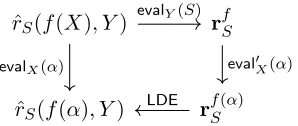
The inefficiency. The foregoing discussion tells us that, to solve the lincheck problem, the verifier must determine the value of the Reed–Solomon encodings of~r(α)◦xand~r(α)M ◦yat a given point inL. The encodings of the vectorsxandyare provided (asf andg). Hence it suffices for the verifier to evaluate
low-degree extensionsof~r(α)and~r(α)M at a given point, and then perform a field multiplication.
This last step is the computational bottleneck of the protocol. In [BCRSVW19], the verifier evaluates the low-degree extensions of~r(α)andM>~r(α)via Lagrange interpolation, which requires timeΩ(|H|). To make our verifier efficient, we must evaluate both low-degree extensions in timepolylog(|H|). In particular, this requires thatM be succinctly represented, since computing the low-degree extension of~r(α)M in general requires time linear in the number of nonzero entries inM, which is at least|H|.
The lincheck protocol in [BCRSVW19] chooses the linearly independent polynomials~r(X)to be the
standard(orcoefficient) basis(1, X, . . . , X|H|−1). For this basis, however, we do not know how to efficiently evaluate the low-degree extension of~r(α). This problem must be addressedregardlessof the matrixM.
A new basis and succinct matrices. We leverage certain algebraic properties to overcome the above problem. There is another natural choice of basis for polynomials, the Lagrange basis(LH,h(X))h∈H,
whereLH,h is the unique polynomial of degree less than|H|withLH,h(h) = 1andLH,α(γ) = 0for all γ ∈H\ {h}. We observe that the low-degree extension of~r(α) = (LH,h(α))h∈H ∈FH has a simple form
that allows one to evaluate it in timepolylog(|H|)provided thatH is an additive or multiplicative subgroup ofF. In other words, the Lagrange basis yields a small-bias generator overFwhose low-degree extension
can be computed efficiently.
It remains to find a useful class of succinctly-represented matrices M for which one can efficiently evaluate a low-degree extension of~r(α)M ∈FH. The foregoing discussion suggests a natural condition:
if we can efficiently compute a low-degree extension of a vector v ∈ FH thenwe should also be able to
efficiently compute a low-degree extension of the vectorvM. If this holds for all vectorsv, we say that the matrixMis (algebraically)succinct. For example, the identity matrix satisfies this definition (trivially), and so does the matrix with1s on the superdiagonal for appropriate choices ofFandH(see Section 8.1).
In sum, if we choose the Lagrange basis in the lincheck protocol and the linear relation is specified by a succinct matrix, then, with some work, we obtain a lincheck protocol where the verifier runs in time
polylog(|H|). To check satisfiability of succinctly-represented arithmetic circuits, however, we need to handle a more general class of matrices, described next.
We show that the matrices that we consider aresemisuccinct, namely, they can be decomposed into a “large” part that is succinct and a “small” part that has no special structure.6 This structure should appear familiar, because it is analogous to how a succinctly-described circuit consists of a small arbitrary component (the circuit descriptor) that is repeatedly used in a structured way to define the large circuit. Another analogy is how in an automaton or machine computation a small, and arbitrary, transition function is repeatedly applied across a large computation.
Specifically, by “decompose” we mean that the matrixM ∈ FH×H can be written as theKronecker product of a succinct matrix A ∈ FH1×H1 and a small matrix B ∈
FH2×H2; we write M = A ⊗B.
(Succinctly representing a large operator like M via the tensor product of simpler operators should be a natural idea to readers familiar with quantum information.) In order for the product to be well-defined, we must supply a bijectionΦ : H → H1×H2. If this bijection satisfies certain algebraic properties, which
preserve the succinctness of the matrixA, we call it abivariate embedding. We obtain a succinct lincheck protocol for semisuccinct matrices.
Lemma 2.2(informal). There is a linear-length oracle reduction from the lincheck problem for semisuccinct matrices to testing membership in the Reed–Solomon code, where the verifier runs in polylogarithmic time.
Next, we discuss how to obtain a reduction from algebraic automata (succinct R1CS) to testing member-ship in the Reed–Solomon code, where the verifier runs in time that ispolylogarithmicin the circuit size, by building on our succinct lincheck protocol for semisuccinct matrices.
2.3 Checking bounded-space computations in polylogarithmic time
An instance of thealgebraic automatonrelation is specified by threek×2kmatrices(A, B, C)overF, and
a time boundT. A witnessf: [T]→Fkis valid if
∀t∈[T−1] Af(t, t+ 1)◦Bf(t, t+ 1) =Cf(t, t+ 1) , (1)
wheref(t, t+ 1) :=f(t)kf(t+ 1)is the concatenation of the consecutive statesf(t)∈Fkandf(t+ 1)∈Fk.
We use the term “algebraic automata” since one can think ofA, B, Cas specifying the transition relation of a computational device withkalgebraic registers, andf as anexecution tracespecifying an accepting computation of the device. The relation isPSPACE-complete: it is inNPSPACEbecause it can be checked by a polynomial-space Turing machine with one-directional access to an exponential-size witness, and recall that
NPSPACE=PSPACE; also, it isPSPACE-hard because given an arithmetic circuit specifying the transition relation of a polynomial-space machine, we can find an equisatisfiable R1CS instance in linear time.
If we view the execution trace f as a vectorf = f(1)k · · · kf(T) ∈ FT k, then we can rewrite the
condition in Eq. (1) via the following (possibly exponentially large) R1CS equation:
A0 A1 A0 A1
. .. ...
A0 A1
f ◦
B0 B1 B0 B1
. .. ...
B0 B1
f =
C0 C1 C0 C1
. .. ...
C0 C1
f
whereA0, A1∈Fk×kare the first half and second half ofArespectively; and likewise forBandC. We thus
see that algebraic automata are equivalent toSuccinct-R1CS.
The matrices in the above R1CS equation have a rigid block structure that we refer to as astaircase. Given the discussions in Sections 2.1 and 2.2, in order to achieve polylogarithmic verifier time,it suffices to show that staircase matrices are semisuccinct(or, at least, the sum of few semisuccinct matrices).
So letS(M0, M1)be the staircase matrix of two givenk×kmatricesM0, M1overF. Namely,S(M0, M1)
is theT k×T kmatrix withM0-blocks on the diagonal andM1-blocks on the superdiagonal. Observe that:
1. we can write the matrix withM0-blocks on the diagonal asI⊗M0, whereIis theT×T identity matrix;
2. we can write the matrix withM1-blocks on the superdiagonal asI)⊗M1, whereI)is theT×Tmatrix
with1s on the superdiagonal.
Under an appropriate mapping from [T k]into a subset of F, we prove that both of these matrices are
semisuccinct. This tells us thatS(M0, M1)is the sum of two semisuccinct matrices:
S(M0, M1) :=
M0 M1 M0 M1
. .. ...
M0 M1 M0
=I⊗M0+I)⊗M1 ∈FT k×FT k .
(Note that the above is not exactly the matrix structure we want, because of the extraM0block; we handle
this technicality separately.) We obtain the following lemma.
Lemma 2.3(informal). There is a linear-length oracle reduction from the algebraic automaton relation to testing membership in the Reed–Solomon code, where the verifier runs in timepoly(k,logT).
2.4 Checking succinct satisfiability in polylogarithmic time
We outline our construction of a linear-length IOP for succinct circuit satisfiability (Succinct-ASAT) over a large smooth fieldF. Informally, our strategy is as follows. First, we note that there is a simple linear-size
reduction (see Section 10.2) fromSuccinct-ASATto satisfiability of an algebraic automaton augmented with a permutation constraint; we refer to the latter as analgebraic machine. Then, we prove that checking such an instance can be reduced to checking an algebraic automatonwithoutthe permutation constraint, which can be achieved as described in the previous section. In the remainder of this section we discuss the main technical challenges that arise in this approach.
An instance of thealgebraic (R1CS) machinerelation is specified by two algebraic (R1CS) automata
(A,A0). A witness(f, π), wheref: [T]→ Fkis an execution trace andπ: [T]→ [T]is a permutation, is
valid if: (1)f is a valid witness for the automatonA, and (2)f ◦π is a valid witness for the automaton
A0. The algebraic machine relation isNEXP-complete, asSuccinct-ASATreduces to it in linear time (see Section 10.2).
Classical techniques of Gurevich and Shelah [GS89] tell us that one can efficiently represent an execution trace for a machine viatwoexecution traces that arepermutations of one another. Informally, sorting the execution trace by time enables us to check the transition relation of the machine; and sorting the execution trace by the accessed addressed (and then by time) enables us to locally check that memory is consistent. (One must ensure that, for each location, if we write some value to memory and then read the same address, we retrieve that same value.) The transition relation and memory consistency can each be expressed individually as automata. This view of machines immediately gives rise to the algebraic machine relation above.
Checking the algebraic machine relation. We have discussed how to check automata in Section 2.3, so it remains to check that the traces are permutations of one another. Historically this has been achieved in the PCP literature using algebraic embeddings of routing networks; e.g., see [BCGT13a]. The problem is that this increases the size of the representation of the execution trace by at least a logarithmic factor. We instead use an interactive permutation test from the program checking literature [Lip89; BK95]. The test is based on the observation thatu∈FT is a permutation ofv∈FT if and only if the multi-sets given by their elements
are equal, which is true if and only if the polynomialspu(X) =QT
i=1(X−ui)andpv(X) =
QT
i=1(X−vi)
are equal. Thus it suffices to evaluate each polynomial at a random point and check equality.
These polynomials require time Θ(T)to evaluate, which in our setting is exponential. Therefore the prover must assist the verifier with the evaluation. We show that evaluating this polynomial can be expressed as an algebraic automaton, and can therefore be checked again using the protocol from Section 2.3.
The reader may believe that by now we have reduced checking an algebraic machine to checking three instances of algebraic automata. Recall, however, that the algebraic automaton relation isPSPACE -complete, whereas the algebraic machine relation isNEXP-complete. What happened? The answer lies in the randomness used in the permutation automaton. In order to check thatuis a permutation ofv, the prover must first commit touandvbefore the verifier chooses his evaluation pointα, and then the prover sends the trace of the automaton that evaluatespu(α), pv(α). This trace depends on the choice ofα, and so we use
interaction. This is captured by theinteractive automaton relation(Definition 8.1), which isNEXP-complete; it can be checked in essentially the same way as the automaton relation described in Section 2.3.
We hence obtain the following lemma.
Lemma 2.4 (informal). There is a linear-length oracle reduction from the algebraic machine relation (hence,Succinct-ASAT) to testing membership in the Reed–Solomon code, where the verifier runs in time poly(k,logT).
2.5 Oracle reductions
Many results in this paper describe IOPs that reduce a computational problem to membership in (a subcode of) the Reed–Solomon code. We find it useful to capture this class of reductions via a precise definition. This lets us prove general lemmas about such reductions, and obtain our protocols in a modular fashion.
We thus formulate a new notion that we callinteractive oracle reductions(in short,oracle reductions). Informally, an oracle reduction is a protocol that reduces from a computational problem to testing membership in a code (in this paper, the code is the interleaved Reed–Solomon code). This is a well-understood idea in constructions of PCPs and IOPs. Our contribution is to provide a formal framework for this technique.
We describe an oracle reduction that maps the foregoing problem to the problem of testing membership in the Reed–Solomon code of the related polynomialg:=f /ZH. Observe thatf is divisible byZH if and
only iffis zero everywhere inH, and sogis in the Reed–Solomon code if and only iff satisfies the desired property. But what exactlyisg? In the oracle reduction framework, we refer togas avirtual oracle: an oracle whose value at any given point in its domain can be determined efficiently by making a small number of queries to concrete oracles. In this case, so long as the domainLwe choose forgdoes not intersectH, a verifier can evaluategat any pointα∈Lwith only a single query tof. To test thatgis low degree, the verifier can invoke any low-degree test ong, and simulate queries to the virtual oraclegvia queries tof.
The two main parameters in an oracle reduction are theproof length, which is simply the total length of the oracles sent by the prover, and thelocality, which is the number of queries one would have to make to the concrete oracles to answer a single query to any virtual oracle (in this paper, locality always equals the number of rounds). Using the perspective of oracle reductions, our main theorems (Theorems 1 and 2) follows by combining two main sub-components: (1) a linear-length3-local oracle reduction from theSuccinct-ASAT
problem to proximity testing to the Reed–Solomon code (discussed in Section 2.4); and (2) a linear-length
3
Roadmap
Fig. 1 below provides a diagram of the results proved in this paper. The remaining sections in this paper are organized as follows. In Section 4 we recall useful notions and definitions. In Section 5 we define oracle reductions, and prove how to create IOP protocols from RS oracle reductions and RS proximity tests. In Section 6 we define and construct trace embeddings. In Section 7 we describe our succinct lincheck protocol. In Section 8 we describe an oracle reduction from R1CS automata to testing proximity to the Reed–Solomon code, proving Theorem 1. In Section 9 we describe an oracle reduction from R1CS machines to testing proximity to the Reed–Solomon code. In Section 10 we prove Theorem 2 and Theorem 3.
Theorem 1:
IOP for succinct R1CS
Theorem 2:
IOP for succinct arithmetic circuits
Theorem 3:
IOP for algebraic machines
[BCGRS17]:
linear-size constant-query IOP of proximity for RS
with polylog verifier
[BCRSVW19]:
univariate sumcheck
Lemma 7.4:
succinct lincheck
Lemma 8.2:
(interactive) algebraic automata
Lemma 9.2:
algebraic machines
Corollary 5.10:create IOP protocol from RS oracle reduction and RS proximity test
4
Preliminaries
Given a relationR ⊆S×T, we denote byL(R) ⊆S the set ofs∈S such that there existst ∈T with
(s, t)∈ R; fors∈S, we denote byR|s⊆T the set{t∈T : (s, t)∈ R}. Given a setSand stringsv, w∈ Snfor somen∈N, thefractional Hamming distance∆(v, w)∈[0,1]is∆(v, w) := n1|{i:vi6=wi}|. We
denote the concatenation of two vectorsu1, u2 byu1ku2, and the concatenation of two matricesA, B by [A|B]. All fieldsFin this paper are finite, and we denote the finite field of sizeqbyFq. We say thatHis a subgroupinFif it is either a subgroup of(F,+)(an additive subgroup) or of(F\ {0},×)(a multiplicative
subgroup); we say thatHis acosetinFif it is a coset of a subgroup inF(possibly the subgroup itself).
4.1 Codes and polynomials
The Reed–Solomon code. Given a subsetSof a fieldFandrateρ∈(0,1], we denote byRS [S, ρ]⊆FS
all evaluations over S of univariate polynomials of degree less thanρ|S|. Namely, a wordc ∈ FS is in RS [S, ρ]if there is a polynomial of degree less thanρ|S|that, for everya∈S, evaluates tocaata. We denote byRS [S,(ρ1, . . . , ρn)] :=Qni=1RS [S, ρi]the interleaving of Reed–Solomon codes with ratesρ1, . . . , ρn. Representations of polynomials. We frequently move from univariate polynomials overFto their
evalu-ations on subsets ofF, and back. We use plain letters likef, g, h, πto denoteevaluationsof polynomials,
and “hatted letters”f ,ˆg,ˆ ˆh,πˆto denote corresponding polynomials. This bijection is well-defined only if the size of the evaluation domain is larger than the degree. Iff ∈RS [S, ρ]forS ⊆Fandρ∈(0,1], thenfˆis the unique polynomial of degree less thanρ|S|whose evaluation onSequalsf. Likewise, iffˆ∈F[X]with
deg( ˆf)< ρ|S|, thenfS := ˆf|S ∈RS [S, ρ](but we drop the subscript when the subset is clear from context). Vanishing polynomials. LetFbe a finite field, andS ⊆F. We denote byZSthe unique non-zero monic
polynomial of degree at most|S|that is zero everywhere onS;ZSis called thevanishing polynomialofS.
In this work we use efficiency properties of vanishing polynomials for setsSthat have group structure. IfSis a multiplicative subgroup ofF, thenZS(X) =X|S|−1, and soZS(X)can be evaluated at any α ∈ Fin O(log|S|)field operations. More generally, if S is aγ-coset of a multiplicative subgroupS0
(namely,S =γS0) thenZS(X) =γ|S|ZS0(X/γ) =X
|S|−γ|S|.
IfSis an (affine) subspace ofF, thenZS is called an(affine) subspace polynomial. In this case, there
exist coefficientsc0, . . . , ck∈F, wherek:= dim(S), such thatZS(X) =Xp
k
+Pk i=1ciXp
i−1
+c0(ifS
is linear thenc0 = 0). Hence,ZS(X)can be evaluated at anyα∈FinO(klogp) =O(log|S|)operations.
Such polynomials are calledlinearizedbecause they areFp-affine maps: ifS = S0 +γ for a subspace S0 ⊆Fand shiftγ ∈F, thenZS(X) =ZS0(X−γ) =ZS0(X)−ZS0(γ), andZS0is anFp-linear map. The
coefficientsc0, . . . , ckcan be derived from a description ofS(any basis ofS0and the shiftγ) inO(k2logp)
field operations (see [LN97, Chapter 3.4] and [BCGT13a, Remark C.8]).
Lagrange polynomials. ForFa finite field,S ⊆F,a∈S, we denote byLS,athe unique polynomial of
degree less than|S|such thatLS,a(a) = 1andLS,a(b) = 0for allb∈S\ {a}. Note that
LS,a(X) = Q
b∈S\{a}(X−b) Q
b∈S\{a}(a−b)
= L
0
S(X) L0S(a) ,
whereL0S(X)is the polynomialZS(X)/(X−a). For additive and multiplicative subgroupsSanda∈S,
we can evaluateLS,a(X)at anyα∈Finpolylog(|S|)field operations. This is because an arithmetic circuit
4.2 Interactive oracle proofs
The information-theoretic protocols in this paper areInteractive Oracle Proofs(IOPs) [BCS16; RRR16], which combine aspects of Interactive Proofs [Bab85; GMR89] and Probabilistically Checkable Proofs [BFLS91; AS98; ALMSS98], and also generalize the notion of Interactive PCPs [KR08].
Ak-round public-coin IOP haskrounds of interaction. In thei-th round of interaction, the verifier sends a uniformly random messagemito the prover; then the prover replies with a messageπito the verifier. After
krounds of interaction, the verifier makes some queries to the oracles it received and either accepts or rejects. AnIOP systemfor a relationRwith round complexitykand soundness errorεis a pair(P, V), where
P, V are probabilistic algorithms, that satisfies the following properties. (See [BCS16; RRR16] for details.)
Completeness: For every instance-witness pair(x,w)in the relationR,(P(x,w), V(x))is ak(n)-round interactive oracle protocol with accepting probability1.
Soundness: For every instancex∈ L/ (R)and unbounded malicious proverP˜,( ˜P , V(x))is ak(n)-round interactive oracle protocol with accepting probability at mostε(n).
Like the IP model, a fundamental measure of efficiency is the round complexityk. Like the PCP model, two additional fundamental measures of efficiency are the proof lengthp, which is the total number of alphabet symbols in all of the prover’s messages, and thequery complexityq, which is the total number of locations queried by the verifier across all of the prover’s messages.
We say that an IOP system isnon-adaptiveif the verifier queries are non-adaptive, namely, the queried locations depend only on the verifier’s inputs and its randomness. All of our IOP systems will be non-adaptive.
4.2.1 IOPs of proximity
An IOPof Proximityextends an IOP the same way that PCPs of Proximity extend PCPs. AnIOPP system
for a relationRwith round complexityk, soundness errorε, and proximity parameterδis a pair(P, V)that satisfies the following properties.
Completeness: For every instance-witness pair(x,w)in the relationR,(P(x,w), Vw(x))is ak(n)-round interactive oracle protocol with accepting probability1.
Soundness: For every instance-witness pair(x,w)with∆(w,R|x)≥δ(n)and unbounded malicious prover
˜
P,( ˜P , Vw(x))is ak(n)-round interactive oracle protocol with accepting probability at mostε(n).
5
Oracle reductions
We defineinteractive oracle reductions(henceforth justoracle reductions), which, informally, are reductions from computational problems to the problem of testing membership of collections of oracles in a code.
The main result in this section is Lemma 5.4 (and an implication of it, Corollary 5.10), which enables the construction of IOPs by modularly combining oracle reductions and proximity tests. The ideas underlying oracle reductions are not new. Essentially all known constructions of PCPs/IPCPs/IOPs consist of two parts: (1) an encoding, typically via an algebraic code, that endows the witness with robust structure (often known asarithmetization); and (2) a procedure that locally tests this encoding (often known aslow-degree testing).
Oracle reductions provide a formal method of constructing proof systems according to this framework. We use them to express results in Sections 7 to 9, which significantly simplifies exposition. Additionally, expressing our results as oracle reductions enables us to consider the efficiency of the oracle reduction itself as a separate goal from the efficiency of the low-degree test. In particular, future improvements in low-degree testing will lead immediately to improvements in our protocols.
This section has two parts: in Section 5.1 we define oracle reductions; then in Section 5.2, we introduce a special case of oracle reductions where the target code is the Reed–Solomon (RS) code. For this special case we give additional lemmas: we show that it suffices to prove a weaker soundness property, because it generically implies standard soundness; also, we show that all such oracle reductions admit a useful optimization which reduces the number of low-degree tests needed to a single one.
5.1 Definitions
Informally, an oracle reduction is an interactive public-coin protocol between a prover and a verifier that reduces membership in a language to a promise problem on oracles sent by the prover during the protocol.
In more detail, an oracle reduction from a languageL ⊆Xto a relationR0 ⊆X0×Σsis an interactive
protocol between a prover and a verifier that both receive an instancex∈X, where in each round the verifier sends a message and the prover replies with an oracle (or several oracles), as in the IOP model. Unlike in an IOP, the verifierdoes not make any queries. Instead, after the interaction the verifier outputs a list of claims of the form “(x,Π) ∈ R0”, which may depend on the verifier’s randomness, wherex0 ∈ X0 andΠis a deterministic oracle algorithm that specifies a string inΣsas follows: thei-th entry inΣsis computed as
Ππ1,...,πr(i), whereπ
j is the oracle sent by the prover in thej-th round. The reduction has the property that
ifx∈ Lthen all claims output by the verifier are true, and if insteadx∈ L/ then (with high probability over the verifier’s randomness) at least one claim is false.
We refer to each oracle algorithmΠ(j)as avirtual oraclebecauseΠ(j)represents an oracle that is derived from oracles sent by the prover. We are interested in virtual oraclesΠ(j)where, for eachi, the number of queriesΠπ1,...,πr(i)makes to the oracles is small. For simplicity, we also assume that the algorithms are
non-adaptive in that the queried locations are independent of the answers to the queries.
A crucial property is that virtual oracles with small locality compose well, which allows us to compose oracle reductions. For this we need an oracle reductionof proximity(Definition 5.3), which we can view as an oracle reduction from a relationR ⊆X×Σsto another relationR0 ⊆X0×Σs0
. Then we can construct an oracle reduction fromLtoR0by composing an oracle reductionAfromLtoR0 with an oracle reduction of proximityBfromR0toR00. Such a reduction may output virtual oracles of the formΠΠA
B whereΠBis a
virtual oracle output byBandΠAis a virtual oracle output byA. This can be expressed as a standard virtual
oracle with access to the prover messages, and ifΠAandΠBhave small locality then so doesΠΠBA.
(“post-processing”) algorithms. The query algorithm receives an indexi∈[s]and computes a list of locations to be queried across oracles. The answer algorithm receives the same indexi, and answers to the queries, and computes the value of the virtual oracle at locationi. In other words, the answer algorithm computes the value of the virtual oracle at the desired location from the values of the real oracles at the queried locations.
Definition 5.1. Avirtual oracleΠof lengthsover an alphabetΣis a pair of deterministic polynomial-time algorithms(Q, A). Given any oraclesπ1, . . . , πr of appropriate sizes, these algorithms define an oracle Π∈Σsgiven byΠ[π
1, . . . , πr](i) :=A(i,(πj[k])(j,k)∈Q(i))fori∈[s].Πis`-localifmaxi∈[s]|Q(i)| ≤`.
Observe that the definition of a virtual oracle given above is equivalent to saying thatΠis an algorithm with non-adaptive query access toπ1, . . . , πr. Where convenient we will use this perspective.
We now define the notion of an oracle reduction. Since in this work we primarily deal with relations, rather than languages, we define our reductions accordingly.
Definition 5.2. Anoracle reductionfrom a relationRto a relationR0with base alphabetΣis an interactive protocol between a proverP and verifierV that works as follows. The proverP takes as input an instance-witness pair(x,w)and the verifierV takes as input the instancex. In each round,V sends a message mi ∈ {0,1}∗, and P replies with an oracleπi ∈ Σ∗i over an alphabetΣi = Σsi; let π
1, . . . , πr be all oracles sent.7 After the interaction,V outputs a list of instances(x(1), . . . ,x(m))and a list of virtual oracles (Π(1), . . . ,Π(m))over alphabetsΣ01, . . . ,Σ0mrespectively, whereΣ0i= Σs0i.
We say that the oracle reduction hassoundness erroranddistanceδif the following conditions hold.
• Completeness:If(x,w)∈ Rthen, with probability1over the verifier’s randomness, for everyj∈[m]it holds that x(j),Π(j)[π1, . . . , πr]
∈ R0where(x(j),Π(j))j∈[m]←(P(x,w), V(x)).
• Soundness:8 Ifx∈ L/ (R)then for any proverP˜, with probability1−over the verifier’s randomness, there existsj ∈[m]such that∆(Π(j)[π1, . . . , πr],R0|x(j))> δwhere(x(j),Π(j))j∈[m]←(P(x,w), V(x)).
An oracle reduction ispublic coinif all of the verifier’s messages consist of uniform randomness. All of the oracle reductions we present in this paper are public coin. Note that we can always choose the base alphabetΣto be{0,1}, but it will be convenient for us to use a larger base alphabet.
This above definition can be viewed as extending the notion oflinear-algebraic CSPs[BCGV16], and indeed Lemma 5.4 below gives a construction similar to the “canonical” PCP described in that work.
It will be useful tocomposeoracle reductions. As in the PCP setting, for this we will require an object with a strongerproximity soundnessproperty.
Definition 5.3. Anoracle reduction of proximityis as in Definition 5.2 except that, for a given proximity parameterδ0 ∈(0,1), the soundness condition is replaced by the following one.
• Proximity soundness:If(x,w)is such that∆(w,R|x)> δ0then for any proverP, with probability˜ 1− over the verifier’s randomness, there existsj∈[m]such that∆(Π(j)[π1, . . . , πr],R0|x(j))> δ(δ0)where (x(j),Π(j))j∈[m]←(P(x,w), V(x)).
In the PCPP literature the foregoing soundness property is usually known asrobust soundness, and the condition is expressed in terms of expected distance. The definition given here is more convenient for us.
Efficiency measures. There are several efficiency measures that we study for an oracle reduction.
7Sometimes it is convenient to allow the prover to reply with multiple oraclesπi,
1, πi,2, . . .; all discussions extend to this case.
8
• An oracle reduction hasrroundsif the interactive protocol realizing it hasrrounds.
• An oracle reduction hasmvirtual oraclesandlocality`if the verifier outputs at mostmvirtual oracles
{Π(j) = (Qj, Aj)}j∈[m], and it holds thatmaxi∈[s]| ∪mj=1Qj(i)| ≤`. Note that the answer to a single
query may consist of multiple symbols over the base alphabetΣ, but we count the query only once.
• An oracle reduction haslengths=Pr
i=1si|πi|over the base alphabet. Its length inbitsisslog|Σ|.
Other efficiency measures include the running time of the prover and of the verifier.
Oracle reductions combine naturally with proofs of proximity to produce IOPs. The following lemma is straightforward, and we state it without proof.
Lemma 5.4. Suppose that there exist:
(i) anr-round oracle reduction fromRtoR0 over base alphabetΣwith soundness error, distanceδ, lengths, locality`, andmvirtual oracles;
(ii) anr0-round IOPP forR0over alphabetΣwith soundness error0, proximity parameterδ0 ≤δ, lengths0,
and query complexity(qw,qπ).
Then there exists an(r+mr0)-round IOP forRwith soundness error+0, lengths+s0·moverΣ, and query complexity(qw·`+qπ)·m.
5.2 Reed–Solomon oracle reductions
In this work we focus on a special class of oracle reductions, in which we reduce to membership in the Reed–Solomon code, and where the virtual oracles have a special form. These reductions coincide with “RS-encoded IOPs” [BCRSVW19, Definition 4.6], which we recast in the language of virtual oracles.
We first define the notion of arational constraint, a special type of virtual oracle that is “compatible” with the (interleaved) Reed–Solomon code.
Definition 5.5. Arational constraintis a virtual oracleΠ = (Q, A)over a finite fieldFwhereQ(α) = ((1, α), . . . ,(r, α))andA(α, β1, . . . , βr) = N(α, β1, . . . , βr)/D(α), for two arithmetic circuits (without
division gates)N:F
P
isi →FandD:F→F.
A Reed–Solomon (RS) oracle reduction is a reduction from some relation to membership in the Reed– Solomon code, where additionally every oracle is a rational constraint.
Definition 5.6. AReed–Solomon (RS) oracle reductionover a domainL⊆Fis an oracle reduction, over the base alphabetF, from a relationRto the interleaved Reed–Solomon relation
R∗RS :=n(~ρ, f)s.t.~ρ∈(0,1]∗, f:L→Fis a codeword inRS [L, ~ρ]o
where every virtual oracle output by the verifier is a rational constraint, except for a special instance(~ρ0,Π0), which the verifier must output.Π0, over alphabetF
P
isi, is given byΠ
0(α) = (π1(α), . . . , πr(α))(i.e., it is a stacking of the oracles sent by the prover).
In this work we will assume throughout thatLcomes a family of subgroups (of a family of fields) such that there is an encoding algorithm for the Reed–Solomon code on domainLwith arithmetic complexity
O(|L|log|L|).
Note thatΠ0 is not a rational constraint because its alphabet is notF. Later we will also refer to the
non-interleavedReed–Solomon relationRRS :={(ρ, f) :ρ∈(0,1], f ∈RS [L, ρ]}.