Improving performance parameters of combustion
engine for racing purposes
T. Polonec, I. Janoško
Department of Transport and Handling, Technical Faculty, Slovak University
of Agriculture in Nitra, Nitra, Slovak Republic
Abstract
Polonec T., Janoško I., 2014. Improving performance parameters of combustion engine for racing purposes. Res. Agr. Eng., 60: 83–91.
Mechanical parts of stock engine have a performance reserve which could be utilized when the engine is used under the race conditions. Especially normal turbocharged engines have their performance parameters designed to drive in traffic, where a good flexibility, reliability, fuel consumption and a long service life is required. It is possible to utilize the whole power of the engine, when changing or modifying some of its external parts and achieve better performance parameters without modifying or changing internal engine components. Performed changes must be realized thought-fully and on the admittable level, so the engine and other drive train components would not be damaged. In our study we design several changes of external parts of engine which have a significant impact on the improvement of engine performance parameters. Their contribution has been verified in practice by an engine dynamometer.
Keywords: engine; performance parameters; turbocharger; roller dynamometer
It is generally known that the engine perfor-mance is substantially dependent on the amount of air (oxygen), which enters to the combustion cham-ber. Turbocharged engines are using turbochargers or compressors to increase the amount of induced air. The most commonly used charging system tur-bocharger powered by kinetic energy of exhaust gases (Ferenc 2004; Sloboda et al. 2008; Čupera, Šmerda 2010; Hromádko et al. 2010;).
There are several ways to increase power of tur-bocharged engine:
– increase of engine displacement,
– increase of turbocharger’s boost pressure and airflow,
– decrease of intake air temperature (behind tur-bocharger),
– reduction of mechanical and airflow losses, – optimization of intake and exhaust manifolds, – optimization of combustion processes by
sophis-ticated motor-management.
The purpose is to design the best solutions to improve the performance of normal supercharged engine, to improve acceleration of the vehicle as much as possible, to verify these modifications by measurements on roller dynamometer, to assess their contribution and propose other solutions to achieve even better results.
MATERIAL AND METHODS
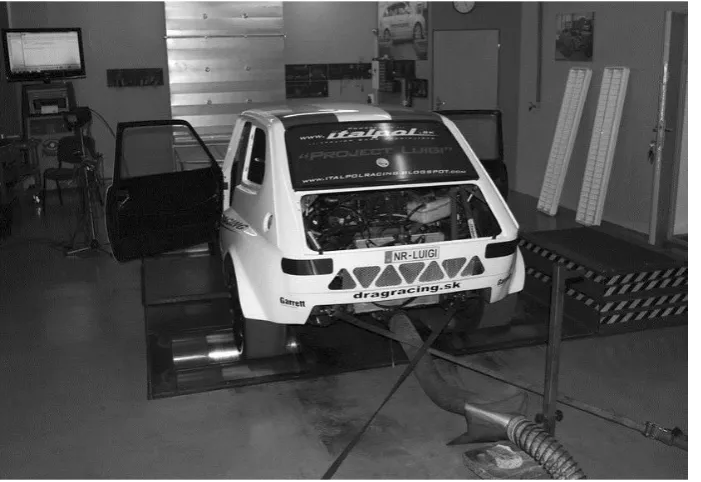
Measured vehicle. Performance measurement was done on a special prototype vehicle designed for a drag race (Janoško, Polonec 2011). The base of the vehicle was bodywork of Fiat 127A (Fiat Auto S.p.A., Torino, Italy). As the power unit Lancia 2.0 16V Turbo engine was used, which was placed in the vehicle across, front of rear axle (Fig. 1).
The vehicle was two-door hatchback, with frame-less steel body. Total weight of vehicle without driver was 830 kg.
A powerful engine from Lancia Thema, made by Fiat Auto S.p.A., Italy was used. It was petrol engine with charging by turbocharger. Displacement of en-gine was 1,995 cm3 (bore: 84 mm, stroke: 90 mm). Engine had 4 cylinders in-line block with 16 valve DOHC head. Compression ratio is 8:1. Max. pow-er of stock engine was 147 kW at 5,500 min–1 and torque 298 Nm at 3,750 min–1.
Fuel delivery was provided by simultaneously multi point port fuel injection, controlled by elec-tronic control unit Bosch LE2 – Jeelec-tronic (Robert Bosch GmbH, Gerlingen, Germany). Ignition was fully electronic, “wasted-spark” type, controlled by electronic control unit Magneti Marelli MED 601E (Magneti Marelli S.p.A., Corbetta, Italy).
Calculation of suitable turbocharger. In the calculations of suitable turbocharger we took ac-count of future application of the vehicle in races and we defined a max. engine power to 300 kW at 6,000 min–1. The best turbocharger for the intended use of vehicle was calculated using the following re-lations (Estill 2008). Substituting the results into
compressor maps we have chosen the best turbo-charger Turbo Tech 103 (Honeywell International Inc., Morris Township, USA).
Airflow needed to achieve the performance target:
Qv=Pm× λ ×SpSB (1)
where:
Qv – airflow (kg/min)
Pm – performance target (kW) λ – air/fuel ratio (–)
SpSB – brake specific fuel consumption (kg/kW·min)
Required absolute manifold pressure to achieve performance target:
pABS=Qv
×R×(255.6+TP)
ηVOL×n
2×Vm
(2)
where:
pABS – required absolute manifold pressure (kPa) Qv – airflow (kg/min)
R – gas constant
Tp – intake manifold temperature (°C) ηVOL – volumetric efficiency (–)
n – engine speed (min–1)
Vm – engine displacement(cm3) Compressor discharge pressure:
p2C=pABS+ΔpSTR (3)
where:
p2C – compressor discharge pressure (kPa) pABS – absolute manifold pressure (kPa)
[image:2.595.75.526.83.275.2]ΔpSTR – pressure loss between the compressor and the manifold (determined to 14 kPa)
Fig. 1. Measured vehicle (a) Fiat 127A and engine (b) Lancia 2,0 16V Turbo
Compressor inlet pressure:
p1C=pATM− ΔpSTR.S (4)
where:
p1C – compressor inlet pressure (kPa) pATM – ambient air pressure (at sea level) (kPa) ΔpSTR.S – pressure loss in air filter and piping (determine
to 7 kPa)
Pressure ratio:
∏TD= p2C
p1C (5)
where:
ΠTD – pressure ratio
p1C – compressor inlet pressure (kPa) p2C – compressor discharge pressure (kPa)
Based on calculations of operating parameters and substituting them into various compressor maps we chose a Garrett GT3076R turbocharger (Honeywell International Inc., Morris Township, USA). As seen on the compressor map (Fig. 2), this turbocharger is the most suited to performance
re-quirements and the expected use of the vehicle for racing purpose.
Calculation of theoretical injectors fuel flow:
QP=QλV N
× ρP (6)
where:
QP – flow of fuel (kg/min) Qv – flow of air (kg/min)
λN – numerical value of lambda (–) ρP – fuel density (kg/m3)
Because of lower heat stress of injectors we cal-culated with approximately 80% duty cycle. Con-sidering this duty cycle RC Racing injectors with fuel flow 750 cm3/min were chosen (at 300 kPa fuel pressure).
Calculation of heat ratios in the intercooler
(Estill 2008).
W=U×S×(ΔT1− ΔT2)÷F
ln ΔT1
ΔT2
⎛ ⎝⎜
⎞ ⎠⎟
[image:3.595.67.376.86.459.2](7)
Fig. 2. Compressor map of Garrett GT3076R turbocharger
p2C/p1C – pressure ratio of inlet and outlet of turbocharger
Corrected airflow (kg/min)
p2C
/
p1C
4.5
4.0
3.5
3.0
2.5
2.0
1.5
1.0
where:
W – total transfer of heat energy (J) U – heat transfer coefficient (W/m2·K)
S – heat transfer surface (m2)
ΔT1 – difference between intercooler input air tempera-ture and temperatempera-ture of cooling air behind inter-cooler (Tin – T2) (°C)
ΔT2 – difference between output air temperature from intercooler and temperature of cooling air in front of intercooler (Tex – T1) (°C)
F – correction factor
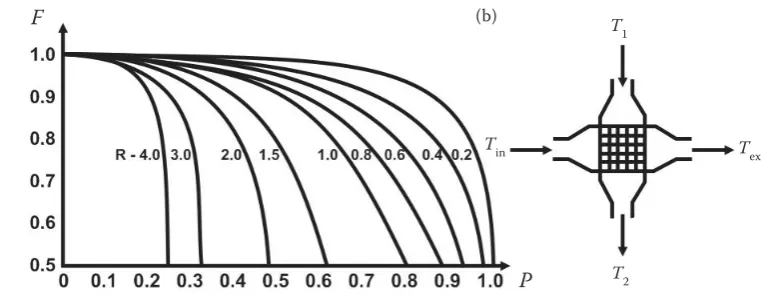
Determination of the correction factor F. Cor-rection factor F, taking into account the unequal distribution of heat at exchanger area, could be read from the diagram according to the calculated values of temperature ratios of P and R (Fig. 4). For calculation of temperature ratios P and R we need to know temperature of compressed air (Tin, Tex) and cooling air (T1, T2) on the inlets and outlets of the intercooler (Fig. 3).
P=Tex−Tin
T1−Tin (8)
R= T1−T2
Tex−Tin
(9)
where:
P, R – temperature ratios
Tex – compressed air temperature on outlet (°C) Tin – compressed air temperature on inlet (°C) T1 – outside (cooling) air temperature on inlet (°C) T2 – outside (cooling) air temperature on outlet (°C)
Calculating the amount of lost or received heat on one side of exchanger:
W=Qm×CP× ΔT (10)
where:
W – heat energy transfer (J) Qm – mass airflow (kg/min) Cp – heat capacity of air (J/K·mol)
[image:4.595.83.464.81.228.2]ΔT – difference of input and output temperatures (K)
Fig. 3. Heat diagram of correction factor F (a) and intercooler temperature scheme of inlet/outlet flow (b)
[image:4.595.65.360.606.755.2]F – correction factor (–); P – temperature ratio (–); T1 – outside (cooling) air temperature on inlet (°C); T2– outside (cooling) air temperature on outlet (°C); Tin – compressed air temperature on inlet (°C); Tex – compressed air temperature on outlet (°C)
Fig. 4. Airflow through the intercooler
T1 – outside (cooling) air temperature on inlet;
T2 – outside (cooling) air temperature on out-let; Tin – compressed air temperature on inlet;
Tex – compressed air temperature on outlet
(a) (b)
Tex
T2
T2 T1
Tex Tin
Tin
T1
RESULTS AND DISCUSSION
Performed engine modifications
The engine power can be measured by the dy-namometer directly or through the power take-off shaft, or possibly on a roller bench or by the road-board test (Semetko, Janoško 2005). After per-formance measurement of stock engine the follow-ing modifications were made:
Stage 1:
– turbocharger replaced by more powerful type Garrett GT3076R, with rotor on ball bearings, – injectors replaced by more powerful (RC Racing;
RC Engineering, Inc., Higgins Court Torrance, USA) with fuel flow 750 cm3.min (at fuel pres-sure 300 kPa),
– shortened exhaust system, removed mufflers, – modified of sensing airflow by electronic control
unit,
– intercooler placed in the box enabling cooling by ice,
– boost pressure controlled by manual boost con-troller.
Stage 2:
– stock electronic control units replaced by fully programmable unit VEMS ver. 3.6 (Acmv LLC, Wilmington, USA),
– intercooler replaced by “water to air type” with cooling by circulated water,
– intake manifold replaced by shorter type from Lancia Kappa,
– throttle body replaced by bigger one with inter-nal diameter 73 mm,
– stock exhaust manifold replaced by custom steel manifold with pipes with diameter 42 mm, – boost pressure controlled by electronic control
unit with solenoid valve.
Dynamometer
The measurements were performed on the roll-er dynamometroll-er MAHA LPS 3000 PKW 4 × 4 (MAHA Maschinenbau Haldenwang GmbH & Co. KG, Haldenwang, Germany) (Fig. 5).
Parameters of dynamometer MAHA LPS 3,000 PKW:
– max. measurable output: 520 kW (4 × 4 version), – max. measurable torque: 1,000 Nm,
– accuracy: +/– 2%,
– conversion of measured parameters according to technical norms.
Procedure of measuring power and torque on dynamometer
[image:5.595.64.415.517.758.2]The vehicle will start to gradually speed up to 50 km/h, on penultimate gear. Then depress accel-erator pedal to maximum and watch the course of performance on monitor up to reach a max. engine
speed. When max. speed is reached, the techni-cian pushes the clutch pedal and simultaneously releases accelerator pedal. The wheels are left free to catch up to 0 km/h. Dynamometer now records power loss. The waveform of power, torque and losses are saved to the memory of dynamometer.
Measurement No. 1 – Stock engine
First measurement was used to determine the initial state. Engine with stock technical specifica-tions without any performance modificaspecifica-tions was installed in vehicle. Intake air temperature (in front of air filter) according to the testing laboratory was 19.1°C, relative humidity 55.4% and atmospheric pressure 1,008 hPa.
During the verification measurements slightly lower max. values, than those declared by manu-facturer were recorded, but this was attributable to higher mileage and therefore wear of the engine.
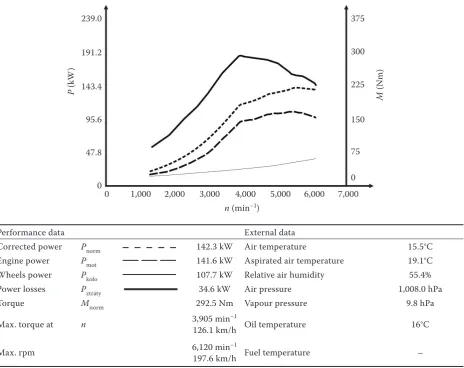
However, the measured values of power and torque were not significantly different from the manufturer’s values. Max. measured power [adjusted ac-cording to DIN 70020 (1993)] was 142.3 kW and torque was 292.5 Nm (Fig. 6).
Measurement No. 2 – First level of modifications
The second measurement was performed after the “Stage 1” of engine modifications (see “Performed engine modifications” section). Conditions of meas-urement were almost unchanged. According to the testing laboratory intake air temperature (in front of air filter) was 18°C, relative humidity was 56.6% and the atmospheric pressure was 1,007.9 hPa. In-tercooler was cooled by ice with the temperature of approx. 0°C. As it is seen on the graph of the sec-ond measurement(Fig. 7), the recorded power was 210.2 kW and the torque was 400.3 Nm. An increase
Performance data External data
Corrected power Pnorm 142.3 kW Air temperature 15.5°C Engine power Pmot 141.6 kW Aspirated air temperature 19.1°C Wheels power Pkolo 107.7 kW Relative air humidity 55.4% Power losses Pztráty 34.6 kW Air pressure 1,008.0 hPa Torque Mnorm 292.5 Nm Vapour pressure 9.8 hPa Max. torque at n 3,905 min126.1 km/h–1 Oil temperature 16°C
[image:6.595.67.532.80.448.2]Max. rpm 6,120 min197.6 km/h–1 Fuel temperature –
Fig. 6. Measurement of power and torque before engine modifications
0 1,000 2,000 3,000 4,000 5,000 6,000 7,000 239.0
191.2
143.4
95.6
47.8
0
375
300
225
150
75
0
P
(kW
)
n (min–1)
M
of performance over the first measurement was 67.9 kW and an increase of torque was 107.8 Nm.
This increase of power and torque was affected mainly by mechanical modifications of external parts of engine, exchange of turbocharger with a more powerful one and an increase of intercooler cooling efficiency.
Measurement No. 3 – Second level of modifications
The third measurement was performed after “Stage 2” engine modifications (see “Performed en-gine modifications” section). According to the test-ing laboratory intake air temperature (in front of air filter) was 22.3°C, relative humidity was 33.7% and atmospheric pressure was 982.4 hPa. As it is shown in the graph of the third measurement (Fig. 8), there is one more shape (grey colour), which shows the boost pressure level. Since using new engine
elec-tronic control unit, we were able to control the boost level with electronic control unit and solenoid valve. Max. boost pressure was now set to 1.6 bar, but be-cause we wanted to protect transmission system against high torque peaks, boost pressure was in-creased slowly from 1 bar (at approx. 4,000 rpm) to 1.6 bar at max. engine speed. This allowed driver to utilize engine max. power and torque in high revolu-tions, which is very useful in race conditions.
Max. measured power (adjusted according to DIN 70020 (1993)) was 310.7 kW and torque was 457.9 Nm. Increase of performance over the previ-ous (Stage 1) measurement was 100.5 kW and in-crease of torque was 57.6 Nm. But more interesting is the increase of max. power over stock engine, which was 168.4 kW and for max. torque it was 165.4 Nm. In percentage, it is an increase of more than 118% of max. power and more than 56% of max. torque.
This increase of power and torque mechani-cal modifications of intake and exhaust system, exchange of intercooler and also exchange of the
Performance data External data
Corrected power Pnorm 210.2 kW Air temperature 15.5°C Engine power Pmot 209.5 kW Aspirated air temperature 19.1°C Wheels power Pkolo 171.1 kW Relative air humidity 55.4% Power losses Pztráty 38.4 kW Air pressure 1,008.0 hPa Torque Mnorm 400.3 Nm Vapour pressure 9.8 hPa Max. torque at n 133.4 km/h4,130 min–11 Oil temperature 16°C
[image:7.595.68.530.82.449.2]Max. rpm 6,330 min204.5 km/h–1 Fuel temperature –
Fig. 7. Measurement of power and torque after “Stage 1” engine modifications
0 1,000 2,000 3,000 4,000 5,000 6,000 7,0000 1,000 2,000 3,000 4,000 5,000 6,000 7,000 367.8
294.2
220.7
147.1
73.6
0
500
400
300
200
100
0
P
(kW
)
n (min–1)
M
Performance data External data
Corrected power Pnorm 310.7 kW Air temperature 20.5°C Engine power Pmot 300.1 kW Aspirated air temperature 22.3°C Wheels power Pkolo 256.3 kW Relative air humidity 33.7% Power losses Pztráty 43.8 kW Air pressure 982.4 hPa Torque Mnorm 457.9 Nm Vapour pressure 8.1 hPa Max. torque at n 202.8 km/h6,470 min–11 Oil temperatureFuel temperature 19°C–
[image:8.595.68.530.84.451.2]Max. rpm 6,495 min203.6 km/h–1 Manifold air pressure (hPa)
Fig. 8. Measurement of power and torque after “Stage 2” engine modifications
Fig. 9. Modifying and logging data in programme VemsTune
367.8
294.2
220.7
147.1
73.6
0
0 1,000 2,000 3,000 4,000 5,000 6,000 7,000 500
400
300
200
100
0
n (min–1)
P
(kW
)
M
[image:8.595.76.520.488.739.2]stock electronic control units by fully programma-ble unit, allow us to optimise all necessary control parameters of ignition timing and fuel injection.
Tuning of electronic control unit
At the first and second measurements, engine was controlled by stock control units only with modified airflow sensing system for adjusting the correct air/fuel ratio at all driving conditions.
Before measurement No. 3, we installed new, fully programmable electronic control unit VEMS. This unit allowed us to modify all necessary data to tune up main control parameters of the engine. Modification of the parameters is possible in real time, without stopping the engine or disconnecting control unit. Tuning was done in the official com-puter programme VemsTune (Acmv LLC, Wilm-ington, USA), which allowed us to change engine management parameters and also to log actual data from all engine sensors (Fig. 9).
CONCLUSION
This paper presents some options and method-ology for upgrading the turbocharging and fuel injection system to increase engine power, which can also be used (with some modifications) in oth-er types of turbocharged transport and agriculture vehicles to increase their dynamical parameters or working efficiency.
From the measured values it can be seen what benefits to an increase of the engine performance parameters modifications of engine components performed. During the measurements, we found an increase of the max. engine power, compared to the serial status, up to 168 kW and max. torque up to 165 Nm. This increase is mainly due to an exchange of turbocharger for a more powerful one, optimising thus intake and exhaust manifolds and optimising the fuel and ignition system for new engine setup.
Since we designed the turbocharger to be able to supply the necessary amount of air to the engine
power up to 300 kW and engine is currently reaching more than 310 kW, we reached our goal. The manu-facturer recommended this type of turbocharger also for engines with power more than 400 kW, but if we want to maintain the reliability at this high perfor-mance level, it will be necessary to exchange all in-ternal components of engine by stronger, high quality forged parts in future. Next step must be modification of the transmission system and clutch, because now these parts are on their performance peaks.
To achieve higher performance parameters of the engine in future, it will be necessary to set up boost pressure of turbocharger to higher level, upgrade camshafts and also to upgrade the fuel system.
References
Čupera J., Šmerda T., 2010. Influence of engine power and shifting mode on energy-performance parameters of trac-tor’s set. Research in Agricultural Engineering, 56: 47–52. DIN 70020, 1993. Straßenfahrzeuge; Kraftfahrzeugbau; Be-griffe von Abmessungen. Berlin, DIN Deutsches Institut für Normung e. V.
Estill J., 2008. Heat exchanger theory and intercoolers. Available at http://www.gnttype.org/techarea/turbo/ intercooler.html
Ferenc B., 2004. Spalovací motory – karburátory a vstřikování paliva. [Combustion engines – carburettors and fuel injec-tion.] 1st Ed. Prague, Computer Press.
Hromádko J., Hromádko J., Hönig V., Miler P., 2011. Spalovací motory. [Combustion Engines.] Prague, Grada Publishing.
Janoško I., Polonec T., 2011. Design of prototype vehicle for drag racing. In : Proceedings from XLII. International Student Scientific Conference: Recent Advances in Agriculture, Me-chanical Engineering and Waste Policy. May 3–4, 2011, Nitra. Semetko J., Janoško I., 2005. Zisťovanie parametrov traktorov
[Determination of Tractor΄s Parameters.] Nitra, ES SPU. Sloboda A., Ferencey V., Hlavňa V., Tkáč Z. et al., 2008.
Konštrukcia kolesových a pásových vozidiel. [Construction of Wheeled and Tracked Vehicles.] Košice, Vienala.
Received for publication May 22, 2012 Accepted after corrections September 20, 2012
Corresponding auhtor: