The Collapse of Global Trade: What a
Tangled Web We Weave
Spehar, Ann / AOS
Carroll College
8 July 2010
Online at
https://mpra.ub.uni-muenchen.de/23875/
The Collapse of Global Trade
The Collapse of Global Trade:
What a Tangled Web We Weave
Ann Spehar
Carroll College
Abstract
A unique feature of the financial crisis is the unprecedented collapse in global world trade.
The objective of this paper is to explain some of that collapse as a move toward protectionism
triggered not by nationalistic interests but by ‘competing’ objectives among trading partners
from the Mundell-Fleming Trilemma. Even with the best of intentions, efforts toward internal
rebalancing necessarily implies harming your trading partner unintentionally if they should be
using conflicting policy objectives of the Trilemma. National interests are at odds between two
such countries and their policy prescriptions counteract, and paralyze rebalancing and
coordination efforts between nations. Policymakers may be forced into protectionists’ stances in
The Collapse of Global Trade
Introduction
As Barry Eichengreen points out in A Tale of Two Depressions “World trade is falling much
faster now than in 1929-30 (Figures 1 and 2). This has been highly alarming given the
prominence attached in the historical literature to trade destruction as a factor compounding the
Great Depression.” This synchronized and catastrophic drop in trade has been well documented
by many; Barry Eichenberry (2009), Baldwin and Evenett (2009) (IMF 2009), Araujo and
Olivera Martins (2009) and in Richard Baldwin’s 2009 VOXEU eBook to name a few.
A number of plausible and insightful explanations have been documented so far. Their focus
is not just on causality but on the channels and propagation mechanisms as well.
The objective of this paper is to expand on an additional channel that may amplify the effects
of a drop in global trade within our increasingly open and interconnected trading community.
This paper will argue that conflicting policy objectives among trading partners stemming from
the Fleming Trilemma have helped make this drop in trade precipitous.
Mundell-Flemming Trilemma states that nations cannot simultaneously maintain free capital movement,
an independent monetary policy and stable exchange rates. Nations may choose only two of the
three policy objectives. When trading partners choose different and competing objectives they
may be forced into protectionist stances in spite of the fact that policymakers are aware that
maintaining open trade will play a prominent role in minimizing and ameliorating the effects of
the macroeconomic collapse.
The move toward protectionism, though disconcerting, can be appreciated when one
recognizes that often the conflict is triggered by clashing policy objectives from the
due to the nature of the policy objectives chosen and the ensuing instruments. The ensuing policy
instruments used to regain internal and external balance create unintended consequences that
trigger retaliatory trade barriers from trading partners. This problem may be unavoidable as the
policy instruments available to a country are limited and determined by the selection of policy
objectives chosen from the Mundell-Flemming Trilemma. Even with the best of intentions, any
effort toward internal rebalancing necessarily implies harming your trading partner
unintentionally if they should be using conflicting policy objectives of the Trilemma.
Instruments stemming from the clashing objectives counteract and paralyze trading partners in
their rebalancing efforts. National interests are at odds between two such countries and the
conflicting tools complicate coordination efforts.
The recent global upturn, though encouraging, does not provide much comfort. Our Great
Recession follows closely with a short term growth spurt in trade during the Great Depression of
1929 (Figure 1), which unfortunately, was merely a pause in the downward trend. Additional
concerns about the long term viability of trade growth focus on the inevitable reduction in
supportive stimulus measures while private demand required to supplant the government support
is wanting. Moreover, the degree to which stimulus measures were initially required has begun to
raise new concerns regarding the ongoing sustainability of such support. In the face of these
concerns it is not surprising then, that Simon Evenett’s (February 2010) study found that recent
recovery and stabilization has not slowed the pace of protectionism. “In the last quarter of 2009
almost every major trading nation has implemented discrimination against foreign commercial
interests above trend levels.” This pace could well put a halt to our prospects for continued
Section one will review the Mundell-Fleming model focusing on the Mundell-Fleming
Trilemma. Section two will discuss the difficulty in coordination efforts that trigger the descent
into the tangled web of protectionism by countries whose policy objectives from the Trilemma
collide, compounding the complexities already inherent in cross country efforts to follow
Mundell-Fleming Model
The Trilemma Policy Objectives
The Mundell-Fleming Trilemma is a useful framework that illustrates the tradeoffs countries
face when seeking to maintain a stable exchange rate, free flowing capital mobility, and an
autonomous monetary policy. This tradeoff is frequently referred to as “The Unholy Trinity” and
states that a country cannot simultaneously (a) maintain stable exchange rates (b) maintain an
autonomous monetary policy and thereby control over their domestic interest rates, and (c) have
free flowing capital into and out of the country. Countries must select precisely two of the three
desirable options while sacrificing the third. The choice can be exacting and problematic.
Consider each option. The first option - exchange rate stability: Stable exchange rates can be
particularly desirable for countries. The European Monetary Union was driven by a number of
economic benefits but not trivial among them was the reduced exchange rate risk. In the 1990
special issue of European Economy the European Commission stated that a significant source of
gains from the union would be the expectation of a reduction in the exchange rate risk that would
reduce risk premium. This reduction in the cost of capital was expected to increase corporate
investment. High exchange rate volatility can seriously impede the markets and has been found
to have a negative effect on bilateral trade flows (Dell’ Ariccia 1998). When exchange rates
appreciate exporters are harmed by decreased demand. When exchange rates depreciate
industries who import resources are harmed as domestic markets face higher international prices.
If rates are low one year with a corresponding strong export market while the next year rates are
high and exports low it can wreak havoc on international business plans discouraging long term
investment. Moreover, such fluctuations can trigger internal business cycles. Stable prices
The second option – monetary policy autonomy: autonomy was a driving force during the
Great Depression for leaving the gold standard, is a critical policy tool particularly during a
macroeconomic collapse. Monetary autonomy provides the central bank with the freedom to use
requisite tools for maintaining or regaining internal and external control over the economy
primarily by allowing the bank to freely adjust interest rates or use other required monetary
measures. This policy option has proved critical in preventing a complete collapse of the
financial and commercial banking institutions during our current Great Recession.
The last option, international capital mobility, often referred to as full capital account
convertibility means that a country’s financial assets and liabilities can be converted without
restraint and denominated into any currency at market exchange rates. It implies changes in
ownership in local financial assets by anyone within the local country or by any foreign investor.
Freely flowing capital is important to countries who are interested in financing investment with
foreign capital, who are interested in investing abroad or simply maintaining day-to-day
international business operations. In today’s global economy, where much of the trade occurs
among global supply chains, freely flowing capital mobility is crucial for global growth.
Although it is important to note that many countries are uncomfortable with open capital
accounts and allowing uncontrolled freely flowing wealth into and out of their nations. Concerns
include sudden movements of capital leaving the country from speculation. For example, foreign
held debt can provide fuel for sudden capital flight. Externally held debt can be transformed
quickly from inflows to outflows by awareness from foreign investors of an increased risk of a
debt crisis due to the unsustainable levels of debt. In the past, this has been particularly
characteristic of emerging and developing nations. However, in today’s economic environment
developed countries where a sudden outflow of capital could result in a currency collapse and
ultimately a default on the country’s debt spreading the crisis to those countries holding their
debt. This is exactly the set of circumstances of the Asian countries in the late 1990’s and that is
currently occurring within the European Union today. Foreign borrowings can mutate from
capital inflow to capital flight. This type of growth has been characterized as a “start-stop”
growth pattern - abnormally high growth rates followed by quick damaging reversals with slow
recoveries. It is interesting to note that both India and China were spared the Asian crisis and
neither had full capital account convertibility. According to Joseph Stiglitz, the former Chief
Economist at the World Bank and a Nobel Laureate in 2001 “full capital account convertibility
exposes an economy to extreme volatility due to “hot money” flows.” Developing countries that
may not have well developed capital markets may be more willing to sacrifice unrestricted
capital mobility and forgo the risks. Indeed, the International Monetary Fund (IMF) has recently
changed its policy of disfavour with any capital controls to identifying specific conditions under
which controls on inflows (foreign purchases of domestic assets) may be warranted. Specifically
as stated in their IMF Staff Position Note on the role of controls
“if the economy is operating near potential, if the level of reserves is adequate, if the exchange rate is not undervalued, and if the flows are likely to be transitory, then use of capital controls—in addition to both prudential and macroeconomic policy—is justified as part of the policy toolkit to manage inflows.” (Ostry, Ghosh, et al 2010)
Notwithstanding, even several developed countries have moved away from freely flowing capital
Trilemma policy option and have implemented capital controls on outflows, the United States is
one such example.1
Whether to choose the policy option of freely flowing capital into and out of the country can
concurrent selection of the remaining two policy options - fixed exchange rates and autonomous
monetary policy.
The message here is that each policy option in the Trilemma can be desirable and selection of
any two depends on the unique economic circumstances faced by the nation state and the choice
can be exacting.
The Trilemma Policy Instruments
According the Mundel-Fleming Trilemma, countries may only chose two of the three
objectives stable exchange rates, autonomous monetary policy, free flowing capital into and out
of the country. However, from the policy objectives chosen by a country one can infer a
corresponding set of policy instruments; and from specific policy instruments one can infer a
corresponding set of economic tools that will support these instruments. Both the instruments
and the tools depend on the chosen policy objective. Let’s take a closer look.
Exchange Rate Stability (ERS)
Autonomous Monetary Policy Unrestricted Capital Mobility
(AMP) (UCM)
Figure 3
The chosen set of policy objectives (identified at each corner) determine which side of the
triangle policy makers will operate. Moreover, it will also determine a set of specific economic
policy instruments (identified on each side of the triangle) the country can expect to employ in Capital Controls Fixed Exchange Rates
correcting economic imbalances. Countries that chose Autonomous Monetary Policy (AMP) and
Unrestricted Capital Mobility (UCM) engage in the floating exchange rate regimes. Similarly,
countries that opt for Exchange Rate Stability (ERS) and Unrestricted Capital Mobility will
engage in a fixed exchange rate instrument. But what is more pivotal according to the
Mundell-Fleming model, is that each exchange rate regime limits the economic tools available to policy
makers in correcting economic imbalances.
Floating Exchange Rates: Monetary Policy vs. the Fiscal Policy
According to the Mundell-Fleming model, monetary policies are more likely to result in
successful stabilization efforts than a fiscal policy within a floating exchange rate regime; while
the fiscal policy will be more successful in stabilization efforts within a fixed exchange rate
regime.
Consider first, the monetary policy under floating rates. The channels are well known. An
expansionary monetary policy increases the money supply, since the currency is floating it
depreciates. This causes domestic products to become more competitive abroad increasing
aggregate net exports and thereby increasing the country’s aggregate output. Expansionary
monetary policies have powerful short run effects in a floating exchange rate regime.
Specifically, the net effect is a shift in demand away from foreign goods and services to domestic
goods and services encouraging economic growth.
Consider now the fiscal policy, again, under a floating regime. These effects will be more
benign. Increased government purchases results in an increase in aggregate income and demand
which increases money demand and thus interest rates. Foreign capital flows into the country
rates and a corresponding decrease in exports. The decrease in exports counteracts the initial
increase in demand, ultimately, minimizing the impact on aggregate output. In other words, a
fiscal expansion would increase demand increasing money demand raising interest rates and
putting upward pressure on the exchange rate decreasing net exports and therefore aggregate
output. Thus a Keynesian fiscal policy under a floating exchange rate regime has a limited effect
on the economy. Aggregate demand may increase but at the expense of a decrease in net exports.
Fixed Exchange Rates: Monetary Policy vs. the Fiscal Policy
Similar arguments can be made for a monetary and fiscal policy under a fixed exchange rate
regime. However, in this case the opposite holds true; fiscal policies will have more a robust
impact on the economy while monetary policies will be more benign.
Consider an expansionary monetary policy under fixed exchange rates. The currency cannot
act as a counter balancing measure. A monetary policy is not an effective option to the central
bank under a fixed exchange rate regime as an increase in the money supply causes depreciation
in currency values and a corresponding need to sterilize the initial expansionary policy
transactions by a contractionary policy in order to appreciate the currency to its original fixed
level.
Another way to view the same argument is that with fixed exchange rates and no capital
controls domestic, foreign interest rates must be equal or else arbitrage will take place until it is
equal. This implies that no independent monetary policy is possible since independence means
by definition that central banks can change interest rates.
Now consider an expansionary fiscal policy with a fixed exchange rate regime. An
increase in money demand and a corresponding increase in interest rates and thus an increase in
the exchange rates. But now, the central bank must correct the increased exchange rate by
increasing the money supply in order to maintain the fixed exchange rate values. This would
cause aggregate output to increase resulting in more robust results in an expansionary fiscal
policy. Under fixed exchange rates the monetary policy cannot be used to affect output while the
fiscal policies are effective. Table 1 summarizes the results.
The Tangled Web of Protectionism
The Mundell-Flemming Trilemma states that the policy objectives of an Autonomous
Monetary Policy and Unrestricted Capital Mobility (AMP/UCM) implies a policy instrument of a
floating exchange rate regime which further implies the use of the economic tools of the
monetary policy for internal and external balancing. In addition, the Trilemma establishes that
the policy objectives of Exchange Rate Stability and Unrestricted Capital Mobility implies a
policy instrument of a fixed exchange rate regime which further implies the use of the economic
tools of the fiscal policy for internal and external balancing of the country. AMP/UCM
corresponds to the bottom leg of the Mundel Triangle while ERS/UCM corresponds to the right
leg of the triangle. The left leg characterizes a country that has chosen Stable Exchange Rates
coupled with Autonomous Monetary Policy - implying closed capital accounts such as has
typified Chinese policies until recently. This policy instrument requires policy tools that require
ongoing federal interference in maintaining fixed exchange rates characteristic of strong capital
The Web of Protectionism
The next step is to look at the implications among trading partners when each subscribe to a
different set of policy objectives and are implementing different policy instruments to correct
imbalances within their respective nations following a global downturn.
To appreciate the challenge, consider countries with competing objectives as they begin the
arduous and daunting task of regaining internal and external balance. Now their initial intent may
not be to cause harm to their neighbors. Unfortunately, the very fact that they have chosen policy
objectives in conflict with trading partners, results in policy prescriptions that could trigger
protectionist measures.
Autonomous Monetary Policy and Unrestricted Capital Mobility AMP/UCM
Consider those countries that have chosen an AMP/UCM and as a result engage in a Floating
Exchange Rate regime. These countries are free to aggressively pursue expansionary monetary
policy. Indeed, in our current crisis, expansionary policies have been promoted by the
International Monetary Fund (IMF) in an effort to avoid protectionism. The idea behind the
policy is to minimize incentives toward barriers to trade by increasing world demand and output.
In this case an expansionary monetary policy increases the money supply reducing interest rates,
lowering the exchange rates, increasing net exports (due to increased demand from lower prices)
and finally increasing output and demand. Yet, if a floating exchange rate regime pursues such a
policy within a country the consequences may not increase aggregate worldwide demand. Rather,
it is more likely to shift demand from foreign to domestic products increasing demand internally
but at the expense of their trading partners. The question is which impact dominates – the
during the depression (Eichengreen and Sachs 1985) the policy acts as an indirect trade tariff
triggering at a minimum disgruntled trading neighbors and at a maximum retaliatory responses
and a worldwide move toward protectionism.
“A devaluation is economically equivalent to an import tariff plus and export subsidy, except it is better than a tariff alone because it gives monetary policy the flexibility to boost domestic demand in times of recession” (Irwin 2009).
This can and has triggered a scramble and at times an apparent chaotic scramble toward
retaliatory protectionist measures. Countries are forced to create barriers to trade during global
downturns in order to avoid the deleterious consequences of policy instruments in use from
trading nations who have chosen alternative policy objectives.
This is exactly what occurred during the Great Depression. According to Eichengreen and
Irwin (2009) “Countries remaining on the gold standard and thereby prevented from using
monetary stimulus to reflate were more inclined to resort to trade restrictions” (Eichengreen
Irwin 2009). Eichengreen and Irwin argue that those that ‘delinked’ early from the gold standard
regained internal balance and experience relatively mild recessions. If everyone had left the gold
standard and the “restrictive monetary policies associated with it” all would have enjoyed a
relatively mild recession.
While their research is highly informative, I argue against their conclusion and suggest
instead that had everyone delinked, all countries would have been sharing the same policy
objectives and instruments and would have been unable to ‘lure’ trade in their direction at the
expense of those countries that could not use exchange rates as protectionist policies. All
countries would have been forced to negotiate the sharing of the burden of recovery at the
negotiation table. No recovery is free; the tough questions revolve around how to share the
coordination fails. As it were, it is possible that those who remained on the gold standard during
the depression ended up bearing the brunt of recovery.
Eichengreen and Irwin’s narrative of the colossal and chaotic move toward protectionism can
be seen clearly with the use of the Mundel-Fleming framework. The spark that flamed the chaos
began with a devaluation of the franc and an increase in interest rates by the Federal Reserve
Board. Both policies triggered an inflow of gold into France and the US. With the fiscal policy
unknown and an ineffective monetary policy for those on the gold standard there was little
recourse left. Countries could delink from gold and engage in expansionary monetary policies
(thereby adopting the very same policy objectives of all countries that had delinked) or they
could implement countervailing measures such as tariffs, capital controls or other transparent
barriers to trade. The important point here is that those that engaged in the more transparent
barriers were no more or less guilty than those that delinked and engaged in the less transparent
expansionary monetary policies that resulted in currency depreciations. It is just a matter of
which policy objectives and instruments the country had at its disposal. Both parties are equally
guilty of non-cooperation.
The message here is that , monetary policy stimulation could trigger retaliatory responses
should the effects of exchange rate depreciation dominate the effects of an increase in the money
supply resulting in little to no or even negative effects in aggregate demand or output.
Exchange Rate Stability and Unrestricted Capital Mobility ERS/UCM
Now consider those countries that choose Exchange Rate Stability (ERS) and Unrestricted
Capital Mobility (UCM) and the corresponding fixed exchange rate policy instrument of a
IMF? According to the Mundel-Fleming model, again, it may not. Under a fixed exchange rate a
fiscal stimulus and the resultant increase in income and demand, could result in an increase in
imports. This has the potential to trigger domestic dissent internally as increased imports
amounts to currency flowing out of the country and supporting a recovery for other nations at the
domestic taxpayers’ expense and ballooning budget deficits.
“The problem ... is that the country applying the stimulus worries that benefits will spill out to its neighbors, who are free riding. Fiscal stimulus is not costless; it means incurring public debt that will have to be serviced by the children and grandchildren of the citizens of the country initiating the policy. ….there is that temptation for that country to resort to “Buy America” provisions. .. The protectionist dangers are still there… it is the active rather than the passive country that is subject to the temptation.” Eichengreen (Jul 2009)
Fiscal policies have the potential to trigger internal protectionist measures with moves toward
implementing fiscal packages that guarantee local taxes stay with the borders. There are many
‘murky’ methods today for implementing barriers: subsidies to industries that have been hard hit
by the downturn for example the automobile industry, riders attached to legislation that stipulate
“Buy Locally”
Again these nations with a ERS/UCM policy are forced to implement the fiscal policy as their
primary means to mitigate the downturn. And while policy makers may honestly attempt to
prevent protectionist measures from being buried in domestic legislation they may secretly
begrudge the negative impact of the depreciating currency from those who hold the competing
AMR/UCM policy objectives. Such depreciation from their trading partners leaves them paralyzed
with inaction in preventing their country from bearing the worldwide cost of the downturn. Trade
barriers are their only tool to counteract depreciating currencies abroad.
When the objectives compete, it leaves trading partners paralyzed with inaction with no ability
available to them to counter the measures of trading partners using alternative policy
instruments. They are strapped within the confines of their chosen Trilemma objectives. The
ERS/UCM country cannot continually depreciate their currency in an attempt to keep up with the
depreciation for to do so is in essence adopting the very same policy objectives and turning to a
float. Their only other alternatives are barriers to trade or simply suffer the consequences and pay
for the recovery of other nations at their expense. From the perspective of the ERS/UCM country,
implementing tariffs or other protectionist measures is simply a retaliatory response to the
protectionist measure of devaluation.
In essence, under a floating exchange rate regime the fiscal policy is benign and the most
effective tool available is the monetary policy. It is the primary tool available to the AMP/UCM
country to correct for imbalances. Unfortunately, expansionary monetary policies results in
currency depreciation which shifts global demand toward their own domestic goods at the
expense of trading partners. This forces trading partners to bear the cost of the global downturn
with the potential of triggering a retaliatory response and a collapse in global trade.
Under a fixed exchange rate regime, the monetary policy is benign while the most effect tool
available is the fiscal policy. It is the primary tool available to the ERS/UCM country to correct
for imbalances. Unfortunately, a fiscal policy that increases demand increases imports. This has
the potential to trigger a move toward protectionism through internal dissent as taxpayers watch
their debt explode while their fiscal currency is used to support their neighbor’s recovery. Often,
to discourage tax dollars from leaving the country, legislation is added that ensures fiscal dollars
remain within the domestic economy. Thus, fiscal policies are likely to create incentives to erect
fiscal sacrifices - with the potential of triggering a retaliatory response and a collapse in global
trade.
Since fiscal and monetary tools have very different effects on countries depending on the
selection of the policy objectives chosen from the Trilemma, countries are cornered into their
protectionist stances simply in an effort to correct economic collapse. It is important to recognize
that both tools can create incentives for engaging in protectionist measures. And it is not
necessarily due to subversive tactics but simply the byproduct of policy instruments meant to
restore economic growth but that may nonetheless evolve and escalate into retaliatory and
subversive trade protectionist measures.
Ultimately, the real culprit is the lack of understanding of what creates the chaos and tangled
web. Countries are responding to the crisis at cross purposes and with different objectives. When
the global community faces a downturn in unison it is difficult and challenging to determine how
and who will or should share in the burden, for when everyone is facing the same
macroeconomic collapse there is no escape hatch because everyone is facing the same losses and
running for the same exits in tandem. Until the issue of how and who should share the burden is
formally addressed the world faces grave danger of returning to the tangled web of descent into
trade barriers once more.
The Overwhelming Complexities of the Consequences of Policy Options
Finally, the degree to which both global current accounts and the capital account have opened
and expanded globally creates increasingly strong incentives for protectionist stances during
downturns. An open capital account leaves a country more vulnerable to sudden outflows of
capital flows. The more open the capital account, the more pressure is imposed on the country’s
financial system and the more likely the country will resort to protective measures.
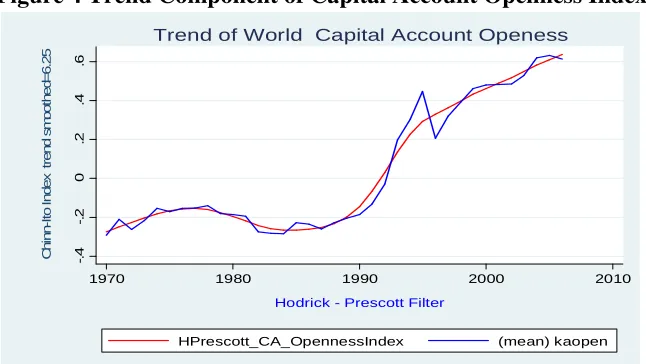
Figure 4 provides evidence of the growth in the openness of capital accounts over the past
four decades. Beginning in the early 1990s there has been a remarkable increase toward
international financial trade. With financial interests interlocked with so many other countries
that are equally precariously balanced there is much at stake when engaging in policy
prescriptions. The additional level of complexity resulting from conflicting policy objectives and
instruments within the international community one might expect an increased desire to
disengage from trade in order to regain the freedom to move about within the confines of their
own policy space in an effort to minimize collateral damage during a macroeconomic collapse.
And this increase in desire to disengage may be proportional to the degree in which countries
have opened the doors to trade and international finance. With so much at stake and with so
much of their fate intertwined we should expect to see an increase in the responsiveness and
sensitivity to movements in national debt, expectations, demand, interest rates, and any sign of
capital flight. The complexities are overwhelming and the consequences of a misguided policy
response could result in unforgiving consequences. The desire to disengage to simplify the policy
options, minimize risk and thereby allow the country the freedom to minimize potential
unintended consequences of instruments is more plausible than the standard response that
countries suddenly become myopic and ethnocentric. Most statesmen know full well the
consequences of a protectionist policy and are likely to avoid this course of action until all other
policy options have been exhausted. Many may take the “wait and see” approach until
place. This may be among their least intrusive and even their best options - minimize or avoid
uncertain, unapparent collateral damage in such a complex intertwined global trading milieu.
The volatility in the movement of capital account openness as evidenced in Figure 5 suggests
that countries policy response is to disengage during economic downturns. The Chinn-Ito index
used in generating Figures 4 and 5 is a measure of financial openness based on policy positions.
Detailed in the Appendix, these Figures are derived from a policy based index unlike previous
price based indices that measure capital account openness. The Chinn-Ito index is regulatory in
nature and thus provides a reasoned measure of a country’s international financial trade position.
Figure 5 makes evident the cyclical behavior around the trend in the growth in capital account
openness over the past four decades. The sudden downturn in the movement of global financial
liberalization in recent years may provide evidence of a change in global policy toward open
capital accounts.
Figure 5 also makes apparent that along with the growth in financial openness in the 1990’s
has come an increase in volatility in the cyclical behavior of financial openness globally. This
volatility may be due to the financial crises that have occurred during this decade2 and may help
explain the current pattern in the unprecedented decline in world financial liberalization now
occurring.
In short, when crises occur, my argument is that the conflicting Trilemma policy mix among
countries force nations into isolationist stances. Their best alternative in order to avoid
unintended international consequences of their policy prescriptions is that of minimizing
international financial engagement altogether thereby minimizing the friction that could trigger
Summary
World Trade Organization and Protectionism
In closing, I would like to applaud the efforts of The World Trade Organization (WTO) who
have kept everyone abreast of the movements of protectionist measures within our global
community. But according to the Center for Economic Policy Research, at the World
Bank-CEPR conference in Brussels in May 2009 the world faces its biggest challenge in 2010. The
many subversive and ‘murky’ methods of implementing trade barriers were outlined in the
conference and there is concern that as policy choices narrow incentives increase toward
protectionist measures. The report called for increased vigilance. Unemployment has not eased
and historically protectionist measures are procyclical with unemployment rates. While many
stimulus packages are in development and while policy options are narrowing there is still ample
time for benign internal balancing prescriptions to result in unintended consequences triggering a
“massive slide into protectionism”.
If we are to contain the secondary effects of this crisis, we will need to remain vigilant at
minimizing any incentives for moving in the direction of protectionism. It must begin with the
global community addressing in unison the challenge of how and who will or should share in the
burden. There is no escape hatch and for countries who believe they can ‘go it alone’ stand to
trigger a global collapse in trade where everyone suffers. The issue will be addressed either
formally at the negotiating table or informally and chaotically as occurred during the Great
Depression. Until the issue of how and who should share the burden is formally addressed the
world faces grave danger of repeating history and descending into the tangled web of trade
References
1. Artis, Michael, 1991."One market, one money: An evaluation of the potential benefits and
costs of forming an economic and monetary union," Open Economies Review, Springer,
vol. 2(3), pages 315-321, October.
2. Baldwin, Richard, The Great Trade Collapse: Causes, Consequences and Prospects ,
27 November 2009 ebook URL: http://www.voxeu.org/index.php?q=node/429
Retrieved: November 25, 2009
3. Chinn, M. D. and Ito, H. (2008). A New Measure of Financial Openness. Journal of
Comparative Policy Analysis: Research and Practice, 10(3), 309-322
doi:10.1080/13876980802231123
4. Dell’Ariccia, G. (1998, August). Exchange Rate Fluctuations and Trade Flows: Evidence
from the European Union (IMF Working Paper 98/107). Washington, DC: IMF.
Retrieved December 4, 2009, from http://www.imf.org/external/pubs/ft/wp/wp98107.pdf
5. Eichengreen, Barry, A Tale of Two Depressions Retrieved VOXEU November 20, 2009
http://www.voxeu.org/index.php?q=node/3421
6. Eichengreen, Barry J. and Irwin, Douglas A., The Slide to Protectionism in the Great
Depression: Who Succumbed and Why? (July 2009). NBER Working Paper No. w15142.
Available at SSRN: http://ssrn.com/abstract=1434657
7. Jonathan D. Ostry, Atish R. Ghosh, Karl Habermeier, Marcos Chamon, Mahvash S. Qureshi,
and Dennis B.S. Reinhardt 2010, Capital Inflows: The Role of Controls IMF Staff
Position Note 19 February 2010 SPN/10/04
8. The Fateful Allure of Protectionism: Taking Stock for the G8: World Trade Bank edited by
Evenett, Hoekman Cattaneo World Bank-CEPR. The results of a conference in Brussels
in May 2009
9. Neely, Christopher J., Introduction to Capital Controls: Review Federal Reserve Bank of St
Louis November/December 1999
URL: http://research.stlouisfed.org/publications/review/99/11/9911cn.pdf Retrieved 4
Appendix
Description of Chinn-Ito Capital Account Openness Data Series
The Chinn-Ito data set is a broad measure of a country’s degree of capital account openness
and financial liberalization. While the dataset includes the time period of 1970-2006 for 182
countries, only 123 countries were selected from the Chinn-Ito file due to discontinuous data.
The data represents de jure controls on capital transactions with a mean of zero and range of
(-3,3) .
The objective of this index is to capture both intensity and direction of capital controls. The
file contains country, year and the ‘ kaopen’ index. Kaopenis a binary dummy variable that
codifies restrictions on cross-border financial transactions reported in the IMF’s Annual Report on
Exchange Arrangements and Exchange Restrictions (AREAER). The codification involves the below
dummy variables that identify restrictions place on four major categories of foreign accounts:
• k1: presence of multiple exchange rates;
• k2: restrictions on current account transactions;
• k3: restrictions on capital account transactions; and
• k4: the requirement of the surrender of export proceeds.
Notice that this index differs from ‘price-based indices such as interest rate parity measures that are
typically de facto measures on financial global openness. While any measure of capital account
openness contains it own quantitative problems with coverage and accuracy, the strength of the
Chinn-Ito data set is its focus on the regulatory nature of capital account openness and represents a de
jure measure.
Chinn-Ito data series was collapsed by year taking the mean across countries before applying
Summary of year kaopen
Variable | Obs Mean Std. Dev. Min Max ---+--- year | 37 1988 10.82436 1970 2006 kaopen | 37 -.0472392 .3187506 -.3753164 .5468727
The 123 countries from the Chinn-Ito file were used in the analysis.
For greater detail on the data set see Ito, Hiro and Chinn, Menzie, A New Measure of
Financial Openness, JEL Classification Nos.: F33, G28 May 23, 2007
Hodrick-Prescott Filter
Figures 4 and 5 apply the Hodrick-Prescott (HP) filter to the Chinn-Ito capital account data
series. The HP filter is one of several popular trend-cycle decomposition filters used in
macroeconomics. It was first applied to economic data by Robert J. Hodrick and Edward C.
Prescott, Nobel Prize winner in Economics in 2004 "for contributions to dynamic
macroeconomics”. The Hodrick-Prescott (Hodrick and Prescott, 1997)filter, although the subject
of intense criticism, has stood the test of time and remains one of the standard methods for
removing trend and cyclical components in a business cycle or in macroeconomic time series
data in general. It remains a steadfast tool to modern economists due to its ability to be applied to
nonstationary time series (up to four unit roots). Aggregate macroeconomic time series is
characteristically nonstationary, hence its popularity. The Chinn-Ito data set was Differenced
Stationary and thus had one unit root.
Conceptually, it decomposes economic series into the sum of trend and cyclical components.
The cyclical component is considered a transitory deviation from the trend which is classified as
a ‘cycle’.
However, as the constituent parts of - the trend ( ) and cycle ( ) - are not observable,
the decomposition derives the trend and cycle by solving the below minimization problem
subject to a penalty constraint:
min x τ 2 -λ τ τ - τ τ ] 2 (2)
Goodness of fit Penalty Constraint
where the ‘smoothing’ parameter λ approximates the actual series xt as 0 and approximates
a linear trend as ∞ . Hodrick and Prescott suggest values for λ for monthly, quarterly and
yearly data of 16,000 , 14,400 , 100 respectively. However, others such as Ravn and Uhlig have
suggested values of 129,600, 14,400 and 6.25 respectively. For the Chinn-Ito index capital
account openness index, I used the λ smoothing value of 6.25
The first sum in equation (2) minimizes the difference between the data and its growth
component ( its cyclical component ) while the penalty component minimizes the
second-order difference of the growth component, or the second derivative of the growth component.
The lambda is used to weight the two components. The larger lambda the more the HP trend is
constrained to be linear. While the closer lambda is to zero the more the minimization problem
reduces to minimizing only the first summation which is simply a linear trend estimated with a
standard regression. Intermediate values allows lambda to move between a smooth linear trend
(large values λ ) and one that shows the more variation in the data (small values of λ).
Footnotes 1
The United States have implemented capital controls with the passing of HR 2847. page 27 of HR 2847 ‘‘Hiring Incentives to Restore Employment Act’’ (HIRE): Offset Provisions - Subtitle A— Foreign Account Tax Compliance, which requires foreign banks to withhold 30% of all outgoing capital flows while disclosing all details of non-exempt account-holders.
Reasons for implementing controls on outflows during crises include 1.) the need to correct a balance of payments deficit 2.) need to generate revenue while financing the recovery 3.) and ‘to preserve savings for domestic use to ensure that the benefits of investments in economy accrue to domestic savers’ (Neely 1999)
2
Tables
Krugman, Paul and Obstfeld, Maurice International Economics Theory and Policy 2009
TABLE 1
TYPE OF EXCHANGE RATE REGIME Float Fixed
Impact On:
Yes
Exchange
Rate
Net-Export
Yes
Exchange
Rate
Net-Export
Fiscal Expansion
0 ↑ ↓ ↑ 0 0
Monetary Expansion
↑ ↓ ↑ 0 0 0
Import Expansion
Figures
Figure 1. The Volume of World Trade, Now vs Then.
Source: Eichengreen,Barry and O’Rouke,Kevin A Tale of Two Depressions,
retrieved 7 July 2010 http://www.voxeu.org/index.php?q=node/3421 Data covers up to February 2010
Eichengreen and O’Rouke sources: League of Nations Monthly Bulletin of Statistics,
http://www.cpb.nl/eng/research/sector2/data/trademonitor.html
Figure 2 World Imports 1965-2009
Source: OECD Quarterly real trade data. Baldwin, Richard,
Figures 4 and 5 below use the Hodrick-Prescott (HP) filter applied to the Chinn-Ito capital account data series (kaopen) using λ=6.25 (see Appendix for details on how Figure 4 and 5 were generated)
[image:31.612.74.399.393.555.2]Figure 4 Trend Component of Capital Account Openness Index
Figure 5 Cyclical Component of Capital Account Openness Index
-. 4 -. 2 0 .2 .4 .6 C h in n -I to I n d e x tr e n d s m o o th e d = 6 .2 5
1970 1980 1990 2000 2010
Hodrick - Prescott Filter
HPrescott_CA_OpennessIndex (mean) kaopen
Trend of World Capital Account Openess
-. 1 -. 0 5 0 .0 5 .1 .1 5 C h in n -I to I n d e x d e v ia ti o n f ro m t re n d s m o o th d = 6 .2 5
1970 1980 1990 2000 2010
Hodrick - Prescott Filter