in the recent years, the development in the inter-national agri-food markets was affected by the sig-nificant price volatility. The contribution aims at analysing the causes of the price volatility incidence in the international markets, at drawing the reader’s attention to the potential jeopardy of its transmission to the area of the Slovak republic and providing the repeated incidence of the price volatility to find suitable measures for its elimination. it is caused by the fact that managerial strategies of the Slovak farmers and businessmen in the agri-food sector are significantly influenced by the current situation in the international markets. The prediction of the price development of agri-food commodities at the world market and the potential price transmission to the Slovak market is also a component part of the paper.
THEORETICAL BASIS
The contribution was elaborated pursuant to the results of the project that has been solved at the
research institute of Agriculture and Food Economics since 2009. in the concrete, it is the project of the technical assistance for the Ministry of Agriculture of the Slovak republic “The prognosis of the Slovak agriculture development” (Matošková 2009). The topic of agri-food markets including the price develop-ment is exposed in many publications and scientific articles.
Krížová (2009) stated that at present, the globaliza-tion trend penetrated also into the agricultural sector, processor industry and trade. For all that, the Slovak republic is not able to avoid the effects pertinent to the afflation and convergence of the economy that exercise an influence on the price level of agri-food products. gálik (2010) observed that since 2004, the share of the EU-27 countries in the total agri-food trade has increased continually.
According to Božík (2008), the future development of the common Agricultural Policy (through specific forms of policies) can contribute to the price increase (following the reduction of supply) and also to the
Volatility of agrarian markets aimed at the price
development
Volatilita agrárnych trhov s akcentom na cenový vývoj
Dagmar Matošková
Research Institute of Agricultural and Food Economics, Bratislava,
Slovak Republic
Abstract: Significant price volatility has been observed at the world agri-food markets in these latter years. it has been cau-sed by the triggers of the so-called market shocks that negatively influenced the stability of supply and demand of agri-food commodities. The contribution analyzes the causes of the price volatility incidence, it calls attention to the potential jeopar-dy of the price volatility transmission on the territory of Slovakia and it finds appropriate measures for its elimination. The price volatility of the Slovak agri-food commodities was reviewed pursuant to the variation coefficient calculation in three consecutive five-year intervals.
Key words: world prices, volatility, supply, demand, agri-food commodities
Abstrakt: V poslednom období bola na svetových agropotravinárskych trhoch zaznamenaná výrazná volatilita prejavujú-ca sa dramatickými výkyvmi cien. Spôsobuje ju hlavne výskyt spúšťačov, tzv. trhových šokov, ktoré negatívne ovplyvňujú stabilizáciu dopytu a ponuky agrárnych komodít. Predmetný príspevok analyzuje príčiny vzniku cenovej volatility, upozor-ňuje na potenciálne riziká jej transmisie na územie Slovenska a hľadá vhodné opatrenia k jej eliminácii. cenová volatilita slovenských agrárnych komodít bola posúdená na základe výpočtu variačného koeficientu v troch po sebe nasledujúcich päťročných intervaloch.
volatility and unexpected price development not only in the world markets but also in the domestic market.
Balcomb (2009) stated that price volatility is induced by market shocks which can come into existence on the demand side (expansion and recession) or on the supply side (market with agri-food products, inputs and energy ...). Shocks can be transferred also through macroeconomic variables (exchange rate, trade indicators).
Čechura with Šobrová (2008) dealt with the price transmission analysis and they focused on the agri-food vertical of pig meat. They confirmed the long-term relation between the farm price of the slaughter pigs and the wholesale price of processed products from pig meat.
in the light of the jeopardy of the price volatility incidence, it would be useful to diversify the agricul-tural production into the commodities which prices do not correlate with each other. Also according to Buday et al. (2009), the diversification of activities has to ensure the competitiveness increase of rural economy and the enhancement of living standard in the countryside.
MATERIAL AND METHODS
The main information sources were the data from the publications of prestigious world institutions (oEcD and FAo) periodically publishing updated prognosis of the world agri-food markets, from sci-entific papers of the research institute of Agriculture and Food Economics (riAFE) and the Statistical
office of the Slovak republic (So Sr). in accordance with the oEcD and the FAo methodology, the price volatility (eventually price variability) of agri-food commodities was evaluated pursuant to the varia-tion coefficient.
The following calculations were used in the con-tribution:
v = s/x
v = variation coefficient s = standard deviation x = arithmetical average
The value of the variation coefficient close to 0 indicates a lower volatility and the higher value in-dicates a higher volatility
RESuLTS AND DISCuSSION
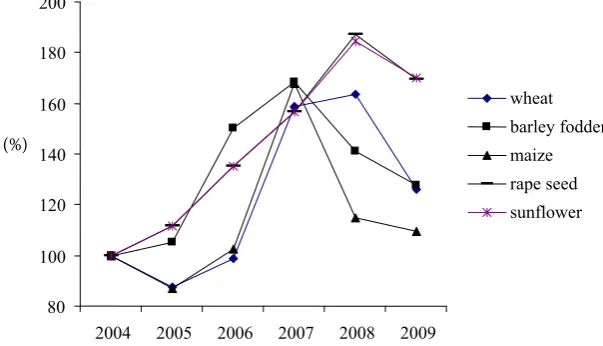
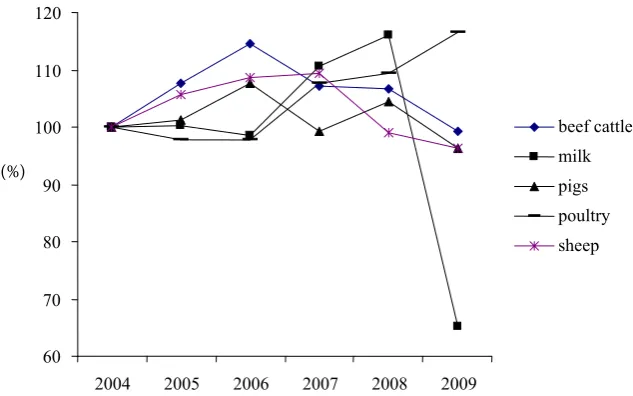
The significant price volatility has been observed in the world agri-food markets in these latter years. it has been manifested through the dramatic price variation. Within the last decade, the years 2007–2008 were critical. in the mentioned period, significant upward tendencies were marked by prices of several agrarian commodities (Figure 1 and 2). The price development of grains and oilseeds was the most striking. in the inscribed period, they reached their historical maximum.
The price increase of agri-food commodities was a result of several sequences of production down-swings that were induced by unfavourable weather conditions (drought) in the period of low world grain stocks, by the increasing integration of food and
80 100 120 140 160 180 200
2004 2005 2006 2007 2008 2009 %
[image:2.595.139.441.541.714.2]wheat barley fodder maize rape seed sunflower
Figure 1. Development of the world prices of plant commodities in 2005–2009 (2004 = 100%)
Source: oEcD-FAo (2010), FAPri (2010), own calculations (calculations were realized following the world commodity prices in €/t)
energy markets (biodiesel production development) and unsuitable political decisions. Furthermore, the mentioned topic has its background in the global macroeconomic development, a rapid economic progress of developing countries and in the monetary impacts including the exchange rates movement (in the main, dollar devaluation) in the international markets.
Price is a motivation power of the supply and de-mand development in the world markets. Supply of agrarian markets can be characterized through the low elasticity to the realized production. Furthermore, the production has been changed every year pursu-ant to the variable weather conditions. in general, demand for basic agri-food commodities has been increased steadily in compliance with the population growth and it does not indicate a higher flexibility. The low demand elasticity of agri-food products causes the fact that a relatively small production volume variability can induce significant changes (so-called shocks) in supply and demand, and consequently in price levels. Pursuant to the presented facts, it is necessary to remark that the low demand elasticity may be partially compensated by the stocks creation. in the event of low production, the mentioned facts can enable meeting the demand.
A cultivating medium for the incidence of the poten-tial price volatility can be also the presence of strong investors, speculative business activities (higher prices attract attention and intention to invest) and also the
elimination of stability policy measures.
Price volatility is influenced by the degree of price transmission, it means by the price interactivity in
the domestic and world (foreign, regional) market. The transmission of international prices to the do-mestic market is adequate to the level of foreign trade liberalization of the given country and its effect can be different by individual commodities. The relation between liberalization and volatility is complicated. in the event of poor production, the import of the given commodity can limit the increase of domestic prices. Vice versa, in the event of the oversize pro-duction, its export can limit the price decrease in the domestic market.
Price transmission can be obstructed (blocked) through various political measures (export and im-port restrictions, customs duties, quotas, sanitary and phyto-sanitary measures, minimal price fixing, intervention purchases and alike) and also through the deficiently developed infrastructure.
in connection with the price transmission, it is necessary to remark that Slovakia is a country with the small market space. For all that, prices of agrarian commodities have been significantly affected by the international market. The presented tendencies were shown very markedly by maize and pig meat (Figure 3). in the evaluated period, prices of beef, poultry and wheat did not reach the world price level.
Volatility relates to the macroeconomic level (gov-ernmental decisions) and also to the microeconomic level (decisions of producers and consumers). At the macroeconomic level, the price volatility plays an important role mostly in less developed countries that have poor opportunities to diversify their production. on the demand side, high prices of basic agri-food commodities can affect the living standard of inhabit-60
70 80 90 100 110 120
2004 2005 2006 2007 2008 2009
%
[image:3.595.143.460.70.268.2]beef cattle milk pigs poultry sheep
Figure 2. Development of the world prices of animal commodities in 2005–2009 (2004 = 100%)
Source: oEcD-FAo (2010), FAPri (2010), own calculations (calculations were realized following the world commodity prices in €/t of live weight; litre)
ants. For all that, the governments of the endangered countries have taken stability measures.
The response of the individual countries (eventu-ally the aggregations of countries) to the high price volatility of agri-food commodities was miscellaneous in 2007–2008. The following measures were taken very frequently: decreasing of the foodstuffs VAT (value added tax), subsidization of the basic food-stuffs, the imposition of import duties and export barriers, unlocking of the governmental reserves, the stimulation of domestic production, the control of retail prices, and the change of political measures concerning biodiesel and so on.
Price volatility can be identified through the cal-culation of the variation coefficient in the selected period. That manner is used in the FAo and the oEcD analyzes. The mentioned methods enable to compare variation coefficient among the individual commodities. it is measured ex post pursuant to the current prices. in this connection, it is necessary to note that the selection of the compared time series is very important for the objective examination of the price level development.
Pursuant to the comparison of variation coefficients regarding grains (calculated per 4 decades), it is
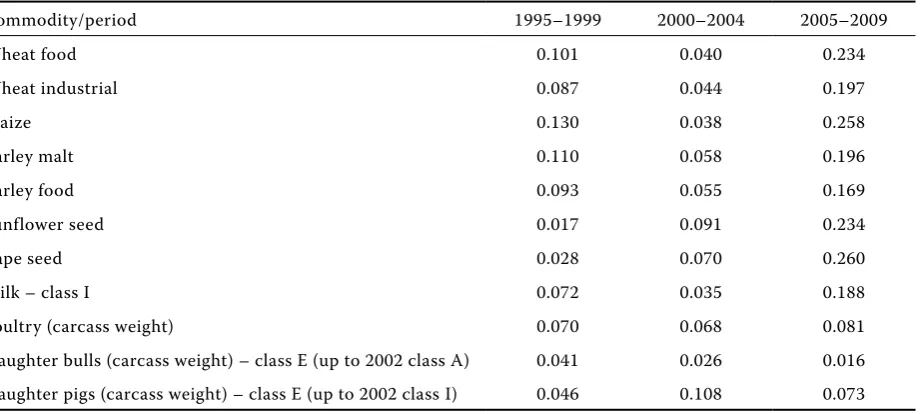
im-possible to draw clear conclusions about the dramatic price volatility increasing in the world agrarian mar-kets (Table 1). Price volatility of agrarian commodities in the Slovak market (calculated through the variation coefficient in five years intervals) shows an upward trend for grains and oilseeds. As to the animal com-modities, the price variability was increased for milk and less by poultry, but the same tendencies were not confirmed for beef and pig meat (Table 2).
Estimations of the future supply and demand de-velopment the international agrarian markets (in-cluding price development) are very important for the strategic decisions of businessmen undertaking in agriculture. According to the mentioned estima-tions, businessmen make decisions on their future production structure and its volume. Predictions of prices in the world markets are yearly published by the oEcD in collaboration with the FAo. Forasmuch as it is not possible to predict an incidence of the price volatility triggers, the predictions were done providing the standard climatic and macroeconomic conditions, it means without an impact of the so- called “shocks”.
According to the oEcD-FAo prognosis, in the future decade the world prices of agri-food
188 132
2883
1467
1193
149 139
2558
1464
1093
0 500 1 000 1 500 2 000 2 500 3 000 3 500
wheat maize beef pig meat poultry
[image:4.595.112.471.72.250.2]world prices SR prices
Figure 3. comparison of the world and Slovak prices of the selected commodities (average of 2006–2008, €/t)
Source: So Sr databases, oEcD-FAo (2010)
Table 1. Development of variation coefficient by grains world prices
commodity/period 1970–1979 1980–1989 1990–1999 2000–2009
Maize 0.194 0.185 0.089 0.135
rice 0.183 0.157 0.121 0.116
Wheat 0.280 0.123 0.096 0.112
[image:4.595.67.531.681.750.2]ties are expected to be at a higher level than in the previous 10 years, but the price level of 2007–2008 will be not reached by many commodities (Figure 4). The mentioned price development is conditioned by the progressive trend in the world economy.
With regard to the assumed conditions, the pre-sented trends of the world agri-food commodities prices development ought to be obtained also in the Slovak market. however, the question is the future advancement of the common Agricultural Policy of the EU after 2013. According to our opinion, the price volatility in the agrarian markets is assumed to occur relatively often in the future. This theory is supported by the significant dependency of some agri-food
commodities on energy prices, namely it means the commodities used as the raw material for the energy production (grains, oilseeds), but also butter.
[image:5.595.73.534.84.291.2]The price volatility is an international trouble; it runs over the state frontiers and to a certain extent, it resembles an epidemic contagious disease. Because of this, it is necessary to search for an effective rem-edy. For the venture elimination resulting from the price volatility, it would be advisable to improve the information market system, to enforce the transpar-ency and credibility of the provided information in the domestic and international markets and to strengthen the institutional competences for the purpose of price stability assurance in the agri-food Table 2. Development of variation coefficient of farm prices of selected agrarian commodities at the Sr market
commodity/period 1995–1999 2000–2004 2005–2009
Wheat food 0.101 0.040 0.234
Wheat industrial 0.087 0.044 0.197
Maize 0.130 0.038 0.258
Barley malt 0.110 0.058 0.196
Barley food 0.093 0.055 0.169
Sunflower seed 0.017 0.091 0.234
rape seed 0.028 0.070 0.260
Milk – class i 0.072 0.035 0.188
Poultry (carcass weight) 0.070 0.068 0.081
Slaughter bulls (carcass weight) – class E (up to 2002 class A) 0.041 0.026 0.016 Slaughter pigs (carcass weight) – class E (up to 2002 class i) 0.046 0.108 0.073
Source: So Sr, own calculations
0
20 40 60 80 100 120 140wheat maize
oilseeds vegetableoils
sugarraw beef pig meat poultry butter cheese SMP WMP biofuel ethanolaverage 2007–2008 average 2010–2019
Figure 4. Development of the average world prices of the selected commodities in comparison with the average of 1997–2006 (%)
[image:5.595.65.531.540.691.2]markets. With the view to affect supply and demand, it would be efficient to define clear rules how to act if import tariffs, export and import restriction were imposed etc. These questions are subjects to inter-national negotiations and have to be in compliance with the WTo rules.
CONCLuSION
The significant price volatility has been observed in the world agri-food markets in these latter years. it has been caused by the triggers of the so-called market shocks that negatively influenced the stability of supply and demand of agri-food commodities. The price volatility of the Slovak agri-food commodities was reviewed pursuant to the variation coefficient calculation in three consecutive five-year intervals. From the results, it was ensued that in the mentioned period, the price volatility was increased for grains, oilseeds, milk and poultry meat. This trend was not confirmed for beef and pork meat.
in connection with the real jeopardy of the signifi-cant price volatility occurrence (mainly in connection with a notified energy price increase) that impends the harmonic structural development of the Slovak agri-food sector, within the research activities it would be useful to pay attention to the depth analysis of agrarian markets in the future. The accomplishment of the mentioned analysis is conditioned by the im-provement of the relevant market information system including the regular data actualization concerning the stock level of the basic agrarian commodities and the regular actualization (eventually establishing) of the information system on the agrarian political measures affecting supply and demand in the inter-national markets.
REfERENCES
Balcombe K. (2009): The nature and Determinants of Volatility in Agricultural Prices. Technical report, re-port to the FAo.
Buday Š., Federičová z., Vajcíková r. (2009): Diverzifica-tion of farm busines. Agricultural Economics – czech, 55: 77–83.
Božík M. (2008): Prognóza vývoja slovenského poľnohos-podárstva (The prognosis of the Slovak agriculture development). riAFE, Bratislava.
Čechura L., Šobrová L. (2008): The price transmission in pork meat agri-food chain. Agrucultural Economics – czech, 54: 77–84.
FAPri 2010 U.S. and World Agricultural outlook (2010). FAPri Staff report 10-FSr 1, p. 76. Food and Agricul-tural Policy research institute with centers at iowa State University, Ames, and the University of Missouri, co-lumbia; iSSn 1534-4533. Available at http://www.fapri. iastate.edu/outlook/2010/text/outlook_2010.pdf gálik J. (2010): Vplyv reformy SPP a rokovaní WTo na
zahraničný agropotravinársky obchod (impact of the cAP reform and WTo negotiations on foreign agri-food trade). riAFE, Bratislava; iSBn 978-80-8058-538-9. Krížová S. (2009): Selected food verticals and their impact
on prices of food products. Agricultural Economics – czech, 55: 94–101
Matošková D. (2009): Prognóza vývoja slovenského poľ-nohospodárstva (The prognosis of the Slovak agriculture development). riAFE, Bratislava.
oEcD-FAo Agricultural outlook 2010–2019 (2010). Part i and ii [TAD/cA/APM/WP(2010)1,2], p. 136. Available at www.oecd.org
So Sr (Statistical office of the Slovak republic). Available at www.statistics.sk
Arrived on 28th october 2010
Contact address:
Dagmar Matošková, research institute of Agricultural and Food Economics, Trenčianska 55, Bratislava, Slovak republic