EL92: Entity Linking Combining Open Source Annotators
via Weighted Voting
Pablo Ruiz and Thierry Poibeau
Laboratoire LATTICE
CNRS, École Normale Supérieure, U. Paris 3 Sorbonne Nouvelle 1, rue Maurice Arnoux
92120 Montrouge, France
{pablo.ruiz.fabo,thierry.poibeau}@ens.fr
Abstract
Our participation at SemEval’s Multilingual All-Words Sense Disambiguation and Entity Linking task is described. An English entity linking (EL) system is presented, which com-bines the annotations of four public open source EL services. The annotations are com-bined through a weighted voting scheme in-spired on the ROVER method, which had not been previously tested on EL outputs. Results on the task’s EL items were competitive.
1 Introduction
The paper describes our participation at SemEval 2015, Task 13 (Moro and Navigli, 2015): Multilin-gual all-words Sense Disambiguation (WSD) and Entity Linking (EL). Systems performing both tasks, or either one, can participate. The preferred word-sense and entity inventory is Babelnet (Navi-gli and Ponzetto, 2012); other inventories are al-lowed. Our system performs English EL to Wikipedia, combining the output of open-source, publicly available EL systems via weighted voting. The system is relevant to the task’s interest in comparing the results of EL systems that apply encyclopedic knowledge only, like ours, and sys-tems that jointly exploit encyclopedic and lexico-graphic resources for EL.
The paper’s structure is the following: Section 2 discusses related work, and Section 3 describes the
system. Sections 4 and 5 present the results and a conclusion.
2 Related Work
General surveys on EL can be found in (Cornolti et al., 2013) and (Rao et al., 2013). Work on combin-ing NLP annotators and on evaluatcombin-ing EL systems is particularly relevant for our submission.
The goal of combining different NLP systems is obtaining combined results that are better than the results of each individual system. Fiscus (1997) created the ROVER method, with weighted voting to improve speech recognition outputs. A ROVER was found to improve parsing results by De la Clergerie et al. (2008). Rizzo et al. (2014) im-proved Named Entity Recognition results, combin-ing systems via different machine learncombin-ing algorithms. Our approach is inspired on the ROVER method, which had not been previously attempted for EL to our knowledge. Systems that combine entity linkers exist (NERD, Rizzo and Troncy, 2012). However, a difference in our sys-tem is that the set of linkers we combine is public and open-source. A second difference is the set of methods we employed to combine annotations.
EL evaluation work (Cornolti et al., 2013), (Usbeck et al., 2015) has highlighted to what an extent EL systems’ performance can differ depend-ing on characteristics of the corpus. This motivates testing whether different EL systems, properly combined, can complement each other.
3 System Description
The system performs English EL to Wikipedia, combining the outputs of the following EL sys-tems: Tagme 21 (Ferragina and Scaiella, 2010),
DBpedia Spotlight2 (Mendes et al. 2011),
Wikipe-dia Miner3 (Milne and Witten, 2008) and Babelfy4
(Moro et al. 2014). Babelfy outputs were only con-sidered if they started with a WIKI prefix or their first character was uppercase.5 Details about each
of our workflow’s steps follow.
3.1 Individual Systems’ Thresholds
First of all, a client requests the annotations for a text from each linker’s web-service, using the ser-vices’ default settings except for the confidence threshold, which is configured in our system. An-notations whose confidence is below a threshold are eliminated.
All of the linkers used, except Babelfy, output confidence scores for their annotations. Cornolti et al., (2013) reported optimal confidence-score thresholds for all our linkers (except Babelfy). Us-ing Cornolti’s BAT Framework, we verified that the thresholds are still valid.6 We adopted the
weak-annotation match thresholds for the IITB dataset, since we consider the IITB corpus close to the task’s data, in text-length and topical variety. Our thresholds were 0.102 for Tagme, 0.023 for Spotlight, and 0.219 for Wikipedia Miner. Since Babelfy does not output confidence scores, all of its annotations were accepted to the next step in the workflow.
3.2 Ranking the Systems to Combine
Our method for combining annotators’ outputs re-quires the annotators to be previously ranked for precision on an annotated reference set. It is not viable to annotate a reference set for each new cor-pus. To help overcome this issue, we adopt the fol-lowing heuristic: We have ranked the annotators
1 http://tagme.di.unipi.it/tagme_help.html
2 https://github.com/dbpedia-spotlight/dbpedia-spotlight/wiki
3 http://wikipedia-miner.cms.waikato.ac.nz/
4 http://babelfy.org/download.jsp
5 Babelfy was a late addition to our pipeline; the reader will
note that we made some ad-hoc decisions to benefit from its outputs while complying with previously defined features in our workflow.
6 https://github.com/marcocor/bat-framework
on a series of very different reference corpora. To perform EL on a new corpus, our heuristic consid-ers the following criteria: First, the types of EL annotations needed by the user. Second, how simi-lar the new corpus is (along dimensions described below) to the reference corpora on which we have pre-ranked the annotators. To apply the workflow to a new corpus, the heuristic chooses the annota-tor-ranking obtained with the reference corpus that is most similar to that new corpus, while still re-specting the annotation-types needed by the user.
The reference corpora on which we pre-ranked the annotators are AIDA/CoNLL Test B (Hoffart et al., 2011), and IITB (Kulkarni et al., 2009). These corpora are very different to each other, in terms of character length, topical variety, and re-garding whether they annotate common-noun men-tions or not. Moreover, some EL systems obtain opposite results when evaluated on AIDA/CoNLL B vs. IITB, as tests by Cornolti et al. (2013) and on the GERBIL platform7 have shown.
The heuristic’s first criterion is the types of an-notations needed: If the user needs anan-notations for common-noun mentions, the IITB ranking is used, since IITB is the only one in our reference-datasets that was annotated for such mentions. If the user does not need common noun annotations, our heu-ristic compares the user’s corpus with our two ref-erence corpora in terms of character length and of a measure of lexical cohesion. Both factors have been argued to influence linkers’ uneven results across corpora (Cornolti et al., 2013).
We accepted common-noun annotations for the task, as they were relevant for the task’s domains (e.g. disease names for the biomedical texts). Ac-cordingly, the heuristic ranked annotators as per their IITB results: 1st Wikipedia Miner (0.568
pre-cision), 2nd Babelfy (0.493), 3rd Spotlight (0.462),
4th Tagme (0.452).8
3.3 Weighting and Selecting Annotations
Using the linker ranking from the previous step, the annotations are voted, and selected for final output or rejected based on the vote. We used two
7 See http://gerbil.aksw.org/gerbil/overview at the site for the
GERBIL platform (Usbeck et al., 2015):
8 The precision is from tests in Cornolti et al., 2013, using
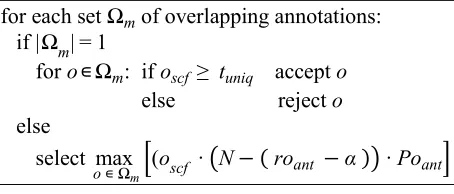
voting schemes. The first one relies on each anno-tation’s confidence score, weighted by the annota-tor’s rank and precision on the ranking datasets from 3.2. The rationale is that a high-confidence annotation for a low-ranked annotator can be better than a low-confidence annotation for a higher-ranked annotator. The definition is in Figure 1: For each annotation (m, e) in the results, m is its men-tion,9 e is the entity paired with m, and Ω
m is the set of annotations in the results whose mentions overlap10 with m. If the size of Ω
m is 1, the scaled confidence11o
scf of Ωm’s unique annotation ο must reach threshold tuniq in order for ο to be accepted. Threshold tuniq is the average of the scaled confi-dence scores for all annotations in the corpus. If
Ωm has more than one annotation, the voting is thus: For each annotation ο in Ωm, ο’s vote is a product determined by several factors: oscf is o’s scaled confidence.12N is the total number of
anno-tators we combine (i.e. 4). Operand roant is the rank of annotator oant, which produced annotation o.
Poant is that annotator’s precision on the ranking reference corpus (3.2 above). For roant, 0 is the best rank and N – 1 the worst. Parameter α influences the distance between the annotations’ votes based on their annotators’ rank, and was set at 0. The annotation with the highest vote in Ωm is accepted; the rest are rejected.
for each set Ωmof overlapping annotations:
if |Ωm|=1
for o∊Ωm: if oscf ≥ tuniq accept o
else reject o
else
select max
o∊Ωm[(oscf ∙ (N− (roant −α)) ∙ Poant]
Figure 1: Annotation voting scheme used in Run 1.
9 The string of characters in the text that the annotation is
based on (the term mention is often used in EL for this notion).
10 Assume two mentions (p1, e1)and (p2, e2), where p1 and
p2 are the mentions’ first character indices, and e1 and e2 are the mentions’ last character indices. The mentions overlap iff ((p1 = p2) ˄ (e1 = e2)) ˅ ((p1 = p2) ˄ (e1 < e2)) ˅ ((p1 = p2) ˄ (e2 < e1)) ˅ ((e1 = e2) ˄ (p1 < p2)) ˅ ((e1 = e2) ˄ (p2 < p1)) ˅ ((p1 < p2) ˄ (p2 < e1)) ˅ ((p2 < p1) ˄ (p1 < e2)).
11 Since the range of confidence-scores output by each
annota-tor was different, we minmax-scaled all original (orig)
confi-dence scores to a 0-1 range: scaled_confidence =
(orig_confidence – corpus_min_orig_confidence) /
(corpus_max_orig_confidence–corpus_min_orig_confidence)
12 As Babelfy does not provide confidence scores, its
annota-tions were assigned the average over the whole result-set of the scaled confidence-scores output by the other annotators.
The second voting scheme is similar to the ROVER method in (De la Clergerie et al., 2008). The method assesses annotations based on how many linkers have produced them, using the link-ers’ rank, and their precision on the ranking-sets, as weights. If enough lower-ranked annotators have linked to an entity, this entity can win over an entity proposed by a higher-ranked annotator.
The voting is defined in Figure 2. For each an-notation (mention m, entity e), Ωm is the set of an-notations whose mentions overlap10 with m. Based
on the different entities in Ωm’s annotations, Ωmis divided into disjoint subsets, each of which con-tains annotations linking to a different entity. Each of these subsets L is voted by vote(L). In vote(L), for each annotation o in L, terms N, roant, α, Poant have the same meaning as the terms bearing the same names in Figure 1, and are described above.
for each set Ωmof overlapping annotations: for L∊Ωm:
vote(L) = ∑o∈L (N − (roant − α)) ∙ Poant
N
if max
[image:3.612.73.300.416.513.2]L∊Ωm(vote(L) ) > Pmax : select argmax L∊Ωm (vote(L))
Figure 2: Entity voting scheme used in Runs 2 and 3.
The entity for the subset L which obtains the highest vote among Ωm’s subsets is selected if its vote is higher than Pmax, i.e. the maximum preci-sion in the ranking dataset (0.568, see Section 3.2). After selecting the winning entity, we still need to select a mention for it. The mention is selected at random among the mentions of the annotations in the winning subset L. This implementation of men-tion selecmen-tion is meant as a baseline that can be refined in the future. Two initial factors to consider in mention selection would be mention length and the annotators having chosen each mention.
3.4 Entity Classification
After the vote, entities in the selected annotations are classified before final output. The classification is rule-based. It exploits the category or type labels output by the EL services we combined—except Babelfy, which does not output such information.
The classification-rules are based on type labels in the NERD ontology (Rizzo and Troncy, 2012)13
and on a subset of the DBpedia ontology classes (Mendes et al. 2011)14 relevant for the task’s
do-mains. For types Person, Location, Organization, Wikipedia category labels were also exploited.
Some rules involve an exact match against the annotations’ categories or types, e.g. “Assign type
Location if the annotation has type
DBpe-dia:Place”. Some rules involve a partial match, e.g. “Assign type Person if one of the Wikipedia category labels for the entity contains births”.
For Babelfy outputs, Wikipedia category labels and DBpedia types were obtained through Wikipe-dia Miner’s3 and DBpedia’s15 APIs.
4 Results and Discussion
Since the task was open to systems doing either WSD or EL, or both, the corpus targeted both WSD and EL. Participant systems were evaluated on a different set of items depending on their na-ture (EL only, WSD only, both). The corpus con-tained 4 generic and domain-specific documents with 1094 single-word instances, 82 multi-words and 86 named entities (NE).
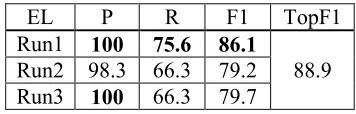
Our system was conceived and evaluated as an EL system. Table 1 shows our precision, recall and F1 for all three runs. Column TopF1 is the maxi-mum F1 attained by a participant on the EL items.
EL P R F1 TopF1
Run1 100 75.6 86.1
88.9 Run2 98.3 66.3 79.2
[image:4.612.96.274.418.475.2]Run3 100 66.3 79.7
Table 1: English EL results for all domains.
Run 1 results were competitive, ranking 3rd of 10,
if we compare all participants’ best runs. Runs 2 and 3 lag behind, due to lower recall. Run 1 em-ployed the voting scheme in Figure 1. Runs 2 and 3 correspond to the scheme defined in Figure 2, with parameter α set to 0 in Run 2 and to 1 in Run 3. In spite of its results, the voting scheme from Figure 2 has advantages over the first one: It does not require confidence scores, so it accom-modates linkers that don’t score their annotations. Also, it does not need a separate threshold to de-cide on annotations produced by one annotator on-ly. More work is needed to determine the reason
14 http://mappings.dbpedia.org/server/ontology/classes/
15 http://dbpedia.org/sparql
for this difference in results, i.e. whether the sec-ond approach itself is not useful to combine EL annotations, or whether its worse results were re-lated to our implementation.
One of the task’s purposes was to compare sys-tems’ performance across domains. Table 2 shows our best run’s results per domain. Column N re-flects the number of EL items in the corpus for each domain. All other columns have the same meaning as in Table 1, but considering the per-domain results.
N P R F1 TopF1
Biomedical 48 100 83.3 90.9 100
Math & Computer 22 100 54.4 70.6 74.3
General 16 100 81.3 89.7 90.3
Table 2: English EL Run 1 results by domain.
Note that the small number of EL items availa-ble for each domain limits in our opinion the relia-bility of interpretations for these results.
Since our workflow combines several EL sys-tems, it would be interesting to compare results for each individual system by itself vs. the results for the combined system. In later work (Ruiz and Poibeau, 2015), using an improved version of the system described here, and larger EL golden-sets, we performed such comparisons, finding signifi-cant improvements in the combined system vs. the individual ones.
5 Conclusion
The entity linking (EL) system presented was ranked 3rd (out of 10) on the task’s EL items. The system combines the outputs of four public open source EL services. Two weighted voting methods were described to combine the outputs. The first method relies on annotations’ confidence scores; the second one is a weighted majority vote. The first method obtained better results, but the second one has the advantage of being easily applicable to non-scored annotations. More work is needed to assess the reasons for the methods’ differential per-formance. Future work also includes adding other public open source systems to the workflow.
Acknowledgments
References
Marco Cornolti, Paolo Ferragina, and Massimiliano Ciaramita. (2013). A framework for benchmarking entity-annotation systems. In Proc. of WWW, 249– 260.
Éric Vilemonte De La Clergerie, Olivier Hamon, Dja-mel Mostefa, Christelle Ayache, Patrick Paroubek, and Anne Vilnat. (2008). Passage: from French par-ser evaluation to large sized treebank. In Proc. of LREC 2008, 3570–3576.
Paolo Ferragina and Ugo Scaiella. (2010). Tagme: on-the-fly annotation of short text fragments (by wikipe-dia entities). In Proc. of CIKM’10, 1625–1628. Jonathan G Fiscus. (1997). A post-processing system to
yield reduced word error rates: Recognizer output voting error reduction (ROVER). In Proc. of the IEEE Workshop on Automatic Speech Recognition and Understanding, 1997, 347–354.
Johannes Hoffart, Mohamed Amir Yosef, Ilaria Bordi-no, Hagen Fürstenau, Manfred Pinkal, Marc Spaniol, Bilyana Taneva, Stefan Thater, and Gerhard Weikum. (2011). Robust disambiguation of named entities in text. In Proc. of EMNLP, 782–792. Sayali Kulkarni, Amit Singh, Ganesh Ramakrishnan,
and Soumen Chakrabarti. (2009). Collective annota-tion of Wikipedia entities in web text. In Proc. ACM SIGKDD, 457–466.
Pablo N. Mendes, Max Jakob, Andrés García-Silva, and Christian Bizer. (2011). DBpedia spotlight: shedding light on the web of documents. In Proc. of the 7th Int. Conf. on Semantic Systems, I-SEMANTICS’11, 1–8.
David Milne and Ian H. Witten. (2008). An effective, low-cost measure of semantic relatedness obtained from Wikipedia links. In Proc. of AAAI Workshop on Wikipedia and Artificial Intelligence: an Evolving Synergy, 25–30
Andrea Moro and Roberto Navigli (2015) SemEval-2015 Task 13: Multilingual All-Words Sense Disam-biguation and Entity Linking. In Proc. of SemEval-2015.
Andrea Moro, Alessandro Raganato, and Roberto Navi-gli. (2014). Entity Linking meets Word Sense Dis-ambiguation: A Unified Approach. Transactions of the ACL, 2, 231–244.
Roberto Navigli and Simone Ponzetto. (2012). BabelNet: The automatic construction, evaluation and application of a wide-coverage multilingual se-mantic network. Artificial Intelligence, 193, 217– 250.
Delip Rao, Paul McNamee, and Mark Dredze. (2013). Entity linking: Finding extracted entities in a knowledge base. In Multi-source, Multilingual In-formation Extraction and Summarization, 93–115. Springer.
Giuseppe Rizzo and Raphaël Troncy. (2012). NERD: a framework for unifying named entity recognition and disambiguation extraction tools. In Proc. of the Demonstrations at EACL’12, 73–76.
Giuseppe Rizzo, Marieke van Erp, and Raphaël Troncy. (2014). Benchmarking the Extraction and Disambig-uation of Named Entities on the Semantic Web. In
Proc. of LREC 2014, 4593–4600.
Pablo Ruiz and Thierry Poibeau. (2015). Combining Open Source Annotators for Entity Linking through Weighted Voting. In Proceedings of *SEM 2015. Fourth Joint Conference on Lexical and Computa-tional Semantics. Denver, U.S.