Proceedings of the First International Workshop on Spatial Language Understanding (SpLU-2018), pages 63–70
The Case for Systematically Derived Spatial Language Usage
Bonnie Dorr
Institute for Human and Machine Cognition 15 SE Osceola Ave, Ocala, FL 34471
Clare Voss
U.S. Army Research Laboratory Adelphi, MD 20783
Abstract
This position paper argues that, while prior work in spatial language understanding for tasks such as robot navigation focuses on map-ping natural language into deep conceptual or non-linguistic representations, it is possi-ble to systematically derive regular patterns of spatial language usage from existing lexical-semantic resources. Furthermore, even with access to such resources, effective solutions to many application areas such as robot nav-igation and narrative generation also require additional knowledge at the syntax-semantics interface to cover the wide range of spatial expressions observed and available to natu-ral language speakers. We ground our in-sights in, and present our extensions to, an ex-isting lexico-semantic resource, covering 500 semantic classes of verbs, of which 219 fall within a spatial subset. We demonstrate that these extensions enable systematic derivation of regular patterns of spatial language without requiring manual annotation.
1 Introduction
While prior work in spatial language understand-ing for tasks such as robot navigation focuses on mapping natural language into deep concep-tual or non-linguistic representations—for further reasoning or embodied cognition (Perera et al.,
2017;Pastra et al.,2011)—we argue that it is pos-sible to systematically derive regular patterns of language usage from existing lexical-semantic re-sources (Dorr et al., 2001). Furthermore, even with access to such resources, effective solutions to many application areas such as robot naviga-tion and narrative generanaviga-tion require addinaviga-tional knowledge at the syntax-semantics interface to capture the range of spatial expressions observed and available to natural language speakers.
The emphasis of this position paper is on the representational underpinnings of spatial
expres-sions for problems such as natural-language medi-ated two-way human-robot dialogue. Such com-munication may ultimately take place over low bandwidth networks where, for example, an au-tonomous robot will navigate and report back from a remote site on what it sees in cooperation with its distant human teammate who directs and responds to the robot as needed. We focus on the use and modification of existing resources to address this problem, making certain linguistically-motivated, working assumptions about:
• layers within our lexical representations, • levels for distinct language-based modules
with syntactic, semantic, and conceptual knowledge (each with primitives and oper-ations for that level), and
• a shared computational model of an environ-ment that includes representations of objects, agents, their relations to each other, events– thus enabling navigation information to be accessible to both robot and human.
That is, we assume first that there exist lexical-internal semantic structures with layers, and those semantic structures contain primitives that are grounded at a conceptual level (not discussed herein). We leverage Lexical Conceptual Struc-ture (LCS) (Jackendoff,1983;Dorr,1993), a log-ical representation with compositional properties, to guide development of semantics for spatial lan-guage in lanlan-guage understanding and generation.1 We note that other logical representations may also be adequate for this study, e.g., Abstract Meaning Representation (Banarescu et al.,2014), Prague Dependency Trees (Hajiˇc et al., 2018), and descendants of such representations ( Vander-wende et al., 2015). LCS has been selected due 1We take these structures to capture language-bound
meanings, that is semantic forms. In our framework, these do not, despite their name, capture language-independent, con-ceptual knowledge.
to its compositional, lexicon-based formalism and its potential for follow-on work in other language processing applications for which cross-lingual LCS mappings have already been devised (e.g., machine translation (Habash and Dorr,2002)).
We assume second, that for human-robot natural-language mediated communication, a number of constraints at the syntax-semantics in-terface are crucial for interpreting the wide rang-ing flexibility of real utterances and the context of the system is central to dialogue management. We leverage previously collected dialogue data with naturally occurring spoken Bot Language (Marge et al., 2017) that provides transcripts and dialog analyses (Traum et al., 2018), but without any form of lexical semantics.
We assume third, that we will test and validate our approach by augmenting an implemented di-alogue system for understanding and generation of Bot Language. The application of our founda-tional paradigm to this problem is a future direc-tion outside of the scope of this posidirec-tion paper.
The layered lexical representations referred to in the first assumption above form the basis for this discussion. Specifically, we posit that the de-velopment of an application such as robot navi-gation (Bonial et al., 2018; Moolchandani et al.,
2018) or generation of narrative explanations ( Ko-rpan et al., 2017; Lukin et al., 2018) requires a layered representation scheme to include a set of spatial primitives (the basis for the LCS represen-tation) coupled with a representation of constraints at the syntax-semantics interface. Additional lay-ers include prepositional collocates2 and spatial semantics that are crucial for understanding and production of unconstrained spatial expressions.
We describe our extensions to an LCS resource covering 500 semantic classes of verbs, of which 219 fall within a spatial subset. We demonstrate that this resource is designed to systematically ac-count for certain types of spatial expressions based on lexical-semantic constraints of spatial verbs in those expressions.
At the heart of the position presented herein is a representational framework that supports the abil-ity to “read off” such constraints from lexical en-tries without requiring laborious manual
annota-2Prepositions that, when tested in collocations with
oth-erwise non-spatial expressions, add spatial information. For example, inThe hawk screeched across the sky., the preposi-tional phrase headed byacrossintroduces motion not present in the intransitiveThe hawk screeched(Talmy,2014).
tion. Similarly, when subsequent lexicon updates occur, the ability to “read off” constraints is still available without manual annotation. This differ-entiates our approach from others, e.g., feature-based annotation (for a cogent review of natural language annotation approaches, see (Stubbs and Pustejovsky,2012)). Our LCS-based approach is described next, followed by related work and con-cluding remarks.
2 Approach
This section introduces the notion of LCS and describes an LCS-based approach to systematic derivation of usage patterns for understanding and generation. We extend an LCS resource to include constraints (blocks, overlaps, and fills) and present the upshot of these extensions.
2.1 Lexical Conceptual Structure
Lexical Conceptual Structure (LCS) (Jackendoff,
1983, 1990; Dorr, 1993; Dowty, 1979; Guerssel et al.,1985) has been used for a range of different applications, including interlingual machine trans-lation (Habash and Dorr,2002), lexical acquisition (Habash et al.,2006), cross-language information retrieval (Levow et al.,2000), language generation (Traum and Habash, 2000), and intelligent lan-guage tutoring (Dorr,1997).
The LCS representation was introduced by Jackendoff as based in the spatial domain and nat-urally extended to non-spatial domains, as spec-ified by fields.3 For example, the spatial dimen-sion of the LCS representation corresponds to the
(Loc)ationalfield, which underlies the meaning of
John traveled from Chicago to Bostonin the LCS [John GOLoc [From Chicago] [To Boston]]. This is straightforwardly extended to the (Temp)oral
field to represent analogous meanings such asThe meeting went from 7pm to 9pmin the LCS [Meet-ing GOTemp[From 7pm] [To 9pm]].
An “LCS Verb Database” (LVD) developed in prior work (Dorr et al.,2001) includes a set of LCS templates classified according to an extension of (Levin, 1993)’s 192 classes, totaling 500 classes. The first 44 classes were added beyond the origi-nal set of semantic classes (Dorr and Jones,1996). Additional classes were derived through aspectual distinctions to yield LCS classes that were finer-grained than the original Levin classes (Olsen
3For a more extensive, non-LCS-based analysis and
et al., 1997). Each LCS class consists of a set of verbs and, in several cases, the classes include
non-Levin words(those not in (Levin,1993)), de-rived semi-automatically (Dorr, 1997). LVD is foundational for the position adopted in this pa-per, as it provides a mapping from LCS-based verb classes to their surface realizations.
The representational framework provided by the LVD has many similarities with others such as FrameNet (Ruppenhofer et al., 2016) and Verb-Net (Palmer et al.,2017), both of which also in-clude classes and mappings to surface realizations. Whereas FrameNet has a richer semantics, e.g., finer grained classes than those of Levin (1993), VerbNet has a clearer mapping to surface realiza-tions with specific mappings from thematic roles to syntactic realizations.The LVD differs from both of these in that its compositional represen-tations support the ability to “read off”different types of lexical-semantic constraints without re-quiring manual annotation. For example, con-straints on the mapping between semantics and syntax, e.g., blocks, overlaps, and fills, can be “read off” LVD entries, as described below.
2.2 Syntax-Semantics Interface
Prior work (Jackendoff, 1996;Levin, 1993; Dorr and Voss, 1993; Voss and Dorr, 1995; Kipper et al.,2007;Palmer et al.,2017) suggests that there is a close relation between underlying lexical-semantic structures of verbs and nominal predi-cates and their syntactic argument structure. The work of Voss et al. (1998) supports that the gener-ation of a preposition (in English) as dependent on both the semantics of the predicate and structural idiosyncracies at the syntax-semantics interface.
Three notions introduced in this earlier work are relevant to spatial language understanding: BLOCK (where a LCS predicate preempts or blocks the composition into one of its argument positions by another LCS), OVERLAPS (where a LCS predicate allows the composition of an-other LCS into one of its already-occupied argu-ments), and FILLS (where a LCS predicate allows the composition of another correctly typed LCS into one of its empty arguments).
To investigate the systematic derivation of lan-guage usage patterns for both understanding and generation of spatial language, we first sim-plify and adapt the LVD to include mappings to both lexically implicit and lexically explicit direc-tional components of meaning. We focus
specifi-LCS Primitives: GO, BE, STAY, CAUSE, etc. Spatial Semantics: upward, downward, etc. Prepositional collocates: up, down, in, into,
[image:3.595.311.536.65.127.2]out of, across, to, from, etc.. Blocks Overlaps Fills
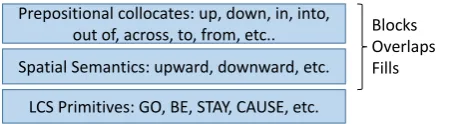
Figure 1: Layered Representation Scheme: Spatial primitives (bottom layer) are coupled with spatial se-mantics (middle layer) and spatial sese-mantics (top layer) for spatial language understanding and generation cally on directional verbs coupled with these im-plicit/explicit directional components of meaning. We posit that the development of a framework for both understanding and generation of spatial language requires a layered representation scheme illustrated in Figure 1. The top two layers rely heavily on the notions of BLOCKS, OVERLAPS, and FILLS. More specifically:
• BLOCKS refers to lexically implicit
di-rectional components of meaning (such as
upward) that cannot be lexically realized on the surface, as happens when a predicate al-ready includes the corresponding directional component of meaning, e.g.,elevateand as-cenddo not collocate with the prepositionup.
• OVERLAPSrefers to lexically implicit and
optionally explicitdirectional components of meaning (such asupward) that may or may not be lexically realized on the surface even though the semantics of the predicate in-cludes the corresponding directional compo-nent of meaning, e.g.,liftandraiseoptionally collocate withup.
• FILLSrefers tolexically explicitdirectional
components of meanings that fall into one of two categories: (1) obligatory components of meaning (such asupward) that must be lexically realized, as the semantics of the predicate does not include the correspond-ing directional component of meancorrespond-ing, e.g.,
2.3 Upshot of Lexico-Semantic Extensions for Spatial Language Understanding An adapted form of the LVD has been developed for the purpose of illustrating the position taken in this paper. This derivative resource contains sim-plified LCS classes, omitting the full LCS struc-tures and thematic roles from prior work, and aug-menting LCS classes to include prepositional col-locations(the top layer of Figure1), coupled with a new spatial component of meaning(the middle layer of Figure1).
The spatial component of meaning may or may not be overtly realized on the surface. For exam-ple, in the LCS Class of Verbs of inherently di-rected motion (corresponding to Class 51.1.a in (Levin,1993)), the verbleavecan take a NP com-plement (as inleave the room) and the verbdepart
can take a PP complement (as indeparted from the room). For either case, the spatial component of meaning is uniformly move to a position outside of the room.
Whereas the collocations were derived from thematic roles in the original LVD, the spatial components of meaning were derived from verb-prepositions pairs associated with a subset of the “Categorial Variation” database (Habash and Dorr, 2003). Representative members of LCS classes were then paired with prepositions that were propagated to other members of the class.
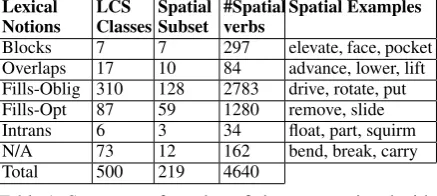
Table1summarizes the number of LCS classes associated with the lexical notions introduced above (Blocks, Overlaps, Fills-Oblig, Fills-Opt).4 Not all LCS classes are spatial in nature; thus, the second column provides a tally for the full set of LCS classes, and the third column provides a tally for just the spatial subset. The fourth column presents the number of spatial verbs included in the corresponding spatial classes. Representative spatial examples are provided in the fifth column.
Lexical
Notions LCSClassesSpatialSubset #Spatialverbs Spatial Examples Blocks 7 7 297 elevate, face, pocket Overlaps 17 10 84 advance, lower, lift Fills-Oblig 310 128 2783 drive, rotate, put Fills-Opt 87 59 1280 remove, slide Intrans 6 3 34 float, part, squirm N/A 73 12 162 bend, break, carry
Total 500 219 4640
Table 1: Summary of number of classes associated with Blocks, Overlaps, Fills-Oblig, Fills-Opt, and Intrans in LCS Classes and Spatial Subset
4N/A refers to verb classes whose members take bare NP
or S arguments. Intrans refers to Intransitive verbs.
Interestingly, the spatial subset of classes is sizeable (44% of the entire set of 500 classes). The percentage of verb entries in the spatial sub-set is also quite high (42% of the 11K total num-ber of verb entries). Several verbs in the Spatial Subset are relevant to those used in robot naviga-tion, e.g.,move, go, advance, drive, return, rotate,
andturn. Others are easily accommodated by ex-tending classes—without modification to the spa-tial notions described above. For example,back up
matches the class containing advance, and pivot
matches the class containingrotate.
Note that the BLOCKS, OVERLAPS, AND FILLS notions are generalizable to a high num-ber of LCS classes that are non-spatial as well. These typically correspond to metaphorical exten-sions of spatial components of meaning to other domains, e.g., lifted her spirits up, elevated her spirits. Thus, these notions are more broadly ap-plicable than just to the spatial dimension.
Ultimately, surface realizations of verbs with collocations include lexically explicit prepositions as inlift up, whereas no such collocates are avail-able when spatial components of meaning are in-ternally conveyed as inelevate and thus are lex-ically implicit. Adding this information to the derivative resource supports a refined formulation of BLOCKS, OVERLAPS, and FILLS notions– which are central to a range of important prob-lems, e.g., dialogue management in robot naviga-tion (Bonial et al.,2017) and generation of narra-tive explanations (Korpan et al.,2017).
3 Related Work
The ever-growing number of interdisciplinary re-search programs that now involve natural language processing but are published outside of computa-tional linguistics, provides both challenges and op-portunities to all communities seeking to leverage emerging insights from beyond their own areas of expertise. In this short position paper, we high-light but two areas pertinent to our work, while acknowledging there exists much other research in situated dialogue for robots (e.g., (Mavridis and Roy, 2006;Kruiff et al., 2007)) and spatial cog-nition (e.g., publications of the Spatial Cogcog-nition collaborative research center in Germany) that is not as central to our focus.
3.1 Spatial Language Understanding
[image:4.595.73.292.601.699.2]lan-guage resources and standards for capturing spa-tial information. For example, the ISO 24617 standard provides guidelines for annotating spa-tial information in English language texts ( 24617-7,2014) that continues to evolve (Pustejovsky and Lee,2017). This Semantic Annotation Framework (semAF) identifies places, paths, spatial entities, and spatial relations that can be used to associate sequences of processes and events in news articles (Pustejovsky et al., 2011). Spatial prepositions and particles (such asnear, off) and verbs of po-sition and movement (such aslean, swim) in text have corresponding spatial components of mean-ings, collocations, and classes of spatial verbs in the perspective adopted in this paper.
Spatial role labeling using holistic spatial se-mantics (i.e., analysis at the level of the full ut-terance) has been used for identifying spatial rela-tions between objects (Kordjamshidi et al.,2010). The association between thematic roles and their corresponding surface realizations has been inves-tigated previously, including in the LCS formal-ism (described next), but Kordjamshidi et al’s ap-proach also ties into deeper notions such asregion of space andframe of reference. Their work dif-fers from the perspective adopted in this paper in that they provide annotation guidelines for train-ing systems that do spatial information extraction, and so do not focus on generalized mappings at the syntax-semantics interface to predict possible linguistic constructs for spatial relations.
3.2 Embodied Cognition
Another research area relevant to the position adopted herein is that of embodied cognition for the development of language processing tools (Pastra et al., 2011). A European-funded project (POETICON) has resulted in a suite of embodied language processing tools relating symbolic and sensorimotor representation spaces. This work sheds light on the nature of the relationship be-tween language and action, enabling exploration of a range of different projects concerning lan-guage learning and human-robot interaction.
Other researchers have focused on natural lan-guage grounding for embodied interaction ( Al-Omari et al., 2017) to learn components of lan-guage and the meanings of each word. The ac-quired knowledge that emerges from this approach is used to parse commands involving previously unseen objects. Thus, that work assumes no prior knowledge of the structure of language; rather,
word meanings are learned from scratch. In con-trast, the perspective put forward in this paper is one in which this knowledge already exists and can be leveraged for support of both language un-derstanding and generation.
The work of Spranger et al. (2016) is the clos-est to our perspective, particularly in its use of spatial relations such as across and in front of, both for hearing and for producing utterances for robot-robot communication. However, the posi-tion adopted here is one in which generalizaposi-tions about language structure are assumed and avail-able in natural language generation for both use
(“lift up”) and suppression (“elevate”) of spatial prepositions in phrases containing motion and di-rection verbs, depending on the context.
4 Conclusions and Future Work
We have made a case for the systematic deriva-tion of regular patterns of spatial language us-age from an existing lexical semantic resource (LCS Verb Lexicon). We have focused on a re-fined formulation of BLOCKS, OVERLAPS, and FILLS, lexical-semantic notions that are central to problems dialogue management in robot naviga-tion and generanaviga-tion of narrative explananaviga-tions. We demonstrated that these extensions enable system-atic derivation of regular patterns of spatial lan-guage without requiring manual annotation.
Future work motivated by the position set forth in this paper is investigation of systematic deriva-tion of mappings at the syntax-semantics inter-face for other parts of speech involving access to a “Categorial Variation” database (CatVar) (Habash and Dorr,2003) to map verbs in the LCS classes to their nominalized and adjectivalized forms. For example, the CatVar entry for depart includes the nominalized form departure, which takes a prepositional-phrase complement (e.g., from the room)—analogous to the verbal counterpart spec-ified in the simplspec-ified LCS classes.
Acknowledgments
We would like to acknowledge and thank three anonymous reviewers for their careful reading of our manuscript and their many insightful com-ments and constructive suggestions. This research is supported, in part by the Institute for Human and Machine Cognition, in part by the U.S. Army Research Laboratory, and in part by the Office of the Director of National Intelligence (ODNI) and the Intelligence Advanced Research Projects Ac-tivity (IARPA) via the Air Force Research Labo-ratory (AFRL) contract number FA875016C0114. The U.S. Government is authorized to repro-duce and distribute reprints for Governmental pur-poses notwithstanding any copyright annotation thereon. Disclaimer: The views and conclusions contained herein are those of the authors and should not be interpreted as necessarily represent-ing the official policies or endorsements, either expressed or implied, of ODNI, IARPA, AFRL, ARL, or the U.S. Government.
References
ISO 24617-7. 2014. Language Resource management Semantic Annotation Framework Part 7: Spatial
information (ISOspace). https://www.iso.
org/standard/60779.html.
Muhannad Al-Omari, Paul Duckworth, David C. Hogg, and Anthony G. Cohn. 2017. Natural Language Acquisition and Grounding for Embodied Robotic Systems. In Proceedings of the Thirty-First AAAI Conference on Artificial Intelligence, February 4-9, 2017, San Francisco, California, USA.. pages 4349– 4356.
Laura Banarescu, Claire Bonial, Shu Cai, Madalina Georgescu, Kira Griffitt, Ulf Hermjakob, Kevin Knight, Philipp Koehn, Martha Palmer, and Nathan Schneider. 2014. Abstract Mean-ing Representation (AMR) 1.2.1
Specifica-tion. https://github.com/amrisi/
amrguidelines/blob/master/amr.md.
Claire Bonial, Stephanie Lukin, Ashley Foots, Cassidy Henry, Matt Marge, Ron Artstein, David Traum, and Clare Voss. 2018. Human-robot dialogue and collaboration in search and navigation. In LREC 2018 AREA Workshop (Annotation, Recognition and Evaluation of Actions.
Claire Bonial, Matthew Marge, Ron Artstein, Ashley Foots, Felix Gervits, Cory J. Hayes, Cassidy Henry, Susan G. Hill, Anton Leuski, Stephanie M. Lukin, Pooja Moolchandani, Kimberly A. Pollard, David R. Traum, and Clare R. Voss. 2017. Laying Down the Yellow Brick Road: Development of a Wizard-of-Oz Interface for Collecting Human-Robot Dialogue.
InAAAI Fall Symposium on Natural Communication for Human-Robot Collaboration.
Bonnie Dorr and Doug Jones. 1996. Acquisition of Se-mantic Lexicons: Using Word Sense Disambigua-tion to Improve Precision. InIn Proceedings of the Workshop on Breadth and Depth of Semantic Lexi-cons, 34th Annual Conference of the Association for Computational Linguistics. Kluwer Academic Pub-lishers, pages 42–50.
Bonnie J. Dorr. 1993. Machine Translation: A View from the Lexicon. MIT Press, Cambridge, MA. Bonnie J. Dorr. 1997. Large-Scale Dictionary
Con-struction for Foreign Language Tutoring and Inter-lingual Machine Translation. Machine Translation 12:271–322.
Bonnie J. Dorr, Mari Olsen, Nizar Habash, and Scott Thomas. 2001. LCS Verb Database Documentation.
http://www.umiacs.umd.edu/˜bonnie/ Demos/LCS_Database_Documentation. html.
Bonnie J. Dorr and Clare R. Voss. 1993. Machine Translation of Spatial Expressions: Defining the Re-lation between an Interlingua and a Knowledge Rep-resentation System . InProceedings of the Twelfth Conference of the American Association for Artifi-cial Intelligence. pages 374–379.
David Dowty. 1979. Word Meaning and Montague Grammar. Reidel, Dordrecht.
M. Guerssel, K. Hale, M. Laughren, B. Levin, and J. White Eagle. 1985. A Cross-linguistic Study of Transitivity Alternations. In W. H. Eilfort and P. D. Kroeber and K. L. Peterson, editor,Papers from the Parasession in Causatives and Agentivity at the Twenty-first Regional meeting of the Chicago Lin-guistic Society. pages 48–63.
Nizar Habash and Bonnie Dorr. 2003. A categorial variation database for english. In In NAACL/HLT 2003, Proceedings of the Human Language Technol-ogy and North American Association for Computa-tional Linguistics Conference. pages 96–102. Nizar Habash and Bonnie J. Dorr. 2002. Handling
Translation Divergences: Combining Statistical and Symbolic Techniques in Generation-Heavy Machine Translation. InProceedings of the Fifth Conference of the Association for Machine Translation in the Americas. Tiburon, CA, pages 84–93.
Nizar Habash, Bonnie J. Dorr, and Christof Monz. 2006. Challenges in Building an Arabic GHMT system with SMT Components. In Proceedings of the 7th Conference of the Association for Machine Translation in the Americas. Boston, MA, pages 56– 65.
Mark´eta Lopatkov´a, Marie Mikulov´a, Jiˇr´ı M´ırovsk, Anna Nedoluzhko, Petr Pajas, Jarmila Panevov´a, Lucie Pol´akov´a, Magdal´ena Rysov´a, Petr Sgall, Jo-hanka Spoustov´a, Pavel Straˇn´ak, Pavl´ına Synkov´a, Magda evˇc´ıkov´a, Jan tp´anek, Zdeˇnka Ureov´a, Barbora Vidov´a Hladk´a, Daniel Zeman, ˇS´arka Zik´anov´a, and Zdenˇek ˇZabokrtsk´y. 2018. Prague
dependency treebank 3.5. LINDAT/CLARIN
dig-ital library at the Institute of Formal and Ap-plied Linguistics ( ´UFAL), Faculty of Mathematics and Physics, Charles University. http://hdl. handle.net/11234/1-2621.
Ray Jackendoff. 1983. Semantics and Cognition. MIT Press, Cambridge, MA.
Ray Jackendoff. 1990. Semantic Structures. MIT Press, Cambridge, MA.
Ray Jackendoff. 1996. The Proper Treatment of Mea-suring Out, Telicity, and Perhaps Even Quantifica-tion in English. Natural Language and Linguistic Theory14:305–354.
Karin Kipper, Anna Korhonen, Neville Ryant, and Martha Palmer. 2007. A Large-scale Classification of English Verbs. InLanguage Resources and Eval-uation.
P. Kordjamshidi, M. Van Otterlo, and Marie-Francine Moens. 2010. Spatial Role Labeling: Task Defi-nition and Annotation Scheme. In Proceedings of Language Resources and Evaluation Conference.
Raj Korpan, Susan L. Epstein, Anoop Aroor, and Gil Dekel. 2017. WHY: Natural Explanations from a Robot Navigator. InAAAI 2017 Fall Symposium on Natural Communication for Human-Robot Collabo-ration.
Geert-Jan Kruiff, Hendrik Zender, Patric Jensfelt, and Henrik Christensen. 2007. Situated dialogue and spatial organization: What, where ... and why? In International Journal of Advanced Robotic Systems.
Beth Levin. 1993. English Verb Classes and Alterna-tions: A Preliminary Investigation. The University of Chicago Press.
Gina Levow, Bonnie J. Dorr, and Dekang Lin. 2000. Construction of Chinese-English Semantic Hierar-chy for Cross-language Retrieval. InICCLC’2000 International Conference on Chinese Language Computing.
Stephanie Lukin, Reginald Hobbs, and Clare Voss. 2018. A pipeline for creative visual storytelling. In NAACL 2018 StoryNLP.
M Marge, C Bonial, A Foots, C Hayes, C Henry, K Pol-lard, R Artstein, C Voss, and D Traum. 2017. Ex-ploring Variation of Natural Human Commands to a Robot in a Collaborative Navigation Task. In ACL2017 RoboNLP workshop.
Nikolaos Mavridis and Deb Roy. 2006. Grounded situ-ation models for robots: Where words and percepts meet. In Proceedings of the IEEE/RSJ Conference on Intelligent Robots and Systems.
Pooja Moolchandani, Cory Hayes, and Matthew Marge. 2018. Evaluating robot behavior in re-sponse to natural language. InHRI ’18 Companion: ACM/IEEE International Conference on Human-Robot Interaction Companion.
Mari Broman Olsen, Bonnie J. Dorr, and Scott Thomas. 1997. Toward Compact Monotonically Composi-tional Interlingua Using Lexical Aspect. In Pro-ceedings of the Workshop on Interlinguas in MT. San Diego, CA, pages 33–44.
Martha Palmer, Claire Bonial, and Jena D. Hwang. 2017. VerbNet: Capturing English Verb behavior, Meaning and Usage. In Susan Chipman, editor,The Oxford Handbook of Cognitive Science, Oxford Uni-versity Press.
Katerina Pastra, Eirini Balta, Panagiotis Dimitrakis, and Giorgos Karakatsiotis. 2011. Embodied Lan-guage Processing: A New Generation of LanLan-guage Technology. InLanguage-Action Tools for Cogni-tive Artificial Agents: Papers from the 2011 AAAI Workshop (WS-11-14).
Ian E. Perera, James F. Allen, Lucian Galescu, Choh Man Teng, Mark H. Burstein, Scott E. Fried-man, David D. McDonald, and Jeffrey M. Rye. 2017. Natural Language Dialogue for Building and Learning Models and Structures. InProceedings of the Thirty-First AAAI Conference on Artificial Intel-ligence, February 4-9, 2017, San Francisco, Cali-fornia, USA.. pages 5103–5104.
J. Pustejovsky, J. L. Moszkowicz, and M. Ver-hagen. 2011. Using ISO-Space for
An-notating Spatial Information. http:
//www2.denizyuret.com/bib/
pustejovsky/pustejovsky2011cosit/ COSIT-ISO-Space.final.pdf.
James Pustejovsky and Kiyong Lee. 2017. Enriching the Notion of Path in ISOspace. InProceedings of the 13th Joint ISO-ACL Workshop on Interoperable Semantic Annotation (ISA-13).
Josef Ruppenhofer, Michael Ellsworth, Miriam R. L Petruck, Christopher R. Johnson, Collin F. Bakerand, and Jan Scheffczyk. 2016.
Framenet ii: Extended theory and practice.
https://framenet.icsi.berkeley. edu/fndrupal/the_book.
Amber Stubbs and James Pustejovsky. 2012. Nat-ural Language Annotation for Machine Learning. O’Reilly Media.
Leonard Talmy. 2014. Foreward: Past, present, and future of motion research. In Iraide Ibarretxe-Antugano, editor, Motion and Space across Lan-guages: Theory and Applications. HCP (Human Cognitive Processing) Series, John Benjamins.
Thora Tenbrink. 2011. Reference frames of space and time in language. In Journal of Pragmatics. vol-ume 43, pages 704–722.
D Traum, C Henry, S Lukin, R Artstein, F Gervitz, K Pollard, C Bonial, S Lei, C Voss, M Marge, C Hayes, and S Hill. 2018. Dialogue Structure An-notation for Multi-Floor Interaction. InLREC.
David Traum and Nizar Habash. 2000. Generation from Lexical Conceptual Structures. In Proceed-ings of the Workshop on Applied Interlinguas, North American Association for Computational Linguis-tics / Applied NLP Conference. pages 34–41.
Lucy Vanderwende, Arul Menezes, and Chris Quirk. 2015. An amr parser for english, french, german, spanish and japanese and a new amr-annotated cor-pus. InHLT-NAACL.
Clare Voss and Bonnie J. Dorr. 1995. Toward a Lex-icalized Grammar for Interlinguas. J. of Machine Translation10:14–3.