239
TDDiscourse: A Dataset for Discourse-Level Temporal Ordering of
Events
Aakanksha Naik Luke Breitfeller
Language Technologies Institute, Carnegie Mellon University {anaik, mbreitfe, cprose}@cs.cmu.edu
Carolyn Rose
Abstract
Prior work on temporal relation classifica-tion has focused extensively on event pairs in the same or adjacent sentences (local), pay-ing scant attention to discourse-level (global) pairs. This restricts the ability of systems to learn temporal links between global pairs, since reliance on local syntactic features suf-fices to achieve reasonable performance on ex-isting datasets. However, systems should be capable of incorporating cues from document-level structure to assign temporal relations. In this work, we take a first step towards discourse-level temporal ordering by creat-ing TDDiscourse, the first dataset focus-ing specifically on temporal links between event pairs which are more than one sentence apart. We create TDDiscourse by augmenting TimeBank-Dense, a corpus of English news articles, manually annotating global pairs that cannot be inferred automatically from exist-ing annotations. Our annotations double the number of temporal links in TimeBank-Dense, while possessing several desirable properties such as focusing on long-distance pairs and not being automatically inferable. We adapt and benchmark the performance of three state-of-the-art models on TDDiscourse and observe that existing systems indeed find discourse-level temporal ordering harder.
1 Introduction
Temporal ordering of events is a crucial problem in automated text analysis. Systems capable of performing this task find widespread applicabil-ity in areas such as time-aware summarization, temporal information extraction or event timeline construction. Prior work has focused extensively on creating annotated corpora for temporal order-ing, some notable efforts being the development
of the TimeML annotation schema (Pustejovsky
et al., 2003), TimeBank (Pustejovsky et al.) and
TimeBank-Dense (Cassidy et al., 2014).
How-ever, most work has focused mainly on local or-dering, i.e., events present in the same or adjacent sentences. This leads to a major drawback, also
pointed out byReimers et al.(2016). Low
preva-lence of global discourse-level temporal ordering annotation in existing datasets allows systems to achieve moderate performance simply using local syntactic cues. Having more global annotations would require systems to incorporate global con-sistency and assimilate features from document-level structure and flow to achieve high perfor-mance, thus presenting a more challenging task. In this work, we present TDDiscourse, a dataset focused on discourse-level temporal ordering.
We create TDDiscourse by augmenting
TimeBank-Dense (Cassidy et al.,2014), a corpus
of English news articles, with more long-distance event pair annotations. Our work makes the first
attempt to explicitly annotate relations between
event pairs that are more than one sentence apart, a more difficult annotation task than previous datasets. In addition to facing similar challenges as prior work (eg: hypothetical/negated events (Cassidy et al., 2014)), we tackle new global
discourse-level issues such as incorporating
event coreference and causality/prerequisite links arising from world knowledge. To handle these, we design a careful coding scheme that achieves high inter-annotator agreement (Cohen’s Kappa of 0.69 on the test set). However, getting expert manual annotation for all possible long-distance event pairs is expensive. Moreover, it is possible to leverage annotations from existing datasets to automatically infer temporal relations for certain
event pairs. To make optimal use of expert
annotation, we develop a heuristic algorithm for automatic inference of temporal relations using
to all documents.1 We then randomly subsample the unannotated event pairs and source expert annotations for those. At 6150 pairs, our manually annotated subset is of the same size as
TimeBank-Dense. Adding the automatic subset makes
our dataset 7x larger (§6). Finally, we perform
a principled comparison between manual and automatic pairs by annotating 3 test documents (107 manual and 110 automatic event pairs) with phenomena required to reason correctly about
the pair. These annotations suggest that our
manual subset exhibits a high proportion of global discourse-level phenomena such as reasoning about chains of events.
In addition to developing TDDiscourse, we adapt three state-of-the-art models on TimeBank-Dense for discourse-level temporal ordering and benchmark their performance on our data, separat-ing scores on manual and automatic subsets. We observe that models perform worse on average on TDDiscourse, with none beating a majority class baseline on the manual subset. A manual analysis of model errors reveals key shortcomings of cur-rent temporal ordering techniques. We offer our
dataset2as a challenging new resource for the
tem-poral ordering community and hope that insights from our analysis will spark interest in the devel-opment of more global discourse-aware models.
2 Related Work
2.1 Prior Work on Temporal Annotation
The development of TimeML (Pustejovsky et al.,
2003) and TimeBank (Pustejovsky et al.) marked
the first attempt towards creating a corpus for tem-poral ordering of events. TimeML uses temtem-poral
links (TLINKs) (Setzer,2002), to represent
order-ing. A TLINK expresses the temporal relation
be-tween two events. For example, an event e1 can
occur before another event e2. TimeBank is
an-notated using TLINKs, but the number of possi-ble TLINKs in a document is large (quadratic in number of events). So annotation is restricted to a subset of TLINKs, leading to sparsity. To com-bat this, several works attempted to create denser
corpora (Bramsen et al., 2006;Kolomiyets et al.,
2012;Do et al., 2012;Cassidy et al., 2014), but still focused largely on local TLINKs.
1We validate our algorithm by obtaining human
annota-tions for a subset of 100 examples and observing agreement with the generated label in 99% cases
2https://github.com/aakanksha19/
TDDiscourse
Reimers et al.(2016) addressed high annotation cost by proposing a new scheme in which events were associated with explicit time expressions. Annotation effort now scaled linearly with num-ber of events, making it feasible to annotate all of them. Using this scheme, they created Event-Time, which had some discourse-level temporal
annotation. However this dataset had one
ma-jor drawback: events which could not be associ-ated with a time expression were ignored. We ob-served that it may not always be possible to de-termine specific times for an event, but ordering it with respect to other events is often possible based on world knowledge. For example,
con-sider the snippet: “Police discover body of
kid-nappedman. Police found the man’sdismembered
body wrapped in garbage bags”. In this text,
dis-memberedcannot be associated with a time. But
the temporal relation between dismembered and
kidnappedis clear because the kidnapping should
have happened before dismembering. Based on
this, we address the drawback in EventTime, by using TLINK-based annotation, which is expen-sive but allows more expresexpen-sive power. Following
TimeML, we augment TimeBank-Dense (Cassidy
et al.,2014) with global discourse-level TLINKs. To optimize manual effort, we automatically gen-erate all TLINKs that can be inferred from Event-Time. Then, we manually annotate a large subset of missing TLINKs involving events not associ-ated with specific dates.
Most recently, Ning et al. (2018b) proposed a
new scheme, which labels TLINKs based only on event start time. This improved inter-annotator agreement allowing for crowdsourcing of long-distance annotations at lower cost. However, they focused only on verb events, whereas our work is broader in scope and poses no such restrictions.
2.2 Prior Temporal Ordering Systems
TimeBank and the TempEval tasks (Verhagen
et al.,2007,2010;UzZaman et al.,2013) spurred the development of many temporal ordering
sys-tems (UzZaman and Allen, 2010; Llorens et al.,
2010;Str¨otgen and Gertz,2010;Chang and Man-ning, 2012; Chambers, 2013; Bethard, 2013). More recently, TimeBank-Dense and EventTime
prompted development of newer models (
on TLINKs between events in the same or adjacent sentences, relying on local features rather than document-level structure, with some exceptions.
Chambers and Jurafsky(2008);Denis and Muller
(2011); Ning et al. (2017) introduce document-level consistency via integer linear programming
constraints.Bramsen et al.(2006);Do et al.(2012)
also incorporate document-level structure, but
fo-cus on different corpora.Reimers et al.(2018)
velop a model for EventTime, which uses a de-cision tree of CNNs to associate each event from a document with a time. Several works have ex-plored techniques to incorporate document-level
cues such as event coreference (Do et al., 2012;
Llorens et al.,2015) and causality (Do et al.,2012;
Ning et al., 2018a) in temporal ordering systems. However, due to a lack of standard datasets focus-ing on global discourse-level links, most work has been evaluated on datasets of their own creation or standard datasets with mainly local TLINKs. This further stresses the need for a standardized benchmarking effort, which we address by evalu-ating adaptations of three state-of-the-art systems on our dataset (§8).
3 Constructing TDDiscourse
To emphasize the need for a global discourse-level focus in temporal ordering, we develop
TDDis-course, the first dataset which focusesexplicitlyon
TLINK annotations between event pairs that are more than one sentence apart. To create TDDis-course, we augment a subset of documents from TimeBank with global TLINKs. We use the same
set of 36 documents as TimeBank-Dense (Cassidy
et al.,2014) and EventTime (Reimers et al.,2016) to facilitate comparison with previous work. We also utilize the same set of temporal relations as
TimeBank-Dense.3 Table1gives a brief summary
of these relations. To add global links, we use two approaches:
• Manual annotation: We manually label a subset of global TLINKs using document
cues, world knowledge and causality (§4). To
optimize human effort, we ensure that these TLINKs are not automatically inferable.
• Automatic inference: We use a heuris-tic algorithm to automaheuris-tically label global
TLINKs using EventTime (§5) annotations,
to generate a large number of links at low
3We discard the “vague” label since we do not require
annotators to label all event pairs
Symbol Relation
a e1occursaftere2
b e1occursbeforee2
s e1ande2aresimultaneous
i e1includese2
[image:3.595.324.509.62.146.2]ii e1is includedine2
Table 1: Temporal relation set used in TDDiscourse. All relations are mutually exclusive.
cost.
4 Manual Annotation
In this phase, we ask experts4 to label
discourse-level TLINKs that cannot be inferred
automati-cally.5 Getting expert annotation for all
miss-ing TLINKs is expensive. Hence, we randomly subsample TLINKs not annotated by TimeBank-Dense or automatic inference. This subsample is as large as TimeBank-Dense, thus doubling the data size while making the overall task harder (see
§8). Note that TLINKs annotated in this phase
may involve events for which a specific time of occurrence cannot be determined, which were ig-nored in EventTime. We refer to this subset as
TDD-Man.
Since TLINKs are not restricted to the same or adjacent sentences, our annotation task becomes harder, requiring cues from the entire document. Many TLINKs also require the use of causal links and world knowledge to label the relation. Based on our observations, we develop a coding scheme. To ensure high inter-annotator agreement, we re-fine our scheme over multiple rounds of annota-tion and discussion of disagreements.
4.1 Coding Scheme
Our scheme reduces the task of labeling a TLINK to a set of concrete decision steps:
1. Using textual cues 2. Using world knowledge 3. Using narrative ordering
A TLINK may be assigned a label at any step. If it cannot be assigned a label, it moves on to the next step. Information from previous steps is retained, making it possible to combine multiple sources of evidence. For example, textual cues may not suffice, but they can be used in conjunc-tion with world knowledge to label a pair. We
4
Expert annotators are the authors of the paper, with a background in computational linguistics
Snippet
Atlanta nineteen ninety-six. A bombblast shocksthe Olympic games. One person iskilled.
January nineteen ninety-seven. Atlanta again. This time abombat an abortion clinic. More people arehurt.
Event pair:blast,hurt
Relation:before
[image:4.595.76.288.59.154.2]Textual cues:Eventblastoccurred in 1996. Eventhurt occurred because of second bomb blast in 1997.
Table 2: Sample document-level textual cues used dur-ing temporal annotation
choose to organize our coding scheme as men-tioned above, to make the process of gathering ev-idence about an event pair systematic, and ensure that experts do not miss important cues. The fi-nal step is guaranteed to assign a label. We choose not to allow annotators to leave event pairs unla-beled or label them “vague”, to keep them from overusing this option. Owing to this decision, we need to develop mechanisms for handling TLIN-LKs containing events which have not actually oc-curred (eg: negated, hypothetical or conditional events). Drawing from prior work, we interpret
these events using a possible worlds analysis, in
which the event is treated as if it has occurred. We
refer interested readers to (Chambers et al.,2014)
for a more detailed discussion.
4.1.1 Using textual cues
In this step, we use document-level textual cues to label a TLINK. The cues used are similar to those
used in previous datasets (Cassidy et al., 2014).
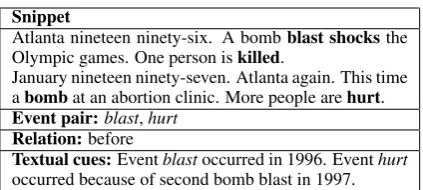
Table2gives an example of the types of cues used.
A key textual cue we use here is event coref-erence. Event coreference has not been used for annotation because the occurrence of coreferent
events in adjacent sentences is rare. However,
this cue is crucial for global discourse-level an-notation. Since TimeBank does not contain event coreference annotation, we develop a procedure to annotate our document subset. Our procedure is based on the ERE (Entities, Relations, and Events)
scheme (Song et al., 2015), which cannot be
di-rectly used for TimeBank due to differing notions of what constitutes an event and different
meta-data. In our procedure, events are considered
coreferent iff they share the following:
• Entities involved in the event
• Temporal attributes
• Location attributes
• Realis (whether event is real or hypothetical)
Events which are synonymous in context are also
considered coreferent (for instance, in “...held an
interview Monday. The segment covered...”,
in-terview and segment are synonymous). These
attributes (barring temporal) are not provided in TimeBank and must be inferred. Often, an event may only have partial information about these at-tributes - here we use human judgment. Our def-inition of coreference is closer to the strict no-tion of “event identity” in Light ERE than the
re-laxed definition in Rich ERE.6 To test our
proce-dure, we select all “simultaneous” TLINKs from TimeBank-Dense to ensure that our sample
con-tains a sizeable proportion of possiblycoreferent
event pairs. The corpus contains 179 “simultane-ous” links, of which 93 are event pair TLINKs. Our first annotation pass achieves high agreement between two annotators, with a Kappa of 0.70. We refine our guidelines through an adjudication step, reaching perfect agreement on this sample. Post-adjudication guidelines are used to annotate event coreference for all documents. Resulting annota-tions are used as textual cues in our scheme. Based on textual cues, an appropriate label is assigned to a TLINK. Coreferent TLINKs are labeled “si-multaneous”. Unlabeled links move on to the next decision step.
4.1.2 Using world knowledge
This step uses real world knowledge to determine causal/prerequisite links which are used to label a TLINK. We consider both events in the TLINK and determine whether they possess one or both of the following:
• Causal Link: Two events have a causal link if the occurrence of one event results in the
other event coming about. For example,
in the sentence “The paper got wet when I spilled water on it”, the event pair (spilled, wet) have a causal link.
• Prerequisite Link: Two events have a
pre-requisite link if one eventmustoccur before
the other can happen. For example, in the sentence “We cooked dinner and ate it”, the event pair (cooked, ate) have a prerequisite link. Note that we use the knowledge that a meal must be cooked before it can be eaten, though it is not explicitly mentioned.
We examine the event pair in the context of the en-tire document to detect causal/prerequisite links,
also allowing weak or transitive links. For
Rule Label
[image:5.595.112.250.61.114.2]TLINK=(A, B), A=P Before TLINK=(A, B), A=I Includes TLINK=(B, A), A=P After TLINK=(B, A), A=I Is Included
Table 3: Labels assigned to event pairs based on event and TLINK metadata
stance, in the text “Diplomacy is making head-way in resolving the UN’s standoff with Iraq. One major sticking point has been Iraq’s proposal...”,
proposal causes standoff, which is a prerequisite
for resolving. Hence, the pair (proposal,
resolv-ing) is considered causal/prerequisite. Our assign-ment of causal/prerequisite links is unordered. For example, reverse event pairs (wet, spilled), (ate, cooked), and (resolving, proposal) are also consid-ered causal/prerequisite. Link order is taken into consideration while assigning a temporal relation. If two events contain a causal/prerequisite link, we identify the event in the pair that causes or is a prerequisite for the other. We call this event “A” and the other “B”. For example, (spilled, wet) is expressed as (A, B), while (wet, spilled) is ex-pressed as (B, A). To label the TLINK, we de-termine whether A is a point (P) or interval (I) event using existing date annotations from
Event-Time (Reimers et al.,2016). This helps us catch
cases where A is a long-lasting interval and the time span for B is completely included in A. For instance, in “the war forced civilians to evacuate”, (war, evacuate) has a causal/prerequisite link with
war being event A. Though war caused
evacua-tion, it is reasonable to expect that the war started
before and ended after evacuation. If A is not
present in EventTime (i.e it cannot be assigned a specific time), we use our judgment to determine
event length. We then assign a label as per table3.
Unlabeled links are passed to the next step.
4.1.3 Using narrative ordering
This step uses a heuristic based on the intuition that events in a narrative are often presented in chronological order. To label a TLINK, we deter-mine which event appeared first in the document. This event is called “A”, and the other is “B”. We then detect whether A is a point (P) or interval (I) from EventTime, falling back to our own judgment if it is not present. Finally, a label is assigned
fol-lowing table3. This step is guaranteed to assign a
label since every pair will have a narrative-based order.
Dataset Kappa
TimeBank 0.71
TimeBank-Dense 0.56-0.64
TDD-Man 0.69
Table 4: Inter-annotator agreement (Cohen’s Kappa) on temporal ordering datasets. Kappa scores for TDD-Man are reported on the test set containing 1500 links.
a b s i ii
a 137 22 0 12 22
b 30 311 1 72 23
s 0 0 42 5 4
i 9 36 3 462 35
[image:5.595.343.489.62.119.2]ii 12 32 0 21 209
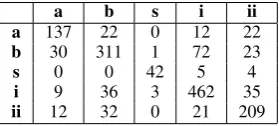
Table 5: Relation agreement between annotators on the TDD-Man test set containing 1500 links.
4.2 Inter-annotator agreement
Our annotation scheme was developed over multi-ple rounds of coding and discussion between two experts. In each round, experts separately
anno-tated a set of 10-15 TLINKs.7 Cohen’s Kappa
was computed and disagreements were discussed. TLINKs were changed in every round to en-sure expoen-sure to diverse event pair types. Inter-annotator agreement in preliminary rounds ranged from 0.48-0.69. The final coding scheme resulted
in an agreement of 0.69 on the test set. Table 4
shows that our agreement is comparable to prior
work. Table 5 presents a class-wise distribution
of agreements between pairs of annotators. Dis-agreements mainly include cases where one anno-tator chose after/before while the second chose in-cludes/is included (64%). This indicates that de-termining precise end-points for an interval event
is difficult, as corroborated byNing et al.(2018b).
5 Automatic Inference
This approach uses automatic inference to de-rive new TLINKs at low cost from EventTime (Reimers et al., 2016), which assigns specific times to events. EventTime divides events into two types: SingleDay and MultiDay. SingleDay events are assigned dates, while MultiDay events are assigned intervals. Possible event pairs can be divided into three categories: SS (both events are SingleDay), SM (one event is SingleDay while the other is MultiDay) and MM (both events are Mul-tiDay). Not all assigned dates and intervals are ex-act. EventTime relies heavily on under-specified
[image:5.595.347.487.175.238.2]temporal expressions (such as “after1998-06-08”), making automatic inference non-trivial.
We follow separate algorithms to infer TLINKs for each pair type (SS, SM and MM). For SS pairs, both events are associated with dates, which may
be expressed in one of four ways8, resulting in
16 date combinations for SS links. We develop
heuristics9 for each combination, which generate
a temporal relation based on date values. Our
heuristics were developed with a focus on preci-sion to avoid adding incorrect links. Often, a re-lation cannot be generated. For example, consider two events associated with the same date “after02-01-1999”. We know that both events occur after 02-01-1999, but we cannot infer their order with
respect to each other. In such cases, we do not
label the pair. For SM pairs, one event is asso-ciated with a time interval having begin and end dates. Here we use the SS pair inference algo-rithm to generate relations between the SingleDay event date and the MultiDay event begin and end dates. These relations are compared to infer the label for the pair. For MM pairs, both events have begin and end dates. We infer relations between begin and end points using SS link inference and use these to infer the pair label. After inference,
we perform temporal closure, according to
Cham-bers et al. (2014). To evaluate validity of gener-ated TLINKs, we randomly sample a subset of 100
TLINKs and ask three annotators10to determine
the correctness of the labels. All annotators unani-mously agree with the assigned label in 99% cases.
We call this subsetTDD-Auto.
6 Dataset Statistics
Our data construction pipeline produces the first dataset focused on temporal links between global
discourse-level event pairs (TDDiscourse),
con-sisting of two subsetsTDD-ManandTDD-Auto.
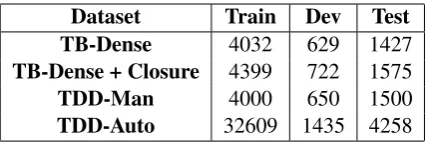
Table 6 presents train, dev and test set sizes for
both subsets, Timebank-Dense as well as an aug-mented version of TimeBank-Dense with
addi-tional links inferred via temporal closure. Our
complete dataset is 7x larger than both, indicating that our construction adds valuable new TLINKs. TDD-Man itself is as large as TimeBank-Dense
8
MM-DD-YYYY, afterMM-DD-YYYY, beforeMM-DD-YYYY, afterMM-DD-YYYYbeforeMM-DD-YYYY (MM-DD-YYYY stands for a specific date value)
9
Sample heuristics provided in the appendix
10Annotators were volunteers with no vested interest in the
corpus
Dataset Train Dev Test
TB-Dense 4032 629 1427
TB-Dense + Closure 4399 722 1575
TDD-Man 4000 650 1500
[image:6.595.310.524.61.132.2]TDD-Auto 32609 1435 4258
Table 6: Dataset sizes for TimeBank-Dense and our dataset. Note that we only count event-event TLINKs
and can be used in isolation, however incorporat-ingTDD-Autoprovides a large amount of training data making the task more amenable to deep neu-ral net approaches.
Table 7 presents class distributions for
TDD-Man and TDD-Auto test sets. Though there is a clear majority class, both sets are more balanced than TimeBank-Dense, in which 40% event pairs are labeled “vague”. To evaluate the presence of long-distance TLINKs, we present the distribution of distance between event pairs from annotated
TLINKs in table8 which shows that nearly 53%
TLINKs in our dataset comprise of event pairs which are more than 5 sentences apart. Further, to gain deeper insight into global discourse-level phenomena exhibited by our dataset, we augment 3 documents from the test set (107 manual and 110 automated event pairs) with additional annotations about phenomena required to label them correctly. We consider the following phenomena:
• SingleSent (SS): Textual cues from sen-tences containing the events suffice to predict the relation (irrespective of distance).
• Chain Reasoning (CR): Correct relation prediction requires reasoning about other events from the document.
• Tense Indicator (TI):For verb events, tense information indicates the correct relation.
• Future Events (FE): One or both events from the pair will occur in the future.
• Hypothetical/ Negated (HN): One or both events are hypothetical or negated.
• Event Coreference (EC):Event coreference resolution is needed to predict relation.
• Causal/ Prereq (CP): Causal/ prerequisite links must be identified to predict relation.
• World Knowledge (WK): Real world
knowledge is needed to identify the relation.
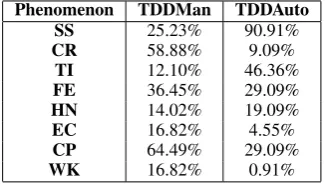
Table9shows the distribution of these phenomena
Dataset a b s i ii
TB-Dense 0.18 0.22 0.02 0.05 0.06
TDD-Man 0.13 0.27 0.03 0.38 0.19
[image:7.595.69.291.61.119.2]TDD-Auto 0.28 0.32 0.16 0.11 0.13
Table 7: Class distributions for our test sets and TimeBank-Dense. Note that the distribution for TimeBank-Dense does not sum to 1, since it includes a vague class.
Dataset <5 <10 <15 <20 >20
TDD-Man 0.40 0.40 0.15 0.04 0.01
TDD-Auto 0.50 0.32 0.12 0.05 0.01
Table 8: Distribution of distance between events for all TLINKs in our test sets (in terms of #sentences)
may be sufficient to label many long-distance links in this subset correctly. This principled compari-son of both subsets leads us to hypothesize that models which perform well on TimeBank-Dense, should achieve similar scores on TDD-Auto but perform much worse on TDD-Man.
7 Experiments
To statistically evaluate the difficulty of TDDis-course, we adapt and benchmark three SOTA models on our data. Our results reveal interesting insights about model drawbacks, highlighting the need to shift focus to handling global discourse-level phenomena such as chain reasoning.
7.1 Adapting State-of-the-Art Models for Benchmarking
As most state-of-the-art temporal ordering mod-els are built on datasets containing mainly local TLINKs, they are not well-equipped to handle global TLINKs. Hence, we adapt these models to ensure fair evaluation. We focus on the following: CAEVO (Chambers et al., 2014): This system
Phenomenon TDDMan TDDAuto
SS 25.23% 90.91%
CR 58.88% 9.09%
TI 12.10% 46.36%
FE 36.45% 29.09%
HN 14.02% 19.09%
EC 16.82% 4.55%
CP 64.49% 29.09%
[image:7.595.100.263.626.719.2]WK 16.82% 0.91%
Table 9: Distribution of various phenomena in the an-notated test subset. These phenomena were labeled manually.
consists of specialized learners (sieves) which in-clude heuristic rules and trained models. For each document, sieves run in decreasing order of
pre-cision. Decisions made by earlier sieves
con-strain following ones. This framework integrates transitive reasoning, but decisions made by ear-lier sieves cannot be overturned, causing error cas-cades. To extend CAEVO, we increase window
sizes and remove the AllVague sieve.11
BiLSTM(Cheng and Miyao, 2017): Inspired by
Xu et al.(2015), this model uses a BiLSTM classi-fier. For each pair, dependency paths from source and target events to the sentence root are fed to a BiLSTM. For events in adjacent sentences, source and target event sentences are assumed to be con-nected to a ”common root”. We follow the same framework to build a BiLSTM.
SP+ILP (Ning et al., 2017): CAEVO and BiL-STM make separate local decisions for each TLINK, which may result in global inconsistency. For example, for events A, B and C, if A oc-curs before B and B ococ-curs before C, transitivity implies that A occurs before C. Models classify-ing each pair independently may assign a
differ-ent relation to A-C. To correct this, Ning et al.
(2017) proposed SP+ILP, which uses a structured
perceptron with ILP constraints, explicitly enforc-ing global consistency. This model was trained on TimeBank-Dense which contains fewer TLINKs per document, making joint learning tractable with loose transitivity constraints. But loose transitiv-ity is an issue for our data with 7x more TLINKs, since the number of constraints increases
tremen-dously. To improve tractability, we define a
stricter transitivity constraint. LetE,RandP be
sets of events, temporal relations and event pairs
respectively(P = {(ei, ej) ∈ E ×E|ei, ej ∈
E, i 6= j}). We define an array of binary
indica-tor variables y, where y<r,i,j> indicates whether
the relationrholds between eventsei andej. Our
objective function is defined as:
arg min y
X
<ei,ej>∈P
X
r∈R
−y<r,i,j>logp<r,i,j> (1)
subject to the following constraints:
y<r,i,j>∈ {0,1},∀(ei, ej)∈P,∀r∈R (2)
X
r∈R
y<r,i,j>= 1,∀(ei, ej)∈P (3)
11since our data does not include the vague class. We also
System TB-Dense TDD-Auto TDD-Man
P R F1 P R F1 P R F1
MAJOR 40.5 40.5 40.5 34.2 32.3 33.2 37.8 36.3 37.1
CAEVO 49.9 46.6 48.2 61.1 32.6 42.5 32.3 10.7 16.1
BiLSTM 63.9 38.9 48.4 55.7 48.3 51.8 24.9 23.8 24.3
SP 37.7 37.8 37.7 43.2 43.2 43.2 22.7 22.7 22.7
[image:8.595.133.468.62.158.2]SP+ILP 58.4 58.4 58.4 46.4 45.9 46.1 23.9 23.8 23.8
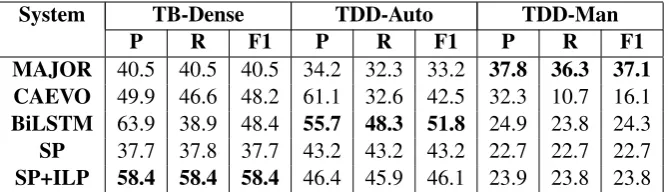
Table 10: Performance of SOTA models on TB-Dense, TDD-Auto and TDD-Man. MAJOR represents a majority-class baseline. We report performance on non-vague event-event links for TB-Dense to ensure fair comparison.
y<r1,i,j>+y<r2,j,k>−y<r3,i,k>≤1,
∀(ei, ej),(ej, ek),(ei, ek)∈P,∀(r1, r2, r3)∈T C
(4)
where p<r,i,j> is the probability that event pair
(ei, ej)has labelr. (2) ensures that indicator
vari-ables are binary, (3) forces event pairs to be
as-signed a unique label and (4) imposes transitivity.
T Cdenotes the set of transitive relation triples.12
Relation probabilities (p<r,i,j>) come from the
structured perceptron. In addition to this model,
we also evaluate the structured perceptron (SP) in
isolation, which lets us study the effect of intro-ducing global consistency via ILP.
8 Results and Analysis
We benchmark 4 adapted SOTA models
(CAEVO, BiLSTM, SP and SP+ILP) on
TDD-Auto and TDD-Man. SP is a local
perceptron-based classifier, while SP+ILP
in-troduces transitivity via ILP into the perceptron.
This . For tractability, we limit all models to
using event pairs which are 15 or fewer sentences apart. This discards only 5% of our data (table
8). Table 10 presents the benchmarking results.
We also benchmark models on TimeBank-Dense (TB-Dense) to demonstrate that our modifications do not affect performance on local TLINKs.
All models perform better than a majority class
baseline on TDD-Auto. The BiLSTM and SP
perform particularly well, achieving a higher F1 than TB-Dense, while CAEVO and SP+ILP show slight degradation in comparison to TB-Dense. This corroborates our hypothesis that many long-distance TLINKs in TDD-Auto can be handled with local information. However, all models show a significant drop on TDD-Man, with none outper-forming a majority class baseline. Further analysis of model errors offers valuable insights into which phenomena are not handled by models, posing
in-12(“before”, “before”, “before”) form a transitive relation
triple as A before B and B before C implies A before C
teresting challenges for future work.
Maintaining global consistency: Most SOTA models make separate local decisions for each pair and are not globally consistent. Adding global consistency improves the performance of a local classifier, as evinced by a 3-point F1 gain observed on adding ILP to SP. We validate this observa-tion by performing a transitivity analysis of BiL-STM and SP+ILP on TDD-Auto. We go through
all event triples (e1, e2, e3). For each model, if
(e1, e2), (e2, e3) and (e1, e3) are all assigned la-bels, we check whether labels are consistent. For
example,e1aftere2,e2aftere3ande1aftere3is a
consistent assignment. We observe that though the BiLSTM has higher F1, it maintains transitivity in 41.9% cases, while SP+ILP enforces transitivity in 53.6% cases, a 12% increase. We believe that incorporating such constraints into neural models can help, which we delegate to future work. Incorporating real world knowledge: To exam-ine the dismal performance of all models on TDD-Man, we manually look at 100 pairs on which all models made mistakes. 40% of these cases re-quire real world knowledge. Some examples in-clude determining that “military actions” refers to the same event as “air strikes” (strikes would have to be carried out by the military which cannot be inferred from text), or knowing that certain events (eg: “war”) are long-term. No SOTA model cur-rently has this ability.
Using event coreference and structure: Our analysis reveals another source of errors arising from models’ inability to handle event coreference and event structure such as sub-events or aspec-tual predication, a grammatical device which fo-cuses on different facets of event history (eg: using
”begin” to indicate initiation) (Pustejovsky et al.,
2003). This inability causes models to fail in 22%
Dealing with hypothetical or negated events: We observe that SOTA models do not possess the ability to handle these, causing 31% of errors.
9 Conclusion and Future Work
In this work, we created TDDiscourse, the first dataset focused on global discourse-level tempo-ral ordering. Our annotation scheme for TDDis-course handled several issues which have not been
explicitly addressed in prior work. We further
adapted and benchmarked 3 SOTA models. All models, on average, performed worse on TDDis-course, validating the difficulty of the task. Our error analysis reveals key phenomena not handled by current systems, such as hypothetical/negated events, event coreference, aspectual predication, real world knowledge and global consistency. Fu-ture work in temporal ordering must address these issues, and we suggest several avenues for ex-ploration, such as a BiLSTM-ILP joint learning framework which has the advantage of combining representational power of neural models with key linguistic insights, and introducing event corefer-ence information via ILP into a structured
learn-ing approach similar to Ning et al. (2017).
Fi-nally, we hope that our dataset offers a challeng-ing testbed for the development of more global discourse-aware models for temporal ordering.
Acknowledgements
This work was supported by the University of Pittsburgh Medical Center (UPMC) and Abridge AI Inc through the Center for Machine Learn-ing and Health at Carnegie Mellon University. It was also funded in part through NSF IIS 1723454. The authors would like to thank Lisa Carey Lohmueller, Shivani Poddar and Michael Miller Yoder for assisting in human evaluation of TDD-Auto, Evangelia Spiliopoulou for help in im-plementing parts of the SP+ILP system and the anonymous reviewers for their helpful feedback on this work.
References
Steven Bethard. 2013. Cleartk-timeml: A minimalist approach to tempeval 2013. InSecond Joint Con-ference on Lexical and Computational Semantics (*SEM), Volume 2: Proceedings of the Seventh In-ternational Workshop on Semantic Evaluation (Se-mEval 2013), pages 10–14, Atlanta, Georgia, USA. Association for Computational Linguistics.
Philip Bramsen, Pawan Deshpande, Yoong Keok Lee, and Regina Barzilay. 2006. Inducing temporal graphs. InProceedings of the 2006 Conference on Empirical Methods in Natural Language Process-ing, pages 189–198, Sydney, Australia. Association for Computational Linguistics.
Taylor Cassidy, Bill McDowell, Nathanel Chambers, and Steven Bethard. 2014. An annotation frame-work for dense event ordering. Technical report, CARNEGIE-MELLON UNIV PITTSBURGH PA.
Nathanael Chambers. 2013. Navytime: Event and time ordering from raw text. Technical report, Naval Academy Annapolis MD.
Nathanael Chambers, Taylor Cassidy, Bill McDowell, and Steven Bethard. 2014. Dense event ordering with a multi-pass architecture. Transactions of the Association for Computational Linguistics, 2:273– 284.
Nathanael Chambers and Daniel Jurafsky. 2008.
Jointly combining implicit constraints improves temporal ordering. InProceedings of the 2008 Con-ference on Empirical Methods in Natural Language Processing, pages 698–706, Honolulu, Hawaii. As-sociation for Computational Linguistics.
Angel X Chang and Christopher D Manning. 2012. Su-time: A library for recognizing and normalizing time expressions. In Lrec, volume 2012, pages 3735– 3740.
Fei Cheng and Yusuke Miyao. 2017. Classifying tem-poral relations by bidirectional lstm over depen-dency paths. In Proceedings of the 55th Annual Meeting of the Association for Computational Lin-guistics (Volume 2: Short Papers), pages 1–6, Van-couver, Canada. Association for Computational Lin-guistics.
Pascal Denis and Philippe Muller. 2011. Predicting globally-coherent temporal structures from texts via endpoint inference and graph decomposition. In Twenty-Second International Joint Conference on Artificial Intelligence.
Quang Do, Wei Lu, and Dan Roth. 2012. Joint infer-ence for event timeline construction. InProceedings of the 2012 Joint Conference on Empirical Methods in Natural Language Processing and Computational Natural Language Learning, pages 677–687, Jeju Island, Korea. Association for Computational Lin-guistics.
Hector Llorens, Nathanael Chambers, Naushad UzZa-man, Nasrin Mostafazadeh, James Allen, and James Pustejovsky. 2015. Semeval-2015 task 5: Qa tem-peval - evaluating temporal information understand-ing with question answerunderstand-ing. InProceedings of the 9th International Workshop on Semantic Evaluation (SemEval 2015), pages 792–800, Denver, Colorado. Association for Computational Linguistics.
Hector Llorens, Estela Saquete, and Borja Navarro. 2010.Tipsem (english and spanish): Evaluating crfs and semantic roles in tempeval-2. InProceedings of the 5th International Workshop on Semantic Evalua-tion, pages 284–291, Uppsala, Sweden. Association for Computational Linguistics.
Paramita Mirza and Sara Tonelli. 2016. On the con-tribution of word embeddings to temporal relation classification. In Proceedings of COLING 2016, the 26th International Conference on Computational Linguistics: Technical Papers, pages 2818–2828, Osaka, Japan. The COLING 2016 Organizing Com-mittee.
Qiang Ning, Zhili Feng, and Dan Roth. 2017. A struc-tured learning approach to temporal relation extrac-tion. InProceedings of the 2017 Conference on Em-pirical Methods in Natural Language Processing, pages 1027–1037, Copenhagen, Denmark. Associ-ation for ComputAssoci-ational Linguistics.
Qiang Ning, Zhili Feng, Hao Wu, and Dan Roth. 2018a. Joint reasoning for temporal and causal rela-tions. InProceedings of the 56th Annual Meeting of the Association for Computational Linguistics (Vol-ume 1: Long Papers), pages 2278–2288, Melbourne, Australia. Association for Computational Linguis-tics.
Qiang Ning, Hao Wu, and Dan Roth. 2018b. A multi-axis annotation scheme for event temporal relations. InProceedings of the 56th Annual Meeting of the As-sociation for Computational Linguistics (Volume 1: Long Papers), pages 1318–1328, Melbourne, Aus-tralia. Association for Computational Linguistics.
James Pustejovsky, Jos´e M Castano, Robert Ingria, Roser Sauri, Robert J Gaizauskas, Andrea Set-zer, Graham Katz, and Dragomir R Radev. 2003. Timeml: Robust specification of event and tempo-ral expressions in text. New directions in question answering, 3:28–34.
James Pustejovsky, Patrick Hanks, Roser Sauri, An-drew See, Robert Gaizauskas, Andrea Setzer, Dragomir Radev, Beth Sundheim, David Day, Lisa Ferro, et al. The timebank corpus.
Nils Reimers, Nazanin Dehghani, and Iryna Gurevych. 2016. Temporal anchoring of events for the time-bank corpus. In Proceedings of the 54th Annual Meeting of the Association for Computational Lin-guistics (Volume 1: Long Papers), pages 2195– 2204, Berlin, Germany. Association for Computa-tional Linguistics.
Nils Reimers, Nazanin Dehghani, and Iryna Gurevych. 2018. Event time extraction with a decision tree of neural classifiers. Transactions of the Association for Computational Linguistics, 6:77–89.
Andrea Setzer. 2002. Temporal information in newswire articles: an annotation scheme and cor-pus study. Ph.D. thesis, University of Sheffield.
Zhiyi Song, Ann Bies, Stephanie Strassel, Tom Riese, Justin Mott, Joe Ellis, Jonathan Wright, Seth Kulick, Neville Ryant, and Xiaoyi Ma. 2015. From light to rich ere: Annotation of entities, relations, and events. In Proceedings of the 3rd Workshop on EVENTS at the NAACL-HLT 2015, pages 89–98, Denver, Colorado. Association for Computational Linguistics.
Jannik Str¨otgen and Michael Gertz. 2010.HeidelTime: High quality rule-based extraction and normaliza-tion of temporal expressions. InProceedings of the 5th International Workshop on Semantic Evaluation, pages 321–324, Uppsala, Sweden. Association for Computational Linguistics.
Naushad UzZaman and James Allen. 2010. TRIPS and TRIOS system for TempEval-2: Extracting tempo-ral information from text. In Proceedings of the 5th International Workshop on Semantic Evaluation, pages 276–283, Uppsala, Sweden. Association for Computational Linguistics.
Naushad UzZaman, Hector Llorens, Leon Derczyn-ski, James Allen, Marc Verhagen, and James Puste-jovsky. 2013. Semeval-2013 task 1: Tempeval-3: Evaluating time expressions, events, and temporal relations. In Second Joint Conference on Lexical and Computational Semantics (*SEM), Volume 2: Proceedings of the Seventh International Workshop on Semantic Evaluation (SemEval 2013), pages 1– 9, Atlanta, Georgia, USA. Association for Compu-tational Linguistics.
Marc Verhagen, Robert Gaizauskas, Frank Schilder, Mark Hepple, Graham Katz, and James Pustejovsky. 2007. Semeval-2007 task 15: Tempeval tempo-ral relation identification. In Proceedings of the Fourth International Workshop on Semantic Evalua-tions (SemEval-2007), pages 75–80, Prague, Czech Republic. Association for Computational Linguis-tics.
Marc Verhagen, Roser Sauri, Tommaso Caselli, and James Pustejovsky. 2010. Semeval-2010 task 13: Tempeval-2. InProceedings of the 5th International Workshop on Semantic Evaluation, pages 57–62, Uppsala, Sweden. Association for Computational Linguistics.
Appendix
A Coreference Examples
• Coreferent example: In the example ”their
disputes have beenbedeviledby a number of
disputes”, the event ”disputes” is itself the entity enacting the event ”bedeviled”. The events take place over the same time period and location, and are both real events. Thus, we can conclude the events are coreferent.
• Non-coreferent example: In ”lower rates have helped invigorate housing by making loans more affordable”, though the events share an agent (”lower rates”) and realis states, they act on different patient entities and thus are not coreferent.
B Sample heuristic rules from SS link inference procedure:
Assume S1 and S2 indicate the points associated with events 1 and 2 which are to be linked. Fol-lowing subsections provide a brief sample of some of the heuristic rules we develop to infer the tem-poral link based on the values of S1 and S2.
B.1 S1 is of type MM-DD-YYYY and S2 is of type afterMM-DD-YYYY
• Get the relation (rel) between the date values
from S1 and S2
• If rel is simultaneous or before, the SS link
value is before
• Else skip this link
B.2 S1 is of type MM-DD-YYYY and S2 is of type beforeMM-DD-YYYY
• Get the relation (rel) between the date values
from S1 and S2
• If rel is simultaneous or after, the SS link
value is after
• Else skip this link
B.3 S1 is of type MM-DD-YYYY and S2 is of type afterMM-DD-YYYY
beforeMM-DD-YYYY
• From S2, the date associated with after is
named date1 and the date associated with be-fore is named date2
• Get the relation (rel1) between date value
from S1 and date1 from S2
• If rel1 is simultaneous or before, the SS link
value is before
• Get the relation (rel2) between date value
from S1 and date2 from S2
• If rel2 is simultaneous or after, the SS link
value is after
• Else skip this link