Proceedings of NAACL-HLT 2018, pages 278–283
Recurrent Entity Networks with Delayed Memory Update for
Targeted Aspect-based Sentiment Analysis
Fei Liu Trevor Cohn Timothy Baldwin School of Computing and Information Systems
The University of Melbourne Victoria, Australia
[email protected] [email protected] [email protected]
Abstract
While neural networks have been shown to achieve impressive results for sentence-level sentiment analysis, targeted aspect-based sen-timent analysis (TABSA) — extraction of fine-grained opinion polarity w.r.t. a pre-defined set of aspects — remains a difficult task. Motivated by recent advances in memory-augmented models for machine reading, we propose a novel architecture, utilising exter-nal “memory chains” with a delayed mem-ory update mechanism to track entities. On a TABSA task, the proposed model demon-strates substantial improvements over state-of-the-art approaches, including those using ex-ternal knowledge bases.1
1 Introduction
Targeted aspect-based sentiment analysis (TABSA) is the task of identifying fine-grained opinion polarity towards a specific aspect as-sociated with a given target. The task requires classification of opinions on different entities across a range of different attributes, with the expectation that there will be no overt opinion expressed on a given entity for many attributes. This can be seen in Example (1), e.g., where opinions on the aspects SAFETY and PRICE are expressed for entityLOC1but not entityLOC2:2
(1) LOC1 is your best bet for secure although expensive and LOC2 is too far.
Target Aspect Sentiment
LOC1 SAFETY positive LOC1 PRICE negative LOC2 TRANSIT-LOCATION negative
1Code available at https://github.com/
liufly/delayed-memory-update-entnet. 2Note that in our dataset, all entity mentions have been pre-nomalised toLOCn, wherenis an index.
The earliest work on (T)ABSA relied heavily on feature engineering (Wagner et al.,2014; Kir-itchenko et al.,2014), but more recent work based on deep learning has used models such as LSTMs to automatically learn aspect-specific word and sentence representations (Tang et al.,2016a).
Despite these successes, keeping track of mul-tiple entity–aspect pairs remains a difficult task, even for an LSTM. As reported in Saeidi et al.
(2016), a target-dependent biLSTM is ineffective, both in terms of aspect detection and sentiment classification, compared to a simple logistic re-gression model withn-gram features. Intuitively, we would expect that a model which better cap-tures linguistic structure via the original word se-quencing should perform better, which provides the motivation for this research.
More recently, successful works in (T)ABSA have explored the idea of leveraging external memory (Tang et al., 2016b;Chen et al., 2017). Their models are largely based on memory net-works (Weston et al.,2015), originally developed for reasoning-focused machine reading compre-hension tasks. In contrast to memory networks, where each input sentence/word occupies a mem-ory slot and is then accessed via attention indepen-dently, recent advances in machine reading sug-gest that processing inputs sequentially is bene-ficial to overall performance (Seo et al., 2017;
Henaff et al.,2017).
However, successful machine reading models may not be directly applicable to TABSA due to the key difference in the granularity of inputs be-tween the two tasks: on the Children’s Book Test corpus (CBT), for example, competitive models take as input a window of text, centred around can-didate entities, with crucial information contained within that window (Hill et al.,2015;Henaff et al.,
2017). In TABSA, given the fine-grained nature of the task, it is common practice for models to
operate at the word- rather than chunk/sentence-level. It is not uncommon to see examples like Example (1), where the sentence starts withLOC1, but the negative PRICEsentiment towards the en-tity is not expressed until much later. Moreover, phrases such asbest betandalthoughplay the role of triggers, indicating that succeeding tokens bear aspect/sentiment signal. This key difference ne-cessitates the ability to model the delayed activa-tion of memory updates.
In this work, we propose a novel model ar-chitecture for TABSA, augmented with multiple “memory chains”, and equipped with a delayed memory update mechanism, to keep track of nu-merous entities independently. We evaluate the effectiveness of the proposed model over the task of TABSA, and achieve substantial improvements over a number of baselines, including one incor-porating external knowledge bases, setting a new state of the art in both sentiment classification and aspect detection.
2 Methodology
Task description. In TABSA, a sentence s typically consists of a sequence of words: {w1, . . . , wi, . . . , wm} where wi denotes words
interleaved with one or more targets (t), which we assume to be pre-identified as with LOC1 and LOC2 in Example (1). Following Saeidi et al. (2016), we frame the task as a 3-class classification problem: given a sentence s, a pre-identified set of target entities T and fixed set of aspects A, predict the sentiment polarity y ∈ {positive,negative,none} over the full set of target–aspect pairs {(t, a) : t ∈ T, a ∈
A}. For example, (LOC1,SAFETY) has gold-standard polaritypositive, while (LOC1,TRANSIT -LOCATION) has polaritynone.
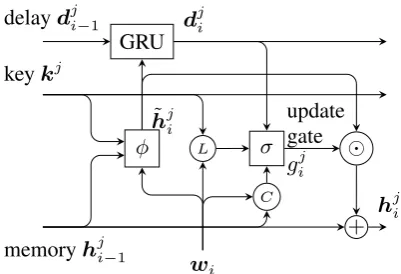
Proposed model. To this end, we design a neu-ral network architecture, capable of tracking and updating the states of entities at the right time with external memory, making it a natural fit for the task. Specifically, our model maintains a number of “memory chains”hj, one for each entity with
the keykj and dynamically updates the states (hj)
of them as it progresses through the sentence with the help of the delay recurrencedj, taking
previ-ous activations into account. An illustration of our model is provided in Figure1.
wi
φ GRU keykj
delaydji−1
˜
hji dji
σ
L
C
update gate gij
+
memoryhji−1
[image:2.595.313.514.66.203.2]hji
Figure 1: Illustration of our model with a single mem-ory chain at time i. σ, φ and GRU represent
Equa-tions (2), (3) and (4), while circled nodesL,C,and +depict the location, content terms, Hadamard prod-uct, and addition, resp.
Delayed memory update. Update of each
memory chain is controlled by a gating mecha-nism, consisting of three components: the “con-tent” termwi·hji−1 , the “location” termwi·kj
and the “delay” termv·dji wheredji carries
knowl-edge regarding previous activation of the gate and
v is a trainable parameter vector. All three terms
may lead to the activation ofgji, but differ in how they turn the gate on. While the “location” term causes the gate to open for memory chains whose keys (kj) match the input, the “content” term
trig-gers the activation when the content of the entities (hji−1) matches the input. The delay term models
how and when the gate was turned on in the past with a GRU (Chung et al.,2014) and how past ac-tivations should influence the current one.
More formally, with arrows denoting processing direction, the update gate is defined as:
− →gj
i =σ(wi·−→hji−1+wi·kj+−→v ·−→dji) (2)
where −→gji is the update gate value for the j-th memory at timei,3kj is the embedding for thej -th entity (key),−→hji−1is the hidden memory
repre-sentation responsible for keeping track of the state of the j-th entity (content), and σ is the sigmoid activation function. The delay recurrence −→dji is
defined as: − →˜
hji =φ(−→U−→hij−1+−→V kj+−→W wi) (3)
− →
dji =−−→GRU(−→h˜ji,−→dji−1) (4)
3While −→gj
where−→h˜j
i is the new candidate memory vector to
be incorporated into the existing memory −→hji−1
to form the new memory −→hji, φ is the paramet-ric ReLU activation function (He et al.,2015), and −
→
U,−→V and−→W are trainable weight matrices.
Once the update gate value has been computed, thej-th memory is then updated according to the intensity of−→gji:
− →
˚hj i =
− →
hji−1+−→gji −→˜hji (5)
whereis the Hadamard product, and −→˚hji is the
unnormalised memory representation for the j-th entity.
Essentially, gate −→gji determines how much the j-th memory should be updated, factoring in three elements: (1) how similar the current inputwiis to
the entity being tracked (kj); (2) how related the
current input wi is to the state of the j-th entity (−→hji−1); and (3) how past activation should
influ-ence the current one. Update of the memory of an entity is only triggered when the gate is activated.
Normalisation. Following the update, the model performs a normalisation step, allowing the memory to forget: −→hji = −→˚hji/k−→˚hjik where k−→˚hjikdenotes the Euclidean norm of−→˚hj
i. As all
information stored in−→hji is constrained to be of
unit length, when new information −→h˜j
i is added
to the existing memory−→hji−1, the cosine distance
between the original and updated memory de-creases, allowing the model to forget information deemed out-of-date.
Bi-directionality. We apply the above steps both forward and backward over the sentence, enabling the model to capture sentiment terms appearing before and after its associated entity. The memory representation incorporating contexts from both directions is obtained by hji = −→hji +←h−ji, with
←−
hji computed analogously to−→hji.
Final classifier. Our model predicts the senti-ment polarity yˆ to the given target t and aspect a embeddings by incorporating the states of all
tracked entities in the form of a weighted sumu:
pj =softmax
(kj)>W
att
t
a (6)
u =X
j
pjhjm (7)
where [ ] denotes concatenation, m is sentence length, and Watt is a trainable weight matrix.
Here, the values of both t and a take the
em-bedding values of their corresponding words (i.e.
t and a are drawn from the same embedding
matrix as are the input words wi). In the case
of multi-word aspect expressions (e.g. TRANSIT -LOCATION), we take the mean of the embeddings of the constituent words. We then transformu to
get:
ˆ
y=softmax(Rφ(Hu+a)) (8)
Training is carried out based on cross entropy loss.
L= CrossEntropy(y,y)ˆ (9)
Comparision withEntNet. While our model is largely inspired by Recurrent Entity Networks (EntNets: Henaff et al. (2017)), it differs in three main respects. First, we explicitly model the delay of activation of the update gatesgj with the GRU in Equations (2) and (4) as opposed to making hji implicitly assume the same
responsi-bility in EntNets. Admittedly, for EntNets on bAbI and CBT, given the coarse-grained na-ture and the difference in the granularity of inputs (sentences vs. words), the demand for modelling delayed memory update is less obvious. With this delayed gate activation mechanism, we essentially decouple the duty of capturing transitions of acti-vations between steps from the task of entity state tracking. That is, hjt is now dedicated to
keep-ing track of the state of the j-th entity only and released from the burden of monitoring the acti-vation of the update gate. Second, tailoring to the task of TABSA, we incorporate not only the target
t but also the aspecta when trying to determine
the attention in the softmax function. Third, the proposed model is bi-directional.
3 Experiments
3.1 Experimental Setup
Dataset. To test the effectiveness of our model, we use Sentihood, a dataset constructed by
Saeidi et al. (2016) for the purpose of detecting aspects and identifying sentiments for each target– aspect pair, consisting of5,215sentences,3,862
Model Aspect Sentiment Acc. F1 AUC Acc. AUC
LR(Saeidi et al.,2016) — 39.3 92.4 87.5 90.5
LSTM-Final(Saeidi et al.,2016) — 68.9 89.8 82.0 85.4 LSTM-Loc(Saeidi et al.,2016) — 69.3 89.7 81.9 83.9 LSTM+TA+SA(Ma et al.,2018) 66.4 76.7 — 86.8 — SenticLSTM(Ma et al.,2018) 67.4 78.2 — 89.3 — EntNet† 66.3 69.8 89.5 87.6 89.7
[image:4.595.129.471.62.202.2]Our model† 73.5 78.5 94.4 91.0 94.8
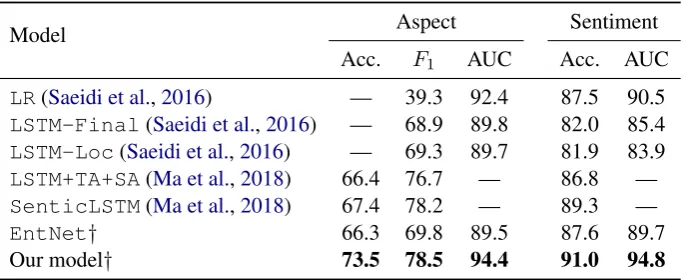
Table 1: Performance onSentihood. We take the results reported inSaeidi et al.(2016) andMa et al.(2018), resp;Bold= best performance; “—” = not reported;†= average performance over 5 runs.
a given targettins. Ultimately, given a sentence s, we are interested in both detecting the mention of an aspectafor targett(a label other thannone), and also identifying the specific sentimentyw.r.t. the target–aspect pair. A detailed description of the task is presented in Section2.
Model configuration. We initialise our model withGloVe(300-D, trained on 42B tokens, 1.9M vocab, not updated during training: Pennington et al.(2014))4and pre-process the corpus with to-kenisation usingNLTK(Bird et al.,2009) and case folding. Training is carried out over 800epochs
with the FTRL optimiser (McMahan et al.,2013) and a batch size of128and learning rate of0.05.
We use the following hyper-parameters for weight matrices in both directions: R ∈ R300×3,H,U,
V,Ware all matrices of sizeR300×300,v ∈R300,
and hidden size of the GRU in Equation (4) is300.
Dropout is applied to the output of φin the final classifier (Equation (8)) with a rate of0.2.
More-over, we employ the technique introduced byGal and Ghahramani (2016) where the same dropout mask is applied to the inputwi at every step with
a rate of 0.2. Lastly, to curb overfitting, we
reg-ularise the last layer (Equation (8)) with an L2
penalty on its weights:λkRkwhereλ= 0.001.
We empirically set the number of memory chains to 6, with the keys of two of them set to the same embeddings as the target words LOC1 andLOC2, resp., and the other 4 chains with free key embeddings which are updated during train-ing, and therefore free to capture any entities.5
4http://nlp.stanford.edu/data/glove.
42B.300d.zip
5In line with the findings ofHenaff et al.(2017) that ty-ing key vectors damages model performance, we observed similar performance deterioration when using tied keys only. While we also experimented with various configurations (all
Consistent withSaeidi et al. (2016), we tackle the data unbalanced problem (nonepositive+
negative) by sampling the same number of training instances within a batch randomly from each class.
Evaluation. We benchmark against baseline systems presented in the works of Saeidi et al.
(2016) andMa et al.(2018): (1)LR: a logistic re-gression classifier withn-gram and POS tag fea-tures; (2) LSTM-Final: a biLSTM taking the final states as representations; (3)LSTM-Loc: a biLSTM taking the states at the location where target t is mentioned as representations; (4) LSTM+TA+SA: a biLSTM equipped with complex target and sentence-level attention mechanisms; (5)SenticLSTM: an improved version of (4) in-corporating theSenticNet external knowledge base (Cambria et al., 2016). We additionally im-plement a bi-directional EntNet with the same hyper-parameter settings andGloVeembeddings as our model (Henaff et al.,2017).
In terms of evaluation, we adopt the stan-dard 70/10/20 train/validation/test split, and re-port the test performance corresponding to the model with the best validation score. Following
Saeidi et al.(2016), we consider the top 4 aspects only (GENERAL, PRICE, TRANSIT-LOCATION, and SAFETY) and employ the following evalua-tion metrics: macro-averageF1 and AUC for
as-pect detection ignoring thenoneclass, and accu-racy and macro-average AUC for sentiment clas-sification. Following Ma et al. (2018), we also report strict accuracy for aspect detection, as the fraction of sentences where all aspects are detected correctly.
LOC1 is a lovely town with plenty of
restaurants
,
you won’
t
go
hungry that’
s
for sure and if you wanted to pop up into london for an
ev
ening
there’
s
trains every 15 minutes
EntNet
Our
model
[image:5.595.314.527.63.191.2]0 0.5 1
Figure 2: Example of the gate valuegtaveraged across
memory chains, forward and backward, inEntNetvs. our model.
3.2 Results
The experimental results are presented in Table1.
State-of-the-art results. Our model achieves state-of-the-art results for both aspect detection and sentiment classification. It is impressive that the proposed model, equipped only with domain-independent general-purposeGloVeembeddings, outperformsSenticLSTM, an approach heavily reliant on external knowledge bases and domain-specific embeddings.
EntNetvs. our model. We see consistent per-formance gains for our model in both aspect de-tection and sentiment classification, compared to EntNet, esp. for aspect detection, underlining the benefit of delayed update gate activation.
3.3 Discussion
To better understand what the model has learned, we visualise the average gate valuegtin Figure2,
where colour intensity indicates how much mem-ory is updated. Observe that, while updated less by the mention ofLOC1, our model carries out mem-ory updates upon seeing lovely town and plenty of restaurants, key phrases associated with as-pects such as GENERAL and DINNING. Perhaps even more importantly, despite the distance be-tweenLOC1and the final portion of the sentence, our model recognises the relevance to TRANSIT -LOCATION and keeps the update gates open to track this particular aspect, as opposed toEntNet where the last phase is overlooked. The ultimate prediction for the TRANSIT-LOCATION aspect of
LOC1is correct with our model (positive), but not detected by EntNet (none), resulting in a false negative. More interestingly, withEntNet, once distant from a target, it can be frequently observed
2 3 4 5 6 7 8 9 10
76 77 78 79
# of memory chains
Aspect
detection
F1
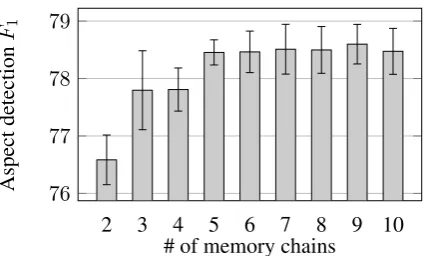
Figure 3: Sensitivity study of model performance to # of memory chains n. Note that we report average
performance over 5 runs with standard deviation.
that the activation rate ofgt tends to drop, a
ten-dency not so apparent with our model.
In Figure 3, we further study the sensitivity of model performance to the number of mem-ory chains n (2 of which are constrained to
trackLOC1andLOC2, the rest are unconstrained chains). Observe that, whenn <5, the model
suf-fers from insufficient capacity (not enough mem-ory chains) to capture the various aspects required by the task, with aspect detectionF1remaining
be-low 78. In particular, when n = 2 (no
uncon-strained chains), model performance drops sub-stantially to a F1 of 76.6±0.4. Once n ≥ 5,
aspect detectionF1 increases to around78, and is
quite stable even with as many asn= 10chains.
4 Conclusion
In this paper, we have proposed a model which is capable of dynamically tracking entities with a delayed memory update mechanism, and demon-strated the effectiveness of the method over the task of targeted aspect-based sentiment analysis.
Acknowledgments
We thank the anonymous reviewers for their valuable feedback, and gratefully acknowledge the support of Australian Government Research Training Program Scholarship and National Com-putational Infrastructure (NCI Australia). This work was also supported in part by the Australian Research Council.
References
[image:5.595.76.284.67.186.2]Erik Cambria, Soujanya Poria, Rajiv Bajpai, and Bjo-ern Schuller. 2016. Senticnet 4: A semantic re-source for sentiment analysis based on conceptual primitives. InProceedings of the 26th International Conference on Computational Linguistics (COLING 2016). Osaka, Japan, pages 2666–2677.
Peng Chen, Zhongqian Sun, Lidong Bing, and Wei Yang. 2017. Recurrent attention network on mem-ory for aspect sentiment analysis. InProceedings of the 2017 Conference on Empirical Methods in Nat-ural Language Processing (EMNLP 2017). Copen-hagen, Denmark, pages 452–461.
Junyoung Chung, Caglar Gulcehre, KyungHyun Cho, and Yoshua Bengio. 2014. Empirical evaluation of gated recurrent neural networks on sequence mod-eling. In Proceedings of the NIPS 2014 Deep Learning and Representation Learning Workshop. Montr´eal, Canada.
Yarin Gal and Zoubin Ghahramani. 2016. A theo-retically grounded application of dropout in recur-rent neural networks. In Proceedings of Advances in Neural Information Processing Systems (NIPS 2016). Barcelona, Spain, pages 1027–1035.
Kaiming He, Xiangyu Zhang, Shaoqing Ren, and Jian Sun. 2015. Delving deep into rectifiers: Surpass-ing human-level performance on imagenet classifi-cation. In Proceedings of the 2015 IEEE Interna-tional Conference on Computer Vision (ICCV 2015). Washington, DC, USA, pages 1026–1034.
Mikael Henaff, Jason Weston, Arthur Szlam, Antoine Bordes, and Yann LeCun. 2017. Tracking the world state with recurrent entity networks. In Proceed-ings of the 5th International Conference on Learn-ing Representations (ICLR 2017). Toulon, France.
Felix Hill, Antoine Bordes, Sumit Chopra, and Jason Weston. 2015. The goldilocks principle: Reading children’s books with explicit memory representa-tions. InProceedings of the 4th International Con-ference on Learning Representations (ICLR 2016). San Juan, Puerto Rico.
Svetlana Kiritchenko, Xiaodan Zhu, Colin Cherry, and Saif Mohammad. 2014. NRC-Canada-2014: De-tecting Aspects and Sentiment in Customer Re-views. In Proceedings of the 8th International Workshop on Semantic Evaluation (SemEval 2014). Dublin, Ireland, pages 437–442.
Yukun Ma, Haiyun Peng, and Erik Cambria. 2018. Targeted aspect-based sentiment analysis via em-bedding commonsense knowledge into an attentive lstm. In Proceedings of the 32rd AAAI Conference on Artificial Intelligence (AAAI 2018). New Orleans, USA.
H. Brendan McMahan, Gary Holt, David Sculley, Michael Young, Dietmar Ebner, Julian Grady, Lan Nie, Todd Phillips, Eugene Davydov, Daniel Golovin, et al. 2013. Ad click prediction: A view
from the trenches. InProceedings of the 19th ACM SIGKDD International Conference on Knowledge Discovery and Data Mining (KDD 2013). Chicago, USA, pages 1222–1230.
Jeffrey Pennington, Richard Socher, and Christopher Manning. 2014. GloVe: Global vectors for word representation. In Proceedings of the 2014 Con-ference on Empirical Methods in Natural Language Processing (EMNLP 2014). Doha, Qatar, pages 1532–1543.
Marzieh Saeidi, Guillaume Bouchard, Maria Liakata, and Sebastian Riedel. 2016. Sentihood: Targeted aspect based sentiment analysis dataset for urban neighbourhoods. InProceedings of the 26th Inter-national Conference on Computational Linguistics (COLING 2016). Osaka, Japan, pages 1546–1556.
Minjoon Seo, Sewon Min, Ali Farhadi, and Hannaneh Hajishirzi. 2017. Query-reduction networks for question answering. InProceedings of the 5th Inter-national Conference on Learning Representations (ICLR 2017). Toulon, France.
Duyu Tang, Bing Qin, Xiaocheng Feng, and Ting Liu. 2016a. Effective lstms for target-dependent senti-ment classification. InProceedings of the 26th Inter-national Conference on Computational Linguistics (COLING 2016). Osaka, Japan, pages 3298–3307. Duyu Tang, Bing Qin, and Ting Liu. 2016b. Aspect
level sentiment classification with deep memory net-work. In Proceedings of the 2016 Conference on Empirical Methods in Natural Language Processing (EMNLP 2016). Austin, USA, pages 214–224.
Joachim Wagner, Piyush Arora, Santiago Cortes, Utsab Barman, Dasha Bogdanova, Jennifer Foster, and Lamia Tounsi. 2014. DCU: Aspect-based polarity classification for SemEval task 4. InProceedings of the 8th International Workshop on Semantic Evalu-ation (SemEval 2014). Dublin, Ireland, pages 223– 229.