Proceedings of NAACL-HLT 2018, pages 42–48
Neural Models for Reasoning over Multiple Mentions using Coreference
Bhuwan Dhingra1 Qiao Jin2 Zhilin Yang1
William W. Cohen1 Ruslan Salakhutdinov1
1Carnegie Mellon University 2University of Pittsburgh
{bdhingra,zhiliny,wcohen,rsalakhu}@cs.cmu.edu, [email protected]
Abstract
Many problems in NLP require aggregating in-formation from multiple mentions of the same entity which may be far apart in the text. Ex-isting Recurrent Neural Network (RNN) lay-ers are biased towards short-term dependen-cies and hence not suited to such tasks. We present a recurrent layer which is instead bi-ased towards coreferent dependencies. The layer uses coreference annotations extracted from an external system to connect entity men-tions belonging to the same cluster. Incorpo-rating this layer into a state-of-the-art reading comprehension model improves performance on three datasets – Wikihop, LAMBADA and the bAbi AI tasks – with large gains when training data is scarce.
1 Introduction
A long-standing goal of NLP is to build systems capable of reasoning about the information present in text. One important form of reasoning for Ques-tion Answering (QA) models is the ability to ag-gregate information from multiple mentions of en-tities. We call this coreference-based reasoning
since multiple pieces of information, which may lie across sentence, paragraph or document bound-aries, are tied together with the help of referring expressions which denote the same real-world en-tity. Figure1shows examples.
QA models which directly read text to answer questions (commonly known as Reading Com-prehension systems) (Hermann et al., 2015; Seo
et al., 2017a), typically consist of RNN layers.
RNN layers have a bias towards sequential re-cency (Dyer, 2017), i.e. a tendency to favor short-term dependencies. Attention mechanisms alleviate part of the issue, but empirical studies suggest RNNs with attention also have difficulty modeling long-term dependencies (Daniluk et al.,
2017). We conjecture that when training data
is scarce, and inductive biases play an important role, RNN-based models would have trouble with coreference-based reasoning.
Context: [...] marygot the football there [...] mary went to the bedroom [...]marytravelled to the hallway [...]
Question:where was the football before the hallway ? Context:Louis-Philippe Fiset [...] was a local physician and politician in theMauriciearea [...] is located in the Mauricieregion of Quebec, Canada [...]
Question:country of citizenship – louis-philippe fiset ? Figure 1: Example questions which require coreference-based reasoning from the bAbi dataset (top) and Wikihop dataset (bottom). Coreferences are in bold, and the correct answers are underlined.
At the same time, systems for coreference res-olution have seen a gradual increase in accuracy over the years (Durrett and Klein, 2013;
Wise-man et al.,2016;Lee et al.,2017). Hence, in this
work we use the annotations produced by such systems to adapt a standard RNN layer by intro-ducing a bias towardscoreferent recency. Specif-ically, given an input sequence and coreference clusters extracted from an external system, we in-troduce a term in the update equations for Gated Recurrent Units (GRU) (Cho et al.,2014) which depends on the hidden state of the coreferent an-tecedent of the current token (if it exists). This way hidden states are propagated along corefer-ence chains and the original sequcorefer-ence in parallel.
We compare our Coref-GRU layer with the reg-ular GRU layer by incorporating it in a recent model for reading comprehension. On synthetic data specifically constructed to test coreference-based reasoning (Weston et al., 2015), C-GRUs lead to a large improvement over regular GRUs. We show that the structural bias introduced and coreference signals are both important to reach high performance in this case. On a more
alistic dataset (Welbl et al., 2017), with noisy coreference annotations, we see small but signif-icant improvements over a state-of-the-art base-line. As we reduce the training data, the gains be-come larger. Lastly, we apply the same model to a broad-context language modeling task (Paperno
et al., 2016), where coreference resolution is an
important factor, and show improved performance over state-of-the-art.
2 Related Work
Entity-based models. Ji et al. (2017) presented a generative model for jointly predicting the next word in the text and its gold-standard corefer-ence annotation. The differcorefer-ence in our work is that we look at the task of reading comprehen-sion, and also work in the more practical set-ting of system extracted coreferences. EntNets
(Henaff et al.,2016) also maintain dynamic
mem-ory slots for entities, but do not use coreference signals and instead update all memories after read-ing each sentence, which leads to poor perfor-mance in the low-data regime (c.f. Table1).Yang
et al. (2017) model references in text as explicit
latent variables, but limit their work to text gen-eration. Kobayashi et al. (2016) used a pooling operation to aggregate entity information across multiple mentions. Wang et al.(2017) also noted the importance of reference resolution for read-ing comprehension, and we compare our model to their one-hot pointer reader.
Syntactic-recency. Recent work has used syn-tax, in the form of dependency trees, to replace the sequential recency bias in RNNs with a syntactic recency bias (Tai et al.,2015;Swayamdipta,2017;
Qian et al., 2017; Chen et al., 2017). However,
syntax only looks at dependencies within sentence boundaries, whereas our focus here is on longer ranges. Our resulting layer is structurally similar to GraphLSTMs (Peng et al.,2017), with an addi-tional attention mechanism over the graph edges. However, whilePeng et al.(2017) found that using coreference did not lead to any gains for the task of relation extraction, here we show that it has a pos-itive impact on the reading comprehension task. Self-Attention(Vaswani et al., 2017) models are becoming popular for modeling long-term depen-dencies, and may also benefit from coreference in-formation to bias the learning of those dependen-cies. Here we focus on recurrent layers and leave such an analysis to future work.
Mary went … she … …
Mary went … she … …
hf t 1
hft
hf yt
hb t0
hb t0+1
xt xt0 hb
[image:2.595.331.503.64.130.2]yt0
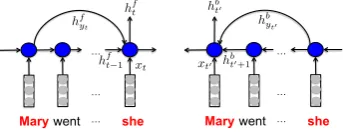
Figure 2: Forward (left) and Backward (right) Coref-GRU layers.Maryandsheare coreferent.
Part of this work was described in an unpub-lished preprint (Dhingra et al., 2017b). The cur-rent paper extends that version and focuses exclu-sively on coreference relations. We also report re-sults on the WikiHop dataset, including the perfor-mance of the model in the low-data regime.
3 Model
Coref-GRU (C-GRU) Layer. Suppose we are given an input sequence w1, w2, . . . , wT along
with their word vectors x1, . . . , xT and
annota-tions for the most recent coreferent antecedent for each tokeny1, . . . , yT, whereyt ∈ {0, . . . , t−1}
andyt= 0denotes the null antecedent (for tokens
not belonging to any cluster). We assume all to-kens belonging to a mention in a cluster belong to that cluster, and there areCclusters in total. Our
recurrent layer is adapted from GRU cells (Cho
et al.,2014), but similar extensions can be derived
for other recurrent cells as well. The update equa-tions in a GRU all take the same basic form given by:
f(W xt+U ht−1+b).
The bias for sequential recency comes from the second term U ht−1. In this work we add
an-other term to introduce a bias towards coreferent recency instead:
f(W xt+αtU φs(ht−1) + (1−αt)U0φc(hyt) +b),
wherehyt is the hidden state of the coreferent
an-tecedent ofwt(withh0 = 0),φsandφcare
non-linear functions applied to the hidden states com-ing from the sequential antecedent and the coref-erent antecedent, respectively, and αt is a scalar
weight which decides the relative importance of the two terms based on the current input (so that, for example, pronouns may assign a higher weight for the coreference state). When yt = 0, αt is
set to 1, otherwise it is computed using a key-based addressing scheme (Miller et al.,2016), as
vector. In this work we use simple slicing func-tionsφs(x) =x[1 :d/2], andφc(x) =x[d/2 :d]
which decompose the hidden states into a sequen-tial and a coreferent component, respectively. Fig-ure2(left) shows an illustration of the layer, and the full update equations are given in AppendixA. Connection to Memory Networks. We can also view the model as a memory network
(Sukhbaatar et al.,2015) with a memory stateMt
at each time step which is a C×dmatrix. The
rows of this memory matrix correspond to the state of each coreference cluster at time step t.
The main difference between Coref-GRUs and a typical memory network such as EntNets (Henaff
et al., 2016) lies in the fact that we use
corefer-ence annotations to read and write from the mem-ory rather than let model learn how to access the memory. With Coref-GRUs, only the content of the memories needs to be learned. As we shall see in Section 4, this turns out to be a useful bias in the low-data regime.
Bidirectional C-GRU. To extend to the bidi-rectional case, a second layer is fed the same se-quence in the reverse direction, xT, . . . , x1 and yt ∈ {0, t+ 1, . . . , T} now denotes the
immedi-ately descendent coreferent token from wt.
Out-puts from the two layers are then concatenated to form the bi-directional output (see Figure2).
Complexity. The resulting layer has the same time-complexity as that of a regular GRU layer. The memory complexity increases since we have to keep track of the hidden states for each coref-erence cluster in the input. If there areCclusters
andB is the batch size, the resulting complexity
is byO(BT Cd). This scales linearly with the
in-put sizeT, however we leave exploration of more
efficient architectures to future work.
Reading comprehension architecture. All tasks we look at involve tuples of the form
(p, q, a,C), where the goal is to find the answer
a from candidates C to question q with passage p as context. We use the Gated-Attention (GA)
reader (Dhingra et al.,2017a) as a base architec-ture, which computes representations of the pas-sage by passing it through multiple bidirectional GRU layers with an attention mechanism in be-tween layers. We compare the original GA archi-tecture (GA w/ GRU) with one where the bidirec-tional GRU layers are replaced with bidirecbidirec-tional C-GRU layers (GA w/ C-GRU). Performance is reported in terms of the accuracy of detecting the
correct answer fromC, and all models are trained using cross-entropy loss. When comparing two models we ensure the number of parameters are the same in each. Other implementation details are listed in AppendixB.
4 Experiments & Results
Method Avg Max # failed
EntNets (Henaff et al.,2016) – 0.704 15 QRN (Seo et al.,2017b) – 0.901 7
Bi-GRU 0.727 0.767 13
Bi-C-GRU 0.790 0.831 12
GA w/ GRU 0.764 0.810 10
GA w/ GRU + 1-hot 0.766 0.808 9
[image:3.595.309.522.170.267.2]GA w/ C-GRU 0.870 0.886 5
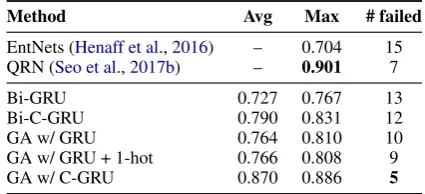
Table 1: Accuracy on bAbi-1K, averaged across all20
tasks. Following previous work we run each task for10
random seeds, and report theAvgandMax(based on dev set) performance. A task is considered failed if its Maxperformance is<0.95.
BAbi AI tasks. Our first set of experiments are on the 1K training version of the synthetic bAbi AI tasks (Weston et al., 2015). The pas-sages and questions in this dataset are generated using templates, removing many complexities in-herent in natural language, but it still provides a useful testbed for us since some tasks are specifi-cally constructed to test the coreference-based rea-soning we tackle here. Experiments on more nat-ural data are described below.
Table1shows a comparison of EntNets (Henaff
et al., 2016), QRNs (Seo et al., 2017b) (the best
published results on bAbi-1K), and our models. We also include the results for a single layer ver-sion of GA Reader (which we denote simply as Bi-GRU or Bi-C-GRU when using coreference) to enable fair comparison with EntNets. In each case we see clear improvements of using C-GRU layers over GRU layers. Interestingly, EntNets, which have>99%performance when trained with 10K examples only reach70%performance with
1K training examples. The Bi-C-GRU model sig-nificantly improves on this baseline, which shows that, with less data, coreference annotations can provide a useful bias for a memory network on how to read and write memories.
0.0 0.1 0.2 0.3 0.4 % removed coreferences 0.5
0.6 0.7 0.8 0.9 1.0
Accuracy
GA w/ GRU GA w/ randomGRU GA w/ CGRU
Training progress
0.0 0.1 0.2 0.3 0.4 0.5
V
alidation
exp
(
−
loss
)
full C-GRU full GRU 5K C-GRU
[image:4.595.309.525.63.236.2]5K GRU 1K C-GRU 1K GRU
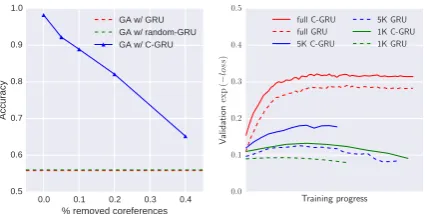
Figure 3:Left:Accuracy of GA w/ C-GRU as corefer-ence annotations are removed for bAbi task 3. Right: Expected probability of correct answer (exp (−loss))
on Validation set as training progresses on Wikihop dataset for 1K, 5K and the full training datasets.
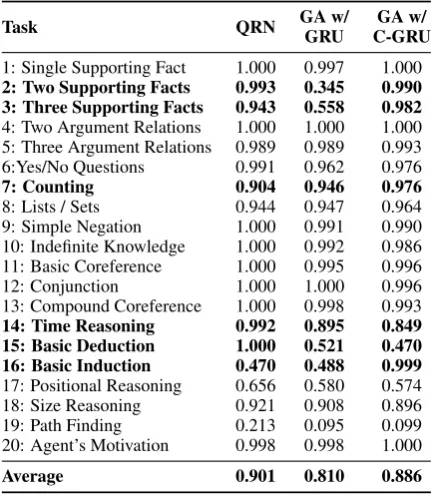
tasks require aggregation of information across sentences to derive the answer. Comparing to the QRN baseline, we found that C-GRU was signif-icantly worse on task 15 (basic deduction). On closer examination we found that this was because our simplistic coreference module which matches tokens exactly was not able to resolve “mice” to “mouses” and “cats” to “cat”. On the other hand, C-GRU was significantly better than QRN on task 16 (basic induction).
We also include a baseline which uses coref-erence features as 1-hot vectors appended to the input word vectors (GA w/ GRU + 1-hot). This provides the model with information about the coreference clusters, but does not improve perfor-mance, suggesting that the regular GRU is unable to track the given coreference information across long distances to solve the task. On the other hand, in Figure 3 (left) we show how the per-formance of GA w/ C-GRU varies as we remove gold-standard mentions from coreference clusters, or if we replace them with random mentions (GA w/ random-GRU). In both cases there is a sharp drop in performance, showing that specifically us-ing coreference for connectus-ing mentions is impor-tant.
Wikihop dataset. Next we apply our model to the Wikihop dataset (Welbl et al.,2017), which is specifically constructed to test multi-hop reading comprehension across documents. Each instance in this dataset consists of a collection of passages
(p1, . . . , pN), and a query of the form(h, r)where his an entity andris a relation. The task is to find
the tail entitytfrom a set of provided candidates
C. As preprocessing we concatenate all documents in a random order, and extract coreference
anno-Method Follow Follow+single +multipleFollow Overall
Dev Dev Dev Dev Test
1K
GA w/ GRU 0.307 0.332 0.287 0.263 – GA w/ C-GRU 0.355 0.370 0.354 0.330 –
5K
GA w/ GRU 0.382 0.385 0.390 0.336 – GA w/ C-GRU 0.452 0.454 0.460 0.401 –
full
BiDAF – – – – 0.429
[image:4.595.75.288.70.177.2]GA w/ GRU 0.606 0.615 0.604 0.549 – GA w/ C-GRU 0.614 0.616 0.614 0.560† 0.593
Table 2: Accuracy on Wikihop. Follow: annotated as answer follows from the given passages.Follow +mul-tiple: annotated as requiring multiple passages for an-swering. Follow +singleannotated as requiring one passage for answering. †p= 0.057using Mcnemar’s
test compared to GA w/ GRU.
tations from the Berkeley Entity Resolution sys-tem (Durrett and Klein, 2013) which gets about
62% F1 score on the CoNLL 2011 test set. We
only keep the coreference clusters which contain at least one candidate fromC or an entity which co-occurs with the head entityh. We report results
in Table2when using the full training set, as well as when using a reduced training set of sizes 1K and 5K, to test the model under a low-data regime. In Figure 3 we also show the training curves of
exp (−loss)on the validation set.
We see higher performance for the C-GRU model in the low data regime, and better gen-eralization throughout the training curve for all three settings. This supports our conjecture that the GRU layer has difficulty learning the kind of coreference-based reasoning required in this dataset, and that the bias towards coreferent re-cency helps with that. However, perhaps sur-prisingly, given enough data both models per-form comparably. This could either indicate that the baseline learns the required reasoning patterns when given enough data, or, that the bias towards corefence-based reasoning hurts performance for some other types of questions. Indeed, there are
9%questions which are answered correctly by the
(Welbl et al., 2017)1. We believe this is because
the GA models select answers from the list of candidatees, whereas BiDAF ignores those candi-dates.
Method overall context
Chu et al.(2017) 0.4900 –
[image:5.595.103.257.127.190.2]GA w/ GRU 0.5398 0.6677 GA w/ GRU + 1-hot 0.5338 0.6603 GA w/ C-GRU 0.5569 0.6888†
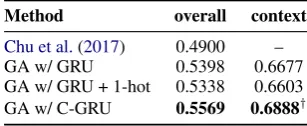
Table 3: Accuracy on LAMBADA test set, averaged across two runs with random initializations. context: passages for which the answer is in context. overall: full test set for comparison to prior work.†p <0.0001
using Mcnemar’s test compared to GA w/ GRU.
LAMBADA dataset. Our last set of exper-iments is on the broad-context language model-ing task of LAMBADA dataset (Paperno et al.,
2016). This dataset consists of passages 4-5 sen-tences long, where the last word needs to be pre-dicted. Interestingly, though, the passages are fil-tered such that human volunteers were able to pre-dict the missing token given the full passage, but not given only the last sentence. Hence, predict-ing these tokens involves a broader understandpredict-ing of the whole passage. Analysis of the questions
(Chu et al.,2017) suggests that around 20% of the
questions need coreference understanding to an-swer correctly. Hence, we apply our model which uses coreference information for this task.
We use the same setup as Chu et al. (2017) which formulated the problem as a reading com-prehension one by treating the last sentence as query, and the remaining passage as context to ex-tract the answer from. In this manner only80%of
the questions are answerable, but the performance increases substantially compared to pure language modeling based approaches. For this dataset we used Stanford CoreNLP to extract coreferences
(Clark and Manning,2015), which achieved0.63
F1 on the CoNLL test set. Table3shows a com-parison of the GA w/ GRU baseline and GA w/ C-GRU models. We see a significant gain in perfor-mance when using the layer with coreference bias. Furthermore, the 1-hot baseline which uses the same coreference information, but with sequential recency bias fails to improve over the regular GRU
1The official leaderboard athttp://qangaroo.cs.
ucl.ac.uk/leaderboard.html shows two models
with better performance than reported here (as of April 2018). Since we were unable to find publications for these models we omit them here.
layer. While the improvement for C-GRU is small, it is significant, and we note that questions in this dataset involve several different types of reasoning out of which we only tackle one specific kind. The proposed GA w/ C-GRU layer sets a new state-of-the-art on this dataset.
5 Conclusion
We present a recurrent layer with a bias towards
coreferent recency, with the goal of tackling read-ing comprehension problems which require aggre-gating information from multiple mentions of the same entity. Our experiments show that when combined with a powerful reading architecture, the layer provides a useful inductive bias for solv-ing problems of this kind. In future work, we aim to apply this model to other problems where long-term dependencies at the document level are im-portant. Noise in the coreference annotations has a detrimental effect on the performance (Figure3), hence we also aim to explore joint models which learn to do coreference resolution and reading to-gether.
Acknowledgments
This work was supported by NSF under grants CCF-1414030 and IIS-1250956 and by grants from Google.
References
Huadong Chen, Shujian Huang, David Chiang, and Ji-ajun Chen. 2017. Improved neural machine transla-tion with a syntax-aware encoder and decoder. ACL. Kyunghyun Cho, Bart Van Merri¨enboer, Caglar Gul-cehre, Dzmitry Bahdanau, Fethi Bougares, Holger Schwenk, and Yoshua Bengio. 2014. Learning phrase representations using rnn encoder-decoder for statistical machine translation. arXiv preprint arXiv:1406.1078.
Zewei Chu, Hai Wang, Kevin Gimpel, and David McAllester. 2017. Broad context language model-ing as readmodel-ing comprehension.EACL.
Kevin Clark and Christopher D Manning. 2015. Entity-centric coreference resolution with model stacking. In Proceedings of the 53rd Annual Meeting of the Association for Computational Linguistics and the 7th International Joint Conference on Natural Lan-guage Processing (Volume 1: Long Papers), vol-ume 1, pages 1405–1415.
Bhuwan Dhingra, Hanxiao Liu, Zhilin Yang, William W Cohen, and Ruslan Salakhutdinov. 2017a. Gated-attention readers for text comprehen-sion.ACL.
Bhuwan Dhingra, Zhilin Yang, William W Cohen, and Ruslan Salakhutdinov. 2017b. Linguistic knowl-edge as memory for recurrent neural networks.
arXiv preprint arXiv:1703.02620.
Greg Durrett and Dan Klein. 2013. Easy victories and uphill battles in coreference resolution. InEMNLP, pages 1971–1982.
Chris Dyer. 2017. Should neural network architecture reflect linguistic structure? CoNLL Keynote.
Mikael Henaff, Jason Weston, Arthur Szlam, Antoine Bordes, and Yann LeCun. 2016. Tracking the world state with recurrent entity networks. arXiv preprint arXiv:1612.03969.
Karl Moritz Hermann, Tomas Kocisky, Edward Grefenstette, Lasse Espeholt, Will Kay, Mustafa Su-leyman, and Phil Blunsom. 2015. Teaching ma-chines to read and comprehend. InAdvances in Neu-ral Information Processing Systems, pages 1693– 1701.
Yangfeng Ji, Chenhao Tan, Sebastian Martschat, Yejin Choi, and Noah A Smith. 2017. Dynamic entity rep-resentations in neural language models. EMNLP.
Sosuke Kobayashi, Ran Tian, Naoaki Okazaki, and Kentaro Inui. 2016. Dynamic entity representation with max-pooling improves machine reading. In
Proceedings of the 2016 Conference of the North American Chapter of the Association for Computa-tional Linguistics: Human Language Technologies, pages 850–855.
Kenton Lee, Luheng He, Mike Lewis, and Luke Zettle-moyer. 2017. End-to-end neural coreference resolu-tion. EMNLP.
Alexander Miller, Adam Fisch, Jesse Dodge, Amir-Hossein Karimi, Antoine Bordes, and Jason We-ston. 2016. Key-value memory networks for directly reading documents. arXiv preprint arXiv:1606.03126.
Denis Paperno, Germ´an Kruszewski, Angeliki Lazari-dou, Quan Ngoc Pham, Raffaella Bernardi, San-dro Pezzelle, Marco Baroni, Gemma Boleda, and Raquel Fern´andez. 2016. The lambada dataset: Word prediction requiring a broad discourse context.
ACL.
Nanyun Peng, Hoifung Poon, Chris Quirk, Kristina Toutanova, and Wen-tau Yih. 2017. Cross-sentence n-ary relation extraction with graph lstms. Transac-tions of the Association for Computational Linguis-tics, 5:101–115.
Jeffrey Pennington, Richard Socher, and Christo-pher D. Manning. 2014. Glove: Global vectors for word representation. InEmpirical Methods in Nat-ural Language Processing (EMNLP), pages 1532– 1543.
Feng Qian, Lei Sha, Baobao Chang, Lu-chen Liu, and Ming Zhang. 2017. Syntax aware lstm model for chinese semantic role labeling. arXiv preprint arXiv:1704.00405.
Minjoon Seo, Aniruddha Kembhavi, Ali Farhadi, and Hannaneh Hajishirzi. 2017a. Bidirectional attention flow for machine comprehension.ICLR.
Minjoon Seo, Sewon Min, Ali Farhadi, and Hannaneh Hajishirzi. 2017b. Query-reduction networks for question answering.ICLR.
Sainbayar Sukhbaatar, Jason Weston, Rob Fergus, et al. 2015. End-to-end memory networks. InAdvances in neural information processing systems, pages 2440–2448.
Swabha Swayamdipta. 2017. Learning Algorithms for Broad-Coverage Semantic Parsing. Ph.D. thesis, Carnegie Mellon University Pittsburgh, PA.
Kai Sheng Tai, Richard Socher, and Christopher D Manning. 2015. Improved semantic representations from tree-structured long short-term memory net-works. ACL.
Ashish Vaswani, Noam Shazeer, Niki Parmar, Jakob Uszkoreit, Llion Jones, Aidan N Gomez, Lukasz Kaiser, and Illia Polosukhin. 2017. Attention is all you need. NIPS.
Hai Wang, Takeshi Onishi, Kevin Gimpel, and David McAllester. 2017. Emergent logical structure in vector representations of neural readers. 2nd Work-shop on Representation Learning for NLP, ACL.
Dirk Weissenborn, Georg Wiese, and Laura Seiffe. 2017. Fastqa: A simple and efficient neural archi-tecture for question answering. CoNLL.
Johannes Welbl, Pontus Stenetorp, and Sebastian Riedel. 2017. Constructing datasets for multi-hop reading comprehension across documents. arXiv preprint arXiv:1710.06481.
Jason Weston, Antoine Bordes, Sumit Chopra, Alexan-der M Rush, Bart van Merri¨enboer, Armand Joulin, and Tomas Mikolov. 2015. Towards ai-complete question answering: A set of prerequisite toy tasks.
arXiv preprint arXiv:1502.05698.
Sam Wiseman, Alexander M Rush, and Stuart M Shieber. 2016. Learning global features for coref-erence resolution. NAACL.
Zichao Yang, Phil Blunsom, Chris Dyer, and Wang Ling. 2017. Reference-aware language models.
A C-GRU update equations
For simplicity, we introduce the variablemtwhich
concatenates (||) the sequential and coreferent hid-den states:
mt=αtφs(ht−1)||(1−αt)φc(hyt)
Then the update equations are given by:
rt=σ(Wrxt+Urmt+br) zt=σ(Wzxt+Uzmt+bz)
˜
ht= tanh(Whxt+rtUhmt+bh)
ht= (1−zt)mt+zt˜ht
The attention parameterαtis given by:
αt=
expxTtk1
expxT
tk1+ expxTtk2
wherek1andk2are trainable key vectors.
B Implementation details
We use K = 3 layers with the GA architecture.
We keep the same hyperparameter settings when using GRU or C-GRU layers, which we describe here.
For thebAbidataset, we use a hidden state size ofd= 64, batch size ofB = 32, and learning rate 0.01which is halved after every120updates. We
also use dropout with rate0.1at the output of each
layer. The maximum number of coreference clus-ters across all tasks wasC = 13. Half of the tasks
in this dataset are extractive, meaning the answer is present in the passage, whereas the other half are classification tasks, where the answer is in a list of candidates which may not be in the passage. For the extractive tasks, we use the attention sum layer as described in the GA Reader paper (
Dhin-gra et al.,2017a). For the classification tasks we
replace this with a softmax layer for predicting one of the classes.
For theWikihopdataset, we use a hidden state size of d = 64, batch size B = 16, and
learn-ing rate of0.0005which was halved every 2500
updates. The maximum number of coreference clusters was set to 50 for this dataset. We used
dropout of0.2in between the intermediate layers,
and initialized word embeddings with Glove (
Pen-nington et al.,2014). We also used character
em-beddings, which were concatenated with the word embeddings, of size10. These were output from a
CNN layer with50filters each of width5. Follow-ing (Weissenborn et al.,2017), we also appended a feature to the word embeddings in the passage which indicated if the token appeared in the query or not.
For the LAMBADA dataset, we use a hidden state size ofd= 256, batch size ofB = 64, and
learning rate of0.0005which was halved every2
epochs. Word vectors were initialized with Glove, and dropout of0.2was applied after intermediate
layers. The maximum number of coreference clus-ters in this dataset was15.
C Task-wise bAbi performance
Task QRN GA w/GRU C-GRUGA w/
1: Single Supporting Fact 1.000 0.997 1.000 2: Two Supporting Facts 0.993 0.345 0.990 3: Three Supporting Facts 0.943 0.558 0.982 4: Two Argument Relations 1.000 1.000 1.000 5: Three Argument Relations 0.989 0.989 0.993 6:Yes/No Questions 0.991 0.962 0.976
7: Counting 0.904 0.946 0.976
8: Lists / Sets 0.944 0.947 0.964 9: Simple Negation 1.000 0.991 0.990 10: Indefinite Knowledge 1.000 0.992 0.986 11: Basic Coreference 1.000 0.995 0.996 12: Conjunction 1.000 1.000 0.996 13: Compound Coreference 1.000 0.998 0.993 14: Time Reasoning 0.992 0.895 0.849 15: Basic Deduction 1.000 0.521 0.470 16: Basic Induction 0.470 0.488 0.999 17: Positional Reasoning 0.656 0.580 0.574 18: Size Reasoning 0.921 0.908 0.896 19: Path Finding 0.213 0.095 0.099 20: Agent’s Motivation 0.998 0.998 1.000
[image:7.595.308.524.268.516.2]Average 0.901 0.810 0.886