Engineer Manual
1110-2-2300
Washington, DC 20314-1000
31 July 1994
Engineering and Design
EARTH AND ROCK-FILL DAMS -
GENERAL DESIGN AND
CONSTRUCTION CONSIDERATIONS
Distribution Restriction Statement
Approved for public release; distribution is
US Army Corps
of Engineers
ENGINEERING AND DESIGN
Earth and Rock-Fill
Dams-General Design and
CECW-EG
Washington, DC 20314-1000
Manual
No. 1110-2-2300 31 July 1994
Engineering and Design
EARTH AND ROCK-FILL DAMS—GENERAL DESIGN
AND CONSTRUCTION CONSIDERATIONS
1. Purpose. This manual presents fundamental principles underlying the design and construction of earth and rock-fill dams. The general principles presented herein are also applicable to the design and construction of earth levees. The construction of earth dams by hydraulic means was curtailed in the 1940’s due to economic considerations and liquefaction concerns during earthquake loading and are not discussed herein.
2. Applicability. This manual applies to HQUSACE elements, major subordinate commands, districts, laboratories, and field operating activities having responsibility for the design and construction of earth and rock-fill dams.
FOR THE COMMANDER:
WILLIAM D. BROWN Colonel, Corps of Engineers Chief of Staff
CECW-EG
Washington, DC 20314-1000
Manual
No. 1110-2-2300 31 July 1994
Engineering and Design
EARTH AND ROCK-FILL DAMS—GENERAL DESIGN
AND CONSTRUCTION CONSIDERATIONS
Table of Contents
Subject Paragraph Page Subject Paragraph Page
Chapter 1 Introduction
Purpose . . . 1-1 1-1 Applicability . . . 1-2 1-1 References . . . 1-3 1-1 Overview of Manual . . . 1-4 1-1
Chapter 2
General Considerations
General . . . 2-1 2-1 Civil Works Project Process . . . 2-2 2-1 Types of Embankment Dams . . . 2-3 2-2 Basic Requirements . . . 2-4 2-5 Selection of Embankment Type . . . 2-5 2-5 Environmental Conditions . . . 2-6 2-6
Chapter 3
Field Investigations and Laboratory Testing
Geological and Subsurface Explorations
and Field Tests . . . 3-1 3-1 Laboratory Testing . . . 3-2 3-3
Chapter 4
General Design Considerations
Freeboard . . . 4-1 4-1 Top Width . . . 4-2 4-1 Alignment . . . 4-3 4-1 Embankment . . . 4-4 4-1 Abutments . . . 4-5 4-1 Earthquake Effects . . . 4-6 4-2 Coordination Between Design and
Construction . . . 4-7 4-2 Value Engineering Proposals . . . 4-8 4-2
Partnering Between the Owner
and Contractor . . . 4-9 4-3
Chapter 5
Foundation and Abutment Preparation
Preparation . . . 5-1 5-1 Strengthening the Foundation . . . 5-2 5-2 Dewatering the Working Area . . . 5-3 5-3
Chapter 6 Seepage Control
General . . . 6-1 6-1 Embankment . . . 6-2 6-1 Earth Foundations . . . 6-3 6-1 Rock Foundations . . . 6-4 6-4 Abutments . . . 6-5 6-5 Adjacent to Outlet Conduits . . . 6-6 6-5 Beneath Spillways and Stilling
Basins . . . 6-7 6-6 Seepage Control Against Earthquake
Effects . . . 6-8 6-6
Chapter 7
Embankment Design
Embankment Materials . . . 7-1 7-1 Zoning . . . 7-2 7-1 Cracking . . . 7-3 7-5 Filter Design . . . 7-4 7-8 Consolidation and Excess Porewater
Subject Paragraph Page Subject Paragraph Page
Compaction Requirements . . . 7-8 7-9 Slope Protection . . . 7-9 7-13
Chapter 8
Appurtenant Structures
Outlet Works . . . 8-1 8-1 Spillway . . . 8-2 8-1 Miscellaneous Considerations . . . 8-3 8-1
Chapter 9
General Construction Considerations
General . . . 9-1 9-1 Obtaining Quality Construction . . . 9-2 9-1 Stage Construction . . . 9-3 9-1 Stream Diversion . . . 9-4 9-2 Closure Section . . . 9-5 9-3 Construction/Design Interface . . . 9-6 9-3 Visual Observations . . . 9-7 9-3 Compaction Control . . . 9-8 9-4 Initial Reservoir Filling . . . 9-9 9-4 Construction Records and
Reports . . . 9-10 9-5
Chapter 10 Instrumentation
General . . . 10-1 10-1 Instrumentation Plan
and Records . . . 10-2 10-1 Types of Instrumentation . . . 10-3 10-1 Discussion of Devices . . . 10-4 10-1 Measurements of Seepage
Quantities . . . 10-5 10-2 Automatic Data Acquisition . . . 10-6 10-2
Appendix A
References . . . A-1
Appendix B
Filter Design . . . B-1
Appendix C
Slope Protection . . . C-1
Appendix D
Automatic Data Acquisition
Chapter 1
Introduction
1-1. Purpose
This manual presents fundamental principles underlying the design and construction of earth and rock-fill dams. The general principles presented herein are also applicable to the design and construction of earth levees. The con-struction of earth dams by hydraulic means was curtailed in the 1940’s due to economic considerations and lique-faction concerns during earthquake loading and are not discussed herein.
1-2. Applicability
This manual applies to HQUSACE elements, major subor-dinate commands, districts, laboratories, and field
operating activities having responsibility for the design and construction of earth and rock-fill dams.
1-3. References
Required and related references are listed in Appendix A.
1-4. Overview of Manual
Chapter 2
General Considerations
2-1. General
a. Introduction. The design of earth and rock-fill dams involves many considerations that must be examined before initiating detailed stability analyses. Following geological and subsurface explorations, the earth and/or rock-fill materials available for construction should be carefully studied. The study should include the determ-ination of the quantities of various types of material that will be available and the sequence in which they become available, and a thorough understanding of their physical properties is necessary. Failure to make this study may result in erroneous assumptions which must be revised at a later date. For example, a rock-fill dam was originally designed to utilize sandstone in rock-fill shells. However, subsequent investigations showed that the sandstone would break down during excavation and compaction, and it was necessary to redesign the embankment as an earth dam.
b. Embankment. Many different trial sections for the zoning of an embankment should be prepared to study utilization of fill materials; the influence of variations in types, quantities, or sequences of availability of various fill materials; and the relative merits of various sections and the influence of foundation condition. Although procedures for stability analyses (see EM 1110-2-1902 and Edris 1992) afford a convenient means for comparing various trial sections and the influence of foundation conditions, final selection of the type of embankment and final design of the embankment are based, to a large extent, upon experience and judgment.
c. Features of design. Major features of design are
required foundation treatment, abutment stability, seepage conditions, stability of slopes adjacent to control structure approach channels and stilling basins, stability of reservoir slopes, and ability of the reservoir to retain the water stored. These features should be studied with reference to field conditions and to various alternatives before initiat-ing detailed stability or seepage analyses.
d. Other considerations. Other design considera-tions include the influence of climate, which governs the length of the construction season and affects decisions on the type of fill material to be used, the relationship of the width of the valley and its influence on river diversion and type of dam, the planned utilization of the project (for example, whether the embankment will have a permanent
pool or be used for short-term storage), the influence of valley configuration and topographic features on wave action and required slope protection, the seismic activity of the area, and the effect of construction on the environment.
2-2. Civil Works Project Process
a. General. The civil works project process for a
dam is continuous, although the level of intensity and technical detail varies with the progression through the different phases of the project development and imple-mentation. The phases of the process are reconnaissance, feasibility, preconstruction engineering and design (PED), construction, and finally the operation, maintenance, repair, replacement, and rehabilitation (OMRR&R).
b. Reconnaissance phase. A reconnaissance study
is conducted to determine whether or not the problem has a solution acceptable to local interests for which there is a Federal interest and if so whether planning should proceed to the feasibility phase. During the reconnaissance phase, engineering assessments of alternatives are made to deter-mine if they will function safely, reliably, efficiently, and economically. Each alternative should be evaluated to determine if it is practical to construct, operate, and main-tain. Several sites should be evaluated, and preliminary designs should be prepared for each site. These prelimi-nary designs should include the foundation for the dam and appurtenant structures, the dam, and the reservoir rim. The reconnaissance phase ends with either execution of a Feasibility Cost Sharing Agreement or the major subordi-nate command (MSC) Commander’s public notice for a r e p o r t r e c o m m e n d i n g n o F e d e r a l a c t i o n (ER 1110-2-1150).
developed. All of the project OMRR&R and dam safety requirements should be identified and discussed with the sponsor and state during the feasibility phase. A turnover plan for non-Federal dams that establishes a definite turn-over point of the dam to the sponsor should be docu-mented in the initial project management plan and in the feasibility report. The turnover of the dam should occur immediately following the first periodic inspection. Ade-quate engineering data must be obtained and analyzed and sufficient design performed to define the appropriate level of risk associated with the contingencies assigned to each cost item in the estimate (ER 1110-2-1150).
d. Preconstruction engineering and design phase.
During the preconstruction engineering and design (PED) phase, it may be determined that a GDM is necessary because the project has changed substantially since admin-istration review of the feasibility report (with engineering appendix) or authorization, the project was authorized without a feasibility report, there is a need to readdress project formulation, or there is a need to reassess project plans due to changes in administration policy (ER 1110-2-1150 will be followed). For a complex project such as a dam, results of the engineering studies for individual features of the project such as the spillway, outlet works, embankment, and instrumentation will be submitted in separate design memorandums (DMs) with sufficient detail to allow preparation of plans and specifications (P&S) to proceed during the review and approval process. Contents and format of a DM are given in ER 1110-2-1150, Appendixes B and D, respectively. A significant level of geological investigation and exploration and stud-ies on the availability of construction materials are accom-plished to support the DM. While final design parameters are not selected at this stage of design, it is necessary that the testing for engineering properties of materials and hydraulic model testing that may be necessary for the project be in progress. In preparation for the beginning of each major construction contract, engineering will prepare a report outlining the engineering considerations and providing instructions for field personnel to aid them in the supervision and inspection of the contract. The report will summarize data presented in the engineering appen-dix to the feasibility report but will also include informal discussions on why specific designs, material sources, and construction plant locations were selected so that field personnel will be provided the insight and background necessary to review contractor proposals and resolve construction problems without compromising the design intent (ER 415-2-100). Format of the report on engineer-ing considerations and instructions for field personnel is given in Appendix D of ER 1110-2-1150.
e. Construction phase. This phase includes
prepa-ration of P&S for subsequent construction contracts, review of selected construction contracts, site visits, sup-port for claims and modifications, development of opera-tion and maintenance (O&M) manuals, and preparaopera-tion and maintenance of as-built drawings. Site visits must be made to verify that conditions match the assumptions used in designing the project features. Site visits may also be necessary to brief the construction division personnel on any technical issues which affect the construction. The O&M manual and water control manual will be completed and fully coordinated with the local sponsor during this phase of the project. As-built drawings are prepared and maintained by engineering during the construction phase (ER 1110-2-1150).
f. Operation and maintenance phase. The project
is operated, inspected, maintained, repaired, and rehabili-tated by either the non-Federal sponsor or the Federal Government, depending upon the project purposes and the terms of the project cooperation agreement (PCA). For PCA projects and new dams turned over to others, the Corps needs to explain up front the O&M responsibilities, formal inspection requirements, and responsibilities to implement dam safety practices. Periodic inspections will be conducted to assess and evaluate the performance and safety of the project during its lifetime. Modifications to the features of a project which occur during the operating life of a project will be reflected in the as-built drawings (ER 1110-2-1150).
2-3. Types of Embankment Dams
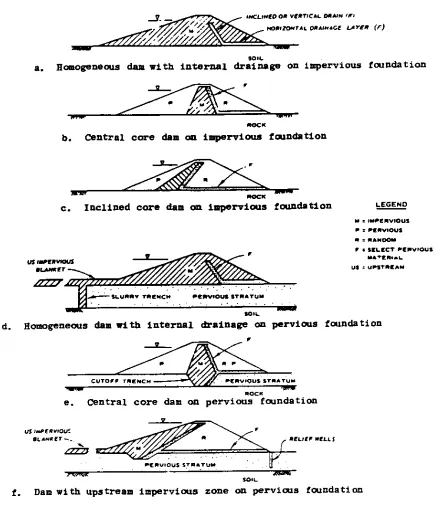
Figure 2-1. Types of earth dam sections
higher contact pressure between the core and foundation to prevent leakage, greater stability under earthquake loading, and better access for remedial seepage control. An inclined upstream core allows the downstream portion of the embankment to be placed first and the core later and reduces the possibility of hydraulic fracturing.
control is necessary to prevent excessive uplift pressures and piping through the foundation. The methods for control of underseepage in dam foundations are horizontal drains, cutoffs (compacted backfill trenches, slurry walls, and concrete walls), upstream impervious blankets, down-stream seepage berms, toe drains, and relief wells. Rock-fill dams may be economical due to large quantities of rock available from required excavation and/or nearby borrow sources, wet climate and/or short construction season prevail, ability to place rock fill in freezing cli-mates, and ability to conduct foundation grouting with simultaneous placement of rock fill for sloping core and decked dams (Walker 1984). Two generalized sections of rock-fill dams are shown in Figure 2-2. A rock-fill dam with steep slopes requires better foundation conditions than an earth dam, and a concrete dam (or roller-compacted concrete dam) requires better foundation con-ditions than a rock-fill dam. The design and construction of seepage control measures for dams are given in EM 1110-2-1901.
b. Earth dams. An earth dam is composed of
suit-able soils obtained from borrow areas or required exca-vation and compacted in layers by mechanical means. Following preparation of a foundation, earth from borrow areas and from required excavations is transported to the site, dumped, and spread in layers of required depth. The soil layers are then compacted by tamping rollers, sheeps-foot rollers, heavy pneumatic-tired rollers, vibratory rollers, tractors, or earth-hauling equipment. One advan-tage of an earth dam is that it can be adapted to a weak foundation, provided proper consideration is given to thorough foundation exploration, testing, and design.
[image:10.612.45.506.324.683.2]c. Rock-fill dams. A rock-fill dam is one com-posed largely of fragmented rock with an impervious core. The core is separated from the rock shells by a series of transition zones built of properly graded mater-ial. A membrane of concrete, asphalt, or steel plate on the upstream face should be considered in lieu of an impervious earth core only when sufficient impervious
material is not available (such was the case at R. W. Bailey Dam; see Beene and Pritchett 1985). However, such membranes are susceptible to breaching as a result of settlement. The rock-fill zones are compacted in layers 12 to 24 in. thick by heavy rubber-tired or steel-wheel vibratory rollers. It is often desirable to determine the best methods of construction and compaction on the basis of test quarry and test fill results. Dumping rock fill and sluicing with water, or dumping in water, is generally acceptable only in constructing cofferdams that are not to be incorporated in the dam embankment. Free-draining, well-compacted rock fill can be placed with steep slopes if the dam is on a rock foundation. If it is necessary to place rock-fill on an earth or weathered rock foundation, the slopes must, of course, be much flatter, and transition zones are required between the foundation and the rock fill. Materials for rock-fill dams range from sound free-draining rock to the more friable materials such as sand-stones and silt-shales that break down under handling and compacting to form an impervious to semipervious mass. The latter materials, because they are not completely free-draining and lack the shear strength of sound rock fill, are often termed “random rock” and can be used successfully for dam construction, but, because of stability and seepage considerations, the embankment design using such mater-ials is similar to that for earth dams.
2-4. Basic Requirements
a. Criteria. The following criteria must be met to
ensure satisfactory earth and rock-fill structures:
(1) The embankment, foundation, and abutments must be stable under all conditions of construction and reservoir operation including seismic.
(2) Seepage through the embankment, foundation, and abutments must be collected and controlled to prevent excessive uplift pressures, piping, sloughing, removal of material by solution, or erosion of material by loss into cracks, joints, and cavities. In addition, the purpose of the project may impose a limitation on the allowable quantity of seepage. The design should consider seepage control measures such as foundation cutoffs, adequate and nonbrittle impervious zones, transition zones, drainage blankets, upstream impervious blankets, and relief wells.
(3) Freeboard must be sufficient to prevent over-topping by waves and include an allowance for the nor-mal settlement of the foundation and embankment as well as for seismic effects where applicable.
(4) Spillway and outlet capacity must be sufficient to prevent overtopping of the embankment.
b. Special attention. Special attention should be given to possible development of pore pressures in foundations, particularly in stratified compressible mate-rials, including varved clays. High pore pressures may be induced in the foundation, beyond the toes of the embank-ment where the weight of the dam produces little or no vertical loading. Thus, the strengths of foundation soils outside of the embankment may drop below their original in situ shear strengths. When this type of foundation condition exists, instrumentation should be installed dur-ing construction (see Chapter 10).
2-5. Selection of Embankment Type
a. General. Site conditions that may lead to
selec-tion of an earth or a rock-fill dam rather than a concrete dam (or roller-compacted concrete dam) include a wide stream valley, lack of firm rock abutments, considerable depths of soil overlying bedrock, poor quality bedrock from a structural point of view, availability of sufficient quantities of suitable soils or rock fill, and existence of a good site for a spillway of sufficient capacity.
saddles may provide a spillway location. If the reservoir rim is high and unbroken, a chute or tunnel spillway may be necessary (Bureau of Reclamation 1984).
c. Geology and foundation conditions. The geology
and foundation conditions at the damsite may dictate the type of dam suitable for that site. Competent rock foundations with relatively high shear strength and resis-tance to erosion and percolation offer few restrictions as to the type of dam that can be built at the site. Gravel foundations, if well compacted, are suitable for earth or rock-fill dams. Special precautions must be taken to provide adequate seepage control and/or effective water cutoffs or seals. Also, the liquefaction potential of gravel foundations should be investigated (Sykora et al. 1992). Silt or fine sand foundations can be used for low concrete (or roller-compacted concrete) and earth dams but are not suitable for rock-fill dams. The main problems include settlement, prevention of piping, excessive percolation losses, and protection of the foundation at the downstream embankment toe from erosion. Nondispersive clay foun-dations may be used for earth dams but require flat embankment slopes because of relatively low foundation shear strength. Because of the requirement for flatter slopes and the tendency for large settlements, clay foun-dations are generally not suitable for concrete (or roller-compacted concrete) or rock-fill dams (Golze 1977, Bureau of Reclamation 1984).
d. Materials available. The most economical type of dam will often be one for which materials can be found within a reasonable haul distance from the site, including material which must be excavated for the dam foundation, spillway, outlet works, powerhouses, and other appurtenant structures. Materials which may be available near or on the damsite include soils for embank-ments, rock for embankments and riprap, and concrete aggregate (sand, gravel, and crushed stone). Materials from required excavations may be stockpiled for later use. However, greater savings will result if construction sched-uling allows direct use of required excavations. If suit-able soils for an earth-fill dam can be found in nearby borrow pits, an earth dam may prove to be more econom-ical. The availability of suitable rock may favor a rock-fill dam. The availability of suitable sand and gravel for concrete at a reasonable cost locally or onsite is favorable to use for a concrete (or roller-compacted concrete) dam (Golze 1977, Bureau of Reclamation 1984).
e. Spillway. The size, type, and restrictions on location of the spillway are often controlling factors in the choice of the type of dam. When a large spillway is to
be constructed, it may be desirable to combine the spillway and dam into one structure, indicating a concrete overflow dam. In some cases where required excavation from the spillway channel can be utilized in the dam embankment, an earth or rock-fill dam may be advanta-geous (Golze 1977, Bureau of Reclamation 1984).
f. Environmental. Recently environmental
consid-erations have become very important in the design of dams and can have a major influence on the type of dam selected. The principal influence of environmental con-cerns on selection of a specific type of dam is the need to consider protection of the environment, which can affect the type of dam, its dimensions, and location of the spill-way and appurtenant facilities (Golze 1977).
g. Economic. The final selection of the type of dam should be made only after careful analysis and com-parison of possible alternatives, and after thorough eco-nomic analyses that include costs of spillway, power and control structures, and foundation treatment.
2-6. Environmental Conditions
This policy applies to all elements of design and construc-tion. Actions to be taken in some of the more important areas are:
a. Overflow from slurry trench construction should not be permitted to enter streams in substantial quantities. Settling ponds or offsite disposal should be provided.
b. Borrow areas must be located, operated, and drained to minimize erosion and sediment transport into streams.
c. Alterations to the landscape caused by clearing operations, borrow area operations, structure excavations, and spoil areas must be controlled and treated by final grading, dressing, turfing, and other remedial treatments as to minimize and eliminate adverse postconstruction environmental effects, as well as to eliminate unsightly areas and promote aesthetic considerations. General state and local requirements on erosion control, dust control, burning, etc. should be followed. Such postconstruction alterations planned for these purposes must be compatible with the requirements of safety and performance of the dam.
of a given damsite. Public Law 91-190, National Environmental Policy Act of 1969, as amended, establishes a national policy promoting efforts which will
Chapter 3
Field Investigations and Laboratory
Testing
3-1. Geological and Subsurface Explorations and Field Tests
a. General requirements.
(1) Geological and subsurface investigations at the sites of structures and at possible borrow areas must be adequate to determine suitability of the foundation and abutments, required foundation treatment, excavation slopes, and availability and characteristics of embankment materials. This information frequently governs selection of a specific site and type of dam. Required foundation treatment may be a major factor in determining project feasibility. These investigations should cover classifica-tion, physical properties, location and extent of soil and rock strata, and variations in piezometric levels in ground-water at different depths.
(2) A knowledge of the regional and local geology is essential in developing a plan of subsurface investiga-tion, interpreting conditions between and beyond boring locations, and revealing possible sources of trouble.
(3) The magnitude of the foundation exploration program is governed principally by the complexity of the foundation problem and the size of the project. Explora-tions of borrow and excavation areas should be under-taken early in the investigational program so that quantities and properties of soils and rock available for embankment construction can be determined before detailed studies of embankment sections are made.
(4) Foundation rock characteristics such as depth of bedding, solution cavities, fissures, orientation of joints, clay seams, gouge zones, and faults which may affect the stability of rock foundations and slopes, particularly in association with seepage, must be investigated to deter-mine the type and scope of treatment required. Further-more, foundations and slopes of clay shales (compaction shales) often undergo loss in strength under reduction of loading or by disintegration upon weathering. Careful investigation of stability aspects of previous excavations and of natural slopes should be made. Foundations of clay shales should be assumed to contain sufficient fis-sures so that the residual shear strength is applicable unless sufficient investigations are made to prove otherwise.
(5) Procedures for surface and subsurface geotechni-cal investigations and geophysigeotechni-cal explorations are given in EM 1110-1-1804 and EM 1110-1-1802, respectively. Soil sampling equipment and procedures are discussed in EM 1110-2-1907 (see also Hvorslev 1948). Foundations believed to have a potential for liquefaction should be thoroughly investigated using in situ testing and dynamic response analysis techniques (see Sykora et al. 1991a, 1991b; Sykora, Koester, and Hynes 1991a, 1991b; Sykora and Wahl 1992; Farrar 1990).
b. Foundations.
(1) The foundation is the valley floor and terraces on which the embankment and appurtenant structures rest. Comprehensive field investigations and/or laboratory testing are required where conditions such as those listed below are found in the foundation:
(a) Deposits that may liquefy under earthquake shock or other stresses.
(b) Weak or sensitive clays.
(c) Dispersive soils.
(d) Varved clays.
(e) Organic soils.
(f) Expansive soils, especially soils containing montmorillonite, vermiculite, and some mixed layer minerals.
(g) Collapsible soils, usually fine-grained soils of low cohesion (silts and some clays) that have low natural densities and are susceptible to volume reductions when loaded and wetted.
(h) Clay shales (compaction shales) that expand and lose strength upon unloading and/or exposure to weather-ing frequently have low in situ shear strengths. Although clay shales are most troublesome, all types of shales may present problems when they contain sheared and slicken-sided zones.
(i) Limestones or calcareous soil deposits contain-ing solution channels.
(j) Gypsiferous rocks or soils.
(l) Clay seams, shear zones, or mylonite seams in rock foundations.
(m) Rock formations in which the rock quality des-ignation (RQD) is low (less than 50 percent).
(2) Subsurface investigation for foundations should develop the following data:
(a) Subsurface profiles showing rock and soil materials and geological formations, including presence of faults, buried channels, and weak layers or zones. The RQD is useful in the assessment of the engineering quali-ties of bedrock (see Deere and Deere 1989).
(b) Characteristics and properties of soils and the weaker types of rock.
(c) Piezometric levels of groundwater in various strata and their variation with time including artisan pres-sures in rock or soil.
(3) Exploratory adits in abutments, test pits, test trenches, large-diameter calyx holes, and large-diameter core boring are often necessary to satisfactorily investigate foundation and abutment conditions and to investigate reasons for core losses or rod droppings. Borehole pho-tography and borehole television may also be useful. Core losses and badly broken cores often indicate zones that control the stability of a foundation or excavation slope and indicate a need for additional exploration.
(4) Estimates of foundation permeability from laboratory tests are often misleading. It is difficult to obtain adequate subsurface data to evaluate permeability of gravelly strata in the foundation. Churn drilling has often proven satisfactory for this purpose. Pumping tests are required in pervious foundations to determine founda-tion permeability where seepage cutoffs are not provided or where deep foundation unwatering is required (see EM 1110-2-1901).
c. Abutments. The abutments of a dam include that
portion of the valley sides to which the ends of the dam join and also those portions beyond the dam which might present seepage or stability problems affecting the dam. Right and left abutments are so designated looking in a downstream direction. Abutment areas require essentially the same investigations as foundation areas. Serious seep-age problems have developed in a number of cases because of inadequate investigations during design.
d. Valley walls close to dam. Underground river channels or porous seepage zones may pass around the
abutments. The valley walls immediately upstream and downstream from the abutment may have steep natural slopes and slide-prone areas that may be a hazard to tunnel approach and outlet channels. Such areas should be investigated sufficiently to determine if corrective measures are required.
e. Spillway and outlet channel locations. These areas require comprehensive investigations of the orienta-tion and quality of rock or firm foundaorienta-tion stratum. Explorations should provide sufficient information on the overburden and rock to permit checking stability of vated slopes and determining the best utilization of exca-vated material within the embankment. Where a spillway is to be located close to the end of a dam, the rock or earth mass between the dam and spillway must be investi-gated carefully.
f. Saddle dams. The extent of foundation
investi-gations required at saddle dams will depend upon the heights of the embankments and the foundation conditions involved. Exploratory borings should be made at all such structures.
g. Reservoir crossings. The extent of foundation investigations required for highway and railway crossing of the reservoir depends on the type of structure, its height, and the foundation conditions. Such embankments may be subjected to considerable wave action and require slope protection. The slope protection will be designed for the significant wave based on a wave hind cast analy-sis as described in Appendix C and the referenced design document. Select the design water level and wind speed based on an analysis of the risk involved in failure of the embankment. For example, an evacuation route needs a higher degree of protection, perhaps equal to the dam face, than an access road to a recreational facility which may be cheaper to replace than to protect.
h. Reservoir investigations. The sides and bottom
them. Areas containing old mines should be studied. In areas where there are known oil fields, existing records should be surveyed and reviewed to determine if plugging old wells or other treatment is required.
i. Borrow areas and excavation areas. Borrow areas and areas of required excavation require investiga-tions to delineate usable materials as to type, gradation, depth, and extent; provide sufficient disturbed samples to determine permeability, compaction characteristics, com-pacted shear strength, volume change characteristics, and natural water contents; and provide undisturbed samples to ascertain the natural densities and estimated yield in each area. The organic content or near-surface borrow soils should be investigated to establish stripping require-ments. It may be necessary to leave a natural impervious blanket over pervious material in upstream borrow areas for underseepage control. Of prime concern in consider-ing possible valley bottom areas upstream of the embank-ment is flooding of these bottom areas. The sequence of construction and flooding must be studied to ensure that sufficient borrow materials will be available from higher elevations or stockpiles to permit completion of the dam. Sufficient borrow must be in a nonflooding area to com-plete the embankment after final closure, or provision must be made to stockpile low-lying material at a higher elevation. The extent of explorations will be determined largely by the degree of uniformity of conditions found. Measurements to determine seasonal fluctuation of the groundwater table and changes in water content should be made. Test pits, dozer trenches, and large-diameter auger holes are particularly valuable in investigating borrow areas and have additional value when left open for inspec-tion by prospective bidders.
j. Test quarries. The purposes of test quarries are to assist in cut slope design, evaluate the controlling geo-logic structure, provide information on blasting techniques and rock fragmentation, including size and shape of rocks, provide representative materials for test fills, give pro-spective bidders a better understanding of the drilling and blasting behavior of the rock, and determine if quarry-run rock is suitable or if grizzled rock-fill is required (see EM 1110-2-2302).
k. Test fills. In the design of earth and rock-fill dams, the construction of test embankments can often be of considerable value, and in some cases is absolutely necessary. Factors involved in the design of earth and rock-fill dams include the most effective type of compac-tion equipment, lift thickness, number of passes, and placement water contents; the maximum particle size allowable; the amount of degradation or segregation
during handling and compaction; and physical properties such as compacted density, permeability, grain-size distri-bution, and shear strength of proposed embankment materials. Often this information is not available from previous experience with similar borrow materials and can be obtained only by a combination of test fills and labora-tory tests. Test fills can provide a rough estimate of permeability through observations of the rate at which water drains from a drill hole or from a test pit in the fill. To measure the field permeability of test fills, use a dou-ble-ring infiltrometer with a sealed inner ring (described in ASTM D 5093-90; see American Society for Testing and Materials 1990). It is important that test fills be per-formed on the same materials that will be used in construction of the embankment. The test fills shall be performed with the same quarry or borrow area materials which will be developed during construction and shall be compacted with various types of equipment to determine the most efficient type and required compaction effort. It is imperative that as much as possible all materials which may be encountered during construction be included in the test fills. Equipment known not to be acceptable should be included in the test fill specifications so as not to leave any “gray areas” for possible disagreements as to what will or will not be acceptable. Plans and specifica-tions for test quarries and test fills of both earth and rock-fill materials are to be submitted to the Headquarters, U.S. Army Corps of Engineers, for approval. Test fills can often be included as part of access road construction but must be completed prior to completion of the embank-ment design. Summarized data from rock test fills for several Corps of Engineers projects are available (Ham-mer and Torrey 1973).
l. Retention of samples. Representative samples from the foundation, abutment, spillway excavation, and borrow areas should be retained and stored under suitable conditions at least until construction has been completed and any claims settled. Samples should be available for examination or testing in connection with unexpected problems or contractor claims.
3-2. Laboratory Testing
Handbook (U.S. Army Corps of Engineers 1990). Since shear strength tests are expensive and time-consuming, testing programs are generally limited to representative foundation and borrow materials. Samples to be tested should be selected only after careful analysis of boring logs, including index property determinations. Mixing of different soil strata for test specimens should be avoided unless it can be shown that mixing of different strata during construction will produce a fill with characteristics identical to those of the laboratory specimens.
b. Procedure. Laboratory test procedures for
deter-mining all of the properties of rock-fill and earth-rock mixtures have not been standardized (see Torrey and Donaghe 1991a, 1991b; Torrey 1992). A few division
laboratories have consolidation and triaxial compression equipment capable of testing 12-in.-diam specimens.
c. Sample. For design purposes, shear strength of
Chapter 4
General Design Considerations
4-1. Freeboard
a. Vertical distance. The term freeboard is applied
to the vertical distance of a dam crest above the maxi-mum reservoir water elevation adopted for the spillway design flood. The freeboard must be sufficient to prevent overtopping of the dam by wind setup, wave action, or earthquake effects. Initial freeboard must allow for subse-quent loss in height due to consolidation of embankment and/or foundation. The crest of the dam will generally include overbuild to allow for postconstruction settle-ments. The top of the core should also be overbuilt to ensure that it does not settle below its intended elevation. Net freeboard requirements (exclusive of earthquake con-siderations) can be determined using the procedures described in Saville, McClendon, and Cochran (1962).
b. Elevation. In seismic zones 2, 3, and 4, as
delin-eated in Figures A-1 through A-4 of ER 1110-2-1806, the elevation of the top of the dam should be the maximum determined by either maximum water surface plus con-ventional freeboard or flood control pool plus 3 percent of the height of the dam above streambed. This requirement applies regardless of the type of spillway.
4-2. Top Width
The top width of an earth or rock-fill dam within conven-tional limits has little effect on stability and is governed by whatever functional purpose the top of the dam must serve. Depending upon the height of the dam, the mini-mum top width should be between 25 and 40 ft. Where the top of the dam is to carry a public highway, road and shoulder widths should conform to highway requirements in the locality with consideration given to requirements for future needs. The embankment zoning near the top is sometimes simplified to reduce the number of zones, each of which requires a minimum width to accommodate hauling and compaction equipment.
4-3. Alignment
Axes of embankments that are long with respect to their heights may be straight or of the most economical align-ment fitting the topography and foundation conditions. Sharp changes in alignment should be avoided because downstream deformation at these locations would tend to produce tension zones which could cause concentration of seepage and possibly cracking and internal erosion. The
axes of high dams in narrow, steep-sided valleys should be curved upstream so that downstream deflection under water loads will tend to compress the impervious zones longitudinally, providing additional protection against the formation of transverse cracks in the impervious zones. The radius of curvature forming the upstream arching of the dam in narrow valleys generally ranges from 1,000 to 3,000 ft.
4-4. Embankment
Embankment sections adjacent to abutments may be flared to increase stability of sections founded on weak soils. Also, by flaring the core, a longer seepage path is devel-oped beneath and around the embankment.
4-5. Abutments
a. Alignments. Alignments should be avoided that
tie into narrow ridges formed by hairpin bends in the river or that tie into abutments that diverge in the downstream direction. Grouting may be required to decrease seepage through the abutment (see paragraph 3-1c). Zones of structurally weak materials in abutments, such as weath-ered overburden and talus deposits, are not uncommon. It may be more economical to flatten embankment slopes to attain the desired stability than to excavate weak materials to a firm foundation. The horizontal permeability of undisturbed strata in the abutment may be much greater than the permeability of the compacted fill in the embank-ment; therefore, it may be possible to derive considerable benefit in seepage control from the blanketing effects of flared upstream embankment slopes. The design of a transition from the normal embankment slopes to flattened slopes is influenced by stability of sections founded on the weaker foundation materials, drainage provisions on the slopes and within the embankment, and the desirabil-ity of making a gradual transition without abrupt changes of section. Adequate surface drainage to avoid erosion should be provided at the juncture between the dam slope and the abutment.
abutments should be delayed until significant embankment and foundation settlement have occurred.
c. Settlement. Because large differential settlement near abutments may result in transverse cracking within the embankment, it may be desirable to use higher place-ment water contents (see paragraph 7-8a) combined with flared sections.
4-6. Earthquake Effects
The embankment and critical appurtenant structures should be evaluated for seismic stability. The method of analysis is a function of the seismic zone as outlined in ER 1110-2-1806. Damsites over active faults should be avoided if at all possible. For projects located near or over faults in earthquake areas, special geological and seismological studies should be performed. Defensive design features for the embankment and structures as outlined in ER 1110-2-1806 should be used, regardless of the type of analyses performed. For projects in locations of strong seismicity, it is desirable to locate the spillway and outlet works on rock rather than in the embankment or foundation overburden.
4-7. Coordination Between Design and Construction
a. Introduction. Close coordination between design
and construction personnel is necessary to thoroughly orient the construction personnel as to the project design intent, ensure that new field information acquired during construction is assimilated into the design, and ensure that the project is constructed according to the intent of the design. This is accomplished through the report on engi-neering considerations and instructions to field personnel, preconstruction orientation for the construction engineers by the designers, and required visits to the site by the designers.
b. Report on engineering considerations and instructions to field personnel. To ensure that the field personnel are aware of the design assumptions regarding field conditions, design personnel (geologists, geotechnical engineers, structural engineers, etc.) will prepare a report entitled, “Engineering Considerations and Instructions for Field Personnel.” This report should explain the concepts, assumptions, and special details of the embankment design as well as detailed explanations of critical sections of the contract documents. Instruction for the field inspection force should include the necessary guidance to provide adequate Government Quality Assurance Testing. This report should be augmented by appropriate briefings,
instructional sessions, and laboratory testing sessions (ER 1110-2-1150).
c. Preconstruction orientation. Preconstruction orientation for the construction engineers by the designers is necessary for the construction engineers to be aware of the design philosophies and assumptions regarding site conditions and function of project structures, and under-stand the design engineers’ intent concerning technical provisions in the P&S.
d. Construction milestones which require visit by designers. Visits to the site by design personnel are required to ensure the following (ER 1110-2-112, ER 1110-2-1150):
(1) Site conditions throughout the construction period are in conformance with design assumptions and principles as well as contract P&S.
(2) Project personnel are given assistance in adapt-ing project designs to actual site conditions as they are revealed during construction.
(3) Any engineering problems not fully assessed in the original design are observed, evaluated, and appropri-ate action taken.
e. Specific visits. Specifically, site visits are required when the following occur (ER 1110-2-112):
(1) Excavation of cutoff trenches, foundations, and abutments for dams and appurtenant structures.
(2) Excavation of tunnels.
(3) Excavation of borrow areas and placement of embankment dam materials early in the construction period.
(4) Observation of field conditions that are signifi-cantly different from those assumed during design.
4-8. Value Engineering Proposals
not adversely affect the long-term performance or condi-tion of the dam.
4-9. Partnering Between the Owner and Contractor
Partnering is the creation of an owner-contractor relation-ship that promotes achievement of mutually beneficial goals. By taking steps before construction begins to change the adversarial mindset, to recognize common interests, and to establish an atmosphere of trust and candor in communications, partnering helps to develop a cooperative management team. Partnering is not a con-tractual agreement and does not create any legally enforceable rights or duties. There are three basic steps involved in establishing the partnering relationship:
a. Establish a new relationship through personal contact.
b. Craft a joint statement of goals and establish common objectives in specific detail for reaching the goals.
c. Identify specific disputes and prevention pro-cesses designed to head off problems, evaluate perfor-mance, and promote cooperation.
Chapter 5
Foundation and Abutment Preparation
5-1. Preparation
a. Earth foundations.
(1) The design of dams on earth foundations is based on the in situ shear strength of the foundation soils. For weak foundations, use of stage construction, founda-tion strengthening, or excavafounda-tion of undesirable material may be more economical than using flat slopes or stability berms.
(2) Foundation preparation usually consists of clearing, grubbing to remove stumps and large roots in approximately the top 3 ft, and stripping to remove sod, topsoil, boulders, organic materials, rubbish fills, and other undesirable materials. It is not generally necessary to remove organic-stained soils. Highly compressible soils occurring in a thin surface layer or in isolated pockets should be removed.
(3) After stripping, the foundation surface will be in a loose condition and should be compacted. However, if a silty or clayey foundation soil has a high water con-tent and high degree of saturation, attempts to compact the surface with heavy sheepsfoot or rubber-tired rollers will only remold the soil and disturb it, and only light-weight compaction equipment should be used. Where possible without disturbing the foundation soils, traffic over the foundation surface by the heaviest rollers or other construction equipment available is desirable to reveal compressible material that may have been over-looked in the stripping, such as pockets of soft material buried beneath a shallow cover. Stump holes should be filled and compacted by power-driven hand tampers.
(4) For dams on impervious earth foundations not requiring a cutoff, an inspection trench having a minimum depth of 6 ft should be made. This will permit inspection for abandoned pipes, soft pockets, tile fields, pervious zones, or other undesirable features not discovered by earlier exploration.
(5) Differential settlement of an embankment may lead to tension zones along the upper portion of the dam and to possible cracking along the longitudinal axis in the vicinity of steep abutment slopes at tie-ins or closure sections, or where thick deposits of unsuitable foundation soils have been removed (since in the latter case, the compacted fill may have different compressibility
characteristics than adjacent foundation soils). Differen-tial settlements along the dam axis may result in trans-verse cracks in the embankment which can lead to unde-sirable seepage conditions. To minimize this possibility, steep abutment slopes and foundation excavation slopes should be flattened, if feasible, particularly beneath the impervious zone of the embankment. This may be eco-nomically possible with earth abutments only. The por-tion of the abutment surface beneath the impervious zone should not slope steeply upstream or downstream, as such a surface might provide a plane of weakness.
(6) The treatment of an earth foundation under a rock-fill dam should be substantially the same as that for an earth dam. The surface layer of the foundation beneath the downstream rock-fill section must meet filter gradation criteria, or a filter layer must be provided, so that seepage from the foundation does not carry founda-tion material into the rock fill.
b. Rock foundations.
(1) Rock foundations should be cleaned of all loose fragments, including semidetached surface blocks of rock spanning relatively open crevices. Projecting knobs of rock should be removed to facilitate operation of compac-tion equipment and to avoid differential settlement. Cracks, joints, and openings beneath the core and possibly elsewhere (see below) should be filled with mortar or lean concrete according to the width of opening. The treat-ment of rock defects should not result in layers of grout or gunite that cover surface areas of sound rock, since they might crack under fill placement and compaction operations.
(2) The excavation of shallow exploration or core trenches by blasting may damage the rock. Where this may occur, exploration trenches are not recommended, unless they can be excavated without blasting. Where core trenches disclose cavities, large cracks, and joints, the core trench should be backfilled with concrete to prevent possible erosion of core materials by water seep-ing through joints or other openseep-ings in the rock.
(3) Shale foundations should not be permitted to dry out before placing embankment fill, nor should they be permitted to swell prior to fill placement. Consequently, it is desirable to defer removal of the last few feet of shale until just before embankment fill placement begins.
can be done in the core zone by extending the zone into sound rock and by treating the rock as discussed above. Where movement of shell materials into openings in the rock foundation is possible, joints and other openings should be filled, as discussed, beneath both upstream and downstream shells. An alternative is to provide filter layers between the foundation and the shells of the dam. Such treatment will generally not be necessary beneath shells of rock-fill dams.
(5) Limestone rock foundation may contain solu-tion cavities and require detailed investigasolu-tions, special observations when making borings (see EM 1110-1-1804), and careful study of aerial photographs, combined with surface reconnaissance to establish if surface sinks are present. However, the absence of surface sinks cannot be accepted as proof that a foundation does not contain solu-tion features. The need for removing soil or decomposed rock overlying jointed rock, beneath both upstream and downstream shells, to expose the joints for treatment, should receive detailed study. If joints are not exposed for treatment and are wide, material filling them may be washed from the joints when the reservoir pool rises, or the joint-filling material may consolidate. In either case, embankment fill may be carried into the joint, which may result in excessive reservoir seepage or possible piping. This consideration applies to both earth and rock-fill dams.
(6) Where faults or wide joints occur in the embankment foundation, they should be dug out, cleaned and backfilled with lean concrete, or otherwise treated as previously discussed, to depths of at least three times their widths. This will provide a structural bridge over the fault or joint-filling materials and will prevent the embankment fill from being lost into the joint or fault. In addition, the space beneath the concrete plug should be grouted at various depths by grout holes drilled at an angle to intersect the space. This type of treatment is obviously required beneath cores of earth and rock-fill dams and also beneath rock-fill shells.
c. Abutment treatment. The principal hazards that exist on rock abutments are due to irregularities in the cleaned surfaces and to cracks or fissures in the rock. Cleaned areas of the abutments should include all surfaces beneath the dam with particular attention given to areas in contact with the core and filters. It is good practice to require both a preliminary and final cleanup of these areas. The purpose of the preliminary cleanup is to facili-tate inspection to identify areas that require additional preparation and treatment. Within these areas, all irregu-larities should be removed or trimmed back to form a
reasonably uniform slope on the entire abutment. Over-hangs must be eliminated by use of concrete backfill beneath the overhang or by barring and wedging to remove the overhanging rock. Concrete backfill may have to be placed by shotcrete, gunite, or similar methods to fill corners beneath overhangs. Vertical rock surfaces beneath the embankment should be avoided or, if per-mitted, should not be higher than 5 ft, and benches between vertical surfaces should be of such width as to provide a stepped slope comparable to the uniform slope on adjacent areas. Relatively flat abutments are desirable to avoid possible tension zones and resultant cracking in the embankment, but this may not be economically possi-ble where abutment slopes are steep. In some cases, however, it may be economically possible to flatten near vertical rock abutments so they have a slope of 2 vertical on 1 horizontal or 1 vertical on 1 horizontal, thereby minimizing the possibility of cracking. Flattening of the abutment slope may reduce the effects of rebound crack-ing (i.e., stress relief crackcrack-ing) that may have accompa-nied the development of steep valley walls. The cost of abutment flattening may be offset by reductions in abut-ment grouting. The cost of foundation and abutment treatment may be large and should be considered when selecting damsites and type of dam.
5-2. Strengthening the Foundation
a. Weak rock. A weak rock foundation requires individual investigation and study, and dams on such foundations usually require flatter slopes. The possibility of artisan pressures developing in stratified rock may require installation of pressure relief wells.
b. Liquefiable soil. Methods for improvement of liquefiable soil foundation conditions include blasting, vibratory probe, vibro-compaction, compaction piles, heavy tamping (dynamic compaction), compaction (dis-placement) grouting, surcharge/buttress, drains, particulate grouting, chemical grouting, pressure-injected lime, elec-trokinetic injection, jet grouting, mix-in-place piles and walls, insitu vitrification, and vibro-replacement stone and sand columns (Ledbetter 1985, Hausmann 1990, Moseley 1993).
c. Foundations. Foundations of compressible
movements occurred during embankment construction (Fetzer 1967).
5-3. Dewatering the Working Area
a. Trenches. Where cutoff or drainage trenches extend below the water table, a complete dewatering is necessary to prepare properly the foundation and to com-pact the first lifts of embankment fill. This may also be necessary where materials sensitive to placement water content are placed on embankment foundations having a groundwater level close to the surface. This may occur, for example, in closure sections.
b. Excavation slopes. The contractor should be allowed a choice of excavation slopes and methods of
Chapter 6
Seepage Control
6-1. General
All earth and rock-fill dams are subject to seepage through the embankment, foundation, and abutments. Seepage control is necessary to prevent excessive uplift pressures, instability of the downstream slope, piping through the embankment and/or foundation, and erosion of material by migration into open joints in the foundation and abutments. The purpose of the project, i.e., long-term storage, flood control, etc., may impose limitations on the allowable quantity of seepage. Detailed information concerning seepage analysis and control for dams is given in EM 1110-2-1901.
6-2. Embankment
a. Methods for seepage control. The three methods
for seepage control in embankments are flat slopes with-out drains, embankment zonation, and vertical (or inclined) and horizontal drains.
(1) Flat slopes without drains. For some dams constructed with impervious soils having flat embankment slopes and infrequent, short duration, high reservoir lev-els, the phreatic surface may be contained well within the downstream slope and escape gradients may be suffi-ciently low to prevent piping failure. For these dams, when it can be ensured that variability in the characteris-tics of borrow materials will not result in adverse stratifi-cation in the embankment, no vertical or horizontal drains are required to control seepage through the embankment. Examples of dams constructed with flat slopes without vertical or horizontal drains are Aquilla Dam, Aubrey Dam (now called Ray Roberts Dam), and Lakeview Dam. A horizontal drainage blanket under the downstream embankment may still be required for control of underseepage.
(2) Embankment zonation. Embankments are zoned to use as much material as possible from required excavation and from borrow areas with the shortest haul distances, the least waste, the minimum essential process-ing and stockpilprocess-ing, and at the same time maintain stability and control seepage. For most effective control of through seepage and seepage during reservoir draw-down, the permeability should progressively increase from the core out toward each slope.
(3) Vertical (or inclined) and horizontal drains. Because of the often variable characteristics of borrow materials, vertical (or inclined) and horizontal drains within the downstream portion of the embankment are provided to ensure satisfactory seepage control. Also, the vertical (or inclined) drain provides the primary line of defense to control concentrated leaks through the core of an earth dam (see EM 1110-2-1901).
b. Collector pipes. Collector pipes should not be placed within the embankment, except at the downstream toe, because of the danger of either breakage or separation of joints, resulting from fill placement and compacting operations or settlement, which might result in either clogging or piping. However, a collector pipe at the downstream toe can be placed within a small berm located at the toe, since this facilitates maintenance and repair.
6-3. Earth Foundations
a. Introduction. All dams on earth foundations are
subject to underseepage. Seepage control is necessary to prevent excessive uplift pressures and piping through the foundation. Generally, siltation of the reservoir with time will tend to diminish underseepage. Conversely, the use of some underseepage control methods, such as relief wells and toe drains, may increase the quantity of under-seepage. The methods of control of underseepage in dam foundations are horizontal drains, cutoffs (compacted backfill trenches, slurry walls, and concrete walls), upstream impervious blankets, downstream seepage berms, relief wells, and trench drains. To select an under-seepage control method for a particular dam and founda-tion, the relative merits and efficiency of different methods should be evaluated by means of flow nets or approximate methods (as described Chapter 4 and Appen-dix B, respectively, of EM 1110-2-1901). The changes in the quantity of underseepage, factor of safety against uplift, and uplift pressures at various locations should be determined for each particular dam and foundation vary-ing the anisotropy ratio of the permeability of the foundation to cover the possible range of expected field conditions (see Table 9-1 of EM 1110-2-1901).
horizontal drain increases the quantity of seepage under the dam (see Figure 9-1 of EM 1110-2-1901).
c. Cutoffs.
(1) Complete versus partial cutoff. When the dam foundation consists of a relatively thick deposit of pervi-ous alluvium, the designer must decide whether to make a complete cutoff or allow a certain amount of underseep-age to occur under controlled conditions. It is necessary for a cutoff to penetrate a homogeneous isotropic founda-tion at least 95 percent of the full depth before there is any appreciable reduction in seepage beneath a dam. The effectiveness of the partial cutoff in reducing the quantity of seepage decreases as the ratio of the width of the dam to the depth of penetration of the cutoff increases. Partial cutoffs are effective only when they extend down into an intermediate stratum of lower permeability. This stratum must be continuous across the valley foundation to ensure that three-dimensional seepage around a discontinuous stratum does not negate the effectiveness of the partial cutoff.
(2) Compacted backfill trench. The most positive method for control of underseepage consists of excavating a trench beneath the impervious zone of the embankment through pervious foundation strata and backfilling it with compacted impervious material. The compacted backfill trench is the only method for control of underseepage which provides a full-scale exploration trench that allows the designer to see the actual natural conditions and to adjust the design accordingly, permits treatment of exposed bedrock as necessary, provides access for instal-lation of filters to control seepage and prevent piping of soil at interfaces, and allows high quality backfilling operations to be carried out. When constructing a com-plete cutoff, the trench must fully penetrate the pervious foundation and be carried a short distance into unweath-ered and relatively impermeable foundation soil or rock. To ensure an adequate seepage cutoff, the width of the base of the cutoff should be at least one-fourth the maxi-mum difference between the reservoir and tailwater eleva-tions but not less than 20 ft, and should be wider if the foundation material under the cutoff is considered margi-nal in respect to imperviousness. If the gradation of the impervious backfill is such that the pervious foundation material does not provide protection against piping, an intervening filter layer between the impervious backfill and the foundation material is required on the downstream side of the cutoff trench. The cutoff trench excavation must be kept dry to permit proper placement and compac-tion of the impervious backfill. Dewatering systems of wellpoints or deep wells are generally required during
excavation and backfill operations when below ground-water levels (TM 5-818-5). Because construction of an open cutoff trench with dewatering is a costly procedure, the trend has been toward use of the slurry trench cutoff.
(3) Slurry trench. When the cost of dewatering and/or the depth of the pervious foundation render the compacted backfill trench too costly and/or impractical, the slurry trench cutoff may be a viable method for con-trol of underseepage. Using this method, a trench is excavated through the pervious foundation using a sodium bentonite clay (or Attapulgite clay in saline water) and water slurry to support the sides. The slurry-filled trench is backfilled by displacing the slurry with a backfill material that contains enough fines (material passing the No. 200 sieve) to make the cutoff relatively impervious but sufficient coarse particles to minimize settlement of the trench forming the soil-bentonite cutoff. Alterna-tively, a cement may be introduced into the slurry-filled trench which is left to set or harden forming a cement-bentonite cutoff. The slurry trench cutoff is not recom-mended when boulders, talus blocks on buried slopes, or open jointed rock exist in the foundation due to difficul-ties in excavating through the rock and slurry loss through the open joints. When a slurry trench is relied upon for seepage control, the initial filling of the reservoir must be controlled and piezometers located both upstream and downstream of the cutoff must be read to determine if the slurry trench is performing as planned. If the cutoff is ineffective, remedial seepage control measures must be installed prior to further raising of the reservoir pool. Normally, the slurry trench should be located under or near the upstream toe of the dam. An upstream location provides access for future treatment provided the reservoir could be drawn down and facilitates stage construction by permitting placement of a downstream shell followed by an upstream core tied into the slurry trench. For stability analysis, a soil-bentonite slurry trench cutoff should be considered to have zero shear strength and exert only a hydrostatic force to resist failure of the embankment. The design and construction of slurry trench cutoffs is covered in Chapter 9 of EM 1110-2-1901. Guide specification CW-03365 is available for soil-bentonite slurry trench cutoffs.
and the element wall, have been used. Since the wall in its simpler structural form is a rigid diaphragm, earthquakes could cause its rupture; therefore, concrete cutoff walls should not be used at a site where strong earthquake shocks are likely. The design and construction of concrete cutoff walls is covered in Chapter 9 of EM 1110-2-1901. Guide specification CW-03365 is available for the concrete used in concrete cutoff walls.
d. Upstream impervious blanket.1
When a complete cutoff is not required or is too costly, an upstream imper-vious blanket tied into the imperimper-vious core of the dam may be used to minimize underseepage. An example is shown in Figure 2-1f. Upstream impervious blankets should not be used when the reservoir head exceeds 200 ft because the hydraulic gradient acting across the blanket may result in piping and serious leakage. Down-stream underseepage control measures (relief wells or toe trench drains) are generally required for use with upstream blankets to control underseepage and/or prevent excessive uplift pressures and piping through the founda-tion. Upstream impervious blankets are used in some cases to reinforce thin spots in natural blankets. Effec-tiveness of upstream impervious blankets depends upon their length, thickness, and vertical permeability, and on the stratification and permeability of soils on which they are placed. The design and construction of upstream blankets is given in EM 1110-2-1901.
e. Downstream seepage berm. When a complete cutoff is not required or is too costly, and it is not feasi-ble to construct an upstream impervious blanket, a down-stream seepage berm may be used to reduce uplift pressures in the pervious foundation underlying an imper-vious top stratum at the downstream toe of the dam. Other downstream underseepage control measures (relief wells or toe trench drains) are generally required for use with downstream seepage berms. Downstream seepage berms can be used to control underseepage efficiently where the downstream top stratum is relatively thin and uniform or where no top stratum is present, but they are not efficient where the top stratum is relatively thick and high uplift pressures develop. Downstream seepage berms may vary in type from impervious to completely free draining. The selection of the type of downstream seepage berm to use is based upon the availability of borrow materials and relative cost of each type. The
_____________________________
1
The blanket may be impervious or semipervious (leaks in the vertical direction).
design and construction of downstream seepage berms is given in EM 1110-2-1901.
f. Relief wells. When a complete cutoff is not required or is too costly, relief wells installed along the downstream toe of the dam may be used to prevent exces-sive uplift pressures and piping through the foundation. Relief wells increase the quantity of underseepage from 20 to 40 percent, depending upon the foundation condi-tions. Relief wells may be used in combination with other underseepage control measures (upstream impervi-ous blanket or downstream seepage berm) to prevent excessive uplift pressures and piping through the founda-tion. Relief wells are applicable where the pervious foun-dation has a natural impervious cover. The well screen section, surrounded by a filter if necessary, should pene-trate into the principal pervious stratum to obtain pressure relief, especially where the foundation is stratified. The wells, including screen and riser pipe, should have a diameter which will permit the maximum design flow without excessive head losses but in no instance should the inside diameter be less than 6 in. Geotextiles should not be used in conjunction with relief wells. Relief wells should be located so that their tops are accessible for cleaning, sounding for sand, and pumping to determine discharge capacity. Relief wells should discharge into open ditches or into collector systems outside of the dam base which are independent of toe drains or surface drain-age systems. Experience with relief wells indicates that with the passage of time the discharge of the wells will gradually decrease due to clogging of the well screen and/or reservoir siltation. Therefore, the amount of well screen area should be designed oversized and a piezome-ter system installed between the wells to measure the seepage pressure, and if necessary additional relief wells should be installed. The design, construction, and rehabil-itation of relief wells is given in EM 1110-2-1914.