USFD’s Phrase-level Quality Estimation Systems
Varvara Logacheva, Fr´ed´eric Blain and Lucia Specia
Department of Computer Science University of Sheffield, UK
{v.logacheva, f.blain, l.specia}@sheffield.ac.uk
Abstract
We describe the submissions of the Uni-versity of Sheffield (USFD) for the phrase-level Quality Estimation (QE) shared task of WMT16. We test two different ap-proaches for phrase-level QE: (i) we en-rich the provided set of baseline features with information about the context of the phrases, and (ii) we exploit predictions at other granularity levels (word and sen-tence). These approaches perform closely in terms of multiplication of F1-scores (primary evaluation metric), but are con-siderably different in terms of the F1 -scores for individual classes.
1 Introduction
Quality Estimation (QE) of Machine Translation (MT) is the task of determining the quality of an automatically translated text without compar-ing it to a reference translation. This task has received more attention recently because of the widespread use of MT systems and the need to evaluate their performance on the fly. The prob-lem has been modelled to estimate the quality of translations at the word, sentence and document levels (Bojar et al., 2015). Word-level QE can be particularly useful for post-editing of machine-translated texts: if we know the erroneous words in a sentence, we can highlight them to attract post-editor’s attention, which should improve both pro-ductivity and final translation quality. However, the choice of words in an automatically translated sentence is motivated by the context, so MT er-rors are also context-dependent. Moreover, as it has been shown in (Blain et al., 2011), errors in multiple adjacent words can be caused by a sin-gle incorrect decision — e.g. an incorrect lexical choice can result in errors in all its syntactic
de-pendants. The task of estimating quality at the phrase level aims to address these limitations of word-level models for improved prediction perfor-mance.
The first effort to estimate the quality of trans-lated n-grams (instead of individual words) was described in (Gandrabur and Foster, 2003), but there the multi-word nature of predictions was motivated by the architecture of the MT system used in the experiment: an interactive MT system which did not translate entire sentences, but rather predicted the next n word translations in a sen-tence. An approach was designed to estimate the confidence of the MT system about the prediction and was aimed at improving translation prediction quality.
The phrase-level QE in its current formulation – estimation of the quality of phrases in a pre-translated sentence using external features of these phrases – was first addressed in the work of Lo-gacheva and Specia (2015), where the authors segmented automatically translated sentences into phrases, labelled these phrases based on word-level labels and trained several phrase-word-level QE models using different feature sets and machine learning algorithms. The baseline phrase-level QE system used in this shared task was based on the results in (Logacheva and Specia, 2015).
This year’s Conference on Statistical Machine Translation (WMT16) includes a shared task on phrase-level QE (QE Task 2p) for the first time. This task uses the same training and test data as the one used for the word-level QE task (QE Task 2): the set of English sentences, their automatic trans-lations into German and their manual post-editions performed by professional translators. The data belongs to the IT domain. The training set con-tains 12,000 sentences, development and test sets — 1,000 and 2,000 sentences, respectively. For model training and evaluation, the words are
belled as “BAD” or “OK” based on labelling gen-erated with the TERcom tool1: if an edit oper-ation (substitution or insertion) was applied to a word, it is labelled as “BAD”; contrarily, if the word was left unchanged, it is considered “OK”. For the phrase-level task, the data was segmented also into phrases. The segmentation was given by the decoder that produced the automatic transla-tions. The segments are labelled at the phrase level using the word-level labels: a phrase is labelled as “OK” if it contains only words labelled as “OK”; if one or more words in a phrase are “BAD”’, the phrase is “BAD” itself. The predictions are done at the phrase level, but evaluated at the word level: for the evaluation phrase-level labels are unrolled back to their word-level versions (i.e. if a three-word phrase is labelled as “BAD”, it is equivalent to three “BAD” word-level labels).
The baseline phrase-level features provided by the organisers of the task are black-box features that were originally used for sentence-level quality estimation and extracted using the QuEst toolkit2 (Specia et al., 2015). While this feature set consid-ers many aspects of sentence quality (mostly the ones that do not depend on internal MT system information and do not require language-specific resources), it has an important limitation when ap-plied to phrases. Namely, it does not take into account the context of the phrase, i.e. words and phrases in the sentence, either before or after the phrase of interest. In order to advance upon the baseline results, we enhanced the baseline feature set with contextual information for phrases.
Another approach we experimented with is the use of predictions made by QE models at other levels of granularity: word level and sentence level. The motivation here is twofold. On the one hand, we use a wider range of features which are unavailable at the phrase level. On the other hand, the use of word-level and sentence-level predic-tions can help mitigate the uncertainty of phrase-level scores: there, a phrase is labelled as “BAD” if it has any number of “BAD” words, so “BAD” phrases can be of very different quality. We be-lieve that information on the quality of individual words and the overall quality of a sentence can be complementary for phrase-level quality predic-tion.
The rest of the paper is organised as follows. We
1http://www.cs.umd.edu/˜snover/tercom/
2http://www.quest.dcs.shef.ac.uk/
quest_files/features_blackbox
describe our context-based QE strategy in Section 2. In Section 3 we explain our approach to build phrase-level QE models using predictions of other levels. Section 4 reports the final results, while Section 5 outlines directions for future work.
2 Context-based model
The feature set used for the baseline system in the shared task considers various aspects of a phrase. It has features that allow to evaluate the likelihood of its source and target parts individually (e.g. probabilities of its source and target phrases as given by monolingual language models), and also the correspondences between the parts (e.g. the ratio of numbers of punctuation marks and words of particular parts of speech in the source and tar-get sides of the phrase). However, this feature set does not take into account the words surrounding an individual phrase. This is explained by the fact that the feature set was originally designed for QE systems which evaluate the quality of automatic translations at the sentence level. Sentences in an automatically translated text are generally pro-duced independently from each other, given that most MT systems cannot take extra-sentential con-text into account. Therefore, concon-text features are rarely used for sentence-level QE.
2.1 Features
In order to improve the representation of phrases, we use a number of additional features (CON-TEXT) that depend on phrases to the left and right of the phrase of interest, as well as the phrase it-self. The intuition behind these features is that they evaluate how well a phrase fits its context. Here we list the new features and the values they can take:
• out-of-vocabulary words (binary) — we
check if the source phrase has words which do not occur in a source corpus. The feature has value1if at least one of source words is out-of-vocabulary and0otherwise;
• source/target left context (string) — last word of the previous source/target phrase;
• source/target right context (string)— first word of the next source/target phrase;
previous phrase and generate the combina-tion of the first target word in the phrase and 1 to 4 words that precede it in the sen-tence. Let us denote the first word from the phrase wf irst and the 4-grams from the
previous phrase p−4p−3p−2p−1. If the
en-tire 5-gram p−4p−3p−2p−1wf irst exists in
the target LM, the feature value is 5. If it is not in the LM, n-grams of lower order (from p−3p−2p−1wf irst to unigram wf irst)
are checked, and the feature value is the or-der of the longest n-gram found in the LM;
• highest order of n-gram that includes the last target word (0 to 5) — feature that considers the n-gramwlastp1p2p3p4 (where wlast is the last target word of the current
phrase and p1p2p3p4 is the opening 4-gram of the next feature) analogously to the previ-ous feature;
• backoff behaviour of first/last n-gram (0 to 1) — backoff behaviour of n-grams
p−2p−1wf irst and wlastp1p2, computed as described in (Raybaud et al., 2011).
• named entities in the source/target (bi-nary) — we check if the source and target phrases have tokens which start with capital letters;
• part of speech of the source/target left/right context (string)— we check parts of speech of words that precede or follow the phrase in the sentence.
Some of these features (e.g. highest n-gram or-der, backoff behaviour, contexts) are used because they have been shown useful for word-level QE (Luong et al., 2013), others are included because we believe they can be relevant for understanding the quality of phrases.
We compare the performance of the baseline feature set with the feature set extended with con-text information. The QE models are trained using CRFSuite toolkit (Okazaki, 2007). We chose to train a Conditional Random Fields (CRF) model because it has shown high performance in word-level QE (Luong et al., 2013) as well as phrase-level QE (Logacheva and Specia, 2015) tasks. CRFSuite provides five optimisation algorithms: L-BFGS with L1/L2 regularization (lbfgs), SGD with L2-regularization (l2sgd), Averaged Percep-tron (ap), Passive Aggressive (pa), and Adaptive
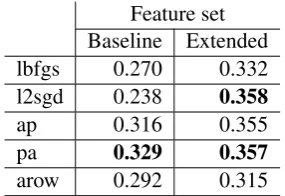
Feature set Baseline Extended lbfgs 0.270 0.332 l2sgd 0.238 0.358
ap 0.316 0.355
pa 0.329 0.357
[image:3.595.345.488.62.160.2]arow 0.292 0.315
Table 1:F1-multiplied scores of models trained on baseline and extended feature sets using different optimisation algorithms for CRFSuite.
Regularization of Weights (arow). Since these al-gorithms could perform differently in our task, we tested all of them on both baseline and extended feature sets, using the development set.
Table 1 shows the performance of our CRF models trained with different algorithms. We can see that the extended feature set clearly outper-forms the baseline for all algorithms. Passive-Aggressive scored higher for the baseline feature set and is also one of the best-performing algo-rithms on the extended feature set. Therefore, we used the Passive-Aggressive algorithm for our subsequent experiments and the final submission.
2.2 Data filtering
Many datasets for word-level QE suffer from the uneven distribution of labels: the “BAD” words occur much less often than those labelled as “OK”. This characteristic stems from the nature of the word-level QE task: we need to identify erro-neous words in an automatically translated text, but the state-of-the-art MT systems allow produc-ing texts of high enough quality, where only a few words are incorrect. Since for the shared task data the phrase-level labels were generated from word-level labels, we run into the same problem at the phrase level. Here the discrepancy is not so large: the “BAD” labels make for 25% of all labels in the training dataset for the phrase-level task. How-ever, we believe it is still useful to reduce this dis-crepancy.
0 0,1 0,2 0,3 0,4 0,5 0,6 0,7 0,8 0,9
1000 3000 5000 7000 9000
Sco
res
Sentences in the training data
F1-BAD
F1-OK
[image:4.595.77.280.61.222.2]F1-mult
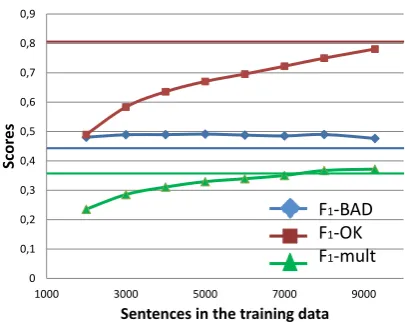
Figure 1: Performance of the phrase-level QE model with different numbers of training sen-tences.
training sentences by their HTER score (ratio of “BAD” words in a sentence) so that the worst sen-tences are closer to the top of the list, and trained our phrase-level QE model using onlyNtop sen-tences from the training data (i.e. only sensen-tences with larger number of errors).
Figure 1 shows how the scores of our phrase-level models change as we add more training data. We examineF1-scores for both “BAD” and “OK” classes as well as their multiplication, which is the primary metric for the task (denoted asF1-mult).
The flat lines denote the scores of a model that uses the entire dataset (12,000 sentences): red for
F1-OK, blue for F1-OK, green for F1-mult. It is clear that F1-BAD benefits from filtering out sentences with less errors. The models with re-duced data never reach the F1-OK score of the ones which use the full dataset, but their higher
F1-BAD scores result in overall improvements in performance. TheF1-mult score reaches its maxi-mum when the training set contains only sentences with errors (9,280 out of 12,000 sentences), al-thoughF1-BAD score is slightly lower in this case than with a lower number of sentences. SinceF1 -mult is our main metric, we use this version of the filtered dataset for the final submission.
3 Prediction-based model
Following the approach in (Specia et al., 2015), which makes use of word-level predictions at sen-tence level, we describe here the first attempt to using both word-level and sentence-level predic-tions for phrase-level QE (W&SLP4PT).
Phrase-level labels by definition depend on the
quality of individual words comprising the phrase: each phrase-level label in the training data is the generalisation of word-level labels within the con-sidered phrase. However, we argue that the quality of a phrase can also be influenced by overall qual-ity of the sentence.
We used the following set of features based on predictions of different levels of granularity and on the phrase segmentation itself:
• Sentence-level predictionfeatures:
1. sentence score — quality prediction score assigned for the current sentence. Same feature value for all phrases in a sentence.
• Phrase segmentationfeatures:
2. phrase ratio — ratio of the length of the current phrase to the length of the sen-tence;
3. phrase length — number of words in the current phrase.
• Word-level predictionfeatures:
4/5. number of words predicted as “OK”/“BAD” in the current phrase; 6/7. number of words predicted as
“OK”/“BAD” in the sentence.
Similarly to the context-based model described in Section 2, we trained our prediction-based model with the CRFSuite toolkit and the Passive-Aggressive algorithm. The phrase segmentation features are extracted from the data itself and do not need any additional information. The sentence-level score is produced by the SHEF-LIUM-NN system, a sentence-level QE system with neural network features as described in (Shah et al., 2016). The word-level prediction fea-tures are produced by the SHEF-MIME QE sys-tem (Beck et al., 2016), which uses imitation learning to predict translation quality at the word level.
4 Results
F1-BAD F1-OK F1-mult W&SLP4PT 0.486 0.757 0.368
CONTEXT 0.470 0.777 0.365
[image:5.595.307.523.61.136.2]BASELINE 0.401 0.800 0.321
Table 2: Performance of our official submissions on the test set.
sentence-level QE models, plus the phrase seg-mentation features. The performance of our of-ficial submissions on the test set is given in Table 2.
For the prediction-based model, we used word-level predictions from the MIME system with
β=0.3. While (Beck et al., 2016) reports bet-ter performance withβ = 1, we obtained slightly
lower performance both on F1-mult = 0.367 and
F1-OK = 0.739. OnlyF1-BAD was better = 0.497. Even though the two systems are very differ-ent in terms of the features they use, their perfor-mance is very similar. The prediction-based model is slightly better in terms ofF1-BAD, whereas the context-based model predicts “OK” labels more accurately. Both systems outperform the baseline. In terms of the F1-multiplied metric, our prediction-based and context-based systems ranked 4th and 5th (out of 10 systems) in the shared task, respectively.
4.1 Model combination
Since both our models outperform the baseline system, we also combined them after the offi-cial submission to check whether further improve-ments could be obtained. Surprisingly, we got the exact same prediction performance as our prediction-based model. This is because two fea-tures of our prediction-based model – the number of words predicted as “BAD”/“OK” in the current phrase – have a strong bias and do most of the job by themselves3. The reason of this behaviour lies in the way both the training and test data have been tagged for the phrase-level task. The labelling was adapted from the word-level labels by assigning the “BAD” tag to any phrase that contains at least one “BAD” word. Consequently, during the train-ing against gold standards labels, our model learns to tag as “BAD” any phrase that contains at least
3We get the exact same scores either combining the
prediction-based features with the baseline features, both the baseline and context features, or considering the number of predicted “BAD” words in the current phrase as the only fea-ture of our model.
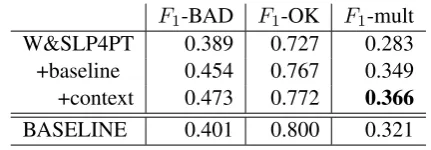
F1-BAD F1-OK F1-mult W&SLP4PT 0.389 0.727 0.283 +baseline 0.454 0.767 0.349 +context 0.473 0.772 0.366
BASELINE 0.401 0.800 0.321
Table 3: Performance for combinations of models on the test set.
on “BAD” word in a systematic way.
After removing the features 4 and 5 from the feature set, we retrained our prediction-based model and its new performance is given in the first row of Table 3. On its own, it performs worse than the baseline, but by successively adding the base-line and context features to it (without any data filtering), it performs as well as our official sub-missions in terms ofF1-BAD and F1-multi, and gets higherF1-OK.
5 Conclusion and future work
We presented two different approaches to phrase-level QE: one extends the baseline feature set with context information, another combines the scores of different levels of granularity to model the quality of phrases. Both performed similarly, al-though the prediction-based strategy is more “pes-simistic” regarding the training data. Both outper-formed the baseline.
In future work, we further experiments to gather a better understanding of these approaches. First, additional feature engineering can be performed: we did not check the usefulness of individual con-text features, nor of the additional features used in the prediction-based model. Secondly, the corre-spondences between labels of different granulari-ties can be further examined: for example, it is in-teresting to see how the use of sentence-level and word-level predictions can influence the prediction of phrase-level scores.
Acknowledgements
This work was supported by the EXPERT (EU FP7 Marie Curie ITN No. 317471, Varvara Lo-gacheva) and the QT21 (H2020 No. 645452, Lu-cia SpeLu-cia, Fr´ed´eric Blain) projects.
References
[image:5.595.79.286.61.121.2]InProceedings of the First Conference on Machine Translation, Berlin, Germany.
Fr´ed´eric Blain, Jean Senellart, Holger Schwenk, Mirko Plitt, and Johann Roturier. 2011. Qualitative Analy-sis of Post-Editing for High Quality Machine Trans-lation. InProceedings of the MT Summit XIII, pages 164–171, Xiamen, China.
Ondˇrej Bojar, Rajen Chatterjee, Christian Federmann, Barry Haddow, Matthias Huck, Chris Hokamp, Philipp Koehn, Varvara Logacheva, Christof Monz, Matteo Negri, Matt Post, Carolina Scarton, Lucia Specia, and Marco Turchi. 2015. Findings of the 2015 workshop on statistical machine translation. InProceedings of the Tenth Workshop on Statistical Machine Translation, pages 1–46, Lisbon, Portugal. Simona Gandrabur and George Foster. 2003. Confi-dence estimation for translation prediction. In Pro-ceedings of Seventh Conference on Natural Lan-guage Learning, pages 95–102, Edmonton, Canada. Varvara Logacheva and Lucia Specia. 2015. Phrase-level quality estimation for machine translation. In
Proceedings of the 2015 International Workshop on Spoken Language Translation, Da Nang, Vietnam.
Varvara Logacheva, Chris Hokamp, and Lucia Specia. 2015. Data enhancement and selection strategies for the word-level quality estimation. InProceedings of the Tenth Workshop on Statistical Machine Transla-tion, pages 330–335, Lisbon, Portugal.
Ngoc Quang Luong, Benjamin Lecouteux, and Lau-rent Besacier. 2013. LIG system for WMT13 QE task: Investigating the usefulness of features in word confidence estimation for MT. In Proceedings of the Eighth Workshop on Statistical Machine Trans-lation, pages 386–391, Sofia, Bulgaria.
Naoaki Okazaki. 2007. Crfsuite: a fast implementa-tion of condiimplementa-tional random fields (CRFs). Available
at http://www.chokkan.org/software/
crfsuite/.
Sylvain Raybaud, David Langlois, and Kamel Sma¨ıli. 2011. This sentence is wrong. Detecting errors in machine-translated sentences. Machine Translation, 25(1):1–34.
Kashif Shah, Fethi Bougares, Loic Barrault, and Lu-cia SpeLu-cia. 2016. Shef-lium-nn: Sentence level quality estimation with neural network. In Proceed-ings of the First Conference on Machine Translation, Berlin, Germany.