Model Combination for Correcting Preposition Selection Errors
∗Nitin Madnani Michael Heilman Aoife Cahill
660 Rosedale Road Princeton, NJ 08541, USA
{nmadnani,mheilman,acahill}@ets.org
Abstract
Many grammatical error correction approaches use classifiers with specially-engineered fea-tures to predict corrections. A simpler alterna-tive is to usen-gram language model scores. Rozovskaya and Roth (2011) reported that clas-sifiers outperformed a language modeling ap-proach. Here, we report a more nuanced result: a classifier approach yielded results with higher precision while a language modeling approach provided better recall. Most importantly, we found that a combined approach using a logis-tic regression ensemble outperformed both a classifier and a language modeling approach.
1 Introduction
In this paper, we compare methods for correcting grammatical errors. Much of the previous work on grammatical error detection and correction has stud-ied methods based on statistical classifiers (Tetreault and Chodorow, 2008; De Felice and Pulman, 2009; Tetreault et al., 2010; Rozovskaya and Roth, 2010; Dahlmeier and Ng, 2011; Seo et al., 2012; Cahill et al., 2013). In particular, Tetreault and Chodorow (2008) and Tetreault et al. (2010) found that classi-fiers based on a variety of contextual linguistic fea-tures performed well, especially in terms of precision (i.e., avoiding false positives). Gamon (2010), how-ever, reported that a language modeling approach substantially outperformed a classifier using contex-tual features. Finally, Rozovskaya and Roth (2011) found that a classifier outperformed a language mod-eling approach on different data, making it unclear which approach is best.
∗Michael Heilman is now a data scientist at Civis Analytics.
Much of the previous work has used well-formed text when training contextual classifiers due to the lack of large error-annotated corpora. Han et al. (2010) conducted experiments with a relatively small error-annotated corpus and showed that it outper-formed a contextual classifier trained on well-edited text. More recently, Cahill et al. (2013) mined Wikipedia revisions to produce a large, publicly avail-able error-annotated corpus and reported similar re-sults on multiple, publicly available data sets.
Our goal in this paper is not to build a state-of-the-art system but rather to investigate the following research questions:
• Does a contextual classifier trained on error-annotated data outperform a language modeling approach?
• Can a classifier trained on error-annotated data and the language modeling approach be effec-tively combined?
With respect to the second question, Gamon (2010) previously reported that a combination of a contex-tual classifier trained on well-edited text and a lan-guage modeling approach outperformed each indi-vidual method. However, given that the performance of his classifier was lower than what has been re-ported on other datasets (Tetreault and Chodorow, 2008; Rozovskaya and Roth, 2011), we believe it is worth reinvestigating the merits of system combina-tion but with publicly available data sets and with a classifier trained on error-annotated data instead of on well-edited text. This work differs from Susanto et al. (2014) in that we are interested in combining statistical models in order to more accurately cor-rect individual preposition errors, while their work
combined — at the sentence level — the outputs of multiple systems designed to correctdifferent types
of grammatical errors.
2 Task Description
In this paper, we focus on the task of detecting and correcting preposition selection errors in English writ-ing — that is, errors where the writer selects the in-correct preposition for a given context. We consider 36 different prepositions (§3.1).
2.1 Evaluation Datasets
We use two data sets for evalution: (a) The CLC
FCEdataset, which contains exam scripts written by English language learners for the Cambridge ESOL First Certificate in English (Yannakoudakis et al., 2011), with 20% held out for development, and (b) TheHOO2011 shared task data set, which contains excerpts of ACL papers manually annotated for gram-matical errors (Dale and Kilgarriff, 2011). No HOO data was used for development.
2.2 Metrics
To evaluate performance, we compute precision, re-call, andF1score for each dataset. Precision is the
percentage of system corrections that are correct ac-cording to the gold standard, and recall is the per-centage of the gold standard corrections that were correctly marked by the system. Our evaluation met-ric can be viewed as similar to a micro-averaged
F1 score for a multi-class document classification
task where documents are the original prepositions, classes are the possible corrections, and only doc-uments for ungrammatical prepositions have class labels. OurF1 score is similar to the WAS
evalua-tion scheme of Chodorow et al. (2012), except that we treat cases where the original preposition, sys-tem prediction, and gold standard all differ as false negatives. Chodorow et al. (2012) instead treat such cases as both false positives and false negatives, and as a result, the sum of true positives, false positives, true negatives, and false negatives does not equal the number of examples.
3 Methods
This section describes our implementations of the classifier, language modeling, and system
combina-tion approaches to preposicombina-tion error correccombina-tion.
3.1 Classifier
Our first system is a classifier trained on error-annotated data, following Cahill et al. (2013). The classifier uses logistic regression to solve a 36-way classification problem with one class per preposition (Tetreault and Chodorow, 2008). It includes 25 lexi-cal and syntactic contextual features. It also includes a feature indicating the writer’s original preposition. The classifier learns a conditional probability dis-tributionpCLS(w|x)over prepositionswgiven the
contextxin which they appear.
To train this classifier, we used the preposition error corpus mined from revisions in an XML snap-shot of Wikipedia (Cahill et al., 2013). The snapsnap-shot contained 8,735,890 articles and 288,583,063 revi-sions. The resulting data set consists of 7,125,317 prepositions and their sentence contexts. Of these prepositions, 1,027,643 were marked as errors and annotated with corrections.
We include a threshold parameterλCLS, tuned to
maximizeF1score on the development set. Letworig
be the writer’s preposition, letQbe the set of preposi-tions, and letwalt= argmaxy∈Q−{worig}pCLS(y|x)
(i.e., the best alternative that differs from the orig-inal). IfpCLS(walt)−pCLS(worig) > λCLS, then
the alternative is predicted (i.e., a correction is made). Otherwise, no change is made. We explored values ranging from 0 to 1, with steps of size.001.
3.2 Language Model
Our second system uses a language modeling ap-proach. We use KenLM (Heafield, 2011) to estimate an unpruned model forn= 6with modified Kneser-Ney smoothing (Chen and Goodman, 1998) on the text of all articles contained in a snapshot of English Wikipedia from June 2012 (68,356,743 sentences). We use thisn-gram language model to obtain scores
gLM(w, s, i) = log10pLM(f(w,s,i))
|s|+1 , where w is the
preposition to be scored, sis the writer’s original sentence,iis the position of the original preposition ins,f is a function that returns a variant ofswith the preposition atireplaced withw, andpLMreturns
differences in sentence lengths.1
Again, we include a thresholdλLM for deciding
whether to replace the writer’s original preposition with the best alternative preposition. This works similarly, except that it works with differences in the language model scoresgLM rather than differences
in probabilities. We explored a grid with 45 manually selected points obtained by examining the percentiles forgLM on the development set.2
3.3 System Combinations
We examine three methods for combining the lan-guage modeling and classifier approaches.
3.3.1 Heuristic
The first method is a simple heuristic combination intended to increase the recall of the classifier ap-proach. We first tune theλCLS andλLM thresholds
individually for the classifier and language model approaches to optimizeF1score, as described above.
Then, if the classifier predicts a correction, we return that as the final correction. If the classifier did not predict a correction but the language model did, then we return the language model’s suggested correction. If neither predicts a correction, then we return the original preposition.
3.3.2 Interpolation
The second method combines the scores from the classifier and the language model, finds the best al-ternative to the original (i.e., a potential correction), and then applies a threshold to decide whether or not to make the correction.
Let gLM(w, s, i) be the language model score
(§3.2) for the sentencescontaining the preposition of interestw at positioni, and let gCLS(w, s, i) = log10pCLS(w|fCLS(s, i)), computed using the
clas-sifier, wherefCLS is a function that returns the
con-textual features for the classifier.3
1Our language modeling approach differs from that of Ro-zovskaya and Roth (2011). We use a language model to compute probabilities for whole sentences, whereas they use one to de-rive feature weights for contexts around the writer’s original preposition, which are used in a separate model.
2We also evaluated language models forn=3,4,5on the development set, but we do not include them here since their performance was not as good as the6-gram model.
3We take the logarithm of the classifier probability here to put it on a similar scale to the language model score.
For each original prepositionworig, this method
computes the difference between its classifier or lan-guage model score and the corresponding score for each alternative prepositionwalt:
∆CLS(worig, walt, s, i) =gCLS(walt, s, i)
−gCLS(worig, s, i) ∆LM(worig, walt, s, i) =gLM(walt, s, i)
−gLM(worig, s, i)
The method then computes an interpolated score for each alternative preposition as follows:
gINT(worig, walt, s, i) =
α∗∆CLS(worig, walt, s, i)
+ (1−α)∗∆LM(worig, walt, s, i)
It then finds the best alternative wˆINT to the
writer’s original prepositionworigbased on that score,
i.e.,
ˆ
wINT = arg maxw
alt gINT(worig, walt, s, i),
and then predicts it as the final correction if
gINT(worig,wˆINT, s, i)> λINT. The interpolation
parameterαand the threshold parameterλINT are
tuned to maximizeF1on the development set, with a
search grid forαandλINT ranging from 0 to 1 with
steps of size.01.
3.3.3 Ensemble Classifier
Finally, we evaluate an ensemble that uses scores from the classifier and language model as features.
Specifically, we use a logistic regression classifier to make binary predictions about whether or not to ac-cept potential corrections from the revision classifier (§3.1). We give priority to the classifier since it had higher precision on the development set. Given an original prepositionworigin a sentencesat position i, with wˆCLS being the best alternative according
to the revision classifier, the following features are considered by the logistic regression:
• binary features for each of the 36 possible values of the writer’s original preposition. The feature forworigis set to1, and the rest are set to0.
• binary features for each of the 36 possible values of the best alternative to the writer’s original preposition, according to the revision classifier. The feature forwˆCLS is set to1, and the rest are
• ∆CLS(worig,wˆCLS, s, i)(see§3.3.2)
• ∆LM(worig,wˆCLS, s, i)
Once trained, we obtain the probability of mak-ing a change for any given prepositionp(change= 1|worig, s, i)according to the logistic regression. We
outputwˆCLS as the final prediction if p(change = 1|worig, s, i)> λENS.
To tuneλENS, we use a procedure based on
10-fold cross-validation to obtain probabilities for the development set. Each fold (i.e., tenth) of the devel-opment set is iteratively held out, and the ensemble is trained on the remaining folds. The ensemble is then used to obtain probabilities of corrections for the examples in the held-out fold. Once we have proba-bilities for the whole set, we tuneλENS to maximize F1score, using a search grid ranging from 0 to 1 with
steps of.001.
4 Results
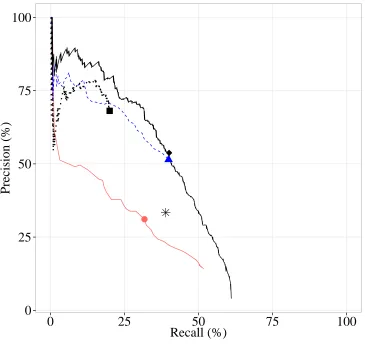
Figure 1 shows the development set precision-recall curves for the revision classifier, the language mod-eling approach, the interpolation approach, and the ensemble approach. The heuristic approach is shown as a single point in the figure since there is no thresh-old to tune. For each curve, the figure also shows the point corresponding to the threshold that yields the optimalF1 score. From these results, all system
combination approaches seem useful for combining the outputs of the classifier and language model to balance precision and recall. The ensemble appears particularly effective: the ensemble system’s preci-sion is generally higher than the classifier and lan-guage model systems at the same levels of recall, and the ensemble’s recall is generally higher at the same levels of precision.
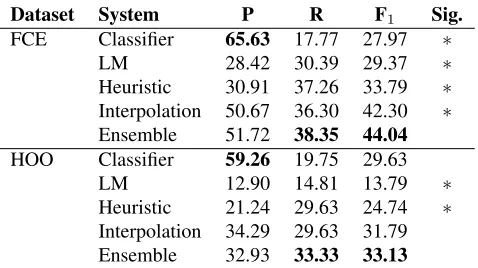
Table 1 shows the performance of all methods on the FCE and HOO test sets. Note that to apply the ensemble method to a test set, we trained the ensemble on the entire development set and then computed probabilities of corrections for the test set instances. We observe the following:
1. For both the FCE and the HOO test sets, the clas-sifier approach yields results with higher preci-sion whereas language model approach provides better recall.
2. For the FCE test set, we find that the ensemble approach attains the bestF1 score and that it
Dataset System P R F1 Sig.
FCE Classifier 65.63 17.77 27.97 ∗
LM 28.42 30.39 29.37 ∗
Heuristic 30.91 37.26 33.79 ∗
Interpolation 50.67 36.30 42.30 ∗
Ensemble 51.72 38.35 44.04
HOO Classifier 59.26 19.75 29.63
LM 12.90 14.81 13.79 ∗
Heuristic 21.24 29.63 24.74 ∗
Interpolation 34.29 29.63 31.79
[image:4.612.314.553.53.187.2]Ensemble 32.93 33.33 33.13
Table 1:P, R andF1scores for the FCE and HOO test sets. Bold indicates the best result for each metric. “∗” indicates that the
F1score for a system was significantly different (p < .05) from that of the ensemble system as per the BCaBootstrap (Efron and
Tibshirani, 1993) test with 10,000 replications.
performs significantly better than all other ap-proaches, including both the classifier and the language model.
3. For the HOO test set — which is quite differ-ent from the FCE data in both its genre (ACL papers) and the distribution of grammatical er-rors — the ensemble approach still attains the best performance and is significantly better than the language model and the heuristic system combination approach.
Finally, we also compared the ensemble approach to a current state-of-the-art preposition error correc-tion system. To do this, we evaluated on the CoNLL 2013 shared task test set (Ng et al., 2013), which contains essays written by students at the National University of Singapore and manually annotated with grammatical errors. We use the “revised” version of the annotations that includes revisions submitted by participants after the initial evaluation and only evalu-ate preposition selection errors. We did not use any of this data for development. We compared our ensem-ble system to the system submitted by the team that performed best on preposition errors (“NAIST, PC”). Our ensemble obtainedF1 = 14.24, whereas the
NAIST system obtainedF1 = 7.56. This difference
is statistically significant (p <0.05).
●
0
25
50
75
100
0
25
50
75
100
Recall (%)
Precision (%)
●
[image:5.612.124.489.60.404.2]Ensemble
Interpolation
Classifier
LM
Heuristic
Figure 1:P and R values for the development set. Curves indicate performance at various values for the thresholdλfor making a correction. Corresponding shaped dots indicate points at whichF1is highest for each method.
not designed to correct either extraneous or missing preposition errors. Secondly, the F1 results on the CoNLL shared task used estimated types for comput-ing precision, while were were certain of our error type. It is also not possible to compare to the pub-lished results on the HOO 2012 shared task (Dale et al., 2012) which used CLC-FCE data, because re-sults for the three types of preposition errors were combined in one overall score.
5 Conclusions
Our goal in this paper wasnotto build a state-of-the-art preposition error correction system but rather to re-examine how well a simple language modeling approach performs on the task of correcting preposi-tion selecpreposi-tion errors, compared to the more typical
approach that uses a classifier trained on a large error-annotated corpus (Cahill et al., 2013). We found that a language model does not generally perform as well as a classifier in terms ofF1, similar to a previous
finding from Rozovskaya and Roth (2011). In addi-tion, we also found that while the classifier has higher precision, the language model yields higher recall.
Acknowledgments
We would like to thank Lyle Ungar for his original suggestion, Kenneth Heafield for help with KenLM, Lei Chen, Anastassia Loukina, and the BEA review-ers.
References
Aoife Cahill, Nitin Madnani, Joel Tetreault, and Diane Napolitano. 2013. Robust systems for preposition error correction using wikipedia revisions. InProceedings of NAACL, pages 507–517.
Stanley F. Chen and Joshua Goodman. 1998. An Em-pirical Study of Smoothing Techniques for Language Modeling. Technical Report TR-10-98, Harvard Uni-versity.
Martin Chodorow, Markus Dickinson, Ross Israel, and Joel Tetreault. 2012. Problems in Evaluating Gram-matical Error Detection Systems. InProceedings of COLING 2012, pages 611–628.
Daniel Dahlmeier and Hwee Tou Ng. 2011. Grammatical Error Correction with Alternating Structure Optimiza-tion. InProceedings of ACL, pages 915–923.
Robert Dale and Adam Kilgarriff. 2011. Helping Our Own: The HOO 2011 Pilot Shared Task. In Proceed-ings of the Generation Challenges Session at the 13th European Workshop on Natural Language Generation, pages 242–249.
Robert Dale, Ilya Anisimoff, and George Narroway. 2012. Hoo 2012: A report on the preposition and determiner error correction shared task. In Proceedings of the Seventh Workshop on Building Educational Applica-tions Using NLP, pages 54–62, Montr´eal, Canada, June. Association for Computational Linguistics.
Rachele De Felice and Stephen G. Pulman. 2009. Auto-matic detection of preposition errors in learner writing. CALICO Journal, 26(3):512–528.
Bradley Efron and Robert J. Tibshirani. 1993. An In-troduction to the Bootstrap. Chapman and Hall/CRC, Boca Raton, FL.
Michael Gamon. 2010. Using Mostly Native Data to Correct Errors in Learners’ Writing. InProceedings of HLT-NAACL, pages 163–171.
Na-Rae Han, Joel Tetreault, Soo-Hwa Lee, and Jin-Young Ha. 2010. Using Error-Annotated ESL Data to De-velop an ESL Error Correction System. InProceedings of LREC.
Kenneth Heafield. 2011. KenLM: faster and smaller lan-guage model queries. InProceedings of the EMNLP 2011 Sixth Workshop on Statistical Machine Transla-tion, pages 187–197.
Hwee Tou Ng, Siew Mei Wu, Yuanbin Wu, Christian Hadiwinoto, and Joel Tetreault. 2013. The CoNLL-2013 Shared Task on Grammatical Error Correction. In Proceedings of CoNLL.
Alla Rozovskaya and Dan Roth. 2010. Training Paradigms for Correcting Errors in Grammar and Us-age. InProceedings of HLT-NAACL, pages 154–162. Alla Rozovskaya and Dan Roth. 2011. Algorithm
Selec-tion and Model AdaptaSelec-tion for ESL CorrecSelec-tion Tasks. InProceedings of ACL: HLT, pages 924–933.
Hongsuck Seo, Jonghoon Lee, Seokhwan Kim, Kyusong Lee, Sechun Kang, and Gary Geunbae Lee. 2012. A Meta Learning Approach to Grammatical Error Cor-rection. InProceedings of ACL (Short Papers), pages 328–332.
Raymond Hendy Susanto, Peter Phandi, and Hwee Tou Ng. 2014. System combination for grammatical er-ror correction. InProceedings of the 2014 Conference on Empirical Methods in Natural Language Process-ing (EMNLP), pages 951–962, Doha, Qatar, October. Association for Computational Linguistics.
Joel R. Tetreault and Martin Chodorow. 2008. The Ups and Downs of Preposition Error Detection in ESL Writ-ing. InProceedings of COLING, pages 865–872. Joel Tetreault, Jennifer Foster, and Martin Chodorow.
2010. Using Parse Features for Preposition Selection and Error Detection. In Proceedings of ACL (Short Papers), pages 353–358.