Automated classification of collaborative problem solving interactions
in simulated science tasks
Michael Flor, Su-Youn Yoon, Jiangang Hao, Lei Liu, Alina A von Davier
Educational Testing Service, 660 Rosedale Road, Princeton, NJ 08541, USA
{mflor,syoon,jhao,lliu001,avondavier}@ets.org
Abstract
We present a novel situational task that inte-grates collaborative problem solving behavior with testing in a science domain. Participants engage in discourse, which is used to evaluate their collaborative skills. We present initial ex-periments for automatic classification of such discourse, using a novel classification schema. Considerable accuracy is achieved with just lexical features. A speech-act classifier, trained on out-of-domain data, can also be helpful.
1
Introduction
Collaborative problem solving (CPS) is a com-plex activity that involves an interplay between cog-nitive processes, such as content understanding, knowledge acquisition, action planning and execu-tion (Greiff, 2012; von Davier and Halpin, 2013), non-cognitive processes, such as adaptability, en-gagement, social regulation, and affect states, such as boredom, confusion, and frustration (Baker et al., 2010; Graesser et al., 2010). Collaborative learning techniques are used extensively in educational prac-tices, from pre-school to higher education. Collabo-rative activity in learning environments may take place in face-to-face interactions or via online dis-tance-learning platforms (Prata et al., 2009).
Within the domain of educational assessment, there has been a strong recent interest in the evalua-tion of CPS as a social skill (Griffin et al., 2012; Liu et al., 2015; von Davier and Halpin, 2013). Such in-terest is informed by analysis of group interactions, which often integrate context, experience, and ac-tive engagement of learners (Hatano & Inagaki, 1991; Hmelo-Silver, Nagarajan, & Day, 2000). For
example, Damon and Phelps (1989) pointed out that collaborative discussion provides a rich environ-ment for mutual discovery, reciprocal feedback, and frequent sharing of ideas. Duschl and Osborne (2002) noted that peer collaboration provides op-portunities for scientific argumentation – proposing, supporting, criticizing, evaluating, and refining ideas.
To include discursive collaboration in large-scale educational assessments, it is essential to automate the scoring and annotation process of discursive in-teractions. In our study, we explore an application of natural language processing techniques for anno-tating group discourses using a novel CPS classifi-cation framework.
The rest of this paper is structured as follows. Section 2 presents the experimental task that is used for eliciting collaborative behavior in a controlled setting. Section 3 describes the collected data. Sec-tion 4 presents the CPS classificaSec-tion framework and the manual annotation of data according to this framework. Machine learning experiments for auto-mated annotation of collaborative interactions are presented in section 5.
2
Task Description
We have designed a research study to explore the relationship between CPS skills and collaboration outcomes (Hao et al., 2015). We focus on measuring collaboration skills within the domain of science. The task was structured as a computer-based simu-lation, in an interactive game-like environment. Such setting can provide students with opportunities to demonstrate proficiencies in complex interactive environments that traditional assessment formats cannot afford (Klopfer et al., 2009). The simulation
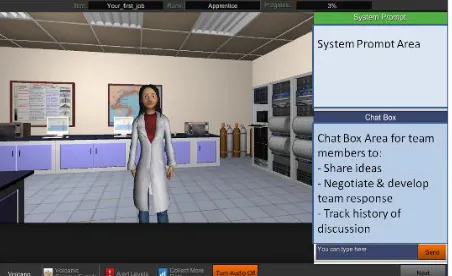
task was modified from an existing simulation, Vol-cano Trialogue (Zapata-Rivera et al., 2014), and de-livered over a web-based collaborative platform (see Figure 1). Task participants took the roles of assistants in a virtual seismic measurement labora-tory, measuring and monitoring seismic events re-lated to various aspects of (simure-lated) volcanic ac-tivity. They were given various assignments (by a script-controlled virtual scientist agent), and their performance was measured based on their responses to the assignments in the simulation task. In this task, two participants work together via text chat to complete the specific subtasks. All of the turn-by-turn conversations and responses to the questions were recorded in an activity log with time stamps. The conversations were used to measure CPS skills, while responses to the in-simulation test items were used to measure science inquiry skills.
Figure 1. Sample screenshot from the Volcano task.
Figure 2. Binned distribution of turn counts per session
A session in this simulation task consists of tiple items/subtasks in various formats, such as mul-tiple choice, constructed response, and conversa-tions with virtual agents. There were also action items, such as placing seismometers on a virtual volcano map and making notes of collected seismic data. Pre-designed prompts were displayed in the system prompt area to guide participants through the sequence of subtasks in a session. To capture the evidence for the outcomes of collaboration in the simulation, a three-step response procedure was used for each item. First, each participant was prompted to respond the item individually. Next, each participant was prompted to discuss the item with the partner. Individual response could be re-vised at this stage and a team-response could be ne-gotiated. Finally, a team-representative was ran-domly chosen to submit a team answer. The changes in the test-responses before and after the tion may indicate how effective the team collabora-tion was. In a separate paper, we describe how such changes provide insights on which CPS skills are important for better collaboration outcomes (Hao et al., submitted). In the present paper, we focus on de-veloping automated methodologies to classify the conversations in the sessions.
3
The CPS chat data
Data was collected through the Amazon Mechan-ical Turk crowdsourcing data-collection platform. We recruited 1,000 participants with at least one year of college education. Participants were teamed randomly into pairs to take the collaborative science simulation task. After removing sessions with in-complete data, we had in-complete responses from 482 teams. Figure 2 presents a binned histogram for the amounts of turns taken in the 482 sessions, indicat-ing the amount of dialogue that has occurred. A ‘turn’ consists of whatever text a participant types before pressing ‘Send’. About 80% of the sessions had 35-100 turns. The chattiest session had 300 turns. Sample chat excerpts are presented in Table 2. Overall, there are 38,703 turns in our corpus. The total number of tokens is 189K (213K with punctu-ation). Average token-count per turn is 4.9 tokens (5.5 with punctuation).
0 20 40 60 80 100 120 140 160 180
Count of turns per s es s ion
C
o
u
n
t o
f s
e
s
s
io
n
[image:2.612.76.289.468.634.2]4
CPS classification
By analyzing discourse, researchers can make sense of how students collaboratively solve prob-lems. Observable features from the collaborative in-teraction, such as turn taking, sharing resources and ideas, negotiating, posing and answering questions, etc., may be used for measuring CPS skills.
There are many different ways to annotate inter-actions, for different purposes. Dialogue acts (DA) are sentence-level units that represent states of a di-alogue, such as questions, statements, hesitations, etc. However, classification of dialogue acts differs from CPS classification (Erkens and Janssen, 2008). Whereas dialogue act coding is based on the prag-matic, linguistic features, close to utterance form, the coding of collaborative activities is based on the theoretical interpretation of the content of the utter-ances – the aim and function of the utterutter-ances in the collaboration process. For example, from the DA perspective, “Look at the map” and “Wait for me” are simply directives. From CPS perspective, the former may be considered “Sharing of ideas/re-sources”, the latter – a “Regulating” expression.
Research in the field of collaboration analysis has not settled yet on a single CPS annotation scheme. Hmelo-Silver and Barrows (2008) provide a schema for characterizing collaborative knowledge building for medical students working with an expert facili-tator, thus focusing on facilitation aspects. Higgins et al. (2012) present a coding scheme that is focused on the types of interactions between participants (negotiation, elaboration, independence, etc.). Asterhan and Schwarz (2009) describe dual CPS coding of discussion protocols. Kersey et al. (2009) focus on knowledge co-construction in peer interac-tions. Mercier et al. (2014) describe a coding scheme that focuses on leadership skills in CPS. Lu et al. (2011) describe a coding scheme of discourse moves in online discussions. Weinberger and Fischer (2006) provide a multi-dimensional coding scheme for argumentative knowledge construction in computer-supported collaborative learning.
4.1
The CPS FrameworkThe CPS classification schema used in the pre-sent work was developed based on review of com-puter-supported collaborative learning (CSCL) re-search findings (Barron, 2003; Dillenbourg and Traum, 2006; Griffin et al., 2012; von Davier and
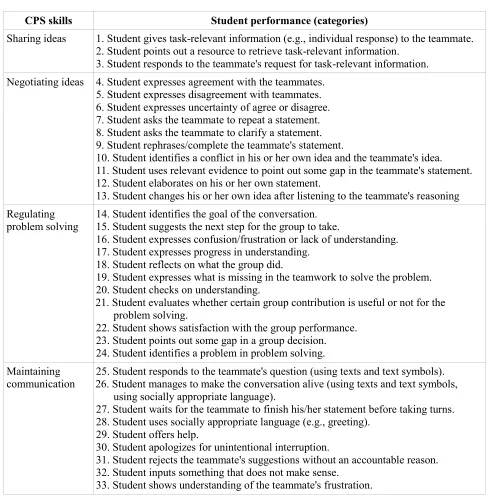
Halpin, 2013) and the PISA 2015 Collaborative Problem Solving Framework (OECD, 2013). Our schema (Liu et al., 2015) is comprised of 33 CPS skills grouped into four major dimensions. The full listing is presented in Table 1. The four dimensions are: sharing ideas, negotiating, regulating problem-solving activities, and maintaining communication. The first dimension – sharing ideas – considers how individuals bring divergent ideas into a collabora-tive conversation. For instance, participants may share their individual responses to assessment items and/or point out relevant resources that might help resolve a problem. The second dimension – negoti-ating ideas – is to capture evidence of the team’s collaborative knowledge building and construction through negotiating with each other. The categories under this dimension include agreement/disagree-ment with each other, requesting clarification, elab-orating/rephrasing other’s ideas, identifying gaps, revising one’s own idea. The third dimension – reg-ulating problem-solving activities – focuses on the collaborative regulation aspect of the team dis-course. This dimension includes such categories as identifying goals, evaluating teamwork, and check-ing understandcheck-ing. The last dimension – maintain-ing a positive communication atmosphere – is to capture social communications beyond the task-spe-cific interactions.
4.2
Human coding of CPS classesTwo human annotators were trained to annotate the chats. Training involved overview of definitions and coding examples for each of the 33 categories of CPS skills. After training, annotators inde-pendently coded discourse data from the chat proto-cols. Seventy seven sessions out of 482 (16%) were coded by both annotators, all other sessions were coded by the same single annotator (H1).
The unit of analysis was each turn of a conversa-tion, i.e. each turn received a label drawn from the 33 categories. Due to complexity of the collabora-tive process, one turn of chat may have more than one function that can be mapped in the CPS frame-work. Therefore, an annotator was allowed to assign up to two labels to each turn. A primary label re-flects what the annotator considered as the major function in a given turn, and a secondary label re-flects an additional, less central function.
CPS skills Student performance (categories)
Sharing ideas 1. Student gives task-relevant information (e.g., individual response) to the teammate. 2. Student points out a resource to retrieve task-relevant information.
3. Student responds to the teammate's request for task-relevant information. Negotiating ideas 4. Student expresses agreement with the teammates.
5. Student expresses disagreement with teammates. 6. Student expresses uncertainty of agree or disagree. 7. Student asks the teammate to repeat a statement. 8. Student asks the teammate to clarify a statement. 9. Student rephrases/complete the teammate's statement.
10. Student identifies a conflict in his or her own idea and the teammate's idea. 11. Student uses relevant evidence to point out some gap in the teammate's statement. 12. Student elaborates on his or her own statement.
13. Student changes his or her own idea after listening to the teammate's reasoning Regulating
problem solving
14. Student identifies the goal of the conversation. 15. Student suggests the next step for the group to take.
16. Student expresses confusion/frustration or lack of understanding. 17. Student expresses progress in understanding.
18. Student reflects on what the group did.
19. Student expresses what is missing in the teamwork to solve the problem. 20. Student checks on understanding.
21. Student evaluates whether certain group contribution is useful or not for the problem solving.
22. Student shows satisfaction with the group performance. 23. Student points out some gap in a group decision. 24. Student identifies a problem in problem solving. Maintaining
communication
25. Student responds to the teammate's question (using texts and text symbols). 26. Student manages to make the conversation alive (using texts and text symbols,
using socially appropriate language).
27. Student waits for the teammate to finish his/her statement before taking turns. 28. Student uses socially appropriate language (e.g., greeting).
29. Student offers help.
30. Student apologizes for unintentional interruption.
31. Student rejects the teammate's suggestions without an accountable reason. 32. Student inputs something that does not make sense.
[image:4.612.71.559.44.542.2]33. Student shows understanding of the teammate's frustration.
Table 1: CPS Framework coding rubric of collaborative problem solving interactions skills
presents the chat text. The fourth column presents the primary classification code assigned by annota-tor H1. The third column indicates the general di-mension for primary label. The fifth column shows the secondary labels given by annotator H1. For ex-ample, in the last row of the table, note that the re-sponse of participant s8 is classified as primary=cat-egory#11 (point out a gap in statement) and second-ary=category#2 (suggest information resource).
ID Chat text Dimension P S
s1 hi there i’m george! maintaining
communication 28 s2 good morning,
I'm j
maintaining
communication 28 s1 i think the answer
is b sharing ideas 1
s2 magma
approach-ing crater? sharing ideas 1 20 s1 i remember the
video saying high frequency waves resulted from rocks cracking
sharing ideas 2 12
s2 i just reviewed it
and you are correct negotiating ideas 12 4
s2 c sharing ideas 1
s1 i chose c as well sharing ideas 1 (some turns omitted here)
s2 ? regulating 16
s1 we can keep the first two notes we seemed to have similar answers
regulating 15
Example from another session: s9 I thought it started
low? sharing ideas 1
s8 nope you can look at the volcanic seis-mic events in the bottom left corner
[image:5.612.74.300.52.420.2]negotiating ideas 11 2
Table 2: Sample excerpts from some chat sessions, with CPS classifications by annotator H1. P=primary label, S-secondary label. Labels are explained in Table 1.
agreement as follows. The 77 sessions that were processed by both annotators had 6,079 turns. Over those turns, the two annotators agreed in their pri-mary tags in 3,818 cases (62.8% agreement, Co-hen’s kappa 0.56). We also considered a different criterion, when second annotator’s primary tag agreed with either primary or secondary tag given by the first annotator. In this approach, agreement is 72%s and Cohen’s kappa is 0.62. According to Lan-dis and Koch (1977) scale, those levels of agree-ment are somewhere between moderate (kappa 0.41-0.61) and substantial (kappa 0.61-0.80).
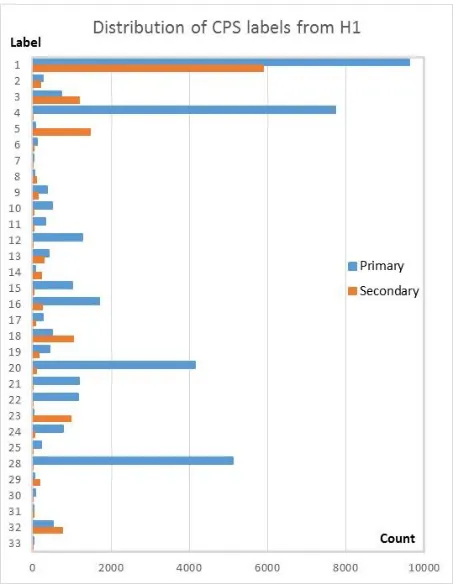
[image:5.612.313.543.53.346.2]Figure 3 presents the distribution of primary and secondary CPS labels assigned by annotator H1 to the whole set of 38,703 turns. The distribution is very uneven. Two categories were never used (#26 and #27).
Figure 3. Histogram of primary and secondary CPS labels assigned by annotator H1 for the set of 38,703 chat turns.
It is not uncommon to see uneven distribution of categories in collaborative discourse (Chin and Os-borne, 2010; Schellens and Valcke, 2005; Lipponen et al. 2003). Given that the task prompted students to share individual responses, it is also not surpris-ing to see categories #1 (give info to partner) and #4 (expresses agreement) as the most frequent codes. Social factors may also be at play. For instance, peo-ple often tend to be polite and respectful and express disagreement indirectly. Instead of saying “no, I dis-agree”, very likely a person would say “my answer is …” or “I think it’s … because”, and such re-sponses are not coded as expressed disagreement, but rather as sharing or negotiating. This may ex-plain why explicit agreements are five times more frequent than explicit disagreements in our data, the latter also mostly coded as secondary label.
5
Automation of CPS classification
time consuming, researchers have turned to auto-mating such analyses by utilizing computational lin-guistic methods. Discourse Processing is a well-es-tablished area in computational linguistics, and there is much research on automatically recognizing and tagging dialogue acts, for spoken or transcribed data (Webb & Liu, 2008; Webb et al., 2005; Serafin & Di Eugenio, 2004; Stolcke et al., 2000; Samuel et al., 1999). De Felice and Deane (2012) describe identifying speech acts in e-mails, as part of a scor-ing system for educational assessment. Similarly, researchers have developed computational linguis-tic approaches in analysis of collaboration proto-cols. Law et al. (2007) presented a mixed system, where manual coding is augmented with automated suggestions, derived from keyword and phrase matching. Erkens and Janssen (2008) describe a rule-based approach for automatic coding of dia-logue acts in collaboration protocols. Erkens and Janssen have also stressed the difference between dialogue acts, which are closer to the linguistic form of interaction, and classes of collaborative utter-ances, which are more context specific and depend on respective theoretical frameworks of collabora-tion processes. Rosé et al. (2008) and Dönmez et al. (2005) describe a machine learning approach to code collaboration protocols according to the clas-sification system of Weinberger and Fischer (2006).
Here we describe machine learning experiments towards automated coding of collaboration proto-cols according to the novel CPS framework. In our experiments we attempt to learn directly the 31 cat-egories of the 33 defined in the framework. We chose a multinomial Naive-Bayes and HMM ap-proaches, as starting points to explore assigning CPS tags to chat-turns in our data.
As a pre-processing step, all texts were automat-ically spell-corrected using a contextually-aware spell checker (Flor, 2012). Slang words and expres-sions were normalized (e.g. {ya, yea, yeah, yiss,
yisss, yep, yay, yaaaay, yupp} → yes), using a
dic-tionary of slang terms (this functionality is provided in the spell-checker). All texts were then tokenized and converted to lower case.
Following the manual annotation, our goal is to provide a single class-label to each chat turn, which may consist of one or more sentences. All machine learning experiments reported here use five-fold cross-validation with 4:1 train:test ratio. For this purpose the 482 collaboration sessions (described in
section 3) were partitioned (once) into five groups: two groups of 97 sessions and three groups of 96 sessions each). This also resulted in unequal (but ap-proximately similar) amount of turns in each fold (7541 turns in the smallest fold, 8032 in the largest).
Experiment 1. In our first experiment we train a
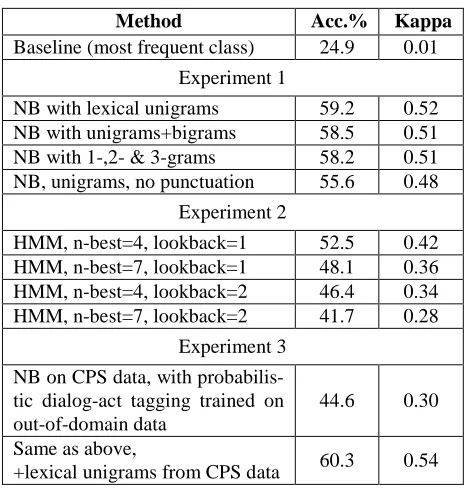
Naive-Bayes classifier on just the primary labels from human annotator H1. We do not filter features, but rather use all available tokens. We use lexical features (word and punctuation tokens) in several configurations – unigrams, bigrams and trigrams. Performance results (micro-averaged across test-folds) are shown in Table 3. As a baseline, we al-ways predict the most frequent category (CPS cate-gory#1), an approach that achieves 24.9% accuracy. The best result, 59.2% classification accuracy, is achieved by using just unigram features (single words and punctuation tokens). It clearly outper-forms the baseline by a large margin. Bigrams and trigrams are not useful, their use actually decreases classification accuracy, as compared to using just unigrams.
We also experimented with ignoring the punctu-ation. A Naïve-Bayes classifier trained on lexical unigrams, but without punctuation, achieves accu-racy of 55.5%. This is lower than the 59.2% achieved when punctuation is used. It demonstrates that punctuation is clearly useful for classification, which is consistent with similar results in a different domain (De Felice and Deane, 2012).
Experiment 2. Since collaborative interactions
act modeling, found that using dialogue history worsens rather than improves performance.
A per-CPS-category performance comparison was conducted between the Naïve-Bayes unigrams-based classifier and the HMM classifier (with n-best=4, lookback=1). The HMM classifier performs worse than NB classifier on all categories, except CPS category #4 (student expresses agreement with the teammates), where HMM is better than NB by 7.34%. This suggests that selective integration of contextual information might be useful.
Method Acc.% Kappa
Baseline (most frequent class) 24.9 0.01
Experiment 1
NB with lexical unigrams 59.2 0.52 NB with unigrams+bigrams 58.5 0.51 NB with 1-,2- & 3-grams 58.2 0.51 NB, unigrams, no punctuation 55.6 0.48
Experiment 2
HMM, n-best=4, lookback=1 52.5 0.42 HMM, n-best=7, lookback=1 48.1 0.36 HMM, n-best=4, lookback=2 46.4 0.34 HMM, n-best=7, lookback=2 41.7 0.28
Experiment 3
NB on CPS data, with probabilis-tic dialog-act tagging trained on out-of-domain data
44.6 0.30
Same as above,
+lexical unigrams from CPS data 60.3 0.54
Table 3: Evaluation results (accuracy and Cohen’s kappa) for machine learning classification experiments with 31 CPS Framework tag categories. All results were micro-averaged from five cross-validation test folds (N=38,703 chat turns). NB=Naïve-Bayes, HMM=Hidden Markov Model.
Experiment 3. In this experiment we
investi-gated whether automatic dialogue-act detection, trained on out-of-domain data, can be beneficial for CPS classification. Webb & Liu (2008) have demonstrated that using out-of-domain data can contribute to more robust classification of speech acts for in-domain data. Here, we extend this idea even further – use out-of-domain training data and a different classification schema.
In a separate study, we developed an automated speech-act classifier using the ICSI Meeting Re-corder Dialogue Act (MRDA) corpus (Shriberg et al., 2004). The dialogue act of each sentence was
annotated using MRDA annotation scheme devel-oped for multiparty natural human-human dialogue. It defined a set of primitive communicative actions. In total, it includes 50 tags: 11 general tags and 39 specific tags. General tags include speech act types such as statements and yes/no questions and also make distinctions among syntactically different forms. Specific tags describe the purpose of the ut-terance, e.g., whether the speaker is making a sug-gestion or responding positively to a question.
The automated speech-act classifier was trained using a set of linguistic features described in Webb and Liu (2008), including sentence length, sentence initial and final word/POS n-grams, and pres-ence/absence of cue phrases. A Maximum Entropy model-based classifier was trained on randomly se-lected 40 meetings and tested on the remained 24 meetings. The kappa between the system and human annotator was 0.71 for general tag and 0.61 for spe-cific tag. The inter-rater agreement based on the subset of data was 0.80 for general tag and 0.71 for specific tag.
Notably, the MRDA data – conversations among computer scientists – is different from our CPS data, and the tag-set of dialogue acts is different from the CPS Framework tag-set. For our experiment, we used the out-of-domain-trained speech-act classifier to process CPS chat data and recorded the predicted probabilities of each speech act. Since CPS data was not annotated for speech acts, we do not know how accurate that classifier is. We just took the assigned speech-act tags and used them as probabilistic fea-tures in training our Naïve-Bayes CPS classifier, as follows. In training a standard Naïve-Bayes text classifier, each token (e.g. word) is a feature and its basic weight (count) is 1. Thus, the standard ap-proach is to maximize:
i
argmax log( ( )) log P(w |C)
c i
P C
We use the predicted speech-act tags as special features, and their probabilities as feature weights, using the following formula:
i i
argmax log( ( )) log P(f ) P(f |C)
c i
P C
[image:7.612.69.302.206.450.2]A Naïve-Bayes CPS classifier, trained with prob-abilistic speech-act features, achieves accuracy of 44.6% in assigning CPS tags, which is substantially better than our baseline of 24.9%. We then trained a Naïve-Bayes classifier that integrates both lexical features (unigrams) from CPS training data and probabilistic speech-act features, using the formula:
j i i
argmax log( ( )) log P(w |C)+ log P(f ) P(f |C)
c j i
P C
where wj are lexical features (tokens). This ap-proach makes the additional naïve assumption that speech acts as features are independent of the words. This classifier achieves 60.3% accuracy in CPS classification, 1% more than lexical-unigrams Naïve-Bayes (significant difference, p<0.000001, McNemar’s test for correlated proportions).
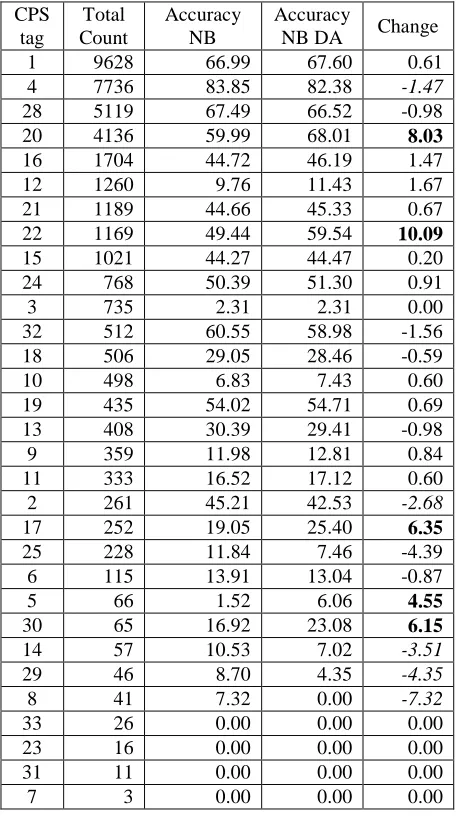
We conducted additional investigations, to look how the classifiers perform for each individual CPS category. Table 4 presents the accuracy of the Na-ïve-Bayes unigram-based classifier on each CPS category. One obvious conclusion is that the larger is the count of a given category, the higher is the classifier accuracy. In fact, the Pearson correlation between tag count and accuracy is 0.701. While this might be expected, there are also some examples that do not follow this trend. The classifier achieves only 9.76% accuracy on label #12 (student elabo-rates on own statement), although it is a rather fre-quent category. A possible reason for this might be that elaboration statements are highly heterogene-ous in form and lexical content, their status as ‘elab-orations’ requires some abstraction and semantic in-ference. Another example is label #3 (student re-sponds to the teammate's request for task-relevant information), with only 2.31% classification accu-racy. This looks like one of the cases that could ben-efit from considering content from previous chat-turns, although not always from the immediately preceding turn.
Detailed analysis of classifier performance on each CPS category provides some interesting find-ings. In experiment 3 we have found that adding probabilistic dialogue act detection as features to a lexical Naïve-Bayes classifier improves overall ac-curacy by just 1%. However, a detailed view reveals additional information (see last column in Table 4). For some CPS categories, adding dialogue acts con-siderably improves classifier accuracy: 8% for
cat-egory #20 and 10% for catcat-egory #22. This is not expected – CPS category #20 (student checks on un-derstanding) directly corresponds to dialogue-act category ‘understanding-Check’. Another case is CPS category #17 (student expresses progress in un-derstanding), which corresponds rather directly to dialogue-act “acknowledgement”. For several other CPS categories, detection of dialogue-acts was not helpful for CPS classification. In future work, we will consider how to use dialogue-act detection se-lectively in CPS classification.
While the results from our experiments are en-couraging, higher levels of accuracy are needed for
CPS tag
Total Count
Accuracy NB
Accuracy
NB DA Change
1 9628 66.99 67.60 0.61
4 7736 83.85 82.38 -1.47
28 5119 67.49 66.52 -0.98
20 4136 59.99 68.01 8.03
16 1704 44.72 46.19 1.47
12 1260 9.76 11.43 1.67
21 1189 44.66 45.33 0.67
22 1169 49.44 59.54 10.09
15 1021 44.27 44.47 0.20
24 768 50.39 51.30 0.91
3 735 2.31 2.31 0.00
32 512 60.55 58.98 -1.56
18 506 29.05 28.46 -0.59
10 498 6.83 7.43 0.60
19 435 54.02 54.71 0.69
13 408 30.39 29.41 -0.98
9 359 11.98 12.81 0.84
11 333 16.52 17.12 0.60
2 261 45.21 42.53 -2.68
17 252 19.05 25.40 6.35
25 228 11.84 7.46 -4.39
6 115 13.91 13.04 -0.87
5 66 1.52 6.06 4.55
30 65 16.92 23.08 6.15
14 57 10.53 7.02 -3.51
29 46 8.70 4.35 -4.35
8 41 7.32 0.00 -7.32
33 26 0.00 0.00 0.00
23 16 0.00 0.00 0.00
31 11 0.00 0.00 0.00
[image:8.612.313.541.235.645.2]7 3 0.00 0.00 0.00
using automated CPS classifiers in operational set-tings. Beigman-Klebanov and Beigman (2014) and Jamison and Gurevych (2015) have suggested that, in supervised machine learning, the presence of dif-ficult items in the training sets is detrimental to learning performance and that performance can be improved if systems are trained on only easy data. They define ‘easy’ as less controversial in human annotations. We explore this aspect using the Naïve-Bayes classifier with unigram lexical features.
Experiment 4. Our annotator H1 used secondary
labels when a chat-turn had two prominent func-tions (rather than just one). Such cases can be con-sidered ambiguous and more difficult than cases that have only one prominent CPS function. In this experiment we filtered such cases out (reduction of about 34%, to N=25,299), from either training, test-ing or both. Results are shown in Table 5.
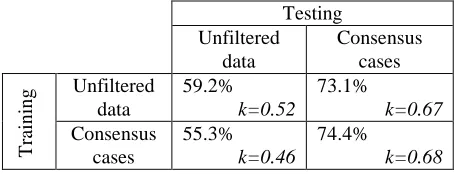
Experiment 5. Here we consider as ‘easy’ only
those 3,818 cases where two human annotators agreed on the primary label. We train a new set of classifiers, using the same five-fold cross-validation splits, but filter out from training all cases that lack explicit consensus. Micro-averaged performance for this type of classifier is compared to the classi-fier that used unfiltered training data. Results are presented in Table 6.
Testing Unfiltered
data
Cases without secondary tag
T
rain
in
g Unfiltered
data
59.2%
k=0.52
69.0%
k=0.62
Cases without secondary tag
57.8%
k=0.49
70.9%
[image:9.612.68.301.429.516.2]k=0.63
Table 5: Classifier accuracy when trained and tested with/without cases that have secondary CPS labels.
Testing Unfiltered
data
Consensus cases
T
rain
in
g Unfiltered
data
59.2%
k=0.52
73.1%
k=0.67
Consensus cases
55.3%
k=0.46
74.4%
k=0.68
Table 6: Classifier accuracy when trained and tested with all or just human-rater-consensus cases.
In both experiments 4 and 5 we see that when a classifier is trained on ‘easy’ data and tested on all data, performance degrades (relative to a classifier that was trained on all data), but degradation is very moderate. In experiment 4, training data was re-duced by 30%, but degradation of accuracy was just 1.4%. In experiment 5 training data was reduced by 90%, but degradation of accuracy was just 3.9%. On the other hand, when tested on only easy data, clas-sifiers that were trained on easy data outperform the classifiers that were trained on unfiltered data, but only by a very small margin (1-2%).
6
Conclusions
In this paper we presented a novel task that inte-grates collaborative problem solving behavior with testing in a science domain. For integration in edu-cational assessment, the task would benefit from au-tomated scoring of CPS discourse. We used a com-plex CPS coding scheme with four major dimen-sions and 33 classes. In our initial exploration, we sought to obtain a single CPS category-label for each turn in chat dialogues. Our results indicate that considerable accuracy (59.2%) can be achieved by using a simple Naïve-Bayes classifier with unigram lexical features. This result approaches human inter-rater agreement (62.8%).
[image:9.612.72.299.554.641.2]References
Asterhan, C.S.C., and B.B. Schwarz. 2009. Argumenta-tion and ExplanaArgumenta-tion in Conceptual Change: Indica-tions from Protocol Analyses of Peer-to-Peer Dialog.
Cognitive Science, 33, 374–400.
Baker, R., D'Mello, S.K., Rodrigo, M.M.T. and A.C. Graesser. 2010. Better to Be Frustrated than Bored: The Incidence, Persistence, and Impact of Learners' Cognitive-Affective States during Interactions with Three Different Computer-Based Learning Environ-ments. International Journal of Human-Computer Studies, 68, 4, 223-241.
Barron, B. (2003). When smart groups fail. The Journal of the Learning Sciences, 12(3):307-359.
Beigman Klebanov, B. and E. Beigman. 2014. Difficult Cases: From Data to Learning, and Back. In Proceed-ings of the 52nd Annual Meeting of the Association for Computational Linguistics (Short Papers), pages 390–396.
Boyer, K.E., Ha, E.Y., Phillips, R., Wallis, M.D., Vouk, M.A. and J.C. Lester. 2010. Dialogue act modeling in a complex task-oriented domain. In Proceedings of the 11th Annual Meeting of the Special Interest Group on Discourse and Dialogue, pages 297-305. Association for Computational Linguistics.
Chin, C., and J. Osborne. 2010. Students' questions and discursive interaction: Their impact on argumentation during collaborative group discussions in science.
Journal of Research in Science Teaching, 47(7), 883-908.
Damon, W., and E. Phelps. 1989. Critical distinction among three approaches to peer education. Interna-tional Journal of EducaInterna-tional Research, 13, 9-19. De Felice R. and P. Deane. 2012. Identifying Speech Acts
in E-Mails: Toward Automated Scoring of the TOEIC® E-Mail Task. ETS Research Report RR-12-16. Educational Testing Service, Princeton, NJ. Dillenbourg, P. and D. Traum. 2006. Sharing solutions:
Persistence and grounding in multimodal collabora-tive problem solving. The Journal of the Learning Sci-ences, 15(1):121-151.
Dönmez, P., Rosé, C., Stegmann, K., Weinberger, A., and F. Fischer. 2005. Supporting CSCL with automatic corpus analysis technology. In T. Koschmann, D.D. Suthers, and T.-W. Chan (Eds.), Proceedings of the 2005 conference on Computer support for collabora-tive learning: The next 10 years! Mahwah, NJ: Law-rence Erlbaum Associates, pages 125–134.
Duschl, R., and J. Osborne. 2002. Supporting and pro-moting argumentation discourse. Studies in Science Education, 38, 39-72.
Erkens, G. and J. Janssen. 2008. Automatic coding of di-alogue acts in collaboration protocols. Computer-Sup-ported Collaborative Learning, 3:447–470.
Flor, M. 2012. Four types of context for automatic spelling correction. Traitement Automatique des Langues (TAL), 53:3, 61-99
Graesser, A.C., D'Mello, S.K., Craig, S.D., Witherspoon, A., Sullins, J., McDaniel, B. and B. Gholson. 2008. The relationship between affective states and dialog patterns during interactions with AutoTutor. Journal of Interactive Learning Research, 19, 2,293-312. Greiff. S. 2012. From interactive to collaborative
prob-lem solving: Current issues in the Programme for In-ternational Student Assessment. Review of Psychol-ogy, 19, 2, 111–121.
Griffin, P., Care, E., and B. McGaw. 2012. The changing role of education and schools. In P. Griffin, B. McGaw, and E. Care (Eds.), Assessment and teaching 21st cen-tury skills, pages 1-15. Heidelberg, Germany: Springer.
Hao, J., Liu, L., von Davier, A., and P. Kyllonen. 2015. Assessing collaborative problem solving with simula-tion based tasks. In Proceeding of the 11th international
conference on computer supported collaborative learning, Gothenburg, Sweden.
Hao, J., Liu, L., von Davier, A., Kyllonen, P. and C. Kitchen. (Submitted). Collaborative problem solving skills versus collaboration outcomes: findings from statistical analysis and data mining, The 9th Interna-tional Conference on EducaInterna-tional Data Mining Hatano, G., and K. Inagaki. 1991. Sharing cognition
through collective comprehension activity. In L.B. Resnick, J.M. Levine, & S.D. Teasley (Eds.), Perspec-tives on socially shared cognition, pages 331-348, Washington, DC: American Psychological Associa-tion.
Higgins, S., Mercier, E., Burd, L. and A. Joyce-Gibbons. 2012. Multi-touch tables and collaborative learning.
British Journal of Educational Technology, 43(6), 1041-1054
Hmelo-Silver, C.E., and H.S. Barrows. 2008. Facilitating collaborative knowledge building. Cognition and In-struction, 26, 48-94.
Hmelo-Silver, C.E., Nagarajan, A., and R.S. Day. 2000. Effects of high and low prior knowledge on construc-tion of a joint problem space. Journal of Experimental Education, 69, 36-57.
Jamison, E.K. and I. Gurevych. 2015. Noise or additional information? Leveraging crowdsource annotation item agreement for natural language tasks. In Proceed-ings of the 2015 Conference on Empirical Methods in Natural Language Processing, pages 291–297. Kersey, C., Di Eugenio, B., Jordan, P., and S. Katz. 2009.
Klopfer, E., Osterweil, S., Groff, J. and J. Haas. 2009.
Using the technology of today, in the classroom today. The Education Arcade, MIT.
Law, N., Yuen, J., Huang, R., Li, Y., and N. Pan. 2007. A learnable content & participation analysis toolkit for assessing CSCL learning outcomes and processes. In C. A. Chinn, G. Erkens, and S. Puntambekar (Eds.), Mice, minds, and society: The Computer Supported Collaborative Learning (CSCL) Conference 2007 (Vol. 8, pp. 408–417). New Brunswick, NJ: Interna-tional Society of the Learning Sciences.
Landis J.R. and G.G. Koch. 1977. The measurement of observer agreement for categorical data. Biometrics, 33:159-174.
Lipponen, L., Rahikainen, M., Lallimo, J., and K. Hakkarainen. (2003). Patterns of participation and dis-course in elementary students’ computer-supported collaborative learning. Learning and instruction, 13(5), 487-509.
Liu, L., Hao, J., von Davier, A.A., Kyllonen, P. and D. Zapata-Rivera. 2015. A tough nut to crack: Measuring collaborative problem solving. Handbook of Research on Technology Tools for Real-World Skill Develop-ment, pages 344-359.
Lu, J., Chiu, M. M., and N. Law. 2011. Collaborative ar-gumentation and justifications: A statistical discourse analysis of online discussions. Computers in Human Behavior, 27, 946-955.
Mercier, E.M., Higgins, S. and L. da Costa. 2014. Differ-ent leaders: EmergDiffer-ent organizational and intellectual leadership in collaborative learning groups. Interna-tional Journal of Computer-Supported Collaborative Learning, 9(4), 397-432.
OECD. 2013. PISA 2015 draft collaborative problem solving assessment framework. OECD Publishing, Organization for Economic Co-operation and Devel-opment. http://www.oecd.org/pisa/pisaprod-
ucts/Draft%20PISA%202015%20Collabora-tive%20Problem%20Solving%20Framework%20.pdf Prata, D.N., Baker, R., Costa, E., Rosé, C.P., Cui, Y. and
A.M.J.B. de Carvalho. 2009. Detecting and Under-standing the Impact of Cognitive and Interpersonal Conflict in Computer Supported Collaborative Learn-ing Environments. In ProceedLearn-ings of the 2nd Interna-tional Conference on EducaInterna-tional Data Mining, 131-140.
Rosé, C.P., Wang, Y.-C., Cui, Y., Arguello, J., Stegmann, K., Weinberger, A. and F. Fischer. 2008. Analyzing collaborative learning processes automatically: Ex-ploiting the advances of computational linguistics in computer-supported collaborative learning. Interna-tional Journal of Computer Supported Collaborative Learning, 3, 237–271.
Samuel, K., Carberry, S., & K. Vijay-Shanker. 1999. Au-tomatically selecting useful phrases for dialogue act
tagging. In Proceedings of the Fourth Conference of the Pacific Association for Computational Linguistics, Waterloo, Ontario, Canada.
Schellens, T., and M. Valcke. 2005. Collaborative learn-ing in asynchronous discussion groups: What about the impact on cognitive processing?. Computers in Human Behavior, 21(6), 957-975.
Serafin, R., and B. Di Eugenio. 2004. FLSA: Extending Latent Semantic Analysis with features for dialogue act classification s. In Proceedings of the 42nd Annual Meeting on Association for Computational Linguis-tics, Barcelona, Spain.
Shriberg, E., Dhillon, R., Bhagat, S., Ang, J. and H. Car-vey, 2004. The ICSI Meeting Recorder Dialog Act (MRDA) Corpus. In Proceedings of the 5th SIGdial Workshop on Discourse and Dialogue at NAACL- HLT 2004 conference.
Stolcke, A., K. Ries, N. Coccaro, E. Shriberg, R. Bates, D. Jurafsky, P. Taylor, R. Martin, C. Van Ess-Dykema, and M. Meteer. 2000. Dialogue act modeling for auto-matic tagging and recognition of conversational speech. Computational Linguistics, 26(3), pages 339-373.
Von Davier, A.A., and P.F. Halpin. 2013. Collaborative Problem Solving and the Assessment of Cognitive Skills: Psychometric Considerations. ETS Research Report RR-13-41. Educational Testing Service, Princeton, NJ.
Webb, N., Hepple, M., and Y. Wilks. 2005. Dialogue Act Classification Based on Intra-Utterance Features. In Proceedings of the AAAI Workshop on Spoken Lan-guage Understanding.
Webb, N., and T. Liu, 2008. Investigating the portability of corpus derived cue phrases for dialogue act classi-fication. In Proceedings of the 22nd International Con-ference on Computational Linguistics, Vol. 1, pages 977–984, Association for Computational Linguistics. Weinberger, A., and F. Fischer. 2006. A framework to an-alyze argumentative knowledge construction in com-puter-supported collaborative learning. Computers and Education, 46(1), 71–95.