Original Article
Predictive significance of
VEGFA
variations in
intracranial aneurysm
Tao Li1, Hongbin Wang1, Xiushan Li1, Hong Ge2, Hongyan Sun1, Dongzhou Ma1
1Department of Neurosurgery, Affiliated Hospital of Hebei University of Engineering, Handan 056029, Hebei
Province, China; 2The Office of Hospital, Handan Tumor Hospital, 056001, Hebei Province, China
Received December 22, 2015; Accepted March 21, 2016; Epub September 15, 2017; Published September 30, 2017
Abstract: Aim: This study was aimed to predict the significance of vascular endothelinal growth factor A (VEGFA) gene variations (rs3025039 and rs201096) in intracranial aneurysm (IA). Methods: 114 IA patients and 128 healthy controls were enrolled in this case-control study. Cases and controls were age- and gender- matched. All of the participants were unrelated Han Chinese. Strength of the association between the VEGFA variations and IA risk was presented by odds ratios (ORs) and 95% confidence intervals (CIs). Results: Frequency of rs3025039 TT genotype obviously higher in cases than in controls, indicating a statistical significance in the development of IA (P=0.025, OR=3.090, 95% CI=1.113-8.580). Meanwhile, the T allele of rs3025039 variation might act as a risk factor of IA (P=0.006, OR=1.812, 95% CI=1.182-2.776). Stratified analysis showed significant association of rs3025039 with the aneurysms number and size (P<0.05). VEGFA rs2010963 had no significant association with the IA both in the susceptibility and the clinical features of IA. Conclusion: VEGFA rs3025039 might predict the development of IA, including the susceptibility, aneurysms number and size. Further studies were needed to certify this results.
Keywords:VEGFA, variations, intracranial aneurysm
Introduction
Intracranial aneurysm (IA), also called cerebral or brain aneurysm, is defined as the tumor-sim-ulating protuberance in the cerebral vascular. The alteration is caused by the local abnormal changes of intracranial blood vessels which lead to the dilation or bulging of cystic artery walls. IA mainly occurs in the Circle of Willis [1]. Rupture of IA will lead to the subarachnoid hemorrhage (SAH). So IA is one of the most destructive cerebrovascular diseases at pres-ent [2]. Prognosis of IA is very poor, it has a high mortality after the rupture [3]. Specific molecu-lar mechanism of IA is extremely complex [4]. The formation and rupture of IA is a pathologi-cal process affected by many factors [5, 6]. Risk factors of IA could divide into 3 phases: ① factors promote the aneurysm development; ② factors alter the growth or morphology of IA; and ③ factors lead to the rupture [7].
Vascular endothelinal growth factor A (VEGFA), a member of platelet-derived growth factor
Therefore, in this case-control study we select-ed two single nucleotide polymorphisms (SNPs) rs3025039 and rs201096 of VEGFA gene to explore the mechanism of IA in Chinese Han population.
Materials and methods
Study objects
Local ethic committee approved this study. Participants understood this study and
provid-Results
Features of the participants
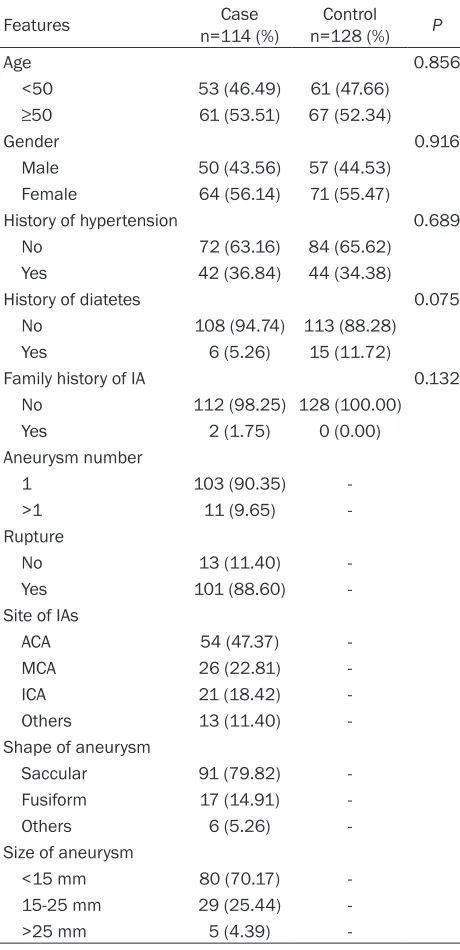
Basic features had no significant differences between the case and control groups (Table 1). The clinical features were also listed in the Table 1. Most IA patients had one aneurysm. Aneurysms mainly located at anterior cerebral artery (ACA), middle cerebral artery (MCA), and internal carotid artery (ICA). Most of the aneu-Table 1. Features of the participants
Features n=114 (%)Case n=128 (%)Control P
Age 0.856
<50 53 (46.49) 61 (47.66)
≥50 61 (53.51) 67 (52.34)
Gender 0.916
Male 50 (43.56) 57 (44.53) Female 64 (56.14) 71 (55.47)
History of hypertension 0.689
No 72 (63.16) 84 (65.62)
Yes 42 (36.84) 44 (34.38)
History of diatetes 0.075
No 108 (94.74) 113 (88.28)
Yes 6 (5.26) 15 (11.72)
Family history of IA 0.132
No 112 (98.25) 128 (100.00)
Yes 2 (1.75) 0 (0.00)
Aneurysm number
1 103 (90.35)
>1 11 (9.65)
-Rupture
No 13 (11.40)
Yes 101 (88.60)
-Site of IAs
ACA 54 (47.37)
MCA 26 (22.81)
ICA 21 (18.42)
Others 13 (11.40)
-Shape of aneurysm
Saccular 91 (79.82)
Fusiform 17 (14.91)
Others 6 (5.26)
-Size of aneurysm
<15 mm 80 (70.17)
15-25 mm 29 (25.44)
>25 mm 5 (4.39)
-Notes: ACA, anterior cerebral artery; MCA, middle cerebral artery; ICA, internal carotid artery.
ed the informed consent. Study process and the sample collection conformed with the declaration of Helsinki. Controls and cases matched with each other in age and gender. All of the subjects were Chinese Han population and had no blood relation among them.
Between January 2013 and June 2015, 114 new diagnosed IA patients and 128 controls were recruited from Affiliated Hospital of Hebei University of Engineer- ing, Patients were diagnosed by computed tomography angiography (CTA), magnetic resonance sngiography (MRA) or digital subtraction angiography (DSA). Controls were take in a healthy check-up in the hos-pital, and had no histories of IA, stroke and other cerebrovascular diseases.
Genotype analysis of VEGFA polymor -phisms
5mL peripheral venous blood was collect-ed from every fasting participator using an EDTA anticoagulation vacuum tube, and then stored at -70°C until to use. Genomic DNA was extracted by a Blood Genomic DNA Kit (Sigma, USA). VEGFA rs3025039 and rs2010963 polymorphisms were de- tected by MassARRAY Assay Design Ver- sion (Sequenom, USA).
Statistical analysis
[image:2.612.91.321.85.560.2]rysms were saccular, small (<15 mm) and ruptured.
Association between VEGFA variations (rs3025039 and rs2010963) and IA risk
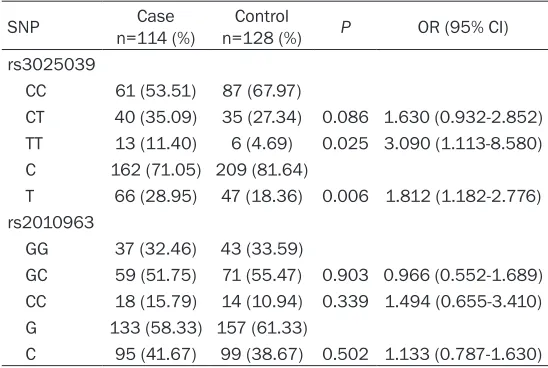
Genotype distributions of rs3025039 and rs2010963 SNPs were not deviated from the HWE test both in cases and controls, indicating the subjects could represent the general population.
For rs3025039, the frequencies of CT and TT genotypes were respectively 35.09%, 11.40% in cases and 27.34%, 4.69% in controls (Table 2). Genotype frequencies of CT and TT were higher in cases than in controls, but only the difference of TT genotype was statistically significant (P=0.025). This obvious difference showed a close association between rs30- 25039 TT genotype and the risk of IA (OR= 3.090, 95% CI=1.113-8.580). At the same time, T allele of rs3025039 polymorphism was significantly higher in case group than in con-trol group (P=0.006), demonstrated that T allele positively associated with the suscepti- bility of IA (OR=1.812, 95% CI=1.182-2.776). Conversely, all of the genotypes and alleles of rs2010963 variation had no significant correla-tion with the risk of IA (P>0.05).
Correlation between VEGFA variations (rs3025039 and rs201096) and the features of IA patients
In order to explore the exact role of VEGFA SNPs in the development of IA, we detected the
cor-shape of IA. It also divided into unruptured and ruptured IA [22]. Unruptured IA usually is asymptomatic, before a larger aneurysm rup-ture, patients may undergo the symptoms such as nausea, vomiting, severe headache, vision impairment, and loss of consciousness. Un- ruptured IA patients are often found through screening high risk patients or as purely inci-dental findings of other neurological symptoms [22]. If an aneurysm ruptures, blood spilled into the space around the brain, this symptom is called SAH. Prognosis of ruptured IA patients depends on many factors. However, most IA patients with ruptures had poor prognosis [23, 24]. Most aneurysms are unobserved until they have been ruptured. There is no effective pre-dictive and therapy method for IA. So it is urgent to explore the mechanism of IA, so as to looking for a predictive marker of IA. Epidemiology researches showed that IA rarely occurs in pediatric populations, and the development of it is influenced by multiple factors [5, 6]. Among these factors, genetic factors are the crucial factor for the onset and development of IA. Genetic factors result in the dilated artery may be the basic factor for IA progression.
[image:3.612.89.363.96.280.2]VEGFA, a highly conserved homodimer glyco-protein, is linked by disulfide bond. Proliferation and migration of vascular endothelial cells may be induced by VEGFA factor [10]. Whilst, VEGFA is essential for both physiological and patho-logical of angiogenesis [11]. VEGFA might play a potential role in the development of IA. A vitro study suggested that recombinant human VEGF (rhVEGF) is effective for the therapy of Table 2. Association between VEGFA SNPs (rs3025039 and
rs2010963) and IA risk
SNP n=114 (%)Case n=128 (%)Control P OR (95% CI) rs3025039
CC 61 (53.51) 87 (67.97)
CT 40 (35.09) 35 (27.34) 0.086 1.630 (0.932-2.852) TT 13 (11.40) 6 (4.69) 0.025 3.090 (1.113-8.580) C 162 (71.05) 209 (81.64)
T 66 (28.95) 47 (18.36) 0.006 1.812 (1.182-2.776) rs2010963
GG 37 (32.46) 43 (33.59)
GC 59 (51.75) 71 (55.47) 0.903 0.966 (0.552-1.689) CC 18 (15.79) 14 (10.94) 0.339 1.494 (0.655-3.410) G 133 (58.33) 157 (61.33)
C 95 (41.67) 99 (38.67) 0.502 1.133 (0.787-1.630)
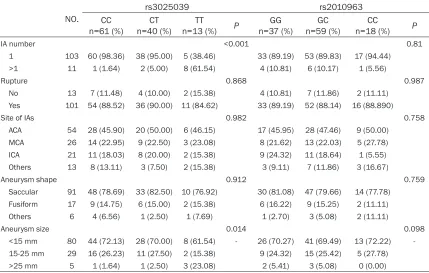
relation between VEGFA varia-tions and the clinical features of IA (Table 3). Afterwards, we found that genotypes of rs30- 25039 significantly related to the number and size of aneu-rysms (P<0.05), but not the rup-ture, site and shape of aneu-rysms (P>0.05). Meanwhile, no significant association was obs- erved between rs2010963 poly-morphism and the clinical char-acteristics of IA (P>0.05). Discussion
aneurysms [25]. A previous study showed that expression of VEGF was altered in the injured brains [26]. However, Sandalcioglu et al. indi-cated that plasma VEGF level was not signifi-cantly associated with aneurysm include the number and location in unruptured IA patients [27]. Recent years, polymorphism becomes the hotspot in the exploration of the mecha-nism of many diseases. Besides, many re- searches revealed that variations of VEGFA
gene correlated with the occurrence of cerebro-vascular diseases [21]. VEGFA rs3025039 and rs201096 variations, respectively located in the 3’ and 5’ untranslated regions (UTRs) of
VEGFA gene, associated with many diseases [28-30]. Because the role of VEGFA gene in IA onset is not clear, we selected these two SNPs of VEGFA gene to certify the pathogenesis of IA. In this study we found that rs3025039 TT geno-type increased the IA risk about 3.090 times compared with the CC genotype. T allele of rs3025039 variation enhanced 1.812 times risk of IA. These results were different from a study performed in Italy which suggested that
VEGF +936C>T and 18 bp microdeletion poly-morphisms were not significantly associated with the susceptibility and clinical features of
aneurysmal SAH [31]. But He et al. [29] indicat-ed that T allele increasindicat-ed the risk of hyperten-sive cerebellar hemorrhage. This variation also positively associated with the risk of glioma [28]. These results provide an evidence that rs3025039 associated with the susceptibility of IA from other aspect. However, no significant association was observed between rs2010963 variation and the IA susceptibility. This result accorded with the previous study which sug-gested that VEGFA -634GG genotype signifi-cantly enhanced the risk of abdominal aortic aneurysm [21]. But it was different from the role in glioma [28] and hypertensive cerebellar hemorrhage [29]. Further stratified analysis revealed that rs3025039 variation correlated with the aneurysms number and size, but not other features. Meanwhile, rs2010963 poly-morphism was not related to the clinical char-acteristics of IA.
In summary, VEGFA rs3025039 variation may be predictive to the development of IA, includ-ing susceptibility, number and size of IA. Present results suggested that VEGFA rs30- 25039 variation could predict the onset and development of IA. However, the small sample size, unadjusted result, as well as other con-Table 3. Correlation between VEGFA SNPs (rs3025039 and rs2010963) and the features of IA pa-tients
NO.
rs3025039 rs2010963
CC
n=61 (%) n=40 (%)CT n=13 (%)TT P n=37 (%)GG n=59 (%)GC n=18 (%)CC P
IA number <0.001 0.81
1 103 60 (98.36) 38 (95.00) 5 (38.46) 33 (89.19) 53 (89.83) 17 (94.44)
>1 11 1 (1.64) 2 (5.00) 8 (61.54) 4 (10.81) 6 (10.17) 1 (5.56)
Rupture 0.868 0.987
No 13 7 (11.48) 4 (10.00) 2 (15.38) 4 (10.81) 7 (11.86) 2 (11.11)
Yes 101 54 (88.52) 36 (90.00) 11 (84.62) 33 (89.19) 52 (88.14) 16 (88.890)
Site of IAs 0.982 0.758
ACA 54 28 (45.90) 20 (50.00) 6 (46.15) 17 (45.95) 28 (47.46) 9 (50.00)
MCA 26 14 (22.95) 9 (22.50) 3 (23.08) 8 (21.62) 13 (22.03) 5 (27.78)
ICA 21 11 (18.03) 8 (20.00) 2 (15.38) 9 (24.32) 11 (18.64) 1 (5.55)
Others 13 8 (13.11) 3 (7.50) 2 (15.38) 3 (9.11) 7 (11.86) 3 (16.67)
Aneurysm shape 0.912 0.759
Saccular 91 48 (78.69) 33 (82.50) 10 (76.92) 30 (81.08) 47 (79.66) 14 (77.78)
Fusiform 17 9 (14.75) 6 (15.00) 2 (15.38) 6 (16.22) 9 (15.25) 2 (11.11)
Others 6 4 (6.56) 1 (2.50) 1 (7.69) 1 (2.70) 3 (5.08) 2 (11.11)
Aneurysm size 0.014 0.098
<15 mm 80 44 (72.13) 28 (70.00) 8 (61.54) - 26 (70.27) 41 (69.49) 13 (72.22) 15-25 mm 29 16 (26.23) 11 (27.50) 2 (15.38) 9 (24.32) 15 (25.42) 5 (27.78)
[image:4.612.92.521.97.370.2]founding factors may lead to the limitations of present study. Therefore, further studies are necessary to understand the mechanism of IA. Disclosure of conflict of interest
None.
Address correspondence to: Dongzhou Ma, Affiliat- ed Hospital of Hebei University of Engineering, No. 81 Congtai Road, Handan 056029, Hebei Province, China. E-mail: [email protected]
References
[1] Leveque S, Derrey S, Castel H and Proust F. The Mini Supra-orbital Approach for Cerebral Aneurysm of the Anterior Portion of the Circle of Willis. Acta Neurochir Suppl 2014; 119: 21-24.
[2] Anxionnat R, Tonnelet R, Derelle AL, Liao L, Barbier C and Bracard S. Endovascular treat-ment of ruptured intracranial aneurysms: Indications, techniques and results. Diagn Interv Imaging 2015; 96: 667-675.
[3] Staalso JM, Bergstrom A, Edsen T, Weikop P, Romner B and Olsen NV. Low plasma arginine:asymmetric dimethyl arginine ratios predict mortality after intracranial aneurysm rupture. Stroke 2013; 44: 1273-1281. [4] Caranci F, Briganti F, Cirillo L, Leonardi M and
Muto M. Epidemiology and genetics of intra-cranial aneurysms. Eur J Radiol 2013; 82: 1598-1605.
[5] Morgan MK, Alsahli K, Wiedmann M, Assaad NN and Heller GZ. Factors Associated With Proximal Intracranial Aneurysms to Brain Arteriovenous Malformations: A Prospective Cohort Study. Neurosurgery 2016; 78: 787-92.
[6] Lee GI, Choi KS, Han MH, Byoun HS, Yi HJ and Lee BR. Practical Incidence and Risk Factors of Terson’s Syndrome: A Retrospective Analysis in 322 Consecutive Patients with Aneurysmal Subarachnoid Hemorrhage. J Cerebrovasc Endovasc Neurosurg 2015; 17: 203-208.
[7] Thompson BG, Brown RD Jr, Amin-Hanjani S, Broderick JP, Cockroft KM, Connolly ES Jr, Duckwiler GR, Harris CC, Howard VJ, Johnston SC, Meyers PM, Molyneux A, Ogilvy CS, Ringer AJ and Torner J. Guidelines for the Manage- ment of Patients With Unruptured Intracranial Aneurysms: A Guideline for Healthcare Profes- sionals From the American Heart Association/ American Stroke Association. Stroke 2015; 46: 2368-2400.
[8] Pereza N, Ostojic S, Smircic A, Hodzic A, Kapovic M and Peterlin B. The -2549 inser-tion/deletion polymorphism in the promoter
region of the VEGFA gene in couples with idio-pathic recurrent spontaneous abortion. J Assist Reprod Genet 2015; 32: 1789-94. [9] Platania CB, Di Paola L, Leggio GM, Romano
GL, Drago F, Salomone S and Bucolo C. Molecular features of interaction between VEGFA and anti-angiogenic drugs used in reti-nal diseases: a computatioreti-nal approach. Front Pharmacol 2015; 6: 248.
[10] Gao Y, Wu K, Chen Y, Zhou J, Du C, Shi Q, Xu S, Jia J, Tang X, Li F, Hui K, He D and Guo P. Beyond proliferation: KLF5 promotes angio-genesis of bladder cancer through directly regulating VEGFA transcription. Oncotarget 2015; 6: 43791-805.
[11] Zhao DQ, Chen J, Wu YF, Tian D and Zhou RX. Correlation between Vascular Endothelial Growth Factor and Somatostatin Receptor with Progression and Prognosis in Gastric Cancer. Hepatogastroenterology 2014; 61: 1154-1158.
[12] Hollborn M, Vogler S, Reichenbach A, Wiede- mann P, Bringmann A and Kohen L. Regulation of the hyperosmotic induction of aquaporin 5 and VEGF in retinal pigment epithelial cells: in-volvement of NFAT5. Mol Vis 2015; 21: 360-377.
[13] Duan X, Murata Y, Liu Y, Nicolae C, Olsen BR and Berendsen AD. Vegfa regulates perichon-drial vascularity and osteoblast differentiation in bone development. Development 2015; 142: 1984-1991.
[14] Ma J, Hu W, Zhang P, Sun Y, Wang N, Teng X and Qiao Q. The Association Between VEGF +936C/T and -634G/C Polymorphisms and Breast Cancer Susceptibility, Tumor Growth, and Metastases: Evidence From 20,728 Subjects. Cancer Invest 2015; 33: 312-317. [15] Simons M and Eichmann A. Molecular controls
of arterial morphogenesis. Circ Res 2015; 116: 1712-1724.
[16] Cydzik M, Abdul-Wahid A, Park S, Bourdeau A, Bowden K, Prodeus A, Kollara A, Brown TJ, Ringuette MJ and Gariepy J. Slow binding ki-netics of secreted protein, acidic, rich in cyste-ine-VEGF interaction limit VEGF activation of VEGF receptor 2 and attenuate angiogenesis. FASEB J 2015; 29: 3493-3505.
[17] DiStefano PV, Kuebel JM, Sarelius IH and Glading AJ. KRIT1 protein depletion modifies endothelial cell behavior via increased vascu-lar endothelial growth factor (VEGF) signaling. J Biol Chem 2014; 289: 33054-33065.
[19] Lakkireddy S, Aula S, Kapley A, Swamy AV, Digumarti RR, Kutala VK and Jamil K. Association of Vascular Endothelial Growth Factor A (VEGFA) and its Receptor (VEGFR2) Gene Polymorphisms with Risk of Chronic Myeloid Leukemia and Influence on Clinical Outcome. Mol Diagn Ther 2016; 20: 33-44. [20] Sivaprasad S, Govardhan B, Harithakrishna
R, Venkat Rao G, Pradeep R, Kunal B, Ramakrishna N, Anuradha S and Reddy DN. Association of vascular endothelial growth fac-tor (VEGF) gene polymorphism and increased serum VEGF concentration with pancreatic ad-enocarcinoma. Pancreatology 2013; 13: 267-272.
[21] Strauss E, Waliszewski K, Oszkinis G and Staniszewski R. Polymorphisms of genes in-volved in the hypoxia signaling pathway and the development of abdominal aortic aneu-rysms or large-artery atherosclerosis. J Vasc Surg 2015; 61: 1105-1113 e1103.
[22] Tromp G, Weinsheimer S, Ronkainen A and Kuivaniemi H. Molecular basis and genetic predisposition to intracranial aneurysm. Ann Med 2014; 46: 597-606.
[23] Rouchaud A, Brinjikji W, Lanzino G, Cloft HJ, Kadirvel R and Kallmes DF. Delayed hemor-rhagic complications after flow diversion for intracranial aneurysms: a literature overview. Neuroradiology 2016; 58: 171-7.
[24] Wang R, Zhang D, Zhao J, Wang S, Zhao Y and Niu H. A comparative study of 43 patients with mirror-like intracranial aneurysms: risk factors, treatment, and prognosis. Neuropsychiatr Dis Treat 2014; 10: 2231-2237.
[25] Ohyama T, Nishide T, Iwata H, Sato H, Toda M and Taki W. Vascular endothelial growth factor immobilized on platinum microcoils for the treatment of intracranial aneurysms: experi-mental rat model study. Neurol Med Chir (Tokyo) 2004; 44: 279-285; discussion 286-277.
[26] Wang F, Shen Y, Tsuru E, Yamashita T, Baba N, Tsuda M, Maeda N and Sagara Y. Syngeneic transplantation of newborn splenocytes in a murine model of neonatal ischemia-reperfu-sion brain injury. J Matern Fetal Neonatal Med 2015; 28: 842-847.
[27] Sandalcioglu IE, Wende D, Eggert A, Regel JP, Stolke D and Wiedemayer H. VEGF plasma lev-els in non-ruptured intracranial aneurysms. Neurosurg Rev 2006; 29: 26-29.
[28] Zhang J, Yang J, Chen Y, Mao Q, Li S, Xiong W, Lin Y, Chen J and Ge J. Genetic Variants of VEGF (rs201963 and rs3025039) and KDR (rs7667298, rs2305948, and rs1870377) Are Associated with Glioma Risk in a Han Chinese Population: a Case-Control Study. Mol Neuro- biol 2016; 53: 2610-8.
[29] He QS, Yang LF, Wang WB, Yuan B, Zhang LY and Guo XJ. Vascular endothelial growth factor gene is associated with hypertensive cerebel-lar hemorrhage and rehabilitative treatment. Genet Mol Res 2015; 14: 9849-9857.
[30] Kim OJ, Hong SH, Oh SH, Kim TG, Min KT, Oh D and Kim NK. Association between VEGF poly-morphisms and homocysteine levels in pa-tients with ischemic stroke and silent brain in-farction. Stroke 2011; 42: 2393-2402. [31] Fontanella M, Gallone S, Panciani PP, Garbossa