OEE_LEACH: Optimized Energy Efficient Low Energy
Adaptive Clustering Hierarchy Protocol in Wireless
Sensor Network
Lalit Kumar Chourse
Truba Institute of Engineering & Information Technology, Bhopal, India
Amit Saxena
Truba Institute of Engineering & Information Technology, Bhopal, India
ABSTRACT
Wireless Sensor Network (WSN) is infrastructure based. Sensors usually rely on their battery for power, which cannot be recharge or replaced. To reduce the energy consumption focus is on the cluster stability. A new protocol is proposed called OEE_LEACH for cluster stability by adding parameter in distributive Cluster Setup function in terms of energy of nodes, number of nodes and average distance between CH and member nodes by putting weights alpha, beta and gamma respectively. The coefficient of parameters is 1.The OEE_LEACH protocol is better than in terms of energy performance, throughput, and packet delivery ratio than LEACH.
Keywords
Routing, clustering, Energy efficiency, Energy level, Cluster head CH, network lifetime.
1.
INTRODUCTION
Wireless Sensor Networks (WSNs) are communication networks that interconnect several sensor devices to perform some set of tasks. A sensor node is made up of four basic components: a sensing unit, a processing unit, a transceiver unit and a power unit. These sensor nodes can self organize to form a network and can communicate with each other in a wireless manner. Each self-organized node collects data from the environment, exchanges these data with other nodes and sends the final information to the sink node or the base station. Commonly sensors are severely energy constrained since they are battery powered [9].
The WSN can be applied to various types of applications, such as Environment Management, Military Monitoring, Health Applications and Home Applications. Some environmental applications of sensor networks include tracking the movements of birds, small animals, monitoring environmental conditions that affect crops and livestock [5]
.
Some of the military applications of sensor networks are monitoring friendly forces, equipment and ammunition, battlefield surveillance, reconnaissance of opposing forces and terrain, targeting, battle damage assessment, and nuclear, biological and chemical (NBC) attack detection and reconnaissance.
Some of the health applications for sensor networks are providing interfaces for the disabled; integrated patient monitoring; diagnostics, drug administration in hospitals, monitoring the movements and internal processes of insects or other small animals.
Home application, smart sensor nodes and actuators can be buried in appliances, such as vacuum cleaners, micro-wave
ovens, refrigerators, and VCRs. These sensor nodes inside the domestic devices can interact with each other and with the external network via the Internet or Satellite. So, it is essential to improve the energy efficiency to enhance the quality of application service.
The rest of the paper is organized as follows. Section II presents the basic protocol of WSN. In section III, problem statement is given. Section IV, presented the propose scheme. Section V, provide simulation and result performance of proposed scheme by comparing it with the existing schemes in terms of energy. In Section VI, conclusion and future directions of this paper is presented.
2.
Low-Energy
Adaptive
Clustering
Hierarchy (LEACH)
Perhaps the first network protocol that is specifically designed for wireless sensors is the Low-Energy Adaptive Clustering Hierarchy (LEACH) protocol [1]. It is also the base protocol from which several of the well-known routing protocols for wireless sensor networks are derived. The main setting that LEACH protocol addresses is that of a large number of homogeneous, resource-constrained cheap, stationary nodes monitoring the environment. Nodes periodically send their readings to a base station located far away from the field as shown in Figure 1.
The protocol achieves its power saving goals by allowing a small percentage of the nodes (cluster heads) to collect data from their surrounding neighbors, aggregate the data and send a single report to the base station representing the combined readings. The protocol avoids depleting the cluster heads energies by selecting a new set of cluster heads at the beginning of each round. The set up overhead is assumed to be negligible since the setup time is small compared to the rounds duration. The protocol uses a randomized routine for each node to elect itself as a cluster head. This routine is run locally at each node to avoid the traffic overhead of a centralized routine.
2.1 Clusters Formation in LEACH:
Fig1. Cluster-based Network Routing
LEACH protocol [2][8] operates in rounds, where in each round a new set of cluster heads is selected. Each round is divided into a setup phase and a steady state operation phase. Since this is a distributed system, each node elects itself as a cluster head independently during the setup phase. To do this, each node (n) will independently choose a random number in the interval (0, 1). This number is then compared to the network wide threshold T (n) given by the equation:
Where p is the optimized cluster heads percentage. This number is determined prior to network deployment. It is calculated using empirical data to get the percentage of cluster heads [4] that gives the lowest energy consumption in the network. G is the group of nodes that have not been cluster heads in the past 1-p rounds, and r is the round number. In round 0, all nodes are eligible to elect themselves as cluster heads. During subsequent rounds, the number of eligible nodes decreases, consequently, the threshold probability must increase to maintain the required percentage.
This protocol is divided into rounds [4]; each round consists of two phases;
Set-up Phase
(1) Advertisement Phase (2) Cluster Set-up Phase
Steady Phase (1) Schedule Creation (2) Data Transmission
Each node decides independent of other nodes if it will become a CH or not. This decision takes into account when the node served as a CH [6] for the last time (the node that hasn't been a CH for long time is more likely to elect itself than nodes that have been a CH recently).In the following advertisement phase, the CHs inform their neighborhood with an advertisement packet that they become CHs. Non-CH nodes pick the advertisement packet with the strongest received signal strength.
In the next cluster setup phase, the member nodes inform the CH that they become a member to that cluster with "join packet" contains their IDs using CSMA. After the cluster-setup sub phase, the CH knows the number of member nodes and their IDs. Based on all messages received within the cluster, the CH creates a TDMA schedule, pick a CSMA code randomly, and broadcast the TDMA table to cluster members. After that steady-state phase begins.
Steady-state phase:
Data transmission begins; Nodes send their data during their allocated TDMA [7] slot to the CH. This transmission uses a minimal amount of energy (chosen based on the received strength of the CH advertisement). The radio of each non-CH node can be turned off until the nodes allocated TDMA slot, thus minimizing energy dissipation in these nodes.
When all the data has been received, the CH aggregates these data and sends it to the BS. LEACH is able to perform local aggregation of data in each cluster to reduce the amount of data that transmitted to the base station. Although LEACH protocol acts in a good manner, it suffers from many drawbacks such like;
1. CH selection is randomly, that does not take into account energy consumption.
2. It can't cover a large area.
3. CHs are not uniformly distributed; where CHs can be located at the edges of the cluster.
Since LEACH has many drawbacks, many researches have been done to make this protocol performs better.
3. PROBLEM STATEMENT
Clustering is efficient scheme for data aggregation in the wireless sensor network. In which each sensor node sends data to the aggregator node means cluster head (CH) and then cluster head perform aggregation process on the received data and then send it to the base station (BS). Performing aggregation function over cluster-head still causes significant energy wastage. In case of homogeneous sensor network cluster-head will soon die out and again re-clustering has to be done which again cause energy consumption. In this paper, an algorithm is proposed that performs data aggregation process within a cluster. In this proposed algorithm focus is on avoiding re-clustering, improve the CH stability over the time of clustering process, increase the throughput, packet delivery ratio, minimize the end-to-end delay and reduce the energy consumption within cluster in large-scale and dense sensor networks with the help of cluster head selection and cluster formation. To achieve these objectives, proposed algorithm is presented in which CHs are not rapidly changes in the different interval of time from cluster in each round and data are sent to CH in multi-hop manner to prolong the lifetime of network.
High Power Tx
Low power Tx
Sensor Node
Cluster Head
BS
T (n) =
P
1-P(r mod 1/p)
0
if n ϵ G
Otherwise
4. PROPOSED ALGORITHM:
Optimal parameters estimation for successful clustering is very important. WSN has specific constraints like energy, coverage and connectivity have to be satisfied.
OEE_LEACH protocol focuses on the cluster stability, therefore three parameters are added in distributive Cluster Setup function in terms of energy of nodes, number of nodes and average distance between CH and member nodes by putting weights alpha, beta and gamma respectively. The coefficient of parameters is 1.
OEE_LEACH protocol operates in rounds, where in each round a new set of cluster heads is selected. Each round is divided into a setup phase and a steady state operation phase. Since this is a distributed system, each node elects itself as a cluster head independently during the setup phase. To do this, each node (n) will independently choose a random number in the interval (0, 1).
FTHRESH = alpha * thresh + beta * thresh1 +
gama * thresh2
where,
thresh = Ei(t) / ETotal(t)
thresh1 = nn / tn
thresh2 = average distance / maximum
distance.
Ei(t) = current energy of nodes.
ETotal(t) = total energy from all nodes in
Network.
nn = number of nodes.
tn = total number of nodes.
avgDist = average distance.
The value of alpha + beta + gamma =1
Due to above parameter Cluster Head are not change rapidly as compare to original Cluster Head of LEACH protocol. In OEE_LEACH protocol Cluster Head collects and aggregates data from sensors in its own cluster and passes the information to the BS directly.
5. SIMULATION AND RESULTS
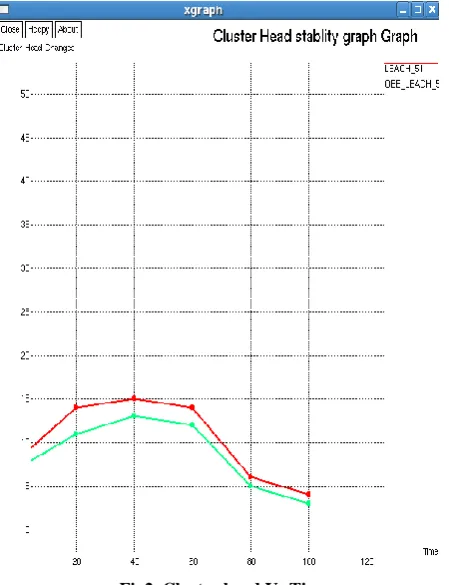
[image:3.595.316.541.427.720.2]This section present the performance of the proposed algorithm OEELEACH obtained by simulation using NS-2.34 simulator. In this simulation, experiment performed on 100 nodes which were randomly deployed and distributed in a 100×100 square meter area. Table1 shows the simulation parameter. Sensor nodes contain two kinds of nodes: sink nodes (no energy restriction) and common nodes (with energy restriction).
TABLE 1
Simulation parameter
By taking into account the above parameter, put the values of alpha, beta and gamma are such that its summation gives resultant 1.Therefore, after simulation it is concluded that alpha, beta and gamma are 0.5, 0.4 and 0.1 respectively which gives the optimal results. During simulation, focus is on the nodes 51,101,151 and 201.
Case I: Analysis stated from node 0 to 50, in that 50th node is the base station.
Fig2. Cluster head Vs Time
Parameter Value
Simulation 360 sec
Initial Node 2 Joules
Node Distribution Nodes are randomly distributed
BS Position 56,175
Fig3. Average Energy Consumption Vs Time
Case II: In this case analysis is done from nodes 0 to 100, in
that 100th node is the base station.
Fig4: Cluster head Vs Time
Fig5. Average Energy Consumption Vs Time
Case III: Now, again analysis is done from nodes 0 to 150, in
that 150th node is the base station.
Fig7.Average Energy Consumption Vs Time
Case IV: The last analysis is done from node 0 to 200, in that
200th node is the base station.
Fig8.Cluster head Stability Vs Time
Fig9. Average Energy Consumption Vs Time
Case V: Graphs shown Throughput, Packet Delivery Ratio
and End-to-End Delay.
Fig11. No. of Nodes Vs Time
Fig12. No. of Nodes Vs Time
6.
CONCLUSION & FUTURE WORK
In this paper a new approach is presented for optimal cluster Head formation. In particular, this new approach uses a weight parameter for optimal formation of cluster Head. Simulation performed at area 100*100 and found that OEE_LEACH perform well in terms of energy performance, throughput, and packet delivery ratio than LEACH. Future work will be on alive nodes.
7.
REFERENCES
[1] Ahmed Badi, Imad Mahgoub, Ahmed Badi, Ima Mahgoub, “Impact of Transmission-related Parameters on the Energy Performance of Cluster-based Routing Protocols for Wireless Sensor Networks,” 2011 International Conference on Innovations in Information Technology.
[2] Kiran Mariya, Kamal Kanth andNitin Gupta , “Efficient Cluster Head Selection Scheme for DatAggregation in Wireless Sensor Network”, 2011 International Journal of Computer Application (0975-8887) Volume 23-No.9,June 2011.
[3] Sabarish B A, Guru Moorthy S M, Dhivya M A, Sakthi Naveen K, Vaishnavi S “A survey on clustering protocols in Wireless Sensor Networks” International Journal Of Advances In Computing and Information Technology, published on April 2012.
[4] Anindita Ray, Debashis De, “P-EECHS: Parametric Energy Efficient Cluster Head Selection protocol for Wireless Sensor Network”, International Journal of Advanced Computer Engineering & Architecture, Vol. 2 No. 2, June-December, 2012
[5] Moufida Maimour, Houda Zeghilet, “A Survey Paper on Cluster-based Routing Protocols for Energy Efficiency in Wireless Sensor Networks” Francis Lepage CRAN laboratory, Nancy University, CNRS France
[6] Min Yoon, Jaewoo Chang, “Design and Implementation of Cluster-based Routing Protocol using Message Success Rate in Sensor Networks,” 2011 IEEE .
[7] Rabia Noor Enam , Mumtazul Imam and Rehan Inam Qureshi, “Energy Consumption in Random Cluster Head selection Phase of WSN”, 2012 IACSIT Hong Kong Conferences, IPCSIT vol. 30 (2012), IACSIT Press, Singapore.
[8] F. Xiangning, S. Yulin, "Improvement on LEACH Protocol of Wireless Sensor Network", International Conference on Sensor Technologies and Applications, IEEE, pp.260-264, 2007.