Proceedings of the 7th Joint Conference on Lexical and Computational Semantics (*SEM), pages 255–264
Solving Feature Sparseness in Text Classification
using Core-Periphery Decomposition
Xia Cui, Sadamori Kojaku, Naoki Masuda, and Danushka Bollegala
Department of Computer Science, University of Liverpool Department of Engineering Mathematics, University of Bristol
{xia.cui, danushka.bollegala}@liverpool.ac.uk {sadamori.koujaku, naoki.masuda}@bristol.ac.uk
Abstract
Feature sparseness is a problem common to cross-domain and short-text classification tasks. To overcome this feature sparseness problem, we propose a novel method based on graph decomposition to find candidate fea-tures for expanding feature vectors. Specif-ically, we first create a feature-relatedness graph, which is subsequently decomposed into core-periphery (CP) pairs and use the periph-eries as the expansion candidates of the cores. We expand both training and test instances using the computed related features and use them to train a text classifier. We observe that prioritising features that are common to both training and test instances as cores dur-ing the CP decomposition to further improve the accuracy of text classification. We evalu-ate the proposed CP-decomposition-based fea-ture expansion method on benchmark datasets for cross-domain sentiment classification and short-text classification. Our experimental re-sults show that the proposed method consis-tently outperforms all baselines on short-text classification tasks, and perform competitively with pivot-based cross-domain sentiment clas-sification methods.
1 Introduction
Short-texts are abundant on the Web and ap-pear in various different formats such as micro-blogs (Kwak et al., 2010), Question and Answer (QA) forums, review sites, Short Message Ser-vice (SMS), email, and chat messages (Cong et al., 2008;Thelwall et al., 2010). Unlike lengthy re-sponses that take time to both compose and to read, short responses have gained popularity par-ticularly in social media contexts. Considering the steady growth of mobile devices that are physi-cally restricted to compact keyboards, which are suboptimal for entering lengthy text inputs, it is safe to predict that the amount of short-texts will
continue to grow in the future. Considering the importance and the quantity of the short-texts in various web-related tasks, such as text classifica-tion (kun Wang et al.,2012;dos Santos and Gatti, 2014), and event prediction (Sakaki et al.,2010), it is important to be able to accurately represent and classify short-texts.
Compared to performing text mining on longer texts (Guan et al.,2009;Su et al.,2011;Yogatama and Smith,2014), for which dense and diverse fea-ture representations can be created relatively eas-ily, handling of shorter texts poses several chal-lenges. The number of features that are present in a given short-text will be a small fraction of the set of all features that exist in all of the train instances. Moreover, frequency of a feature in a short-text will be small, which makes it difficult to reliably estimate the salience of a feature using term frequency-based methods. This is known as the feature sparsenessproblem in text classifica-tion.
Feature sparseness is not unique to short-text classification but also encountered in cross-domain text classification (Blitzer et al., 2006, 2007; Bollegala et al., 2014), where the train-ing and test data are selected from different do-mains with small intersection of feature spaces. In the domain adaptation (DA) setting, a classifier trained on one domain (source) might be agnostic to the features that are unique to a different do-main (target), which results in afeature mismatch problem similar to the feature-sparseness problem discussed above.
To address the feature sparseness problem en-countered in short-text and cross-domain classi-fication tasks, we propose a novel method that computes related features that can be appended to the feature vectors to reduce the sparsity. Specif-ically, we decompose a feature-relatedness graph into core-periphery (CP) structures, where a core
feature (a vertex) is linked to a set of periph-eries (also represented by vertices), indicating the connectivity of the graph. This graph decompo-sition problem is commonly known as the CP-decomposition (Csermely et al., 2013; Rombach et al.,2017;Kojaku and Masuda,2018,2017).
Our proposed CP-decomposition algorithm significantly extends existing CP-decomposition methods in three important ways.
• First, existing CP-decomposition methods consider unweighted graphs, whereas edges in feature-relatedness graphs are weighted (possibly nonnegative) real-valued feature-relatedness scores such as positive pointwise mutual information (PPMI). Our proposed CP-decomposition method can operate on edge-weighted graphs.
• Second, considering the fact that in text clas-sification a particular periphery can be related to more than one core, we relax the hard as-signment constraints on peripheries and al-low a particular periphery attach to multiple cores.
• Third, prior work on pivot-based cross-domain sentiment classification methods have used features that are frequent in train-ing (source) and test (target) data as ex-pansion candidates to overcome the feature mismatch problem. Inspired by this, we define coreness of a feature as the point-wise mutual information between a feature and the source/target domains. The CP-decomposition algorithm we propose will then compute the set of cores considering both structural properties of the graph as well as the coreness values computed from the train/test data.
To perform feature vector expansion, we first construct a feature-relatedness graph, where ver-tices correspond to features and the weight of the undirected edge connecting two features repre-sent the relatedness between those two features. Different features and relatedness measures can be flexibly used in the proposed graph construc-tion. In our experiments, we use the simple (yet popular and effective) setting of n-gram features as vertices and compute their relatedness using PPMI. We compute the coreness of features as the sum of the two PPMI values between the feature
and the source, and the feature and the target do-mains.1 Next, CP-decomposition is performed on
this feature-relatedness graph to obtain a set of core-periphery structures. We then rank the set of peripheries of a particular core by their PPMI val-ues, and select the top-ranked peripheries as the expansion features of the core. We expand the core features in training and train a logistic regression-based binary classifier using the expanded feature vectors, and evaluate its performance on the ex-panded test feature vectors.
We evaluate the effectiveness of the proposed method using benchmark datasets for two dif-ferent tasks: short-text classification and cross-domain sentiment classification. Experimental results on short-text classification show that the proposed method consistently outperforms pre-viously proposed feature expansion-based meth-ods for short-text classification and even some of the sentence embedding learning-based methods. Moreover, the consideration of coreness during the CP-decomposition improves the text classifi-cation accuracy. In cross-domain sentiment clas-sification experiments, the proposed method out-performs previously proposed pivot-based meth-ods such as the structural correspondence learning (SCL) (Blitzer et al.,2006).
2 Related Work
Two complementary approaches for overcoming feature sparseness in text classification can be identified in the literature: (a) expanding the in-stances by predicting the missing features, and (b) projecting the instances to a dense (poten-tially lower-dimensional) space and performing the classification task in this projected space. Our work can be categorised to the first group of meth-ods. We next review prior work on both types of approaches.
Man (2014) proposed a feature vector expan-sion based on frequent term sets (FTS), where they first define the co-occurrence among the fea-tures and then the expansion candidates are se-lected by a pre-defined threshold on frequency. Fi-nally, the features in the original feature vectors are expanded using these frequently co-occurring features. Ma et al. (2016) proposed an improve-ment based on FTS by introducing the support and confidence to the co-occurrence relationship when
1In short-text classification experiments, coreness is
they create the frequent term sets for expansion. Our proposed method is related to the pivot se-lection methods proposed in prior work on un-supervised cross-domain sentiment classification, where common features (called the pivots) are first identified using some heuristic measure, and pre-dictors are learnt that can accurately predict those pivots using the other (non-pivot) features. For ex-ample, in spectral feature alignment (SFA) (Pan et al., 2010), a bipartite graph is created be-tween non-pivots (domain-specific) and pivots (domain-independent) then spectral methods are used to learn a projection from domain-specific to domain-independent feature spaces. Blitzer et al. (2006) proposed the frequency (FREQ) of a fea-ture in the source and the target domain as the criterion for selecting pivots for structural corre-spondence learning (SCL) when performing cross-domain named entity recognition. However, they found (Blitzer et al., 2007) that mutual informa-tion (MI) to be a better pivot selecinforma-tion criterion for cross-domain sentiment classification tasks. Bol-legala et al.(2015) proposed a feature expansion-based domain adaptation method, where a senti-ment sensitive thesaurus (SST) is built using the pointwise mutual information (PMI) between a feature and the source/target domains. The cores identified by CP-decomposition can be seen as playing the role of pivots in cross-domain text classification tasks because cores get expanded by their corresponding peripheries during the feature expansion step. However, one notable characteris-tic in the proposed method is that we induce cores via CP-decomposition instead of applying heuris-tic measures such as MI or PMI. As we later see in the experiments, the proposed method outper-forms the previous pivot-based feature expansion methods in cross-domain sentiment classification benchmarks.
A complementary approach to overcome feature-sparseness is to learn a (potentially lower dimensional) dense feature representation for the training and test instances that suffer from feature sparseness, and train and evaluate classifiers in this dense feature space instead of the original sparse feature space. Skip-thought vectors (Kiros et al., 2015) encodes a sentence into a lower-dimensional dense vector using bidirectional long short-term memory (bi-LSTM), whereas FastSent (Hill et al., 2016) learns sen-tence embeddings by predicting the words in the
adjacent sentences in a corpus, ignoring the word ordering. Paragraph2Vec (Le and Mikolov,2014) jointly learns sentence and word embeddings that can mutually predict each other in a short-text such as a paragraph in a document. Sequential Denoising Autoencoder (SDAE) (Hill et al.,2016) transforms an input sentence into an embedding by a look-up table consisting of pre-trained word embeddings and attempts to reconstruct the orig-inal sentence embedding from a masked version. Sentence embedding learning methods such as skip-thought vectors, FastSent, SDAE etc. require a large amount of unlabelled texts for training such as 80 million sentence Toronto books corpus, which might not be available for specialised domains. As shown in our experiments, the pro-posed methods perform competitively with these embedding-based methods, while not requiring any additional training data, other than the small (typically less than 50,000 sentences) benchmark training datasets.
cores in general. Another CP-decomposition al-gorithm allows communities to overlap and regard the vertices belonging to many communities as a core (Yang and Leskovec, 2014). Then, the de-tected peripheral vertices may be densely intercon-nected because they belong to the same commu-nity. In contrast to these algorithms, the present algorithm seeks peripheries that are densely inter-connected with the associated cores while sparsely interconnected with other peripheral vertices.
To the best of our knowledge, we are the first to apply CP-decomposition to any NLP task, let alone short-text classification. Moreover, our for-mulation of the CP-decomposition is customised to the needs in the NLP domain such as prioritis-ing lprioritis-inguistically appropriate cores and allows a single periphery to link to multiple cores. We hope that our work will inspire NLP practitioners to use CP-decomposition in related NLP tasks such as information retrieval (Mihalcea and Radev,2011) (measuring similarity between short-text docu-ments), query suggestion/expansion (Fang,2008) (suggesting related peripheral terms to a query corresponding to a core).
3 CP-decomposition-based Feature Expansion
Our proposed method consists of three steps: (a) building a feature-relatedness graph (Section3.1), (b) performing CP-decomposition on the feature-relatedness graph (Sections 3.2 and 3.3) and (c) using the core-peripheries from the decomposition to perform feature expansion (Section3.4). Next, we describe each of those steps in detail.
3.1 Feature-Relatedness Graph
Given a set of texts, we build a feature-relatedness graph G(V,E,W), whereV is the set of vertices
corresponding to the features,Eis the set of undi-rected edges between two vertices in G and the weight of the edge eij ∈ E connecting two
fea-tures iand j is given by the Wij element of the
weight matrix W. Let us denote the number of vertices and edges respectively byN andM (i.e. |V| = N and|E| = M). Different types of fea-tures such as n-grams, part-of-speech sequences, named entities, dependency relations etc. can be used as vertices in the feature-relatedness graph. Moreover, different relatedness measures such as co-occurrence frequency, pointwise mutual infor-mation,χ2, log-likelihood ratio etc. can be used
to compute the weights assigned to the edges. For simplicity, in this paper, we represent each text-document using the set of unigrams extracted from that document, and use PPMI to compute a non-negativeW. We connect two words if PPMI val-ues between them are greater than zero. This for-mulation is used for both short-text classification and cross-domain sentiment classification experi-ments conducted in the paper.
3.2 Core-Periphery Decomposition
Given a feature-relatedness graphGcreated using the process described in Section 3.1, we propose a method that decomposesGinto a set of overlap-ping core-periphery structures. A core-periphery structure assumed in this study consists of one core vertex and an arbitrarily number of periph-eral vertices that are adjacent (i.e., directly con-nected) to the core vertex.2 Therefore, a
core-periphery structure forms a star graph. We fur-ther assume that a core belongs only to one core-periphery structure, but a core-periphery can belong to multiple core-periphery structures.
Let C ⊆ V be the set of cores and Pi be the
set of peripheries associated with the corei(∈ C).
We regard that a core-periphery structure is a good pair if the core is adjacent to its peripheries with large edge weights. One goodness measure is the sum of edge weights between the core iand pe-ripheries, which is given by Pj∈PiWij. This
quantity should be larger than the value expected from a null model (i.e., randomised graph) for the detected core-periphery structure to be meaning-ful. We seekCandPi(∀i∈C) by maximising
Q=X
i∈C X
j∈Pi
Wij− X
i∈C X
j∈Pi
E[Wij], (1)
whereE[Wij]is the expected edge weight between
verticesiandjin the null model. The first term on the right-hand side of (1) is the total weights of the edges between the cores and peripheries. The second term is the expected value of the first term according to the null model. Therefore, a large positive Qvalue indicates that cores and periph-eries are connected with large edge weights. To compute E[Wij], we must specify a null model.
We consider a simple null model where any pair of vertices is adjacent by an edge with an equal
2In the remainder of the paper, we refer to core vertices
expected weight (Erd˝os and Rényi,1959). Then, we can rewrite (1) as
Q=X
i∈C X
j∈Pi
(Wij −p), (2)
wherepis the average edge weight of the original graph given by
p= 2
N(N −1) X
i,j∈V,i6=j
Wij. (3)
We maximise Q as follows. Given a set of cores C, it is easy to find peripheries that max-imise Q. Suppose a core iand a vertex j /∈ Pi,
which may belong to one or more different core-periphery structures. Adding the vertex j to Pi
increasesQ, ifWij −pis positive. Therefore,Pi
associated with core imust be the neighbours of vertexiwith an edge weight ofWij > p.
There-fore, we have
max
C Pimax,i∈CQ= maxC X
i∈C X
j∈V\C ˜
Wij, (4)
where
˜
Wij =
Wij −p Wij−p >0,
0 otherwise. (5)
(4) indicates that the maximisation ofQis equiv-alent to partitioning of the set of verticesV intoC andV \ Csuch that the sum of edge weights given by (5) betweenC and V \ C is maximised. This is known as the max-cut problem (Goemans and Williamson,1995). However, solving the max-cut problem is NP-hard (Karp,1972). Therefore, we use the Kernighan-Lin’s algorithm (Kernighan and Lin,1970) to find a good (but generally a subopti-mal) solution.
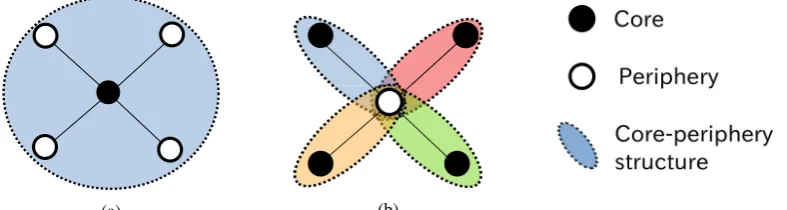
It should be noted thatQis conserved when we regard V \ C as the cores and C as peripheries. This is becauseQis the sum of edge weights be-tweenCandV \ C. For example, suppose a graph with a single core-periphery structure as shown in Figure 1(a). By regarding the core as a periph-ery and vice versa, we have another assignment of the core-periphery structure achieving the sameQ value as shown in Figure1(b). AlthoughQis the same in the two assignments, we would like to pri-oritise the core-periphery structure shown in Fig-ure1(a), because we would like to have a smaller set of cores than peripheries. Therefore, we regard Cas the set of cores if|C|<|V \ C|; otherwise we regardCas the set of peripheries.
3.3 Semi-supervised Core-Periphery Decomposition
The objective given by (4) depends only on G and does not consider any prior linguistic knowl-edge that we might have about which features are appropriate as cores. For example, for cross-domain sentiment classification, it has been shown that features that express similar sentiment in both source and target domains are suitable as piv-ots (Blitzer et al., 2007). To incorporate this in-formation, we integrate thecorenessof words into the objective as follows:
max
C Pmaxi,i∈C
Q= max
C X
i∈C X
j∈V\C
˜
Wij+λ
X
i∈C
coreness(i).
(6)
In (6), coreness(i)is a nonnegative value that
indi-cates the appropriateness ofias a core. Hyperpa-rameterλadjusts the importance we would like to give to coreness as opposed to determining cores based on the graph structure. We tuneλusing a held out portion of the training data in our exper-iments. Different measures can be used to pre-computed the coreness values from the train/test data such as FREQ, MI, PMI, PPMI etc, which have been proposed in prior work on DA for se-lecting pivots (Blitzer et al.,2006,2007;Bollegala et al., 2015). In this work, we use PPMI to pre-compute the coreness for a wordias follows:
coreness(i) = (PPMI(i,Dtrain)−PPMI(i,Dtest))2. (7)
Here, Dtrain and Dtest are respectively the set of
training and test data (or in the case of DA selected from the source and the target domains).
3.4 Feature Expansion
To overcome feature-sparseness in training and test instances, we expand features that are cores by their corresponding peripheral sets. Specifically, for each corei∈ C, we sort its peripheriesPi by
(a) (b)
Core
[image:6.595.103.497.65.170.2]Periphery
Figure 1: Core-periphery structures with an equal quality,Q. Each filled and empty circles indicate core and peripheral vertices, respectively. Each shared region indicates a core-periphery structure.
Dataset SCL CP-decomposition
FREQ MI PMI PPMI No Expansion Non-overlapping w/o corenessOverlapping Overlappingw/ coreness
TR 67.60 66.12 67.44 63.21 78.86 80.34 80.56 80.86
CR 77.85 74.83 78.52 75.50 80.87 83.89 83.89 84.40
SUBJ 87.65 82.15 85.65 82.75 88.05 89.75 90.15 90.48
MR 64.68 58.07 64.26 59.10 73.55 75.23 74.95 75.66
[image:6.595.83.512.210.308.2]AVG 74.45 70.29 73.97 70.14 80.33 82.30 82.39 82.85
Table 1: Results for the short-text classification task. For each dataset, the best results are shown in bold.
4 Experiments
We evaluate the proposed method on two tasks: short-text classification (a non-DA task) and cross-domain sentiment classification (a DA task). For short-text classification we use the Stanford sen-timent treebank (TR)3, customer reviews dataset
(CR) (Hu and Liu, 2004), subjective dataset (SUBJ) (Pang and Lee, 2004) and movie reviews (MR) (Pang and Lee,2005). For DA we use Ama-zon multi-domain sentiment dataset (Blitzer et al., 2007) containing product reviews from four cat-egories: Books (B), DVDs (D), Electronics (E) and Kitchen Appliances (K). Each category is re-garded as a domain and has 1000 positive and 1000 negative reviews, and a large number of unla-belled reviews.4 We train a classifier on 12 domain
pairs adapting from source to target (S-T): D, B-E, B-K, D-B, D-B-E, D-K, E-B, E-D, E-K, B, K-D, K-E. For the short-text classification datasets, we use the official train/test split.
We represent each instance (document) using a bag-of-features consisting of unigrams. Stop words are removed using a standard stop words list. We train an `2 regularised binary logistic regression classifier with each dataset, where the regularisation coefficient is tuned via 5-fold cross validation.
3https://nlp.stanford.edu/sentiment/treebank.html 4Blitzer et al.(2007) considered 4 and 5 star rated reviews
as positive and 1 or 2 as negative in sentiment.
Methods TR CR SUBJ MR
No Expansion 76.31 81.54 88.05 73.35 FTS (Man,2014) 76.47 62.41 50.15 66.83 SCL (Blitzer et al.,2006) 67.60 78.52 87.65 64.68 SFA (Pan et al.,2010) 60.08 70.13 79.00 59.57
Proposed 80.86 84.40 90.48 75.66
Table 3: Proposed vs. feature-based methods for short-text classification.
4.1 Classification Accuracy
S-T SCL CP-decomposition
FREQ MI PMI PPMI No Expansion Non-overlapping w/o corenessOverlapping Overlappingw/ coreness
B-D 72.75 65.50 71.50 69.25 75.00 75.75 76.75 76.38 B-E 72.75 71.00 74.50 66.00 71.00 71.00 69.75 69.75 B-K 77.25 64.00 80.50 77.25 78.25 78.25 77.75 78.00 D-B 71.00 53.00 66.25 65.50 74.00 74.25 74.25 75.25
D-E 72.00 67.00 72.75 74.75 74.75 73.75 73.00 74.75
D-K 79.75 57.50 79.00 76.75 79.25 78.00 79.25 79.25 E-B 62.75 57.25 66.25 60.25 69.50 68.50 68.75 68.75 E-D 64.50 62.75 65.50 62.75 73.25 71.75 73.25 73.50
E-K 82.00 77.75 81.25 79.50 84.25 84.00 82.50 84.00 K-B 65.75 52.50 68.00 68.75 70.00 70.00 69.75 69.50 K-D 67.25 53.75 66.75 68.50 72.75 72.00 72.75 73.63
K-E 77.25 74.50 74.50 74.75 79.00 79.75 79.00 80.50
[image:7.595.83.512.64.247.2]AVG 72.08 63.04 72.23 70.33 75.08 74.75 74.73 75.27
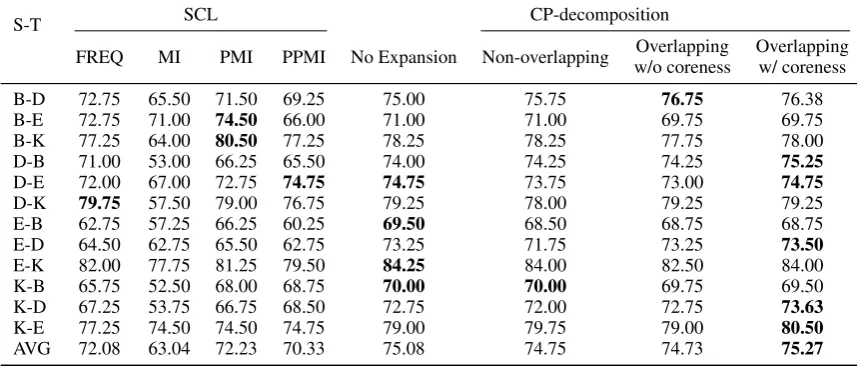
Table 2: Results for DA tasks. For each S-T pair, the best results are shown in bold. The last row shows the average of performance over the 12 S-T pairs.
the short-text and DA tasks are summarised re-spectively in Tables1and2.
As shown in Table 1, all variants of the CP-decomposition outperform theNo Expansion
baseline and the best performance is reported by the overlapping CP-decomposition considering the coreness values. According to binomial test re-sults, there is no statistical significance in Table1. SCL performs poorly on this non-DA task, indicat-ing that it is specifically customised for DA tasks. Table 3 compares the performance of the pro-posed method (i.e., overlapping version of the CP-decomposition with coreness) against FTS, a pre-viously proposed feature expansion method and DA methods such as SCL and SFA applied to short-text classification. We see that the proposed method consistently outperforms FTS, which uses frequently occurring features as expansion candi-dates. This result implies that frequency of a fea-ture alone does not enable us to find useful feafea-tures for expanding sparse feature vectors. The subop-timal performance of SFA and SCL for short-text classification indicates that, despite the fact that the featumismatch problem in DA has some re-semblance to the feature-sparseness problem in short-text classification, applying DA methods to short-text classification is not effective. On the other hand, as shown in Table2, proposed method reports equal or the best performance for 10 out of 12 domain pairs indicating that it is effective not only for short-text classification but also for DA. However, the improvements reported in Ta-ble 2 are not statistically significant (according to Clopper-Pearson confidence intervals (Clopper
Methods MR CR SUBJ
Skip-thought (Kiros et al.,2015) 76.5 80.1 93.6
Paragraph2Vec (Le and Mikolov,2014) 74.8 78.1 90.5 FastSent (Hill et al.,2016) 70.8 78.4 88.7 SDAE (Hill et al.,2016) 74.6 78.0 90.8
CNN (Kim,2014) 76.1 79.8 89.6
Proposed 75.7 84.4 90.5
Table 4: Proposed vs. document-level embedding-based methods for short-text classification. and Pearson, 1934) computed at p < 0.01),
im-plying that CP-decomposition is less effective on DA datasets, which contain longer (on average 5-10 sentence reviews) texts.
We compare the proposed method against the state-of-the-art embedding-based short-text classi-fication methods in Table4. For skip-thought vec-tors (Kiros et al., 2015), Paragraph2Vec (Le and Mikolov, 2014), FastSent (Hill et al., 2016) and SDAE (Hill et al., 2016) provided by Hill et al. (2016), we show the published results on MR, CR and SUBJ.5CNN represents the convolutional
neural network-based document-level embedding learning method proposed by Kim (2014). The proposed method reports the best results on CR, whereas skip-thought does so for MR and SUBJ datasets. An interesting future research direction would be to combine feature-expansion method and document-level embedding methods to further improve the accuracy of short-text classification.
An example feature expansion is shown in Ta-ble 5, where 6 cores are expanded by the over-lapping version of the CP-decomposition method
5These methods have not been evaluated on the TR
Sentence: The film makes a strong case for the importance of the musicians in creating the motown sound.
Methods: Overlapping w/o coreness Overlapping w/ coreness
Cores: film strong case musicians creating sound motown
Peripheries: tribeca remakes grossing slasher blaxploitation
willed fliers syllabic roderick oxidizing
neko genitive accusative dative eeml
remixers trombonists bandleaders saxophonists clarinetists
irritation populating abolishing duopoly soundscapes
puget stereophonic nootka mcmurdo blaster
discographer gordy supremes stax dozier
Table 5: An example of cores and top 5 peripheries chosen by overlapping CP-decomposition with/without coreness (k= 5). This example sentence in TR is classified incorrectly using the method
without coreness (and theNo Expansionbaseline) but correctly after considering coreness.
(a) (b)
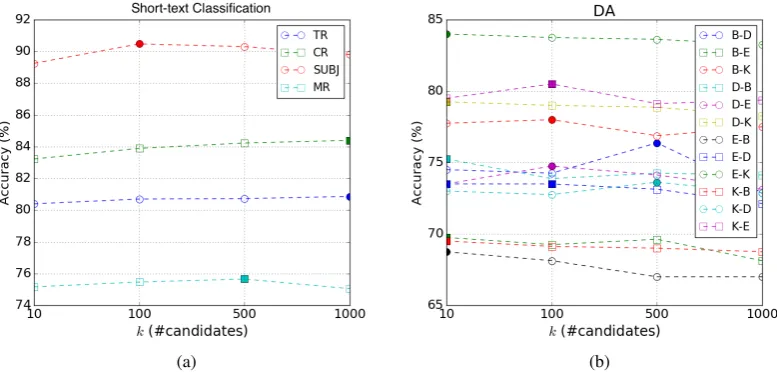
Figure 2: Number of expansion candidates for the proposed method. The marker for the best result for each dataset is filled.
without using coreness and one core with the proposed method. Top 5-ranked peripheries are shown for each core, which are used as the ex-pansion features. We see that many cores are found without constraining the CP-decomposition by coreness, introducing noisy expansions result-ing in an incorrect prediction. On the other hand, although by integrating coreness into the CP-decomposition process we have only a single matching core,motown, it is adequate for making the correct prediction. motown is a music com-pany, which is expanded by a more general pe-riphery discographer, which is a type of music performer, helping the final classification. Con-sideration of coreness improves the classification accuracy in both short-text classification as well as DA.
In both Tables 1 and 2, the non-overlapping version performs poorly compared to the over-lapping counterpart. With non-overover-lapping CP-decomposition, peripheries are not allowed to con-nect to multiple cores. This results in producing a large number of cores each with a small number
of peripheries, which does not help to overcome the feature-sparseness because each core will be expanded by a different periphery.
Figure 2 shows the effect of the number of expansion candidates k on the performance of the proposed overlapping CP-decomposition with coreness. For short-text classification (Figure2a), the accuracy increases for k ≥ 100(TR and CR
obtain the best fork= 1000). For DA (Figure2b),
k ≤100yields better performance in most of the
domain pairs (10 out of 12). For all 12 domain pairs, the accuracy achieved a peak whenk≤500.
5 Conclusion
[image:8.595.77.521.78.149.2] [image:8.595.102.491.213.399.2]different CP decomposition methods with differ-ent tasks in NLP.
References
John Blitzer, Mark Dredze, and Fernando Pereira. 2007. Biographies, bollywood, boom-boxes and blenders: Domain adaptation for sentiment classi-fication. InProc. of ACL. pages 440–447.
John Blitzer, Ryan McDonald, and Fernando Pereira. 2006. Domain adaptation with structural correspon-dence learning. InProc. of EMNLP. pages 120–128. Danushka Bollegala, Takanori Maehara, and Ken ichi Kawarabayashi. 2015. Unsupervised cross-domain word representation learning. In Proc. of ACL. pages 730–740.
Danushka Bollegala, David Weir, and John Carroll. 2014. Learning to predict distributions of words across domains. InProc. of ACL. pages 613–623. C. J. Clopper and E. S. Pearson. 1934. The use of
con-fidence or fiducial limits illustrated in the case of the binomial. Biometrika26(4):403–413.
Gao Cong, Long Wang, Chin-Yew Lin, Young-In Song, and Yueheng Sun. 2008. Finding question-answer pairs from online forums. InProc. of SIGIR. pages 467–474.
Peter Csermely, András London, Ling-Yun Wu, and Brian Uzzi. 2013. Structure and dynamics of core/periphery networks. Journal of Complex Net-works1(2):93–123.
Cicero dos Santos and Maira Gatti. 2014. Deep con-volutional neural networks for sentiment analysis of short texts. InProc. of COLING. pages 69–78. P Erd˝os and A Rényi. 1959. On random graphs i.
Publ. Math.6:290–297.
Hui Fang. 2008. A re-examination of query expansion using lexical resources. InProc. of ACL. pages 139– 147.
Michel X Goemans and David P Williamson. 1995. Improved approximation algorithms for maximum cut and satisfiability problems using semidefinite programming. Journal of the ACM (JACM)
42(6):1115–1145.
Hu Guan, Jinguy Zhou, and Minyi Guo. 2009. A class-feature-centroid classifier for text categorization. In
Proc. of WWW. pages 201–210.
Felix Hill, Kyunghyun Cho, and Anna Korhonen. 2016. Learning distributed representations of sentences from unlabelled data. In Proceedings of NAACL-HLT. pages 1367–1377.
Minqing Hu and Bing Liu. 2004. Mining and summa-rizing customer reviews. InKDD 2004. pages 168– 177.
Richard. M. Karp. 1972. Reducibility among Combi-natorial Problems. Springer US, Boston, MA.
Brian W Kernighan and Shen Lin. 1970. An efficient heuristic procedure for partitioning graphs.The Bell System Technical Journal49(2):291–307.
Yoon Kim. 2014. Convolutional neural networks for sentence classification. InProceedings of the 2014 Conference on Empirical Methods in Natural Lan-guage Processing (EMNLP). pages 1746–1751.
Ryan Kiros, Yukun Zhu, Ruslan R Salakhutdinov, Richard Zemel, Raquel Urtasun, Antonio Torralba, and Sanja Fidler. 2015. Skip-thought vectors. In
Advances in neural information processing systems. pages 3294–3302.
Sadamori Kojaku and Naoki Masuda. 2017. Finding multiple core-periphery pairs in networks. Physical Review E96(5):052313.
Sadamori Kojaku and Naoki Masuda. 2018. Core-periphery structure requires something else in the network.New Journal of Physics40:043012.
Bing kun Wang, Yong feng Huang, Wan xia Yang, and Xing Li. 2012. Short text classification based on strong feature thesaurus. Journal of Zhejiang University-SCIENCE C (Computers and Electron-ics)13(9):649–659.
Haewoon Kwak, Changhyun Lee, Hosung Park, and Sue Moon. 2010. What is twitter, a social network or a news media? InProc. of WWW. pages 591–600.
Quoc Le and Tomas Mikolov. 2014. Distributed rep-resentations of sentences and documents. In Inter-national Conference on Machine Learning. pages 1188–1196.
Huifang Ma, Lei Di, Xiantao Zeng, Li Yan, and Yuyi Ma. 2016. Short text feature extension based on im-proved frequent term sets. In Zhongzhi Shi, Sunil Vadera, and Gang Li, editors,Intelligent Information Processing VIII. Springer International Publishing, Cham, pages 169–178.
Yuan Man. 2014. Feature extension for short text cate-gorization using frequent term sets. Procedia Com-puter Science 31:663–670. 2nd International Con-ference on Information Technology and Quantitative Management, ITQM 2014.
Rada Mihalcea and Dragomir Radev. 2011. Graph-based Natural Language Processing and Informa-tion Retrieval. Cambridge University Press.
Sinno Jialin Pan, Xiaochuan Ni, Jian-Tao Sun, Qiang Yang, and Zheng Chen. 2010. Cross-domain senti-ment classification via spectral feature alignsenti-ment. In
Proc. of WWW. pages 751–760.
the 42nd annual meeting on Association for Compu-tational Linguistics. Association for Computational Linguistics, page 271.
Bo Pang and Lillian Lee. 2005. Seeing stars: Ex-ploiting class relationships for sentiment categoriza-tion with respect to rating scales. InProceedings of the 43rd annual meeting on association for compu-tational linguistics. Association for Computational Linguistics, pages 115–124.
Puck Rombach, Mason A. Porter, James H. Fowler, and Peter J. Mucha. 2017. Core-periphery structure in networks (revisited). SIAM Review59(3):619–646. Takeshi Sakaki, Makoto Okazaki, and Yutaka Matsuo.
2010. Earthquake shakes twitter uers: Real-time event detection by social sensors. InProc. of WWW. pages 851–860.
Divya Sardana and Raj Bhatnagar. 2016. Core pe-riphery structures in weighted graphs using greedy growth. In Proc. 2016 IEEE/WIC/ACM Int. Conf. Web Intelligence Core. ACM, New York, pages 1–8.
Jiang Su, Jelber Sayyad-Shirabad, and Stan Matwin. 2011. Large scale text classification using semi-supervised multinomial naive bayes. In Proc. of ICML.
Mike Thelwall, Kevan Buckley, Georgios Paltoglou, Di Cai, and Arvid Kappas. 2010. Sentiment strength detection in short informal text. Journal of the As-sociation for Information Science and Technology
61(12):2544–2558.
Bing-Bing Xiang, Zhong-Kui Bao, Chuang Ma, Xingyi Zhang, Han-Shuang Chen, and Hai-Feng Zhang. 2018. A unified method of detecting core-periphery structure and community structure in networks.
Chaos: An Interdisciplinary Journal of Nonlinear Science28(1):013122.
Bowen Yan and Jianxi Luo. 2016. Multicore-periphery structure in networks. Preprint arXiv:1605.03286.
Jaewon Yang and Jure Leskovec. 2014. Overlapping communities explain core–periphery organization of networks. Proc. IEEE102(12):1892–1902.